







Abstract
Parents often guide the interactions of their young children with their peers. Identifying factors that may shape parents’ behaviors in such situations is thus important. The objective of this study was to investigate whether maternal rejection sensitivity (RS) would be related to mothers’ responses to challenges in their children’s peer interactions. Specifically, we examined whether mothers’ RS would be associated with their information processing of hypothetical events that may suggest rejection of their child by her/his peers. Two hundred nineteen mothers of preschool- and kindergarten-aged children completed an online survey. To assess RS, mothers completed the Adult Rejection Sensitivity Questionnaire. Mothers were also presented with five ambiguous common scenarios that could be interpreted as peer rejection of their child. Mothers were asked about their attributions, emotions, and likely behavioral responses regarding each scenario. Maternal RS was associated with more attributions of intentional rejection of the child, more negative emotions, and more behavioral responses of avoidance and overinvolvement. Furthermore, the associations between mothers’ RS and maternal responses of avoidance and overinvolvement were sequentially mediated by maternal attribution of intentional rejection followed by negative emotions. The study thus extends RS research to the context of parenting and suggests that practitioners working with families of young children should consider parents’ RS disposition, as it might affect parents’ responses to their children’s peer interactions.
Keywords
Parents often mediate and guide the social interactions of their preschool- and kindergarten-aged children (Parke et al., 1989). However, not all parents provide constructive assistance in these situations, in particular in challenging and conflictual situations (McDowell, Parke, & Wang, 2003) such as peer rejection. In the current study, we examined whether maternal readiness to perceive social rejection is associated with mothers’ information processing when they participate or observe their child in situations that might suggest that the child was rejected by her/his peers.
Rejection sensitivity (RS) is a predisposition to “anxiously expect, readily perceive, and overreact” to social rejection (Downey & Feldman, 1996, p. 1327). RS was studied extensively in the contexts of adult romantic relationships (e.g., Downey, Feldman, & Ayduk, 2000) and children’s (e.g., Downey, Lebolt, Rincón, & Freitas, 1998) and adolescents’ relationships with peers (e.g., London, Downey, Bonica, & Paltin, 2007). This research associated RS with unique sets of social information processing.
Because intentions that underlie the behaviors of others are often invisible, they are open to subjective interpretation. People high in RS tend to overestimate others’ intentions to deliberately reject them, rather than considering other explanations in ambiguous social interactions (Downey & Feldman, 1996; Pietrzak, Downey, & Ayduk, 2005). For example, respondents high in RS were more likely to attribute a confederate’s wish not to continue an experiment as a reflection on themselves (Downey & Feldman, 1996, Study 2). In addition, the rejection expectations of individuals high in RS are accompanied by heightened negative emotions, in particular anxiety, anger, hurt, and guilt (Downey & Feldman, 1996; Zimmer-Gembeck, Nesdale, Webb, Khatibi, & Downey, 2016). These negative, intense emotions increase the likelihood of maladaptive behavioral responses. Two distinct behavioral strategies were identified in RS studies: social withdrawal, by, for example, avoiding social interactions in threatening and uncertain situations (Levy, Ayduk, & Downey, 2001) and overinvolvement, which can be reflected in, for example, showing preoccupation with the whereabouts of a romantic partner (Purdie & Downey, 2000) or in trying to control the partner’s behavior (Downey & Feldman, 1996).
Furthermore, higher RS was associated with negative consequences in various age groups. In elementary school–aged children, it was related to lower academic achievement and poorer school functioning (Downey et al., 1998, Study 3). In adolescence, higher RS was associated with higher social anxiety, withdrawal, and loneliness, as well as poorer emotion regulation (London et al., 2007; Silvers et al., 2012). Finally, in adulthood, higher RS was related to loneliness, lower self-esteem (Watson & Nesdale, 2012), and poorer health (Cole, Kemeny, & Taylor, 1997).
Taken together, RS has significant hampering effects on various aspects of close relationships, daily functioning, and well-being across the life span. Yet, to our knowledge, there has been no investigation of the associations between RS and parenting processes. Such an examination is important, particularly in the context of parents of young children, because parents are role models for children and, as mentioned above, often mediate their child’s social interactions (Grusec & Davidov, 2010).
RS may be activated in parents not only during their own social interactions but also when they participate in, witness, or think about social interactions involving their child. RS is considered a chronically accessible sociocognitive schema that is readily activated even in situations that are hypothetical and/or not personally related to the individual (Berenson et al., 2009). Furthermore, the parent–child relation is intimate, and a central parental task is to protect the child from harm and distress (Bowlby, 1958). Thus, parents may be motivated to prevent or relieve a child’s distress that may result from peer rejection. The link between parental RS and parents’ information processing of social interactions involving the child may also have evolutionary roots, given the fundamental motivation to belong (Baumeister & Leary, 1995). By being attuned to a possible peer rejection of their child, parents increase the probability that their genes will survive and be reproduced.
An indirect support for the link between parental RS and information processing with respect to the child comes from studies of other parental dispositions, such as avoidant and anxious attachment orientations. Parents who are high in these dispositions rely more on automatic schematic cognitions and miss “bottom-up” information. As a result, these parents show biases in their perceptions of and emotional reactions and behavioral responses to their child’s behavior that are in accordance with their dispositions (Bugental & Johnston, 2000; Jones, Cassidy, & Shaver, 2015). For examples, parents with avoidant attachment orientation and parents with anxious attachment orientation have more negative perceptions of their infant’s temperament (Priel & Besser, 2000). An observational study of mothers and their young child indicated that mothers with avoidant attachment orientation tend to miss their child’s signals, are less accessible to their child, and show discomfort with contact with their child during observed interactions. Mothers with anxious attachment orientation, on the other hand, tend to miss their child’s signals, tend to interfere in their child’s exploration, and have more interactions that are characterized by conflict (Selcuk et al., 2010).
Accordingly, in situations that might suggest that their child is being rejected by her/his peers, parents high in RS may show information-processing patterns that are similar to the patterns they follow in their own social interactions. They may tend to attribute intentional rejection of their child by his/her peers, experience high levels of negative emotions, and respond defensively by avoiding and withdrawing from the situation, or by showing overinvolvement, namely preoccupation with and attempts to control the situation inappropriately (Downey & Feldman, 1996; Purdie & Downey, 2000; Zimmer-Gembeck et al., 2016). Parental avoidance might leave the child without proper guidance and support in such challenging situations. Parental overinvolvement might minimize the child’s ability to develop independent social strategies; for example, it might limit the child’s ability to cope with and resolve the situation by herself or himself. Indeed, studies of parental overinvolvement suggest that it is related to lower social competence of kindergarten children (Ladd & Golter, 1988; Ladd, Profilet, & Hart, 1992).
In summary, in the current study, we examined whether maternal RS is associated with mothers’ attributions of intentional rejection, negative emotions, and avoidant and overinvolved behavioral responses to hypothetical events, which may suggest that their child was rejected by her/his peers. We focused on mothers of preschool- and kindergarten-aged children because at these ages, peer interactions at the dyadic and group levels increase and dominance hierarchies in group interactions emerge (Hay, Payne, & Chadwick, 2004). Also, at these ages parents still supervise their children’s interactions with peers (Ladd et al., 1992). Mothers were asked to read hypothetical scenarios about their young children’s interactions with their peers, in which the mothers are not directly involved, such as peer interaction in the child’s preschool/kindergarten. Importantly, these scenarios were ambiguous and could be interpreted as peers’ intentional rejection (e.g., a mother realizes that invitations to a birthday party of the child’s peer were distributed in school; she opens the child’s bag and cannot find the invitation). We studied whether maternal RS would be associated with mothers’ information processing of these hypothetical scenarios. In particular, we hypothesized the following.
Method
Participants
Israeli mothers of children attending preschool or kindergarten were recruited to participate in an Internet survey about mothers’ understanding of their children’s social interactions in early childhood. A description of the study was posted on Internet social network forums for mothers (e.g., Facebook groups). Two hundred seventy-one mothers responded to the post and agreed to receive a link to the survey. Of these mothers, 247 (91.14%) completed the survey. Twenty-eight (11.3%) mothers were excluded from the current analyses because they reported in the survey that their child had developmental difficulties or was under 36 months of age, which left 219 participants. Maternal average age was 36.17 years (SD = 4.58). Mothers’ mean years of education was 16.90 (SD = 2.52), and 89.50% were married. Mean age of the participants’ children (51.10% female, 47.00% firstborn) was 59.86 months (SD = 9.08).
Measures
Adult Rejection Sensitivity Questionnaire
The Adult Rejection Sensitivity Questionnaire (A-RSQ) was used to assess mothers’ RS (Berenson et al., 2013). It consists of nine hypothetical situations in which rejection by a significant other is possible (e.g., “You approach a close friend to talk after doing or saying something that seriously upset him/her”). For each situation, respondents were asked to indicate the degree of their concern or anxiety about the outcome of the situation (e.g., “How concerned or anxious would you be over whether or not your friend would want to talk with you?”) on a 6-point scale ranging from 1 (very unconcerned) to 6 (very concerned). Respondents were then asked to indicate the likelihood that the other person(s) would respond in an accepting fashion (e.g., “I would expect that he/she would want to talk with me to try to work things out.”) on a 6-point scale ranging from 1 (very unlikely) to 6 (very likely). RS score was calculated by multiplying the level of concern/anxiety by the reverse of the level of acceptance expectancy. The A-RSQ showed good psychometric properties with internal reliability of Cronbach’s α = .83, 4-month test–retest reliability of Cronbach’s α = .78, and convergent validity with related traits such as neuroticism and social avoidance/distress and attachment styles of anxiety and avoidance (Berenson et al., 2013). Internal reliability of the A-RSQ in the current study was good (Cronbach’s α = .83).
Peer Rejection Scenarios (PRS)
Mothers were asked to read five ambiguous hypothetical scenarios of daily social interactions that could be perceived as a rejection of their child by his/her peers (e.g., “One morning, when you bring your child to preschool/kindergarten, a group of children starts to rhyme using her/his name”). The scenarios included varied contexts of peer interactions (e.g., at home, in preschool/kindergarten, and on the playground; see Appendix) and were introduced to the mothers in random order. Following each scenario, mothers were asked to respond to four subscales (Harel-Zeira, Gur-Yaish, Sher-Censor & Shiff, 2015).
Attributions of intentional rejection
Mothers were asked to indicate the degree to which they think their child’s peers meant to reject their child on a 5-point scale ranging from 1 (my child’s peers didn’t mean to reject my child) to 5 (e.g., my child’s peers rejected my child on purpose). A mean score of attribution of intentional rejection was computed across scenarios (Cronbach’s α = .69).
Negative emotions
Mothers were asked to indicate how they would feel if this scenario had happened to their child, by rating each of seven negative emotions on a 5-point scale ranging from 1 (not at all) to 5 (extremely). Following Downey and her colleagues (Downey & Feldman, 1996; Zimmer-Gembeck et al., 2016), we examined the emotions of concern, anger, guilt, and hurt. Further, because negative emotional responses are often mixed, we also evaluated the emotions of embarrassment, disappointment, and being puzzled. Importantly, these seven emotions were previously examined in a study by Rubin and Mills (1990) on parental information processing of hypothetical scenarios in which their children showed aggressive behaviors and social withdrawal in peer social interactions. An aggregated negative emotions score was constructed based on the mean of the seven emotions across scenarios (Cronbach’s α = .95).
Avoidance responses
Mothers reported on a 5-point scale ranging from 1 (not at all true) to 5 (very true) the extent to which they would have responded to the event described in the scenario by (1) trying to disconnect themselves and thinking about other issues and (2) preferring not to talk with the child about what had happened. The average score of these responses across scenarios was calculated for the current analyses (Cronbach’s α = .79).
Overinvolvement responses
Mothers reported on a 5-point scale ranging from 1 (not at all true) to 5 (very true) the extent to which they would have responded by (1) ruminating about what had happened and (2) becoming actively involved in their child’s interaction with her/his peers and stopping the peers’ behavior toward their child. The average score of these two responses across scenarios was calculated for the current analyses (Cronbach’s α = .81).
Procedure
Preliminary Phase 1
Seven mothers of preschoolers were asked to report daily social situations, which they believe to be ambiguous, with respect to a possible peer’s rejection of their child. These mothers did not participate in the current study. The five situations chosen for this study were the most common in mothers’ reports.
Preliminary Phase 2
An online version of the PRS was administered to nine mothers of preschoolers. These mothers did not participate in the current study. Mothers were asked to complete the questionnaire and provide feedback on the relevance of the events described in each scenario to their children’s social life, the clarity of the questions that followed the scenarios, the time needed to complete the questionnaire, and other technical issues. Based on the mothers’ comments, we constructed the final PRS questionnaire.
Study phase
Mothers responded to an online survey, which was uploaded to the university’s online platform for collecting scientific data using polls and questionnaires. Mothers provided written informed consent. The survey included a brief demographic questionnaire, followed by the PRS. Mothers were then asked to complete the A-RSQ (Berenson et al., 2013). Mothers had a chance to win a prize ($50 in gift cards). The study procedure and measures were approved by the university’s Human Research Review Board (#044/15).
Results
Preliminary analyses
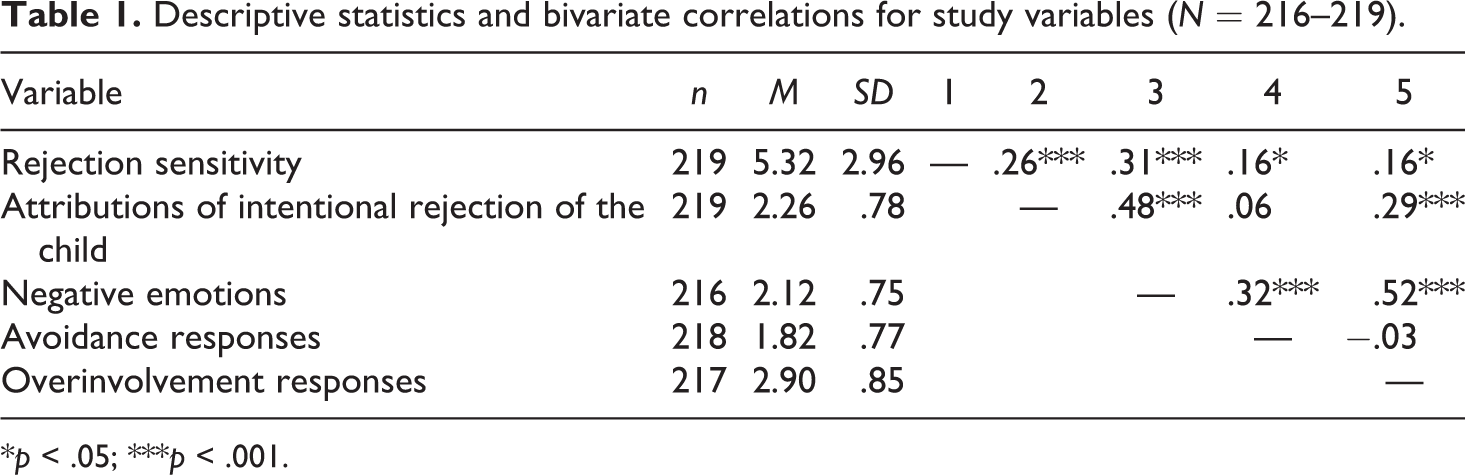
All variables were sufficiently normal to render parametric statistics valid (Afifi, Kotlerman, Ettner, & Cowan, 2007). Means and standard deviations of study variables are presented in Table 1. Child gender, child age, and maternal years of education were not associated with any of the study variables (all ps > .14). Older mothers reported lower RS (r = −.19, p = .005). Mothers of later-born children reported lower RS (r = −.21, p = .002), tended less to attribute intentional rejection of their child (r = −.23, p = .001), and reported less negative emotions (r = −.26, p < .001). To minimize collinearity concerns, and in light of the significant relationship between maternal age and child birth-order (r = .42, p < .001), we included only child birth-order in further analyses.
Descriptive statistics and bivariate correlations for study variables (N = 216–219).
*p < .05; ***p < .001.
Maternal RS and information processing of the PRSs
Bivariate relationships
As shown in Table 1, more attributions of intentional rejection of the child were associated with more negative emotions and more overinvolvement responses, but not with avoidance responses. More negative emotions were associated with more avoidance and overinvolvement responses. Avoidance and overinvolvement responses were not significantly correlated. As expected, maternal RS was associated with mothers’ tendency to attribute more intentional rejection of their child. Maternal RS was also associated with more negative emotions, and with more responses of avoidance and overinvolvement (see Table 1).
Mediation analyses
We next examined whether attributions of intentional rejection and negative emotions mediated sequentially the links between maternal RS and mothers’ behavioral responses of avoidance and overinvolvement, using Hayes’s (2013) SPSS PROCESS routine for serial mediation models. The PROCESS routine enables simultaneous tests of multiple indirect effects while controlling for the effects of other mediators in the analysis. Thus, it overcomes the problem of estimation bias that may occur when intercorrelated mediators are tested in separate simple mediation models using the approach offered by Baron and Kenny (Hayes, 2009; Preacher & Hayes, 2008). The PROCESS routine estimates the significance of the indirect effects with a bootstrap approach—namely a nonparametric method based on repeated, random resampling with replacement—which yields 95% bootstrapped confidence intervals (CIs) for each indirect effect. A significant indirect effect is evident when zero is outside of the 95% CI, which suggests that the mediation effect is statistically different from zero at p < .05.
We conducted the analyses twice, once to examine the mediating roles of attributions of intentional rejection of the child and negative emotions in the link between RS and avoidance responses and once to examine the mediating roles of attributions of intentional rejection of the child and negative emotions in the link between RS and overinvolvement responses. Analyses controlled for child birth-order. Continuous predictors were standardized.
As shown in Figure 1, we found significant links between maternal RS, maternal attributions of intentional rejection of the child, negative emotions, and maternal avoidance and overinvolvement responses. Bootstrap results supported mediation models and indicated that, in line with our hypotheses, the total indirect effects of maternal RS on avoidance and on overinvolvement responses through all three indirect paths—attributions of intentional rejection, negative emotions, and attributions of intentional rejection followed by negative emotions—were significant, with bootstrapped 95% CIs around the indirect effects not containing a zero value (CIs [.02, .14] and [.08, .22], respectively). Furthermore, examination of the specific indirect effects revealed that the indirect effects involving only negative emotions as well as attributions of intentional rejection followed by negative emotions were significant (RS > negative emotions > avoidance responses: 95% CI [.01, .11]; RS > negative emotions > overinvolvement responses: 95% CI [.03, .15]; RS > attributions of intentional rejection > negative emotions > avoidance responses: 95% CI [.01, .05]; and RS > attributions of intentional rejection > negative emotions > overinvolvement responses: 95% CI [.01, .07]). However, the indirect effects of RS on avoidance and on overinvolvement responses via attributions of intentional rejection only were nonsignificant (95% CIs [−.05, .01] and [−.003, .06], respectively).
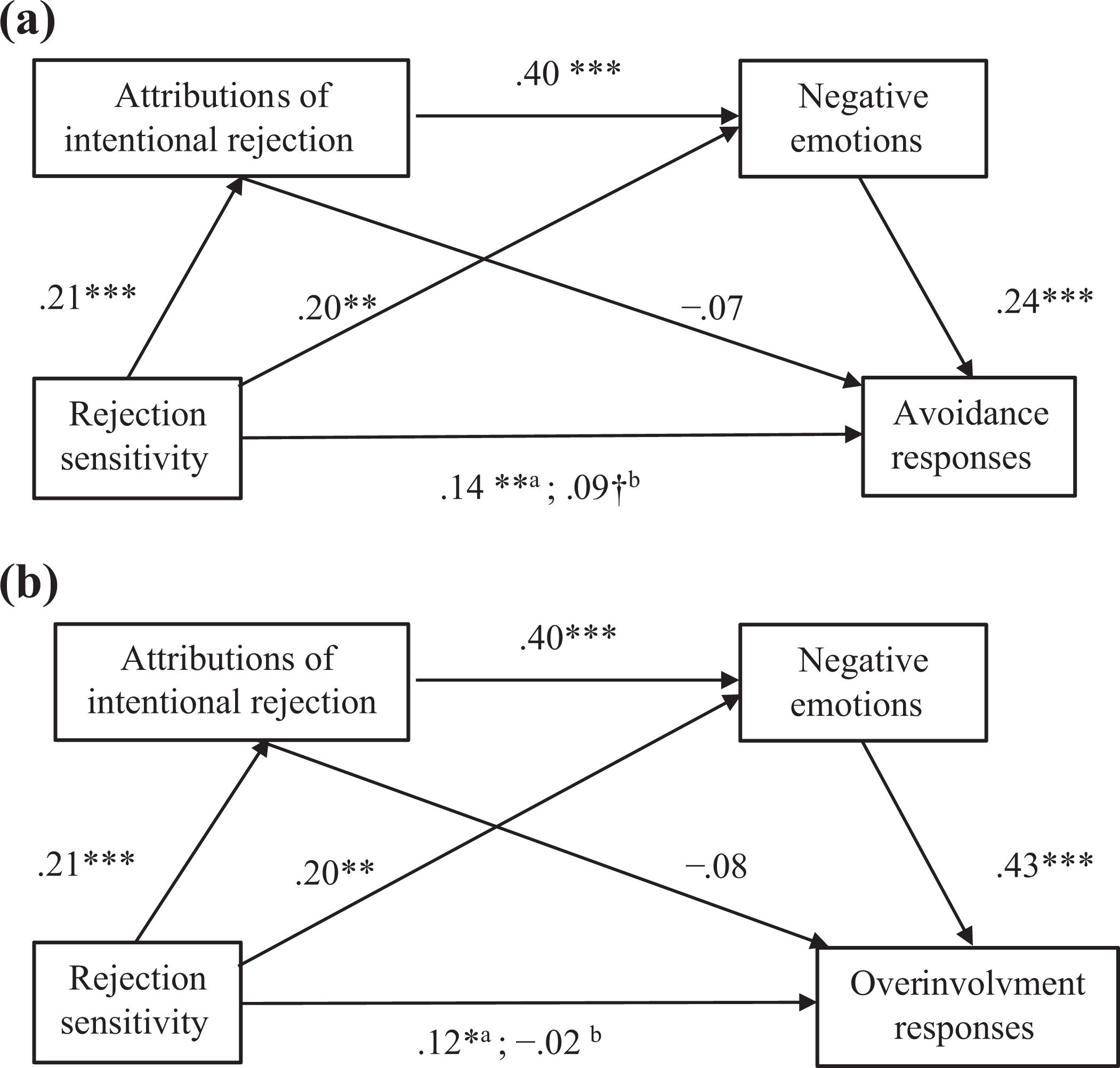
Path diagrams for the associations between mothers’ RS and behavioral responses of (a) avoidance and (b) overinvolvement as mediated by attributions of intentional rejection of the child and negative emotions, controlling for child birth-order. Numbers represent standardized regression coefficients. aStandardized regression coefficient of the total effect of mothers’ RS on mothers’ behavioral response, namely when the mediators are not included in the regression analysis. bStandardized regression coefficient of the direct effect of mothers’ RS on behavioral response, when the effects of the mediators (i.e., attribution of intentional rejection and negative emotions) on mothers’ behavioral response are considered. †p < .10; *p < .05; **p < .01; ***p < .001.
Discussion
In the current study, we found that maternal RS was associated with mothers’ biased information processing of hypothetical common yet ambiguous scenarios that could be interpreted as peers’ rejection of their child. Maternal RS was associated with more attributions of intentional rejection of the child by her/his peers and more negative emotions in response to the ambiguous scenarios. These associations support previous research, which found that individuals high in RS anxiously expect to be rejected and thus tend to perceive ambiguous social encounters as intentional rejection (Romero-Canyas & Downey, 2005) and respond with heightened negative emotions (Downey & Feldman, 1996; Zimmer-Gembeck et al., 2016). Previous research usually investigated social interactions in which the individual was actively involved (e.g., romantic relationships; Downey & Feldman, 1996). The current study extends this body of work and suggests that RS may put individuals at risk of a distorted perception and negative emotional arousal not only with respect to their own social relationships but also to those of their kin.
Strong negative emotions may overwhelm the parent and interfere with flexible information processing and with the child-rearing task at hand (Dix, 1991). Indeed, results indicated that mothers’ attribution of intentional rejection of their child by peers and negative emotions mediated sequentially the links between maternal RS and avoidance responses, namely maternal responses of disconnecting, trying not to think how the child was treated by his/her peers, and avoiding discussing the events with the child. Such avoidant responses do not support children’s social competence. Not talking with the child and not explaining the situation to her/him may leave the child confused and lacking the necessary parental guidance for coping with future similar social interactions.
Similarly, mothers’ attribution of intentional rejection and negative emotions mediated sequentially the links between maternal RS and overinvolved responses including direct interaction with the child’s peers to stop the rejecting behavior. This parenting response is considered inappropriate (Ladd & Golter, 1988; Ladd et al., 1992) and is the characteristic of mothers of children who are less socially acceptable (Finnie & Russell, 1988; Russell & Finnie, 1990). Even if a peer rejection occurred and is not the parent’s misperception, interfering on behalf of the child may diminish the child’s sense of competence and does not give her/him the opportunity to develop adaptive tools to use in future similar social interactions.
Taken together, these results join developmental research which demonstrated that parents’ characteristics or dispositions bias their information processing of their child’s social interactions (e.g., parents’ attachment orientations; Jones et al., 2015; parents’ proneness to shame; Mills et al., 2007). The present study extends this line of research by suggesting that biased social information processing may be activated in mothers in situations where the behavior is that of their child’s peers and not that of their own child.
As expected, attributions of intentional rejection were associated with more negative emotions and with overinvolvement behaviors. However, intentional rejection was not associated with avoidance responses. Further, results suggest that attributions of intentional rejection does not mediate directly the relationship between RS and maternal overinvolvement and avoidance responses. Rather, our study supports a sequential information processing in which RS disposition shapes cognitive attributions, which in turn arouse negative emotions, and the latter affect behavior. Previous RS studies usually did not measure attributions and emotions within the same study. More research is needed to replicate our findings and examine the distinct roles of attributions and emotions.
Interestingly, avoidance and overinvolvement behaviors did not correlate with each other, but both were related to higher RS. A possible interpretation of this pattern of results is that mothers high in RS may respond by showing avoidance in some circumstances and overinvolvement in others. Alternatively, these distinct behavioral responses may represent two types of mothers high in RS: some may tend to respond with avoidance, whereas others may react with overinvolvement, as suggested in the romantic relationship literature (Downey et al., 2000). Future research could investigate these speculations further.
Mothers in our study had a lower average score on the RS scale (M = 5.32, SD = 2.96) than the mean score obtained in prior RS studies of adults (M = 8.6, SD = 3.6; Berenson et al., 2009). This difference might be due to the specific characteristics of our sample, namely mothers who were older than adult participants in prior research. Also, most of the mothers were in committed relationships (90% were married). As people age, their tendency to maintain secure relationships increases, and this tendency is even more prevalent for individuals in committed relationships (Keren & Mayseless, 2013). Interestingly, we also found that child’s firstborn status was related to more maternal attributions of intentional peer rejection and to higher levels of negative emotions. These findings may suggest that mothers of later-born children had more daily experiences of their older children’s peer interactions and thus could rely more on their knowledge of and experiences with such interactions and less on their own social experiences. To our knowledge, this is the first study to examine RS among mothers. More research, including of single parents and parents of firstborn children, is needed to further explore these interpretations.
Several caveats of this study may guide future research. First, this study examined maternal hypothetical attributional, emotional, and behavioral responses. Studies assessing mothers’ information processing of their children’s actual peer interactions would contribute to a more complete understanding of the influence of RS on parents’ reactions to their children’s peer relationships. Second, we focused only on mothers’ RS and information processing. Further research should assess children’s RS and information processing and evaluate whether intergenerational transmission of RS from parent to child is mediated via parental inadequate responses examined in this study (i.e., avoidance and overinvolvement). Previous studies of intergenerational transmission of aggressions, which found relationships between mothers’ hostile attributions and children’s hostile attribution style (Dodge, 2006; MacBrayer, Milich, & Hundley, 2003), support such future RS research.
Third, the study was based on maternal self-reports, which were assessed concomitantly. This design precludes inference of the direction of effects and causality. Experimental designs that induce RS contextually might shed further light on causality. Fourth, the scope of maternal behavioral responses was rather small, and future studies may investigate other maternal behaviors such as compassion for the child, tendency to blame the child, and overcompensation for the child. Further, aggression is a common behavioral response among adults high in RS in the context of romantic relationships (e.g., Romero-Canyas, Downey, Berenson, Ayduk, & Kang, 2010). Its equivalence in parental behaviors should be further investigated. Finally, attributions were examined in the current investigation based on one item, and internal consistency of the attributions measure was rather low (although adequate); more studies are needed in which attributions are assessed more comprehensively.
Despite these limitations, the study’s strength lies in combining the literature of personality and social psychology on RS with developmental psychology research on parenting. The study deepens our understanding of parents’ characteristics and their influence on parents’ information processing with respect to their child. Fostering the child’s social skills is an important parenting task (Hay et al., 2004). Our study suggests that RS may interfere with this task, as it may bias maternal perceptions and lead to mothers’ negative emotional arousal and inappropriate behavioral responses to their children’s daily peer interactions. Finally, this study has practical implications for professionals working with families of preschoolers. It suggests that practitioners should consider parents’ RS dispositions. In particular, psychoeducation programs could be developed that make parents aware of their predispositions and their possible effects on how they process and respond to their child’s social interaction with her/his peers.
Footnotes
Funding
The author(s) disclosed receipt of the following financial support for the research, authorship, and/or publication of this article: This research was supported by Oranim Academic College of Education Research Grant.