







Abstract
Jealousy has been linked to a number of deleterious relationship outcomes; yet, few studies have explored the broader ways in which inducing jealousy affects intimate relationships. Using data on 892 young adults from the Toledo Adolescent Relationships Study, we examined correlates and consequences of intentionally inducing jealousy in intimate relationships. Results indicated that factors both unique and internal to the intimate dyad and those external to the intimate relationship were associated with jealousy-inducing behaviors. Dyadic factors included verbal conflict and partners’ infidelity and controlling behaviors, and external factors included childhood experiences of parent–child physical aggression. Jealousy induction was associated with experiences of partner violence after accounting for familial background, relationship, and sociodemographic factors. We discuss potential mechanisms linking these relationship dynamics and provide suggestions for future research.
Keywords
Introduction
Experiencing jealousy is common in intimate relationships. Defined as “a complex of thoughts, emotions, and actions that follows loss or threat to self-esteem and/or existence or quality of the romantic relationship” (White & Mullen, 1989, p. 9), jealousy may be particularly intense during young adulthood when individuals have more limited relationship experience (Pines & Aronson, 1983) and relationship instability is high (Halpern-Meekin, Manning, Giordano, & Longmore, 2013). Moreover, although some scholars (e.g., Barelds & Barelds-Dijkstra, 2007) have found positive associations between jealousy as a response to direct relationship threats and relationship quality, anxious and possessive forms of jealousy are associated with a number of deleterious relationship outcomes, including poorer relationship quality (Barelds & Dijkstra, 2006), doubt about the relationship’s future (Bevan, 2004; White, 1980), and intimate partner violence (IPV) (Caldwell, Swan, Allen, Sullivan, & Snow, 2009). Given the potential for negative outcomes, it is often presumed that individuals wish to avoid making their partners jealous (Bevan, 2004; Caldwell et al., 2009). Yet, social psychologists and interpersonal communication researchers (e.g., Cayanus & Booth-Butterfield, 2004; Sheets, Fredendall, & Claypool, 1997) have reported that most individuals have, on at least one occasion, intentionally induced jealousy in their intimate relationships. Accordingly, increased knowledge about why certain individuals are at greater risk for jealousy-inducing behaviors may help lead to strategies that reduce such behaviors and their associated negative outcomes.
Although the prevalence of jealousy-inducing behaviors has been examined, research on correlates and consequences of jealousy induction is more limited. For example, much prior research on jealousy induction has utilized small samples, usually college students (e.g., Fleischmann, Spitzberg, Andersen, & Roesch, 2005); apart from biological sex, sociodemographic correlates have remained comparatively unexamined. Likewise, although relationship quality and other dyadic factors are undoubtedly central in understanding jealousy induction, individuals’ familial and sociodemographic backgrounds may also be associated with jealousy-inducing behaviors. Broadening the examination of jealousy induction to include noncollege samples and risk factors beyond intimate relationship qualities may help explain greater variability in jealousy-inducing behaviors. Finally, although the association between feelings of jealousy, generally, and IPV has been studied rather extensively (e.g., Bevan, 2013; Caldwell et al., 2009), the various ways in which jealousy induction, that is, trying to make the partner feel jealous, affects IPV largely have been unexplored. Understanding whether the intentional inducement of jealousy, rather than jealous feelings generally, contributes to violence may help further reduce IPV experiences in young adult relationships.
The present study examined whether familial, intimate relationship and sociodemographic factors were associated with young adults’ jealousy-inducing behaviors; whether jealousy induction was associated independently with partner violence or was a component of a larger package of characteristics reflecting poor quality relationships. Importantly, population-based longitudinal data were utilized to assess these relationships among young adults with a wide range of educational and life experiences.
Jealousy induction
Jealousy occurs when one or both partners feel their self-esteem, or the quality or continued existence of their relationship has been threatened (White & Mullen, 1989). This threat often revolves around concerns of partner infidelity and unavailability associated with perceived flirting or spending extended amounts of leisure time away from an intimate partner (e.g., Cayanus & Booth-Butterfield, 2004; Fleischmann et al., 2005). Whether such concerns are current or anticipated, and unambiguous or unclear, the resulting jealousy that is experienced may lead to further distress, withdrawal, conflict, and aggression within the relationship (Bevan, 2004, 2013; Guerrero, Hannawa, & Babin, 2011). As a response to these emotions and experiences, individuals may intentionally induce jealousy.
Often referred to as “counter-jealousy induction,” jealousy induction can be understood as one potential communicative response to jealousy (CRJ), where CRJs refer to behavioral reactions with the potential to communicate feelings and emotions to the relationship partner, as well as fulfill individual or relationship goals (Guerrero, Andersen, Jorgensen, Spitzberg, & Eloy, 1995). Within the categories of CRJs, jealousy induction often is classified as a negative communication form, falling within the broader category of manipulation attempts to control a partner (Bevan, 2013; Guerrero et al., 2011). Previously, researchers have classified jealousy induction into relational distancing, flirtation façade, and relational alternatives tactics, with specific examples including not making plans with the partner, leaving fake numbers or pictures with other people laying around, or comparing a partner to past relationships (e.g., Fleischmann et al., 2005).
In assessing motives, some researchers (Bevan, 2013; Whitson & Mattingly, 2010) have argued that individuals may engage in jealousy induction for relational power and control, seeking to stop the partner’s behavior that is leading to jealous emotions. Or, the individual may try to exact revenge or punish the partner for initially inciting the individual’s jealousy. Conversely, despite its classification as a destructive communication strategy, other researchers (Dainton & Gross, 2008) have found that individuals may engage in jealousy induction for the purposes of relational maintenance. More specifically, researchers (Fleischmann et al., 2005; Guerrero et al., 2011; Sheets et al., 1997) have found that, under some conditions, individuals’ jealous feelings and expressions may lead to improvements in relationships through constructive communication or compensatory restoration.
Despite advances in our comprehension of the varied motivations for inducing jealousy, more work is needed to understand why jealousy induction is viewed as a viable, or even preferable, response to jealous emotions, compared to more constructive forms of relational communication (i.e., self-disclosures concerning jealous feelings). It is possible that the communicative response selected is a result of earlier life experiences that have affected individuals’ abilities to communicate with others in effective and constructive ways.
Family background and attachment
Much prior research assessing causes for jealousy-inducing behavior has been rooted in attachment theory (e.g., Goodboy, Dainton, Borzea, & Goldman, 2017; Mattingly, Whitson, & Mattingly, 2012). Attachment theory rests on the premise that individuals begin to form early cognitive models of relationships with others based on interactions they have with parents and other adult caregivers. These cognitive models often entail notions of others as predictable and trustworthy, of the self as lovable and competent, and of relationships in general as rewarding and worthwhile (Bowlby, 1982). However, when primary caregivers do not socialize children in a nurturing manner, insecure attachment styles may result, inhibiting the social skills necessary to initiate or maintain healthy relationships with others later in life (e.g., Dutton, 1994). Researchers (e.g., Simpson, 1990; Wolf & Foshee, 2003) have found that insecurely attached individuals may experience higher levels of relationship conflict, negative communication styles, partner mistrust, fears of partner abandonment, violence, and overall poorer relationship quality.
Directly relevant to the current examination, Goodboy, Dainton, Borzea, and Goldman (2017) found that individuals characterized by insecure attachment styles were more likely to engage in jealousy-inducing behaviors in their intimate relationships. Individuals with a preoccupied attachment style were more likely to induce jealousy due to an overinvestment in the relationship and high anxieties about their own unworthiness. Individuals with a fearful attachment style engaged in jealousy induction due to higher levels of partner mistrust and a tendency to interpret their partners’ behaviors in negative ways. Conversely, securely attached individuals sought to maintain trusting and respectful relationships and were more able to engage in constructive communication with partners when negative emotions or situations arose. Similarly, Mattingly, Whitson, and Mattingly’s (2012) study of college undergraduates concluded that negative attachment styles reflected in anxiety over abandonment and discomfort with closeness were key components in the prediction of jealousy induction.
Despite evidence linking attachment styles and jealousy-inducing behavior, prior research on jealousy induction has devoted seemingly little attention to the sources of insecure attachments. As adult attachment styles are presupposed to result from early life experiences with primary caregivers, assessing individuals’ relationships with parents may provide a more complete portrait of who is most at risk for viewing jealousy induction as a viable relationship tactic. In the present study, we included measures of family structure, parent–child physical aggression, and parental support in the prediction of jealousy induction. We hypothesized:
Family background and relationship qualities
Certain qualities of romantic relationships may increase the likelihood of engaging in jealousy induction and may also be the result of familial background experiences. In a study of 132 college students, Knobloch, Solomon, and Cruz (2001) found that attachment anxiety was a key predictor of cognitive jealousy in intimate relationships. Yet further analyses revealed that the association between attachment anxiety and cognitive jealousy was mediated by feelings of relationship uncertainty, including uncertainty about the definition and future of the relationship. That is, anxiously attached, compared to non-anxiously attached, individuals were more likely to experience feelings of cognitive jealousy only if they also experienced feelings of relationship uncertainty. In turn, researchers (Colman & Widom, 2004; Cui, Fincham, & Durtschi, 2010) have demonstrated links between various indicators of relationship uncertainty and deleterious familial backgrounds. For example, Colman and Widom (2004) found that previously abused and neglected individuals reported higher rates of cohabitation compared to marriage, greater odds of leaving relationships, and higher odds of divorce compared to the control group. Such findings are not only in line with attachment theory, but are consistent with social learning approaches, whereby individuals’ attitudes and behaviors toward others are shaped by relationships with parents, as well as through observation and modeling of parents’ relationships with each other. Based on these previous research findings, we hypothesized:
Other intimate relationship qualities
As individuals’ attitudes and behaviors are not solely products of familial background, it is important to examine interactions between intimate partners when assessing risk for jealousy induction. For example, researchers (Cayanus & Booth-Butterfield, 2004; Mattingly et al., 2012; Whitson & Mattingly, 2010) have found that jealousy induction occurs most often in relationships characterized by high levels of conflict (e.g., frequency of fighting) and lower levels of affection (e.g., saying “I love you” and complimenting partner). Partners’ sexual infidelity is also intuitively important because of its association with feelings of jealousy (e.g., Cayanus & Booth-Butterfield, 2004) and because infidelity illustrates that jealousy induction may be a response to objective behaviors that are detrimental to the relationship, rather than perceptions of unavailability or fears of abandonment carried over from earlier life experiences. Prior researchers (e.g., Barelds & Barelds-Dijkstra, 2007) have distinguished between fait accompli or reactive jealousy and suspicious or preventive jealousy. Fait accompli/reactive jealousy occurs when a jealous individual is reacting to an objective, unambiguous relationship threat. Conversely, suspicious/preventive jealousy occurs where there is no clear or immediate relationship threat and the jealous individual engages in actions that try to prevent perceived or future threats and to control the partner.
Accordingly, we included partner’s sexual infidelity, partner’s control attempts, and the degree of verbal conflict with the partner to further assess whether individuals’ jealousy-inducing behaviors were a product of deleterious familial backgrounds (indicative of suspicious/preventive jealousy) or objective relationship threats (indicative of fait accompli/reactive jealousy). We hypothesized:
Sociodemographic correlates
Aside from differences in biological sex (e.g., White, 1980; Whitson & Mattingly, 2010), sociodemographic variation in jealousy-inducing behaviors remains largely unexplored. For example, in a recent review of jealousy research to date, Bevan (2013) outlined potential correlates of biological sex, sexual orientation, and age. However, correlates not included in Bevan’s (2013) review and for which there appears to be no research as to date include race–ethnicity and socioeconomic and parental statuses. This lack of research is surprising, as these correlates are commonly found in studies of intimate relationships more generally. Because jealousy induction is only one of several ways in which jealousy may be experienced in intimate relationships, correlates found in prior work to be associated with jealousy and infidelity, more generally, were examined in the present study. For instance, younger individuals are more likely to report jealousy (Bevan, 2013; Pines & Aronson, 1983); while employed individuals, and African American and Hispanic compared with European American individuals, are more likely to report sexual non-exclusivity in their intimate relationships (Allen et al., 2005), which can lead to jealousy. Additionally, in past reviews of the literature (Allen et al., 2005), scholars have examined education and parenthood statuses as correlates of sexual infidelity, although findings are inconsistent. In a systematic review, Blow and Hartnett (2005) concluded that the presence of children may increase relationship investment and therefore reduce the likelihood of infidelity. Yet, they also reported that children may increase relationship stress and lower relationship satisfaction, both of which led to increased odds of sexual infidelity. Finally, although biological sex has been studied rather extensively with regard to jealous feelings and expressions, findings have been similarly inconsistent. Some researchers have found that men experience more jealousy than women, others have found that women are more jealous than men, and still others have found no significant differences in jealous feelings and expressions by biological sex (e.g., Bevan, 2013).
Given these previous research findings, sociodemographic correlates were included in the present study as additional potential sources of variation in jealousy-inducing behaviors. However, as research on the association between sociodemographic characteristics and jealousy induction specifically is rather limited and has demonstrated some inconclusiveness in the areas of jealousy and infidelity more generally, we refrained from positing a priori hypotheses concerning the effects of sociodemographic characteristics on jealousy induction reports. Rather, these associations were examined as exploratory aims of the present study.
Jealousy induction and IPV
Previous literature has identified a number of relationship qualities that are key predictors of IPV. These factors include jealousy (Caldwell et al., 2009; Giordano, Soto, Manning, & Longmore, 2010), control (Caldwell et al., 2009), verbal conflict (Giordano et al., 2010), and infidelity (Giordano et al., 2010). Yet comparatively little research has examined whether jealousy induction influences violence experiences, alone or combined with other negative relationship qualities. Accordingly, the second goal of the present study was to examine whether jealousy induction was correlated with partner violence both before and after other relationship qualities were taken into account. We hypothesized:
Likewise, we assessed whether jealousy induction continued to affect individuals’ likelihood of self-reported IPV once parent–child physical aggression, parental support, and sociodemographic factors were accounted for, all of which have been found to be correlated with partner violence, independent of the presence of jealousy-related constructs. In doing so, the present study improved our understanding of one potential way in which jealous emotions and expressions come to exist in intimate relationships (i.e., through individual characteristics and familial processes or qualities of the current intimate dyad) and, in turn, how jealousy affected IPV experiences.
Method
The sample
The Toledo Adolescent Relationships Study (TARS) is based on a stratified random sample of 1,321 adolescents in the 7th, 9th, and 11th grades in 2001 and their caregivers in Lucas County, Ohio, USA. The sampling frame was drawn from school enrollment records, although school attendance was not a requirement for study inclusion. The names and addresses of potential participants were obtained through a complete roster of all students enrolled in Lucas County schools, available under the Ohio Open Records Act. Devised by the National Opinion Research Center, the stratified random sample included over-samples of African American and Hispanic adolescents. The geographic area of Lucas County is similar to U.S. Census data (2010) on the national population with regard to race and ethnicity, family income, and education.
Once recruited, confidential interviews generally took place in respondents’ homes. Due to the sensitivity of many of the research questions, after preliminary data were entered (i.e., sociodemographic factors, household rosters, etc.), the respondent completed the bulk of the interview using laptops to enter their responses to interview questions directly. Each interview lasted, on average, 1–1.5 hr, and participants were compensated with a US$75 gift card. For subsequent interviews in future waves of data collection, participants were located via their last known address, telephone number, or through contact information of a family member or other person they identified for future contact purposes in the previous interview. Interviews were conducted in the same fashion at each wave with equivalent compensation.
Data originally were collected to investigate the influence of parents, peers, and intimate partners on adolescents’ and young adults’ intimate and sexual behaviors. At the first interview (2001), individuals were, on average, 15 years of age. The second interview was conducted in 2002, the third interview in 2004, fourth interview in 2006–2007, and fifth interview in 2011–2012, when individuals were, on average, 16, 18, 20, and 25 years old, respectively. By the fifth interview, there were 1,021 individuals, with a retention rate of 77% of the first interview. Our analyses were based primarily on the fifth interview, but we drew on earlier interviews to establish socioeconomic and familial background.
The analytic sample included all individuals reporting on a current or recent (i.e., “non-daters” were dropped from the analyses, n = 94) relationship. Of the remaining 927 respondents, we excluded 24 with missing data on either dependent variable (i.e., jealousy induction or IPV) as well as those missing data on more than half the items used to construct family backgrounds and intimate relationship qualities (n = 11). The final analytic sample included 892 respondents (402 male and 490 female respondents).
Measures
To place our research within the broader jealousy induction and IPV literatures, we constructed measures consistent with those utilized in prior research. Nonetheless, to further illustrate measurement validity, we present Cronbach’s αs for all multiple-item measurements. We likewise present goodness of fit statistics based on structural equation modeling performed in Stata 13.1. More specifically, given that some measurement items in the present study (e.g., IPV) are not normally distributed, robust maximum likelihood estimation was performed, resulting in standardized root mean square residual (SRMR) and coefficient of determination (CD) goodness of fit statistics.
Dependent variables
Jealousy induction was an 8-item scale from the fifth interview, based on White’s (1980) and Fleischmann, Spitzberg, Andersen, and Roesch’s (2005) categorizations of jealousy-inducing tactics. Five items asked individuals how often they behaved in the following ways to make their partners jealous: (1) “I tell him[her] someone talked to me or tried to get my number,” (2) “I leave or post pictures of me with other people for him[her] to find,” (3) “I talk about how attractive other people are,” (4) “I talk about past intimate relationships,” (5) and “I compare him[her] to past partners.” Three additional items asked individuals how often the following experiences occurred during the relationship with their partner: (6) “I withheld affection from him[her],” (7) “I threatened to have an affair,” and (8) “We fought because I cheated on him[her].” Responses ranged from 1 = never to 5 = very often and were combined for a scale range of 8–40 (α = .80, SRMR = .05, CD = 0.86).
IPV with the current or recent partner, measured at the fifth interview, included 24 items from the Revised Conflict Tactics Scale (CTS2) (Straus, Hamby, Boney-McCoy, & Sugarman, 1996). In the present study, we emphasized any physical violence, so 12 items assessed perpetration and 12 assessed victimization experiences. Items included whether respondents or their partners pushed, shoved, or grabbed the other; twisted their partner’s arm or hair; punched, hit, slapped, kicked, or choked the other; threw something at partner; burned or scalded their partner; slammed the other against a wall; or used a knife or gun on their partner. For each act of violence, respondents were coded 1 if they reported ever experiencing the act and 0 otherwise. Responses to all 24 items were then summed for a continuous measure of IPV, ranging from 0 to 24 (α = .94, SRMR = .10, CD = 0.95).
It is worth noting that the current measure of IPV did not meet traditionally accepted (<0.08) SRMR criteria. However, this finding is not inconsistent with prior research in the relatively few studies where confirmatory factor analyses have been performed on the CTS2 (e.g., Cascardi, Avery-Leaf, O’Leary, & Smith Slep, 1999; Yun, 2011). Moreover, both content and construct validity have been demonstrated in prior research via internal reliability scores and the CTS2 subscales’ correlations with other study variables (Straus et al., 1996). Likewise, the CTS2 has been used well in over 100 prior studies on IPV (Yun, 2011), including in research utilizing the same TARS data from the present study (e.g., Giordano, Copp, Longmore, & Manning, 2015; Longmore, Manning, Giordano, & Copp, 2014). Taken together, and to place the present research within the broader literature on IPV, one unitary scale of IPV was retained.
Independent variables
All family background variables were assessed at the first interview when respondents were, on average, 15 years of age. Family structure, measured with three dichotomous indicators, included single parent, stepparent, and other family type, with two biological parents serving as the comparison category. Parent–child physical aggression asked individuals, “When you and your parents disagree, how often do they push, slap, or hit you” (Straus et al., 1996). Responses ranged from 0 = never to 5 = two or more times a week. Parental support was measured by individuals’ level of agreement to six statements: (1) “My parents give me the right amount of affection,” (2) “My parents trust me,” (3) “My parents sometimes put me down in front of other people” (reverse coded), (4) “My parents seem to wish I were a different type of person” (reverse coded), (5) “I am closer to my parents than most kids my age,” and (6)”I feel close to my parents” (Johnson, Giordano, Manning, & Longmore, 2011). Responses ranged from 1 = strongly disagree to 5 = strongly agree and were combined for a scale range of 5–30 (α = .77, SRMR = .05, CD = 0.81).
All intimate relationship qualities were from the fifth interview and assessed qualities of the respondents’ current or recent intimate relationship. Duration assessed relationship length, which ranged from less than 1 year to 14 years. Union status was measured by two dichotomous indicators, cohabiting and married, with individuals in dating relationships serving as the comparison group. Respondent’s relationship uncertainty measured respondents’ level of agreement with three statements: (1) “I have second thoughts about our relationship,” (2) “I may not want to be with him/her a few years from now,” and (3) “I feel uncertain about our prospects to make this relationship work for a lifetime.” Responses ranged from 1 = strongly disagree to 5 = strongly agree and were combined for a scale range of 3–15 (α = 0.87, SRMR = .00, CD = 0.88). Partner’s control attempts assessed whether the respondent believed their partner tried to control them and was measured by level of agreement with two statements: (1) “X sometimes wants to control what I do” and (2) “X always tries to change me” (Longmore et al., 2014). Responses ranged from 1 = strongly disagree to 5 = strongly agree and were combined for a scale range of 2–10 (α = .85, SRMR = .00, CD = 1.00). Verbal conflict was based on 3 items assessing the frequency of verbal conflict in the relationship: (1) “How often do you and X have disagreements or arguments,” (2) “…yell or shout at each other,” and (3) “…have disagreements about your relationship” (Straus et al., 1996). Responses ranged from 1 = never to 5 = very often and were combined for a scale range of 3–15 (α = .89, SRMR = .00, CD = 0.89). Partner’s infidelity examined whether the respondent’s partner had engaged in perceived or actual infidelity and was assessed by how often the respondent and their partner fought because (1) “He/she cheated on me” and (2) “I thought he/she cheated on me”; how often their partner (3) “threatened to have an affair with someone else” and (4) “has seen another guy/girl”; and how often the individual (5) “thinks X was physically involved with other guys/girls” (Giordano et al., 2015). Responses to all 5 items ranged from 1 = never to 5 = very often and were combined for a scale range of 5–25 (α = .83, SRMR = .07, CD = 0.92).
Sociodemographic correlates were assessed at the fifth interview. Age was measured in years; and biological sex was dichotomized with male coded as 0 and female coded as 1. Race, measured with two dichotomous variables, included African American and Hispanic, with European American serving as the comparison category. Gainful activity, assessing educational and employment status (Alvira-Hammond, Longmore, Manning, & Giordano, 2014), was coded as 1 if the respondent was either employed full time or enrolled in school, and 0 otherwise. Parental status was a dichotomous variable coded as 1 if the individual had at least one child and 0 otherwise.
Data analysis
In the first analysis, we used ordinary least squares (OLS) regression to examine the familial, relational, and sociodemographic correlates of inducing jealousy in an intimate relationship. We estimated zero-order models, followed by a series of nested multivariate models. In line with attachment and social learning processes, the first multivariate model regressed jealousy induction on familial background (i.e., parent–child physical aggression, parental support, and childhood family structure) to assess whether earlier life experiences in the family of origin might be the source of individuals’ jealous emotions and expressions. Model 2 then included intimate relationship qualities that might further increase the risk of jealousy induction. These qualities included relationship duration, union status, respondent’s relationship uncertainty, verbal conflict, and partner’s infidelity and control attempts. Hayes’ PROCESS tests for mediation (Hayes, 2012) were also run to test the hypothesis that respondents’ relationship uncertainty would mediate the association between familial background and jealousy induction reports. Finally, given links between sociodemographic characteristics and jealousy and infidelity more generally, Model 3 included respondent age, biological sex, race, and gainful activity and parental statuses to assess whether these correlates explained further variation in the risk for engaging in jealousy-inducing behaviors.
In the second analysis, we used Tobit regression to assess the effect of jealousy induction on respondents’ experiences of IPV, once familial background, relationship, and sociodemographic factors had been taken into account. Tobit analysis was used to maintain variability in partner violence reports (opposed to a potential false 0, 1 dichotomization), while also acknowledging the large right skew of the data, whereby 76% of respondents reported never experiencing any form of IPV (Long, 1997). To this end, both Tobit regression and zero-inflated binomial regression models were considered. However, review of the data failed to support the underlying premise of zero-inflated binomial regression, in which the outcome under examination can be modeled by two independent processes (i.e., one process occurring for respondents who report no IPV, and a separate process that can predict the frequency of violence among those respondents who do experience it) (Long, 1997). Accordingly, we selected Tobit regression as the most appropriate form of analysis for the present data. Less than 5% of the sample reported experiencing 11 or more acts of violence, so we selected 11 acts of violence as our upper limit for right censoring.
Based on previous research findings and for model parity, we included the same variables in the models of IPV that were included in the models of jealousy induction. However, in this analysis, we presented only a zero-order and a full model, based on the premise that the primary goal of this research was to assess whether jealousy induction was an independent predictor of intimate violence experiences, with a lesser focus on whether and how other known risk factors (i.e., family, intimate relationship, and sociodemographic variables) influenced violence in intimate relationships.
Results
Descriptive statistics
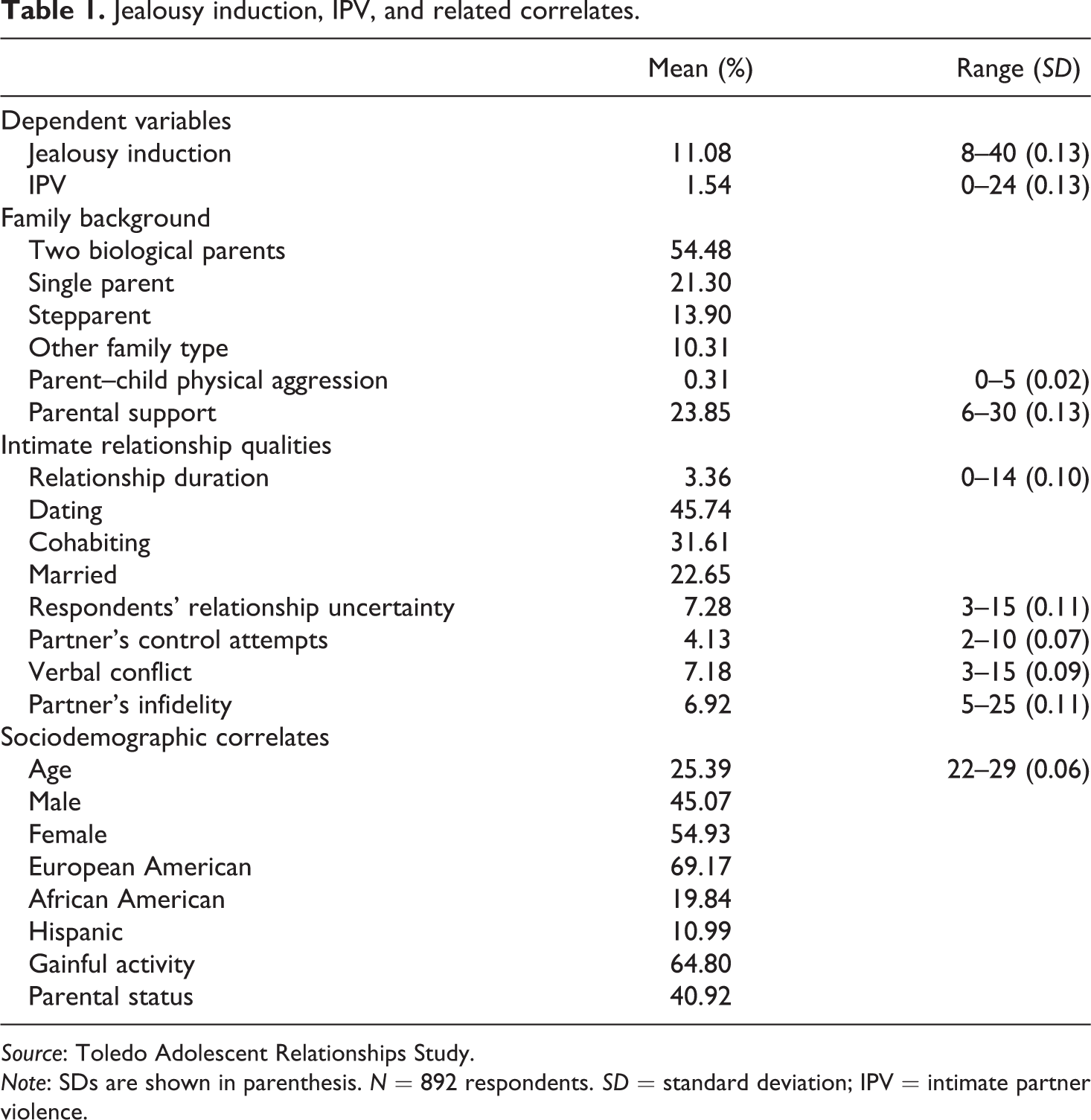
In Table 1, we present the means and percentages for the total sample for each of the independent and dependent variables. Individuals’ average age was 25.39 years old; slightly more than half of the respondents were female; and approximately 69% of the sample was European American. At the time of the fifth interview, approximately two-thirds were gainfully active, and just under 41% were parents. With regard to individuals’ familial backgrounds, approximately 54% were raised in two-biological parent households, and reports of parent–child physical aggression were low. On average, respondents reported a high degree of parental support. Turning to qualities of the intimate relationship, individuals reported on relationships that were, on average, 3.36 years in length, with a slight majority reporting on dating unions (46%) compared with cohabiting (32%) and marital (23%) unions. On average, respondents reported relatively high-quality relationships, rating such negative qualities as partner’s control attempts, verbal conflict, and partner’s infidelity relatively low. Finally, with regard to the two dependent variables, respondents reported, on average, relatively few jealousy-inducing behaviors and either no or few instances of violence.
Jealousy induction, IPV, and related correlates.
Source: Toledo Adolescent Relationships Study.
Note: SDs are shown in parenthesis. N = 892 respondents. SD = standard deviation; IPV = intimate partner violence.
Multivariate results predicting jealousy induction
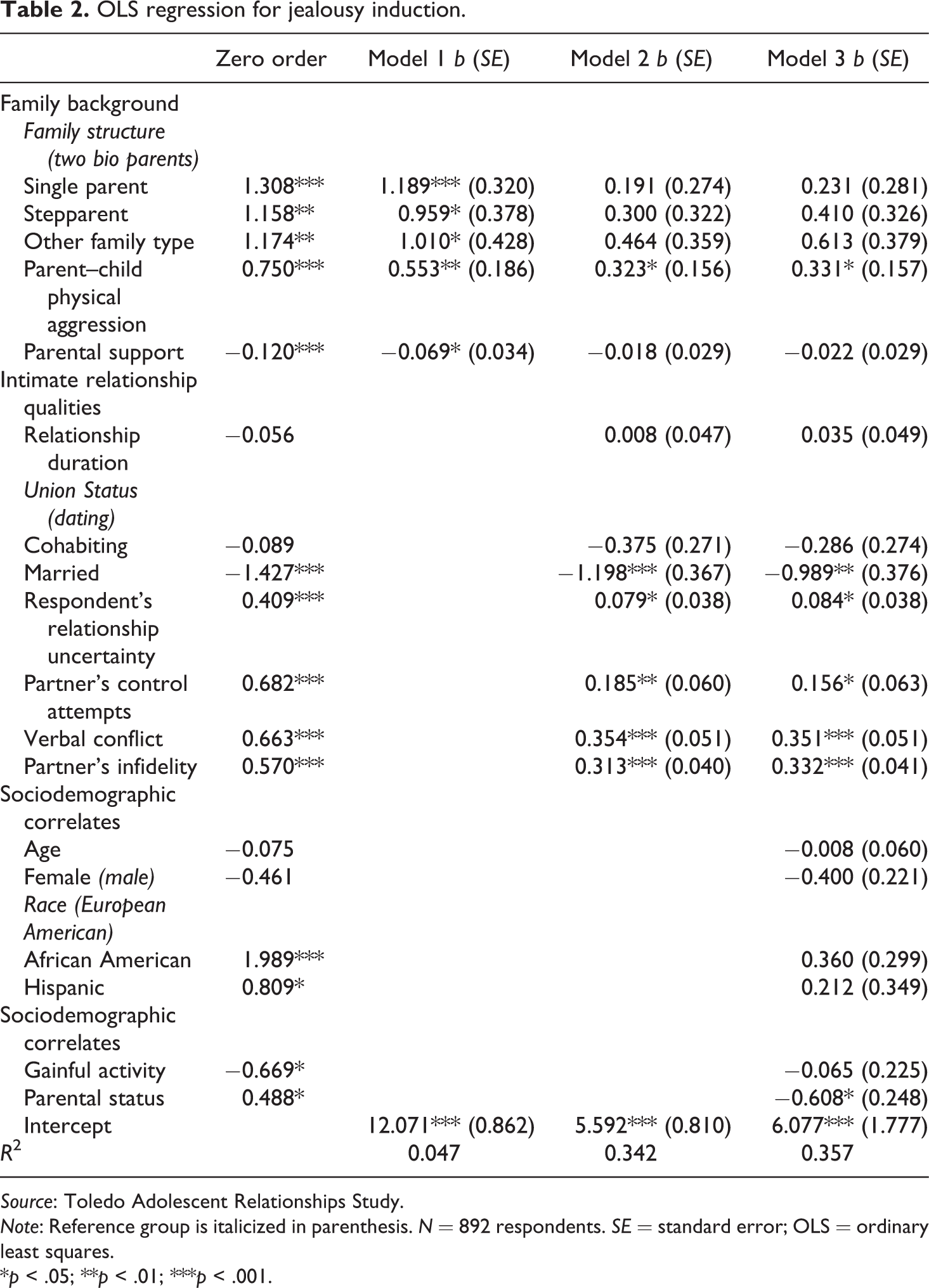
Table 2 presents both zero-order and multivariate results for the OLS regression of self-reported jealousy induction. Providing support for the first hypothesis (H1), each of the family background measures was significant correlates of jealousy induction and operated in the expected directions. Individuals raised in single parent, stepparent, and “other family” households, compared to two biological parent households, reported higher levels of jealousy induction, at 1.189, 0.959, and 1.010 units, respectively. Similarly, for each unit increase in exposure to parent–child physical aggression, respondents experienced a 0.553 unit increase in jealousy induction. Conversely, each unit increase in parental support decreased jealousy-inducing behaviors by 0.069 units.
OLS regression for jealousy induction.
Source: Toledo Adolescent Relationships Study.
Note: Reference group is italicized in parenthesis. N = 892 respondents. SE = standard error; OLS = ordinary least squares.
*p < .05; **p < .01; ***p < .001.
Model 2 included intimate relationship qualities thought to further influence jealousy-inducing behaviors. Providing partial support for H2, each unit increase in respondents’ relationship uncertainty led to a 0.079 unit increase in jealousy induction. Also consistent with hypotheses, individuals in marital, compared to dating, unions experienced a 1.198 unit decrease in jealousy induction reports. Following the hypothesis (H3) that the effect of familial background experiences on jealousy induction would be mediated by respondents’ relationship uncertainty, we performed Hayes’ PROCESS tests for mediation. Partial support was found for this hypothesis. Results from bootstrapping confidence intervals (CIs = 95%, n = 5,000) indicated that respondents’ relationship uncertainty mediated the total effects of both parent–child physical aggression (indirect effect = 0.112, lower level CI = 0.027, upper level CI = 0.257) and single-parent families (indirect effect = 0.451, lower level CI = 0.230, upper level CI = 0.687) on respondents’ reports of jealousy induction. Each unit increase in parent–child physical aggression led to a 0.284 unit increase in relationship uncertainty; each unit increase in relationship uncertainty led to a 0.392 unit increase in jealousy-inducing behaviors. Respondents raised in single-parent families, compared to two biological parent households, experienced a 1.157 unit increase in relationship uncertainty; each unit increase in relationship uncertainty led to a 0.390 unit increase in jealousy induction reports. Finally, with the inclusion of intimate relationship qualities, the effects of parental support and childhood family structure in Model 1 were reduced to statistical nonsignificance.
The final model, Model 3, included individuals’ sociodemographic characteristics to assess whether these variables explained additional variation in self-reported jealousy induction. Only respondents’ parental status was associated with jealousy-inducing behaviors. Respondents with children experienced a 0.608 unit decrease in jealousy induction, compared to respondents without children. There was no significant difference in self-reported jealousy induction based on biological sex, age, race, or gainful activity status.
We also note that the causal ordering of intimate relationship qualities and jealousy induction reports may be the opposite of what is proposed in the present study (i.e., jealousy induction may produce such relationship qualities as partner’s infidelity and partner’s control attempts rather than result from them). Unfortunately, as many respondents have different relationship partners in earlier points of data collection, intimate relationship qualities cannot be assessed at an earlier time point than jealousy induction reports for the entire sample. Nonetheless, a subsample of respondents (n = 213) maintained the same relationship partner between the fourth and fifth interviews. We ran supplemental analyses among this subsample using intimate relationship quality reports (partner’s infidelity, partner’s control attempts, and verbal conflict) at the fourth interview to predict respondents’ jealousy induction at the fifth interview. These results (see Online Supplemental Material) should be interpreted with caution due to the comparatively smaller sample size, because respondents who have the same partners in the 5 years between the fourth and fifth interviews may differ on a number of indicators than those who report on different partners in the two interviews. Nonetheless, these results demonstrated that, when measured 5 years prior, partner’s infidelity and verbal conflict were positive predictors of respondents’ jealousy-inducing behaviors at the fifth interview. While these analyses may not allow for the definitive conclusion that certain intimate relationship qualities cause respondents’ jealousy-inducing behaviors, they do provide further support for the process by which jealousy induction may unfold.
Multivariate results predicting IPV
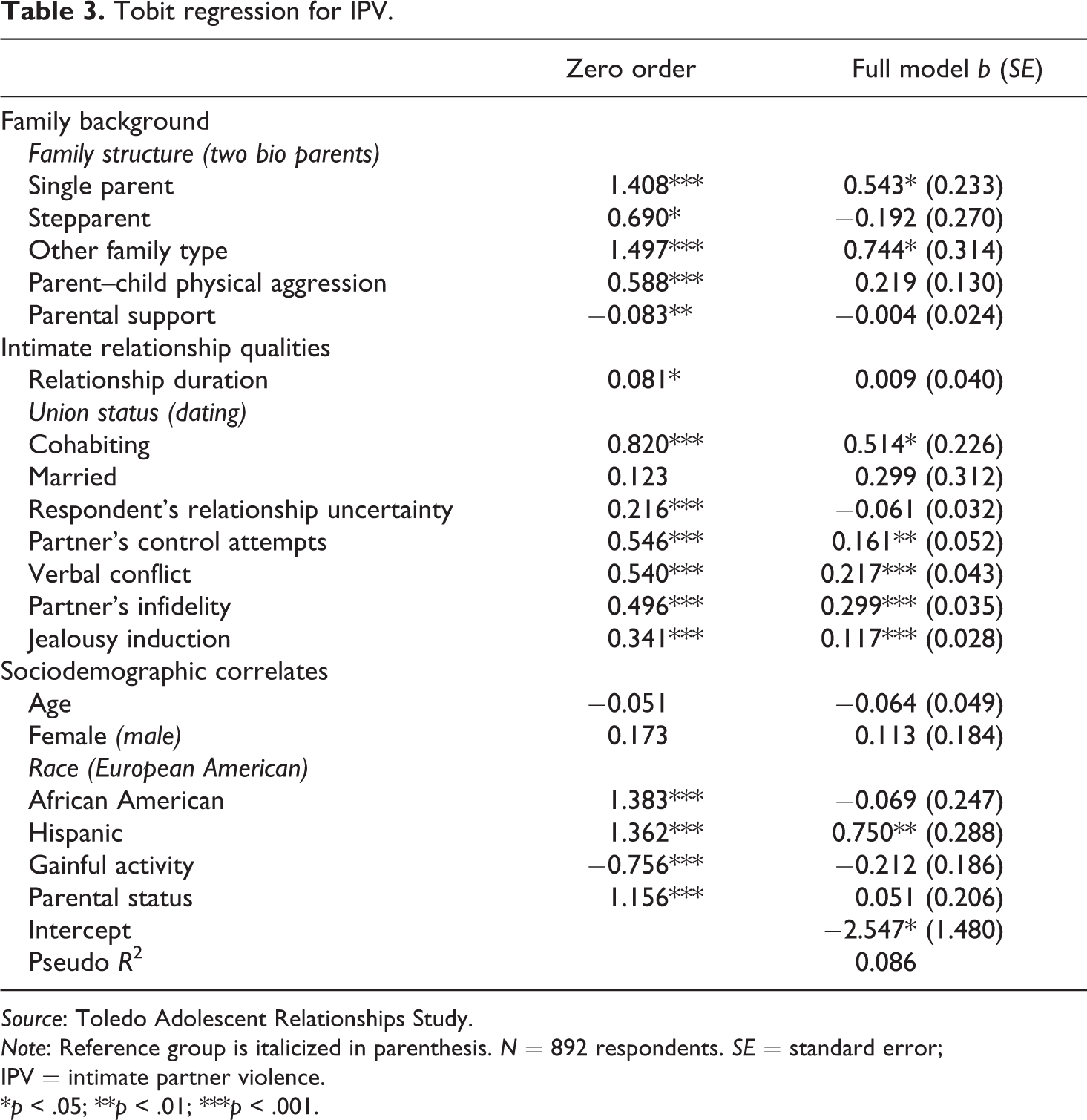
Table 3 presents the Tobit regression analyses to assess whether jealousy induction is an independent correlate of partner violence or a component of a larger package of characteristics reflecting poor quality relationships. Results indicated that jealousy induction is an independent correlate of violence in intimate relationships. At the bivariate level, each unit increase in jealousy induction increased the reports of IPV by 0.341 units. When all other covariates were included in the full model, the effect of jealousy induction was reduced by about 66%; however, it remained a positive correlate of IPV (p < 0.001), whereby each unit increase in jealousy induction increased violence reports by 0.117 units. Other significant correlates of IPV included union status (cohabiting compared to dating relationships), partner’s control attempts, verbal conflict, partner’s infidelity, family structure (single-parent and “other family” households, compared to two biological parent households), and Hispanic racial-ethnic identity.
Tobit regression for IPV.
Source: Toledo Adolescent Relationships Study.
Note: Reference group is italicized in parenthesis. N = 892 respondents. SE = standard error;
IPV = intimate partner violence.
*p < .05; **p < .01; ***p < .001.
Discussion
The results of our analyses illustrated three significant findings with regard to jealousy induction. First, when analyzing individuals’ jealousy-inducing behaviors, it is important to examine factors that are unique and internal to the intimate dyad as well as factors that are external to the intimate relationship. Consistent with prior research examining relationship-specific dynamics (e.g., Cayanus & Booth-Butterfield, 2004; Mattingly et al., 2012), results from our first analysis indicated that respondents in lower quality relationships, as evidenced by verbal conflict, respondent’s relationship uncertainty, and partner’s control attempts and infidelity, were significantly more likely to engage in jealousy-inducing behaviors. These findings held in supplemental analyses when verbal conflict and partner’s infidelity were assessed 5 years prior to jealousy induction reports. Similarly, relationships characterized by lower levels of commitment, as evidenced by a dating versus marital union, were greater frequency of jealousy induction in full sample analyses.
Second, in addition to these relationship-specific factors, our results demonstrated that jealousy-inducing behaviors were linked to individuals’ family of origin experiences. In particular, individuals exposed to parent–child physical aggression were significantly more likely to report greater frequency of intentionally inducing jealousy with their intimate partners. Thus, although qualities of the intimate relationship are key in precipitating jealousy concerns, certain individuals may enter romantic partnerships already predisposed to experiencing higher levels of jealousy due to deleterious experiences in earlier life. Following the basic premises of attachment and social learning theories, these findings lead us to conclude that individuals exposed to dysfunctional or unhealthy parenting practices may be more likely to view intimate relationship partners as less trustworthy, to interpret partner’s behavior more negatively or more threatening, and to have greater difficulty resolving relationship conflict and threats in healthy, constructive ways (e.g., Bowlby, 1982; Colman & Widom, 2004; Goodboy et al., 2017). Providing further support for this view, findings from the present study indicated that respondents’ feelings of relationship uncertainty served to mediate the total effects of parent–child physical aggression and childhood family structure on jealousy induction reports; although, importantly, the direct effect of single-parent households on jealousy-inducing behaviors was reduced to statistical nonsignificance with the inclusion of other intimate relationship qualities.
The complexity of these relationships has important implications for couples dealing with jealous emotions and expressions, as well as practitioners who may work with such couples in therapeutic settings. Following past researchers’ differentiation between fait accompli/reactive jealousy and suspicious/preventive jealousy (e.g., Barelds & Barelds-Dijkstra, 2007), it may be useful to first establish the sources of individuals’ jealous feelings and expressions to better deal with experiences of jealousy in intimate relationships. Individuals with deleterious experiences in earlier life, particularly in the form of parent–child physical aggression, may be experiencing romantic jealousy due to relationship threats that are imagined but not objectively real. In this case, jealousy-inducing behaviors might, perhaps, be reduced if such individuals learn to deal with the lasting effects of their troubled pasts. As one example and as evidenced in therapeutic settings dealing with jealous and martially violent men (e.g., Holtzworth-Munroe, 1992), such attempts may focus on addressing social skills deficits, where jealous individuals learn how to appropriately evaluate partners’ intentions and behaviors, as well as respond to those intentions and behaviors in an effective and nondestructive manner. Conversely, regardless of individuals’ earlier life experience, their partners may be engaging in behaviors that objectively exist and that are threatening to the relationship, such as attempting to control the individual through monitoring their schedule or whereabouts or by being sexually nonexclusive. In these cases, resolution strategies might be better geared toward couples’ therapy in hopes of addressing underlying problems that are specific to the intimate dyad or where both partners’ actions have contributed to jealousy induction becoming a preferred relational strategy for one or both partners.
These findings also have implications for academic and research communities. Future research efforts should explore the importance of peers. We know that peer relationships are central to child and adolescent development (e.g., Giordano, 2003; Waldrip, Malcolm, & Jensen-Campbell, 2008) and that adolescent poor friendship quality, as measured by limited communication, presence of conflict, and not feeling accepted by friends, is associated with higher odds of teen dating violence (Linder & Collins, 2005). Researchers (Cook, Buehler, & Fletcher, 2012) have also demonstrated that there is often continuity in the types of relationships formed within familial and peer domains, such that individuals reared in hostile families are likely to form friendships with similarly hostile peers. Yet, it is also plausible that individuals with dysfunctional family backgrounds may go on to develop prosocial relationships within the peer domain, learning healthy relationship maintenance strategies as a result. This suggests that incorporating friendship qualities may explain further variation in individuals’ jealousy-inducing behavior. Similarly, in developing more multifaceted portraits of individuals’ relationships with key socializing others and their influence on the initiation and maintenance of healthy relationships, it may be wise to explore such domains as the school and workplace environments, the larger neighborhood context, and any other contextual domain where individuals may develop meaningful relationships.
A third key finding in the present study is that jealousy induction is an independent correlate of violence experienced within intimate relationships, even after accounting for traditional family-of-origin characteristics, a variety of additional relationship qualities, and sociodemographic controls. In other words, although jealousy induction is undoubtedly part of a wide array of negative constellations present in intimate relationships, it continues to remain significant even when multiple other characteristics of the intimate dyad and individual are taken into account. This finding thus builds on prior research examining the link between jealousy and partner violence by establishing one potential way in which such jealousy arises in the first place.
Although jealousy is often the result of partners’ objective behaviors, such as infidelity, our study also supports the possibility that jealousy may be intentionally brought into the relationship, especially when individuals face additional barriers to healthy relationships, such as the presence of verbal conflict and control attempts, fear of partner abandonment and availability, and general issues with trust and attachment. As such, individuals may induce jealousy due to the belief that jealous emotions will result in partner retention and relationship improvement, even if, in reality, their relationships may ultimately suffer from such strategies. Conversely, jealousy induction may be a retaliatory response to partners’ objective and hurtful misconduct in the relationship. The potential of this idea, and its relationship to partner violence, may be extended in future research efforts and in settings for practitioners and clinicians dealing with victims and perpetrators of IPV. For instance, it may be that individuals engaging in jealousy induction for purposes of revenge or punishment are also those most likely to experience violence in their relationships due to more aggressive or adverse ways of handling interpersonal difficulties. Conversely, for individuals hoping to retain their partner or improve the relationship, it may be that jealousy induction leads to partner violence via partners’ negative reactions to elicited feelings of jealousy. These potential pathways suggest the usefulness of longitudinal data in future research to better parse out the causal nature of the relationship between jealousy induction and partner violence.
Although this study moves forward our understanding of jealousy induction and IPV, the regional nature of the sample is a limitation, although basic comparisons indicate that the large metropolitan area we focused on is similar to the U.S. as a whole on several basic demographic characteristics, including estimates of race and ethnicity, family status, income, and education. Related to issues of generalizability, the measure of jealousy induction utilized in the present study is somewhat limited compared to measures used in some past research (e.g., Fleischmann et al., 2005). Due to a priori nature of the present data, we were unable to account for some of the relational distancing, flirtation façade, and relational alternatives tactics utilized in previous studies. A third limitation is that individual reports were used for partner violence, encompassing instances of both perpetration and victimization, as well as for all of the relationship qualities measured in the present study. Although issues of under- or overreporting are possible with any self-reported data, this may be especially the case here given the absence of partner reports in the current data set. Finally, given that the current study utilizes cross-sectional measurements of intimate relationship qualities and jealousy induction reports, we cannot make causal inferences. While we attempted to reduce the issues of time order with our measurements of intimate relationship qualities and jealousy induction through the use of subsample supplemental analyses, time ordering of variables is not the same as establishing causal processes. Thus, future researchers should seek to utilize longitudinal data where both intimate relationship qualities and jealousy induction reports can be controlled for at multiple waves of measurement to further parse out these causal processes. Likewise, attempts to use nationally representative or couple-level data, where feasible, should be made to overcome potential issues of under- or overreporting and limited generalizability.
Although continued research is needed to further understand the precursors and consequences of jealousy induction in intimate relationships, the current study makes several strides to improve upon past research efforts. Through the inclusion of individual sociodemographic and familial background characteristics, the results presented here indicated that factors external to the intimate dyad influence individuals’ propensity for engaging in jealousy-inducing behaviors. The current study also contributed to previous research concerning the relationship between jealousy and partner violence by establishing that one potential way that jealousy occurs in intimate relationships and leads to subsequent violence is through intentional inducement by one or both partners. Such findings provided support for further examination of the various ways in which jealousy occurs between intimate partners and how, in turn, this jealousy leads to the manifestation of physical violence.
Supplemental material
Supplemental Material, jspr-17-280-File004_supple - Inducing jealousy and intimate partner violence among young adults
Supplemental Material, jspr-17-280-File004_supple for Inducing jealousy and intimate partner violence among young adults by Angela M. Kaufman-Parks, Monica A. Longmore, Peggy C. Giordano and Wendy D. Manning in Journal of Social and Personal Relationships
Footnotes
Authors’ note
The opinions, findings, and conclusions or recommendations expressed in this publication are those of the authors and do not necessarily reflect those of the Department of Justice.
Funding
The author(s) disclosed receipt of the following financial support for the research, authorship, and/or publication of this article: This work was supported under award numbers 2009-IJ-CX-0503 and 2010-MU-MU-0031, by the National Institute of Justice, Office of Justice Programs, U.S. Department of Justice, and in part by the Center for Family and Demographic Research, Bowling Green State University, which has core funding from the Eunice Kennedy Shriver National Institute of Child Health and Human Development R24HD050959.
Open research statement
This research was not pre-registered. The data and materials used in the research are available upon request by emailing
Supplemental material
Supplemental material for this article is available online.
References
Supplementary Material
Please find the following supplemental material available below.
For Open Access articles published under a Creative Commons License, all supplemental material carries the same license as the article it is associated with.
For non-Open Access articles published, all supplemental material carries a non-exclusive license, and permission requests for re-use of supplemental material or any part of supplemental material shall be sent directly to the copyright owner as specified in the copyright notice associated with the article.
