







Abstract
Consensual nonmonogamous (CNM) relationships (e.g., open relationships) are common among adult gay and bisexual men, and thus, younger gay and bisexual men may also engage in consensual nonmonogamy. Yet little is known about CNM relationships among young gay and bisexual men. This is problematic, as nonmonogamy may have important implications for relationship health, which is linked to individual mental and physical health. The present study explored dimensions of relationship quality among a sample of (n = 20) young gay and bisexual men in CNM relationships. Participants were recruited, along with their primary partners, from an ongoing cohort study of young men who have sex with men in New York City. Participants completed semistructured interviews that included questions about relationship quality. A modified version of the consensual qualitative research method was used to analyze the data. Participants’ responses were also analyzed at the dyad level to assess agreement between partners on dimensions of relationship quality. Among the men interviewed, most reported being satisfied with their relationship with their primary partner and with nonmonogamy more generally. Many participants identified improvements in their overall relationship, communication, and sex life as a result of nonmonogamy. These findings suggest that CNM relationships are viable relationship structures for some young gay and bisexual men. Consistent with these findings, mental health practitioners should help young gay and bisexual men in CNM relationships to bolster their communication and conflict resolution skills and should avoid pathologizing nonmonogamy. Also, medical providers and HIV/sexually transmitted infections (STI) prevention programs may benefit from increased competence regarding consensual nonmonogamy and should tailor their services to the unique needs of young gay and bisexual men in CNM relationships.
Keywords
Consensual nonmonogamous (CNM) relationships are relationships in which the partners have agreed to be nonmonogamous and to have extradyadic sexual, romantic, and/or emotional partners (Conley, Ziegler, Moors, Matsick, & Valentine, 2012). Common types of CNM relationships include open relationships (i.e., partners agree to extradyadic sexual partners), monogamish (i.e., partners agree to have extradyadic sexual partners but only while their primary partner is present), and polyamorous relationships (i.e., partners agree to have extradyadic romantic and/or sexual partners). CNM relationships have historically been considered taboo, often being miscategorized as infidelity, and they have only recently been the topic of scientific inquiry (Barker, 2005; Barker & Langdridge, 2010).
CNM relationships may be common among romantically partnered gay and bisexual men, with more than half reporting being in some type of CNM relationship in some recent studies (Grov, Starks, Rendina, & Parsons, 2014; Hosking, 2013). Yet prevalence estimates vary considerably across studies, from 23% in one sample of gay men (Bricker & Horne, 2007) to 56% of men in another sample (Grov et al., 2014). Older studies suggest that as many as 82% of sexual minority men will be in some type of nonmonogamous romantic relationship in their lifetime (Blumstein & Schwartz, 1983; Hickson et al., 1992; Nimmons, 2002). These estimates differ due to methodological differences, including sampling methods, how CNM relationships were defined, and varying inclusion criteria regarding relationship length.
Studies suggest that gay and bisexual men in CNM relationships rate various dimensions of relationship quality (e.g., relationship satisfaction, communication, sex) positively, similar to their peers in monogamous relationships (Blasband & Peplau, 1985; Hoff & Beougher, 2010; Hoff, Beougher, Chakravarty, Darbes, & Neilands, 2010; Kurdek, 1988; Parsons, Starks, Gamarel, & Grov, 2012; Wagner, Remien, & Dieguez, 2000; Whitton, Weitbrecht, & Kuryluk, 2015). For example, several studies have found no differences between men in monogamous and nonmonogamous relationships with regard to relationship satisfaction (Bricker & Horne, 2007; Hoff et al., 2010; LaSala, 2004a; Whitton et al., 2015). Other studies have found no differences in communication quality between gay men in monogamous and nonmonogamous relationships (Hoff et al., 2010; Parsons et al., 2012), while other studies have found no differences in sexual satisfaction between gay men in monogamous and nonmonogamous relationships (Bricker & Horne, 2007; Parsons et al., 2012). While these studies are noteworthy, they are primarily concerned with differences in relationship quality between men in monogamous and nonmonogamous relationships rather than exploring dimensions of relationship quality exclusively among men in CNM relationships.
Less is known about CNM relationships among young gay and bisexual men, and, as of this writing, no studies have examined relationship quality among this population. Indeed, most studies of nonmonogamy among gay and bisexual men have used samples with a mean age of 38 and older (Bonello & Cross, 2009; Hoff & Beougher, 2010; Hoff et al., 2010; LaSala, 2004b; Parsons et al., 2012). This is an important distinction, as young people face a range of challenges associated with the transition from late adolescence to adulthood, such as increased autonomy, role and identity confusion, and changes in educational/career demands (Arnett, 2000), which may make navigating a nonmonogamous relationship more difficult. It is also unclear whether the trends in relationship quality noted among older gay and bisexual men will be observed among younger men in CNM relationships, as they are likely to have less romantic relationship experience.
The dearth of information regarding CNM relationships among young gay and bisexual men is problematic for several other reasons. First, the health of the individual is influenced by the quality of their relationships (Broadhead et al., 1983). Given that young gay and bisexual men are at disproportionate risk for mental and physical health problems (Graham et al., 2011), it is important for health-care providers to have a better understanding of the diversity of relationship arrangements that young gay and bisexual men participate in. Second, given the rapid progression of historical changes differentially affecting successive generations of gay and bisexual men (e.g., the HIV/AIDS crisis, the advent of effective HIV treatments, and the recent repeal of the Defense of Marriage Act), previous understandings of CNM relationships among gay and bisexual men may not apply to this new generation of gay and bisexual men. Finally, in a dating world that has been drastically affected by technology, and as many people struggle to initiate and maintain fulfilling romantic relationships (Ansari & Klinenberg, 2016), a greater understanding of what contributes to healthy, satisfying relationships may be helpful for young gay and bisexual men who are not satisfied with traditional monogamy. Thus, a study of relationship quality among young gay and bisexual men in CNM relationships is warranted.
Study aims
This project will address gaps in the current knowledgebase by exploring themes related to relationship quality among a sample of young gay and bisexual men and their partners in CNM relationships. Given the relative lack of information about this population, a qualitative approach will be used to achieve a more in-depth exploration of the experiences of these men and their partners. Furthermore, this study will add to the existing literature by providing dyad-level comparisons of participants’ responses. This proposed dyad-level analysis will allow us to better understand how similarly partners in CNM relationships evaluate the quality of their relationship.
Method
Procedure and participants
A convenience sample of young gay and bisexual men in CNM relationships was used for the present substudy. Participants and their primary partners were recruited from Project 18 (P18), an ongoing cohort study of young men who have sex with men in New York City. Full details about P18 can be found in previous manuscripts (Halkitis & Figueroa, 2013; Halkitis et al., 2013). To be eligible for the parent study, at the time of enrollment, participants had to (1) be aged 18 or 19 years, (2) be born biologically male, (3) have had sex with a male partner in the previous 6 months, and (4) report a HIV-negative serostatus. The preceding eligibility criteria were relevant for the aims of the parent study from which participants for the present substudy were recruited.
At the time of the substudy, participants recruited from the parent study were aged 23 or 24. Participants of the parent study were informed of the substudy during their regularly scheduled study visits and via e-mail. Those interested in participating completed an interviewer-administered eligibility screener in-person or by phone. To be eligible for the present substudy, potential participants had to report (1) that they were in a relationship with a male partner for at least 6 months, (2) that their primary male partner was aged 18 or older, (3) that they had explicitly agreed to be in a CNM relationship, and (4) that their primary partner would also agree to participate in the study. Participants were asked to identify the type of CNM relationship that they were engaged in using three categories: open, which was defined as a relationship wherein both partners explicitly agreed to have extradyadic sexual partners, but not romantic partners; monogamish, wherein the partners agreed to have extradyadic sexual partners, but only while their main partner was present (e.g., threesomes, sex parties); or polyamorous, in which the partners agreed to have extradyadic romantic and/or sexual partners. Interested participants were also permitted to select an “other” option and to describe their particular CNM relationship structure. A total of 113 interested participants were screened for eligibility and 28 participants of the parent study were eligible to participate in the substudy. A final sample of P18 participants (n = 10) and their primary partners (n = 10) were enrolled into the present study, for a final sample of participants who completed the study protocol (n = 20).
Individual and dyad-level characteristics
Table 1 displays the sociodemographic characteristics of the study participants. As a result of how the sample was constructed, more than half of the participants were aged 23 and 24, with a mean age of approximately 25 years. The sample was racially and ethnically diverse, with more than two thirds of the sample identifying as non-White. Specifically, five identified as Black, four as Hispanic or Latino, four as biracial/multiracial, one as Other, and six as White. With regard to sexual orientation, the majority of participants (n = 18) identified as gay.
Individual and dyad-level characteristics of young gay and bisexual men in consensual nonmonogamous (CNM) relationships.
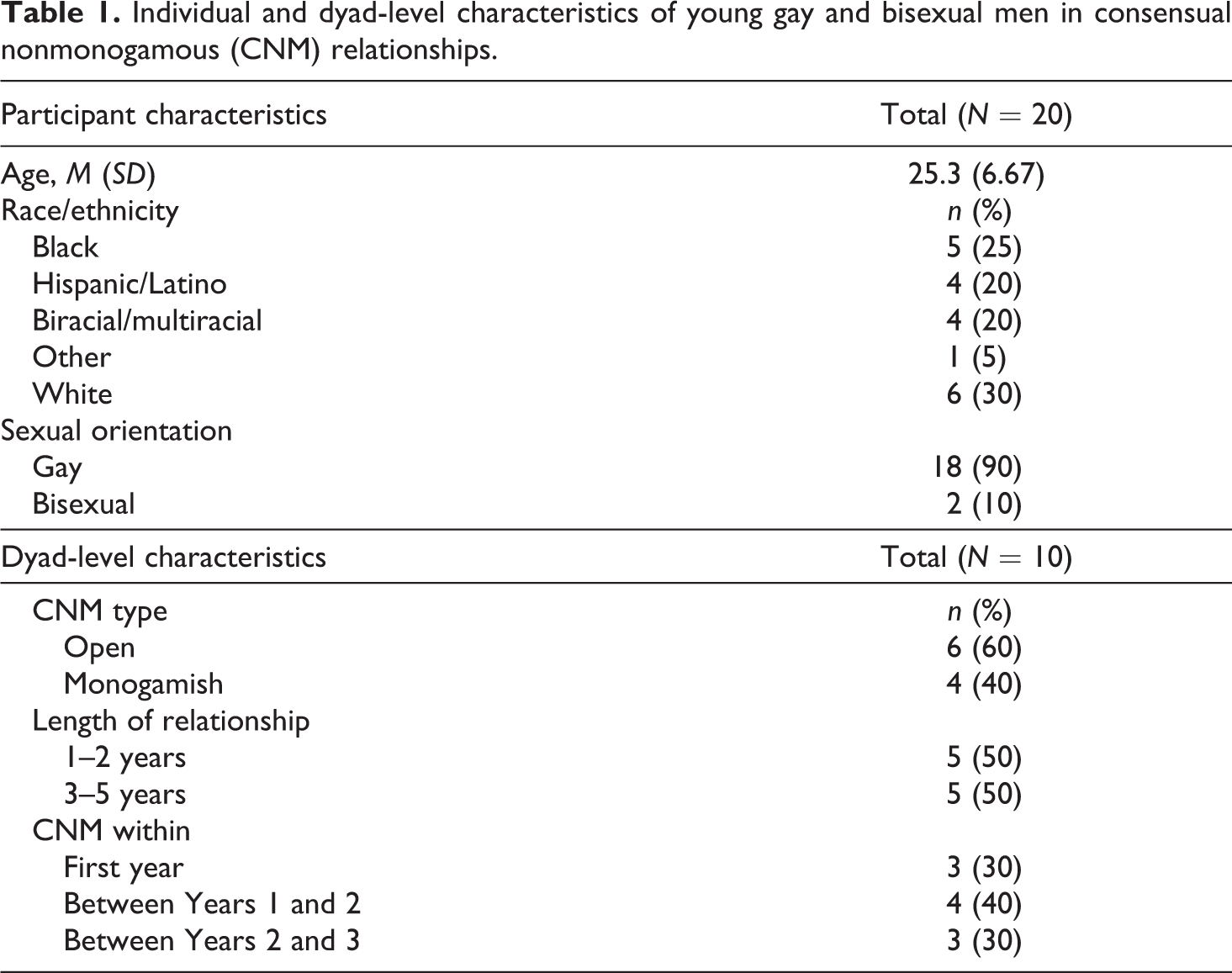
Table 1 also displays dyad-level characteristics of the couples (n = 10). More than half of the couples (n = 6) identified as being in an open relationship, while the remaining couples identified as being in a monogamish relationship. No couples in this study identified as being in a polyamorous relationship. Half of the couples in the study (n = 5) reported being together for 1–2 years, while the other half reported being in a relationship of 3–5 years in length. Additionally, about a third of the couples (n = 3) became nonmonogamous in the first year of their relationship, while the remaining couples became nonmonogamous either between the first and second year (n = 4) or between the second and third year (n = 3) together.
Materials
Eligible participants were scheduled for 1-hr semistructured individual interviews independent of their participant partners; however, appointments were not completed unless both partners confirmed their appointment. After confirming their eligibility for the study, participants provided written consent. First, basic sociodemographic information was recorded. The author, a trained interviewer, then conducted semistructured interviews with participants. The interviews included open-ended questions about participants’ satisfaction with their relationship with their main partner (“How satisfied or happy are you with your relationship with your main partner?”), satisfaction with nonmonogamy (“To what extent are you satisfied with nonmonogamy?”), improvements resulting from nonmonogamy (“How does being nonmonogamous improve your relationship?”), complications resulting from nonmonogamy (“How does being nonmonogamous complicate or make your relationship worse?”), and participants’ sex lives (“To what extent does being nonmonogamous improve your sex life?” and “To what extent does being nonmonogamous hurt or hinder your sex life?”). The semistructured interview protocol allowed the interviewer to ask follow-up questions to probe for additional information and to clarify participants’ responses. The protocol also allowed the interviewer to follow lines of inquiry introduced by the participants (e.g., communication) that were related to but not explicitly included in the interview protocol.
Data analysis and synthesis
A modified version of the consensual qualitative research (CQR) method was used to analyze the data (Hill et al., 2005; Hill, Thompson, & Williams, 1997). A qualitative approach, such as CQR, allows for a more in-depth exploration of the experiences of these young men. It also provides greater detail about their experiences, as it allows their words to illustrate the relevant themes extracted from the transcripts.
Prior to analysis, the audio-recorded interviews were transcribed and verified for accuracy by a team of five research staff. According to CQR protocol, the coding team began with a discussion of potential biases related to sexual minority populations as well as biases about nonmonogamous relationships. The coding team then developed a preliminary codebook that corresponded to the larger domains outlined in the semistructured interview protocol.
The team members independently coded a small sample of transcripts using the ATLAS.ti (Version 7) software. After the team coded each small batch of transcripts, the team would meet to discuss the addition of new codes or the collapsing or deletion of existing codes. When the process was completed, two staff independently coded each transcript. A final review of each transcript was completed by a separate team member, acting as an auditor, to verify that all new, collapsed, and deleted codes were consistently applied across all transcripts.
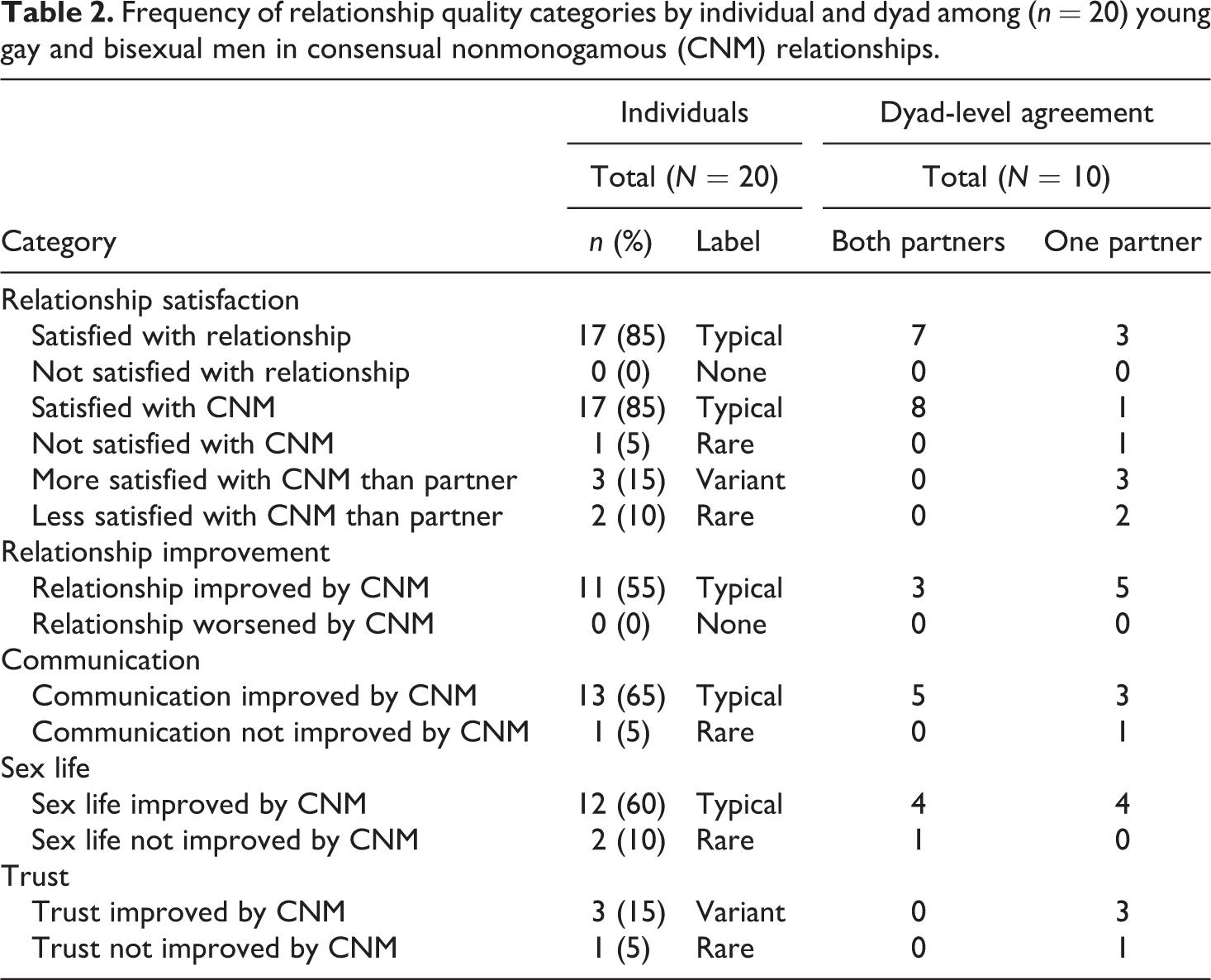
ATLAS.ti was used to tabulate the frequency and co-occurrence of codes across all transcripts. The frequency table produced with the assistance of ATLAS.ti was used to conduct dyad-level comparisons of participants’ coded responses. Codes pertaining to the dimensions of relationship quality will be hereafter referred to as categories. Category frequency labels will be used in the manuscript and in Table 2 to summarize the number of transcripts that contain various categories. The category labels are defined as general (appearing in all or nearly all transcripts), typical (appearing in more than half), variant (appearing in less than half), and rare (appearing in one or two). ATLAS.ti was also used to identify quotations from the transcripts to illustrate the various categories and overarching domains. The author made the final quotation selections for this article in collaboration with the team to ensure that they reflect the categories and domains extracted during the analysis.
Frequency of relationship quality categories by individual and dyad among (n = 20) young gay and bisexual men in consensual nonmonogamous (CNM) relationships.
Results
Within the larger domain of relationship quality, five groups of categories emerged: relationship satisfaction, relationship improvement, communication, sex, and trust. In the following subsections, for each category, individual and dyad-level frequencies will be reported, and exemplar participant quotations will be presented.
Relationship satisfaction
Within the group of categories pertaining to relationship satisfaction, six categories emerged: satisfied with relationship with main partner, not satisfied with relationship with main partner, satisfied with nonmonogamy, not satisfied with nonmonogamy, more satisfied with nonmonogamy than partner, and less satisfied with nonmonogamy than partner.
Satisfaction with main partner
As displayed in Table 2, being satisfied with one’s relationship was a typical response, as most participants (n = 17) stated that they were happy or satisfied with their relationship with their main partner. Regarding dyad-level agreement, both partners in 7 of the 10 dyads stated that they were satisfied with their relationship with their main partner. In 3 of the 10 dyads, one partner stated that they were satisfied. No participants stated that they were not satisfied with their relationship with their main partner.
For example, some participants described how their main partner was similar to a best friend or trusted confidante: We make a really good team. If I said he was my best friend, it would be an understatement. (23, Black, gay, open) Honestly, to this day, [he] understands me in a way that no one else does. [He] has been there. [He] has made me feel happy about everything that we’ve done. (24, Hispanic/Latino, gay, open) It’s still a work in progress but I’m pretty happy with how things are going. I really am because I feel like now that we’ve gone through all the rough patches that we have, we are becoming stronger for it. And we are really doing what we can to be adult about the situations that we are going through. (24, Hispanic/Latino, gay, open)
Satisfaction with nonmonogamy
Also as presented in Table 2, satisfaction with nonmonogamy was typical, as most participants (n = 17) described being satisfied with nonmonogamy, with only (n = 1) participant stating that he was not satisfied with nonmonogamy. Regarding dyad-level agreement, both partners in 8 of the 10 dyads stated that they were satisfied nonmonogamy. In one dyad, one partner stated that he was satisfied with nonmonogamy, while the other stated that he was not satisfied with nonmonogamy.
For example, in describing how satisfied he was with nonmonogamy, one participant expanded on how much he appreciates the openness and transparency of his relationship: I’m very happy with it…Something I really value is that we can both acknowledge that we have desire. So we can be out somewhere and I can be like “That guy is really cute,” and he can be like, “I totally agree,” or he’ll say someone is really cute and I’ll be like, “Oh my god, no.” That brings us closer together in a way that I think a lot of people in relationships [who] pretend that they—well maybe they don’t pretend, maybe they really do feel that way—but I think in a lot of relationships that my friends are in have never disclosed that kind of feeling. Like I’m thinking of my friends who are in straight relationships, if they ever said, “Oh wow, she’s so beautiful,” their girlfriends would be like, “What is your problem, I’m right here, how dare you?” That would never be something that we would have an issue with. So it’s like a homo-elitist thing I guess. I’m happy with that aspect of it. (23, White, gay, open) We like exploring. We like doing different things. If we like it, we continue doing it. If we don’t like it, we don’t do it anymore…. We communicate very well when it comes to it. If I don’t feel like doing anything, he doesn’t push me. If he doesn’t feel like doing anything, I won’t push him. (23, Hispanic/Latino, gay, monogamish) I also do like the casual sex aspect of it because I feel like we are both really young and maybe we will outgrow it. Maybe if we are still together in some capacity years from now, we won’t be attracted to every single person that walks by. But the fact is we are attracted to a lot of people and sometimes we can share that, and sometimes we don’t, but it doesn’t change the way that we feel about each other. (23, White, gay, open) For now, we’re definitely happy with it. I don’t know if it will be indefinite, but for now, I know that we’re happy with it. (24, Hispanic/Latino, gay, open) It’s like a best of both worlds scenario. (23, White, gay, open) As far as being intimate with people outside of the relationship, I have not found it to be a particularly fulfilling event. I have met friends from it, and that has been more beneficial than not beneficial, and there hasn’t been anything particularly negative about it. I wouldn’t say that it weakened our overall bond, but I would say that I’m not particularly satisfied with whatever it is. (23, White, gay, monogamish)
Satisfaction discrepancy
As reported in Table 2, two participants reported that they were less satisfied with nonmonogamy than their main partner, while three participants stated that they were more satisfied. However, these perceived discrepancies in satisfaction with nonmonogamy were not highly consistent at the dyad level. Specifically, only partners from 1 of the 10 dyads reported corresponding discrepancies in satisfaction. However, the partners of the other (n = 3) participants did not corroborate these perceived discrepancies in satisfaction.
For example, two men reported that they were less satisfied with nonmonogamy than their partner: For me, I’ve always had this idea of just being simply with one person. So I can be open to inviting someone in, but I think traditionally I would prefer to just be with one person. (28, Biracial/multiracial, gay, open) This open relationship, it really takes a certain person. And he’s dealing with it because, like I said, he’ll do anything for me, [and] I’ll honestly I’ll do anything for him. So he’s dealing with it, but he’s really not that person. (23, Black, gay, open)
Relationship improvement
As reported in Table 2, more than half of those interviewed (n = 11) reported that their relationship improved as a result of nonmonogamy, making it a typical response. Indeed, no participants stated that their relationship worsened as a result of nonmonogamy. At the dyad level, both partners from 3 of the 10 dyads stated that their overall relationship improved due to nonmonogamy. In 5 of the 10 dyads, one partner stated that their overall relationship improved.
For example, one participant described the improvement in his relationship in terms of the successful resolution of challenges faced together: It’s added challenges to our relationship. And as much as the challenges weren’t as welcomed as I would expect them to be, they did show us sides of each other that I feel needed to be expressed, something that we had to recognize about each other, pages of our books that we had to flip over, because at some point or another we had to work on it. We had to see how we fit together in that situation. (24, Hispanic/Latino, gay, open) Everyone’s going to be attracted to people besides their partner when they go out in life. Not saying you’re in love with them, but there is attraction. That’s how the human species is; we’re attracted to more than just one person. And that’s something normal. And some relationships choose to do something with that attraction and some don’t and that’s totally fine. But I feel those who don’t, and they’re completely strictly monogamous where it’s like every single thing you want sexually can only be done by me, it causes a lot of stress on both people. It’s like well you have to be 110% for this one person and it’s kind of hard to give that person everything they want if what they want is, “Hey, maybe we can just have a second person,” you can’t do that. So, it’s kind of good to be open to the idea of different types of sexuality. (23, Biracial/multiracial, bisexual, monogamish)
Communication
As displayed in Table 2, more than half of participants (n = 13) reported that the communication in their relationship improved as a result of engaging in nonmonogamy, making it a typical response. At the dyad level, both partners from 5 of the 10 dyads stated that their communication improved as a result of nonmonogamy. In 3 of the 10 dyads, one partner stated that their communication improved. In one dyad, one partner stated that their communication did not improve as a result of nonmonogamy.
For example, one participant described how being able to have honest, and sometimes difficult, conversations about sex increased the couple’s ability to discuss other challenging topics: I don’t think I would have nearly the level of, or we would have this level of communication that we have, and our ability to really lay it all out on the table…[It] started within the sexual level, but it’s permeated throughout the relationship. Anytime we have something to communicate about, whenever we’re frustrated or had a bad day at work, we’ve really learned, worked out the kinks. I think sex sometimes is the heaviest part of relationships and the hardest part is to work out the kinks. And if you’re able to communicate and work your way through that in a way that’s productive, which I believe we have, then you’re able to, when you come home from work, and you’ve had a bad day, and you’re feeling frustrated, and you don’t really want to talk, you’re able to, or at least I’m able to, tell my partner that in a better way than I think if I didn’t go through all of that. (23, White, gay, monogamish) Honestly I feel like it’s ameliorated a lot of my feelings of jealousy because he’s so honest with me now. He was honest about cheating. I have never had someone be so honest with me. And I’ve never been that honest with another person. And I think that a lot of jealousy is the fear of not knowing information and when you know that information you meet it head-on and you look it right in the face and you’re like, “Well why does he want to fuck other people? Is it because I’m not good enough?” And it’s like, “Well no, that’s not really it.” (23, White, gay, open) You’re not hiding anything, you’re not ashamed of anything. (24, Hispanic/Latino, gay, monogamish) Some people are married to their significant other and don’t know what they’re really like. (24, Hispanic/Latino, gay, monogamish) At least I know everything. All of the weird details that you don’t know in traditional relationships, they don’t talk about these things. Even nontraditional relationships, people are still scared to discuss these things and I think we passed that stage already. (23, biracial/multiracial, gay, monogamish) I think we realized that we are strong enough to…have an open relationship going forward, and that we have the communication skills that would allow us to do that. (23, White, gay, monogamish) Any communication problems we have would be…like planning or conveying details or something, but not really around emotions or trust. (23, White, gay, open)
Sex
As reported in Table 2, improvement in the couple’s sex life as a result of consensual nonmonogamy was a typical response, as more than half of the participants (n = 12) reported that their sex life had improved, while only (n = 2) reported their sex life did not improve. At the dyad level, both partners in 4 of the 10 couples stated that their sex life improved as a result of nonmonogamy. In 4 of the 10 dyads, one partner stated that their sex life improved, while in 1 of the 10 dyads, both partners stated that their sex life did not improve as a result of nonmonogamy.
For example, several of the men described how extradyadic sex allowed them to discover enjoyable sex acts with other partners that they would introduce into their primary relationship: Sometimes there is someone that we do things with that does something that is satisfying to us. It’s not something that he would naturally discover on his own or I would naturally discover on my own and we come back to each other and we’re just like, “Well maybe you could try to do this and see what happens.” (24, Hispanic/Latino, gay, open) I would say it makes it better, only because, since we go out with others and we’ve experimented with others, we realize what we like about our partner. The people that we had sex with versus what we like to do with each other. So it’s just a good viewing point, to know what turns us on, what doesn’t turn us on. It makes us realize what we like about each other and it helps. (24, Hispanic/Latino, gay, open) From my end, it does. Because sometimes there are some things he’s not into that I’m into. And it’s not that I’m going to not be into him, but sometimes I just want something else. I don’t want PB&J every day. Some days I want grilled cheese. If he doesn’t eat grilled cheese, then just let me go get a grilled cheese and it will make the PB&J that much better since I took a day off. (23, Black, gay, open) Yeah, I think he definitely feels…more competitive, in a playful way. Sometimes he’ll ask me what people did with me sexually that he doesn’t do. And I think whenever we’ve had sex right after doing something outside the relationship, it’s been almost like more passionate. But I think it’s almost a turn on to hear each other talk about the kind of guys we like, the kind of things we like, even if it doesn’t really apply. It’s really refreshing to just know to not be worried like, “Am I doing a good job.” Because he’ll be like, “Oh this one guy did this really cool thing, you want to try it?” And I’ll do that. (23, White, gay, open) I would think it improved my sex life, only because I think that it’s a territorial thing for men, you know? Just to be like, “Oh, somebody else had something of mine, now I’m taking it back.” It’s like this reclaiming kind of thing. (24, Black, gay, open) I think we’re much more open about our desires. Or if one night we’re interested in very vanilla sex, we can do that. We are open. If we are open to a miscellaneous fetish we like, we can be much more transparent about that. It’s a non-judgmental zone of, “Okay, you know what, you’re interested in this, I’ll try it out, because you were interested in threesomes, I tried it out, it worked.” Or, “You were interested in open relationships, I tried it out, and it didn’t destroy anything.” So, just being much more open. I think definitely our sex life is much better because of the threesomes. And also even just fantasizing about having threesomes or open relationships has actually worked its way into our intimate relationship with each other. So, not necessarily having sex with someone else, but talking about it is arousing. (23, White, gay, monogamish) I don’t know, it’s hard for me to say that it’s improved our one-on-one sex lives. I’m not really sure. I wouldn’t say that it has. But I don’t think it’s hurt it. It’s kind of stayed the same. (24, White, gay, monogamish)
Trust
Trust came up less frequently than other dimensions of relationship quality. As reported in Table 2, three participants described how trust improved as a result of nonmonogamy, while one participant discussed how trust did not improve. At the dyad level, in 3 of the 10 dyads, one participant discussed how trust improved as a result of nonmonogamy, while in 1 of the 10 dyads, one participant stated that trust did not improve.
For example, regarding improved trust, one participant described how his perception of the benefits of nonmonogamy: I think the benefit of being open has more to do with trust and stability and less to do with an impulse to have sex with other people. (23, White, gay, monogamish) We trust each other. And you know the saying, the couple that plays together stays together. Since he doesn’t get a little temptation, I don’t either. (24, Hispanic/Latino, gay, monogamish) It’s been totally physical, like with a third or a fourth person, at least for me. I’m pretty secure with the physical aspects. And, if there’s any emotional or mental aspects or problems that come up from it, I don’t know, that’s a separate issue. I don’t think emotional issues in our relationship would arise out of being non-monogamous. (24, White, gay, monogamish)
Discussion
This study sought to explore dimensions of relationship quality among a sample of young gay and bisexual men and their partners in CNM relationships. Most participants described being satisfied with their relationship with their main partner and with nonmonogamy more generally. Indeed, no participants stated that they were unsatisfied with their relationship and few described being unsatisfied with nonmonogamy. There was also broad dyad-level agreement regarding satisfaction with the relationship and with nonmonogamy. While five participants described a discrepancy between their level of satisfaction with nonmonogamy and the satisfaction of their partner, only partners from one dyad reported corresponding perceptions of a discrepancy in satisfaction. It is unclear why participants were not more accurate in estimating their partners’ degree of satisfaction with nonmonogamy among those who reported a discrepancy. However, given the broad level of agreement within the majority of dyads, it is possible that those who reported a discrepancy may come to have a more accurate understanding of their partners’ level of satisfaction over time and as a consequence of improved communication.
More than half of those interviewed stated that their relationship, communication, and sex lives improved as a result of nonmonogamy. Many participants described how the communication skills acquired in negotiating sex with other partners helped them to discuss other sensitive or important relationship matters. Others described how exploring their sexuality as a couple, including having sex with extradyadic partners, improved the quality of their own sexual intimacy. Additionally, some of those interviewed discussed how their bond with their partner improved, due to increased transparency and awareness of their partner’s sexual desires and fantasies. As compared to relationship satisfaction, there were fewer instances where both partners from the same dyad described an improvement or worsening in the previous domains. However, there was also no disagreement at the dyad level (i.e., instances where one partner reported an improvement while the other partner reported a worsening).
Taken together, these findings are consistent with previous studies that have used samples of older gay and bisexual men which have shown that men in nonmonogamous relationships are generally satisfied with their relationships and rate their communication and sex lives favorably (Hoff & Beougher, 2010; Hoff et al., 2010; Parsons et al., 2012; Whitton et al., 2015). These findings are also consistent with the extant literature on correlates of relationship satisfaction among heterosexual couples (Sternberg & Hojjat, 1997). Specifically, past research indicates that people who are in relationships that are characterized by open, nondefensive communication styles generally report higher levels of relationship satisfaction, as compared to people who are in relationships with communication patterns that are marked by contempt and defensiveness (Gottman, 2014; Gottman et al., 2003). The men in the present study frequently linked their relationship satisfaction with their relationships’ nonjudgmental styles. Consistent with past research among older gay and bisexual men (Hoff & Beougher, 2010), the young men in this study enjoyed their perceived sexual freedom and nonheteronormative identities. The importance of communication and shared exploration in relation to relationship quality observed in this study is consistent with previous findings on the health of same-sex and heterosexual couples (Gottman, 2014; Gottman et al., 2003; Sternberg & Hojjat, 1997).
Implications
These findings have several implications for counseling and psychotherapy. First, they suggest that CNM relationships are viable relationship options for some young gay and bisexual men. As such, providers should be aware of any potential biases that they have against CNM relationships and should avoid pathologizing nonmonogamy. Second, much of the improvements in relationship quality were attributed to openness and transparency in the partners’ communication. Thus, providers should emphasize the importance of communication and conflict resolution skills when working with young gay and bisexual men in CNM relationships. Providers should also help to facilitate the acquisition of requisite communication skills for those having difficulties in this area. Furthermore, much of the participants’ satisfaction appears to be rooted in a nonjudgmental stance toward their partners’ and their own sexuality. Practitioners can assist young gay and bisexual men in CNM relationships to explore their attitudes regarding sexuality, to help them have happier, healthier relationships.
Additionally, given the link between relationship health and individual mental and physical health (Broadhead et al., 1983), health promotion programs may be improved by greater inclusivity regarding the diverse relationship structures that young gay and bisexual men participate in. For example, HIV/sexually transmitted infections (STI) programming may be tailored to address how couples in CNM relationships can maintain their sexual health in a context wherein one or both partners have extradyadic sexual experiences. These efforts may help to reduce HIV/STI infection rates among young gay and bisexual men, a group that is disproportionately affected by HIV and STIs (Graham et al., 2011).
Strengths and limitations
There is a limited but growing literature regarding consensual nonmonogamy in general. Thus, few studies have examined CNM relationships among gay and bisexual men and, as of this writing, none have examined CNM relationship quality among young gay and bisexual men. Indeed, many previous studies have used samples of older gay and bisexual men, with the mean age of the men surveyed ranging from age 38 (Parsons et al., 2012) to 43 (LaSala, 2004b). As such, the present study contributes novel information about consensual nonmonogamy among younger gay and bisexual men, thus expanding the extant literature. Given the mean age of this sample (M = 25), most of the men in the study were navigating the complexities of consensual nonmonogamy during emerging adulthood, a developmental period noteworthy for unique challenges and vulnerabilities (e.g., transition from school to employment, moving away from family of origin, increased substance use and sexual behaviors; Arnett, 2000).
Another significant contribution of this study is its use of dyad-level analyses to examine the extent to which participants’ responses corresponded with their partners’ responses. In this study, there was considerable agreement between partners with regard to relationship satisfaction, satisfaction with nonmonogamy, relationship improvement, communication, and sex. Few studies have examined dyadic data to study CNM relationships and, as of this writing, no studies have used qualitative dyadic data to examine relationship quality among young gay and bisexual men in CNM relationships. Thus, this study contributes novel information to the existing knowledgebase regarding consensual nonmonogamy.
Importantly, this study used a sample which was comprised only of men in CNM relationships. This distinction is significant, as most previous research has been conducted using samples in which only a minority of the men sampled had explicit nonmonogamous agreements with their partners. Also, many studies have only focused on sexual agreements and behaviors and have not focused on other correlates of relationship quality (Bonello & Cross, 2009; LaSala, 2004b; Parsons et al., 2012; Worth, Reid, & McMillan, 2002).
Another strength of this study is the racial/ethnic diversity of its sample, which allows for a greater understanding of the experiences of young gay and bisexual men in CNM relationships with different racial/ethnic identities. Many previous studies have used samples comprised mostly of White men, which may limit our understanding of how men of different races/ethnicities may experience consensual nonmonogamy (Bonello & Cross, 2009; LaSala, 2004a, 2004b; Parsons et al., 2012).
A final strength of the present study is its use of qualitative methods, which facilitates a greater exploration of the themes related to relationship quality. A qualitative approach provides for a more detailed understanding of these men’s experiences as they attempt to construct satisfying, healthy nonmonogamous relationships with their partners. The narratives that emerged during the semistructured interviews help to elucidate various dimensions of relationship quality that may have been harder to capture utilizing quantitative methods.
The strengths of the present study should be considered in the light of the following limitations. First, the sample, while diverse in many ways, is geographically homogenous. Thus, these findings may not generalize to young gay and bisexual men living in nonurban contexts, where consensual nonmonogamy may be less acceptable, and where men in these relationships may face increased hostility.
Second, the study did not include participants from dissolved CNM relationships. As such, the present study may fail to capture information that may be less favorable toward the prospects and benefits of nonmonogamy. Future research may seek to include participants from dissolved CNM relationships to help elucidate the potential drawbacks of nonmonogamy from those who may have had different experiences from those included in this study. Furthermore, given that the participants were required to enroll their partners prior to being interviewed for the study, it is possible that men in distressed relationships did not complete the enrollment process. While the cash incentive to participate may have ameliorated this potential selection bias, we recognize that men in distressed relationships may have had difficulties participating in the study. We recommend that future researchers consider the potential benefits and drawbacks of requiring both/all partners from a relationship to participate.
Additionally, future studies may be improved by employing quantitative methods with larger, geographically diverse samples of young gay and bisexual men. This will permit researchers to obtain findings that may be generalized to young gay and bisexual men more broadly.
Conclusion
In sum, CNM relationships appear to be viable relationship structures for some young gay and bisexual men. These young men appear to be satisfied with their relationships and with nonmonogamy more generally. Many men CNM relationships also view nonmonogamy as having improved their overall relationship, communication, and sexual relationship quality. Health-care providers may benefit from increased competence regarding consensual nonmonogamy and health promotion programs may be improved by addressing the unique needs of young gay and bisexual men in CNM relationships.
Footnotes
Acknowledgements
The author would like to thank Drs. Perry Halkitis and Farzana Kapadia, as well as James Despotoulis, Annie Ristuccia, and J. Stewart for their support in conducting this study.
Funding
The author(s) disclosed receipt of the following financial support for the research, authorship, and/or publication of this article: Research reported in this publication was supported in part by the Doug Kirby Adolescent Sexual Health Research Grant, Rural Center for AIDS/STD Prevention.

Open research statement
This research was not pre-registered. The data used in the research are not available due to participant confidentiality concerns. The materials used in the research are available by email from