







Abstract
Purpose:
This study aims to evaluate the importance of individual determinants (gender, age), attachment style, and perceived discrimination on depression among young lesbian, gay, and bisexual (LGB) Romanians.
Method:
Participants comprised 374 young adults (172 men and 202 women; mean age = 25.75, SD = 7.78; 216 LGB and 158 heterosexuals). They completed the Adult Attachment Scale, the Beck Depression Inventory, and underwent a structured interview, designed to classify clinical depression, and measure the perceived discrimination in relation to their sexuality. Differences between groups were evaluated using the χ2 test (for the distribution of depressed individuals), the Mann–Whitney test (to compare the depression scores), a hierarchical linear regression analysis (to identify the predictors of depression), the F-test (to compare perceived discrimination in the LGB subgroups), and a moderation analysis (to test the interaction effects of attachment and sexual identity).
Results:
In the LGB group, the depression scores were higher (U = 12.99, Z = −4.14, p < .0001) and the insecure attachment was more prevalent, χ2(2) = 25.66, p < .0001, than in heterosexuals. Perceived discrimination inside this group was skewed toward higher scores (mean = 5.68, SD = 2.58). Attachment style played the highest predictive role for depression (β = .352, p < .0001), followed by age (β = −.120, p < .012). The predictive effect of attachment on depression was not mediated by sexual orientation.
Conclusion:
Our study points out insecure attachment style and age as being important in the onset of depression in LGB individuals. This result can have implications for how depression is handled in these patients and the development of efficient care standards.
Nonheterosexual orientations represent an emerging matter of interest in Romania, in the light of increasing awareness and understanding of importance or respecting individual human rights. A shift in the understanding of sexual and gender identities, from a rigid conservative mentality to a more flexible point of view, has been occurring in Western societies since the 1970s and 1980s (Russell & Fish, 2016); however, it reached ex-communist countries, including Romania, mostly after the year 2000 (Štulhofer & Sandfort, 2005). Since Romania’s affiliation with the European Union (EU) (2007), nonheterosexual orientations have become a subject of public discussion, but openness toward them has remained typically poor (FRA, 2016; Năchescu, 2005; Năstase, 2004; Turcescu & Stan, 2005). Traditional societal norms contribute strongly to this phenomenon, making nonheterosexual individuals the subjects of implicit or explicit discrimination and stigma even now (Andreescu, 2011; Moraru, 2010). Psychiatric illnesses, particularly depression, are, in this kind of climate, possible health concerns in young nonheterosexual Romanian adults.
From a medical perspective, knowledge about the individual or psychosocial variables that may play a protective or predisposing role for depression in nonheterosexual people could be very useful for understanding the mechanisms through which depression develops and also for designing appropriate psychotherapeutic interventions. According to the World Health Organization (2017), depression is a leading cause of disability worldwide, thus its prevention must be an important aim of Public Health programs, including addressing depression in nonheterosexual individuals. Many studies evaluating this condition and its determinants among nonheterosexual individuals have been conducted in EU countries, U.S., Canada, and Australia (Björkenstam, Björkenstam, Andresson, Cohran, & Kosidou, 2017; Bostwick, Boyd, Hughes, & West, 2014; Cochran, Sullivan, & Mays, 2003; McLaren, Jude, & McLachlan, 2007; Morrison, 2011), but unfortunately, there have been none so far in Romania.
In our study, we focused mainly on the associations between attachment style, perceived discrimination, and depression in young nonheterosexual individuals who identified themselves as being either lesbian, gay, or bisexual (LGB). This topic seemed worthy of investigation, given the current literature data, which illustrate intercorrelations between insecure attachment style, perceived discrimination, depression, and being a member of the LGB community (Bifulco, Moran, Ball, & Bernazzani, 2002; Conradi & DeJonge, 2009; Cook & Calebs, 2016; Erozkan, 2011; Gattis, Woodford, & Han, 2014; Murphy & Bates, 1997; Pascoe & Richman, 2009; Wang, Schale, & Broz, 2010). Part of these relationships are more documented, especially regarding the higher levels of depression at LGB individuals (Cochran et al., 2003; Scott, Lasiuk, & Norris, 2016) or the positive association between insecure attachment style and depression (Irons & Gilbert, 2005; Jinyao et al., 2012; Marganska, Gallagher, & Miranda, 2013; Mula et al., 2017). Still, their comparative importance remains unclear, with authors identifying other variables, such as the sense of belonging to the community (McLaren et al., 2007) and loneliness (Bostwick et al., 2014; Westefeld, Maples, Buford, & Taylor, 2001) acting as mediators, or claiming that discrimination may play a secondary role (Herek, 2009; Morrison, 2011). This specific area of interest is so far virtually unexplored in Romania, even if the LGB population has steadily increased in the last decades. Focusing our study on young adults furthermore offers the possibility of an early diagnosis of depression and appropriate intervention, which could be very advantageous in terms of Public Health aims. In this sense, this article represents an initiative designed to fill a gap in the current state of knowledge and also opens a path for future developments in this field.
Our study aimed to evaluate the comparative role of individual determinants (gender, age), attachment style, and perceived discrimination in predicting depression in young LGB Romanians. Also, it investigated whether, in this group, there are gender-specific differences among attachment style, depression, and perceived discrimination and whether they are influenced by the sexual identity.
Method
Participants
Data collection took place between June 2016 and November 2017, and subjects were recruited among members of the online youth communities in Romania (who identified themselves as being lesbian, gay, bisexual, or heterosexual).
For inclusion in the study, participants were required to be over 18 years of age, hold Romanian nationality status, be proficient in Romanian, and describe themselves as having a well-defined sense of their sexual identity (homosexual, bisexual, or heterosexual). Additionally, we only considered participants who completed all the study questionnaires and were not afflicted by chronic illness and/or psychiatric disorders that would interfere with their judgment.
All participants completed written informed consent forms before they took part in the study. This research was conducted in accordance with the World Medical Association Declaration of Helsinki (2013) and with the ethical standards of research applicable to LGB and transgender populations (Martin, 2003).
Procedure
Initially, we conducted a preliminary online survey, which evaluated the target group’s interest in the topic of study and was also used to ensure the accuracy of participant selection. Subsequently, we ran a one-time self-administration of the psychometric instruments. The results were collected by three of the study authors (C.T., F.A.I., and D.S.). Responses were processed anonymously by assigning a numerical code to each participant. The collected data were accessible exclusively to the researchers.
Instruments
Adult Attachment Scale (Collins & Read, 1990) is a standardized questionnaire that evaluates elements of a specific attachment style. It contains 18 items and 3 subscales—closeness, dependency, and anxiety (6 items each). The answers are provided on a Likert-type scale from 1 to 5, with 1 = representing no identification and 5 = complete identification of the participant with each item. Closeness measures the level of proximity and intimacy with which an individual is comfortable. Dependency assesses the level of trust the subject has in those around them as well as the degree of help anticipated to be received when in need. Anxiety reflects how much the subject fears that they are rejected or unloved. The results classify individuals into secure and insecure (avoidant [fearful or dismissive] and anxious) attachment types. The test has good validity and reliability (Collins & Read, 1990; Ravitz, Maunder, Hunter, Sthankiya, & Lancee, 2010) and has been previously used in studies run on Romanian youth (Cioca, Truţescu, Diaconescu, & Popa-Velea, 2015; Popa-Velea, Truţescu, Cioca, & Diaconescu, 2015; Truţescu, Tilici, Luca, & Popa-Velea, 2016) and LGB populations (Kurdek, 2002; Mohr & Fassinger, 2003; Regnerus, 2012; Sirota, 2009). In the latter case, the scale has been reported to have a reliability between .83 (closeness) and .89 (anxiety) (Mohr & Fassinger, 2003). Beck Depression Inventory (BDI) (Beck, Ward, Mendelson, Mock, & Erbaugh, 1961) represents one of the most widely used psychometric tests for measuring the severity of depression. It is a self-reported test, with 21 items and a 4-point Likert-type answer scale, ranging from 0 = symptoms not present to 3 = very intense symptoms. The symptoms evaluated by BDI include negative mood, pessimism, sense of failure, self-dissatisfaction, guilt, suicidal ideas, self-accusation, crying, irritability, social withdrawal, insomnia, fatigue, loss of appetite, and weight loss. High concurrent validity ratings are reported between the BDI and other depression instruments, such as the Minnesota Multiphasic Personality Inventory (Carter & Dacey, 1996; Richter, Werner, Heerlein, Kraus, & Sauer, 1998; Schaefer et al., 1985) and the Hamilton Depression Scale (Aben, Verhey, Lousberg, Lodder, & Honig, 2002; Cusin, Yang, Yeung, & Fava, 2009). The BDI has also been used successfully in studies conducted on human sexuality (Blagov & Goodman, 2016; Frohlich & Meston, 2002; Lorenzi, Miscioscia, Ronconi, Pasquali, & Simonelli, 2015; Simons, Schrager, Clark, Belzer, & Olson, 2013) and has high reliability (Cronbach’s α = .92) in assessing the adjustment of sexual minority youth (Williams, Connolly, Pepler, & Craig, 2005). The abovementioned instruments were supplemented with a structured interview (run by F.A.I. and D.S.), which focused on perceived characteristics of the participants’ social environment. During this interview, a visual analog scale ranging from 0 to 10, where 0 means not at all and 10 means severely, was used to collect information regarding feelings of discrimination experienced by the LGB participants, in relation to their own sexual behavior. Also, during this interview, depressive symptoms, if present, were classified by the two study operators, into mild, medium, or severe, using the International Classification of Diseases–Revision 10 criteria for depression severity.
Study design and analysis
The study design was cross-sectional and comprised a single administration of the psychometric instruments, supervised by two of the authors (F.A.I. and C.T.). The independent variables were grouped into demographic (gender, age, location), individual (sexual orientation, attachment style), and social (perceived discrimination) categories, whereas depression was the dependent variable. Data analysis was performed using Microsoft Excel and IBM SPPS Statistics 20. First, we ran a descriptive analysis of the participants’ sexual orientations, attachment styles, and, in the case of the LGB participants, perceived discrimination. This phase was useful in comparing our results with already existent literature and preparing the statistical analysis. Subsequently, we ran the statistical analysis, which included the χ2 test (to compare the distribution of depressed individuals in the two study groups), the Mann–Whitney test (to compare the depression scores in the same two groups), a hierarchical linear regression analysis (to identify the best predictors for depression from the three abovementioned categories of independent variables), the F-test (to compare perceived discrimination in the different subgroups of the LGB group), and a moderation analysis (to test the possible interaction effects of attachment and sexual identity in predicting depression scores). The Kolmogorov–Smirnov test was used to check the normality of depression and perceived discrimination scores. In what concerns the LGB group, these analyses were also separately run by gender to capture the relationships between study variables which could be gender-specific. For all tests, a value of p < .05 was considered statistically significant.
Results
Descriptive analysis
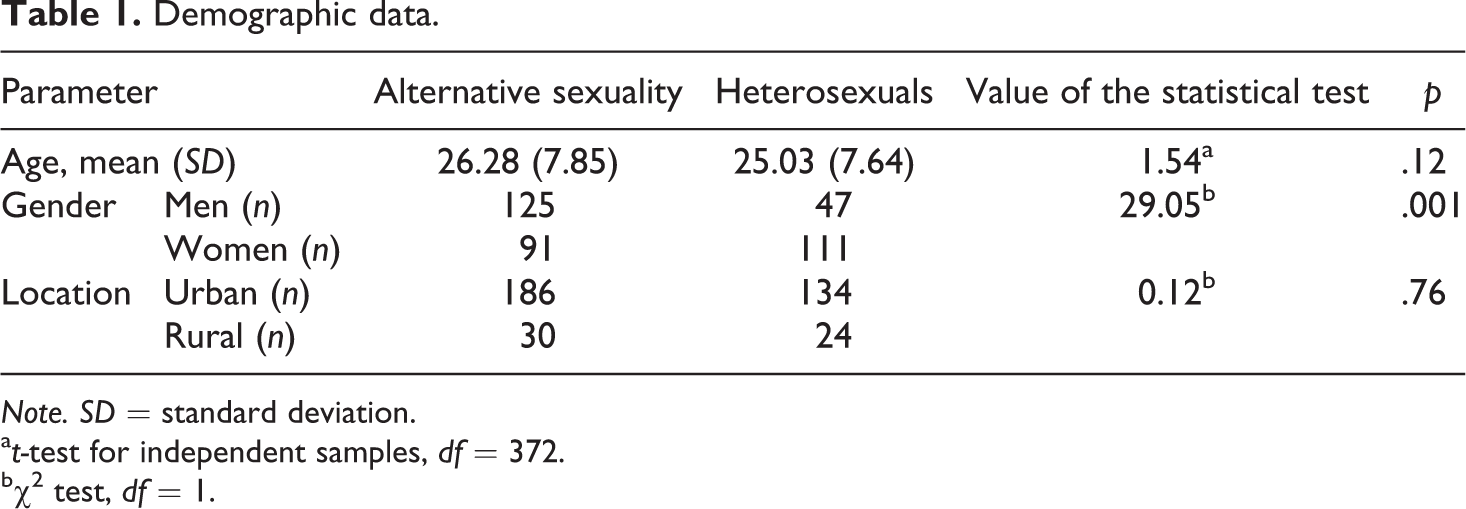
From those (n = 458) who initially declared interest in the topic of our study, 84 (18.34%) were excluded, as they did not comply with the inclusion criteria. The most frequent reasons for exclusion were age and confusion regarding sexual identity (with all the participants with questioning sexual identity not meeting the criterion of age). Finally, 374 respondents (202 women and 172 men; mean age = 25.75, SD = 7.78) participated in the study. Of these, 216 (57.76%) identified themselves as being LGB: 155 (41.44%) homosexuals and 61 (16.31%) bisexuals and were included into the study group. The other 158 participants (42.24%) declared themselves as heterosexual and comprised the control group. There were no significant differences between the two groups in terms of mean age and location. However, a certain asymmetry of the two groups emerged concerning gender, with a greater percentage of women in the heterosexual group. The whole set of collected demographic data is presented in Table 1.
Demographic data.
Note. SD = standard deviation.
at-test for independent samples, df = 372.
bχ2 test, df = 1.
In all, 111 participants (29.67%; 46 men and 65 women) had a secure attachment style, whereas 263 (70.32%) had an insecure attachment style (126 men and 137 women). From those with an insecure attachment style, 174 (66.15%) belonged to the LGB group (101 men and 73 women). In this group, as a whole, the most prevalent type of attachment was fearful-avoidant (n = 99; 45.8%), followed by fearful-dismissive (n = 43; 19.9%), secure (n = 42; 19.4%), and anxious (n = 32; 14.8%). In contrast, in the heterosexual group, the prevalence of attachment was, in decreasing order, secure (n = 69; 43.7%), fearful-avoidant (n = 36; 22.8%), fearful-dismissive (n = 35; 22.2%), and anxious (n = 18; 11.4%).
Statistical analysis
Comparative assessment of depression among the two groups
As the condition of normal distribution was not met, the Mann–Whitney test was utilized to evaluate the significance of depression differences. The depression scores of the LGB individuals were significantly higher than those of heterosexuals (mean = 16.78, SD = 13.53 vs. mean = 11.62, SD = 10.25; U = 12.99, Z = −4.14, p < .0001; effect size r = .21). This finding was confirmed also when considering in the comparison only depression as a clinically manifest variable. In the LGB group, there were 57 (26.38%) individuals with severe depression and 46 (21.29%) with medium depression, whereas in the heterosexual group, the number of depressed individuals was much lower: 13 (8.22% [severe]) and 29 (18.35% [medium]), χ2(3) = 23.13, p < .0001; effect size r = .24.
Comparative assessment of attachment among the two groups
The two groups differed significantly in what concerned their distribution of secure and insecure attachment, with a higher prevalence of insecure attachment in the LGB group, χ2(2) = 25.66, p < .0001; effect size r = .26.
Perceived discrimination among LGB individuals
The scores of self-perceived discrimination were not normally distributed, Kolmogorov–Smirnov test (216) = .182, p < .0001; skewness = −.588, which is relevant for a higher perceived discrimination inside this group (mean = 5.68, SD = 2.58).
Predictors of depression
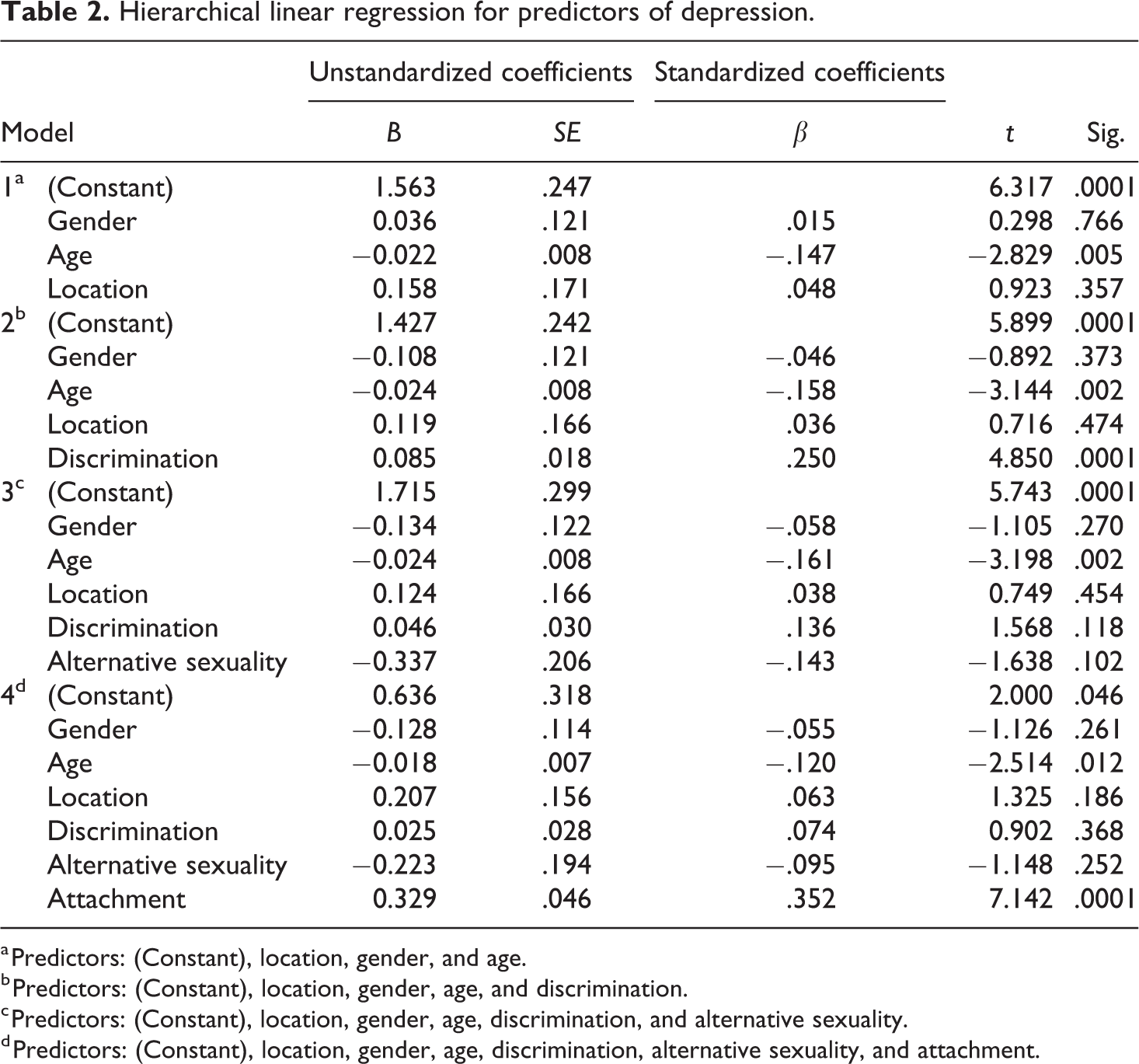
To evaluate the comparative impact of depression predictors, we ran multiple hierarchical linear regressions, in which the independent variables were separated into blocks. Individual demographic variables (gender, age, location) were introduced first, followed by the social variable (perceived discrimination) and individual variables (sexual orientation [coded as heterosexual and LGB] and attachment style [coded as secure and insecure]). To disentangle the distinct impact of sexual orientation and attachment style on depression, they were separated into two distinct blocks.
The final model indicated that attachment style plays the highest predictive role in risk for depression (β = .352, p < .0001). Although displaying a less important role, age can be also considered a significant predictor for depression, especially in young individuals (β = −.120, p < .012; Table 2).
Hierarchical linear regression for predictors of depression.
a Predictors: (Constant), location, gender, and age.
b Predictors: (Constant), location, gender, age, and discrimination.
c Predictors: (Constant), location, gender, age, discrimination, and alternative sexuality.
d Predictors: (Constant), location, gender, age, discrimination, alternative sexuality, and attachment.
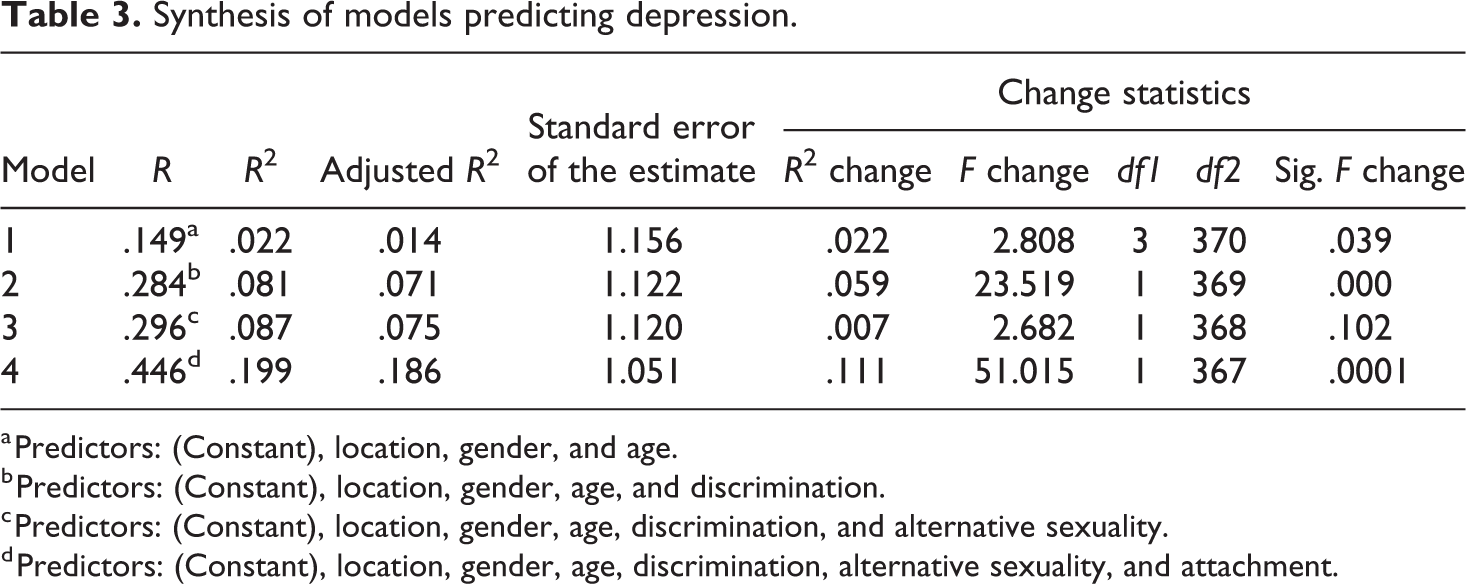
The models’ summary reveals that the introduction of attachment into the statistical analysis increased the proportion of explained depression variance from 7.5% to 18.6%, with all the other categories of predictors playing a much more modest role (Table 3).
Synthesis of models predicting depression.
a Predictors: (Constant), location, gender, and age.
b Predictors: (Constant), location, gender, age, and discrimination.
c Predictors: (Constant), location, gender, age, discrimination, and alternative sexuality.
d Predictors: (Constant), location, gender, age, discrimination, alternative sexuality, and attachment.
The comparative importance of attachment among the other independent variables is emphasized by the fact that it has a direct predictor effect on depression and not mediated by the sexual orientation. This was shown by the outcome of a moderation analysis we ran to assess the possible effects of attachment type on the relationship between depression scores and LGB identity. This analysis showed a direct significant effect of attachment type, t(370) = 7.55, p < .0001, and no significant effect of the interaction LGB × Attachment, t(370) = −.99, p < .32.
Gender-related differences in the LGB group
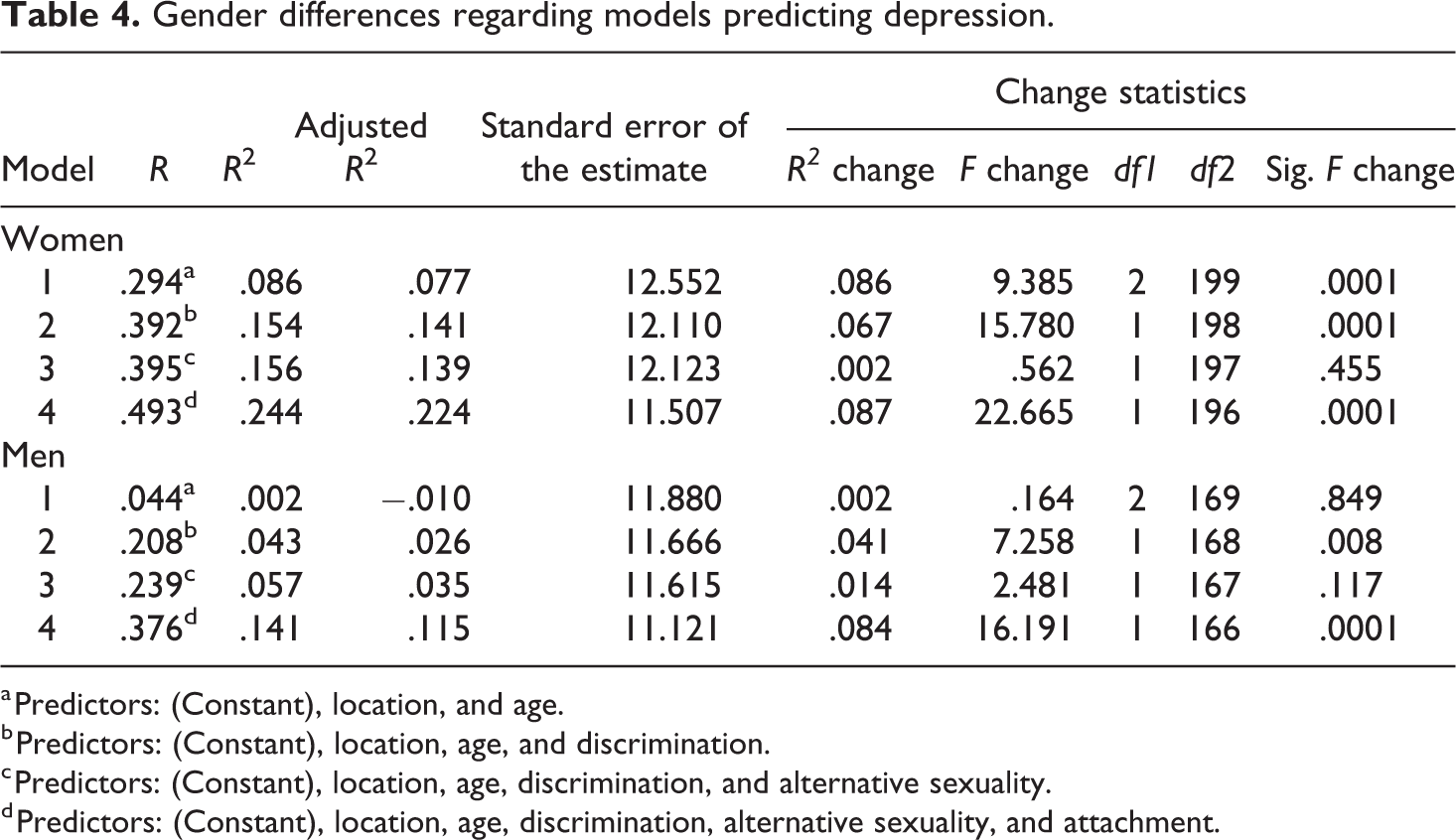
No significant gender-related differences were found concerning the distribution of attachment styles in the LGB group, χ2(3) = .134, p < .987; effect size r = .02. For both men and women, the descending hierarchy of attachment styles prevalence was fearful-avoidant, dismissive-avoidant, secure, and anxious (45.04%, 20.87%, 19.78%, and 14.29% in women; 46.4%, 19.2%, 19.2%, and 15.2% in men). Also, no differences were found regarding the role of attachment style in predicting depression in LGB women, compared to LGB men (the increase in the percentage of explained depression variance was similar) (Table 4).
Gender differences regarding models predicting depression.
a Predictors: (Constant), location, and age.
b Predictors: (Constant), location, age, and discrimination.
c Predictors: (Constant), location, age, discrimination, and alternative sexuality.
d Predictors: (Constant), location, age, discrimination, alternative sexuality, and attachment.
In the LGB group, perceived discrimination was not influenced by gender: t(214) = −.613, p < .54; effect size (Cohen’s d) = .08. The level of perceived discrimination among LGB participants was also found to be similar for all of the sexual orientations considered in the study (F = 1.095, p < .336; partial η2 = .01).
Discussion
In the current study, we investigated the relationships between attachment style, perceived discrimination, and depression in young homosexual, lesbian, and bisexual adults. Our results confirm that there is indeed an association, in the sense that LGB individuals are more prone to depression. Even though depression (both as a measurable parameter and as a clinical symptom) was higher in the study group, it was attributable mainly to attachment style rather than to sexuality itself. In support of this conclusion, we noticed that depression in LGB participants was predicted by the attachment type across the entire sample (independently of sexual orientation).
This study sustains previous literature data which identify the attachment style developed during the first years of life as being highly important for the normal cognitive and emotional growth of the individual (Mikulincer & Florian, 2001). In this regard, we consider that the therapeutic approach of young LGB patients with depression should be based on a complex personality assessment, including the type of attachment. The individuals with insecure attachment could substantially benefit from psychological counseling or psychotherapy centered on their issue rather than on the origins or manifestations of their sexuality. The importance of addressing problems of attachment in this tailored, personalized manner is consistent with findings from previous studies (Diamond et al., 2011; Ross, Doctor, Dimito, Kuehl, & Armstrong, 2007).
Indirectly, this result promotes the idea of implementing parenting programs addressing the potential risks derived from the development of insecure attachment in young individuals, especially in disorganized families, still numerous in Romania. This kind of programs should be made available on a larger scale throughout the country and complement the measures destined to improve the social services for the youth and their access to psychological assistance for depression.
An additional predictor that emerged as being significant for depression in LGB individuals was age. Specifically, low age was associated to higher depression. This finding is consistent with previous literature data (Bybee, Sullivan, Zielonka, & Moes, 2009; Shilo & Savaya, 2012) and represents a supplementary reason for implementing preventive strategies and screening for depression at young LGB.
The perceived discrimination level in the LGB group was higher than average. This finding was independent of the participants’ gender and indicates perceived discrimination (be it implicit or explicit) as a rather universal problem which LGB individuals confront. This result also confirms previous national research (Leluţiu-Weinberger & Pachankis, 2017), which identified discrimination toward members of this group as a frequent phenomenon in Romania. Deeply rooted, cisnormative mentalities, traditions, and conservative values may contribute to the onset and continuation of discrimination and be themselves a subject of interest for future research, especially since the Romanian literature in this field is still scarce. In this sense, the identification of those factors that contribute the most to perceived discrimination could represent the beginning of a more substantial awareness at the societal level regarding the needs and personal experiences of LGB individuals.
We did not identify gender differences related to the variables of this study. This result is important, as it shows certain uniformity in what concerns the problems members of the LGB community confront. Depression, insecurity, and perceived discrimination are, at least in the Romanian context, independent on one’s particular sexual orientation inside the LGB group. This finding may suggest identical mechanism for emotional regulation in these individuals but could also potentially contribute in dismantling certain lay stereotypes concerning the “acceptable” or “less acceptable” sexual orientations of LGB individuals.
Limitations
The limitations of this article stem mainly from its cross-sectional design, which could be addressed by a follow-up study, on a larger population, with the aim of improving this analysis. The sexual identity itself was self-evaluated, this being an additional limit in participant selection. Also, the preliminary selection of participants was conducted online, thereby narrowing the range of selection. Still, this kind of procedure was to some extent necessary, as it offered more anonymity to participants who would have been otherwise reluctant to admit their sexual orientation.
Conclusion
The relevance of our findings for clinical practice stem from the current social context in Romania, where there is still a public lack of knowledge about the problems with which LGB people may have to cope. Despite efforts by numerous nongovernmental organizations in the public arena, evidence-based research which could legitimize these efforts is still scarce. In this respect, this study exposes the presence of an insecure attachment style and of perceived discrimination in the lives of young depressed LGB individuals. These results could be the starting point for a local initiative which may better direct the community and political efforts aimed toward understanding and addressing the needs of these persons. Also, they can stand as an argument for physicians when addressing depression in LGB patients to not label it erroneously as being the result of their sexual practices per se. The study reinforces the idea of a tolerant and supportive attitude of medical practitioners toward patients’ sexual choices, an element that should be included in the basic standard of everyday practice and as a reliable criterion for good quality medical services.
Footnotes
Funding
The author(s) received no financial support for the research, authorship, and/or publication of this article.
Open research statement
As part of IARR’s encouragement of open research practices, the authors have provided the following information: This research was not pre-registered. The data used in the research are not available. The materials used in the research are not available. Data and materials are not available due to participants’ confidentiality concerns of the Romanian minority group targeted by this study.