







Abstract
The role of contextual stressors, such as economic stress, in the development of positive outcomes among adolescents is an important area of inquiry. The current study aimed to examine the links between economic stress and low-income adolescents’ prosocial behaviors (i.e., actions that benefit others) via mothers’ use of material and social rewards. Participants were 311 adolescents (M age = 16.10 years; 58.7% girls) who reported on their own economic stress experiences, mothers’ use of material and social rewards, and their tendency to engage in six forms of prosocial behaviors. The results demonstrated complex links between stressors, parenting practices, and prosocial behaviors depending on adolescent gender. Discussion focuses on the role of contextual and familial factors in shaping low-income adolescents’ sociobehavioral outcomes.
Scholars have suggested that stressful experiences are important predictors of adolescents’ maladjustment (Conger et al., 1992; Lazarus & Folkman, 1984). One salient form of stress for many families is economic stress (i.e., pressures and resulting from inadequate resources). In 2013, there were 4.5 million people living in poverty in the U.S., including 19.9% of all children in the U.S. (US Census Bureau, 2014). With the large number of children and families living in poverty with limited access to financial support, it is important to understand how economic disadvantage contributes to adolescents’ negative outcomes, and there is a substantive body of research on this topic (e.g., Conger et al., 1992; Kim, Conger, Elder, & Lorenz, 2003; Ponnet, 2014). However, much less is known regarding the factors associated with economic stress that might promote positive adjustment in adolescents. Research on these factors and on positive social adjustment in youth from low-income households is needed to develop more effective interventions aimed at fostering such positive sociobehavioral outcomes in this vulnerable population.
One marker of positive social adjustment is prosocial behaviors. Prosocial behaviors are defined as actions intended to benefit others and include helping behaviors such as volunteering, comforting others, and donating time or resources (Carlo & Randall, 2002; Eisenberg & Miller, 1987). These behaviors are indicators of health and well-being and are also important for a flourishing society (see Randall & Wenner, 2014). There is evidence, for example, that prosocial behaviors among youth are positively associated with academic performance (Caprara, Barbaranelli, Pastorelli, Bandura, & Zimbardo, 2000), social competence and healthy relationships, and physical and mental health (Carlo, 2014; Laible, Carlo, & Roesch, 2004). However, these actions require an orientation toward the needs of others and a care-based response to assist or alleviate suffering in others. Such requirements could be challenging for youth who may themselves be quite needy and facing difficulties from the stressful consequences of economic strain. Indeed, despite the prevalent existing research on prosocial development in youth, investigations of prosocial development among youth from low-income households are relatively rare. Therefore, the present study was designed to address specific limitations in the current literature on stress and adolescent adjustment. First, the current study examines the associations between economic stress and indicators of positive adjustment (prosocial behaviors) among low-income adolescents which will provide important information on the role of stress in shaping prosociality to better foster resilience for youth under conditions of stress. Second, the current study examines the mediating role of parenting practices to utilize a systems approach to better understand the role of stress in family processes.
Multidimensionality of prosocial behaviors
Recently, researchers have suggested that prosocial behaviors are complex and multidimensional and should not be examined as a unidimensional or global construct (see Padilla-Walker & Carlo, 2014). Carlo and Randall (2002) proposed six forms of prosocial behaviors that are common among adolescents and young adults: emotional, dire, compliant, anonymous, public, and altruistic. Emotional prosocial behaviors are helping behaviors expressed in emotionally evocative situations, such as comforting another. Dire prosocial behaviors refer to helping in crisis situations. Compliant prosocial behaviors include helping when others ask for help. Anonymous prosocial behaviors include helping without the knowledge of others, such as donating time or resources. Public prosocial behaviors are helping behaviors done in the presence of others. Finally, altruistic prosocial behaviors include helping with little to no expected benefit to the self (Carlo & Randall, 2002). Because public helping is conducted with the knowledge that others are watching, it is thought to be relatively more self-serving and there is evidence that such helping might be motivated by gaining others’ approval (Carlo, Hausmann, Christiansen, & Randall, 2003). Altruistic helping, on the other hand, is a relatively selflessly motivated form of helping because there is little or no expected benefit to the helper. Indeed, this latter form of helping has been linked to altruistic resource allocations in a behavioral task measure (Benenson, Pascoe, & Radmore, 2007). Other research has consistently yielded evidence that these forms of helping are distinct, and somewhat related, constructs (see McGinley, Opal, Richaud, & Mesurado, 2014). Therefore, an additional purpose of the present study was to examine whether economic stress and parental rewards were differentially related to these specific forms of prosocial behaviors among low-income adolescents.
Economic stress and prosocial behaviors
Scholars suggest that family-level stress predicts family functioning and ultimately the social behaviors of youth. The family stress model, for example, asserts that stressful experiences impact parents’ psychological functioning, which results in reduced parenting quality and increased behavioral problems for youth (Conger et al., 1992). This model primarily considers the influence of stress on maternal depression, which subsequently results in more controlling, less warm parenting and increased levels of conflict within the family (Conger et al., 1992). Therefore, considering the links among economic stress, parenting behaviors, and adolescents’ social behaviors is an important avenue of research. The current study aimed to extend the literature by examining the links between economic stress and adolescents’ prosocial behaviors via specific parenting practices (i.e., material and social rewards).
Economic stress, which refers to objective (e.g., employment status, income) and subjective (e.g., perceived financial strain) stressors, may impact adolescents’ prosocial behaviors. When a family is experiencing high levels of economic stress and the limited resources associated with living in low-income communities, adolescents may become focused on their own needs and the needs of the family and may be less inclined to engage in prosocial behaviors, particularly prosocial behaviors that require an additional cost to the self (i.e., altruistic helping). Economic stress may not necessarily be negatively linked to all forms of prosocial behaviors. The altruism born of suffering concept (Staub & Vollhardt, 2008) suggests that when individuals experience stress, they may become sensitive to the needs of others and may be inclined to engage in behaviors aimed at helping others (McGinley et al., 2010). It may be that economic stress promotes an understanding of the awareness of others, which may contribute to specific forms of helping, particularly forms that require an emotional connection with others (such as emotional and dire).
The majority of the existing research on economic stress and adolescents’ behavioral outcomes has focused on negative adjustment indices, such as internalizing and externalizing behaviors and has supported positive links between this form of stress and negative behavioral outcomes (Conger, Ge, Elder, Lorenz, & Simons, 1994; Guerra, Huesmann, Tolan, Van Acker, & Eron, 1995; Gutman, McLoyd, & Tokoyawa, 2005; Parke et al., 2004; Wadsworth & Compas, 2002). However, to date, few researchers have examined the links between economic stress and indicators of positive adjustment. One study demonstrated that economic stress was indirectly and negatively associated with prosocial behaviors (Carlo, Padilla-Walker, & Day, 2011). Specifically, in a sample of majority European American adolescents from families of middle to high socioeconomic status (SES), economic stress was indirectly, negatively associated with prosocial behaviors via parental depression and parent–child connectedness (Carlo et al., 2011). Importantly, this study examined prosocial behaviors toward family, friends, and strangers but did not examine multiple types of helping, so comparability of studies is difficult. In a recent study of U.S. Latino/a families, economic stress was directly, positively related to altruistic prosocial behaviors but negatively related to public prosocial behaviors (Davis, Carlo, Streit, & Crockett, 2017). Additionally, economic stress has been indirectly, negatively associated with other indicators of youth positive adjustment (academic performance and positive classroom behavior) in African American youth (Conger et al., 2002; Wadsworth & Compas, 2002).
Economic stress and maternal rewards
Economic stress is a pervasive stressor that often impacts the family unit, including youth (see Elder & Caspi, 1988). Parents who are experiencing high levels of stress may become overwhelmed and depleted of the cognitive and emotional resources necessary to effectively engage with their adolescents, which may ultimately lead to poor behavioral outcomes among youth, as demonstrated by the family stress model (Conger et al., 1992). The family stress model suggests that economic stressors are associated with reduced parenting quality via parents’ mental health, ultimately impacting the social outcomes of youth (Conger et al., 1992, 2002; Grant et al., 2000; Mistry, Lowe, Benner, & Chien, 2008). Stress has been consistently associated with parenting styles and parental discipline (e.g., Conger et al., 1994, 2002; Gutman & Eccles, 1999). However, examining specific parenting practices that parents tend to rely on, as opposed to broad styles or dimensions, may be a useful alternative to understand how stressful experiences are associated with specific parenting behaviors that may ultimately predict adolescents’ outcomes. One parenting practice that is common among parents of adolescents is parental use of rewards to encourage desirable behaviors in youth (Carlo, McGinley, Hayes, Batenhorst, & Wilkinson, 2007). Two common rewards used by parents are material (e.g., money, prizes) and social (e.g., praise) rewards. Scholars have emphasized the importance of examining specific practices that might reflect broader parenting dimensions, such as warmth (see Grusec, Goodnow, & Kuczynski, 2000). For example, parents who notice adolescents’ positive behaviors and effectively engage in reward methods may be conveying warmth to their youth through this specific parenting practice.
Stressful experiences may influence the degree to which mothers rely on social and material rewards. Mothers who are experiencing stress may be less likely to use social rewards because their cognitive and emotional resources are depleted, and these mothers may be more focused on dealing with their own stress rather than attending to their children’s social behaviors. Thus, when their children behave appropriately, mothers who are chronically stressed may be less able to allocate social rewards. With regard to the relations between stress and use of material rewards, there are at least two possibilities. On the one hand, material rewards may provide a simpler and quicker alternative for parents who are experiencing stress; thereby, stress might lead to greater propensity to use material rewards. On the other hand, stress exposure for parents might lead to less use of material rewards because parents may not have sufficient resources to provide to their children. The link between family stress and maternal rewards has not been examined; however, there is evidence that economic stress predicts lower levels of other forms of positive parenting (e.g., warmth, support) and more negative parenting (e.g., hostile control, poorer quality of parent–child relationship), in general (Conger et al., 2002; see Webster-Stratton, 1990). Given these previous findings and the overall positive correlates of social rewards and negative correlates of material rewards (see below), we expected economic stress to negatively predict social rewards and positively predict material rewards.
Maternal rewards and prosocial behaviors
Social and material rewards are linked to different motivations associated with social behaviors. According to self-determination theorists, intrinsic and extrinsic motivations differentially predict behaviors (see Ryan & Deci, 2000). Intrinsic motivation is defined as engaging in behaviors because of an innate desire to do so, while extrinsic motivation is defined as engaging in behavior because of reinforcing factors outside of the individual, such as material rewards (see Ryan & Deci, 2000). Adolescents who are externally motivated to engage in positive behaviors, therefore, may only do so when there is an external reward present, ultimately undermining any intrinsic desire to engage in selfless helping behaviors (e.g., altruistic behaviors) as well as social cognitions and emotions that may foster such behaviors. Material rewards, however, may actually foster selfishly motivated prosocial behaviors (e.g., actions intended to gain the approval of others) because of the self-serving motivations behind such behaviors. Thus, providing material rewards to youth may reduce their intrinsic motivation to engage in other-oriented forms of prosocial behaviors and, therefore, may be detrimental to such behaviors over time (Bénabou & Tirole, 2005). In contrast, providing social rewards when children behave positively may foster internalized notions of being a good person and encourage youth to engage in other-oriented behaviors and promote associated social cognitions and emotions.
Research with young children has demonstrated that social rewards can promote prosocial action, while material rewards may undermine such behaviors, particularly when such rewards are no longer present (Fabes, Fultz, Eisenberg, May-Plumlee, & Christopher, 1989; Grusec & Redler, 1980). The relevant studies on parents’ use of rewards and adolescents’ prosocial behaviors are sparse, and the findings are mixed. One study demonstrated positive links between social rewards and both emotional and public prosocial behaviors, and a negative link between material rewards and altruistic prosocial behaviors (Carlo et al., 2007). Similarly, in a sample of adolescents from Argentina, material rewards were negatively associated with altruistic prosocial behaviors and positively associated with public and anonymous prosocial behaviors (Richaud, Mesurado, & Lemos, 2013). However, a cross-cultural study of adolescents in Spain and the U.S. showed that material rewards were positively associated with emotional, compliant, dire, and public prosocial behaviors, while social rewards were positively associated with public, anonymous, dire, compliant, and emotional prosocial behaviors (Carlo, Samper, Malonda, Tur-Porcar, & Davis, 2016).
Consistent with intrinsic and extrinsic motivation theories, these studies generally suggest that material rewards are negatively associated with altruistic prosocial behaviors, whereas social rewards appear to be positively related to multiple forms of prosocial behaviors. However, comparability across previous existing studies is challenging, given the distinct ethnic and cultural characteristics of the samples. Furthermore, firm interpretations of previous research on the relations between parents’ use of reward practices and prosocial behaviors are difficult, given the few existing studies. In addition, prior research examining relations between use of rewards and children’s prosocial behaviors have been conducted in mostly White, middle- to upper-class samples. Research on relatively diverse and low-SES samples of youth is desirable to test the generalizability of such findings. Therefore, the current study aimed to extend the literature by investigating the links between two forms of rewards (i.e., material and social) and six forms of prosocial behaviors among adolescents who reside in a low-resource community.
Gender moderation
It is also important to consider potential gender differences when examining the influence of family stress on parenting practices and prosocial behaviors. Stress theories suggest that boys and girls may respond differently to stressful events (Taylor et al., 2000). Boys may be more likely to respond with a “fight or flight” mentality, whereas girls may be more likely to seek out social support and emotional closeness (Taylor et al., 2000). Based on this previous theorizing, girls may be more likely to respond to stress by engaging in prosocial behaviors because of the desire for social interaction. Boys, however, may be more likely to engage in aggressive behaviors or avoid contact with others during stressful times (Taylor et al., 2000). Prior research has also consistently demonstrated gender differences in prosocial behaviors among adolescents. Specifically, in previous work examining prosocial behaviors, girls were more likely to report engaging in selfless and emotional forms of prosocial behaviors, while boys reported engaging in more public forms of prosocial behaviors (Carlo et al., 2003). Because of the established gender differences in stress responses and prosocial behaviors, the present study also examined whether the hypothesized relations differed for boys and girls.
Method
Participants and procedures
Adolescents were recruited from a public high school in a Missouri community (population of approximately 76,780; Suburban Statistics, 2017). The high school is situated in a working-class, low-resource area of the broader metropolitan community (median income = US$35,062; City Data, 2017). While the community is predominantly European American, the Latino population is significantly higher than the state average (City Data, 2017). The attendance rate at this particular school was below the state average, and approximately 61% of students qualify for the free or reduced lunch program (Missouri Department of Elementary and Secondary Education [DESE], 2017). Additionally, fewer than half of students enter a 4-year University after graduating (DESE, 2017). The final sample consisted of 311 adolescents (M age = 16.10 years; range = 14–19 years; 58.7% girls; 82.7% European American; 13.6% Latino/a). Adolescents reported on their mothers’ education as an indicator of SES (9.7% some high school, 34.5% high school, 20.6% some college, 19.7% college). Parental consent forms and recruitment letters were sent home with all students who were in class on the recruitment day. The students who returned their parental consent forms were eligible to participate in the study, and the majority of students returned the consent forms. All students with parental consent chose to participate in the study. Data were collected during classes at the high school. Students who were not participating were allowed to work on an alternative assignment.
Measures
Economic stress
Adolescents completed a measure of objective and subjective economic strain (Conger et al., 1992). The adolescents completed 8 items assessing subjective economic stress. A sample item is, “There is no money left over to do something fun as a family.” The adolescents rated the items on how often they occurred in the last 6 months from 0 = not at all to 3 = almost every day. There were 5 items used to assess objective economic stress. These items included questions such as, “Has your parent lost a job?” The scales were combined to create an economic stress score (α = .91). This scale has been used in diverse samples of adolescents, including adolescents from low-income populations, and has demonstrated consistently good reliability and convergent validity across studies (e.g., Gutman et al., 2005; Yoder & Hoyt, 2005).
Maternal rewards
Adolescents completed a measure of their mothers’ typical use of material and social rewards (Prosocial Practices Measure [PPM]; Carlo et al., 2007). The material rewards subscale consists of 5 items (α = .85). A sample item is, “Your mother buys you a gift for doing something nice to someone.” The social rewards subscale consists of 4 items (α = .89). A sample item is, “Your mother praises you when you help someone in need.” Adolescents rated items on a 5-point scale from 1 = does not describe my parent well to 5 = describes my parent very well. The PPM has demonstrated good reliability and convergent and divergent validity when used with diverse groups of adolescents (Calderón-Tena, Knight, & Carlo, 2011; Carlo et al., 2007). Additionally, this measure was developed after utilizing focus groups with both European American and Mexican American adolescents (Calderón-Tena et al., 2011; Carlo et al., 2007).
Prosocial behaviors
Adolescents completed the Prosocial Tendencies Measure–Revised (PTM-R; Carlo et al., 2003), which assessed adolescents’ tendency to engage in six forms of prosocial behaviors. Adolescents rated items from 1= does not describe me well to 5 = describes me greatly. Dire prosocial tendencies (3 items; α = .76) include helping others in emergency situations. A sample item is, “I tend to help people who are in real crisis or need.” Emotional prosocial tendencies (5 items; α = .86) include helping behaviors in emotionally evocative situations. A sample item is, “It makes me feel good when I can comfort someone who is really upset.” Compliant prosocial tendencies (2 items; α = .77) include helping when asked. A sample item is, “I never wait to help others when they ask for it.” Public prosocial behaviors include helping in front of others (3 items; α = .64). A sample item is, “When other people are around, it is easier for me to help others in need.” Altruistic prosocial behaviors include helping with no expected reward (4 items; α = .74). A reverse-scored sample item is, “I believe I should receive more rewards for the time and energy I spend on volunteer service.” Anonymous prosocial behaviors include helping without the knowledge of others (4 items; α = .74). A sample item is, “I think that helping others without them knowing is the best type of situation.” The PTM-R has consistently demonstrated good internal reliability (Cronbach’s α = .59–.86), test–retest reliability, convergent validity, and discriminant validity (Carlo et al., 2003). Additionally, previous research has demonstrated that the six subscales are invariant among boys and girls and European American and Mexican American adolescents (Carlo, Knight, McGinley, Zamboanga, & Jarvis, 2010).
Analytic plan
Path analyses were conducted using maximum likelihood estimation in Mplus, version 7 (Muthén & Muthén, 2010) to examine the direct and indirect associations between economic stress, maternal use of material and social rewards, and adolescents’ prosocial behaviors. The model included economic stress as the exogenous variable, which was set to predict maternal use of material and social rewards. Material and social rewards were set to predict adolescents’ prosocial behaviors. All direct paths from economic stress to prosocial behaviors were also included. Adolescents’ age, race, and maternal education were entered as statistical controls. Results are presented in Figure 1. Model fit is considered good in path analysis if the comparative fit index (CFI) is .95 or greater (fit is adequate at .90 or greater), and the root mean square error of approximation (RMSEA) is less than or equal to .06 (values of .08 or less indicate adequate fit; Byrne, 2010; Hu & Bentler, 1999). Fit for the overall model was good: χ2(11) = 13.15, p = .28; CFI = 1.00; RMSEA = .03; standardized root mean square residual (SRMR) = .02. To examine gender differences in the models, each path was constrained to be equal across the two groups (boys and girls). A χ2 difference test was conducted to examine whether the constrained and unconstrained models were significantly different.
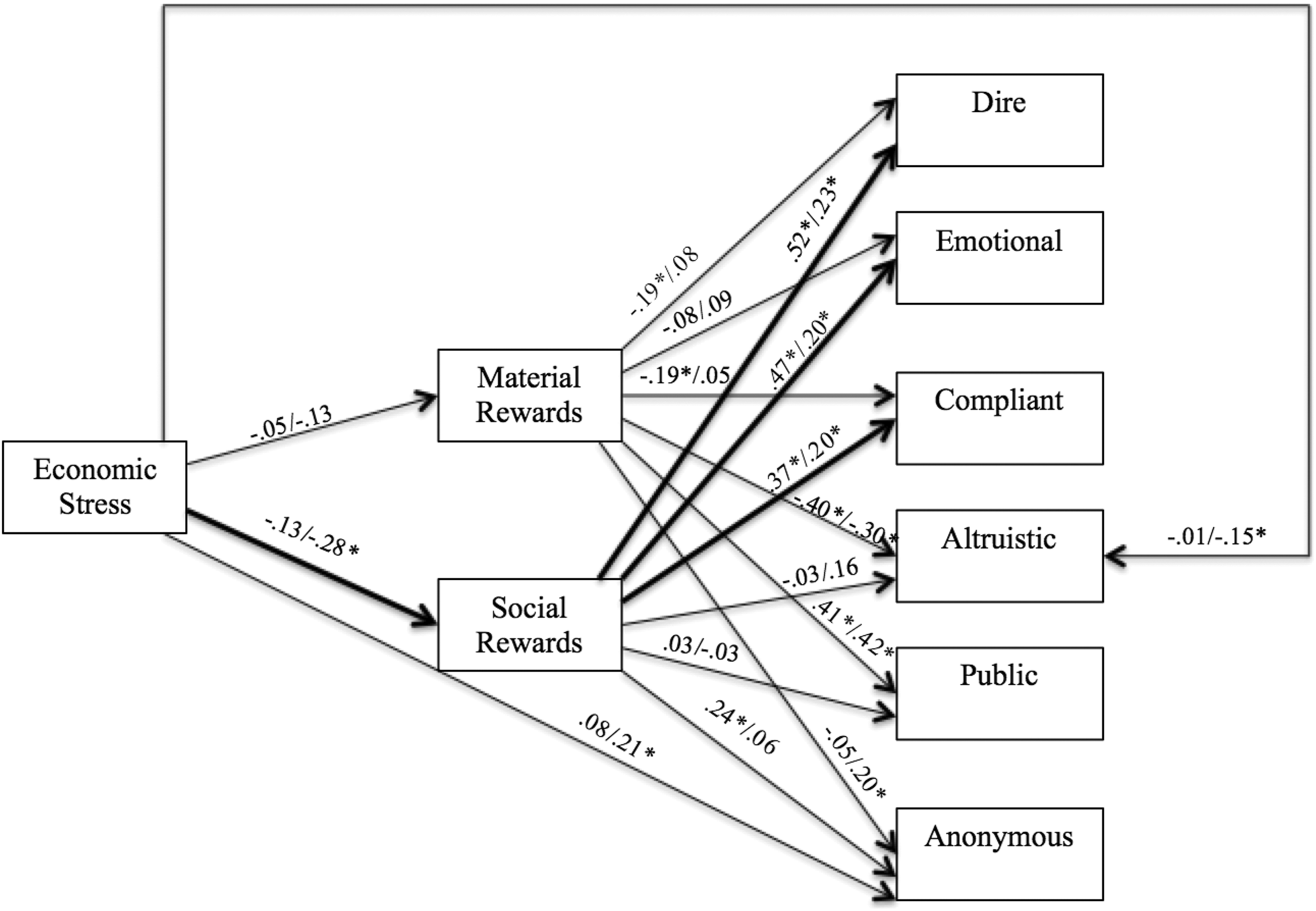
Standardized coefficients for the associations between economic stress, material rewards, social rewards, and prosocial behaviors. Results are presented for boys/girls. All direct paths were included, but only significant direct paths from rewards to prosocial behaviors are depicted. *p = .05. Significant indirect effects are bolded.
Results
Descriptives and correlations
Descriptive statistics and bivariate correlations were examined among the main study variables (see Table 1). For boys, the results demonstrated that economic stress was positively related to dire prosocial behaviors. Material rewards were positively associated with social rewards. Material rewards were also negatively associated with altruistic prosocial behaviors and positively associated with public prosocial behaviors. Social rewards were positively associated with dire, compliant, emotional, public, altruistic, and anonymous prosocial behaviors. There were also interrelations among the prosocial behaviors in the expected directions. For girls, economic stress was negatively associated with social rewards. Material rewards were positively associated with social rewards, dire, compliant, emotional, public, and anonymous prosocial behaviors and negatively associated with altruistic prosocial behaviors. Social rewards were positively associated with dire, compliant, emotional, and public prosocial behaviors. Again, there were also interrelations among the prosocial behaviors in the expected directions.
Descriptive statistics and bivariate correlations among economic stress, parental rewards, and prosocial behaviors.
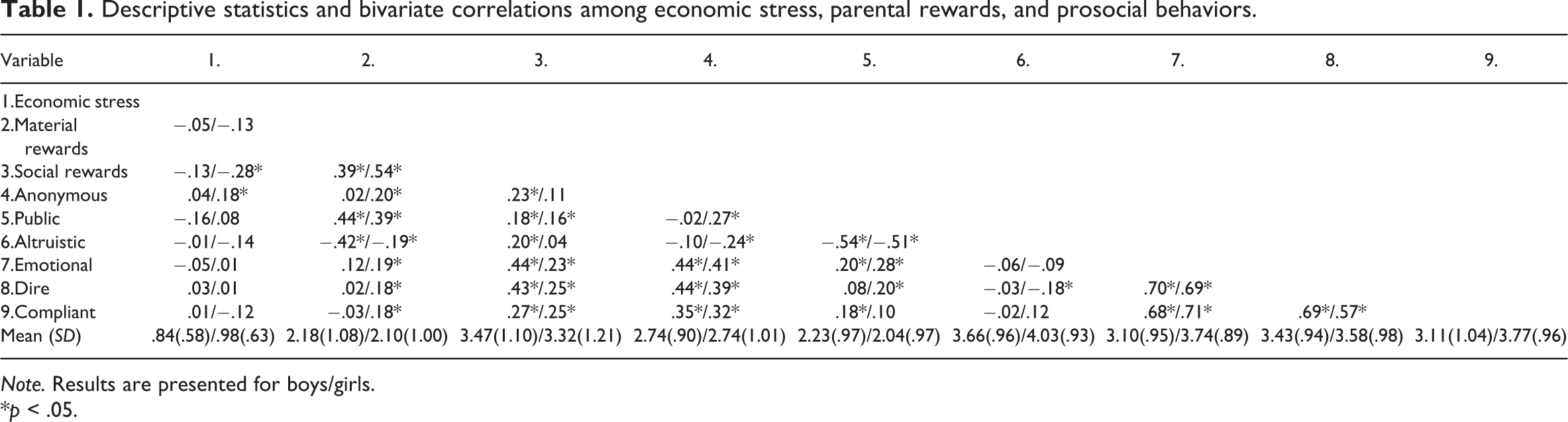
Note. Results are presented for boys/girls.
*p < .05.
A series of analyses of variance were conducted to examine mean-level gender differences in the main variables. Results demonstrated that girls reported significantly higher levels of compliant helping, t(246.67) = −5.61, p < .001; emotional helping, t(248.69) = −5.86, p < .001; and altruistic helping, t(253.51) = −3.36, p = .001, than boys. Girls also reported higher levels of economic stress than boys, t(271.75) = −1.98, p = .05 (see Table 1 for means of all main study variables).
Path analysis results
Initially, we conducted path analyses for the full model across the whole sample. Model fit was good, χ2(11) = 13.15, p = .28; CFI = 1.00; RMSEA = .03; SRMR = .02. Next, we conducted gender difference tests to examine whether gender differences exist in the model to determine whether the results should be presented for the whole sample or separate by gender. As hypothesized, the results revealed gender differences in the relations among economic stress, parenting practices, and adolescents’ prosocial behaviors. The results of the moderation by gender analyses demonstrated that the constrained model, CFI = .98; RMSEA = .07; SRMR = .05; χ2(28) = 48.11, p = .01, and the unconstrained model, CFI = .99; RMSEA = .08; SRMR = .03, χ2(8) = 16.57, p = .03, were significantly different, Δχ2(20) = 31.54, p = .05. Next, χ2 difference tests were conducted on each specific path to examine the paths that differed for boys and girls. The results demonstrated that the following paths were significantly different for boys and girls: material rewards to dire prosocial behaviors, Δχ2(1) = 4.13, p = .04; social rewards to dire prosocial behaviors, Δχ2(1) = 6.12, p = .01; social rewards to emotional prosocial behaviors, Δχ2(1) = 6.05, p = .01; and material rewards to anonymous prosocial behaviors, Δχ2(1) = 4.03, p = .04. Because of the established gender differences, results are presented separately for boys and girls.
For girls only, economic stress was directly negatively associated with altruistic prosocial behaviors and positively associated with anonymous prosocial behaviors (see Figure 1 for all path coefficients). There were no direct links between economic stress and prosocial behaviors for boys. We hypothesized that economic stress would positively predict material rewards and negatively predict social rewards, and these hypotheses were partially supported. The results demonstrated that for boys, economic stress was not associated with maternal rewards, and for girls, economic stress was negatively associated with social rewards. As hypothesized, social rewards were positively related to emotional, dire, compliant, and anonymous prosocial behaviors for both boys and girls. For boys, material rewards were positively related to public prosocial behaviors and negatively related to dire, compliant, and altruistic prosocial behaviors, as hypothesized. For girls, material rewards were negatively associated with altruistic prosocial behaviors and positively associated with public and anonymous prosocial behaviors.
Indirect effects
Mediation tests using maximum likelihood with robust standard errors were also conducted. For boys, there were no significant indirect effects. However, for girls, there were three significant specific indirect effects: economic stress to dire prosocial behaviors via social rewards (β = −.06; SE = .03; p = .03), economic stress to emotional prosocial behaviors via social rewards (β = −.06; SE = .03; p = .05), and economic stress to compliant prosocial behaviors via social rewards (β = −.06; SE = .03; p = .05).
Discussion
The results of the current study extend existing theoretical models on family stress and adolescents’ positive social development by demonstrating the indirect role of specific parenting practices (i.e., use of social rewards) in the links between economic stress and adolescents’ prosocial behaviors among a low-income sample of adolescents. The family stress model asserts that family stressors, particularly economic stressors, predict lower levels of maternal warmth and increases in harsh parenting (e.g., negativity, conflict; Conger et al., 2002) via mothers’ mental health. The current study extends these prior findings by demonstrating that economic stress may also predict mothers’ use of social rewards and adolescents’ prosocial behaviors, highlighting the importance of examining specific parenting practices in addition to general parenting styles. Moreover, the present findings show a differentiated pattern of relations between economic stress, parental reward practices, and specific forms of prosocial behaviors. Such findings add to the growing evidence that specific forms of prosocial behaviors have distinct predictors and correlates, thereby demonstrating the need for conceptualizing prosocial behaviors in a more nuanced manner. Additionally, given the differentiated pattern of results by adolescents’ gender, the findings highlight the importance of integrating gender-based socialization into existing theories on stress and prosocial development. These results are important in highlighting the pervasive role of stress in the interactions between parents and youth and ultimately positive social behaviors among youth.
The overall pattern of positive links between mothers’ use of social rewards and adolescents’ prosocial behaviors suggest that the use of social rewards might be a beneficial parenting strategy and may be protective for low-income adolescents. There were several positive links between social rewards and distinct forms of prosocial behaviors for both boys and girls. Consistent with previous research, it may be that providing social rewards after youth engage in prosocial behaviors promotes intrinsic motivation for helping others and contributes to an orientation toward the needs and situations of others (see Carlo et al., 2007). Interestingly, social rewards predicted dire, emotional and compliant forms of prosocial behaviors for both boys and girls but anonymous prosocial behaviors for boys only. Although the gender difference in the relations between social rewards and anonymous prosocial behavior requires further research to better understand, the overall findings highlight the relevance of social rewards, which do not require a financial sacrifice from parents, in predicting several common forms of prosocial behaviors. For families living with limited access to resources, these findings are particularly important as parents can focus on promoting their adolescents’ prosocial actions by adopting social praise, love, and approval practices.
Consistent with prior research, material rewards were negatively associated with altruistic prosocial behaviors and positively associated with public prosocial behaviors (Carlo et al., 2007; Richaud et al., 2013). When parents rely on external factors, such as material rewards, adolescents may become dependent on such rewards, which may undermine their social cognitions and emotions, and ultimately prosocial behaviors. Consistent with motivation theories, extrinsic motivation (e.g., use of material rewards) may contribute to self-focused behaviors as opposed to a focus on the needs of others. Therefore, reliance on material rewards may foster prosocial behaviors that are selfishly motivated (public) but may inhibit prosocial behaviors that require a cost to the self (altruistic). Additionally, for boys, material rewards were negatively associated with two other forms of prosocial behaviors (i.e., dire and compliant), but, for girls, these relations were not significant. Dire and compliant prosocial behaviors are forms of helping that might require an emotional connection with others and an ability to suppress one’s own desires to engage in helping. It may be that material rewards, which are associated with extrinsic motivation, actually undermine boys’ engagement in these forms of helping. Girls’ propensity to help under these circumstances might be less affected when parents use material rewards because such actions are closely aligned with gender-role expectations to help when needed and to care for others.
While previous research has demonstrated negative links between economic stress and multiple aspects of parenting (e.g., involvement, warmth, higher levels of harsh control), prior research has not examined the links between economic stress and parental rewards. Of particular interest is the finding that relatively high levels of economic stress were linked to less use of social rewards with girls (but not boys). Moreover, there were significant indirect effects between economic stress and emotional, dire, and compliant prosocial behaviors via social rewards for girls only. Because the majority of primary caregivers in the present study were mothers and because girls tend to report more positive relationships with their mothers and also greater parental awareness (e.g., Hair, Moore, Garrett, Ling, & Cleveland, 2008), one possible explanation is that girls may be more susceptible to changes in mothers’ parenting behaviors than boys. Another possibility is that because girls may be highly oriented to social relationships and concerned with maintaining harmonious relationships (see Rose & Rudolph, 2006), adolescent girls may perceive shifts in their mothers’ use of rewards to a greater degree than boys. Alternatively, the distinct pattern of relations between boys and girls might reflect different parental expectations of boys and girls, such that stressed mothers might attend relatively less to girls than boys because positive social behaviors (e.g., care-based) are consistent with normative and gender-typed expectations (see Gilligan, 1982; Gilligan & Attanucci, 1988).
Contrary to our hypotheses, economic stress was not significantly associated with material rewards. Moreover, use of material rewards did not significantly account for the relations between economic stress and prosocial behaviors. Material rewards may be a quicker, simpler alternative than social rewards, which require emotional resources to engage positively with adolescents. Therefore, economic stress may be relatively more predictive of mothers’ use of social rewards more so than the use of material rewards. The fact that social rewards, but not material rewards, partly accounted for the relations between economic stress and prosocial behaviors might reflect the relatively more frequently reported use of social (overall mean level was 3.38) versus material (overall mean level was 2.14) rewards in low-income families, which may have different enduring effects.
There was also a direct, negative link between economic stress and altruistic prosocial behaviors for girls only. This finding is consistent with previous research among U.S. Latino/a adolescents, which found a negative link between economic stress and altruistic prosocial behaviors (Davis et al., 2017). Previous research has also demonstrated that girls tend to endorse altruistic helping behaviors at higher rates than boys (e.g., Carlo & Randall, 2002). Therefore, this specific prosocial behavior may be salient for girls and such behaviors may be highly influenced by stressful experiences. Because altruistic helping often requires a cost to the self, a reduction in personal resources, and little to no expectation for self-gain, girls who are experiencing economic stress may be depleted and less able to allocate resources to this specific form of helping. Additionally, economic stress was positively associated with anonymous prosocial behaviors for girls only. Anonymous prosocial behaviors may not require a cost to the self in the same manner as altruistic prosocial behaviors. Additionally, previous stress theory has suggested that girls may be likely to seek out social support and emotional closeness during times of stress (Taylor et al., 2000). Engaging in anonymous prosocial behaviors may allow girls to seek out positive engagement with the community and maintain a positive mood without using too many additional personal resources.
Limitations
Despite the contributions toward a better understanding of positive social outcomes among adolescents from low-income households, there are several study limitations. First, the study design was cross-sectional (not longitudinal nor experimental), so neither causation nor the direction of effects can be firmly established. For example, although there is substantive prior evidence that early parenting predicts later youth prosocial behaviors, there is also prior research that early youth prosocial behaviors can predict subsequent parenting (Carlo, Mestre, Samper, Tur, & Armenta, 2011). Future research, such as cross-lagged, longitudinal studies, will be necessary to better address causal inferences and direction of causality. Second, all measures were self-report questionnaires increasing the likelihood of confluence of shared method variance and self-presentational biases. Although the effects of these confounding influences are likely minimal given the differentiated pattern of relations, multiple reporters (e.g., teachers, parents), behavioral tasks, and observations are important tools that can be used in future research to reduce such biases. And third, the sample was limited to predominantly White, European American adolescents from a relatively small, U.S. Midwestern community. Therefore, the sample does not adequately represent the diversity (especially with regards to ethnicity, race, and geographic location) of adolescents from low-income communities. Future research on low-income youth of varied demographic factors and from diverse communities (e.g., ethnic, religious) is needed to ascertain the generalizability of the present findings. Additionally, future research should examine additional socialization agents, including fathers and other family members (e.g., siblings), to better understand the role of other significant social influences.
Conclusions
Despite the limitations, the current study contributes to the literature on family-level stress and adolescents’ prosocial behaviors by demonstrating the important role of mothers’ use of rewards as behavioral reinforcers. These findings highlight the role of economic stress in predicting adolescents’ prosocial behaviors by examining a process model and demonstrating the salient role of both contextual factors and familial processes in predicting low-income adolescents’ prosocial behaviors. Specifically, economic stress negatively predicted social rewards, which in turn were associated with prosocial behaviors, and these links also differ depending on the gender of the adolescent. Girls may be at particular risk for experiencing negative outcomes as a result of economic stress, via maternal social rewards. Additionally, social rewards may be a particularly positive parenting practice that fosters internal motivation for engaging in multiple forms of prosocial behaviors. Economic stress may be a risk factor for families as resources are reduced and parents become overwhelmed, ultimately impacting adolescents’ prosocial behaviors. The results of the current study also highlight the importance of examining prosocial behaviors as a multidimensional construct, as is demonstrated by the distinct associations between parental rewards and the six forms of prosocial behaviors. Therefore, the results support the idea that while stressors may be a general risk factor for parents and adolescents, stress may also be positively associated with specific forms of community engagement and helping behaviors.
Examining contextual factors, family processes, and prosocial behaviors among low-income youth is important to help practitioners, parents, and educators promote resilience and positive development among low-income youth. Taken together with previous research, the present findings yield evidence on the role of social rewards as a positive parenting practice that is linked to multiple forms of other-oriented prosocial behaviors among low-income youth. In contrast, material rewards were positively linked to selfishly-motivated prosocial actions and overall negatively linked to other-oriented and altruistic prosocial behaviors. Therefore, providing parents from low-income households with limited resources support systems and education programs that promote parents’ use of social rewards relative to material rewards might be more beneficial for promoting adolescents’ prosociality.
Footnotes
Funding
The author(s) received no financial support for the research, authorship, and/or publication of this article.

Open research statement
As part of IARR’s encouragement of open research practices, the author(s) have provided the following information: This research was not pre-registered.
The data used in the research are not available. For information regarding the data, please contact Dr. Alexandra Davis at