







Abstract
Romantic relationships are one of the most important sources of well-being. Unfortunately, many people who begin relationships with high hopes later find that they are unhappy but unwilling or unable to leave. Why do people remain in unsatisfactory relationships? The present research examined whether elevated fear of change in anxiously attached individuals is associated with greater commitment to unsatisfying relationships. We found that fear of change mediated the association between attachment anxiety and commitment to relationships, and that fear of being alone was a serial mediator for the anxiety to commitment association along with fear of change.
Romantic relationships are an important source of adults’ subjective well-being. Unfortunately, some people find themselves in unsatisfactory relationships that they are not able or willing to leave. The present research examined how attachment anxiety and fear of change relate to commitment to unsatisfactory relationships.
According to attachment theory, individual differences in mental representations of adult romantic relationships explain romantic relationship dynamics (see Mikulincer & Shaver, 2016, for a comprehensive review). These differences are assessed along two dimensions, attachment anxiety and avoidance. Adults high in attachment anxiety are uncertain about their partners’ love and intentions to remain in the relationship and often have unhappy relationships. By contrast, adults high in attachment avoidance tend to eschew closeness and intimacy in romantic relationships. Their relationships are characterized by psychological distance (Mikulincer & Shaver, 2016).
Here, we focus on attachment anxiety, because anxiously attached individuals are theoretically the most likely to remain committed to unsatisfying relationships. Because their level of relationship satisfaction is often low (Feeney, 2016), their relationships would seem likely to break up quickly (Rusbult et al., 2012), but many do not (Joel et al., 2011).
We argue that this apparent paradox is actually predicted by attachment theory, which posits that anxiously attached individuals crave love and intimacy and are terrified of being alone (Mikulincer & Shaver, 2016). Indeed, research shows that adults high in anxiety appear to fear much about their relationships. They fear being alone after a break-up (Wei et al., 2005), that their source of emotional support will dry up (Campbell et al., 2005), and that they will lose a sense of identity with a relationship change (Slotter & Gardner, 2012). We suggest that these kinds of fear may collectively manifest as a general fear of change or desire for stability in relationships, even those that are less satisfying. In other words, more anxious people are highly dependent on relationships (Drigotas & Rusbult, 1992); hence, they may cling to the stability offered by even a mediocre relationship because they fear the outcomes that may arise by changing relationship status. If so, then this fear of change should sustain commitment to unsatisfactory relationships. Therefore, we hypothesize that fear of relationship change mediates an association between attachment anxiety and commitment to relationships. Study 1 examined this hypothesized mediational model. On an exploratory basis, we also examined the same model replacing anxiety with avoidance. Study 2 replicated and extended Study 1.
Study 1
Method
Participants
Two-hundred and sixty-four people (120 men and 144 women) participated via Amazon’s Mechanical Turk (MTurk). Power analyses indicated that this number of participants provided an achieved power of 1.0. to detect our indirect effect in our analysis involving anxiety and .71 for our analysis involving avoidance. Participants were aged 21–67 (M = 35.71, SD = 9.46). Eighty-one percent identified as White, 8% as African American, 6% as Asian American/Pacific Islander, 3% as Hispanic, with the rest specifying more than one ethnicity. All participants were in a romantic relationship of at least 1 year (M = 10.08, SD = 9.09). Eighty-eight participants (33%) were unmarried, and 176 were married (67%).
Materials and procedure
We measured anxiety and avoidance using the Experiences in Close Relationships Inventory (Brennan et al., 1998). Commitment was measured with 15 items (Rusbult et al., 2009). Relationship satisfaction was measured with Hendrick’s (1988) scale. Relationship commitment (RC; Rusbult et al., 2009) was assessed relative to one’s satisfaction level (S) with a residualized measure (RC/S). Commitment was regressed on satisfaction, and the standardized residuals represented RC/S. We chose this approach because the resulting metric can be interpreted as the degree and direction of deviation from a linear relationship between satisfaction and commitment, in that residuals above 0 indicate more commitment than would be expected on the basis of satisfaction level, and residuals below 0 indicate less. Fear of change in general was measured using a 5-item scale developed by Weeks et al. (2004). Fear of change in relationships used the same 5 items adding a relationship context, with an example being “I fear change when it comes to my relationship.” Both scales were administered but only the relationship specific scale was used in the analyses. Because they were highly correlated (r = .78), the results were substantively identical using either scale or both additively combined. All scales comprised 7 points (1 = strongly disagree; 7 = strongly agree).
Results and discussion
Using PROCESS software (model 4; Hayes, 2018), the first mediational model tested the hypothesis that fear of change mediates the association between anxiety and RC/S. (See Table 1 for means and standard deviations.) The test of the model with avoidance as a covariate (all analyses used either avoidance or anxiety as a covariate; this is essential to test the unique effects of each due to their covariance) showed that fear of change mediates the anxiety to RC/S association (indirect effect = .138; CI = [.069, .214]; see Figure 1). 1
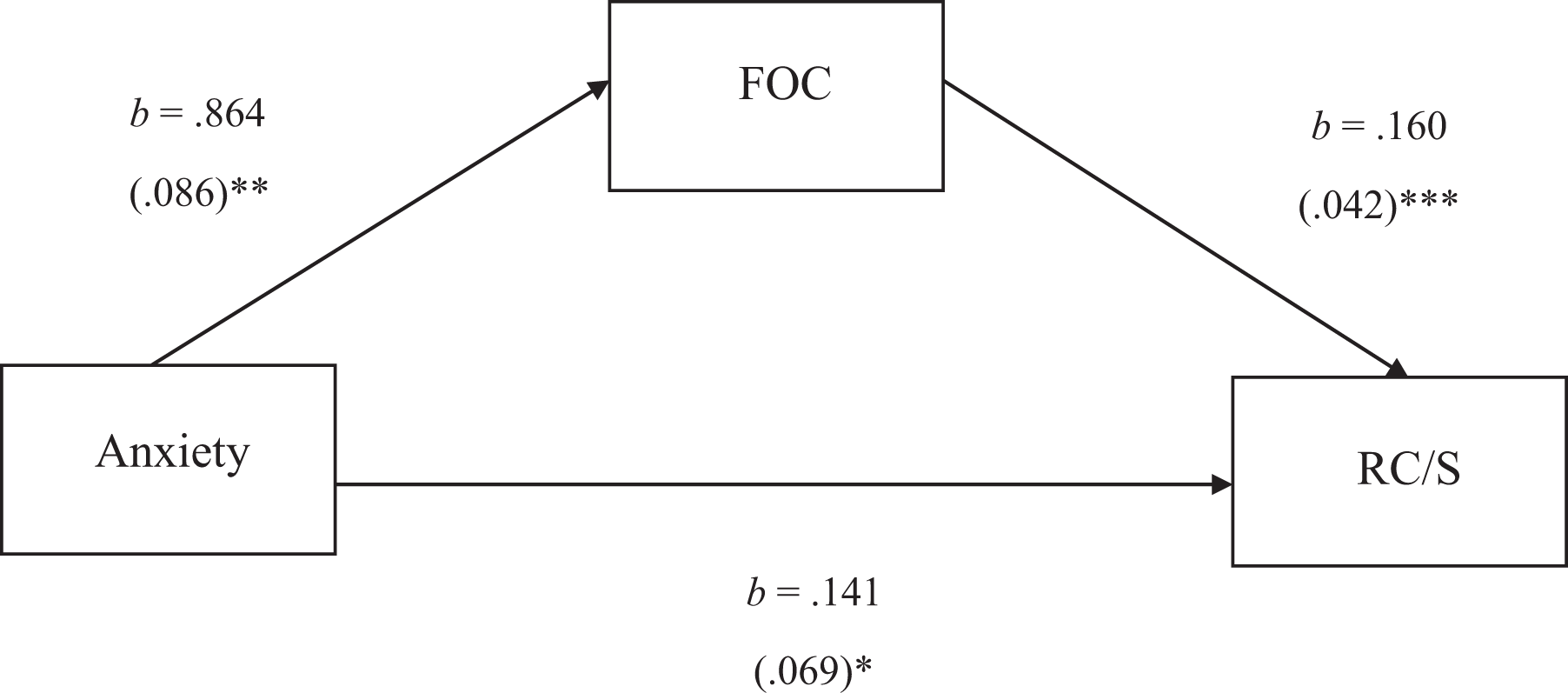
The mediation of anxiety to RC/S by fear of change. *p < .05; **p < .01; ***p < .001. N = 264; scale range = 1 (strongly disagree)–7 (strongly agree). FOC = fear of change; RC = relationship commitment; S = satisfaction level.
Means, standard deviations, alphas, and Pearson correlation matrix for continuous variables for Study 1.
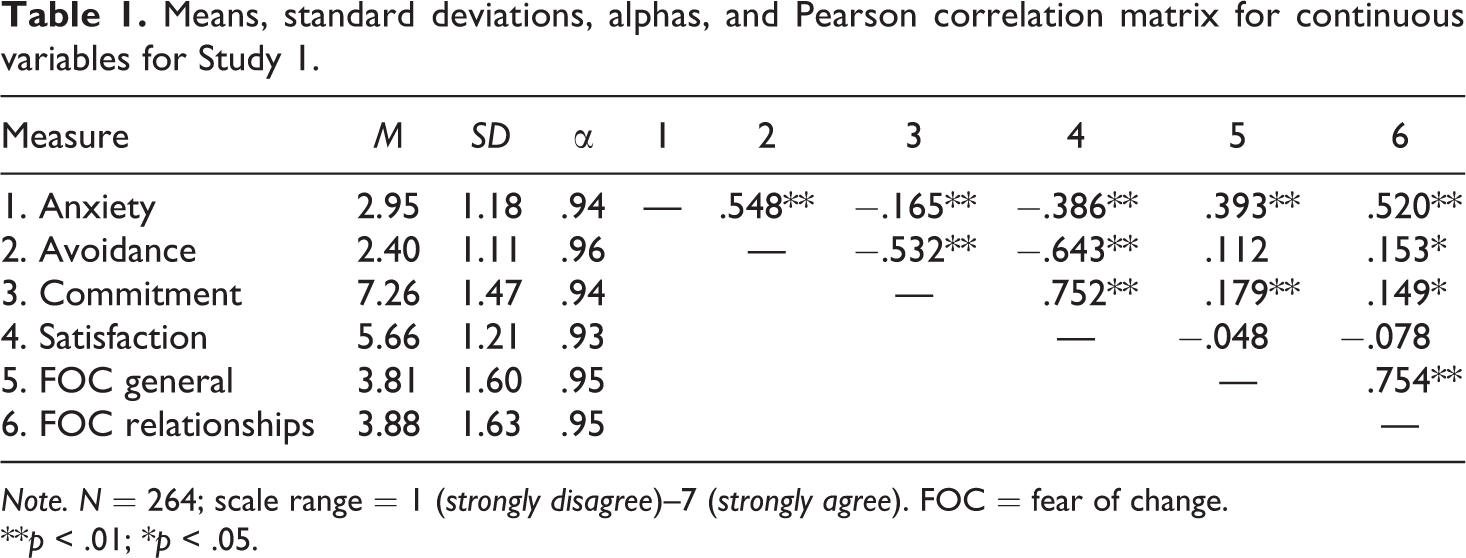
Note. N = 264; scale range = 1 (strongly disagree)–7 (strongly agree). FOC = fear of change.
**p < .01; *p < .05.
More anxious people tend to be more afraid of change, and greater fear of change is associated with higher levels of RC/S. An exploratory analysis of the same model substituting avoidance for anxiety was also examined; see Figure 2. This analysis showed that lower fear of change mediates a negative association between avoidance and RC/S (indirect effect = −.044; CI = [− 086, −.013]). This suggests that more avoidant people fear change less, which mediates the relationship between higher avoidance and lower levels of RC/S.
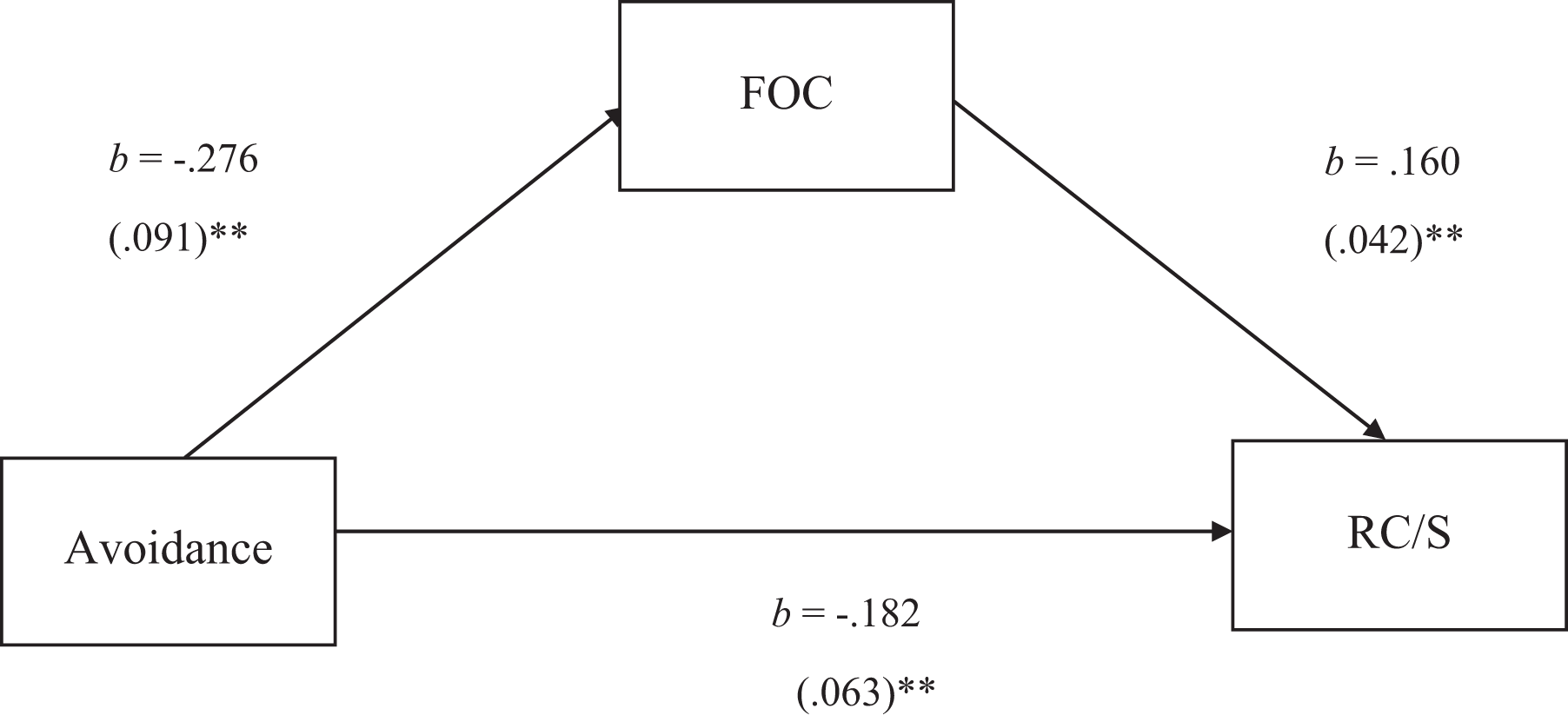
The mediation of avoidance to RC/S by fear of change. *p < .05; **p < .01; ***p < .001. N = 264; scale range = 1 (strongly disagree)–7 (strongly agree). FOC = fear of change; RC = relationship commitment; S = satisfaction level.
Study 2
We designed Study 2 to replicate Study 1 and to examine the mediation of the pathway between anxiety and fear of change. Possible mediators were quality of alternatives to the current relationship, size of investment in the current relationship, and fear of being alone. The first two of these variables are suggested by the investment model of commitment (Rusbult et al., 2012). (We did not include relationship satisfaction as a mediator because it was a component of RC/S.) The last mediator, fear of being alone, seemed important even though it is not part of the investment model. We included it because loneliness is central to attachment anxiety, so fear of being alone might be as or more related to fear of change than the investment model variables. We hypothesized that these variables, in combination with fear of change, would serially mediate the connection between attachment anxiety and RC/S.
Method
Participants
Participants were 462 MTurk workers (226 men and 236 women). A power analysis indicated that this number of participants yielded an achieved power of 1.0. to detect our indirect effect. Participants were aged 21–75 (M = 32.48, SD = 9.87). 56.7% identified as White, 21.2% identified as Asian American, 11.3% as African American, 6.9% as Hispanic, 2.8% as Native American, and the rest indicated mixed ethnicity. Participants were in a romantic relationship of at least 6 months duration (M = 11.1 years, SD = 7.48); 129 (27.9%) were not married but were living with their current partner, 115 (24.9%) were seriously dating their romantic partner, and 218 (47%) were married.
Materials and procedure
All participants completed the same questionnaires used in Study 1. RC/S was computed in the same way. Participants also completed 7-point questionnaires assessing quality of alternatives to their current relationship, investment in their relationship (Rusbult et al, 1998), and fear of being alone (Spielmann et al., 2013).
Results and discussion
The primary focus of our PROCESS analysis (Model 6; Hayes, 2018) is the sequence anxiety → various mediators → fear of change → RC/S. (See Table 2 for means and standard deviations.) “Various mediators” include fear of being alone, investment in the relationship, and quality of alternatives to the relationship. When we tested our first model (anxiety → fear of being alone → fear of relationship change → RC/S), we found that the two mediator variables serially mediated the relationship of anxiety to RC/S (indirect effect = .020; CI = [.006, .040]). Higher anxiety was associated with higher RC/S, and their association was mediated by fear of being alone and fear of relationship change (see Figure 3). In a separate analysis, we reversed the order of the serial mediators and found that the mediation was not significant.
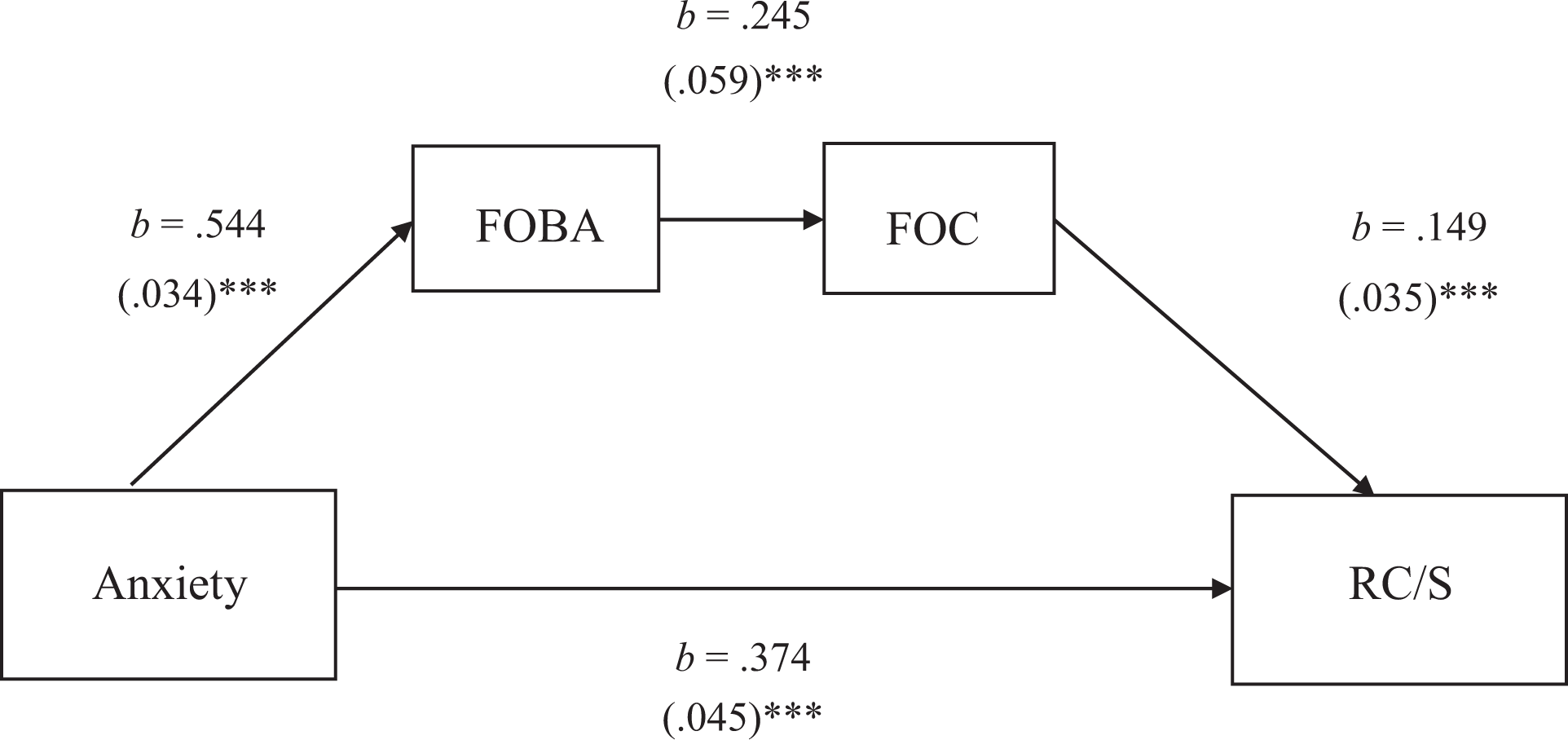
The serial mediation of anxiety to RC/S by fear of being alone and fear of change. *p < .05; **p < .01; ***p < .001. N = 462; scale range = 1 (strongly disagree)–7 (strongly agree). FOBA = fear of being alone; FOC = fear of change; RC = relationship commitment; S = satisfaction level.
Means, standard deviations, alphas, and Pearson correlation matrix for continuous variables for Study 2.
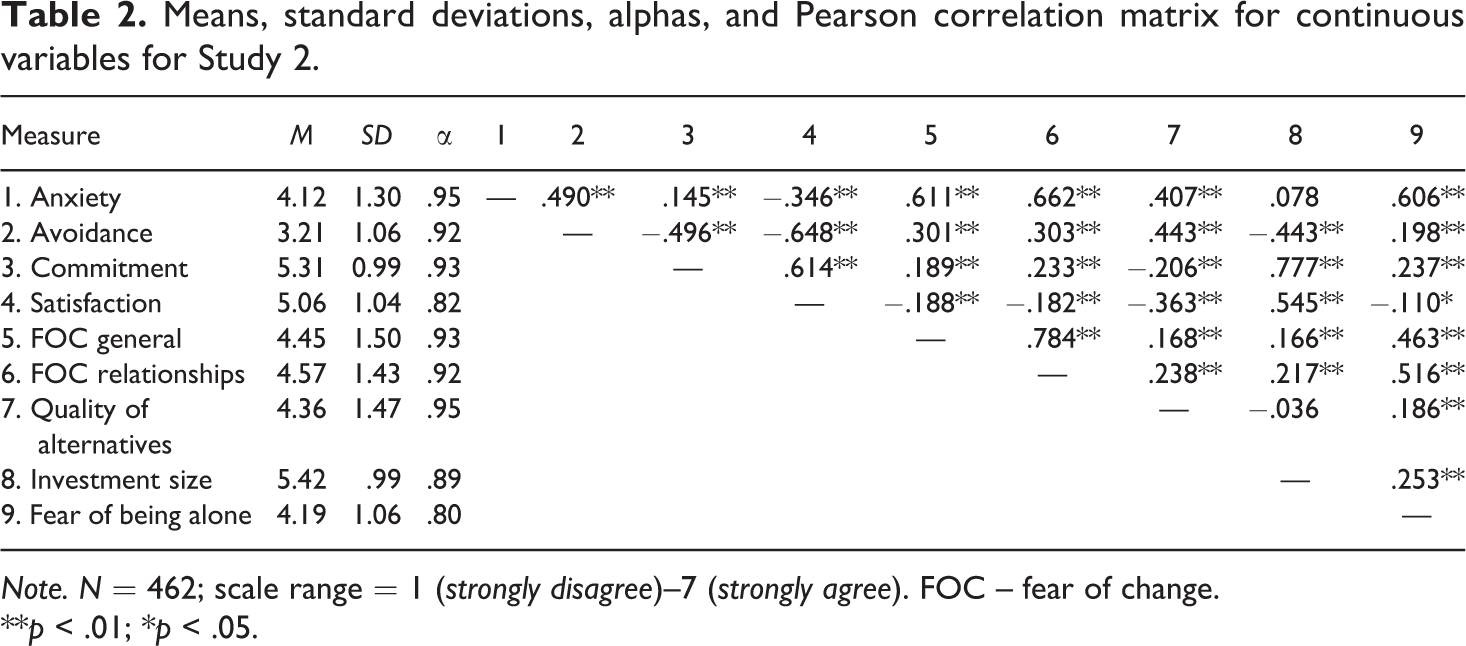
Note. N = 462; scale range = 1 (strongly disagree)–7 (strongly agree). FOC – fear of change.
**p < .01; *p < .05.
We also report the outcomes of the two component mediation paths of this overall serial mediation model. One analysis indicates no evidence that the anxiety and RC/S association is mediated solely by fear of being alone (indirect effect = .035; CI = [−.023, .091]). This reveals a distinction between fear of change and fear of being alone. They are not isomorphic. The other provides evidence that the relationship between anxiety and RC/S is mediated by fear of change (indirect effect = .090; CI = [.039, .147]). This analysis replicates the primary analysis of Study 1, providing evidence for the reliability of Study 1’s findings.
Next, the analysis testing the model, anxiety → investment level → fear of relationship change → RC/S provided no evidence of serial mediation (indirect effect = .007; CI = [−.001, .018]). The analysis testing quality of alternatives and fear of relationship change as possible serial mediators also provided no support for the model (indirect effect = .001; CI = [−.007, .003]).
We next tested an exploratory mediation model: avoidance → fear of relationship change → RC/S. Unlike Study 1, this provided no evidence of mediation of avoidance → RC/S (indirect effect = −.006; CI = [−.032, .014]), so we did not conduct analyses involving additional mediators.
General discussion
Study 1 found that fear of change mediates the association between anxiety and RC/S. Study 2 found that fear of being alone and fear of change serially mediate the relationship of anxiety to RC/S. These findings suggest a reason why more anxious people feel dissatisfied with their relationships (Feeney, 2016): they stay in unhappy relationships longer.
Whereas people high in anxiety have been described as being dependent on having a relationship (Drigotas & Rusbult, 1992), people higher in avoidance are not equally dependent on being in a relationship (Mikulincer & Shaver, 2003). Thus, they fear relationship change less and are more likely to become uncommitted to a partner when their satisfaction is low. We found evidence for this in Study 1 but did not replicate it in Study 2. Future research might attempt to resolve this inconsistency.
Study 2 revealed additional findings. First, it replicated the finding from Study 1 that the relationship between anxiety and RC/S is mediated by fear of relationship change, increasing confidence in the findings of Study 1. Second, fear of being alone was found to be involved in a serial mediation of the relationship between anxiety and RC/S. Fear of being alone, however, did not mediate the relationship between anxiety and RC/S on its own, as fear of change did. This suggests that fear of being alone is part of the reason for fearing change but that fear of being alone is not the same thing as fear of change. This supports our speculation that fear of change is an emergent construct related to multiple concerns that anxious individuals have about intimacy and loneliness.
Of course, the present research is limited in some ways, including the use of self-report measures and a cross-sectional correlational design. At the same time, the main results appear robust across two studies with large, diverse samples of participants.
In summary, the initial goal of this research was accomplished; fear of change was shown to mediate the anxiety to commitment relationship, suggesting that attachment anxiety and fear of change may partially explain why some individuals are more likely to be found in unsatisfying relationships. The second goal was to examine other mediators that might add detail to the fear of change findings. Fear of being alone was shown to be a mediator, but only in a model that contained fear of change.
A notable feature of this study is that it brings together two major theories of relationships, interdependence and attachment theory. A goal for future research may be to examine new serial mediation pathways to more fully understand the fear-of-change construct. For now, it appears that anxiety predicts fear of being alone, which predicts fear of change, which predicts RC/S. Overall, we conclude that fear of change is a highly predictive construct that appears to deserve further investigation.
Footnotes
Funding
The author(s) received no financial support for the research, authorship, and/or publication of this article.
Open research statement
As part of IARR’s encouragement of open research practices, the author(s) have provided the following information: This research was pre-registered. The aspects of the research that were pre-registered were Study 2. The registration was submitted to: As predicted (#16714;  ). The data used in the research are available. The data can be obtained by emailing: