







Abstract
Being the recipient of severe bullying messages for a period of time is a meaningful predictor of subsequent mental health issues. Employing Goal Understanding Theory, we test an explanation for this association. Specifically, we hypothesize and generally confirm that targets’ adverse emotional reaction and hurt from bullying messages serially mediate the positive association between message severity and depression and general anxiety, depending on the goal understanding of targets (i.e., inferences of upward-mobility, personal-attack, and highlight-differences goals motivating a bully). That is, the mediation of message severity on mental health via emotional reaction and then hurt is present at high (not low) levels of goal inferences. Implications of the communicative processes connecting severe bullying with mental health are discussed.
Bullying poses meaningful threats to mental health, such as poor body image (Hager & Leadbeater, 2016) and psychoses (Campbell & Morrison, 2007). Bullying involvement during adolescence/childhood predicts increased risk of adulthood psychotic symptomatology (Bebbington et al., 2004; Elledge et al., 2019). Although bullying has negative outcomes for everyone involved, targets of bullying seem to suffer more than bullies, bystanders, or victim-bullies (Betts et al., 2017). Whereas bullying is an international public health issue with significant negative implications for self-perception (van Dam et al., 2012), theoretical explanations for bullying’s association with mental health have been insufficient (Arseneault et al., 2010), which is limiting considering the reciprocal relationship between self-concept and achievement (Bakadorova & Raufelder, 2019). Whereas some explanations emphasize targets’ perceptions of a bully’s mental state motivating bullying, no data support such claims (Smith, 2019). Social support might mitigate the mental health consequences (Gini et al., 2009), but explanatory mechanisms are not elaborated. Other work shows bullying severity (i.e., message frequency) in childhood predicts later mental health problems (Schreier et al., 2009). Taking a goal understanding theoretical perspective can shed light on the mechanism through which message severity predicts mental health, which might generate successful means to mitigate the negative consequences of bullying through interventions that facilitate coping.
Past accounts to explain this connection are steps in the right direction but limited because of a few theoretical concerns. First, explanations are cursory, often failing to offer a mechanism connecting severity to mental health in conceptually logical and effective ways, which reduces the utility of such findings. For example, few mediation processes in bullying have been investigated (e.g., Einarsen et al., 2018), with none evaluating bullying severity. A second theoretical limitation is the lack of sophistication in the definitions of bullying and its severity (except see, Sticca & Perren, 2013). Bullying severity has been defined as the frequency or number of bullying episodes (van Dam et al., 2012). Yet, bullying severity is distinct from and more complex than frequency (Chen et al., 2011). Bullying messages can highlight characteristics or circumstances outside targets’ control (e.g., criticizing religion or body). Even spreading false rumors or criticizing changeable aspects of a target (e.g., attire) can be particularly severe for targets because what often matters is what others believe to be true even if it is objectively false. Thus, severity is the extent to which a target finds the messages to be hostile and hateful because they attack the person in ways that are either true or can be assumed true. Given these concerns, our primary objective is to provide an account for why the severity of bullying predicts mental health outcomes by invoking Goal Understanding Theory (GUT; Palomares & Wingate, 2020).
First, we define bullying and message severity. Next, we deduce a prediction connecting message severity to depression and general anxiety. We then explain how targets’ inferences of a bully’s goals moderate the association between message severity and mental health. Using GUT, we subsequently provide an explanation for the mediation process between bullying severity and mental health as a function of targets’ goal inferences. We test our hypotheses via young adults’ recounting of a previous bullying episode.
Message severity predicts mental health
Bullying occurs when goal-directed repetitive behaviors are maliciously aimed at a target with an immediate goal to harm. Bullying is comprised of hostile malintent to induce physical, emotional, and/or mental pain (Craig & Pepler, 2007) with participants ranging in age from children in preschool (e.g., Camodeca et al., 2015) to adults in the workplace (e.g., Kowalski et al., 2018). Bullies employ a series of hostile and malicious messages. Bullying is associated with significant negative outcomes for targets, such as reduced self-esteem, depression, anxiety, social isolation, and even suicidal ideation (Reijntjes et al., 2010). Bullying severity focuses on message content. Specifically, bullying severity is the extent to which targets find messages to be hostile, hateful, and vulgar and focus on valid immutable characteristics. Messages low in severity will attack a target in a mildly hurtful and vulgar manner that focuses on fabricated or inconsequential characteristics that a target can relatively easily dismiss or prevent, such as criticisms of a roller backpack or the use of misplaced name-calling; whereas messages high in severity will attack a target in an extremely hurtful and vulgar manner that focuses on valid and consequential characteristics that are not easily dismissed or prevented, such as harsh insults of one’s sexuality and skin color and the use of racial epithets and other hostile names with stereotypically references (Troop-Gordon, 2017).
Targets can take severe bullying messages to heart because they induce high levels of negative affect and hurt. For our purposes, severity is defined as the perceived validity of criticism (i.e., the extent to which the messages include detailed information that the target or other recipients of the messages may find factual). This maps onto prior research suggesting attacks on unchangeable characteristics produce more negative consequences because targets cannot change the characteristics for which they are being bullied (e.g., Troop-Gordon, 2017). Additionally, bullying severity contains a subjective “hurtful” component (i.e., the extent to which the target felt negatively affected by the bullying). Because of the increased personalism and perceived validity in high severity bullying, targets will be at a greater risk for depression and general anxiety later in life. As the severity of the messages they received during a bullying episode increases, the long-term consequences increase because attacking immutable characteristics causes targets to have low self-worth and increases helplessness because they cannot enact change (Troop-Gordon, 2017). Bullying during childhood/adolescence is a significant predictor of relatively decreased health (mental and physical) in early and later adulthood, which is demonstrated across several studies (Hager & Leadbeater, 2016). Similar developmental implications for later mental health problems exist for child abuse and other forms of childhood and adolescent victimizations (McDougall & Vaillancourt, 2015). Adolescence is a particularly vulnerable stage of development for identity formation and self-perception (Bakadorova & Raufelder, 2019; Steinberg & Morris, 2001). Thus, we posit that the severity of a prior bullying episode, especially those happening in developmentally-formative years, predicts current levels of depression and general anxiety:
Goal understanding in bullying
GUT takes a message production and processing perspective (Greene, 1997; Wilson, 2002) in its explanatory calculi. A fundamental premise is that communication emerges from mentally represented hierarchies of goals, strategies, and behaviors. Communication is goal directed (Kellermann, 1992), wherein individuals’ objectives and plans drive social interaction. Goals, or the mental representations of desired end-states, reside in hierarchies with lower-level goals facilitating the acquisition of higher-level goals (Palomares, 2014). For instance, the goal of purchasing groceries strategically facilitates the goal of reducing hunger, just as the goal of getting to know someone promotes the goals of obtaining support and/or avoiding boredom.
Similar to how people send goal-directed messages to others, people often understand and interpret others’ messages in terms of goals (Palomares, 2008). Social actors infer each other’s goals—consciously or unconsciously—to provide meaning to messages and to expedite social interaction because inferring others’ goals yields a framework from which to interpret others’ behaviors (Cupach, 1994). Indeed, goal inferences affect what people recall from social interaction (Bower et al., 1979) and how they fill in missing gaps between events (Taylor & Crocker, 1981). At the same time, people’s goal inferences can have spillover effects, wherein their thoughts, perceptions, and actions are subject to what goals they have inferred. For instance, inferring goals of relationship protection was associated with positive relational outcomes, whereas inferring self-serving goals had the opposite pattern (Palomares & Derman, 2019). Goal inferences are consequential beyond the interpretation of messages.
When applied to bullying, an implication from GUT is that although the goal to-harm is—by definition—the immediate objective of bullying, harming a target often serves superordinate goals. For instance, just as purchasing groceries facilitates reducing hunger, bullying can satisfy an array of goals, such as gaining status, personally attacking, or highlighting differences (Palomares & Wingate, 2020). Because goal inferences are not always easy to ascertain and accuracy varies (Palomares, 2008), targets can erroneously infer goals that a bully might not actually be pursuing, just as they might miss inferring goals that a bully is actually trying to achieve. Goal hierarchies are a bridge that connect the surface-level to-harm goal of bullying and any superordinate goals, which often means targets must infer goals with some level of uncertainty about why a bully wants to harm. Based on this reasoning, targets are sometimes left to guess the superordinate goals driving bullying. For instance, targets can infer a bully wants upward mobility in a social network, but the extent to which they infer that goal is not uniform.
According to GUT, targets’ goal inferences provide meaning to understand and process a bullying episode, which can be consequential for targets. The association between the severity of the messages and mental health depends on a target’s goal inferences for a bully. At least three constellations of goals—achieve upward mobility, personally attack, and highlight differences—matter for the negative consequences of bullying (Varjas et al., 2010). First, bullying helps achieve upward mobility in a social network of peers, such that attacking socially close others increases one’s status (Faris, 2012). Likewise, bullies tend to reside in higher ranked positions in a social network of peer adolescents, which facilitates their popularity and continued high status (Faris & Felmlee, 2011). Second, goals that highlight a target’s differences are relevant to bullying because negatively deviating from a peer group, especially in adolescence, is quite anxiety provoking, given the stigma associated with being “abnormal” (Troop-Gordon, 2017). Finally, goals to personally attack a target are germane to bullying because bullies often react or lash out in defense mechanistic ways often due to jealousy, revenge and other self-protective motives (Schenk et al., 2013). Being a target of a bully who employs severe methods to achieve their goals at the expense of the target is likely more painful and negatively emotionally charged for a target than if a target does not perceive him/herself as a tool that the bully employs for their gain. Thus, inferring any of these three goals as motivators of severe bullying is likely associated with negative mental health consequences for targets because those goals also have the potential to make a target seem like an expendable means to an end, which can trigger an adverse negative emotional response, as GUT suggests.
Thus, the connection between bullying severity and mental health likely depends on goal understanding processes and the extent to which targets infer certain goals during social interactions in which they are bullied, which has been partially explored in cyberbullying contexts (e.g., Jones & Savage, 2018). That is, as a target thinks bullies are trying to harm him/her for the self-serving purposes of gaining status, personally attacking the target, or highlighting the target’s differences, the extent to which the severity of bullying has the potential to increase target’s risk for long-term future mental health consequences escalates because a target’s self-perception as a bully’s pawn—used at the will of the bully—is strong compared to when inferences of those goals are low. In contrast, when a target does not infer those goals, s/he may still experience short-term negative emotional consequences, but those consequences will not necessarily translate into long-term adverse mental health outcomes because the bullying does not place the target in a vulnerable and exploitative position and, therefore, is less negatively emotionally charged. Thus, we expect goal inferences to moderate the association between severity and subsequent mental health.
We have argued, thus far, that the severity of bullying messages predicts subsequent adverse mental health outcomes, which depends on the target’s goal inferences. We have suggested, but not explicitly predicted, a theoretical connection between severity and mental health through target’s negative emotional reaction and the amount of hurt a target experiences. Stimuli, such as severe bullying messages, tend to trigger adverse emotional reactions (Lang et al., 1997). Emotional reactions often lead to an appraisal, or a cognitive assessment of the physiological emotional experience (Folkes, 1982), which can include an evaluation of the extent to which the bully caused pain or psychological injury. Experiencing hurt is an appraisal process, as it is an assessment of the extent to which someone else caused an injury. Thus, because of the negative emotional reactions targets have when severely bullied and the subsequent hurt they experience, severity predicts increased levels of depression and general anxiety. Therefore, the severity of bullying leads to an emotional reaction which is then appraised (i.e., hurt), and those appraisals may predict mental health outcomes. Thus, there are two mediators (emotional reactivity and hurt) which are theoretically sequential, and therefore conceptualized as serial mediators (for discussion, see Jones et al., 2015). People subjected to severe stressors that were beyond their control tended to experience increased negative emotion, which was associated with increased depression compared to those who did not experience as much negative emotion (Troy et al., 2013). Thus, a serially mediated relationship between severity and mental health outcomes is predicted:
We expect this mediation process to be a function of goal inferences for the same reasons as H2, such that the serial mediation of emotional reaction and hurt for the association between severity and mental health is present at high, but not low, levels of goal inferences. Figure 1 contains a graphical representation of our predictions. Thus:
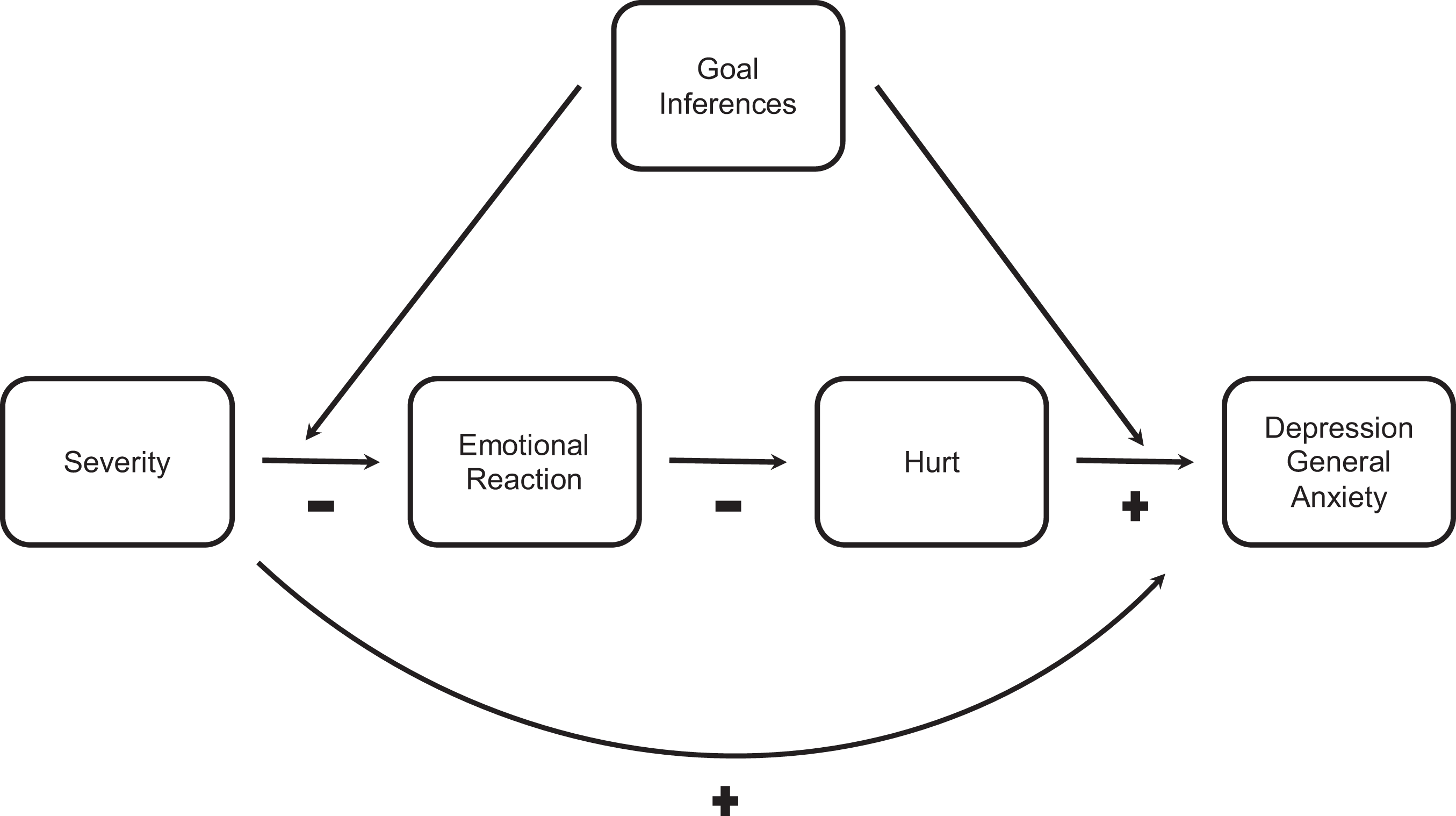
Conceptual model.
Method
We employed a survey to collect data from students at a large west coast university in the United States at two separate times. First, participants completed a recruitment prescreener that assessed a variety of measures for assorted projects, wherein they indicated their current levels of depression and general anxiety. We employed the prescreener to reduce the length of the main study and to keep their recollections separate from their mental health reports. Second, participants completed a series of measures that focused on a previous bullying episode wherein they received a series of hurtful messages from a source over a period of time; participants also completed a second assessment of depression.
Participants
Students (n = 1,636) at a major university participated in an electronic survey (Qualtrics) for course incentive. Participants were recruited from the university’s subject pool via SONA systems, which recruits students from several psychology and communication undergraduate courses. Data were collected from Fall 2016 through Spring 2017 quarters. Institutional Review Board approval was obtained prior to data collection. To be eligible, participants must have completed the prescreener during the same quarter of their participation in the main study.
Participants were asked to recall an episode in which they received a series of hurtful messages. Participants fitting our a priori criteria for inclusion (i.e., they must have received multiple hurtful messages over a period of time from a single source) continued the study, whereas those who indicated they had not received such messages were filtered from the survey. For those continuing, a series of subsequent questions cross-checked (in real-time via pre-settings in Qualtrics) participants’ recalls assuring the number of messages received exceeded one and occurred over a period of time. Participants who indicated receiving only one message or receiving multiple messages on a single a day were reminded of the message criteria and prompted to confirm that their recollection fits. Those indicating their recalls did not fit were asked to recall a different episode that actually fit. If they could not recall a different episode, then they were removed from further participation. If they could recall a different episode, the same cross-checks were included to determine if their recalled episode actually fit the criteria, with the same follow-ups. Only 6 participants (.007%) were prompted to recall a second episode that actually fit. No participants required a third recall attempt.
A bit over half of those asked (n = 896; 54.77%) were able to report an episode. Three additional post-data collection criteria were manually employed for a further layer of filtering participants. Recalls that included a parent, other family member, or authority figure (e.g., coach, teacher) as the aggressor were excluded (n = 58, 6.5%), as bullying is conceptualized separately from domestic or child abuse (Olweus, 1994). Second, recalls that clearly included mutual abuse wherein the participant was similarly hurtful and aggressive to the bully were excluded (n = 53, 5.9%) to not conflate targets and bully-victims (Olweus, 1994), which is not our focus. Finally, we employed a measure of the seconds spent completing the questionnaire for the 896 participants as a filtering method to exclude those participants who took 1.25 SDs below the median number of seconds. 1 We eliminated 49 (5.5%) participants who did not take the study seriously because they rushed through the instructions and measures. Thus, our final sample was comprised of 735 participants.
Severity
Severity, our main predictor, is the extent to which bullying messages constitute an excessively cruel/hateful attack on a target (Craig & Pepler, 2007). Severity increases as messages focus on attributes that are highly relevant and easily applicable to the target (e.g., not easily dismissed, not false). Severe messages often highlight immutable (or ostensibly immutable) characteristics of targets and usually contain taboo words that highlight anger and hostility (Troop-Gordon, 2017). Severe messages are antagonistic and can even include threats of physical violence (realistic, potential, or actual). Thus, messages are increasingly severe when they contain content that targets perceive as personally negative, hostile, and hateful.
Given the theoretical complexity of the severity construct relative to past work (and that our definition is quite unique), we developed a severity measure. We employed an open-ended and guided set of questions to facilitate participants’ accounts of the bullying episodes. The three open-ended prompts asked participants to describe in detail the circumstances surrounding the episode (when, where, why, and how), the content of messages received (what the source did, said, and sent), and the targets’ reactions to the messages (thoughts and perceptions in response to messages). Two coders quantified severity (three-point scale; 3 = high) by reading participants’ responses to all three prompts with a particular focus on and prioritization of participants’ interpretation/characterization of the messages. For instance, “They would make fun of me to my face and exclude me in group work. I was deeply hurt, but was also very confused as to why I was getting picked on.” is lower in severity than “They were hate messages because of my beliefs. That I was a ‘terrorist’ and that I should go back to the Middle East. I was very sad, terrified, and upset all in the same time I had read the messages.” Thus, coders were able to assess severity not only by reading targets’ summary of the messages, but target’s perceptions and reactions, thereby validly capturing the breadth of severity.
Training took place over the series of several weeks by reading a conceptual definition of message severity and also examples of message varying in severity. Coder also learned about the three prompts given to participants and the purpose for each open-ended prompt. A codebook contained all relevant information, procedures, rules, etc. Coders then practiced via randomly selected responses and discussion among the coders and authors. After several practice responses, independent coding of a randomly selected subset of the data occurred, followed by a resolution of discrepancies. Once coders had minimal discrepancies, each coder independently coded a random sample of 150 open-ended responses and reliability was calculated (Krippendorff’s alpha = .75). Each coder assessed a randomly selected half of responses.
Mediators
Emotional Reaction. A semantic differential scale, with 15 antonym pairs (e.g., happy-sad, relieved-distressed, worried-not worried, fine-in pain, scared-reassured) captured the valence and arousal of basic emotional responses (Mauss & Robinson, 2009) to assess participants’ feelings when they received the messages. Low scores on the 1 to 7 scale indicated a negatively valenced emotional reaction (M = 2.52, SD = .81, α = .87; 11 reverse-coded).
Hurt. Four existing items measured hurt by assessing the extent to which participants thought the most memorable messages they received were hurtful, caused them pain, made them happy, and were kind (Vangelisti et al., 2005). The items formed a reliable scale (M = 5.82, SD = 1.22, α = .77; 7 = high).
Outcomes
Depression
The Beck Depression Inventory Second Edition (BDI-II; Beck et al., 1996), a well-established and valid measure, assessed participants’ depression in two ways. First, participants completed the scale focusing on their current state as part of the university participation pool pre-screener. Second, participants completed items retrospectively focusing on how they felt during the episode. We altered each item to be conducive to this retrospective focus. For example, the sadness item included the prompt “During the period of time when I received the series of messages…” followed by the response options, which were in past tense (e.g., “I was sad all the time.”). Responses to the 21 items for the retrospective scale and for the current scale were summed separately (range: 0–63; current: M = 14.33, SD = 10.60, α = .93; retrospective: M = 19.25, SD = 13.26, α = .94).
General anxiety
We used the well-established Beck Anxiety Inventory (BAI; Beck et al., 1988) to measure participants’ general anxiety during the pre-screener. Twenty items were summed where higher scores represent higher levels of general anxiety (M = 36.72, SD = 12.83, α = .94; range = 20–79).
Goal inference moderators
We assessed the likelihood that participants thought the source of the messages were trying to achieve three sets of goals, based on previous research and measures (Palomares, 2008; Schenk et al., 2013; Varjas et al., 2010): upward-mobility goals, personal-attacking goals, and highlight-differences goals. Upward-mobility goals were assessed through seven items, such as “Because the source craves positive attention from peers, he/she sent me the messages,” “The source sent the messages to make him/her feel powerful,” and “The source sent me these messages in order to impress his/her friends” and four other items highlighting the source’s pursuit of status gains (M = 4.27, SD = 1.26, α = .77, 7 = high). Personal-attack goals were measured with eight items, such as “The source sent me those messages to seek revenge on me for something I did or something he/she thought I did,” “The source sent me those messages because he/she was envious of me,” “I had provoked or angered the source and the messages were his/her way to get me back,” “The source sent the messages to protect him/herself,” and four other items focused on a reactionary affronts on the target (M = 3.95, SD = 1.33, α = .77, 7 = high). Targeting someone because they are different was the third goal inference, assessed via two items: “The source sent me these messages because I am not your average person” and “The source sent me these messages because I don’t conform to the norm in how I dress and look.” The two items were strongly related (M = 3.25; SD = 1.69; Spearman-Brown 2 (734) = .64, p < .001; 7 = high). PCA confirmed that the items we employed for each goal formed separate goal components as anticipated.
Controls and filters
As control variables, we included publicness, estimated number of days of the bullying episode, estimated number of sent messages, and participants’ age, and sex. We also assessed mutuality and the source’s relationship to use as filters for inclusion in main analyses.
Publicness
Participants indicated the public means through which they received messages during the bullying episode. An exhaustive list of all possible public means for both traditional bullying and cyberbullying (e.g., Facebook wall, comments on targets’ Instagram posts, face-to-face public interactions) was presented to participants. Participants could also list any means not already included, which the authors subsequently categorized. Several private means (e.g., Snapchat chats, Instagram private messages, face-to-face private interactions) also were included to be thorough. Each public means was tallied to create a measure of the extent to which messages occurred in public domains (M = .94, SD = 1.13).
Initial year of episode
The year in which the bullying episode started was measured as a means to control for the time from episode to recall. We employed the calendar year as the operationalization (M = 2011.93, SD = 4.05, Median = 2013).
Length of time
Participants estimated the number of days spanning the bullying episode (M = 70.49, SD = 224.48, Median = 9).
Number of messages
Participants also estimated the number of messages they received during the episode (M = 24.77, SD = 73.98, Median = 7).
Age
Age was also treated as a covariate, with the majority of participants indicating 18 years of age (M = 19.94, SD = 2.67).
Sex
Due to the overwhelming prevalence of women in the sample (80.4%), biological sex was treated as a covariate.
Source relationship
Source was coded from the bullying episode recollections. Coding and training techniques were identical to those for severity, which we previously described. Source categorizations included the following: 1 = peer (e.g., classmate, co-worker, acquaintance), 2 = romantic relationship (e.g., boyfriend, ex-partner, dating), 3 = friend, 4 = family (immediate or extended), 5 = unknown (the source was anonymous), 6 = unstated (target did not indicate a source), and 7 = authority figure (e.g., coach, teacher). Coders were reliable (Krippendorff’s alpha = .82). Nearly half of the final sample indicated that the bully was a peer (43.3%), whereas the remainder of bullies were romantic partners (12.5%), friends (27.2%), unknown (9.4%), or unstated (7.6%). Participants indicating categories 4 and 7 were excluded from the final sample.
Bullying mutuality
Mutuality was coded using the same techniques for severity into three categories: 1 = one-sided (where targets received hostile messages but did not send hostile messages back to source), 2 = two-sided (where targets received and sent hostile messages), and 3 = unknown (unclear based on target’s recollection). Krippendorff’s alpha was .79. Because we did not want to conflate the victimization of targets with bully-victims who can be both a target and a bully, all cases that were not one-sided were removed from the final sample (n = 92).
Procedure
Prescreener procedures included obtaining informed consent followed by participants completing a randomly ordered series of measures including the depression and general anxiety scales; other measures were included but we do not have access to those data. For the bullying episode recalls, participants were presented with a consent form where they agreed to participate in the study. Next, they read an in-depth description of bullying and the different forms it might take. Instructions never used the word bullying or bully to avoid stigmatization and attendant negatively impacted responses (Kowalski et al., 2014). Instructions started by stating that people can receive messages that vary in their hurtfulness, hostility, and aggression and indicated that receiving such messages is an unfortunate and regrettable part of life. Instructions then asked participants to think of a time they received multiple messages that were aggressive and hurtful. To cover a wide breadth of possible bullying episodes, instructions stated that such messages can be sent from a variety of sources, over various lengths of time, and across assorted means. Finally, instructions stated: “Please reflect over your grammar school, middle school, and high school years…to recall any instances when for a period of time some source sent you a series of hurtful messages (at least two) intended to cause you mental, emotional, and/or psychological pain.” We were intentionally broad in our request for repetitive hurtful messages to not have a self-selection bias. Participants then provided details about the recalled bullying episode, including the number of days the episode lasted, year in which the episode started, number of messages received, the means in which they received messages, and finally the three open-ended severity prompts. Next, participants completed all other measures, which were randomly ordered within each scale. The order of scales was also randomized. Finally, participants completed demographics.
Results
Bullying episodes
Across the final sample, targets received an average of 24.77 hurtful messages across an average of 70.49 days during the recalled bullying episode. Most bullying episodes occurred in 2015 or earlier (79.3%) with 18% occurring in 2016 and 2.7% occurring in 2017. Although the range of recalls spanned 1979 through 2017, less than 2% of recalls occurred prior to 2004. Thus, given the average age of participants, bullying episodes largely occurred during adolescence.
Data analysis strategy
Despite employing three different goal inference measures and three different mental health measures, our theoretical model is parsimoniously depicted in Figure 1. Rather than testing a single and overly complex model with somewhat redundant measures for a few constructs, we decided to use three sets of models, with each focused on either current depression, retroactive depression, or general anxiety. Next, for each set of models targeting a particular mental health measure, we created three unique models corresponding to the three goal inference measures respectively. Thus, given three mental health measures and three goals inference measures, we employed a total of 9 statistical models of moderated mediation. Using a customized model 92 of PROCESS (Hayes, 2018) to test hypotheses, only those connections depicted in Figure 1 were included and tested. Across the 9 models, severity was always the predictor, and emotional reaction and hurt were always the mediators with relevant direct effects, conditional effects, indirect effects, and conditional indirect effects included, as specified in Figure 1. 3 The outcome variable and the moderator changed across the models, as just described above. Estimated number of messages received, estimated number of days of bullying episode, the year in which the bullying episode started, the number of public means in which the bullying messages were sent, biological sex, and age served as controls for all models. We provide an overview of the findings below, with all relevant statistics in Tables 1 and 2. Additional results (produced by default via PROCESS) not germane to the rationale and predictions are available from authors. All required tests for Hs are in Tables and/or text.
H1
H1 predicted that severity would be positively associated with increased levels of targets’ depression (measured retrospectively and currently) and general anxiety. Across models, H1 received no support based on direct effects (see Table 1). Nearly all coefficients between severity and mental health were not significant. We employed zero-order correlations for a more direct test of H1, which showed positive correlations between severity and retroactive depression, r (733) = .207, p < .001, current depression, r (698) = .141, p < .001, and general anxiety, r (674) = .077, p = .045.
Summary of results for H1 & H2 of severity predicting depression (current and retro) and severity predicting general anxiety.
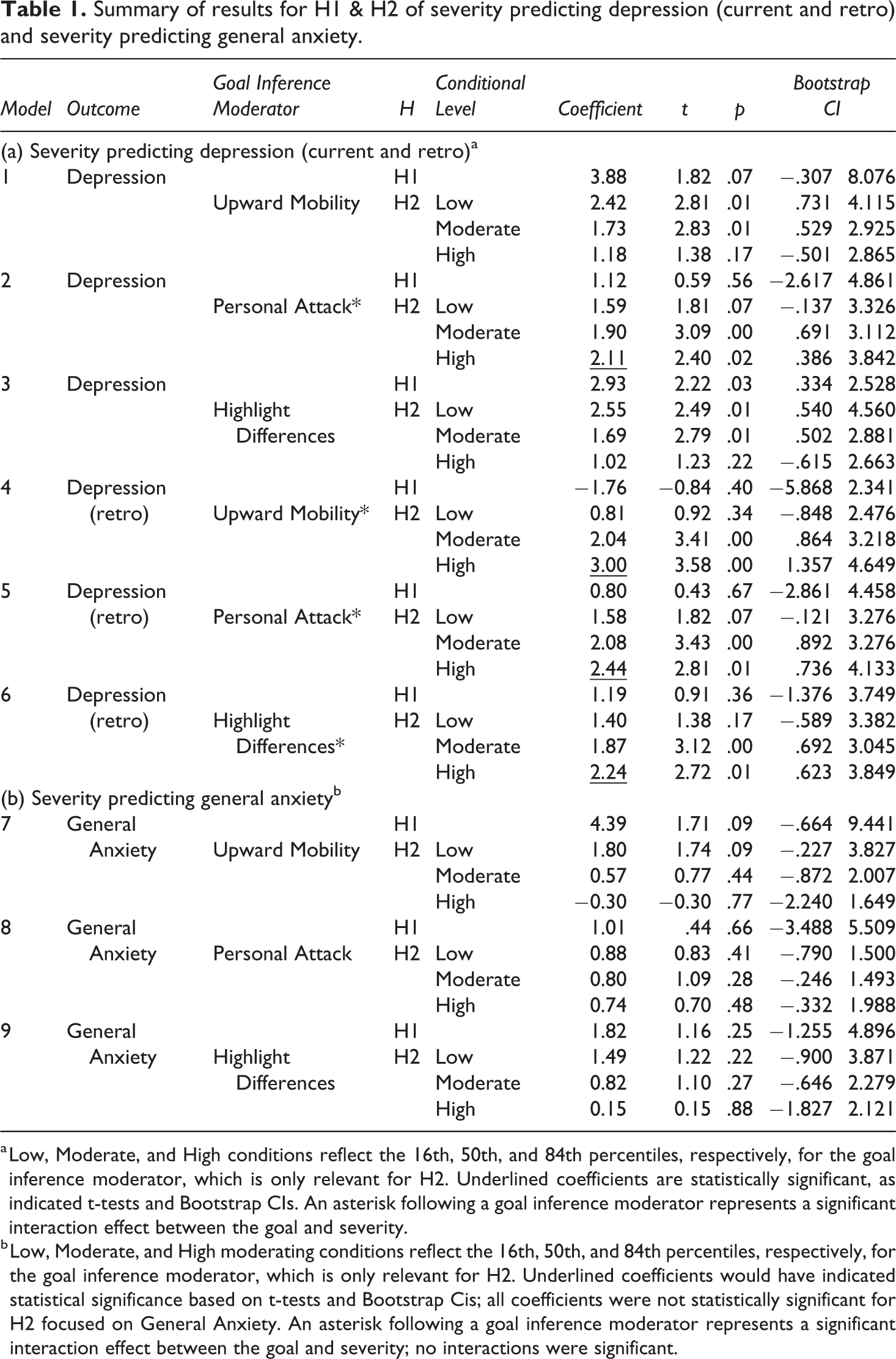
a Low, Moderate, and High conditions reflect the 16th, 50th, and 84th percentiles, respectively, for the goal inference moderator, which is only relevant for H2. Underlined coefficients are statistically significant, as indicated t-tests and Bootstrap CIs. An asterisk following a goal inference moderator represents a significant interaction effect between the goal and severity.
b Low, Moderate, and High moderating conditions reflect the 16th, 50th, and 84th percentiles, respectively, for the goal inference moderator, which is only relevant for H2. Underlined coefficients would have indicated statistical significance based on t-tests and Bootstrap Cis; all coefficients were not statistically significant for H2 focused on General Anxiety. An asterisk following a goal inference moderator represents a significant interaction effect between the goal and severity; no interactions were significant.
H2
H2 focused on how goal inferences moderate the association between severity and depression and general anxiety, such that the association would be present at high levels of goal inferences, but not at low levels. Table 1 reports the simple slopes (underlined coefficients are significant) between severity and each mental health outcome across low, moderate, and high levels of goal inferences. Support for H2 did not emerge for general anxiety (models 7–9 in Table 1 (panel b)). All three models (4–6) that focused on retroactive depression revealed significant coefficients (“conditional direct effects” of severity on mental health) for medium and high values of goal inferences. Only a single model (2; personal-attack goals) for the current depression measure yielded results consistent with H2. Overall, H2 gained weak support.
H3
H3 expected significant indirect effects of severity on depression and general anxiety sequentially through emotional reaction and hurt (mediation). Table 2 summarizes all 9 models. Models for retrospectively measured depression (4–6) and general anxiety (7–9) were consistent with H3: Emotional reaction and hurt serially mediate the effects of severity on general anxiety and retrospective depression. The predicted mediation for current depression in models 1–3 was not supported, however. H3 had mixed support.
Summary of results for H3 and H4 based on moderated mediation of severity predicting depression via emotional reaction and hurt.
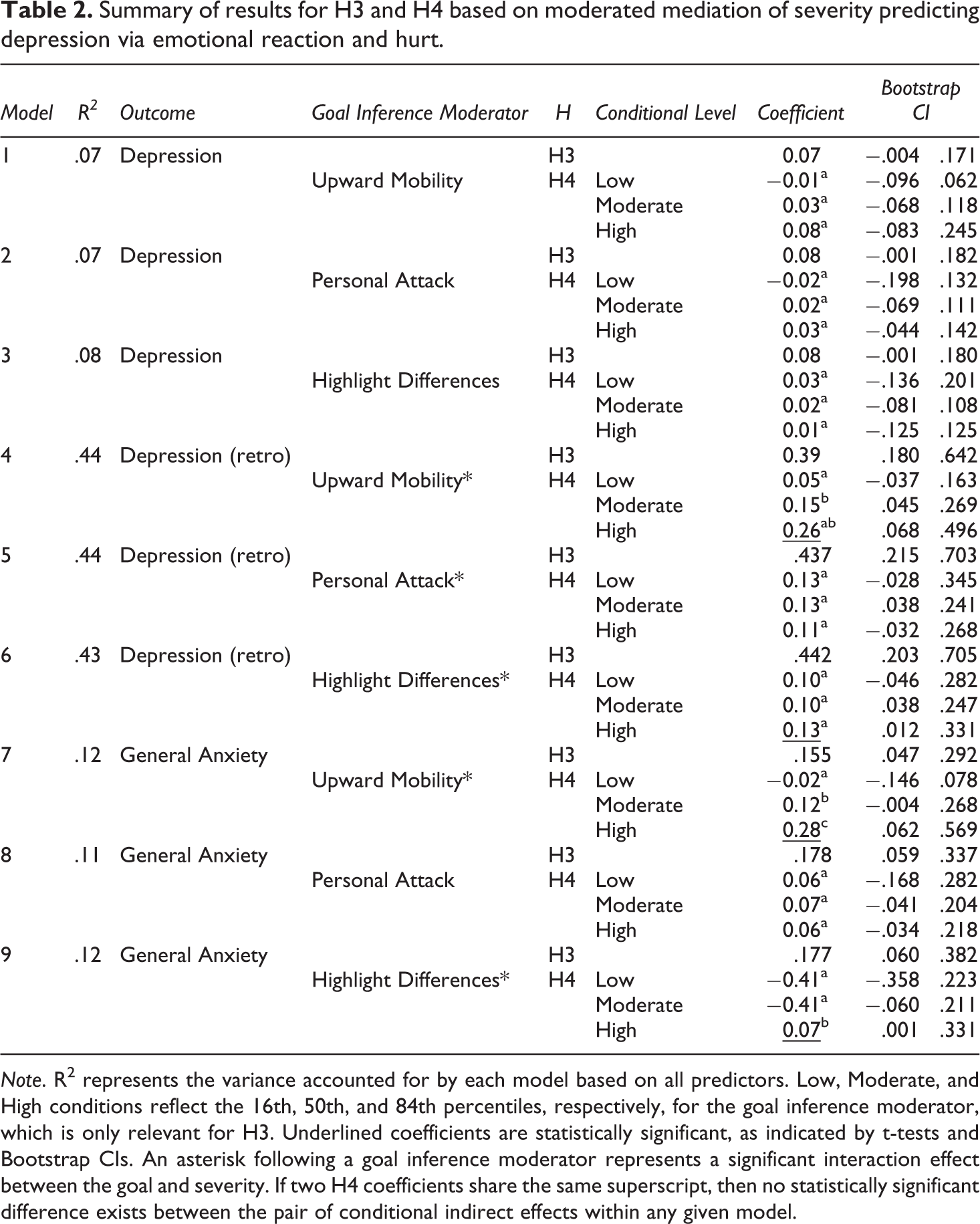
Note. R2 represents the variance accounted for by each model based on all predictors. Low, Moderate, and High conditions reflect the 16th, 50th, and 84th percentiles, respectively, for the goal inference moderator, which is only relevant for H3. Underlined coefficients are statistically significant, as indicated by t-tests and Bootstrap CIs. An asterisk following a goal inference moderator represents a significant interaction effect between the goal and severity. If two H4 coefficients share the same superscript, then no statistically significant difference exists between the pair of conditional indirect effects within any given model.
H4
H4 expected the same serial mediation in H3 for high but not low levels of goal inferences. See Table 2 for the conditional indirect effects of severity on each mental health outcome across low, moderate, and high goal inferences. Table 2 also includes pairwise comparisons (see superscripts) for the conditional indirect effects of H4. Support for H4 did not emerge for current depression across all goal inference moderators (models 1–3). 4 Support emerged for H4 for general anxiety (models 7 and 9), such that the serial mediation occurred for high, but not low, levels of targets’ inferences of upward-mobility and highlight-differences goals (not personal-attack inferences). Results for retrospective depression were somewhat consistent with H4 (models 4 and 6) in that the indirect effect was significant for high levels of inferring upward mobility and highlight differences goals, respectively, but the indirect effects across inference levels did not differ as predicted.
Discussion
Bullying is a communication phenomenon in which a target of severe messages must understand and process the bully’s intent and goals. Generally confirming our account based on GUT, data demonstrated that increased levels of message severity indirectly predicted increased depression (retrospectively measured) and general anxiety via negative affective reactions and increased levels of hurt (H3); however, goal inferences tempered this mediation process at times, such that the magnitude of the indirect effect of severity on mental health via emotional reaction and hurt depended on the superordinate goals targets inferred for the bully (H4). Although H1–2 are worth considering, we focus our discussions on the broader process, its implications, and a few limitations in order to highlight the more comprehensive theoretical account (H3–4, as depicted in Figure 1) rather than a part of it.
The conclusions suggest implications for how practitioners and counselors can facilitate coping for targets of bullying and reduce negative impacts on mental health, especially given the frequency of bullying. Estimates range from 35–50% depending on population and measurement factors (Zych et al., 2018), which is consistent with our rate (45%). Thus, solutions focused on mitigating bullying’s negative consequences via effective coping mechanisms are beneficial. Based on our data, reappraisals of a bullying episode might be one means of assisting targets, as school counselors and other relevant facilitators can work with youth to create alternative narratives of bullying experiences, similar to the real-world applications of strategic narratives in other health contexts (Green et al., 2002). Altering targets’ goal understanding of why a bully might be attacking them could reduce the connection between severity and mental health, as the connection was not present at low levels of inferring upward-mobility goals. Instead, targets can be encouraged to focus on their own behavior and not the behavior or motivations of the sender. Thus, an intervention approach which allows for a reevaluation of goal inference processes may elicit more positive mental health outcomes.
At the same time, a reason is needed for why only upward-mobility and highlight-differences goal inferences moderated effects: Whereas upward-mobility and highlight-differences are clearly superordinate goals for bullying, the superordinate status of personal-attack goals might be less obvious, which could account for why personal-attack goals did not moderate the indirect effects of severity on mental health. This post-hoc explanation seems unlikely, however, because precise personal attack goals (e.g., revenge, envy, self-protection) are clearly superordinate to bullying, even if the term “personal attack” seems to suggest otherwise. Alternatively, the upward-mobility and highlight-differences goals have a relatively stronger social component, as they inherently require multiple third parties versus a personal attack of revenge or jealousy. Perhaps goal understanding is more consequential when targets’ reputation in a social network is on the line compared to a personal vendetta attack. Similarly, upward-mobility and highlight-differences goals inherently put the bully in a one-up position over the target to a greater extent than personal vendetta goals; revenge, envy, and other self-protective goals suggest targets are superior to bullies in at least one way. Whatever the reason, additional work should continue to assess differences among goal inferences in bullying.
Indeed, a developmental implication is targets likely perceive themselves as a tool or means for bullies to secure higher-order goals. Although our focus has been on high levels of goal inferences that facilitate the mediation process, an alternative point of view suggests that preventing or reducing these goal inferences might break the process. Effective coping strategies for bullying include reframing the bullying episode and think in alternate ways (Bradbury et al., 2018), which suggests not generating adverse goal inferences might mitigate the negative effects of bullying. Indeed, for targets who do not infer upward-mobility and highlight-differences goals, the association between severity and mental health did not appear to exist. Thus, interventionists seeking to mitigate the risks for long-term consequences on mental health might consider reframing targets’ goal inferences, especially via experimental methods. As we did not assess it, future research could benefit from measuring the accuracy of targets’ inferences of a bully’s goals and the extent to which being accurate matters in the mitigation and/or exacerbation of bullying’s negative consequences, which we would predict depends on what goals are inferred and their level of accuracy. Accurate inference may mitigate severity’s impact on mental health. Indeed, anonymity is a strong predictor of perceptions of bullying severity (Sticca & Perren, 2013), which suggests that targets’ accurate understanding of a bully’s goals could be a helpful coping strategy, as anonymity increases target’s uncertainty of a bully’s identity and motives. Based on GUT, inference accuracy processes might provide effective explanatory mechanisms for bullying.
Our data also have implications for the conceptual separation of severity and frequency regarding bullying messages (Chen et al., 2011). Targets experiencing increasingly frequent bullying episodes are increasingly negatively impacted (van Dam et al., 2012), which combined with our data suggest a more comprehensive understanding of bullying would benefit from the use of both discrete frequency counts and continuous severity assessments. We controlled for repetitions (message frequency) within a single bullying episode, which is a form of frequency. However, interactions may exist, such as targets finding bullying episodes that are infrequent but highly severe more consequential than frequent but low severity episodes. Such combinations could result in differing mental health outcomes.
Although the narrative we construct tells a compelling story and gives a springboard from which future research we can continue to understand bullying and how to suggest effectives means to cope, we recognize our conclusion should be taken with limitations. Our study contains at least three limitations. First, our method used recollections. Albeit effective to test predictions, recollections of past events can be less reliable than the immediate reporting of such events. That said, recalls of bullying episodes tend to demonstrate stability in their consistency across prolonged points in time (Rivers, 2001). Indeed, about half of all recollections occurred within 5 years of data collection and four of five episodes occurring between 2002 and 2015. Bullying episodes are relatively memorable, especially considering their intensity given a heightened negative impact on the individual (Baumeister et al., 2001). Further, neuroimaging shows negative emotion improves the vividness of a prior event as well as promotes the likelihood of remembering event details due to the amygdala and orbitofrontal cortex activation for encoding and retrieving negative memories (Kensinger, 2007). Additionally, retrospective measures of bullying are now being applied to adults in the hopes of establishing reliable and valid assessments of prior bullying behavior (e.g., Green et al., 2018). Even though current mood can impact retrospective reports of adverse childhood experiences (for review, see Hardt & Rutter, 2004), we argue that bullying is a targeted and personal attack whereas events like school shootings, although another negative experience, are fundamentally different than bullying. More specifically, bullying and school-shooting events differ in terms of personalization and repetition of attack. Thus, stressful events can occur in many forms, but each form is unique in its characteristics which supports the fact they range in memorability and accuracy. Thus, although our data are limited, because bullying episodes are often remembered quite accurately even years later, the extent of this limitation is reduced.
A potential second limitation of the current study is that we measured emotional reaction via self-reports, rather than physiological means. We do not find this limitation to be particularly problematic, however, for a few reasons. Self-report is the most frequently used instrument to assess emotional reaction (Watson, 2000). Self-reports are not only convenient, they are quite flexible when trying to capture past emotional experiences, surpassing physiological measures which are limited to immediate emotional reactions (e.g., Robinson & Clore, 2002). Additionally, the recall of specific past events would constitute episodic memory which can be “reconstructed by recalling relevant thoughts and event-specific details” (Robinson & Clore, 2002, p. 935). Since our study asked participants to recall bullying episodes and first provide open-ended detailed accounts of the episode, the initial emotional state tied to that episodic memory should have been recreated (Lang et al., 1980). Although self-report has inherent limitations, for the purposes of assessing specific emotional reactions that occurred during a past event, it was arguably our best option.
The third limitation of this study concerns our ability to make causal conclusions. The temporal order for the variables of interest rely on our theoretical claims that determined how we arranged the predictive models. Had we collected longitudinal data, we would have been able to demonstrate the causal order of the episodes, their interpretations, and subsequent mental health levels. We attempted to decrease the likelihood of spuriousness by controlling for several variables. Yet, one cannot control all possible factors that could have been at play. Additionally, we have not addressed potential reciprocal processes wherein individuals suffering from mental health issues can be targeted, indicating a cyclical relationship where depression or general anxiety can be both a precursor to and outcome of bullying (Cook et al., 2010). Yet, coupling our findings with longitudinal work establishing causality (Hager & Leadbeater, 2016) and a strong theoretical foundation reduce the significance of this limitation. Nonetheless, future longitudinal work can be more effective at asserting causal relationships.
Employing GUT, we provided an explanation to illuminate how experiencing bullying leads to worse mental health. Successful intervention, prevention, and treatment strategies are founded on rigorous empirical examination and theory-building, both of which are inherently lacking in the bullying literature (e.g., Volk et al., 2017). Future research should further distinguish bullying frequency and severity as predictors of mental health outcomes. Furthermore, goal inference accuracy could be examined as it relates to bullying episode processing and subsequent mental health outcomes.
Footnotes
Authors’ note
Earlier version presented at NCA, 2018.
Funding
The author(s) received no financial support for the research, authorship, and/or publication of this article.

Open research statement
As part of IARR’s encouragement of open research practices, the authors have provided the following information: This research was not pre-registered. The data used in the research are available. The data can be obtained by emailing: