







Abstract
Adoptees are studied more as children than as adults. While there is nevertheless a large body of research on adopted adults, little of this has focused on the families they build. Adoptees’ parenthood has been particularly neglected. The few studies conducted on this subject up to now all had serious methodological flaws, and were not interested in adoptees who either refuse to become parents or, at the other extreme, invest massively in parenthood. In the present study, our objective was therefore to better understand the experience and determinants of two specific attitudes toward parenthood among adoptees: refusal and massive investment. We carried out semistructured interviews with 13 adopted adults who held just such attitudes toward parenthood. The interview transcripts were submitted to a thematic analysis using QDA Miner 5 software. This analysis shed light on the experiences of adoptees who either refuse parenthood (satisfaction, parenting by proxy, views on child adoption) or invest massively in it (parenting style, desire for children, difficulties encountered), as well as on the determinants of these positions (impact of adoptee status, relationships with adoptive parents and with partners). These results enhance current understanding of the potential distress of adoptees regarding parenthood, as well as the challenges that this life stage can pose for them and their children. We discuss the theoretical and clinical implications.
Introduction
Research conducted on adopted populations has focused more on children than on adults. While there is nonetheless a large body of research on adopted adults, there has been little focus on the families they build. Adoption should, however, be regarded as a lifelong process (Brodzinsky et al., 1993) that continues to affect adoptees well beyond childhood. Reaching adulthood is an important stage in all our lives, as this is when we make choices about romantic relationships and whether or not to start a family. Although a consensus has yet to be reached on this subject, most research so far has shown that adopted adults are at particular risk of mental health issues. They appear to be sometimes less well-adjusted than nonadopted adults (Brown et al., 2019; Dekker et al., 2017), and are potentially less securely attached (Borders et al., 2000; Feeney et al., 2007). This possible vulnerability may have an impact on their relationships, especially romantic ones. Adults who were adopted as children have been shown to be less happily married than the general population (Feigelman, 2000), and some of them experience severe relational problems that can manifest themselves as a fear of being abandoned, difficulty trusting people, a feeling of being unworthy of love, and a need for control (Verzuli, 2000). Adoptees have also been found to be 2 times less likely to forge intimate relationships, live with a partner, and marry than nonadopted people (Tieman et al., 2006). This is nonetheless a controversial aspect, as a recent meta-analysis showed that adoptees score similarly to nonadoptees on dyadic adjustment and commitment (Deluca Bishop et al., 2019).
If adult adoptees’ potential vulnerability may affect their ability to enjoy good conjugal relations, we can assume that it may also influence their family life in terms of parenthood. Becoming a parent is a life-changing event for any individual, and one that requires adjustment at both an individual and dyadic level (Romito, 1990). Two models of parenthood determinants have been described in the literature and informed the present study. First, Belsky’s process of parenting model (1984) shows that parenthood is multidetermined and is influenced by the characteristics of the parents, the child and the social context. Roskam and Mikolajczak’s (2015) model of parental behaviors (2015) also describes parenthood as having multiple determinants, foremost of which are marital relations, the children’s characteristics and development, the parents’ investment in their work, social support, and the parents’ personality and developmental history. Given the research findings outlined above, adoptees may therefore have several risk factors affecting their ability to enjoy parenthood.
Two systematic reviews of the available literature on adoptees’ parenthood have recently been carried out (Despax & Bouteyre, 2019; Field & Pond, 2018). These reviews each identified 10 publications, and each picked out the same four themes. The first of these is adoptees’ reactivation of their adoption history on becoming parents (Brodzinsky et al., 1993; Gatzke, 2015; Hampton, 1997). This resurgence of the past can be a painful experience, especially if adoptees have unanswered questions about their origins. Greco et al. (2015) stressed that partners’ representations of these adoption histories can also influence adoptees’ relationship with their past. When the past resurfaces, partners may be either a protective or a risk factor. The second theme concerns the specific issues encountered by adoptees when they become parents, such as the importance of the biological link (Brodzinsky et al., 1993; Horowitz, 2011; Moyer & Juang, 2011; Pinkerton, 2011; Sherr et al., 2018), the fear of passing on problematic genetic traits, the fear of abandoning their child (Hampton, 1997), and problems identifying with their biological and adoptive parents (Brodzinsky et al., 1993; Horowitz, 2011; Moyer & Juang, 2011; Pierron, 2017). These aspects may explain why adoptees have a weaker desire for children than nonadoptees (Horowitz, 2011), are older on average when they have their first child (Collishaw et al., 1998), and may abandon the idea of becoming a parent altogether (Sherr et al., 2018). The third theme is the change in adoptees’ relationship with their adoptive (and possibly biological) parents in the context of parenthood. Becoming a parent often seems to prompt adoptees to seek out their origins (Pinkerton, 2011; Sherr et al., 2018). If this quest is successful, the biological parents may provide an alternative model with which they can identify (Gatzke, 2015), and the adoptees may even lose their sense of belonging to their adoptive family, resulting in a conflict of loyalty (Brodzinsky et al., 1993). The fourth and final theme, which has been studied even less than the others, is that of parenthood as a potential source of resilience for adoptees. Becoming a parent is sometimes described as a rebirth or a means of mending the past, in that it allows adoptees to revisit their history and give meaning to hitherto unresolved conflicts (Gatzke, 2015; Hampton, 1997; Pierron, 2017; Pinkerton, 2011).
Although a number of studies have described adoptees’ experience of parenthood, few have explored two specific and opposing attitudes: refusal versus massive investment in parenthood. In the present study, we used the term massive investment to describe adoptees who regard parenthood as the sole source of meaning in their lives, but who may also suffer as a result of this investment. Authors have already described similar phenomena, using the terms overparenting or overinvestment (Munich & Munich, 2009; Nelson, 2010; Segrin et al., 2013). However, in the present study, we decided to use the term massive investment, as the prefix over has a judgmental overtone. No value judgments were made about either attitude (i.e., refusal or massive investment) toward parenthood. Greco et al. (2015) noted the absence of research among adoptees who reject the idea of having children or feel that something is holding them back. Nevertheless, it seems important to explore this issue, for as we described above, adoptees seem to have a weaker desire to have children, generally put off becoming parents until later, and may abandon the idea altogether. Studying adoptees who feel paralyzed whenever they contemplate parenthood would allow researchers to better understand what is at stake and potentially give professionals new tools for caring for this population. As for adoptees who invest massively in their parenting role, there has also been scant research, despite the potential repercussions not only for the parents, but also for the children. Although parenthood has been identified as a source of resilience, massive investment may also reflect an attempt to mend the past or serve as an emotional crutch when dealing with existential questions.
Objectives
Based on this theoretical background, we conducted the present study among two categories of adults who were adopted as children: those who refuse to become parents, and those who invest massively in parenthood. We set out to answer the following research questions:
For participants who refuse to become parents: For participants who invest massively in parenthood:
These questions were not directly put to the participants, and they did not know the precise goal of our study. They were just informed that this was a study of adoptees and parenthood.
Studying these two extreme attitudes toward parenthood among adoptees would allow us to gain a better understanding of the potential effects of adoption on adoptees’ desire to start a family and to think about the keys to helping adoptees who regard parenthood as a source of distress. While adoptees do not differ from nonadoptees on a number of variables related to parenthood (Despax et al., 2020), it is relevant to focus on individuals whose adoption seems to have a real impact on their parenthood. This study also contributes more broadly to the field of research on the long-term outcomes of people who have experienced adversity in childhood. The use of a qualitative methodology allowed us to go beyond the averages and to gain a more nuanced picture of the potential challenges of parenthood for this population. We asked participants about their experiences and studied their responses from a qualitative perspective (thematic analysis with a realistic approach), as a thematic analysis can account for the diversity of experiences and makes it possible to cross-reference data between participants.
Method
Participants
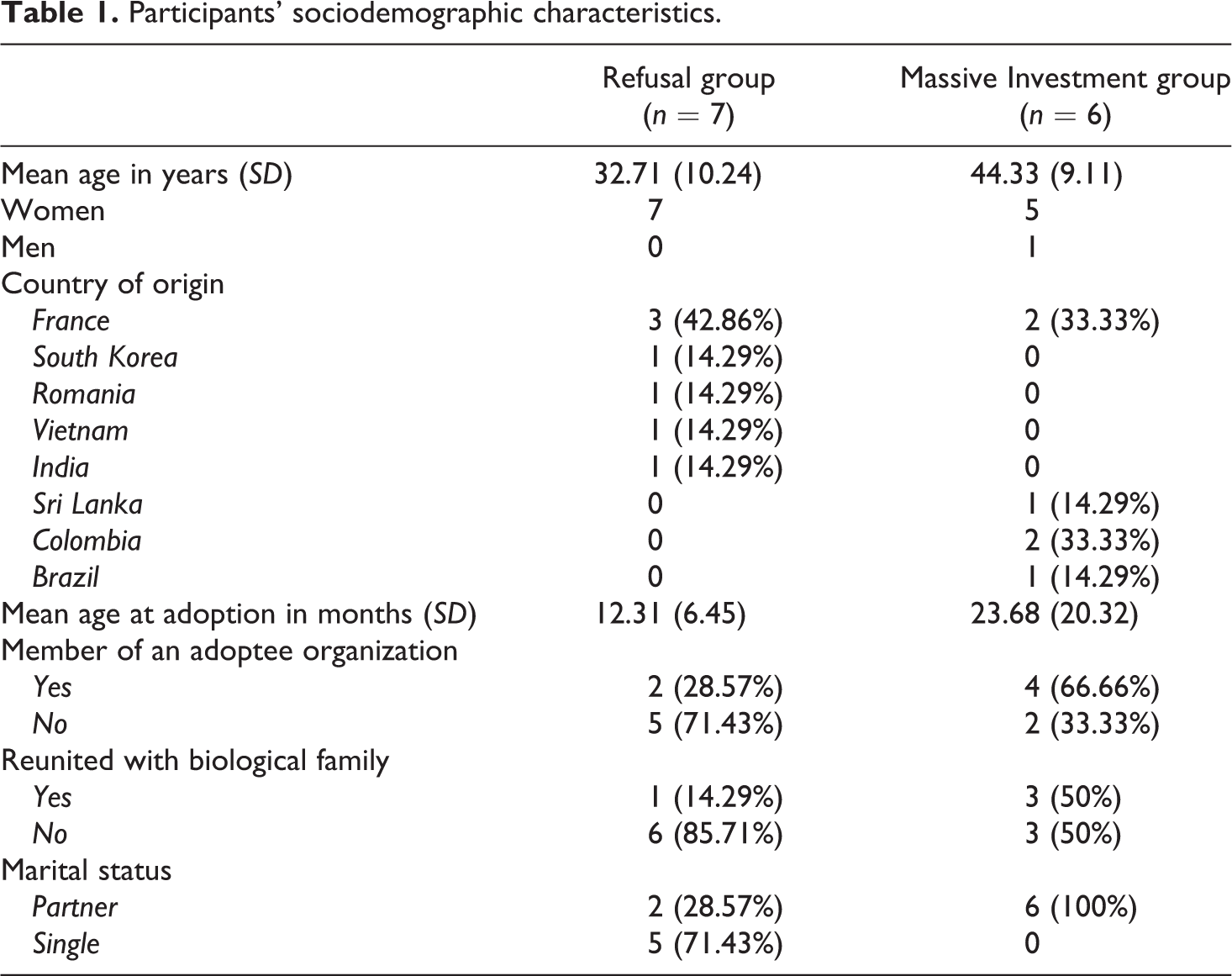
We recruited 13 French-speaking participants (12 living in France, and 1 living just across the border in Switzerland): 7 female adoptees who did not wish to have children (refusal group; mean age = 32.71 years), and 1 male and 5 female adoptees who already had children (massive investment group; mean age = 44.33 years). None of the participants in the refusal group had children, and five were single. All the participants in the massive investment group were already biological parents, and all of them were living with a partner. The number of participants was defined using a data saturation method. Thus, for each group, we stopped conducting interviews when the last two participants had failed to provide any new information.
Table 1 sets out the sociodemographic characteristics of each.
Participants’ sociodemographic characteristics.
Procedure
Participants in the initial sample (283 adoptees; 243 women and 40 men) were contacted in several ways. Some of them were members of adoption charities such as La Voix des Adoptés, l’AFOR, Mouvement Retrouvailles, or Racines Coréennes. Others were contacts of members of adoption charities, or members of social media groups, but were not directly involved in adoption charities. They were sent a link to an online survey containing questions about parenthood and rating scales for measuring the experience of parenthood. Respondents had to indicate their parental status (“I already have children,” “I don’t yet have children but I would like to,” “I don’t yet have children and I don’t want any,” or “I don’t yet have children and I can’t/can no longer have any”). A total of 24 participants (19 women, i.e. 7.82% of all women, and 5 men, i.e. 12.5% of all men) answered “I don’t yet have children and I don’t want any.” When we contacted these respondents, seven of them agreed to be contacted later to undergo the interview, and therefore formed the refusal group. A total of 160 participants answered either “I already have children” or “I don’t yet have children but I would like to,” and were invited to complete the French-language Motivation to Have a Child Scale (Gauthier et al., 2007). We then selected respondents who scored 6 or 7 (max. score 7) on intrinsic motivation (i.e., type of motivation that reflects the highest level of self-determination). As 65% of respondents achieved this score, we then performed a second selection, based on responses to the open question “What has being parent given you?” On the basis of their discourse, we selected 17 respondents (6%), who presented parenthood as the sole source of meaning in their lives. Six of them agreed to undergo the interview and therefore formed the massive investment group. The final sample of 13 participants was therefore a convenience sample, comprising all the participants who met the criteria required to enter the study and agreed to take part. The study was presented to participants as research on adoptees and parenthood, and the participants were not told that they had been selected on the basis of their specific profile, so as not to lock them into a category.
All the interviews were conducted face to face in the participants’ home towns, either in their home or in a library or quiet café. Participants were informed about the aim of the study, how the interview would be conducted, and data confidentiality. They signed two copies of an informed consent form in the presence of the researcher (one for the researcher and one for them). All information allowing participants to be identified was removed from the data. Participants did not receive any financial compensation for taking part. This study was approved by the ethics committee of Lille University, France (no. 2018-316-S66).
Instruments
Participants underwent a semistructured interview and completed a timeline.
Semistructured interview
Lasting 90 minutes on average (min: 50 minutes, max: 130 minutes), the semistructured interview conducted by a researcher (JD) tackled seven themes: the potential desire to have a child, representations of parenthood, the reasons behind the participant’s attitude toward parenthood, the participant’s satisfaction with this attitude, coparenting, bonds with adoptive and biological parents, and the participant’s view of adoption. Questions were a mix of open and closed questions. The interview protocol can be consulted in an additional file. All the interviews were recorded and transcribed.
Timeline
The timeline was developed by Pace (2003) as part of a therapeutic method called Lifespan Integration. It was originally intended to help individuals who had experienced childhood trauma to piece together the fragments of their lives into a coherent whole. In the present study, participants were just asked to place the positive and negative events that had marked them the most (and the age at which they each occurred) on a timeline running from the day they were born to the day of the interview. There was no time limit on this exercise. Participants were then asked to describe their timeline, going over the events in any order they wished. The final question was “Now that you have drawn your timeline, in your opinion, which of the events in it contributed to your current attitude toward parenthood?”
The timeline exercise was not intended to achieve any particular objective, but rather to back up the semistructured interview. Therefore, the timeline results are not presented as such but are included in the results of the semistructured interview. It enabled participants to gain a clear vision of the events in their lives and gave them an opportunity to think about those that had led them to form their current attitude toward parenthood.
Data analysis
We subjected the data to a thematic analysis. We chose thematic analysis as a qualitative analysis method for its ability to summarize the essential points of a large body of data and to offer a comprehensive description of the dataset. This method also allows similarities and differences across the data to be highlighted. However, we are aware that this approach has several limitations. For instance, a corpus can give rise to very wide-ranging interpretations if a specific theoretical context is not defined beforehand. In addition, this technique does not consider the fine-grained elements of language. According to Braun and Clarke (2006), a thematic analysis can be realist, constructionist or contextualist. In the present study, in order to answer our research questions, we chose the realist approach, which means that we “reported experiences, meanings and the reality of participants” (Braun & Clarke, 2006, p. 81). To gain an overview of the results, we applied an inductive, bottom-up approach, where the themes were derived from the data. It only took one participant to mention a theme once for it to be considered. We made this choice not only because of the small sample size, but also because the number of occurrences is not necessarily a reliable indicator of a theme’s actual importance (Paillé & Mucchielli, 2012). We followed the analytical steps recommended by Braun and Clarke (2006). The first step was familiarization with the data. During this phase, the audio recordings were transcribed by two researchers (YD & OH). More specifically, each interview was transcribed by one researcher, and each transcript was then checked by the other researcher. This initial phase allowed us to familiarize ourselves with the data. We then coded the whole transcripts using QDA Miner 5 qualitative analysis software (Lewis & Maas, 2007). Two researchers independently carried out this analysis, to ensure that it was as objective as possible. We established four initial categories: experience of refusal, determinants of refusal, experience of massive investment, and determinants of massive investment. The two researchers in charge of the coding located all the themes in the transcripts that were linked to one of these four categories. Once each transcript had been coded, we carried out a cross-sectional analysis to pick up common themes across the transcripts. In addition, each of the two researchers harmonized the resulting themes, to avoid repetitions and hone the wording. The themes were then defined and named at the most appropriate level of generalization. Lastly, the two researchers compared the themes they had identified for each category, rewording, redefining or merging them. When the two researchers disagreed on the identification of a theme, the arguments for each proposition were presented and discussed until a consensus was reached. This important phase ensured that the results were as objective as possible, with themes that best represented the corpus.
Researcher description
Three researchers participated in the data collection and analysis. All three were female psychologists and researchers. JD, the instigator of the research project, carried out all the interviews. She is familiar with the subject of adoption and parenthood. She also participated in the transcription and coded the interviews using the software. OH was not present during the interviews, but contributed to the transcription and coding of the data with the software. As this second researcher had not previously collaborated with us, she provided outsider’s perspective on our research and a neutral view of the results, which might have suffered from a confirmation bias had the first researcher analyzed the data on her own. EB is familiar with the themes of both adoption and parenthood. She helped to construct the framework of the interview and verified the data analysis and the results, thus providing a third opinion to maximize the objectivity of the results. The first and third researchers were from the same research team. None of the researchers knew the participants before the study.
Thus, to optimize the reliability of our results, we followed the five research validity processes related to personal relationships cited by Suter (2009): methodological triangulation (lifeline and interviews), investigator triangulation, examples, audibility, and peer review.
Presentation and analysis of results
The results of the thematic analysis are set out in Tables 2 to 5. We decided to present our results in tables to make it easier for readers to navigate the different themes, subthemes, descriptions, and examples. In addition, this strategy allowed us to present more quotes from participants than we would have been able to do in a text, all the while summarizing our data as much as possible. The interlinking of the different themes is then explained for each of the tables.
Thematic analysis of experience of parenthood refusal (n = 7).
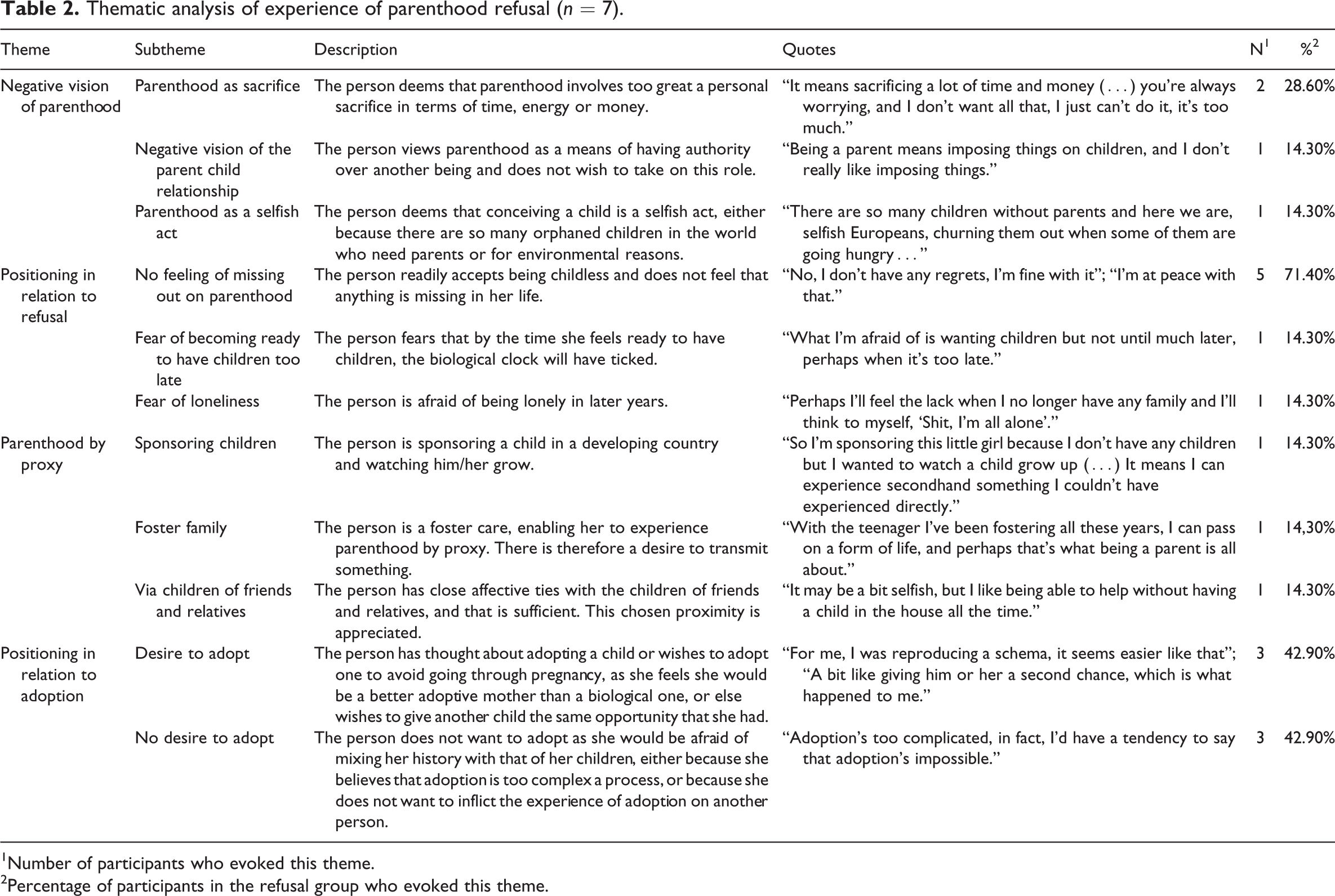
1Number of participants who evoked this theme.
2Percentage of participants in the refusal group who evoked this theme.
Thematic analysis of determinants of refusal of parenthood (n = 7).
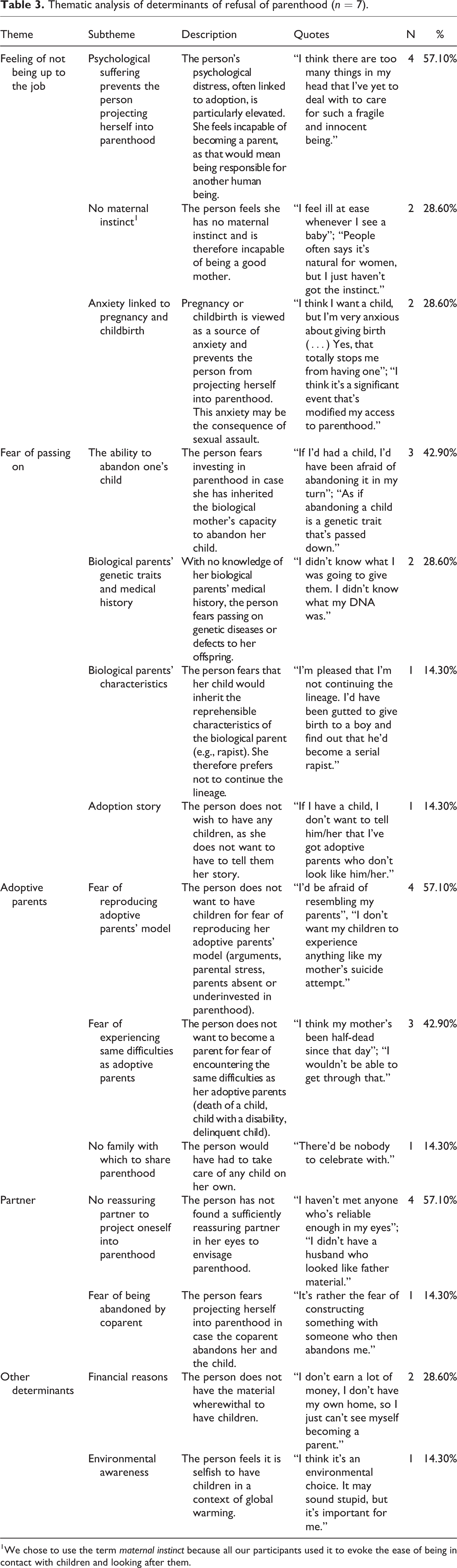
1We chose to use the term maternal instinct because all our participants used it to evoke the ease of being in contact with children and looking after them.
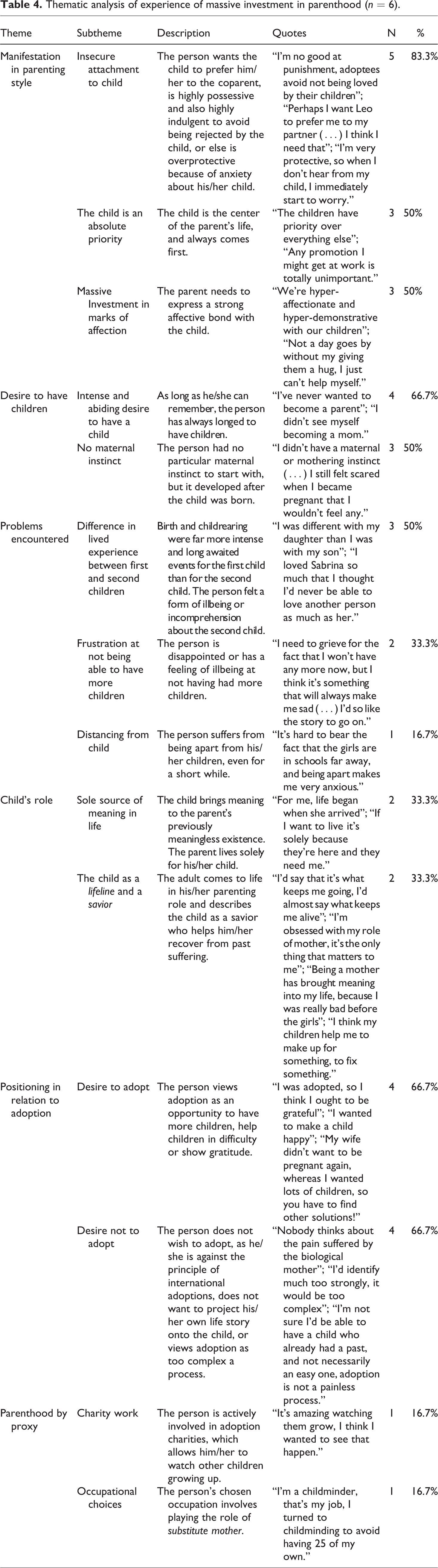
Thematic analysis of experience of massive investment in parenthood (n = 6).
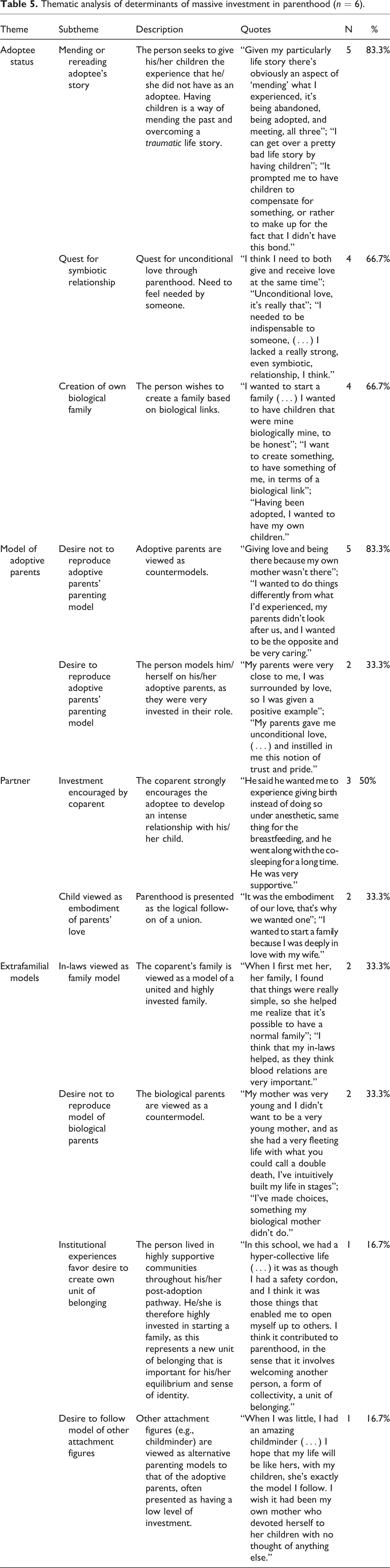
Thematic analysis of determinants of massive investment in parenthood (n = 6).
The data provided in Table 2 (thematic analysis of experience of parenthood refusal) show that most of the women we interviewed did not feel any yearning for motherhood. Instead, they had a negative vision, describing biological parenthood as a selfish act because of the number of abandoned children in the world or citing environmental reasons whereby biological children are seen as a preventable source of pollution. In line with this way of thinking, three female participants experienced parenthood by proxy, as they either sponsored a child or were close to children in their family. This way of investing in children indicated a potential interest in the role of parent, but also showed just how much anxiety it generated, hence the need to keep a distance. These female participants also had conflicting attitudes toward the possibility of adopting a child, for although it was sometimes presented as a more accessible solution, in that they were more familiar with it than with biological parenthood, it was sometimes viewed as an experience that should in no circumstances be replicated.
The data provided in Table 3 (thematic analysis of determinants of refusal of parenthood) show that some women felt very strongly that they were simply not up to it, on account of their anxiety or psychological distress. Fear of transmission (genetic or psychological) also seemed to go a long way toward explaining why some adoptees refused parenthood. Romantic relations or the absence of a partner contributed to the refusal of parenthood, as the majority of participants (n = 5) in the refusal group were single. Lastly, relations with adoptive parents played a decisive role. Nearly all the women (n = 6) refused parenthood because they were afraid they would end up resembling their adoptive parents or would experience the same traumatic events as they did (death of a child, child with a disability, etc.).
The data in Table 4 (thematic analysis of experience of massive investment in parenthood) highlight the marked effect that massive investment in parenthood had on our participants’ parenting style, as adoptees invested massively in their relationships with their children, with whom they obviously had an insecure attachment. Moreover, this massive investment appeared to be detrimental to the parents themselves, as some participants reported that they found it hard to invest as much in their subsequent children as they had in their firstborn, suffered when they were apart from their child, and felt frustrated at not being able to have more children. Such massive investment may therefore heighten parenting stress. Analysis also revealed that adoptees often viewed their child as a lifeline or their savior, helping them to overcome their past suffering. Lastly, in contrast to participants in the refusal group, some of those in the massive investment group saw adoption and parenthood by proxy as a means of experiencing parenthood even more vividly, and possibly even as a means of being a parent despite biological barriers (infertility) or a partner who did not want any more children.
The data set out in Table 5 (thematic analysis of determinants of massive investment in parenthood) show that this massive investment in parenthood was particularly influenced by adoptee status. Although some of our participants’ motivations to have children were shared by the general population (quest for unconditional love, desire to do a better job than one’s own parents, etc.), most of them saw becoming a parent as a means of mending their adoption history by creating their own biological family and experiencing an intense relationship with their child(ren). Relationships with their adoptive parents also seemed to account for the massive investment of some adopted parents. Although some of these adoptees viewed their adoptive parents as models, the majority claimed that their own investment in parenthood was an attempt to distance themselves as far as possible from their adoptive parents. The latter were judged to have been too detached or not sufficiently invested. The massive investment in parenthood also seemed to be based on other models, with participants citing their experience of living in an institution prior to adoption, their relationship with a childminder, and even their relations with their partner’s family. Lastly, half the participants stated that their partner encouraged them to invest more in parenthood.
Discussion
The overall aim of the present study was to improve current understanding of the lived experience of two categories of adults who were adopted as children: those who refuse to become parents, and those who invest massively in their parenting role.
Experience and determinants of the refusal of parenthood
First, we explored the experience of the seven female adoptees who did not want to have children. Our aim was to extend the results of previous studies showing that adopted adults have a weaker desire for children than nonadopted adults (Horowitz, 2011), and may even reject the idea of becoming a parent altogether (Sherr et al., 2018). We found that 7.82% of the women and 12.5% of the men in our initial sample (283 adoptees) not only did not have children, but did not wish to have any. These are interesting figures, as they are significantly higher than the percentages for the general population, χ2(1) = 8.98, p < .05. According to a report (Debest & Mazuy, 2014) published by the French National Institute of Demographic Studies (INED), this profile is only found in 6.3% men and 4.3% women in France. In view of our results, we think that it would be interesting to study the potential over-representation of individuals adopted in France among those who do not wish to have children.
Through these seven interviews, we also explored the reasons behind this refusal of parenthood. As our participants often felt that becoming parent would be too challenging in terms of psychological adjustment, we can surmise that adoptees’ vulnerability in terms of mental health (Brown et al., 2019; Dekker et al., 2017) affects how they project themselves into parenthood, not least by damaging their self-esteem. Brenning et al. (2015) demonstrated that the degree of motivation to have children is linked to both psychological adjustment and marital satisfaction, so the absence of a desire for children among our participants may also have stemmed from weak dyadic adjustment. The fear of transmission expressed by some of our participants had already been explored by Brodzinsky et al. (1993), Pinkerton (2011), and Pierron (2017), but these authors focused on concerns about passing on medical conditions. Our results suggest that the fear of transmission may also apply to other aspects, such as psychological disorders or the ability to abandon a child. Moreover, regarding romantic relationships, adoptees are generally described in the literature as having greater difficulty forging relationships, living with a partner, and marrying, compared with nonadoptees (Tieman et al., 2006).They also report less marital happiness (Feigelman, 2000) and are more sensitive to relational stressors (Feeney et al., 2007). For some adoptees, difficulty forming stable and secure relationships may be a barrier to becoming a parent. Finally, our results regarding adoptees’ fear of reproducing their adoptive parents’ model corroborate those of Gatzke (2015), Greco et al. (2015), and Pierron (2017), who reported that adoptees have difficulty identifying with their adoptive parents when they themselves become parents. That said, wanting to do things differently from one’s parents and the fear of reproducing their model is not specific to adoptees and is frequently observed in the general population (Roskam et al., 2015).
Most of the determinants we identified were therefore based on fears of various kinds. Whereas studies conducted in the United States and Europe among the general population (Bloom & Trussell, 1984; Tanturri et al., 2015) have highlighted the influence of values and education level on the decision not to have children, adoptees’ refusal to have children seems to be driven more by specific sources of anxiety.
Experience and determinants of massive investment in parenthood
Next, we analyzed the six adoptees who, by contrast, invested massively in their parenting role. We found that some of them had an insecure attachment to their child. In the literature, insecure attachment has been linked to parental control attitudes (Roskam et al., 2015), distorted representations of the parent child relationship (Rholes et al., 1997), higher levels of parenting distress (Lionetti et al., 2015), and lower levels of parental satisfaction (La Valley & Guerrero, 2012). These parental characteristics may have a negative impact on the child’s development and on family cohesion. The role of savior that some adoptees conferred on their child is consistent with research showing that the children of adopted parents serve a reparatory function. For the very first time, parents can experience a biological link, physically resemble someone, and give their child what they themselves never had (Moyer & Juang, 2011; Pinkerton, 2011; Sherr et al., 2018). However, this raises the question of how children who are given this role are affected. For instance, enabling a parent to mend his or her past may be a heavy burden to bear. Children whose parents express an insecure attachment to them may in turn risk developing an insecure attachment. Some authors have studied the transmission of attachment patterns from parents to their children, and Stievenart and Roskam (2013) showed that transmission of these patterns does indeed take place.
When we looked at the reasons behind this massive investment in parenthood, we found that adoptee status was particularly influential. The potential reparatory effect of parenthood among adoptees has already been described by Pinkerton (2011), Gatzke (2015), and Pierron (2017). Regarding the wish to distance oneself from adoptive parents’ parenting model, although some individuals in unselected samples express a desire to distance themselves from their parents’ model when they themselves become parents (Roskam et al., 2015), we can legitimately ask whether adoptive parents are indeed less invested on average than biological parents, or whether adopted children simply feel that their adoptive parents are more detached, perhaps because their life story means that they have a greater affective need than nonadopted children. A conflict of loyalty between the biological family and the adoptive parents may also explain why the latter become countermodels. This conflict is observed extremely frequently among adoptees from a very early age, and may have a negative impact on their relations with their adoptive parents (Coutanceau & Dahan, 2020). Finally, adoptees’ partners seemed to play an important role. As Roskam et al. (2015) underlined, parenthood can be used to strengthen the parental couple’s own relationship. This turns the spotlight on the role played by the other parent in an adoptee nonadoptee couple. The results of the study by Greco et al. (2015) suggest that partners have a major influence on the way in which adoptees experience their present and relive their past.
Strengths, limitations and future directions
The present study provided an opportunity to look at two specific attitudes of adult adoptees toward parenthood. Our results are important, as they shed light on situations that can be a source of distress for adoptees and allow for a better understanding of the potential effects of adoption on how adoptees build families. Several of the determinants we identified in our two groups (e.g., relations with parents, with a partner, etc.) also lead nonadopted adults to express similar specific attitudes toward parenthood. These similarities may explain why no differences have been observed at the quantitative level between adoptees and nonadoptees on certain variables related to the experience of parenthood (Despax et al., 2020). Other determinants, however, seemed to be specifically linked to their adoption history, showing that this population deserves particular attention from researchers studying parenthood. The present study also contributes more broadly to research on the long-term outcomes of people who have experienced adversity in childhood. Our results show that a common instance of early adversity (e.g., being adopted) can give rise to a wide variety of experiences. This confirms the finding of Palacios et al. (2019), who underlined the considerable heterogeneity of adoptees’ experiences. Clinicians caring for adult adoptees could explore their relationship to parenthood as a means of accessing distress linked to their past. Caring for these potentially fragile parents is also a way of protecting the development of any children they have, so that they do not find themselves in a potentially toxic position. Our results will also allow practitioners offering family therapy to adoptive parents, adoptees, and/or their children to identify certain harmful family dynamics.
The present study nevertheless had several limitations in the form of potential biases. First, our sample was not sufficiently representative, especially when it came to the sex ratio, given that there was only 1 man for 12 women. Many studies of adults who were adopted as children have reported a virtual absence of male participants, and it would be interesting to examine the reasons behind this difference in participation, one hypothesis being that men are less present on social media (Alzahrani, 2016). Second, the small size of our sample limited the extent to which our results can be generalized. Third, the considerable heterogeneity within the two groups (e.g., age at adoption, country of origin, age of any children) further hindered generalization. There is also a possible ethical issue, insofar as a degree of stigma may be attached to adoptees’ parenting styles, as though they were automatically driven by their personal experience. Stereotype threat may thus have led our participants to describe their relationship to their child or their parenthood in a particular way. Lastly, after data collection, the coding of the transcripts into themes was necessarily influenced by the subjectivity of each researcher, even if we carried out interrater comparisons to limit this bias.
Future research could investigate adoptees’ experience of parenthood further by studying larger and more representative samples, and by ensuring a better sex ratio. Scales measuring attachment and mental health could be included, to draw parallels between participants’ scores on these scales and observations yielded by the qualitative analyses. It would also be useful to include a comparison group of adopted parents within the norm, in terms of parental investment, to determine whether there are any real differences between their answers and those given by parents in the massive investment group. The influence of partners on adoptees’ attitudes toward parenthood also deserves to be explored in greater depth. As Greco et al. (2015) explained, partners considerably influence the way in which adoptees view both their past and their present. Finally, given our results on the parenting behaviors of some adoptees, it would be useful to study the development of adoptees’ children, in order to improve our understanding of how best to support parenthood in these families.
Supplemental material
Supplemental Material, sj-pdf-1-spr-10.1177_02654075211028288 - Refusal versus massive investment: Qualitative study of parenthood among adopted adults in France
Supplemental Material, sj-pdf-1-spr-10.1177_02654075211028288 for Refusal versus massive investment: Qualitative study of parenthood among adopted adults in France by Johanna Despax, Evelyne Bouteyre and Onsua Halidi in Journal of Social and Personal Relationships
Footnotes
Acknowledgments
We would particularly like to thank the nonprofit organizations La Voix des Adoptés, EFA 13, AFOR, Racines Coréennes and Le Mouvement Retrouvailles for telling their members about our research protocol. We also thank Mathilde Grillo, Léa Plessis, Mariel Pietri, Tricia Murray and Pauline Duval for their careful reading of our manuscript and their constructive comments.
Funding
The author(s) received no financial support for the research, authorship, and/or publication of this article.

Open research statement
As part of IARR’s encouragement of open research practices, the author(s) have provided the following information: This research was not pre-registered. The data used in the research cannot be publicly shared but are available upon request. The data can be obtained by emailing:
Supplemental material
Supplemental material for this article is available online.
References
Supplementary Material
Please find the following supplemental material available below.
For Open Access articles published under a Creative Commons License, all supplemental material carries the same license as the article it is associated with.
For non-Open Access articles published, all supplemental material carries a non-exclusive license, and permission requests for re-use of supplemental material or any part of supplemental material shall be sent directly to the copyright owner as specified in the copyright notice associated with the article.
