







Abstract
Framed by Wefulness Theory (WT; Nuru & Bruess, 2022), the present study explores the COVID-19 global pandemic as a context for examining relational struggle and strength during times of challenge. Analysis of in-depth, dyadic interviews with 54 couples who reflect a broad range of ethnic-racial compositions, partnership structures, sexual orientations, and ages rendered intelligible relational partners’ wefulness practices in situ. Results reveal four suprathemes: (a) cultivating relational consciousness, (b) negotiating wefulness amidst challenge, (c) accepting life on life’s terms, and (d) inviting challenge as opportunity for growth. Data reveal how relational partners engage in ritualized (re)commitments as multi-vocal practices of expressing and embracing the current pandemic moment. Data also evidenced WT is heuristically powerful in reconceptualizing and illuminating relational meaning- and sense-making.
The COVID-19 pandemic has impacted personal relationships in unprecedented ways (Bevan & Lannutti, 2021; Li & Samp, 2021; Lillie et al., 2021; Waddell et al., 2021). In addition to navigating environments of physical confinement, relational partners faced stressors of caregiving, homeschooling, widespread shifts in employment, and renegotiation of childcare and housework. Health care disparities for individuals from differing social locations of ethnicity-race, age, (dis)ability, gender identity, socioeconomic background, pre-existing medical conditions, and citizenship status have compounded stressors while presenting new challenges for family systems (Fraenkel & Cho, 2020; Novacek et al., 2020).
Although the precise, long-term effects of the pandemic on relational functioning are yet to be known, research evidences how anxiety and conflict from natural disasters or traumatic events (e.g., September 11th attacks) results in increased stress, relational strain, and marital dissolution (Cohan et al., 2009; Luetke et al., 2020; Novacek et al., 2020; Prime et al., 2020). In addition to deterioration of psychosocial well-being (APA, 2020; Hou et al., 2020), pandemic-incited stressors of financial hardship, confinement fatigue, or illness may spillover into relationships, impeding relational functioning (Luetke et al., 2020). As such, partners’ inability to cope with everyday pressures simultaneous with pandemic-induced hardships may lead to decreased relational quality and satisfaction, and increased likelihood of relational dissolution (Luetke et al., 2020; Prime et al., 2020; Randall & Bodenmann, 2017).
Research also suggests some couples experience increased relational satisfaction and intimacy during times of natural disaster or crisis (Luetke et al., 2020; Marshall & Kuijer, 2017), seeking security and comfort from close others in the face of threat to their existence (Mikulincer & Shaver, 2007). Given that most adverse life events are indirectly or directly experienced with others (Carr & Koenig Kellas, 2018; Koenig Kellas & Trees, 2006), one explanation for improved relational quality following crisis may be partners’ ability to cultivate resilience and interpersonal closeness through relational discourse. Buzzanell (2010, p. 2) argues communicative processes of resilience enable individuals to “endure and reintegrate” following difficult life experiences, and that resilience does not reside within an individual; rather, it is communicatively negotiated between relational partners (Buzzanell, 2010, 2018; Lucas & Buzzanell, 2012).
Afifi and colleagues (2016, 2020) advance that communication maintenance behaviors can help partners manage stress and foster resilience in relationships. Further, the ways that relational partners communicate when experiencing stressful life events may contribute to increased interpersonal closeness as relational partners make sense of the adverse situation (Buzzanell, 2010, 2018; Carr & Koenig Kellas, 2018). Collectively, research suggests that resilience may be created in part through interactions with others, and our close relationships serve as particularly important places where such talk occurs. Communication scholars have chronicled the discursive power of relational resilience during times of crisis for familial sense-making (Koenig Kellas & Trees, 2006), resource building (Afifi et al., 2016), and reinforcing relational bonds (Socha & Torres, 2015).
In the most comprehensive longitudinal study mapping resilience development from birth to adulthood, Werner and Smith (1992) found supportive adult relationships, such as a spouse, contribute significantly to later life resilience. Mayer and Faber (2010) assert the significance of connection in fostering resilience whereas Carr and Koenig Kellas (2018) evidence how emotionally supportive marital communication positively predicts resilience. Taken together, research suggests relational partners most likely to develop resilience during crisis are those who feel interpersonally connected (Carr & Koenig Kellas, 2018; Mayer & Faber, 2010) and engage in emotionally supportive communication (Buzzanell, 2010, 2018; Carr & Koenig Kellas, 2018; Werner & Smith, 1992).
The pandemic has clearly impacted personal relationships and relational systems. Considering that little is understood about the sense-making processes of couples successfully navigating the COVID-19 pandemic, a nuanced exploration of relational struggle and strength during a time of transition and challenge as presented by the pandemic is warranted. Specifically, this study attends to the ways couples navigate their relationship systems, examining interpersonal rituals as core relational cultural practices and investigating how couples engage wefulness as relational cultural work.
Rituals and relational cultural framework
Relationships are microcultures wherein relational identities are co-created through symbolic enactments of members (Baxter & Braithwaite, 2002; Braithwaite & Baxter, 1995; Braithwaite et al., 1998; Bruess & Pearson, 1997, 2002). Wood’s (1982, p. 76) foundational relational cultural framework points to a couple’s relationship culture as the nucleus of intimacy, providing members a mini-universe of shared discourse that serves to “…erect a cognitive and normative edifice which guides their knowledge of and interaction with the world at large, and which establishes rules that coordinate transactions within the private sphere of their relationship.” Viewing relationships as microcultures provides scholars a lens for studying close relationships as entities in which enactments such as rituals, private language, and symbols create and sustain the relationship as an idiosyncratic system.
Rituals reflect the core of the relationship itself (Baxter & Braithwaite, 2002; Braithwaite & Baxter, 1995; Braithwaite et al., 1998; Bruess & Pearson, 1997, 2002). As methodical sequences of symbolic interactions, rituals are communicative acts through which relational partners pay homage to sacred objects, persons, memories, or activities (Goffman, 1967). Rooted in action and repetition, rituals are different from routine in their symbolic value (Viere, 2001). For example, a couple reading together in bed before sleep moves from routine to ritual as they come to value that space and time, symbolically embracing the comfort of lying side-by-side at the conclusion of each day.
Rituals are the hallmarks of relational cultures and serve to foster their (re)establishment (Baxter, 1987; Bruess & Pearson, 1997, 2002; Wood, 1982). Dense with meaning, their enactments are rich in relational work (Imber-Black, 2020) as they reveal the status of relationships (e.g., a couple welcomes each other home with a unique hand signal); maintain relational ties (e.g., geographically distant families convene every Sunday for conversation via video conference); mark transitions (e.g., children becoming old enough to learn the family’s secret recipe); and reveal acceptance or rejection (e.g., a partner is invited to the family cabin for the first time).
Rituals serve profound functions for relational members: as organizing devices allowing for both stability and change (Pearson et al., 2010); as enactments for navigating competing ideals of marriage (Baxter & Braithwaite, 2002) and blending families (Braithwaite et al., 1998); as sites of intersectional identity negotiation and performance (Glass, 2014; Oswald, 2002); as safe spaces for LGBTQ+ partners (Oswald & Masciadrelli, 2008); as devices through which bonds among family members are forged and solidarity reified (Campbell & Ponzetti, 2007; Smit, 2011); as transmissions and (re)enactments of family values, beliefs, and attitudes (Fiese et al., 2002); and as contributors to the physical and mental well-being of family members (Santos et al., 2018).
Rituals are rich exercises in order and stability, serving as cultural occasions through which partners “step back from everyday life in order to reflect symbolically on that very life” (Baxter & Braithwaite, 2002, p. 97). Such enactments happen in the mundane rhythms of relational life (e.g., family dinner at which each member shares best and worst part of their day) and in public celebrations of commitment, transition, or rites of passage (e.g., marriage ceremonies, vow renewals, funerals, pictures on the first day of school). Rituals give relational members a sense of rightness and solidarity during crisis, loss, or transition (Imber-Black, 2020), in part because the cognitive mechanisms underpinning rituals build and sustain coalitions (Boyer & Liénard, 2020). Rituals have power as sites wherein relational meanings are (re)produced, (re)negotiated, and contested in the way they “hold us, shape us, sustain us, and connect us” (Imber-Black, 2020, p. 920).
In a time of COVID-19, researchers are documenting how prioritizing routines and rituals can improve mental and relational health (Hou et al., 2020), as well as how couple and family rituals “capture and express the current moment” of a global pandemic (Imber-Black, 2020, p. 920). Given Shils’ (1966) argument that ritual, at its core, protects members from destructive forces by infusing them with a sense of what’s sacred, the current study examines rituals as both sites and manifestations of couples’ wefulness as they narrate, sense-make, and navigate the COVID-19 pandemic.
Theoretical foundation: Wefulness Theory
Grounded in constitutive communication (Craig, 1999), the relational culture perspective (Baxter, 1987; Bruess & Pearson, 1997, 2002; Wood, 1982), and mindfulness frameworks (Kabat-Zinn, 2003, 2015), Wefulness Theory (WT; Nuru & Bruess, 2022) describes the phenomena through which relational partners are involved in a process of relational consciousness, or wefulness. Nuru and Bruess (2022) define wefulness as the intentional communicative practices of present-minded interpersonal awareness. Functioning as both a cognitive schema and an interpersonal process, WT maintains relational cultures come into being through social interaction and are (re)negotiated through multiple, overlapping, and sometimes opposing discursive frames (Baxter, 2004, 2011; Hecht, 2002).
Much like a quilt, relationships are comprised of interwoven threads of selves, cultural histories, cognitions, and experiences (Baxter, 2004, 2011; Burke, 1966; Gergen, 1991). Each thread reflects multiple axes of social identity and existence (Baxter, 2004, 2011; Burke, 1966) as well as prediscursive meanings that stretch and pull in multiple ways as we evolve and interact with others (Gergen, 1991; Tracy, 2002, 2004; Tracy & Trethewey, 2005). WT posits that through relational consciousness, or wefulness, these quilts are materialized, stitched, and re-stitched through ongoing communicative enactments that can be purposefully and present-mindedly honed through systematic and routine practices (Nuru & Bruess, 2022). Wefulness, therefore, is a relational phenomenon through which partners engage purposeful communicative behaviors that beget penetrative insight about their relational, social, and cognitive realities (Nuru & Bruess, 2022).
WT asserts that relationships function as microcultures wherein the structural elements of the relational system “are both medium and outcome of the practices they recursively organize” (Giddens, 1984, p. 25). Hence, relational practices are shaped and performed under the specific conditions of the relational system while, simultaneously, the relational system is maintained and reproduced only through such relational practices (Nuru & Bruess, 2022). Extending the relational cultural perspective, WT argues the relational work of (re)creating relational systems involves purposeful citation and repetition of communicative behaviors that yield microcultures, as well as the subjective meanings within them. In other words, WT explicates how partners do relational cultural work, and the doing of relational work involves a tripartite process of communicative practices: relational talk, relational consciousness, and relational ritual, whereby each presupposes the others (Nuru & Bruess, 2022). Further, WT posits that this processual whole has no discernible end points and connects psychological, emotional, and social dimensions as part of an intentional practice (Nuru & Bruess, 2022).
Notably, WT pioneers the idea of relational consciousness as core to this constitutive process. In doing so, WT extends the conceptual underpinnings of mindfulness by centering relational awareness to elucidate how relational partners individually and collectively exercise purposeful, reflective, ritualized acts as relational maintenance. For example, Nuru and Bruess (2022) explicate how relational partners co-create shared, intentional consciousness and how they engage talk about such consciousnesses as one such practice. Kabat-Zinn (2003, p. 145) conceptualizes mindfulness as “the awareness that emerges through paying attention on purpose, in the present moment, and nonjudgmentally to the unfolding of experience moment by moment.” As one type of awareness-based intervention, mindfulness serves as a gateway to presencing (Brendel, 2019). By focusing on “the here and now regardless of location” (Brendel, 2019, p. 217), mindfulness and presencing offer a collection of micro-tools for shifting consciousness from a thinking/doing quality of awareness to one of sensing into a future that wants to emerge (Gunnlaugson & Brendel, 2020; Scharmer, 2018).
A growing body of research evidences the interpersonal benefits of mindfulness including improved relational quality (Karremans et al., 2017; Manusov et al., 2020), “attunement, connection, and closeness” (Brown et al., 2007, p. 225), commitment (Harvey-Knowles et al., 2015), forgiveness (Crowley et al., 2014), satisfaction (Kozlowski, 2012), as well as perspective-taking and interpersonal cooperativeness (Harvey-Knowles et al., 2015; Wachs & Cordova, 2007). WT embraces and extends mindfulness and presensing scholarship (Gunnlaugson & Brendel, 2020), calling specific attention to the ways relational partners engage the practices interpersonally (Nuru & Bruess, 2022).
Further, WT expounds how these intentional practices embody ongoing commitments to constructive contestation and relational agency. Nuru and Bruess (2022) define constructive contestation (CC) as the relational action wherein values, meanings, and perspectives may be held at variance rather than collectively accepted, noting CC as a relational undertaking toward productive, ongoing “struggle and change” (bell hooks, 2000, p. 185). Relational agency (RA) is defined by its three parts (Nuru & Bruess, 2022): (a) relational partners’ ability to act independently and make their own free choices (Giddens, 1984); (b) relational partners’ capacity to make a difference in the relational system, and such impact contributes to relational (re)construction (Del Mol et al., 2018; Giddens, 1984; Goffman, 1967); and, (c) the potential of the interpersonal processes that create relational agency to transform experiences, situations, or relationships (Sugarman & Martin, 2011).
Given that the present study aims to better understand how partners mindfully engaged in relational cultural work during the COVID-19 global pandemic, WT is a particularly well-suited theoretical framework. Using WT as a sensitizing lens, we pose the following research question: RQ: How, if at all, did couples engage wefulness practices during the COVID-19 pandemic?
Method
The present study is situated in the interpretive paradigm, following the precedent of relational scholars examining ritualized relational communication (Baxter & Braithwaite, 2002,; Braithwaite & Baxter, 1995; Bruess & Pearson, 1997, 2002). Interpretive researchers pursue understanding with the goal of rendering intelligible the experiences of participants from their perspectives (Baxter, 2004). The goals of the present study are consistent with the purposes of interpretive research (Baxter, 2004; Baxter & Babbie, 2004; Braithwaite, 2014). As such, we use a comprehensive, qualitative-interpretive research design drawing from dyadic interview data.
Participants
A research team of IRB-approved, trained interviewers recruited and collected data over a 5-month period (i.e., September 2020–January 2021) as part of a larger study on relational communication. We used purposive, network, and snowball sampling to recruit couples for simultaneous participation in the present study (Baxter & Babbie, 2004). Criteria for participation required both relationship partners be: (a) at least 18 years old, (b) in a committed romantic relationship (married or cohabiting), (c) living in the same household, and (d) in the relationship at least 5 years.
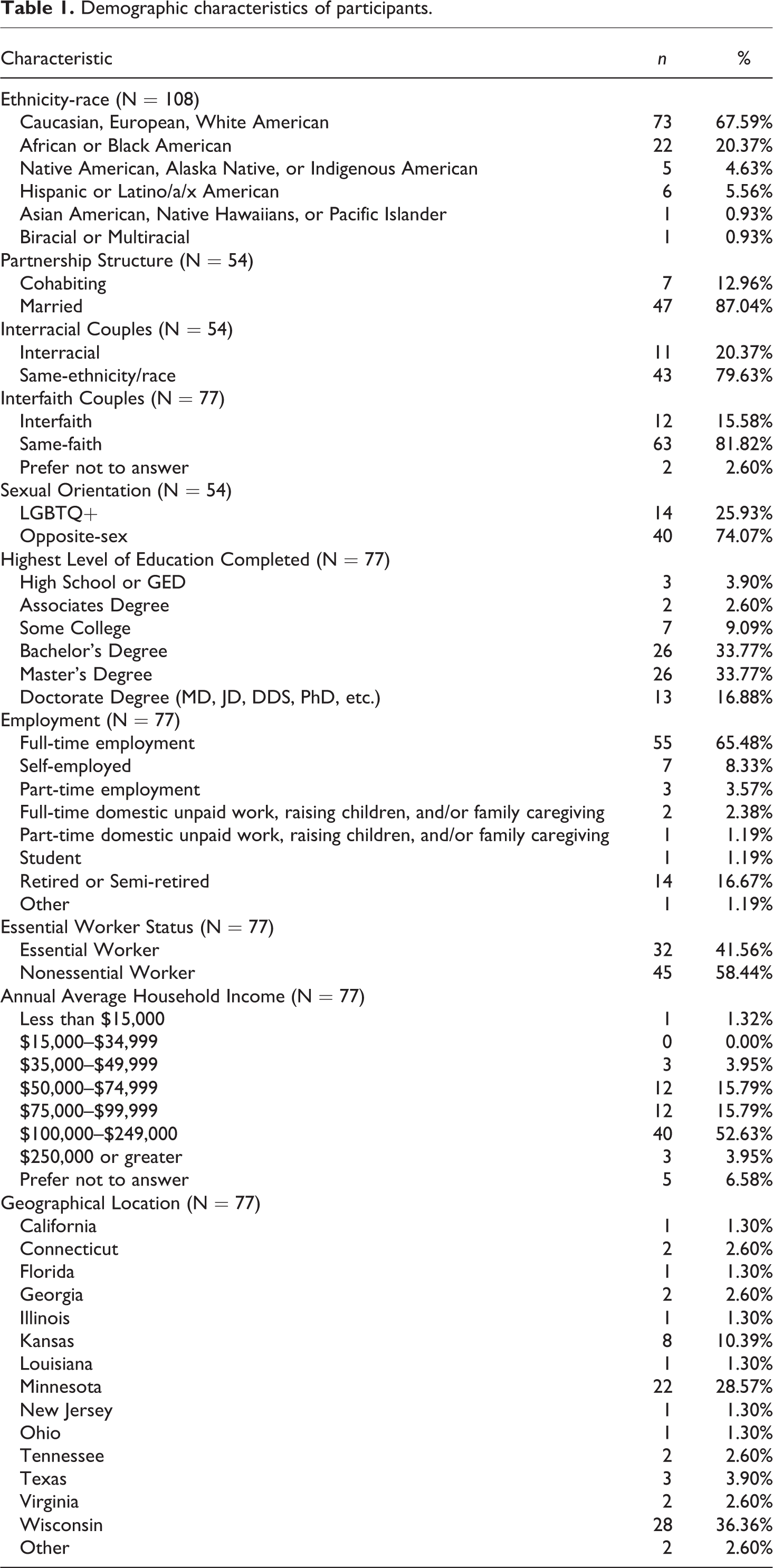
Participants included 54 couples spanning ages 24–99 years (M = 47.54, SD = 15.56) and married or cohabiting between 5 and 78 years (M = 20.76, SD = 16.02). Participants represented a broad range of ethnic-racial compositions, partnership structures, sexual orientations, employment and essential worker statuses, geographical locations, as well as educational and socioeconomic backgrounds. An overview of demographic data appears in Table 1.
Demographic characteristics of participants.
Data collection
To gain rich, in-depth, nuanced understandings of if and how couples engage wefulness while navigating the COVID-19 pandemic, we collected data through semi-structured, open-ended dyadic interviews (Rubin & Rubin, 2005). Due to social-distancing mandated by the pandemic, all interviews were conducted over video conference (i.e., Zoom), recording only the audio.
Prior to the interview, participants completed a “Key Moments Timeline” which asked the couple to work together to map times, events, or conversations with special significance in shaping understandings of their relationship. We encouraged participants to record as many key moments as they recalled, noting they need not agree on items chosen. Drawing from turning point and critical incident literatures (Baxter & Bullis, 1986; Flanagan, 1954), we developed “key moments” as a methodological framework for gaining greater understandings of participants’ relationships by examining pivotal relational occurrences considered influential in their relational trajectory (Baxter & Bullis, 1986; Baxter et al., 1999). The approach also allowed us to capture contexts in which participants are embedded and the perceived influence of those contexts on their relationship (Flanagan, 1954). We chose the phrase “key moments” instead of “critical incidents” to encourage inclusion of positive, negative, and neutral events (i.e., “critical” can unintentionally connote negative). This methodological tool allowed for precision in the collection of significant relational interactions such as those emergent during the COVID-19 pandemic. During the interview, we probed events listed on the “Key Moments Timeline” by asking questions exploring wefulness practices specific to their experiences during the pandemic (e.g., “Can you identify any pandemic-related key moments?”; “In what ways has this moment defined your sense of ‘we?’”; “Were you able in this moment to be intentional in any way about what either of you were feeling/experiencing/noticing?”).
Interviews ranged from 58 minutes to 2 hours and 22 minutes with an average length of 1 hour and 36 minutes. Using theoretical saturation as a measure of completion, we collected data until we reached the analysis point when all themes were thoroughly developed in “properties, dimensions, and variations” (Corbin & Strauss, 2008, p. 263). Although theoretical saturation was achieved within the first 23 interviews, we continued interviewing to further develop our dataset and vet our analyses. Following completion of all interviews, participants were invited to complete an anonymous, online demographic questionnaire to report the potentially more sensitive data of their socioeconomic status. Of the 108 participants who participated in an interview, 77 individuals completed the additional demographic survey.
Data analysis
Interviews were transcribed verbatim and verified against their original recordings, resulting in 1,484 pages of interview transcripts. All names and identifiers were replaced with pseudonyms. In the results section, verbatim exemplars from participants are included followed by parenthetical references cataloging exact locations of responses in the dataset, noting the assigned interview number and line numbers in the transcript (e.g., “IV 15, 94–98”).
Data analysis involved several interrelated steps. First, using an “idiographic approach” we separately read each transcript twice: first to gain detailed understanding of the dataset’s contents, then to note key passages and emergent patterns (Smith, 1995, p. 19). Second, we read the transcripts together and derived themes using Owen’s (1984) criteria of recurrence (same meaning, different wording), repetition (same wording explicitly repeated), and forcefulness (nonverbal cues that stressed or deemphasized words or phrases). We then engaged constant comparative analysis through which we compared the first two themes to determine whether they represented similar or divergent meanings. When the themes offered similar meanings, we placed them in the same category; when they offered divergent understandings we placed them in different categories. We repeated this process as we approached the third and fourth themes, and until we compared each theme to each other (Baxter & Babbie, 2004). Third, we returned to the original dataset to review our themes to ensure the identified themes were representative examples of the participants’ voiced experiences (Baxter, 2004). We then finalized our themes ensuring each was distinctly defined and noteworthy under the purview of the present study (Baxter & Babbie, 2004).
To ensure the credibility and trustworthiness of our research (Corbin & Strauss, 2008), we participated in an interactive data conference (Braithwaite et al., 2014). Through data conferencing, we critically discussed our results with experts in mindfulness, interpersonal theory, and qualitative research methods and invited their feedback related to our interpretation of results. Differences were minor and resolved through discussion.
Results
Emerging from data analysis were four suprathemes, each with two subthemes, reflecting how couples engaged wefulness practices and navigated ritual creation and adaptation during the COVID-19 pandemic: (a) cultivating relational consciousness, (b) negotiating wefulness amidst challenge, (c) accepting life on life’s terms, and (d) inviting challenge as opportunity for growth. Each supratheme and subtheme are explicated below as distinct while noting they mutually inform each other in a webbed system of meanings (Baxter, 2011). While interpreting findings, it is of paramount importance to recognize data were collected contemporaneously with the COVID-19 pandemic enabling niche insights on wefulness practices as couples navigated and experienced it.
Cultivating relational consciousness
Cultivating relational consciousness emerged as a supratheme revealing couples’ intentional practice of relational agency as the COVID-19 global pandemic entered and disrupted relational life, catalyzing shifts in thinking and pacing. Two emergent subthemes constituted this supratheme: (a) shifting mindsets toward gratitude, and (b) slowing down for relational presence.
Shifting mindsets toward gratitude
The first subtheme reflected couples’ shifting mindsets toward gratitude and revealed how a COVID-19 reality instigated powerful shifts in couples’ mindsets, a consciousness distinctly marked by gratitude. Partners articulated the opportunity of quarantine and the crisis of the global pandemic as opening them to an awareness of, and expressed appreciation for, each other, life in general, and the existence of their relational system—one, before the pandemic, they admitted at least partially taking for granted. The intentionality of their newfound gratitude, an ability to recognize blessings and embrace little moments with each other—as well as with family, friends, and community—was a clarity couples credited to the complex challenges presented by the pandemic. Facing something this significantly unprecedented and scary—job loss, fear of furloughs, loss of health, loss of life, children returning home—catalyzed a profound cognitive move for couples toward focused awareness on blessings, one discussed to some degree in each of our 54 interviews. Ruth, 99 years old and married 78 years to Earl (also 99) best captured the sentiment, reflecting on quarantine challenges: “You know, you don’t realize how lucky you are or how blessed you are until you can’t do some of the things that you often did” (IV 45, 294–295).
For couples like Dan and Cathy (married 33 years), the shift was a growing, explicit awareness of their relational culture’s value—the private world they built as a familial unit. Several participants described appreciative, heightened relational consciousness about their own situation when comparing them to the pandemic-incited difficulties experienced by others, a view inspiring clarity on their own relational microculture’s value. Dan explained: I read some articles about how COVID has been really challenging for a lot of couples, and leading to a lot of conflict and the divorce rate is up. But for me, it was like geez, ya know, we’ve got this little universe that we operate in and we’re so comfortable with it (IV 26, 886–889).
Slowing down for relational presence
Slowing down for relational presence was the second subtheme emerging in the supratheme cultivating relational consciousness. Consistently across the dataset couples shared how the pandemic enabled them to still the hustle of life, shifting their literal and cognitive pace toward savoring moments in their relational reality. Randall (married 21 years to Beth) voiced how the pandemic “gave us more time to be present” (IV 36, 530–531). Multiple participants similarly noted how the pandemic presented a unique opportunity to relish in each other’s company. Anthony and Grace, married 57 years, shared how the pandemic reminded them to intentionally create smaller moments of connection, even little opportunities for physical touch. Anthony points out, “My right hand is currently resting on her thigh. And we have been holding hands […] We didn’t make a deal of it. Now, we do” (IV 47, 1212–1214). Adam and Deidre (married 20 years), discussed how the pandemic slowed their lives down, providing a chance to attend to each other. Deidre: I guess what the pandemic has done for us, because we’re normally really busy, we […] wouldn’t have ever had time to sit down […] in all honesty. So what it has made us do now I think is really take a break […] We’re both leaders within our organization, so we’re busy constantly […] So this kind of made us slow down and take some time with each other. […] We get up in the mornings, we cook breakfast […] I’ve been able to kind of take care of him more, and him the same for me. […] It’s kind of brought us closer because we’ve been able to slow down and spend some time together (IV 43, 409–427).
Negotiating wefulness amidst challenge
Negotiating wefulness amidst challenge was the second supratheme emergent in the dataset, revealing how couples are responding to the pandemic as threat and engaging constructive struggle to navigate competing discourses incited by the pandemic. The two emergent subthemes are: (a) responding to threat by re-imagining traditions and ritual, and (b) (re)constructing relational microcultures through constructive contestation and relational agency.
Responding to threat by re-imagining traditions and ritual
The first subtheme reflected how the pandemic reached into marriages, relationships, and personal lives like an intruder enters a scene: unwelcome and, especially in early pandemic months, posing literal (i.e., health) and relational threats by upsetting relational systems. In response to threat, humans assume a defensive stance. Echoing Buzzanell’s (2010, p. 3) observation that families actively “craft normalcy” in the face of uncertainty, a clear pattern emerged in our dataset: Couples responded to the pandemic by actively re-imaging their traditions and rituals, a defensive response in the face of the pandemic’s dizzying unsettledness. As Shils (1966, p. 447) observes, ritual is “a response to danger,” both those crises already on the scene and those anticipated. Our dataset provided a window into couples’ responses to the pandemic’s threats, moving to protect the traditions and rituals that affirm their solidarity and stability and (re)shaping them in ways to continue their existence. In doing so, they co-created and embraced a shared belief that the pandemic’s destructive forces would not dismantle the greater force that is their relational culture, their we.
Couples overwhelmingly took a defensive-proactive stance as they negotiated, often toiled, over adjustments to traditions and celebrations such as weddings, Thanksgiving, and Christmas rituals. Nick and Tara, married 19 years with four school-aged boys, shared a perspective not unlike many others. With their move to a permanent home delayed because of COVID-19, Tara looked around the apartment they were renting as she explained: We are without any of our Christmas decorations for celebrating Christmas. Which should be a big deal. But instead, we decided we were doing new traditions. So, it was ‘Elf night,’ and the kids decorated like Elf, and then we made spaghetti with maple syrup for dinner and then watched the movie. It probably should be a much bigger deal to all of us than it was. But it was just an opportunity to start something new in a lot of ways, right? (IV 48, 1581–1585). […] one thing was Thanksgiving: like how is that gonna work? We were originally going to have my parents come and his. We weren’t going to do the big, huge thing. And then that sort of fell through and so I think we’re both a little disappointed about that. But knowing okay, we can still celebrate as our little four-person family and make it fun, and trying to look on the positive side and find things that we can do together (IV 10, 699–704).
(Re)constructing relational microcultures through constructive contestation and relational agency
The second subtheme of negotiating wefulness amidst challenge involved a sense-making process wherein relational partners worked through relational challenges emergent or resurfaced during the pandemic by concomitantly interweaving CC and RA as intentional (re)commitments. Across the dataset, participants described a range of relational struggles including incarceration, infidelity, miscarriage, infertility, job insecurity, and bereavement. Giving voice to the ways relationships are messy and require ongoing (re)creation of the relational microculture, participants illuminated how CC and RA worked in tandem. Yiska (with Aponi seven years) explains how they communicatively navigate the continuing impact of compound difficulties which resurfaced during the pandemic, including an affair and death of a parent: We’re still navigating it […] It’s something that we’re still working through. […] You have to be able to communicate with somebody that’s willing to communicate with you. And if you have two different perspectives, sometimes it’s harder to get to the table and talk through things and to be able to compromise so that two different parties are able to get to an understanding. […] I think that’s one of the keys to successful anything is being intentional about communicating. But the reality is it’s hard to do, you know? And it doesn’t always bubble up to the top of people’s priority list because you have all of these other things like work and every other commitment that you have in the world (IV 52, 712–772). […] There was another pretty big infidelity. He moved out again—or I kicked you out again—and I actually got a tattoo this time to remind myself that I wasn’t doing this anymore […] It was driving me nuts that I couldn’t make him want to be in this marriage. I couldn’t make him want to make it work. So then in November [eight months into the pandemic] there’s another […] Then he said, well, it’s not my fault. I’m a sex addict. And I was like, okay, well then we’re going to find a sex therapist. […] We just recently had another incident, but we’re working through it. […] And I will say this incident feels different, and the reason that I think I don’t remember the date: because I don’t think this incident is a defining moment for our marriage. I think it’s the work that we’ve done since then. […] It’s the first time that I felt like we truly had a conversation about the events, and not the emotions. Like it was about the actions, and not the feelings. It was about the core, and not the fluff. […] It’s a choice. Whether or not you grow old together, whether or not it’s right for you, whether or not your marriage is solid or shaky, is a choice. And you both have to be making the same choice, but it’s a choice (IV 53, 1754–1828).
Similarly, Michael (married 53 years to Theresa) described how the pandemic evoked stressful memories of infidelity they experienced earlier in their marriage. When reflecting on these reemergent emotions, Michael captured the way many couples negotiate wefulness through commitments to CC and RA, a process which manifested as their intentional choice-making: “I think it’s a recommitment to the commitment, and recognizing that to hang onto it has no positive value. So I guess it was a decision to commit” (IV 44, 670–673). Overall, participants revealed their commitments to the interpersonal processes and actions of productive struggle, change, and relational agency, and thus to ongoing choices toward transforming their relational experiences and perspectives.
Accepting life on life’s terms
The third emergent supratheme represented couples’ intentional moves toward accepting life on life’s terms. As they slowed to the pace of the present moment, couples embraced the shifting landscape of COVID-19 by making cognitive and behavioral shifts. Two emergent subthemes characterize the shifts: (a) enjoying little things, and (b) creating new rituals.
Enjoying little things
Acceptance of what the pandemic brought to couples’ lives was revealed as couples marked small wins: “It forced all of us to appreciate the little things in life. […] We were literally forced to appreciate the small things” (IV 20, 239–240). The first subtheme underscored how, as couples’ mindshifts toward gratitude occurred, so did their behavioral choices, each synergistically feeding back on the other. As if the pandemic became a zoom lens focusing couples on small things right before them, clarity of vision manifested in behaviors reifying the preciousness of the mundane, as well as their we. As couples then recognized increased connection growing out of small enactments and paying attention to little things during the pandemic context, they noted an increased sense of rightness in their relationship: seeing meaning and value already there. Viola (married 26 years to Will) explained how affection grew thanks to enjoying little things. Viola: “Our caring and being able to take care of each other really elevated […] just appreciating the little things such as that walk around the lake and enjoying each other’s time” (IV 25, 151–154). Many couples, like Hannah and Ashley (together 8 years), voiced becoming better together because each was happier and enjoying more small things. Hannah: “We’d come up and have lunch together and go for walks down to the beach. And, personally, I didn’t get stuck in crazy traffic every day, like I used to. […] And so we were better together” (IV 12, 629–632).
So powerful was this new pattern of embracing little things, couples like Jenna and Austin (married 10.5 years) mourned the anticipated post-pandemic life. Jenna: And now I can’t imagine going back, like not spending time together. I was like, oh my gosh, I feel like I got a little bit addicted to him and I’m so used to seeing him any time of the day that I want to […] it feels like it’s been more of a privilege that we’ve got to spend that much time together (IV 35, 425–428).
Creating new rituals
A second subtheme in accepting life on life’s terms reflected couples’ behavioral enactment of wefulness, specifically creating new rituals. Our dataset revealed couples employed a strategy for marking pandemic uneasiness simultaneously with appreciating its opportunities by developing new relationship rituals, bolstering their sense of connection and relational rightness. In doing so, they crafted new normalcy (Buzzanell, 2010). While many new rituals embodied an expressed appreciation of little things brought by COVID-19, distinct to this subtheme is the way creating new rituals reflected the core of what rituals are and how they function: as repeated, shared enactments imbued with meaning as they pay homage to couples’ shared sense of what’s sacred.
In the creation of new rituals, couples revealed their intentional moves to express care not only for their partner but also toward the reification of their relationship’s present and future. Our dataset revealed couples repeatedly articulating how rituals hold, shape, connect, and confirm both acceptance of the present moment (i.e., the pandemic) and their relationship more broadly. Ritual’s power to do such work is at the same time subtle and profound, highlighted by Marlon (married 27 years to Tina) explaining how Tina cared for him while he recovered from COVID-19, quarantined at home. Tina came to his door at 9:00 p.m. each evening to watch the news with him: her with an iPad in the hallway outside the door, Marlon on the other side of the door watching the same channel so they could be “a little bit together.” Marlon: […] just even coming to the door with a mask and gloves on and saying ‘Hey, you need anything? How are you feeling? Is there something I can do to make this easier for you?’ […] And she knew that right around 9 o’clock every night I would struggle a little bit in terms of, you know, either being tired or just not breathing a little bit. […] every 9 o’clock she’d bring that tea and she’d sit there and say, ‘I really miss you.’ I know it’s weird, we’re in the same house, but I really miss you. […] She came with her iPad and sat in the hallway and watched on her iPad while I watched on TV, just so she could say ‘hey, at least we can kind of watch it a little bit together.[…] I think it reinforced the fact that we had each other’s back. I mean, it reinforced the fact that if you’re down I got you, if you’re struggling, I’m with you (IV 40, 911–956).
Almost every couple revealed at least one new welcome ritual during quarantine, expressed with fondness and mindful recognition both that these rituals of connection didn’t happen before the pandemic and will be missed post-pandemic. Helen and Rose (together 17 years) shared how their work-from-home routines paved new opportunities for rituals of connection, the comfort these new rituals provided, and anticipated loss of these ritualized connection-points. Helen: “We go out for Starbucks every morning and drive thru […]it’s a 15–20 minute break for us. And then we have lunch together.” Rose: “It’ll be an adjustment when we go back to full-time. But we get to have those moments […] And it’s almost like having an emotional support animal. Like you have a touch point. […] I can come down and say, I don’t know what to do with this. And you can help me with that” (IV 22, 663–672).
Helen and Rose pay homage to their relationship, naming comfort in new rituals grown during the pandemic context. Overall, participants illuminated ways the pandemic encouraged accepting the terms of life as they embraced little things and wove new rituals into their relational lives.
Inviting challenge as opportunity for growth
Inviting challenge as opportunity for growth was the final emergent supratheme representing couples’ widely shared understanding of how the pandemic presented a diverse array of teachable moments. Similar to Walsh’s (2002, 2020) notion of families “bouncing forward” out of great suffering and loss, participants voiced the pandemic-incited opportunity for relational growth, learning from and about one another, and providing insights valuable both present and future. The supratheme entwines mutually-informing subthemes: (a) recognizing the pandemic as a powerful teacher, and (b) appreciating tools gained.
Recognizing the pandemic as a powerful teacher
Recognizing the pandemic as a powerful teacher was prominent in participants’ revelations that the pandemic functioned as a classroom. In addition to learning through self-reflection, couples framed the pandemic as if a wise teacher, opening understandings of each other and shared needs. Mya (married 24 years to Jordan) noted learning through quarantine: “When we sense that the other person is stressed, or something’s bothering them […] we have learned now to kind of let that person be for a little bit, until they’re ready to voice what they’re feeling” (IV 3, 598–601). Like a good teacher who creates conditions in which formative learning can take place, many participants, similar to Amelia and Stuart (married 32 years), pointed to ways the pandemic catalyzed their evolution. Amelia: I think our relationship was constantly being redefined and re-established […] we’re learning. […] you change, you grow and evolve as a person. […] So together, especially during this COVID situation, […] I’m all about ‘tomorrow is never promised today,’ we don’t know what the future will hold, given these psycho times. So I want to make sure that while I’m here, and in this moment, I want to be as happy as can be. I want to make sure that my love tank is full and I’m evolving as a person (IV 21, 537–549).
Appreciating tools gained
The subtheme appreciating tools gained emerged from participants’ observations of how their relational system adapted to the pandemic, specifically appreciating the pandemic giving them new relational tools. Carrie and Isaac (married 7 years) recalled how early in the pandemic when relational rules about health and safety were not fully aligned, they were driving to Sam’s Club for supplies when Carrie urgently declared “we need a pandemic family philosophy” (IV 30, 992–994). After that declaration, they reported co-constructing a plan to navigate their pandemic reality. Many couples, including Madeline and Brian (together 6 years), noted with gratitude how the pandemic gave them tools for the future, including new perspectives. Madeline: […] we can pretty much, at this point, do anything now. We have the tools to get through it. And I think, honestly planning the wedding and stuff was so stressful, and I hated every minute of it. […] everyone was like, Oh you’re a COVID bride, how sad blah, blah. But honestly, I think it’s one of the best things that could have happened because at the end of the day, we just wanted to get married […] which I think was really helpful to show us, okay, yeah, we really do want this (IV 17, 778–785).
Discussion
By engaging wefulness practices during the unscripted and unprecedented moment of crisis and change, couples navigated the COVID-19 pandemic through a dynamic, interwoven processes of negotiating, cultivating, accepting, and inviting (re)construction of their relationship cultures. Couples demonstrated how engaging ritualized (re)commitments as multi-vocal practices of both expressing and embracing the current pandemic moment is a communicative defense against real and anticipated threats. As intentional points of relating, and ubiquitous in the daily lives of couples and families even during a time of substantial uncertainty, rituals revealed their ability to buffer couples from the slings and arrows of ambiguity that crept into daily lives during COVID-19, doing what rituals do well: “fulfilling competing tendencies inherent in relationships” (Braithwaite et al., 1998, p. 115).
Rituals both new and adapted imbued couples’ new normal with measures of comfort, certainty, connection, joy, and levity: an intentional communicative process that crafted a measure of normalcy (Buzzanell, 2010). Simultaneously, as the world around them heaved and fluxed—and thus did relational systems—couples marked this time with constructive contestation as well as by both introducing and adapting, sometimes intentionally and sometimes as a matter of situational need, interpersonal rituals and traditions (Bruess & Pearson, 1997, 2002). In doing so, couples commented on their relational resilience, engaging wefulness practices as a processual whole toward interpersonal attunement (Brown et al., 2007; Manusov et al., 2020) during a time of both upheaval and opportunity with increased relational proximity. As they did so, couples revealed commitments to productive struggle and relational agency, each a manifestation of both choices and opportunities for transforming experiences.
We observed a reality Imber-Black (2020, p. 920) did as well: “Rituals bent but did not break during COVID-19.” As couples in our study dynamically centered relational awareness, they created and re-imagined relational rituals toward affirming their solidarity and shared values (Baxter, 1987; Baxter & Braithwaite, 2002; Bruess & Pearson, 2002; Fiese et al., 2002). Couples’ relational cultures were (re)established in ritual creations, enactments, and (re)fashionings as a wefulness process (Nuru & Bruess, 2022). Shils (1966, p. 447) argued that because rituals put people back in touch with what they deem sacred, rituals act as “assurances against the danger of dissolution.” We likewise evidenced couples not only permitting, but at times appreciatively inviting, the pandemic to teach them: situating couples as students of the current moment, learning anew to benefit their present and future relationship(s).
We gave witness to what Boyer and Liénard (2020, p. 2) argue: The cognitive underpinnings of ritual are mechanisms through which members of groups (i.e., couples) build coalitions, maintain alliances, and increase their chances, as members in an alliance, of “success against rival coalitions” (i.e., the pandemic). As couples faced the rival of COVID-19, new and re-imagined rituals served to reinforce their shared worldview with wefulness practices becoming tools for their relational coalition. Couples’ practices of constructive contestation and relational agency acted as processes toward advancing couples’ co-recognition of a collective will to accept, embrace, and even appreciate the pandemic’s challenges as opportunities. While Imber-Black (2020) agrees simple new rituals during COVID-19 “keep couples connected” (p. 920), we also observed what Shils (1966) did: that rituals put relational members in touch with the core of what they know to be right and good, and in doing so give couples a sense they are on the right path. Couples’ acceptance of the pandemic’s negatives was both expressive of the temporary moment (the “pandamnic”) and poised to establish aspects of their post-pandemic existence.
Our study yields new insights on relational resilience. Collectively, couples’ revealed what Walsh (2020, p. 910) also observed: a “bouncing forward,” seeing the pandemic as an opportunity to embrace and co-create new mindsets and perspectives. As Lucas and Buzzanell (2012) reveal, constructive family communication such as validating negative emotions, reframing negative events with positive meaning, and providing a sense of security promotes resilience for families in crisis. For marital partners, emotionally-supportive communication about adverse experiences positively predicts resilience (Carr & Koenig Kellas, 2018). Results of the present study similarly identify practices of relational consciousness through ongoing commitments to “constructive struggle and change” (bell hooks, 2000, p. 185), a means of cultivating relational resilience during and likely beyond COVID-19.
While the current study uncovered couples’ practices of relating and creating shared meaning during a global pandemic, their relational strategies can provide scaffolding for other couples facing a range of challenges, changes, transitions, or stressors, as well as those who support couples and relational members. In these ways, the data evidence WT’s heuristic value toward studying relational struggle and strength during times of change or disruption. Specifically, findings offer an opportunity to investigate and apply couples’ abilities and strategies toward inviting challenge as opportunity for growth and slowing down for relational presence during other significant life events, including: the transition to parenthood, death of a family member, blending families, caring for aging parents, job loss or significant shifts in family roles, diagnosis of cancer or significant health challenges, and as couples navigate gender identity transition of relationship member(s).
Further, the wefulness strategies used by couples navigating the COVID-19 pandemic can serve as a blueprint for how other relationship cultures and relational systems face future local, national, or global crises. As scholars and relational practitioners reflect on and document strategies used in past large-scale crises—California’s wildfires (Afifi et al., 2012), the SARS outbreak (Hawruluck et al., 2004), the September 11th terrorist attacks (Cohan et al., 2009)—the patterns emerging and choices made by relational members during a global pandemic will have import as future crises are, unfortunately, inevitable. Scholars are wise to also consider how wefulness practices might illuminate resilience processes of “alternative logics” (Buzzanell, 2010, p. 6).
Findings also contribute to knowledge of communication in situ. A pervasive challenge for communication researchers is capturing phenomena as it occurs, situated in its original temporal, proximal, relational, and societal context. Data were contemporaneously collected as participants experienced the pandemic, providing another unique methodological opportunity: witnessing couples engaging in sense-making processes during interviews while in the pandemic. Data collection took place as couples were quarantined per state-mandated regulations, many working from home, providing the researchers an opportunity to observe events as they unfolded and noting the co-constructive processes couples employed as they lived into and grappled with this historic moment.
Limitations and directions for future researchers
Limitations should be noted as findings are interpreted and considered, among them that the sample likely did not include couples most adversely affected by the pandemic. Nonetheless, the present study offers profound applications for those who support, educate, or work with couples and families and extends the work of family therapists already prescribing mindfulness, ritual development, and intentional relational-presence during challenge or transition. The findings herein add resonance and texture to the chorus to voices supporting couples as they navigate their relational journeys. For instance, therapists Fraenkel and Cho (2020) advance a taxonomy to help couples navigate the COVID-19 pandemic, including the strategy Reaching In: “…a turn towards experiences available in the mind and in shared minds in relationships that provide pleasure, excitement, joy, and peace, given that external sources of these emotions are of limited availability due to quarantine” (p. 847). The current study and its explication of wefulness practices adds further insight into the validity of such interventions and strategies. As Imber-Black (2020) implores, couple and family therapists must, during a moment when life is situated in the COVID-19 reality, “be vigilant” (p. 920). The findings of this study support their ability, as well as couples’ abilities, to do so.
Footnotes
Acknowledgments
The authors would like to thank the 54 couples who participated in this study and shared their experiences. The authors would also like to thank the editors, Drs. Jennifer Bevan and Pamela Lannutti, as well as the anonymous reviewers for their helpful input. The authors are also grateful to student research assistants Whitney DeMeuse, Lexi Hennen, Makayla Henry, Sophie Larkin, Amy Lippman, Anne Malloy, and Khanyi Ndlovu for their help recruiting and interviewing participants.
Funding
The author(s) received no financial support for the research, authorship, and/or publication of this article.

Open research statement
As part of IARR’s encouragement of open research practices, the authors have provided the following information: This research was not pre-registered. The data used in the research are not available. The materials used in the research are not available.