






Abstract
While most studies have attempted to identify the causes and consequences of adult children’s estrangement from their parents, this study focuses on a relatively unexplored topic -- factors associated with family relationships in which the adult child and parents reconcile after a period of estrangement. An online survey of 1360 parents who had experienced an estrangement from their adult child provided data concerning three constructs: (a) whether the parents were now still married, remarried, or divorced, (b) secure attachment ratings of self, other parent, and child, from the perspective of the responding parent, and (c) whether the estrangement was continuing or there had been a reconciliation. Parents who were still married described all family members as having a more secure model of attachment than did remarried or divorced parents. Also, continuous ratings of security of attachment by parents in families that had resolved the estrangement were higher than ratings by parents in which the estrangement was continuing. Two exploratory path models tested alternative hypotheses about how marital status and perceived security of attachment combined to differentiate between families in which the adult child reconciled, and families in which the adult child remained estranged. Model A did not find an indirect path leading from attachment security to marital status to reconciliation. Model B found a statistically significant indirect path leading from parents remaining married to higher levels of attachment security in their ratings of family members, to reconciliation rather than continued estrangement of the parent–child relationship. With data obtained at a single point in time, this study represents a first step toward exploring continuity or discontinuity in the relationship between the parents and between the parents and their adult child. Directions for further research and implications for clinical intervention to promote reconciliation are discussed.
Keywords
Attachment security, divorce, parental estrangement, and reconciliation
No matter how fraught the relationship between parents and their adult children becomes, the relationship is usually expected to continue through the lifespan. When the adult child chooses to become estranged from one or both parents, the disruption of the expected continuous relationship is typically accompanied by great distress in both generations (Coleman, 2007; Pillemer, 2020). While most studies have attempted to identify the causes and consequences of adult children’s estrangement from their parents (e.g., Blake et al., 2017), the present study focuses on a relatively unexplored topic—factors associated with family relationships in which the adult child and parents ultimately reconciled.
Clinical descriptions have identified two types of disruptions in family relationships that are salient in families experiencing child–parent estrangement: (a) a categorical change in marital status through divorce and remarriage of the parents and (b) a breakdown in the quality of relationships between parental partners and between each parent and the child (Blake et al., 2020). The relationships in estranged families have been described in terms used by theorists to characterize insecure attachments that fail to provide either a safe haven in times of distress, or a secure base that encourages exploration (Hazan & Shaver, 1992). We know of no systematic empirical studies that have investigated the connections among parents’ marital status, attachment security of all three family members, and whether the once-estranged adult child repairs the rift by reconciling with the parents. This information could increase our understanding of the estrangement–reconciliation process and provide guidance for developing more nuanced and targeted interventions to reduce the incidence of estrangement and increase the possibility of reconciliation once estrangement has occurred.
Marital status, estrangement, and reconciliation of adult children with their parent
Given the potentially disruptive nature of divorce for all family members, it is not surprising that having divorced parents might increase the risk of an adult child’s eventual estrangement from them. Reports from clinical work with estranged parents and adult children suggest that this is the case (Coleman, 2021a; Siegel, 2014). One empirical study also finds that a mother’s divorce increases the risk of estrangement between an adult child and the mother (Kalmijn, 2007). An unanswered question is whether biological parents staying married might increase the probability of reconciliation after estrangement has occurred.
Remarriage following divorce presents another stressful life transition for the parent, his or her new spouse, and the offspring of both partners (Cherlin, 1992; Hetherington et al., 1985). We are not aware of studies that reveal whether remarriage increases the risk of the adult child becoming estranged or increases the probability that the adult child chooses to reconcile by providing a new, more harmonious interparental relationship.
Attachment, estrangement, and reconciliation in family relationships
Regardless of the quality of relationship between children and their parents, the children normally develop strategies to maintain proximity to their parents in times of stress (Bowlby, 1988), behaviors often described as the product of an attachment system. Some children appear to achieve a secure attachment by using the parent as a safe haven when they are anxious or as a secure base from which to explore their world. Others adopt an avoidant strategy, in which they deny or dismiss the importance of the parent–child relationship, but continue to focus on the parent as a potential source of support. Still other children become anxious in times of stress, preoccupied about the need to seek parental support, and angry or depressed when it is not forthcoming. These different attachment orientations to threats to the safety of key relationship have been applied to individuals across the lifespan (Cassidy & Shaver, 2016) and include attachment relationships between adults and their intimate partners (Alexandrov et al., 2005; Crowell & Treboux, 2001; Dickstein, 2004; Shaver & Mikulincer, 2007).
While there is much to debate about how attachment is conceptualized, measured, and plays out in close relationships (e.g., Cowan & Cowan, 2007), there is general consensus that all individuals from infancy through adulthood develop a “working model” of intimate relationships that shapes their beliefs about whether they are lovable and deserving of care and can expect close relationships to sustain them in times of stress or threat (Bretherton & Munholland, 2016). Secure attachment is predicated on the expectation that an individual will be protected and comforted when threatened by the actual or potential loss of a primary attachment figure and be better equipped to cope with threats and losses when they occur (Simpson & Rholes, 2017).
In estranged parent–child relationships, typically initiated by the adult child (Blake et al., 2017; Carr et al., 2015), voluntary contact with the parent is either severely reduced or cut off completely (Coleman, 2021a). In the language of attachment theory, estranged parent–child relationships are thought to result from attachment disorders in the adult child or from the failure of the parent to provide a secure base that supports the child’s explorations of the world outside the family along with a welcoming and safe environment on the child’s return (Siegel, 2014). Authors who do not refer specifically to attachment theory often use terms that are consistent with its central constructs. For example, the disruption in contact may cause the parent or adult child to deny or dismiss the consequences of the estrangement or to engage in angry justifications about why the other is at fault for the rupture . Anxiety, sadness, and disappointment color the daily lives of both of the estranged generations (Aggllias, 2017, 2017b).
Although the pain of estrangement is based in part on the perception that the relationship separation will be permanent, in some families the rupture is resolved and reconciliation is possible. Clinical accounts suggest that even when the breach involves complete absence of contact, the attachment bonds between the generations are still operating; the adult child continues to long for parental support or feel angry at the lack of support (Blake et al., 2020). To our knowledge, there are no empirical studies of the possibility that attachment processes play a role in whether relationship reconciliation is achieved.
Research on the antecedents of divorce suggests that among other risk factors, insecure working models of attachment in either or both spouses increase the risk that the partners will sever their marital bond (Crowell et al., 2009). Thus, the children of divorce may be faced not only with the economic and psychological consequences of disruption in family relationships and living arrangements after divorce (Amato, 2007), but also with the consequences of being cared for by one or both parents with an insecure model of adult attachment, whose parenting styles are not conducive to their child’s optimal development and well-being (Siegel, 2014). We know of no empirical studies of whether or how a parent’s marital status and attachment security might combine to explain the difference between families in which estrangement continues and those in which reconciliation repairs the rupture in parent–child relationships.
The present study
Our review of the literature suggests that family relationship status and quality, security of attachment, and estrangement/reconciliation are interconnected, a conclusion drawn primarily from clinical observations. Our goals in this study are (a) to provide a systematic test of the connection between each pair of constructs and (b) to begin an exploration of how parents’ marital status and attachment security combine to predict whether adult children who have become estranged from their parents will reconcile with them. Are parents’ marital status and security of attachment in the family merely correlated, or does one of these variables function as a mechanism to explain how the other variable is linked to reconciliation?
In a large sample of mothers and fathers who responded to an online survey of parents who have experienced estrangement with an adult child, we gathered information about parents’ earlier and current marital status, a questionnaire assessment of attachment style, and a statement about whether the estrangement was continuing or had ended. In the absence of empirical data concerning the pathways linking marital status, attachment security, and reconciliation, we explored the two logically possible alternative mediation models, based in part on different assumptions about the temporal relationship among the variables.
Model A. The link between the respondent’s description of self, partner, and child as securely attached and the adult child’s reconciliation is mediated by whether the respondent stayed married to the child’s other parent.
This model places attachment security first because of the widely-regarded assumption that working models of attachment are formed early on and are relatively stable over time (Main et al., 1985). The insecure attachment of one or both partners in a couple is often cited as a cause of separation and divorce, although this has not been supported by empirical data (Brennan et al., 2008). As we noted above, parents’ divorce has been associated with adult child estrangement, but we do not know whether remaining married is associated with reconciliation.
The question posed by Model A is whether the hypothesized link between perceived security of attachment and the adult child’s tendency to reconcile after estrangement can be explained in part by the biological parents’ marital stability.
Model B. The link between whether the parents remain married and the adult child’s reconciliation is mediated by the parent’s description of attachment security of self, partner, and child.
The temporal assumption here is that whether or not parents of the estranged child were married, remarried, or divorced predates the current survey. Further, estrangement or reconciliation follows the family members’ establishment of working models of attachment. We acknowledge that it is possible that an adult child’s decision to reconcile could affect the parent respondent’s working models of self, partner, and child, or that estrangement could affect marital status. The question here is whether the data fit either of the hypothesized sequences.
We acknowledge at the outset that the measures were all obtained at the same time, and so our assumptions about temporal sequencing are speculative. We are also aware that the data concerning attachment security of partner and adult child reflect the perspective of the father or mother who responded to the online survey. Nevertheless, we take advantage of this unusually large data set that contained measures of attachment security to begin to explore pathways from the adult child’s estrangement to reconciliation with parents.
Method
Participating parents were recruited online from a listserv of more than 10,000 individuals concerned about parental estrangement. The online study sample included 1360 respondents with 1251 sisgender women (92%) and 109 sisgender men (8%) who filled out questionnaires. The age of the parent respondents ranged from 37 to 88 (SD = 7.16), with a median age of 64; 39% were still married to the biological parent of the estranged child, 32%% were divorced from the biological parent and had not remarried, and 28% had remarried. The sample predominantly self-identified as White (93.9%). The remaining participants self-identified as Latino (2.1%), Asian (1.5%), American Indian/Alaskan Native (1%), African American (.4%), Middle Eastern (.4%), and Native Hawaiian/Pacific Islander (.1%). Of the total sample, 241 (18%) adult children had reconciled with their parent at the time of the survey, and 1119 (82%) were still estranged. All the adult children were 18 or older; 44% were male, 55% were female, and 1% were non-binary.
This was not a random sample of the USA population, especially in terms of the gender and race of the respondents. Furthermore, their median income level was high (US$82,000) and 64% of the parent participants had a BA or higher levels of education.
Procedure
Each participant responded to 348 questions that included demographic information, reasons for the estrangement; whether the estrangement was still continuing or there had been a reconciliation; the past and current marital status of the biological parent responding; and questions focusing on attachment security of both parents and the adult child.
Measuring attachment security. Assessments of working models of attachment security in adults come from two measurement traditions: developmental psychologists rely on coded transcripts of in-person Adult Attachment Interviews that measure attachment categories based on the described early relationship of the interviewee with his or her parents (Main et al., 1985), while social and personality psychologists use questionnaires that measure attachment style using items focused on the interviewee’s general orientation to intimate relationships (Hazan & Shaver, 1987). Given that the current study’s survey was administered online, we used questionnaire measures of attachment style. It might have been desirable to use a more contemporary measure, the short form of the Experiences in Close Relationships scale (ECR-RS; Fraley et al., 2011), which contains nine items. Because we wanted to obtain secure attachment ratings of self, partner, and child, that choice would have resulted in 27 items in an already long list of questions. We chose instead to go back to the original short questionnaire developed by Hazan and Shaver (1987), which presents three narrative descriptors of secure, dismissing, and preoccupied attachment for each of three attachment targets: (1) the responding parent, (2) the other biological parent of the estranged child, and (3) the adult child. For each target, participants were asked to rate three sets of statements—one set with attributes of secure attachment (e.g., I find it relatively easy to get close to others), one set describing avoidant attachment (e.g., others want me to be more intimate than I feel comfortable being), and one set describing anxious attachment (e.g., I want to get very close to others and this sometimes scares people away). Ratings of each set were requested on a 5-point scale: How well does this describe you, your partner, and your child?—not at all, slightly, somewhat, very, or extremely. In total, then, there were nine security of attachment items rather than the 27 that would have been required by the ECR-RS.
Consistent with the current practice of considering attachment security as a continuous variable (Fraley et al., 2011), the three ratings (Secure, Avoidant (reversed), and Anxious (reversed) were summed and averaged to produce an overall average security of attachment score ranging between one and five for self, for partner, and for the adult child. A rating of one describes both wanting and fearing close relationships, finding it difficult to get close to others, and worrying about being abandoned. A rating of five describes the respondent as seeking intimate relationship closeness in times of stress.
Results
Means and standard deviations for measure of attachment security rated for self, partner, and child, as a function of the parent’s marital status and current estrangement of child.

To set up the analyses of the interconnection among the three constructs in this study, we conducted a three-way ANOVA of the data in Table 1—Marital status × Security of attachment × Reconciliation/Estrangement. The results of the main effects and interactions are described in the following sections.
Marital status and respondent’s rating of attachment security in self, partner, and child.

Marital status of parent and proportion of the sample with adult children who continued to be estranged and adult children who reconciled with their parent.

Attachment security and reconciliation. The ANOVA main effect analysis revealed that the target made a significant difference to the security of attachment ratings (F 2/2724 = 78.07; p < .001; d =.63). Respondents were more likely to rate themselves as having a more securely attached working model of intimate relationships than they rated their partners (t = 6.46; p <.001; d = .36), and they rated their partners as more securely attached than they rated their children’s attachment security (t = 6.05; p <.001; d = .34). This finding held for respondents in both estranged and reconciled families; that is, the interaction between target and reconciliation was not statistically significant.
Respondent’s attachment security ratings of self, partner, and child in reconciled and non-reconciled families.

Linking attachment security, marital status, and reconciliation
We have presented the results so far in terms of pairs of constructs. First, marital status was not related directly to whether or not the adult children had reconciled with their parents at the time of the online survey. Second, children who did reconcile were in families in which the responding parents were more likely to have described themselves, their partners, and their adult child as having higher scores (i.e. more secure) on the attachment scale. Third, while parents who remained married were not more likely to experience a reconciliation with their child, these parents were more likely to describe themselves and their partners as securely attached. Overall, then, whether the parents remained married was associated with higher ratings of attachment security, and higher ratings of attachment security were related to reconciliation, but, the parents’ current marital status was not directly related to reconciliation/estrangement.
This pattern of findings raises the possibility that marital status might increase the probability that the respondent’s perception of self, partner, and child as securely attached may be linked to reconciliation. It may also be possible that the link between marital status and reconciliation might be indirect, mediated by the respondent’s perceptions of attachment security of himself/herself and other family members. In the absence of previous research on this topic, we conducted an exploratory analysis, using path models to identify both direct and indirect links among the variables.
The present study gathered data from one respondent (a parent) at a single point in time, and so we have no empirical guidelines concerning the sequence in which these three markers of family functioning should be entered in a structural equation. In the Introduction, we presented two different rationales for the ordering of marital status and attachment security. Because this was an exploratory exercise, we tested both alternatives. Model A. Self /partner attachment security-> child attachment security-> marital status-> reconciliation. (Figure 1 Model A. Marital status, attachment security, and reconciliation. *** p < .001 *p < .05. Model B. Marital status-> Self/partner attachment security-> child attachment security ->Reconciliation (Figure 2 Model B. Marital status, security of attachment, reconciliation. ***p < .001 *p < .05.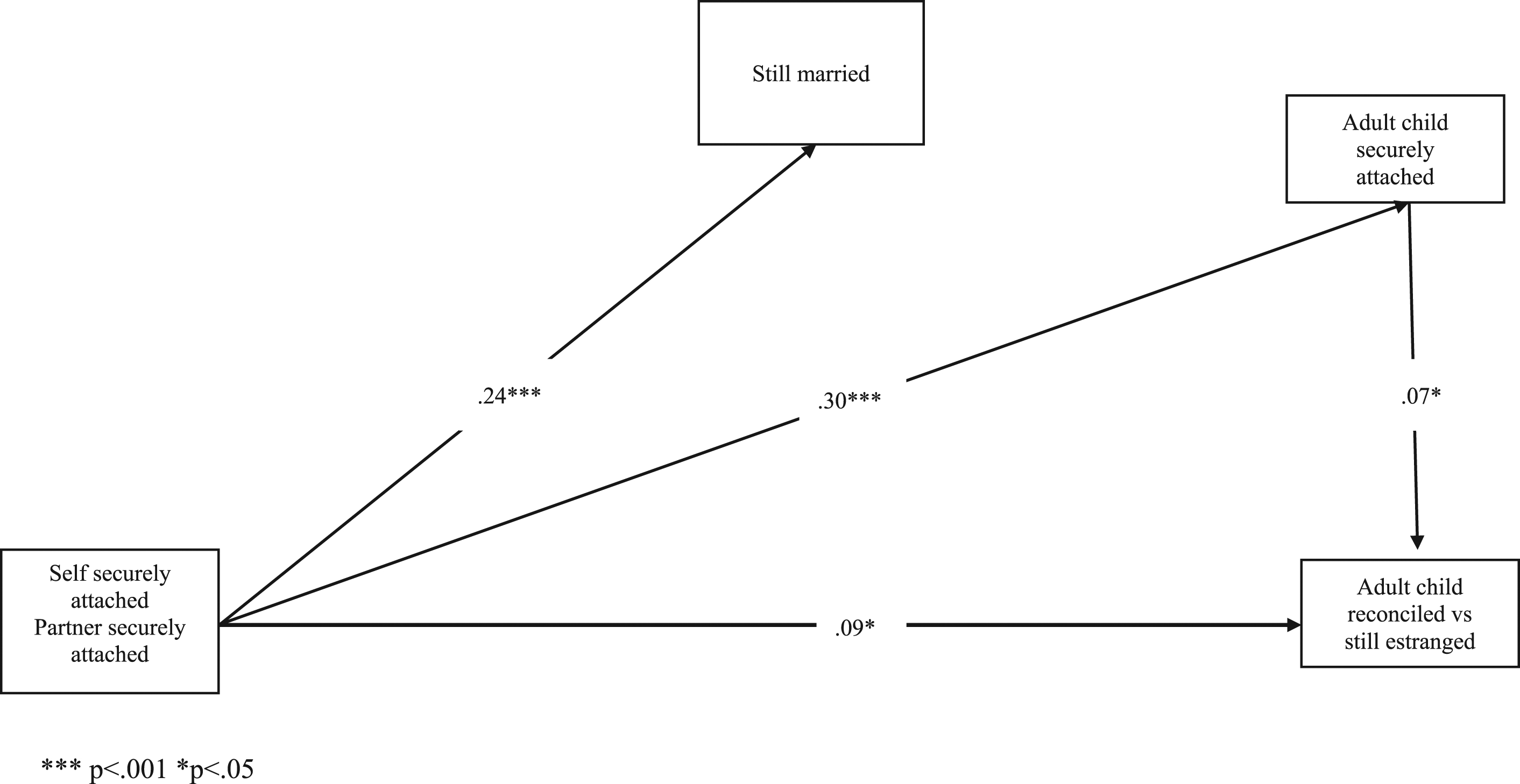

Because remarried parents did not differ significantly from divorced parents in terms of whether there was a reconciliation with their child (Table 3), we created a dichotomous variable that contrasted the parents still married to the child’s other biological parent with parents who had divorced, some of whom had remarried. We included the measures of self and partner security of attachment in a single latent variable, and ratings of the adult’s child’s security of attachment in a separate latent variable. Using the Smart-PLS Structural Equation Modeling program (Hair et al., 2016), the data were entered in the sequence described by Model A (see Figure 1) and then again in the sequence described by Model B (see Figure 2).
Each box in Figures 1 and 2 contains one or two single measures. While all possible paths were tested in each model, for clarity only the statistically significant paths are included in the figures. Numbers on the paths are beta weights that convey the relative strength of the association between the variables, with asterisks indicating the level of statistical significance of the association. The fit index of both models is .08 on a scale that goes from .00 as a perfect fit, with .08 described as a “very conservative measure of good fit” (Hair et al., 2016).
In Model A (Figure 1), there was a statistically significant path linking self/partner security of attachment, but not child security of attachment with whether the parents were still married, consistent with data from the analysis of pairs of variables reported above. However, there were no statistically significant paths linking marital status with whether the adult child had reconciled with the parent and no statistically significant indirect effect connecting security of attachment with reconciliation.
In Model B (Figure 2), consistent with the analyses of pairs of variables reported above, and with the data in Model A, there was no statistically significant link between whether the parents were still married and whether the adult child had reconciled with them. Also consistent with the separate pairs analyses, the parents’ marital status was connected with ratings of self and partner as securely attached, and with ratings of the child as securely attached. In turn, both of the attachment measures were significantly associated with the adult child having reconciled with the parents at the time of the online survey. What model B reveals is that there is a statistically significant indirect path in which attachment security ratings mediate the link between marital status and reconciliation. Beyond the separate paths from marital status to attachment security and from attachment security to reconciliation, there was an added contribution to explaining variance in reconciliation from the two indirect pathways—marital status to self/partner security to adult child security to reconciliation (t = 2.00; p = .046) or marital status to self/partner security to reconciliation (t = 2.05; p = .041).
Discussion
The findings presented here represent a first attempt to consider the role of parents’ continuation of their marriage and their perception of their own and their partner’s security of attachment in understanding whether the adult child’s estrangement continues or he or she resumes contact with the parent after a period of estrangement. As depicted in Model B (Figure 2), adult children were more likely to reconcile with a parent when that parent (a) was still married to the child’s other parent and (b) described the other biological parent of the adult child as more securely attached. There was a statistically significant indirect path that linked parents remaining married to the adult child’s decision to reconcile with them.
Divorce, marriage, and reconciliation
The association between not divorcing/staying married and reconciliation could result from the more positive family environment created by the parents who stayed married or the disequilibrating consequences of divorce. On the negative side, divorce may create an opportunity for one parent to influence the child’s negative view of the other parent (Schoppe-Sullivan et al., 2021) . It may also cause the child to fault one parent over the other as the cause of breaking up the family. Remarriage after divorce can introduce new family members, step-parents, and step-siblings who may compete for material and emotional resources (Papernow, 2017). It may also lead the child of any age to view the parents more as individuals with their own strengths and liabilities as opposed to thinking of a family unit in which they, the children, are a part (Coleman, 2021b).
By contrast, parents remaining married may help to decrease the risk of continued estrangement with their children. The parental couple may provide a home atmosphere that is more conducive to return to than the separate homes (and often new marriages) of their two divorced parents. The still-married parental couple may provide an example of how relationships can be maintained in spite of the normal disagreements and conflict present in any marriage; this can protect the adult child from the guilt, worry, and over-responsibility that can burden adult children of divorced parents and lessen their concern about how their decision to cut off contact is leading to parental distress. Parents who have stayed together may also be able to collaborate more effectively in their reactions to the pain of estrangement and in their responses to their adult child, either by adopting a united front or by working together to provide a buffer when the adult child has focused his or her decision to cut off contact with one or both of the parents. In heterosexual couples, for example, a father’s sternness or criticality might be mitigated by a mother’s greater emotional flexibility or empathy. A mother’s worried over-involvement might be balanced by a father’s more relaxed or laissez faire approach to the child. Together, the parents might be able to tolerate an estrangement without thinking of the rift as a disaster, and work together toward conveying hopefulness about a reconciliation. These speculations are consistent with the hypothesis that when parents stay married, they hold out the hope of providing a safe haven and a secure base for the adult child that ultimately makes it possible to that child to consider ending the period of estrangement.
Attachment and reconciliation
Reconciliation with the estranged adult child appears to require more than parents staying married. The links between marital status and reconciliation were strengthened when the responding parents viewed both themselves and their partners as more securely attached and less avoidant or angrily preoccupied about intimate relationships.
It may be that parents who have secure attachment models are better able to cope with both the threatened and actual loss of their relationship with their child. They may feel less devastated by what seems like overwhelming criticism, less likely to avoid ongoing conflict with the child, and less likely to respond angrily. They may be more likely to take constructive and effective efforts to repair the relationship in spite of the fact that estrangement is almost always highly stressful for all family members. From other studies, we know that secure adult attachments in married couples are associated with less conflict and more positive interaction in their relationship as a couple and a more effective approach to parenting their young children (Cowan et al., 2009).
We have suggested that Model B provides an illustration of mediation, with the respondent’s perceptions of attachment security functioning as a mechanism to explain why a larger proportion of formerly estranged adult children choose to reconcile with their parents, compared with children of divorced or remarried parents. We note that the results do not completely fit the commonly used statistical definition of mediation proposed by Baron and Kenny (1986), in which a significant association between variables A and C disappears when variable B is included in the equation; that is, that variable B explains or signifies a mechanism that links variables A and C. In the present case, there was no direct connection between marital status and reconciliation. Critics of Baron and Kenny’s formulation (e.g., Imai et al., 2011) have argued strongly that if there is a statistically significant indirect path from A to B and from B to C, that satisfies the interpretation of a mediation effect regardless of whether there is also a direct connection from A (in this case, marital status) to C (in this case, reconciliation).
Causal models of mediation require that the linking variable temporally precedes the outcome variable—that it acts as a mechanism that causes changes in the outcome over time. As we have stated, although the data in this study were obtained at one point in time, there is an implied temporal sequence in that the marital status of the parents preceded this study and, to the extent that attachment security ratings are stable over time, they precede the estrangement or reconciliation of the adult child. We acknowledge that this temporal sequence is speculative. More importantly, we do not interpret the structural equation models in Figures 1 and 2 as establishing causal linkages. We do not claim, for example, that staying married influences the parents to rate family relationships more highly in terms of secure attachment, or that security of attachment increases the probability of reconciliation after estrangement.
The data presented in Figures 1 and 2 resulted from two possible orderings of marital status and attachment ratings, with a finding of indirect linkage in Model B but not in Model A. If this sequence is replicated in future studies, we could conclude that the parents’ continuing example of intimate connection along with their secure working models of intimate relationships provide a context in which parents can tolerate a period of estrangement and the adult child is more likely have room to consider a reconciliation. Establishing a causal sequence would require a study that follows families longitudinally with an intervention focused on improving attachment security and determining whether the probability of the adult child reconciling increases over time.
Limitations and suggestions for further research
The fact that we were only able to obtain data concerning attachment security from one parent constitutes the most serious limitation of the study. In the future, researchers must find a way to obtain the perspectives of both parents and the child in order to understand how secure and insecure attachments play a role in estrangement and reconciliation.
There are also limitations based on the fact that when we gather data by using online surveys, we do not know whether the respondents are representative of the larger population of estranged and reconciled families in the United States. The present sample is largely comprised of highly educated parents (116 fathers and 1251 mothers) in families with above average household income. Future investigations should include larger samples of fathers and a greater diversity of race, ethnicity, and socioeconomic status, who have experienced an estranged relationship with their adult child.
Although we found a consistent pattern of statistically significant associations among parents’ marital stability, attachment security, and reconciliation of the adult child, with the exception of the connection between attachment and reconciliation (d = .63), the effect sizes of the connections were quite small, ranging in the .20s and .30s. This means that in addition to marital stability and working models of attachment, there are other important sources of variation that would be necessary to explain whether adult children choose to reconcile with their parents. These two variables should be examined in the context of other family factors (e.g., emotional distress of parent or child, quality of parent-parent and parent–child communication) and external factors (e.g., unemployment, poverty) that may well contribute either to estrangement or reconciliation.
Despite the limitations involved in this and any online study, the online survey approach provided an economical way to reach a large number of parents, more than 1300, who have experienced estrangement from an adult child. And, given the importance of the pain of such relationship ruptures, the results provide a new focus away from the body of research that tries to explain estrangement, and toward identifying key factors—marital status and attachment style—that are associated with parent–child reconciliation.
Implications for intervention
The finding that parents who remained married were more likely to experience a reconciliation with their adult child should not be taken as support for convincing unhappy couples to stay married, but rather as evidence that intervention offered to couples early in the process of estrangement to strengthen their couple relationship may also improve their relationship with their adult child. Our study also suggests that it could be productive to help individuals and couples to re-fashion their working models of intimate relationships by making their models more conscious and exploring further how changes in parents’ attachment security are associated with increased probabilities that the adult child will end his or her estrangement.
One prevailing interpretation of working models of attachment is that they are formed early in life and act as an unchanging template that shapes perceptions of intimate relationships as children grow into adulthood. Despite the widespread acceptance of this assumption, substantial evidence exists that the view of attachment security as a template that is stable over time is incorrect. Researchers have described how working models are subject to modification—both positive and negative—resulting from both internal reorganizations and external changes in relationship circumstances (Cowan et al., 2018). A number of successful interventions have recently been described in a Handbook of Attachment-Based Interventions (Steele & Steele, 2017), most of which focus on helping mothers to be more sensitive and responsive parents, but evaluations of these interventions make it clear that positive shifts in parenting behavior are accompanied by alterations in the parents’ expectations about their intimate relationships—their working models that they bring to the intervention. Clinicians working with parents whose child is estranged, especially if they are divorced or have insecure models of close relationships themselves, may be able to help them reconsider their avoidant or angry reactions to their estranged child, and understand why reaching out to the adult child to make amends or foster the notion of reconciliation is difficult for them (Coleman, 2020).
Conclusion
In sum, the findings from the present study stimulate hypotheses about the connections between the ability of the adult child’s parents to maintain their relationship as a couple, their perception of each other’s security of attachment, and their adult child’s tendency to remain estranged or reconcile with the parent. We have noted the need for longitudinal studies that follow families as estrangement plays out in different ways and include more of the within-family and external factors that affect both estrangement and the tendency to reconcile. These studies would strengthen our ability to determine the causal connections among these aspects of close family relationships.
Footnotes
Acknowledgments
We are grateful to the Donner Foundation for providing financial support for the on line survey described in this article and to the many participants who responded so thoughtfully to the questions.
Funding
The author(s) disclosed receipt of the following financial support for the research, authorship, and/or publication of this article: This work was supported by the Donner Foundation.

Open research statement
As part of IARR’s encouragement of open research practices, the author(s) have provided the following information: This research was not pre-registered. The data used in the research are available. The data can be by emailing: