







Abstract
Trait mindfulness is associated with sexual satisfaction, but their temporal relation is unexplored. Using a short-term longitudinal design, the present study not only examines their temporal relation but also extends extant research by also investigating relationship mindfulness and potential mechanisms that might account for any temporal relation that exists between the two forms of mindfulness and sexual quality. Participants were sexually active emerging adults (N = 104) in romantic relationships who initially completed measures of trait and relationship mindfulness, and 6 weeks later measures of relationship satisfaction and difficulties in emotion regulation. After another 6 weeks, they completed a measure of sexual quality. Relationship mindfulness was related to sexual satisfaction 12 weeks later via relationship satisfaction, whereas trait mindfulness was related to later sexual dissatisfaction via difficulties in emotion regulation. These results suggest that the temporal relationship between mindfulness and sexual quality is indirect and more nuanced than previously thought. Several avenues for future research are suggested.
Mindfulness, or the tendency to pay nonjudgmental and undistracted attention to the present moment, is a universal phenomenon as “we are all mindful to one degree or another, moment by moment” (Kabat-Zinn, 2003, pp. 145–146). However, individual differences in mindfulness have led to it frequently being conceptualized and assessed as a trait. Trait mindfulness has been linked to reduced individual suffering and numerous indicators of psychological well-being (see Hofmann, et al., 2010; Keng, et al., 2011; Sedlmeier et al., 2012). Research on mindfulness has also begun to focus on relationship outcomes. It is now well documented that in romantic relationships, trait mindfulness is related to numerous relationship outcomes including relationship quality, and sexual satisfaction (e.g., Eyring et al., 2021; Gesell et al., 2020; Stephenson & Welch, 2020).
Although the study of trait mindfulness has been fruitful, there is increasing recognition of the importance of context leading to the development of context-specific measures of mindfulness, including a measure of mindfulness in the context of romantic relationships. Kimmes et al. (2018) argued that “Because romantic relationships are often the source of strong emotions, being mindful when in isolation or in the presence of friends and acquaintances may be substantively different than being mindful in the context of a romantic partner” (p. 575). These authors further suggested that a measure of mindfulness specific to the context of romantic relationships was necessary and that the lack of such a measure might limit understanding of the impact of mindfulness in romantic relationships. They therefore developed such a measure and showed that it accounted for variance in relationship satisfaction and attachment to the partner over and above that of trait mindfulness both concurrently and 6 weeks later.
Although mindfulness specific to romantic relationships has yet to be examined in relationship to sexual satisfaction, it can be argued that in promoting relationship satisfaction, mindfulness in relationships is likely to be indirectly related to sexual satisfaction (Hypothesis 1; H1). This is because higher relationship satisfaction (presumably facilitated by mindfulness) is related to more frequent sex (Costa & Brody, 2012; Roels & Janssen, 2020) and the associated pleasurable emotions that likely accompany it thereby increasing sexual satisfaction. In an important theoretical analysis, Karremans et al. (2017) identify another important mechanism that might account for the association between trait mindfulness and relationship outcomes, namely, emotion regulation. Pepping et al. (2018) have shown that difficulties in emotion regulation potentially mediate the relation between trait mindfulness and sexual outcomes in both individuals in a committed romantic relationship of at least 1 year’s duration and individuals who had been single for at least 3 years. Like other studies that examine potential mechanisms that link trait mindfulness to sexual outcomes (e.g., Newcombe & Weaver, 2016; Stephenson & Welch, 2020), the Pepping et al. (2018) study analyzed data collected at a single point in time. This makes the interpretation of results regarding mechanism difficult because the operation of a mechanism takes place over time and research designs testing mechanisms should reflect this circumstance.
Another issue that arises in research on sexual quality is its conceptualization. When assessing the global subjective experience of a sexual relationship it is often assumed that sexual quality is a unidimensional bipolar construct defined by sexual satisfaction at one end and sexual dissatisfaction at the other (Shaw & Rogge, 2016). The use of bipolar scales is however problematic. How are responses at the midpoint interpreted? Yorke (2001) outlines 15 ways in which they may be interpreted, including whether they signify that both endpoints are equally important and that neither endpoint applies. Recognizing this issue, Shaw and Rogge (2016) “conceptualized sexual satisfaction and dissatisfaction as inter-related components of sexual quality representing those global positive and negative evaluations of one’s sex life.” (p. 250) and developed a psychometrically sound measure—the Quality of Sex Inventory—that distinguishes sexual satisfaction from sexual dissatisfaction and shows a high level of responsiveness in detecting change over time.
Distinguishing sexual dissatisfaction from sexual satisfaction also allows greater refinement in the study of mechanisms relating mindfulness to sexual quality. Specifically, it can be argued that difficulties in emotion regulation are likely to mediate the relation between trait mindfulness and sexual dissatisfaction. This line of reasoning is based on three observations, one theoretical and two empirical. At the theoretical level, Karremans et al., (2017) point out that mindfulness cultivates the recognition that thoughts and feelings are transient, allowing the person to experience negative emotion without getting caught up in the emotion (i.e., not get upset about being upset). Absent such recognition, the person is likely to be more emotionally reactive and experience greater dissatisfaction with the relationship experience. At the empirical level, there is already evidence that lower trait mindfulness is associated with poorer emotional regulation (e.g., Creswell et al., 2007; Goldin & Gross, 2010). Second, poorer emotion regulation, is related to more negative experiences in romantic relationships (e.g., Rusu et al., 2019). It can therefore be expected that trait mindfulness will be indirectly related to sexual dissatisfaction via difficulties in emotion regulation (H2).
The Present Study
The present study investigates the temporal association between relationship mindfulness and sexual quality and whether it is mediated by relationship satisfaction and difficulties in emotion regulation among sexually active emerging adults in nonmarital romantic relationships. Emerging adults were studied because they are in a developmental period characterized by relatively rapid changes, a period characterized by identity exploration, instability, intensive self-focus, and feeling in-between adolescence and adulthood (Arnett, 2007; Arnett et al., 2014). As such, this period lends itself to short-term longitudinal studies (e.g., Bartlett et al., 2017; Fincham & May, 2017).
It is important when investigating relationship mindfulness to show that it provides information that is not captured by trait mindfulness. Simply stated, if relationship mindfulness simply reflects shared variance with trait mindfulness it would be of limited interest. The present study does so by testing whether relationship mindfulness operates independently of trait mindfulness in predicting later sexual quality.
The model to be tested is depicted in Figure 1. Although the general tendency to be mindful (trait mindfulness) may not perfectly align with the tendency to be mindful in a romantic relationship (relationship mindfulness), the two forms of mindfulness should be strongly correlated (H3) as they are assessing similar constructs that vary only at level of specificity/context. A significant positive path is hypothesized between relationship mindfulness and later relationship satisfaction (H4) as concurrent and longitudinal associations between these two constructs has been previously found (Kimmes et al., 2018, 2020). Although a strong theoretical case can be made for an association between trait mindfulness and relationship satisfaction, this association has emerged only for a concurrent association (e.g., Eyring et al., 2021; for review see Quinn-Nilas, 2020) but not a longitudinal association (Khaddouma & Coop Gordon, 2018; Kimmes et al., 2018). In view of limited research on the longitudinal association, this path is included in the model, but no hypothesis is offered for it. Model showing proposed relations among study variables.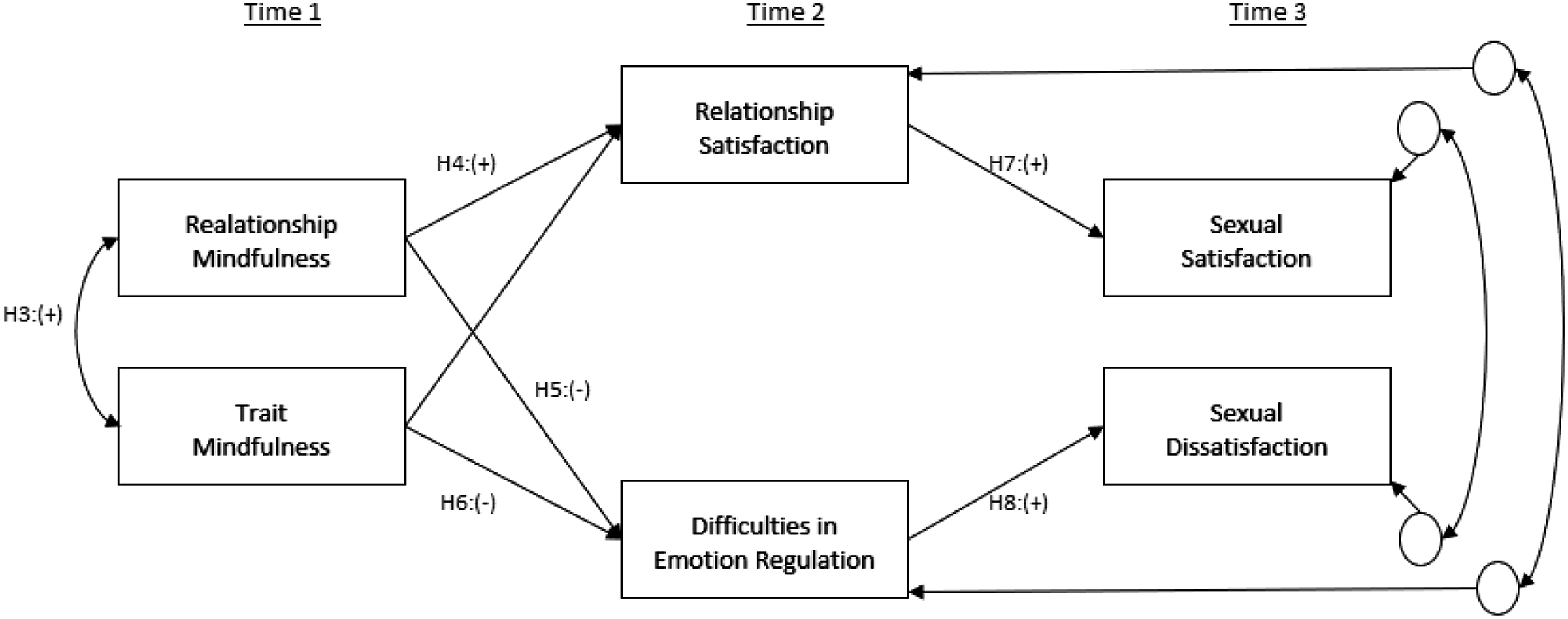
As there is a strong theoretical link between mindfulness and emotion regulation (Karremans et al., 2017) as well as correlational, experimental, and mindfulness intervention studies to support this link (see Roemer et al., 2015), negative paths were hypothesized therefore to exist between both relationship mindfulness (H5) and trait mindfulness (H6) and difficulties in emotion regulation. In light of data showing that relationship satisfaction is associated with later sexual satisfaction (Byers, 2005; McNulty et al., 2016), a positive path was hypothesized between them (H7). Finally, a positive path from difficulties in emotion regulation to sexual dissatisfaction is posited (H8) as poorer emotion regulation has been related to more negative experiences in romantic relationships (e.g., Rusu et al., 2019) and specifically to overall sexual satisfaction and distress (Girouard, et al., in press; Pepping et al., 2018).
In sum, the present longitudinal study investigates indirect effects between two types of mindfulness and sexual quality through relationship satisfaction and difficulties in emotion regulation (H1 and H2) and as well as several direct effects (H4–H8).
Method
Participants
Participants (N = 104) were sexually active emerging adults in dating, romantic relationships from a university in the south-eastern United States located in Tallahassee, Florida. They were recruited from a course that satisfied a university-wide liberal studies requirement. Participation in the study required completing online surveys that were part of a larger study to examine the mental, physical, spiritual, and relational well-being of students. Participants completed an online survey at three points separated by 6-week intervals. The data analyzed for the present study were from respondents who indicated they were sexually active in a nonmarital, heterosexual romantic relationship that was in place across the three time points. Students were offered options for receiving a small amount of extra credit, one of which was completing the survey. The monitoring of a relatively small sample, the brief period involved (a single semester), the ability to provide class reminders about completing the survey, and the students’ motivation to receive extra made it possible to collect a complete data set without missing data. Ethical approval for the study was obtained from the local Institutional Review Board. Only students falling in the age range of 18 to 29 years, which defines emerging adulthood according to Arnett et al. (2014), were used in this study.
The mean age of participants was 20.54 years (SD = 2.1169, range = 18–29). All participants were in dating relationships with relationship length at Time 1 varying from 1 month to 86 months (M = 23.12 months, SD = 17.65). Of the 104 participants, 97 (93.0%) identified as female and 7 (7.0%) identified as male. Regarding racial background, 71.2% identified as White or Caucasian or European American, 20.2% as Latino or Hispanic, 4.0% as African American or Black, 4.0% as Asian or Pacific Islander, and 1.0% preferred not to say.
Measures
Trait mindfulness
Trait mindfulness was measured using the 5-item version of the Mindful Attention Awareness Scale (MAAS) that was derived from an Item Response Theory (IRT) analysis of the 15-item MAAS (Van Dam et al., 2010). This scale measures the general tendency to be attentive to and aware of what is taking place in the present moment in daily life. The items (e.g., “I rush through activities without being really attentive to them.”) were rated on a 6-point scale ranging from 1 (almost always) to 6 (almost never). All items were reverse-coded and summed with higher scores reflecting higher levels of trait mindfulness (Cronbach’s α = 0.94).
Relationship mindfulness
Relationship mindfulness was assessed with the 5-item Relationship Mindfulness Measure (RMM; Kimmes et al., 2018). This measure was based on the MAAS with questions reframed to be specific to the context of a romantic relationship. It therefore comprises questions to assess the ability to be present and mindful within the relationship (e.g., “When I’m with my partner, I find myself saying or doing things without paying attention”). Participant responses range from 1 = almost always to 6 = almost never, with higher scores indicating more relationship mindfulness. As with the MAAS, the RMM is unidimensional. Responses were summed with higher scores reflecting greater mindfulness. This measure shows acceptable test–retest reliability over a 6-week period (r = 0.60, Nunnally & Bernstein, 2010; Rousson, et al., 2002). In the present sample, Cronbach’s α was 0.78.
Relationship satisfaction
Starting with 180 items previously used to assess relationship satisfaction, Funk and Rogge (2007) conducted an IRT analysis to develop a four-item measure of relationship satisfaction with optimized psychometric properties. Sample items are “How rewarding is your relationship with your partner?” (answered on a 6-point scale ranging from not at all to extremely) and “I have a warm and comfortable relationship with my partner” (answered on a 6-point scale ranging from not at all true to very true). Responses were summed to yield an index of relationship satisfaction. This measure correlates 0.87 with the widely used Dyadic Adjustment Scale. In the present sample, coefficient alpha was 0.92.
Difficulties in emotion regulation
The Difficulties in Emotion Regulation Scale (DERS; Gratz & Roemer, 2004; Victor & Klonsky, 2016) measured outcomes of individual difficulty in regulating emotions. The abbreviated 18 item measure was used for the current analysis (Victor & Klonsky, 2016) with sample reliability of α = 0.95 in the present study. Example items include “when I’m upset, I lose control over my behaviors,” “when I’m upset, I have difficulty concentrating,” and “when I’m upset, I feel guilty for feeling that way.” Items were rated on a scale of 1 (“almost never”) to 5 (“almost always”). Higher summed scores denote greater difficulties in regulating emotions.
Sexual quality
Beginning with over 110 items, Shaw and Rogge (2016) developed the Quality of Sex Inventory using IRT to arrive at 12-item and six-item scales that provided greater information than any existing measure of sexual quality. The present study used the 12-item version comprising six satisfaction items (e.g., “I am satisfied with our sexual relationship”) and six dissatisfaction items (e.g., “Sexual activity with my partner is not worth the time or effort”). Each item was rated on a 6-point scale ranging from “not at all true” to “completely true.” The measure yields two scale scores, one for sexual satisfaction and one for sexual dissatisfaction. Consequently, item scores were summed to yield a measure of sexual satisfaction (Cronbach’s α = 0.98 in present sample) and sexual dissatisfaction (Cronbach’s α = 0.96 in present sample).
Statistical analysis
First, descriptive statistics and Pearson correlations among the study variables were computed to allow the hypothesized association between relationship mindfulness and trait mindfulness to be tested (H3). Second, structural equation modeling was used to test the fit of the model proposed in Figure 1. Because normal distributions are rare in small- to moderate-sized samples (MacKinnon, et al., 2004), bootstrapping was used to obtain more accurate estimates of indirect effects to test the first two hypotheses. The remaining hypotheses were tested by examining the relevant parameter estimates in the model.
Results
Descriptive statistics
Descriptive statistics and correlation among study variables.
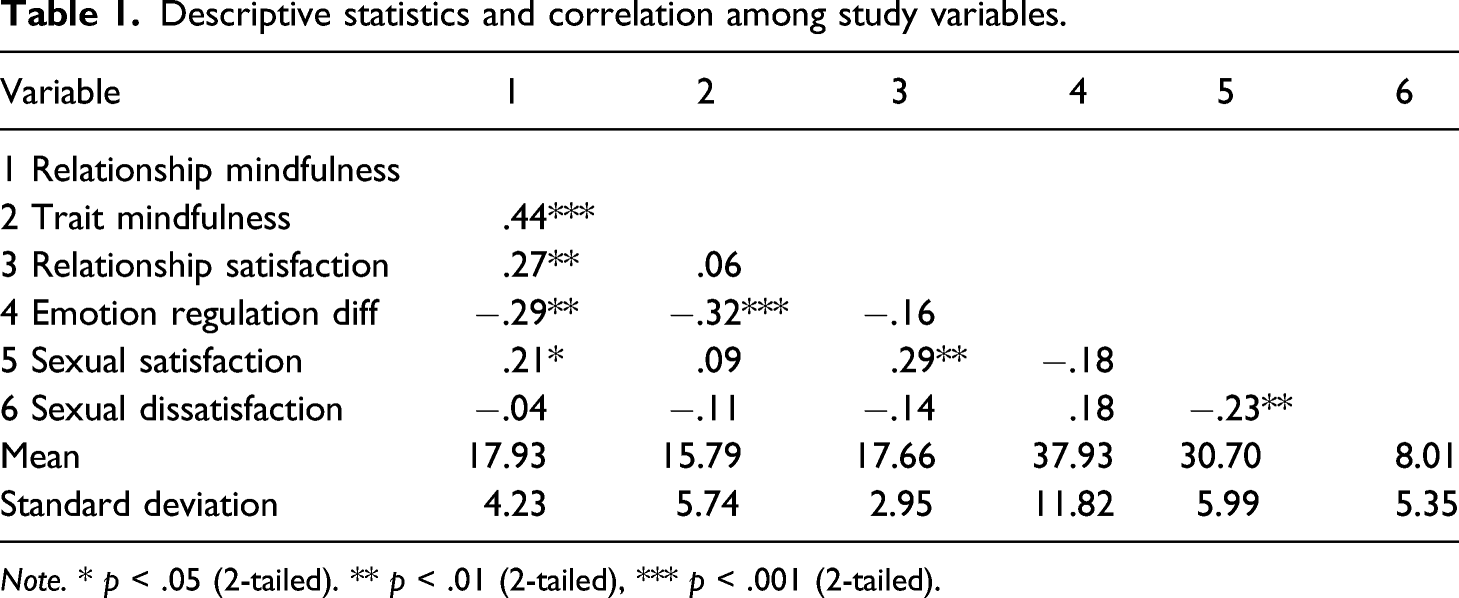
Note. * p < .05 (2-tailed). ** p < .01 (2-tailed), *** p < .001 (2-tailed).
Parameters for indirect and direct effects tested.
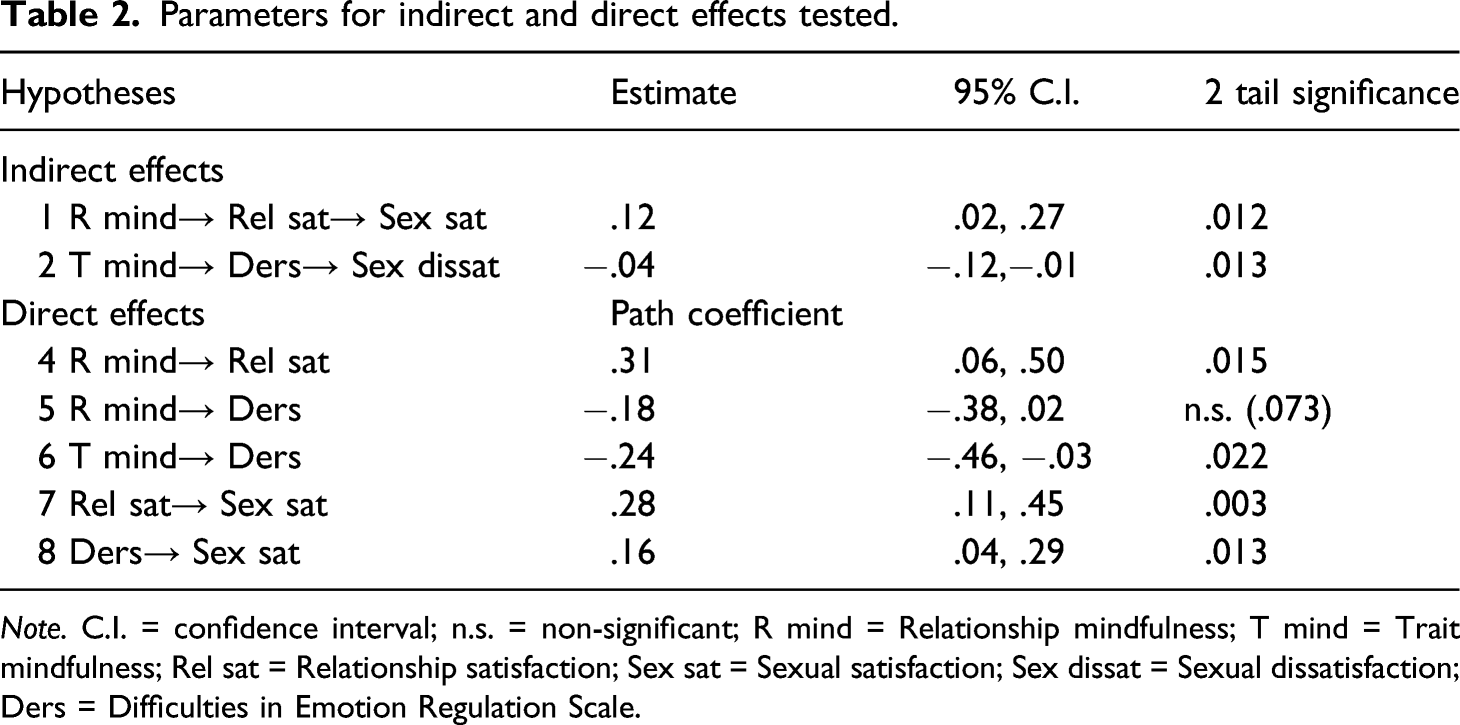
Note. C.I. = confidence interval; n.s. = non-significant; R mind = Relationship mindfulness; T mind = Trait mindfulness; Rel sat = Relationship satisfaction; Sex sat = Sexual satisfaction; Sex dissat = Sexual dissatisfaction; Ders = Difficulties in Emotion Regulation Scale.
Regarding direct effects, the path from relationship mindfulness to relationship satisfaction was significant, supporting H4. However, H5 was not supported as the path from relationship mindfulness to difficulties in emotion regulation was not significant. In contrast, the path from trait mindfulness to difficulties in emotion regulation was significant, supporting H6. It would be easy to infer from these findings that relationship mindfulness and trait mindfulness relate differently to later difficulties in emotion regulation. However, to do so requires that they be directly compared. A model was therefore computed in which the two paths were constrained to be equal. No decrement in model fit was obtained, χ2 (1) = .02, p > .10, showing that the magnitude of the paths from relationship mindfulness and trait mindfulness to difficulties in emotion regulation did not differ significantly. Finally, the path from relationship satisfaction to later sexual satisfaction was significant, supporting H7, and the significant path from difficulties in emotion regulation to sexual dissatisfaction supported H8.
Because the romantic relationships investigated varied considerably in duration, relationship duration was added to the model as a control variable and the model was recomputed. Again, the model fit was excellent, χ2 (6) = 5.16, p = .523, CFI = 1.00, RMSEA = 0.001, SRMR = 0.045. All the significant effects reported above (without using relation duration as a control) remained significant and no new significant effects emerged. This is not surprising as no direct or indirect effects involving relationship duration were significant.
Discussion
Following the recognition that mindfulness may be context-specific (e.g., Duncan, 2007; Kimmes et al., 2018; McCaffrey, 2017), the present research focused on an emerging line of inquiry on mindfulness in romantic relationships. Building on an initial study showing a relationship between mindfulness in romantic relationships and later relationship satisfaction, this study replicated the documented association showing that romantic relationship mindfulness accounts for variance in later relationship satisfaction over and above that of trait mindfulness (Kimmes et al., 2018). It is also important to note another replicated finding, namely, the longitudinal relationship between relationship satisfaction and sexual satisfaction (e.g., McNulty et al., 2016).
The study also extends research documenting a robust concurrent association between trait mindfulness and emotion regulation (e.g., Creswell et al., 2007; Goldin & Gross, 2010; for a review, see Chiesa et al., 2013) by showing that trait mindfulness is inversely related to later difficulties in emotion regulation. Indeed, the magnitude of the path from trait mindfulness to later difficulties in emotion regulation may account for the fact that the path from relationship mindfulness to difficulties in self-regulation was not significant even though they were significantly related at the bivariate level.
Another important contribution of the present study is that it built on work showing that sexual satisfaction and sexual dissatisfaction are distinct constructs and examined relationship mindfulness and trait mindfulness in relation to both. In doing so, it is among the first to provide longitudinal data on mindfulness and sexual satisfaction and sexual dissatisfaction. Although relationship mindfulness was significantly related to sexual satisfaction 12 weeks later, it was found that, as hypothesized, the relationship was mediated by relationship satisfaction. This finding is consistent with theoretical arguments that mindfulness in relationships promotes relationship satisfaction (Karremans et al., 2017), the prior finding that relationship mindfulness facilitates later relationship satisfaction (Kimmes et al., 2017), and the argument that higher relationship satisfaction presumably facilitates the likelihood of sex and the associated pleasurable emotions that accompany it thereby increasing sexual satisfaction. In a similar vein, trait mindfulness was indirectly related to sexual dissatisfaction via difficulties in emotional regulation. Karremans et al. (2018) identified emotion regulation as an important factor that might serve as a mechanism accounting for the association between trait mindfulness and relationship outcomes. In the present study, difficulties in emotion regulation did indeed mediate the relationship between trait mindfulness and later sexual dissatisfaction.
The differing patterns described above relating to indirect effects for relationship mindfulness and trait mindfulness provide further evidence to support their distinction and thereby the need to consider context-specific assessments of mindfulness in addition to trait mindfulness in future research. Interestingly, the magnitude of the paths from both relationship mindfulness and trait mindfulness to difficulties in emotion regulation did not differ significantly from each other. This suggests that each type of mindfulness might be indirectly related to sexual dissatisfaction, 1 but only trait mindfulness was indirectly related to sexual dissatisfaction via difficulties in emotion regulation. This finding stresses the importance of investigating trait mindfulness and relationship mindfulness together, so that each can be shown to have effects that are independent of the other.
A further important contribution concerns the findings obtained regarding sexual satisfaction and sexual dissatisfaction. That the relationship between the two forms of earlier measures mindfulness and later sexual satisfaction and sexual dissatisfaction was mediated by different constructs provides further support for the bidimensional conceptualization of sexual quality proposed by Shaw and Rogge (2016). The current findings also provide additional data to support the convergent and divergent validity of the Relationship Mindfulness Measure (Kimmes et al., 2018) and the Quality of Sex Inventory (Shaw & Rogge, 2016). Both recently developed measures require their nomological network to be elaborated and the present study goes some way toward doing so as it documents correlates with which they have not previously been associated.
Notwithstanding the novelty of the present findings, they need to be interpreted cautiously in light of several limitations to the study. First, most of the participants were female and therefore the current findings need to be replicated in a male sample. Second, the present findings need to be replicated using a more diverse sample in terms of socioeconomic status, race, age, and disability status. In a similar vein, it would be useful to explore the relationships among the constructs studied over both shorter and longer time periods to determine the boundary conditions for the interval over which the relationships reported are manifest. Third, the present study did not control for the initial levels of variables assessed at later time points which is a limitation that should be remedied in future longitudinal research on this topic. Fourth, the study did not include dyadic data which will be important to do in future research. Fifth, the use of the Mindful Attention Awareness Scale is not optimal as a measure of trait mindfulness as it is unidimensional and does not measure the acceptance component of mindfulness. Its deficiency is further emphasized by the fact that all the questions are negatively worded or concern the absence of attentional focus or mindlessness, rather than mindfulness. Because the Relationship Mindfulness Measure draws on the Mindful Attention Awareness Scale, it reflects similar weaknesses. Future research might profitably use the newly developed Attentive Awareness in Relationships Scale that assesses attentive awareness and inattention/distraction and shows that they change independently over time (Daks et al., 2021). Finally, it might prove useful in future research to reconsider the way in which relationship quality was operationalized in this study as Rogge et al. (2017) have also offered a bidimensional measure of relationship quality that offers measures of relationship satisfaction and relationship dissatisfaction.
The above limitations should, however, be considered in the context of the numerous strengths of the research. Unlike the vast majority of prior studies of mindfulness and sexual outcomes, the present research examined not only trait mindfulness but also relationship mindfulness and utilized a longitudinal design to investigate possible mechanisms that might account for any mindfulness-sexual outcome association. This study also appears to be the first to examine mindfulness in relation to both sexual satisfaction and sexual dissatisfaction.
In conclusion, the present study constitutes a novel contribution in that it replicates prior findings regarding relationship mindfulness and relationship satisfaction as well the link between relationship satisfaction and later sexual satisfaction and extends research on mindfulness and sexual quality by including a temporal component. It showed that relationship mindfulness and trait mindfulness are related to later sexual quality by different mechanisms. In doing so, it provides initial evidence on direction of effects contributing to a growing data base documenting the impact of mindfulness in relationships on relationship outcomes.
Footnotes
Funding
The author(s) received no financial support for the research, authorship, and/or publication of this article.
Open science statement
As part of IARR’s encouragement of open research practices, the author(s) have provided the following information: This research was not pre-registered. The data used in the research are available upon request. The data can be obtained by emailing: ffincham@fsu.edu. The materials used in the research comprise questionnaires that are publically available.
