







Abstract
What do couples’ activities and behaviors on Instagram reveal about the quality of their relationships? To answer this question, we surveyed couples (N = 178) about their perceptions of their relationships and analyzed 3,270 of their recent Instagram posts. Actor and partner effects were found between relational quality and engagement with the relationship on Instagram (i.e., the number of couple pictures and partner-initiated likes and comments). There were also actor effects of attention to Instagram alternatives on the perceived quality and actual pursuit of alternative partners, as well as a partner effect on alternative quality. The findings contribute to extending the investment model to the digital age and have methodological implications for understanding relationship dynamics on visual social network sites.
Social network sites (SNSs) first began to emerge in the mid to late 90s, around the same time that many Americans were just starting to become acquainted with the Internet (Ellison & boyd, 2013). Now, more than 20 years later, SNSs have become an important way that romantic relationships are maintained (Vogels & Anderson, 2020). Ellison and boyd (2013) situate SNSs under the broader umbrella of social media, defining them as platforms that assist in relationship maintenance through the creation of profiles, accumulation of connections, and engagement with user-generated content. The Pew Research Center (2019) estimates that nearly three-quarters of American adults use social media, with many logging in on a daily basis. Among the most well-known and widely studied SNSs is Facebook, which has been the focus of much of the research on the role of social media in contemporary romantic relationships (Rus & Tiemensma, 2017). However, within the Facebook family of apps, Instagram has been gaining increasing attention for its effects on individual and relational well-being (Ridgway & Clayton, 2016; Yang, 2016).
Instagram is an image-based social network app that was acquired by Facebook in 2012, and which has since grown to include over 1 billion active user accounts per month (Instagram, 2020). Not surprisingly, many users of the app are young adults between the ages of 18 and 29, who are often early adopters of SNSs (Perrin & Anderson, 2019; Pew Research Center, 2019). Instagram works by allowing people to share a virtual photo album of their lives with their followers and to present themselves as they actually are or as they would (ideally) like to be seen by the public. When applied to couples, these self-presentational affordances provide partners with opportunities for maintenance while at the same time raising questions about whether their posts on the platform are an accurate reflection or a desired image of the quality of their relationships. Instagram also connects people to former and potential partners within their existing social networks, thus provoking concerns about whether this exposure to alternatives erodes commitment to the primary relationship (Abbasi & Alghamdi, 2017).
The investment model (Rusbult, 1980, 1983) offers one way of understanding how features of romantic relationships are associated with engagement on social media platforms. From an investment model perspective, commitment is a primary reason why couples maintain relationships and persist or dissolve in the face of alternatives (Rusbult, 1980). The investment model has been applied to a variety of contexts within and outside the field of personal relationships (Le & Agnew, 2003; Tran et al., 2019), yet studies utilizing this framework often privilege offline behaviors. This points to a need to continue to examine its applicability in an age where communication technologies have become the norm (Dibble, 2017). Based on the logic of the investment model, we propose that relationship quality and attention to alternatives will be associated with couples’ activities on Instagram. We test our propositions with self-report data from couples and direct observations of their relationships using the actor-partner interdependence model (APIM; Kenny et al., 2006).
Most of what is known about social media and relationships has come from research on Facebook. However, as SNSs have continued to evolve and expand, this has left many newer sites and apps underexplored, making it important that researchers begin to extend this literature beyond the Facebook platform. In this study, we focus our attention on Instagram because it is one of the most popular SNSs outside of Facebook, and because the mobile and visual nature of the app provides an unprecedent glimpse into the maintenance behaviors of its users. Instagram also offers a unique opportunity for studying relationship maintenance because unlike platforms such as Facebook, most of the interactions on the app are responses to self-initiated posts, which gives page owners considerable influence over the image they present to their followers. The specific contributions of this study are threefold: (a) we utilize couple-level data to gain insight into the interpersonal dynamics of Instagram use and the interdependence in partners’ behaviors, (b) we examine relationship maintenance activities on Instagram as a means of expanding formative knowledge of Facebook to the domain of visual SNSs, and (c) we take a holistic approach to understanding the role of SNSs in couples’ relationships by using the investment model to test the effects of multiple components of relationship quality on Instagram use.
Relationship presentations and Instagram features and affordances
Individuals have long managed their impressions and how others see them through the process of self-presentation (Goffman, 1959), but advances in technology have afforded new ways to selectively self-present a positive image vis-à-vis face-to-face (FtF) communication while minimizing or hiding personal flaws. In primarily text-based SNS channels (e.g., Tweets, Facebook status updates), selective self-presentation can be accomplished through affordances such as editability and asynchronicity that give people more control over what they say and more time to consider the image they want to communicate to others (Walther, 1996). Visual SNSs like Instagram offer similar affordances as well as greater bandwidth, increased presence, and lower anonymity than text-based channels (Fox & McEwan, 2017). Such affordances are noteworthy for giving people a choice in whether to present their real selves or an idealized image of the person they aspire to be (Utz & Beukeboom, 2011). For instance, on SNSs, people have been known to idealize their relationships by engaging in excessive displays of affection relative to what would be typical of them FtF (Seidman et al., 2019). Other studies have demonstrated that SNS self-presentations are generally accurate reflections of who people truly are offline (Back et al., 2010; Wilson et al., 2012).
Given that Instagram is a social platform, the process of impression management also involves attending to the relational and public contexts of one’s self-presentation. Relationships are an important part of identity (Emery et al., 2021), which suggests that people should want to portray them in a positive light. The public nature of SNSs may further affect how people choose to present their relationships on Instagram (Toma & Choi, 2015), where the images they share are viewable by their partner as well as a larger network of followers. Because these relationship presentations occur in front of their peers, individuals may internalize the joint couple identity they convey in their posts. This points to Instagram as a valuable context for examining how relationships affect—and are affected by—couples’ usage of SNSs (Rus & Tiemensma, 2017; Toma & Choi, 2015).
Romantic relationships on Visual SNSs: An investment model perspective
Rusbult’s (1980, 1983) investment model is a theory about relationship maintenance that builds on and extends the principles of interdependence theory (Kelley & Thibaut, 1978; Thibaut & Kelley, 1959) to include the concept of investments. More specifically, the investment model identifies three distinct factors influencing commitment, or a sense of psychological attachment to a partner and a desire for sustained involvement in a relationship (Rusbult, 1980). According to Rusbult and Buunk (1993), satisfaction is positive affect that arises from comparing the rewards and costs of a current relationship to one’s own internal standards and expectations. Alternative quality refers to the attractiveness of the available options outside of an existing relationship, which could include spending time alone or in the company of someone else. Investments are resources that become directly or indirectly linked to a relationship and which would increase the costs of its termination, such as shared possessions or mutual friends.
The investment model posits that high satisfaction, low alternatives, and high investments lead to greater commitment, which, in turn, promotes cognitive and behavioral maintenance by encouraging partners to think and act in ways that help keep their relationships in a persistent state (Agnew & VanderDrift, 2018; VanderDrift & Agnew, 2020). Cognitive maintenance can include cognitive interdependence, devaluing or derogating alternatives, and positive illusions, to name a few. On Instagram, these processes may manifest in pictures reflecting an idealized or collective orientation to the relationship. Behavioral maintenance might involve actions such as a willingness to sacrifice for the relationship or to accommodate a partner and could take the form of liking and commenting behaviors directed at a partner’s posts.
With its basis in interdependence theory, the investment model is grounded in the assumption that partners’ experiences in relationships are interrelated (Kelley & Thibaut, 1978; Thibaut & Kelley, 1959). The APIM is particularly well suited for empirically testing the logic of interdependence theories such as the investment model by modeling the mutual dependence between actors and their partners (Wickham & Knee, 2012). Kenny et al. (2006) explain that actor effects are intrapersonal in nature and occur when an individual’s predictors affect their own outcomes, whereas partner effects capture interpersonal dynamics and are when a partner’s predictors affect the outcomes of an individual (Kenny et al., 2006). The APIM can also be used to probe for sex differences in maintenance behaviors, with past research indicating that women engage in more maintenance activities than men (Canary & Stafford, 1992; Dainton & Stafford, 1993). Using the APIM, we apply the investment model to the Instagram platform by modeling the interdependence within couples in their perceptions of relationship quality and attention to alternatives while considering the possibility of sex differences in the actor and partner effects.
Instagram and relationship quality
Recent studies have suggested that the investment model may shed light on Instagram use in romantic relationships. As one example, Tokunaga (2016) identified connections between the investment model constructs and negative relational maintenance behaviors over SNSs. Satisfaction was negatively associated with online surveillance and alternative quality was positively associated with online surveillance, but there were no direct associations between investments or commitment and using SNSs to keep tabs on a partner. There is also the potential for SNS use to support positive aspects of relationship functioning; for example, by providing a public outlet for couples to showcase affection and commitment (Utz & Beukeboom, 2011). Of particular relevance to the current study, Castañeda et al. (2015) found that individuals who perceived themselves as having greater investments and commitment and fewer alternatives exhibited more overlap with their partner’s Facebook profile.
Existing research, primarily in the context of Instagram’s parent company, Facebook, has also established a link between the quality and visibility of relationships on SNSs. Toma and Choi (2015) showed that people who listed themselves as in a relationship reported greater commitment than those who did not, people who shared more couple pictures reported greater commitment than those who shared fewer, and people who posted more frequently on their dating partner’s Facebook wall reported greater commitment than those who posted less. However, in contrast to the authors’ predictions, people who were the recipients of more frequent posts from their dating partner on their own Facebook wall and those who shared more mutual friends with their dating partner reported lower commitment relative to others. The authors explained these findings by speculating that partner-initiated wall posts may come across as possessive while mutual friends might indicate the availability of alternative partners in one’s network. Commitment, in turn, was associated with a greater likelihood that the couple was still together 6 months later.
Others have similarly shown that couple profile pictures on Facebook are associated with greater satisfaction among both the individuals who post them and their romantic partners (Papp et al., 2012; Saslow et al., 2012). One possibility for why these images might be a good barometer for the quality of a relationship is that couple pictures serve as a form of cognitive maintenance by acting as visual markers of interdependence and signals of a joint identity much akin to the use of plural pronouns in verbal communication (Agnew & VanderDrift, 2018; Saslow et al., 2012; VanderDrift & Agnew, 2020). We extend this work to visual SNSs by using the investment model to predict the extent of dyadic engagement on Instagram, which we define as the number of couple pictures an individual posts on the platform and the number of likes and comments from a partner that are visible on their page. Although Toma and Choi (2015) found a negative association between the number of partner-initiated wall posts on Facebook and commitment, partner engagement should be welcome on Instagram, where likes and comments mainly occur in response to posts rather than being unsolicited bids for connection. Based on the investment model and prior research on SNS use in romantic relationships, we expect that couples will publicly engage more with their relationships on Instagram when they are satisfied, invested, and committed, but less when they perceive high quality alternatives. Thus, we propose that: H1: Actor and partner reports of satisfaction are positively associated with the amount of relationship engagement on Instagram, as indicated by the number of couple pictures and partner-initiated likes and comments. H2: Actor and partner reports of alternative quality are negatively associated with the amount of relationship engagement on Instagram, as indicated by the number of couple pictures and partner-initiated likes and comments. H3: Actor and partner reports of investments are positively associated with the amount of relationship engagement on Instagram, as indicated by the number of couple pictures and partner-initiated likes and comments. H4: Actor and partner reports of commitment are positively associated with the amount of relationship engagement on Instagram, as indicated by the number of couple pictures and partner-initiated likes and comments.
It may also be the case that engagement on Instagram is a function of not just one but both partners’ perceptions of the quality of their relationship. That is, the associations between an actor’s reports of relationship quality and the amount of public relationship engagement on Instagram may depend as well on their partner’s perceptions. For example, an individual who receives many comments from their partner may still be relatively uncommitted if their views of the relationship are not congruent with the other person’s, given that these activities can also be sign of a partner’s commitment (Toma & Choi, 2015). This leads us to explore the possibility of an actor-by-partner effect of relationship quality on relationship engagement. Specifically, we ask: RQ1: Do actor and partner reports of relationship quality (i.e., satisfaction, alternative quality, investments, and commitment) interact in their effects on the amount of relationship engagement on Instagram?
Instagram and attention to alternatives
In addition to providing tools for relationship maintenance, visual SNSs also possess features that may make people more vigilant to attractive alternatives within their social environment. Individuals who exhibit greater attention to alternatives are more aware of their options for potential partners outside of an existing relationship (Miller, 1997). Alternatives tend to increase the likelihood of relationship dissolution (Sprecher, 2001), making the awareness of alternatives an important consideration in research on commitment and a potential risk to relational stability. Miller (1997) found that people paid less attention to alternatives to the extent that they were more committed, satisfied, and invested in their relationships. His results also indicated that more attention to alternatives was associated with an increase in the perceived number, accessibility, and quality of available partners. The amount of attention that people allocate to alternative partners may be especially pronounced on visual SNSs due to the way these platforms are specifically designed to pique their users’ interest in others.
Visual SNSs connect people with their social networks, and many utilize algorithms to determine which pictures populate their users’ feeds. In this way, these platforms may have the unintended consequence of increasing people’s awareness of alternative partners, even if they are not necessarily looking to stray from an existing relationship (Abbasi & Alghamdi, 2017; Rus & Tiemensma, 2017). For example, drawing on the investment model, Dibble and Drouin (2014) uncovered a positive association between the number of “back burner” relationships that people maintained through technology and their perceptions of the quality of their alternatives, which suggests that the lure of potential partners may be especially powerful in online environments where options seem abundant. The culture of social media and Instagram trends such as posting “thirst traps” (i.e., sexually-suggestive selfies) to capture the attention of one’s followers may further enhance perceptions of alternative quality (Ulaby, 2018). On the Instagram platform, individuals who are more attentive to alternatives may perceive more desirable options based on the images they see and the ease with which they can connect with others. Furthermore, because people are generally less committed when they perceive more available options (Rusbult, 1983), greater attention to alternatives may increase the likelihood of using Instagram to pursue extradyadic involvement. We thus advance the following: H5: Actor and partner reports of attention to alternatives on Instagram are positively associated with alternative quality. H6: Actor and partner reports of attention to alternatives on Instagram are positively associated with the pursuit of alternative partners.
Method
Sample and procedures
This study utilized a combination of survey data from participants and their romantic partners and direct observations of couples’ activities on Instagram. Participants were recruited from the department’s human subjects research pool at a large public university in the United States and offered extra credit and entry in a drawing for a $50 Amazon e-gift card if both members of the couple completed the study. Participants were eligible for this study if they were in romantic relationship and both partners were (a) 18 years of age or older, (b) active on Instagram, and (c) willing to enroll. The study procedures received Institutional Review Board (IRB) approval and all participants agreed to have a sampling of their Instagram posts captured for further analysis.
Participants were members of 178 mixed-sex couples 1 (N = 356). They ranged in age from 18 to 34 (M = 20.15, SD = 2.03) and self-identified as Caucasian/White (80.3%), followed by African American (9.0%), another race/ethnicity (e.g., Middle Eastern; 3.4%), Asian American/Asian (3.1%), Hispanic/Latino or Latina (3.1%), and Native American/Pacific Islander (1.1%). They described themselves as seriously dating (78.7%), casually dating or hooking up (18.5%), engaged (1.7%), or married (1.1%). The average relationship length reported by the sample was 17.33 months (range = less than 1 month to 72 months, SD = 16.69 months).
To better understand the social media habits of the sample, we relied on user activity data. Participants were given instructions for opening the Instagram app and recording their daily average usage rate for the past week. The average amount of time per day that they registered spending on the Instagram app was 55.92 minutes (SD = 65.96 minutes). Participants were also asked to estimate how long ago they had created an Instagram account. Many were experienced users who indicated being active on the app for 63.37 months on average (SD = 24.81 months).
We conducted this study on the Instagram platform. Advertisements directed participants to enroll by following a private Instagram account and sending us their partner’s username. From there, we used the account to send both partners follow requests and the link to an online survey. By accepting our follow request, participants were providing access to their Instagram pages for observation. Participants were given assurances that any information they disclosed as part of this study that was not already public to their followers would not be shared with their partner. Instructions and reminders were delivered throughout the data collection process using Instagram posts that appeared in the feeds of all participants and direct messages to specific individuals.
Self-report measures
Relationship quality
Rusbult et al.’s (1998) 22-item Investment Model Scale (IMS) was used to measure the quality of participants’ relationships and relationship alternatives. The items were measured on a 7-point scale (1 = strongly disagree, 7 = strongly agree) and distributed across four subscales assessing satisfaction (e.g., “I feel satisfied with our relationship”; women: M = 5.98, SD = 1.20, α = .92; men: M = 6.11, SD = 1.10, α = .91), quality of alternatives (e.g., “The people other than my partner with whom I might become involved are very appealing”; women: M = 3.26, SD = 1.45, α = .83; men: M = 3.25, SD = 1.49, α = .85), investments (e.g., “I have put a great deal into our relationship that I would lose if the relationship were to end”; women: M = 5.05, SD = 1.29, α = .78; men: M = 5.06, SD = 1.22, α = .76), and commitment (e.g., “I am committed to maintaining my relationship with my partner”; women: M = 6.01, SD = 1.30, α = .89; men: M = 6.03, SD = 1.20, α = .89).
Attention to alternatives
A three-item scale was used to measure the extent to which participants attended to potential alternative partners on Instagram. The items for attention to alternatives were prefaced by instructions to “Please indicate how often you engage in each of the following behaviors on Instagram” and rated on a 7-point scale (1 = never, 7 = always) to tap the frequency of participants’ liking, commenting, and direct messaging behaviors with other-sex partners on the Instagram app outside of the current relationship (women: M = 2.93, SD = 1.20, α = .70; men: M = 2.47, SD = 1.15, α = .65). The items read: (a) “How often do you like photos of members of the opposite/preferred sex (other than your current romantic partner)?” (b) “How often do you comment on photos of members of the opposite/preferred sex (other than your current romantic partner)?” and (c) “How often do you exchange direct messages (DMs) with members of the opposite/preferred sex (other than your current romantic partner)?”
Alternative partner pursuit
Three items based loosely on Clayton et al.’s (2013) Facebook-related conflict scale were used to measure the degree to which participants were interested in pursuing alternative partners on Instagram. The alternative partner pursuit items asked participants to indicate on a 7-point scale (1 = never, 7 = always) their frequency of involvement with potential romantic interests on the Instagram app other than their current partner (women: M = 1.75, SD = 1.16, α = .83; men: M = 1.83, SD = 1.22, α = .86). The items asked: (a) “How often have you considered pursuing someone, other than your partner, whom you have connected or reconnected with on Instagram?” (b) “How often have you used Instagram to reconnect with individuals with whom you have had past romantic relationships?” and (c) “How often have you become romantically involved with someone, other than your partner, whom you have connected or reconnected with on Instagram?”
Observational coding of the Instagram posts
To observe couples’ behaviors on social media, we manually scraped 3,270 of their recent Instagram posts and coded for the number of couple pictures and partner-initiated likes and comments on participants’ pages. We trained two teams of coders who were unfamiliar with the goals of the study on the coding task using public posts from celebrity Instagram accounts. We calculated intercoder reliability on approximately 5% of the study data to ensure that there was consistency in their ratings (Krippendorff’s α = .90 to .99). The first team gathered and coded data from participants’ pages in real time for the number of likes (women: M = 6.40, SD = 3.90; men: M = 5.76, SD = 4.06) and comments (women: M = 1.99, SD = 2.76; men: M = 2.91, SD = 3.75) from a partner across their 10 most recent posts. A second team assisted with coding the same 10 posts for the number of couple pictures (women: M = 1.77, SD = 1.83; men: M = 2.46, SD = 2.70). Couple pictures were images that included or visually referenced the partner or the relationship, such as an engagement ring selfie or a “relfie” (i.e., relationship selfie). The number of pictures, likes, and comments together constituted a measure of the overall level of engagement with the relationship that was publicly visible on participants’ Instagram pages. For additional descriptive information about the Instagram pages, see Table 1.
Descriptive statistics for the Instagram pages.
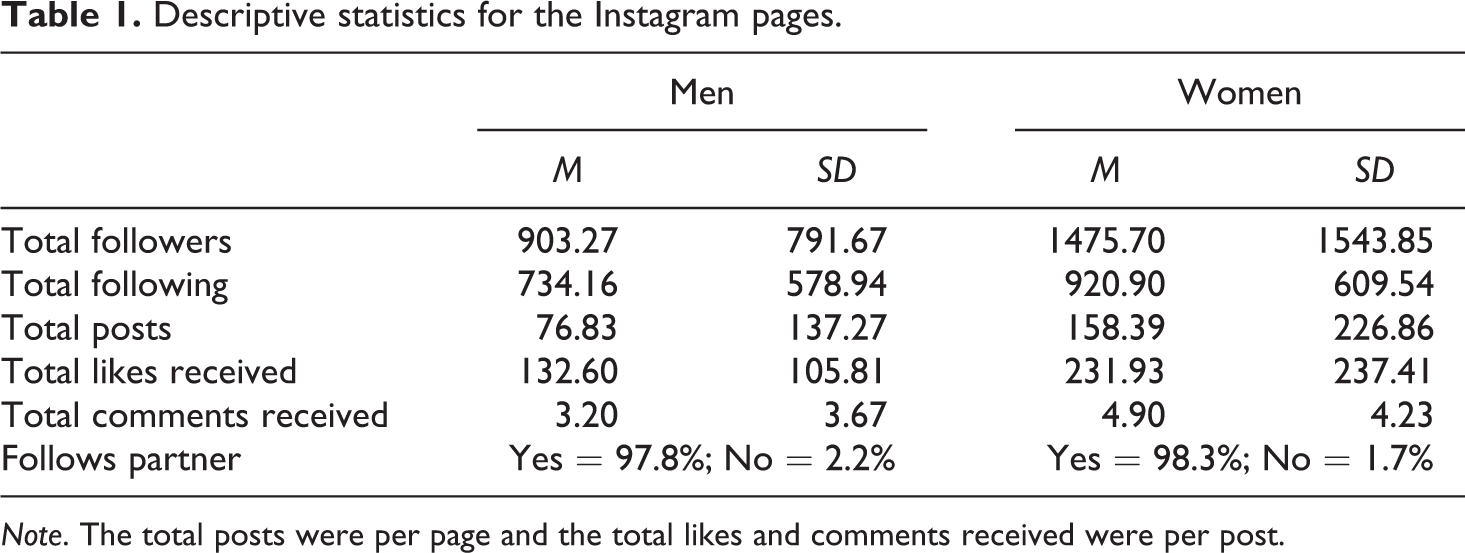
Note. The total posts were per page and the total likes and comments received were per post.
Results
Preliminary analyses
We began our analyses by conducting several preliminary tests. First, we calculated bivariate correlations among the independent and dependent variables for men and women and within couples (see Table 2). All of the correlations were significant for women, and all but two were significant for men. The significant positive correlations between partners also evidenced a high degree of interdependence within couples. Second, we compared men and women on each of the study variables. Women reported significantly more attention to alternatives on Instagram than men (men: M = 2.48, SD = 1.15; women: M = 2.93, SD = 1.20), paired-samples t(176) = 4.54, p < .001, η2 = .10. Women also received significantly more Instagram likes from their partner (men: M = 5.76, SD = 4.06; women: M = 6.39, SD = 3.91), paired-samples t(176) = 2.55, p < .05, η2 = .03. However, men had more engagement on their Instagram pages in the form of pictures (men: M = 2.46, SD = 2.70; women: M = 1.77, SD = 1.83), paired-samples t(177) = 4.28, p < .001, η2 = .09, and partner-initiated comments (men: M = 2.91, SD = 3.75; women: M = 1.99, SD = 2.76), paired-samples t(177) = 4.03, p < .001, η2 = .08. Thus, we used the couple as the unit of analysis to account for nonindependence and included sex as a moderator to test for differences between men and women (Kenny et al., 2006).
Bivariate correlations among men and women and within couples.
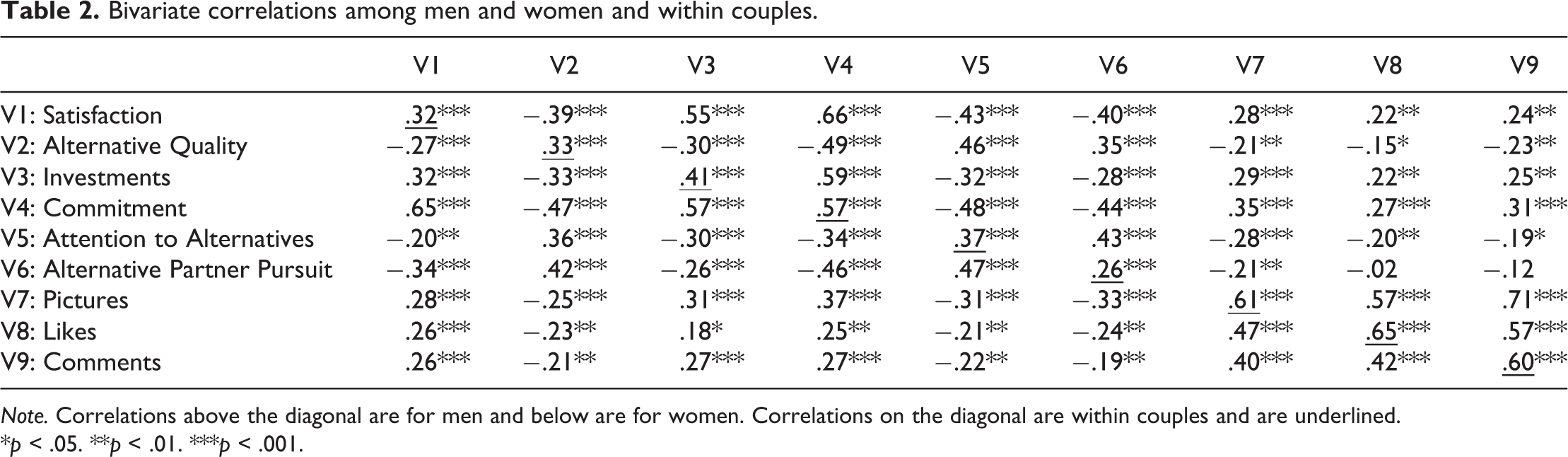
Note. Correlations above the diagonal are for men and below are for women. Correlations on the diagonal are within couples and are underlined.
*p < .05. **p < .01. ***p < .001.
Main analyses
We conducted the main study analyses using actor-partner interdependence modeling. Following Kenny et al. (2006), we estimated the APIMs using multilevel modeling (MLM) with restricted maximum likelihood estimation (REML) and heterogeneous compound symmetry for the covariance structure. The continuous independent variables were grand-mean centered, and the dichotomous sex variable was effect coded (−1 = women, 1 = men) and used to distinguish between partners in the analyses. All of the models contained the main effects of the predictors, their two-way interactions with sex, and the length of the relationship and amount of Instagram use as controls. In the models predicting relationship engagement on Instagram, we also included multiplicative two- and three-way interactions between the actor and partner effects and sex and controlled for the number of times that participants had posted (Garcia et al., 2015). We probed the significant interactions with sex using a two-intercept approach in order to inspect the simple slopes for men and women (Raudenbush et al., 1995).
How do couples in happy relationships behave on Instagram?
Hypothesis 1 examined whether there were actor and partner effects in the association between satisfaction and the amount of Instagram relationship engagement. Table 3 shows that there were significant positive actor and partner effects of satisfaction on the number of couple pictures and partner-initiated likes and comments. More satisfaction on the part of actors and partners was associated with more engagement with the relationship on the actor’s Instagram page. There was also a significant two-way interaction between the actor effect of satisfaction and sex on the number of pictures. Simple slopes for the interaction revealed that an actor’s satisfaction was associated with a greater number of pictures on men’s (b = .74 p < .001) and women’s (b = .34, p < .01) Instagram pages. In regard to Research Question 1, we uncovered significant two- and three-way interactions between the actor and partner effects of satisfaction and sex on the number of pictures and likes, which we probed and plotted at high and low levels of partner satisfaction (Aiken & West, 1991). As shown in Figure 1, an actor’s Instagram page received a greater number of likes when both partners were satisfied with the relationship. Similarly, the actor-by-partner effect was associated with a greater number of pictures on men’s Instagram pages (b = .23, p < .05), but not on women’s (b = .02, p = .73; see Figure 2).
Associations between relationship quality and observations of relationship engagement on Instagram.
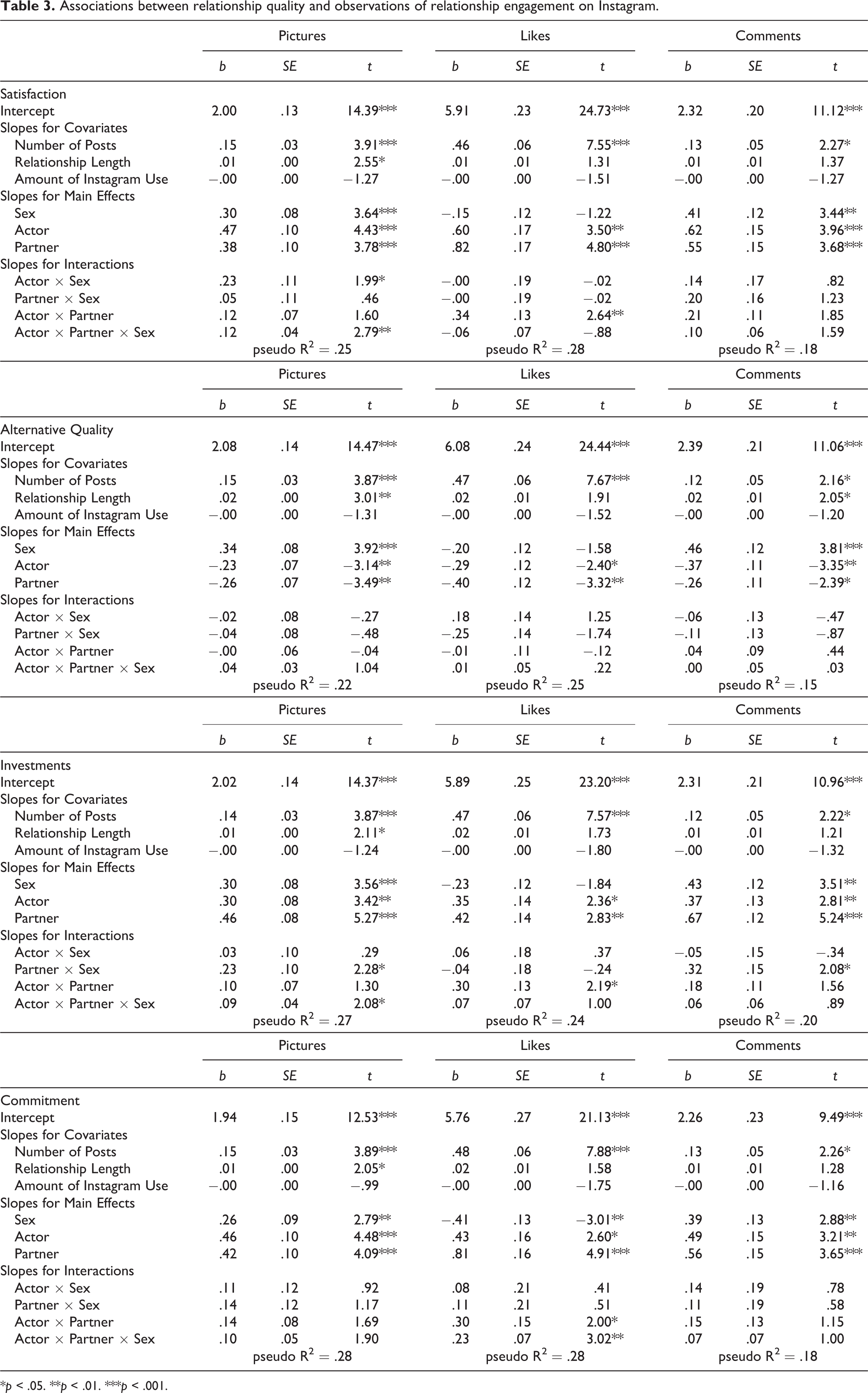
*p < .05. **p < .01. ***p < .001.
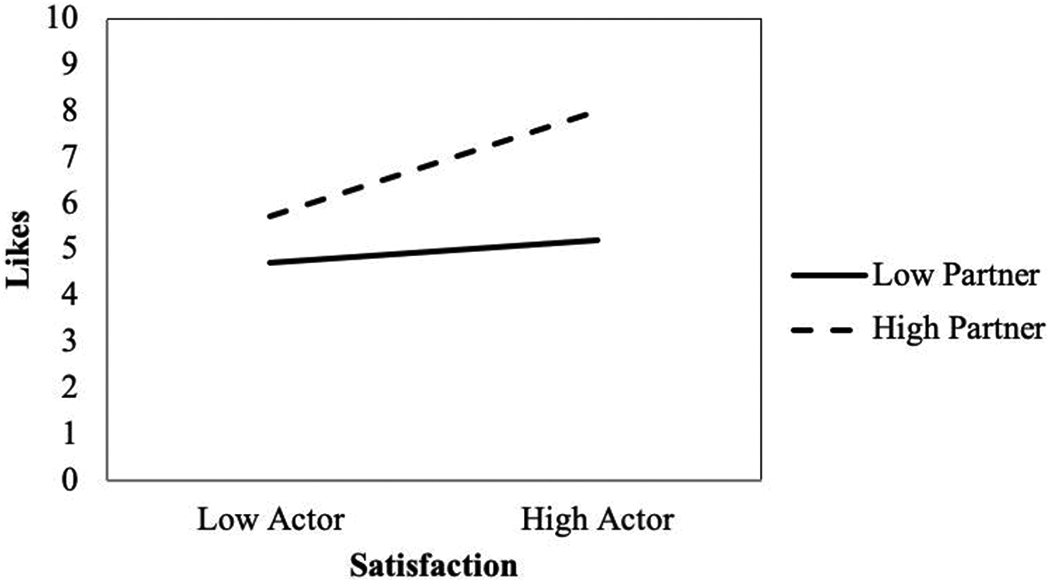
Actor × partner interaction for satisfaction predicting the number of Instagram likes. Simple slopes were plotted at +/– 1 SD of the mean for satisfaction.
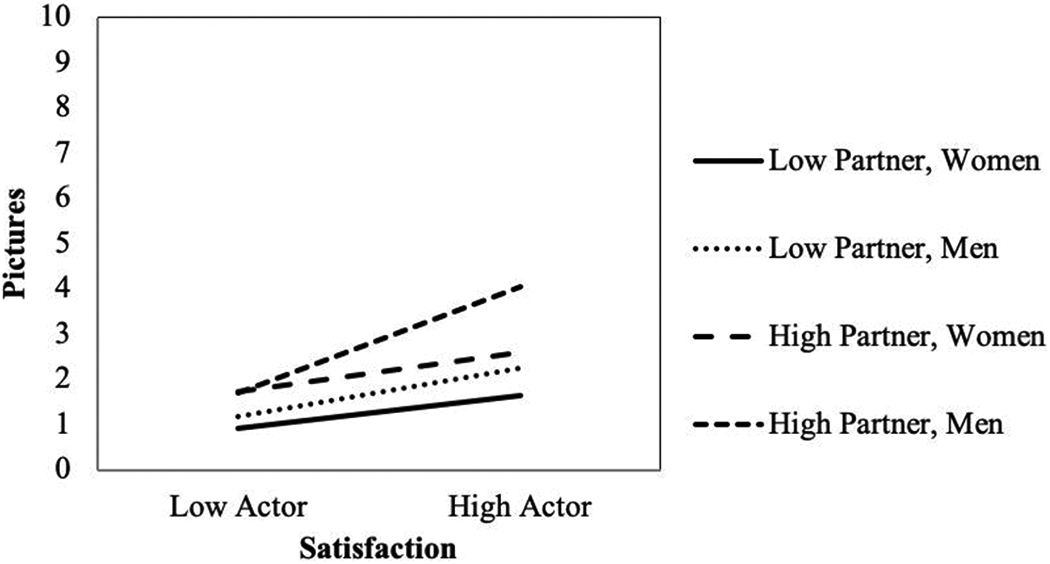
Actor × partner interaction for satisfaction predicting the number of Instagram pictures by sex. Simple slopes were plotted at +/– 1 SD of the mean for satisfaction.
The models for Hypothesis 2 evaluated whether there were actor and partner effects in the association between alternative quality and the amount of observed relationship engagement on Instagram. As can be seen in Table 3, alternative quality had significant negative actor and partner effects on the number of couple pictures and partner-initiated likes and comments. Actors and partners who perceived more quality alternatives engaged less with the relationship on the actor’s Instagram page.
Hypothesis 3 tested for actor and partner effects in the association between investments and the amount of engagement with the relationship on Instagram. Investments had significant positive actor and partner effects on the number of couples pictures and the amount of likes and comments from a partner (see Table 3). When actors and partners were more invested, more relationship engagement was visible on the actor’s Instagram page. Probing the significant two-way interaction between the partner effect of investments and sex on the number of comments and pictures indicated that a partner’s investments were associated with a greater number of comments (b = 1.06, p < .001) and pictures (b = .76, p < .001) on men’s Instagram pages. The partner effect of investments on the number of comments (b = .35, p = .05) and pictures (b = .22, p = .06) was just shy of significance for women. For Research Question 1, significant two- and three-way interactions also emerged between the actor and partner effects of investments and sex on the number of pictures and likes. Figure 3 shows that when both partners were invested in the relationship, a greater number of likes could be seen on an actor’s Instagram page. Follow-up simple slopes tests showed that the actor-by-partner effect on the number of Instagram pictures was not significant for men (b = .19, p = .07) or for women (b = .00, p = .94).
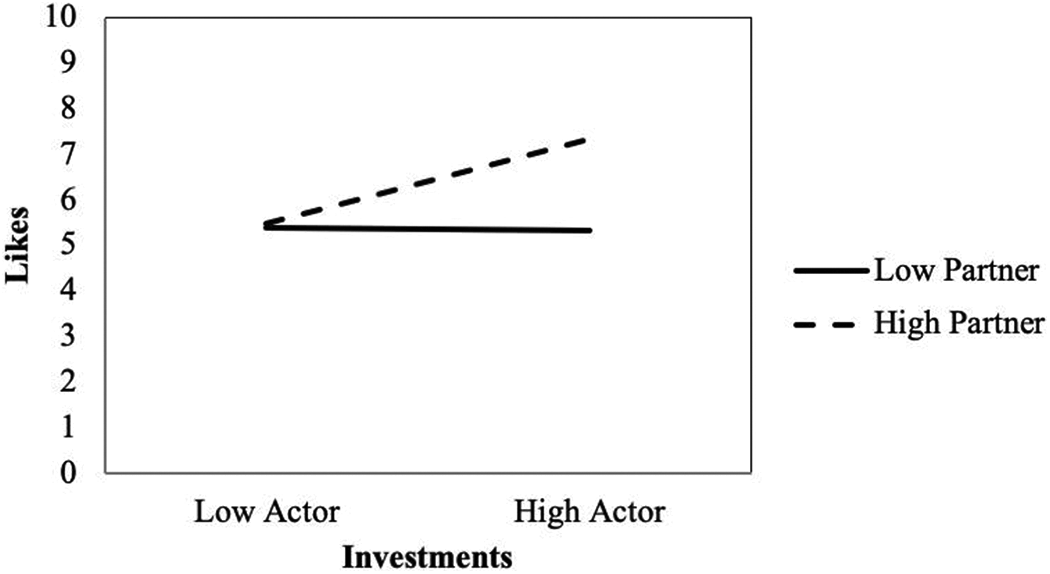
Actor × partner interaction for investments predicting the number of Instagram likes. Simple slopes were plotted at +/– 1 SD of the mean for investments.
Hypothesis 4 posited actor and partner effects in the association between commitment and relationship engagement on Instagram. Commitment had significant positive actor and partner effects on the number of couples pictures and the amount of partner likes and comments (see Table 3). When actors and partners were more committed, more relationship engagement was evident on the actor’s Instagram page. Two- and three-way interactions between the actor and partner effects of commitment and sex on the number of likes were also significant (Research Question 1). A simple slopes analysis demonstrated that the actor-by-partner effect was associated with a greater number of likes on men’s Instagram pages (b = .60, p < .01; see Figure 4). Once again, the effect of the number of Instagram likes on women’s pages was not significant (b = .18, p = .32). To summarize, we found full support for the actor and partner effects proposed in Hypothesis 1 through Hypothesis 4, as well as some evidence of the actor-by-partner interaction outlined in Research Question 1.
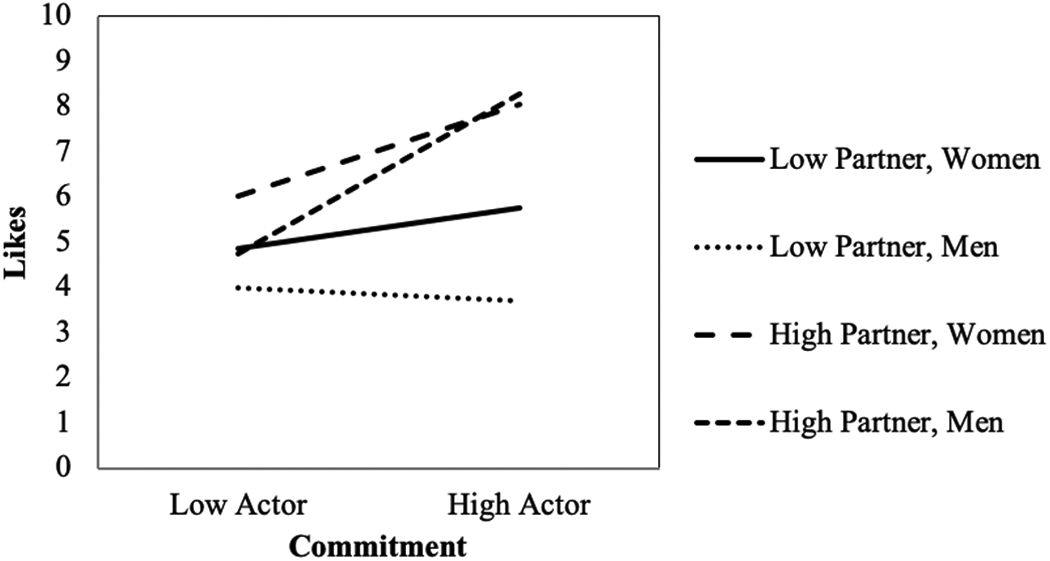
Actor × partner interaction for commitment predicting the number of Instagram likes by sex. Simple slopes were plotted at +/– 1 SD of the mean for commitment.
Do alternatives on Instagram pose a threat to relationships?
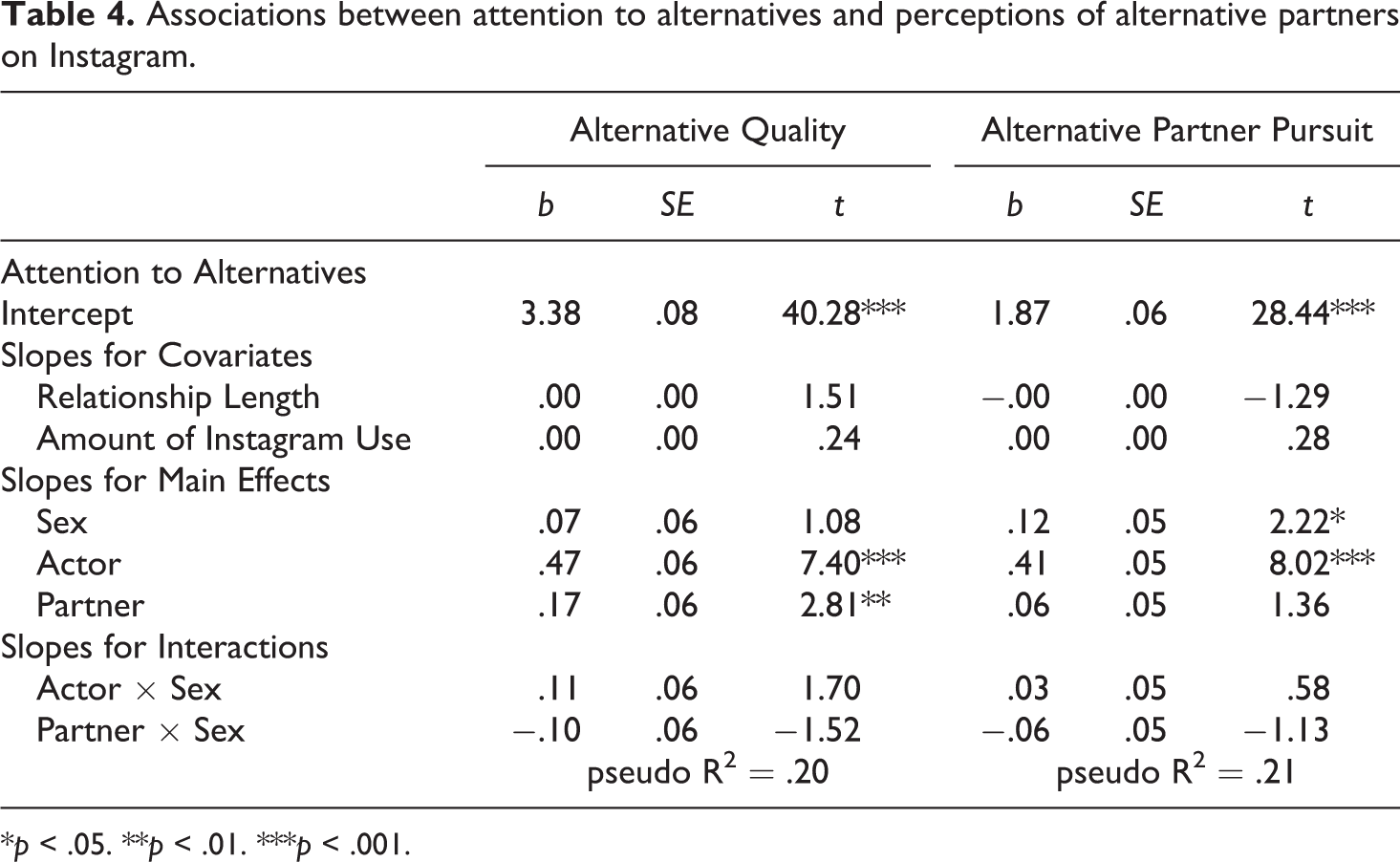
The final set of models focused on whether there were actor and partner effects in the associations between attention to alternatives on Instagram and alternative quality (Hypothesis 5) and the pursuit of alternative partners (Hypothesis 6). In Table 4, it can be seen that attention to alternatives had significant positive actor effects on alternative quality and alternative partner pursuit. When actors devoted more attention to alternatives on Instagram, they reported more quality alternatives and pursuit of alternative partners. There was also a significant positive partner effect of attention to alternatives on alternative quality. To the extent that partners paid more attention to Instagram alternatives, actors noted more quality alternatives of their own. In sum, the actor and partner effects fully supported Hypothesis 5. Hypothesis 6 was not supported.
Associations between attention to alternatives and perceptions of alternative partners on Instagram.
*p < .05. **p < .01. ***p < .001.
Discussion
Forty years after Rusbult (1980) published her seminal article on commitment and dependence in romantic relationships, research has called for a reexamination of the investment model in light of new communication technologies that offer opportunities to test and extend the guiding principles of many of the field’s foundational theories of personal relationships (Dibble, 2017). To that end, we sought to apply the investment model to Instagram in an effort to better understand relationship maintenance and attention to alternatives among couples on visual SNS platforms. We found that perceptions of alternative quality were tied to fewer instances of engagement on an individual’s Instagram page. At the same time, however, greater satisfaction, investments, and commitment corresponded with more engagement with the relationship on Instagram, as evidenced by the number of couple pictures that an individual posted and the amount of likes and comments from a partner on their page. We also observed that more attention to alternatives on Instagram was associated with greater perceived quality and likelihood of pursuing alternative partners. The presence of partner effects and actor-by-partner interactions further revealed the interdependence in couples’ Instagram activities.
Theoretical and empirical implications
The investment model proposes that satisfaction, alternative quality, investments, and commitment are key features of relationship maintenance (Rusbult, 1980). Our results showed that when individuals and their partners perceived having higher quality alternatives, their relationships were less visible on Instagram. Sometimes the absence of a relationship on SNSs is intentional (Robards & Lincoln, 2016), and in this case may signal an interest in presenting a public image of oneself as being unattached. However, the pattern of the other investment model constructs was clear: When individuals and their partners reported higher satisfaction, investments, and commitment, they were observed to engage more with the relationship in front of their Instagram followers. The consistency between these findings and past research linking Facebook use with markers of relationship quality (e.g., Castañeda et al., 2015; Papp et al., 2012; Saslow et al., 2012; Seidman et al., 2019; Toma & Choi, 2015) demonstrates a fundamental desire to affiliate with others that appears to transcend any one SNS platform (for a review, see Walther, 1996). Despite the tendency for women to report more maintenance efforts than men (Canary & Stafford, 1992; Dainton & Stafford, 1993), both sexes were observed to engage in maintenance on Instagram, albeit in different ways. Women’s Instagram pages received more likes from their partner, whereas men’s contained more partner-initiated comments and pictures of the couple. This may indicate that women expect different kinds of engagement from their partner on social media relative to men, or that men are less likely to recognize some types of behaviors as maintenance, potentially leading them to report partaking in these activities less than they actually do.
The investment model is based in interdependence theory and thus operates from the assumption that relationship partners affect each other’s thoughts, feelings, and actions (Kelley & Thibaut, 1978; Thibaut & Kelley, 1959). Consistent with this reasoning, the actor and partner main effects of relationship quality on Instagram relationship engagement show the intrapersonal and interpersonal processes involved in maintenance and the value of examining SNS activity through a dyadic lens. There was also some evidence that these effects were particularly strong when both partners held similar perceptions of the relationship. That is, there were significant actor-by-partner interactions of satisfaction, investments, and commitment on the number of pictures and likes appearing on an individual’s Instagram page, and some of these effects also differed by sex. However, there were generally fewer significant interactions overall, which suggests that an individual’s sex and the similarity between partners’ perceptions of the relationship may play less of a role in understanding maintenance activities on SNSs.
A central question of this study was whether the affordances of visual SNSs would create a discrepancy between the actual quality of couples’ relationships and the ways they choose to present themselves on social media. It appears based on our results that, generally speaking, partners who share more couple pictures on Instagram and who frequently engage with each other’s posts really are happier in their relationships. These findings resonate with research suggesting that the impressions people form of others based on their Facebook profiles are often accurate reflections of the profile owner’s offline persona (Back et al., 2010; Wilson et al., 2012). Considering that SNS self-presentations occur in a primarily public forum and that the awareness and approval of friends and family are important for relationships (Sprecher et al., 2002), it may be that people’s social networks hold them accountable for presenting a realistic image. It is also possible that the unique affordances of visual SNSs make an inaccurate relationship presentation difficult to achieve (Fox & McEwan, 2017). Of course, we modeled the investment model constructs as predictors of relationship behaviors on Instagram, but we cannot determine cause and effect from these data alone. Do couples engage with their relationships on SNSs because they are high in quality? Or does presenting an image of a high-quality relationship on SNSs make it so? Schlenker et al. (1994) found that public self-presentations can shape identity and behavior, which points to a possible bidirectional association between relationship quality and engagement with relationships on visual SNS platforms that warrants further investigation.
The overt presence of alternatives on Instagram has implications for research on the potential barriers to relationship maintenance that exist in SNS environments. It is well known that greater attention to alternatives can be damaging to relationships (Miller, 1997), and recent work suggests that technology may exacerbate this problem by alerting people to the presence of potential partners within their social networks (Abbasi & Alghamdi, 2017; Dibble & Drouin, 2014). In the present study, individuals who demonstrated greater diligence to their alternatives on Instagram reported higher quality options outside of their current relationship. Moreover, our findings showed that when partners paid more attention to their alternatives, individuals rated the quality of their own options more highly. Individuals with greater awareness of their alternatives on Instagram were also more inclined to actually pursue them, which coheres with studies showing that alternatives decrease commitment and increase the risk of relationship dissolution (Rusbult, 1983; Sprecher, 2001). Additional research is needed to explore whether this attentiveness to alternatives is the product of Instagram, or if people who are more engaged with the other sex online are equally as aware of their alternatives in person. For instance, Drouin et al. (2015) found that alternative partners cued from memory still posed a greater threat to relationships than those identified from a Facebook friends list. We were also surprised to find that women were more attentive to their alternatives on Instagram than men. Although this may appear to contradict past research findings that men pay more attention to their alternatives than women (Miller, 1997), we cannot rule out the possibility that women were more aware of everyone in their network, including the other sex. It is also possible that both sexes were attentive, but that women were more likely to actually register this attention publicly.
Something this study did not directly address is how individuals and relationships are affected by images of other couples’ maintenance activities on SNSs. Instagram provides access to lightweight tools (e.g., the infamous “like” button) that reduce the costs and effort involved in maintaining relationships, and couples can use this to their advantage by frequently engaging on the platform. Yet, it is important for the individuals who witness this engagement to recognize that even relationships that might seem “perfect” on social media are almost certainly not good all of the time. Many couples will eventually encounter conflict and stressors that may challenge their relationships, but which are unlikely to be moments they would necessarily choose to highlight in an Instagram post. This suggests that SNSs “might work to produce normative ‘relationship traces’, privileging neat linearity, monogamy, and obfuscating (perhaps usefully, perhaps not) the messy complexity of romantic relationships” (Robards & Lincoln, 2016, p. 2). There is strong evidence that social comparison on Instagram can be harmful to individuals’ mental health, but it may be detrimental to the health of relationships as well by creating unrealistic expectations of what being a couple should look like (Abbasi & Alghamdi, 2017).
Methodological considerations
This study underscores several benefits of using SNSs for data collection in relationships research. First, recruiting couples to participate in web-based studies can be difficult (Kenny et al., 2006), and one challenge is making sure that both partners participate. Gathering data through SNSs provides another level of identity verification that, while never a guarantee, can offer additional assurances that the person taking the survey is who they claim to be. Second, participants have access to some of their own user activity data on many SNSs, which can be used to capture behaviors that might be difficult to discern from self-reports (e.g., the amount of time spent on SNSs). Third, the behavioral residue (Gosling et al., 2002) that couples leave behind on SNSs can be used as a unique source of data about relationships. However, as we observed in this study, SNSs are constantly evolving as posts gain likes and comments, and as new content is added and later erased. In this way, SNSs provide a dynamic record of couples’ relationships, making them both a complex and intriguing site for research.
Limitations and directions for future research
The limitations of this research are important to mention. Like many studies of SNS use (Rus & Tiemensma, 2017), our sample was located in the United States and consisted mainly of young, White, heterosexual couples. There is a clear and pressing need for research in non-college student populations in order to generalize to a broader group of users. There is also a need for future research to empirically validate the behavioral measure of engagement utilized in this study and to provide evidence that this assessment (and others like it) are indeed accurate indicators of the relationship phenomena they are intended to capture. Furthermore, although our study has implications for visual SNSs generally, we collected data exclusively from Instagram. Researchers should continue to examine the associations between SNS use and relationship functioning to determine whether the same patterns emerge on similarly visually-oriented platforms with different features and affordances (e.g., Snapchat, TikTok). The reliability of our measure of attention to alternatives was also low for men, which may have been due to the items tapping distinct behaviors (e.g., liking, direct messaging) that would not necessarily be expected to correlate. However, another more compelling possibility for future research to examine is that men may have exhibited different patterns of behavior because they inferred more romantic interest from their interactions with the other sex (Abbey, 1982).
Conclusion
This study applied the investment model to understanding couples’ activities on the Instagram platform. The results revealed significant actor, partner, and actor-by-partner effects of relationship quality on the amount of observed relationship engagement between partners. There were also actor effects of attention to alternatives on alternative quality and alternative partner pursuit, along with a partner effect on alternative quality. The findings illustrate the complicated role of Instagram in couples’ romantic relationships and suggest that visual SNSs may offer valuable opportunities for maintenance to those who can resist the temptation of alternatives.
Footnotes
Acknowledgments
The authors thank Janine Beer, Jordan Coddington, McKenzie Diehl, Zackary Hlatky, Christiana Robey, Margaret Thorwart, Madison Wedge, and Morgan Winner for their assistance with this study and the editors and anonymous reviewers of this special issue for their generous feedback.
Funding
The author(s) received no financial support for the research, authorship, and/or publication of this article.

Open research statement
As part of IARR’s encouragement of open research practices, the authors have provided the following information: This research was not pre-registered. The quantitative data used in the research are available. The data can be obtained by emailing: