







Abstract
A Fast Friends procedure was created years ago as a method to generate closeness between people interacting for the first time and to provide an experimental procedure to test hypotheses about factors that may lead to initial closeness. In their original study, Aron et al. (1997) validated their closeness-generating task by comparing the degree of interpersonal closeness it generated versus that by a small-talk task. Few subsequent studies, however, have tested the validity of the closeness task by comparing the affiliative outcomes resulting from it with that from other activities. To further examine its validity, this study involved zero-history dyads randomly assigned to become acquainted through either Aron et al.’s closeness-inducing task, Aron et al.’s small-talk task, or an unstructured getting-acquainted task. The dyads were then compared on the closeness they experienced as well as on several other affiliative outcomes. In support of the validity of the closeness-inducing task, the task generated more closeness and other positive outcomes, relative especially to the small-talk task. A second manipulation in the study was the mode of communication (video-chat vs. face-to-face). No significant differences in outcomes (e.g., closeness, liking) were found based on mode of communication. Furthermore, the effectiveness of the closeness task (relative to the other tasks) for generating closeness and other affiliative outcomes was not moderated by the mode of communication.
Keywords
Many years ago, Aron et al. (1997) created a closeness-generating self-disclosure task for developing an “interconnectedness of self and other” (p. 364) within pairs of strangers who were becoming acquainted. The goal was to provide researchers with a method to create temporary closeness in a laboratory setting in order to test theoretical predictions about the early stage of relationship development and in a way that would make it possible to manipulate factors such as the particular pairings and the circumstances under which the interaction occurs. The procedure was inspired by but designed to improve upon the acquaintance paradigm of the 1970s and 1980s (Collins & Miller, 1994), which typically involved participants disclosing to a confederate in written statements. Aron et al.’s goal to produce a procedure for creating interpersonal closeness in an experimental context as well as in other situations involving strangers becoming acquainted (e.g., classroom settings) has been achieved. This exercise, also sometimes referred to as the “Fast Friends” procedure, has been adapted for use in many experimental studies to examine factors that influence initial feelings of closeness and attraction in getting-acquainted interaction (for a review, see Sprecher, 2020).
The original procedure (Aron et al., 1997) had 36 self-disclosure topics that were divided into three sets that escalated in intimacy and personalism and lasted 45 minutes. The dyads were directed to take turns reading each topic, with the person who read the topic answering the question first and then the other answering it. The sets were timed, and the experimenter indicated when to go on to a new set of questions. Over the years, researchers have adapted Aron et al.’s (1997) Fast Friends procedure in various ways, including using a briefer version and reducing the length of the interaction (e.g., Boothby et al., 2016; Lundy & Drouin, 2016; Vacharkulksemsuk & Fredrickson, 2012), combining some of the items with those from another closeness-generating task particularly Sedikides et al. (1999) Relationship Closeness Induction task (see, for example, Sprecher et al., 2013), and using an expanded version that allows for multi-session, get-acquainted interactions (e.g., Mendoza-Denton & Page-Gould, 2008; Page-Gould et al., 2008). The Fast Friends procedure was developed in research that involved face-to-face (FtF) interaction, although in some recent studies a version has been used in interactions that involve computer-mediated communication (CMC), including instant messaging and video communication (Mallen et al., 2003; Sprecher & Hampton, 2017).
The Fast Friends procedure has been used in many studies, although there are additional ways that it can be validated. The first purpose of this study was to examine the affiliative outcomes it generates compared to that from Aron et al.’s (1997) small-talk task, although with consideration of a wider variety of affiliative outcomes than were measured in Aron et al. (1997). Second, this study further tests the validity of the closeness-generating task by comparing it to an unstructured getting-acquainted task—a comparison that has not previously been conducted (to my knowledge). In addition, this study explores whether the positive outcomes generated from the closeness task are accentuated or diminished when the task occurs over CMC-video (Skype) as compared to face-to-face. Many people today are becoming acquainted through video forms of CMC such as Skype, Zoom, Whatsapp, and Facetime (e.g., Croes et al., 2019, 2020; LeFebvre, 2018; Yang et al., 2014), which has been accelerated because of the COVID pandemic.
Affiliative reactions generated from structured self-disclosure in initial interaction
As noted above, Aron et al.’s (1997) closeness-generating procedure, as well as Sedikides et al.’s (1999) Closeness Induction task, were designed to generate interpersonal closeness. Although such procedures have been used to enhance closeness in existing relationships (e.g., Slatcher, 2010), the original purpose of the tasks was to create closeness, particularly subjective closeness, between strangers (Aron et al., 1997). Aron et al. defined subjective closeness as “an interconnectedness of self and other” and “including other in the self.” Aron et al. (1997) and others who have used a version of the closeness task (Kashdan & Wenzel, 2005; Ketay et al., 2017) have measured subjective closeness with the Inclusion of Other in the Self (IOS) Scale (Aron et al., 1992), which consists of seven overlapping pairs of Venn diagrams that represent self and the other. Participants are asked to select the one pair that bests represents their relationship or interaction. Subjective closeness has also been measured by asking participants a direct item such as how close they feel toward the other (e.g., Berscheid et al., 1989).
Many other affiliative outcomes in addition to closeness can be experienced in an initial interaction. Perhaps the most important additional outcome variable to consider is liking (or attraction), which is frequently examined in research on relationship development (Clark et al., 2019; Finkel & Eastwick, 2015; Montoya & Horton, 2014; Montoya et al., 2018), including in the study of online relationship development (e.g., Rodrigues et al., 2017). Indeed, attraction research is a subfield within the interdisciplinary field of close relationships, and has included a long history of the examination of predictors of liking (or attraction) in initial interactions (e.g., Finkel & Eastwick, 2015).
Another important variable to consider in the further testing of the validity of the Fast Friends procedure is the degree to which the interaction is fun or enjoyable. Reciprocal, personal self-disclosure that characterizes a structured self-disclosure task can be rewarding and lead to the experience of having fun. As noted by Reis et al. (2017), having fun is a common goal for social interaction. The experience of fun and enjoyment in an interaction is associated with other positive affiliative outcomes such as liking, positive forecasts for a future relationship, and desire for more interaction (Sprecher et al., 2013; Treger et al., 2013). Another important evaluation that may occur in an initial interaction, particularly in interaction characterized by self-disclosure, is the perceived responsiveness of the interaction partner (Joel & Eastwick, 2018; Reis et al., 2011). A responsive partner in the interaction is warm and sensitive, and can make one feel understood and validated (Reis et al., 2004). Responsiveness has been theorized to be important in initial interactions (Reis & Clark, 2013). A related affiliative outcome is the perception of being liked, also referred to as reciprocal liking. The knowledge that another likes us is gratifying and rewarding because it validates we are desirable and have likeable qualities; it is also associated with believing that the other is trustworthy (Eastwick & Finkel, 2009; Montoya & Insko, 2008).
The Fast Friends procedure versus a small-talk task
In their original research on the Fast Friends procedure, Aron et al. (1997) tested the procedure’s validity by randomly assigning some unacquainted dyads to the closeness-generating procedure and other dyads to a small-talk condition. The small-talk task also included 36 questions that were divided into three sets. However, this task involved only minimal personal self-disclosure and the topics did not increase in intensity over the sets. To test the validity of the closeness-generating procedure, Aron et al. compared the pairs from the two conditions on their scores to a composite of Aron et al.’s (1992) Inclusion of Other in Self Scale and Berscheid et al.’s (1989) Subjective Closeness measure. The researchers found that the composite closeness score was significantly higher for pairs who engaged in the closeness-generating task than for pairs who engaged in the small-talk task, which provided evidence for the validity of the closeness task for generating closeness.
In most subsequent research using the closeness-inducing task, however, the small-talk task has not also been included. In one exception, Kashdan and Wenzel (2005) included both self-disclosure tasks in a study focused on the effects of the participants’ social anxiety on the interaction. On a manipulation check, the pairs assigned to the closeness-generating task reported disclosing more intimately than the pairs assigned to the small-talk task, which confirmed that the personal disclosure condition was more effective in facilitating intimate disclosure than the small-talk condition. The researchers also reported that the closeness ratings were higher in the disclosure condition compared to in the small-talk condition. In another study that included both self-disclosure tasks from Aron et al. (1997), pairs of existing couples who were unacquainted with each other engaged in either the closeness-generating task or the small-talk task (Slatcher, 2010). After the couples interacted in a laboratory setting, the participants’ closeness both for their partner and for the other couple was assessed with Aron et al.’s (1992) Inclusion of Other in the Self Scale. Both closeness scores (for partner and for the other couple) were higher for those who engaged in the closeness-generating task as compared to those who engaged in the small-talk task.
Other than the above studies, however, little research has compared the two self-disclosure tasks. It is an empirical question as to whether the closeness-generating task leads to a variety of positive affiliative outcomes to a greater degree than would the small-talk task. If differences are found on diverse affiliative outcomes, however, it provides further evidence for the validity of the closeness procedure, not only for developing closeness but also for enhancing other interpersonal reactions in early acquaintance. Thus, the first purpose of this study was to further test the validity of the closeness-generating task by comparing the outcomes it generates relative to that of the small-talk task. For this purpose, I first determine whether the original finding in Aron et al. (1997)—that the closeness-generating task leads to more closeness than the small-talk task—will be replicated. Second, I examine whether participants perceive greater and deeper self-disclosure in the closeness-generating task condition than in the small-talk condition, as found by Kashdan and Wenzel (2005). Third, I explore whether the closeness-generating task leads to other positive outcomes, including liking, fun, and perceived responsiveness of the other in the interaction, to a greater degree than does the small-talk task.
H1: Dyads who engage in the closeness task will report more closeness than dyads who engage in the small-talk task.
H2: Dyads who engage in the closeness task will report greater own disclosure and perceived partner disclosure than dyads who engage in the small-talk task.
RQ1: Will there be other differences between dyads who engage in the closeness task and dyads who engage in the small-talk task, namely in their liking, fun/enjoyment, and perceived responsiveness?
Structured self-disclosure versus an unstructured getting-acquainted task
Both self-disclosure procedures developed by Aron et al. (1997)—the closeness-inducing task and the small-talk task—are structured activities in that the participants are provided questions to answer and a protocol to follow (e.g., taking turns answering the questions). In some studies on the get-acquainted process, participants have been allowed to interact without being told what topics should be discussed. This approach can be referred to as an unstructured getting-acquainted paradigm. It has been used in several lines of research including in a set of studies that involved studying spontaneous interactions between college students who were covertly videotaped interacting while they were ostensibly waiting for a psychology study to begin (Ickes, 2009; Ickes et al., 1990). As another example, an unstructured format has been used in speed-dating events, which generally involve very brief interactions (Eastwick & Finkel, 2008). Several studies in the communication field have also studied the get-acquainted process through unstructured interactions (e.g., Sunnafrank & Ramirez, 2004; Tidwell & Walther, 2002; Walther et al., 2016).
Surprisingly, no study (to my knowledge) has compared the degree of closeness (and other outcome variables) generated from a structured, closeness-inducing task (e.g., Aron et al.’s [1997] Fast Friends procedure) versus from an unstructured getting-acquainted task. It is possible that the closeness-generating task does not create any greater closeness and other affiliative outcomes than would occur from any natural (unstructured) getting-acquainted interaction, but this issue has not been previously considered. Thus, the second purpose of this study was to compare the outcomes experienced by dyads who engaged in the closeness task versus outcomes experienced by dyads who engaged in an unstructured (free-format) getting-acquainted task. The hypotheses and research question for this purpose are the following:
H3: Dyads who engage in the closeness task will report more closeness than dyads who engage in an unstructured getting-acquainted task.
H4: Dyads who engage in the closeness task will report greater own and perceived partner disclosure than dyads who engage in an unstructured getting-acquainted task.
RQ2: Will there be other differences between dyads who engage in the closeness task versus dyads who engage in an unstructured getting-acquainted task, particularly in liking, fun/enjoyment, and perceived responsiveness?
The small-talk condition will also be compared with the unstructured task on the various affiliative outcomes, although this comparison is of less methodological and theoretical importance than the other comparisons referred to above.
Mode of communication
As noted above, the Fast Friends procedure was developed before people communicated through video-CMC and validated by comparing it to the small-talk task in face-to-face interaction only (e.g., Aron et al., 1997). Since the 1990s, various forms of CMC have been in widespread use, and researchers have examined the effects of mode of communication on interpersonal outcomes, including whether people becoming acquainted feel less intimacy and closeness if they interact via CMC versus face-to-face. For example, early research on this topic compared a text-based CMC with FtF, and the results were mixed and depended somewhat on the length of time the participants were given to communicate in a text-based medium (e.g., Mallen et al., 2003; McKenna, Green, & Gleason, 2002; Okdie, Guadagno, Bernieri, Geers, & Mclarney-Vesotski, 2011). Many of the studies were testing various theories about differences between communication in CMC and FtF. One such theory is the Hyperpersonal perspective (e.g., Walther, 2011), which argues that in some cases (such as with extended time), CMC can even be more personal than FtF communication.
A few of the studies that examined the effect of mode of communication on interpersonal outcomes in initial interaction considered visual CMC. Antheunis et al. (2007) randomly assigned other-sex dyads to one of three communication modes (text-only CMC, visual CMC, and face-to-face). The dyads communicated for 24 minutes in an unstructured format (with directions to get to know each other by discussing topics of their choice). No difference was found in the participants’ attraction for each other at the end of the 24 minutes as a function of which communication mode they engaged in, but both the number of direct questions asked and the perceived level of self-disclosure were greater in text-CMC and visual-CMC compared to face-to-face.
In another early study that compared outcomes after a get-acquainted interaction as a function of different modalities, Ramirez and Burgoon (2004) had same-sex dyads interact for 20 minutes either through text-chat, audio only, video and audio, or face-to-face (randomly assigned). The dyads were given a brief form of a structured self-disclosure with questions (e.g., “What do you like or dislike about your classes?”) that were similar to the type of small-talk task of Aron et al. (1997). Some differences were found in the outcome variables (e.g., perceived mutuality [e.g., understanding, connectedness]), although the significant differences were mostly between text-based CMC and the other modalities. No differences in outcomes were found between the dyads in the visual-CMC and the dyads in the face-to-face condition, however. The researchers concluded that richer modes of communication (defined as including visual, audio, verbal, and contextual information) foster connectedness in getting-acquainted interactions. Other studies that have compared the outcomes of brief interactions across multiple modalities—including both visual-CMC and face-to-face (often as part of a larger study that focused on modality switching in communication modes)—also have found no differences in reactions after a brief interaction in dyads assigned to these particular modalities (Sprecher, 2014; Sprecher & Hampton, 2017).
More recently, Croes and colleagues (Croes et al., 2016, 2019) compared video-mediated communication (VMC) with face-to-face (FtF) communication, particularly in regard to affiliative behaviors that are relevant to attraction. In one study that involved brief speed-dating interactions (Croes et al., 2016), participants had three 5-min dates over several days with three different people under different communication conditions: Skype-video, video communication that involved direct eye contact (Eye-catcher), or face-to-face. No significant differences were found in romantic attraction across the three experimental conditions. The researchers found some differences on other variables, such as more intimate self-disclosures but fewer intimate questions asked in the Eye-catcher and FtF conditions relative to the Skype VMC (which had less direct eye contact). In a second study, Croes et al. (2019) assigned other-sex (stranger-stranger) dyads to one of two experimental conditions: FtF communication or VMC (Eye-catcher). The dyads interacted for 12 minutes for the purpose of becoming acquainted and were allowed to chat about any topics (i.e., unstructured interaction). The interaction was videotaped and the researchers examined how nonverbal affiliative behaviors differed based on mode of interaction. VMC and FtF communications were not found to differ on most of the nonverbal affiliative behaviors considered, leading the authors to conclude that the participants were equally responsive in both conditions. They did find, however, that participants engaged in more facial and vocal expressiveness in the VMC condition.
In sum, the research that has compared affiliative outcomes of stranger-stranger dyads interacting via CMC-visual versus FtF would suggest no differences will be found in overall affective outcomes as a function of whether the dyads communicate via CMC-visual or FtF. Thus, the fifth hypothesis is:
H5: There will be no differences in the overall affiliative outcomes of dyads who become acquainted over Skype versus of dyads who become acquainted face-to-face.
No prior study, however, has considered how the mode of communication may affect affiliative outcomes while manipulating mode of communication jointly with type of self-disclosure task. Particularly interesting is whether the outcomes based on mode of communication (CMC-visual vs. FtF) will vary as a function of the type of self-disclosure task. Looking at this in another way, the study design allows the consideration of how the effect of the self-disclosure task on affiliative outcomes (e.g., closeness) depends on the mode of communication. For example, will closeness and other affiliative outcomes experienced in response to the closeness task be attenuated in either FtF or visual-CMC, relative to the other self-disclosure tasks?
Although no prior theory and research support a clear prediction concerning the interaction between mode of communication and self-disclosure task, a theory about nonverbal communication (Patterson, 1990) is relevant. The theory states that people fine-tune their interactions to establish comfortable levels of closeness, which might suggest that a closeness-inducing task would be more comfortable for stranger-stranger dyads if the self-disclosure occurs over video-mediated communication than in FtF. According to this perspective, if one channel of communication (e.g., verbal) becomes especially intimate, people may adjust other channels (e.g., nonverbal) to compensate in order to feel comfortable. The intimate topics of a closeness-generating task may feel more comfortable to discuss at a distance (over a video camera) than in face-to-face, and thus getting-acquainted dyads may enjoy the closeness task more if it is over video-CMC than FtF, whereas no such differences based on mode of communication may be found for the other self-disclosure tasks.
However, the application of Patterson’s (1990) theory to the design of this study is speculative, and thus a research question (rather than a hypothesis) is posed:
RQ3: Will more positive outcomes experienced in the closeness-generating task (relative to the other tasks) be greater in the Skype condition compared to in the face-to-face condition (i.e., will there be a communication mode x type of self-disclosure task interaction)?
Method
Participants
Participants were from a large, U.S. Midwestern University. Most of the participants were obtained from the university’s psychology participant pool, although some participants were obtained from sociology classes who were given research opportunities (among other options) to earn extra learning credits. The final sample for analysis (after eliminating 3 dyads who reported knowing each other, as assessed by a question in the survey after the interaction) consisted of 103 dyads or 206 participants. Due to the gender imbalance of the psychology participant pool (and of the larger university), a greater proportion of the participants were women (n = 163, 79.1%). The mean age was 19.96 (SD = 2.70). In ethnic background, 69.4% identified themselves as White, 13.6% were Black/African-American, 10.7% were Hispanic/Latino, 2.4% were Asian, and 3.9% responded Other.
Procedure
After participants signed up for the study, they were contacted by a lead team member and scheduled in pairs based on their mutual availability. The majority of the pairs formed were female-female dyads (n = 67), with a smaller sample of male-female dyads (n = 30) and only a few male-male dyads (n = 5). One dyad had one member who identified as “other” to the gender question.
Each member of the dyad arrived for the study to different rooms in a university building and was greeted by an experimenter. In an initial step, the participant read an informed consent and other directions and then completed a preliminary survey that assessed background questions and other individual variables not considered in this study. Then, the dyad engaged in a 24-minute interaction, which was conducted either face-to-face in one room (thus, one participant was moved to the room of the other) or over Skype-video from the two different rooms. After the deletions referred to above, the analysis sample included 56 dyads who engaged in face-to-face interaction and 47 dyads who engaged in Skype interaction. In addition to the manipulation of mode of communication, the dyads were randomly assigned to engage in one of three self-disclosure tasks: (1) the closeness-generating task of Aron et al. (1997); n = 38 dyads; (2) the small-talk task of Aron et al.; n = 35 dyads; or (3) an unstructured getting-acquainted task (n = 30 dyads).
After the interaction ended, the experimenters directed each participant to separate computers (in different rooms) to complete an online post-interaction survey that assessed their reactions to their partner and the interaction.
The getting-acquainted tasks
Participants were randomly assigned to one of three getting-acquainted tasks. Regardless of which task the dyad was assigned, the interaction lasted 24 minutes and was divided into three segments of 8 minutes. The interaction was divided into segments to mirror the procedure used in the Aron et al. (1997) Fast Friends procedure. Each of the tasks is described below.
The closeness-generating task
The dyad (if they were together in the same room for face-to-face interaction) or each member of the dyad (if the dyad members were in separate rooms because they were in the Skype condition) were read directions by the experimenters, which included that they would be receiving a set of topics for each of three 8-minute segments, they should take turns reading the topic, and that both should answer the questions.
Each dyad member was then given the first set of self-disclosure topics. After 8 minutes, the experimenter stepped in and gave them the second set of self-disclosure topics. Then, after another 8 minutes, the experimenter stepped in and gave them the third set of self-disclosure topics. The self-disclosure topics were those from Aron et al.’s (1997) closeness-generating task. Each sheet with a self-disclosure topic also had a reminder at the bottom which indicated “alternate asking questions and both should answer,” which had also been part of the general directions that they received.
The small-talk self-disclosure task
The procedure and directions for the small-talk task were the same as for the closeness-generating task, except that the topics given to the participants were those from the small-talk task (Aron et al., 1997).
The unstructured getting-acquainted task
The unstructured getting-acquainted task also was 24 minutes and divided into three 8-minute segments. The directions that the experimenters read to the participants emphasized that they should become acquainted with each other and “discuss any of the topics you might discuss if you were meeting someone for the first time out in a natural setting.”
The dyads in this condition were given a “tip sheet” to help them get started, and to keep the interaction as natural as possible. To make this condition parallel to the structured tasks, the experimenter also stepped in at 8-minute intervals and stated, “Just checking in. Eight minutes have passed. Go ahead and keep sharing.”
Post-interaction measures
Several items were included in the post-interaction survey that assessed the participants’ reactions to the interaction and to their interaction partner.
Manipulation checks
Participants were asked, “How would you describe the questions asked in the interaction?” A 7-point response scale followed, with the anchors 1 = Seemed like casual, small talk questions; 4 = Seemed like moderately intimate questions; and 7 = Seemed like very intimate questions. Participants were also asked “How thoughtful were the questions asked of you?” with responses that ranged from 1 = Not at all; 4 = Somewhat; and 7 = A great deal. As another check on how the self-disclosure topics were perceived, participants were asked, “How awkward was the conversation?” with response options that ranged from 1 = Not at all; 4 = Somewhat; and 7 = A great deal.
Perceived degree of self-disclosure
To measure self-disclosure received from the other, the participants were asked the following four questions: (1) “How much did the Other tell you about himself or herself?”; (2) “How much personal or intimate information did the Other share with you?” (3) “How honest and open do you think the Other was in her or his responses?” and (4) “How much knowledge do you think you gained about the Other?” Each item was followed by a 7-point response scale that was anchored by 1 = Not at all or Nothing or almost nothing and 7 = A great deal. Similar questions were asked about the participants’ perceptions of their own self-disclosure (e.g., “How much did you tell the Other about yourself?”). Composite scores were created for perceived other disclosure (α = .82) and for own self-disclosure (α = .82), which were then averaged between partners for a total composite of self-disclosure in the dyad.
Closeness
Closeness in the interaction was assessed with 2 items. The first was the Inclusion of Other in the Self (IOS) Venn diagram (Aron et al., 1992), which is a commonly used scale to measure closeness (e.g., Aron et al., 1992; Fraley & Aron, 2004). This measure has several pairs of circles that range from just touching to being almost completely overlapping. One circle in each pair refers to “self” and the other circle refers to “other.” The participants were asked to choose which pair of circles best describes their interaction with the other. In addition, participants were asked a general question on closeness: “How close do you feel toward the Other?” A 7-point response scale followed this question, and included the anchors, 1 = Not at all; 4 = Somewhat; and 7 = A great deal. The 2 items were combined for a composite score with a Cronbach alpha of .67.
Liking
Liking was assessed with 2 items. One item was: “How much did you like the other?” (1 = Not at all, 7 = A great deal). The other item was adapted from Byrne’s (1971) Interpersonal Judgment Scale and asked about general feelings (1 = I feel that I would probably dislike this person very much, to 7 = I feel that I would probably like this person very much). Cronbach’s alpha for a composite score created of the 2 items was .74.
Perception of being liked
Participants were also asked, “How much do you think the Other liked you?” with the response options ranging from 1 = Not at all; to 7 = A great deal.
Enjoyment/fun of interaction
The enjoyment/fun of the interaction was assessed with 3 items: (1) “How much did you enjoy the interaction?” (2) “How much did you and the other laugh during the interaction?”; and (3) “How much fun was the interaction?” Each item was followed by a 7-point response scale that ranged from 1 = Not at all, 4 = Somewhat; to 7 = A great deal. Cronbach’s alpha for the composite score was .85.
Perceived similarity
Perceived similarity was assessed with 2 items: “How much do you think you have in common with the other person?” (1 = Nothing or almost nothing; to 7 = A great deal) and “How similar do you think you and the Other are likely to be?” (1 = Not at all; 7 = A great deal). A composite was created of the 2 items and the Cronbach’s alpha was .88.
Perceived responsiveness of the other
Participants were presented with four questions that assessed the degree to which they perceived their partner was responsive in the interaction. Three of the items were from Reis et al.’s (2011) Responsiveness scale and were: “The Other seemed to really listen to me,” “The Other seemed interested in what I am thinking and feeling,” and “The Other was ‘on the same wavelength’ with me.” A fourth item was written by the author and has been used in prior social interaction studies (e.g., Sprecher & Treger, 2015): “The other was responsive to my questions/answers.” Each item was followed by a 7-point response scale, with options anchored in the following ways: 1 = Not at all true in this situation; 4 = Somewhat true in this situation; and 7 = Very true in this situation. The composite score of the 4 items had an α of .87.
Desire for further interaction
Two items asked about future interaction. One was the item, “How much would you like to spend time with the Other again in the future?” (options ranged from 1 = Not at all; to 7 = A great deal). A second item asked, “If there were opportunities to interact again with the Other, how likely is it that the two of you could become friends?” (options ranged from 1 = Not at all likely; to 7 = Very likely). Cronbach’s alpha for the 2-item composite was .82.
Results
Overview of analyses
The data were analyzed at the level of the dyad, with mean scores created for the dyads on each variable. Aggregated dyadic scores are recommended when the focus of the study is on the effects of between-dyad predictor variables, in this case two experimental variables’ effects on outcome variables (e.g., Kenny, 2015; Kenny et al., 2006). Thus, each of the dependent variables is a dyad mean score.
Results of a 3 (self-disclosure task) × 2 (mode of communication) ANOVA
A 3 × 2 ANOVA was conducted on each of the dependent variables (represented by pair scores). These results indicated that the mode of communication did not have a significant main effect on any of the dependent variables (Fs ranged from .001 to 1.56; ps > .215; ηp 2 = .000 to .016), which supported H5. Furthermore, the self-disclosure task x mode of communication interaction was not significant for any of the dependent variables (Fs ranged from .11 to 1.73, ps > .182; ηp 2 = .002 to .035), indicating that mode of communication did not moderate the effect of the self-disclosure task on the outcomes (RQ3). However, there were strong main effects for type of self-disclosure task. The results, including follow-up Bonferonni tests, are presented in Table 1 and discussed below (a table of pairwise comparisons is available in a supplementary document).
Scores on the various dependent variables for three self-disclosure tasks.
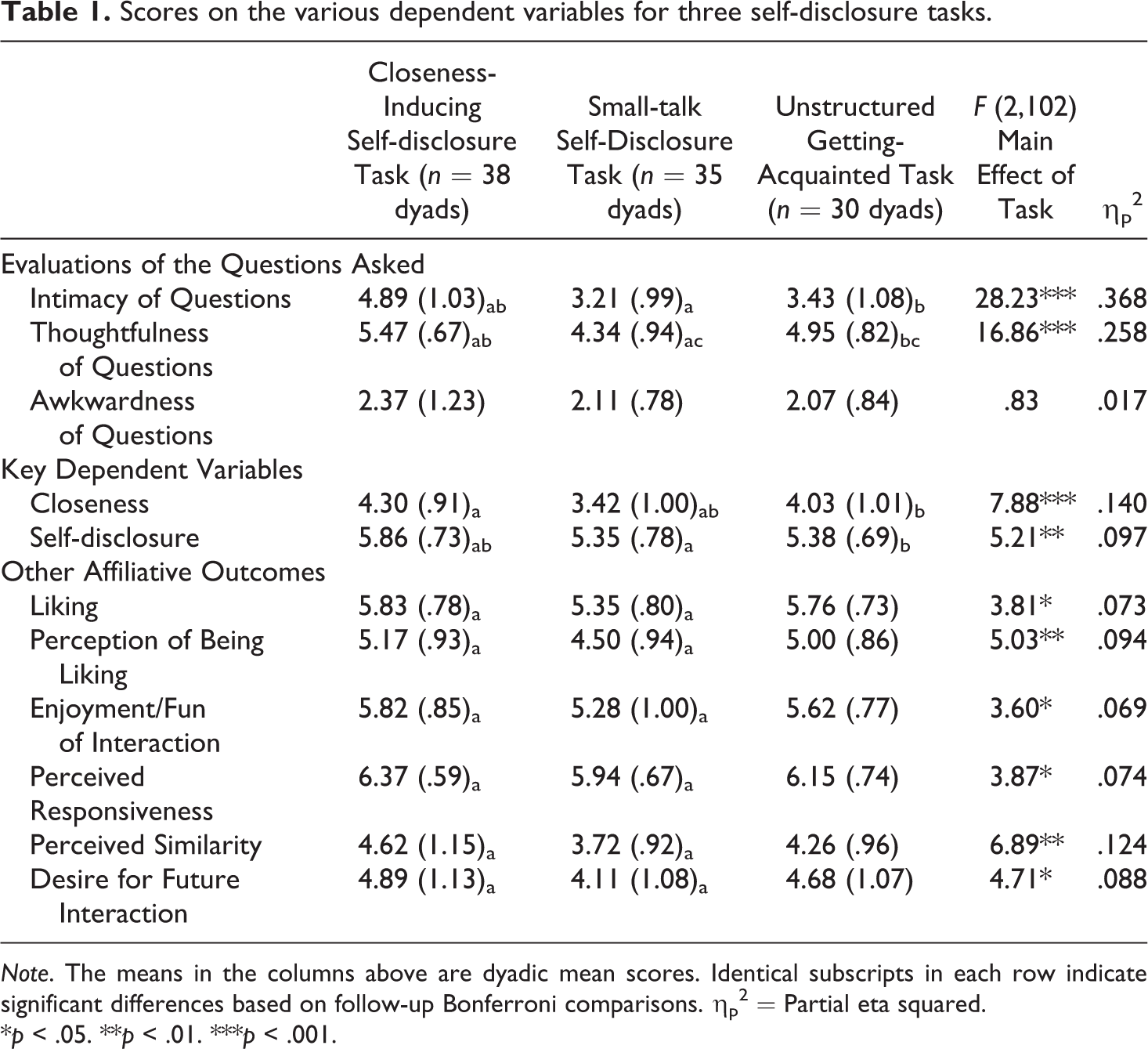
Note. The means in the columns above are dyadic mean scores. Identical subscripts in each row indicate significant differences based on follow-up Bonferroni comparisons. ηp 2 = Partial eta squared.
*p < .05. **p < .01. ***p < .001.
Closeness task versus small-talk task
The first two columns of Table 1 present the means for the dependent variables for the dyads who engaged in the closeness-inducing task and the dyads who engaged in the small-talk task, respectively. Below, I discuss the differences that were found based on Bonferroni pairwise comparisons of these two groups.
Quality of the questions asked
First, the two conditions were compared on the perceived quality of the questions asked, which represents a type of manipulation check. The dyads who engaged in the closeness task perceived that the questions in their task were more intimate as well as more thoughtful than did the dyads who engaged in the small-talk task. However, no differences were found between the two conditions on how awkward the conversation was perceived to be.
Key dependent variables: Closeness and self-disclosure
Next, the dyads in the two conditions were compared on closeness and self-disclosure, which are the key dependent variables that should theoretically distinguish them (Aron et al., 1997). The results indicated that the dyads in the closeness-inducing task condition reported greater closeness and perceived more (and deeper) self-disclosure in the interaction than did the dyads in the small-talk condition. These findings support H1 and H2, respectively.
Other affiliative outcomes
RQ1 asked whether there would be differences between the two conditions in other affiliative outcomes, which would suggest that engaging in the closeness-inducing task would not only enhance closeness, but would also have downstream effects on other evaluations that are important for relationship development. A significant difference between the two conditions (dyads in the closeness-inducing task scoring higher) was found for each of the other affiliative outcomes: liking, perception of being liked, enjoyment/fun in the interaction, perceived responsiveness of the interaction partner, perceived similarity, and desire for future interaction.
Closeness task versus unstructured getting-acquainted task
Next, the dyads who engaged in the closeness-inducing task were compared with the dyads who engaged in the unstructured self-disclosure, in order to determine whether the closeness task was more effective (in generating positive outcomes) than a more natural get-acquainted (unstructured) communication. This is a comparison of the means in columns 1 and 3 in Table 1. Dyads in the closeness condition rated their questions to be significantly more intimate and more thoughtful than did the dyads in the unstructured self-disclosure condition. Dyads in the closeness task condition also reported significantly more self-disclosure than the dyads who engaged in unstructured self-disclosure (H4). Interestingly, however, the comparisons between these two self-disclosure tasks did not yield significant differences for closeness or any other affiliative outcomes (H3 & RQ2). For each of the other affiliative outcomes, the mean was higher for the dyads in the closeness task than for dyads in the unstructured task, but the differences were not significant.
Although of less interest, I also considered the Bonferonni pairwise comparisons between dyads engaged in the small-talk task versus dyads engaged in the unstructured getting-acquainted task. Dyads in the small-talk task condition had lower scores than dyads in the unstructured task condition on thoughtfulness of the questions asked and the closeness generated. No other significant differences were found between the two conditions.
Discussion
Although structured self-disclosure tasks with topics that become increasingly intimate (e.g., Aron et al., 1997; Sedikides et al., 1999) have been used in many research studies, there has been a lack of research that has tested the validity of a structured self-disclosure procedure for generating closeness and other positive feelings in initial interaction relative to other activities. The purpose of this study was to compare closeness (the primary affiliative outcome the closeness task was designed to generate; Aron et al., 1997) as well as other affiliative outcomes (e.g., liking, perceived responsiveness) as a function of the task (Fast Friends, small-talk, or unstructured) in combination with mode of communication (face-to-face vs. video-CMC).
The findings of this study demonstrated that Aron et al.’s (1997) closeness-generating task (with its intimate questions) generated more closeness, as well as more liking and other positive reactions (fun and enjoyment, perceived responsiveness of the partner), than did the small-talk task. These findings are consistent with and extend the original findings from Aron et al. (1997). In addition, the closeness-inducing task was perceived to have more intimate and thoughtful questions than the small-talk task and generated deeper self-disclosure, further supporting the validity of the Fast Friends procedure.
The unstructured, free-format getting-acquainted task (requesting dyads to “become acquainted in a natural way”) generated almost as much closeness and other affiliative outcomes as did the structured, intimate task. Although there was a pattern for the scores on closeness, liking, and other affiliative outcomes to be higher for participants in the closeness-inducing task than for participants in the unstructured self-disclosure task, these differences were not significant as indicated by pairwise comparisons of the two conditions. Still, the two tasks were perceived differently in the intimacy and thoughtfulness of the disclosure topics (higher in the closeness task). In addition, the participants in the closeness-generating task perceived that more disclosure had occurred than the participants in the unstructured getting-acquainted task.
In addition to the manipulation of self-disclosure task, this study also had the manipulation of mode of communication (Skype-video vs. face-to-face). Several recent studies have shown that visual forms of CMC (e.g., Skype) can result in positive outcomes comparable to interaction in FtF (Croes et al., 2016; Sprecher, 2014), and thus it is not surprising that no differences were found in affiliative outcomes as a function of mode of communication. Guided by Patterson’s (1990) theory of how people balance the intimacy of different channels of communication, a research question had been posed of whether mode of communication would moderate the influence of the closeness task (relative to the other tasks) on closeness and other affiliative outcomes. However, no evidence was found for this speculation.
Implications of the results
The finding that the closeness-generating task created positive affiliative outcomes to a significantly greater degree than engaging in an alternative structured activity (the small-talk task with less personal topics) and the finding that it generated more and deeper self-disclosure (even if not significantly more liking, closeness, and other affiliative outcomes) than an unstructured activity indicates that a structured closeness task is useful for the purpose it was intended. It provides a method to create closeness in a laboratory setting to test theoretical predictions about early stages of relationships. The closeness task also provides a mechanism for manipulating factors such as the particular pairings and the circumstances under which the interaction occurs (e.g., mode of communication). The advantage of this method relative to an unstructured getting-acquainted task—even if no differences were found in this study in the level of closeness generated—is that the experience itself (topics asked) are consistent across conditions, thus reducing variation that could be confounded with other aspects of the design. For example, certain individuals, certain pairings of individuals, or certain contextual factors that are manipulated (e.g., mode of communication) could lead to variation in topics discussed or the number of questions asked (Antheunis et al., 2007), which would make the interpretation of a manipulated variable to be ambiguous if these confounding factors are also associated with the outcome variables. Furthermore, if the researcher’s goal is to create two conditions in a study that vary in the closeness generated, the combination of the closeness task and the small-talk task is effective for this purpose, as validated in this study. Of course, the non-close condition could be other types of activities. Some researchers have randomly assigned dyads to either the Fast Friends procedure or another type of low self-disclosure task such as having the dyad members give each other directions to places around campus (Ketay & Beck, 2017; Ketay et al., 2017). The current study has provided evidence that an unstructured getting-acquainted task (focused on free-format interaction) should not be used as the non-close condition, as it may generate almost as much closeness as the closeness-generating task.
There is another important implication of the findings from this study at the time this paper was being finalized. The world was facing COVID-19 and people were socially distancing. People were interacting with others through communication technologies such as Skype and Zoom, at an accelerating rate. The results of this study suggest that Skype, Zoom, or another synchronous visual technology can be as effective for developing initial closeness and other affiliative outcomes as would a face-to-face interaction. Thus, individuals can be confident that when they meet someone online and have their first getting-acquainted meeting virtually rather than face-to-face in a café or bar, they may be just as likely to develop closeness, liking, and other affiliative outcomes.
Strengths, weaknesses, and future directions
This was a unique experimental study that included a comparison of three self-disclosure tasks crossed with two modes of communication, under a carefully controlled laboratory study. The experimental control, along with two manipulated variables, was a strength of the study. As is true of any study, however, there are also limitations and thus contributions that can be made in future research. One limitation in regard to having a perfect validity test for Aron et al.’s (1997) closeness-inducing procedure is that this study had the task last 24 minutes rather than the 45 minutes done in the original study. Although many other recent studies have also used a briefer time period for the closeness-inducing task (e.g., Boothby et al., 2016; Lundy & Drouin, 2016; Sprecher et al., 2013), a similarly executed study to this one but with the participants engaged in a full 45 minutes, or even with extended interactions over multiple days, may yield more distinctions among the outcomes of the self-disclosure tasks. For example, the differences between the outcomes of the closeness task and the unstructured task may become greater with more interaction time. The dyads in the closeness task may ask even more of the intimate topics and the dyads in the unstructured task may run out of topics to discuss. It is unknown in this study how many topics in the structured self-disclosure tasks that the participants actually discussed, and how this number compared to what occurred in the unstructured discussion. Second, the dyads in the unstructured task were given guidance through a tip sheet of general topics that may be discussed when becoming acquainted. It is unclear how much they looked at it or used it, 1 but the tip sheet is not given in natural interactions.
The sample consisted of 103 dyads, which is a relatively large sample for social interaction studies conducted in a laboratory setting that require two participants and two experimenters. However, an even larger sample size would have resulted in greater statistical power, and thus further replications are encouraged. In addition, a majority of the dyads consisted of two women. A greater distinction in the positive outcomes generated from the use of a closeness-generating task versus an unstructured format may be found especially in pairs who are considering each other for a romantic relationship. In addition, although no differences were found in this study between those who communicated over Skype and those who communicated face-to-face, such differences may be found in pairs who are considering each other for a romantic relationship.
This study also did not consider potential effects of individual differences. The Fast Friends procedure may be especially effective for breaking the ice and generating positive feelings relative to unstructured communication for groups who are more socially anxious or have difficulty knowing how to start a conversation. This can be a topic for future research.
Conclusion
COVID-19 may have permanently changed interaction, even once the pandemic is under control. Many people are and will likely continue to engage in visual-CMC interaction as part of the getting-acquainted process. Getting-acquainted dyads may also obtain a structured self-disclosure task, such as Aron et al.’s (1997) 36 questions (featured in a New York Times article), from the Internet to facilitate the getting-acquainted process. This study demonstrated that closeness and other affiliative outcomes generated depends on the task, particularly when the comparison is between the closeness-generating task and the small-talk task, but does not depend on the mode of communication (when the comparison is FtF vs. video-CMC). For researchers interested in testing theoretical issues about the development of relationships, this study provided additional evidence for the validity of the closeness procedure for generating a minimal relationship in a laboratory setting.
Supplemental material
Supplemental Material, sj-docx-1-spr-10.1177_0265407521996055 - Closeness and other affiliative outcomes generated from the Fast Friends procedure: A comparison with a small-talk task and unstructured self-disclosure and the moderating role of mode of communication
Supplemental Material, sj-docx-1-spr-10.1177_0265407521996055 for Closeness and other affiliative outcomes generated from the Fast Friends procedure: A comparison with a small-talk task and unstructured self-disclosure and the moderating role of mode of communication by Susan Sprecher in Journal of Social and Personal Relationships
Footnotes
Acknowledgment
The author would like to thank all of the following students who worked in her research lab during one or more semesters of the data collection period: Maia Cain (lab co-director), Dani Creasey, Sergei Deptula (lab co-director), Joshua Espinoza, Samantha Gray (lab co-director), Hailie Halverson, Taylor Karey, Morgan Margiotta, Christian Maynard, Mary Mulligan (lab co-director) Laine Perry (lab co-director), Rachel Sands, Alexis Swanson (lab co-director), Angela Yonan (lab co-director).
Funding
The author(s) received no financial support for the research, authorship, and/or publication of this article.

Open research statement
As part of IARR’s encouragement of open research practices, the author has provided the following information: This research was not pre-registered. The data used in the research are available. The data can be obtained by emailing the author at
Supplemental material
Supplemental material for this article is available online.
Note
References
Supplementary Material
Please find the following supplemental material available below.
For Open Access articles published under a Creative Commons License, all supplemental material carries the same license as the article it is associated with.
For non-Open Access articles published, all supplemental material carries a non-exclusive license, and permission requests for re-use of supplemental material or any part of supplemental material shall be sent directly to the copyright owner as specified in the copyright notice associated with the article.
