







Abstract
Background:
Young adults’ connectedness with and independence from parents have important implications for both their development and family relationships. Although technology plays an increasingly important role in these dynamics, there are few direct observations of how connectedness and independence unfold in the digital world. Little is known of between- and within-person differences in these dynamics.
Purpose:
This study uses Screenomics to directly observe smartphone interactions between young adults and their parents, and discover whether and how dimensions of connectedness and independence manifest in these interactions at multiple timescales.
Research Design, Study Sample, and Data Collection:
Screenshot sequences were collected from 10 ethnically diverse young adult (50% female) participants’ smartphones every 5 seconds for up to 1 month (total of 457,905 screenshots). We identified 1413 interaction instances between young adults and their parents (including 359 calls, 1032 messages, and 10 other communication instances).
Analysis and Results
Digital ethnographic analysis of screenshots revealed multiple themes related to connectedness (emotional support, logistical and financial support, consistent communication) and independence (parent fostering independence, parent intrusiveness/overinvolvement, and young adults’ psychological separation). Quantitative descriptions at different timescales (week, day, hour, moment) revealed within-person and between-person differences in active engagement, reciprocal communication, consistent communication, parent intrusiveness, young adults’ reliance on parents’ support, and young adults’ psychological separation.
Conclusion:
Findings highlight the need to examine family digital interactions at multiple timescales and the utility of temporally dense and comprehensive Screenomics data in studying social relations.
Keywords
Introduction
In the modern world, digital devices are ubiquitous and pervasive, impacting family interactions (Dworkin et al., 2019; Sun & McMillan, 2018). Smartphones, in particular, offer family members opportunities to stay in perpetual contact with one another and to readily check in through digital communication. For adolescents and young adults, these activities may facilitate autonomy and independence (“letting go”) while simultaneously offering more opportunities for both connectedness and intrusiveness (Ehrenreich et al., 2020; Ling, 2004; Miller-Ott et al., 2014; Ribak, 2009; Yang, 2018). Although extant literature has discussed the role of mobile phones in young adults’ connectedness with and independence from parents (Miller-Ott et al., 2014; Yang, 2018), the focus has been predominantly on young adults’ subjective ratings of digital interactions and the associations with relationship quality and well-being. There is a lack of objective observations of these interactions and examinations of how the connectedness-independence dynamics unfold over time in the digital world. In line with calls for more detailed phenomenological descriptions that might support theory development and hypothesis formulation (Munger et al., 2021), this study supplies theory-driven, qualitative and quantitative descriptions of objectively observed smartphone interactions that can further the understanding of parent-young adult’s digital interactions. We used a newly available data collection paradigm, Screenomics (Reeves et al., 2020; 2021), to capture and study parent-young adult smartphone interactions that manifest specific dimensions of connectedness and independence at different timescales—across moments, days, and weeks.
Connectedness-Independence and young adults’ digital interactions with parents
During young adulthood, individuals are expected to establish independence and autonomy, while at the same time they need to receive support and stay connected with parents (Arnett, 2000; Fingerman, 2017). Healthy independence from parents provides a sense of agency, self-reliance, and self-determination apart from parents; while connectedness with parents provides access to support, reciprocal communication, active engagement and emotional closeness (Inguglia et al., 2015; Lamborn & Groh, 2009). Both independence and connectedness are important to young adults’ identity development and well-being (Fingerman et al., 2012; Kenyon & Koerner, 2007; Koepke & Denissen, 2012).
Digital technology plays an increasingly important role in family life, including in the connectedness-independence dynamics between parents and young adults (Hessel & Dworkin, 2018). Digital devices are helping young adults maintain connection and closeness with their parents even when they are physically away from home (Miller-Ott et al., 2014; Yang, 2018). Meanwhile, there have been discussions about whether digital interactions with parents facilitate or hinder youth’s development towards independence. On one hand, studies on texting and social media interactions suggest that the constant and immediate access granted by the digital platforms may make parents feel more comfortable and less anxious about “letting go” and granting their children independence (Ehrenreich et al., 2020; Yang, 2018). On the other hand, the mobile phone is perceived as an “umbilical cord” that allows parents to exert remote control over their children (Ling, 2004; Ribak, 2009). The constant access of digital platforms makes it easier than ever for parents to be overinvolved and intrusive in their young adult child’s life (Yang, 2018), and for youth to rely upon their parents (Ehrenreich et al., 2020). The control, overinvolvement and intrusiveness, along with a psychological reliance on parents, may hinder young adults’ development towards independence (Kins et al., 2009; Lamborn & Groh, 2009). Following these concerns, our study used direct observations of parent-young adult smartphone interactions to describe the interaction patterns tied to the connectedness-independence dynamics that extant literature suggests are being significantly impacted by digital technology.
Measuring family digital interactions
Despite the important role of digital technology in parent-young adult interactions, we still know very little about how these dynamics actually unfold in the digital world. One major aspect limiting our understanding of family digital interactions is the predominant reliance on self-reports, instead of actual observations of family communication. Example items for the measures used in previous studies include in the past week, the total time in hours that youth and parents spent interacting with each other online or over the phone (Vaterlaus et al., 2019), and how many text messages youth exchanged with parents each day (Manago et al., 2019). Despite the contributions of these measures to an understanding about family digital interactions, emerging research has shown that retrospective self-reports provide inaccurate representations of actual digital activities (Parry et al., 2021). In addition, the self-report measures are mostly geared towards assessment of general amounts of digital interaction (e.g., from “never” to “more than once a day”) and are usually only obtained once (Coyne et al., 2014; Padilla-Walker et al., 2012). Thus, little is known about whether and how parent-youth digital interactions manifest at any given timescale and how they change over time. Stepping into this gap, this study used digital data—specifically, intensive longitudinal screenome data collected from young adults’ smartphones—to obtain more accurate and temporal descriptions of family digital interactions over time.
Parent-youth interactions observed through digital data
The few studies that have collected data from family members’ digital devices used a variety of data sources (e.g., messages, calls, social media interactions) in examining how family interactions manifest in the digital context. For example, The BlackBerry project collected text messages from adolescents’ mobile phones from Grades 9 through 12 (Ehrenreich et al., 2020). Aggregating 4 days of text messages, they found that text messages exchanged with parents were between 3.16% and 6.45% of total messages. Another study of 2 weeks of college students’ texts revealed that young adults exchanged, on average, 87.8 and 28.4 texts with their mothers and fathers, respectively (Hussong et al., 2021). Data on family digital interactions have also come from social media. Analysis of 400,000 posts and comments drawn from Facebook over 3 months revealed both the volume and content of parent-child communication on Facebook, including age-related differences and differences across interactions between mothers versus fathers with daughters versus sons (Burke et al., 2013).
All together, these studies demonstrate that parent-youth interactions do extend into the digital world, can be observed, and exhibit both between- and within-person differences in how often they occur.
The importance of timescale
Pushing further, we leveraged new digital data that open potential for describing how parent-youth interactions manifest and change over time. Lifespan developmental theories highlight that biopsychosocial development manifests at multiple levels of analysis (cells to society) and at different timescales (milliseconds to millenia) (Baltes, 1987; Nesselroade, 1991). In a similar fashion, family systems are dynamic systems wherein processes, interactions, and changes occur on multiple timescales (Cox & Paley, 1997; Minuchin, 1985). Understanding of these systems requires capturing and examining behaviors and interactions that manifest at both faster and slower timescales (Ram et al., 2014; Ram & Gerstorf, 2009).
Reflecting the multi-timescale nature of lifespan development and family systems processes, research on family digital interactions has measured and examined dynamics at a variety of timescales. Some studies have measured frequency, duration and/or intensity of parent-youth digital interactions in the past day (Manago et al., 2019), some have examined the past week (Vaterlaus et al., 2019), and some the past month (Rudi & Dworkin, 2018). Qualitative studies on parent-youth digital interactions also have interviewed participants with specific, pre-determined time windows. Examples include cell phone communication with parents that occurred within the previous 24 hours (Fletcher et al., 2018) and Facebook interactions with parents during 2 weeks (Yang, 2018). Although these studies have rarely focused on changes over time, the variety of time windows being invoked suggests that family digital interactions unfold at multiple timescales.
Research on parent-young adult interactions in general settings beyond the digital world also suggests that interactions, including those related to connectedness and independence, unfold at multiple timescales. Researchers examining college students’ daily involvement and conflict with parents found relations between these interactions and within-person, day-to-day variability in positive and negative affect (Rogers et al., 2018). Others have found that profiles indicating high-connectedness and high-separateness from parents over a 3-month time window were particularly beneficial to college students’ adjustment (Kenyon & Koerner, 2007). Nevertheless, we were unable to find studies that investigate parent-young adult dynamics across multiple timescales simultaneously. As a start in this direction, we used newly available screenome data to describe how parent-young adult smartphone interactions unfold at multiple timescales and how interaction patterns observed across those different timescales contribute to the connectedness-independence dynamics.
Using Screenomics to study family digital interactions across timescales
In this study using Screenomics, screenshots were passively and unobtrusively collected from participants’ smartphones every 5 seconds, under a rigorous privacy-protection and human subjects committee approved protocol, to provide a record of all the experiences individuals engage on their smartphone in situ (Reeves et al., 2021). We used this approach to observe and study all the smartphone interactions that a sample of young adults had with their families. The data facilitate both qualitative, digital ethnographic analysis (boyd, 2014) and quantitative descriptions of parent-young adult interactions.
A growing body of research is using Screenomics to examine digital activities. Ethnographic and quantitative analysis of screenome data obtained from four low-income, Mexican American teenagers highlighted the extent of variability across persons, days, hours, and minutes in teenagers’ screen activities, and, in a domain-specific analysis, how and when food-related content appeared on teenagers’ smartphone screens (Ram et al., 2020). Analysis of screenome data from 132 individuals (age 18–50 years) similarly highlighted the extent of between- and within-person differences in temporal, textual, and graphical dimensions of individuals’ digital behavior at multiple timescales – minutes, hours, days – and in how and when specific types of content (nutrition, public affairs, and purchasing) were engaged (Brinberg et al., 2021). These studies have highlighted the utility of the Screenomics approach for describing differences and changes in digital behaviors that manifest at multiple timescales.
The present study
Our study used Screenomics to study smartphone interactions between young adults and their parents, specifically to describe dynamics surrounding connectedness and independence in the digital context. Our descriptions and analysis were based on the extant literature that specifies multiple dimensions of connectedness and independence between young adults and parents (Inguglia et al., 2015; Lamborn & Groh, 2009). Specifically, we expected to observe digital interactions that capture emotional closeness, support, reciprocal communication, and active engagement for manifesting connectedness. For independence, we expected to observe interactions that may impact young adults’ sense of agency and self-reliance, such as parental intrusiveness/overinvolvement, young adults’ reliance on parents, parent fostering independence, and young adults’ psychological separation from parents.
We first made ethnographic observations with the screenome content involving parent-young adult interactions, looking for the dimensions of connectedness and independence outlined in the literature. We then developed quantitative summaries of the intensive longitudinal data to describe patterns indicating connectedness and independence on multiple timescales; across weeks (i.e., up to about a month), and on the daily, hourly, and moment-to-moment bases. Grounded in life developmental perspectives (Baltes, 1987; Nesselroade, 1991), family systems perspectives (Cox & Paley, 1997; Minuchin, 1985), and prior literature theoretically highlighting both between- and within-person differences on multiple timescales for individual behaviors and family dynamics (Ram et al., 2014; Ram & Gerstorf, 2009), we expected that the parent-young adult connectedness-independence dynamics vary both within-person and between-person on each timescale.
Method
Sample
Demographics and Summary of Screenome Information for Participating Young Adults (YA; N = 10).
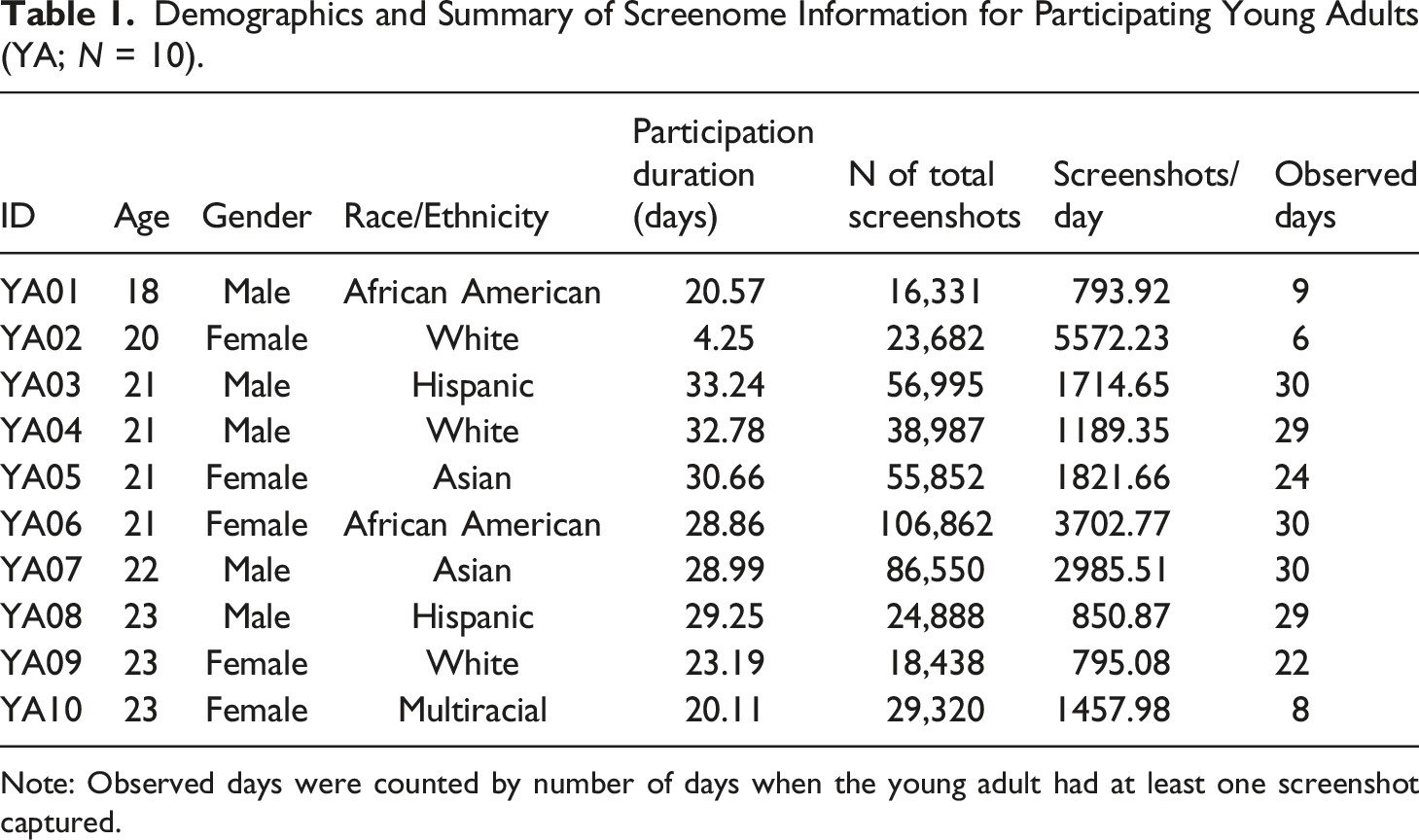
Note: Observed days were counted by number of days when the young adult had at least one screenshot captured.
Procedure
Screenshots of the full content, including all text and all images, that appeared on participants’ smartphone screens, along with the timestamp of each screenshot, were captured every 5 seconds for between 4.25 to 33.24 days. The screenshots were encrypted and securely transferred, stored, and analyzed. Stanford University’s Institutional Review Board approved all procedures (protocol number: 38485).
Data collection
For the larger study, participants were screened and recruited via focus groups organized by a commercial consumer research panel provider. Focus group participants who expressed interest in the study were provided information about the study goals. Those who agreed to participate provided informed consent for participation and installed the Screenomics mobile application. Once installed, the app began capturing and uploading screenshots every 5 seconds when the smartphone was in use, and encrypted and securely transmitted those data to a research database at Stanford University. Participants were asked to use their smartphones normally during the study period. Participants were compensated with gift cards, with $100 for focus group participation, $200 for successfully uploading data for 10 days, and $300 for a month of participation. When finishing participation, the participants were thanked and instructed to uninstall the study mobile application from their smartphones. Participants were able to withdraw from participation and/or request that their data be deleted at any time.
Data preparation
Parents’ Media Identities and Summary of Family Interaction Instances for Participating Young Adults (YA).
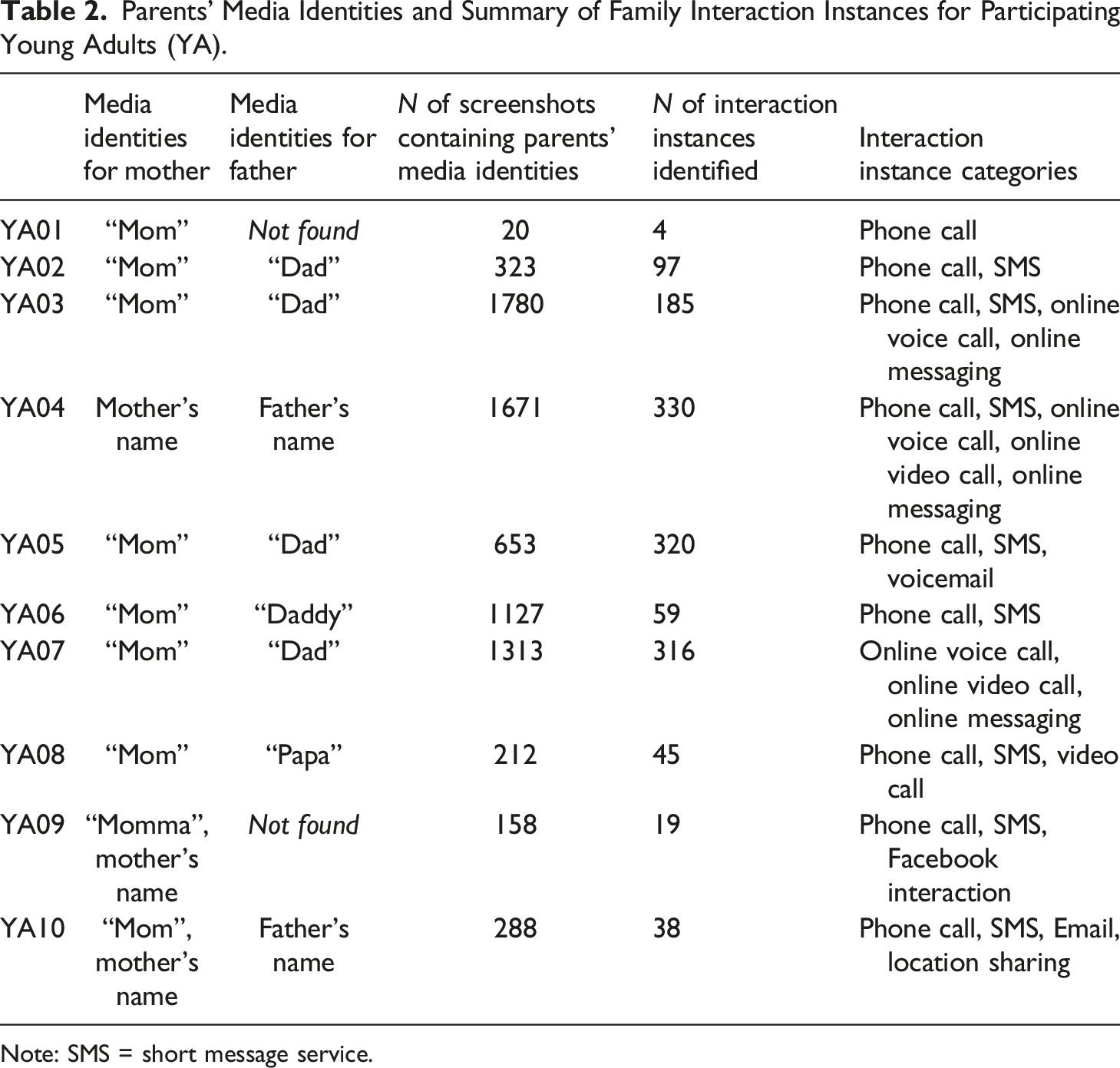
Note: SMS = short message service.
Measures
During the data preparation process, we also identified four basic features for each smartphone interaction instance to be coded—platform, time, interaction partner, and direction of communication.
Platform
Each interaction instance was coded as occurring on a specific kind of platform (9 mutually exclusive categories). Calls, messages, and voicemails made and sent using system core or basic apps for phone calls or texting were coded as phone calls, SMS, and voicemails, respectively. Voice and video calls and messages that occurred through other apps (e.g., WhatsApp, Talkatone) were coded as online voice and video calls and online messaging. Other specific platforms included Facebook, emails, and location sharing.
Time
Each instance was coded with onset time and span, based on the timestamp (year, month, day, hour, minute, and second) of the involved screenshots and any additional time information that appeared on the screen. When an incoming call or message activated the screen with a real-time notification, or when the young adult initiated a call or sent a message, the timestamp of the screenshot that first shows this activity was treated as the onset time of this instance. For instances not appearing on a screenshot at the time when they occurred, we used the timestamp shown on the screen combined with the screenshot timestamps to determine the onset time of the instance.
The span of each interaction instance described its duration. For connected phone and online calls, we coded the span with the duration of the call that was shown on the screenshot captured when the call ended, or, in cases where this information was unavailable, with the time elapsed between the screenshot when the call was started and ended. For all other instances, including missed calls, we coded the span as 5 seconds, the temporal precision at which screenshots were collected.
Interaction partner
Interaction partner for each instance was coded as either “Mom”, “Dad”, or “Family group” based on the specifics of screen content, including the media identities of mother and father, and, in the case of family group interactions, with the chat group in which both the mother and the father were involved.
Direction of communication
Each instance was coded to show whether the young adult sent or received the interaction to or from the parent. We coded the instance as sent to the parent when the young adult initiated a phone call or sent the information to the parent through platforms of messaging, emails, Facebook, and location sharing. In contrast, when it was the parent who initiated the call or sent the information, we coded the instance as received from the parent.
Data analysis
We examined the coded smartphone interaction instances between each young adult and their parents to capture dimensions of connectedness and independence in two sets of analysis. First, we conducted digital ethnographic analysis (boyd, 2014) to examine details of the digital interactions, identify themes related to connectedness and independence that manifested in the interactions, and obtain exemplars of those themes. Second, leveraging what we learned in the qualitative analysis, we developed quantitative descriptions of the interaction instances at four temporal resolutions: the entire participation duration (weeks), days, hours, and moments. Following methods used in prior Screenomics research (Brinberg et al., 2021; Ram et al., 2020), we developed informative data visualizations for each timescale to: describe the digital interaction patterns that manifest specific dimensions of connectedness and independence; illustrate and examine the within- and between-person differences in those manifestations; and suggest how the young adults could be grouped into different clusters based on these differences.
Results
Connectedness and independence themes
Exemplar sequences of the three connectedness themes identified in the digital ethnographic analysis of parent-young adult smartphone interaction instances are shown in Figure 1: emotional support, logistical and financial support, and consistent communication. First, there were instances where young adults were seeking emotional support from their parents. YA02, on Day 2 at 00:14-00:26, had a message-based conversation with Dad to complain about another person who was unpleasant. YA03, on Day 2 at 15:18-15:23, sent Mom three calls (all missed) and three messages to ask for a conversation about his bad dream. Parents were also providing emotional support, including YA02’s Dad who solicited the conversation and expressed his understanding about YA02’s complaints, and YA09’s Mom, who, on Day 23 at 13:37, sent a text message to check in and express love. Second, young adults were also seeking logistical and financial support from parents. YA04, on Day 25 at 20:39-20:55, sent six online messages and one phone call to Dad, asking about whether some objects were fixable, and received Dad’s return call at 21:28. YA08, on Day 20 at 16:06-16:11, had a short message-based conversation with Mom asking for money. YA10, on Day 21 at 14:50-19:48, had email exchanges with Mom where Mom was booking a flight for her. Third, although not a dimension specified in the connectedness-independence literature, an additional theme emerged that could indicate connectedness, that is, consistent communication, given that consistency has been suggested as an important dimension in parent-youth relationships (Sun et al., 2017). As an example, YA07 was having consistent communication with Mom: from Day 1 to Day 9, Mom sent online messages to YA07 almost every late afternoon or early evening to check in with him for whether he had dinner and what he was doing. Examples of screenome-based digital ethnographic observations of parent-young adult (YA) smartphone interactions about connectedness. Each column includes examplar sequence(s) for each of the three themes: emotional support, logistical and financial support, and consistent communication.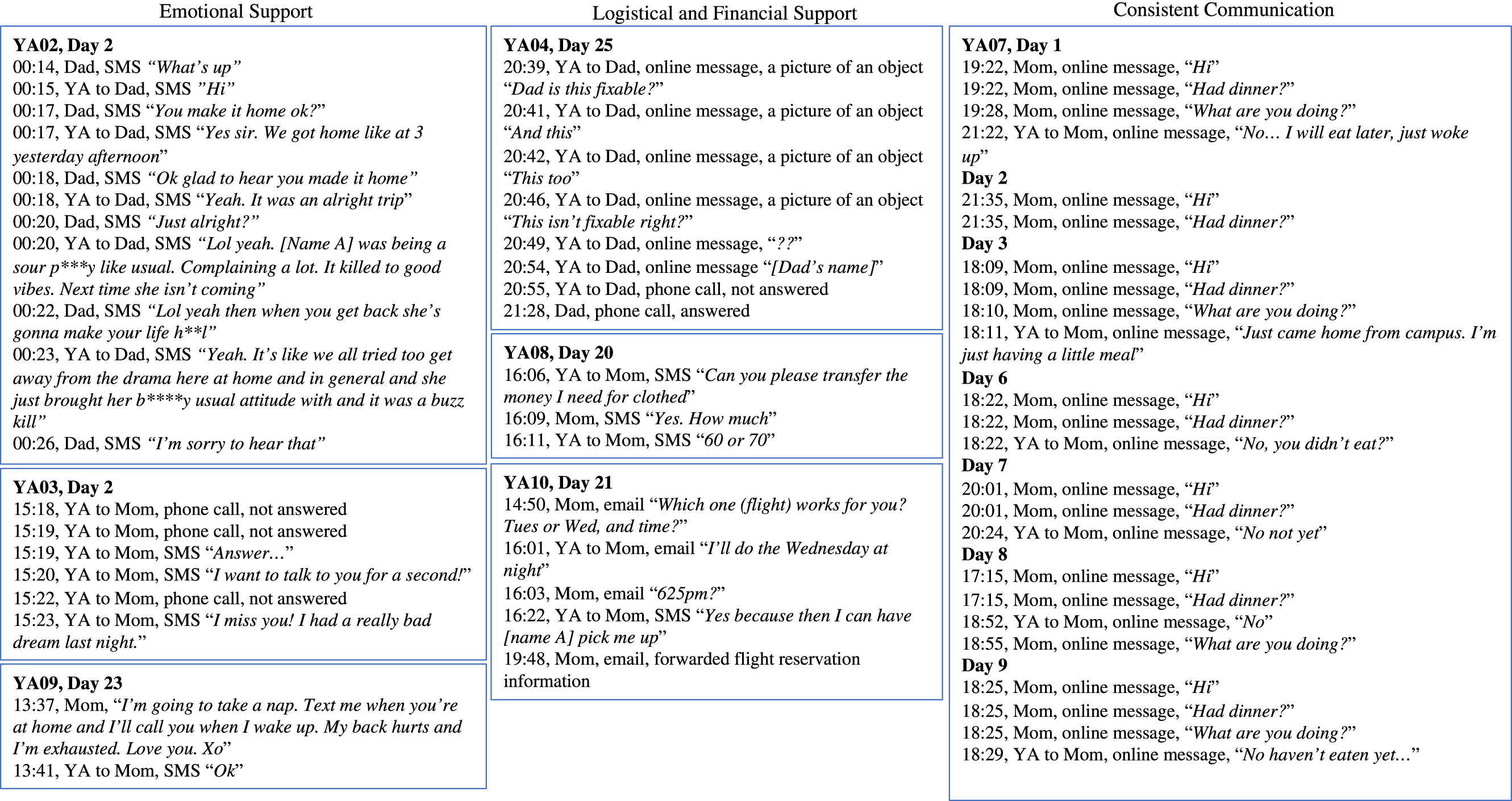
Exemplar sequences of the three independence themes identified in our digital ethnographic analysis are shown in Figure 2: parent fostering independence, parent intrusiveness/overinvolvement, and young adults’ psychological separation from parents. First, there were instances where parents were fostering young adults’ independence. YA02’s Mom, on Day 2 at 17:07, sent three messages to YA02 about her living arrangements independent from the grandmother and finding a job. YA03’s Mom, on Day 2 at 21:43, sent YA03 a message about finding a stable job and paying rent. YA08 on Day 24, shortly after having a phone call at 15:54 that lasted 23 minutes and 46 seconds with Mom, received a message from Mom at 16:45 to ask him to take charge of his own life and be responsible for his own choices. Second, there were cases where parents were intrusive or overinvolved. For example, on Day 3 from 21:17 to 23:07, YA05’s Mom sent YA05 bursts of messages to ask whereabouts of YA05, with YA05’s few responses. This series of dynamics—which sometimes also include calls—was common across nights from YA05’s Mom. Third, we also observed cases for young adults’ psychological separation from parents where young adults dismissed interactions initiated by their parents while they were using smartphones for gaming, video watching, or texting friends. These cases could indicate a way that they prioritized their agency in entertainments or other social interactions over connections with parents. YA01 on Day 4, received a call from Mom at 17:36 while he was playing a game on this phone; he did not answer the call and continued to play the game. YA05 received calls from Mom on Day 12, Day 22, and Day 26 at night while she was texting a friend or watching a YouTube video; she dismissed the calls and continued to text the friend or watch the video. Examples of screenome-based digital ethnographic observations of parent-young adult (YA) smartphone interactions about independence. Each column includes examplar sequence(s) for each of the three themes: parent fostering independence, parent intrusiveness/overinvolvement, and young adults’ psychological separation from parents.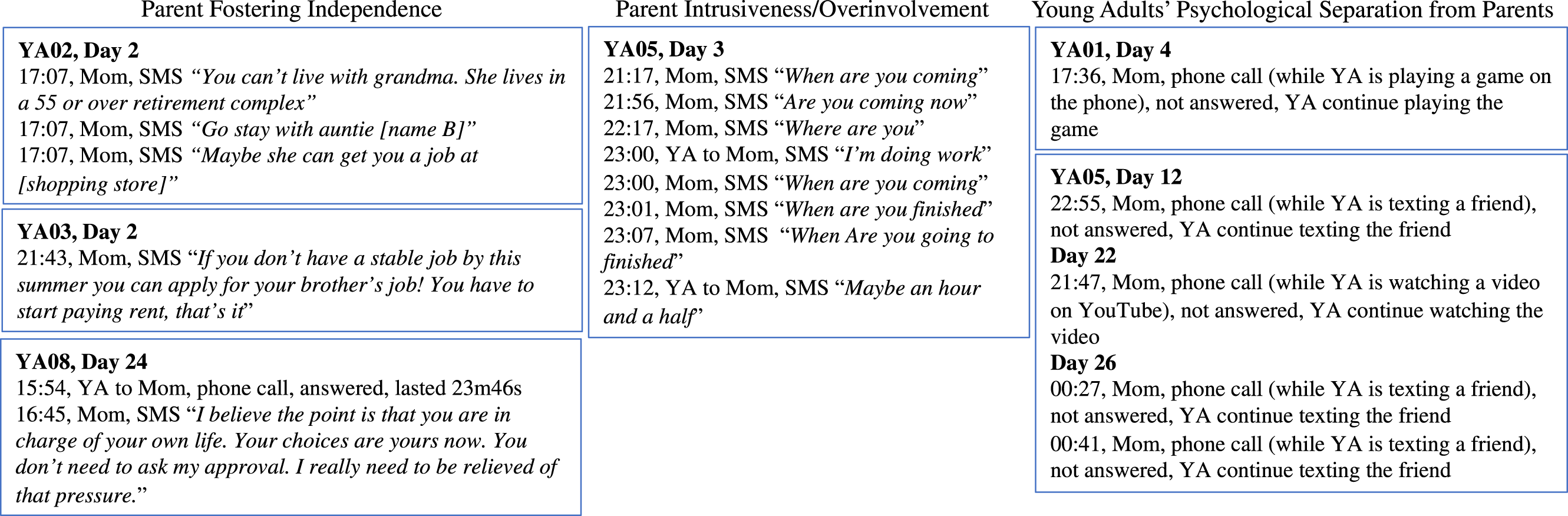
Together, these examples detail six specific thematic sequences in which both connectedness and independence unfold between young adults and parents through smartphone interactions. These observations informed the subsequent quantitative analysis that summarized patterns tied to specific dimensions of connectedness and independence. In addition, in qualitative analysis we were unable to find obvious examples for the literature-specified reciprocal communication and active engagement dimensions for connectedness, and for the young adults’ reliance on parents dimension for independence. We continued to seek patterns for these dimensions in the subsequent quantitative descriptions.
Parent-young adult digital interactions across up to a month
Our quantitative descriptions of parent-young adult digital interactions begin at the longest timescale available – all weeks of participation (i.e., up to approximately 1 month). This timescale constitutes the lowest temporal resolution examined in this study but is the closest to the timescale most prior studies of family digital interactions (implicitly) adopted, especially those that were cross-sectional. The histogram in the upper panel of Figure 3 shows the weekly frequency of parent-young adult digital interactions that were engaged during up to a month of observations by each participant. Between-person differences in this measure of the active engagement dimension of connectedness are readily apparent in the differential heights of the green bars. As shown by order in this plot, YA02, YA05, YA04, YA07, YA03, YA10, YA06, YA08, YA09, and YA01 had from the highest to the lowest levels of overall engagement with parents. Long timescale (weeks). The histogram plot in the upper panel shows the averaged weekly frequency (green bar) of each young adult’s (YA) smartphone interactions with parents across their entire participation. In the lower panel, each mosaic plot shows the young adult’s relative frequency of interactions across the entire participation with Mom (left) and Dad (right), and sent/initiated to Mom/Dad (top) and received from Mom/Dad (bottom). The block is replaced with a line with a small colored circle when no interaction occurred for that combination. Mosaic plots are grouped into five clusters of connectedness/independence profiles; each cluster indicated as separate bold outline box marked with the label.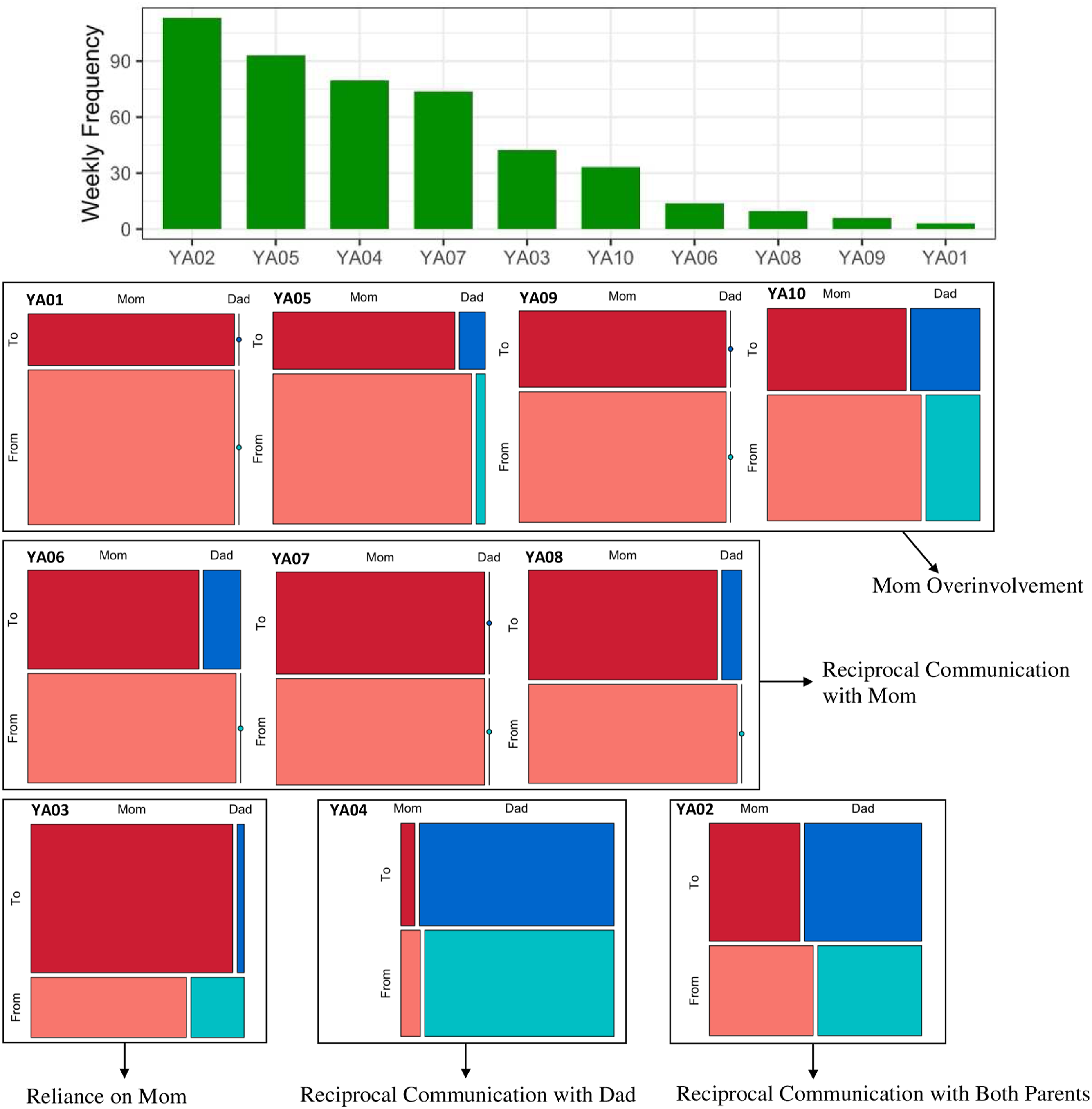
The mosaic plots in the bottom panel of Figure 3 show relative frequency of interactions sent to and received from mothers and fathers. This combination manifests within-person differences on this timescale, in that within each young adult, they tended to experience more or less differences in the frequency of sent/initiated (i.e., To) versus received (i.e., From) interactions with mother versus father. The contrast of the two directions with each parent manifests the reciprocal communication dimension of connectedness, and may be related to the parental intrusiveness/overinvolvement and young adults’ reliance on parents’ support dimensions of independence. Specifically, different profiles across young adults along this combination can be grouped into different clusters, manifesting between-person differences on this long timescale: YA01, YA05, YA09 and YA10 had more interactions on the From Mom dimension than on the other three dimensions, which can suggest Mom’s overinvolvement; YA06, YA07 and YA08 experienced more balanced interactions To and From Mom, that is, more reciprocal communication with Mom; the dimension with the highest frequency for YA03 is To Mom, which may be related to his reliance on Mom’s support; YA04 experienced more balanced interactions To and From Dad, that is, more reciprocal communication with Dad; YA02 had relatively balanced frequency across the four dimensions, manifesting reciprocal communication with both parents.
Parent-young adult dynamics on the daily and hourly timescales
Zooming in on the timescale, we unpacked how connectedness manifested daily. Figure 4 shows, for each young adult, the total count of interaction instances with parents for each observed day. On this timescale, aligning with what we have observed from the weekly frequency, the daily frequency could also indicate the active engagement dimension of connectedness. However, observations at this timescale revealed that beyond between-person differences, there were also within-person differences across observed days in the degree of active engagement. Further, by revealing how frequency of interactions varied across days for each young adult, patterns at this timescale also manifested the degree of consistent communication—a dimension of connectedness discovered in the digital ethnographic analysis. The daily frequency and variability across days constitute profiles that can be grouped into different clusters across young adults. Specifically, YA03, YA04, YA05, YA07, and YA10 had interactions with parents on most of the days, thus they can be considered having consistent communication, though how actively they engaged with parents still varied across different days, with some days being highly active and some much less. YA06 and YA08 also had interactions with parents across many days, which can be considered as consistent communication, but low frequencies across these days that indicated low engagement. YA01 and YA09 were not actively engaging with parents through smartphones on most of the days despite occasional interactions on certain days, thereby also lacking consistent communication with parents on this timescale. Finally, YA02 had a distinct profile with inconsistent communication where she had no or low engagement with parents on most of the days, but had very high frequencies of interactions, that is, a burst of high engagement, on a particular day. Daily timescale. Histograms show the total count (gray bar) of smartphone interactions between the young adult (YA) and their parents on each observed day of the study. Histograms are grouped by different outline boxes with labels that indicate different clusters of connectedness patterns at this timescale.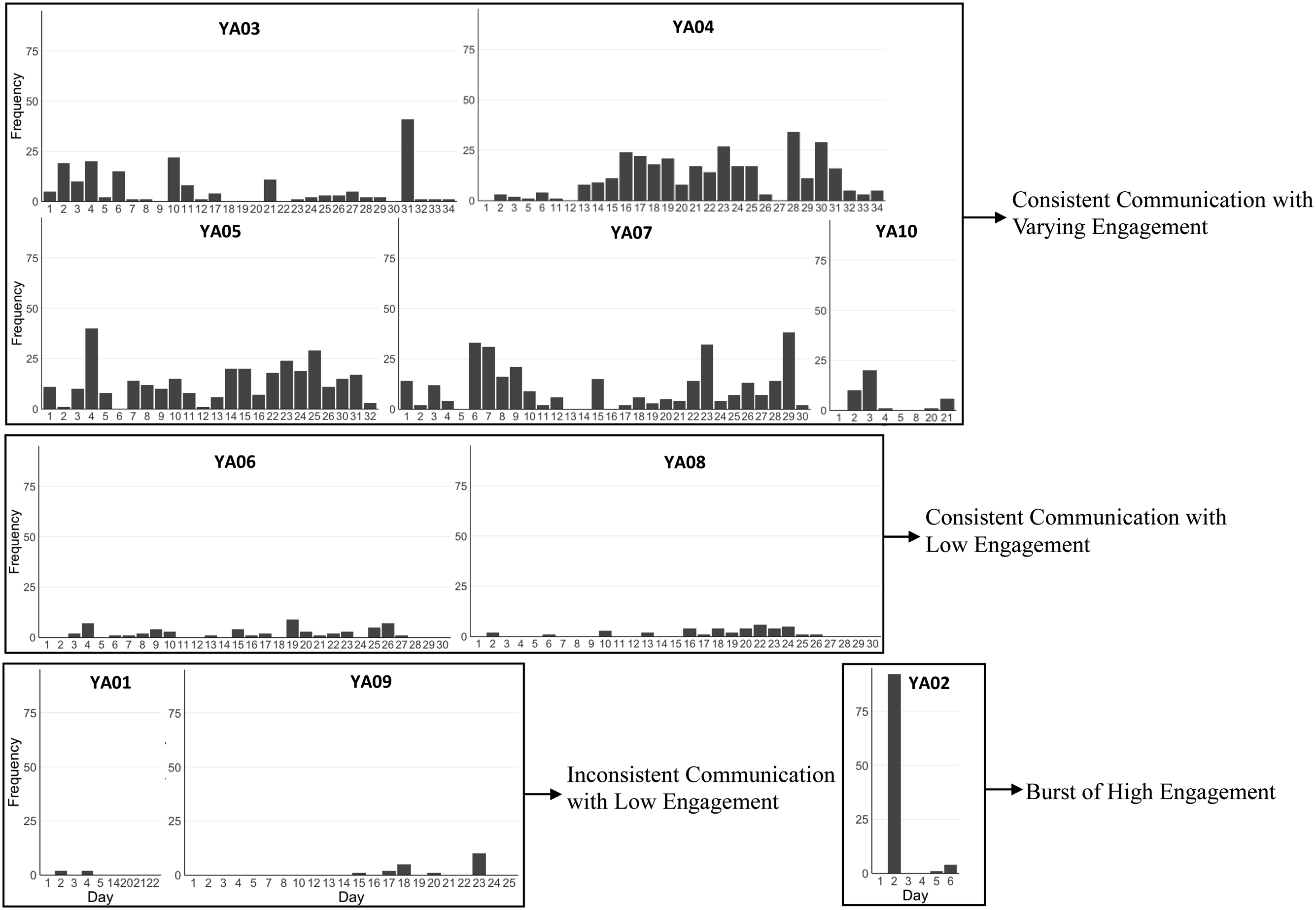
Zooming even further in, we unpacked how connectedness manifested on the hourly timescale. Figure 5 shows, for each young adult, the frequency of interaction instances per hour for each hour of the day, averaged across all observed days. Aligning with the weekly and daily timescales, the hourly frequency can also reflect the active engagement dimension of connectedness. However, patterns at this timescale uniquely show within-person differences in the timing of active engagement. Based on the profile of the within-person differences, we again grouped young adults into different clusters, which also demonstrates between-person differences on this timescale. First, YA01, YA06, YA08, and YA09 had low engagement with parents at any particular hour(s). In contrast, YA02, YA05, and YA07 had very salient variability in how actively they engaged with parents across different time of the day, with no or few interactions in certain hours but high frequency of interactions, that is, high engagement, in peak hours (i.e., 16:00-19:59 and 0:00-0:59 for YA02, 21:00-23:59 and 0:00-1:59 for YA05, and 18:00-23:59 and 0:00-0:59 for YA07). Finally, YA03, YA04, and YA10 had moderate engagement compared to the first two groups, with interactions more evenly distributed across different hours of the day. Hourly timescale. Line charts show averaged frequencies of smartphone interactions between each young adult (YA) and their parents over each hour of the day. Each point indicates the frequency of the young adult’s interaction instances with parents during that hour of the day, averaged across all observed days. Charts are grouped by different outline boxes with labels to indicate different clusters of connectedness patterns at this timescale.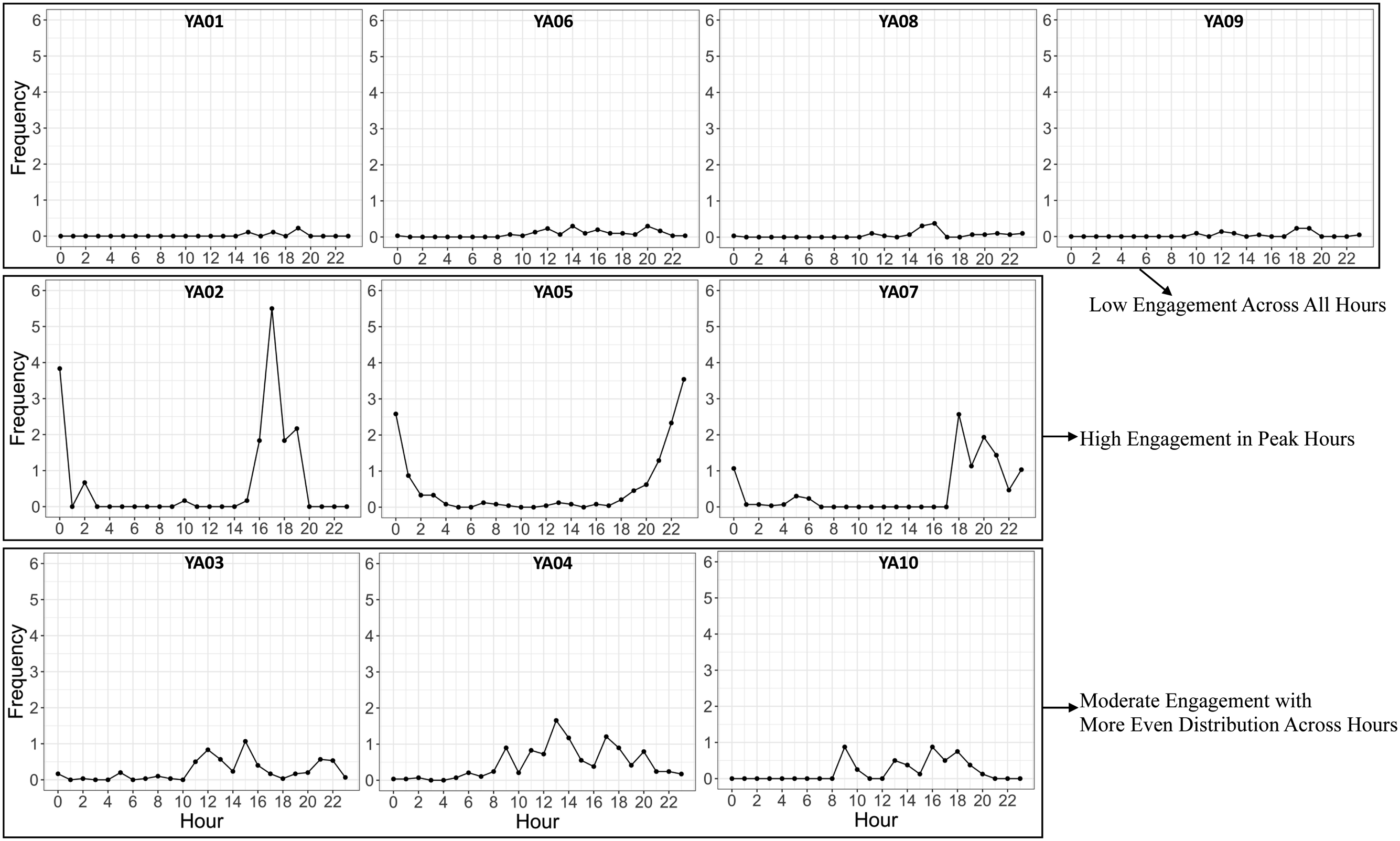
Similarly, we could also observe at the daily and hourly timescales, both within- and between-person differences in independence on dimensions that were observed at the long timescale (i.e., intrusiveness and reliance), by depicting separately for To/From interactions with Mom/Dad. For parsimony these results are not detailed in this section.
Parent-young adult smartphone interactions on the moment-to-moment timescales
The fine temporal density of the screenome data allowed us to zoom even further in to a high-resolution, moment-to-moment timescale. Figure 6 shows the exact timing, interaction partner, and direction of each participant’s interactions with their parents. Examples of specific sequences characterized by active engagement and reciprocal communication, parent intrusiveness and young adults’ psychological separation from parents, and consistent communication are shown in the pop-outs at the lower right of Figure 6. Moment-to-moment timescale. Barcode plots show smartphone interaction instances between each young adult (YA) and their mother (in red), father (in green), or family group (in purple) on a moment-to-moment basis, with 4 examples zoomed in from parts of the barcode plots manifesting specific dimensions of connectedness and independence. In each barcode plot, each row is a participation day spanning time from 0:00 (midnight) on the left to 23:59 on the right. Gray vertical bars indicate when the smartphone screen was on during each 5-second interval but was not an interaction instance with a parent. The green and red bars indicate the onset time and span of the young adult’s interaction instances with Dad and Mom, respectively. An overlaying dot indicates that the instance was initiated/sent by the young adult to parents. On the lower right, Examples 1 and 2 showcase active engagement and reciprocal communication, Example 3 mainly showcases parent intrusiveness and young adults’ separation from parents, and Example 4 mainly showcases consistent communication.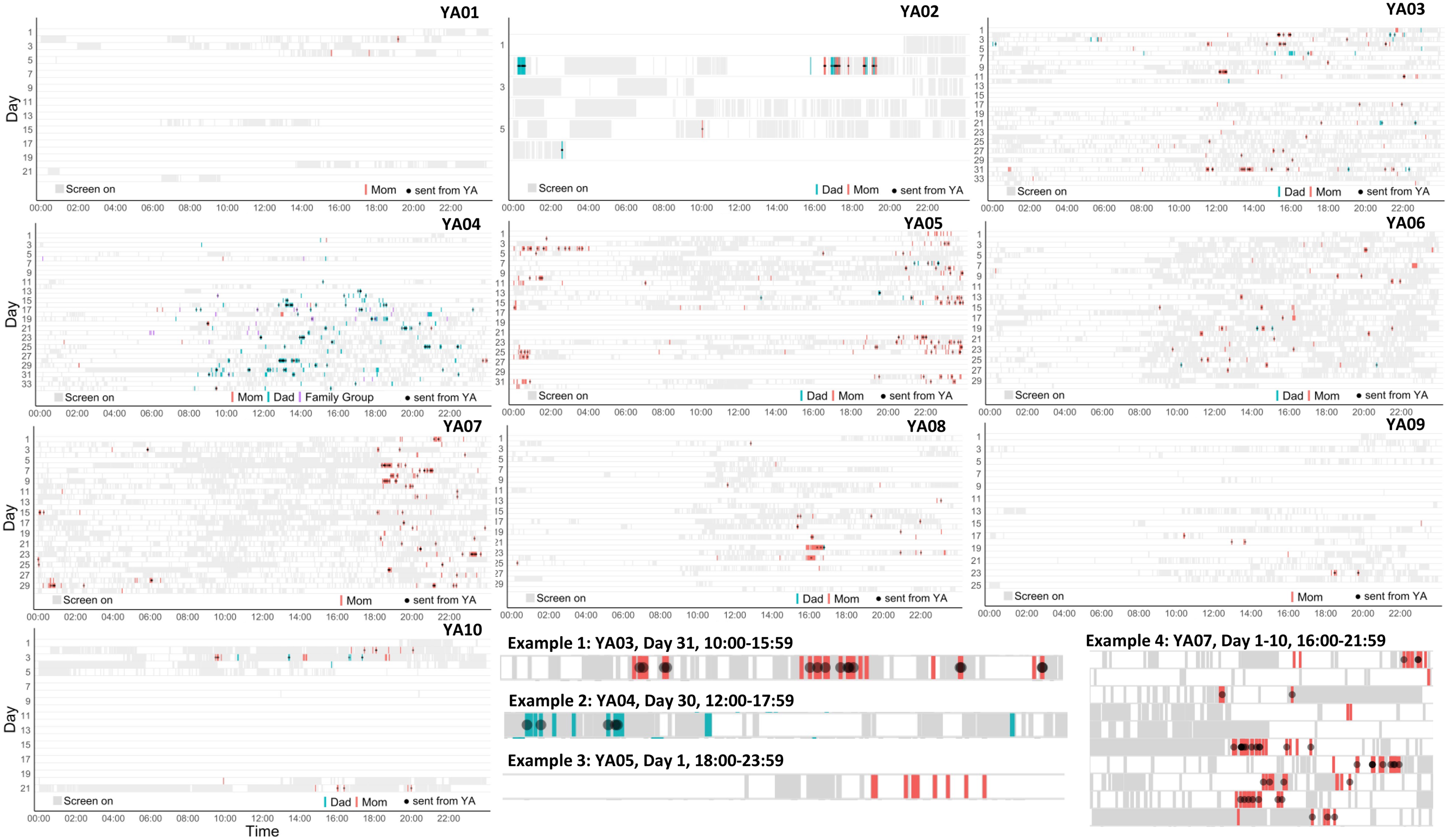
At this timescale, the active engagement dimension of connectedness was identified as multiple instances occurring consecutively in short periods of time. Example 1 shows active engagement between YA03 and Mom on Day 31, the 5 instances (4 messages, 1 call) from 11:27 to 11:49 (within 22 minutes), and the 16 instances (all messages) from 13:15 to 13:58 (within 43 minutes). In addition, Example 2 shows, for interactions between YA04 and Dad on Day 30, the 4 instances (4 messages) from 12:13 to 12:22 (within 9 minutes), and the 4 instances (2 messages, 2 calls) from 13:05 to 13:14 (within 9 minutes). These observations move beyond previous timescales where we mainly relied on frequencies (i.e., weekly, daily, and hourly) as indicators for active engagement by illuminating sequences of consecutive interactions across time.
Adding to previous timescales where we relied on the comparison of frequencies of interactions in two interaction directions, at this timescale reciprocal communication (i.e., a dimension of connectedness) is illustrated as turn-taking sequences of parent-young adult interactions. As shown in Example 1 between YA03 and Mom, reciprocal communication occurred from 10:00 on Day 31, in which Mom first sent a message to YA03, followed by YA03’s sending three messages and initiating one call, then by Mom’s one message, then by YA03’s message and more subsequent back-and-forth communications. Further, Example 2 shows a sequence of reciprocal communication instances between YA04 and Dad from 12:00 on Day 30, which started by YA04 sending a message to Dad, followed by Dad sending two messages to YA04, then YA04 sending another message to Dad, and then another message and a call sent from Dad.
We also observed interaction sequences that indicate parent intrusiveness and young adults’ psychological separation from parents—dimensions of independence, where a parent dominated the communication within certain time periods. Example 3 shows these dynamics between YA05 and Mom from 18:00 to 23:59 on Day 1, which included 11 instances (10 messages, 1 missed call) all sent/initiated by Mom consecutively without YA05 responding.
Finally, we observed consistent communication where digital interactions with parents occurred regularly across days. As shown in Example 4, for YA07, sequences of interactions with Mom regularly started around 18:00 to 20:00 across most of the days observed while no interaction was observed between 7:00 and 18:00, suggesting prominent consistency for their interactions in the digital context. A similar pattern is also shown for YA05 where many of the bursts of instances with Mom and Dad occurred at the nighttime (both before and after midnight) across most days.
At this timescale, both within- and between-differences are salient in that the patterns of how these interaction instances occurred varied both within each young adult across time and across different young adults. Moreover, at this timescale, it is no longer possible to easily identify clusters of young adults that have similar profiles of interaction. At this level of temporal resolution, we see how unique each young adult’s interactions are with their parents. This suggests that even though young adults’ interaction patterns could be grouped into clusters at the slower timescales as described above, there is still heterogeneity within each cluster with regard to when and how parent-young adult smartphone interactions occurred over time.
Discussion
The connectedness and independence dynamics between young adults and parents are important both developmentally (Arnett, 2000; Fingerman, 2017) and to their relationship quality and well-being (Fingerman et al., 2012; Inguglia et al., 2015; Kenyon & Koerner, 2007; Lamborn & Groh, 2009). This study focused on describing and examining these dynamics in the digital world through observations of parent-young adult smartphone interactions, given the important role that digital technology plays both in general family interactions (Dworkin et al., 2019; Sun & McMillan, 2018) and in the connectedness-independence dynamics (Ehrenreich et al., 2020; Ling, 2004; Miller-Ott et al., 2014; Ribak, 2009; Yang, 2018). In particular, family dynamics unfold on multiple timescales (Minuchin, 1985; Nesselroade, 1991; Ram et al., 2014), and thus we examined the patterns of parent-young adult smartphone interactions at different timescales. Our study used an innovative approach, Screenomics – collection of temporally dense and high-resolution screenshot data from individuals’ smartphones (Reeves et al., 2021) – to analyze parent-young adult smartphone interactions. We discovered the patterns of those interactions through digital ethnography and at the weekly, daily, hourly, and moment-to-moment basis that manifested specific dimensions of connectedness and independence between young adults and parents, and revealed within- and between-person differences in these patterns at each timescale.
Our objective, intensive longitudinal observations based on screenome data addressed limitations in previous studies based on self-reports, including inaccuracy, cross-sectional design, single or unspecified time windows. Further, prior studies using digital data streams have usually focused on only one communication platform, such as texting (Ehrenreich et al., 2020; Hussong et al., 2021). The awareness that family interactions can occur across multiple digital platforms (e.g., text, phone, Email, social media), as observed in our study, also suggests the importance of comprehensive observations across platforms. With these comprehensive observations, we identified that 1.65% of the young adults’ total screenshots involved interactions with parents. This proportion converges with findings from previous time use research on youth’s dyadic time with parents—about 151 minutes per 7 days (i.e., 1.5%; Lam et al., 2012)—highlighting the ecological value of the screenome-based observations.
Beyond its methodological advancements the study also contributes theoretically to the understanding about parent-young adult relationships. In the face of existing discussions in the literature about whether and how digital devices may facilitate or hinder connectedness/closeness and independence/autonomy (Ehrenreich et al., 2020; Ling, 2004; Miller-Ott et al., 2014; Ribak, 2009; Yang, 2018), our study directly revealed digital interaction patterns that are tied to dimensions of connectedness and independence. Through digital ethnographic analysis of parent-young adult smartphone interactions, we identified the emotional support, logistical and financial support, and consistent communication themes for connectedness, and the parent fostering independence, parent intrusiveness/overinvolvement, and young adults’ psychological separation from parents themes for independence. Then, quantitative descriptions across multiple timescales revealed smartphone interaction patterns that manifested active engagement, reciprocal communication, and consistent communication for connectedness, and parent intrusiveness/overinvolvement, young adult psychological separation, and young adult reliance on parents for independence. Although we mainly focused on dimensions that have been specified in the connectedness-independence literature (Inguglia et al., 2015; Lamborn & Groh, 2009), our observations revealed a theme that was not specified in this literature but has been highlighted as an important parent-youth relationship dimension in other studies (Sun et al., 2017), that is, consistent communication. Our finding suggests that consistency in communication can be an additional important dimension to be considered for parent-young adult connectedness, especially in the digital context. Further, despite overlaps between the qualitative and quantitative results in dimensions being manifested, there were also dimensions that were manifested only by qualitative analysis (i.e., emotional support, logistical and financial support, and parent fostering independence) and only by quantitative analysis (i.e., active engagement, reciprocal communication, and young adult reliance on parents). These differences between the two sets of analysis results suggest that the screenome content and quantitative metrics could capture different aspects of parent-young adult interactions and complement with each other to reveal important patterns in their dynamics.
An important theoretical contribution of this study is the finding that digital interactions between young adults and parents encompass dynamics for both connectedness and independence. On one hand, we discovered specific patterns where young adults and parents maintain connectedness in the digital context, which may be a continuation or enhancement of their closeness in the face-to-face context. This is especially important during young adulthood, a developmental period where individuals are experiencing physical distance from parents, but they also need to maintain connections with parents, such as through technology (Hessel & Dworkin, 2018). On the other hand, our findings addressed different opinions that have emerged in the literature on whether digital devices facilitate or hinder youth development towards independence (Ehrenreich et al., 2020; Ling, 2004; Ribak, 2009; Yang, 2018), which is especially important to consider during young adulthood, an exploratory phase of development that emphasizes relationships and intimacy beyond the immediate family (Arnett, 2000). Results in this study show that smartphone interactions with parents include both interactions that can facilitate independence, such as parent fostering independence and young adult psychological separation by dismissing interactions from parents and prioritizing entertainment and other social relationships, and interactions that may hinder independence, such as parents’ overinvolvement and young adults’ reliance on parents. These findings suggest that instead of the existence of digital devices in family interactions, what matters to young adult development towards independence may be the patterns of their use and interactions.
Our study also uniquely contributes to the literature by revealing both within- and between-person differences in the digital interaction patterns across weeks, days, hours, and moments. Previous research on family digital interactions and on parent-young adult dynamics have predominantly focused on between-person differences and one timescale in each study. We were able to observe these interactions simultaneously on multiple timescales to reveal that connectedness and independence may be more salient not only for some young adults than others (i.e., between-person differences), but also for their interactions with certain parents (e.g., mother vs. father), and at certain times. These findings highlight the need for future theory and research on parent-young adult relationships and young adult independence development to incorporate changes across time and contexts in addition to the predominant focus on individual differences.
Further, at each timescale we also tried to group young adults into different clusters based on profiles that manifest within- and between-person differences in connectedness and independence, in that within each cluster, the young adults had similar patterns. However, these clusters were inconsistent across timescales. For example, YA01 was grouped with YA05, YA09, and YA10 for the parent-direction combination at the long timescale, but with YA06, YA08, and YA09 at the hourly timescale, and only grouped with YA09 at the daily timescale. YA07 and YA08 were in the same cluster at the long timescale regarding the parent-direction combination, but different clusters at the daily and hourly timescales. These inconsistencies across timescales suggest that observations on any single timescale are unable to reliably represent how the family dynamics unfold on other timescales, thereby highlighting the need to investigate connectedness and independence simultaneously on multiple timescales for a comprehensive understanding. Moreover, observations at the moment-to-moment timescale, a timescale that has not been possible in previous research on family digital interactions, highlight the idiosyncratic nature of sequences of connectedness-independence dynamics. The finding that every young adult has a unique pattern in their interactions with parents at the fastest timescale provides support for personalized interventions and for family therapy to treat each individual or family as a unique case.
To our knowledge, this is also the first study that unpacked connectedness and independence in parent-youth interactions in the digital context, with our findings revealing specific dimensions of these two relationship constructs. The findings importantly provide a framework for future hypothesis-testing studies to capture and model within- and between-person differences in connectedness and independence. More generally, this study also showcases the importance of quantitative descriptions of family dynamics on multiple timescales, especially based on time-intensive, objective observations, which can provide rich contexts for theory development and future hypothesis forming and model testing (Munger et al., 2021). The theoretically important patterns in family dynamics that are discovered through quantitative descriptions can feed into future work that makes use of new advances in statistical and computational methods to examine these patterns with new types of data, including digital data.
Limitations and future directions
Regardless of strengths, this study has limitations. First, despite the comprehensive observations, we may have failed to identify some instances of family smartphone interactions; any not linked to parents’ media identities determined in coding. A future direction is to obtain a more complete list of family members’ media identities through questionnaire to minimize potentially missed observations of family interaction instances. Second, interactions happening through different platforms may have different optimal metrics: For example, frequency may be optimal for messages, emails, location sharing and social media interactions but duration may apply better to calls. We chose frequency as the predominant metric in data aggregations given duration is hardly captured for instances other than calls, but we also realized that one text message might carry different amount of information than one call. Next steps include exploring algorithms that can reasonably convert and merge between interaction frequency and duration. Third, with our goal to describe and demonstrate a variety of interaction patterns across timescales that manifest dimensions of connectedness and independence with a small sample, we did not focus on quantifying all dimensions. In addition, unfortunately, the data did not include self-report measures of parent-young adult relationships or well-being and thus we were unable to examine how the digital interaction patterns identified from screenome data are related to specific (self-reported) relational or individual outcomes. Nevertheless, our effort in capturing dimensions of connectedness and independence on various timescales sets the foundation for future studies collecting both screenome and survey data of family relationship quality and youth well-being within a larger sample, and for developing metrics to quantify these dimensions for analysis. Fourth, despite the objective observations of parent-young adult interactions, our interpretations in the digital ethnographic analysis are necessarily subjective and potentially biased. Another future direction is to incorporate qualitative interviews among the family members along with screenome observations. Finally, participants’ gender identity, sexual orientation, and disability status were not asked during data collection and thus we were unable to report these characteristics.
In conclusion, this study took an innovative approach, Screenomics, to observe and analyze parent-young adult interactions in the digital world and describe specific interaction patterns that manifest the connectedness-independence dynamics. By capturing screenshots that include all the content appearing on smartphone screens, the digital ethnographic observations discovered themes for connectedness and independence. The collection of temporally dense, comprehensive data from smartphones enabled us to quantitively describe parent-young adult digital interactions across multiple timescales, from weeks to days, hours, and moments, with each timescale allowing us to capture dimensions of connectedness and independence that demonstrate both within-person and between-person differences. This study also lays the groundwork for many future research directions, including those that examine how the relationship dimensions in parent-young adult digital interactions across timescales may be associated with relationship quality and individual well-being.
Footnotes
Acknowledgements
We gratefully acknowledge the support provided by the Cyber Social Initiative at Stanford University, the Stanford University PHIND Center (Precision Health and Integrated Diagnostics), the Stanford Maternal and Child Health Research Institute, the Department of Pediatrics at Stanford University, the Knight Foundation (G-2017–54227), and the Stanford Data Science Scholarship. We thank the participants for contributing data for this study. The content is solely the responsibility of the authors and does not necessarily represent the official views of the funding organizations.
Funding
The author(s) disclosed receipt of the following financial support for the research, authorship, and/or publication of this article: This work was supported by the The Cyber Social Initiative at Stanford University, the Stanford University PHIND Center (Precision Health and Integrated Diagnostics), the Stanford Maternal and Child Health Research Institute, the Department of Pediatrics at Stanford University, the Knight Foundation (G-2017–54227), and the Stanford Data Science Scholarship.

Open research statement
As part of IARR’s encouragement of open research practices, the authors have provided the following information: This research was not pre-registered. The raw data (i.e., screenshots) used in the research are not available. The de-identified, processed data used in the research are available. The data can be obtained by emailing: