







Abstract
Previous research suggests that impression management goals and face threats can be barriers to seeking support, especially among college students and those facing severe problems that are highly stigmatized. In such cases, technologically-mediated communication channels (TMCCs) may be an important resource because they have unique affordances that can help overcome impression concerns and thereby promote well-being. To examine this possibility, the present study explored how impression goals, problem severity, perceived stigma, and perceived affordances interact to affect comfort with seeking support. Contrary to expectations, results from an online survey of undergraduate students (N = 183) indicated that problem severity was not associated with levels of comfort with seeking support, and the interaction of stigma with impression goals had an unexpected positive effect. Furthermore, TMCCs affording persistence and conversation control facilitated comfort with support seeking as stigma increased. Possible explanations for these findings and implications for scholarship on TMCCs and social support are discussed.
Keywords
Introduction
Supportive communication is a valuable resource for coping with distress and improving well-being (Cohen & Wills, 1985) and consists of “verbal and nonverbal behavior produced with the intention of providing assistance to others perceived as needing that aid” (Burleson & MacGeorge, 2002, p. 374). Seeking and receiving quality social support and engaging in validating supportive interactions in the face of stress has psychological benefits (e.g., Arroyo et al., 2022). Social support can inform people of healthy behaviors (e.g., Uchino, 2009), provide comfort (e.g., Cutrona & Russell, 1990), and increase interest in caring for one’s personal health (e.g., Yarcheski et al., 2003), supporting well-being over time.
Seeking support can be face-threatening, however, because it implies that someone is unable to meet their own or others’ expectations for coping with distress (Lim et al., 2013). In particular, people with strong impression management goals (Dillard et al., 1989; Goffman, 1959) may worry about how potential support providers will react to a request for support, especially if the problem they are experiencing is stigmatized (Schnyder et al., 2017) or severe (Buehler et al., 2018). College students may be particularly susceptible to these concerns because they report higher levels of mental and emotional distress compared to other populations (Arsandaux et al., 2021; National Institute of Mental Health, 2022), and these levels of distress have also been increasing over time (Duffy et al., 2019). Because of the benefits that disclosing support needs can provide, understanding factors that help people overcome relevant barriers is valuable.
One option for overcoming these barriers may be utilizing technologically-mediated communication channels (TMCCs), such as phone calls, text messaging, and social networking sites (SNSs; e.g., Instagram, Snapchat). TMCCs have unique affordances (Fox & McEwan, 2017) that allow people to manipulate (audio)visual and/or text-based cues to control elements of an interpersonal interaction. The affordances that TMCCs provide make them useful tools for achieving goals pertaining to impression management (Oh & LaRose, 2016; Walther, 2007) and seeking support (Buehler et al., 2018). Indeed, college students’ self-disclosure of stressors via TMCCs often exerts a stress buffering effect by increasing the opportunity for supportive interactions and reducing levels of distress (Zhang, 2017). Additionally, TMCCs are valuable to address in the context of support-seeking among college students because enrolling in a given university often requires them to be geographically separated from social ties whom they would otherwise be able to interact with in face-to-face settings.
Although existing social support research on TMCC affordances has focused largely on SNSs (e.g., Buehler et al., 2018; Oh & LaRose, 2016), other TMCCs, like texting or phone calls, offer similar affordances that facilitate support seeking. The present study considers a variety of TMCCs to expand on research that has solely considered SNSs (e.g., Buehler et al., 2018; Oh & LaRose, 2016). Our goal was to examine how impression management goals, perceived stigma, and problem severity are associated with college students’ level of comfort with seeking support via TMCCs, as well as how perceived technological affordances of individuals’ preferred TMCCs could influence these associations. We focused specifically on college students because they report high levels of distress compared to other populations (Arsandaux et al., 2021), suggesting that they are especially likely to need support and are familiar with barriers to seeking it. At the same time, students’ self-disclosure of stressors via TMCCs is associated with mitigated symptoms of distress (Zhang, 2017). Thus, they are an especially relevant population for exploring the aforementioned topics of interest.
Social Support and Well-Being
Disclosing distress and seeking support are each associated with psychological well-being, especially for young adults navigating life changes, such as moving away from home and beginning college (Arroyo et al., 2022). The benefits of receiving support include improved self-esteem (Johnson et al., 2000) and improved responses to stress (Uchino et al., 2011). Furthermore, individuals who disclose mental and emotional distress report increased empowerment over distress, fostering perceptions of well-being (e.g., Corrigan et al., 2013).
Cutrona and Russell (1990) identified five types of support. Emotional support is sought to address distressing feelings. For example, one may seek comforting messages from a friend following an emotionally distressing event. Esteem support reinforces self-efficacy. Someone lacking self-confidence may reach out to a friend who reminds them of their capabilities and positive traits. Informational support consists of advice or guidance. People may seek advice from others about an event or issue they lack experience with. Tangible support refers to the exchange of external resources, such as services or money. Finally, social integration support occurs when someone gains a sense of belonging in a social group or activity. When people receive support that is consistent with the type of support that they seek, they experience improved perceptions of well-being (Cutrona & Russell, 1990).
Barriers to Seeking Support
Seeking support is an inherently face-threatening act (Goldsmith & Parks, 1990). Goffman’s (1955; 1959) concept of face refers to a person’s desired self-image, shaped by the need to gain others’ approval (i.e., positive face) without imposing or being imposed upon (i.e., negative face). When seeking support, a person’s positive face may be at risk because people fear their self-image could be damaged by revealing something negative about themselves (Goldsmith & Parks, 1990). Thus, costs associated with risks to face are barriers that influence individuals’ comfort with seeking support.
Face-Work and Impression Management
Individuals strive to maintain face during interactions to leave positive impressions on others (Goffman, 1959; Goldsmith & Parks, 1990). “Facework” describes social actions which are used to maintain desired social images, particularly when face is threatened by some other action (Goffman, 1955). Impression management comprises the processes by which people manipulate available social cues to influence how they are perceived by others (Goffman, 1959). When people manipulate social cues, Goffman’s (1955; 1959) theories regarding facework and impression management suggest that people engage in performances aimed to display positive characteristics to maintain positive impressions. Overall, efforts to avoid displaying negative social characteristics and emphasizing positive characteristics comprise impression management processes (Goffman, 1955, 1959).
Leary and Kowalski’s (1990) impression management model includes two central components. Impression motivation refers to “the desire to create particular impressions in others’ minds'' (p. 35). This motivation is rooted in goals such as obtaining better outcomes in social interactions and creating or maintaining a desired identity. Impression construction refers to the process of altering behaviors to cultivate desired impressions. These two components of impression motivation and impression construction (Leary & Kowalski, 1990) outline the processes that individuals use to present themselves to others in a positive way.
People often do not engage in impression management in active ways, but instead become sensitive to impression goals if a particular situation makes them self-conscious (Goffman, 1959; Leary & Kowalski, 1990). For example, the prospect of self-disclosure of distress can introduce uncertainty about how others might respond (see Brashers, 2001). Self-disclosure of distress is associated with negative social consequences including being rejected, ignored, or misunderstood (Vogel & Wester, 2003; Williams & Mickelson, 2008). Such uncertainty regarding social consequences reflects a threat to face when seeking support (Goffman, 1955; Goldsmith & Parks, 1990). College students in particular have been observed to experience increased pressure to manage their impressions effectively (Hesler, 2016). Consequently, college students may experience heightened uncertainty regarding how their peers will respond to any perceived shortcomings related to support needs. As impression management goals become salient, the likelihood of seeking support often decreases, particularly when support-seeking messages are more publicly visible (Lim et al., 2013; Oh & LaRose, 2016; Zhao et al., 2021).
Impression goals will be negatively associated with comfort with seeking support via TMCCs.
Stigma
The characteristics of a problem likely influence people’s comfort in seeking support. When a problem could be perceived as stigmatized (Smith, 2007; Williams & Mickelson, 2008), it is particularly stressful for people to reach out to others because seeking support requires disclosing such a problem. Stigma is “a simplified, standardized image of the disgrace of certain people that is held in common by a community at large” (Smith, 2007, p. 464). Perceptions of mental health-related stigma are associated with less active support-seeking (Schnyder et al., 2017). The perceived stigma of a problem is the extent to which people believe that disclosing a problem will foster prejudice by message receivers (Yeshua-Katz & Hård af Segerstad, 2020).
Disclosing stigmatized experiences often evokes concern that others may express social rejection, reducing the likelihood that stigmatized experiences are disclosed, especially among college students (Goffman, 1963; Gulliver et al., 2010; Schnyder et al., 2017; Yeshua-Katz et al., 2020). Perceived stigma may be a strong barrier to seeking support among those with high impression goals because people facing stigmatized experiences, such as mental and emotional distress, are typically devalued and isolated (Goffman, 1963; Smith, 2007). Because college students experience high levels of mental and emotional distress compared to other populations (Arsandaux et al., 2021; National Institute of Mental Health, 2022), this group may be particularly vulnerable to the negative effects of perceived stigma on support-seeking. Thus, the negative effects of impression management goals on comfort with seeking support should be stronger for problems that are perceived to be more stigmatized.
The relationship between impression goals and comfort with seeking support via TMCCs will be moderated by perceived stigma, such that comfort with seeking support will be more negatively affected by impression goals as perceived stigma increases.
Problem Severity
Another factor shaping people’s comfort with seeking support is the perceived severity of the problem. Zhang (2017) argued that college students’ most salient sources of stress are related to academic responsibilities, but even these types of problems may vary widely in their severity. A mild problem might be failing an exam in college, for example, whereas a serious problem would be failing out of college entirely. Scholars have found that problem severity is negatively related to comfort with seeking support (Barker, 2007; Vogel & Wester, 2003), but positively associated with support-seeking goals (Buehler et al., 2018), suggesting that problem severity may simultaneously encourage and discourage support-seeking. Buehler et al. (2018) report a positive association between the perceived severity of a problem and impression management goals, such that people with more severe stressors experience increased impression management concerns. Problem severity might be a situational factor that increases impression motivation, exacerbating college students’ already high levels of impression management concerns (e.g., Hesler, 2016). Thus, the negative effects of impression management on comfort with seeking support should be stronger for problems that are perceived to be more severe.
The relationship between impression goals and comfort seeking support via TMCCs will be moderated by problem severity, such that comfort with seeking support will be more negatively affected by impression goals as problem severity increases.
Overcoming Barriers via TMCCs
Based on the preceding logic, people are likely to perceive barriers to seeking support when impression management concerns are high, particularly for problems that are perceived to be face-threatening due to severity or stigma. The challenge is determining how people might overcome these barriers to increase their comfort with seeking support. Scholars have explored how technologically-mediated communication (TMC) settings influence decisions to seek support (DeAndrea, 2015; Wright & Bell, 2003). For example, college students often use an SNS (i.e., Facebook) to disclose support needs and obtain supportive responses from their online network, and such supportive responses inspire further disclosures of mental and emotional distress (Moreno et al., 2011). Also, college students experience reduced symptoms of depression via disclosures on an SNS (Zhang, 2017).
Although SNSs have been studied as contexts in which support seeking occurs (Buehler et al., 2018; Oh & LaRose, 2016), the public nature of many SNSs is often associated with self-censorship due to the many groups of people in one’s life who can access content that may negatively impact impressions (Marwick & boyd, 2011). Other TMCCs, such as text-messaging, are often more private than (semi-)public SNSs. Within SNSs, increased privacy (i.e., decreased publicness) has been shown to mitigate impression management concerns that lead to self-censorship among college students (Oh & LaRose, 2016). Additionally, people facing stigmatized problems tend to be more aware of impression management concerns in SNSs with high visibility (Zhao et al., 2021), so they might choose to disclose distress on TMC platforms that afford one-to-one interactions, such as text messaging (De Choudhury & De, 2014). Thus, we build on previous research by considering both SNSs and other more private TMCCs, including text-messaging, phone calls, and video-chatting.
TMCCs have unique affordances that can be used to facilitate support seeking goals (Buehler et al., 2018; Caplan & Turner, 2007; DeAndrea, 2015; Lu & Hampton, 2017). Affordances describe perceived action possibilities during interactions with another in a given channel (Evans et al., 2017). Affordances may be part of why using TMCCs in general is associated with subjective well-being, as scholars have found that factors shaping this association include people’s motivations, behaviors pertaining to disclosure and seeking support, and how TMCCs are used (High et al., 2023). Even though it is potentially useful to consider individual TMCCs as opposed to their affordances, perceptions of social action possibilities are not inherently tied to any specific TMCC brand or technology, each of which may change (e.g., Twitter), develop (e.g., TikTok), lose relevance (e.g., MySpace), or become unavailable (e.g., Vine) at any given time (Fox & McEwan, 2017).
Fox and McEwan (2017) describe several affordances 1 that may be particularly important for seeking support. Conversation control is the perceived ability to regulate the duration of interactions (Fox & McEwan, 2017). When seeking social support, people may value TMCCs that offer control over how long a conversation lasts and the option to terminate an interaction. For example, a person can request to “hang up” during a phone call because there is no gap in time between transmitted messages (i.e., synchronicity). Control over the duration of interactions is less available in asynchronous channels such as text-messaging because there is some delay in when a support provider will receive and respond to messages, likely leaving uncertainty about when an interaction will conclude. Increased autonomy over disclosures via higher levels of conversation control may be particularly attractive to individuals who are aiming to manage impressions (Goffman, 1963).
Network association describes the degree to which content shared in a channel is accessible to audience groups, as well as the degree to which channels allow a (semi-)public network to participate in interactions (Fox & McEwan, 2017). Channels affording high network association such as SNSs (e.g., Facebook), can be used to receive several types of support from a broader social network (High & Buehler, 2019; Zhang, 2017). However, when online networks are large, it can be difficult to manage impressions and meet the expectations of multiple and diverse audience groups (Marwick & boyd, 2011). Thus, someone with increased impression management concerns may choose a channel lower in network association in order to disclose support needs to as few others as possible. We selected network association in lieu of personalization and privacy to highlight whether students prioritize network members’ ability to access and respond to self-disclosures of support needs (Zhang, 2017) over their ability to target self-disclosures towards specific network members (i.e., personalization), or whether such disclosures can be unintentionally accessible to network members they are not attempting to disclose to (i.e., privacy).
Persistence reflects the degree to which shared messages are made permanent (as opposed to ephemeral, or temporarily available) in a platform after a message is sent (Fox & McEwan, 2017). Shared content with greater persistence in channels such as text messaging (instead of ephemeral channels such as a phone call) may reduce individuals’ willingness to share sensitive content because audiences can return to the content and make judgements in the future (Stoycheff, 2016). Thus, individuals with greater impression management concerns might avoid disclosing distress in channels that will (semi)-permanently store messages.
Editability describes the extent to which individuals can alter messages before distribution to some receiver(s) (Fox & McEwan, 2017). This is possible due to the time available between message construction and distribution in asynchronous TMCCs such as text-messaging or email, which allow individuals to review, delete, and alter messages in accordance with their goals before sending (Walther, 2007). Individuals concerned with impressions might be more comfortable seeking support via channels affording time to edit or delete (support-seeking) messages before sending, which is impossible in synchronous channels such as a phone call.
Anonymity is the ability to conceal aspects of one’s identity (Fox & McEwan, 2017). When people reach out to a social network to seek support, they often benefit from being known by their network because the support they receive tends to be more personalized (Lu & Hampton, 2017). However, being anonymous to some degree when seeking support may be advantageous to people seeking to disclose stigmatized problems (Wright, 2000) with less fear of negative consequences (Caplan & Turner, 2007; DeAndrea, 2015). Thus, anonymity allows people with greater impression management concerns to “save-face” and avoid displaying negative social characteristics when disclosing problems because aspects of their identity are not connected to their messages (DeAndrea, 2015; Goffman, 1955, 1959).
Finally, social presence describes the feeling of closeness between people during interactions in a social exchange. Channels with higher levels of social presence often include a greater availability of social cues (Fox & McEwan, 2017). TMCCs affording high social presence such as synchronous video-chatting applications allow people to convey a range of feelings and corresponding social cues (Rice, 1993; Short et al., 1976), which may enhance their ability to communicate support needs. However, the reduced social cues offered by some TMCCs (e.g., texting) can buffer negative disclosures (O’Sullivan, 2000; Zhang, 2017) and make people feel less anxious about self-disclosures (Caplan & Turner, 2007; DeAndrea, 2015). The impression management goals that may motivate people to select TMCCs affording different extremes of social presence make it difficult to predict under what circumstances people may value TMCCs affording high or low levels of social presence when seeking support. Studies have shown that greater social presence benefits online support (Feng et al., 2016; Li et al., 2015), but such research tends to focus on support provision rather than support seeking. Though social presence may influence impression concerns when conducting supportive interactions via TMCCs, it is unclear how social presence affects comfort with seeking support. Given the preceding logic that social presence is particularly ambiguous in its influence on comfort with seeking support, we propose:
As impression goals, stigma, and problem severity increase, people will express more comfort with seeking support on channels that have (a) high conversation control, (b) low network association, (c) low persistence, (d) high editability, and (e) high anonymity.
To what degree does social presence moderate the relationships between impression goals, stigma, severity, and comfort with seeking support via TMCCs?
Methods
Sample
Participants were recruited from an undergraduate-level course at a large university in the northeastern U.S. Students received course credit for their participation, and students who did not wish to participate were given an alternative assignment. Participants were eligible for the study if they were at least 18 years old and indicated in a pre-screening questionnaire that they had considered seeking (or actually sought) support via TMCCs within the past month for a mentally and emotionally distressing experience. 2 The pre-screening survey also asked participants whether they generally prefer to seek support via mediated channels (i.e., TMCCs) or face-to-face. Only participants who preferred TMCCs were selected for this study to ensure their familiarity with TMCCs, and those who preferred face-to-face settings were recruited to a separate, paired study. Data were cleaned to remove participants who had unusually long (>45 minutes) or short response times (<25% of estimated duration per Qualtrics, 4.5 minutes), gave incomplete or duplicate responses, did not indicate their consent before responding, or did not report a preferred TMCC for seeking support (n = 28), resulting in a final sample size of N = 183. See Table S1 in Supplemental Materials for demographic characteristics.
Design and Procedures
Data were collected with an online survey distributed via Qualtrics. After providing informed consent, participants read background descriptions of social support (“By support we mean emotional comfort, advice, esteem boosts, or offers to spend time together”) and feelings of distress (“Some experiences of mental and emotional distress might be little interest or pleasure in doing things, worrying too much about different things…”). Participants were then presented with closed-ended questions. First, participants reported their one most preferred TMCC for seeking support. Allowing participants to choose their preferred platform for seeking support reflects realistic decisions that individuals make when reaching out to others for support, as opposed to grounding the study within one channel. Next, participants filled out measures of perceived affordances of their chosen platform, their impression goals when seeking support on that platform, perceived severity and stigma for problems corresponding to each of the five support types (e.g., esteem support), and their comfort with seeking support on that platform for each type of problem. The design resembles previous work addressing these variables (see Buehler et al., 2018; Oh & LaRose, 2016), with the exception that participants were allowed to choose a preferred TMCC.
Measures
When indicating their preferred TMCC, participants were asked to indicate the single channel they would be most likely to use to seek support. Participants could select from several TMCC options, including Facebook, Twitter, Instagram, Snapchat, Reddit, Tumblr, Pinterest, YouTube, text messaging, video chat, phone call, or other. We listed different options for social media sites to choose from because affordances can differ substantially depending on the SNS.
Perceived affordances of the preferred TMCC were measured using items developed by Fox and McEwan (2017). These included five items measuring network association (α = .88), four items measuring social presence (α = .87), six items measuring anonymity (α = .94), four items measuring persistence (α = .92), four items measuring editability (α = .97), and four items measuring conversation control (α = .82). All affordances were measured using 7-point Likert-type scales (1 = strongly disagree, 7 = strongly agree).
Impression goals (α = .77) were measured using four items adapted from Oh and LaRose (2016). The items assessed the extent to which participants were concerned about how others perceive them when communicating via their chosen platform, using 7-point Likert-type scales (1 = strongly disagree, 7 = strongly agree). 3
Perceived stigma and severity were measured for problems corresponding to each of the five support types (Cutrona & Russell, 1990). We created items asking people to imagine that they were facing each type of problem or to recall a time when they had faced that type of problem. For esteem support, the problem was when people “lack feelings of worth and validation from others”. For tangible support, the problem was when people “lack tangible resources such as money or help with a task such as moving furniture”. For information support, the problem was when people “lack information or knowledge about important topics or events around them”. For emotional support, the problem was when people “experience negative emotions”. Finally, for social integration support, the problem was when people “lack social activities/plans or feel alone.”
For each type of problem, perceived stigma was assessed using three items adapted from Boyle’s (2018) measure of felt stigma (αs = .85–.93), and perceived severity was assessed using three items adapted from Burleson et al. (2011) (αs = .87–.90). Both constructs were assessed using 5-point Likert-type scales (1 = strongly disagree, 5 = strongly agree).
Finally, we measured participants’ comfort with using their preferred channel to seek support for each type of problem (Cutrona & Russell, 1990). Each was measured with three items (αs = .68–.91) using 7-point Likert-type scales (1 = strongly disagree, 7 = strongly agree).
Factor Analyses
Using R 4.2.0 (R Core Team, 2022), confirmatory factor analyses (CFAs) were conducted to examine the fit of the data to the proposed factor structure for all measures. Specifically, the lessR statistical package (Gerbing, 2020), which uses the centroid solution to estimate parameters (see Hunter & Gerbing, 1982), was used to identify items associated with large residuals for removal from their respective factors. Then, additional fit statistics for the final models were obtained with the lavaan statistical package (Rosseel et al., 2019), using maximum likelihood estimation. Based on the combinational rules proposed by Hu and Bentler (1999), good fit was defined as a confirmatory fit index (CFI) > .95 and a root mean squared residual (SRMR) < .08.
The CFAs were conducted in two steps. One analysis examined the fit of the items measuring impression goals and perceived affordances to a seven-factor structure, and a second analysis examined the fit of the items measuring perceived problem severity, perceived stigma, and comfort with seeking support for each problem type to a 15-factor structure. Recent simulations (Koran, 2020) suggest that for a model similar to the first model (8 factors, M = 4.38 items per factor, M loading = .83), the minimum sample size required to minimize the chances of adverse outcomes (nonconvergence, improper solutions, bias in the model chi-square, bias in parameter estimates and standard errors, power to detect a misfitting model, and power to test individual parameter estimates) is N = 125 (for a simulated model of 6 factors, 4 items per factor, loadings of .80). For a model similar to the second model (15 factors, 3 items per factor, M loading = .86), the minimum sample size required to minimize the chances of adverse outcomes is also N = 125 (for a simulated model of 12 factors, 3 items per factor, loadings of .80). Thus, even allowing for a somewhat larger factor structure than simulated here, the evidence suggests that the obtained person-level sample size of N = 183 was adequate for our purposes.
Initially, neither model exhibited good fit to the data (CFIs = .92, .91; SRMRs = .06, .06, respectively). Inspection of the residuals indicated that the poor fit could be attributed to several invalid items that were associated with more large, statistically significant errors than would be expected to occur due to chance alone. Removing these items from their respective factors yielded good fit for both models (CFIs = .96, .95, SRMRs = .06, .04, respectively). The remaining items were averaged to form composites for each measure (see Table S2 in the supplemental materials for all items, factor loadings, and descriptive statistics; see Table S3 for factor correlations).
Results
Preliminary Analyses
Prior to the main analyses, descriptive statistics were examined for key variables of interest. These analyses indicated that almost all participants preferred channels that afford one-to-one or one-to-few interactions, such as text messaging (n = 73, 39.9%), phone calls (n = 42, 23.0%), video chatting (n = 38, 20.8%), and Snapchat (n = 15, 8.2%). Very few participants chose channels that mainly afford publicly visible interactions (e.g., Twitter: n = 1, .5%; Instagram: n = 3, 1.6%; YouTube: n = 3, 1.6%). 4 The more private channels (text, phone, video chat, and Snapchat) were also perceived to have high levels of social presence (M = 4.93, SD = 1.21) and conversation control (M = 5.64, SD = .85), modest levels of persistence (M = 4.41, SD = 2.01) and editability (M = 4.15, SD = 2.36), and low levels of network association (M = 3.32, SD = 1.46) and anonymity (M = 2.75, SD = 1.53), providing a preliminary indication of how affordances might be perceived when seeking support.
Participants generally had moderately strong impression management goals (M = 4.48, SD = 1.30) when using their preferred channels. Across the five types of problems, overall levels of perceived problem severity (M = 3.63, SD = .90) and stigma (M = 2.51, SD = .99) were modest, and participants also reported that they were fairly comfortable seeking support (M = 5.11, SD = 1.40).
Tests of Dependence
Because responses about the five support types were nested within subjects and subjects were also grouped by their preferred channel, preliminary analyses were conducted to examine possible dependence in the data. Univariate ANOVA analyses revealed this to be the case. Subject had substantial main effects on severity, F (182, 732) = 4.28, p < .001, ICC(1) = .39; stigma, F (182, 732) = 7.56, p < .001, ICC(1) = .57; and comfort seeking support, F (182, 732) = 3.50, p < .001, ICC(1) = .33. Channel also had small, though statistically significant, main effects on severity, F (7, 907) = 7.30, p < .001, ICC(1) = .05; stigma, F (7, 907) = 4.69, p < .001, ICC(1) = .03; and comfort seeking support, F (7, 907) = 5.37, p < .001, ICC(1) = .04. 5
To account for this dependence in the data, analyses of the hypotheses and research questions were conducted using a three-level hierarchical linear model (HLM) using the lmerTest package (Kuznetsova et al., 2017) in R 4.2.0 (R Core Team, 2022). In this model, responses about each type of support (k = 5) were nested within people (N = 183). This data structure is similar to what would be used in longitudinal multilevel modeling (Singer & Willett, 2003), in which responses at different time points are likewise nested within people. This approach also had the benefit of providing a level-1 sample size of 5 * 183 = 915 observations. Thus, we were able to examine 915 different observations of the relationships among stigma, severity, and comfort with seeking support, which provided substantial power to test the main effects of these variables (i.e., level-1 predictors) and their interactions with impression goals and affordances (i.e., cross-level interaction effects; H2-H3, part of H4, RQ1). G*Power estimates that the sample size needed to detect a small effect (see Gignac & Szodorai, 2016) in linear regression (f 2 = .01, ɑ = .05, two-tailed) with high power (.80) is ∼ 787. This suggests that the obtained level-1 sample size was ample. The level-2 sample size was the number of people (N = 183). This sample provided reasonable power to detect the main effects of the level-2 variables (H1) and level-2 interaction effects (interactions with impression goals for H4, RQ1). G*Power estimates that the sample size needed to detect a moderate effect in linear regression (f 2 = .04, ɑ = .05, two-tailed) with high power (.80) is ∼ 199, only slightly higher than the sample obtained here. Overall, we evaluated the level-1 (N = 915) and level-2 (N = 183) sample sizes as adequate for multilevel modeling because they met conventional guidelines for both power (Snijders, 2005) and robustness (Chen et al., 2007; Maas & Hox, 2004). The level-3 sample size was the number of channels by which participants were grouped (k = 8), but this small sample size was not a concern because no level-3 relationships were examined in this study. Before conducting the analysis, level-1 predictors (stigma and severity) were centered within-cluster, and continuous level-2 predictors (impression goals and affordances) were grand-mean centered (Enders & Tofighi, 2007).
Impression Goals, Stigma, and Severity
Hierarchical linear model results: H1-3.
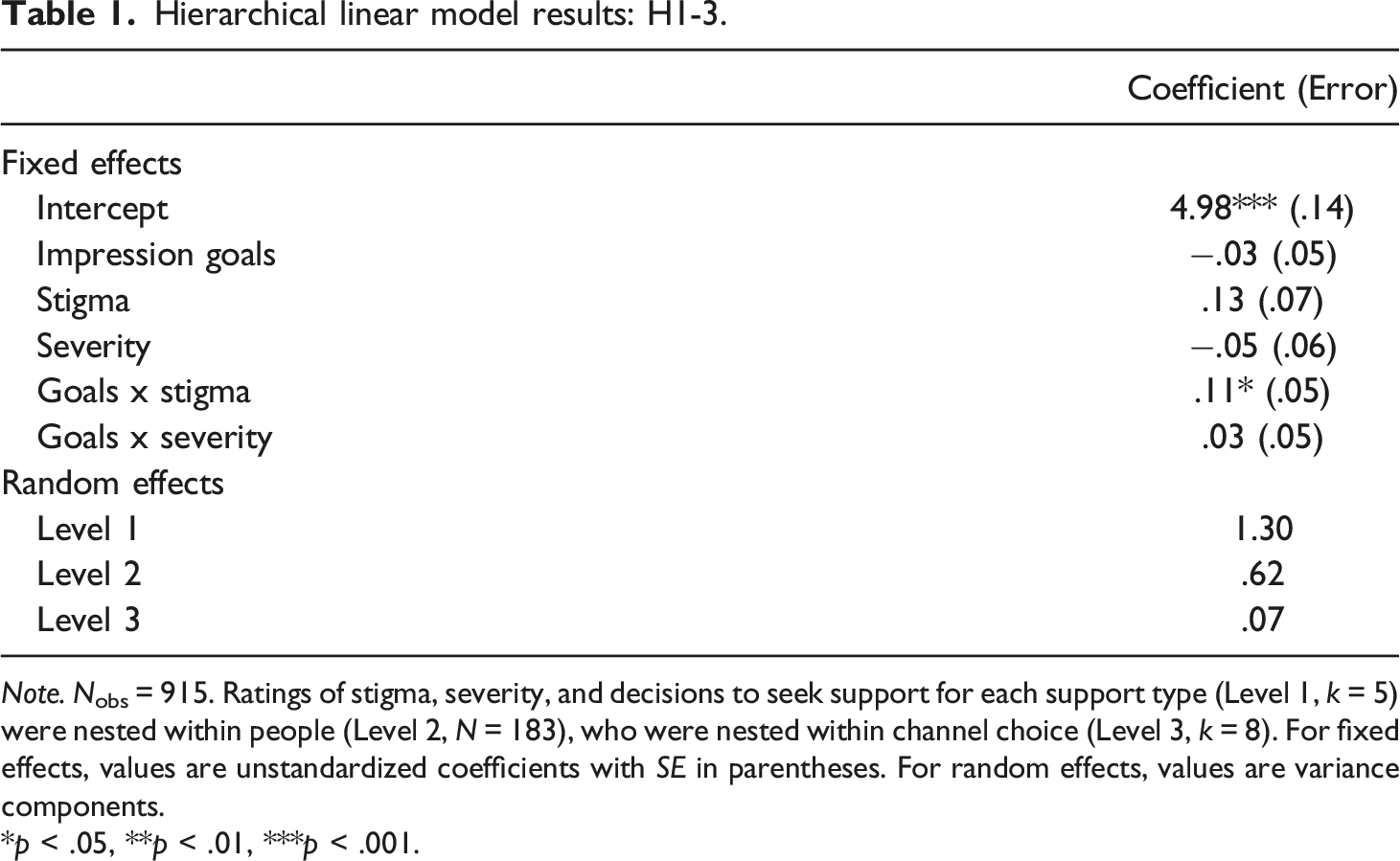
Note. Nobs = 915. Ratings of stigma, severity, and decisions to seek support for each support type (Level 1, k = 5) were nested within people (Level 2, N = 183), who were nested within channel choice (Level 3, k = 8). For fixed effects, values are unstandardized coefficients with SE in parentheses. For random effects, values are variance components.
*p < .05, **p < .01, ***p < .001.
The results revealed that neither the main effect of impression goals (unstandardized B = −.03, p = .59) nor the goals-severity interaction term (unstandardized B = .03, p = .58) had a significant impact on comfort with seeking support. The goals-stigma interaction term did have a significant effect (unstandardized B = .11, p = .02), but it was in the direction opposite of what was hypothesized (see Figure 1). Although impression goals had the expected negative effect on comfort with seeking support when perceived stigma was low, this effect weakened and then became positive as perceived stigma increased. As a result, those with high impression management goals appeared to be more comfortable seeking support for more stigmatized problems than for less stigmatized problems. Thus, the results did not provide support for H1-H3.
6
Marginal Effects Plot: Impression x Stigma Interaction Effect.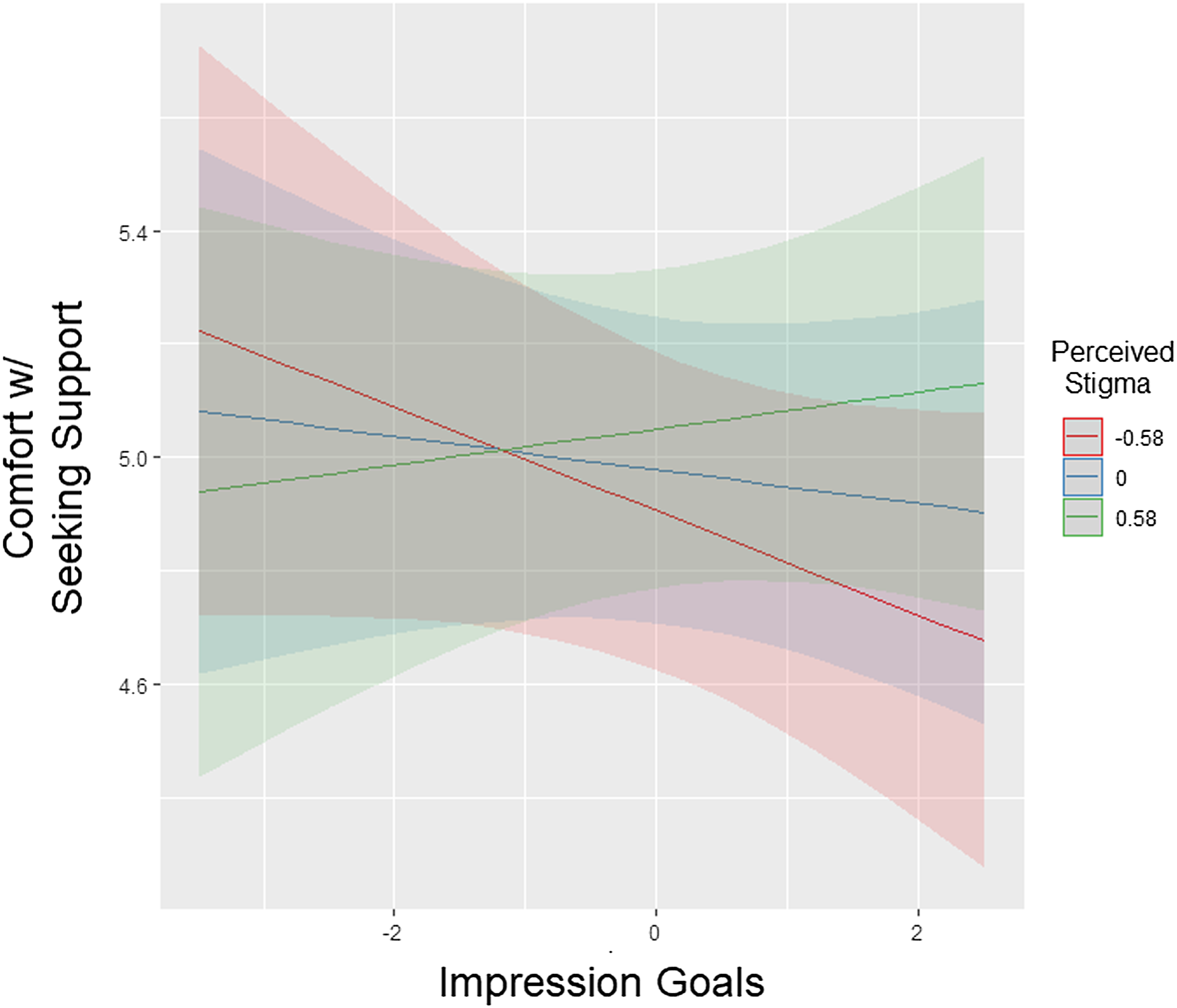
Affordances
Hierarchical linear model results: H4, RQ1.
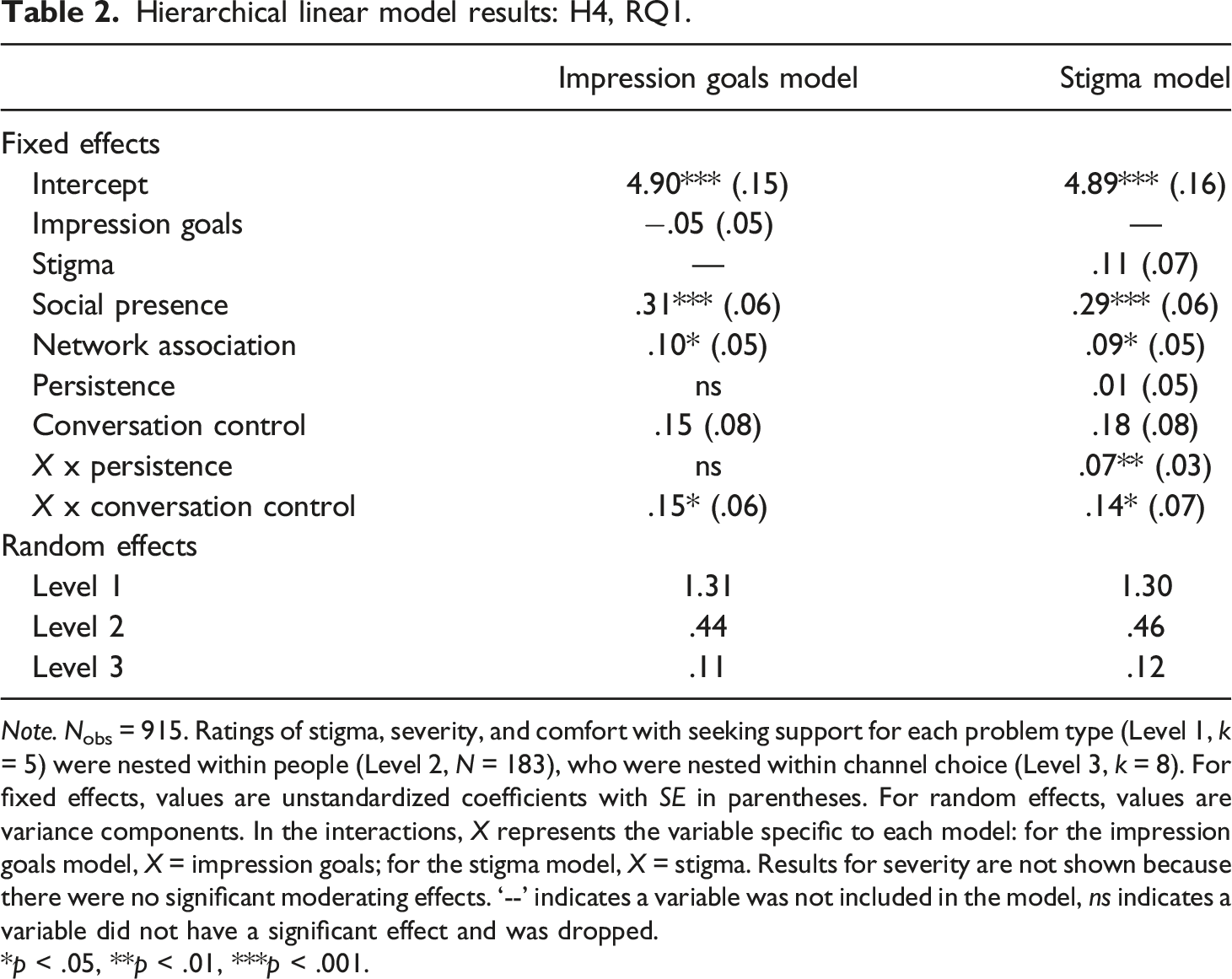
Note. Nobs = 915. Ratings of stigma, severity, and comfort with seeking support for each problem type (Level 1, k = 5) were nested within people (Level 2, N = 183), who were nested within channel choice (Level 3, k = 8). For fixed effects, values are unstandardized coefficients with SE in parentheses. For random effects, values are variance components. In the interactions, X represents the variable specific to each model: for the impression goals model, X = impression goals; for the stigma model, X = stigma. Results for severity are not shown because there were no significant moderating effects. ‘--’ indicates a variable was not included in the model, ns indicates a variable did not have a significant effect and was dropped.
*p < .05, **p < .01, ***p < .001.
In the analysis of impression goals, only conversation control had a significant moderating effect (unstandardized B = .15, p = .01), such that impression goals had the expected negative association with comfort with seeking support when conversation control was low, but this relationship weakened and then became positive as perceived conversation control increased (see Supplemental Materials, Figure S2). Overall, the result was that conversation control tended to increase comfort with seeking support when impression goals were high, but decrease comfort with seeking support when impression goals were low.
Only persistence (unstandardized B = .07, p = .04) and conversation control (unstandardized B = .14, p = .04) had significant moderating effects on stigma. For both affordances, the nature of the interaction was such that perceived stigma had no association with comfort with seeking support when the affordances were low, but this effect became increasingly positive as affordances increased (see Supplemental Materials, Figures S3–S4). Thus, both persistence and conversation control appeared to facilitate support seeking for more stigmatized problems. In the analysis of severity, none of the affordances had significant moderating effects. Overall, H4 was thus partially supported with regards to conversation control, but not supported with respect to the other affordances, and persistence had the opposite effect as what was predicted. For RQ1, the results indicated that social presence did not moderate any of the tested relationships.
Discussion
The goal of the present study was to assess the factors that inhibit support seeking among college students (e.g., stigma, problem severity, impression goals), as well as the factors that help them overcome those barriers (preferred TMCCs and corresponding affordances). Understanding and mitigating barriers to support-seeking is particularly valuable, given that supportive communication improves mental and emotional well-being among people facing distress (Cohen & Wills, 1985). This is particularly valuable for college students, who tend to face ever-increasing levels of mental and emotional distress (Duffy et al., 2019; Gulliver et al., 2010; National Institute of Mental Health, 2022; Zhang, 2017).
Results revealed that impression goals had no main effect on comfort with seeking support via TMCCs, nor was this relationship moderated by problem severity. Although the interaction of stigma and impression goals did have a significant impact, it was in the opposite direction of what was predicted. The results suggested that channel affordances may play an important role, as both persistence and conversation control appeared to facilitate support seeking among those with strong impression concerns and for those facing stigmatized problems.
Theoretical Implications
These findings hold implications for scholarship on supportive communication, impression management, and mediated interactions. First, the finding that impression goals did not have a main effect on comfort with seeking support contradicts previous research which identified impression management as a concern when disclosing distress (Albrecht & Goldsmith, 2003; Lim et al., 2013; Oh & LaRose, 2016; Zhao et al., 2021). This may have occurred because participants in this study were limited to individuals who had already sought or considered seeking support via TMCCs. Thus, this sample may have been more comfortable seeking support via TMCCs than would a more general sample. If so, this suggests that future research on how impression goals influence support seeking would benefit from distinguishing between those who have sought support in the past (referred to here as ever-seekers) from those who have not (never-seekers).
Another reason why impression goals and problem severity may not have had the expected impact is that we allowed participants to choose their most preferred channel for seeking support. Several studies examining impression goals on support-seeking have focused on specific (semi-)public SNS platforms (Buehler et al., 2018; Oh & LaRose, 2016), but our results revealed that very few people would choose an SNS for seeking support. This is an interesting finding given that previous research has listed SNS platforms as particularly popular among college students (e.g., Facebook; Moreno et al., 2011), and other research suggests that college students’ stressors are mitigated by self-disclosures of distress via an SNS (Zhang, 2017). It may be that previous findings about the strong effects of impression goals for these SNS platforms (e.g., Buehler et al., 2018) reflect artifacts of design; it may not be support-seeking that activated concerns about impression management in previous studies, but rather the idea of disclosing distress on platforms where one would not do so in reality. Future studies incorporating channel selection or matching samples to their preferred channels would be helpful in examining this possibility.
The nonsignificant main effect of impression goals may also explain why the moderating effect of stigma was in the direction opposite of our prediction. Because disclosing distress about stigmatized problems is riskier than disclosing less stigmatized problems (Goffman, 1963; Goldsmith & Parks, 1990; Smith, 2007; Smith et al., 2008; Yeshua-Katz et al., 2020), it is possible that ever-seekers who experience stigma have already thought about channels they are comfortable using to craft support-seeking messages. Indeed, findings might be very different for never-seekers and for those facing the prospect of seeking support on a non-preferred channel. It is also possible that our results regarding stigma and comfort with support seeking represent a limitation of our sample, such that college students’ perceptions of stigma towards our example problems might be lower, compared to either other populations or other example problems. For example, college students may feel more comfortable asking others for financial resources (i.e., tangible support) compared to other age groups. In this case, perceptions of stigmatized problems may be influential beyond impression goals or channel selection and affordances when seeking support.
The findings also have implications for the affordances literature. Affordances that had significant moderating effects in this study were persistence and conversation control, both of which facilitated support seeking among college students facing barriers to disclosure (high impression goals and high stigma). Whereas this effect is largely as we would expect concerning conversation control and impression management, it is not consistent with previous work on persistence (e.g., Fox & McEwan, 2017; Stoycheff, 2016). Rather, persistence has been expected to inhibit support seeking because of concerns that audiences can return to messages and make judgements later on (Stoycheff, 2016). One possible explanation is that our finding reflects between-channel differences rather than within-channel differences. Among the popular channels for seeking support in this study (phone, text, video chat, and Snapchat), texting was the highest in perceived persistence (M = 6.18, SD = .86). Thus, it is possible that the apparent positive effect of persistence is merely an artifact of the fact that college students with concerns about stigma and impression management feel more comfortable seeking support via texting than with other popular options. Thus, future research should explore more precise connections between affordances and specific types of support (e.g., tangible, emotional). It could also be the case that affordances sometimes conflict, such that several action possibilities are available in a given platform, yet a person’s preference for one of them outweighs their concerns about (unwanted) others. In practice, someone seeking support may accept some degree of unwanted persistence or conversation control because other affordances are particularly desirable. Though our research is a first step toward connecting perceived affordances of TMCCs and the five types of support defined by Cutrona and Russell (1990), more studies are needed to uncover relationships between different TMCC affordances and types of support.
Practical Implications
The results also offer practical implications for overcoming barriers to seeking support–including impression management goals and stigmatized problems–thereby promoting mental and emotional well-being among college students. Because SNSs were surprisingly unpopular for seeking support, and there was no main effect of impression goals on comfort with seeking support as reported in research solely including SNSs (e.g. Buehler et al., 2018), TMCCs outside of SNSs might be recommended for those with impression management concerns or stigmatized problems. Alternatively, the results suggest it may be that practice makes perfect among those concerned about impression management or stigmatized problems. The participants in our sample had already sought or considered seeking support recently, which may account for limited effects of impression management goals. Additionally, college students may simply be more experienced with seeking support via TMCCs compared to other groups because they are often geographically separated from network ties who they would otherwise interact with in face-to-face settings. Given the importance of channel selection in this study and the moderating role of persistence and conversation control, never-seekers may be encouraged by hearing about the advantages of certain channels for seeking support. For instance, ever-seekers might simply look back at previous, saved messages in channels with high persistence to reduce stigmatization that could result from new attempts at seeking support (e.g., Özkul & Humphreys, 2015). Such support-seeking might promote mental and emotional well-being in novel ways for never-seekers (Cohen & Wills, 1985).
Strengths, Limitations, and Future Research
Our study examines some of the factors associated with comfort with seeking support via TMCCs, but findings should be interpreted in light of its strengths and limitations. A strength of the study was permitting participants to respond about their preferred channel for hypothetically seeking support, which was more realistic than restricting participants to any particular channel. This choice possibly contributed to several unexpected findings that may not have emerged otherwise. However, future research can differentiate channel selections based on support type to extend our findings, with particular consideration to populations beyond undergraduate students. Also, future research can extend our findings using a longitudinal design to track whether real-world channel selections reflect participants’ reported preferences. Our study is limited by the lack of clarification from participants about whether they have previously used–or eventually will use–their preferred channel as reported here for seeking support.
Our measure of impression goals also presents a limitation due to the language of “posting” content via TMCCs, within the survey items. This language appears to address how (support-seeking) content is shared via SNSs, excluding more direct methods of sharing messages via other TMCCs (e.g., text messaging). While the impression goals items were presented after preferred channels were selected, this language could have made the impression goals item appear inapplicable to their selected channel. Additional measurement work on these scales that broadens the language to apply to more diverse channels would be worthwhile for addressing this issue in future research.
Another strength of the study was our use of the language of “mental and emotional distress,” which was included to reduce the chances of inadvertently ascribing labels or stigma to participants’ experiences (Johnstone, 2001). However, this use of “mental and emotional distress” limits the extent to which we can fully address well-being, as we did not include a direct measure of well-being outcomes.
The present study is also limited by not accounting for specific relational partners (friends, siblings, etc.) and any previous face-to-face or mediated interaction with them, both of which might influence channel preferences when seeking support. Future research can extend our findings by asking participants in a questionnaire whether they were thinking of specific people when they choose a preferred channel. To further address whether and how students’ support-seeking via TMCCs may be influenced by specific network members, the affordance of personalization (Fox & McEwan, 2017) could also be considered in future research to determine if the ability to distribute self-disclosures to specific others is perceived to be valuable when seeking support. Also, while participants’ preferred TMCC would presumably afford high accessibility, our omission of this affordance prevents us from providing corresponding evidence.
There are also limitations regarding our sample. We considered the college student population because college students report high levels of mental and emotional distress (Arsandaux et al., 2021; National Institute of Mental Health, 2022) while presumably valuing TMCCs for seeking support from geographically distant network ties. This sample also resembles similar studies investigating the influence of impression management concerns and seeking support via mediated platforms (e.g., Oh & LaRose, 2016). However, we encourage future research to expand on our results by including samples outside of the college student population because we cannot infer that our findings would generalize to other groups. Similarly, we cannot determine how variables such as sexual orientation, disability status, socioeconomic status, or education may impact the relationships of interest. Finally, the study captured variables at only one moment in time, in only one channel per participant. Thus, we cannot make claims about causality, or how goals, perceptions, and support seeking might change over time.
Conclusion
This study provides insight into important barriers to support seeking among college students, including impression management, problem severity, and perceived stigma. The findings indicate that when individuals are able to use their preferred channel for seeking support, those with high impression goals are generally comfortable with seeking support, and this is especially the case for those facing problems with higher perceived stigma and for those using channels with high persistence and conversation control. While these findings did not align with our predictions, they point to the practical and theoretical importance of channel selection for impression management and seeking support.
Supplemental Material
Supplemental Material - Seeking support via mediated channels: The roles of impression goals, stigma, severity, and perceived affordances
Supplemental Material for Seeking support via mediated channels: The roles of impression goals, stigma, severity, and perceived affordances by Daniel A. Lee, Shannon M. Cruz, Kelly Sweeney, and Rachael E. Bishop in Journal of Social and Personal Relationships
Footnotes
Declaration of conflicting interests
The author(s) declared no potential conflicts of interest with respect to the research, authorship, and/or publication of this article.
Funding
The author(s) disclosed receipt of the following financial support for the research, authorship, and/or publication of this article: This work was supported by the National Center for Advancing Translational Sciences of the National Institutes of Health Award Number TL1TR002016. (Award Recipient: Rachael E. Bishop).
Disclaimer
Research reported in this publication was supported by the National Center for Advancing Translational Sciences of the National Institutes of Health Award Number TL1TR002016. The content is solely the responsibility of the authors and does not necessarily represent the official views of the NIH.
Open research statement
As part of IARR’s encouragement of open research practices, the authors have provided the following information: This research was not pre-registered. The data used in the research can be publicly posted. The data can be obtained at:  . The materials used in the research can be publicly posted. The materials can be obtained at: https://osf.io/wxdpq/?view_only=ff64c9a3d14742a7a98742e482c4391d or by emailing:
Supplemental material
Supplemental material for this article is available online.
Notes
References
Supplementary Material
Please find the following supplemental material available below.
For Open Access articles published under a Creative Commons License, all supplemental material carries the same license as the article it is associated with.
For non-Open Access articles published, all supplemental material carries a non-exclusive license, and permission requests for re-use of supplemental material or any part of supplemental material shall be sent directly to the copyright owner as specified in the copyright notice associated with the article.
