







Abstract
Within the United States, 1 in 4 women and 1 in 10 men experience intimate partner violence (IPV): psychological aggression, sexual violence, physical violence, and/or stalking from an intimate partner. Although some studies highlight the complexity of post-IPV recovery, the role of communication in post-IPV recovery remains underexplored. This study employs Communication Theory of Identity (CTI) to analyze in-depth interviews with post-IPV adults. Analysis reveals how individuals negotiate post-IPV identity gaps between the personal-personal and personal-relational layers of identity. The forwarded concept of identity veiling explicates how IPV tactics cause the relational layer of identity to eclipse the personal layer in IPV relationships. Therefore, post-IPV recovery involves unveiling the personal layer of identity—communicatively (re)constructing self-image beyond the IPV relationship and the identity gaps it engendered. This study conceptualizes the role of violent communication in the construction of identity gaps and identity gap negotiation.
Keywords
The dark side of interpersonal communication represents communicative phenomena that are dysfunctional, destructive, and implicated in human exploitation (Spitzberg & Cupach, 1998), including intimate partner violence (IPV). Although IPV is a global issue, within the United States, “about 1 in 4 women and 1 in 10 men experienced contact sexual violence, physical violence, and/or stalking by an intimate partner and reported an IPV-related impact during their lifetime” (Smith et al., 2018, p. 7). A true reflection of the number of individuals experiencing or having previously experienced IPV is unclear, and actual IPV rates are most likely much higher.
IPV research has substantial room to grow within the field of communication, where scholarship can uncover the discursive and relational processes that facilitate IPV and IPV recovery. This research is vital because IPV remains under-studied and under-resourced. In 2020, the National Network to End Domestic Violence (NNEDV) indicated that within a single 24-h timeframe, 76,525 adults and children utilized emergency shelters, housing, or non-residential services (e.g., legal advocacy, support groups, crisis support) due to IPV. Additionally, 21,321 hotline contacts were received, or almost 15 contacts every minute. However, 11,047 requests for services within those 24 h went unmet due to a lack of resources, highlighting the necessity of IPV advocacy and scholar-activism.
Research on IPV recovery spans several disciplines, including nursing (e.g., Crann & Barata, 2016; Wuest & Merritt-Gray, 1999, 2001), social work (e.g., Allen & Wozniak, 2010), and psychology (e.g., Flasch et al., 2017). Previous work has examined the adverse psychological effects of IPV (Breiding et al., 2015), help-seeking behaviors associated with IPV (O’Doherty et al., 2015), and the stigma of IPV (Crowe & Murray, 2015; Overstreet & Quinn, 2013). Many studies are innovative but are limited to atheoretical and phenomenological approaches (e.g., Farrell, 1996; Flasch et al., 2017; Hou et al., 2013). We draw from previous communication studies on IPV (Dunbar & Burgoon, 2005; Olson, 2004; Palazzo & Roberto, 2011; Utley, 2017) and extend this literature by analyzing IPV recovery with communication theory. Further, fewer studies have diversified the research on IPV recovery beyond the boundaries of the U.S. (Hou et al., 2013; Ko & Park, 2020). The current study contributes to this literature with a sample of participants residing inside and outside of the U.S.
The present research asks how individuals experience and negotiate identity gaps after leaving violent relationships. First, we overview the literature on IPV and Communication Theory of Identity (CTI). Second, we describe our methodology. Third, we detail our findings on identity veiling and identity gap negotiation. Finally, we discuss implications, limitations, and future research.
Intimate partner violence
Defining intimate partner violence
IPV is “physical violence, sexual violence, stalking, and psychological aggression (including coercive tactics) by a current or former intimate partner” (Breiding et al., 2015, p. 11). IPV tactics include coercion and threats, intimidation, emotional and economic abuse, male privilege, minimizing, denying, blaming, isolation, and using children to manipulate a partner (Pence & Paymar, 1993). Intimate partners may be romantic and/or sexual, ranging from spousal and dating relationships to more casual relational contexts such as “hooking up” (Smith et al., 2018). Prior IPV research has predominantly focused on cisgender, heterosexual relationships, but IPV can occur in partnerships of all gender identities, gender expressions, and sexual orientations.
According to the 2015 National Intimate Partner and Sexual Violence Survey (NISVS), within the United States, 1 in 4 women and 1 in 10 men, regardless of their sexual orientation, experienced IPV (sexual violence, stalking, physical violence, psychological aggression) and/or and IPV-related impact, such as concern for safety, need for legal/medical services, or missing work/school (Smith et al., 2018). This survey revealed psychological aggression (e.g., intentionally harmful communication and behaviors of coercive control) as the most prevalent form of intimate partner victimization in the U.S., followed by physical violence. Further, more than 21% of women indicated they experienced severe physical violence by an intimate partner during their lifetime, compared to 14.9% of men.
This gender asymmetry was also found in the lifetime prevalence of contact sexual violence by an intimate partner (i.e., unwanted sexual contact, sexual coercion, and rape, whether completed or attempted). More than 18% of women and 8.2% of men reported these experiences nationwide, and 10.4% of women in the U.S. reported experiencing stalking in their lifetime, compared to 2.2% of men. Within queer relationships, the CDC reported that 44% of lesbian women, 61% of bisexual women, 40% of gay men, and 47% of bisexual men had experienced rape, physical violence, and/or stalking by an intimate partner (Walters et al., 2013). These statistics highlight the importance of studying IPV in diverse relational contexts.
Communicating IPV recovery
IPV recovery broadly includes recovery of the self, relationships, and communities after experiencing violent relational trauma. This crucial period is linked to low health and social outcomes (Beck et al., 2014). Previous studies have examined the intricacies of post-IPV recovery through the lens of a journey (Smith, 2003), a rite of passage (Allen & Wozniak, 2010), and a system of processes and support (Lewis et al., 2015). Merritt-Gray and Wuest (1995) posited a reclaiming self model, which reflects the socio-psychological intricacies of post-IPV recovery in four stages: (1) counteracting abuse, (2) breaking free, (3) not going back (Wuest & Merritt-Gray, 1999), and (4) moving on (Wuest & Merritt-Gray, 2001). Farrell’s (1996) theorization established four similar themes: (1) flexibility, (2) awakening, (3) relationship, and (4) empowerment.
Flasch et al.’s (2017) triumph process model of overcoming IPV provides an entry point into a communicative perspective of post-IPV recovery. This model details both interpersonal processes (e.g., building positive social support networks) and intrapersonal processes (e.g., regaining and recreating one’s identity) involved in recovery. Building from this, we conceptualize IPV recovery as a communicative process and use communication theory to do so.
Communication theory of identity
CTI theorizes the co-constitutive nature of communication and identity (Hecht, 1993). This theory asserts that identity is constructed and managed through personal, relational, enacted, and communal layers of identity that are interlocking and mutually influencing. CTI has been used to uncover the relationship between identity and communication in various contexts, particularly concerning stigmatized identities. For example, recent CTI studies have investigated LGBTQ + college students (Trinh & Faulkner, 2023), non-normative sexual partners (Rubinsky, 2021), identity reconstruction after losing a spouse (Wehrman, 2023), and identity negotiation in the context of substance abuse (Crowley & Miller, 2020). CTI is useful for uncovering discrepancies, negotiations, and alignment between identity facets that continually change.
The enacted layer of identity occurs through an individual’s behaviors and messages within social interactions (Hecht, 1993). For example, individuals who engage in IPV activism are enacting their identities. The communal layer of identity reflects group memberships (Hecht et al., 2005) and broader societal definitions of identities (Hecht & Phillips, 2022). For some people, IPV support groups establish their communal identity along with affiliations with spiritual, racial, or cultural groups. Most relevant to this article are the personal and relational layers. The personal layer of identity reflects an individual’s self-image, self-definition, and preferred identity labels (Hecht, 1993). This layer of identity constitutes a self-concept and is a “source of expectations and motivations” (Hecht, 1993, p. 79). Post-IPV individuals may define themselves as a victim, survivor, or neither. The relational layer of identity is negotiated within social interactions and relationships. The relational layer exists within three separate yet interconnected levels: An individual’s relational identity is established by and through social interaction with others; individuals identify themselves regarding their relationships with others; and relationships are units of identity in themselves (Hecht et al., 2005). Within many IPV relationships, abusers often use isolation and manipulation to remove their partners from outside social support systems and increase their own relational influence. As a relational phenomenon, IPV fundamentally implicates this layer of identity within violent communication.
Finally, identity gaps are discrepancies or dialectical contradictions that occur between layers of identity (Jung & Hecht, 2004) or within a single layer (Colaner et al., 2014). Identity gaps are negatively correlated with communication satisfaction, feeling understood, and communication appropriateness (Jung & Hecht, 2004). Like the post-IPV recovery period (Beck et al., 2014), identity gaps are associated with negative social and health outcomes (Faulkner & Hecht, 2011; Jung & Hecht, 2008; Nuru, 2014). Therefore, it is vital to understand how people who have experienced IPV negotiate identity gaps because successful or unsuccessful identity gap negotiation directly impacts their health and wellness outcomes in the post-IPV period. To examine the relationship between post-IPV individuals and identity gaps, we ask the following research questions:
How, if at all, do individuals who have previously experienced intimate partner violence experience identity gaps?
How, if at all, do individuals who have previously experienced intimate partner violence negotiate identity gaps?
Methodology
Grounded theory
We answer Ungar’s (2004) call for more qualitative approaches to IPV, which enables researchers to understand participants’ lived experiences, produce praxis-oriented research (Tracy, 2013), and provide a platform for marginalized individuals. Specifically, this article employs Charmaz’s (2014) constructivist grounded theory (CGT), an extension of previous iterations of grounded theory (Glaser & Strauss, 1967; Strauss & Corbin, 1990) that focuses on constructing theory through qualitative data. CGT is committed to the co-construction of knowledge. Therefore, participants’ lived experiences were integral to producing theoretical knowledge about IPV recovery and identity gaps.
In-depth interviews
Using purposive and criterion-based sampling (Lindlof & Taylor, 2019), Author 1 gathered open-ended, in-depth interviews (Kvale & Brinkmann, 2009). The interview protocol utilized the assumptions of Hecht’s (1993) CTI and allowed participants to elaborate on their post-IPV selves, relationships, and perspectives. To partake in this study, participants had to (a) be 18 years of age or older, (b) have previously experienced any form of IPV, (c) not currently be in a violent or abusive relationship, and (d) be an English speaker with at least intermediate proficiency. Participant recruitment involved several wide-scale social media posts and snowball sampling. Author 1 collected data until theoretical saturation (Charmaz, 2014) was reached with 22 participants.
Participants were located in the U.S. (n = 18, 82%), the United Kingdom (n = 2, 9%), Central Europe (n = 1, 5%), and Australia (n = 1, 5%). Their ages ranged from 18 to 53, with an average of 29. They self-identified their racial/ethnic background as white (n = 17, 77%), Latino/Hispanic (n = 3, 14%), and Asian (n = 2, 9%) and their gender as cisgender women (n = 18, 82%), gender non-conforming women (n = 1, 5%), and cisgender men (n = 3, 14%). Participants self-identified their sexual orientation as heterosexual (n = 14, 64%), bisexual (n = 5, 23%), gay (n = 1, 5%), queer (n = 1, 5%), and heteroflexible (n = 1, 5%). The length of time since IPV perpetration ranged from 4.5 months to 10 years, with an average of 3.2 years. Participants identified their post-IPV relationship status as being single (n = 7, 32%), in a relationship (n = 7, 32%), engaged (n = 2, 9%), married (n = 3, 4%), and casually dating (n = 2, 9%); one participant (n = 1, 5%) chose not to disclose whether they were currently in a relationship. Throughout the interviewing process, participants identified their abusers’ genders as cisgender men (n = 18, 82%) and cisgender women (n = 4, 18%).
After expressing interest in participating in this study, participants received a secure, digital, informed consent form. If a participant provided informed consent, they advanced to a short online questionnaire and designated their availability and preferred method of participation (e.g., phone or preferred video conference platform). Each interview was conducted in a private location, ranging from 60-90 min. Participants chose pseudonyms or had one randomly selected for them. Debriefing forms after the interview provided a list of local and national resources for individuals who have experienced IPV.
Analysis
In line with the tenets of Charmaz’s (2014) CGT, Author 1 utilized memoing and methods of constant comparison (Glaser & Strauss, 1967) to note emerging areas of theoretical interest during data collection. Data were analyzed through Charmaz’s (2014) process of open, focused, and theoretical coding. Emergent insights were first discovered during the initial coding phase and line-by-line coding. Next, Authors 1 and 2 began searching for symbolic terminology that captured participants’ post-IPV identities and identity gaps. Open coding resulted in 48 codes (e.g., “grief,” “I don’t know who I am anymore,” and “finding independence”).
After completing an initial coding scheme, we (Authors 1 and (2) generated a more focused coding scheme to synthesize the large amount of data. This collapsed the initial codes into 23 focused codes (e.g., “starting over,” “stronger now,” and “forgive myself”). Then, we employed theoretical coding (Charmaz, 2014) to synthesize overarching categories and clarify the relationships between the coding categories. Collaborative data analysis promoted rich dialogue between the two authors to produce agreed-upon interpretations and researcher reflexivity during analysis (Cornish et al., 2014).
Ethical considerations
Due to the sensitive nature of this study, the utmost care was given to participants’ confidentiality. This study was approved by Bowling Green State University’s Institutional Review Board. It also included an optional exit survey through which participants shared their views regarding participation, emotional reactions, evaluation of the study, and perceived benefits and drawbacks. Seventeen participants took the questionnaire, strengthening this study’s procedural ethics (Guillemin & Gillam, 2004).
Researcher reflexivity
Author 1: 1 I am a white woman who was raised in a family that experienced intergenerational IPV and I have committed my adult life to advocacy. I completed 18 h of advocacy fundamentals training through the Ohio Domestic Violence Network. I was also a volunteer advocate with a local domestic and sexual violence agency, completing an additional 45 h of training to provide legal and medical advocacy, crisis support, and safety planning for survivors of IPV.
Author 2: 2 I am a Black woman whose extended family has experienced intergenerational IPV. As an interpersonal and family communication scholar, I have served on two research teams focused on interpersonal violence and have used trauma-informed techniques to interview people affected by IPV.
Results
Within the results, we describe how identity veiling (Figure 1) emerged as a concept that extends our understanding of IPV’s impact on the personal and relational layers. Next, we explicate how participants experienced the personal-personal gap and negotiated it through pursuing acceptance and pursuing body, mind, and spirit. Finally, we detail how participants experienced the personal-relational gap and negotiated it through (re)claiming narrative and expressive control. Identity veiling. As part of IARR’s encouragement of open research practices, the author(s) have provided the following information: This research was not pre-registered. The data used in the research are not available. The materials used in the research are not available.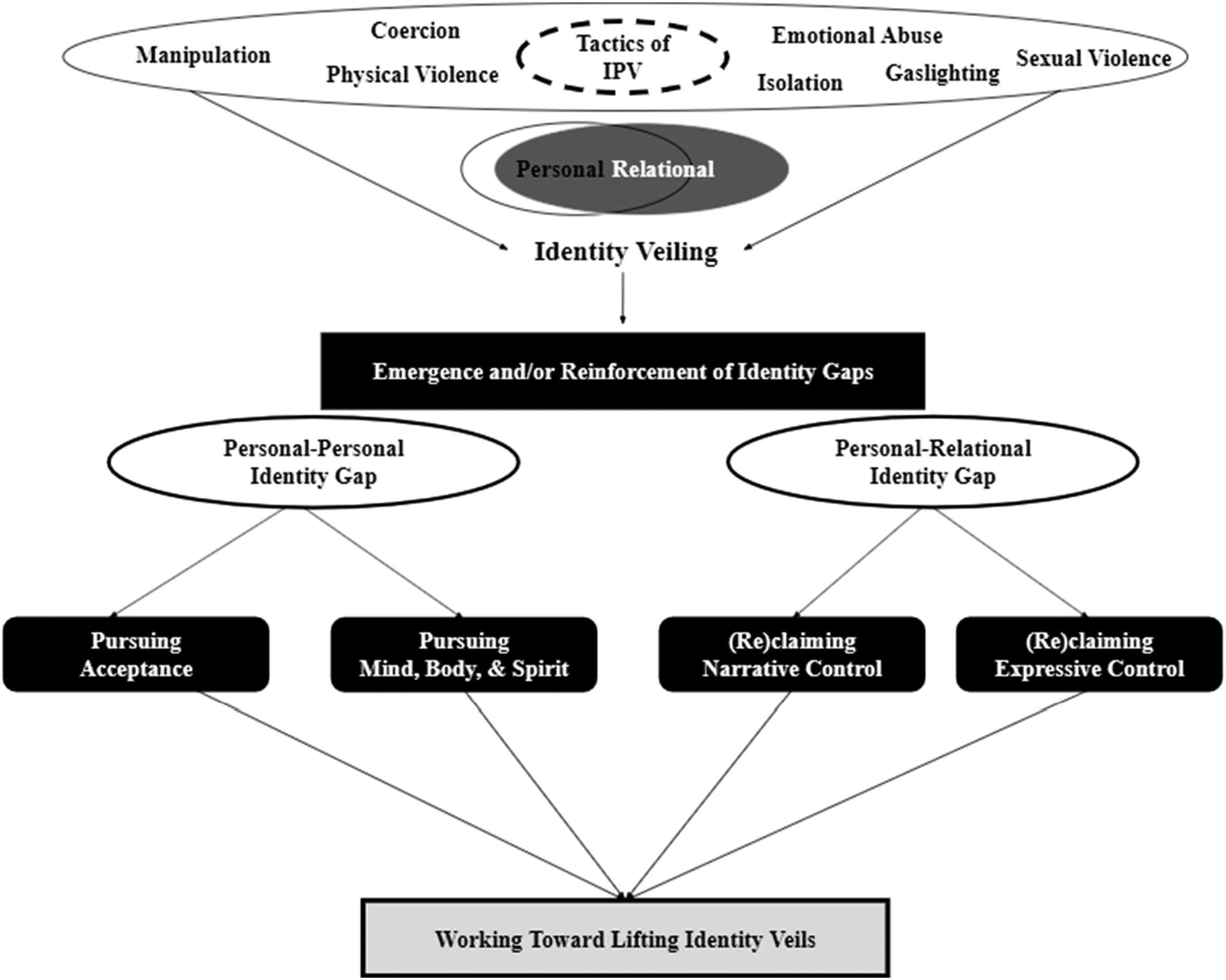
Identity veiling
Although this study examined identity gaps, a central finding was a closely related but distinct concept that we term identity veiling. Identity veiling describes how, within an IPV relationship, the relational layer can eclipse the personal layer in ways that make it difficult to communicate, construct, or negotiate the personal layer of identity. For participants, IPV tactics caused a chronic underdevelopment of the personal layer of identity and an overdevelopment of the violent, relational layer. Identity veiling encapsulates how the relational layer became enmeshed with the personal layer and was the primary mechanism through which many participants understood their sense of self.
Drawing from Minuchin’s (1974) structural family therapy research, enmeshment describes how interpersonal boundaries within families become severely diffused through high levels of communication and little to no distance and differentiation between family members. Similarly, IPV tactics caused the personal layer of identity to become enmeshed with the relational identity of/with the abuser, making it difficult to differentiate the two. This affirms previous scholars, such as Olson (2004) and Fletcher (2018), who discussed the enmeshment of their relational and personal identities in their autoethnographic accounts of IPV. As Fletcher (2018) explained, “During the [violent] relationship, I struggled to see myself as a full person separate from him” (p. 252).
Identity veiling is an experience that describes—not the erasure of the personal layer—but the ways in which IPV tactics severely inhibit people from developing the personal layer of their identity while the relational identity of/with the abuser remains dominant. The current study did not focus on asking participants about the IPV tactics perpetration used against them; however, interviews uncovered that a culmination of IPV tactics made it difficult for people to communicate with themselves or other people about who they were. For Natasha, tactics included her abuser’s control and how he had “gotten into…[her] mind.” For Henry, this encompassed extreme co-dependence, and for Sierra, it involved rape. Though subject to various types of violence, participants expressed similar experiences with the relational layer overshadowing the personal layer.
Identity veiling emerged as a concept because participants described (1) the predominance of the relational layer, (2) the minimization of the personal layer, and (3) the need to rebuild a personal layer separate from their previous relational layer in the post-IPV recovery period. Many participants noted that their relational identities became their personal identities while experiencing IPV perpetration. As Indigo said, “Before the breakup, I was pretty much defined by the relationship and fitting into the things somebody else wants you to be [emphasis added].” Lorelai shared a similar feeling, saying: I feel like so much of my identity, and I mean, this is a part of the abuse, but so much of my identity was wrapped up in [his]. I met him just a couple of months after my fifteenth birthday, and we were in a relationship for eight years. He was a massive part of my life.
Lorelai and her partner were high school sweethearts who would eventually marry, a relationship in which she experienced aggression, deception, and narcissistic abuse. From being routinely “cooped up inside the house” to being berated for ADHD symptoms, Lorelai began to understand herself through her abuser’s perceptions of her. In a catalyst moment in IPV recovery, Lorelai embarked on a trip to the Pacific Northwest, where she cried out to God, asking, “Can you please tell me who I am, what I am supposed to do?” Lorelai’s violent personal layer was so veiled that it was difficult to understand who she was. On the road to IPV recovery, she began rebuilding her self-image with spiritual help. Leah told a similar narrative: I’ve seen the full spectrum. I have been emotionally manipulated. I’ve been physically manipulated. I’ve been coerced. I have been forced to take things and do things that I didn’t want to do…Definitely, I’ve had my life threatened. I’ve been cornered.
After leaving this abusive relationship, Leah recalled telling close friends, “I don’t know who I am. I don’t know what my personality is. I don’t know anything about myself because he had that much control over every aspect of my personality [emphasis added].” Leah had to rediscover her personal layer because her relational identity with their violent partner had been all-encompassing. Like Lorelai, Leah described how these experiences left a “blank slate, ground zero” for constructing a sense of self post-IPV. In other words, the relational layer veiled the personal layer and began to be unveiled during the post-IPV period.
A variety of IPV tactics created the identity veil, including the way abusers isolated their partners, controlled their lives, and manipulated them into distorted views of themselves. Lana faced intimidation and economic abuse, among other forms of abuse, and her partner made it difficult for her to understand who she was outside of him. She explained: It was hard because I really did internalize everything that he said to me. I took it to heart and I really thought I was a shitty, selfish, awful person. At first, I would text friends, and I'd be like, “Am I a piece of shit? Am I selfish? Can you please help me?” But he had me so isolated, I didn't have any friends anymore. I wasn't allowed to talk to anyone. I wasn't even allowed to have my iPhone.
Isolation and manipulation made it difficult for Lana to construct an accurate view of who she was. Her partner’s ascriptions of her (e.g., lazy, awful) became central to her understanding of self, and it was difficult to determine if those were true descriptors of herself. When she left the relationship, she said: I’m just kind of finding out who I am now. What do I like to do, because when I was living with my ex, I couldn't leave the apartment; No friends; I couldn't see my family…So, when I left, I was like, I don't know what I like to do. What are my hobbies?
What Lana experienced was not just a gap between her personal identity and her relational identity. Instead, it was an intentional and sustained diminishing of her personal identity that made it difficult for her to communicate with herself or others about her self-image. Simultaneously, her relational layer was the primary frame through which she understood herself. Significantly, other components of her relational layer (e.g., friends and family) were also underdeveloped, leaving a relational layer primarily composed of her violent relationship. As a result, the post-IPV period remains vital for Lana’s reconstruction of herself, a process that Jacob summarized as an “identity crisis.”
Identity veiling varies from a personal-relational identity gap because an identity gap does not posit that the personal layer is subsumed by the relational layer. For example, Jung & Hecht (2008) studied the personal-relational identity gap of Korean immigrants, exploring how the gap emerges “when members of other ethnic groups make ascriptions to a Korean immigrant [relational] that do not match his or her own self-images in communication [personal]” (p. 319). In this research, the participants have personal and relational identities that are inconsistent, but the relational layer does not eclipse the development of the personal layer. Our results extend this view by showing that the trauma of IPV creates an uneven construction of the layers of identity in which the relational layer becomes the dominant frame for understanding even the personal layer. If identity is constitutive of communication, as CTI posits, then long-term violent communication can disproportionately construct layers and cause the relational layer to eclipse the personal.
In summary, identity veiling conceptualizes the troubling phenomenon during IPV perpetration of an overdeveloped, violent relational layer and an underdeveloped personal layer that is overshadowed by the relational layer. As a result, during post-IPV recovery, many people who experience IPV must search for a personal and relational identity outside of their abusers. The following sections describe how identity veiling created and reinforced the personal-personal and personal-relational identity gaps.
Post-IPV personal-personal identity gap
A personal-personal identity gap is characterized by internal conflict, which may include tensions or discrepancies between a person’s past, current, and ideal self-image and self-cognition. As described previously, identity veiling makes constructing a well-defined sense of self difficult. This exacerbated the personal-personal identity gap, which participants described as the cognitive clash between how they understood their personal identities before, during, and after their IPV relationship. Lorelai said: I used to have a little bit more vitality about me to just get up and get things accomplished. So, that is something that I have struggled with...I do feel like I have a lot more anxiety on the inside.
Lorelai’s experiences with identity veiling left so much of her identity “wrapped up in [her abuser’s identity]” that she had difficulty understanding who she was. She articulates the resulting personal-personal gap as a struggle to reconcile who she was before and after the IPV relationship. Whereas she used to define herself as an energetic person, now her self-definitions involve anxiety. Similarly, Jolene shared her conflicted feelings about who she was before and after the abuse. She said: It fundamentally changed the trajectory of my life. I can’t get back to me. I don’t want to be what 19/18-year-old me was, but at the same time, I wanted to get back to me. I didn’t feel like myself... I had to grieve who I was. I had to grieve my innocence lost.
Jolene expressed a deep disconnect within the personal layer of her identity. Her post-IPV recovery period involved reconciling disparate versions of herself through a grieving process. Grace echoed these sentiments, describing her ongoing “fight” with different versions of herself. Whether characterized as a journey of grief or an internal battle, the personal-personal identity gap was a prominent post-IPV experience, as participants navigated discrepancies between their past, present, future, and ideal selves.
Pursuing acceptance
The first way participants negotiated the personal-personal gap was by pursuing acceptance. This theme encompasses their internal labor to reconstruct the personal layer by offering themselves acceptance through compassion, grace, and forgiveness. Participants’ experiences were varied but they worked toward accepting their past selves and the survival tactics they used during IPV perpetration. Doing so minimized the personal-personal gap by relieving their sense of guilt and shame. Sierra shared: The first time I was raped by my partner, I woke up, realized what was happening, fought him off. Good for me, but then I went to bed. I didn't leave. I didn't go anywhere. I didn't call the police. Then, I went to work the next day. As a kid, I would get hit at home for no reason, and then I would have to go to school and pretend like everything was normal. I had done that my whole life, and I realized that I had made those choices for a reason. While it isn't the most enlightening, it was the choice that I would make now as an adult. I just [think it’s important] to go back and reflecting on your experiences and forgiving yourself for whatever you did because it wasn't your fault.
For Sierra, acceptance meant understanding the relationship between her lifelong experiences with violence. Reflecting on the correlations, she chose not to blame herself, creating a more integrated personal layer post-IPV. Lana’s experiences align with Sierra’s. She said: It took a lot of time for me to be alone, self-reflect, and try to forgive myself for letting myself go through that...You need to forgive yourself for staying. That was a huge thing I had to work on in the beginning was forgiving myself for letting someone treat me like that for two years and thinking that I really deserved it.
While Lana compared herself pre- and post-IPV, Sierra discussed herself during and post-IPV. She ultimately extended herself forgiveness. In this way, participants communicated compassion to themselves at different stages of their lives. Henry summarized this by saying, “I’ve come to have more compassion for the person who was with him for that long and who got out when he did and that it was scary as hell to leave and figure things out.” The intentional extension of grace was vital to negotiating the tensions he felt within the personal layer.
Significantly, many participants chose to accept the very things (e.g., appearance, hobbies) their abusers weaponized against them. Lorelai’s partner verbally abused her because of her interest in fantasy fiction. She said, “Recognizing that what you love has worth to it is such a key part of healing. [My ex] attacked everything about me. [He] would say, ‘You’re so incredibly weird for liking this and this.’” During the IPV perpetration, her personal identity was veiled by his negative ascriptions of her. In the recovery period, she realized, “You need to recognize what you’re pursuing has worth at the same time that you don’t feel your worth.” Lorelai negotiated her personal-personal gap by affirming and acknowledging her interests.
Henry described his journey of self-acceptance as self-love, explaining that “in the moment, it was just this is fight or flight. This is survival. You need to do this. Looking back, I’m like it was, but that shows that you do love yourself to do that for yourself.” He reframed his survival as evidence of self-love, which Nina also did. She said: I feel bad about what I have done to survive, but at the same time, you know what? I had to do what I had to do. I can’t bash myself for that. That doesn’t make me a monster. That makes me have the will to survive. The will to live.
Like other participants, Nina and Henry rewrote their self-narratives. Moving from blame and shame, they offered grace to their past and present selves. Because identity veiling and the personal-personal gap often make it difficult for people who have experienced IPV to communicate about themselves even with themselves, this negotiation tactic was a significant way of rearticulating who they were, are, and will be.
Pursuing body, mind, and spirit
The second way participants negotiated the personal-personal identity gap was by pursuing their bodies, minds, and spirits. Although presented as separate categories for clarity, this subtheme conceptualizes the three components as interwoven and interdependent. Because the personal-personal identity gap involved distorted and contradictory views of self, participants negotiated this gap by reconstructing their post-IPV physical, mental, and spiritual selves. Jacob described how he attended to his physical health: I think what helped me a lot, I guess to empower myself, is working out again. […] I was like, I have to work on myself. I can’t just wait out here and expect something to happen. I just decided to be more proactive in myself. I think the incremental improvements you can see working out kind of helps you more solidify that there is progress happening with you, whether it's on a physical or mental scale, but of course, you can't visualize it mentally even look yourself in the mirror, but…I guess your mood is better when you feel more fit and just healthy.
Jacob also viewed his pursuit of a better physical condition as a way to improve his mental condition. Because he experienced depression and weight gain during IPV, physical activity allowed him to reconstruct his personal identity as a new physical identity. Sierra’s sentiments parallel Jacob’s. She engaged in self-harm and self-neglect during IPV, yet hot power yoga was an avenue to reestablish her self-worth. She said: It's very healing. Sometimes, I get iffy about classes because they can sometimes make me cry very hard, but it's amazing to feel that connection, like you totally exist for a reason. It is a powerful way to reconnect with your body and do something really difficult. I'm that kind of person where a lot of my self-worth is in my ability to do difficult things. Yoga provides me a way to be who I think of as myself. And also heal and repair my relationship with my body.
Sierra and Jacob exemplify the integrated nature of their physical, emotional, and mental selves. Moreover, others described a transformation of their inner emotional and cognitive worlds. Sierra described the confusing and overwhelming nature of post-IPV emotions saying, “If you’ve been in like an abusive environment for a long time, it’s gonna feel really scary and painful to feel happiness again.” Part of her negotiation was allowing herself to feel new, positive emotions. Hannah described how healing her mind was a long process that involved time for reflection. She said: Just taking time for myself….I feel like taking time for myself was just, I don't know. Even small things, like going on a walk or just listening to music, or even just reading books. It just gets your mind going. I feel like especially reading was something that was like really good for me.
Hannah demonstrates how everyday habits like reading stimulated her mind enough to promote a deeper and healthier understanding of herself. So while post-IPV life could make people feel numb (Hannah) or scared (Sierra), pursuing new emotions and a calmer state of mind was important for recovery.
Alongside physical and mental healing, participants negotiated the personal-personal gap within spiritual healing. Hannah’s most prominent internal struggle was her conflicted sense of spiritual self. She rejected her faith while in her abusive relationship. During the recovery process, she returned to her faith: When I was finally able to get out of it, that's when I really leaned on God. I was praying ten times throughout the day, just anytime I felt anxious or alone. I would just start praying, and that was super helpful.
Like Hannah, Cynthia was a life-long devout Christian but struggled with her spirituality after divorcing her abusive husband. She stated, “I found that I was so ashamed of getting divorced in the first place because I made a promise to God. I was really angry at God after some of the things that had gone on.” Despite these tensions, she began easing her way back to her faith during her time as a member of Alcoholics Anonymous.
Matilda’s sense of spirituality never wavered throughout her experiences with IPV. Now, post-IPV, she remains devoted to building a relationship with herself and her faith. She said, “I lean on the Lord. He sees me through.” For these participants, reconstructing a spiritual self was a vital component in negotiating their personal-personal identity gaps. Pursuing acceptance and pursuing mind, body, and spirit helped participants negotiate the personal-personal gap in post-IPV recovery.
Post-IPV personal-relational identity gap
The personal-relational identity gap addresses tensions and contradictions between the personal and relational layers. In the post-IPV context, the personal-relational gap emerged in two ways. First, participants felt discrepancies between who they were personally and who they were in relation to their abusers. Second, participants struggled to rebuild their relational identities with others. Identity veiling created and reinforced the post-IPV personal-relational gap because it underdeveloped the personal layers and overdeveloped the relational layers during IPV perpetration. Therefore, even after perpetration, when participants’ personal layers were more developed and not veiled in the same way, the personal layers were still inconsistent with the relational layers, which the abusers had previously dominated. In other words, although participants were not experiencing identity veiling in the post-IPV period, the effects of the veiling caused and reinforced personal-relational gaps in which participants struggled to reconcile who they were personally with who they were in relation to others outside of the abuser.
After experiencing identity veiling in the violent relationship that spanned her college years, Leah experienced a personal-relational gap in the recovery period. She struggled to articulate her personal goals and desires outside of her abuser’s control. She explained: His family was very wealthy and lived in India. They didn’t want him marrying some run of the mill, poor journalist girl. So, I started applying for graduate school. So, I went and he was the one that told me that I should come here…Well, two weeks in, he ghosted me. Then, two months in he dumped me, because he found some rich girl at [a prestigious university in the U.S.]…Then, I struggled from that point on how to define myself as an academic and define my research. Everything that I wanted to research was stuff that he told me I wanted to research. Everything I wanted to pursue, he told me what I wanted to be and what I wanted to do and what I wanted to study. So, for like a year, I was in limbo trying to stay in line with what I was admitted to do and what I was actually interested in and if I was even interested in academia.
Leah grappled with defining herself personally because of her previous partner’s level of control over her education and career. She described the post-IPV personal-relational gap as a type of “limbo,” a liminal space marked by the effects of her abuser’s control and her desire to reconstruct herself outside of him. Isolation and manipulation often deepened the personal-relational gap, exemplified in Jolene’s narrative: Saying things like ‘I love you’ to friends. I couldn’t say ‘I love you’ to anyone else, even my family. Where it was something that was so simple but felt so radical in a way. It’s not. It’s absolutely not. Just offering to help people without clearing it with anybody, or even just offering to help people with things. Simple things like having people over for dinner or dropping off some food. I don’t know. It was just getting back to me. I obviously didn’t realize that I wasn’t going to go back to me, it was figuring out the new me. The me after that.
Jolene struggled to rebuild her relational identity outside of her abuser after the relationship because he limited the way she could express her love for others. Unable to verbally express her love, she was also physically isolated from others. She felt she had lost a version of herself that could not be retrieved. The only way forward was to rekindle her relationships outside her abuser and build a new personal layer, described as “figuring out the new me.” Leah and Jolene illustrate the struggle to align the personal and relational layers in the post-IPV period.
(Re)claiming expressive control
One way participants negotiated the personal-relational gap was by regaining control of their self-expression. This negotiation tactic involved rebuilding a robust personal layer by gaining control of their narratives and self-expression. To (re)claim power, they adopted newly enacted identities through performances of dress, speech, and aesthetics. Previously, via identity veiling, abusers controlled these self-expressions. Post-IPV, Teagan had little to no idea how to dress. She said, “I signed up for Stitch Fix just because I don’t even know what clothes I want. I haven’t been able to buy clothes that he didn’t approve of since I was 21.” Similarly, Rose shared: I was in that relationship during the last few years of high school, when most people are figuring out what they want to do, who they are, and everything. I'm still figuring out what I want my sense of style to be, what I want to dress like, what I want to look like.
Although this is still a work in progress, Rose uses her enacted identity to fuel her empowerment. She said, “My ex didn’t like it when I wore like bold makeup or bright lipstick colors. So now, I wear bright ass eyeshadow and lipstick.” Leah also rejects the identity she was forced to perform within her IPV relationship. After leaving her violent relationship, she said: I bought the skimpiest dress because he wanted me to dress super classy and formal all of the time...I bought it out of principle. I know he would hate this, so I am going to buy it. I took away a bunch of things in my wardrobe that he had selected for me. I got rid of them and replaced them with that skimpy dress.
Rose and Sierra took different approaches to negotiating the personal-relational gap through types of self-expression. Rose said, “After my ex, I was realizing that I’m really not an introvert. I like being around people. I enjoy people. Being alone drives me crazy. I don’t like quiet. I’m loud.” Recognizing that she could express herself as “loud” and not quite was an integral part of her healing journey. Sierra’s self-expression involved food. Post-IPV, she said: I went vegan. I think that was kind of like a tiny act of resistance that made me feel like a person again […] For me, at least going vegan was a way to get my personality back…So at least it was a way to reclaim a little bit of myself….it was a way for me to fight back a little bit.
For these participants, (re)claiming expressive control via food, communication, and style created a new sense of self they could communicate with others, different from the relational identity established by their abusers. These negotiation tactics were important for mending the personal-relational gap through reconstructing the personal layer.
(Re)claiming narrative control
In addition to (re)claiming expressive control, participants also (re)claimed narrative control, a negotiation tactic focused on the relational side of the personal-relational gap. Abusive tactics such as threats and violence left many participants disconnected from relationships outside of their abusers. During their post-IPV periods, many participants sought to reconnect to others, which they accomplished by regaining control over their narratives through acts of self-disclosure, or lack thereof.
Because experiencing IPV can be a closetable, or concealable identity, these identity negotiation processes are complex and volatile (For examples see Faulkner & Hecht, 2011; Hecht et al., 2002). Unfortunately, many participants’ disclosures were met with a lack of understanding. Isla, who faced victim-blaming from her colleagues, explained the learning curve of disclosure. She said, “One thing that I learned really quickly and trying to kind of reclaim the narrative was, the more explanation I gave or tried to give, the worse that was for me in terms of people victim-blaming.” After these experiences, she understood that controlling the narrative required more nuance to protect herself. She said, “It was much more powerful to just drop what I needed to drop and drop it quickly, in terms of information, or setting people straight, and then let them follow up if they want to.” By actively controlling the narrative, Isla reduced her exposure to dismissal and invalidation. It became a management tactic for maintaining relationships with other people while not denying her personal experiences. Indigo faced similar experiences. She said: I think the challenge, on my part, was how much do I want to share, because once I share this information, they will never look at the person the same again. That is a point of no return. Once you tell someone, how they view that person is different. You don’t know if you want to risk that, sometimes, because you think that people are very important and a part of your life. Determining how much I can share.
Indigo weighed the benefits and risks of IPV disclosure, as she knew disclosing changes the nature of the relationship and becomes a “point of no return” that may involve the invalidation of her personal layer. Henry felt similarly and developed a nuanced way of regaining control over his IPV narrative. He said: I almost have two tiers of talking about my relationship. I have to really have a lot of trust in doing that. I can almost like gauge people now because I'm much more comfortable talking about you know, growing up in a home where alcoholism was rampant, and that was really hard. Coming out as gay is really hard, and that was like traumatic, too. So, it’s almost like sometimes I field things with those. Like, what feels lower stakes at this point? So, I do definitely approach relationships differently, though. Not 100% trusting with that kind of stuff right out of the gate.
Using other experiences of growing up in a home with substance abuse and being gay, Henry gauged how others might react to his IPV disclosure. These decisions allowed him to maintain control over his narrative while navigating how IPV disclosure might change the nature of his relationships with others. Ultimately, Henry decided to disclose his experiences in writing to his closest support network. Though he was living thousands of miles away from them when his violent relationship ended, he still wanted to communicate with them. He said: I ended up writing an abridged short letter to a lot of the really important people in my life about how this is actually my relationship. [They] knew maybe 3% of it, and this is the rest of it: the not fun details and the things he did. And frankly, things that I ended up doing because I was also really not happy and was trying to cope.
Whether writing letters or verbally disclosing, participants carefully chose how to rebuild relationships in a post-IPV life. These tactics ensured they could protect the personal layer and reconstruct the relational layer. Yet, disclosure was not always the right choice. For one participant, not disclosing was seen as the best way to maintain her relationships. Alice’s experiences with victim-blaming resulted in keeping her IPV experiences private. She said, “[My closest friend] knows me very well, but also, I would never let him know something was wrong. I’m very careful to know what information and what words I need to use.” She felt it was necessary to avoid disclosure to sustain her close relationship. This type of identity concealment is a common negotiation tactic when a person has a “socially undesirable identity,” as it can help prevent negative responses (Trinh & Faulkner, 2023, p. 163). Ultimately, choosing to disclose or not disclose was a vital negotiation tactic to mend the personal-relational gap.
Discussion
This study developed insight into the relationship between communication, identity gaps, and IPV recovery. Results show that individuals who experience IPV also experience significant personal-personal and personal-relational identity gaps; and they negotiate these gaps in post-IPV recovery with various strategies, including pursuing self-acceptance and (re)claiming expressive control. The term identity veiling explicates the relationship between IPV tactics and post-IPV identity gaps. It suggests that IPV tactics cause the relational layer to overshadow the personal layer and reinforce identity gaps. Identity veiling conceptualizes how violent communicative tactics can underdevelop identity layers (e.g., personal) and overdevelop identity layers (e.g., relational) in ways that complicate identity construction.
This study examines the role of violent communicative tactics in identity gap negotiation. Coercion, physical and sexual violence, humiliation, and other types of abuse had devastating effects on participants’ abilities to construct the personal layers of their identities. IPV distorted self-image, even minimizing its presence so that participants felt they did not have a personal identity. Participants’ abusers’ ascriptions of them became their self-image, and the abusive relationship stripped them of their agency to define themselves. Therefore, the communication involved in IPV limited the creation of the personal layer. Although this study focuses on the personal and relational layers, identity veiling likely has effects on the communal and enacted layers because all layers interpenetrate and mutually influence one another.
The current study focuses on the trauma of IPV relationships, yet other types of trauma and oppression (e.g., family bullying, racism) may be investigated via identity veiling. Further studies will develop our understanding of how violent communication can simultaneously weaken identity layers, (over)empower identity layers, and reinforce identity gaps. Significantly, CTI research relies on the ability to discern the discursive creation of interpenetrating identity layers. Yet, trauma interferes with those discursive constructions, complicating our ability to communicate with ourselves (intrapersonally) and others (interpersonally), including researchers. Therefore, this study takes seriously the role of trauma in the construction and communication of identity. Although CTI scholarship has traditionally explored identity incongruencies between two or more layers (e.g., Jung & Hecht, 2004, 2008; Kam & Hecht, 2009) and, more recently, within a single layer (e.g., Bergquist et al., 2018; Colaner et al., 2014), our findings suggest we should also investigate the uneven construction of identity layers and the effects of that incongruity.
Applied implications
The identity gaps and negotiation strategies most salient to this study focus on the personal and relational layers equally. Therefore, whether formal or informal, IPV advocacy should focus on both of these frames of growth in the recovery process. And this support should be founded on the principles of a trauma-informed care framework, including strength-based advocacy, empowerment, and fostering of social connection (Elliot et al., 2005). In line with trauma-informed care approaches, supporting the development of the personal and relational layers post-IPV could include prioritizing self-care, self-exploration, and relationship (re)building.
Secondly, the participants’ negotiation strategies illustrate the need for maintaining various types of control over their physical, spiritual, emotional, psychological, and communicative lives in post-IPV recovery. From altering wardrobes to carefully planning acts of disclosure (or lack thereof), participants experienced empowerment through the act of individual choice. IPV support networks should encourage and support individuals as they choose new steps in their post-IPV lives. This does not mean greenlighting every decision regardless of its effects but helping individuals navigate the risks and benefits of self-exploration after leaving violent relationships. This exploration is vital to lifting identity veils and crafting a healthier self.
Limitations and directions for future research
One limitation of this study can be found in the sampling procedure. Due to self-selection, participants may represent post-IPV identities much further in their journey toward posttraumatic growth and with more recovery experience. The sample is another limitation, as participants were predominantly white, cisgender people who experienced IPV in heterosexual romantic relationships. However, the demographic breakdown of participants matches closely with the current national demographics of the U.S.
We urge communication researchers to continue expanding the literature regarding IPV and IPV recovery. Future work should test the identity gaps discovered in this study and continue to investigate the threshold for identity veiling and identity gap negotiation in posttraumatic growth. Moreover, we encourage research on understudied populations who experience IPV and face additional stigmatization, including men, LGBTQIA + individuals, and individuals who were previously married to their abuser(s), who had children with their abuser(s), and/or who navigated the justice system post-IPV.
Identity veiling provides a generative lens for future research. Although not as common as identity gaps, identity veiling may be present in a variety of relational contexts (e.g., intimate partners, siblings, or parent-child relationships). In this study, violent trauma created identity veils, yet future research might uncover how identity veiling develops in healthier, non-violent relationships. Further, identity veiling might implicate other layers of identity, such as the enacted or communal layers. Although this study interrogates the personal and relational layers, a similar argument could be made with the personal and communal layers. For example, people who are members of high-control religions or have other strong communal bonds might also experience identity veiling. Ultimately, identity veiling allows for future research to examine how layers of identity may be underdeveloped or overdeveloped in relationship to one another.
Conclusion
This study generated theoretical insight into the identity gap negotiation among individuals who have previously experienced IPV. Participants showed that although life after violence is incredibly complex, it is also filled with moments of resistance, resilience, recovery, and revival. Participants’ ongoing efforts to rebuild their lives and relationships after IPV show how healing from relational trauma can take many forms. This study represents these individuals’ strength and fortitude after experiencing an all-too-common violation of a human’s fundamental rights to dignity, respect, and love.
Footnotes
Acknowledgment
The authors would like to thank Dr Lisa Hanasono for her feedback on an early version of this manuscript, Judy Burns, Jeanne Carlson, and the anonymous reviewers. We also extend thanks to the participants for sharing their stories of resistance, resilience, recovery, and revival.
Author Note
Contact Aimee Jeanne Burns at
Declaration of conflicting interests
The author(s) declared no potential conflicts of interest with respect to the research, authorship, and/or publication of this article.
Funding
The author(s) received no financial support for the research, authorship, and/or publication of this article.
