







Abstract
Family systems theory recognizes the complex interconnected subsystems within families, yet little is known about how multigenerational coparenting affects coparenting and caregiving outcomes within adolescent parent families. The current study estimated auto-regressive cross-lag models to evaluate the interrelation between mother-father and parent-grandparent coparenting subsystems and caregiver involvement using reports of coparenting conflict and caregiver involvement from 280 adolescent parents (Mage = 17.02, SD = 1.42; 83.6% Latine; 69.6% women) at two time-points, collected nine-months apart. Results showed stability in coparenting conflict and caregiver involvement among mother-father and parent-grandparent dyads and one intergenerational cross-lag effect. Grandmother involvement at time 1 (T1) was negatively linked to parent-grandparent coparenting conflict at time 2 (T2). Gender differences also emerged, such that (1) father’s report of mother involvement at T1 was positively associated with mother-father coparenting conflict at T2; (2) father’s report of mother involvement at T1 was negatively associated with father’s report of grandmother involvement at T2; and (3) father’s report of parent-grandparent coparenting conflict at T1 was negatively associated with father’s report of mother involvement at T2. Findings underscore connections between intergenerational coparenting subsystems and suggest gender differences in sensitivity, malleability, and the influence of the coparenting dyad on coparenting conflict and caregiver involvement. Further research on adolescent coparenting and caregiving dynamics across coparenting subsystems is needed to strengthen interventions aimed at serving young mothers and fathers.
Introduction
Adolescent parent families are a meaningful family system to study. In 2019, 27% of mothers and 11% of fathers in the United States (U.S.) had a child before 20 years of age (Centers for Disease Control and Prevention [CDC], 2021). Although adolescent pregnancy rates are declining in the U.S. (Martin et al., 2021), they remain higher than other western industrialized countries (Sedgh et al., 2015), and birth rates per 1,000 women are higher among American Indian/Alaska Native (29.2), non-Hispanic Black (25.8), and Latine/Hispanic adolescents (25.3; Martin et al., 2021). Adolescents’ adjustment to their new parenting role is informed by 1) larger societal trends that inform how young parenthood is normalized or stigmatized (SmithBattle, 2013) and 2) family and social support systems whose culturally-informed family orientations and values may inform the manner of support provided to young parents (Updegraff et al., 2018).
One support system of importance is the coparenting system, which can include the mother-father (M-F) coparenting dyad and the adolescent parent-grandmother (P-G) coparenting dyad (i.e., the mother-figure of the adolescent parent; Derlan et al., 2018; Rhein et al., 1997), among others. Studying the interrelation between coparenting subsystems is important because past research on adolescent parents has shown that having positive M-F and P-G coparenting relationships are linked to more positive parental and child outcomes (Fagan & Lee, 2011; Krishnakumar & Black, 2003; Perez-Brena et al., 2015). However, most of this research has focused on adolescent mothers’ reports (Derlan et al., 2018; Krishnakumar & Black, 2003; Poblete & Gee, 2018), highlighting the need to better represent adolescent fathers’ experiences along with mothers’ experiences. The purpose of this study was to assess the primary coparenting relationships of adolescent parents by applying a family systems perspective that considers how coparenting and caregiving dynamics (i.e., coparenting conflict and caregiver involvement) are related within (Goal 1) and across (Goal 2) the M-F and P-G coparenting subsystems, and to understand how these associations may differ for mothers and fathers (Goal 3). Data from adolescent mothers and fathers, collected across Time 1 (T1; initial assessment) and Time 2 (T2; nine months later), were used to address these study goals.
Coparenting within adolescent parent families
The coparenting relationship reflects shared responsibility between individuals and the ways they relate to each other to achieve childrearing goals (Feinberg, 2003). The coparenting relationship serves to provide support to individuals fulfilling the caregiver role while also serving to ensure the child’s needs are fulfilled (Weissman & Cohen, 1985). How parents navigate this relationship, including the level of conflict that emerges, is expected to inform the parent-child relationship (e.g., level of caregiver involvement), as well as parent and child adjustment (Feinberg, 2003).
Although researchers have generally focused on assessing coparenting within parental dyads (Perez-Brena et al., 2022), an increasing body of research has noted the importance of diverse coparenting relationships, including multigenerational coparenting, across the globe (Bai et al., 2022). Multigenerational coparenting is particularly salient to adolescent parents, who often report coparenting with non-residing adolescent coparents (Nadeem et al., 2006), along with coparenting with other important family members in their lives such as their own parents, siblings, aunts, uncles, and grandparents (Krishnakumar & Black, 2003; Perez-Brena et al., 2021; Pittman & Coley, 2011).
Adolescent parents typically cite a mother figure (henceforth referenced as grandmothers) as their primary source of support (Cedeño et al., 2021; Gee & Rhodes, 2003; Oberlander et al., 2007; Perez-Brena et al., 2021), and grandmothers are also likely to serve as coparents sharing childrearing roles with their adolescent (Pittman & Coley, 2011). In their roles as coparents, grandmothers help make important decisions about their grandchild(ren) and provide childcare to help their adolescent accomplish educational and job responsibilities (Cedeño et al., 2021). They also provide financial support, like purchasing items and providing stable housing for their adolescent and grandchild(ren). In these ways, grandmothers are often important coparents to adolescent parents, and we must understand how adolescent parents negotiate the M-F coparenting subsystems along with this P-G coparenting subsystem.
Family systems theory as a framework for understanding adolescent coparenting dyads
Family systems theory (Cox & Paley, 1997) allows us to understand the adolescent parent family as a hierarchically organized system made up of interconnected subsystems that include the M-F and P-G coparenting dyads. In this multigenerational family systems context, families experience reorganizations due to youth’s transition to parenthood, which results in the addition of new family members such as the child and the child’s other parent (Pittman & Coley, 2011). Cox and Paley (1997) suggest that these disruptions have a bidirectional influence within and across subsystems through family functions and interactions. To explain these processes of influence, we consider the spillover hypothesis that suggests behavior patterns in one subsystem transfer to another subsystem in a similar manner (e.g., positive behaviors beget positive behaviors; Erel & Burman, 1995; Nelson et al., 2009). Informed by family systems theory and the spillover hypothesis, Feinberg (2003) proposed a coparenting model that suggests positive coparenting relationships, which can encompass low conflict and high support, can lead to supportive behaviors, such as high involvement or high parental warmth. These conceptual foundations provide a framework for examining how coparenting and caregiving dynamics in the interparental subsystem (e.g., M-F conflict) might inform other aspects of parenting (e.g., caregiver involvement) that impact the parent-child subsystem, and how coparenting and caregiving dynamics within one coparenting subsystem (e.g., M-F coparenting conflict) influences the coparenting and caregiving dynamics of a second coparenting subsystem (e.g., P-G coparenting conflict).
Coparenting conflict and caregiver involvement
Within this study, we focus on two aspects of the coparenting and caregiving relationship, coparenting conflict and caregiver involvement, because they have been linked to familial (Fagan & Lee, 2011), parental (Krishnakumar & Black, 2003; Oberlander et al., 2007; Pittman & Coley, 2011; Umaña -Taylor et al., 2013), and child adjustment among adolescent parent families (Derlan et al., 2019; Lewin et al., 2012). Caregiver involvement reflects both parents’ engagement with a child across various activities (e.g., playing, feeding, bathing; Cabrera et al., 2009). Coparenting conflict occurs when coparents disagree on parenting issues (Ahrons, 1981).
Although research focused on adolescent coparenting relationships is growing (Astle et al., 2021; Black et al., 2022; Ethier, 2022), research assessing the links between coparenting conflict and caregiver involvement has primarily focused on adult mother-father coparents. This work suggests that coparenting conflict and caregiver involvement inform one another in a bidirectional manner. For example, among adult Mexican American parents, greater coparenting conflict reported by fathers decreased father involvement in warmth and literacy activities, but not caregiving (Cabrera et al., 2009). Relatedly, mothers’ reports of high coparenting conflict were associated with less positive and responsive mother-infant interactions (Cabrera et al., 2009). Other research suggests reverse directionality between coparenting and caregiving dynamics among samples of mostly non-Hispanic White two-parent families (Fagan & Cabrera, 2012; Jia & Schoppe-Sullivan, 2011). For instance, among married (90.3%) biological parents, fathers’ increased involvement in physical care was linked to an increase in coparenting conflict when the child was 9-, 24-, and 48-months old (Fagan & Cabrera, 2012). However, fathers’ increased involvement in cognitive stimulation was linked to a decrease in coparenting conflict. These results suggest bidirectional associations between M-F coparenting behavior and caregiver involvement, such that high conflict is linked to reduced caregiver involvement, and high early caregiver involvement is linked to a subsequent change in the frequency of conflict. However, research with adolescent parents is needed to determine if such patterns are also present among adolescent parents, whose coparenting dynamics may be influenced by unique developmental, relational, and social contexts.
Interrelations among M-F and P-G subsystems
There is also a need to better understand relational processes within P-G dyads. The P-G dyad is particularly relevant for adolescent parents given that most identify their mother-figures as their prrimary source of support (Oberlander et al., 2007), and studies have shown the influence of grandmothers on various dimensions of the adolescent M-F coparenting relationship (Fagan & Lee, 2014; Krishnakumar & Black, 2003; Poblete & Gee, 2018). In a study with a sample of primarily Black, Latine, and biracial adolescent parents, the level of support from grandparents was associated with M-F coparenting quality (e.g., support, undermining) despite the presence of partner support (Poblete & Gee, 2018). Specifically, for adolescents who reported high levels of grandparent support, high partner support was associated with an increase in coparenting quality; however, for lower levels of grandparent support, there was a weaker and negative association (Poblete & Gee, 2018). Among a sample of Black families, when grandmothers perceived their relationship with both coparents (mother and father) as positive, adolescent mothers also perceived their relationship with the adolescent father as positive (Krishnakumar & Black, 2003). These results suggest a spillover effect such that the M-G subsystem influences the M-F subsystem (Krishnakumar & Black, 2003; Poblete & Gee, 2018). However, in a study of Mexican-origin adolescent mothers, mothers’ reports of M-F conflict at 10 months and three years postpartum were associated with increased M-G conflict at two years and four years postpartum, respectively (Derlan et al., 2018). These studies suggest the possible presence of bidirectional spillover effects such that coparenting interactions between M-F dyads might inform change in coparenting interactions between P-G dyads and vice versa.
Gender dynamics in coparenting conflict and caregiver involvement
Additionally, past research suggests that coparenting conflict and caregiver involvement might impact mothers and fathers differently. For example, among heterosexual adult parents, mothers devote more time to their children than fathers (Cabrera et al., 2018) and are seen as the primary parent whose gatekeeping behaviors have a significant influence on father’s level of involvement (Schoppe-Sullivan et al., 2008). In contrast, fathers’ roles are theorized to be more multifaceted and ambiguous (Pleck, 2010), suggesting that fathers’ less defined boundaries lead to higher malleability and more susceptibility to social relationship dynamics (Cummings et al., 2010), including coparenting conflict and caregiver involvement (Wang et al., 2022). In support of this idea, scholars have found coparenting conflict spilled over to more negative parent-child interactions for fathers but not for mothers (McRae et al., 2021), and coparenting quality was linked over time to reduced father involvement only, especially among non-residential fathers (Wang et al., 2022). Although the extant literature on adult coparents suggests father involvement might be more susceptible to coparenting dynamics compared to mothers, no studies have explored how coparenting conflict and caregiver involvement interrelate differently for adolescent mothers and fathers.
Current study
This study investigates the processes underlying coparenting and caregiving dynamics among M-F and P-G coparenting relationships and examines how the characteristics of these dyads are interrelated over time. Informed by family systems theory (Cox & Paley, 1997) and an ecological model on coparenting (Feinberg, 2003), we used data collected between 2016-2020 from adolescent mothers and fathers across two time points, nine months apart, to address three goals:
Goal and hypothesis 1
First, we aim to assess the interrelationships between adolescent coparenting and caregiving dynamics for coparenting conflict and caregiver involvement across two time points. Based on prior research, we hypothesize that more frequent conflict at T1 will be associated with a decrease in caregiver involvement at T2, and high caregiver involvement at T1 will be associated with less frequent conflict at T2.
Goal and hypothesis 2
Second, we aim to assess the interrelationships between coparenting conflict and caregiver involvement across adolescent coparenting subsystems (i.e., M-F and P-G subsystems). We hypothesize a bidirectional effect between subsystems such that adolescent parents’ reports of more frequent coparenting conflict in the M-F dyad at T1 will be associated with more frequent P-G conflict at T2 (a spillover effect). Conversely, parents’ reports of grandmother involvement will be negatively associated with the frequency of the other parent’s involvement (subsequently referred to as parental involvement) over time.
Goal 3
Finally, most research has focused primarily on M-G coparenting and caregiving dynamics; little is known about adolescent father-grandmother (F-G) dyads. Therefore, we will explore possible gender differences in the interrelations between coparenting conflict and caregiver involvement in M-F and P-G subsystems. Although we expect to find gender differences, there is not enough existing research to support specific hypotheses.
Methods
Procedure
We analyzed data from a larger longitudinal study aimed at assessing the effects of an intervention program serving adolescent parents (Perez-Brena et al., 2021). The goals of the larger project were to conduct a randomized-control trial to assess the efficacy of a coparenting curriculum versus a control curriculum. It was not the focus of the current study to assess curricula effects; therefore, we controlled for the curriculum content to which the adolescents were exposed.
A total of 678 pregnant and parenting adolescents were identified across eight high schools in central Texas, USA. Schools representing urban and suburban/rural regions were selected based on their significant population of pregnant and parenting adolescents. Participants were identified by school partners serving adolescent parents in their respective schools. Eligible participants included high school students who were expecting or parenting.
Recruitment was initiated at the start of the academic school year and included passing out folders with a program flyer, parental consent form, and participant assent form to eligible adolescents. Students were then asked to return completed recruitment forms if they chose to participate. Bilingual staff members followed up in person or through text and calls and were available to answer questions at school sites. Once all forms were returned and participants were enrolled, online survey tools were administered in person by trained research assistants. Snowball sampling techniques were used to identify and recruit additional adolescent fathers who were difficult to identify. Specifically, adolescent mothers were asked to identify the other biological parent of their child and asked for their consent to invite these fathers to participate in the study. Similar recruitment and consent/assent processes were used for these additional participants.
Adolescent parents completed online surveys at the beginning of the school year before intervention (T1) and then again approximately nine months later after two semesters of program participation (T2). Participants were compensated with a $5 gift card for completing the T1 survey and a $25 gift card for completing the T2 survey. Student retention was 71% from T1 to T2. All procedures were reviewed and approved by the Texas State University Institutional Review Board.
Participants
For the current study, participants who were 20 years old or younger, who were already parenting at T1, and who had contact with the child’s other biological parent were included in analyses (n = 280). These participants had children ranging in age from zero to 10 months old, 83.6% (n = 234). Participants identified as Latine or Hispanic (83.6%; n = 234), Black or African American (9.9%; n = 27), White (5.1%; n = 14), Asian American or Pacific Islander (.4%; n = 1), or some other race/ethnicity (1.1%; n = 3). Most participants identified as women (69.6%; n = 195) while all other participants identified as men (30.4%; n = 85). Most were born in the United States (71.9%; n = 182), or Mexico (11.4%), the remainder were born in Honduras, El Salvador, Guatemala, Cuba, Colombia, Canada, or Malaysa. In terms of relationship status, 66.5% (n = 183) were in a relationship with the other biological parent, 5.8% (n = 16) were in a relationship with someone else, and 27.6% (n = 81) were single. The majority cited their biological mother as their primary mother figure (69%), followed by their partner’s mother (11%), their grandmother (4%), or another mother figure (16% e.g., aunt, sister, partner’s grandmother). Most participants lived with their mother figure (90.3%; n = 242) and most had daily or almost daily contact with the other biological parent in a typical month (75.2%; n = 209). Many qualified for free and reduced lunch (56.4%). Over half of the adolescents (57.9%; n = 162) received the coparenting curriculum as part of their participation in the larger program. Of these 280 participants, 85 participated as a dyad (85 father, 85 mothers) and 110 additional adolescent mothers participated on their own.
Measures
Each measure was translated into Spanish by a team of bilingual individuals fluent in both English and Spanish. Any discrepancies between translations were discussed as a team, with the principal investigator making decisions on final translations (Knight et al., 2009). Continuous measures were normally distributed based on skewness and kurtosis falling within the accepted thresholds (+/−2; Tabachnick & Fidell, 2013).
Coparenting conflict
Mothers’ and fathers’ reports of coparenting conflict (Ahrons, 1981) with their child’s other biological parent and grandmother (their own mother or mother figure) were assessed at T1 and T2 using a 4-item scale to assess the degree of conflict (1 = never to 5 = always) that emerged when coparents discussed parenting issues. More frequent coparenting conflict was indicated by higher scores. Responses to the prompt When you and (your child’s other parent/mother figure) discuss parenting issues… included follow-up items such as How often does it result in an argument? and How often are the conversations stressful and tense? Cronbach’s alpha for adolescents’ reports of M-F and P-G coparenting conflict were .86 and .88 at T1 and .87 and .92 at T2, respectively.
Caregiver involvement
Adolescent parents’ perceptions of caregiver involvement within their coparenting dyads was measured using Cabrera and colleagues’ (2009) 11-item Parental Involvement Scale. Parents rated the frequency (1 = never to 4 = often) in which the child’s other parent and grandmother engaged in specific activities with the child during the last month. Activities included reading books to the child, changing the child’s diapers, and hugging or carrying the child. Cronbach’s alpha for adolescents’ reports of the other parent’s involvement (i.e., parental involvement) and grandmother’s involvement were .95 and .93 at T1 and .95 and .94 at T2, respectively.
Control variables
We also included the following control variables: adolescent parents’ age (self-reported, continuous), gender (0 = women, 1 = men), and ethnicity (0 = not Latine/Hispanic, 1 = Latine/Hispanic). We also controlled for the frequency of contact with the other biological parent within the last month (1 = less than once a month to 6 = daily or almost daily) and adolescents’ relationship status (0 = no partner or in a relationship with another person, 1 = in a relationship with the other biological parent). Finally, we controlled for adolescents who received the coparenting (CP) curriculum versus those who received other curriculum/services (0 = no CP intervention, 1 = CP intervention).
Analytic plan
Correlations, means, and standard deviations of T1 and T2 Coparenting (CP) between Mother-Father (MF) and Parent-Grandparent (PG) and control variables.
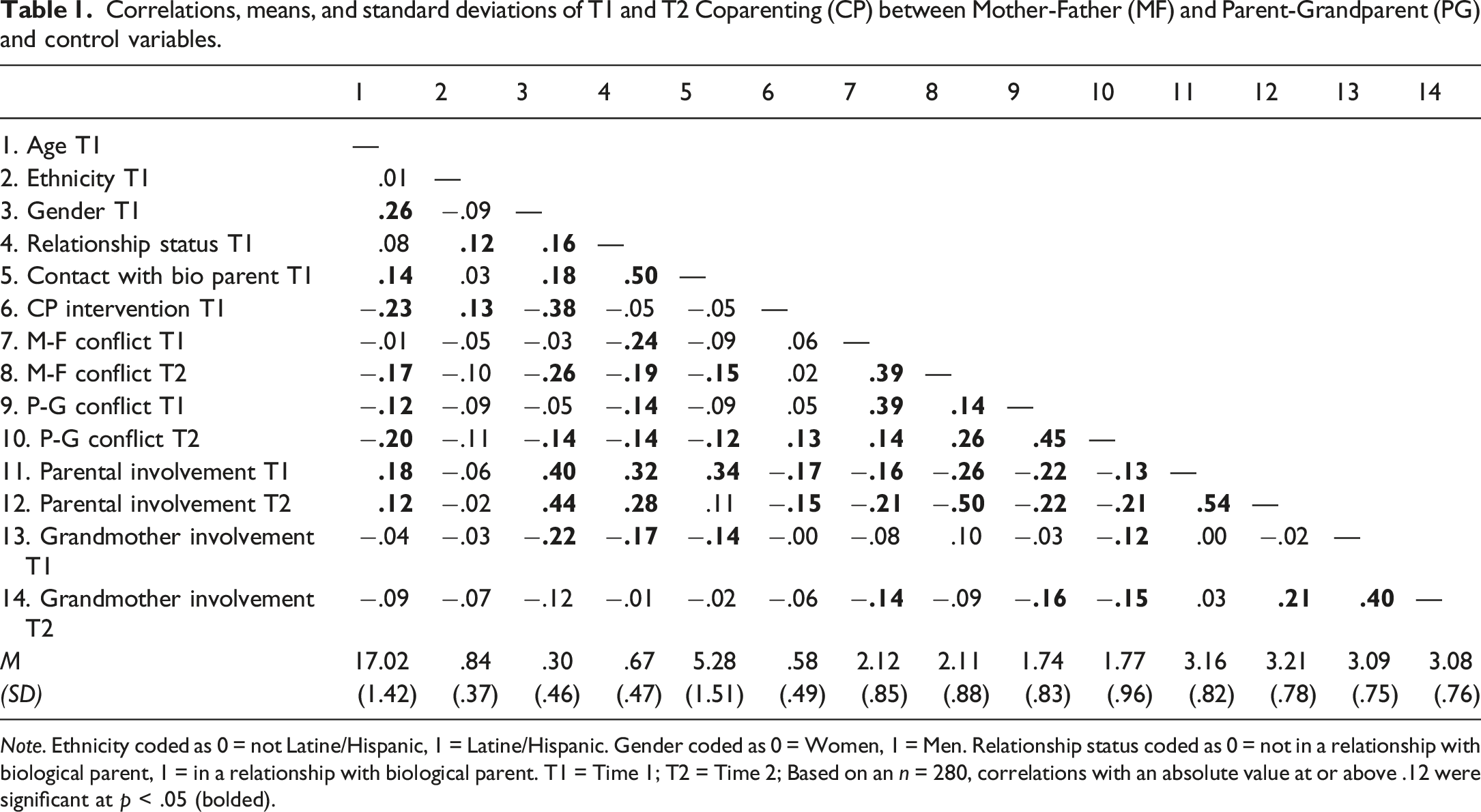
Note. Ethnicity coded as 0 = not Latine/Hispanic, 1 = Latine/Hispanic. Gender coded as 0 = Women, 1 = Men. Relationship status coded as 0 = not in a relationship with biological parent, 1 = in a relationship with biological parent. T1 = Time 1; T2 = Time 2; Based on an n = 280, correlations with an absolute value at or above .12 were significant at p < .05 (bolded).
Correlations, means, and standard deviations for study variables mothers (above the diagonal) and fathers (below the diagonal).
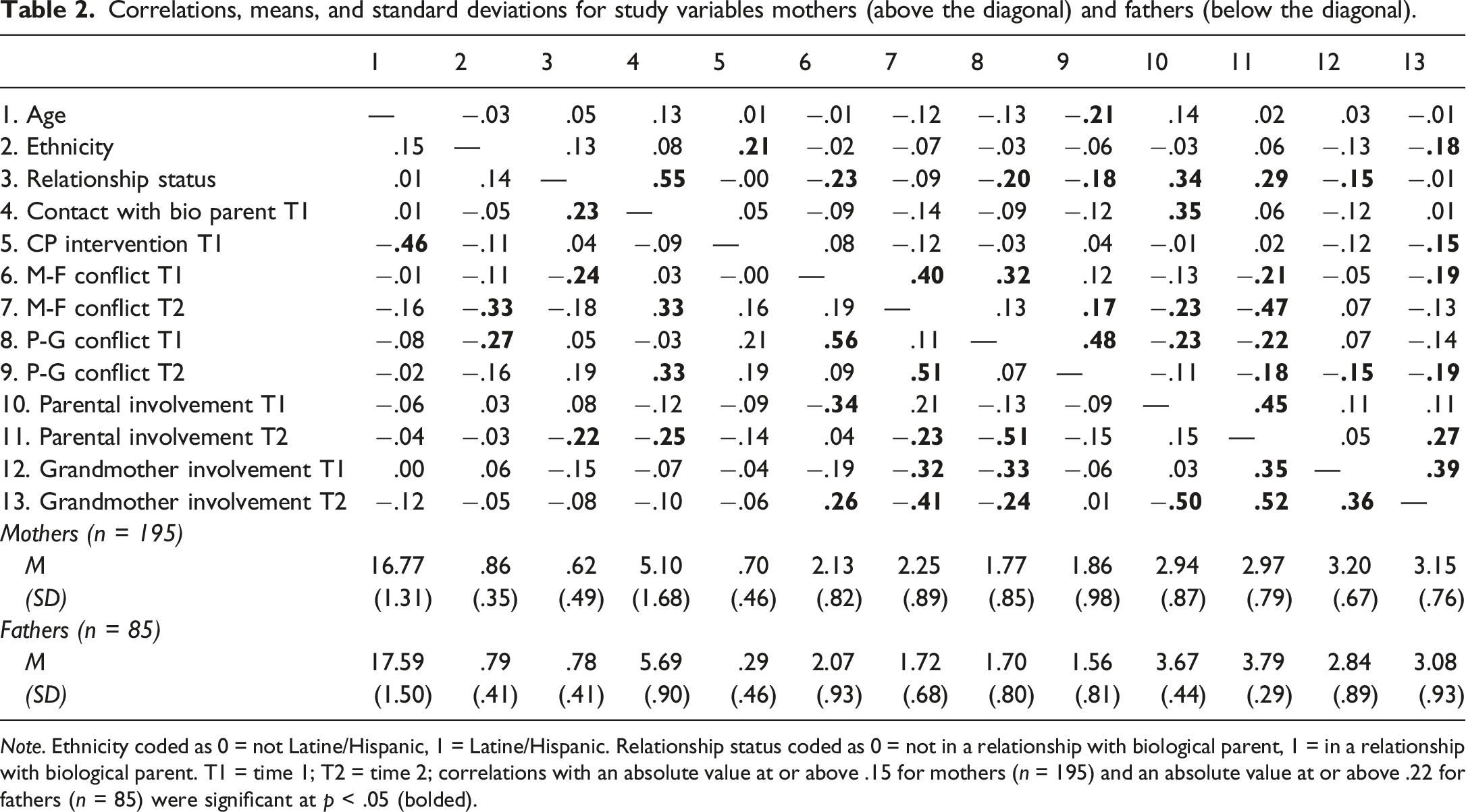
Note. Ethnicity coded as 0 = not Latine/Hispanic, 1 = Latine/Hispanic. Relationship status coded as 0 = not in a relationship with biological parent, 1 = in a relationship with biological parent. T1 = time 1; T2 = time 2; correlations with an absolute value at or above .15 for mothers (n = 195) and an absolute value at or above .22 for fathers (n = 85) were significant at p < .05 (bolded).
To address our study goals, a series of auto-regressive cross-lag models (Cole & Maxwell, 2003) were used to estimate reciprocal associations between coparenting conflict and caregiver involvement among M-F and P-G dyads at T1 and T2. To examine the stability of coparenting and caregiving dynamics over time, Model 1 was specified to include autoregressive paths across timepoints for the frequency of M-F coparenting conflict, parental involvement, P-G coparenting conflict, and grandmother involvement from T1 to T2. Model 2 included cross-lagged paths within a coparenting system, such that M-F variables at T1 predicted T2 variables; a similar process was used for P-G coparenting variables. Model 3 included cross-lagged paths across subsystems, such that P-G coparenting variables at T1 predicted M-F coparenting variables at T2 and vice versa. In addition, adolescents’ age, gender, ethnicity, relationship status, contact with the other biological parent, and coparenting intervention participation were correlated with coparenting conflict and caregiver involvement at T1 and were used to predict coparenting variables at T2. The model fit was considered acceptable if a ꭓ2-test was non-significant (p >= .05), CFI was greater than or equal to .95, RMSEA was less than or equal to .10, and SRMR was less than .08 (Kline, 2023). Log-likelihood difference tests were used to compare model fit when building the model. The results for the within-dyad cross-lags were used to address Goal 1, and the results from the between-dyad cross-lags addressed Goal 2.
To address Goal 3 and assess whether gender moderated the hypothesized associations, we ran a multi-group model comparing results for fathers versus mothers. First, we built the model using the same method described above. To test for gender moderation, all paths were constrained to be equal between fathers and mothers, then path coefficients were released one at a time, and the change in CFI between the constrained and unconstrained model was assessed. If the change in CFI was .01 or larger, we assumed the unconstrained model resulted in better model fit (Cheung & Rensvold, 2002).
Results
Descriptive statistics, including means, standard deviations, and correlations of all study variables are presented in Table 1, and separately for fathers and mothers in Table 2. Preliminary analyses to assess gender differences indicated mothers and fathers differed in their perception of parental involvement, b = .65, SE = .08, p < .001, and grandmother involvement, b = −.35, SE = .12, p = .002, at T1. Specifically, adolescent fathers reported more frequent parental involvement of their child’s other parent than adolescent mothers, and adolescent mothers reported more frequent grandmother involvement than adolescent fathers. At T2, mothers and fathers differed in their reports of M-F coparenting conflict, b = −.45, SE = .14, p = .001, and parental involvement, b = .75, SE = .08, p < .001. Adolescent mothers reported more frequent M-F coparenting conflict than adolescent fathers. Like T1, adolescent fathers reported more frequent parental involvement of their child’s other parent than did adolescent mothers.
Goals 1 and 2: coparenting conflict and caregiver involvement across dyads
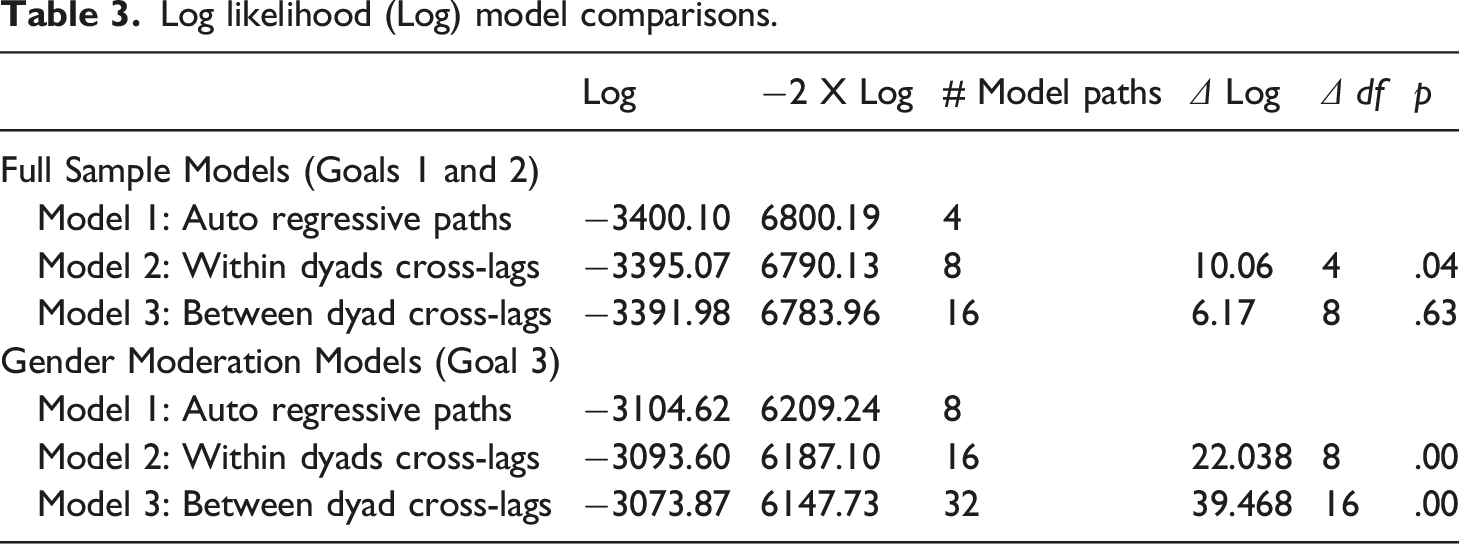
Log likelihood (Log) model comparisons.
In this final model, the autoregressive paths (Figure 1) showed significant stability over time for both dyads and all variables, such that M-F coparenting conflict at T1 was associated with M-F coparenting conflict at T2, and the other parent’s involvement at T1 was associated with their involvement at T2. In addition, P-G coparenting conflict at T1 was associated with P-G conflict at T2, and grandmother involvement at T1 was associated with grandmother involvement at T2. When looking at the cross-lag paths estimated in this model (Figure 1), only one within-dyad cross-lag effect was statistically significant, such that more grandmother involvement at T1 was associated with a decrease in P-G conflict from T1 to T2. In addition, gender was negatively linked to T2 M-F conflict (b = −.43, SE = .16, p < .01) and was positively linked to parental involvement (b = .49, SE = .11, p < .001). Specifically, adolescent fathers reported lower M-F conflict and more parental involvement compared to mothers. No other control variables were statistically significant predictors. Autoregressive Cross-Lag Models for Parent-Grandparent (P-G) and Mother-Father (M-F) Coparenting Conflict and Caregiver Involvement. Note. Unstandardized estimates are presented in this figure. Path coefficients are presented outside the parenthesis (standard errors are inside the parenthesis). T1 = Time 1; T2 = Time 2. *p < .05, **p < .01, ***p < .001.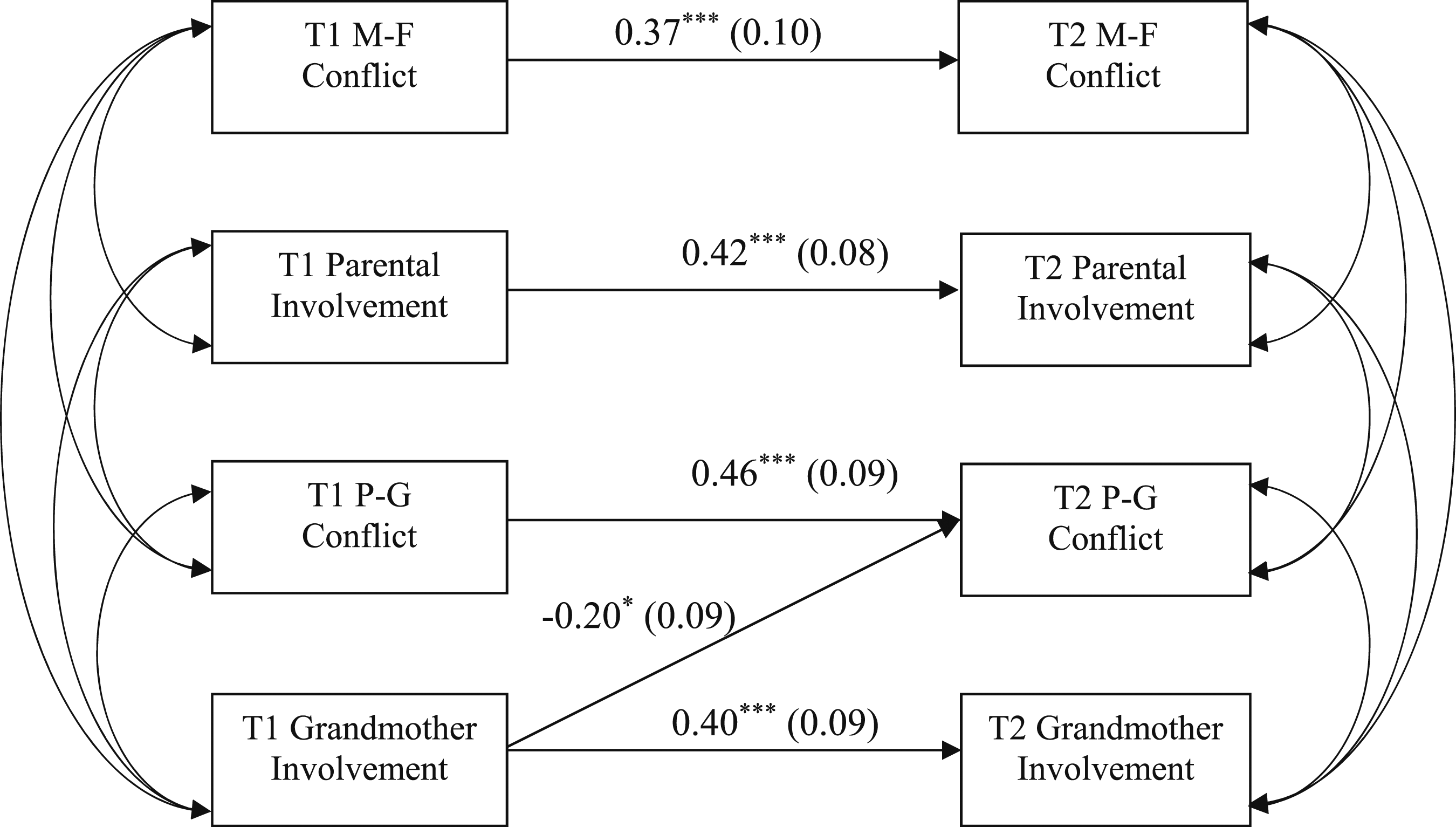
Goal 3: Assessing Gender Moderation
Log-likelihood model fit testing showed that Model 3 (cross-lags for coparenting within and between subsystems) significantly improved fit compared to Model 1 and Model 2 (See Table 3). Using this model, path coefficients were released one at a time and a change in CFI of .01 was used as an indicator of improved fit (Cheung & Rensvold, 2002). There was no improvement in CFI when releasing the paths between M-F conflict from T1 to T2, parental involvement from T1 to T2, and grandmother involvement from T1 to T2, but there was improvement in CFI when all other paths were released. All paths were released to differ for mothers and fathers, except for the three noted above. This partially constrained model showed a significant improvement in fit compared the fully constrained model, ΔLog-likelihood = 18.71, p < .05, ΔCFI = .16, and resulted in adequate overall model fit (ꭓ2 (14, N = 280) = 23.58, p = .03, CFI = .96; RMSEA = .08; 90% confidence interval [.02–.13], SRMR = .07). Thus, we used this as our final model to address Goal 3.
In the final model, the stability effects for M-F conflict from T1 to T2, parental involvement from T1 to T2, and grandmother involvement from T1 to T2 remained significant for mothers and fathers; however, the stability path for P-G coparenting conflict from T1 to T2 was only significant for mothers (Figure 2). Additionally, two within-dyad cross-lags emerged as significant. The within-dyad cross-lag was only significant for mothers: grandmother involvement at T1 was negatively associated with P-G conflict at T2, such that when mothers perceived high grandmother involvement at T1, they reported a decrease in M-G conflict at T2. The second within-dyad cross-lag was only significant for fathers: parental involvement at T1 was positively associated with M-F conflict at T2, such that when fathers perceived high mother involvement at T1, they reported an increase in M-F conflict at T2. Multigroup Autoregressive Cross-Lag Models for Parent-Grandparent (P-G) and Mother-Father (M-F) Coparenting Conflict and Caregiver Involvement, as Moderated by Parent Gender. Note. Unstandardized estimates are presented in this figure. Path coefficients are presented outside of the parentheses (standard errors are inside of the parentheses). T1 = Time 1; T2 = Time 2. M-F = Mother-Father. M-G = Mother-Grandmother. F-G = Father-Grandmother. *p < .05, **p < .01, ***p < .001.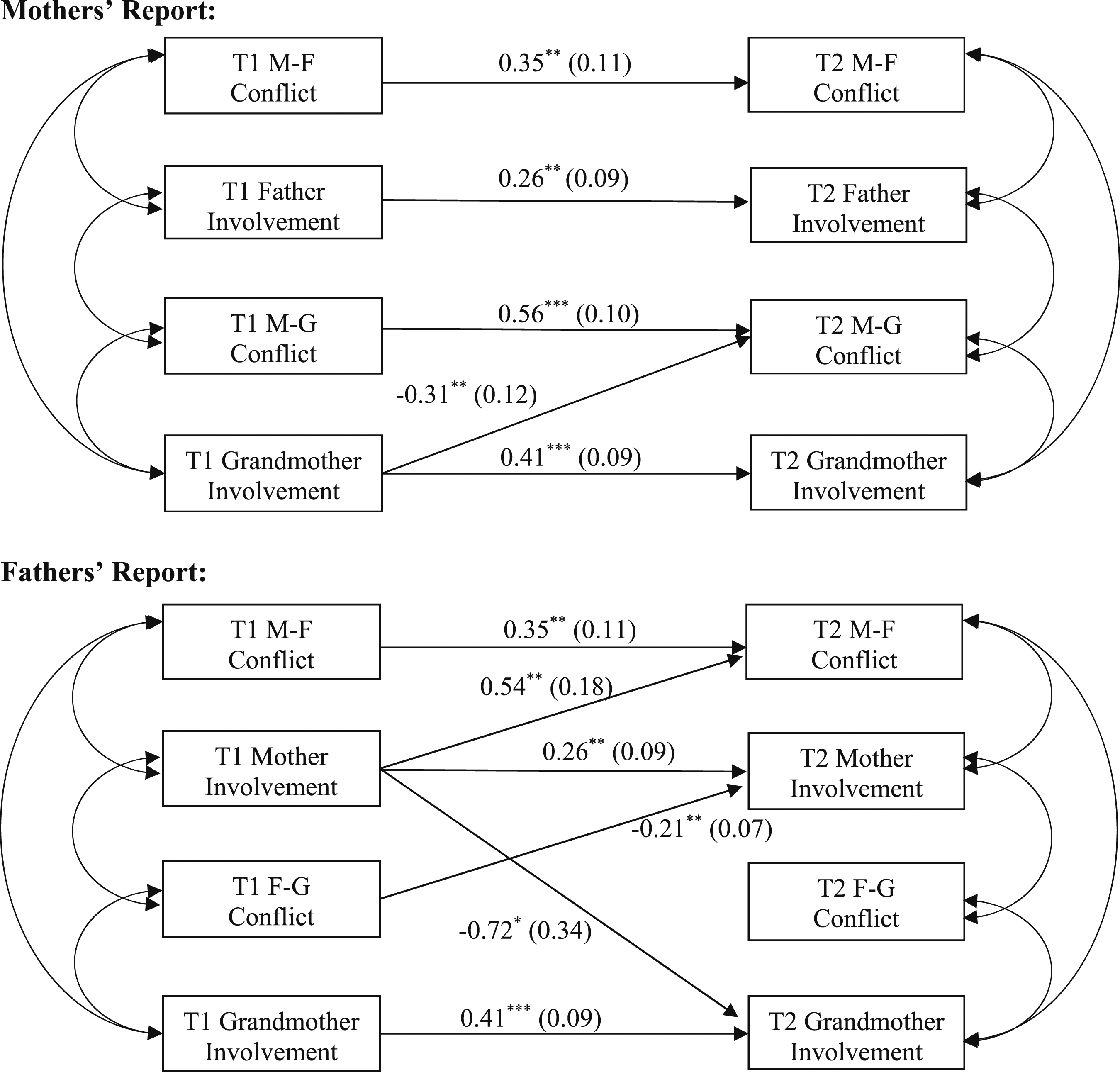
Finally, two significant between-dyad cross-lag paths emerged and were moderated by gender. For fathers, perceptions of high mother involvement at T1 were linked to a decrease in their perceptions of grandmother involvement at T2, but this association was not significant for mothers. A second cross-lag effect from P-G conflict at T1 to parental involvement at T2 was also negative for fathers but not for mothers.
In addition, adolescent mothers’ age was negatively linked to T2 M-G conflict (b = −.11, SE = .05, p < .05), and their relationship status was positively linked to T2 parental involvement (b = .55, SE = .23, p < .05). Specifically, older adolescent mothers reported less conflict with their mothers, and adolescent mothers in a relationship with the other biological parent reported more adolescent father involvement. No other control variables were statistically significant predictors.
Discussion
Guided by a family systems perspective (Cox & Paley, 1997) and an ecological model on coparenting (Feinberg, 2003), our study highlights the complex dynamics linked to coparenting conflict and caregiver involvement within the multigenerational family subsystems of adolescent mothers and fathers. Our study extends prior research that has primarily focused on mother-father adult coparents (Cabrera et al., 2009; Fagan & Cabrera, 2012) or solely focused on adolescent mothers (Derlan et al., 2018; Perez-Brena et al., 2015) to address three goals: (1) to understand how coparenting conflict and caregiver involvement are interrelated, (2) to understand how M-F and P-G subsystems are interrelated, and (3) to understand how these within and between subsystem associations differ for adolescent mothers and fathers.
When looking at our overall model, strong within-system stability effects emerged over time, suggesting stability in adolescent parents’ reports of coparenting conflict and caregiver involvement within both coparenting subsystems. Further, we only found that grandmother involvement was linked to reduced P-G conflict when looking at within- (Goal 1) and between-dyad (Goal 2) associations, and in this same model conflict was not linked to involvement. Such results demonstrate only one direction and contradict past research that has noted bidirectional associations between coparenting conflict and caregiver involvement among adult M-F dyads (Cabrera et al., 2009; Fagan & Cabrera, 2012). Instead, these results suggest that, within the context of adolescent parenthood, greater grandmother involvement may be linked to reduced P-G conflict, highlighting the need for more research on adolescent parents’ family dynamics. The fact that we did not see cross-dyad associations in this model also contradicts past research that has shown bidirectional spillover effects (e.g., more conflict leading to less involvement, and vice versa) across two subsystems when using adolescent mothers’ reports (Derlan et al., 2018; Krishnakumar & Black, 2003). It is possible that our inclusion of adolescent mothers and fathers in this study led to these divergent findings. In fact, our moderated results addressing Goal 3 of our study showed that mothers and fathers showed distinct associations, suggesting that gender differences in these family dynamics masked the expected within- and between-subsystem associations.
Moderating role of gender
Though our results for Goals 1 and 2 seemingly contradict prior research, our moderated results are more consistent with previous findings and highlight the complexities in which mothers and fathers may differentially experience coparenting dynamics. For example, similar to Goal 1, we examined the within-dyad associations between coparenting conflict and caregiver involvement. However, our moderated results indicated that high caregiver involvement was associated with changes in conflict within different coparenting subsystems for mothers and fathers.
Family systems perspectives explain that interconnected subsystems influence and are influenced by characteristics (e.g., gender) and behaviors (e.g., involvement, gatekeeping) of individual family members (Cox & Paley, 1997). Differences in our moderated results support this notion. Specifically, for mothers, more grandmother involvement at T1 was associated with a reduction in P-G conflict at T2. It is possible that within the M-G dyad, grandmother involvement is expected (Oberlander et al., 2007) and is more influential on the M-G coparenting relationship. Frequent grandmother involvement could also be indicative of the adolescent mothers’ acceptance of the grandmothers’ participation in childrearing and mothers’ openness to feedback regarding childrearing issues, including following the grandmothers’ advice and parenting more similarly to the grandmothers over time. This, in turn, might decrease coparenting conflict. These findings support previous research on the M-G dyad, which has found patterns of equal adolescent mother and grandmother caregiving involvement are associated with positive coparenting (Perez-Brena et al., 2015).
For fathers, more adolescent mother involvement at T1 was related to an increase in M-F coparenting conflict at T2. Having a highly involved coparent might increase the opportunities to discuss parenting issues, leading to an increase in communication and subsequent conflict. It could also be that mothers’ higher involvement is an indication of gatekeeping behaviors (Schoppe-Sullivan et al., 2008) that create conflict. Given that these ideas are speculative, more research is needed to disentangle the perceived reasons why involvement is differentially linked to coparenting conflict depending on the parents’ gender and the dyad (M-F vs. P-G) being evaluated. Qualitative approaches, in particular, will help clarify these patterns. Taken together these findings add to the conflicting research which has shown involvement may be positively and/or negatively associated with coparenting conflict (Fagan & Cabrera, 2012), and highlight the need to understand this association within the larger relationship context and in relation to gendered social scripts.
Like Goal 2, we also examined between-dyad associations in our moderated results. These moderated results highlight the ways in which fathers are susceptible to coparenting dynamics across subsystems. The first between-dyad association noted that when fathers perceived adolescent mothers to be highly involved at T1, there was a decrease in fathers’ reports of paternal grandmothers’ involvement at T2. This pattern supports the notion that when mothers are more involved, there is less need for other coparents to step in to support the child, or it can also indicate maternal gatekeeping. The influence of maternal gatekeeping has been noted for father involvement (Schoppe-Sullivan et al., 2008). Thus, it is possible that this dynamic can extend to paternal grandmother involvement.
The second between-dyad cross-lag effect showed that fathers’ reports of low conflict within the F-G dyad at T1 were linked to an increase in fathers’ reports of mothers’ involvement at T2. In support of the spillover hypothesis (Nelson et al., 2009) and how coparenting dynamics spillover to inform parenting behavior (Feinberg, 2003), this pattern suggests that having a positive coparenting relationship between the father and his own mother may encourage the adolescent mother to stay more involved with the child - indicating a spillover of positive behaviors. These between-dyad associations align with past research showing a reciprocal relation between M-F and P-G dyads (Krishnakumar & Black, 2003; Poblete & Gee, 2018) and the research noting that conflict is negatively associated with involvement (Cabrera et al., 2009), except these findings extend prior work focused on adolescent mothers and adult couples by showing that this spillover effect is highly pertinent for adolescent fathers.
Taken together, results from Goal 3 highlight the nuance in how adolescent mothers and fathers negotiate diverse coparenting relationships. In the current study, adolescent fathers were consistently influenced by the dynamics of their coparenting dyads, both within and between dyads. Past research suggests that the father role is less defined, leaving fathers more susceptible to influence (McRae et al., 2021; Pleck, 2010; Wang et al., 2022). Our results suggest that, as adolescent fathers navigate coparenting relationships within the M-F and P-G subsystems, it is possible that the ambiguity of their role as fathers extends across these subsystems. For adolescent mothers, our results indicated that only grandmother involvement was associated with their reports of coparenting conflict, supporting the idea that mother’s roles may be more defined and less susceptible to external factors (Cummings et al., 2010), and the notion that grandmothers play an important coparenting role for adolescent mothers, in particular (Cedeño et al., 2021; Gee & Rhodes, 2003; Oberlander et al., 2007; Perez-Brena et al., 2021).
Most of our results also supported the notion that earlier involvement is linked to later conflict, either within or across dyads. We saw only one association supporting the idea that earlier conflict was associated with later involvement. It is possible that the characteristics of our sample, which was comprised of primarily Latine adolescent parents, might have informed the family dynamics reported in this study. The U.S. Latine population is highly heterogenous and can vary by country of origin, immigration status, and acculturation (Stein et al., 2016; Umaña-Taylor & Updegraff, 2013); however, past research suggests that when compared to the larger U.S. population, Latine families are more likely to endorse familism values that elevate the importance of family support, obligation, and cohesion (Knight et al., 2010; Sabogal et al., 1987; Stein et al., 2016). The need to maintain family cohesion might inform why coparenting conflict at T1, generally, did not spill over to reduced caregiver involvement at T2. How familism values inform coparenting and caregiving dynamics should be tested in future research.
The current study had many strengths, including the use of adolescent parent reports on two coparenting dyads, inclusion of data from adolescent mothers and fathers, and data from two time points during the transition to parenthood. Our study underscores the importance of inclusive family theories that integrate more complex and diverse coparenting systems from mothers’ and fathers’ perspectives. Based on results suggesting fathers were more susceptible to relational factors that informed future coparenting dynamics, future work should examine how fathers negotiate diverse coparenting relationships to support them in their transition into parenthood. Such work will also help inform future interventions that can help family members negotiate their coparenting roles in a manner that is inclusive of fathers and their coparenting support team (e.g., grandmothers). Further, the high stability of mothers' reports underlines the importance of interventions to promote positive coparenting and caregiving dynamics early in the transition into parenthood, including interventions that work with coparenting team members prior to childbirth. These different associations for mothers and fathers highlight the need for tailored interventions that offer generalizable skills (e.g., healthy conflict management) to support the needs of different coparents and target the influence of conflict and caregiver involvement to promote positive coparenting and child development.
Limitations and future directions
In addition to strengths, this study has limitations that can inform directions for future research. First, our study included a limited number of fathers (n = 85) compared to mothers (n = 195), potentially reducing our ability to identify statistically significant moderated effects. The significant moderation effects we identified provide valuable preliminary evidence of gender-specific effects in coparenting conflict and caregiver involvement, yet we urge caution when interpreting these findings and suggest that future studies use our estimates as a point of reference when conducting power analyses to plan studies that would be adequately powered to test formal hypotheses regarding gender differences in intergenerational coparenting outcomes. Second, although this study addresses an understudied population by including fathers’ reports, it did not include grandmothers’ reports. Measuring grandparents’ perspectives of their coparenting relationship with their adolescent, particularly their adolescent sons, would provide a more comprehensive understanding of the P-G dyad. Another limitation worth noting is that adolescents only reported on their relationship with their own mothers, not their partners’ mothers. Moreover, future studies would be strengthened by also assessing the coparenting roles of other family members (e.g., grandfathers, aunts, uncles, siblings). Our study also included only two-waves of data; by including additional waves of data, we could assess if these patterns are replicated as children age and run more robust analyses such as random-intercept cross-lag models (Mulder & Hamaker, 2021). This study should also be replicated to assess how diverse aspects of involvement are related to coparenting conflict (Fagan & Cabrera, 2012; Jia & Schoppe-Sullivan, 2011). Lastly, our study did not assess participants’ sexual orientation or disability, nor did we ask if pregnancies were planned or unplanned. Future research should assess and report these additional participant characteristics to ensure better representation in our research.
Conclusion
Given that in 2019, over 173,000 adolescents in the U.S. became parents before the age of 20 (Martin et al., 2021), it is imperative to understand how shared childrearing responsibilities are negotiated and inform coparenting and caregiving dynamics in the context of adolescent parenthood. Adolescent pregnancies require unique relationship negotiations within and across family systems that include the child’s other parent and the adolescents’ own parents (Derlan et al., 2018; Rhein et al., 1997). The present study builds on past research and capitalized on two waves of data that included father and mother reports to assess the interrelationships between coparenting conflict and caregiver involvement in the M-F and P-G coparenting subsystems. As a result, our study emphasizes coparenting processes that differ by parents’ gender and vary across subsystems. Our findings underscore the critical, but understudied, relationships of adolescent fathers and their coparents. Outcomes of our study support a greater understanding of coparenting and caregiving dynamics that can inform the development of more inclusive family theories and interventions that account for the complexities of multigenerational coparenting relationships and address the needs of adolescent parent families transitioning to parenthood.
Footnotes
Declaration of conflicting interests
The author(s) declared no potential conflicts of interest with respect to the research, authorship, and/or publication of this article.
Funding
The author(s) disclosed receipt of the following financial support for the research, authorship, and/or publication of this article: This work was supported by the Administration for Children and Families 90FM0067.
Open access statement
As part of IARR’s encouragement of open research practices, the authors have provided the following information: This research was pre-registered. The aspects of the research that were pre-registered were related to the randomized control trial of the study. The registration was submitted to: U.S. Department of Office of Planning, Research and Evaluation. The data used in the research are not publicly shared but are available upon request. The data can be obtained by emailing:  . The materials used in the research are not publicly shared but are available upon request. The materials can be obtained by emailing: nperezbrena@arizona.edu.