







Abstract
We hypothesized that dissimilar mate preferences would augment friendship attraction in zero-acquaintance interactions whereas similar mate preferences would hinder friendship attraction. Heterosexual participants completed an online survey to assess their mate preferences. They also rated the attractiveness of opposite-sex photos. Next, they attended a 3-hr speed-friending session in which they interacted with same-sex others for 3-min each. After each interaction, they completed a 2-min assessment about the person they just met. Two sessions were held, one for women (N = 20) and one for men (N = 18). The social relations model was used to regress unique feelings of friendship attraction on similarity in terms of mate preferences while controlling for perceiver and target variance. Our hypothesis was supported among men: Interactions in which two people differed in mate preferences were rated more positively than those in which participants had similar mate preferences. These results are consistent with Parental Investment Theory and highlight the importance of mate preferences in friendship attraction among men.
Keywords
Introduction
The origins of friendship can be traced to ancestral times when humans faced challenges related to pregnancy, hunting, childcare, and warfare (Lewis et al., 2011). The attraction and maintenance of friendships is hypothesized to be one strategy ancestral humans employed to better pursue reproductive and survival goals (Bleske & Buss, 2000; Buss, 2007). The fitness consequences of success or failure at developing quality friendships may still be evident in people today as friendships appear to be essential for mental and physical well-being (e.g., Holt- Lunstad, 2017). People partake in a greater number of friendships than any other relationship type, making them particularly worthy of study (Fehr, 1996). An understanding of the factors that underlie friendship formation is therefore critical.
Friends generally match on characteristics such as education, age, intelligence, physical attractiveness, and mate value (e.g., Buss, 2007). Yet, the degree of similarity in mate preferences has not been examined. Considering their multiple similarities—as well as their likelihood of spending time with each other’s mates—friends may be well-poised to become sexual rivals (Coutinho et al., 2007). Intrasexual competition and mate poaching are common and result in adverse outcomes such as jealousy, guilt, anger, shame, and relationship dissolution (Mogilski & Wade, 2013; Schmitt & Buss, 2001). One protection against developing friendships with individuals who are, or could become, romantic or sexual rivals is favoring friendships with those who are dissimilar in mate preferences to oneself.
In the present study, we used zero-acquaintance scenarios to test whether people rate same-sex others who adopt mate preferences that differ from their own higher in friendship attractiveness. Research has already demonstrated that individuals make rapid assumptions regarding intrapersonal characteristics (e.g., personality) when they first meet (Zebrowitz & Montepare, 2008), and researchers have hypothesized that people integrate information across friendship preference dimensions when selecting and assessing friends (Krems & Conroy-Beam, 2020). We hypothesized that upon first meeting, mate preference similarity would be negatively associated with friendship attraction.
Method
Participants
Participants were 38 university students (20 women, 18 men) with a mean age of 21.71 years (Median = 22; SD = 2.65; Range = 18–28 years). All participants were heterosexual and residing in Southern California. The sample was 65.8% Latin/Hispanic, 15.8% European/White, 5.3% African American/Black, 5.3% Asian, 2.6% Middle Eastern, and 5.2% other. The majority did not have children (84.2%). For relationship status, 26.3% were not currently dating or involved with anyone, 18.4% were casually dating, 26.3% were exclusively or seriously dating, 5.3% were engaged, 10.5% were cohabitating, and 13.2% were married.
Psychology majors were recruited using a web-based participant management system (SONA) that enabled them to sign-up for research studies in exchange for extra credit points that could be applied toward their courses. Non-psychology majors were recruited using campus flyers. To participate, individuals had to be between the ages of 18 to 30 years old and identify as heterosexual. The age range was selected to control for variation in mate preferences that might result from too large a gap between participants (e.g., selection of celebrity photos was tailored to a younger demographic). We only recruited heterosexual participants because same-sex others are not only potential friends or competitors for non-heterosexual individuals, but also potential mates. In addition to extra credit points, participants were incentivized with refreshments at each in-person session and with the option to enter a $25 gift card drawing. Five gift cards were awarded at each session. At the start of each session, participants were instructed not to interact; they also were asked to identify whether they had ever met any person in the room. Five women and nine men reported knowing at least one other person. Ratings made by acquainted pairs were omitted from the analysis (accounting for 5.9% of the men’s data and 2.4% of the women’s data).
Materials
Demographic questionnaire
Participants identified their sex, age, university major, ethnicity/race, sexual orientation, parent status, and romantic relationship status.
Mate preferences
Participants were presented with a list of 10 mate preference dimensions taken from the Mate Preference Budget Allocation Questionnaire (Li et al., 2002). They ranked their preferred characteristics in a long-term relationship partner from the following list: Physical attractiveness, creativity, friendliness, work ethic, intelligence, interesting personality, romance, sense of humor, special non-work-related talents, and yearly income.
Physical attractiveness judgements
Participants were presented a series of opposite-sex photos and rank ordered them from most to least attractive. Each participant rated a total of 20 photos: 10 popular celebrities’ photos (e.g., Selena Gomez, Dwayne Johnson) and 10 strangers’ photos (obtained from Pexels.com and Pixabay.com). The people depicted in the celebrity and stranger photos were selected to reflect the approximate age range of the participants and ensure each major racial group was represented. The celebrities’ photos were first ranked from 1–10 and then the strangers’ photos were separately ranked from 1–10, yielding two separate rankings. Each photo was presented as a black and white headshot.
Speed-friending assessment
Friendship attraction
Participants used a 7-point Likert scale to rate each interaction partner on characteristics such as perceived similarity, shared sense of humor, degree of instant connection, partner’s perceived level of promiscuity, and degree of liking. They also completed an open-ended question where they listed 2–3 words to describe their interaction partner. This scale was novel. Two of the items, instant connection and liking, were used for the friendship attraction assessment, the other items were included for separate studies. These two items provided global metrics, which enabled participants to integrate any number of variables of importance into their assessments. A composite score for friendship attraction was created by averaging the instant connection and liking questions (α = .848).
Procedure
After reading an online consent form and agreeing to participate, individuals completed a web-based survey that was hosted on Qualtrics.com. The survey assessed demographic characteristics, the mate preference measures, and additional individual attributes (e.g., personality, attachment style) that were used for separate studies. The survey took approximately 30 min to complete.
Participants who had completed the online survey and met the study requirements were contacted via email and invited to attend a 3-hr speed-friending session. There were two sessions, one for women and one for men. 1 Each participant was assigned a number to wear on their shirt for identification purposes and was provided a sheet of paper outlining 20 questions that could be used to guide the discussions (see supplementary materials). During the speed-friending sessions, participants interacted with each person in the room for 3 min at a time. After each interaction, they completed a two-minute paper and pencil survey to assess friendship attraction.
Results
The social relations model (Kenny, 1994) was employed to analyze the data using the R package TripleR (Schönbrodt et al., 2012). This method involves partitioning judgments into three distinct sources of variance: (1) perceiver variance, the extent to which a rater views all targets similarly, (2) target variance, the extent to which a target is viewed similarly by all raters, and (3) relationship variance, the extent to which particular targets are viewed by particular raters idiosyncratically. The primary outcome of interest was the composite score on our friendship attraction measure which was created using a pair of indicators: liking of the individual and degree of instant connection. Because this construct was measured with multiple indicators, stable variance across indicators could be separated from unstable variance, allowing relationship variance to be distinguished from error variance in the analyses.
Predicting friendship attraction from mate preference
Descriptive statistics for measures used in analysis.
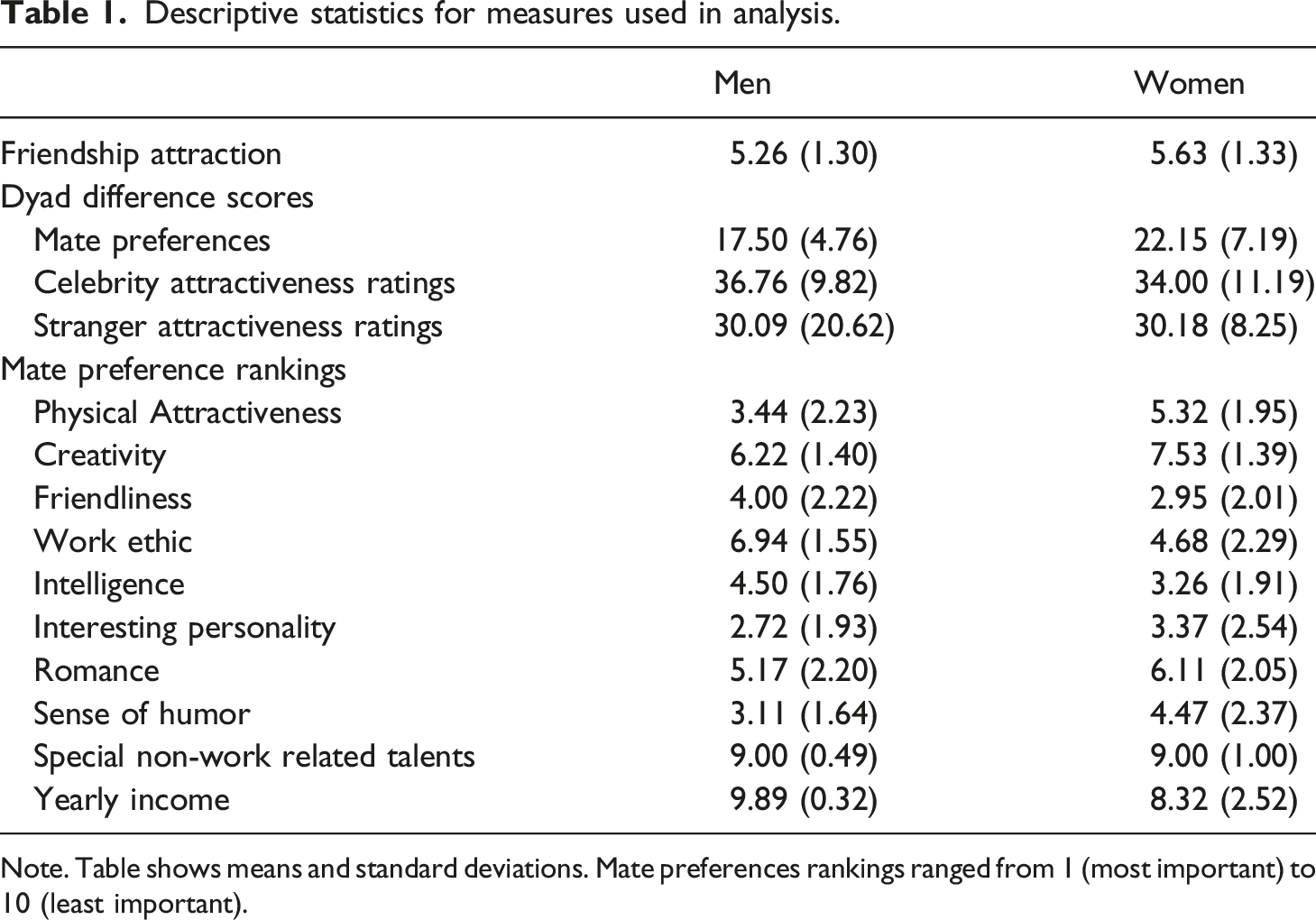
Note. Table shows means and standard deviations. Mate preferences rankings ranged from 1 (most important) to 10 (least important).
Parameter estimates for friendship attraction effect.
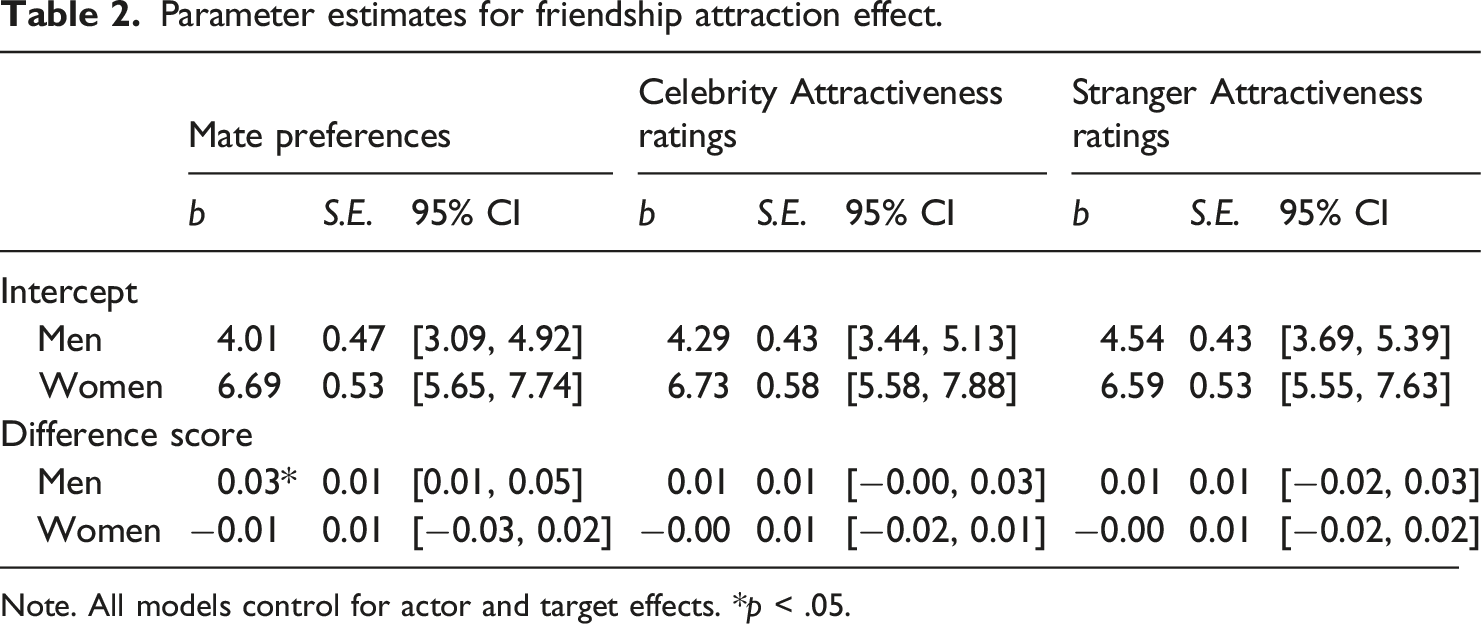
Note. All models control for actor and target effects. *p < .05.
Discussion
Our hypothesis that dissimilar mate preferences would predict friendship attraction in zero acquaintance interactions was supported among men but not women. We tested the prediction using three measures of mate preference similarity—rankings of mate preferences, rankings of physical attractiveness of celebrities, and rankings of physical attractiveness of strangers’ photos—yet it was only the rankings of mate preferences which predicted friendship attraction for men.
Our measures of mate preference similarity that relied exclusively on assessments of physical attractiveness did not yield any effects in men or women, suggesting that similarity on this mate preference dimension alone is not associated with friend attraction. Only when we employed a more comprehensive assessment of mate preferences, and mate preference similarity, were we able to predict friend attraction among men. Our results highlight the importance of mate preference dimensions other than physical attraction. Indeed, particularly in long-term mate selection, traits like kindness, health, and intelligence are rated as more important by both men and women than physical attractiveness (e.g., Krems & Conrory-Beam, 2020). Therefore, it is not surprising that men’s friendship attraction was yoked to a mate preference similarity measure that involved multiple traits demonstrated to be important in long-term mate attraction.
Why did our prediction hold among men but not women? According to Parental Investment Theory, in species in which there is a difference in obligatory parental investment, the sex with the lower obligatory investment is expected to engage in greater competition for access to mates (Trivers, 1972). In humans, females bear the obligatory costs of pregnancy and breastfeeding, making them on average, the greater investing sex. Thus, men’s preference for friends with dissimilar mate preferences may be a sex-specific trait that facilitates, or is a consequence of, intrasexual competition. This account is consistent with findings from related studies. Men’s physical traits, including their upper body size, muscularity, and strength, and their greater behavioral aggression compared to women appear to be the product of intrasexual competition (Puts, 2010). Men are also more likely than women to compete for and poach mates (Schmitt & Buss, 2001). If men were both subject to greater competition for access to mates than women, and at greater risk for losing their mate to rival males, then befriending other men with similar mate preferences may have been particularly costly.
Additionally, we found that variance in friendship attraction was driven by the tendency for particular people to see everyone as potential friends and by the unique interaction of a dyad, rather than by certain people being seen as particularly attractive as a friend by everyone. This finding is consistent with accounts of friendship that argue that what constitutes an ideal friend, and people’s motivation to acquire new friends, may vary depending on their own particular traits, life circumstances, and environment (Bahns et al., 2017; Krems & Conrory-Beam, 2020).
The speed friending methodology was the primary strength of this study. This method provided real-time, dyadic assessments of first-time interactions that extends prior work, which has often relied on retrospective accounts, self-reports, and hypothetical scenarios. The research was additionally conducted at a Hispanic Serving Institution with most participants identifying as Latin/Hispanic, which builds on previous U.S.-based research that has often consisted of predominantly European/White samples. Within the U.S., ethnicity impacts friendship attraction in first-time interactions (Campbell et al., 2015), making the diverse sample valuable.
A major limitation of this study is the convenience sample of mostly Psychology students at one university in Southern California. Although we suggested our results could be the product of men’s evolved psychology related to mate competition, our sample limits our ability to assume that these results would replicate in men who developed and/or are living in different sociocultural contexts. Furthermore, we would not argue that this single study provides sufficient evidence to draw conclusions about universal features of men’s and women’s mating-related psychology (Goetz et al., 2019). Additionally, we did not collect information about the participants’ class (e.g., income) or disabilities in this study and so we recommend these characteristics be assessed in future work. Furthermore, the effect we did observe was small, with a relatively wide confidence interval. Thus, replicating the effect in a new sample would provide greater confidence in its role in friendship formation. Another limitation is that we were unable to test the mechanism by which people may be perceiving or evaluating others’ mate preferences. If, as hypothesized, the association between similarity in mate preferences and friendship attraction in men is due to men detecting same-sex others' mate preferences, we do not know what cues or information men are gleaning from a brief interaction to assess others’ mate preferences. Our study serves as an initial step in demonstrating that an association between mate preference dissimilarity and friendship attraction may exist, future research is needed to specify what mechanisms may be driving this association, and how they operate.
This study provides the first evidence that men’s mate preferences may influence their attitudes towards new potential friends at zero-acquaintance. This phenomenon, if it proves robust, would be consistent with an understanding of intrasexual competition in humans derived from Parental Investment Theory. Additionally, our study supports theories of friendship from multiple disciplinary backgrounds that suggest people’s friend attraction is in part driven by their own unique characteristics and circumstances, and that potential friends are not equally desired by everyone.
Supplemental Material
Supplemental Material - Mate preference dissimilarity predicts friendship attraction at zero-acquaintance for men, not women
Supplemental Material for Mate preference dissimilarity predicts friendship attraction at zero-acquaintance for men, not women by Kelly Campbell, Benjamin R. Meagher, Cari D. Goetz and Nuttacha Vaitayavijit in Journal of Social and Personal Relationships
Footnotes
Declaration of conflicting interests
The author(s) declared no potential conflicts of interest with respect to the research, authorship, and/or publication of this article.
Funding
The author(s) received no financial support for the research, authorship, and/or publication of this article.
Open research statement
As part of IARR’s encouragement of open research practices, the author(s) have provided the following information: This research was not pre-registered. The data used in the research are not available. The data can be obtained by emailing:

Supplemental Material
Supplemental material for this article is available online.
Note
References
Supplementary Material
Please find the following supplemental material available below.
For Open Access articles published under a Creative Commons License, all supplemental material carries the same license as the article it is associated with.
For non-Open Access articles published, all supplemental material carries a non-exclusive license, and permission requests for re-use of supplemental material or any part of supplemental material shall be sent directly to the copyright owner as specified in the copyright notice associated with the article.
