







Abstract
Sense of personal agency (SPA) is crucial for adolescents’ psychosocial adjustment and well-being. The relationships with parents and peers, as well as the adolescent’s sex, have been suggested as important correlates of adolescents’ SPA. Nevertheless, no prior study has adopted a gender perspective to analyze how the intertwining of relationships between parents and peers relates to adolescent’s sense of agency. The current study investigates whether attachment to peers mediates the links between attachment to parents and SPA and whether these links are equal for boys and girls. The sample includes 1119 Portuguese adolescents (56.2% girls; 43.8% boys) aged 14 to 19. Structural equation modeling results suggest that attachment to peers is more strongly associated with boys’ SPA than girls. Results also indicate that regardless of adolescent sex, the quality of the emotional bond with the mother, but not the father, is positively associated with adolescents’ SPA. Furthermore, the results suggest that attachment to peers mediates the links between attachment to parents and adolescents’ SPA. Quality relationships with the adolescent’s different-sex parental figures (mother-son, father-daughter) are associated with higher-quality peer relationships, which are associated with a stronger SPA. On the contrary, inhibition relationships with the adolescent’s same-sex parental figure (mother-daughter, father-son) are associated with lower quality in adolescent’s peer relationships, which is associated with a lower SPA. These findings underline the importance of considering a gender perspective to understand better the role of family and peer contexts in the adolescent SPA.
Keywords
Introduction
Sense of personal agency (SPA) is the human being’s perception that they can intentionally influence their functioning and actions. Individuals with a strong SPA consider themselves capable of resisting or transforming constraints to achieve their self-determined goals (Schoon, 2018). SPA establishes a crucial tool for adolescents to navigate in today’s societies (e.g., Mota et al., 2022). As in other Western countries, Portuguese society is witnessing an increasingly complex transition process from childhood dependence to adult independence (Oliveira et al., 2014). Rising unpredictability emphasizes the need to identify the processes that facilitate or hinder the SPA’s development in adolescence. Especially in times of uncertainty, adolescents need a strong SPA to overcome obstacles and achieve their intrinsic goals (Schoon & Heckhausen, 2019). However, uncertainty also imposes significant constraints on future construction processes and the development of personal agency beliefs (Saraiva & Matos, 2016). SPA is a contextualized process shaped by individuals’ characteristics and relational contexts (e.g., family, peers, and school) (Nunes et al., 2022a, 2022b, 2022c; Schoon & Heckhausen, 2019). Although the relevance of the individual’s sex to SPA is pointed out in the literature, as far as we know, no study has yet attempted to address the intertwining of relationships with parents and peers to SPA using a gender perspective. It is important to clarify that in the current study, we analyze the differences between participants according to their sex assigned at birth (male or female). However, the interpretation and discussion of these differences will be based on a gender lens, that is, the attitudes, feelings, and behaviours that culture attributes to a person’s biological sex (APA, 2024).
Attachment to parents, peers, and SPA
Attachment relationships are unique and exclusive relationships that are important in seeking comfort and support and involve intense affection, especially during separation. They are relationships that contribute unequivocally to developing an internal sense of security that predisposes and empowers human beings to explore themselves, others, and the world in a climate of trust (Bowlby, 1988).
Although attachment is maintained throughout life, relationships with significant figures show changes specific to each developmental stage (Allen, 2004; Allen et al., 2007). In adolescence, youth move towards a gradually more egalitarian relationship with their parents; however, parents maintain relevance as they remain important sources of support for adolescents (Branje, 2018). Adolescents with quality of emotional bonds with their parents are more likely to explore their autonomy in disagreement, knowing their parents will maintain the relationship (Allen et al., 2018; Matos, 2002). Empirical evidence has shown that the quality of emotional bonds with parents promotes higher rates of perceived self-efficacy (Allen et al., 2003), optimism about the future (Thomson et al., 2015), and decision-making (Nawaz & Gilani, 2011) - all crucial indicators of SPA. These findings highlight the importance of emotional bonds with parents for adolescents’ SPA.
In the current study, we analyze attachment to parents based on two pivotal dimensions that capture key aspects of the parent-child relationship and have contrasting implications for SPA: the quality of the emotional bond and the inhibition of exploration and individuality. Quality of emotional bond reflects the emotional security provided by parents, which supports autonomous exploration and is associated with higher self-efficacy and optimism, key constructs of SPA (Allen et al., 2003; Thomson et al., 2015). Inhibition of exploration and individuality, on the other hand, captures parental behaviours that limit adolescents’ autonomy. These behaviours may hinder the adolescent’s ability to develop a strong SPA by limiting their ability to act and make decisions independently (Allen et al., 2018). By focusing on these two dimensions, we aim to highlight their distinct and potentially opposing links to adolescent SPA (Nunes et al., 2022b).
Parenting can differ depending on the gender of parents and adolescents. This is especially true during adolescence due to the onset of puberty and sexuality, as well as increased independence (Collins & Russell, 1991). Recent evidence has pointed out that fathers promote gender typing more than mothers (Mastrotheodoros et al., 2019). Concerning SPA, our previous evidence points to the differential contribution of fathers and mothers as attachment figures to adolescents’ SPA. In a prior study with 501 families (father, mother, and adolescent), where we used part of the current study’s sample (40%), we found that the quality of the emotional bond with the father, but not with the mother, was positively linked to youth’s SPA. On the other hand, relationships with the mother, but not with the father, characterized by inhibiting adolescents' exploration behaviors, were negatively associated with adolescents’ SPA (Nunes et al., 2022b). It is important to clarify that in our previous study, we only analyzed data from adolescents whose mothers and fathers participated simultaneously. This was the only reason we considered only 40% of the adolescents of the current sample in our previous study. Despite these previous results, these links still need to be explored, and more evidence needs to be gathered to understand better the role of fathers and mothers in adolescent SPA. Moreover, we did not inspect a possible moderation by adolescent sex on the role of attachment to fathers and mothers in adolescent SPA.
Attachment theory emphasizes the importance of attachment security with significant figures for other close relationships, including peer relationships (Sroufe & Fleeson, 1986). According to this perspective, quality of emotional bonds with parents can guide adolescents in their social interactions with their peers (Bowlby, 1980, 1988; Waters & Cummings, 2000). Adolescents tend to turn more to their peers to meet their emotional needs (e.g., Allen & Miga, 2010; Hazan & Shaver, 1987). In some cases, peer relationships are characterized by a reciprocal and mutual search for support and intimate sharing and can even be perceived as attachment relationships (Cassidy et al., 1996). When adolescents experience close and reciprocal relationships, with a sense of group belonging and emotional security, they develop the skills to face challenges and feel more agentic (Gurdal & Sorbring, 2019). However, when adolescents develop relationships with their peers characterized by alienation, they experience feelings of failure, isolation, and inadequacy. These feelings, in turn, tend to undermine self-efficacy and optimism for the future, which are key indicators of SPA (Lee & Lee, 2021; Lucktong et al., 2017). Although peer relationships have important implications for adolescents’ SPA (Schoon, 2018), the link between peer attachment and SPA during adolescence remains relatively unexplored in the literature.
Attachment to peers: Possible mediating role
According to attachment theory (Bowlby, 1969/1988, 1973, 1980), people develop internal working models based on the repetition of patterns of relational experience. These representations about self, others, and the world appear as an affective and cognitive map that helps to give meaning to past experiences, guide behavior, interpret the actions of others, regulate emotions, and shape the development of new relationships (Bowlby, 1988; Bretherton & Munholland, 2008). Based on these assumptions, attachment relationships with parents serve as a template that guides people’s expectations and beliefs in relationships developed later in life, including peer relationships (Chris Fraley, 2002). I.E., the quality of emotional bonds with significant figures tends to promote the internal representation of peers as responsive and trustworthy and as offering positive responses to the distress of others (Sroufe & Fleeson, 1986). Several empirical evidence have corroborated these theoretical assumptions (e.g., Allen & Miga, 2010). For instance, a recent systematic review aimed to review the evidence on the links of parental attachment to the quality of peer relationships during adolescence found that secure attachment with parents predicts and promotes the creation of close relationships with peers and friends based on communication, support, intimacy, trust, and quality (Delgado et al., 2022). Guided by these assumptions, the current study asks whether attachment to peers establishes an indirect mechanism through which relationships with parents can shape adolescents’ SPA. To the best of our knowledge, this is the first study to simultaneously articulate these two types of relationships with adolescents’ SPA, considering direct and indirect links.
Adolescents’ sex: Possible moderator role
The literature has pointed to adolescents’ sex as an important correlate of SPA and attachment to parents and peers. Recent evidence has shown that boys consider themselves more agentic than girls (Hurault et al., 2020). Gender stereotypes in Western societies have been pointed out as a possible hypothesis to explain these sex differences (Schoon, 2023). Moreover, individuals from different sexes tend to show different behavior patterns in their relationships. Prior evidence suggests that girls report more secure relationships with both parents than boys (Buist et al., 2002). Other studies suggest that relationships with same-sex parental figures contribute more to young people’s developmental outcomes than relationships with different-sex parents (Hoeve et al., 2012; Wilkinson, 2006). Concerning attachment to peers, there is evidence that girls, more than boys, tend to reveal more trustful relationships with peers (Gorrese & Ruggieri, 2012). Despite this early evidence, more research is needed to understand further whether adolescent sex moderates the link between these relationships with parents and peers with SPA.
Covariates: Adolescents’ age and cumulative family disadvantage
In adolescence, the maturity and experiences of youth vary as they age, meaning that adolescents of different ages may exhibit distinct patterns of interaction with their parents and peers and display different levels of SPA (e.g., Branje et al., 2021; Hitlin & Long, 2009). Furthermore, substantial evidence shows that exposure to family disadvantage significantly and negatively impacts positive adolescent development (e.g., Forman & Davies, 2003; Nunes et al., 2022b; Schoon & Cook, 2021). Considering this, we deemed it important to control for age and cumulative family disadvantage in our models to capture potential age- and disadvantage-related nuances in the variables under study, thereby gaining a deeper understanding of the complex network of associations between attachment to parents and peers, SPA, and adolescents’ sex.
Current study
The current study has three main research questions. The first research question is: How does attachment to parents and peers correlate with adolescents’ SPA? Based on recent empirical evidence and assumptions of self-determination theory (Deci & Ryan, 2014), we expected that quality of emotional bonds with parents and trustful relationships with peers would be positively linked to adolescents' SPA. On the other hand, we expect that parent-adolescent relationships characterized by parental inhibition of adolescent exploration and individuality will be negatively associated with adolescent SPA. Moreover, acknowledging potential sex differences, we also expected that relationships with each parent may contribute differently to adolescents’ SPA. More specifically, based on our previous studies (Nunes et al., 2022a; 2022b), we expected that quality of emotional bond with fathers were positively associated with SPA, while relationships with mothers characterized by inhibition of exploration and individuality of adolescents were negatively associated with SPA. The second research question is: Does attachment to peers mediate the link between attachment to parents and adolescents' SPA? Informed by the assumptions of attachment theory (Bowlby, 1988) and the empirical evidence, we expected that the quality of the emotional bond with both parents is positively associated with adolescents’ SPA by contributing to the quality of relationships with peers. More specifically, we expected that the quality of the emotional bond with both parents would positively correlate with trustful relationships with peers and that trustful relationships with peers positively correlate with SPA. On the other hand, we expected that parental relationships characterized by inhibition of adolescents’ exploration and individuality would negatively correlate with adolescents’ SPA by contributing to more alienated peer relationships. Finally, the third research question is: To what extent does adolescents’ sex moderate the links between attachment to parents and peers with SPA? It is known that boys and girls exhibit different behavioral patterns in their relationships and levels of SPA. As such, we anticipate that the sex of the adolescents may moderate the associations under investigation. However, no specific hypotheses were anticipated, given the complexity of the current study’s model and the lack of prior evidence that simultaneously articulates the variables under study.
Method
Participants
The sample includes 1119 adolescents (56.2% girls and 43.8% boys) who attended upper secondary education in public schools in Porto, Portugal. Participants ranged from 14 to 19 (M = 15.91, SD = .91, Med = 16). Most participants (82.4%) lived with both parents, 14.1% lived with their mother, 2.3% with their father and 1.2% with others. Thirty-nine percent of adolescents were in the 10th grade, 42.6% were in the 11th grade, and 18.1% were in the 12th grade. According to the International Standard Classification of Education (ISCED), this level of education is equivalent to level 3 (upper secondary) (UNESCO, 2011). More than half of adolescents (61.8%) had both parents with unskilled jobs.
Measures
Sense of agency
Sense of agency was assessed using a multidimensional model of four dimensions: goal setting, decision making, self-efficacy, and optimism (Nunes et al., 2022c).
We used an adapted structure of the Portuguese version of the Short Self-Regulation Questionnaire (SSRQ; Carey et al., 2004; García Del Castillo & Dias, 2009) to assess the following dimensions: goal-setting (GS; 7 items) and decision-making (DM; 5 items). The goal-setting dimension assesses the ability of the adolescent to set goals, track progress, and achieve these goals (e.g., “I usually keep track of my progress toward my goals”). The decision-making dimension assesses the ability of adolescents to make decisions (e.g., “I have trouble making up my mind about things”). The items are rated on a five-point Likert scale ranging from 1 (Strongly disagree) to 5 (Strongly agree). We used the Vision About Future (VAF; Ginevra et al., 2016), translated and adapted for the Portuguese population by Nunes et al. (2018), to assess optimism (OPT; 6 items). The optimism subscale assesses positive expectations of adolescents toward the future (e.g., “I think I am an optimist”). The items are rated on a five-point Likert scale ranging from 1 (It does not describe me at all) to 5 (It describes me very well). Finally, we used the General Perceived Self-Efficacy Scale (GSE; Nunes et al., 1999) to assess the general self-efficacy (SE; 10 items, e.g., “I can usually deal with everything that comes in my way”). The items are rated on a four-point Likert scale ranging from 1 (Not at all true) to 4 (Exactly true). This response scale was converted to a five-point scale to express all dimensions in the same measuring scale.
Attachment to parents
We used the short version of the Father and Mother Attachment Questionnaire (FMAQ; Nunes et al., 2020) to assess the quality of attachment to the father and mother, separately. This measure includes 15 items distributed across three dimensions: quality of emotional bond (QEB, 5 items), separation anxiety (SA, 5 items), and inhibition of exploration and individuality (IEI, 5 items). In the current study, we only analyze the QEB and IEI dimensions. QEB assesses the importance of the parental figure as an attachment figure (e.g., “I trust my parents to support me through difficult times in my life”). SA evaluates the anxiety and fear regarding the separation from the parental figure (e.g., “I can only face new situations if my parents are with me”). IEI assesses the perception of restriction to the expression of one’s individuality (e.g., “My parents hardly listen to me”). Although the items were worded in the plural, participants were asked to answer using two separate tables: one for their mother and one for their father. The responses are rated on a six-point Likert scale ranging from 1 (Totally disagree) to 6 (Totally agree). In the current study, we only used these two dimensions because they correspond better to our main goal: to analyze the role of parents as available figures in difficult situations (QEB) and, on the other hand, to examine the role of parents when they impose restrictions on their adolescent’s expression of opinions that differ from their own (IEI) in SPA of adolescents. We also highlight that a comparative analysis between FMAQ results and data from independent judges using a coded semi-structured interview (Family Attachment Interview) with 82 adolescents revealed small to moderate correlations. Subsequent analyses indicated that, except for the separation anxiety subscale, there were moderate to high correlations (ranging from .50 to .76) with dimensions from the Inventory of Parents and Peers Attachment and Parental Bonding Instrument, demonstrating convergent validity (Matos, 2002).
Attachment to peers
Adolescents also reported on their attachment representations regarding peers. We used the Inventory of Parents and Peers Attachment (IPPA; Armsden & Greenberg, 1987; Portuguese version by Ferreira & Costa, 1998
Family disadvantage
Adolescents also reported on their family disadvantage. Taking into account the literature (Hitlin & Johnson, 2015; Salmela-Aro & Upadyaya, 2017), we analyzed the cumulative family disadvantage through three risk factors:
Low parental education
Education equal to or lower than the sixth grade. Scores: zero – No Risk; 1 – Risk associated with one parent; 2 – Risk associated with both parents.
Unskilled parental occupations
Unemployment, retirement, and unskilled job. 0- No Risk; 1 – Risk associated with one parent; 2 – Risk associated with both parents.
Low family income
Families with incomes below the minimum wage. Scores: zero – No Risk, 1 – Risk. We summed the scores of three risk factors into a Composite Risk Index (CRI). This CRI varies on a scale from zero to 5. A higher score indicates a greater cumulative family disadvantage. Approximately 13.1% of adolescents do not experience any of these risk factors; 14.9% experienced at least one; 26.5% experienced two risk factors; 21.8% experienced three risk factors; 20.2% experienced four risk factors; and 3.5% experienced five risk factors. There were 0.1% missing values.
Procedures
We examined data from adolescents collected as part of a larger research project that aims to clarify how some factors from individual, family, school, and psychosocial contexts shape adolescents’ SPA. The current research project has been approved by (i) the Ethics Committee of the Faculty of Psychology and Education Sciences at the University of Porto (Rfa 2017/12-11), (ii) the Ministry of Education, and (iii) the Data Protection Officer at the University of Porto. All 71 schools in the district of Porto were initially contacted (by phone and email); nevertheless, we only met with the school boards of directors, who responded to our initial requests. We were permitted to carry out the study at 18 schools. We then gave the students a quick overview of the research endeavor. Each student (under age) received an informed consent form that needed to be filled out by their parents before they could participate. Adolescents who agreed to participate were required to complete a questionnaire about their SPA, attachment to parents and peers, and cumulative family disadvantage. The leading researcher and teacher oversaw the completion of this questionnaire.
Data analysis
First, we inspect the outliers and missing data. The participants identified as outliers (N = 55) were not considered in the statistical analysis. Missing values (10.9% of the total sample) were not complete at random (MCAR) (χ2(71) = 131.49, p = .001). We performed correlation analyses to clarify if missing data were related to measured variables in our sample, such as age, sex, father’s age, mother’s age, household, and cumulative family disadvantage (Little & Rubin, 2002). We found a positive correlation between cumulative family disadvantage and participants’ missing data (r = . 07, p = .036). Therefore, we assume that data was Missing At Random (MAR), and we use full information maximum likelihood (FIML) in subsequent analyses to avoid deleting participants with missing data (Enders & Bandalos, 2001). We tested the main goals (multigroup analysis) using the saturated correlated approach, that is, we introduced the cumulative family disadvantage as an auxiliary variable (Newson, 2015).
We also examine if class and school levels explain the variance of SPA through an intraclass correlation (ICC). Although adolescents were clustered in classes and schools, SPA was independent of these two levels (ICC = .07/.03), respectively. Despite the ICC ‘s low values, we used a design-based estimation approach to correct standard errors for potential non-independence of observations (Muthén & Satorra, 1995).
Next, we examine the psychometric properties of measures, including Confirmatory Factor Analysis (CFA). We interpret CFA results using the following indicators: CFI and TLI ≥.90, RMSEA, and SRMR <.10 to indicate an acceptable fit (Kline, 2015). Further, we tested the measurement invariance (MI) of all measures among adolescents’ sex and the invariance of FMAQ among parental roles. We interpreted MI results using the following criteria: nonsignificant Δχ2. We also tested the internal consistency of all measures by calculating Cronbach’s alpha. After these preliminary analyses, we calculated correlations, means, and standard deviation by adolescent’s sex. Furthermore, we tested the main hypothesis of the current study using structural equation modeling (SEM). We used latent variables to obtain more accurate estimates, accounting for the measurement errors. We used parcels as indicators of attachment to both parents. Peer relationships were indicated through a latent variable informed by two manifest indicators, namely trust and alienation. SPA was also indicated as a latent variable informed by four manifest indicators: goal-setting, decision-making, optimism, and self-efficacy. We tested the following four nested models (Anderson & Gerbing, 1988): M1 – Unconstrained model; M2 – Constrained model; M3 – Conditional constrained model; M3.1 - Conditional constrained model with indirect paths; M4– Final model with trimmed paths. We also conduct a formal test (Δχ2; Δp) to compare the models and decide which should be retained. The significance of each indirect effect was tested using the bootstrapping procedure with 10.000 resamples.
Based on our preliminary results on missing data, we used a saturated correlated approach that considered the cumulative family disadvantage as an auxiliary variable in our measurement model. In other words, the cumulative family disadvantage was correlated with all exogenous manifest variables of our SEM model. The statistical analysis was conducted in R (R Core Team, 2020) using the lavaan (Rosseel, 2012) and the semTools packages (Jorgensen et al., 2019).
Results
Preliminary analyses: Internal consistency, CFA, and MI
All dimensions of SPA, as well as full model, revealed adequate internal consistency: (goal-setting = .75; decision-making = .71; optimism = .88; self-efficacy = 74; and full model = .88). The CFA indicated that the measurement model for SPA had acceptable fit to the data (χ2(1) = 5.02, p = .025, CFI = .99, TLI = 97, RMSEA = .06, SRMR = .01). Further, metric invariance among adolescents’ sex was established (Δχ2(3) = 5.70, p = .125).
The scales of FMAQ also revealed adequate consistency (QEB = .87/.91 and IEI = .69/.74) in mothers’ and fathers’ versions, respectively. CFA indicated that this scale scores demonstrated a good fit to fathers’ (χ2(8) = 56.90, p = . 001, CFI = .99, TLI = .98, RMSEA = .07, SRMR = .02) and mothers’ (χ2(8) = 26.63, p = .001, CFI = .99, TLI = .99, RMSEA = .05, SRMR = .02) data. We found metric invariance among adolescents’ sex and parental roles (Δχ2(12) = 21.88, p = .039, ΔCFI = −.002, ΔRMSEA = .001).
The scales of IPPA also presented adequate consistency (α = .88 for trust; α = .76 for alienation). The IPPA demonstrated an acceptable fit to the data (χ2(1) = 1.56, p = .212, CFI = .99, TLI = .99, RMSEA = .02, SRMR = .01). We found metric invariance among adolescents’ sex (Δχ2(3) = 2.15, p = .541).
Covariances by adolescent’s sex
Correlation among study’s variables by sex.
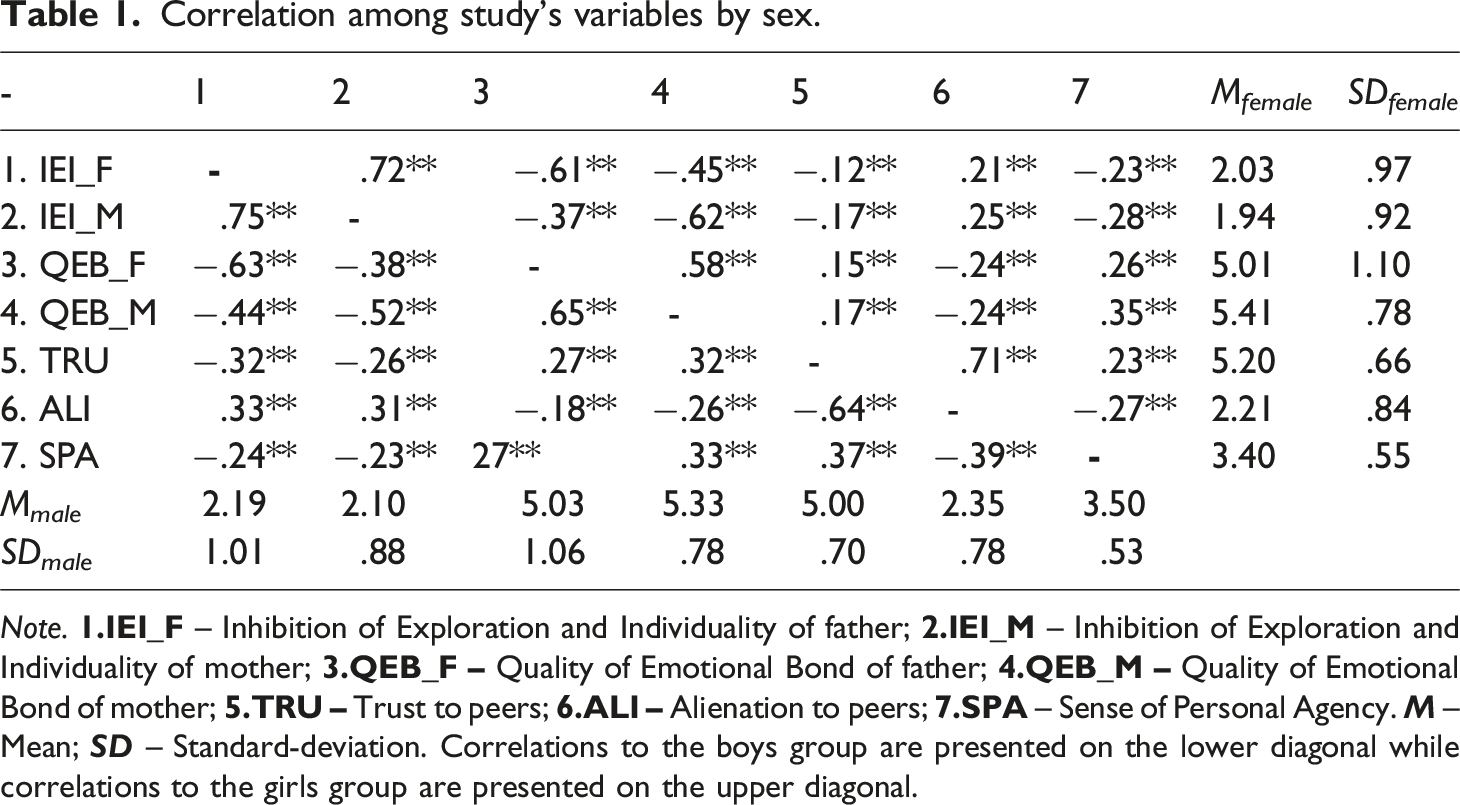
Note.
Moderated mediation model
First, we tested a multigroup model with all direct links among the study variables freely estimated across boys and girls (M1: Unconstrained model). Next, we tested a model where all direct paths were constrained to be equal across boys and girls (M2: Constrained model). Comparing the constrained model versus unconstrained model, we verified that constrained model showed a significantly worse fit to the data (Δχ2(9) = 27.42, p = .001), that is, in our model there were paths significantly different for boys and girls. Next, we inspected which direct paths differed between boys and girls, using a similar strategy (constrained vs. unconstrained); and added the indirect paths. The comparison model indicated that five direct paths differed between two groups: IEI father and mother to IPPA; QEB father and mother to IPPA; and QEB father and SPA (M3 – Conditional constrained model). Next, we tested a nested model from M3, adding the indirect paths (M3.1- Conditional constrained model with indirect paths) (Figure S1). Finally, due to the large number of parameters to be estimated (model complexity) and the size of our sample (divided into two groups), we simplified the previous model (M3.1) by trimming the nonsignificant paths with very low magnitude (close to zero) (M4 – Final model). This final model (M4) did not show a significantly worse adjustment to the data than the M3.1 Δχ2(9) = 15.43, p = .080. The final model showed an acceptable fit, χ2(262) = 622.21, p = .001, CFI = .97, TLI = .97, SRMR = .05, RMSEA = .05, explaining 26% and 36% of the variability of girl’s and boy’s SPA, respectively.
Results showed that inhibition of exploration of the father was negatively linked to boys’, but not girls’, attachment to peers (B = −.15, p = .001). In contrast, the quality of emotional bond with father was positively linked with girls’, but not boys’, attachment to peers (B = .08, p = .003). We found the opposite pattern regarding the mother, that is, inhibition of exploration of the mother was negatively linked with girls’, but not boys’, attachment to peers (B = −.15, p = .002). In turn, the quality of emotional bond with the father was positively linked with boys’, but not girls’, attachment to peers (B = .15, p = .027). Further, the results showed that the quality of emotional bond of the mother was positively linked with girls’ and boys’ SPA (Bgirls = .16, p = .001; Bboys = .25, p = .001), and this association was stronger for girls’ SPA than boys. Also, attachment to peers was positively correlated with girls’ and boys’ SPA (Bgirls = .14, p = .001; Bboys = .29, p = .001), and this association was stronger for boys’ SPA than girls.
The bootstrapping analysis supported the mediating role of attachment to peers on the links between attachment to parents and SPA. The indirect link from fathers’ inhibition of adolescent behavior to SPA through attachment to peers was significant for boys (B = −.05, SE = .01, 95% CI [−.07, −.02], p = .001). Moreover, the indirect link from mothers’ inhibition of adolescents’ behavior to SPA through attachment to peers was also significant for girls (B = −.02, SE = .01, 95% CI [−.04, −.01], p = .020). Also, the indirect link from the quality of the emotional bond of the father to SPA through attachment to peers was significant for girls (B = .01, SE = .01, 95% CI [.01, .02], p = .024). Finally, we verified that the indirect link from the quality of the emotional bond of the mother to SPA through attachment to peers was significant for boys (B = .05, SE = .02, 95% CI [.01, .08], p = .020) (see Figure 1)
1
. Standardized Coefficients of Moderated Mediation Model. Note: IEI father – Inhibition of Exploration and Individuality of father; IEI mother – Inhibition of Exploration and Individuality of mother; QEB father – Quality of Emotional Bond of father; QEB mother – Quality of Emotional Bond of mother; SPA – Sense of Personal Agency. GS – Goal-setting; OPT – Optimism; DM– Decision-making; SE – Self-efficacy. *p < .05; **p < .01; ***p < .001. Non-significant paths are denoted by n. s. The cumulative family disadvantage was correlated with all exogenous manifest variables of our SEM model. Trimmed paths in both groups: IEI father – SPA; IEI mother – SPA. Trimmed paths in the girls’ group: IEI father – IPPA; QLE mother – IPPA. Trimmed paths in the boys’ group: IEI mother - IPPA; QLE father IPPA; QLE father – SPA.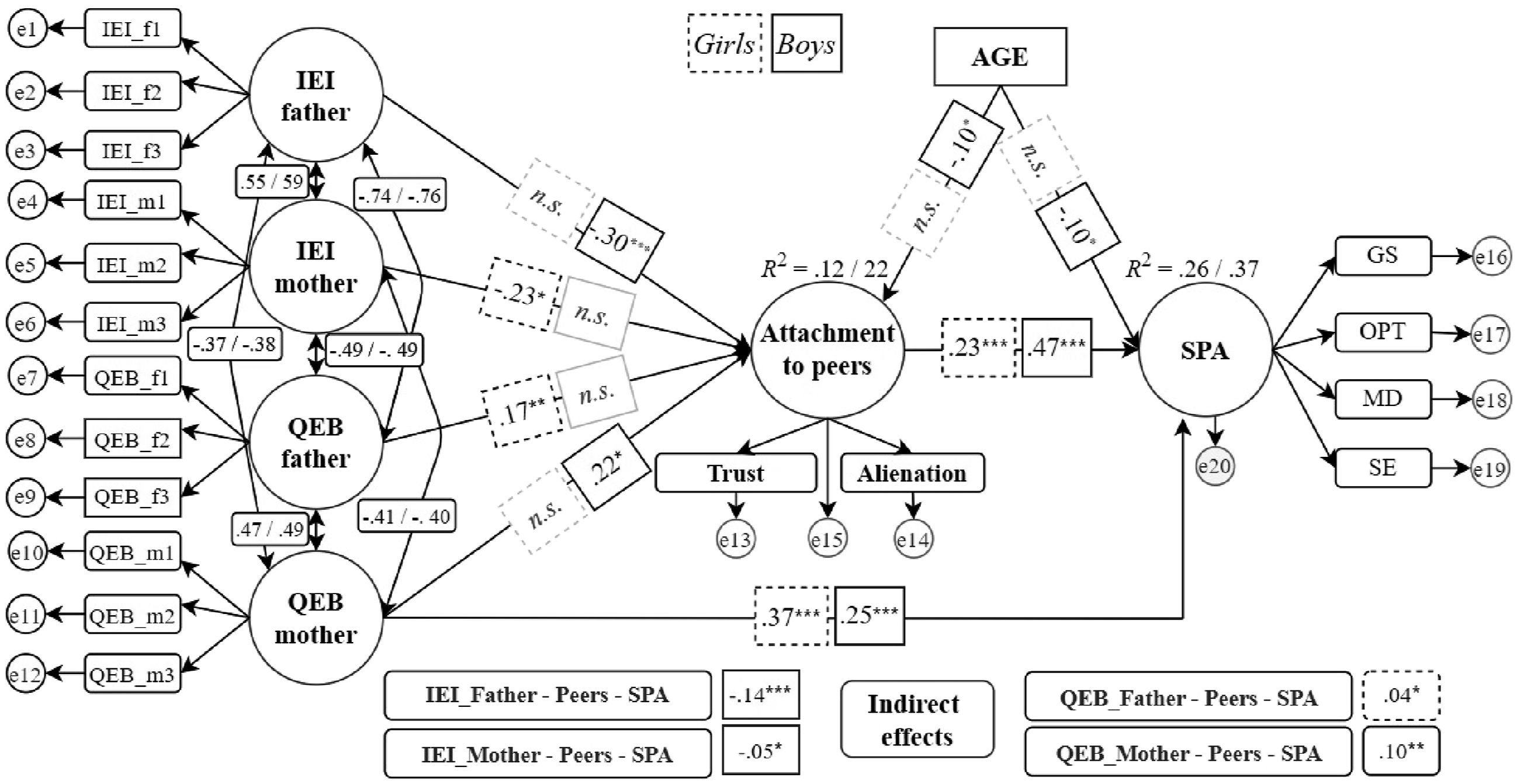
Discussion
In the current study, we tested a moderated mediation model to uncover whether attachment to peers mediates the association between attachment to parents and SPA - and if the sex of adolescents moderates this mediation process. The results indicate that paternal relationships characterized by inhibition of exploration are negatively linked to boys’ attachment to peers. In contrast, maternal relationships characterized by inhibition are negatively related to girls’ attachment to peers. We found the opposite pattern for the quality of the emotional bond. The quality of the emotional bond established with the father is positively associated with girls’ attachment to peers. In contrast, the quality of the emotional bond with the mother is positively associated with boys’ attachment to peers. Therefore, our findings suggest that relationships with same-sex parental figures (mother-daughter and father-son) characterized by higher levels of inhibition of exploration are associated with lower-quality peer relationships. On the contrary, the quality of the emotional bond established with the adolescent’s different-sex parental figure to the adolescent (mother-son, father-daughter) is associated with higher-quality peer relationships. More specifically, our findings suggest differences in the individual contribution of attachment to fathers and mothers to the quality of peer relationships and clarify that this contribution is different for boys and girls. These findings reflect specific relationship dynamics with each parent and add important implications to the literature on attachment to parents and peers in adolescence.
In discussing these findings, the gender intensification perspective comes to mind. This perspective postulates that gender differences increase during adolescence and that same-sex parent-adolescent dyads (mother-daughter; father-son) become even more different from different-sex parent-adolescent dyads (Hill & Lynch, 1983). These differences were observed during pre-adolescence and adolescence; gender differentiation behaviors are generally less pronounced in pre-adolescence.
In a period such as adolescence, when young people are trying to develop their identity and achieve greater autonomy from their parents (Branje et al., 2021), parental orientation, especially from the identification figure (same-sex parental figure), can be perceived as a source of inhibition to their initiatives to explore new relationships (Youniss & Smollar, 1987). On the other hand, the relationship with the different-sex parental figure can be seen as an important resource for autonomy and the establishment of new relationships outside the family context (e.g., Hoeve et al., 2012; Wilkinson, 2006). Despite this initial hypothesis, more studies are needed to understand better the differential role of attachment to fathers and mothers in the quality of boys’ and girls' attachment to peers. More specifically, future research should aim to include longitudinal data spanning pre-adolescence to adolescence to understand the fluctuations of gender differentiation behaviors better. It would be interesting for future studies to analyze the parallel longitudinal trajectories of adolescents’ gender differentiation behaviors and the quality of adolescents' attachment to parents spanning pre-adolescence to adolescence.
The current study’s findings also indicate that the quality of the emotional bond with the mother, but not with the father, is positively associated with the boys’ and girls’ SPA. However, this association revealed a higher coefficient for girls than for boys. For boys, other relational contexts, such as peers, are suggested by our results (see discussion below) as particularly relevant to their SPA. These results are interesting and suggest, once again, not only a differential role but also differences in this link according to adolescents’ sex.
In discussing this result, we consider it important to point out that, on the one hand, there is evidence that girls tend to have a stronger and more intense emotional bond with their mothers than boys (Geuzaine et al., 2000). Evidence also shows that girls continue to turn to their mothers for support in late adolescence. At the same time, boys decrease their need for support and closeness to their mothers at this stage (e.g., Geuzaine et al., 2000; Paterson et al., 1994), which can help us explain the current study’s differences. On the other hand, the current study’s results are inconsistent with the evidence we gathered in a previous study. Our previous study (preliminary sample; approximately 40% of the current sample) found that the quality of the emotional bond with the father, not the mother, was positively associated with adolescents’ SPA (Nunes et al., 2022b). Several aspects should be considered when reflecting on these inconsistent findings. The current study addressed some limitations of the previous study: (a) it adopted a gender perspective to analyze the links among variables; (b) the current sample is more balanced regarding adolescents' sex, and (c) other relational variables (e.g., attachment to peers) were considered in our model. Therefore, the current study’s findings, combined with our previous study’s results, underline the importance of considering a gender perspective to achieve a deeper understanding of the role of attachment to parents in adolescent SPA.
Moreover, we found that attachment to peers is positively associated with adolescents’ SPA regardless of their sex, but this association is stronger for boys than for girls. These findings can be discussed in light of the kind of relationships that boys and girls tend to establish with their peers. Empirical evidence shows that boys' relationships with their peers focus on companionship and competence development. On the other hand, girls’ relationships with their peers are more focused on intimate dyads based on self-disclosure, emotional expression, and interdependence (Galambos, 2004). The companionship and competence experienced in peer relationships make the boys to feel more capable of transforming and overcoming obstacles. It is important to discuss this result combined with the previous one. The findings suggest that peers are particularly important for boys in considering themselves capable of shaping their life paths. At the same time, girls need their mother’s support more to reveal a strong SPA. These findings can be understood in light of the evidence we highlighted earlier: in late adolescence, boys tend to decrease their need for support from their mothers, while girls continue to rely on this support (e.g., Geuzaine et al., 2000; Paterson et al., 1994).
The current study’s findings also suggest that all dimensions of attachment to parents are important for SPA through attachment to peers. More specifically, our findings suggest that inhibition of exploration relationships with the father is negatively associated with boys’ SPA, potentially undermining the quality of boys' peer relationships. A similar pattern was found for inhibition relationships with the mother in the girls’ group. However, the quality of the emotional bond with the father is positively associated with the girls' SPA through its positive association with the quality of attachment to peers. Our findings are consistent with the assumptions of self-determination theory (Deci & Ryan, 2014), which argues that when young people experience the satisfaction of basic psychological needs due to the quality of relationships with their parents, they tend to perceive themselves as having sufficient competence to shape their life course. On the other hand, when young people experience the frustration of these basic needs due to less supportive and warm relationships with their parents, they tend to repress themselves.
Implications, limitations, and future research
Our findings highlighted differences in the individual role of attachment to fathers and mothers regarding the quality of peer relationships and adolescents’ SPA. Also, they clarified that this contribution is not equal for both sexes. Our findings suggest that boys are more susceptible to peers' peers’ context and girls more to family context, especially to attachment to their mother. Furthermore, our results indicate that attachment to peers is more directly associated with adolescents' SPA than attachment to parents. These results can be understood in light of young people’s growing need for autonomy and independence concerning their peers. The current study has some limitations that must be acknowledged. First, the results were based on self-reported data; future studies would be valuable to analyze these links using interview data or parental reports. Second, the current study was based on a sample of adolescents in Northern Portugal, and future studies must assess the generalizability of findings across different cultural contexts. Third, we should interpret the results regarding family disadvantage with caution. Note that the indicators used to analyze family disadvantage were reported only by adolescents, which may lead to some bias. It is important for future research to include multiple sources of information, such as data provided by parents or caregivers, to obtain a more comprehensive and accurate assessment of family conditions. Fourth, the study’s cross-sectional nature limits our ability to infer causality or observe changes over time. Longitudinal studies are needed to investigate how relationships with parents and peers, as well as fluctuations in gender differentiation behavior, affect adolescents’ self-perception and adjustment throughout development. Additionally, it would be valuable for future studies to collect information about participants’ gender identity. Despite these limitations, the current study has important implications for the literature, raising new research questions: Is the contribution of the intertwining of relationships with parents and peers to young people’s SPA stable, or does it show fluctuations throughout adolescence? Considering the current study’s cross-sectional nature, additional longitudinal research would add weight to the potential implications of this study.
Supplemental Material
Supplemental Material - Adolescent sense of personal agency: Exploring gendered perspectives on parental and peers attachments
Supplemental Material for Adolescent sense of personal agency: Exploring gendered perspectives on parental and peers attachments by Filipa Nunes, Paula Mena Matos, Tiago Ferreira, Ingrid Schoon, Rúben Ferreira, and Catarina Pinheiro Mota in Journal of Social and Personal Relationships
Footnotes
Author’s note
A preliminary version of this manuscript was presented as a poster at the European Conference of Developmental Psychology (ECDP), in September 2023 in Turku, Finland.
Acknowledgements
We acknowledge the contributions of Beatriz Castro Rodrigues in the third phase of the current research project, namely in the introduction of data into the database.
Declaration of conflicting interests
The author(s) declared no potential conflicts of interest with respect to the research, authorship, and/or publication of this article.
Funding
The author(s) disclosed receipt of the following financial support for the research, authorship, and/or publication of this article: This work was funded by the Portuguese Science Foundation (UIDB/00050/2020; SFRH/BD/133032/2017; COVID/BD/151973/2022), and the UK Social Economic Research Council (ES/T001526/1; ES/V01577X/1).
Open research statement
As part of IARR’s encouragement of open research practices, the authors have provided the following information: This research was not pre-registered. The data used in the research are not available. The data can be obtained by emailing:

Supplemental Material
Supplemental material for this article is available online.
Note
References
Supplementary Material
Please find the following supplemental material available below.
For Open Access articles published under a Creative Commons License, all supplemental material carries the same license as the article it is associated with.
For non-Open Access articles published, all supplemental material carries a non-exclusive license, and permission requests for re-use of supplemental material or any part of supplemental material shall be sent directly to the copyright owner as specified in the copyright notice associated with the article.
