







Abstract
Toddlers and older siblings (M age = 49.34 months) from 145 two-parent, mother-father families (85% European American, 4.9% African American, 3.5 % Asian American, 3.2% Hispanic) participated in a longitudinal investigation when toddlers were 18, 24, and 36 months old. Sibling sharing and the older siblings’ management of the interaction was observed in a laboratory-based fishing game, and mothers and fathers reported on both the toddlers’ and older siblings’ conscience (affective discomfort, moral regulation) at each timepoint. There were significant increases in both siblings’ sharing and older siblings’ management from 18 to 24 months, whereas toddlers’ sharing increased and older siblings’ management decreased from 24 to 36 months. There were stable individual differences in toddlers’ and older siblings’ sharing, and older siblings’ management from 18 to 24 months, but not from 24 to 36 months, suggesting changes in the development of sibling sharing during the second and third years when toddlers become more autonomous contributors to the sharing dynamic and older siblings can step back from managing turn-taking. Reciprocity between older siblings’ and toddlers’ sharing was evident within each time point, but little evidence of bidirectional influence over time. Moral regulation and affective di
Introduction
Sibling relationships are unique. These relationships are emotionally intimate, intense, and are often characterized by both conflict and cooperation (Dunn, 2002; Kramer, 2010; Volling, 2003). Young siblings spend a large portion of time together, so much so that by middle childhood, they often spend more time with each other than with their parents (McHale & Crouter, 1996). This powerful bond between two highly familiar children provides distinctive opportunities for development not provided by other close or familial relationships and fosters children’s social capabilities (Buist et al., 2022; Dunn & Munn, 1986; Howe et al., 2022). Even though children engage in prosocial behaviors with a sibling as early as the toddler and preschool years (Dunn & Munn, 1986; Hughes et al., 2018; Pike & Oliver, 2017; White et al., 2014) and positive sibling relations have been linked to young children’s social understanding and moral sensibility (Dunn, 1988; Paine et al., 2022; Taumoepeau & Reese, 2014), research is still needed examining the links between prosocial sibling interactions such as sharing, and the development of early conscience (i.e., the internalization of moral standards of what is right and wrong; Kochanska et al., 2010). Sharing between siblings may provide children with opportunities to understand others’ perspectives and the rules that govern cooperative behavior which is consistent with prior research finding that friendly sibling interactions when older siblings were 3 predicted their responses to moral transgressions when they were in kindergarten and first grade (Dunn et al., 1995).
Turn-taking and reciprocal sharing in sibling interactions
The earliest forms of sharing are embedded in the reciprocal give-and- take and turn-taking of social games (e.g., learning to hand over toys in one’s possession to another; Hay & Murray, 1982; Paulus, 2023). Sibling interactions are often centered around joint play and young children have been observed to share with their siblings around 18–24 months (Dunn & Kendrick, 1982; Dunn & Munn, 1986). In their longitudinal study, Dunn and Munn (1986) found that even though 18-month-old toddlers were fully capable of comforting, sharing, and helping their siblings, they were rarely motivated to do so. Further, there was little association between the toddler siblings’ prosocial behaviors and that of their older siblings during home observations at either 18 or 24 months of age. Starting at 18 months, toddlers require explicit scaffolding and communicative support from others in efforts to engage in prosocial actions (Brownell et al., 2013; Dahl et al., 2017) and may require direct support from their older siblings during observations of sibling sharing to partake in a reciprocal, turn-taking game. White and colleagues (2014) examined the predictive links among children’s spontaneous sharing with siblings at age 3 and sharing with siblings, peers and friends at 6 years. Older siblings shared more than younger siblings at the first timepoint, but by age 6, younger siblings shared to the same degree as their older siblings, suggesting more mutual exchange over time. Although 18-month-old toddlers may be less active participants and less likely to initiate prosocial behaviors with an older sibling early on, they may become more equal partners capable of reciprocating sharing as they age and become more active participants in the give-and-take.
Observational studies of sibling sharing in early childhood are few, and there are even fewer looking at sibling sharing longitudinally across the period of early childhood when there are significant advances in young children’s social understanding, self-regulation, and early conscience. Thus, we do not know whether there is greater reciprocity between siblings over time, and whether toddlers need less scaffolding from an older sibling to manage turn-taking and sharing as they mature. In the current study, we examined change in toddlers’ and older siblings’ sharing and turn-taking during a fishing game task from 18, 24, and 36 months, and whether there was a decline in the older sibling’s scaffolding of turn-taking, with a corresponding increase in the toddlers’ capacity to share over time. If so, this would suggest that toddler siblings have acquired some understanding of turn-taking or reciprocal sharing (i.e., there is an obligation to return favors when sharing resources) and can actively participate in the exchange without the assistance of the older sibling. Further, we examined stability in individual differences across this same period in sharing for both toddlers and older siblings, whether there were reciprocal relations between siblings within time, and evidence of bidirectionality over time (e.g., older siblings’ sharing at 18 months would predict toddler sharing at 24 months). The major goal of the current longitudinal study was to examine sharing with an older sibling when toddlers were 18, 24 and 36 months, as well as relations between sibling sharing and the development of conscience for both siblings. Because earlier experimental research has reported toddlers as young as 2 years prefer to help another person who shared with them in an earlier interaction (Vaish et al., 2018; Warneken & Tomasello, 2013), we anticipated that when older siblings had shared with their toddler siblings more at one point in time (e.g., 24 months), toddlers would share more with an older sibling at a subsequent time point (e.g., 36 months).
Sibling sharing and the emergence of early conscience
Young children require the support of responsive caregivers early in life to manage the give-and-take of reciprocal interactions and need gentle guidance to comply with requests and inhibit impulses (Kochanska & Aksan, 2006; Kochanska et al., 1997). The development of early conscience reflects the transition from external caregiver supports to internal regulation of the child’s growing ability to conform to societal standards of conduct and to refrain from antisocial impulses, even in the absence of surveillance. According to Kochanska’s (1993) socialization model, conscience consists of both affective discomfort and moral regulation. Affective discomfort reflects children’s emotional reactions to acts of transgression and wrong-doing such as guilt
Early childhood is a time of increased social and moral understanding (Turiel, 2006). By the age of 2 or 3 years, young children display increased awareness of fairness, empathy, and sympathy for others, and develop an emerging moral self (Brownell et al., 2009; Christner & Paulus, 2022; Jambon et al., 2019; Sloane et al., 2012). Moral emotions such as guilt and pride are also referred to as self-conscious emotions because they require an understanding and evaluation of the self (Lagattuta & Thompson, 2007). Violating one’s internalized moral standard (e.g. not sharing) can elicit negative moral emotions or affective discomfort including shame and guilt. In turn, this affective arousal should promote children’s rule-compatible behavior and motivate them to engage in other-oriented prosocial behaviors (e.g., to share). Sharing stickers with an unknown child in the dictator game was associated with moral emotions such as guilt, a self-focused emotion, and sympathy, an other-focused emotion (Malti et al., 2016; Ongley & Malti, 2104). Dunn et al. (1995) also found that a positive sibling relationship at preschool-age predicted older siblings’ responses to moral transgressions in first grade. Together, these results suggest that sibling sharing may be related to an emergent moral self across the toddler and preschool years, and the internalization of conscience.
Sibling interactions as a context for emerging morality and conscience
Because most children grow up with siblings, spend significant time with their siblings, and interact in a manner that contributes to emotional understanding, self-regulation and experiences of guilt and shame (Kolak & Volling, 2022; Recchia & Howe, 2009; van Berkel et al., 2020), it is puzzling why sibling socialization has not received more attention in the development of young children’s moral development and the emergence of conscience. Traditional theories of moral development have often highlighted unidirectional socialization influences, wherein prosocial behavior is modeled by or learned from other socializing agents, usually the parents (Grusec et al., 2023). A constructivist-interactionist framework (Dahl, 2019; Dahl & Killen, 2018) proposes that early morality develops gradually through a progression of interactions with significant others that provide a context for children to participate actively in social interactions, construct an understanding of moral principles (e.g. fairness), and act accordingly. As such, naturalistic observations of children interacting with a familiar social partner are crucial for understanding the basis of prosociality and the development of sharing.
Paulus (2023) recently proposed a similar social interactionist-pragmatist view in the development of early sharing. Early in development, young children participate in give-and-take games, often with a caregiver, who leads and structures interactions. But, older siblings are also known to take the lead and structure and manage early interactions with a younger sibling (Pike & Oliver, 2017; Tavassoli et al., 2019) so they could easily serve a part in structuring early reciprocal sharing, in the form of turn-taking (I give, you take). Through these repeated exchanges with an older sibling, toddlers begin to understand the rules of reciprocity and become more active participants in these exchanges over time, even if initially, they had little moral understanding of the principles of equality and fairness.
Recent sibling studies have suggested that through interactions with one another, both siblings can act as socializing agents fostering prosocial behavior. These studies have also emphasized the bidirectional, reciprocal nature of children’s sibling relationships (e.g., Jambon et al., 2019; Pike & Oliver, 2017; Tavassoli et al., 2019). Whereas the older siblings’ structuring and communicative exchanges can promote a toddler’s understanding of fairness and equality (e.g., you need to take turns) and ultimately, a moral self, the younger sibling affords the older with socializing experiences to learn empathy, to focus on another in need of help and assistance, and to sensitively teach a younger sibling to engage in turn-taking until the rules of reciprocity are understood (Dunn et al., 1995; Howe & Recchia, 2005; Jambon et al., 2019; Pike & Oliver, 2017). In the current study, we examined the bidirectional and reciprocal relations between toddlers and their older siblings across 18, 24, and 36 months. We expected that as younger siblings become better able to understand norms of fairness, turn-taking, and reciprocity, they will require less scaffolding from their older siblings, become more active participants in the sharing exchange, and increase in their sharing behavior over time. Older siblings will then be able to step back and engage in less structuring and management of the turn-taking exchanges over time.
Assessing sibling sharing in early childhood
Previous research on children’s sharing is often based on tasks borrowed from behavioral economics (e.g., dictator game), wherein individual children are asked to distribute resources with an experimenter, a hypothetical peer, or a puppet as a means of assessing sharing (e.g., Blake & McAuliffe, 2011; Chernyak & Sobel, 2016; Smith et al., 2013). The inhibition of self-focused behaviors appears to be particularly difficult for young children when in the presence of an attractive resource. Compared to older children, younger children more often choose to allocate appealing prizes, such as stickers, to favor themselves in standard sharing paradigms involving the distribution of resources, such as the dictator game (Benenson et al., 2007; Blake & Rand, 2010; Ongley & Malti, 2014). Several of these studies are focused on altruistic sharing, wherein the child is presented with an unequal distribution of resources (five stickers) and asked to allocate resources in a way that necessitates a willingness to forsake resources to another and incur a cost to the self, which does not allow such young children to allocate resources equally in a give-and-take exchange.
These experimental tasks involving individual children cannot be easily applied to the assessment of sibling sharing that occurs within the context of a dyadic relationship, particularly in the toddler years; a time when toddlers’ moral sentiments and behaviors are based on direct interactions with significant others (i.e., dyadic morality) and not on an understanding of group-wide social norms (Vaish & Tomasello, 2023). White et al. (2014) did observe 3-year-old children’s spontaneous sharing (e.g., offering an object previously in their possession) during home visit observations, yet few sibling sharing tasks assess taking turns to share and distribute an attractive resource (e.g., prizes). In one of the only studies to use an observational paradigm to assess sibling sharing with young children, Van Berkel and colleagues (2015) gave preschool children (2.5–4.6 years) a box of raisins, which they were asked to share with their siblings when the toddlers were 12 and 24 months of age. The number of raisins offered to the toddler sibling within the first minute was used as an index of sharing. Preschool siblings’ sharing increased with age and there were stable individual differences across time. However, these researchers only observed the older siblings’ sharing so they were unable to examine the development of the younger siblings’ sharing, the extent of sibling reciprocity, and bidirectional relations over time between siblings. Further, common snack foods may not increase the desire to act in a self-focused manner as would other more valuable resources such as prizes or gifts.
Longitudinal investigations assessing reciprocated sibling sharing in early childhood are needed with paradigms appropriate for very young children that require the distribution of attractive resources in a real-world, dyadic relationship context and that also reflect the give-and-take of early sharing. In the current study, we present for the first time a novel means of assessing sibling sharing with a turn-taking task (the Fishing Game), in which children were instructed to take turns catching fish to win prizes. The rules of the fishing game stipulated that for children to get resources (prizes) that were distributed equally, each child would need to take turns catching ten fish. Children were not told to share “fairly” or to make sure each child got the same number of turns, only to “share and take turns”. Because there were ten fish, if each child took their fair share of turns (five turns each), resources would be shared equally. Taking more than one’s fair share of turns and violating the turn-taking rules meant the other received less, ending in an unfair distribution of resource sharing (see methods for more details). The fishing game was conducted when toddlers were 18, 24, and 36 months, allowing repeated measures of sibling sharing for both older and toddler siblings across the significant developmental period from 2 to 3 years; a time of significant growth in prosocial behaviors, conscience, and moral understanding.
The current study
The current research was exploratory by necessity, given there are no longitudinal studies of sibling sharing using a real-world dyadic interaction task with such young children. Using a longitudinal research design following toddlers when they were 18, 24, and 36 months of age, there were three related aims to the current study. First, we examined mean-level changes in sharing for both toddlers and their older siblings over time, hypothesizing that there would be an increase in toddler sharing over time and a decrease in the older siblings’ need to manage the turn-taking exchanges. Second, we examined interrelations between toddlers’ and their older siblings’ sharing to investigate reciprocity between siblings within each time, and bidirectional influence across time. We expected significant intercorrelations between toddlers’ and older siblings’ sharing at each time point and that these relations would increase in magnitude from 18 to 24 to 36 months as toddlers became more active in sharing and taking turns in the fishing game. We were also interested in bidirectional influence across time and whether older sibling sharing (e.g., 18 and 24 months) predicted the toddlers’ sharing at a subsequent timepoint (e.g., 24 and 36 months) or vice versa (e.g., toddlers’ sharing at 18 months predicted the older siblings’ sharing at 24 months). Third, we examined the longitudinal relations between sibling sharing and children’s conscience, hypothesizing that the older siblings’ conscience would predict their sharing as early as the 18-month time point because of their greater understanding of moral conduct compared to the toddlers, but that relations between toddlers’ sharing and conscience would emerge later between 24 and 36 months.
To test these hypotheses, we used structural equation modeling and introduce an analysis we refer to as an Interdependent Cross-Lagged Model (ICLM) that merges two common statistical approaches to assess longitudinal relations: (1) the Cross-Lagged Panel Model (CLPM) between two variables over time (i.e., sharing and conscience) and (2) the Actor-Partner-Interdependence model (APIM) that addresses the interdependence of individuals in a dyadic relationship (Cook & Kenny, 2005). As depicted in Figure 1, this modeling strategy was necessary because there are two cross-lagged models examining sibling sharing and conscience for both older siblings (top third of the Figure) and toddlers (bottom third of the Figure) that were interconnected because of the interdependence of the dyadic relationship between siblings, as reflected in the APIM model structure in the center of the Figure. Structural equation model testing interrelations between sibling sharing and conscience development for both toddlers and their older siblings utilizing two modeling approaches: (1) an Actor-Partner-Interdependence Model (APIM) that models interdependence in dyadic relationships (rectangular box in middle of figure) and allows testing of the bidirectional relations between toddler and older sibling sharing over time (partner effects), while controlling for stability across time for each sibling (actor effects), and accounting for the interdependence (reciprocity) between siblings within time; and (2) two cross-lagged panel models (CLPM) testing associations between the older siblings’ sharing and conscience (top half of figure) and associations between the toddlers’ or younger siblings’ sharing and conscience (bottom half of figure) over time while accounting for the stability (autoregressive paths) and cross-sectional associations between an individual siblings’ sharing and conscience. OS = older sibling, YS = younger sibling.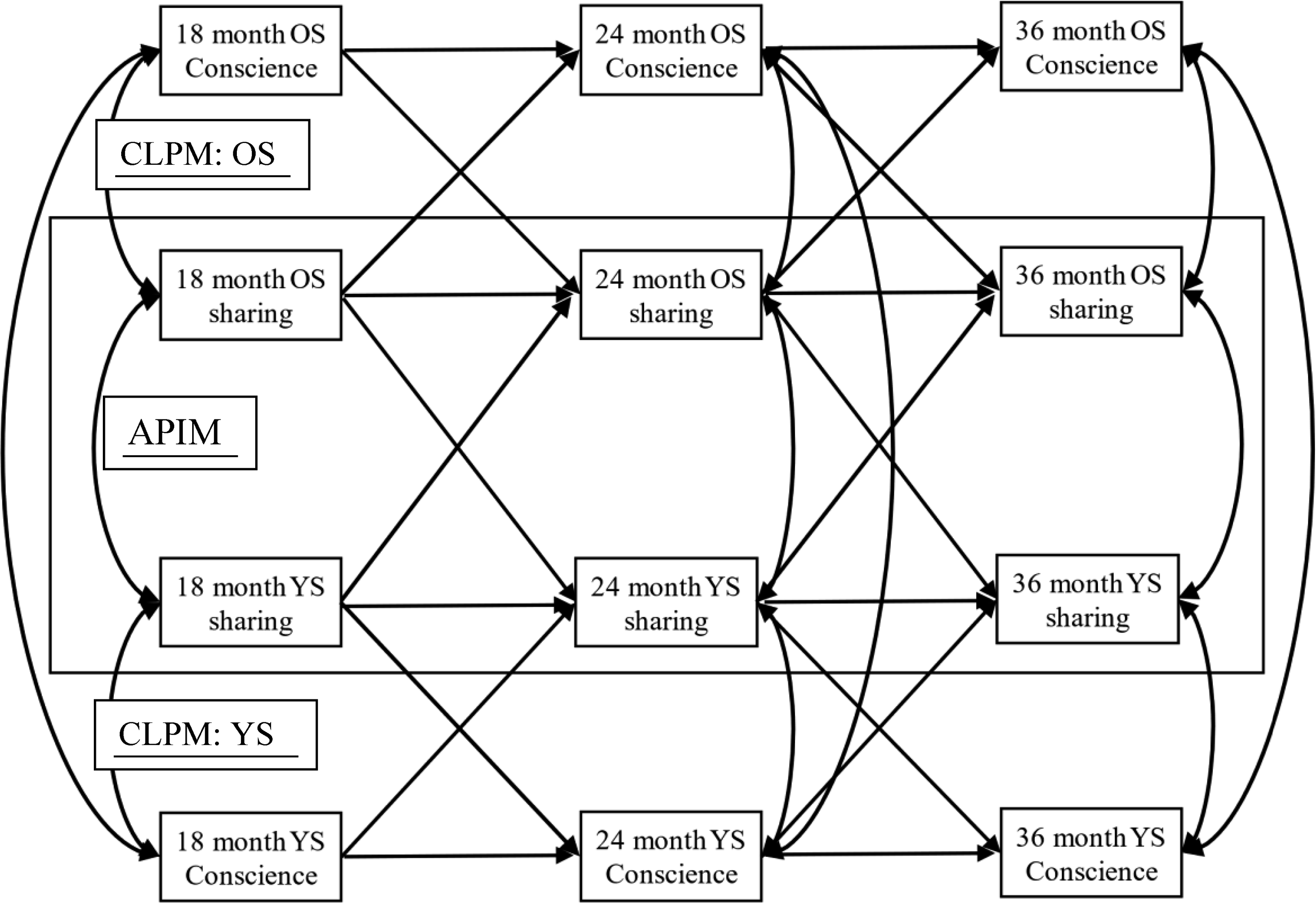
Method
Participants
Participants for this study were 145 families (mothers, fathers, older siblings, and toddlers) participating in a longitudinal study examining changes in child and family functioning during early childhood. All families had participated previously in a longitudinal investigation of children’s adjustment and family relationships in the year after the birth of a sibling (Volling et al., 2017). Families were recruited from Southeastern Michigan in the midwestern United States. Families were re-contacted for follow-up assessments when second-born toddlers were 18, 24, and 36 months old. Data collection for the 18-, 24-, and 36-month timepoints occurred from 2007-2013.
The initial study recruited 241 two-parent, mother-father families, in which mothers were expecting their second infant (85.6% of the pregnancies were planned and wanted by both parents) and fathers were resident and the biological parents of the infants (98% were the biological father of the firstborn). The initial phase (Phase I) included five timepoints of data collection: prenatal in the last trimester of pregnancy, and at 1, 4, 8, and 12 months after the birth of the second child. Families were recruited from obstetric clinics, pediatrician’s offices, childcare centers, and local media targeting parents. Families were excluded if the infant was born preterm (<37 weeks) and the older sibling was diagnosed with any known developmental disability. By the 12-month timepoint, 203 families remained in the study. These 203 families were contacted to participate in the current follow-up study (Phase II), of which 155, 140, and 135 families participated at the 18-, 24-, and 36-month follow-ups, respectively. Attrition was primarily due to one of the following reasons: families moved out of the area, could not be reached, or declined to participate. Parents who participated in the follow-up phase starting at 18 months did not differ demographically on years of marriage, t (239) = .51, p = .61, mothers’ and fathers’ ages, t (143.53) = 1.44, p = .13, t (239) = .24, p = .81, older siblings’ age, t (239) = −.92, p = .36, family income, t (239) = 1.55, p = .12, or older siblings’ gender, χ2 (1) = .55, p = .50, from the 241 families initially recruited for the first phase of the longitudinal investigation.
Of the families contacted for the current follow up study, 145 completed the sibling sharing task (i.e., Fishing Game) at 18 months, 124 families completed the task at 24 months and 116 families completed the task at 36 months. At the 18-month timepoint, families were primarily European American (86.5% of mothers; 86.5% of fathers), followed by African American/Black (5.2% mothers and 4.5% fathers), Asian American (3.2% mothers and 3.9% fathers), Hispanic (3.2% mothers and 3.2% fathers), and Other (1.9% mothers and 1.9% fathers). The mean age of fathers was 34.91 years (SD = 4.65) and the mean age of mothers was 34.03 years (SD = 3.84). Most (38.7%) families earned $60,000 - $99,999, with most mothers (87.1%) and fathers (79.4%) having a bachelor’s degree or higher. Most parents (58% of mothers, 47% of fathers) had professional, specialty, or technical careers followed by executive, administrative, and managerial positions (17.2% of mothers, 25.4% of fathers), administrative support positions (7.0% of mothers, 4.3% of fathers), sales (2.5% of mothers, 6.9% of fathers), precision production and repair (0% of mothers, 4.7% of fathers), or were students (2.5% of mothers, 7.8% of fathers).The mean age of older siblings (43.9% boys) when the toddlers (54.8% boys) were18 months was 49.34 months (SD = 10.28), with a mean age space of 31 months (SD = 10.00). The dyad gender composition was 36 boy-boy (older-younger), 37 girl-girl, 50 girl-boy, and 32 boy-girl.
Measures
Observations of sibling sharing in the fishing game
At 18, 24, and 36 months, both siblings were observed during a fishing game task conducted at the university laboratory. Children were asked to take turns catching ten fish, each with a metal tip by the mouth, with a single magnetic fishing rod from an inflatable swimming pool. The Experimenter (E) told the children that she wanted them “to take turns to catch fish from the pool” and gave each sibling a small hand-held, plastic basket in which to put their fish. E explained further that “when you are all finished, I will count how many fish each of you caught and give you a prize for each fish caught.” E underscored that if they caught two fish, they would get two prizes and if they caught eight fish, they received eight prizes, etc. One parent was present in the room and was instructed to sit nearby, fill out questionnaires, and not intervene in the task unless they deemed it necessary (e.g., to intervene in conflicts or prevent aggression). The E was also present and provided reminders when necessary “to take turns” (e.g., physical struggles over the pole). These reminders were noted during the coding of the videotaped fishing game and then used as a control in analyses. Children were given as much time as needed to complete the task. At the end of the task, the E counted how many fish each sibling had caught, but both children were given five prizes, regardless of the number of fish caught. This decision was made to ensure equity and reduce the potential for sibling squabbles that would require parental intervention. The task started with the experimenter handing the fishing pole to the older sibling and instructing both siblings to “take turns” and ended when all ten fish had been caught from the pool; average length was 4 minutes and 49 seconds (SD = 133 seconds). The fishing pole was always handed to the older sibling first given prior research demonstrating that older siblings often manage sibling interactions during the toddler and preschool years (Abramovitch et al., 1986; Dunn & Munn, 1986; White et al., 2014). Further procedural details can be obtained from the first author upon request.
All sessions were video-recorded and later coded by a team of coders who were trained to criterion reliability of 80% with two senior coders (the second and fourth authors). Independent coders were assigned to rate the older siblings’ and the toddlers’ behaviors. Reliability was calculated on 20% of videos by having two coders independently rate sibling interactions. Intraclass correlations (ICC) were calculated across siblings and timepoints and are reported below.
Coding of cooperation and turn-taking
Global ratings for cooperation/helping and turn-taking were made for both the older siblings and toddlers across the entire duration of the task using a seven-point scale. Exemplars of cooperation/helping (1 = no evidence of cooperation/helping to 7 = cooperation/helping present for entire task) included helping put the fish on the hook for the sibling, making it easier for the sibling to catch the fish by placing the fish closer, offering to catch the fish. Examples of turn-taking (1 = no evidence of turn-taking to 7 = turn-taking present for entire task) included giving up the pole willingly and without prompting at the end of one’s own turn and voluntarily handing over the pole when one’s turn was finished. ICCs for cooperation/helping = .67–.83 across siblings and time; ICCs for turn-taking = .71–.85 across siblings and time. A single composite was created for each sibling at each timepoint by averaging the ratings of cooperation/helping and turn-taking, and these scores were used to reflect each sibling’s sharing. Average ratings were used to reduce the number of variables used in the SEM analyses and to create equivalent measures across siblings.
Older sibling management of the toddler sibling was also rated across the entire task using a seven-point scale for the older sibling only (1 = no evidence of management during task to 7 = high levels of management for entire task), and assessed the extent to which the older sibling attempted to manage, organize, or control the turn-taking activity of the toddler sibling in some way (e.g., older sibling requests or suggests that toddler perform or not perform a behavior, or perform an activity in a certain way, physically assist toddler). Toddlers did not have to comply to the older siblings’ management attempts, only that the older siblings were attempting to make suggestions or manage some aspect of the task. ICCs = .69 - .76 across time.
Children’s conscience development
Both mothers and fathers completed the My Child Questionnaire (Kochanska et al., 1994) at 18, 24, and 36 months for both older siblings and toddlers to assess different dimensions of children’s conscience. The questionnaire consisted of 88 items rated on a seven-point scale (1 = extremely untrue to 7 = extremely true) and yielded eight subscales: (a) Guilt, Remorse/Other Emotional Reactions After Transgression (e.g., “child likely to feel responsible whenever anything goes wrong”, α = .83–.88); (b) Concern Over Good Feelings With Parent After Wrongdoing (e.g. “after having done something naughty, child asks to be forgiven”, α = .85–.86); (c) Confession (e.g., “child may confess to doing something naughty even if unlikely to be found out”, α = .73–.83); (d) Apology (e.g., “child will spontaneously say sorry after having done something wrong”, α = .83–.87); (e) Reparation/Amends (e.g., “child is eager to make amends for doing something naughty”, α = .79–.84); (f) Corrections Occasioned By Others’ Transgressions (e.g., “child is likely to scold another child who violated a house rule”, α = .83–.87); (g) Internalized Conduct (e.g., “child will spontaneously pick up toys, even without being asked”, α = .88–.89); and (h) Empathic, Prosocial Response to Another’s Distress (e.g., “child will try to comfort or reassure another in distress”, α = .80–.84). These eight subscales were further composited into two larger indicators of conscience based on the principal components analysis of Kochanska et al. (1994): affective discomfort (i.e., guilt, apology, concern about good feelings, and empathy) and moral regulation (i.e., confession, reparation/amends, internalized conduct, and concern about other’s wrongdoing). These composites capture, respectively, the moral emotions and moral conduct dimensions of conscience. Kochanska et al. (1994) provided validity for the conscience composites by relating them to observed behavior of children in a toy prohibition task (Don’t Touch), with both affective discomfort and moral regulation negatively correlated with children’s frequency of transgressions (e.g., playing with the prohibited toys). Further, Kochanska et al. (1996) reported that parent reports of affective discomfort and moral regulation revealed increases from toddlerhood into preschool, and predicted children’s conscience based on narrative themes in a story completion task (less antisocial and more guilt/empathy themes). The correlations between mothers’ and fathers’ reports of older sibling affective discomfort, r = .41–.54 over time, all ps < .001, older sibling moral regulation, r = .40–.48, all ps < .001, toddler sibling affective discomfort, r = .33–.45, all ps < .001, and toddler sibling moral regulation: r = .38–.48, all ps < .001, were significant. Mothers’ and fathers’ reports were averaged to create single scores for older siblings’ affective discomfort and moral regulation, and the toddlers’ affective discomfort and moral regulation, to create more robust composites and to reduce single reporter bias.
Data analysis plan
To examine mean-level changes in older siblings’ and toddler siblings’ sharing and conscience development, three random-intercept linear mixed models (LMMs) were conducted with sibling sharing, affective discomfort, and moral regulation as dependent variables, respectively. Older siblings’ age and gender, and toddlers’ gender were entered into the LLMs as covariates to test whether these variables were associated with sibling sharing and conscience development. Significant sibling (older sibling vs. toddler) by Time (18 months vs. 24 months vs. 36 months) interactions in the LMMs tested whether there were significant changes in sharing over time for older siblings and toddlers, and in affective discomfort and moral regulation for both siblings. One additional LMM was conducted to study the changes in the older siblings’ management of toddlers over time. Random intercept LMMs were used because the outcome variables (i.e., sibling sharing, affective discomfort, moral regulation, and sibling management) were measured at 3 time points and clustered within siblings from the same family (i.e., the data points were not independent). LMMs allowed us to account for the interdependence among the data points and handle missing data with maximum likelihood estimation. In the LMMs, time was coded using forward difference coding so that 18 months was compared against 24 months, and 24 months was compared against 36 months in the model. Pairwise comparisons were also conducted to examine the time by sibling differences. All LMMs were run using R 4.3.1.
To examine the reciprocal and bidirectional relations between the older siblings’ and toddlers’ sharing, and between sharing and conscience for both siblings, we conducted two structural equation models testing the ICLM from Figure 1, one model with moral regulation and the other with affective discomfort as the indicators of conscience. In Figure 1, the APIM model is enclosed in the center rectangle of the figure. There are two key components of the APIM, actor effects and partner effects. In longitudinal prediction, actor effects assess how much an individual’s behavior at any one time is predicted by their prior behavior at a former time and represents the stability (rank ordering) of individual differences across time (e.g., older siblings’ sharing at 18 months to older siblings’ sharing at 24 months). Partner effects, which take into consideration the interdependence between siblings, measure how much one siblings’ behavior at one time was influenced by the other siblings’ behavior at a prior time and can be seen in Figure 1 as the cross paths (e.g., older siblings’ sharing at 18 months to toddler siblings’ sharing at 24 months). The correlation (double-headed arrow) between older siblings’ sharing and toddler siblings’ sharing at 18 months assures that if there are any significant actor effects, partner effects are controlled and vice versa. For evidence of bidirectional relations, both partner effects (older sibling to toddler, and toddler to older sibling) need to be significant. The correlated residuals indicated by the double headed arrows between sharing at 24 and 36 months for each sibling reflects the correlation between older siblings’ and toddlers’ sharing once partner effects are controlled and for our purposes, reflects reciprocity between siblings. The CLPMs (older sibling above and toddler below the APIM) between each sibling’s sharing and their conscience enables an examination of the prediction of one sibling’s sharing with their conscience, and vice versa, over time controlling for both the stability in each over time and the cross-sectional associations. The cross-lagged paths in the CLPMs are examined as a means of determining whether conscience at one point predicts sharing at a subsequent time point or sharing predicts conscience. The older siblings’ management of the task was also included as a predictor of both the older siblings’ and toddlers’ sharing (see Figures 4 and 5). The ICLM allowed us to specify the sibling dyad as the unit of analyses in an APIM structure, and to estimate and test simultaneously the interconnections and cross-lagged relations between conscience and sharing for both siblings. The models were estimated using Mplus (version 8.10; Muthén & Muthén, 1998-2017) with maximum likelihood (ML) estimation, leaving 145 sibling dyads for analyses. Because older sibling’s age and gender, the toddlers’ gender, and experimenter reminders were associated with sharing and conscience development, they were included as covariates. Model fit was evaluated using multiple fit indices: RMSEA ≤0.08, CFI ≥0.90, and SRMR ≤0.08 indicated adequate fit (Marsh et al., 2004; Vandenberg & Lance, 2000). The chi-square test of significance is reported but was not used to assess model fit because it has been shown to be highly sensitive to sample size (Kline, 2011).
Results
Descriptive statistics for all study variables.
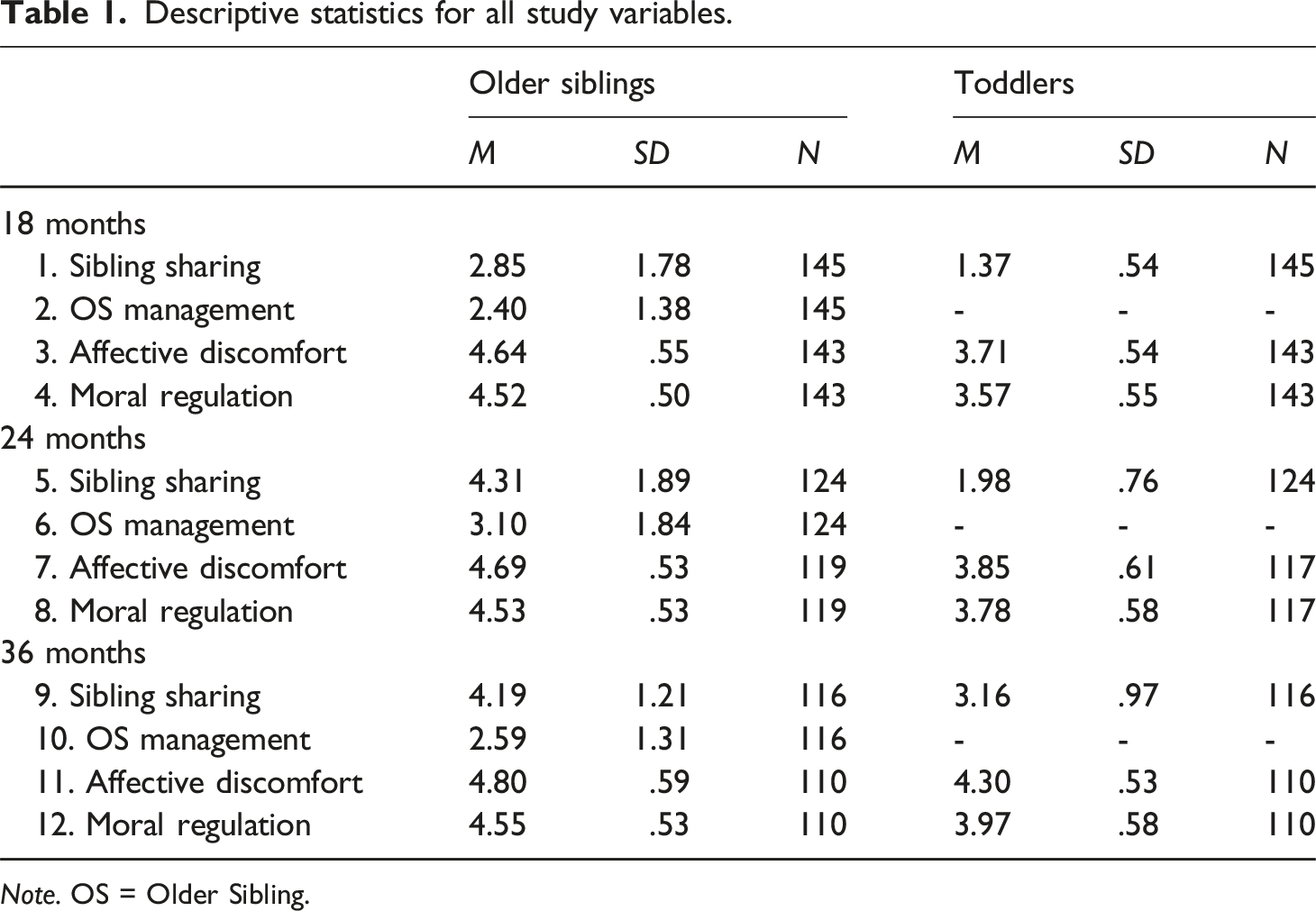
Note. OS = Older Sibling.
Correlations among study variables.
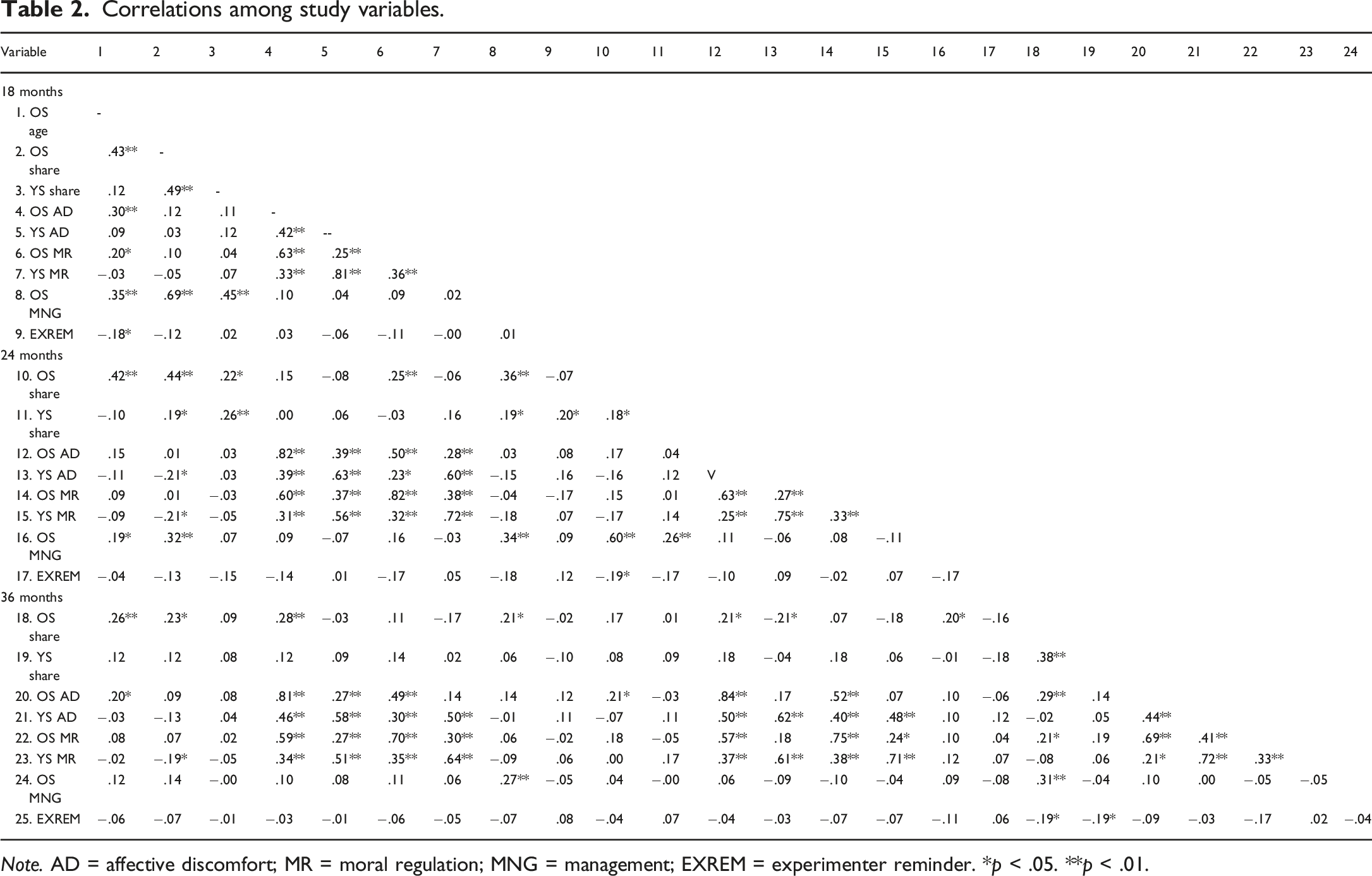
Note. AD = affective discomfort; MR = moral regulation; MNG = management; EXREM = experimenter reminder. *p < .05. **p < .01.
Linear mixed models predicting sibling sharing, affective discomfort, moral regulation, and older siblings’ management.
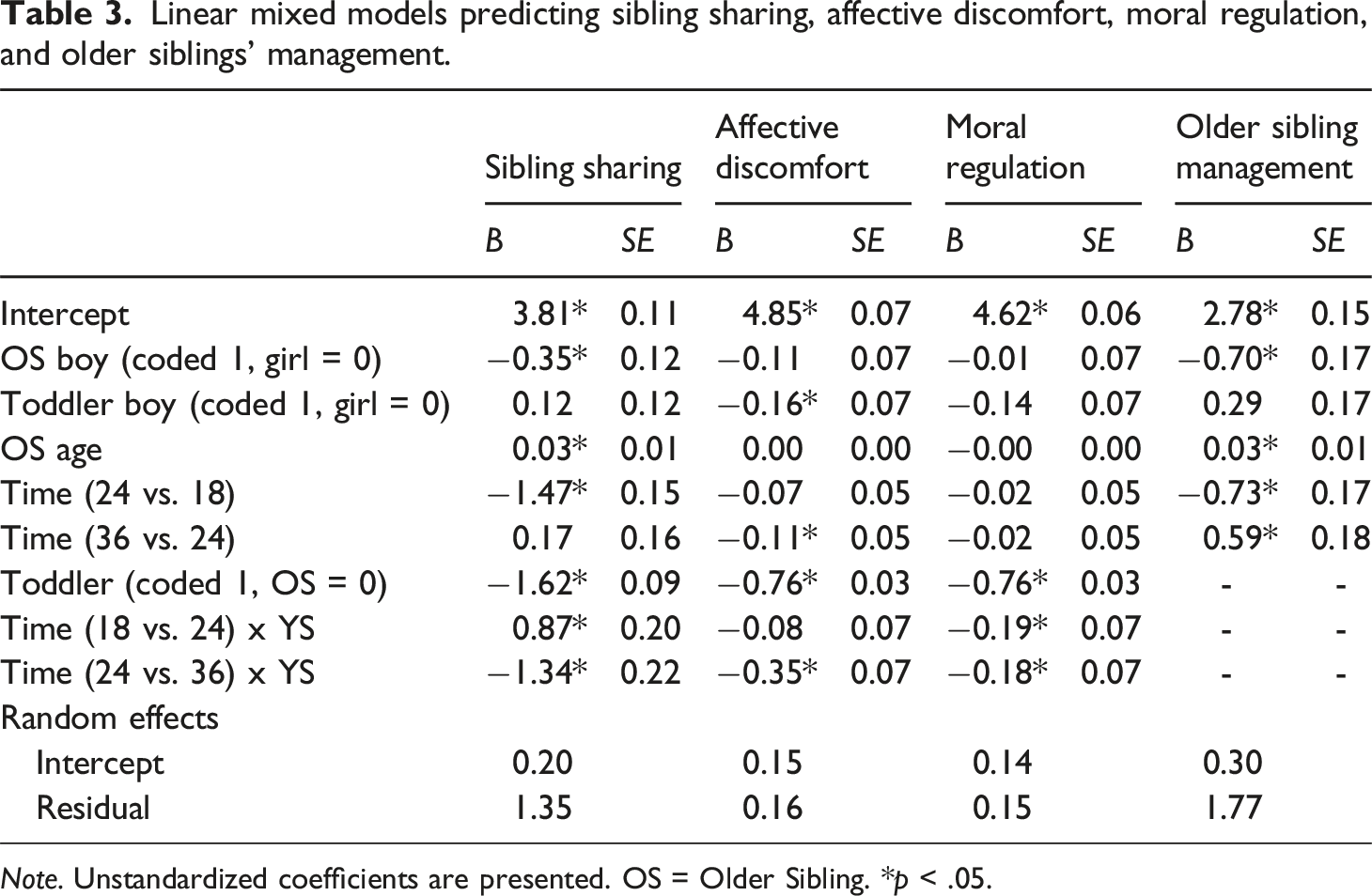
Note. Unstandardized coefficients are presented. OS = Older Sibling. *p < .05.
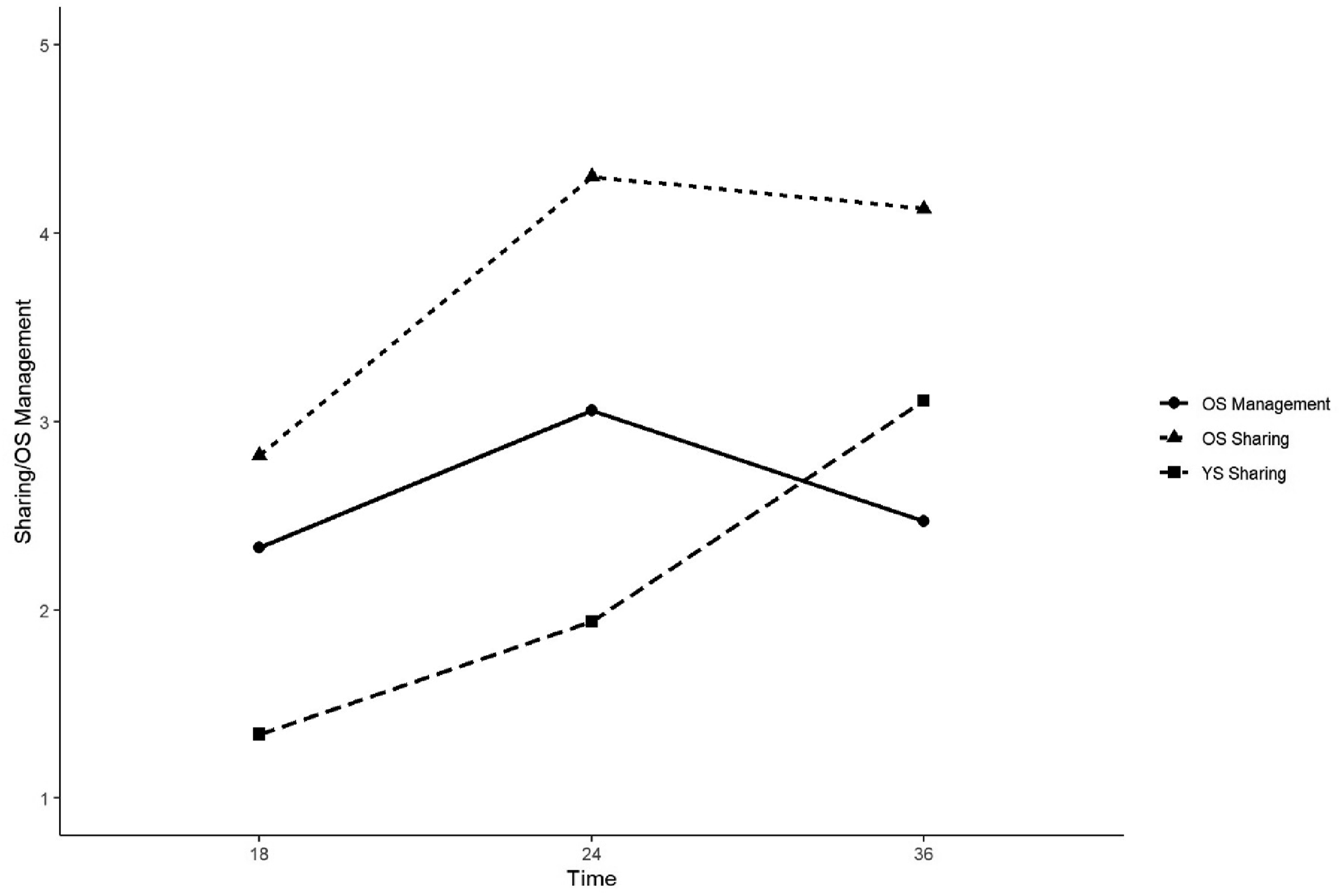
Mean-level changes in the older siblings’ and toddler siblings’ sharing and the older siblings’ management across 18, 24, and 36 months. OS = Older Sibling. YS = Younger Sibling.
Results looking at affective discomfort and moral regulation for both siblings can also be found in Table 3 and are visually represented in Figure 3. Toddler girl siblings, on average, had higher levels of affective discomfort than toddler boy siblings. Similarly, older girl siblings had higher scores on affective discomfort and moral regulation than older boy siblings. Not surprisingly, older siblings had significantly higher levels of both affective discomfort (Δ = .92, .85, and .50, ps < .001) and moral regulation (Δ = .95, .76, and .58, ps < .001) at 18, 24, and 36 months than their toddler siblings. Time effects revealed no change in either affective discomfort (Δ (18 vs. 24) = .07, p = .73, Δ (24 vs. 36) = .11, p = .26) nor moral regulation (Δ (18 vs. 24) = .02, p = .99, Δ (24 vs. 36) = .02 p = .99) from 18 to 24 months or 24–36 months for older siblings. But, as can be seen in Figure 3, there was a significant increase in both affective discomfort (diff Δ (18 vs. 24) = .14, p = .046, diff Δ (24 vs. 36) = .47, p < .001) and moral regulation (diff Δ (18 vs. 24) = .20, p < .001, diff Δ (24 vs. 36) = .21, p = .001) from 18 to 24 and then again from 24 to 36 months for toddlers. Mean-level changes in the older siblings’ and younger siblings’ affective discomfort and moral regulation across 18, 24, and 36 months. OS = Older Sibling. YS = Younger Sibling.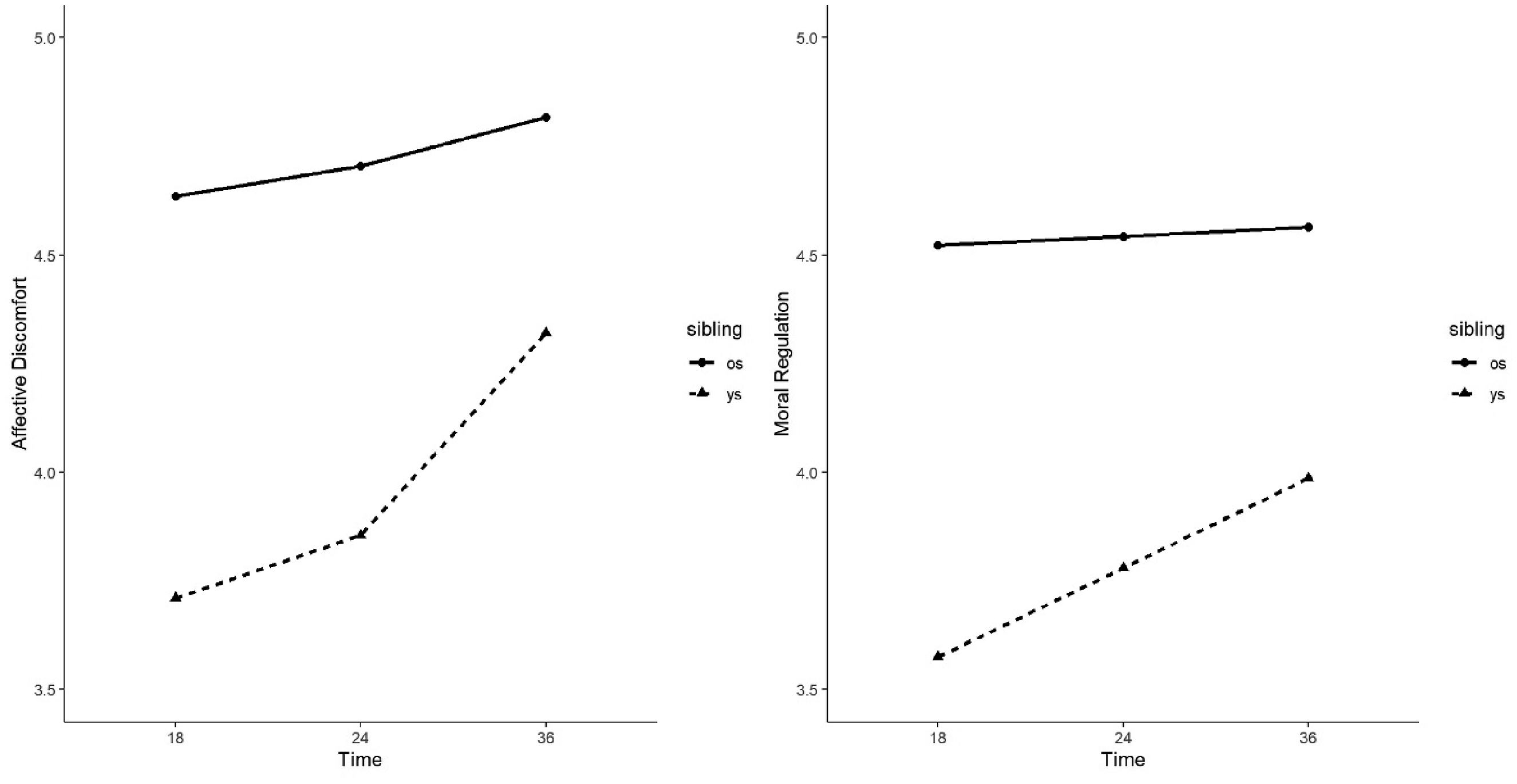
Structural equation models tested the ICLM from Figure 1. The model fit for the model using affective discomfort as an indicator of conscience was good, χ2 (104) = 174.14, p < .001, RMSEA = .07, CFI = .92, SRMR = .07, as was the model fit for moral regulation, χ2 (104) = 134.26, p = .02, RMSEA = .05, CFI = .96, SRMR = .06. Figure 4 shows the standardized coefficients for the model with affective discomfort and Figure 5 the results for moral regulation. In both models, there is considerable stability in individual differences over time for both moral regulation and affective discomfort for both the older sibling and the toddler across the three timepoints, as can be seen in the significant autoregressive path coefficients from 18 to 24 months and from 24 to 36 months. Further, in both models, there is significant stability from 18 to 24 months for the older siblings’ management and for the older siblings’ and the toddler siblings’ sharing. There was no evidence, however, in either model of stability in the sharing behavior of either sibling or the older siblings’ management of the interaction from 24 to 36 months, given all of these paths are nonsignificant. Finally, sharing between older siblings and toddlers was reciprocated within time at all three time points, as can be seen from the significant intercorrelations between older siblings’ and toddlers’ sharing. Structural equation model for siblings’ sharing behaviors, older sibling’s management of toddler sibling, and siblings’ affective discomfort over time. This model controlled for older siblings’ age and gender, toddler/younger siblings’ gender, and experimenter reminders. OS = older sibling, YS = younger sibling, AD = affective discomfort. Significant paths are shown in solid black lines and non-significant paths are shown in dotted gray lines. For ease of presentation, the coefficients for non-significant paths are not presented. Structural equation model for siblings’ sharing behaviors, older sibling’s management of toddler sibling, and siblings’ moral regulation over time. This model controlled for older siblings’ age and gender, toddler/younger siblings’ gender, and experimenter reminders. OS = older sibling, YS = younger sibling, MR = moral regulation. Significant paths are shown in solid black lines and non-significant paths are shown in dotted gray lines. For ease of presentation, the coefficients for non-significant paths are not presented.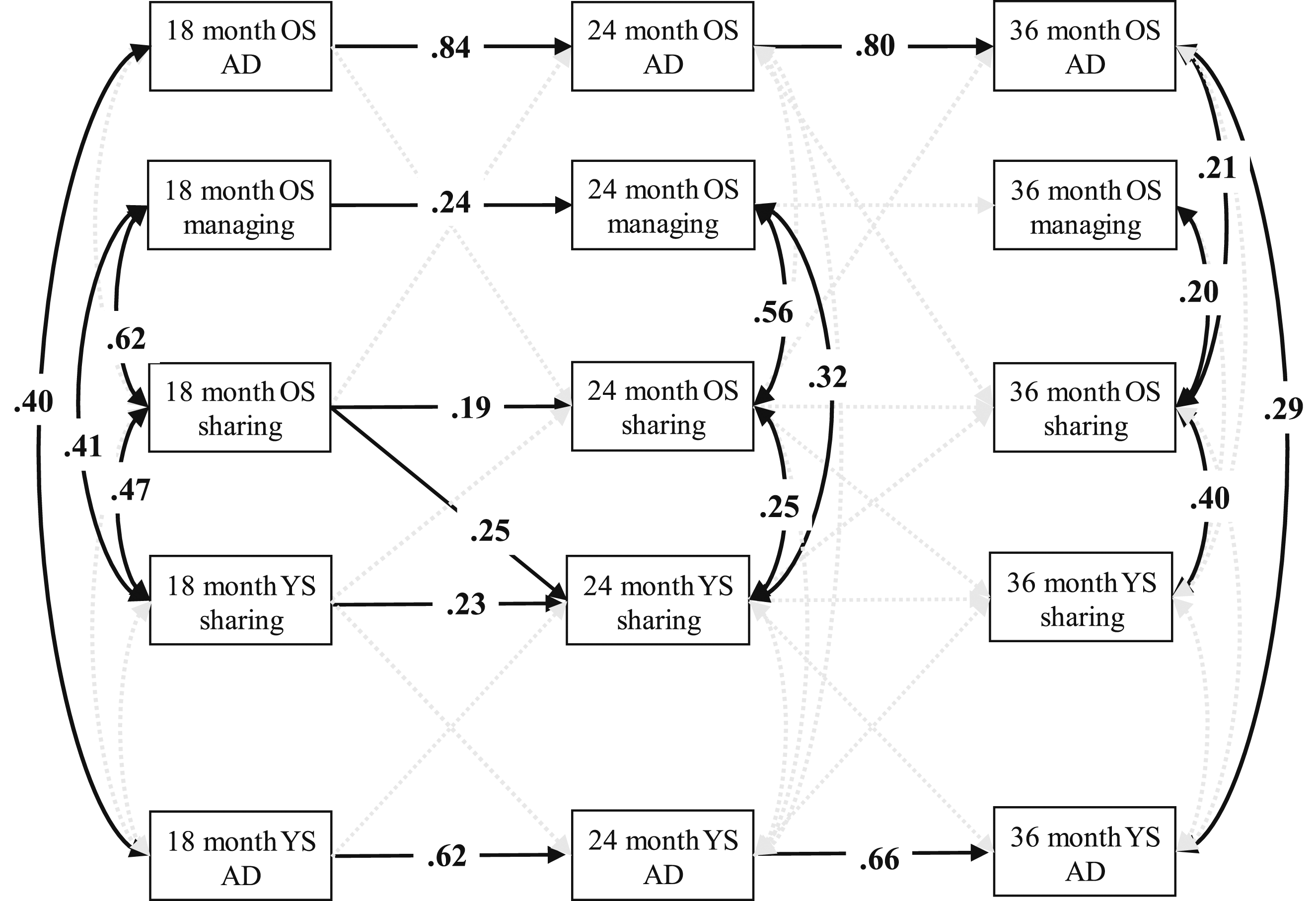
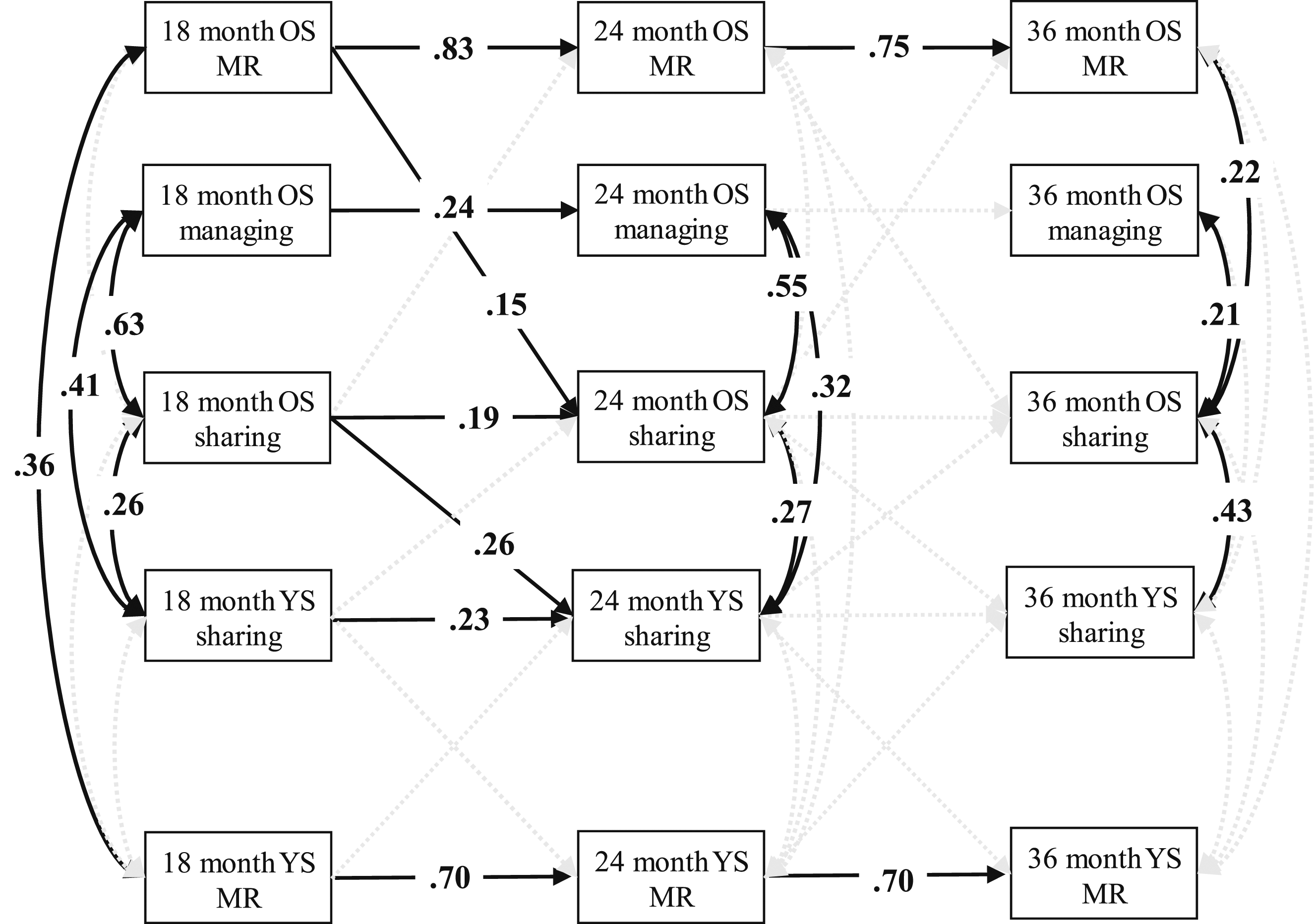
When considering whether there were bidirectional relations between sibling sharing at one point predicting the sharing of the other sibling at the subsequent time point, only the older siblings’ sharing at 18 months predicted the toddlers’ sharing 6 months later when they were 24 months of age (see Figures 4 and 5). There was no further evidence of either sibling’s sharing predicting the other sibling’s sharing at any other time, once the actor (i.e., stability) and partner (cross-lag) effects were controlled
Discussion
The major goal of this investigation was to assess turn-taking between toddlers and their older siblings during a fishing game task as a form of sibling sharing, and to determine whether sibling sharing was associated with conscience development when toddlers were 18, 24 and 36 months of age. Because the current investigation relied on a longitudinal research design spanning the significant developmental period of toddlerhood into preschool, we were able to test whether there were any changes in how siblings engaged in the fishing game, whether they cooperated in taking turns and sharing, and how older siblings might scaffold and manage the interaction for the toddlers. In addition, we wanted to examine whether there was any evidence of dyadic reciprocity and bidirectional relations between the sharing of toddlers and older siblings both within and across time. Prior research has found that older siblings act as teachers and manage interactions, and that cooperative older siblings may very well influence the younger siblings’ prosocial behavior at a later time (Dunn & Munn, 1986), whereas younger siblings use more social cues (e.g., verbal requests, pointing, negative affect) that may elicit sharing from older siblings (Tavassoli et al., 2019).
The fishing game as an observational paradigm for sibling sharing
Most developmental research that examines sharing is based on paradigms of individual children interacting with an experimenter, some as young as 3 years of age, where children are asked to distribute valued resource (e.g., stickers, coins) to another (Gummerum et al., 2010; Ongley & Malti, 2014). These tasks focused on individual children do not easily transfer to an understanding of how young children participate, negotiate, and strategize in their favor in “real-world” social interactions with parents and siblings that contemporary constructivist-interactionist theories underscore as the foundation for the emergence of early morality and sharing (Dahl & Killen, 2018; Paulus, 2023). In the current study, we developed the Fishing Game which allowed us to observe toddlers as young as 18 months of age participating with an older sibling in a game setting to assess how these young children initially engaged in this task, whether the management of the task by the older siblings scaffolded the toddlers’ performance, how sharing would change over time, and whether there were reciprocal and bidirectional relations between the sharing behaviors of toddlers and their older siblings.
Surprisingly, in many of these earlier studies, it seems young children are often selfish and choose to distribute resources that advantage them (e.g., Kim et al., 2023; Smith et al., 2013). But early forms of sharing may be best captured by observing young children participating in the dyadic give-and-take of social interactions between siblings. Consistent with previous research suggesting that older siblings play a dominant role in both prosocial and antagonistic sibling interactions (Abramovitch et al., 1986; Dunn & Munn, 1986; Tavissoli et al., 2019), we did find that older siblings engaged in more sharing at each of the three times than their toddler siblings. Yet, toddlers as young as 18 months were able to engage in some form of turn-taking with the scaffolding and assistance of an older sibling. Toddlers, especially, may benefit and share very early in life when that partner is an older, more knowledgeable, social partner who understands the social conventions of moral conduct, explains the rules of turn-taking, and can assist so their toddler siblings can follow those rules. Older siblings changed their behavior in response to the advances in toddlers’ sharing over time. Toddlers’ sharing increased from 18 to 24 to 36 months, with a corresponding decrease in the older siblings’ management of the task from 24 to 36 months.
Older girl siblings were more likely to share than older boy siblings, as well as had higher scores on both affective discomfort and moral regulation. Toddler girls were also receiving higher scores on affective discomfort than toddler boys. Although we did not have the sample size to adequately address how these relations might differ based on the gender constellation of the sibling dyad, these gender differences in sibling sharing are noteworthy. From a constructivist-interactionist view of moral socialization, interacting with an older sister reflects a different interaction context where toddlers are the recipients of more prosocial behaviors and have more opportunities to observe and learn rules of reciprocity and turn-taking, while also being helped and assisted to participate in the actual task. Prior work finds that girls, in general, engage in more sharing behaviors, and sharing may emerge earlier in girls than boys (e.g., Malti et al., 2012; Ongley & Malti, 2014; White et al., 2014). Girls also engage in more committed compliance, a precursor to later conscience, than boys (Kochanska, 2002). Larger samples will allow a more detailed examination of how sibling interactions are constructed differently by both older and younger siblings based on gender and age, and how these different interactive contexts affect moral development.
Here, I’ll do it for you: Reciprocity and bidirectional relations
In the current research, we advance research on both sharing and sibling relationships through the use of the Interdependent Cross-Lagged Model (ICLM), which allowed an examination of the cross-sectional and longitudinal relations between each sibling’s sharing behavior and their conscience scores, in addition to modeling the dyadic, interdependent relationship between siblings using an APIM modeling structure. Unlike some studies that may analyze these relations in a piecemeal fashion (CLPM and APIM separately) using multiple analysis strategies, the ICLM can estimate the effects of one siblings’ sharing behavior on the other siblings’ sharing behavior both within- and across time by controlling for two key components of an APIM, actor (stability) and partner (cross-lag) effects, while also estimating simultaneously the cross-lagged panel models between sharing behavior and conscience for both siblings.
The findings revealed, contrary to our hypotheses, no evidence of bidirectional relations across 18 to 24 to 36 months either in the turn-taking and sharing within the sibling dyad, or the relations between each sibling’s sharing behavior and their conscience, whether affective discomfort or moral regulation. Only the older siblings’ sharing at 18 months predicted the toddlers’ sharing at 24 months. The toddlers’ sharing at one point in time did not appear to influence whether or not older siblings shared at a subsequent timepoint. These findings suggest that perhaps due to the immaturity of their toddler siblings, how older siblings interact with toddlers at 18 months may be particularly important at setting the stage for cooperative sibling interactions in the form of toddler sharing at a later time, specifically at 24 months. Our findings reveal a developmental sequence that unfolds over time. At 18 months, toddlers are limited in their understanding of fairness and taking turns to achieve valuable resources without communicative support and instructions from an older sibling (Brownell et al., 2013). It also appeared they were unable to engage in the fishing game without their older siblings’ assistance and looked to them for guidance and instructions on how to partake in the turn-taking. By 24 months, however, toddlers may have acquired enough understanding of the rules of reciprocity to socially engage and use the skills modeled by their older sibling at 18 months. By 36 months, these children were now independently making their own choices, participating in the reciprocal back-and-forth required to fish, and understanding what it meant to take-turns and share, regardless of their older siblings’ management. Only at 36 months, was the older siblings’ management of the task no longer related to the toddlers’ sharing. Pike and Oliver (2017) found strong evidence for bidirectional relations between older and younger siblings’ prosocial behaviors across their two-wave longitudinal study when younger siblings were 4 and 7 years old. Thus, it is possible that longitudinal bidirectional relations between older and younger siblings’ sharing behaviors become more prominent beyond early childhood when children develop more individual agency (White et al., 2014). Future studies should examine this dynamic in the preschool years and beyond to determine if dyadic reciprocity and bidirectional relations in sibling sharing emerge beyond the toddler and preschool years.
In contrast to the lack of bidirectional relations, we did find support for dyadic reciprocity between the siblings within each of the three time points. The ICLM analysis revealed that even after the covariance of the partner (cross-lag) and actor (stability) effects of the APIM were estimated, there were still significant correlations between the residuals (unexplained contemporaneous variance) reflecting the interdependence (reciprocity) between the older siblings’ and toddlers’ sharing during the fishing game at 24 and 36 months. Direct reciprocity during repeated interactions with familiar others promotes long-term cooperation because such repeated exchanges involve taking turns that incur costs (sharing resources with another) but also benefits (acquiring resources from others who share) than if neither partner was willing to share in the first place (Sebastián-Enesco & Warneken, 2015). Greater reciprocity in sibling sharing during early childhood may promote cooperative and friendly sibling relationships, but perhaps even more importantly from the perspective of parents, reduce the likelihood of sibling conflicts. Observations of sibling interactions with 2- to 4-year-olds found that conflicts were frequent, approximately six conflicts per hour (Perlman et al., 2007), so parents are often eager to learn skills to intervene in conflict and increase cooperation (Pickering & Sanders, 2016).
Sibling relationships are unique, however, in that they consist of both reciprocal (i.e., the back and forth typical of peers in play or conflict) and complementary interactions (i.e., the hierarchical exchanges typical of caregiving and teaching; Dunn, 1988). Toddlers benefit from both complementary and reciprocal interactions with an older sibling. Starting at 18 months, toddlers’ sharing was related to the older siblings’ sharing but also their management of the task, and the correlation between older siblings’ and toddlers’ sharing may be explained, in part, by the complementary nature of early instructions. By 36 months, toddlers’ sharing is no longer related to the older siblings’ management, so the correlations between each sibling’s sharing may now reflect more reciprocal exchanges. Yet, both reciprocal and complementary interactions are interrelated and no doubt characterize sibling relationships throughout childhood. For instance, Howe and Recchia (2005) examined associations between the reciprocal (i.e., play) and complementary (i.e., teaching) interactions of 5- and 7-year-old siblings. Specifically, when sibling teachers used more verbal instructions during a teaching task, they were also more likely to engage in positive affect during sibling play, and when these sibling teachers were able to facilitate more involvement in learning the task, the sibling dyad was more cooperative and engaged in less negative affect during play. Future research on sibling sharing will need to delineate further the role of both reciprocal and complementary exchanges for the emergence of early morality and conscience.
Sibling sharing and conscience development
The final aim of the current study was to examine relations between sibling sharing and conscience development for both older siblings and toddlers over early childhood from 18 to 36 months. Although there was no change in the older siblings’ moral regulation and affective discomfort across time, there was a significant increase in both affective discomfort and moral regulation for the toddlers from 18 to 24 to 36 months. Recall that sharing requires the promotion of other-focused positive behaviors and the inhibition of self-focused negative behaviors (moral regulation) and has been linked to moral emotions such as guilt and sympathy (affective discomfort). As a result, we hypothesized associations between sibling sharing and children’s conscience, and that the older siblings’ conscience would be particularly important starting already at 18 months to manage the sharing and turn-taking exchanges. Further, we expected there would be more evidence of sharing predicting conscience as toddlers got older between 24 and 36 months. It was the case the older siblings’ moral regulation at the 18- month-timepoint predicted their sharing with their toddler siblings at 24 months. Older siblings with better internalized moral regulation may be better equipped to promote positive other-focused behaviors during turn-taking exchanges with a younger sibling. However, there was no evidence that toddlers’ sharing predicted their conscience at any point in time, which again, may be revealed beyond the age of 3 when children have a better understanding of fairness and the importance of sharing in building and maintaining cooperative social relationships with others. Because most U.S. children grow up with siblings, spend substantial time with their siblings, and interact in a manner that may contribute to early social and moral development (see Howe et al., 2022), understanding how sibling interactions may serve as a context for the developing internalization of conscience is deserving of further scrutiny.
Limitations and future directions
One of the strengths of the current study was its longitudinal three-wave design with repeated measures that assessed sibling sharing and the development of children’s conscience during the early period of childhood when there is rapid growth in the development of an internalization of standards and an understanding of right and wrong. Despite the longitudinal research design, there were also several limitations. First, participants were primarily European American, well-educated, and middle-class two-parent, mother-father families, which may constrain the generalizability of the findings to children from different socioeconomic or cultural circumstances. Future research should continue to investigate sibling sharing using more diverse populations, with respect to SES, race and ethnicity, culture, and family composition, given that the norms for sharing may differ across Western and non-Western cultures (Zeidler et al., 2016). Second, the study was conducted between 2007 and 2013, and we did not collect information on parents’ sexual orientation or ask about their disability status, which is now recommended as part of data collection. Third, although the fishing game was a novel means of assessing sibling sharing starting in toddlerhood and was designed to be a naturalistic lab-based measure of sibling sharing, the length of the task was relatively short and may not have provided a sufficient sampling of behavior. Further, the task was laboratory-based and may not reflect children’s naturalistic spontaneous sharing behavior in the home. Fourth, others have reported that children share more when someone is watching them or present in the room (Leimgruber et al., 2012). Because we had one parent and the experimenter present in the room during the fishing game, older siblings, in particular, may have been more inclined to take turns and not cheat than had they been left alone. Fifth, the modest sample size of the current study precluded us from examining how sharing and conscience were related based on the gender constellation of the sibling dyads (e.g., girl-girl). Finally, there are substantial changes occurring, particularly for the toddler, across the formative period from 18 to 36 months in other areas of development. Physically being able to steady the pole to engage the magnets on the pole and fish, to understanding the actual rules of sharing or turn-taking, to the growth in emotion regulation and the ability to manage the expression of negative emotions, and to the advances in self-regulation and inhibitory control to wait one’s turn are all clearly coming together to alter the type of sharing that occurs between the siblings over time.
In summary, the present study examined sharing behaviors between toddlers and their older siblings, and the relations between sibling sharing and conscience development from 18 to 36 months of age. The sibling relationship is one of the first social contexts in which children acquire and understand the rules that govern cooperative social interaction. Uncovering the longitudinal unfolding of sibling sharing over these early years should remind us there is more to the development of prosocial behaviors beyond parental socialization. Older siblings manage, direct, and organize social interactions that set the stage for their toddler siblings to learn, practice, and eventually demonstrate prosocial behaviors and the moral reasoning necessary to understand the rules of turn-taking, fairness, and cooperation. Instructing toddler siblings can provide opportunities for older siblings to learn how to help, assist, and empathize with another with limited understanding of the rules of conduct, fairness, and the obligation to share with others. Clearly, there is a need for future research investigating siblings and the development of prosocial and moral development in the early years of childhood and beyond.
Footnotes
Acknowledgements
We are grateful to the participating families of the Family Transitions and Toddler Development study, and to the many research project staff and students who helped conduct this study. This research was supported by Grants R01-HD042607 and R01-HD054573, and an Independent Scientist Award (K02-HD047423) from the Eunice Kennedy Shriver National Institute of Child Health and Human Development to Brenda l. Volling (Principal Investigator), in addition to an award from the John E. Fetzer Institute (#2228). Portions of this research were presented at the Biennial Meeting of the Society for Research on Child Development, Austin, Texas, United States.
Declaration of conflicting interests
The author(s) declared no potential conflicts of interest with respect to the research, authorship, and/or publication of this article.
Funding
The author(s) disclosed receipt of the following financial support for the research, authorship, and/or publication of this article: This research was supported by Grants (R01HD042607) and (R01HD054573), and an Independent Scientist Award (K02HD047423) from the Eunice Kennedy Shriver National Institute of Child Health and Human Development to Brenda l. Volling (Principal Investigator), in addition to an award from the John E. Fetzer Institute (#2228).
Open research statement
As part of IARR’s encouragement of open research practices, the author(s) have provided the following information: This research was not pre-registered. The data used in the research cannot be publicly shared due to participant confidentiality concerns. The materials used in the research can be obtained by emailing the first author:
