






Abstract
People often value romantic relationships more than friendships, believing that the former bring greater psychological enhancement and well-being benefits. Some studies, however, have challenged this belief. Extending these studies, a secondary analysis was conducted using a four-wave longitudinal dataset that spans twenty-two years from adolescence to early midlife. Mixed effects modeling revealed that friendship involvement (i.e., being in close friendships) was associated with lower depressive symptoms. Findings regarding the association between romantic involvement (i.e., being in romantic relationships) and depressive symptoms were more nuanced. Associations were moderated by time: both involvements appeared to play more positive roles in adulthood than in adolescence, except for within-person increase in romantic involvement, which was consistently associated with increased depressive symptoms across the investigated life stages. This research confirms previous findings and extends former studies by distinguishing between- and within-person associations and extending the investigated life stages.
Since Durkheim (1897/1951), sociologists and social psychologists have revealed that social integration – the extent to which individuals are included in various social relationships – is influential to mental health (Cohen & Wills, 1985). One of the most consequential mental health problems that are associated with social integration are depressive symptoms (e.g., Joyner & Udry, 2000; Olson & Crosnoe, 2017), which are closely related to a series of severe behavioral outcomes, including suicide (Melhem et al., 2019). Overall, it is desired that one is integrated in various types of social relationships (Cohen & Wills, 1985). However, effects of integration may differ by the type of relationships because different relationship types can function differently (Clark & Reis, 1988). The current study was focused on two important types of social relationships – romantic relationships and friendships – because the two relationship types are often compared in societal perceptions (DePaulo, 2014) and prior work has shown that involvements in these two relationship types are related to depressive symptoms (e.g., Olson & Crosnoe, 2017; Wang et al., 2024).
People often prioritize romantic relationships over friendships (DePaulo, 2014), believing that romantic relationships bring greater psychological enhancement and well-being benefits (DePaulo, 2014). Evidence did suggest attachments with romantic partners are stronger than those with friends (Hudson et al., 2015). However, the higher expectations people hold in romantic relationships like exclusivity (Fuhrman et al., 2009) are linked to more negative experiences like jealousy or conflicts with romantic partners than close friends (Kochendorfer & Kerns, 2020). Structurally, by being highly exclusive, one puts the eggs in the same basket, which can increase the risk of anger or disappointment due to their partner’s failure in meeting the expectations (Clark & Reis, 1988; Kochendorfer & Kerns, 2020). By contrast, expectations in friendships tend to be more flexible and can be fulfilled by different friends (Fuhrman et al., 2009). These structural and functional differences between the two relationship types motivated the current study to compare the roles of involvement in (i.e., being in) romantic relationships and friendships in shaping one’s depressive symptoms.
Previous studies did find that involvements in romantic relationships and close friendships were associated with depressive symptoms differently (e.g., Olson & Crosnoe, 2017; Wang et al., 2024). However, most studies examined involvements in the two relationship types separately. Some studies have revealed romantic involvement is related to more depressive symptoms during adolescence, though the association waned later in pre-midlife adulthood (Joyner & Udry, 2000; Kent & Bradshaw, 2021; Olson & Crosnoe, 2017). However, Olson and Crosnoe (2017) also found benefits of pre-midlife adult singlehood among those who were romantically involved during their adolescence. These people were more likely to show a decreasing trajectory of depressive symptoms as they transitioned from adolescents to young adults than their always-involved counterparts. By contrast, friendship involvement is related to fewer depressive symptoms across life span (e.g., Falci & McNeely, 2009; Thompson et al., 2024; Ueno, 2005; Wang et al., 2024). One study directly compared the roles of romantic and friendship involvement during adolescence and young adulthood (Camirand & Poulin, 2022). The study found having a more enduring best friendship was associated with decreased depressive symptoms ten years later (T2) whereas having a more enduring romantic relationship was not related to depressive symptoms at T2 (Camirand & Poulin, 2022).
Taken together, these findings challenge the belief that romantic relationships benefit well-being more than close friendships (for review, see DePaulo, 2014). They generally showed that both romantic and friendship involvements can be associated with depressive symptoms. However, these findings were not fully consistent. Additionally, these studies did not examine random effects or distinguish between within-person (i.e., state changes within the same person over time) and between-person (i.e., trait differences between individuals across time) associations though considering them can yield richer findings (e.g., Park et al., 2021). Furthermore, findings regarding romantic involvement were restricted to adolescence and pre-midlife adulthood, though evidence suggested associations between romantic involvement and well-being can change as individuals enter early midlife (Park et al., 2022). The socioemotional selectivity theory asserts that individuals value meaningful relationships more as they age (Carstensen, 1992). Thus, individuals may pick better relationships and experience more benefits from their involvement in both romantic relationships and friendships as they grow older. However, this remains a speculation.
Therefore, extending former investigations, a longitudinal analysis was conducted to understand depressive symptoms’ associations with romantic and friendship involvement. Following prior research that analyzed close relationships and well-being across more than three waves (Park et al., 2021), the current study employed mixed effects models in the analysis, which distinguish within- and between-person associations. The analysis spanned from adolescence to early midlife and was guided by the following questions: RQ1: How are between-person differences in romantic involvement, or RI (B), associated with depressive symptoms? RQ2: How are between-person differences in friendship involvement, or FI (B), associated with depressive symptoms? RQ3: How are within-person changes in romantic involvement, or RI (W), associated with depressive symptoms? RQ4: How are within-person changes in friendship involvement, or FI (W), associated with depressive symptoms? RQ5: Do the associations in RQ1-4 change over time?
Method
Sample
The current study used data from the National Longitudinal Study of Adolescent to Adult Health (Add Health). Online Appendix A reports more details for the dataset and its sampling. Data from Wave I (collected in 1994/1995, Mage = 15), II (collected 1996, Mage = 16), IV (collected in 2008, Mage = 28), and V (collected in 2016–2018, Mage = 38) were selected. These waves measured the study variables. To run mixed effects models, the current study included participants who had completed the measures of depressive symptoms in at least three of the four waves. These procedures led to a final sample of 2812 people; four measurement occasions were nested within these participants.
At Wave I, most participants in the final sample were in their adolescence (Mage = 15.55, SD = 1.57, range = [12, 21]); female participants (59%, n = 1651) slightly overnumbered male participants (n = 1161). Most participants (90%) were non-Hispanic (n = 2523); among Hispanic participants, they identified as Mexican/Mexican American (54%, n = 156), Puerto Rican (13%, n = 37), South/Central American (12%, n = 36), Cuban/Cuban American (7%, n = 19), Chicano/Chicana (6%, n = 16), or other Hispanic (13%, n = 38). For race, participants identified as white (72%, n = 2036), Black or African American (20%, n = 565), American Indian or Native American (4%, n = 104), Asian or Pacific Islander (3%, n = 90), or other (6%, n = 163). Most participants’ parents had a high school degree or equivalence (49%), a college degree or equivalence (27%), or post-college education (15%); the rest had parents who had less-than-high school education (9%) or did not disclose their parent’s education level (4%). Most participants (70%) had two biological parents in their household while other did not report so. The percentage of the ever-married increased from less than 1% at Wave I to 70% at Wave V. Most participants (86%) were religious, and the three most common religious identities were: Baptist (24%), Catholic (22%), and Christian Church (9%); some (12%) participants were non-religious.
Measurement
Descriptives statistics and correlations among variables.
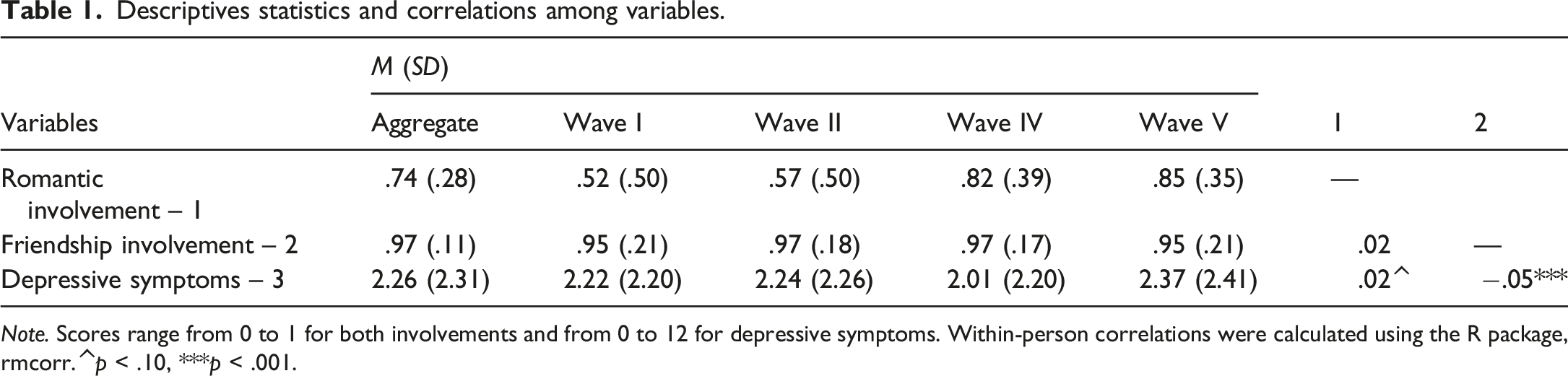
Note. Scores range from 0 to 1 for both involvements and from 0 to 12 for depressive symptoms. Within-person correlations were calculated using the R package, rmcorr. ^ p < .10, ***p < .001.
Data analysis
Mixed effects models were used to analyze the data, allowing random intercepts, random slopes of the linear and quadratic chronology predictors (Tables 1-3). To account for between-and within-person associations, each model included grand mean centered aggregates of the RI and FI predictors (i.e., between-person predictors; average levels of involvements across waves) and person-centered predictors (i.e., within-person predictors; varying levels of involvements for each wave) (See Online Appendix C for more clarifications). The unconditional means model, unconditional growth models, conditional growth model (main effects), and conditional growth models (interaction effects) were run one by one to obtain the interclass correlation coefficient (ICC) and answer research questions. In the conditional growth models, I referred to prior research (Olson & Crosnoe, 2017) and included Wave 1 time-unvarying covariates (i.e., age difference (M = 0, SD = 1.57), biological sex (1651 female, coded as 1; 1161 male, coded as 0), ethnicity (2523 non-Hispanic, coded as 0; 278 Hispanic, coded as 1), race (2036 non-White, coded as 0; 770 White, coded as 1), parent highest education level (1 = Less than high school, 4 = post-college education; median = 2, a high school degree or equivalence, 1331 individuals), both biological parents in household (823 answered “No”, coded as 0; 1973 answered “Yes”, coded 1), and marital history (5757 ever-married by Wave V, coded as 0; 3187 never-married by Wave V, coded as 1) as covariates but excluded some due to insignificance results. This was to avoid overfitting the models (Appendix D). These analyses were conducted using the nlme package in R. Longitudinal weights were not applied because they are not available for the combination of Waves 1, 2, 4, and 5 and because the current study was focused on theoretical tests within the sample rather than population description.
Results
Mixed effects model of depressive symptoms (main effects).
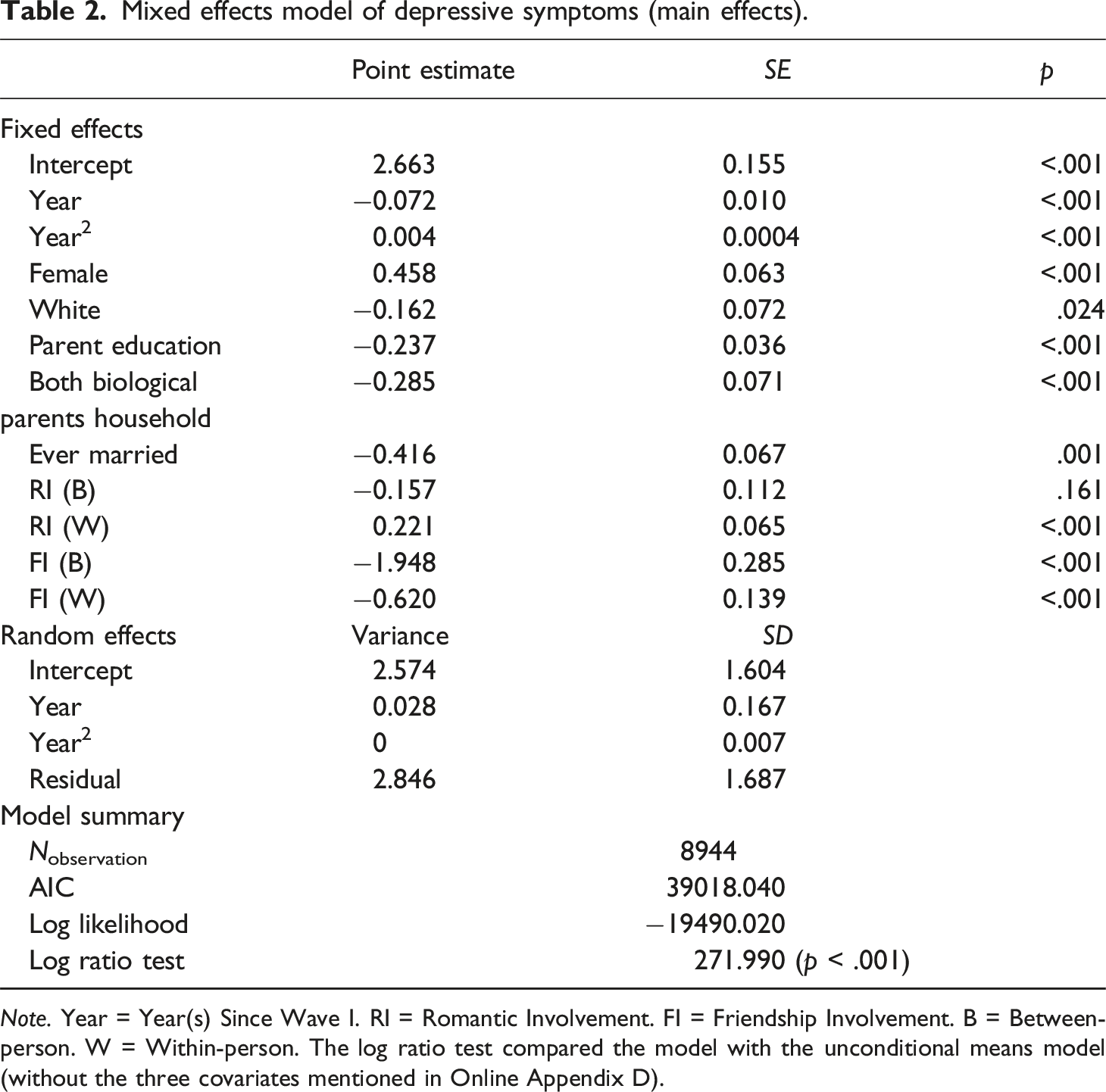
Note. Year = Year(s) Since Wave I. RI = Romantic Involvement. FI = Friendship Involvement. B = Between-person. W = Within-person. The log ratio test compared the model with the unconditional means model (without the three covariates mentioned in Online Appendix D).
Mixed effects model of depressive symptoms (interaction effects).
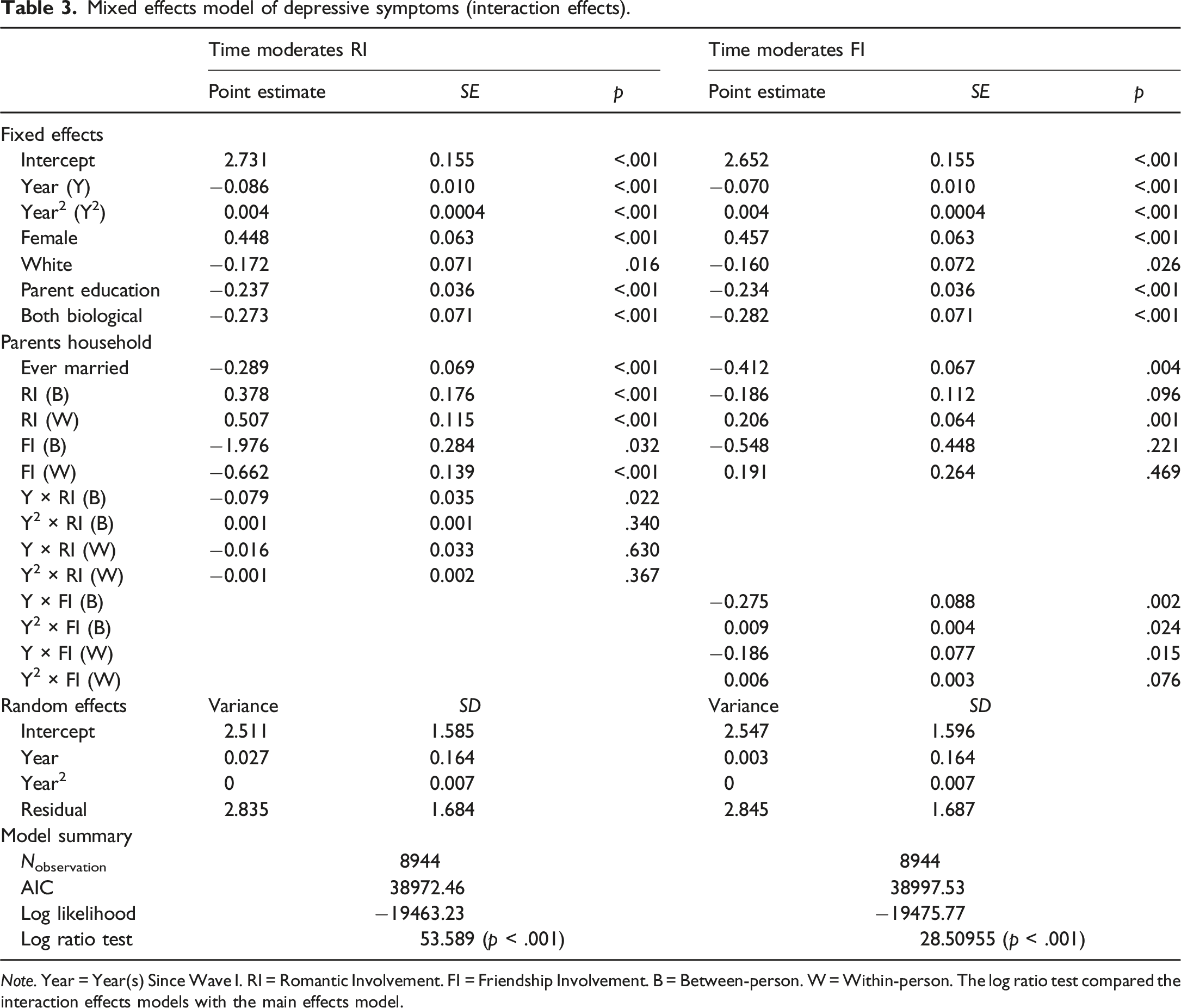
Note. Year = Year(s) Since Wave I. RI = Romantic Involvement. FI = Friendship Involvement. B = Between-person. W = Within-person. The log ratio test compared the interaction effects models with the main effects model.

Associations Between Relationship Involvement and Depressive Symptoms Differed by Wave.
Furthermore, to test RQ5, conditional growth-interaction effects models were fitted for RI and FI separately to examine the contribution of considering time’s interaction effects to model fit for RI and FI separately. Results (Tables 3) showed considering time’s interaction with RI and with FI both increased model fit. Also, time moderated the association between RI (B) and depressive symptoms. Though the association between RI (B) and depressive symptoms was positive in adolescence (Wave I), it became insignificant (Waves II and IV) and even positive (Wave V) later in life as participants moved from adolescence into adulthood and early midlife. However, the negative association between RI (W) and depressive symptoms was not moderated by time. Additionally, the associations between FI (both between- and within-person) and depressive symptoms were mostly not significant in adolescence but consistently negative in adulthood. The aforementioned interactions were presented in plotted in Figure and statistics are further presented in Online Appendix E. Of note, due to the relatively large percentage of cases (16%) dropped because of marital history, robustness tests without dropping cases of because of missing values of marital history were run (Online Appendixes F and G). The aforementioned relationships pertaining to RI and FI held in the robustness tests. Also, modeling time’s interactions with RI and with FI in one model did not change the direction and significance of the aforementioned interaction effects. Results of covariates are reported in Online Appendix H.
Discussion
Built upon prior research, the current research compared the roles of romantic and friendship involvement in shaping depressive symptoms. Overall, longitudinal analyses revealed increased risks of depressive symptoms associated with romantic involvement (within-person state change) in and beyond adolescence and decreased risks associated with friendship involvement (both between-person difference and within-person state change) in adulthood. Additionally, associations were moderated by time: both involvements appeared to play more positive roles in adulthood than in adolescence, except for within-person increase in romantic involvement, which was consistently associated with increased depressive symptoms across the investigated life stages.
These findings generally confirm previous findings of the association between romantic involvement (within-person state change) and increases in depressive symptoms, especially during adolescence (Falci & McNeely, 2009; Joyner & Udry, 2000; Kent & Bradshaw, 2021; Olson & Crosnoe, 2017; Thompson et al., 2024; Ueno, 2005; Wang et al., 2024). Additionally, the current study did also find between-person difference in romantic involvement associated with decreased risks of symptomology in early midlife. This means, individuals who overall had a higher propensity to be romantically involved than others also reported fewer depressive symptoms in their early midlife. This further adds to Olson and Crosnoe’s (2017) finding on the potential benefits of romantic involvement in adulthood by attributing the benefits to between-person differences rather than within-person changes. This contrast implies that those who have a greater propensity to be romantically involved seem to fare better psychologically than those who were not as likely romantically involved by trait (i.e., between-person difference) in early midlife; However, the transition from being single to being romantically involved within the same person (i.e., within-person state change) seems to be associated with an increase in depressive symptoms. Furthermore, this research revealed intensified positive connections between close friendships and better mental health in adulthood. The fact that both involvements seem to play more positive roles later in adulthood compared to in adolescence may be explained by a greater appreciation for quality relationships as people age, per the socio-emotional selectivity theory (Carstensen, 1992).
The current study is not without limitations. First, longitudinal were not applied to the analyses due to their unavailability for the Waves chosen. Results should be interpreted among participants in the final sample but not the general population. Another limitation related to the data is that, on average, most participants in this study were involved in close friendships. Thus, it is plausible that depressed people are less likely to have close friends, though this reverse path is beyond the scope of this paper that compared associations of different involvements. Future research may continue to explore the direction(s) of causality using different analytical techniques. Also, due to my focus on involvement and measure unavailability across waves, this study did not examine relationship quality and stability. However, these are indicators of how well a relationship goes and can also play important roles in shaping mental health. Also, personality (e.g., neuroticism), contextual factors (e.g., stressful events), which were not measured across the four waves selected from the Add Health data, can also impact relationship involvement and depressive symptoms at the same time. The current study also did not distinguish between being involved in a relationship with the same person and being with different persons across waves because this information was not available in the Add Health data. Another measurement related limitation is that the data measured biological sex but not gender, which are different constructs. Future studies can explore impacts of these factors on the associations revealed in the current paper. Additionally, the data used in this study could not answer why romantic involvement’s relationship with depressive symptoms changes as people age – perhaps partly due to self-selection (Park et al., 2022), which should be examined in future research. Lastly, though not of focus in the current study, future studies may also explore the interaction between romantic and friendship involvements over time (Online Appendix I reports an exploratory test).
Together, findings from this study challenge the societal perceptions that prioritize romantic relationships over close friendships for greater anticipated psychological enhancement, which is – though gradually changing – still common in contemporary society (DePaulo, 2014). Pragmatically, these findings highlight the importance of close friendships in maintaining well-being across life stages. Though friendships are often viewed as of secondary importance to romantic relationships (DePaulo, 2014), people should perhaps value friendships more for their ownwell-being.
Supplemental Material
Supplemental Material - A longitudinal analysis of how romantic and friendship involvement are associated with depressive symptoms
Supplemental Material for A longitudinal analysis of how romantic and friendship involvement are associated with depressive symptoms by Junwen M Hu in Journal of Social and Personal Relationships
Footnotes
Acknowledgements
I would like to thank the editor and anonymous reviewers for their valuable feedback on earlier versions of this manuscript. I also feel grateful to Joe and Zack who offered writing suggestions to help me communicate findings to a broader readership.
Declaration of conflicting interests
The author(s) declared no potential conflicts of interest with respect to the research, authorship, and/or publication of this article.
Funding
The author(s) received no financial support for the research, authorship, and/or publication of this article.
Open research statement
As part of IARR’s encouragement of open research practices, the author has provided the following information: This research was not pre-registered. The data used in the research can be publicly accessed via the link  . The materials used in the research cannot be publicly shared but are available upon request. Please email:
Supplemental Material
Supplemental material for this article is available online.
References
Supplementary Material
Please find the following supplemental material available below.
For Open Access articles published under a Creative Commons License, all supplemental material carries the same license as the article it is associated with.
For non-Open Access articles published, all supplemental material carries a non-exclusive license, and permission requests for re-use of supplemental material or any part of supplemental material shall be sent directly to the copyright owner as specified in the copyright notice associated with the article.
