






Abstract
The goal of this study was to examine the links of communal coping to relationship and well-being outcomes in the context of racial discrimination. First, we examined the relation of discrimination to relationship outcomes in a sample of 138 African Americans. Second, we examined whether communal coping (i.e., shared appraisal, collaboration, disclosure) and partner race buffered the link of discrimination to both relationship and well-being outcomes. Results showed that discrimination was associated with adverse relationship outcomes for three of the four measures. Appraising discrimination as a shared problem was related to positive relationship outcomes, whereas collaboration buffered the negative relation between discrimination and positive relationship outcomes. In examining partner race, results showed that collaboration exerted a buffering effect in different-race but not same-race relationships. Future research should attempt to understand the pitfalls of coping with discrimination in same-race relationships where both persons are equally likely to face the same stressor.
Introduction
A large body of research indicates that experiences of discrimination are associated with poor mental and physical health (see Paradies et al., 2015; Pascoe & Smart Richman, 2009 for reviews). Regarding mental health, discrimination has been linked to increased depressive symptoms, anxiety, and psychological distress (Paradies et al., 2015; Schmitt et al., 2014). Regarding physical health, discrimination has been linked to steeper trajectories for systolic and diastolic blood pressure (Smart Richman et al., 2010), increased risk for hypertension (Dolezsar et al., 2014), and decreased cardiovascular health overall (Lockwood et al., 2018).
While the effect of discrimination on health is clearly deleterious, the effect of discrimination on relationship outcomes is less clear. The theory of stress spillover indicates that discrimination, like any stressor, should affect other life domains, including the quality and functioning of one’s relationships (Buck & Neff, 2012). Consistent with this theory, increased discrimination has been associated with decreased marital satisfaction (Lincoln & Chae, 2010) and, for African American men, increased relationship instability (Lavner et al., 2018). Additionally, increased discrimination has been associated with greater relationship strain for both individuals and their partners (Wofford et al., 2019). In a study of Muslim couples, religion-based discrimination was associated with decreased relationship satisfaction, and negative couple interactions seemed to explain this finding (Genc & Baptist, 2020).
However, some research suggests that discrimination can bring couples closer together. A cross-sectional study of African Americans showed that more frequent discrimination was related to higher relationship quality (Murdock & Wood, 2022), and a longitudinal study of African American couples showed that racial discrimination predicted increased supportive behaviors towards their partner three years later (Clavél et al., 2017). Because of these contradictory findings, it is important to identify the conditions under which discrimination is related to positive and negative relationship outcomes.
One potential set of determinants has to do with coping. A recent review highlighted numerous coping strategies that Black people utilize in the face of racism and categorized them as dysfunctional or functional (Jacob et al., 2023). Dysfunctional forms of coping with racism included believing hard work would solve issues of racism, ruminating, and disengaging, whereas functional forms of coping included religious coping and seeking and utilizing social support. Both of these functional forms of coping have the ability to ameliorate the negative effects of racism on an individual’s identity. However, the research on social support in the context of coping with racism is not clear. One limitation of seeking support for racism is that it requires disclosure and discussion of uncomfortable topics (Brondolo et al., 2009). Indeed, findings are mixed as to whether social support buffers the negative effects of racism on health (Marshburn & Campos, 2022). One possibility is that support in response to racism may be more effective when provided by others of a similar race or even another racial minority (Marshburn & Campos, 2022). Other kinds of coping with racism include racial identity development, which could buffer the relation of racism to distress, and anger expression and suppression (Brondolo et al., 2009). Both of these strategies have strengths and weaknesses, and neither has been uniformly linked to good health outcomes. With the exception of social support, note that all of these coping strategies focus on the individual. A novel interpersonal coping approach that has not been applied to discrimination is communal coping.
Communal coping as a moderator
One factor that might moderate the effect of discrimination on relationship outcomes is the extent to which couple members perceive discrimination to be a shared stressor and attempt to manage it together—in other words, whether the couple engages in communal coping with respect to discrimination. Communal coping is the appraisal of a stressor as shared and collaboration with a partner to manage it (Helgeson et al., 2018; Lyons et al., 1998). Shared appraisal and collaboration likely take place in the context of couple members sharing information about the stressor and discussing it; thus, disclosure is tightly linked to communal coping (Helgeson et al., 2018).
In the context of chronic illness, communal coping has been related to good relationship and well-being outcomes (see Helgeson et al., 2018, for a review). However, that body of research tends to focus on stressors that objectively affect only one individual in the couple (e.g., heart disease, diabetes). Research on communal coping in the context of community-based stressors is more nuanced. Studies have shown that communal coping in the context of natural disasters (Afifi et al., 2012) and living in refugee camps (Afifi et al., 2016) has been linked to good adjustment, but communal coping in the context of the great recession was linked to co-rumination about the stressor—an indicator of heightened distress (Afifi et al., 2015).
The effects of communal coping on relationships and well-being have not been examined in the context of a stressor such as discrimination. A specific act of discrimination may objectively affect one couple member, but it is likely to have consequences for the partner—to the extent the stressor is shared. The question is whether perceiving discrimination to be a shared stressor has the same advantages that it does for couple members coping with chronic disease or a natural disaster. We argue that when one couple member perceives discrimination to be a shared stressor with their partner, they will feel validated and more strongly connected to their partner. It is more difficult to consider whether collaboration will be beneficial. Collaboration is often thought to be action-oriented and indicative of joint problem-solving. Discrimination is not something an individual or a dyad can—nor should—try to solve, as it is systemic. However, couple members can collaborate together on how they will cope with the stressor. Disclosure is essential to communal coping in this context. Couple members are unlikely to arrive at a shared appraisal of a stressor and collaborate on coping with the stressor if the person has not disclosed the stressor to their partner. Thus, we cautiously predict that communal coping—as defined by shared appraisal, collaboration, disclosure—will be related to positive relationship outcomes in the context of discrimination and that communal coping will moderate the effect of discrimination on relationship and well-being outcomes such that discrimination will be less strongly related to poor relationship and well-being outcomes in the context of communal coping.
Partner racial similarity as a moderator
One important factor that may determine whether communal coping buffers the effects of discrimination on relationship and well-being outcomes is the race of the person with whom one is communally coping. A shared cultural understanding may be a valuable resource in buffering the negative effects of racial discrimination (Rice et al., 2023). Do only same-race others possess this shared cultural understanding, or does understanding manifest itself in different ways for same-race versus different-race couples? In a qualitative study comparing the role of race in providing support within intraracial (Black-Black) and interracial relationships (Black-White), mutual understanding was the primary theme in intraracial relationships, whereas defending one’s partner was more prevalent in interracial relationships (From et al., 2024). A common theme of interracial relationships is that the person facing discrimination has to educate the partner about their culture (Bell & Hastings, 2011). In the context of romantic relationships, interracial couples also face unique stressors such as unwanted public attention and familial disapproval which may interfere with communal coping (Bell & Hastings, 2011; Killian, 2003). By contrast, a study of Black intraracial couples showed that communication quality was highest when discussing racial discrimination compared to other stressful topics (e.g., financial) (Weber et al., 2023). Collectively, these findings suggest the way in which individuals cope with racial discrimination as well as the benefits of communal coping may differ between those in intraracial versus interracial relationships.
It may be better to share and discuss discrimination with a person of the same race because that person can understand the situation and validate one’s feelings in a way that someone of a different race cannot. Alternatively, it may be difficult to share and discuss discrimination with a person of the same race because the conversation could be upsetting to the partner making it difficult for them to provide effective support. It also could be that a person of the same race dismisses one’s experiences of discrimination as a way to reduce their own distress.
The research on this issue is not clear. Research has indicated that Black college students with a strong racial identity reported higher feelings of closeness to their same-ethnic peers than their peers of different ethnicities (Thelamour et al., 2019). Additionally, when recalling an identity-based stressor, women reported that they received more support from friends of their own race compared to friends of a different race (Davis & High, 2019). In combination, these two studies suggest that discussing identity-relevant stressors (i.e., discrimination) or communal coping with friends of the same race may be more beneficial than with friends of a different race. However, because the research on this issue is sparse, we explore partner race similarity as a moderator variable of the relation of discrimination to relationship and well-being outcomes as well as a moderator variable of the buffering effect of communal coping on relationship and well-being outcomes, but we do not make a directional prediction.
Introduction to the research
In sum, this study had three aims. First, we examined the link of discrimination to a set of relationship outcomes, specifically emotional support, negative interactions, and perceived positive and negative emotional responsiveness. As research has been inconsistent on this issue, we did not make a directional prediction. Second, we examined communal coping as a moderator of the effects of discrimination on relationship and well-being outcomes. We hypothesized that the links of discrimination to poor relationship and well-being outcomes would be weaker under conditions of high communal coping. That is, we viewed communal coping as a resource and a buffer. Finally, we examined whether the race of the person with whom the participant discussed discrimination moderated the effects of communal coping on relationship and well-being outcomes. For the reasons discussed above, we did not make a directional prediction here.
Method
Participants
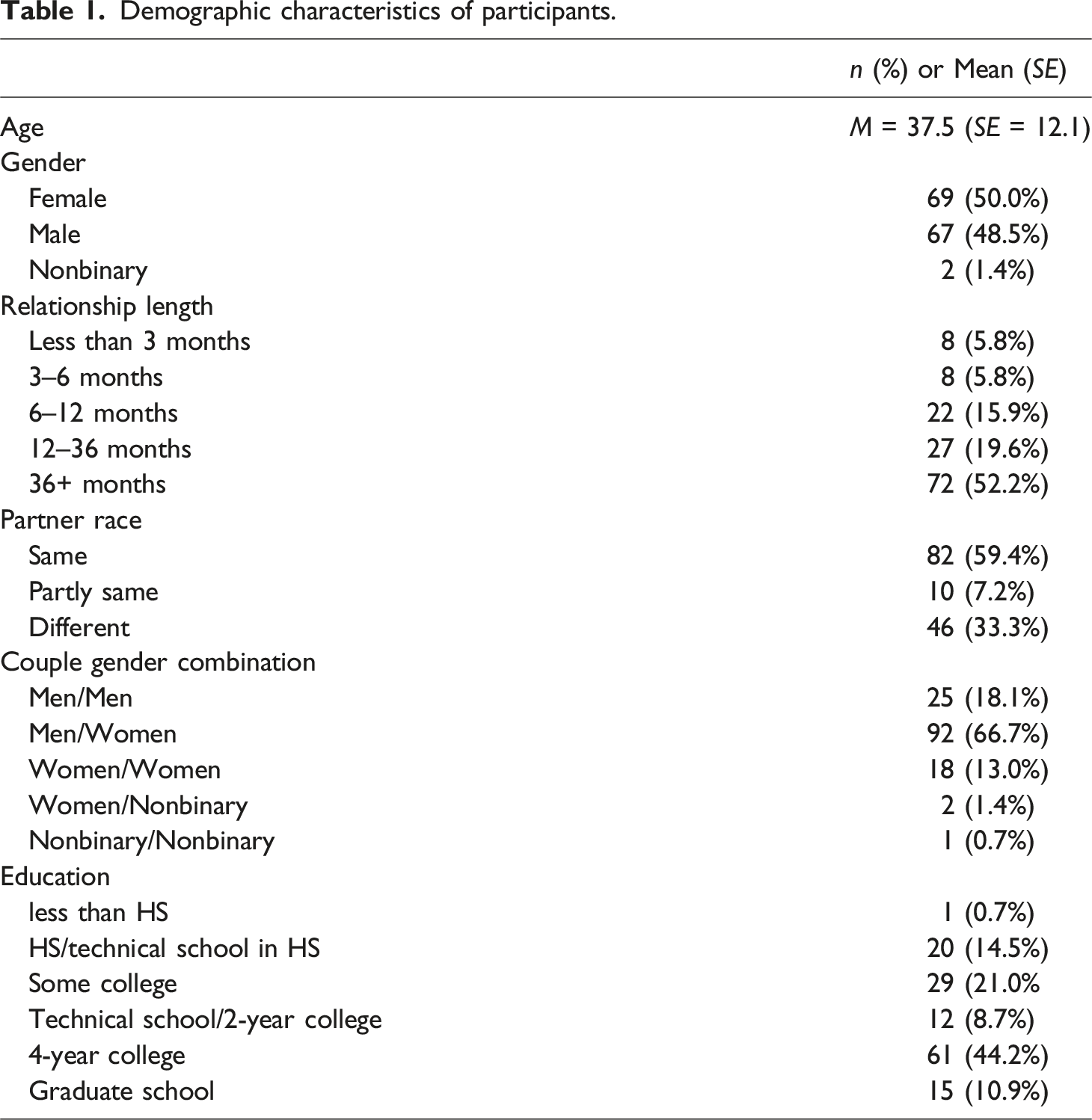
Demographic characteristics of participants.
Procedure
The study was conducted in spring of 2023 and was advertised as a survey on romantic relationships and stress through the online recruitment platform Prolific. To be eligible, participants had to be age 18 or over, identify as African American or Black, currently be in a romantic relationship, and living in the United States. Participants who signed up for the study were directed to a Qualtrics survey. Participants answered questions about discrimination, their relationship quality and relationship behavior, communal coping, and well-being. When completing the communal coping measures, participants were asked to think of their romantic partner. In addition to their own demographics, participants were also asked to identify how similar the race of their partner was to their own race.
Although 152 respondents started the survey, 14 participants’ responses were discarded: 5 failed attention checks, 6 signed the consent form but did not respond to any of the questions, and 3 ignored the eligibility requirements and were found not to be eligible in terms of race and being in a romantic relationship. Thus, the final sample was 138.
Instruments
Discrimination
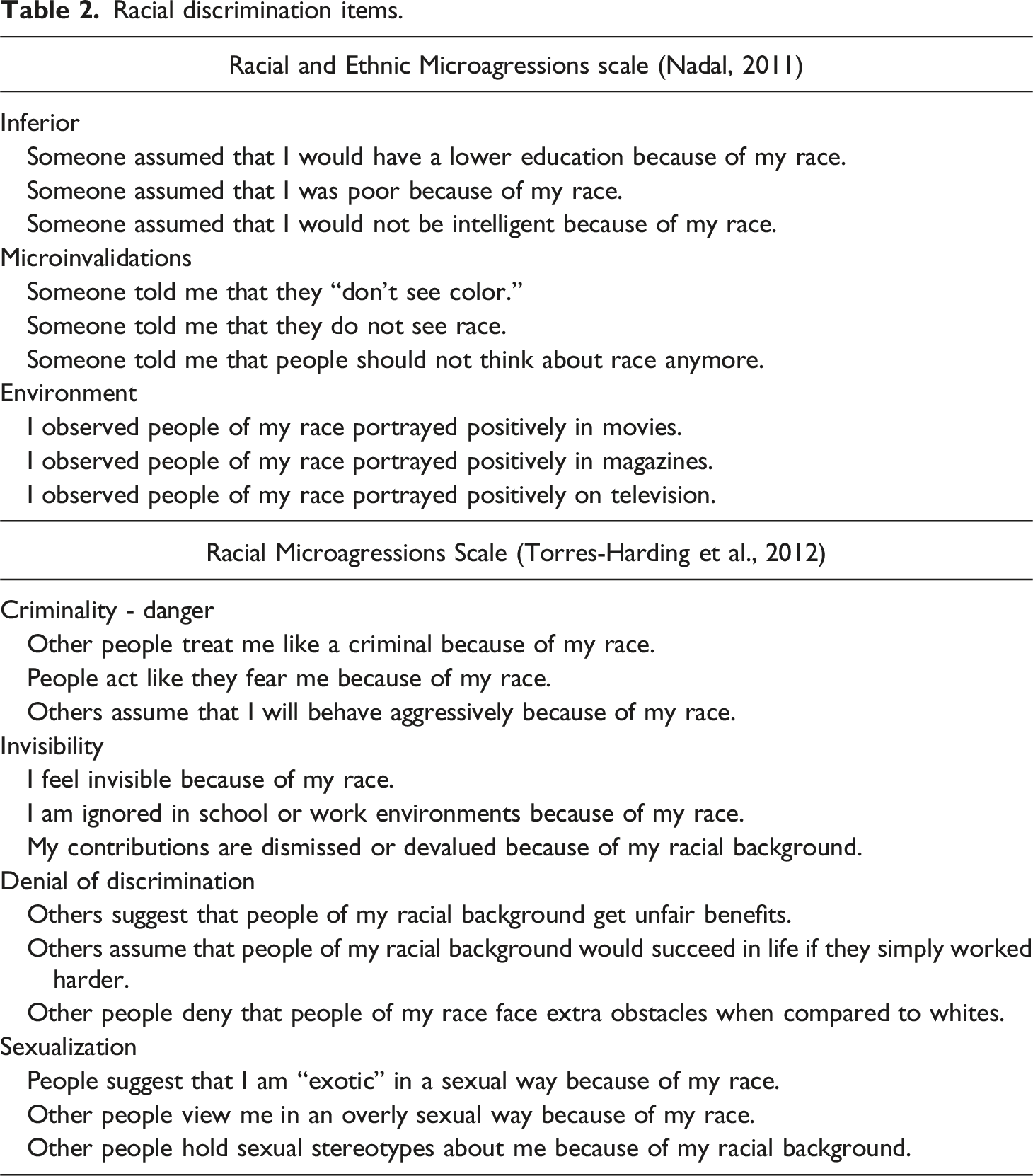
Racial discrimination items.
Communal coping
We measured the three critical components of communal coping: shared appraisal, collaboration, and disclosure. We measured shared appraisal with the single item “Do you view racial/ethnic discrimination as a shared problem between you and your partner or only your own problem?” Respondents indicated how shared they felt the discrimination was on a 7-point scale such that 1 = “My own problem” and 7 = “Shared problem.” We measured collaboration with 3 items assessing how often they worked together with their partner to cope with racism (e.g., “How often do you and your partner try to come up with ways to handle racism?“). Respondents indicated how often they collaborated in coping with discrimination on a 7-point scale such that 1 = “Never” and 7 = “Very often.” These items have been widely used to measure the shared appraisal and collaboration aspects of communal coping (Helgeson et al., 2018). We measured disclosure with 3 face-valid items assessing how often the respondent disclosed experiences of discrimination to their partner (e.g., “When you experience racism, how often do you tell your partner about it?“). Respondents indicated how often they disclosed experiences of discrimination on a 7-point scale such that 1 = “Never” and 7 = “Very often.” Because collaboration and disclosure were highly correlated (r = .69, p < .001), we standardized the two measures and took the average to form a modified collaboration scale. The internal consistency of the 6-item modified collaboration scale was very good (α = 0.87). Note that the internal consistency of this new modified collaboration scale exceeds the correlation of its two components, further justifying the combination. Modified collaboration and shared appraisal were correlated (r = .64, p < .001), but because the two measures are theoretically distinct (disclosure and collaboration are behaviors; shared appraisal is a cognition), we did not combine them. Thus, we examine modified collaboration and shared appraisal separately in all analyses.
Partner race similarity
We asked respondents to identify whether their partner was the same race/ethnicity, was partly the same race/ethnicity, or was a different race/ethnicity. As shown in Table 1, 59% of persons indicated that their partners were of the same race, and 33% of persons indicated that their partners were of a different race. Only 7% (n = 10) indicated that their partners were partly the same race. These 10 persons were not included in the analyses involving same versus different race.
Relationship outcomes
Support
We measured emotional support with four items asking the participant how often their partner engages in supportive behaviors in their relationship (e.g., “You tried to understand their situation” and “You listened to your partner talk about their feelings”; Helgeson et al., 2017). Respondents indicated how often the behaviors occurred on a 7-point scale such that 1 = “Never” and 7 = “A lot.” The internal consistency was good (α = 0.83).
Negative interactions
We measured negative interactions with four items, three of which were taken from the unsupportive interactions scale in previous research (Helgeson, Jakubiak, et al., 2017). We also added one item to strengthen the scale (“You showed anger or impatience with your partner”). Respondents indicated how often the behaviors occurred on a 7-point scale such that 1 = “Never” and 7 = “A lot.” The internal consistency was good (α = 0.83).
Perceived emotional responsiveness
We measured perceived positive emotional responsiveness by prompting the participant to think about how their partner typically responds when the participant experiences racism or discrimination. We used the 8 items from Fekete et al. (2007): understood, respected, supported, better, ignored, worse, rejected, judged. Responses were made on a 4-point scale such that 1 = “Not at all” and 4 = “A lot.” Because the positive items and negative items revealed two distinct clusters, we averaged the positive items into a perceived positive responsiveness scale (α = 0.89) and the four negative items into a perceived negative responsiveness scale (α = 0.85). As expected, the two scales were negatively correlated (r = −.56, p < .001), but their correlation was substantially lower than the individual internal consistencies.
Well-being outcomes
Life satisfaction
We measured life satisfaction with the 5-item Satisfaction With Life Scale (Diener et al., 1985), which prompts participants to indicate how satisfied they are with their lives presently. Responses are made on a 5-point scale such that 1 = “Completely disagree” and 5 = “Completely agree” (α = 0.91).
Depressive symptoms
We measured depressive symptoms with the abbreviated 10-item Center for Epidemiological Studies Depression Scale (Andresen et al., 1994), which asks how often the participant experienced depressive symptoms in the past 30 days. Responses are made on a 4-point scale such that 1 = “None of the time” and 4 = “All of the time” (α = 0.90).
The two well-being measures were moderately correlated (r = −.45, p < .001).
Overview of the analysis
To address our first aim, we examined the relation of discrimination to the four relationship outcomes with correlational analyses. Prior to addressing the rest of the aims, we examined whether there were any demographic or relationship variables that we needed to statistically control. To address the second aim, we used multiple regression analysis to examine whether the relation of discrimination to well-being and relationship outcomes was moderated by communal coping: first with the appraisal item and second with the modified collaboration scale. (As described below, we statistically controlled for age and relationship length in the regression analyses because they were linked to key study variables.) Thus, we entered age, relationship length, discrimination, and the communal coping measure on the first step and the interaction between communal coping and discrimination on the second step. This is represented in Model 1 of the regression tables described below. If the interaction was not significant, we only show the coefficients for step 1. Because the two measures of communal coping (shared appraisal and modified collaboration) were distinct, we examined each hypothesis for the two measures of communal coping separately.
Finally, to examine Aim 3, which is to determine whether partner race moderated the effects of communal coping, we added two steps to the regression analysis. In Step 3, we added the main effect for partner race, the discrimination by partner race interaction, and the communal coping by partner race interaction. In Step 4, we added the three-way partner race X communal coping measure X discrimination interaction—the subject of interest here. Again, when interactions were not significant, we only show the coefficients from the previous step in the equation. We tested this hypothesis for the two measures of communal coping (shared appraisal, modified collaboration) separately. These two steps are shown in Model 2 of the regression tables described below.
We used alpha = .05 to indicate statistical significance in our interpretation of our findings. However, because we have 12 independent outcomes, we additionally applied the Bonferroni alpha adjustment (.05/12 = .004) and emphasize the findings that meet this threshold (which are bolded in the tables).
Results
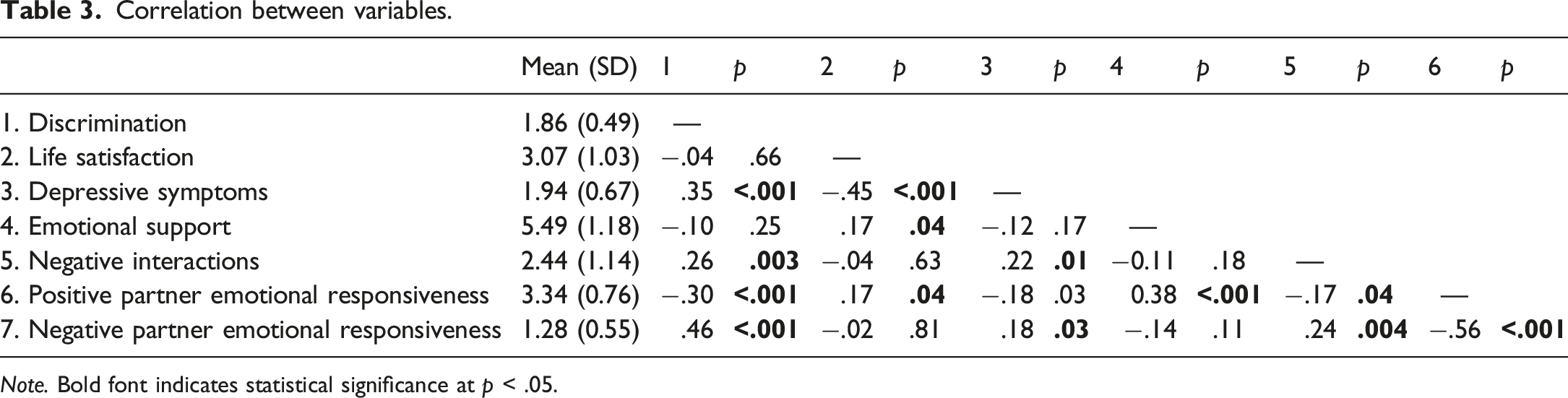
Correlation between variables.
Note. Bold font indicates statistical significance at p < .05.
We examined whether age, relationship length, education, and gender were linked to well-being and relationship outcomes. Relationship length was related to more emotional support (r = .17, p = .05) and greater collaboration (r = .21, p = .01). Older age was related to less depression (r = −.23, p < .01), more collaboration (r = .19, p = .02), and more shared appraisal (r = .19, p = .03). Thus, we statistically controlled for age and relationship length in all our regression analyses. 1 Neither gender nor education were related to any of the study outcomes.
Aim 1: Relations of discrimination to relationships
As shown in Table 3, discrimination was unrelated to supportive behaviors but was related to more negative interactions. Discrimination also was related to lower positive partner emotional responsiveness and higher negative partner emotional responsiveness.
Aim 2: Communal coping as a moderator of the links of discrimination to well-being and relationships
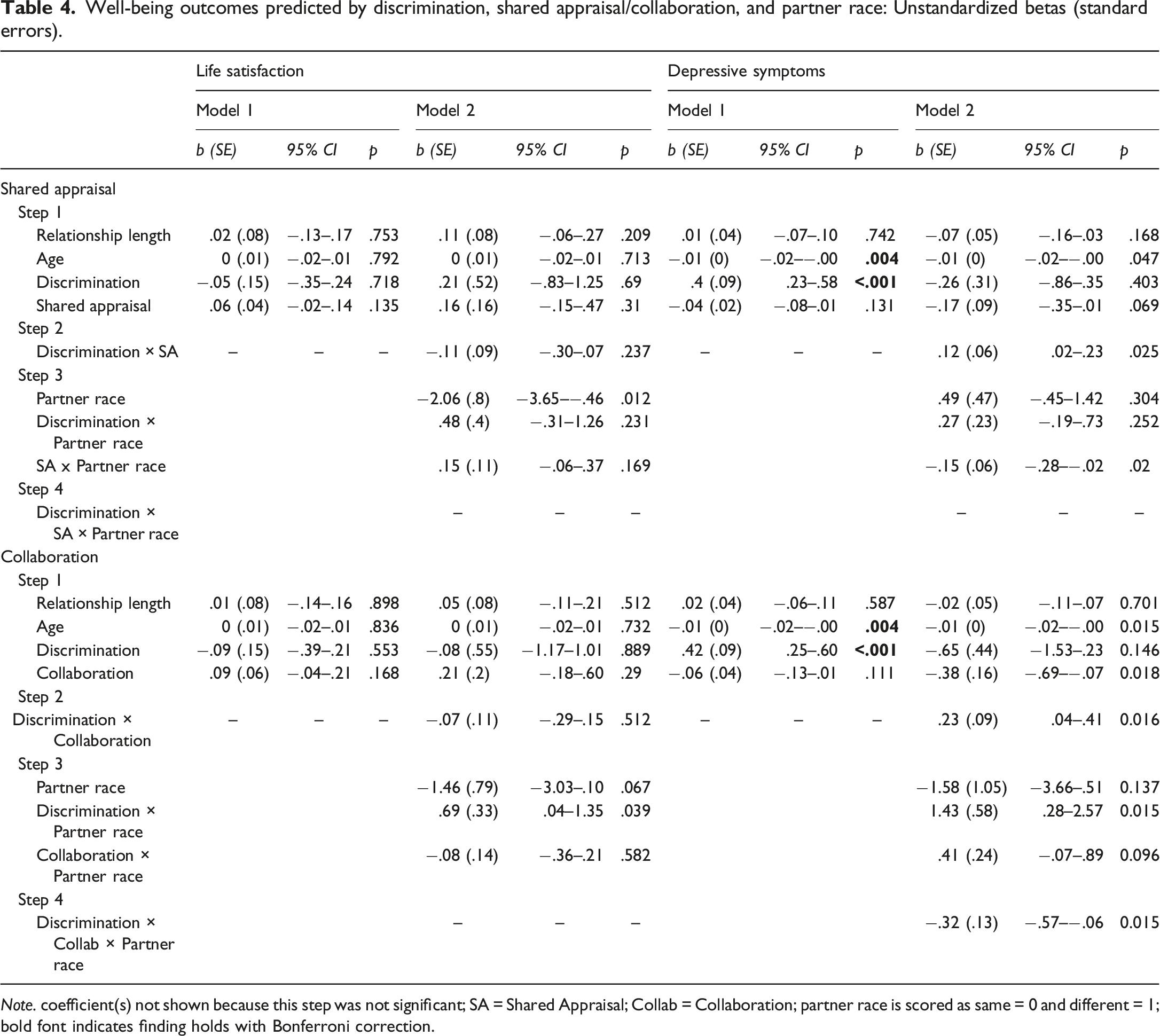
Well-being outcomes predicted by discrimination, shared appraisal/collaboration, and partner race: Unstandardized betas (standard errors).
Note. coefficient(s) not shown because this step was not significant; SA = Shared Appraisal; Collab = Collaboration; partner race is scored as same = 0 and different = 1; bold font indicates finding holds with Bonferroni correction.
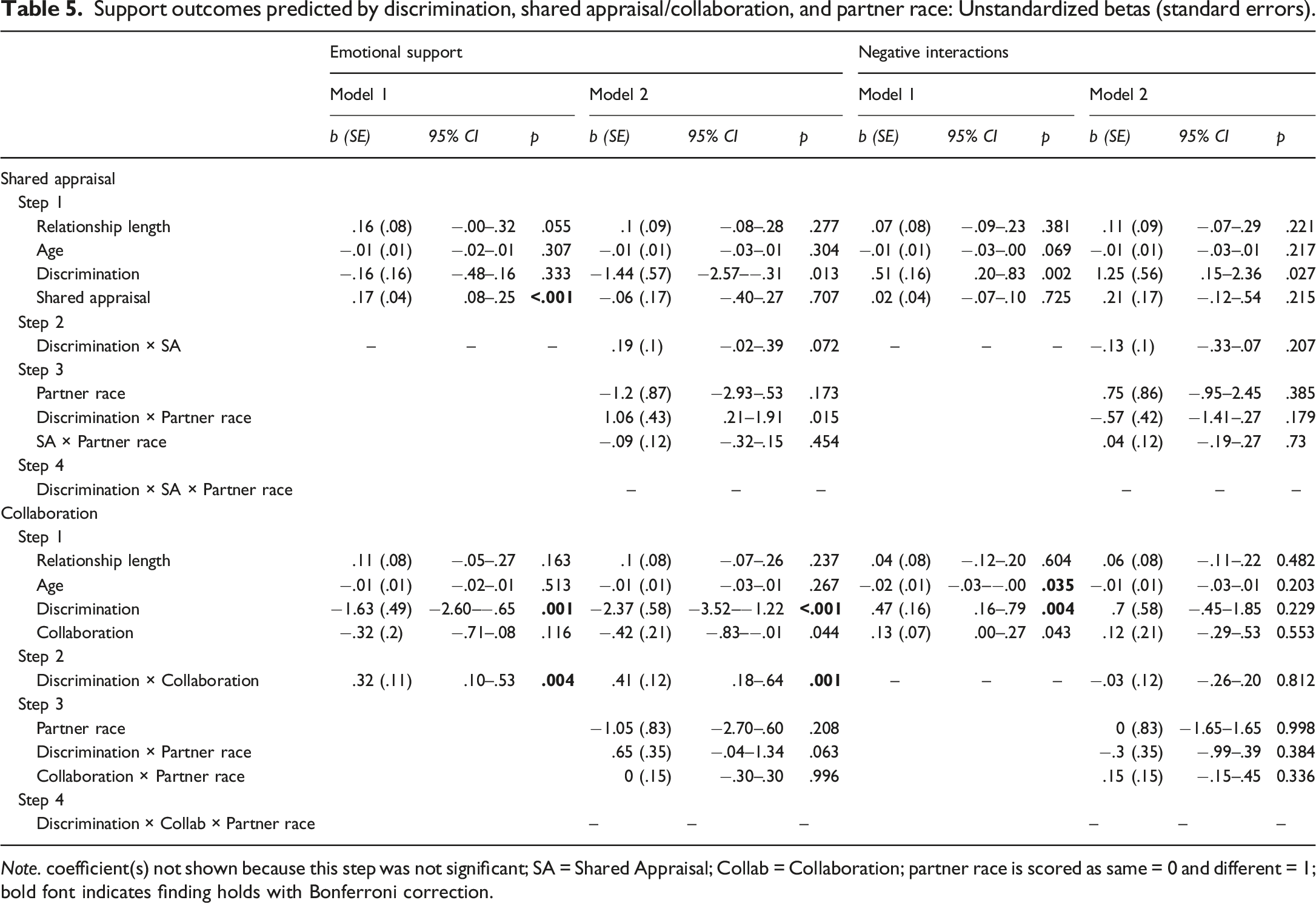
Support outcomes predicted by discrimination, shared appraisal/collaboration, and partner race: Unstandardized betas (standard errors).
Note. coefficient(s) not shown because this step was not significant; SA = Shared Appraisal; Collab = Collaboration; partner race is scored as same = 0 and different = 1; bold font indicates finding holds with Bonferroni correction.
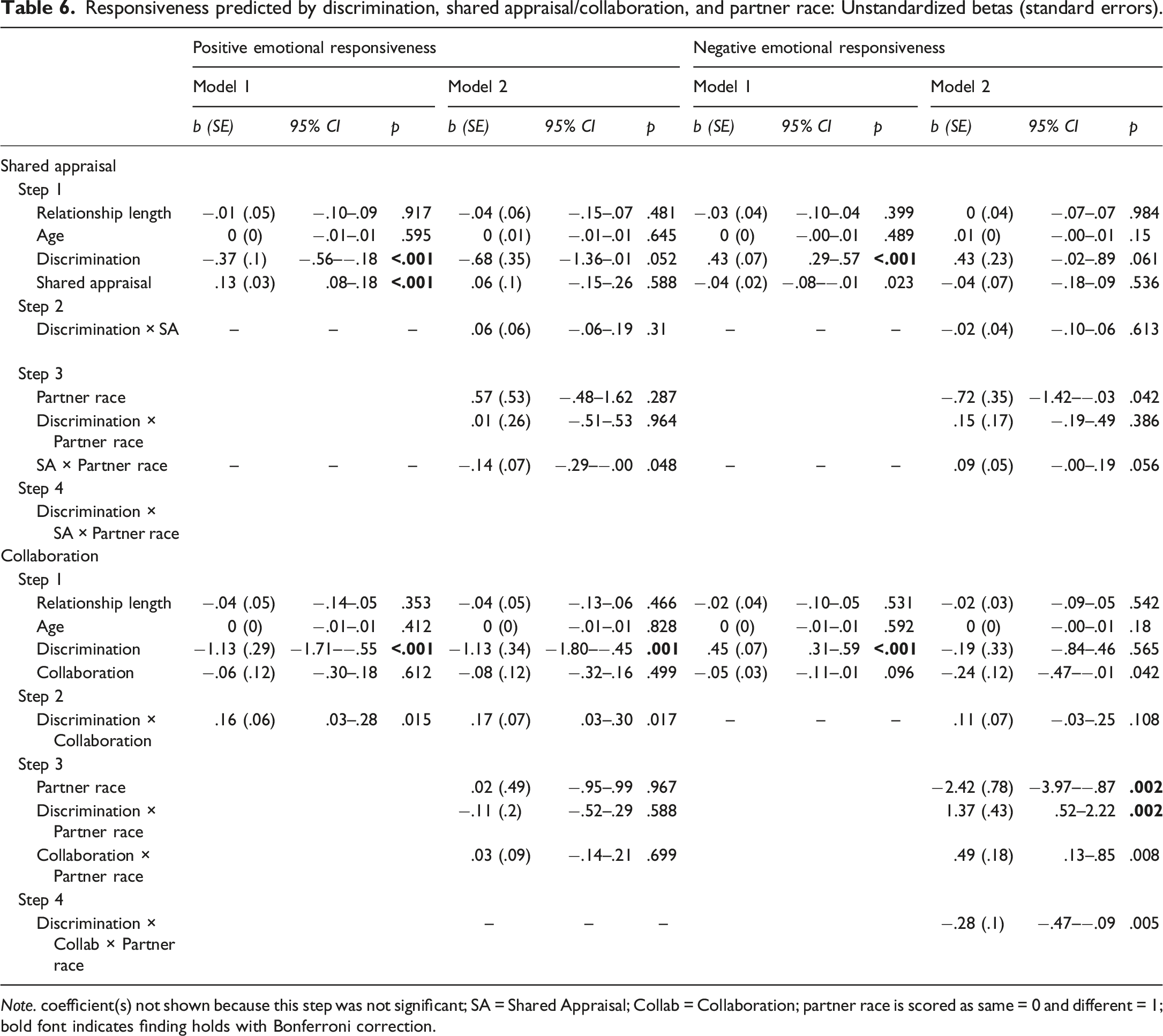
Responsiveness predicted by discrimination, shared appraisal/collaboration, and partner race: Unstandardized betas (standard errors).
Note. coefficient(s) not shown because this step was not significant; SA = Shared Appraisal; Collab = Collaboration; partner race is scored as same = 0 and different = 1; bold font indicates finding holds with Bonferroni correction.
Shared appraisal
As shown in Model 1 of Table 4, shared appraisal was not related to life satisfaction or depressive symptoms. Shared appraisal did not interact with discrimination to predict either well-being outcome. As shown in Model 1 of Table 5, shared appraisal was related to greater emotional support (with correction) but was unrelated to negative interactions. As shown in Model 1 of Table 6, shared appraisal was related to greater positive emotional responsiveness (with correction) and lower negative emotional responsiveness. There were no interactions of shared appraisal with discrimination for any relationship outcome.
Collaboration
As shown in Model 1 on the bottom of Table 4, collaboration was unrelated to life satisfaction and depressive symptoms. Collaboration also did not interact with discrimination to predict either outcome.
As shown in Model 1 of Table 5, collaboration was unrelated to emotional support but interacted with discrimination to predict emotional support (with correction). Discrimination was related to less emotional support when collaboration was low (B = −.71, SE = .22, p < .01), but was unrelated to emotional support when collaboration was moderate (B = −.25, SE = .16, p = .13) or high (B = .22, SE - .23, p = .33; see Figure 1). However, collaboration was related to more negative interactions. Discrimination by collaboration interaction on emotional support. Discrimination is related to lower emotional support only for those who are low in collaboration.
As shown in Model 1 of Table 6, collaboration was unrelated to positive emotional responsiveness but interacted with discrimination to predict positive emotional responsiveness. As shown in Figure 2, discrimination was related to lower positive emotional responsiveness when collaboration was low (B = −.68, SE = .13, p < .01) and moderate (B = .45, SE = .09, p < .01), but was unrelated to positive emotional responsiveness when collaboration was high (B = −.22, SE = .14, p = .11). Collaboration was unrelated to negative emotional responsiveness. Discrimination by collaboration interaction on positive emotional responsiveness. Discrimination is related to lower positive emotional responsiveness only for those who are low or moderate in collaboration.
These two interactions provide some evidence that collaboration buffered the negative relations of discrimination to relationship outcomes.
Aim 3: Race as a moderator of the relation of communal coping to well-being and relationships
Regression analyses showing the effects of race and interactions of race with discrimination and communal coping are shown in steps 3 and 4 (Model 2) of the regression analyses shown in Tables 4, 5, and 6.
Shared appraisal
As shown in Model 2 in the top of Table 4, shared appraisal did not interact with partner race to predict life satisfaction but did interact with partner race to predict depressive symptoms. As shown in Figure 3, shared appraisal was marginally related to fewer depressive symptoms for individuals with a partner of a different race (B = −.09, SE = .05, p = .07), but was unrelated to depressive symptoms for individuals with a partner of the same race (B = .06, SE = .04, p = .11). There were no race by shared appraisal by discrimination interactions for either well-being outcome. Shared appraisal by partner race interaction on depressive symptoms. Shared appraisal is related to fewer depressive symptoms only for those with a different race partner.
As shown in Model 2 of Table 5, discrimination interacted with partner race to predict emotional support. This finding is unrelated to the hypotheses, but we describe it here for completion. Discrimination was related to lower emotional support for individuals with a partner of the same race (B = −.61, SE = .24, p = .01), but was unrelated to emotional support for individuals with a partner of the different race (B = .45, SE = .33, p = .16; see Figure S1). There were no interactions involving race for negative interactions.
As shown in Model 2 of Table 6, there was a shared appraisal by partner race interaction for positive emotional responsiveness. As shown in Figure 4, shared appraisal was related to higher positive emotional responsiveness for individuals with a partner of the same race (B = .17, SE = .04, p = .01), but was unrelated to positive emotional responsiveness for individuals with a partner of a different race (B = .03, SE = .05, p = .57). There were no partner race interactions involving negative emotional responsiveness. Additionally, there were no three-way (race by shared appraisal by discrimination) interactions for relationship outcomes. Shared appraisal by partner race interaction on positive emotional responsiveness. Shared appraisal is related to higher positive emotional responsiveness only for those with a same race partner.
Collaboration
As shown in Model 2 at the bottom of Table 4, discrimination interacted with partner race to predict both well-being outcomes (again unrelated to hypotheses but shown for completion). Discrimination was marginally related to lower life satisfaction for individuals with a partner of the same race (B = −.39, SE = .22, p = .07), but was unrelated to life satisfaction for individuals with a partner of a different race (B = .30, SE = .25, p = .22; see Figure S2). For depressive symptoms, the discrimination by partner race interaction was qualified by the three-way collaboration by discrimination by partner race interaction. As shown in Figure 5, for participants with a same race partner, there was no relation between discrimination and depressive symptoms under low collaboration (B = −.01, SE = .21, p = .98), discrimination was related to more depressive symptoms under moderate collaboration (B = .32, SE = .13, p = .01), and discrimination was strongly related to more depressive symptoms under high collaboration (B = .65, SE = .17, p < .01). However, for participants with a different race partner, there was no relation between discrimination and depressive symptoms under high collaboration (B = .28, SE = .22, p = .21), but discrimination was modestly related to more depressive symptoms under moderate (B = .39, SE = .15, p = .01) and low collaboration (B = .50, SE = .17, p < .01). Discrimination by collaboration by partner race interaction on depressive symptoms. For those with same race partners, discrimination is related to more depressive symptoms only for those who are moderate or high in collaboration. For those with different race partners, discrimination is related to more depressive symptoms only for those who are low or moderate in collaboration.
As shown in Model 2 of Table 5, there were no interactions involving partner race with collaboration for emotional support or negative interactions.
As shown in Model 2 of Table 6, there were no interactions involving partner race with collaboration for positive emotional responsiveness, but for negative emotional responsiveness there were discrimination by partner race (with correction) and collaboration by partner race interactions (with correction) that were qualified by a three-way partner race by discrimination by collaboration interaction. Similar to the previous three-way interaction, as shown in Figure 6, for participants with a same race partner, there was no relation between discrimination and negative emotional responsiveness under low collaboration (B = .12, SE = .15, p = .42), but discrimination was related to greater negative emotional responsiveness under moderate (B = .29, SE = .09, p < .01) and high collaboration (B = .46, SE = .12, p < .01). However, for participants with different race partners, there was no relation between discrimination and negative emotional responsiveness under high collaboration (B = .23, SE = .16, p = .15), but discrimination was related to greater negative emotional responsiveness under moderate collaboration (B = .48, SE = .11, p < .01) and low collaboration (B = .72, SE = .13, p < .01). Discrimination by collaboration by partner race interaction on negative emotional responsiveness. For those with same race partners, discrimination is related to higher negative emotional responsiveness only for those who are moderate or high in collaboration. For those with different race partners, discrimination is related to higher negative emotional responsiveness only for those who are low or moderate in collaboration.
Discussion
The first study goal involved linking experiences of discrimination to relationship outcomes. We did not make a directional prediction about its connection to relationship outcomes. Results generally showed that discrimination was associated with worse relationship outcomes. Discrimination was related to more negative interactions, lower positive emotional responsiveness, and higher negative emotional responsiveness, but was unrelated to support. These results suggest the stress from discrimination may affect an individual’s relationship, consistent with the theory of stress spillover (Buck & Neff, 2012). According to stress spillover theory, stress external to the relationship can negatively impact relationship quality through behaviors or attributions. It is noteworthy that the relationship outcomes linked to discrimination were behavioral rather than affective measures. That is, we showed that discrimination is related to people’s perceptions of how people are behaving toward them—not merely satisfaction or dissatisfaction with one’s relationships.
It may be that discrimination has a negative impact on mood which then interferes with partners being able to provide effective support. There is evidence from the support erosion literature that depression, for example, can drive network members away (Cox et al., 2019). Additionally, in a longitudinal study of adolescents, depression was linked to decreased peer support six months later (Ren et al., 2018). These findings are worrisome because they suggest that experiences of discrimination could be having an adverse effect on the relational resources that are used to mitigate stress.
We also examined whether communal coping would moderate the relation of discrimination to relationship and well-being outcomes, predicting that communal coping would act as a buffer against any harmful effects of discrimination on relationships or well-being that emerged. First, we review the results of shared appraisal. Independent of the amount of discrimination experienced, viewing discrimination as a shared stressor was related to lower depressive symptoms consistent with much previous research connecting shared appraisal to well-being (Helgeson et al., 2018). However, appraising discrimination as a shared stressor was unrelated to life satisfaction. This null finding may be due to the fact that life satisfaction is a more global construct with multiple determinants. In terms of relationship outcomes, viewing discrimination as a shared stressor was connected to three of the four relationship outcomes in a beneficial way—higher emotional support, higher positive emotional responsiveness, and lower negative emotional responsiveness. These findings indicate that individuals who view discrimination as a shared problem with their partner have more supportive relationships with their partner. In this sense, shared appraisal seems to be a resource. However, contrary to hypotheses, shared appraisal did not interact with discrimination to predict any well-being or relationship outcome. Thus, although viewing discrimination as a shared stressor was linked to some good well-being and relationship outcomes, it did not affect the impact of discrimination on those same outcomes.
Collaborating or working together with a significant other to cope with discrimination was unrelated to depressive symptoms and life satisfaction, nor did it interact with discrimination to predict well-being outcomes. However, consistent with predictions, collaboration moderated the link of discrimination to some of the relationship outcomes. For the two positive relationship outcomes (emotional support and positive emotional responsiveness), having higher collaboration attenuated the relation of discrimination to poor relationship outcomes. Discrimination was related to lower emotional support and lower positive emotional responsiveness only for those who were low in collaboration. Interestingly, the buffering effect occurred for the two positive outcomes but not the two negative outcomes, suggesting that collaboration keeps the positive aspects of relationships from deteriorating but is not able to offset relationship difficulties. This finding is novel in terms of the application of communal coping to discrimination. These results suggest that collaborating or working together with one’s partner to cope with discrimination may be an effective way to keep discrimination from adversely affecting that relationship.
Finally, we examined whether the race of the person with whom the participant discussed discrimination moderated the effects of communal coping on relationship and well-being outcomes. Again, we did not make a directional prediction because we had competing hypotheses. We found modest evidence that race altered the buffering effects of communal coping. For one well-being outcome (depressive symptoms) and one relationship outcome (negative partner emotional responsiveness), high collaboration buffered the effects of discrimination on these two negative outcomes in the context of other-race relationships but not same-race relationships. Only collaboration with other-race partners was an effective buffer of discrimination. One explanation for these findings involves co-rumination, which is defined as repeatedly discussing a problem including its causes and consequences with another person (Rose, 2021). Talking about discrimination within a same-race relationship may lead to the recollection, rehashing, and lingering on experiences of discrimination. This process may be less likely to occur in an other-race relationship because a partner of a different race will not have the same experiences. Future research should examine co-rumination as an explanation of these findings.
We found several other interactions that involved race but did not involve communal coping or did not involve discrimination. Consistent with the findings described above, benefits were more likely to occur in the context of other-race than same-race relationships. Independent of communal coping, discrimination was more strongly linked to lower emotional support (shared appraisal model) and lower life satisfaction (collaboration model) for individuals with a partner of the same race but not individuals with a partner of a different race. These results suggest that the impact of discrimination on relationships may be more harmful in the context of a same race relationship compared to a different race relationship. One explanation for this finding may have to do with differences in support offered by same-race and other-race partners. Other-race partners may be more likely to provide emotional support because they cannot directly relate to the discrimination faced by the person—and emotional support is generally considered the most effective type of support in general (Uchino, 2004). In contrast, a same race partner may be more likely to provide instrumental support or advice because they have also experienced discrimination. The benefits of instrumental support are more varied (Helgeson & Zajdel, 2017). Because there are limits on the actions one can take to address racism (i.e., you cannot solve racism on your own), emotional support may be the most effective kind of support in the context of discrimination. Additionally, managing discrimination with a partner of the same race may bring up the partner’s own experiences of discrimination, which may be unpleasant and detract from partners being effective support providers. We have also learned through some focus group discussions that same-race partners’ experiences of discrimination may lead them to be dismissive as they perceive their own experiences to have been far worse than those shared by the participant. Future research should examine the costs and benefits of discussing and managing discrimination with same-race versus other-race partners.
Additionally, independent of discrimination, partner race affected the links of communal coping to outcomes. For example, we found that shared appraisal was linked to lower depressive symptoms and higher perceived positive emotional responsiveness for individuals with a partner of a different race but not individuals with a partner of the same race. In a sense, this is consistent with the previous finding in that communal coping—specifically, shared appraisal—is more beneficial in the context of other-race than same-race relationships. Here, shared appraisal may be more valuable with other-race partners because it is unexpected; that is, perceiving discrimination to be a shared problem is expected within same-race relationships. Having a shared appraisal of discrimination with an other-race partner may foster intimacy and enable the two people to breach a difference that may not need to be breached in same race relationships.
Before concluding, we acknowledge several study limitations. First, the discrimination items that we used were taken from established measures, but we used an abbreviated scale. Although the reliability was good, additional research needs to be conducted to establish its validity. Second, because the data were cross-sectional, no conclusions can be made about causality with regard to discrimination or communal coping. Future research should employ a longitudinal design to assess how changes in discrimination and changes in communal coping over time may affect well-being and relationship outcomes. Third, we acknowledge that we did not examine the specific race of the partner because some participants checked more than one race (3%) and some participants said that their partner was more than one race (4%); but more importantly, we considered the critical variable to be whether the participant considered their partner to share their race or not. Fourth, the sample consisted of only African American participants, so these results cannot be generalized to members of other minority races or ethnicities or other underrepresented groups (e.g., LGBTQ persons). Finally, our power was limited in detecting three-way interactions given this sample size. Neither of the two critical 3-way interactions were significant with the Bonferroni correction. A larger sample of people would enable us to more fully determine whether the partner’s race impacts the effects of communal coping with discrimination on outcomes.
It would be useful for future research to take into consideration age in examining the effects of discrimination and the interaction of discrimination with communal coping on outcomes. The kinds of discrimination young people face are likely to differ from the kinds of discrimination older people face. In addition, older people have faced discrimination not only for a longer period of time but also have faced forms of discrimination that are no longer acceptable today (e.g., segregation, redlining). Although we found that age did not interact with discrimination (see Footnote 1), a larger sample size would provide more power to detect these relations. Future research on the interplay between communal coping and discrimination would also benefit from obtaining the perspective of both members of the dyad. How one’s partner perceives and reacts to discrimination not only has implications for communal coping but also implications for the relationship. Future research also should expand the measures of well-being to include physical measures of health, such as cardiovascular functioning, or physiological markers of the stress response, such as cortisol, as there is substantial evidence that discrimination has effects on physical health (Geronimus, 2023). There are many individual difference variables that we did not assess that could impact the effects of discrimination on well-being and relationships as well as the potential buffering effects of communal coping. For example, racial centrality is one variable that has been linked to how individuals are affected by discrimination (Perkins et al., 2022).
In conclusion, this study extends the literature on discrimination by moving beyond health to focus on the link of discrimination to relationship outcomes. We found that discrimination is linked to poor relationship outcomes. It is noteworthy that the relationship outcomes assessed in this study are behavioral rather than affective, suggesting that discrimination may adversely affect how one interacts with social network members—not merely the perception of the state of the relationship. This finding in and of itself is extremely important as social network members are key resources utilized in dealing with stress—placing those who face discrimination at a further disadvantage. This study is the first to examine how communal coping is associated with discrimination and whether communal coping is a stress buffer in the context of discrimination. Appraising discrimination as a shared stressor seems to be connected to good relationship outcomes, but it is the collaboration component of communal coping that may be the stress buffer. Collaboration may help to alleviate the negative effects of discrimination on the positive aspects of relationships or relationship resources. However, collaboration does not seem to offset the effects of discrimination on relationship difficulties. Finally, this research points to the importance of taking into consideration the race of the person with whom one is engaging in communal coping regarding discrimination. Somewhat surprisingly, these findings suggest that there is merit to collaborating or coping with discrimination with a partner who is perceived to be of a different race and that there may be some downsides to communal coping with same-race partners. Future researchers should examine the processes by which discrimination differentially affects relationships with same and other-race partners to better understand the benefits and boundaries of communal coping.
Supplemental Material
Supplemental Material - The links of communal coping with racial discrimination to relationship and well-being outcomes
Supplemental Material for The links of communal coping with racial discrimination to relationship and well-being outcomes by Zane Kelley and Vicki S. Helgeson in Journal of Social and Personal Relationships.
Footnotes
Acknowledgements
We appreciate the comments of Michael Trujillo on a previous draft of this work and the input from Mahalia Amazigo and Aarushi Aggarwal on the study design.
Declaration of conflicting interests
The author(s) declared no potential conflicts of interest with respect to the research, authorship, and/or publication of this article.
Funding
The author(s) disclosed receipt of the following financial support for the research, authorship, and/or publication of this article: The work was supported by a Small Undergraduate Research Grant to the first author.
Open research statement
As part of IARR’s encouragement of open research practices, the authors have provided the following information: This research was not pre-registered. The data used in the research are available. The data can be obtained by emailing

Supplemental Material
Supplemental material for this article is available online.
Note
References
Supplementary Material
Please find the following supplemental material available below.
For Open Access articles published under a Creative Commons License, all supplemental material carries the same license as the article it is associated with.
For non-Open Access articles published, all supplemental material carries a non-exclusive license, and permission requests for re-use of supplemental material or any part of supplemental material shall be sent directly to the copyright owner as specified in the copyright notice associated with the article.
