






Abstract
This study applies Relational Dialectics Theory (RDT 2.0) to examine the dominant and marginal discourses surrounding the speculum on Weibo in China and how these discourses compete to make meaning of the speculum object. Through contrapuntal analysis, we explore how two discourses—the centripetal discourse, “Speculum is Scientific and Beneficial” (SSB), and the centrifugal discourse, “Speculum is Regressive and Detrimental” (SRD)—interact and compete across three contractive practices, two types of synchronic interplay, and two forms of dialogic transformation. Our research broadens the application of RDT to non-Western stigmatized health contexts. Additionally, the current research deepens our understanding of the unique characteristics of digital platforms and their role in facilitating discourse competition, while illuminating broader social tensions around health, gender, and power in the context of women’s health in China, highlighting the complexities and constraints of public discourse on these issues.
Introduction
On May 8, 2024, renowned health influencer @Dr Sixth Floor posted a 21-minute video on Weibo, a Chinese social media platform akin to Twitter, titled “Is This the Only Way to Use the Speculum?” The video has ignited a crucial discussion about the discomfort associated with the speculum, a standard tool in gynecological examinations. His critique, which highlights the pain many women experience with the speculum, has resonated widely, evidenced by the hashtag #Gynecologists Discuss the Speculum, which has generated nearly 80 million reads and over 10,000 posts.
Under traditional Chinese gender ideology, women historically occupied a marginal social status, resulting in widespread neglect of their physical discomfort and limited access to medical care outside the home. An ancient Chinese medical adage encapsulates this bias: “Better to treat ten men than one child; better to treat ten children than one woman.” This saying underscores the deep-seated prejudice that relegated women’s health issues to the periphery of medical practice, contributing to the perception of such conditions as both incurable and unknowable (Zhao et al., 2019). Moreover, societal attitudes have often dismissed women’s experiences of medical discomfort, perpetuating the belief that women are more prone to emotional responses and possess a lower pain threshold compared to men (Hoffmann & Tarzian, 2001). Cultural taboos and myths surrounding the female body further compound the reluctance to address women’s health issues (Warsh, 2011). This historical neglect has persisted over centuries, leading to significant gaps in scientific understanding of female sexual and reproductive health. Research indicates that women suffering from obstetric and gynecological conditions frequently experience diminished self-efficacy, social withdrawal, and self-deprecation, largely due to these pervasive knowledge gaps.
Ideologies surrounding women and their health have often been a focus of Relational Dialectics Theory (RDT) research, given that the dominant ideology of oppression has been challenged by marginal discourses in contexts such as dating (Wolfe & Scharp, 2022), motherhood (Alvarez et al., 2023), voluntary childlessness (Hintz & Brown, 2020), and abortion (Scharp et al., 2022). Growing scholarship has further documented the dismissive and harmful treatment of women’s health concerns within medical institutions (e.g., Gunning, 2023; Hintz & Tucker, 2023), highlighting the persistence of dialectical tensions in shaping healthcare experiences. These tensions are not limited to Western contexts; similar struggles over medical authority and bodily autonomy can be observed in other sociocultural landscapes, including China.
Guided by RDT 2.0, this research examines how competing discourses on Weibo in China shape the meaning of the speculum. Specifically, it positions the speculum as a relational partner to both women and providers, exploring the meaning-making processes that unfold within and across distinct discursive contexts. Our findings reveal two fundamentally opposing discourses regarding the speculum, “Speculum is Scientific and Beneficial” (SSB), and “Speculum is Regressive and Detrimental” (SRD). We then conducted a thorough investigation into the interaction between these discourses to uncover the complex and multifaceted meanings attributed to the speculum. We argue that within the unique context of social media, marginalized discourses pose a challenge to mainstream narratives, reflecting a growing consciousness among women. Despite this, these alternative discourses have yet to achieve the impact necessary to effectuate substantial policy changes.
This study enriches RDT by uncovering how Chinese women’s negotiations with the speculum enact discursive struggles across multiple positionings: the instrument operates simultaneously as a disciplinary co-actor that collaborates with medical providers to enforce authority and regulation, a trauma-bound antagonist amplifying gendered vulnerabilities in clinical encounters, and an unlikely ally mobilized through collective storytelling to reclaim bodily agency. These contested relationalities expose the praxis of resistance embedded in everyday health narratives—where adherence to, subversion of, and reimagination of the speculum’s “partnership” reflect broader struggles against patriarchal medicalization in China.
Literature review
Gynecological diseases, examinations, and practice in China
Women, as primary bearers of human reproduction, are particularly vulnerable to reproductive diseases (Borras, 2020). Early screening and examinations are essential for the prevention and treatment of gynecological conditions (D’Augè et al., 2023). Despite growing awareness of the importance of routine gynecological check-ups, only 57.8% of women with gynecological symptoms seek medical care (Song, 2024). This reluctance is closely tied to China’s sociocultural context, where Confucian norms impose taboos on sexual topics, leading to the privatization of discussions about sex and a widespread unwillingness to seek gynecological care (Liu & Zou, 2024). Meanwhile, China’s pluralistic medical landscape, where traditional Chinese medicine and Western biomedicine coexist yet lack integration, undermines women’s access to consistent, evidence-based health guidance, intensifying knowledge and accessibility barriers (Shim, 2018). Furthermore, inadequate sex education, compounded by the stigma linking gynecological diseases to immoral behavior, limits women’s awareness of preventive measures and reinforces biases that hinder their access to appropriate medical care (Sandelowski, 2000a; Zhao et al., 2019). Notably, this phenomenon extends beyond China and is prevalent across Asia—including Japan, South Korea, and India—and even globally, where cultural taboos, limited health education, economic disparities, and systemic barriers similarly restrict women’s access to reproductive healthcare (Moon et al., 2023; Narumoto et al., 2022; Sanneving et al., 2013).
In addition to cultural barriers, systemic shortcomings in China’s gynecological healthcare also limit access to necessary exams. With a gynecologist-to-women ratio of 1:1,850 and inadequate screening equipment, many facilities struggle to offer sufficient exams, leading to appointment difficulties and limited treatment options (Yang & Qiu, 2024). Inadequate training for gynecologists further undermines care quality, causing potential discomfort or risks (Li et al., 2016). Additionally, uneven resource distribution and the lack of insurance coverage for many services exacerbate access problems, particularly for low-income and rural women (Cao & Wang, 2021). These factors contribute to high rates of avoidance in seeking gynecological care among women (Wu, 2024).
Framed through social justice and intersectional health perspectives, Borras (2020) argued that these barriers embody deep-seated systemic inequities across economic, cultural, and political dimensions, which entrench health injustices and disproportionately restrict marginalized women’s access to healthcare. In this context, the speculum, a key instrument in gynecological exams, epitomizes significant challenges in China’s healthcare system. Essential for visualizing the cervix and reproductive organs by mechanically separating the vaginal walls, the speculum can cause discomfort or pain due to the stretching and pressure applied (Wright et al., 2005). This discomfort is often dismissed as a result of women’s supposed emotional sensitivity or lower pain tolerance (Hoffmann & Tarzian, 2001). The experience of the speculum is influenced by the doctor-patient relationship and the examination context, leading to feelings of embarrassment, violation, and concerns about hygiene (Yang & Qiu, 2024). Additionally, speculums’ design, based on the body template of white, able-bodied, reproductive-aged women, may not accommodate the diverse needs of women from different ethnicities and ages (Kohler et al., 2021). Despite ongoing criticism since the 1970s in the U.S. regarding women’s bodily autonomy (Houck, 2024), the speculum remains common in China’s gynecological practice. This persistence invites debate and underscores the need for further exploration of its impact on gynecological care, cultural norms, and gender dynamics in China.
Doctor-patient relationships in the stigmatized health context
Effective doctor-patient communication is crucial for improving health outcomes by building relationships, managing expectations, and encouraging patient compliance through self-regulation (Street et al., 2009). Comparative studies of doctor-patient interactions in the United States and three Asian countries reveal that cultural contexts significantly influence the functions of communication (Matusitz & Spear, 2014). In non-Western societies, where modern medicine may be perceived as unfamiliar, the perspectives of lay people are especially important in shaping these interactions (Pan, 2018).
In recent years, conflicts between doctors and patients in China have intensified significantly (Qiao et al., 2019). The traditional bureaucratic relationship, once based on implicit trust, has increasingly shifted to a more transactional dynamic marked by self-interest and widespread mistrust (Tang & Guan, 2018). This change is partly due to the institutional environment of Chinese hospitals, where there is a notable power asymmetry between doctors and patients (Tu et al., 2019). As Sandelowski (2000b) noted, technology reinforces healthcare hierarchies, positioning professionals as gatekeepers of specialized knowledge and resources. In China, these power imbalances—amplified by cultural stigmas around gynecological health—further heighten patient vulnerability, restricting agency and access within an already limited medical system.
In China, gynecological conditions are classified along a continuum from “visible diseases” to “hidden diseases,” reflecting their visibility across physical, cultural, and cognitive dimensions (Lowy, 2011). “Visible diseases,” such as colds or fractures, are easily recognized and discussed. In contrast, “hidden diseases,” like gynecological diseases, are difficult to address due to their private nature and associated cultural or moral taboos. Cheng and Huang (2014) found that the low reported incidence of gynecological conditions in a small Chinese village often results from women’s reluctance to seek care due to stigma, sexual taboos, and the desire to avoid involving close relatives.
The rise of feminist consciousness has empowered young women to articulate their needs and engage in discussions on sensitive topics without the burden of shame (Zoller, 2005). Within the context of gynecological examinations, research suggests that strategies such as interpersonal control and discourse management have enabled individuals to negotiate with medical authorities and challenge the sexual and moral stigmas associated with gynecological symptoms (Yang & Qiu, 2024). Within these discursive dynamics, we explore not only the tensions between medical authority and patient vulnerability but also how these power structures mirror broader societal hierarchies, particularly those rooted in gender and control. In this way, the speculum emerges as a symbolic nexus of contested power, where societal and medical discourses on women’s health intersect, evolve, and reconfigure, underscoring the fluidity of gendered power and its potential to foster social change.
Online activism of Women’s health in China
In recent years, online activism has increasingly spotlighted women’s health issues in China, including gynecological diseases, sexual health education, and access to medical facilities (Yang et al., 2023). Social media has empowered influencers to emerge as grassroots opinion leaders, fostering anonymous, connective support among women and stimulating widespread discussions on public health (Willemsen et al., 2011). These discussions have not only exposed injustices in gynecological healthcare but have also transformed health information dissemination and improved medical practices (Miani & Namer, 2021). Notably, these conversations often extend beyond medical issues to advocate for reproductive rights and gender equality, challenging patriarchal structures (Zou & Liu, 2024).
While both Western and Chinese women’s online activism pursue equality in resources, status, and power, they diverge markedly due to China’s distinct political and cultural context (Subramanian & Weare, 2022). In China, online text is restricted by stringent censorship (Yang & Hu, 2023), with activists facing content removal and account suspensions, fostering a persistent cat-and-mouse dynamic with censors (Yang & Hu, 2023). Consequently, much of China’s online activism is covert, with rhetoric and strategies evolving into resilient, adaptive forms of feminism (Sun & Yin, 2024). Activists often use ambiguous language and alternative terminology to evade censorship, resulting in phenomena such as online activism without hashtags (Han & Liu, 2023). These constraints significantly impact the scope and efficacy of online activism in translating awareness into concrete social practice and influence. In the realm of women’s health, this has fostered a unique form of online illness politics, where activists employ substitution, analogy, and circumlocution to circumvent censorship, addressing sensitive health issues and advocating for reform (Diedrich, 2024; Zou & Liu, 2024).
Despite these limitations, online activism in women’s health in China exhibits notable strengths. Influenced by the One-Child Policy and a growing emphasis on individualism and self-fulfillment, many young women strategically utilize digital platforms to bypass censorship while advocating for health rights and reproductive empowerment (Wu & Dong, 2019). Through covert activism, they employ cultural symbols and social metaphors to highlight women’s health issues, forming online knowledge communities and contributing significantly to knowledge production (Liu & Zou, 2024). This approach shows substantial potential for raising awareness and driving health-related social change.
Relational dialectics theory
RDT posits that meaning is constructed through the competition of discourses (Baxter, 2011). Centripetal discourses, representing dominant societal ideologies, and centrifugal discourses, embodying marginalized perspectives, continuously vie for prominence in shaping the meanings of semantic objects (SOs). A SO refers to a conceptual entity that carries specific meaning and significance for the participants involved within a communicative context. RDT research focuses on why certain meanings, rather than alternatives, emerge around a SO in a given context (Baxter et al., 2021). Notably, most existing RDT studies have explored non-material SOs: collectives like “family” and identity-related concepts such as “childfree regret,” “voluntary childlessness,” and “heterosexual dating” (Baxter et al., 2021; Hintz & Brown, 2020; Wolfe & Scharp, 2022). However, the speculum’s role extends beyond its medical function, shaped by sociocultural and historical narratives on power, gender, and bodily autonomy. Its discursive construction embodies tensions between institutional authority and personal agency, contested views on women’s reproductive health, and evolving attitudes toward gynecological care. These dynamics align with the criteria for a SO in RDT, illustrating that material artifacts also serve as sites of meaning-construction. In this context, the speculum serves as a symbolic entry point to examine broader discursive struggles, through which the meaning of the SO is continuously negotiated across institutional, cultural, and interpersonal contexts.
In our analysis, we draw on Baxter’s (2011) RDT 2.0, which moves beyond simply identifying competing discourses to offer a more nuanced understanding of discursive systems. This approach examines how power dynamics shape the prominence or suppression of discourses, considers the temporal layering of past, present, and future utterances, and situates discursive interactions within distinct cultural and structural contexts (Hintz & Brown, 2020). It also recognizes that not all discourses hold equal power in shaping meaning and highlights contrapuntal analysis as a methodological tool to analyze these power structures (Baxter, 2011).
Additionally, RDT introduces the concept of the utterance chain, which represents interconnected sequences of communication that weave the fabric of dialogue (Baxter, 2011; Baxter et al., 2021). Each utterance is situated within a broader context of past, present, and future interactions. This intertextuality emphasizes the fluidity and ongoing evolution of meaning, as new utterances continually reshape and redefine existing discourses. In RDT 2.0, utterance chains are analyzed through four dimensions—proximal and distal links along temporal (already-spoken vs. not-yet-spoken) and public/private (i.e., distal vs. proximal) axes (Hintz & Brown, 2020; Suter, 2018). This structure allows researchers to examine how utterances are embedded within immediate exchanges and broader cultural contexts, where dominant cultural meanings guide interpretations yet coexist with alternative, often marginalized discourses (Scharp & Thomas, 2016). Through this lens, the utterance chain reveals how competing discourses interact to produce hybrid meanings, reshaping individual and collective understandings over time (Baxter & Norwood, 2015).
Discursive interplay in RDT
A key aspect of RDT is discursive interplay, which describes how competing discourses interact to shape meaning (Baxter, 2011). This interplay ranges from monologue, where a single dominant discourse suppresses others, leading to fixed and stable meanings (Deetz, 1992), to dialogic transformation, where new, hybrid meanings emerge from the synthesis of competing discourses (Baxter et al., 2021). Contractive practices reinforce meaning rigidity by excluding alternative perspectives, while diachronic separation shows temporal shifts in discursive dominance, illustrating how certain discourses rise or fall in prominence over time. Synchronic interplay involves the simultaneous engagement of competing discourses, reflecting a fluid, contested meaning-making process where no single discourse prevails. Dialogic transformation, the most complex form, integrates competing discourses to produce new, hybrid meanings, representing the highest level of discursive struggle and reconciliation.
RDT provides a valuable lens for exploring the complexity and contestation inherent in meaning-making processes within interpersonal and public discourses. Weibo, a leading social media platform in China, serves as a unique venue where diverse perspectives can confront, debate, and reshape the meanings of sensitive and often stigmatized issues. This study applies RDT to analyze discussions of the speculum on Weibo, aiming to uncover how women negotiate and reframe its meaning amid competing discourses. This analysis seeks to elucidate how these evolving constructions reflect broader societal tensions related to health, gender, and power. To this end, we propose the following research questions:
Method
Data collection
Online narratives are particularly well-suited for contrapuntal analysis, a method grounded in Relational Dialectics Theory (RDT), as they offer uninterrupted platforms for narrators to articulate their experiences and negotiate competing discourses (Baxter, 2011). These narratives enable individuals to share their stories without the influence of an interviewer, allowing for greater authenticity and the potential to reduce stigma, coercion, and exploitation, particularly among marginalized groups (Hintz & Scharp, 2023). Weibo, China’s leading social media platform, boasts 530 million monthly active users, with women comprising 54.1% of this population (Sina Weibo Data Center, 2021). Its extensive user base and the anonymity make Weibo an ideal environment for open discussions on women’s health issues. For this study, we initiated our analysis by collecting a corpus of online narratives from Weibo.
To establish an appropriate timeframe for data collection, we selected May 8th, 2024 the day health influencer @Dr Sixth Floor released the video that sparked widespread discussion about the speculum, as the starting point. Recognizing that public engagement with trending topics on Weibo typically diminishes after a few weeks, May 29th, 2024, three weeks after the initial surge in discussion, was chosen as the ending date. Using Python’s XPath syntax, we identified the most frequently used hashtags, including #Speculum (492 posts); #Is the Speculum Your Nightmare (20 posts); #Why Is There No Alternative to the Speculum That Women Fear (94 posts); #Women Call for Improved Speculum (369 posts); #Can the Speculum Be Made More Female-Friendly (3,732 posts); #Is the Speculum Responsible for the Pain of Gynecological Examinations (763 posts); and #Gynecologists’ Discussions of the Speculum (902 posts). The initial dataset contained 2,006 posts totaling 29,921 Chinese characters. Posts with fewer than 50 characters were excluded, as they typically lacked substantial content or consisted of emoticons and advertisements. This process yielded a final sample of 1,743 posts.
Data analysis
We adopted contrapuntal analysis in our data analysis, a method for examining discursive and ideological power struggles, which focuses on the conflicting discourses that coexist within communication, particularly in relational contexts (Baxter, 2011). Drawing on Bakhtin’s concept of “double-voiced discourses” (1984), the term “contrapuntal” emphasizes the presence of multiple, often conflicting perspectives within a single narrative. This approach identifies the various discourses surrounding a specific subject and explores their interactions and conflicts (Baxter, 2011).
Our analytical process began with an immersive approach, where all authors repeatedly read the entire dataset. Following the principle of referential adequacy (Lincoln & Guba, 1985), we then divided the dataset in half. Two of the three authors independently generated initial codes—units of meaning relevant to our research focus (Braun & Clarke, 2006). For instance, references to the speculum as a scientific medical tool were initially coded as “trusted medical tool” by one author and as “advanced technology” by another. Recognizing that these labels reflected the same underlying concept, we consolidated them into the theme “Speculum is Scientific and Beneficial” (SSB). We then resolved any remaining discrepancies in coding through discussion, achieving consensus on the final themes and labels. Focusing on discursive competition, we examined the context and anticipated responses for each utterance (Baxter, 2011). Our analysis considered diachronic separation, synchronic interplay, and dialogic transformation, while maintaining an audit trail to document analytical decisions (Lincoln & Guba, 1985). After developing a preliminary coding schema, we revisited the second half of the dataset to identify any emerging themes (Hintz & Scharp, 2023). Throughout the process, we identified and addressed negative cases until the findings accounted for all coded units of meaning. Finally, we resolved any inconsistency and selected examples to illustrate our themes. It should be noted that the data were analyzed in Chinese to preserve the nuanced meanings of the original texts, with only the examples included in the paper being translated into English. The three authors cross-checked the translations, and in cases of disagreement, a bilingual scholar was consulted for additional feedback. Revisions were subsequently made to ensure both accuracy and accessibility in the final presentation.
Validation and positionality statement
To enhance the rigor of this study and ensure transparency in the coding process, we employed several key strategies. First, it is important to acknowledge that all three authors are native to China and possess extensive knowledge of Chinese culture, offering an insider perspective. However, our familiarity with Chinese cultural norms and values could influence our interpretations in ways that reflect our own beliefs and assumptions. Therefore, we engaged in reflexive practices, documenting our thoughts and emotions throughout the research process to remain aware of how our identities shaped our interpretations. Second, we employed peer briefing to validate our interpretations of narratives and their meanings. Specifically, we invited a graduate student, who was a peer of our participants but not involved in the interviews, to review the transcripts and our final report. Additionally, we consulted an expert in gender culture to critique an earlier draft of our work. By employing these strategies, we sought to enhance the credibility and trustworthiness of our study while fostering a deeper understanding of the complexities inherent in the narratives we analyzed.
Results
In our study, we initially utilized contrapuntal analysis to reveal two fundamentally opposing discourses regarding the speculum. Subsequently, we conducted an in-depth exploration of the interplay between these discourses to elucidate the multifaceted meanings ascribed to the speculum. Particular emphasis was placed on the nuanced processes through which competing discourses were debated, negotiated, and integrated, thereby fostering the emergence of novel interpretations that illuminate the complex relationships between men and women, doctors and patients, and individuals and society.
Competing discourses
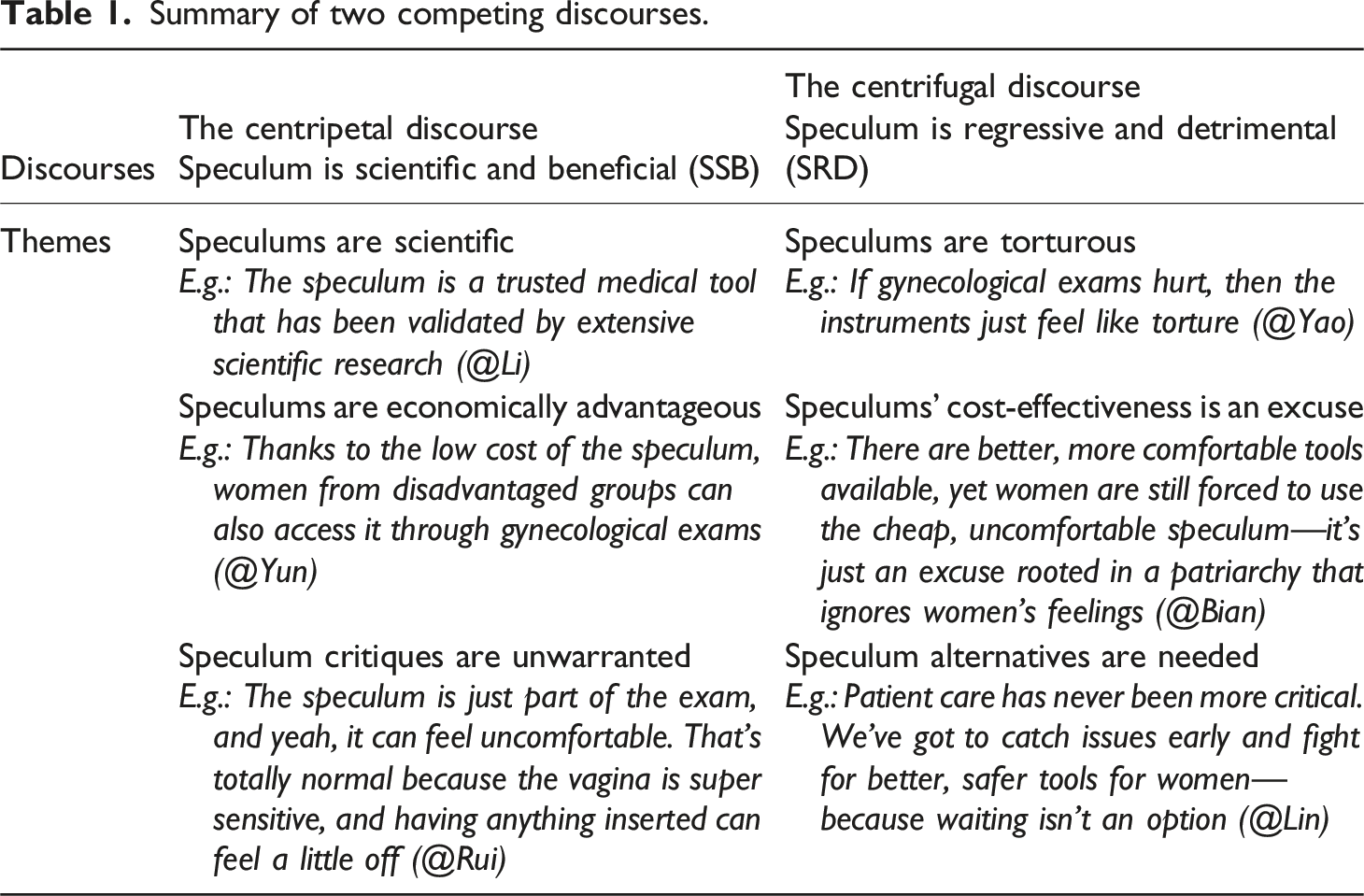
Summary of two competing discourses.
The centripetal discourse: speculum is Scientific and Beneficial (SSB)
SSB was identified as the mainstream discourse, which legitimized the widespread utilization of speculums and dismissed the necessity for its refinement. This discourse was constructed upon three core themes: speculums are scientific, speculums are economically advantageous, and speculum critiques are unwarranted.
Speculums are scientific
The SSB discourse framed speculum as a scientifically validated and essential medical tool, which emphasized its proven efficacy in gynecological exams. For instance, @Tie asserted its universal applicability: “The speculum is a must-have for gynecological exams, check-ups, discharge tests, HPV screenings, and all sorts of cervical, uterine, and vaginal checks. It’s a trusted medical tool.” Moreover, @Yan applauded the historical refinement of the speculum: “It has been around for over a century, getting better and better. It’s stood the test of time!” This discourse underscored speculums’ long-standing and widespread recognition in medical research and practice, affirming its positive significance. However, the privileging of efficiency within scientific narratives epitomized a systemic issue in Chinese healthcare, where standardized protocols systematically erased individual experiences—particularly in gynecology, a field historically complicit in the marginalization of women’s voices. This theme underscored the hierarchical nature of medical structures, casting women as passive recipients of healthcare procedures prioritized by medical authorities.
Speculums are economically advantageous
The SSB discourse emphasized speculums’ cost-effectiveness, particularly in the Chinese context with limited medical resources. For instance, @Qi noted: “Cheap speculums are so affordable that even small, economically struggling rural hospitals can use them. We should be grateful.” Furthermore, posts within this theme underscored that implementing more advanced alternatives remained impractical given the constraints of the existing healthcare infrastructure, as @Fu explained, “Currently, speculums cost less than one yuan each. According to an expert at the Rural Research Center of Fudan University, this low cost makes them accessible to women in rural areas, as hospitals and insurance are more likely to cover them. But at such low prices, manufacturers have little incentive to make better ones.” More aggressively, @Bai argued: “Hysteroscope exams cost around 800 yuan each. Making them universal would mean ten times higher insurance premiums and four times more gynecologists and clinics. It’s unaffordable unless you are pretty rich.” This discourse illuminated how economic constraints shaped healthcare policies while revealing intersecting class and regional disparities in women’s access to medical resources. Structural limitations disproportionately impacted rural hospitals and low-income communities, accentuating divides between urban and rural healthcare. By framing substandard care as economically efficient, this discourse not only rationalized systemic neglect but also positioned the speculum as a necessity in the pursuit of equitable healthcare.
Speculum critiques are unwarranted
The SSB discourse frequently attributed pain to women’s physiology or sensitivity, rather than critically examining the design of the tool itself. For instance, @Tong noted: “Discomfort from the speculum comes from vaginal expansion. No matter what tool is used, it’s going to be uncomfortable because it disrupts natural anatomy.” Furthermore, @Shou pointed out: “Pain during gynecological exams isn’t just about the speculum. Anxiety and personal sensitivity play a bigger role.” Therefore, recommendations included “using lubricants” and “communicating with patients to reduce anxiety” from the doctor’s side, and “relaxing and deep breathing” from the patient’s side, were both suggested as the most effective strategies (@Amao). Such discourses reflected gendered relational dynamics and a broader societal normalization of women’s suffering, perpetuating expectations for women to endure pain silently while subtly transferring responsibility for their discomfort from medical practice to the patient. In the words of @Xue, “This pain is totally normal. If we focus too much on comfort, how can medical exams and treatments proceed?” Such perspectives relegated women’s discomfort to an inherent trait, diminishing their agency and reinforcing power asymmetries in healthcare. At its core, this discourse portrayed women’s discomfort as inherent, diminishing their agency and reinforcing power imbalances in healthcare. It also highlighted how medical priorities and societal norms intersected to sustain unequal relationships. This narrative not only individualized and pathologized women’s pain but also framed the speculum as a disciplinary collaborator with providers, complicit in reinforcing clinical authority over women’s bodies.
The centrifugal discourse: Speculum is regressive and detrimental (SRD)
SRD served as a marginal perspective that challenged and sought to reform the dominant narratives, portraying speculums as instruments of female suffering and symbols of male-driven exploitation of women’s bodies. This discourse was structured around three key themes: speculums are torturous, speculums’ cost-effectiveness is an excuse, and speculum alternatives are needed. This discourse further emphasized the imperative of advancing speculums as a fundamental demand for women’s health and medical progress.
Speculums are torturous
The SRD discourse challenged the mainstream discourse, equating the speculum to an “instrument of torture” and gynecological exams to “cruel punishment,” thus questioning its validity and necessity (@Chen). @Jiong portrayed speculums as “cold” and “impersonal.” @Bu further argued: “Are the speculum medical tools or torture devices? If gynecological exams aren’t comfortable and gentle, they’re just punishment.” Moreover, @Xiao traced its historical origins, noting, “The speculum was invented in 1985 by a male doctor for examining his female slaves—it’s basically a torture device from the start. Even though we have gentler options now, we’re still stuck using a tool from a guy who didn’t care about women’s dignity.” These critiques highlighted the marginalization of women’s bodily autonomy and the ongoing tensions between patients and medical institutions, with the speculum symbolizing the persistence of patriarchal practices in modern healthcare. In this context, the speculum was discursively reconfigured as a relational witness to historical gender imbalances in healthcare interactions.
Speculums’ cost-effectiveness is an excuse
The SRD discourse critiqued the focus on the affordability of speculums, arguing that it was used as a justification for perpetuating the use of substandard tools in women’s healthcare. As @Deng wrote, “Men keep saying there are alternatives to the speculum but they’re too pricey, blaming women for not spending. When women talk about their pain, some men just shut them down.” This discourse exposed how economic rationales mask latent relational imbalances, particularly the prioritization of institutional cost-saving over addressing women’s discomfort and agency. Critics further challenged the broader patriarchal framework underpinning medical practices, as @Shi lamented, “The medical community has long assumed no real differences between male and female bodies, focusing on the ‘male standard.’ Women’s pain was often brushed off as ‘emotional’ or ‘psychological.’ And let’s be real—even policies don’t aim to fix this, because the policymakers are men too. The so-called low cost of speculums is just an excuse to prioritize saving money over women’s comfort.” These posts underscored how systemic biases and cost-driven priorities devalue women’s bodily experiences with the speculum, reflecting underlying structural inequalities. This critique extended beyond the speculum, calling for systemic reforms that prioritize equitable care and relational accountability over patriarchal and cost-centric imperatives.
Speculum alternatives are needed
The SRD discourse emphasized the need for modernizing this device to align with contemporary medical standards, thereby challenging the status quo and calling for transformative changes aimed at addressing both its physical and symbolic limitations. As @Zhen emphasized, “Improving the speculum isn’t about women being overly sensitive. In today’s focus on patient care, finding issues and pushing for better medical equipment is essential.” Others pointed out the disparity in patient-centered care across different medical fields: “With gastroscopies, you have options from standard to super comfy capsule endoscopies. Heart surgeries also offer both traditional and less invasive choices. So why isn’t women’s health getting the same attention for comfort and minimal harm?” This discourse highlighted a shift toward recognizing women’s subjective experiences during medical procedures, advocating for a re-evaluation of patient-doctor relationships in China. By calling for less invasive alternatives, it reflected a commitment to prioritizing patient well-being in line with medical ethics and humanitarian principles. This demand challenged the passive role traditionally assigned to female patients, asserting the need for greater bodily autonomy and the integration of empathetic, patient-centered care within the medical system.
Discursive interplay
The data corpus revealed various instances of synchronous interactions between the two discourses, which collectively shaped the meaning of the speculum through their interplay and competition. We identified three major contractive practices, two synchronic interplays, and two dialogic transformations, as explicated below.
Contractive practices
Discursive practices can serve polemically to challenge competing discourses, thereby establishing or maintaining the dominance of a centripetal discourse (Baxter, 2011). In the debate over the speculum, three types of dialogic contractions emerged: disqualification, naturalization, and neutralization.
Disqualification
Disqualification occurred when a speaker was perceived as lacking expertise or authority, thereby closing alternative perspectives and creating new meanings (Baxter, 2011; Hintz & Scharp, 2023). By emphasizing the non-medical credentials of proponents of the marginal SRD discourse, their legitimacy was systematically questioned, effectively relegating their contributions to the margins of the debate. For instance, @Zhi stated, “Standardized treatments aren’t up for debate by non-medical folks. Finish five years of med school, three years of a master’s, decades of clinical work, and some administrator experience first. Otherwise, shut up your months.” This discourse constructed a hierarchy of expertise, strategically excluding non-medical voices and reinforcing traditional authority structures that marginalize SRD perspectives. In response to calls for improvements to the speculum, @Qu added, “If you think it’s a big problem, why not fix it yourself? You know nothing except complaining.” Such disqualification not only dismissed the critics but also excluded them from effective discourse, thereby maintaining the legitimacy of the dominant SSB discourse.
Naturalization
Naturalization described how certain discourses became normalized and accepted as the “natural” or “inevitable” way to understand a phenomenon (Baxter, 2011, p. 171). As @Ke noted: “Is the speculum the only thing that hurts in hospitals? Isn’t every procedure painful? You think it can be improved, but it’s already as good as it gets.” This perspective naturalized the discomfort of medical exams as an unavoidable norm, thus obscuring the potential for improvement. Similarly, the necessity of the speculum and its use in medical practice was justified through naturalization. @Ying emphasized: “How can you do a gynecological exam without opening the vaginal canal? Any internal exam will cause some pain. The speculum is already designed as efficiently as possible.” This discourse framed pain caused by speculums as a “necessary sacrifice” for medical accuracy, dismissing SRD’s concerns as inconsequential. It underscored the structural normalization of discomfort in women’s healthcare, perpetuating a doctor-centered model where female bodily autonomy is subordinated to clinical procedure.
Neutralization
By invoking medical experts, the centripetal discourse of SSB masked its value-laden positions under the guise of objectivity (Baxter, 2011). Advocates frequently cited “medical students,” “gynecologists,” and “medical professors” from prestigious Chinese universities and hospitals, framing their voices as the only “rational” viewpoint (e.g., @Zhong; @Yuan). For example, @Song noted: “Qiu Jin, Chief Physician, and Sun Yi, Attending Physician at Renji Hospital, Shanghai Jiao Tong University School of Medicine, with nearly thirty and over ten years of experience in women’s health education respectively, both stated that speculums’ design is scientifically sound. They also emphasized that making it entirely comfortable remains difficult despite advancements.” This reliance on expert testimony enabled the SSB discourse to delegitimize SRD’s challenges, portraying them as uninformed or misguided. By presenting women’s discomfort as scientifically justifiable, neutralization reinforced a power hierarchy where medical expertise, rather than patient experience, dictates decision-making within healthcare.
Synchronic interplay
In our analysis, synchronic interplay between discourses about the speculum was evident, suggesting the simultaneous presence of multiple discourses that interact in antagonistic, direct, playful, or transformative ways (Baxter, 2011, p. 131; Baxter et al., 2021). Specifically, we identified two primary forms of interaction: entertaining and negating.
Entertaining
The entertaining approach embraced multiple perspectives, showing openness to different discourses rather than directly refuting or challenging them. It acknowledged alternative viewpoints, enabling nuanced discussions that integrated dominant and marginalized discourses (Baxter, 2011, p. 168). Discourses surrounding the speculum highlighted the conflicts inherent in discussions of women’s health, while also acknowledging the importance of valuing diverse experiences. For instance, @Hu stated, “Don’t stress too much about the speculum. Avoiding gyno exams because of it isn’t worth it—just talk to your doctor beforehand. Every woman’s experience is different; some find it uncomfortable, while some don’t mind it. We need to respect everyone’s feelings. Plus, some hospitals are already working on making things better, like using softer materials to make it less uncomfortable. Those efforts are definitely a step in the right direction.” This discourse balanced respect for individual autonomy with openness to medical innovation, while still valuing traditional practices. However, while such discursive practices encouraged diversity and inclusion, they also revealed deep-seated issues within the medical system, including the need for more compassionate care and systemic reforms to improve patient experiences.
Negating
Negating involved the outright rejection of dominant discourses by marginalized discourses (Baxter et al., 2021). In this study, the marginal SRD discourse dismissed the significance of SSB, framing the speculum as a tool of oppression, as shown in @Aili’s comment: “The speculum is insanely painful for women. Why are we even talking about this torture device?” Our analysis further revealed that the negating discourse frequently escalated, with the speculum condemned as a staunch agent of gendered oppression and systemic violence. For instance, @Lan criticized, “The speculum was invented in 1845 by a doctor who liked torturing female prisoners. It made me cry during an exam. Why are media outlets praising it? It’s basically a torture device.” Similarly, @Mei remarked, “If this speculum were for men, it’d have been upgraded ages ago,” while @Yong (5/15/2024) observed, “Even with tech advances, this tool still sucks. The real deal? Since it’s not used on men, any complaints are just brushed off as overreactions.” By associating speculums’ design with patriarchal values and unequal medical advancements, this discourse underscored the broader issue of neglecting women’s physiological needs. In other words, these intensified expressions of negation spotlighted the speculum as emblematic of systemic gendered oppression, prompting reflections on the urgent need for extensive social and medical reforms.
Dialogic transformations
Dialogic transformation represented an idealized form of dialogue where one discourse no longer dominantly suppresses others, leading to a more open exchange that could generate new meanings (Baxter, 2011). Baxter and Braithwaite (2008) identified these transformations as hybrids and aesthetic moments, which will be illuminated in the following sections.
Hybrids
Hybridization occurred when discourses ceased to vie for dominance and instead merged to create a new, combined meaning (Baxter, 2011). In our analysis, a hybrid discursive construction emerged where the dominant SSB discourses and the marginal SRD discourses were framed as complementary rather than competing. For example, @lzdzxmz reflected this merged perspective by saying, “The equipment needs an upgrade, and so do we. Times are changing, and so are our needs. I get why the speculum is used now, but I’m worried about it for the future. Fingers crossed things get better!” This hybrid discourse acknowledged the scientific value of the speculum while questioning its capacity to meet evolving patient needs. It emphasized the importance of patient autonomy in shaping future medical practices and advocated for a more responsive, adaptive approach to addressing women’s concerns.
Aesthetic moments
Aesthetic moments reframed opposing discourses to construct new, shared meanings distinct from both mainstream and marginalized views (Baxter & Braithwaite, 2008; Scharp et al., 2022). In this study, aesthetic moments surrounding the speculum transcended polarized opinions, offering a unified perspective that positioned it as both a benchmark for compassionate care and a catalyst for advocacy in women’s healthcare.
The first aesthetic moment redefined the speculum as a measure of empathy and attentiveness in doctor-patient relationships, transforming it from a tool into a symbol of the care healthcare providers offer to women. For example, @Miao (5/17/2024) shared, “A gentle, caring healthcare worker can make the procedure almost painless, but some doctors rush through it, making it really painful and dismissing your concerns,” suggesting that patient discomfort was more attributable to the practitioner’s approach than the tool itself. This perspective reframed the speculum as a measure of humane, patient-centered care, underscoring the need to address emotional and psychological concerns alongside clinical efficiency. It positioned the speculum as a reflection of healthcare’s capacity to balance technical expertise with compassion, particularly in contexts defined by power imbalances.
The second aesthetic moment conceptualized the speculum as a symbol of collective empowerment and advocacy, serving as a focal point for addressing gender inequities and amplifying women’s calls for systemic healthcare reform. For instance, @Yi’s (5/17/2024) commented, “It’s not just about blaming the speculum. Women brought us into the world, yet gynecological tools haven’t changed in 200 years. Fixing the tool is just a start; calling out the speculum shows how society fails women and calls for real change.” In this context, the speculum surpassed its practical function, emerging as a symbol of broader calls for dignity, agency, and systemic reform. These discourses reconceptualized the speculum as both a silent witness to systemic neglect and an unwitting agent in women’s embodied resistance, its clinical materiality now entangled with struggles for healthcare justice and bodily autonomy.
Discussion
This study examines the controversial discourses surrounding the speculum on social media, shedding light on the dialectical tensions between institutional authority and personal agency. Through the discursive struggles between SSB and SRD, the speculum transcends its clinical function to become a polyvocal relational partner, embodying three co-constitutive meanings. First, the speculum functions as a material extension of institutional power, ritualizing the asymmetrical surveillance and discipline of women’s bodies. Its standardized use in pelvic exams naturalizes clinical hierarchies, positioning patients as passive subjects of medical scrutiny. Simultaneously, the instrument emerges as a catalyst of gendered vulnerability, its torturous intrusion amplifying embodied traumas. In this way, it serves as an unfeeling interrogator that weaponizes clinical efficiency against their sensory and emotional needs. Paradoxically, the speculum transforms into a relational infrastructure for solidarity, galvanizing collective resistance among women against medical hierarchies to reclaim agency over their bodies.
In China, women’s health rights are ambiguously defined and insufficiently protected (Yang & Qiu, 2024). Deep-seated cultural expectations of women’s endurance and self-sacrifice permeate family, medical, and societal relationships, often contributing to the marginalization of women’s bodily experiences in clinical settings. Women’s limited sense of bodily autonomy, lack of medical knowledge, and deference to authority further lead to their silence in daily life (Liu & Zou, 2024). Moreover, strained doctor-patient relationships and a lack of patient-centered care education exacerbate these issues (Qiao et al., 2019). Physicians often exhibit mechanical and indifferent attitudes during sensitive examinations (e.g., gynecological examinations), which can impede women’s ability to communicate their discomfort, particularly in encounters with male doctors. Such conditions intensify doctor-patient tensions and perpetuate gender power imbalances, thereby normalizing women’s painful experiences with the speculum and obscuring the imperative for improved medical tools and care practices.
Women’s emotions are often repressed in daily life, yet social media serves as a critical platform for expression. Platforms like Weibo facilitate the contestation of traditional medical authority, allowing women to articulate experiences typically silenced offline. The anonymity and openness of these spaces empower marginalized voices to coalesce into epistemic communities that challenge dominant discourses (Bellander & Landqvist, 2020). This not only highlights the constrained avenues for women’s expression in offline environments but also signifies a broader struggle for agency and recognition within Chinese society characterized by doctor-patient relations, gender ideologies, and socio-economic stratification. However, while these online voices advocating for bodily autonomy and humane medical practices spotlight a growing feminist consciousness, their impact on substantial social change remains limited due to the absence of effective mechanisms for policy influence. In contrast to international movements such as Ireland’s “Repeal the eighth” campaign, which leveraged social media to galvanize public support for the abolition of the abortion ban (Statham & Ringrow, 2022), social media activism in China is curtailed by state censorship and deeply entrenched sociocultural norms. Additionally, digital activism on platforms like Weibo is often disparaged as “foreign interference,” further undermining efforts to enact substantial healthcare reform (Lin, 2018). Thus, although Weibo serves as a crucial forum for amplifying women’s voices, the ephemeral nature of online text, constrained by a restrictive political framework, limits the broader efficacy of digital activism. This underscores the urgent need for strategies that bridge the gap between virtual advocacy and meaningful policy transformation.
Applying RDT to Chinese social media discourses provides valuable insights into the contentious discourse surrounding sensitive issues. Platforms like Weibo, with their focus on emotionally charged content, often amplify extreme views, reinforcing dominant voices while marginalizing more nuanced perspectives (Gonzalez-Polledo & Tarr, 2016). This dynamic aligns with RDT’s emphasis on how competing discourses interact with each other to shape public understanding. For instance, polarized narratives surrounding medical practices such as the use of the speculum reflect broader relational tensions within Chinese society, where doctor-patient interactions frequently reveal power imbalances and a focus on instrumentalized care. In this context, intense discourse exposes public frustrations over perceived insensitivity in healthcare, mirroring the influence of state and institutional priorities on patient experiences. RDT highlights how these polarized discussions obscure underlying social contradictions, such as healthcare inequities, thereby reinforcing a feedback loop that exacerbates public divides. The lens of RDT 2.0 further facilitates an exploration beyond binary “dominant” and “marginal” discourses, situating discourse within a continuum of past, present, and future interactions (Baxter et al., 2021). This framework illuminates how competing ideologies are redefined in response to evolving political, economic, and cultural forces. It also enables the amplification of discourses advocating for gender-sensitive, humane practices, contributing to a broader social critique. Ultimately, this study demonstrates the utility of RDT in uncovering the complex power dynamics within China’s online text, where the meaning-making process surrounding the speculum simultaneously mirrors, perpetuates, and resists deeper societal and cultural structures.
Practically, this study highlights the need to center women’s experiences in gynecological examinations. Current medical tools often prioritize clinical efficiency over patient comfort and emotional well-being. Redesigning these instruments to better align with women’s physical and psychological needs—such as incorporating ergonomic designs and adjustable sizes—can significantly reduce discomfort and improve patient satisfaction. Furthermore, fostering more open public discussions on women’s health, informed by both scientific and personal perspectives, is essential for challenging misconceptions and reducing stigma. These discussions should be inclusive, engaging the wider community to create a more informed and empathetic discourse. Finally, many women’s mistrust of providers stems from poor communication and a lack of empathy. Implementing mandatory communication training for providers—focusing on active listening, empathy, and patient-centered care—can build trust, reduce discomfort, and improve the overall effectiveness of medical care.
Despite the theoretical and practical contributions of this study, several limitations warrant consideration. First, the complexity of social media data poses challenges in identifying the underlying causes of discourse patterns. While our contrapuntal analysis offered valuable insights, future research could benefit from longitudinal studies or other qualitative methods (e.g., interviews and focus groups with doctors, patients, and healthcare professionals) to dive into the multifaceted factors influencing divergent perspectives on speculum use. Second, the reliance on hashtags for data collection on Weibo may have skewed the sample toward more vocal, young, educated, and politically engaged users, potentially underrepresenting other groups. Future research could employ purposive sampling or expand data collection to encompass a broader range of demographics, offering a more holistic understanding. In particular, including perspectives from rural, older, and low-income women could yield deeper insights into how factors such as age, access to resources, and social positioning influence gynecological care experiences. Finally, qualitative discourse analysis cannot capture the proportions of individuals subscribing to particular discourses. Integrating quantitative methods, such as big data analysis, surveys, or experiments, would complement qualitative insights and offer a more generalizable understanding of the relational mechanisms and structural factors shaping discourse on women’s health in China.
Footnotes
Declaration of conflicting interests
The author(s) declared no potential conflicts of interest with respect to the research, authorship, and/or publication of this article.
Funding
The author(s) received no financial support for the research, authorship, and/or publication of this article.
Open research statement
As part of IARR’s encouragement of open research practices, the author(s) have provided the following information: This research was not pre-registered. The materials used in the research cannot be publicly shared but are available upon request. The materials can be obtained by emailing:
