







Abstract
Working as a married couple in the same workplace has its own unique and different aspects. This situation can be a challenging and difficult experience for couples and may also cause discomfort for other stakeholders in the workplace. Although its prevalence in Turkey is not clearly known, there has been an observed increase in married couples’ demand to work in the same workplace. The purpose of this qualitative research is to examine the experiences of married couples working in the same workplace. For this purpose, we conducted interviews with 14 participants (4 = male, 10 = female) aged between 32 and 50. Thematic analysis was used to analyze the data obtained from the interviews and as a result, three main themes were identified: “Invisible costs”, “Support and solidarity”, “Professional relationship”. We believe that the findings of this study will contribute to the literature on the feelings and experiences of married couples working in the same workplace and finally, we offer recommendations to couples, employers and organizational psychologists.
Nowadays, married couples are often seen working at the same workplace. Official institutions in Turkey and international sources do not provide quantitative data on married couples working at the same workplace, but studies conducted with specific occupational groups provide insight into the proportion of such couples in the workforce. Although there are no official and national quantitative data on married couples working at the same workplace in Turkey, the phenomenon of dual-career spouses is becoming more widespread, particularly due to the increase in women’s employment, the rise in the proportion of women with university degrees and the need for labor in the economy (Demirel, 2017; Şener et al., 2018). While the female employment rate in Turkey was 23.3% in 2004, this rate increased to 32.5% in 2024 (TURKSTAT, 2025). It is estimated that the increase in female employment will indirectly increase the likelihood of couples working together in the same workplace. Another piece of data obtained relates to the spousal participation in family businesses. According to TURKSTAT (2022) Household Labor Force Statistics, family labor accounts for 10%–12% of agricultural and artisan businesses. When reviewing the international literature, the majority of studies and data are sourced from the United States. In the US, 36% of academic couples work at the same university (Wolf-Wendel et al., 2004), while in a different study of academic couples, this rate was 40% (Schiebinger et al., 2008). The rate of doctor couples working in the same hospital varies between 11% and 20% (Jagsi et al., 2014; Ly & Seabury, 2016), 5%–10% of married police officers work in the same unit (He et al., 2002). It is also known that 80% of businesses in the US are family businesses, and the rate of spouse participation in these businesses varies between 30%–50% (Astrachan & Shanker, 2003).
While there is no official quantitative data in Turkey on the percentage of married couples working at the same workplace, the data in the international literature originate from the USA. The data obtained from studies conducted in the US belong to specific occupational groups and are not up-to-date. Although their prevalence is not clearly known today, couples working at the same workplace can be seen in every area of life, such as schools, hospitals, courthouses, prisons, plazas, boutique hotels, bakeries, and grocery stores. Some of these couples strategically decide to work at the same workplace, while others meet as co-workers and get married (Moen & Sweet, 2002). Regardless of how it happens, working as a married couple at the same workplace is a unique and different experience. This unique experience can affect couples’ marital relationships, their well-being at work, and their relationships with co-workers and supervisors (Duran & Kosterelioglu, 2017; Hennecke & Hetschko, 2024; Janning, 2009).
Individuals’ work life and relationship quality, as well as the interaction between them, are important determinants of their happiness. It is essential for people to achieve a balance between these two elements, which are extremely important for their quality of life (Halbesleben et al., 2010). In the modern world, married couples prefer to work in the same workplace for many different and advantageous reasons. Shared responsibilities, easier coordination of schedules, flexible working hours and parent-friendly policies are among the reasons why couples choose to work at the same workplace (Janning, 2006; Moen & Sweet, 2002). This situation, which is defined in the literature as one of the subsets of the term ‘work-linked couple’, has become a phenomenon that both employees and employers must deal with (Sarpong, 2018).
Work-linked couples are defined as couples who share the same profession, the same workplace or both (Halbesleben et al., 2010). For example, both spouses are doctors working in different hospitals, one spouse is a doctor and the other is a nurse in the same hospital, or both spouses are doctors working in the same hospital (Halbesleben, 2010). The fact that spouses are also co-workers can give rise to certain individual, social, and organizational risks. Unprofessional relationships can lead to disruption of duties and responsibilities, questioning of equality and fairness in the workplace from the perspective of other employees, and damage to organizational dynamics (Duran & Kosterelioglu, 2017; Janning, 2009). Sharing the same workplace as a married couple can lead to increased work-family conflict and blurred boundaries between spouses (Demirel, 2017; Sener et al., 2018). In the literature, there are studies showing the negative effects of being a work-linked couple. Some of these negative effects include the reflection of negative emotions and situations at the workplace on the family (Moen & Sweet, 2002), tension resulting from work-family conflicts (Halbesleben et al., 2012), the blurring of work-family boundaries (Huffman et al., 2018), depletive conversations about the workplace (Janning, 2006), and unsupportive attitudes of other co-workers (Sarpong, 2018).
Some studies on work-linked couples show that these couples also achieve positive results and gain from an individual and organizational perspective. Being a work-linked couple increases income, job and life satisfaction (Hennecke & Hetschko, 2024), better integrates work and family roles (Halbesleben et al., 2010), increases the sense of closeness between spouses and the level of work-family integration (Janning, 2009; Janning & Neely, 2006), contributes to work-family balance, increases family satisfaction and employer’s job satisfaction (Ferguson et al., 2015), and work-linked couples experience lower emotional burnout with the instrumental support of their spouses (Halbesleben et al., 2012). From the employer’s perspective, working with work-linked couples has positive effects on employee retention, engagement and morale (Sarpong, 2018).
An important issue that needs to be emphasized regarding work-linked couples is role conflict. The most prominent roles in individuals’ lives are family and work roles. Individuals who work as a married couple at the same workplace are simultaneously in the roles of spouse and employee. The intense expectations associated with these roles (both personal and environmental) and the mismatch between individuals’ desires and needs can lead to conflict (Carıkcı & Celikkol, 2009; Cetinceli & Carıkcı, 2020). Conflicts in individuals’ work-family roles are seen in two ways: the family’s impact on work life and work’s impact on family life. These conflicts cause incompatibility between the multiple roles individuals have (Frone et al., 1992). At the same time, the fact that individuals have limited energy and time makes it difficult to perform different roles simultaneously, leading to role conflict (Greenhaus & Beutell, 1985). This situation has a negative impact on individuals’ well-being, causing distress, stress and emotional burnout (Baltes & Heydens-Gahir, 2003). The overlap between individuals’ work and family roles also leads to work-family conflict. Being caught between the demands and expectations of work life and those of family life is associated with many critical issues, including job satisfaction, organizational commitment, turnover, marital satisfaction, family satisfaction, physical symptoms, stress, and depressive symptoms (Kossek & Lee, 2017). In the case of married couples working in the same workplace, this situation may become more complicated as spouses are exposed to the demands and expectations of the same work environment. While there is a wealth of literature on work-family role conflict and work-family conflict (Akintayo, 2010; Arslan, 2012; Frone et al., 1996; Greenhaus et al., 2010; Kulik et al., 2016; Mufidah et al., 2024; Noor, 2004; Çarıkçı & Çelikkol, 2009), studies focusing on married couples working in the same workplace are limited.
Research on work-linked couples has been increasing in the international literature over the years. Work-linked couples attract the attention of researchers on work-family integration (Fritz et al., 2019; Halbesleben, 2010; Halbesleben et al., 2010; Janning, 2009; Janning & Neely, 2006; Walter & Haun, 2020), work-family conflict (Halbesleben et al., 2012), work-life balance (Ferguson et al., 2015) and work-family boundary theory (Huffman et al., 2018; Huffman & Olson, 2017). However, when examining the literature in Turkey, it is observed that there are only two studies on work-linked couples, and these two studies focus on teacher couples working at the same school. According to a study by Duran and Kosterelioglu’s (2017) that examined the management aspects of teacher couples working at the same school, the fact that spouses work at the same school has positive effects such as professional cooperation, time savings, ease of transportation, personal and organizational culture, social adaptation, job satisfaction, and organizational commitment; negative consequences such as causing misunderstandings, favoritism, inability to be objective, and difficulties in ensuring organizational justice. Unal et al.’s (2018) study shows that working as husband-and-wife teachers at the same school has positive and negative effects on daily life and wo rk life. Working at the same school has a positive effects on the daily lives of teacher couples in terms of ease in childcare, sharing of household responsibilities, transportation convenience, while it has a negative effects in terms of monotonous life, the burden of responsibilities falling on one spouse, constant togetherness, and the reflection of work issues at home. Working at the same school has positive effects on professional solidarity, a shared environment, and compensating for each other’s shortcomings; it has negative effects in terms of getting involved in the problems experienced by one’s spouse, taking on one’s spouse’s responsibilities, increased workload, and loss of objectivity.
There are few studies among those conducted mainly in the US that show how working at the same workplace as a married couple affects work life and marital relationships. These studies have mainly focused on the concept of work-linked couples (those who share the same profession and/or workplace). The two studies conducted in Turkey only focus on the positive and negative effects of teacher couples working as husband and wife teachers in the same schools. As a result, there is insufficient information available about the experiences of married couples working in the same workplace within other occupational groups. Moreover, in both studies conducted in Turkey, it is unclear how teacher couples cope with the negative effects and challenges of working at the same school and what kind of strategies they develop. The current study focuses on couples working at the same workplace regardless of occupational similarity, but from different occupational groups. This research aims to reveal how couples’ working in the same workplace affects their marital and work relationship and how they cope with this situation utilizing the exploratory power of qualitative design (Creswell, 2016). It is anticipated that this study will contribute to the relevant literature by providing more detailed information about the phenomenon of married couples who are co-workers, and guide preventive and interventive efforts for couples and employers. In this framework, the research question was structured as follows:
What do married couples working in the same workplace in Turkey experience in their marriage and work life?
Methodology
Study design
This study aimed to investigate the experiences of married couples working at the same workplace by utilizing the strengths of phenomenological research and the hermeneutic tradition was followed in the study. One of the strengths of phenomenological research is that it effectively reveals contextual and cultural differences by deeply exploring the subjective meanings of individuals’ experiences and presenting their complex experiences in a holistic and rich manner. Through phenomenological research, researchers had the opportunity to explain the phenomenon of ‘married couples who are co-workers’, which is recognized but not sufficiently understood, through the experiences of participants with similar experiences (Creswell, 2016). Furthermore, the adoption of the hermeneutic tradition in the study enabled researchers to not only describe the phenomenon of ‘married couples who are co-workers’ that they were interested in, but also to interpret it contextually (Aslan, 2021; Çarpar, 2020).
Participants
Participant specifications.
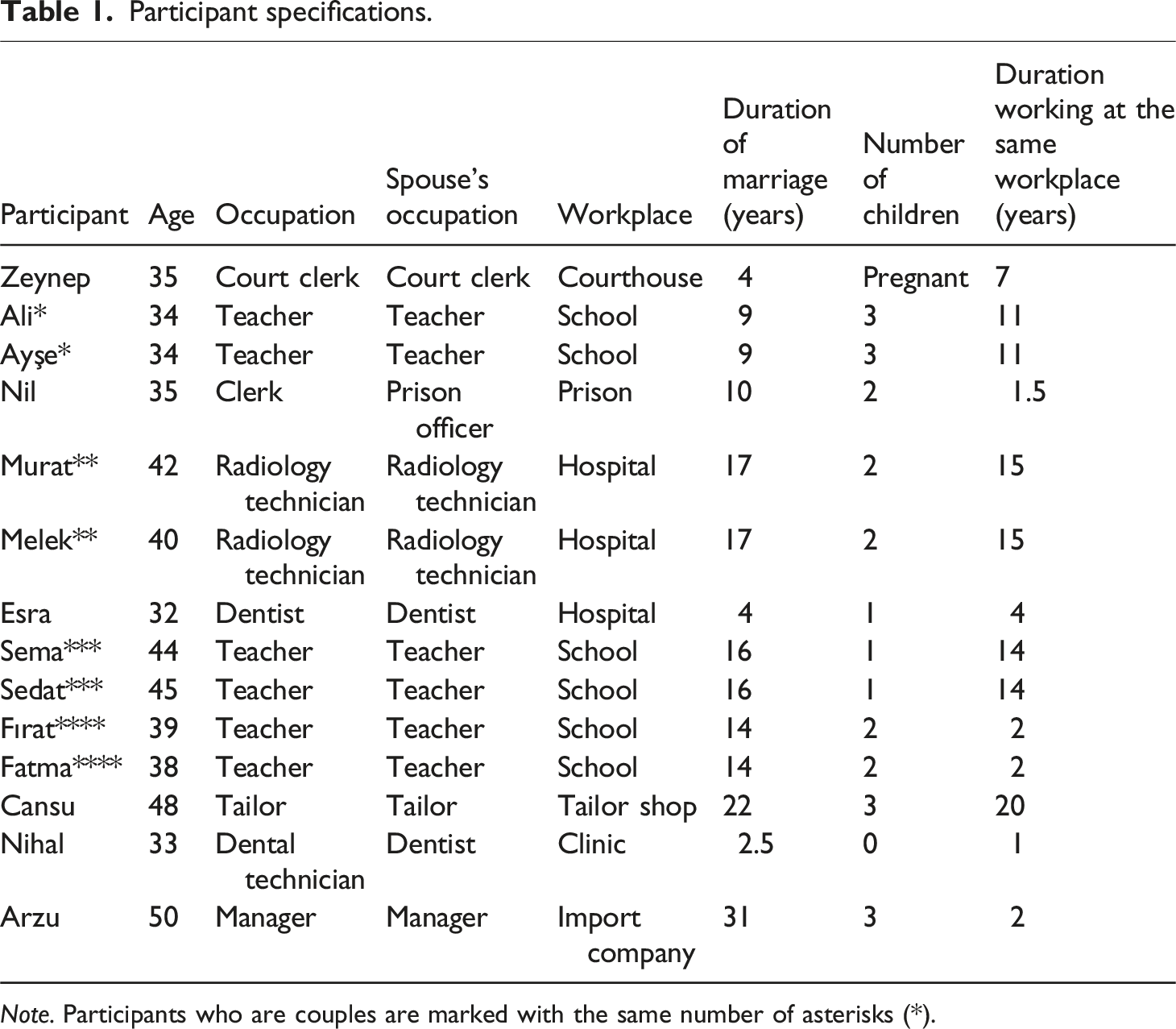
Note. Participants who are couples are marked with the same number of asterisks (*).
Data collection tools
A semi-structured interview form was used as a data collection tool in the study. The Semi-Structured Interview Form was created by the researchers and expert opinions were sought regarding the form. The questions in the interview form were edited and finalized as a result of the pilot interview conducted before the research. The Semi-Structured Interview Form included questions such as; ‘What has changed in your marital relationship after you started working at the same institution with your spouse?’, ‘How does being a colleague with your spouse affect your marital relationship?’, ‘What changes has occured in your professional life after you started working at the same institution with your spouse?’, ‘What are the advantages of working at the same institution with your spouse?’, ‘What are the disadvantages of working at the same institution with your spouse?’
Procedure
First, approval was obtained from the Scientific Research and Publication Ethics Committee of Inonu University’s Faculty of Social and Human Sciences. Data were collected in October and November 2024. In order to reach the participants, the announcement text containing the purpose of the study, inclusion criteria and contact information of the researcher was shared on the social media accounts of the first author of the study. The first author of the study introduced herself to the participants who responded, explained the purpose of the study, answered their questions, and requested an interview from the volunteer participants who accepted the conditions. The Informed Consent Form was explained to the individuals who volunteered to participate in the study and permission was obtained. Interview dates and times were decided together with the participants Interviews with participants residing in the city where the first author lived were conducted face-to-face (4 participants), while interviews with other participants were conducted online via Google Meet. All interviews were conducted by the first author of the study. The interviews lasted 20 min on average. The interviews were audio-recorded with permissions of the participants and then transcribed and transcribed verbatim. The names of the participants and any information that might give clues about their identities were removed from the transcripts. In the final version of the research report, the participants were assigned code names to protect their identities.
Reflexivity
In qualitative research, the researcher is not someone who processes data numerically from the outside, but rather someone who shares participants’ experiences within the research context and actively participates in the process (Patton, 2018; Yıldırım, 1999). The first author of the study works as a school psychological counselor at a middle school affiliated with the Ministry of National Education and is also pursuing a doctoral degree in the Department of Guidance and Psychological Counseling at Inonu University. The second author of the study has been working as a faculty member in the Department of Guidance and Psychological Counseling at Inonu University since 2018 and previously worked as a school psychological counselor in three different schools affiliated with the Ministry of National Education for 19 years. Both authors of the study are single and have no personal experience related to the research topic. However, witnessing the experiences of married couples working at the same workplace and observing these couples’ experiences sparked the researchers’ interest in the topic.
The first author conducted individual interviews with participants using an empathetic approach and encouraged participants to open up. The second author’s experience as a school counselor and academic work at the university enabled them to evaluate the experiences of couples working at the same workplace in an empathetic and analytical manner. The second author played an active role in the preparation, data collection, data analysis, and reporting stages of the research.
In hermeneutic studies where researchers do not bracket themselves, it is important to restrain subjectivity (Sarı, 2022). Multiple restraint strategies were used in this study. In order to recognize and make visible the effect of the researchers’ subjectivity on the analysis process, both authors continuously evaluated the possible effects of their own experiences on the analysis through reflection journals and discussions. For example, the first author recorded in writing how their experience as a school counselor shaped their approach to participants’ statements, while the second author discussed how their professional and academic experiences could influence their interpretation of the data and noted these influences during the analysis process. Furthermore, the presence of multiple researchers during the coding process and the cross-checking of results prevented the formation of biases. These methods made it possible to recognize subjectivity and ensure transparency in the analysis process.
Data analysis
Data analysis was conducted using thematic analysis because it allows for the systematic identification of common and distinct patterns emerging from participants’ experiences (Braun & Clarke, 2006). During thematic analysis, Braun and Clarke’s (2006) six-step procedure was followed, and the MAXQDA-2020 qualitative data analysis software was used.
In the first stage, the audio recordings of the interviews with the participants were transcribed verbatim. Both authors of the study (coder 1 and coder 2) read all fourteen transcripts without coding them to familiarize themselves with the content. In the second stage, the authors independently read the transcripts a second time and identified the initial codes of strong and meaningful expressions. While creating the codes, memos (Charmaz, 2006) were taken regarding what these codes meant, the relationship between the codes, and what themes these codes could create. Thus, it was aimed to create an inclusive and holistic perspective of the data set. In the third stage, the authors came together to compare the initial codes and identify similarities and differences between the codes. At this stage, two authors identified a total of 13 initial codes. Potential main themes and sub-themes were sought based on the codes that both authors agreed on. Sacrifice, compromise, jealousy, distant relationship, transparency and trust are some of these codes. First, 4 main themes and 9 sub-themes were created. In the fourth stage, the codes belonging to the main themes and sub-themes were compared with the whole data set. At this stage, the authors came together a few more times and exchanged ideas about the boundaries of the main themes and sub-themes and the code contents. As a result of the discussions, the main theme named Social Judgments was placed within the main theme of Invisible Costs as a sub-theme of Prejudices. The sub-themes of Co-Workers Instead Spouses and Personal Space were combined within the main theme of Professional Relationship due to their similar meaning and content. As a result, 3 main themes and 6 sub-themes were formed. In the fifth stage, each theme was defined and named to reflect its content. In the sixth stage, which was defined as the final opportunity for analysis, concrete, striking and convincing participant statements that would best explain the themes were selected. The direct statements of the participants were reported in relation to the research objective and the literature.
Validation strategies
In order to ensure the validity and reliability of the research, triangulation, participant confirmation, expert opinion and rich description strategies were used (Creswell & Miller, 2000). The first strategy used in the study was researcher triangulation. In this context, the research data were coded by two different coders experienced in qualitative research. Another strategy used in the research was participant confirmation. Participant confirmation was conducted during and after the interview. First, at the end of each interview with the participants, the content was summarized, and confirmation was obtained so that any misunderstandings, if any, could be adressed immediately. Finally, transcripts of the audio recordings taken during the interviews were sent to all participants and asked whether the statements reflected the participants’ feelings and thoughts. All participants approved the content of the transcripts. Another strategy used was to seek expert opinion. In this context, expert opinion was taken during the preparation of semi-structured interview questions and data analysis stages. Finally, the last strategy used was intensive and rich description. In this context, participant statements were presented directly and densely in the research report.
Results
Three main themes and six sub-themes were identified in the research conducted to explore the experiences of couples working in the same workplace. The emerging themes and sub-themes are shown in Figure 1. Themes and subthemes reached.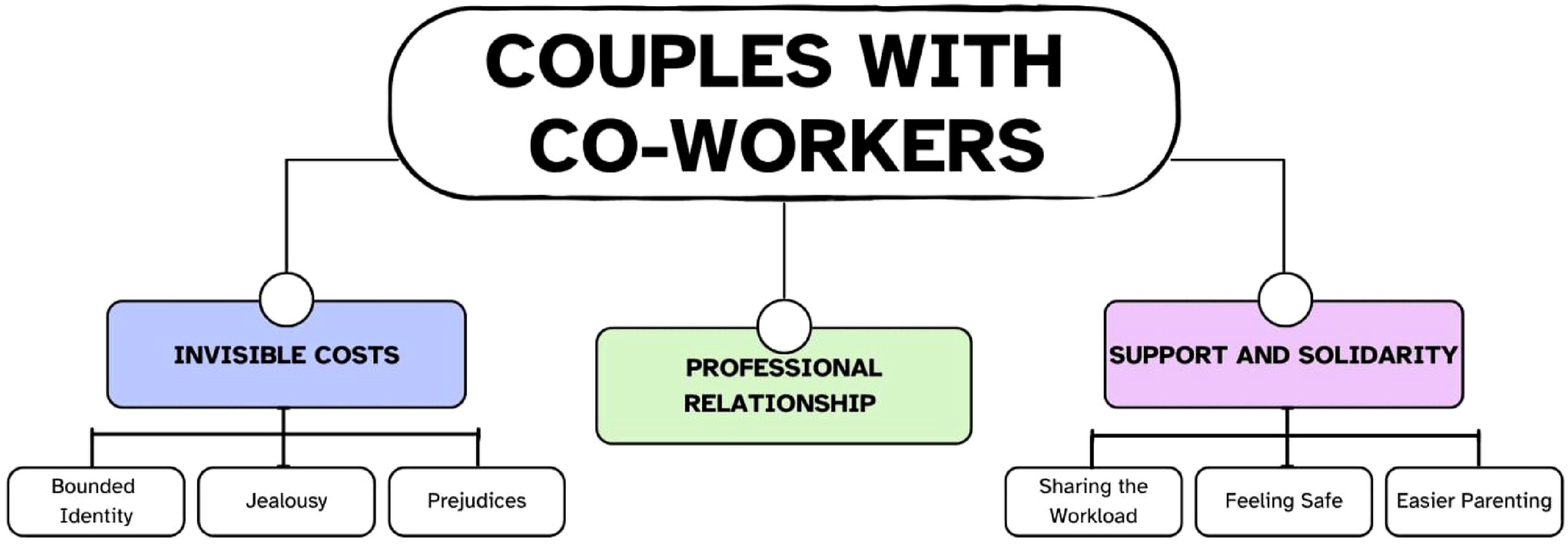
Invisible costs
This main theme includes the difficulties experienced by couples working in the same workplace as their spouses in their personal and professional lives. The main theme of Invisible Costs consists of the sub-themes of “bounded identity”, “jealousy” and “prejudices”. Couples who are also co-workers with their spouses state that they have a bounded identity by compromising themselves in the workplace due to their position, that they experience jealousy due to their spouses’ interaction with the opposite sex at work, and that they face prejudices from other employees. These difficulties affect individuals’ marital and professional lives. Participants’ experiences on these sub-themes are presented below.
Bounded identity
The most intensely expressed challenge by the participants is bounded identity. Couples who work at the same workplace with their spouses do not prioritize their own wants and needs. These couples feel compelled to behave more sensitively and cautiously in their relationships with other co-workers and supervisors. Participants who stated that they do not express their own feelings and thoughts sufficiently explained the reason for this was eliminating the risk of any negative situation reflecting on their spouses. Sedat, who has been working with his wife at the same school for 14 years, summarizes his experiences in this regard with the following words: Inevitably, you have to pull yourself a bit more, you have to withdraw yourself from some things. You have to get along with your friends a little more in case it reflects on your spouse. Or, for example, you cannot get into an argument with a student or a dialog with a parent. I am normally authoritarian towards students, but now I’m trying to take a backseat more. Or sometimes there are issues that we disagree with friends, for example, I also approach them positively whether I want to or not. You can't fully express your own opinion because you say, “If I disagree with this, it will inevitably reflect on my wife.” That’s why you end up holding back a little in everything.
Couples who work with their spouses in the same workplace sometimes compromise themselves and make fewer demands on their supervisors. These couples focus on the welfare and well-being of their spouses and do not prioritize their own problems and needs. Sema, who has been working with her husband as a teacher in the same school for 14 years, described this problem as follows: “For example, the class schedule, you don’t like the class schedule, but if I have a problem, they will create a problem with my spouse. It will be worse for me. Because of such things, it is difficult to work together.’’ Nil, who works in the same prison with her husband despite being from different professions, summarizes her experiences with her colleagues and supervisors as follows: In my former workplace, I could be more strict, whether it was my supervisor or my colleagues. When something was said, for example, I could say no, I could object to people, but now I work in the same place with my husband. When they call me as Ahmet’s wife, I pay a little more attention. I think more about my husband than myself there. Because you don’t want to get into an argument with anyone. You don’t want your husband to be affected, you don’t want him to be bothered, you don’t want yourself to be bothered.
Jealousy
Another difficulty experienced by couples whose spouses are co-workers is jealousy. In Among married couples employed within the same organization, jealousy directed by spouses toward their partners’ colleagues has been found to disrupt work–life balance and facilitate the spillover of work-conflicts into the marital relationship. This jealousy problem between the couples harms their social relationships at work. Who they talk to, socialize with and spend time with at work can be the subject of disputes between couples. Nihal, a dental technician who works in the same clinic with her dentist husband. “Sometimes young and beautiful assistants work with my husband and they say, ‘It is very nice to work with you’. I don’t reflect it on my husband and my work, but I feel strange. Sometimes I keep it to myself, sometimes I argue with my husband.” Zeynep, a court clerk who met and married her husband at the institution where they work, summarizes her experiences on this matter as follows: Since we work in mixed-gender environment, we can encounter problems because some people are very rude, and do not know where to stand. I mean, you can see someone making a bad joke or, I don’t know, a hand joke on your spouse. Or at work, you may might have to deal with someone’s very unnecessary laughter. This can be a bit annoying sometimes. You can also get caught up in unnecessary arguments. It’s like childish behavior. Well, maybe they don’t care, but at that moment, it can be hard on your ego. At that moment, your pride may be hurt, or you may wonder if it is done deliberately. If my husband was in another institution, maybe I wouldn’t mind, but when I see this with my eyes, even the people we call “brother” and “sister” can sometimes become a source of jealousy between us.
Prejudices
Couples working in the same workplace are exposed to unrealistic prejudices by other co-workers and supervisors. Other co-workers and supervisors think that these couples do each other’s work and therefore one of them works less. Another prejudice against couples is that they favor each other and treat others unfairly. These prejudices are challenging for married couples working in the same workplace. Nihal, who works in the same clinic with her husband, describes the attitudes of other co-workers towards them as follows: ‘Suddenly everyone is more curious about your life, they say things like ‘how much do you work’, ‘does your husband do your job’, ‘don’t tire yourself too much, you already have a husband here’”. Murat (radiology technician), who is the unit supervisor of his wife, summarizes the opinions of other co-workers and the impact of these opinions on them as follows: “For nearly 15 years, I have almost always served in a supervisory role. During this time, there were occasions when colleagues would joke about me favoring my spouse, or I was working on her behalf. At times, I even had to argue with my wife because of these work-related issues”.
Other people and supervisors who work with couples at the same workplace view spouses as a couple rather than as individuals. Other co-workers and supervisors perceive arguments with one of the couples as a problem of the couple rather than an individual problem. For this reason, problems experienced with one member of the couple are reflected on the other, or problems are attempted to be resolved with the couple that is not experiencing problems. Sema, who works at the same school with her husband, described her experience as follows: “For example, when my friends have a complaint (about my husband), they call me. When there is a problem, the principal calls me. Finally, I said, “I am not a parent, I am not my husband’s parent.’’ Melek, who has been working as a radiology technician in the same hospital with her husband for 15 years, describes how the problems they experience with other colleagues affect them: “If someone takes a stance against him, they take a stance against me too. Automatically, even when there is no reason. Or if someone argues with me, even if they are angry with me, you see that they have also taken a stance against my spouse.”
Working at the same workplace poses a number of challenges for couples. Compared to other employees, it is possible to say that these couples face different problems at work. The attitudes of their co-workers or supervisors, their social relationships at work, their personal and professional demands are different because they work at the same workplace as their spouses. These difficulties result in couples paying a price in professional, relational, and social contexts.
Support and solidarity
This main theme includes the conveniences provided to each other by married couples working at the same workplace and the advantages arising from these facilities. Couples working at the same workplace provide support to each other under the sub-themes of “sharing the workload”, “feeling safe” and “easier parenting”. Participants’ experiences on these sub-themes are presented below.
Sharing the workload
The support most frequently expressed by the participants is the sharing of workload. Working at the same workplace alleviates the heavy workload of couples. Couples ask for help from each other at work and support each other when they encounter difficulties. Couples provide support to each other in terms of keeping shifts, administrative work, paperwork, taking leave and reports. Couples working in the same workplace think that they have an advantage over their colleagues in these matters. Fırat, who works as a teacher in the same school with his wife, expresses the support he provides to his spouse as follows; “For example, she just had a meeting downstairs and this lesson she was going to give a written exam and I took care of the printouts for her.” Zeynep (court clerk), who has been working with her husband at the same workplace for seven years and currently feels physically strained due to her pregnancy, summarized her husband’s support and its impact on her with the following words. It is pleasant to work with him (her husband). For example, I am pregnant right now. If I need to give an example, it is a bit difficult to put files down and you cannot ask for help from everyone all time. But when you call your husband, come right over to you. I mean, I wouldn’t ask this if he was in another institution. I would have to constantly ask someone to do something, they would do one thing, they wouldn’t do another. Maybe my burden would start to feel heavier on me.
Couples doing the same job in the same workplace share the workload by showing solidarity in professional matters. These couples have spouses whom they can consult without hesitation at work due to their professional unity. Couples working as teachers in the same school show solidarity in teaching difficult subjects, preparing exams, and dealing with student behaviors, while health professionals working in the same hospital show solidarity in referring patients, consulting and discussing difficult cases. Continuous exchange of ideas on professional issues contributes to the professional development of couples and makes their work easier in their workplace. Esra, a dentist working in the same hospital with her husband, expresses her experiences in this regard as follows: So, there are many advantages to being in the same profession. I mean, both professionally and in terms of getting information about patients. I also consult my husband because I trust his knowledge very much. Or when I have a patient and I have an emergency, my husband helps me a lot. Likewise, I help him so we don’t have to worry about each other in such situations.
Feeling safe
Another positive aspect of working at the same workplace for couples is the sense of security it provides. Couples who are co-workers state that being in the same organization with their spouses makes them feel secure. Being in the same environment with the person they love and trust makes couples feel happy and comfortable, and these couples can easily reach their spouses in any negative situation that may arise at work. Arzu, who is a manager in the same company with her husband, expresses her feelings by saying, “Being next to him makes me feel comfortable, I feel secure.” Nil (clerk), who works at the same workplace with her husband despite having a different profession, expresses her feelings on this issue by saying, “Of course, it is nice to feel his presence here all the time. Also, if something happens to me here or if something bothers me, my spouse is the first person I share it with.” Working at the same workplace increases the sense of trust by providing transparency between spouses. As a result of working at the same workplace, couples have information about their spouses’ work environment and friends. This situation enables couples to be more transparent in their marital relationship, thereby fostering trust. Murat, a 15-year radiology technician who has been working in the same hospital with his wife, expresses his thoughts on this issue as follows: The fact that your wife knows what you do and you know what she does gives you confidence. You are also completely involved with your circle of friends. In today’s world, regardless of gender, spouses naturally take an interest in what kind of work environment their partner is in and what their job entails, and in the face of certain negative situations, this curiosity can give rise to suspicion and doubt. However, when both partners work in the same workplace, everything is in plain sight and transparent, which helps prevent such issues from arising.
Easier parenting
Couples who work at the same workplace say that this makes parenting easier and more comfortable. Sharing the same workplace leads to a more comfortable sharing of responsibilities and tasks related to children. Couples who work at the same workplace can arrange their working hours and days off and holidays according to special situations such as illness, meetings, theater performances of their children. Melek, who works as a radiology technician in the same hospital with her husband, explains her experiences as follows: “For example, when there is a problem with the children, if my husband cannot go, I automatically go. When a meeting or something else is needed, we manage to help each other out somehow.” Teacher couples who work at the same school and in the same field emphasize that the flexibility of class schedules and shared vacation days make parenting easier. Fatma, who works at the same school with her husband, explains the effect of this situation on the children as follows: “The children are more comfortable this way. It is economical and practical since we don’t have to worry about finding a babysitter.”
Working in the same workplace has positive and advantageous aspects for married couples. Couples receive professional support from their spouses, feel emotionally secure and comfortable, and find parenting more convenient. Working in the same workplace is described as economical, practical and comfortable for married couples, and these advantages make working at the same workplace attractive.
Professional relationship
This main theme includes how couples who work in the same workplace as their spouse cope with this situation. Couples who are co-workers approach each other at work from a professional perspective and keep their distance. Couples who share the same workplace use boundary management strategies and adopt a professional perspective to better manage this situation for themselves, their colleagues’ and their supervisors. Adopting the role of “co-worker” rather than “spouse” in the workplace helps maintain boundaries between spouses as an indicator of the segmentation strategy. Cansu, who has been working with her husband in the same tailor shop for 22 years, describes their approach to each other during this process as “Neither you see him as your husband, nor does he see you as his wife. We see each other more as work colleagues, as employees. There are a few other employees working with us. For example, my husband treats me same way he treats them, he does not treat me differently.” Melek (radiology technician), whose husband is also her supervisor, expresses her perspective as follows: “I mean, at work, of course, we talk as colleagues. We never mix work issues with personal problems at home, to be honest. As I said, he is ultimately responsible for my unit.”
The professional relationship established between couples also prevents any problems experienced at home or at work from being transferred to the other context. With this perspective, couples try to solve the problems they encounter in their marital and professional lives in the field they belong to. Esra, a dentist who has been working in the same hospital with her husband for four years, shared her experience on this subject: “Problems don’t linger; they are resolved within the day. I’m talking about problems in marriage. They don’t linger. Because we are professionals, neither of us brings them to work or reflects them there.”
Couples working in the same workplace define personal space for each other to ensure a professional relationship. Couples keep their distance from each other and spend time with different social groups, especially in the workplace. This safe distance that couples working at the same workplace put between them not only supports individual independence; it also minimizes work-family conflict by preventing work and family roles from overlapping. Fatma, who works at the same school as her husband, expresses the personal space they grant each other and its advantages as follows: “We need to talk about respect for personal space here. Because yes, we like to spend time together, we do, but if but if I interfere with his friendships at work or he interferes with mine, it would be difficult for us.” This personal space that couples grant each other also helps maintain boundaries between them. This situation prevents spouses - colleagues role conflict at the work. Ayse, who has been working in the same school with her husband for 11 years, summarizes her thoughts on this issue with the following words: It is necessary to be a little independent at work. One should not interfere with each other too much. Actually, a little more attention needs to be paid to boundaries. For example, his (her husband’s) circle of friends at school is different. My circle of friends is different. We don’t influence each other, meaning we have different friends at school. He hangs out more with male teachers. We ladies hang out among ourselves. As such, we don’t have many problems. We are comfortable.
Couples working at the same workplace follow a professional relationship development strategy when dealing with this special situation. While approaching each other as colleagues, couples maintain a physical and emotional distance between them. This situation is also supported by a pivoting strategy in some couples; individuals distance themselves from their “spouse” role at home and step into the “work colleague” role at work, making the boundary between the two areas clearer. Establishing a professional relationship prevents problems experienced in one context from being transferred to the other, thereby preventing boundary and role conflicts that may arise between couples.
Working at the same workplace is sometimes a strategic decision made jointly by married couples, and sometimes a situation that arises out of necessity. In any case, sharing the same workplace as a married couple has its own unique and different structure. These couples face certain challenges as they strive to maintain a balance between their personal and professional lives. At the same time, these couples have a source of support that other employees do not have, namely their spouses. Establishing a professional relationship at work is important for married couples to better manage and control this unique situation.
Discussion
This research was conducted to explore the experiences of married couples working at the same workplace. To examine the interaction between their professional and marital lives, the depth and flexibility of qualitative methods were employed. When the findings of the research are evaluated as a whole, it is seen that couples who work with their spouses in the same workplace demonstrate solidarity, make personal sacrifices and develop a professional relationship at work.
The first finding of the study is the invisible costs of couples working together. The literature emphasizes that working in the same workplace with a spouse is a challenging and difficult situation for couples. These couples face different challenges in their private, professional and social lives (Sarpong, 2018). Couples who work in the same workplace with their spouses run the risk of having a blurred professional identity as they are perceived by their colleagues as “the same person” as their spouse (Unal et al., 2018). On the other hand, problems experienced by one spouse at work may be reflected onto the other spouse by supervisors or colleagues (Sener et al., 2018). In addition, couples working at the same workplace may consider their situation to be “unfair treatment” because they care about their co-workers’ perceptions and judgments about them (Huffman et al., 2018). The findings obtained in the current study are consistent with the existing literature. Couples who work at the same workplace have a limited identity and are exposed to judgments from other co-workers and supervisors that do not reflect reality. In addition, jealousy is seen as another problem experienced by couples who work at the same workplace. While jealousy between couples may arise from social relations with the opposite sex and career advancement (Duran & Kosterelioglu, 2017; Janning, 2006), in the current study, jealousy between spouses is only due to social relationships with the opposite sex.
Another finding of the research is the support and solidarity provided by couples working in the same workplace. First of all, couples who are co-workers support each other by sharing the workload and show professional solidarity. The work support that work-linked couples provide to each other enhances work-family balance and increases family satisfaction (Ferguson et al., 2015), contributes to career success (Hennecke & Hetschko, 2024), and creates less emotional burnout and a higher level of relaxation by providing more integrated work-family roles (Halbesleben et al., 2011, 2012; Walter & Haun, 2020). Secondly, couples who share the responsibilities of raising children more easily due to the advantages of working at the same workplace find parenting easier. It is known that working at the same workplace as one’s spouse provides couples with ease in terms of raising children in a healthier and more comfortable manner, professional support, covering for each other’s shortcomings, empathy, and self-sacrifice (Sener et al., 2018; Unal et al., 2018). Finally, working in the same workplace makes couples feel comfortable, transparent and secure. The additional resources that couples working in the same workplace have enable them to use more active coping strategies against stress (Halbesleben, 2010). For couples working at the same workplace with their spouse, having common co-workers and sharing the work environment is beneficial (Janning, 2006; Sener et al., 2018).
The last finding of the study is the professional relationship that couples develop at work.
Work and family life domains are the main areas of adult life. Individuals create, regulate, or transition between the boundaries of these domains. The successful management of these boundaries – when they are permeable and flexible - enables a high level of work-family balance (Clark, 2000). Individuals employ various strategies to manage these boundaries effectively. The segmentation strategy, which denotes a voluntary separation between work and non-work life, aims to establish impermeable boundaries between work and family domains to prevent mutual interference (Tremblay & Genin, 2008). Married couples working in the same workplace create such boundaries by maintaining physical and social distance from each other. The boundaries established between their work and family lives prevent problems in one domain from spilling over into the other. Another strategy, pivoting, is a communicative practice. These practices enable individuals to temporarily step out of fixed identities and roles, creating safe spaces for interaction (Long et al., 2022). The professional relationship development strategies of married couples working in the same workplace are exemplifythe pivoting as “stepping into X or Y”. Through this strategy, individuals step into the “colleague” (X) role, distancing themselves from the intermediate position of “spouse at work” (between X and Y), thereby maintaining the boundary between the two domains. Approaching each other from the perspective of “my colleague, not my spouse,” building separate social circles, and maintaining interpersonal distance help preserve this boundary and foster a professional relationship. This approach also minimizes potential conflicts that may arise due to couples sharing the same workplace.
When the findings of the study are evaluated as a whole, it is seen that couples who work with their spouses at the same workplace have some advantages and facilities different from other co-workers. Being co-workers lightens the workload of couples in their professional lives and facilitates their parenting responsibilities. At the same time, this situation makes couples feel more secure. Despite all these perceived advantages and conveniences, couples who work at the same workplace as their spouse face certain costs. Spouses who compromise themselves, hesitate to express their requests and complaints, and worry about the reflection of their problems on their spouses limit themselves. The problem of jealousy arising from social relations in the workplace is another challenge that couples have to deal with in their relationships. The perceptions and judgments of other co-workers and supervisors about these couples is another problem that spouses have to deal with. Couples working in the same workplace build a professional relationship to balance between the advantages they have and the cost they pay.
Strengths, limitations and future research
This qualitative study is believed to contribute to the understanding of the difficulties and conveniences faced by married couples working in the same workplace. It is observed that there are few studies on the phenomenon of sharing the same workplace as a married couple. The findings of this study are intended to provide guidance to couples, employers and organizational psychologists on the areas in which these couples may encounter difficulties and which strategies they can use to adress them. In addition, it is believed that the findings of the research will be useful for couples planning to work in the same workplace regarding the potential gains and risks that this special situation may entail.
As in every research, this study also has certain limitations. The first limitation of the research is that although the majority of the participants have different professions, they work in public institutions. Considering that there may be differences between public institutions and private sector institutions due to institutional culture, this issue is considered important. It is recommended that this situation should be taken into consideration in the participant-sample selection of qualitative and quantitative studies to be conducted on couples working in the same workplace. The second limitation of the study is the lack of information on the participants’ ethnic origin, sexual orientation and gender identity. Due to sociocultural norms in Turkey, the participants were not asked any questions about ethnicity, sexual orientation or gender identity. Further research with couples from different ethnic backgrounds, sexual orientations and sexual identities may provide more comprehensive and generalizable results about couples working in the same workplace. The last limitation of the study is that it is a cross-sectional study. Longitudinal research can reveal how working as a couple in the same workplace is perceived and how this perception is transformed in the process.
Implications for practice
The research covers the experiences of married couples working in the same workplace and their perceptions of this phenomenon. The participants in the study mostly experience difficulties in terms of having a limited and obscure identity in the workplace, experiencing jealousy problems arising from being in the same workplace, and encountering prejudices against them by their working partners. Employers-supervisors play the most active role in helping couples cope with these difficulties. At this point, it is important for employers to develop support programs and policies for the needs and difficulties of these couples by creating a supportive organizational culture. In addition, organizational psychologists should be careful about prejudiced thoughts and behaviors that these couples may encounter. Employers/supervisors and organizational psychologists can prevent couples from being exposed to prejudices by encouraging employees to treat each other with respect and understanding. Finally, it is important for couples working in the same workplace to be aware of the benefits as well as the difficulties that may arise. It is recommended that these couples take precautions to prevent the problems they experience at the workp from affecting their marital relationships, and seek psychological support from organizational psychologists or marriage and family counselors when necessary.
Footnotes
Author contributions
Authors’ contribution rates in the study are equal.
Declaration of conflicting interests
The author(s) declared no potential conflicts of interest with respect to the research, authorship, and/or publication of this article.
Funding
The author(s) received no financial support for the research, authorship, and/or publication of this article.
Ethical considerations
This research has the approval of the ethics committee of Inonu University Social and Human Sciences Ethics Committee dated 25.09.2024 with decision number 17/24.
Open research statement
As part of IARR’s encouragement of open research practices, the author(s) have provided the following information: This research was not pre-registered. The data used in the research are not available. The semi-unstructured interview form created by the researchers was used as material in the study and cannot be shared publicly but is available upon request.
