







Abstract
This research introduces the Romantic Relationship-Induced Learning Scale (RRILS), designed to measure personal growth, learning, and positive change stemming from romantic and intimate experiences among adults. The RRILS was developed using a triangulation approach, beginning with qualitative responses to generate thematic domains and an item pool, followed by expert validation. This 15-item measure identified three core dimensions of romantic relationship-induced learning: Self-Change, Relational Competence, and Partner Decision Making. Participants from Slovakia took part in two studies and were divided into three subsamples. In the two young adult samples (YA1: n = 392, Mage = 22.55, SD = 2.55; YA2: n = 393, Mage = 22.64, SD = 2.85), a combined total of 785 individuals participated, of whom 82% identified as women, 16% as men, and 2% as another gender or preferred not to respond. The general population sample included 456 adults (Mage = 38.46, SD = 13.61), with 52% identifying as women, 47% as men, and 2% as another or missing. Exploratory factor analysis revealed a three-factor structure and demonstrated good internal consistency. Confirmatory factor analysis supported the model’s fit, confirming the scale’s structural validity. Convergent validity was assessed through correlations with theoretically related constructs, supporting the instrument’s psychometric soundness, and divergent validity, indicating that the instrument measures a distinct concept. The RRILS provides a linguistically and culturally appropriate tool for capturing how adults learn and grow through romantic experiences.
Keywords
Introduction
Romantic and intimate relationships may serve as learning experiences, fostering personal growth, self-development, and the quality of future intimate interactions (Jakubiak & Tomlinson, 2020; Tashiro & Frazier, 2003; West et al., 2024). The idea of relationships as a training ground has become increasingly prominent in scientific literature, lay discourse, and popular media. Various tools have been used to assess positive change resulting from romantic experiences, including measures of self-expansion (e.g., the Self-Expansion Questionnaire (SEQ), the Relational Self-Change Scale (RSS)) and post-traumatic growth (e.g., the Posttraumatic Growth Inventory (PTGI)). These tools focus primarily on homogenous intrapersonal change or growth from adversity, limiting their scope to the attainment of positive/negative self-attributes from current relationships or to post-traumatic change. There remains a gap in capturing everyday interpersonal learning that enhances relational functioning. To address this, we developed the Romantic Relationship-Induced Learning Scale (RRILS), designed to assess relational learning more broadly, i.e. across diverse relationship experiences (past and present), with the potential to distinguish between different types of learning (self or relationship focused).
The study of learning and self-change resulting from romantic experiences has been a focus of psychological research since the 1990s (Furman & Simon, 1999; Furman & Wehner, 1997; Sroufe & Fleeson, 1986). Initially explored within social-learning theory, the focus was primarily on learning negative partner phenomena such as aggression (Dim & Elabor-Idemudia, 2021), online abuse (Van Ouytsel et al., 2020), and criminal behaviour in intimate and romantic relationships (Giordano, 2020). The study of positive self-change later became integral to theories of identity and personal growth, where it continues to receive increasing attention.
Various overlapping concepts describe this positive personal transformation induced by romantic relationships, including learning (or lesson-learning) (Norona et al., 2017), personal growth (Jiang et al., 2022; Tashiro & Frazier, 2003), self-development (Jakubiak & Tomlinson, 2020), self-change (Mattingly et al., 2014), and self-expansion (McIntyre et al., 2024; West et al., 2024), among others. However, this body of work remains fragmented across psychological subfields, often using different terminologies and conceptual boundaries. To unify these approaches and to provide a coherent framework for empirical investigation, we introduce the umbrella term romantic relationship-induced learning (RRIL) to describe our construct and to ground the development of a new integrative measurement tool.
RRIL refers to changes in individuals’ attitudes and behaviors that enhance personal well-being or the quality of their romantic relationships. This intra- and interpersonal development arises from subjectively meaningful romantic experiences across various stages of relationships. Conceptualized as a cumulative process, RRIL involves learning from both past and present experiences and includes: (a) acquiring new self-attributes and self-knowledge, (b) enhancing relational skills, and (c) forming preferences, boundaries, and attitudes toward romantic relationships. RRIL captures both perceived behavioral changes and shifts in perspective, including hypothetical reasoning and future-oriented convictions and decision-making. It expands previous frameworks (Lewandowski & Aron, 2002; Mattingly et al., 2014) by recognizing that positive change is not limited to identity changes or adversity, but also emerges from everyday relational experiences applicable to present and future romantic life.
Romantic relationship learning: The need for a new measure
Self-expansion research has made the most significant contribution to the quantitative study of relationship-induced change. It explores how falling in love and being in a romantic relationship shape individuals’ self-concept, including changes in self-evaluation, such as increased self-efficacy and self-esteem (Aron et al., 1995; Caselli et al., 2024; Ma & Clark, 2024; McIntyre et al., 2024). The SEQ (Lewandowski & Aron, 2002) is one of the most widely used instruments, assessing the extent to which a relationship was experienced as expanding the self through increased novelty and challenge (Lewandowski & Ackerman, 2006). Similarly, the RSS (Mattingly et al., 2014) measures the extent to which romantic relationships contribute to the addition and the reduction of desirable and undesired self-attributes. However, both instruments focus exclusively on intrapersonal change in the context of current romantic partnerships and do not distinguish between specific types of attributes gained, beyond the overall extent or dichotomy (positive vs. negative) of change.
However, the relationship-induced positive change is not only a self-beneficial process but also enhances the overall relational functioning and quality (Dobson et al., 2024; Mattingly et al., 2019). It involves the development of relationship skills and competence, which can enhance romantic interactions with current or prospective partner(s). These include effective communication and decision-making (Furman & Shaffer, 2003; Shulman, 2003), conflict resolution (Caselli et al., 2024), relational wisdom, the ability to establish healthier partner criteria and expectations (Tashiro & Frazier, 2003), and effective caregiving behaviors later in life (Madsen & Collins, 2011).
Considering the psychometric perspective, the SEQ scale was introduced through a conference presentation (Lewandowski & Aron, 2002) but lacks publicly available documentation regarding item development, factor structure, or comprehensive validation, limiting its transparency and comparability. The initial testing of the RSS relied on exploratory factor analysis with a relatively small sample (N = 194) and did not include confirmatory factor analysis (Mattingly et al., 2014). The SEQ operates as a single-factor measure and includes several abstract or double-barreled items. Methodologically, the RSS employs three-item factors, with negatively worded items largely serving as reverse-coded counterparts to positive items, which raises concerns about conceptual distinctiveness. Developed deductively from self-expansion theory (Aron & Aron, 1996), both instruments lack grounding in qualitative evidence of lived relationship experiences.
Another line of research has examined positive self-change following traumatic or adverse romantic experiences (Blackie & McLean, 2022; Shulman & Yonatan-Leus, 2024; Tashiro & Frazier, 2003). The Posttraumatic Growth Inventory (PTGI; Tedeschi & Calhoun, 1996), originally developed to assess psychological growth after major life crises unrelated to romantic relationships, has been adapted to capture growth following adverse romantic events (Tashiro & Frazier, 2003). However, its psychometric validity in this context remains unestablished. Furthermore, its focus on adversity limits its ability to capture day-to-day learning from a non-traumatic relational context.
Despite growing scientific recognition of romantic relationships as important developmental contexts, existing tools do not fully capture the scope of RRIL—particularly interpersonal competencies such as communication, conflict resolution, and partner selection. The RRILS was developed to address this gap by assessing diverse forms of learning from various romantic experiences. It extends beyond general self-change and posttraumatic growth within current relationships to include how past experiences shape individuals’ relational knowledge, skills, and decision-making.
Overview of the studies
Across two studies, we aim to define the RRIL construct and examine the psychometric properties of the RRILS. Study 1 focuses on item generation and initial scale development, including creating a comprehensive item pool based on qualitative inquiry, expert evaluations for content validity, exploratory factor analysis (EFA), and final item selection. Study 2 seeks to confirm the factor structure from Study 1, assess internal consistency, conduct confirmatory factor analysis (CFA), test measurement invariance across samples and gender, and examine convergent and discriminant validity by comparing RRILS scores with related constructs (e.g., self-expansion, relational self-change, and need for closure and flexibility). Together, these studies provide a stepwise process to ensure that RRILS captures the multidimensional nature of RRIL.
Study 1: Item pool generation and exploratory factor analysis
Study 1 was divided into two parts, i.e., conceptualization and item generation (Part I) and exploratory factor analysis (Part II). As an analysis plan, we began with item-level analyses to evaluate the distribution and performance of the initial item pool, followed by EFA to identify the underlying factor structure of RRILS. Final items were selected based on factor loadings, cross-loadings, and conceptual relevance.
Conceptualization and item generation (part I)
Methods
Participants and procedure
The development of the RRILS was grounded in our previous qualitative study exploring positive change, learning, and personal growth from romantic experiences (Kallová, 2025a). This study involved 104 Slovak emerging adults, who either participated in semi-structured interviews (n = 37) or responded in writing to the same set of questions (n = 67). Data were analyzed using reflexive thematic analysis (Braun & Clarke, 2006, 2019, 2022), constructing key domains of relationship-induced learning. Findings were organized into three overarching themes and multiple subthemes reflecting how romantic experiences shape personal and relational development. These themes informed the scale’s factors, while subthemes were refined into sub-factors, some merged, divided, or renamed, through iterative team discussion. The resulting three-factor model includes ten subdomains, assumed to broadly represent the construct’s conceptual scope (Supplement A).
Item formulation was based on the perception and language of research participants and later revised and translated by the research team (for the original Slovak items, see Supplement M). Further feedback on the initial item pool (readability, formulation, understanding) was obtained from subject matter experts, academics from various fields, undergraduate social-work students, and a representative of the sample population, leading to final revisions before data collection for further validations.
Results
Romantic Relationship-Induced Learning Scale – items, factors and subdomains.
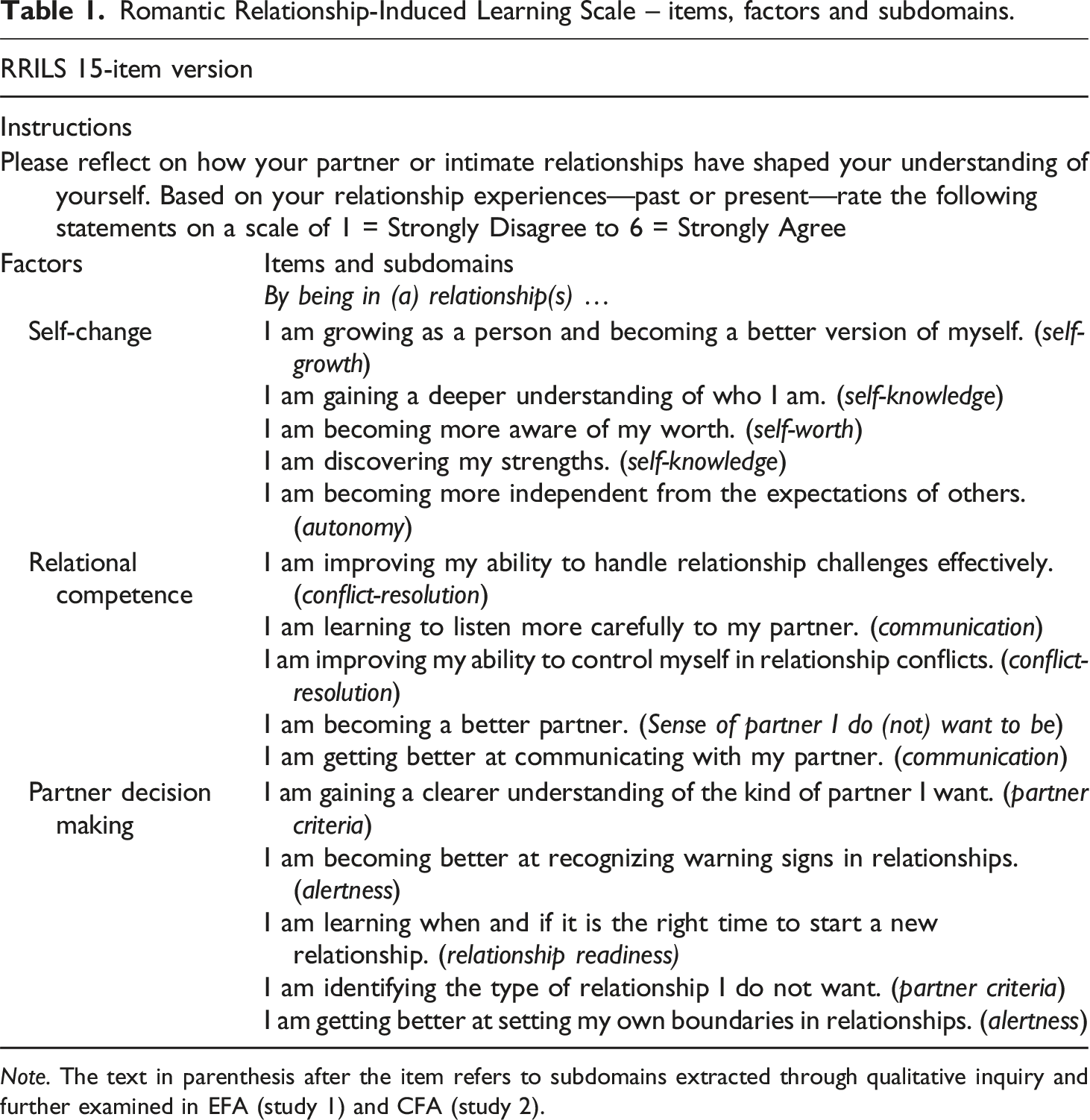
Note. The text in parenthesis after the item refers to subdomains extracted through qualitative inquiry and further examined in EFA (study 1) and CFA (study 2).
Exploratory factor analysis (part II)
The RRILS used in this part consisted of 26 items assessed on a six-point response scale ranging from 1 (strongly disagree) to 6 (strongly agree). Higher values indicate higher romantic relationship-induced learning. The scale is intended to measure three types of learning concerning Self-Change, Relational Competence, and Partner Decision Making.
Methods
Participants and procedure
To examine the factor structure of the RRILS, data were drawn from a subset of young Slovak adults aged 18–30 in the stage of emerging adulthood (N = 785; see Study 2 for sample size justification). The total young adult (YA) sample was randomly split into two roughly equal halves (Supplement B). One subsample (YA1; n = 392) was used for EFA, while the remaining half was reserved for CFA. In the YA1 sample, 82.65% identified as women (n = 324), 15.82% as men (n = 62), and 1.53% (n = 6) preferred not to answer or identified outside of the binary (Mage = 22.55, SD = 2.55). The sample was primarily composed of university students, with most studying humanitarian or social sciences, law, or economics (66.07%, n = 259), followed by students in technical or natural sciences (9.69%, n = 38) and medical or health-related fields (3.32%, n = 13). Employed participants represented 17.86% of the sample (n = 70), while 3.06% were unemployed, on parental leave, or receiving a disability pension (n = 12).
The survey was designed via the Survey Monkey platform, and participants were primarily recruited through university administrators, with additional respondents reached via a snowball sampling method to ensure diversity in age, gender, and occupation. All participants provided written informed consent before enrollment, ensuring that participation was entirely voluntary and confidential. The study received ethical clearance from the Ethics Committees of the Institute for Research in Social Communication of the Slovak Academy of Sciences and the Department of Social Work at Pavol Jozef Šafárik University in Košice.
Results
Exploratory factor analysis
Factor loadings with bias-corrected and accelerated bootstrap 95% CI.
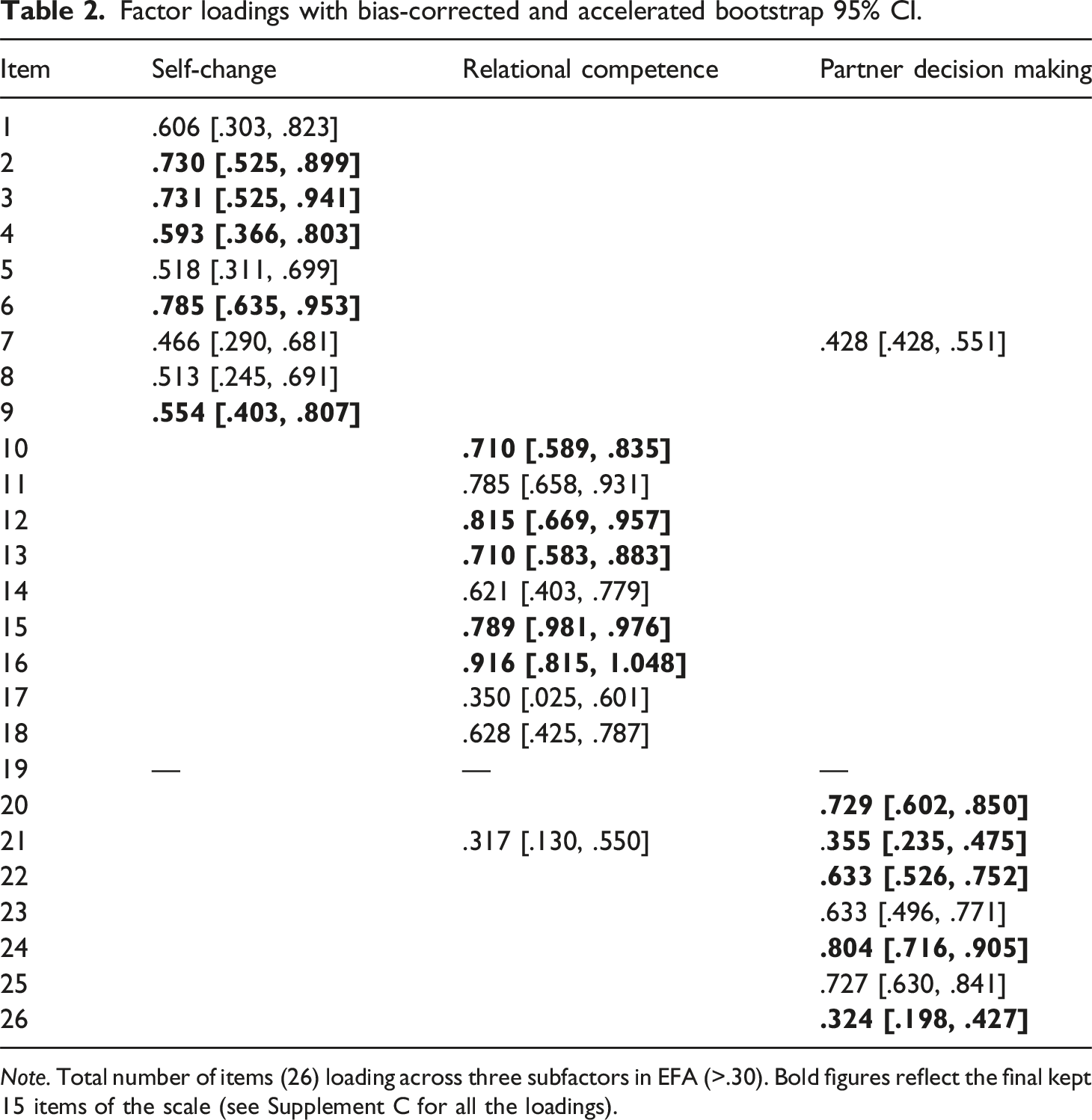
Note. Total number of items (26) loading across three subfactors in EFA (>.30). Bold figures reflect the final kept 15 items of the scale (see Supplement C for all the loadings).
Item selection
The final item selection process incorporated multiple criteria, including statistical performance, conceptual distinctiveness, and scale parsimony. The MSA for all items was greater than .50, indicating that all items effectively measured the same underlying domains. In most cases, items loaded predominantly on their expected dimensions, with no substantial cross-loadings observed. Consistent with our inclusion criteria, we targeted 1–2 items for each qualitatively identified subdomain to ensure comprehensive coverage within the three overarching factors.
From the initial item pool, item 19 was excluded due to insufficient factor loading on its expected factor as well as on any other factor. Additionally, Item 7 was removed because of high cross-loading. In both cases, better alternative items were available within their corresponding factors, rendering these items redundant. Conversely, exceptions were made in two cases. Item 26 was retained despite its lower primary factor loading, and Item 21 was similarly retained despite exhibiting high cross-loadings, while notably exhibiting the narrowest CI compared to other less well-performing items. Both items were deemed theoretically critical for capturing key aspects of partner decision-making and ensuring adequate representation of a subdomain that would otherwise be insufficiently covered, thereby supporting the content validity of this factor.
As preregistered, the initial goal was to reduce the item pool to 12 items to ensure brevity. However, further evaluation highlighted the need to extend the scale to achieve sufficient domain coverage and maintain content validity across the construct’s multidimensional structure. Consequently, we added three more items for a 15-item version scale. This version included five items per factor, i.e., Self-Change, Relational Competence, and Partner Decision Making (see Table 1 for items and subdomain details). QIM further supported the final item structure, with most retained items falling within the 2nd and 3rd quartiles, indicating balanced response patterns. This 15-item version was subsequently employed in Study 2 for CFA, as well as for assessing convergent and discriminant validity.
Discussion
The presented findings of the first study offered an initial empirical support for the construct validity of the RRILS, developed to capture the ways individuals acquire personal and interpersonal positive change through romantic relationships. The construct comprises three interrelated domains: Self-Change, Relational Competence, and Partner Decision Making. These domains align with established theoretical frameworks in social and developmental psychology, which conceptualize romantic relationships as developmental contexts that foster self-expansion, interpersonal skill acquisition, and evolving partner preferences. Results from the EFA supported the proposed three-factor solution, with fit indices indicating an acceptable model. This outcome affirms the multidimensional structure of the scale and is consistent with the theoretical premise that romantic relationships serve as motivators for both intrapersonal transformation and relational learning (Mattingly et al., 2020).
Final item selection was guided by both psychometric indicators and theoretical justification, with deliberate efforts to ensure coverage across all relevant subdomains. Two items were retained despite modest statistical performance due to their conceptual centrality and ability to capture unique dimensions of RRIL not otherwise represented. This approach allowed the scale to reflect both common and under-recognized learning processes that occur through romantic experiences. Their performance was subsequently evaluated in the confirmatory analysis, with the understanding that inadequate performance would warrant their exclusion and further refinement of the factor.
Study 2: Confirmatory factor analysis, reliability, convergent and discriminant validity
The goal of Study 2 was to validate the proposed three-factor structure of the RRILS using the second half of the original sample, young adults (YA2), and a sample from the general (GEN) population that was additionally collected. Furthermore, we assessed the reliability of the three-factor solution and evaluated the similarities and differences of RRILS with conceptually similar relationship scales such as the SEQ and RSS. Study 2 also aimed to investigate the relationship between romantic relationship-induced learning and constructs such as cognitive flexibility and psychological inflexibility, given their relevance to growth-oriented change. As indicated by previous literature (Lezak, 2004; Martin & Rubin, 1995; Morris & Mansell, 2018; Tashiro & Frazier, 2003), cognitive flexibility supports adaptive shifts in thought and behavior and may facilitate relational problem-solving and personal growth. Conversely, psychological inflexibility, characterized by avoidance of emotionally salient experiences and resistance to change, may constrain relational learning (Bond et al., 2011; Meresko et al., 1954; Oreg, 2003).
To establish convergent validity, we hypothesized that the individual factors of the RRILS would show positive associations with related constructs. Specifically, they were expected to correlate positively with the SEQ and the RSS subscales expansion and pruning, with latent correlations anticipated to reach moderate levels. Similarly, positive associations were predicted with the Cognitive Flexibility Scale (CFS), with correlations expected to exceed small-to-moderate magnitudes. In contrast, the RRILS factors were expected to show negative associations with RSS subscales, contraction and adulteration and with constructs reflecting need for closure or psychological inflexibility. We anticipated a small negative correlation with switch costs, and weak to moderate negative correlations with the Need for Cognitive Closure - Short (NFCC-S) and the Acceptance and Action Questionnaire (AAQ-2). These measures were selected based on their conceptual relevance to intrapersonal and relational growth, providing a rigorous test of the RRILS’s validity. Overall, these patterns would provide evidence for the convergent and discriminant validity of the RRILS factors.
In Study 2, for the analyses, we planned to conduct CFA to validate the factor structure identified in Study 1, evaluate subscale reliability, and test measurement invariance across samples and gender. Convergent and discriminant validity was examined by correlating RRILS subscales with related constructs such as self-expansion and relational self-change, including need for closure and cognitive flexibility.
Methods
Participants and procedure
For Study 2, we used the YA2 sample (n = 393) to confirm the factor structure identified in Study 1, alongside a general Slovak adult sample (GEN; n = 456) to strengthen evidence for the RRILS’s factorial validity (Supplement B). In the YA2 group, 81.68% identified as women (n = 321), 17.30% as men (n = 68), and 1.02% (n = 4) preferred not to answer or selected other (Mage = 22.64, SD = 2.85). The majority were university students in humanitarian or social sciences, law, or economics programs (57.51%, n = 226), followed by students in technical or natural sciences (16.28%, n = 64) and medical or health-related fields (1.27%, n = 5). Employed participants comprised 21.12% (n = 83), and 3.82% (n = 15) were unemployed, on parental leave, or receiving a disability pension. Participants in the GEN sample were recruited via a research agency. Recruitment was guided by quotas for age, gender, and education to ensure a more balanced representation, particularly for groups underrepresented in the young adult (YA) sample. The GEN sample included 51.54% women (n = 235), 46.71% men (n = 213), 0.66% selecting neither/preferred not to answer (n = 3), and 1.10% missing gender information (n = 5), with an average age of 38.46 years (SD = 13.61). Education levels were more varied than in the YA samples, with 9.87% completing primary education (n = 45), 53.30% secondary education (n = 243), and 26.54% holding a university degree (n = 109).
To determine the appropriate sample size, we conducted two simulation studies based on the CFA results from YA2, using the lower bound of the 80% confidence interval (CI) for factor loadings and latent correlations. The first simulation (1,000 iterations) showed that at least 200 participants would be sufficient to achieve ≥80% power for detecting the lowest factor loading (.43) and latent correlation (.28). A second simulation (500 iterations per condition) assessed the precision of estimates and indicated that a sample size between 300 and 400 would provide a good balance between power and accuracy (more in Supplement D).
Measures
Relationship-driven changes and learning
We used three self-report methods. First, the newly proposed Romantic Relationship-induced Learning Scale (RRILS). The final version of 15 items (e.g., “By being in (a) romantic relationship/s, I have learned what I don’t want in a relationship”) was rated on a 6-point Likert-type scale (1 = strongly disagree to 6 = strongly agree). Higher values indicate higher romantic relationship-induced learning. The scale measures three factors: Self-Change, Relational Competence, and Partner Decision Making.
Second, the Self-Expansion Questionnaire (SEQ; Lewandowski & Aron, 2002), which consists of 14 items (e.g., “How much has knowing your partner made you a better person?”) rated on a 7-point Likert-type scale (1 = not very much to 7 = very much). Higher values indicate higher self-expansion induced by romantic relationships. The reliability of this measure was α = .90, ω = .91.
Third, the Relational Self Change Scale (RSS; Mattingly et al., 2014), consisting of 12 items (e.g., “I have become more competent and capable”) on a 7-point Likert-type scale (1 = not very much to 7 = very much). RSS measures four factors, i.e., expansion, contraction, pruning, and adulteration. Higher values of expansion and pruning indicate higher levels of positive self-change, whereas higher values of contraction and adulteration indicate higher levels of negative self-change. The reliability of individual factors was α = .62–.75, ω = .62–.75.
Psychological inflexibility
To assess this construct, we used the Acceptance and Action Questionnaire (AAQ-2; Bond et al., 2011). The AAQ-2 consists of 7 items (e.g., “I am afraid of my feelings”) on a 7-point Likert-type scale (1 = strongly disagree to 7 = strongly agree). Higher values indicate lower psychological flexibility. The reliability of this scale was α = .89, ω = .89.
Cognitive flexibility
The 12-item (e.g., “I can communicate an idea in many different ways”) self-report Cognitive Flexibility Scale (CFS) by Martin and Rubin (1995) was used to assess cognitive flexibility on a 6-point Likert-type scale (1 = strongly disagree to 6 = strongly agree). Higher values indicate higher cognitive flexibility. The reliability was satisfactory (α = .78, ω = .78). Additionally, a performance-based task-switching paradigm (Supplement E), specifically the color-shape paradigm, was employed. In this task, participants were presented with stimuli in the form of either a circle or a square. They were required to determine either the shape when the stimulus was filled with color or the color of the frame (red or blue) when only the outline was colored. A total of 128 trials were conducted, consisting of 64 repeating and 64 shifting trials, with a 500 ms break between consecutive trials. Shift cost, calculated as the difference in drift rates between repeating and shifting trials, served as an indicator of cognitive flexibility.
Need for cognitive closure
To assess this construct, we used both the full 41-item version of the Need for Cognitive Closure scale (NFCC; Roets & Van Hiel, 2007; Webster & Kruglanski, 1994) and the short 15-item version of NFCC-S (Roets & Van Hiel, 2011). Items of both scales were rated on a 6-point Likert-type scale (1 = strongly disagree to 6 = strongly agree). Full version consisting of 5 factors: Desire for predictability, Preference for order and structure, Discomfort with ambiguity, Decisiveness, and Closed-mindedness. Higher values indicate a higher need for cognitive closure. The reliability of individual factors ranged significantly across factors (α = .56–.78; ω = .55–.78), while the NFCSS-S displayed adequate reliability (α = .78, ω = .72). Both short and full versions of the NFCC were included, as the short form provides a reliable general index while the full version offers an exploratory look at specific dimensions of need for closure, despite its psychometric limitations (Roets & Van Hiel, 2011).
SEQ, RSS, NFCC, and AAQ were measured on young adults (YA), CF performance tasks on the general population (GEN), and RRILS and CF self-reports were measured on both YA and GEN samples.
Data analysis
CFA tested the proposed structure of RRILS (detailed explanation and descriptive statistics in the Supplement E & F), using robust maximum likelihood estimation to address expected skewness, with FIML used for missing data. The variances of latent variables were fixed to 1 to ensure model identification. Traditional fit indices (CFI & TLI >.90/.95, RMSEA <.08, SRMR <.08), accompanied by dynamic cut-off scores, were used to evaluate the model fit and supported by visual diagnostics (e.g., trace and disturbance-dependence plots). Measurement invariance (MI) across sample and gender was verified. The change in the model was assessed according to the traditional criteria of invariance: ΔCFI ≤.01, ΔRMSEA ≤.015, and ΔSRMR ≤.015 (Chen, 2007). The magnitude of non-invariance was expressed by dMACS. The reliability of scales was assessed by Cronbach’s α and McDonald’s ω. To establish convergent validity, for relationship-driven change and learning scales, we preregistered a latent correlation threshold of .5. For the remaining scales (NFCS(-S), CFS, AAQ-2, and switch cost), a threshold of (−).3 was applied to indicate convergent validity. For discriminant validity, we used CICFA (sys) comparing the (lower) upper 95% CI of latent correlation between two measures against specified thresholds based on Rönkkö and Cho (2022): (a) absolute values of 95% CI < .8 indicate no issues with discriminant validity; (b) values between .8 and .9 suggest marginal issues; (c) values between .9 and 1 indicate moderate issues; and (d) values exceeding 1 indicate severe issues. In cases where marginal issues were previously identified, the χ2 nested model test compares a model with freely estimated latent correlations to one in which the correlations are fixed at ±0.9. For moderate issues, the same procedure is applied, but the threshold is set at ±1. If the χ2 difference test is statistically significant, the current level of discriminant validity is retained; if nonsignificant, the higher threshold is applied. Finally, the heterotrait-monotrait correlation ratio (HTMT2) and its threshold of <0.9 were used to provide evidence for discriminant validity among the measures. Task-switching data were modelled using a hierarchical drift diffusion model.
Results
Factor structure
The hypothesized three-factor structure (Figure 1) fit the data well in the YA2 sample: (scaled χ2 (scaling factor) = 139.21 (1.335), df = 87, p < .001, CFI = .964, TLI = .955, RMSEA = .044, 90% CI [.029, .058], SRMR = .046), as well as in the GEN sample (scaled χ2 (scaling factor) = 192.44 (1.691), df = 87, p < .001, CFI = .957, TLI = .949, RMSEA = .067, 90% CI [.053, .080], SRMR = .048). In the YA2 sample, the model also demonstrated a good fit based on the level-2 dynamic fit index cutoffs, accounting for potential model misspecifications involving two omitted cross-loadings (SRMR = .049, RMSEA = .051, CFI = .955). However, in the GEN sample, the dynamic cutoffs were much stricter (SRMR = .028, RMSEA = .027, CFI = .991). The CFA model of RRILS 15 items (YA2 ample).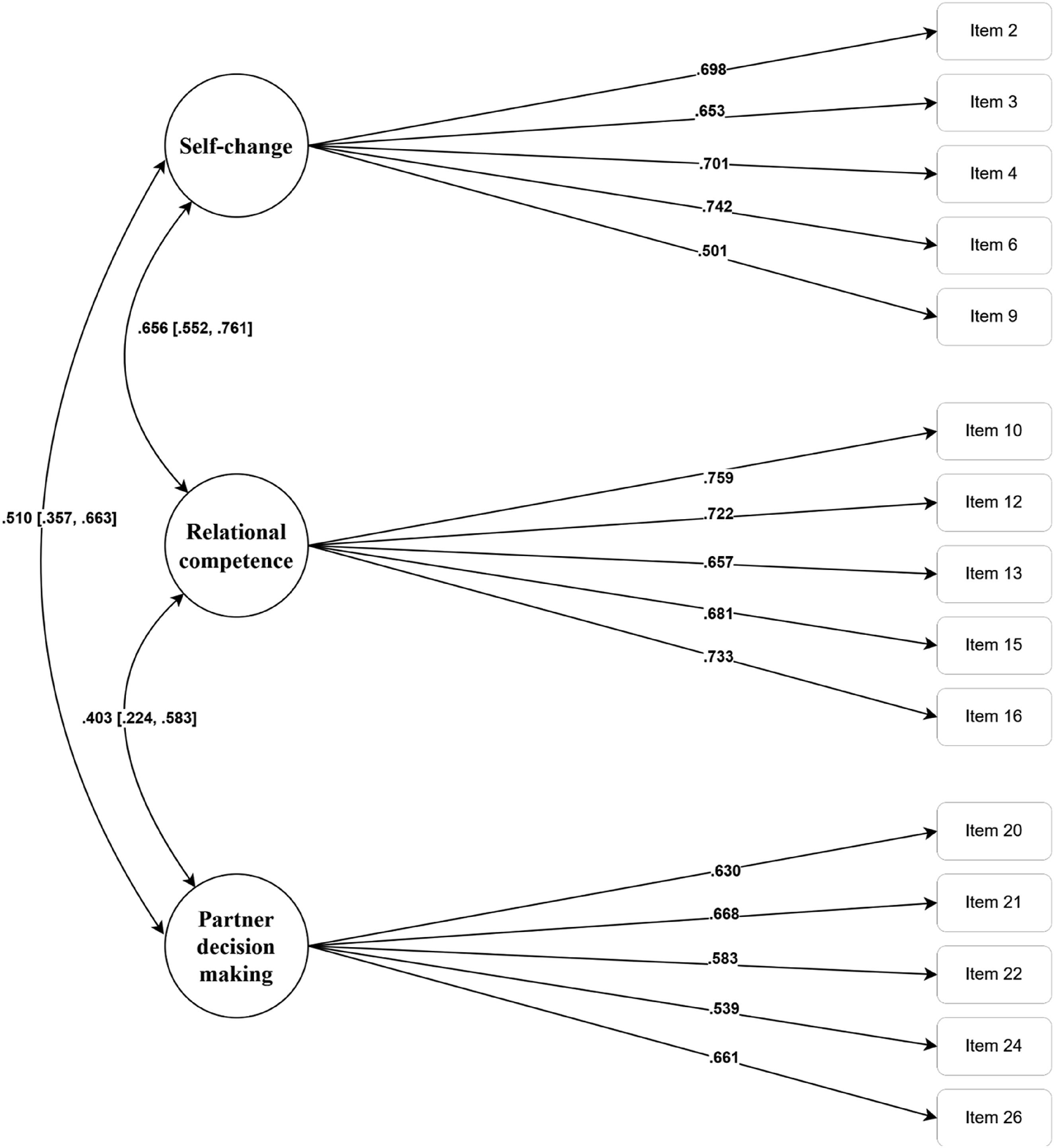
In both samples, the inspection of the residual correlation matrix revealed several discrepancies between the observed and model-implied correlations (|>.10|) (Supplements G & H). The largest residuals were observed between items 2 and 15 in the YA2 sample (rr2.15 = .17) and between items 4 and 26 in the GEN sample (rr4.26 = .14). However, additional visual examination of model fit did not indicate substantial discrepancies (Supplements G & H).
In the GEN sample, all items loaded on their corresponding factors (p < .001) with adequate magnitude (Self-Change: .68–.83; Relational Competence: .78–.84; Partner Decision Making: .60–.79). The latent correlations between factors indicated a strong association, specifically, Self-Change correlated strongly with Relational Competence (r = .85, 95% CI [.78, .93], p < .001) and with Partner Decision Making (r = .75, 95% CI [.65, .86], p < .001). Correlation of similar magnitude was also found in the case of Relational Competence and Partner Decision Making (r = .74, 95% CI [.64, .84], p < .001) (figure for GEN CFA in Supplement G).
Measurement invariance
The results of measurement invariances across samples and gender in both samples.
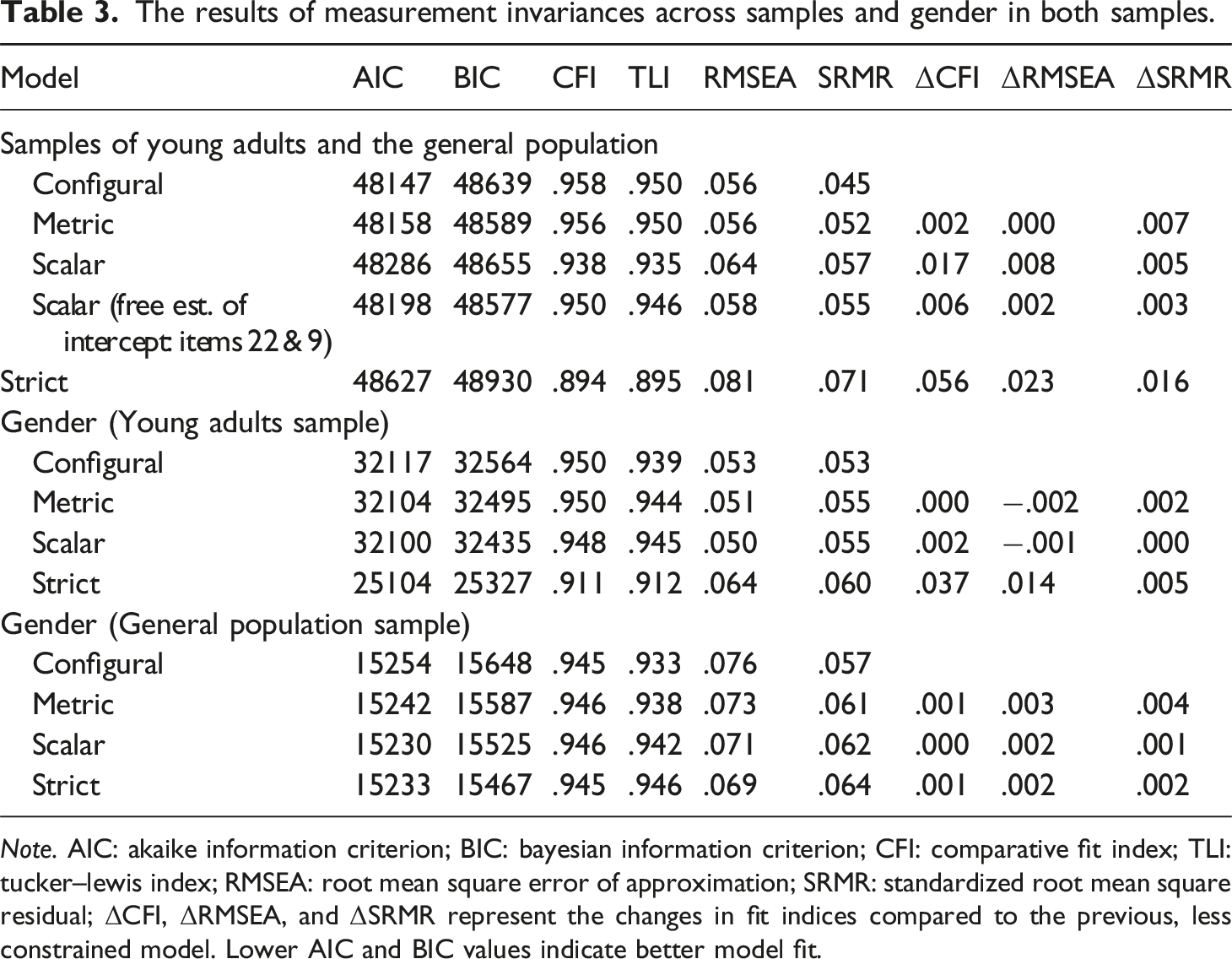
Note. AIC: akaike information criterion; BIC: bayesian information criterion; CFI: comparative fit index; TLI: tucker–lewis index; RMSEA: root mean square error of approximation; SRMR: standardized root mean square residual; ΔCFI, ΔRMSEA, and ΔSRMR represent the changes in fit indices compared to the previous, less constrained model. Lower AIC and BIC values indicate better model fit.
Partial MI was established across samples, with scalar-level non-invariance identified. After sequentially freeing the intercepts for individual items, we found that differences in intercepts were most prominent in Item 22 (YA: est. = 3.97, SE = .05; GEN: est. = 4.47, SE = .06) and Item 9 (YA: est. = 4.22, SE = .05; GEN: est. = 4.64, SE = .06). The dMACS values of 0.36 and 0.33 indicated a moderate level of non-invariance. After freeing the intercepts for these two items, partial scalar invariance was achieved, though strict invariance was not attained.
Reliability
The reliability of individual RRILS factors was adequate in both samples, i.e. young adults and the general population. Specifically, for Self-Change it was ωya = .78 αya = .78; ωgen = .88, αgen = .88. For Relational Competence it was ωya = .83, αya = .83; ωgen = .90, αgen = .90; and for Partner Decision Making it was ωya = .75, αya = .75; ωgen = .83, αgen = .83 (item-wise details in Supplement I & J).
Convergent validity
Latent correlation of individual RRILS factors with validation measures.
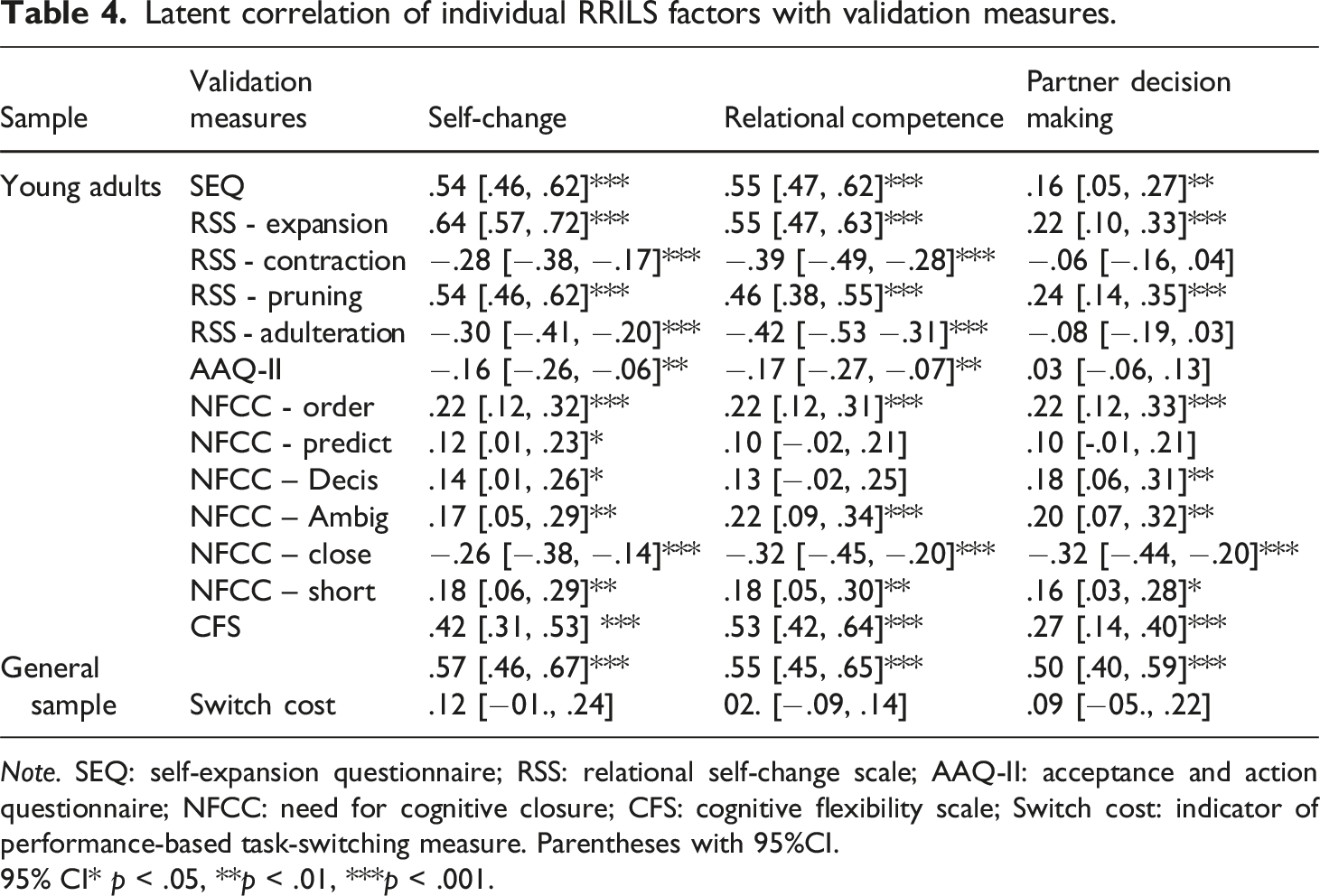
Note. SEQ: self-expansion questionnaire; RSS: relational self-change scale; AAQ-II: acceptance and action questionnaire; NFCC: need for cognitive closure; CFS: cognitive flexibility scale; Switch cost: indicator of performance-based task-switching measure. Parentheses with 95%CI.
95% CI* p < .05, **p < .01, ***p < .001.
We observed moderate to strong correlations between the Self-Change and Relational Competence factors and conceptually related scales. Both Self-Change and Relational Competence exceeded the pre-registered threshold of .50 in their associations with SEQ, Expansion, and Pruning, supporting the establishment of convergent validity, though the Relational Competence factor fell slightly below this threshold (.46) in one instance. In contrast, the Partner Decision Making factor showed relatively weak correlations with validation criteria, providing less robust evidence for convergent validity. With respect to measures assessing the need for closure and psychological inflexibility, predominantly, weak correlations were observed. Among those, the Closed-mindedness factor of NFCC was found to have the closest association with RRILS factors.
Regarding cognitive flexibility, moderate associations were observed between RRILS factors and the CFS scale exceeding the preregistered .3 threshold, except for Partner Decision Making, which fell slightly below this threshold (.27) in the YA sample. However, in the GEN sample, the association between Partner Decision Making and CFS was moderate, as in the case of Self-Change and Relational Competence. In contrast, the relationships with performance-based measures of cognitive flexibility were negligible across all three factors. Here, the negligible correlations with a performance-based cognitive flexibility task and RRILS highlight the discrepancy often found between self-report and performance-based measures (Howlett et al., 2023).
Discriminant validity
CIcfa approach
In the YA2 sample, we did not identify any issues with discriminant validity, as none of the upper (or lower) 95% CI crossed the threshold of (−).8.
In the GEN sample, the upper bound of the 95% CI for the latent correlations between RRILS factors and cognitive flexibility assessment methods remained below the .80 threshold in all instances, indicating no concerns with discriminant validity in these comparisons. However, this was not the case for intercorrelations among individual RRILS factors. The threshold was exceeded for the correlations between Self-Change and Relational Competence (.93), Self-Change and Partner Decision Making (.86), and Relational Competence and Partner Decision Making (.84). The correlation between Self-Change and Relational Competence suggests a moderate issue with discriminant validity, while the other two pairs indicate marginal concerns.
χ2 nested model test
In the GEN sample, we followed up the CIcfa approach by comparing the baseline model with nested models, in which latent correlations were fixed to predetermined values. First, the correlation between Self-Change and Relational Competence was fixed at 1. The issue with a non-positive covariance matrix of latent variables emerged, and thus, we could not proceed with the χ2 nested model test. Based on the findings from the previous approach, we assumed a moderate issue with discriminant validity between these two factors.
Next, we fixed the latent correlation between Self-Change and Partner Decision Making, as well as between Relational Competence and Partner Decision Making, to .90, each tested in separate models. For the Relational Competence, Partner Decision Making pair, the χ2 difference test was statistically significant (Δχ2 = 14.03, p = < .001), supporting the presence of a marginal issue with discriminant validity that is unlikely to compromise scale interpretability (Rönkkö & Cho, 2022). In contrast, the χ2 test for the Self-Change–Partner Decision Making pair was not statistically significant (Δχ2 = 1.72, p = .189), prompting us to test a stricter correlation constraint of 1 between these two factors. In this scenario, the chi-square difference test yielded a significant result (Δχ2 = 409.38, p < .001), indicating a moderate discriminant validity issue between Self-Change and Partner Decision Making. In response to emerging empirical indications of discriminant validity issues, we tested several alternative factor structures, including a one-factor model, a two-factor model (combining Self-Change and Relational Competence into a single factor as suggested by parallel analysis within EFA examination), and a bifactor model (Supplements G, H & K for details).
Heterotrait-monotrait ration of the correlations (HTMT 2)
In both samples, the HTMT2 criterion threshold of .90 was never exceeded (Supplement L), providing evidence regarding the measures’ distinctiveness. However, it provides the weakest evidence for discriminant validity among the approaches used (Rönkkö & Cho, 2022).
Discussion
The hypothesized three-factor structure of the RRILS was supported in both young adult and general population samples, confirming its theoretical and factorial validity. The model fit was acceptable based on traditional indices across both samples. However, while the factor structure in the YA2 sample remained robust against dynamic cutoffs, the GEN sample did not meet the stricter dynamic thresholds. Importantly, all items loaded significantly onto their intended factors with adequate magnitude (>.40). The latent factor intercorrelations suggested moderate to strong associations among the three factors, supporting the conceptual coherence of the scale structure.
In both samples, some item pairs showed residual correlations, likely due to similar wording or content. However, since these were inconsistent across samples and overall model fit was acceptable, we chose not to model them to maintain model parsimony and cross-sample generalizability. Moreover, while the proposed three-factor structure demonstrated a reasonable fit overall, potential overlap among the underlying RRILS factors emerged, indicating marginal to moderate issues with discriminant validity within the GEN sample. In response, we explored three alternative factor structures. First, we tested a one-factor model and a two-factor model. Neither model provided an adequate fit in either sample, leading us to reject these alternatives. In contrast, the bifactor model, comprising one general factor and three specific factors, demonstrated good fit across both samples and outperformed the proposed three-factor solution in terms of statistical model fit. However, we ultimately chose not to adopt the bifactor structure. Although such models often show superior statistical performance, best practices caution against relying solely on fit indices without a strong theoretical rationale (Li & Savalei, 2025). In our analyses, the interpretability of the bifactor solution was further limited by inconsistencies in the magnitude and pattern of factor loadings across the general and specific factors, making the interpretation of this structure more difficult. In contrast, the three-factor correlated model demonstrated stable, interpretable loadings across samples and aligned more closely with the theoretical framework of the RRILS. Given its clearer theoretical grounding, conceptual coherence, replicability, and parsimony, we retained the three-factor correlated model as the most appropriate representation of the construct, while acknowledging that future research may further explore the potential utility of a bifactor approach.
Regarding reliability, the three RRILS factors demonstrated good internal consistency across samples. Validity analyses further substantiated the construct: Self-Change and Relational Competence correlated moderately to strongly with related constructs such as self-expansion and relational pruning, offering support for convergent validity. Partner Decision Making showed lower associations with the validation criteria, indicating that it may represent a distinct and less commonly measured aspect within the broader RRIL framework.
General discussion
This empirical article introduced a novel self-report measure designed to capture romantic relationship–induced learning, created to address the gap in psychometrically sound tools in this area. The development of the RRILS stems from drawing on qualitative and quantitative methodologies. Initial qualitative findings informed the expectation of three broad domains of the romantic relationship-induced learning scale, which were then empirically tested in the present study. The results provided evidence for a three-factor structure, each with adequate reliability, validating the existence of romantic relationship-induced learning as a construct.
The conceptual foundation of RRILS includes key dimensions such as Self-Change, Relational Competence, and Partner Decision Making within romantic relationships. The findings revealed moderate correlations between individual RRILS factors and the Self-Expansion Questionnaire, particularly for Self-Change and Relational Competence, suggesting conceptual overlap with constructs related to self-growth, personal development, and expansion (Aron et al., 1995). However, the Partner Decision Making factor stood out as measuring a more distinct aspect of relational Self-Change—one that appears less represented in existing tools like the SEQ. While the present research supports the overall validity and reliability of the RRILS, the Partner Decision Making factor warrants further attention. Its distinctiveness reflects a gap in existing measures, which often overlook how partner decision-making is learned through relationships. Future research should employ established tools (e.g., Vennum & Fincham, 2011) to better assess this construct, focusing on relationship-induced change.
The study also examined the relationship between romantic relationship-induced learning and cognitive flexibility, given their shared basis in openness to experience and growth through relational contexts. Consistent with prior research (Lezak, 2004; Morris & Mansell, 2018), individuals with higher RRIL showed greater ability to adapt their thoughts and behaviors in response to an experience. This supports the idea that RRIL reflects an adaptive orientation toward change from motivationally relevant experiences (Bond et al., 2011). Conversely, lower RRIL may signal experiential avoidance, which hinders relational growth (Cools & Robbins, 2004; Kruglanski et al., 1993). With this in mind, we suggest that learning through relationships naturally involves elements of cognitive flexibility. In other words, individuals with greater cognitive flexibility may be more inclined to adapt their thinking and perspectives, allowing them to learn and benefit more from romantic relationship experiences.
In both samples, we established measurement invariance across gender, indicating that the construct of RRIL is comparable between men and women. However, the gender imbalance remains a limitation, as it may have influenced response patterns and warrants further investigation in more gender-balanced samples.
When testing for invariance across samples, we achieved partial invariance due to scalar-level differences in two items. Concerning awareness of whether and when to start a new relationship (Item 22), the general adult sample showed a higher intercept, i.e. on average, adults scored higher compared to the young adults. This likely reflects developmental differences, as individuals beyond emerging adulthood (YA sample), typically marked by identity exploration and relational experimentation (Arnett, 2023; Erikson, 1968; Shulman, 2017), tend to have more stable relational goals shaped by experiences such as long-term commitment, separation, or divorce. Their responses may also reflect life-stage constraints and social norms related to settling down or re-partnering. Moreover, the general adult sample showed a higher intercept for autonomy from others’ expectations (Item 9). This is consistent with developmental theory, which suggests that autonomy increases with age as individuals move toward identity consolidation and become less influenced by external approval (Erikson, 1963; Konstam, 2007).
The RRILS demonstrated the ability to distinguish between different types of learning induced by romantic experiences, such as identity exploration and dyadic competencies like conflict resolution and communication. Furthermore, due to distinct types of learning, we also assume that RRILS has the potential of capturing how individuals learn from diverse relationship types, including casual dating, long-term commitment, and breakups. This sensitivity to relational context reflects growing recognition that casual and noncommittal experiences also contribute to sexual identity development and partner selection (Beckmeyer & Jamison, 2021; Jamison & Sanner, 2021). While the differences in subfactor scores across relationship statuses (e.g., single, committed, married) are not the focus of our study, future research could explore whether and how different types of relationships shape learning outcomes.
The RRILS was developed and tested in Slovak, making it context-sensitive to a Central–Eastern European (CEE) setting. While many Slovak romantic norms converge with Western models, relationship-induced learning is shaped by a CEE-specific negotiation between more conservative (often religious) values and increasingly individualistic aims of self-fulfilment (Kallová, 2025a; Lukšík et al., 2023; Lukšík & Guillaume, 2018, 2022). This duality can influence what is learned (e.g., boundary-setting, partner discernment), and which changes are seen as desirable or legitimate (e.g., prioritising commitment and family roles versus personal autonomy) (Kus Ambrož et al., 2021; Lukšík & Guillaume, 2022). Consequently, some RRIL domains may be more or less salient across cultures, and item interpretations may vary with local gender norms, religiosity, and family expectations, placing limits on immediate generalizability despite broad overlap with Western patterns.
Taken together, these considerations support the scale’s likely relevance in many Western or English-speaking populations while also motivating explicit cross-cultural work. Accordingly, future research should test the RRILS in additional languages and contexts and extend validity evidence via test-retest, predictive and criterion testing, and longitudinal designs. In addition, future work should examine RRILS performance in underrepresented groups not explicitly captured by our questionnaires (e.g., people with disabilities; transgender and gender-diverse people; LGBTQIA+ subgroups), using targeted sampling and measurement-invariance analyses to ensure coverage and interpretability across diverse populations.
The study of romantic relationship-induced learning informs research on how individuals develop through relational experience. It contributes to ongoing debates about whether stable, well-functioning partnerships (Lee et al., 2018) or more dynamic and adverse relationship trajectories (Blackie & McLean, 2022; Shulman & Yonatan-Leus, 2024; Tashiro & Frazier, 2003) provide richer opportunities for growth (Kallová, 2025b). RRIL also raises fundamental questions about how relational knowledge and skills are formed—specifically, whether having a first-hand relational experience plays an irreplaceable role, or whether learning through observation and modelling can be equally effective. Additionally, it invites the examination of whether it is relational exposure, in terms of the quantity of experiences, or the quality of those experiences that better promotes development. This includes contrasting development fostered by emotionally steady, secure relationships with that arising from more “rollercoaster”-like, emotionally charged encounters marked by greater variability, intensity, or existential significance. Beyond its theoretical relevance, RRIL research can inform relationship education and interventions by identifying which types of learning promote relational well-being and how they can be supported.
Conclusion
The RRILS is a theoretically and empirically grounded tool for capturing how individuals learn from romantic and intimate experiences. The scale encompasses three distinct factors and moves beyond existing measures focused on intrapersonal growth or post-traumatic change by incorporating relational changes benefiting future relationship functioning. The measure demonstrated reliability and validity across gender and age groups. By introducing the unifying construct of romantic relationship-induced learning, RRILS bridges gaps between previously fragmented conceptual frameworks and expands the scope of existing measures as learning contexts.
Supplemental Material
Supplemental Material - Learning through romantic experiences: Development and validation of a new measure
Supplemental Material for Learning through romantic experiences: Development and validation of a new measure by Nikola Kallova, Tomas Prosek, Sadia Zaman in Journal of Social and Personal Relationships
Footnotes
Acknowledgements
Our thanks go to the other team members, Vladimir Lichner, Magdalena Hovanova, Dominik Maximov, and Antonia Sabolova Fabianova, for their help in the project and recruiting participants. Special thanks go to our intern Martin Muransky for his feedback during the instrument’s design and at various stages of the research and data collection.
Declaration of conflicting interests
The authors declared no potential conflicts of interest with respect to the research, authorship, and/or publication of this article.
Funding
The authors disclosed receipt of the following financial support for the research, authorship, and/or publication of this article: This work was supported by the Grant VEGA 2/0173/24 awarded by the Scientific Grant Agency of the Ministry of Education of the Slovak Republic and the Slovak Academy of Sciences.
Open research statement
As part of IARR’s encouragement of open research practices, the authors have provided the following information: This research was pre-registered. The aspects of the research that were pre-registered were: hypotheses, design plan, sampling plan, variables, and analysis plan. The registration was submitted to: Open Science Framework (OSF): https://osf.io/bq3x9 and https://osf.io/bdtcm. The data used in the research are available. The data can be obtained at:  . The additional research materials can be obtained by emailing:
Ethical consideration
This research was approved by the Ethics Committee of the Institute for Research in Social Communication of the Slovak Academy of Sciences and by the Ethics Committee of the Department of Social Work of the Pavol Jozef Safarik University in Košice. Each participant gave written informed consent before data collection.
Supplemental material
Supplemental material for this article is available online.
References
Supplementary Material
Please find the following supplemental material available below.
For Open Access articles published under a Creative Commons License, all supplemental material carries the same license as the article it is associated with.
For non-Open Access articles published, all supplemental material carries a non-exclusive license, and permission requests for re-use of supplemental material or any part of supplemental material shall be sent directly to the copyright owner as specified in the copyright notice associated with the article.
