






Abstract
Research shows peer networks are crucial in early adolescence, but few studies have examined their structural heterogeneity, links with personality, and mental health implications. This study identified latent profiles of peer network structures among Chinese adolescents and examined their associations with personality and mental health. Data were collected from 340 junior high school students (50% female) across four waves. Latent profile analysis (LPA) was employed using a set of network indicators: indegree, outdegree, centrality, density, and reciprocity. Three distinct profiles emerged in early adolescence: restricted networks (50%; low across indicators), clique-like networks (12.5%; low indegree/outdegree, high density/reciprocity), and extensive networks (37.5%; high indegree/outdegree, low density and moderate reciprocity). Adolescents in extensive networks reported the highest levels of perceived social support and the lowest levels of depressive symptoms contemporaneously, whereas those in clique-like networks showed no similar benefit. Specific personality traits were found to predict profile membership. These findings highlight the heterogeneity of adolescent peer networks and provide a framework for understanding social influences in early adolescence, with implications for mental health interventions.
Introduction
Early adolescence constitutes a critical developmental period characterized by significant neural, cognitive, and social transformations (Blakemore & Mills, 2014; Dahl, 2004). During this phase, young adolescents exhibit a heightened orientation toward their peers and an increased sensitivity to social feedback (Somerville, 2013), which coincides with a rising vulnerability to internalizing difficulties such as depression and anxiety (Zheng & Zheng, 2025). Within this context, peer relationships emerge as paramount, functioning as dual-faceted forces that can profoundly shape developmental trajectories. They can serve as crucial sources of social support and positive development (Rubin et al., 2015), yet also pose potential risks for psychological maladjustment through processes like rejection or conflict (Prinstein & Giletta, 2016). Consequently, gaining a precise and nuanced understanding of the structure and quality of peer interactions during this sensitive window is essential for fostering healthy outcomes.
Significant advances in understanding adolescent peer networks have been achieved through the application of social network analysis (SNA) methods, particularly those grounded in theories of social capital (Coleman, 1988) and homophily (McPherson et al., 2001), which provide frameworks for understanding why certain network structures emerge. The development of statistical models for sociometric networks (complete networks), such as exponential random graph models (ERGMs) and stochastic actor-oriented models (SAOMs), have emerged as established approaches for examining the complex structure of peer relationships (Snijders et al., 2010; Veenstra et al., 2013). A key strength of these methods is their capacity to model the inherent interdependencies among network ties, thereby addressing the limitation of treating relationships as independent observations. These approaches have been instrumental in identifying fundamental social mechanisms underlying network formation and evolution, including reciprocity, transitivity, and homophily (Knecht et al., 2010; Lusher et al., 2013). Consequently, this body of work provides a framework for understanding how macro-level network structures arise from micro-level social processes.
Research using sociometric network analysis has consistently identified specific structural characteristics that are consequential for adolescent development. Extensive studies within bounded peer networks have established that social integration (e.g., Kamis & Copeland, 2020) and network density (Okamoto et al., 2011) are associated with lower levels of depressive symptoms, while social isolation carries significant risk (Umberson et al., 2022). Furthermore, the reciprocity of ties serves as a foundation for reliable social support (Espelage et al., 2007). Beyond static features, the principle that depressive symptoms can spread through network connections (social contagion; Van Zalk et al., 2010) underscores the profound importance of one’s position and connections within the broader peer microstructure. This body of work firmly establishes that an individual’s position within the sociometric structure of their peer group is a powerful determinant of mental health. Consequently, the network metrics that capture these dimensions are established as critical indicators for understanding adolescent social functioning, such as indegree (social preference), outdegree (social initiative), degree (overall connectedness), density (peer cohesion), and reciprocity (relationship stability).
While sociometric studies have established the importance of these individual network metrics, their primary goal is to explain the global structure and relational dynamics of the bounded peer network. A complementary line of inquiry shifts the analytical focus to the adolescent’s personal network as a multidimensional configuration. This distinction stems from a fundamental difference in analytical emphasis: whereas sociometric approaches are designed to elucidate relational dynamics within complete networks, a complementary approach is to examine how multiple network characteristics combine to form distinct individual configurations. Ecological systems theory (Bronfenbrenner, 1979) underscores the importance of studying an individual’s immediate environments, or microsystems, and the interconnections within them. The peer network constitutes such a critical microsystem during adolescence, and its multifaceted structure forms an integrated context for development. While our study focuses specifically on the peer microsystem, this systemic perspective remains highly relevant. It is particularly pertinent during early adolescence, when youth undergo significant social network reorganization during the transition to secondary school (Eccles & Roeser, 2009). As such, the sociometric approach, with its primary focus on bounded networks and relational mechanisms, is not designed to directly model an adolescent’s personal network as a multidimensional configuration. To address this gap, a person-centered approach that can capture how multiple egocentric network characteristics interact and co-occur to form distinct, emergent profiles is needed. This leads to the central research question addressed in this study: What distinct types of egocentric network structures arise during this developmental period, and how are these multidimensional profiles associated with variations in psychosocial adaptation?
To answer this question, the present study adopts a person-centered analytical framework, employing latent profile analysis (LPA). We conceptualize the heterogeneity of peer networks as the existence of qualitatively distinct subgroups of adolescents (latent profiles), where each subgroup is defined by a unique pattern across multiple key egocentric network metrics. The LPA incorporates five key dimensions derived from the established literature: indegree (number of received friendship nominations, reflecting social preference), outdegree (number of sent nominations, reflecting social initiative), centrality (one’s integration within the local network), density (interconnectedness of one’s friends, capturing cohesion), and reciprocity (proportion of mutual ties, indicating stable, high-quality relationships). LPA is a statistical method that classifies individuals into homogeneous subgroups based on their patterns across multiple continuous variables, thereby capturing how various network characteristics co-occur within individuals (Wu et al., 2019). This method offers several advantages for the study of peer networks. First, it can reveal compensatory or synergistic relationships among network features that might be obscured in variable-centered analyses. Second, it enables the identification of naturally occurring configurations of structural indicators such as centrality, density, and reciprocity. Third, it preserves the ecological complexity of network systems while facilitating systematic comparisons of mental health outcomes across different network profiles. By applying this person-centered approach to egocentric network data, this study aims to identify meaningful typologies of adolescent peer networks and their associations with psychosocial functioning.
Grounded in the principles of trait activation theory (Tett & Guterman, 2000), which posits that personality traits influence how individuals perceive and shape their social environments, identifying distinct network profiles raises a critical subsequent question: what factors predict an adolescent’s likelihood of belonging to one profile over another? Personality traits, as stable predispositions that systematically guide social behavior, are theoretically compelling antecedents to network positioning. Grounded in the five-factor model (Costa & McCrae, 1992), traits such as extraversion (sociability) and agreeableness (interpersonal warmth) may facilitate integration into more adaptive, well-connected networks, whereas neuroticism (emotional instability) may predispose youth to more isolated or conflictual social configurations (Selden & Goodie, 2018; Selfhout et al., 2010). By examining how these fundamental personality dimensions predict membership in the empirically derived network profiles, this study aims to illuminate the personal determinants of social network structure. This approach moves beyond describing network types to explaining their formation, thereby addressing a key gap in understanding the origins of peer network heterogeneity and its implications for adolescent development.
The present study
This study employs latent profile analysis (LPA) to investigate the heterogeneity of egocentric peer network structures in early adolescence. LPA is a person-centered, model-based approach that allows for the identification of unobserved subgroups (latent profiles) within a population based on their pattern of responses across a set of continuous indicator variables (here, the five network metrics). This method is ideally suited to our research aim as it moves beyond variable-centered analyses to capture how multiple network characteristics coalesce into holistic social configurations at the individual level. The following research questions were formulated: What distinct latent profiles of egocentric peer network structure (as defined by indegree, outdegree, reciprocity, density, and centrality) can be identified among Chinese early adolescents (RQ1)? How do Big Five personality traits predict membership in the identified network profiles (RQ2)? How do the identified network profiles differ in terms of concurrent levels of (a) perceived social support and (b) depressive symptoms (RQ3)? While the primary focus is on establishing these core cross-sectional relationships (addressing RQ1–RQ3), the longitudinal design, with data collected at four time points, allows for a preliminary assessment of the stability of the derived profiles over the academic year. This longitudinal perspective provides a crucial foundation for interpreting the profiles as meaningful configurations rather than transient states.
Materials and methods
Sample and procedure
This study employed a convenience sample of 340 first-grade junior high school students (typically aged 12–13 years) from eight administrative classes in a public junior high school in Beijing, China. Data collection occurred during regular class sessions in the fall semester of 2023 through paper questionnaires administered by researchers with the assistance of teachers from each class. All participants and their legal guardians provided written informed consent after receiving full disclosure about the study’s academic purpose, data confidentiality protocols, and voluntary participation rights. This study was approved by the committee of the authors’ institute. The sample’s descriptive demographic characteristics, collected via self-report, included sex (50.2% female at baseline), only-child status (53.0% were only children), ethnic minority status (88.7% Han, 11.3% from ethnic minority groups), and family structure (92.8% from intact two-parent families). Parental education levels were also recorded (e.g., 66.5% of fathers and 65.9% of mothers had a junior college education or above). Data on several other demographic variables specified in journal reporting guidelines (e.g., detailed racial/ethnic categorization, sexual orientation, disability status, or household income) were not collected in this study.
Data collection was conducted across four waves over a six-month period, with 1–3-month intervals between assessments. At baseline (T1), questionnaires were completed by 295 students (50.2% female). Follow-up data were obtained from 306 students (49.5% female) at 9 weeks (T2), 286 students (50.7% female) at fourteen weeks (T3), and 297 students (52.4% female) at twenty weeks (T4). Absences resulted from sick leave, personal leave, school transfers, and new enrollments. Individuals who missed one or more surveys but received friendship nominations were retained in the network analysis, maintaining the complete sample of 340 adolescents for structural examination. An attrition analysis was conducted to compare participants who completed all four waves with those who missed one or more assessments. The results indicated no significant differences in key study variables, including perceived social support (t = 1.335, p = .183) and depressive symptoms (t = −1.042, p = .330), suggesting that attrition was not systematic with respect to these measures.
Measures
The questionnaires included demographic data (not analyzed further due to distributional concerns and the pursuit of model parsimony), peer network nominations and psychological assessments of perceived social support, depressive symptoms, and personality traits.
Peer network structures
Data on peer networks were collected at Wave 1 through sociometric friendship nominations within bounded administrative classes. Using a free-recall method, participants nominated up to eight classmates they considered friends by writing each nominee’s full name. This fixed-choice approach was adopted to reduce cognitive burden and to elicit nominations for core, affectively salient friendships, based on pilot observations that unrestricted nominations could lead to indiscriminate selection. From this complete network of each classroom, egocentric networks were extracted for each participant for the Latent Profile Analysis (LPA). Subsequently, five egocentric network parameters were calculated from these nominations: (1) Outdegree: The raw count of friendship nominations sent by the participant (range: 0–8). (2) Indegree: The raw count of friendship nominations received by the participant from peers within the same class. (3) Degree: The total number of connections, calculated as the sum of indegree and outdegree. This metric captures the overall volume of social activity and connectedness. (4) Density: This was calculated specifically for the participant’s egocentric network. It is the proportion of actual directed ties that exist among the participant’s nominated friends (alters) to all possible directed ties among those alters. For a participant with k alters, the number of possible directed ties is k(k-1). Density measures the cohesion within one’s immediate friend group. (5) Reciprocity: The proportion of a participant’s total connections that were mutual. It was calculated as the number of reciprocal (mutual) ties divided by the participant’s total degree. If a participant’s degree was zero, reciprocity was defined as 0.
Perceived social support
Perceived social support was assessed using the Chinese version of the Multidimensional Perceived Social Support Scale (PSSS) (Zhou et al., 2015). This 12-item scale measures support from three sources, namely, family, friends, and teachers, with the original “significant others” subscale adapted to reflect the school context. The participants rated statements such as “When I have a problem, some people (family, classmates, teachers, etc.) will appear next to me” on a 7-point Likert scale ranging from 1 (strongly disagree) to 7 (strongly agree). Subscale scores were calculated for family, peer, and teacher support, with higher scores indicating stronger perceived support. The internal consistency across waves was satisfactory (Cronbach’s α = 0.865–0.915).
Depressive symptoms
The brief form of the Center for Epidemiological Studies Depression Scale (CES-D), a ten-item self-report measure, was used to assess adolescents’ depressive symptoms during the past week at each time point (Yang et al., 2018). Each item of the brief CES-D was rated on a four-point Likert scale ranging from 0 (rarely: less than once per day) to 3 (most or all the time; 5–7 days), with higher scores indicating higher levels of depressive symptoms. In the current study, the Cronbach’s α coefficients of the brief CES-D ranged from 0.709 to 0.865 for all waves.
Personality traits
Personality traits were assessed using the Chinese Big Five Personality Inventory (CBF-PI), which measures five core dimensions: neuroticism, conscientiousness, agreeableness, openness, and extraversion. Each dimension was evaluated through two items rated on a five-point Likert scale ranging from 1 (strongly disagree) to 5 (strongly agree). Representative items include “I am prone to nervousness” (neuroticism), “I am meticulous and conscientious in the things I do” (conscientiousness), “I usually trust others” (agreeableness), “I have a vivid imagination” (openness), and “I consider myself outgoing and good at socializing” (extraversion).
Analytic strategy
Descriptive analyses were conducted using SPSS 25.0. The primary analyses, comprising LPA and subsequent association tests, was performed in Mplus version 8.3 (Muthén & Muthén, 1998–2017). The analyses in Mplus utilized the robust full information maximum likelihood (FIML) estimator, which handles missing data under the missing at random (MAR) assumption by including all available data from each participant. The LPA was employed to identify homogeneous subgroups of adolescents based on their profiles across five continuous egocentric network indicators: outdegree, indegree, degree centrality, reciprocity, and density. To determine the optimal number of latent profiles, models specifying one through five profiles were estimated and compared using a comprehensive set of indices. These indices included the Akaike Information Criterion (AIC), Bayesian Information Criterion (BIC), sample-size adjusted BIC (SABIC), the Lo-Mendell-Rubin adjusted likelihood ratio test (LMR-LRT), and entropy. Lower values on the AIC, BIC, and SABIC indicate better fit, a significant LMR-LRT p-value suggests a model with k profiles fits significantly better than a model with k-1 profiles, and entropy values closer to 1.0 reflect clearer classification. Model stability was confirmed by replicating the loglikelihood values across multiple sets of random starting values. After identifying the optimal model, the manual three-step method (BCH; Bakk & Kuha, 2018) within Mplus was used to examine associations between latent profile membership and distal outcomes (depressive symptoms, perceived social support), accounting for classification uncertainty. Finally, the same BCH method was employed to assess how personality traits predicted profile membership.
Results
Descriptive statistics
Descriptive statistics of sample characteristics and key study variables.

Correlations among network structural features, personality traits, and mental health outcomes (N = 340).

Note. *p < .05, **p < .01, ***p < .001.
Latent profiles of peer network structures
Model fit indices of latent profile analysis and distribution rate of peer network structures (N = 340).

Note. C = number of classes; LL = log-likelihood; AIC = Akaike Information Criterion; BIC = Bayesian information criterion; SABIC = sample-size adjusted BIC; Adjusted LMR–LRT = adjusted Lo‒Mendell‒Rubin likelihood ratio test; p = p value; Bolded values indicate the selected models.
Means and standard deviations for the three-profile model (N = 340).

Note. M: mean; SD: standard deviation.
Profile 2 accounted for 12.5% of the sample, exhibiting low outdegree (M = 2.39), indegree (M = 2.45), and degree centrality (M = 4.84) but elevated reciprocity (M = 0.84) and density (M = 0.76) scores. While outdegree was slightly elevated relative to Profile 1, indegree and degree ranked lowest among the three groups. Notably, this group presented the highest reciprocity and density values. Adolescents in Profile 2 maintained small- to medium-sized peer networks with moderate indegree and below-average outdegree. Given their dense network structure and high reciprocity, this profile was labeled “clique-like networks”, indicating involvement in tight-knit friendship circles.
Key characteristics of the identified latent network profiles.

Note. Profile characteristics are described using relative (high/moderate/low) values based on standardized scores or comparative means across profiles.
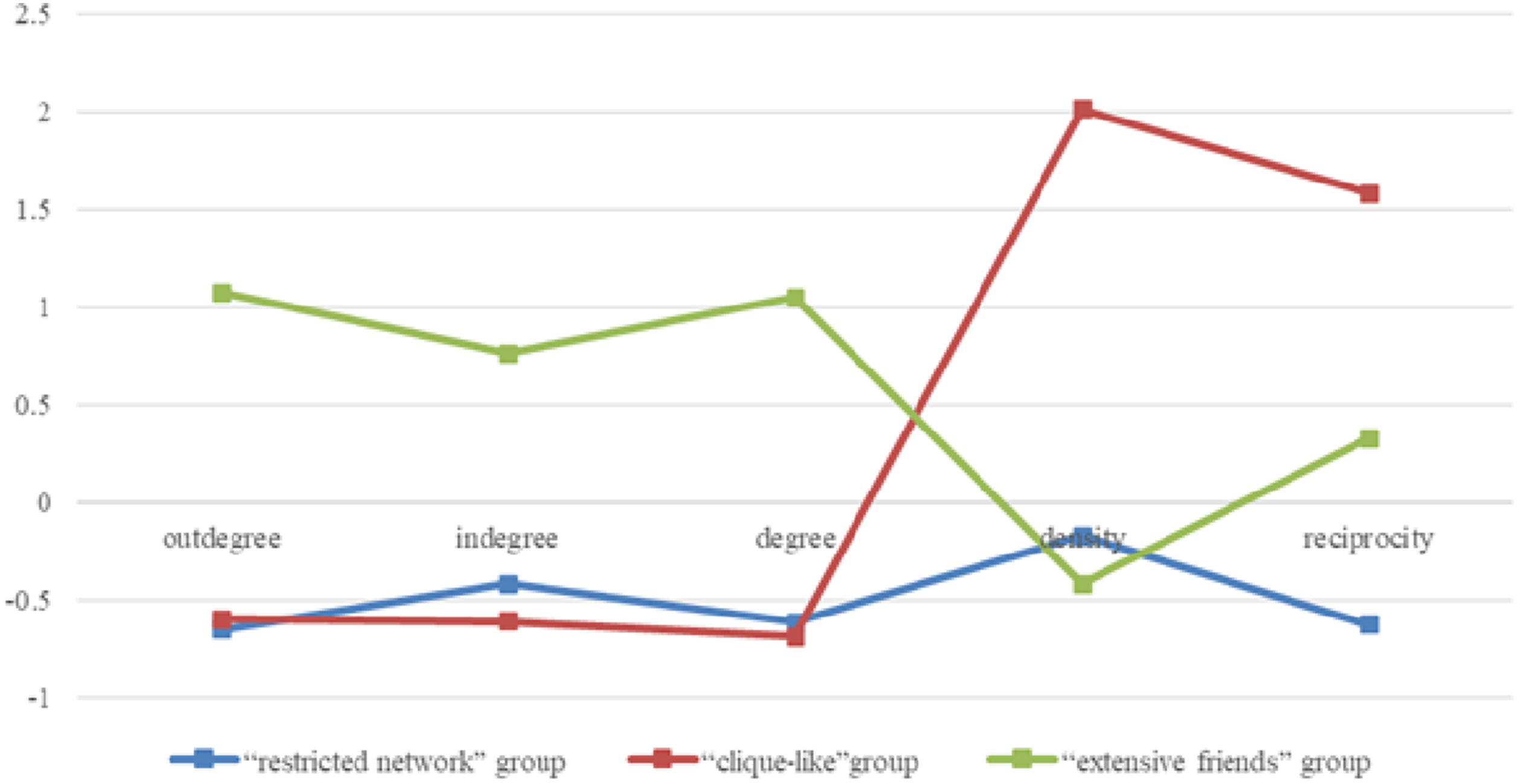
Illustration of the Z score distribution of peer network structures in the three profiles defined in the latent profile analysis.
Predictors across peer network structural profiles
Pairwise comparison of extraversion, agreeableness, conscientiousness, neuroticism, and openness between the three profiles.

Note. *p < .05, **p < .01, ***p < .001. Bold font indicates statistically significant results (p < .05).
Distal outcomes
Differences in outcomes among three latent profiles (N = 340).

Note. *p < .05, **p < .01, ***p < .001. Bold font indicates statistically significant results (p < .05).
Discussion
Combining the analytical strengths of SNA with a person-centered framework, this study applied an ecological systems perspective to address a gap in the peer relationship literature. Moving beyond variable-centered approaches, we examined how multiple egocentric network characteristics co-occur to form holistic profiles among early adolescents. Our latent profile analysis (LPA) successfully identified three distinct and meaningful subtypes: extensive, clique-like, and restricted networks. This person-centered approach confirms that adolescent social worlds are heterogeneous and that these holistic configurations exhibit differential associations with psychosocial functioning, offering a more ecologically valid and nuanced understanding than examining structural indicators in isolation. Applying this approach within the context of early adolescence in China—a period marked by significant social reorganization during the transition to junior high school—allows us to capture these configurations at a critical developmental juncture.
Adolescents in extensive networks occupied central positions within the peer social structure. They exhibited high levels of both received and initiated friendship nominations, along with moderate reciprocity and network density. From an ecological perspective, this configuration reflects a social environment rich in connections and resources, consistent with the idea that development is shaped by systemic social contexts (Bronfenbrenner, 1979). The relatively lower density, which often mathematically coincides with a larger number of connections, indicates a broad but less tightly knit web of relationships. This structural feature provides access to diverse social resources, informational channels, and forms of validation, all of which support positive adjustment. These adolescents reported higher levels of perceived social support, in line with existing evidence that network size and centrality facilitate access to supportive exchanges (Vargas et al., 2018). In practical terms, this structural advantage likely translates to day-to-day experiences of having multiple peers to turn to for help or companionship, fostering a greater sense of belonging and emotional security that buffers against stress. Furthermore, the observed association between greater network centrality and fewer depressive symptoms reinforces previous sociometric research on the mental health benefits of robust social integration (Gossage et al., 2022; Kamis & Copeland, 2020). Therefore, the extensive network profile represents a social context that effectively promotes adolescent psychosocial development through structural advantage and resource diversity.
In contrast, adolescents in the clique-like networks formed a markedly different type of social microsystem. Characterized by fewer friendship nominations but high reciprocity and density, this profile reflects a tight-knit, exclusive group structure. Notably, this cohesive environment was associated with the lowest levels of perceived social support among the three profiles. This finding challenges the conventional assumption that structural cohesion invariably translates into functional support. The lack of significant difference in depressive symptoms compared to the restricted network group, coupled with low perceived support, implies that daily life within these cliques may be characterized by intense but potentially insular relationships, offering limited buffering against stress and potentially fostering relational strain. From an ecological perspective, this microsystem, while rich in interaction within its boundaries, suffers from a critical lack of diversity and external connectivity. Its closed nature may limit adolescents’ access to heterogeneous social resources and perspectives, which are essential for adaptive development (Hall et al., 2020). Furthermore, an intense inward focus on maintaining group dynamics may constrain adolescents’ ability to recognize or utilize support beyond their immediate clique, potentially leading to heightened insularity and relational stress (Heerde & Hemphill, 2018). Therefore, the clique-like profile exemplifies a microsystem that, despite its internal cohesion, may fail to provide the broad-based resources needed for optimal psychosocial adjustment. The identification of this potential risk profile within a collectivistic culture, which often emphasizes group harmony, underscores the sensitivity of our person-centered approach in detecting socially nuanced configurations that may carry unique implications in different settings.
A third distinct profile was identified: adolescents in restricted networks occupied a marginalized position within the peer social ecology. This profile was defined by minimal friendship nominations, low reciprocity, and sparse interconnections among existing ties. Consequently, these adolescents operated within an impoverished microsystem that proved insufficient to deliver adequate social support or positive relational experiences, thereby elevating their risk for adverse psychological outcomes (Long et al., 2020; Umberson et al., 2022). This relational poverty signifies a daily reality of frequent isolation, a lack of confidants, and pervasive loneliness, leaving them acutely vulnerable to common stressors. The prevalence of this profile within our sample, particularly during the transition to junior high school, underscores the developmental vulnerability associated with navigating new social landscapes. As previous research indicates, school transitions often disrupt existing social networks, thrusting adolescents into environments where social skills and relational resources are critically tested (Cairns et al., 1995). The restricted network profile thus exemplifies a microsystem that fails to provide the necessary social scaffolding for healthy adjustment, highlighting a clear target for preventive intervention.
Given these stark differences in social microsystems, we investigated the role of personality as a potential antecedent. When using the extensive network profile as the reference, adolescents with higher levels of extraversion, agreeableness, and neuroticism were less likely to belong to the restricted profile, suggesting these traits may protect against social isolation through distinct mechanisms. While the roles of extraversion, agreeableness and openness in facilitating social connections are well-established (Clark et al., 2023; Hommes et al., 2012), the finding for neuroticism offers a nuanced insight: rather than predisposing to withdrawal, higher neuroticism may motivate youths to seek the diverse validation of extensive networks as a compensatory strategy. Furthermore, higher conscientiousness predicted lower odds of clique-like membership, potentially because the structured nature of cliques presents a more manageable social environment for less goal-oriented adolescents. This is consistent with literature indicating that lower conscientiousness may limit social opportunities and result in less desirable relationship outcomes (Laninga-Wijnen & Veenstra, 2021). Overall, these findings illuminate how personality shapes the structure of peer networks, with future research needed to explore potential moderation by classroom or cultural contexts.
The primary contribution of this study lies in demonstrating the utility of a person-centered, LPA-based framework for mapping the holistic structure of adolescent egocentric networks. Our findings confirm the existence of three distinctive peer network structural profiles that are differentially associated with depressive symptoms among early adolescents. This study provides the first empirical evidence for such heterogeneity by integrating SNA with latent profile analysis, thereby validating this novel methodological approach. The distinct profiles identified—and their clear links to functioning within the Chinese context—serve as a robust proof of concept, suggesting that this methodology can be effectively applied to uncover socially meaningful heterogeneity across diverse populations. On the basis of these results and considering the social dynamics of early adolescents who have just entered junior high school, several practical implications are proposed. First, educators (e.g., teachers, social workers, and counselors) should prioritize monitoring and fostering healthy peer networks, given their demonstrated associations with mental health outcomes. Second, more attention and targeted interventions should be directed toward adolescents in the restricted networks who are socially isolated in class, as well as those in the clique-like networks. Increased peer interaction benefits the mental health of socially isolated adolescents with restricted networks, whereas external support helps mitigate potential risks for those in clique-like networks.
This study has several limitations that should be addressed. First, the generalizability of the findings is constrained by the convenience sample from a single school in Beijing, along with the limited collection of demographic data (e.g., socioeconomic status, race/ethnicity), necessitating future replication in more diverse socioeconomic and cultural contexts. Second, the assessment of peer networks, drawing on student friendship nominations and complemented by a brief personality measure, provides valuable structural data but may be subject to the potential biases of any single informant and the limited precision of short-form scales; future research would benefit from triangulating network data with teacher or peer ratings, and employing comprehensive personality inventories. Furthermore, the network assessment was limited by design, capping nominations at eight and restricting them to within-classroom peers. These constraints may have artificially truncated the size of ‘extensive’ networks and potentially led to the misclassification of adolescents whose most salient friendships lie outside the classroom, particularly affecting the interpretation of the ‘restricted’ and ‘clique-like’ profiles. Finally, this study establishes a foundational cross-sectional typology of peer network profiles. A key direction for future research lies in leveraging longitudinal data to build upon this foundation, specifically by modeling the stability of these profiles and investigating dynamic transitions between them over time using methods such as Latent Transition Analysis. This would evolve the present typology into a dynamic developmental framework. Despite these limitations, the identified profiles provide a foundational typology that captures meaningful heterogeneity in adolescents’ peer social structures. Future research could build upon this foundation by integrating metrics of sociometric network positioning to elucidate how an individual’s broader macro-systemic integration interacts with their immediate micro-system to influence mental health.
Conclusion
This study investigates the heterogeneity of peer social network structures among early adolescents by employing LPA. Three distinctive peer network structural profiles (extensive networks, clique-like networks, and restricted networks) were identified with five network indicators, namely, the indegree, outdegree, degree centrality, network density, and reciprocity ratio. Adolescents in extensive networks reported more perceived social support and fewer depressive symptoms, whereas those in clique-like networks demonstrated less perceived social support across the four waves, and those in restricted networks presented more depressive symptoms. Personality traits, especially extraversion (a core dimension of the Big Five personality framework), serve as predictive factors since adolescents with higher extraversion scores tend to form extensive social networks more frequently. These results underscore the heterogeneity of peer network structures during early adolescence, providing a conceptual framework for examining peer relationships, with important implications for interventions targeting adolescents’ peer network structures.
Footnotes
Acknowledgements
The authors gratefully acknowledge all the participants and organizations that supported this research, including the school for providing this opportunity to collect data, and some of the teachers from the school for their invaluable support with the recruitment and data collection.
Declaration of conflicting interests
The authors declared no potential conflicts of interest with respect to the research, authorship, and/or publication of this article.
Funding
The authors disclosed receipt of the following financial support for the research, authorship, and/or publication of this article: This work was supported by the Institutional Youth Research Project of Beijing Institute of Education (QZ2022-01).
Open research statement
As part of IARR’s encouragement of open research practices, the author(s) have provided the following information: This research was not pre-registered. The data used in the research cannot be publicly shared due to ethics agreements. However, the data required for the analyses performed in the study are available from the corresponding author upon reasonable request (by emailing:
