







Abstract
Social media plays an important role in the maintenance of close relationships, especially in today’s age of technology. However, social media platforms can also threaten existing romantic relationships by using algorithms to expose committed people to attractive and desirable alternatives. The current study focused on TikTok as one platform that may amplify alternative threats through viewing thirst traps on one’s For You Page (FYP). Sixty-five dyads completed an online correlational survey including measures for both their own and perceptions of the partner’s evaluations of TikTok alternatives. Actor Partner Interdependence Modeling (APIM) was used to examine how the partner’s perceived interactions with TikTok alternatives were associated with relationship quality (trust and satisfaction) and if this association was moderated by perceived partner commitment. Additionally, a partner actively interacting with TikTok alternatives was negatively associated with relationship quality, and this effect was exacerbated when the alternative was perceived as dissimilar to the actor. These results have implications for understanding the impact of algorithmically-induced threats on romantic relationship stability and romantic relationship maintenance on the popular TikTok platform.
Short-form video has a long history in social media. In 2012, Vine was famously credited with introducing short-form video content in six-second loops (Anderson, 2020). This feature was later appropriated by other social media platforms, most notably TikTok. Over the past five years, TikTok has rapidly gained popularity - from 21% of U.S. adults reporting TikTok use at the beginning of 2021 up to 33% by the end of 2023 (Pew Research Center, 2024). TikTok is currently the fifth most widely used social media platform by U.S. adults.
Key to TikTok’s success is its algorithm (Bhandari & Bimo, 2022). Klug et al. (2021) define algorithms as “generally invisible mechanisms” that can “influence how we perceive the reality of everyday life” (p. 85). TikTok is known for its algorithmically-curated For You Page (FYP) that pushes content based on individual engagement with the platform. While other social media platforms recommend content to users on the basis of which accounts they choose to follow, TikTok’s FYP uses an algorithm to take information about the content a person interacts with and provides recommendations based on those online engagements (Taylor & Brisini, 2024). One popular type of video on the Tik Tok FYP is known as a “thirst trap,” or a video highlighting the body of an attractive person (Mercer & Smith, 2025). Therefore, if a person’s FYP contains thirst traps, it is an indicator that they are interested in and actively interacting with content created by attractive people.
We argue that the FYP feature has implications for committed romantic relationships due to increased exposure to attractive and desirable alternative partners, which may inform subsequent content on their FYP and has implications for relationship stability (i.e., commitment). For example, perhaps a person’s satisfaction has been lower than usual and they normally do not have a wavering eye, but they pause on a video that contains an attractive person (i.e., passive engagement with alternatives). TikTok’s FYP algorithm is designed to then push more videos like this and may actually introduce relationship doubt. Another example involves a partner who is consciously aware of their wavering commitment and uses TikTok as a way to evaluate their alternative options (i.e., active engagement with alternatives). Perhaps this person is careful not to follow attractive alternatives on other platforms as to not alert their partner, but their FYP primarily consists of attractive people they are actively engaging with because it was recommended. We suggest that TikTok’s FYP may be an earlier indicator of wavering commitment and a more accurate assessment of a person’s interest in attractive alternatives than platforms where content is determined by who someone follows. People in romantic relationships may be able to infer their partner’s current commitment level based on the presence of attractive alternatives on the partner’s FYP. Information about the content on a partner’s FYP may then either promote or deteriorate relationship quality (trust and satisfaction).
Algorithms and relationship maintenance
Algorithms have become an important part of relationship maintenance (Taylor & Choi, 2023). Algorithms can facilitate relationships by recommending connections to people who are looking to expand their networks (Chen et al., 2009). However, they may also make suggestions in situations where people are not actively seeking connections and where such recommendations may pose a threat to relationship stability. For instance, one popular way that viewers encounter attractive alternatives on social media is by watching “thirst traps” videos that are recommended to them in their feeds. Thirst traps are videos created with the intent of receiving attention for one’s body and/or with the purpose of eliciting sexual interest from viewers (Mercer & Smith, 2025). In one study, thirst trap edits increased the perceived attractiveness of political candidates, demonstrating the positive association between viewing thirst traps and attraction.
TikTok is a relevant context for considering the effects of thirst traps and other forms of algorithmically-induced relationship threats. On most social media platforms, the content of a person’s feed is determined primarily by the accounts they choose to follow (Anderson, 2020). However, TikTok is known for centering “algorithmically driven feeds and algorithmically driven experiences” (Bhandari & Bimo, 2022, p. 2). Algorithms reflect who people are by understanding their interests (Lee et al., 2022), making the content of their FYPs especially revealing of their attention to attractive people outside of their relationship. We argue that the presence of attractive people on one’s FYP may be a result of a person actively engaging with TikTok alternatives’ content (e.g., liking videos or following accounts) because they already have wavering commitment. On the other hand, if a person passively engages with TikTok alternatives’ content (e.g., watching videos), the algorithm may start to push thirst traps and create threats to commitment. Either way, people may spontaneously compare their partners to TikTok alternatives and if there is a discrepancy, this could negatively impact satisfaction and lead to dissolution (Fletcher et al., 2000). Additionally, the partner may then perceive the presence of alternatives and this can create further relationship conflict. Thus, an important component of TikTok use may involve how committed people engage with alternatives’ content and how this may in turn influence relationship quality.
Alternative threat
Derogation of alternatives
After romantic commitment has been formed, both partners (or all, if they are involved in a consensually non-monogamous relationship) engage in pro-relationship behaviors that help maintain their commitment (The Investment Model; Rusbult, 1980, 1983). One strategy to protect commitment is to derogate alternatives – namely, physically attractive and available alternative partners that may tempt a person away from their current relationship. In order to trigger the process of derogation the alternative must be perceived as threatening, which has predominantly been operationalized in the existing literature with alternatives that are physically attractive (e.g., Fleuriet et al., 2014; Lydon, 2010; Miller, 1997). Committed people will actively devalue the attractiveness of alternatives to attenuate the threat posed to their relationship, a process known as derogation of alternatives. Researchers have offered multiple explanations for how the process of derogation manifests – a person may be less attentive to alternatives when they are highly committed (e.g., Miller, 1997), a person may perceptually downgrade the alternative’s attractiveness (e.g., Lydon & Karremans, 2015), or a person may use self-regulation strategies when tempted by alternatives (e.g., Brady et al., 2019). Greater derogation is associated with greater satisfaction (e.g., Rusbult, 1980, 1983; Rusbult & Buunk, 1993) and greater trust (e.g., Black & Reis, 2022), which are both indicators of relationship quality. Across these diverse strategies, there is consistent empirical support for the protective function of derogation within committed relationships on relationship quality.
Perceived Partner Devaluation (PPD)
Despite these findings, one account has consistently been missing in derogation studies - the perspective of the other partner involved (Black & Reis, 2022). Due to the interdependent nature of committed dyads, a threat to one partner’s commitment (i.e., an attractive alternative approaching them) should also threaten the other partner(s) involved (e.g., Wieselquist, 2009). The attractive alternative directly threatens the actor’s commitment, triggering the function of derogation (Johnson & Rusbult, 1989). However, the alternative interacting with the actor also can threaten the partner by influencing the partner’s perception of the actor’s commitment level. For example, if Jackson is approached by an alternative, Jackson may be motivated to perceive the alternative as less attractive (i.e., his own derogation). His partner, Rue, however, may perceive Jackson’s commitment as wavering and therefore not believe that Jackson is devaluing (i.e., low perceived partner devaluation, or PPD; Black & Reis, 2022). Low PPD can then have negative implications for how satisfied Rue is and how much they trust Jackson moving forward. Perceived partner commitment, own derogation, and PPD are crucial for protecting committed relationships from alternative threats and are foci of the current study. Additionally, these evaluations of the partner are perception based and therefore the possibility of projection occurring needs to be accounted for. Projection within a relationship context refers to a person assigning their own thoughts, feelings, and behaviors to their partner and is often motivated by a desire for predictability in the partner (Lemay & Clark, 2008). An example of this would be Rue projecting that Jackson is interested in alternatives because Rue finds the alternatives attractive. PPD instead captures perceptions of the partner’s evaluation of alternatives based on current knowledge of the partner’s commitment level and past relationship behaviors (e.g., if they have been trustworthy; Black & Reis, 2022). It is therefore important to control for projection when examining the process of PPD within committed dyads.
Alternatives on social media
A recent review of the existing derogation literature identified online alternatives as a legitimate threat to relationships, and yet the context of social media has not been widely studied (Brady & Baker, 2022). Online alternatives may impact a person’s standards for relationship partners – especially if online alternatives can offer something that the current partner does not have (i.e., perceived dissimilarity between the alternative and the current partner). In fact, one study found that novelty was the main contributing factor to gratification through TikTok use (Scherr & Wang, 2021); McCashin and Murphy (2023) suggest this is due to TikTok’s algorithm providing relevant content distinct from one’s social network. Indeed, gratification of one’s affective needs and desire to expand one’s social network were also themes in a study examining why people use TikTok (Bucknell Bossen & Kottasz, 2020). Applying this to the context of alternatives, the novelty of attractive alternative partners may fulfill a social need to someone with wavering commitment. Additionally, the threat of alternatives may be especially salient in an online setting because romantic partners have access to information that they would not normally be privy to during in-person interactions (Bevan, 2017). For example, a person can see who their partner follows on social media, but it is unclear if that person actually poses a threat to their relationship. Alternatively, people may choose not to follow someone they find attractive to avoid alerting their partner to potential relationship threats. On TikTok, however, a person’s FYP offers information about the content that a person is actively engaging with, which may signal wavering commitment to their current partner in a way that seems more objective given that it is less within their control.
Black (2023) examined the threat of alternatives on social media by asking participants to identify which online behaviors by a partner signal commitment. Unsurprisingly, the behaviors that were reported as eliciting the highest levels of perceived partner commitment all involved attenuating alternative threats (e.g., ignoring flirtatious online messages on Instagram). Perceived partner commitment is therefore important for people in relationships to make inferences about their partner’s evaluation of online alternatives. The findings from Black (2023) also support the idea that people in committed relationships pay attention to how their partner interacts with alternatives on social media, and perhaps rightfully so. Relatedly, Sharabi and Hopkins (2021) found that people who were more attentive to alternatives on Instagram reported more frequently pursuing alternative partners while in a relationship. To our knowledge, no studies have investigated perceptions of these interactions with alternatives on TikTok, despite the unique relational context created by the FYP. Although Tik Tok alternatives may or may not be truly available (i.e., geographically close or actually interested in the partner), the partner’s engagement with Tik Tok alternatives can signal their wavering commitment and threaten relationship stability. We therefore sought to answer the following questions: How do people perceive their partners’ evaluations of and engagement with attractive TikTok alternatives? How are these perceptions associated with relationship quality (satisfaction and trust)?
Current study
Because interactions with alternatives involve both partners, we wanted to collect a dyadic perspective of how each person (i.e., actor) in a relationship perceives alternatives on their own TikTok FYP and also on their partner’s FYP. Going back to our example couple, Jackson and Rue, we measured Jackson’s evaluation of the alternatives on his FYP (i.e., actor’s own derogation), Jackson’s perceptions of Rue’s evaluation of the alternatives on Rue’s FYP (i.e., PPD), while controlling for Jackson’s evaluation of Rue’s alternatives (i.e., projection). Rue also provided their report on all three variables (i.e., own derogation, PPD, and projection).
We hypothesized that greater levels of actor PPD (i.e., Jackson perceiving Rue to devalue alternatives) and partner own derogation (i.e., Rue reporting that they’re actually derogating alternatives) would significantly and positively impact the actor’s relationship quality (trust and satisfaction), while controlling for projective effects (Jackson’s evaluation of Rue’s alternatives;
All hypotheses were pre-registered on the Open Science Framework (OSF), https://osf.io/y7n82/overview?view_only=9fd89a9399b14c4fb49a2d6c70d14c10. Our analyses focused on the outcomes of trust and satisfaction as indicators of relationship quality. Additional outcomes mentioned in the preregistration were not the focus of the current paper and can be found in the online supplemental material in Tables S1–S5.
Methods
Participants and procedure
Dyads were recruited on Prolific in 2023 and completed self-report measures via an online survey; FYP was defined as “For You Page” within the survey. An a priori power analysis (using G*Power 3.1; Faul et al., 2007) specifying a small correlation (rho = .20), power of .80, and an alpha of .05 resulted in a needed sample size of 193 individuals, or approximately 100 couples. The initial sample size included 182 total participants. In an initial screening survey, we asked participants to provide the Prolific IDs of their partners in order to verify they were part of a dyad; 42 participants provided invalid Prolific IDs for their partners and were therefore excluded from proceeding with the study. Additionally, four participants provided blank responses, four responses were duplicates, and the partners of two people did not participate, rendering their data unusable. In total, N = 52 responses were deleted leaving a final sample size of 130 total participants, or 65 dyads.
The majority of our participants self-identified as White (66.9%), followed by Black/African/Caribbean (28.5%), Asian (2.3%), Middle Eastern (1.5%), and Latin American (0.8%); 12.3% self-identified as Hispanic or Latinx. Our sample was relatively young (M age = 28.72, SD age = 8.73) with 53.8% self-identifying as women, 45.4% as men, and one non-binary participant (0.8%). Additionally, 81.5% self-identified as heterosexual, 9.2% as bisexual, 6.9% as gay, 1.5% as flexible, 0.8% as pansexual, and 0.8% as asexual. The majority of our sample reported being in committed, monogamous relationships (63.8%), followed by married people (21.5%). Participants reported being in relatively established relationships (M = 6.43 years, SD = 6.44 years; Range = less than 1 month–38 years together).
On average, our sample reported being highly satisfied (M = 5.13, SD = 0.84) and highly committed to their current relationship (M = 6.10, SD = 1.06; ranging from 1 = completely disagree to 7 = completely agree). To assess TikTok use, participants were asked how long they have had their TikTok accounts (M = 2.45 years, SD = 1.59 years), how frequently their used TikTok on a daily basis on a 7-point scale (from 1 = almost never to 7 = several times a day; M = 5.41, SD = 1.99), and to which extent they were aware of their partner’s activity on TikTok on a 5-point scale (from 1 = not at all aware to 5 = extremely aware; M = 3.49, SD = 1.24). Participants had to have an active TikTok account in order to be eligible for study participation.
Measures
Awareness of the partner’s FYP
Participants were asked the following item, “To which extent are you aware of what your partner watches on TikTok?” on a scale of 1 (not at all aware) to 5 (extremely aware).
Own devaluation of TikTok alternatives
Participants were given the following directions, “Respond to the following questions regarding people of your preferred gender(s) on your for you page (fyp) (e.g., if you are attracted to women, think of women on your fyp).” Participants then responded to the following question: “In your opinion, how attractive are the [people] on your FYP?” on a scale of 1 (not at all attractive) to 7 (extremely attractive). This item was reversed-scored so that higher values reflected greater own derogation of alternatives.
Perceived Partner Devaluation of TikTok alternatives (PPD)
Participants were given the following directions, “Respond to the following questions regarding people of your partner’s preferred gender(s) on their for you page (fyp) (e.g., if your partner is attracted to women, think of women on their fyp).” Participants then responded to the following item: “How attractive do you think your partner finds the [people] on their FYP to be?” on a scale of 1 (not at all attractive) to 7 (extremely attractive). This item was reversed-scored so that higher values reflected greater levels of PPD.
Projection
Participants were given the following directions, “Respond to the following questions regarding people of your partner’s preferred gender(s) on their for you page (fyp) (e.g., if your partner is attracted to women, think of women on their fyp).” Participants responded to the following question: “How attractive do you think the people on your partner’s FYP are?” on a scale of 1 (not at all attractive) to 7 (extremely attractive; reverse-coded).
Perceived Partner Commitment (PPC)
Participants completed a 4-item version of the Revised Own Commitment Inventory (Owen et al., 2011), adapted to represent perceptions of their partner’s commitment level (e.g., “My partner wants this relationship to stay strong no matter what rough times we may encounter.”). Participants rated the extent to which they agreed with a series of statements about their current relationship on a 1 (completely disagree) to 7 (completely agree) scale (α = .82).
Own report of active and passive engagement with TikTok alternatives
Two questions were written for this study to assess the participants’ own self-reported active engagement with TikTok alternatives (“How often do you follow the TikTok accounts of other attractive [people]?” and “How often do you like the videos of other attractive [people]?), and two items were designed to measure participants’ own self-reported passive engagement with TikTok alternatives (“How often do you watch videos that include other attractive [people]?” and “How often does your FYP include videos of other attractive [people]?”) on a scale of 1 (never) to 5 (always). The two items for each subscale were averaged together to create an active (α = .92) and a passive (α = .88) composite for own reported engagement with TikTok alternatives.
Perceptions of the partner’s active and passive engagement with TikTok alternatives
Two questions were designed for the current study to assess the actor’s perceptions of their partner’s active engagement with TikTok alternatives (“How often does your partner follow the TikTok accounts of other attractive [people]?” and “How often does your partner like the videos of other attractive [people]?) and two items were designed to measure perceptions of their partner’s passive engagement with TikTok alternatives (“How often does your partner watch videos that include other attractive [people]?” and “How often does your partner’s FYP include videos of other attractive [people]?”) on a scale of 1 (never) to 5 (always). The two items for each subscale were averaged together to create an active (α = .86) and a passive (α = .86) composite for perceived partner engagement with TikTok alternatives.
Perceived similarity of alternatives to self
Participants responded to the following question: “To which extent do the attractive [people] on your partner’s FYP share similar physical features to yourself?” on a scale of 1 (not at all similar) to 7 (very similar).
Relational trust
Participants completed the Trust subscale of the Perceived Relationship Quality Components Inventory (Fletcher et al., 2000). Participants rated three items regarding how much they trust their current partner (e.g., “How much do you trust your partner?”) on a 1 (not at all) to 7 (extremely) scale (α = .59 1 ).
Relationship satisfaction
Participants completed the 4-item Couples Satisfaction Index (CSI; Funk & Rogge, 2007). Participants rated items (e.g., “I have a warm and comfortable relationship with my partner”) on a scale of 1 (not at all true) to 6 (completely true; α = .92).
Results
Data analytic strategy
The study’s data, syntax, and measures are available on the OSF, https://osf.io/y7n82/overview?view_only=9fd89a9399b14c4fb49a2d6c70d14c10. Correlations and descriptive statistics for the main study variables are reported in Tables 1 and 2, respectively. We used Actor Partner Interdependence Modeling (APIM) to account for the interdependence within dyads and to test for actor effects (i.e., the actor’s evaluations of alternatives predicting their own relationship quality) and partner effects (i.e., the partner’s evaluations of alternatives predicting the actor’s relationship quality; Kenny et al., 2006). The first step in an APIM analysis is to decide whether to model the dyads as distinguishable by using a dichotomous variable (e.g., gender) to differentiate one partner from another. According to Ledermann et al. (2022), only 45 dyads are needed to obtain a significant actor effect within an indistinguishable APIM, whereas 121 dyads are needed for a significant partner effect in the same model. We wanted to be inclusive of gender and sexual minority participants, who are often excluded when gender is used to distinguish between partners in APIM models (see Andersen & Zou, 2015). For these reasons, we chose to treat all dyads in this study as indistinguishable.
All APIM analyses were conducted in SPSS Version 29 using the MIXED command to account for interdependence, and results were plotted in R 4.4.2 (R Core Team, 2024) using the packages lmerTest (Kuznetsova et al., 2017) and interactions (Long, 2024). Variables were centered for testing the interactions. Terms representing the actor’s PPD and the partner’s own derogation were entered, followed by the actor’s evaluation of the partner’s alternatives to control for projective processes predicting relationship quality (trust and satisfaction; H1). Perceived partner commitment (PPC) and its interaction with both the actor’s PPD and partner’s own derogation were also included (H2). In the second set of models, the actor’s perceptions of the partner’s active/passive engagement with TikTok alternatives and the partner’s actual report of their active/passive involvement with TikTok alternatives were entered (H3), followed by their interactions with the actor’s perceptions of similarity to the partner’s TikTok alternatives predicting relationship quality (H4); active and passive engagement were tested in separate models.
Does PPC moderate actor PPD and partner own derogation on relationship quality?
Relational trust
See Table 3 for a full report of the results. In the model predicting trust, neither the main effect of PPD nor its interaction with PPC were significant, ps = .480, nor was own projection, p = .169. However, the partner’s own derogation was a significant predictor, B = 0.12, t(115.808) = 2.23, p = .028, 95% C.I.[0.01, 0.23], as was its interaction with perceived partner commitment (PPC), B = −0.11, t(107.566) = −2.28, p = .025, 95% C.I.[−0.21, −0.01]. Simple slope analyses revealed that for partners relatively high in perceived partner commitment (+1SD), partner actual derogation did not significantly predict trust, B = 0.01, t(115.989) = 0.10, p = .919, 95% C.I.[−0.13, 0.14], whereas for partners relatively low in perceived partner commitment (−1SD), greater partner own derogation significantly predicted greater trust, B = 0.24, t(109.188) = 2.97, p = .004, 95% C.I.[0.08, 0.39]. In other words, if Jackson perceived Rue’s commitment as wavering, Rue actually derogating alternatives promoted Jackson’s trust. The Johnson-Neyman region of significance revealed that the partner’s own derogation was positively associated with relationship trust only at lower levels of perceived partner commitment and is depicted in Figure 1. Partner own derogation x perceived partner commitment on trust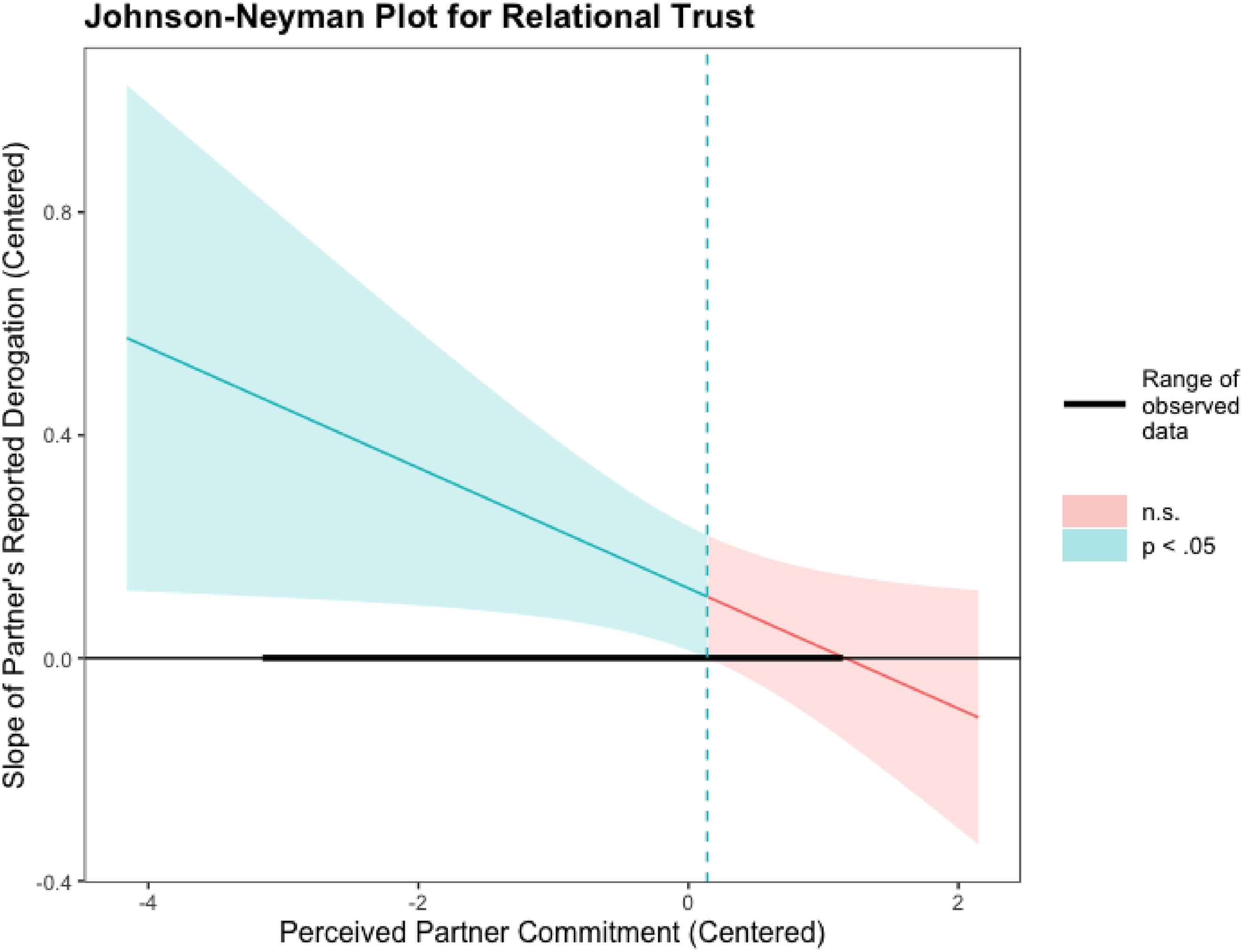
Relationship satisfaction
See Table 4 for a full report of the results. In the model predicting satisfaction, only the main effect of perceived partner commitment significantly predicted satisfaction, B = 0.37, t(121.739) = 5.29, p < .001, 95% C.I.[0.23, 0.51]. None of the other predictors were significant in the model, ps > .615.
Does perceived similarity of alternatives moderate the effect of partner active/passive engagement with TikTok alternatives on relationship quality?
Active engagement predicting relational trust
See Table 5 for a full report of the results. There were no significant main effects of actor’s perceptions of their partner’s active engagement with TikTok alternatives, partner’s actual active engagement with alternatives, or actor’s perceived similarity with alternatives predicting trust, ps > .257. Actor’s perceived similarity with TikTok alternatives, however, significantly interacted with partner’s reported active engagement with alternatives, B = 0.16, t(123.95) = 2.60, p = .011, 95% CI [0.04, 0.27], but not with actor’s perception of their partner’s active engagement, p = .099. None of the other model terms were significant, ps>.257. Simple slopes analyses revealed that for actors who perceived a relatively high degree of similarity with their partner’s TikTok alternatives (+1SD), partner’s reported active engagement was not a significant predictor of trust, B = 0.08, t(123.184) = .84, p = .403, 95% CI[−0.11, 0.27], whereas for actors who perceived a relatively low degree of similarity with their partner’s TikTok alternatives (−1SD), greater partner reported active engagement significantly predicted lower trust, B = −0.24, t(123.698) = −2.77, p = .007, 95% CI[−0.41, −0.07]. In other words, if Jackson thought Rue’s alternatives did not look like him, Rue following or liking videos that include those alternatives diminished Jackson’s trust. The Johnson-Neyman region of significance revealed that the relationship between active engagement and trust was negative at lower levels of perceived similarity. See Figure 2. Partner’s reported active engagement x actor’s perceived similarity on trust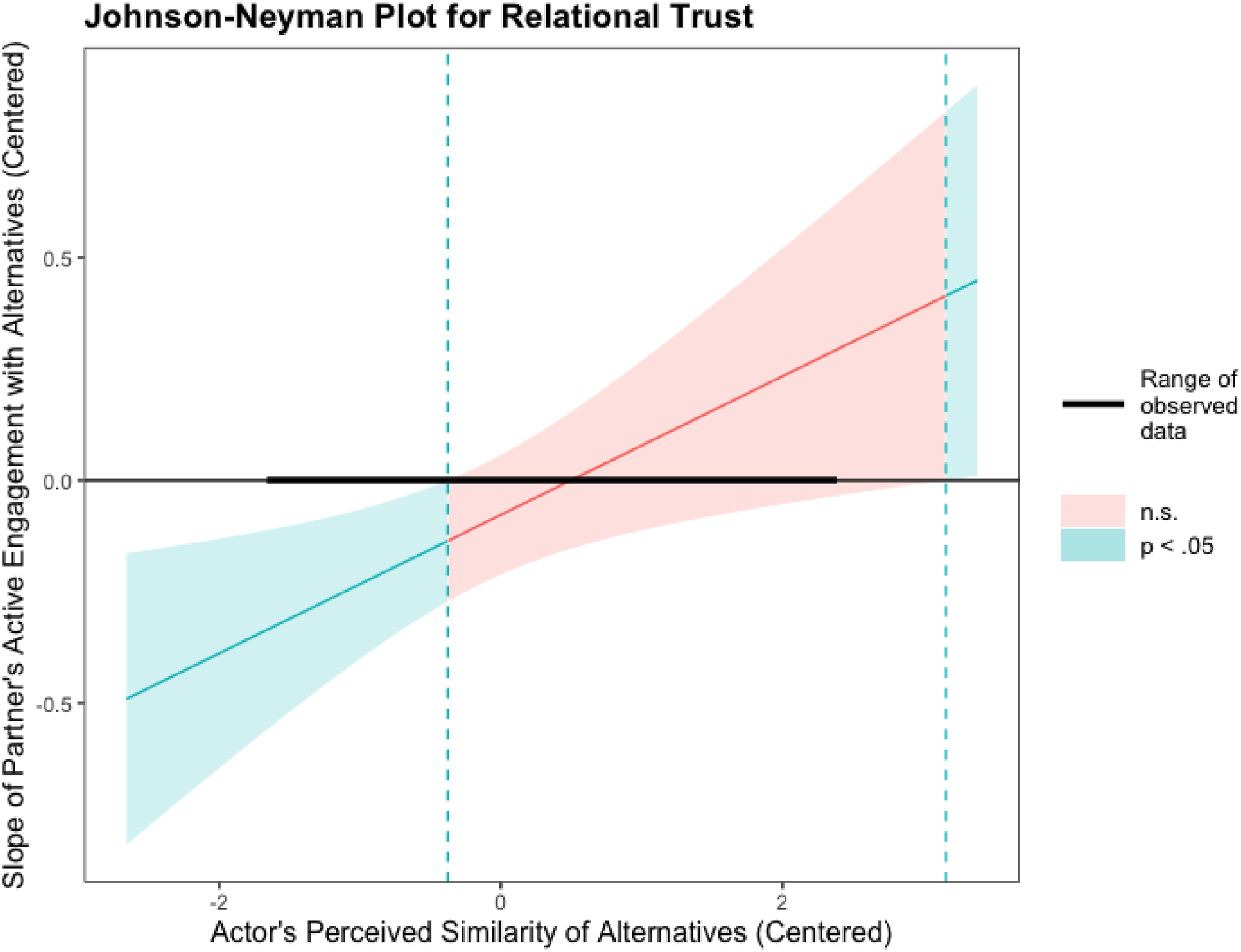
Passive engagement predicting relational trust
See Table 6 for a full report of the results. For the models with passive engagement predicting trust, there was only a significant main effect of partner’s reported passive engagement predicting trust, B = −0.17, t(123.919) = -2.58, p = .011, 95% CI[−0.29, −0.04]. No other effects were significant, ps > .093.
Active engagement predicting relationship satisfaction
See Table 7 for a full report of the results. Actor’s perceived similarity with TikTok alternatives significantly interacted with partner’s actual active engagement with alternatives, B = 0.15, t(101.306) = 2.23, p = .028, 95% CI [0.02, 0.29], but not with actor’s perception of their partner’s active engagement, p = .551. No other effects were significant, ps > .209. Simple slopes analyses revealed that for actors who perceived a relatively high degree of similarity with their partner’s TikTok alternatives (+1SD), partner’s reported active engagement was not a significant predictor of satisfaction, B = 0.06, t(104.942) = 0.49, p = .623, 95% CI [−0.17, 0.28], whereas for actors who perceived a relatively low degree of similarity with their partner’s TikTok alternatives (-1SD), greater partner reported active engagement significantly predicted lower levels of satisfaction, B = −0.26, t(119.612) = -2.53, p = .013, 95% CI [−0.46, −0.06]. In other words, if Jackson thought Rue’s alternatives did not look like him, Rue following or liking videos that include those alternatives was negatively associated with Jackson’s satisfaction. The Johnson-Neyman region of significance revealed that active engagement was negatively associated with relationship satisfaction only at lower levels of perceived similarity to TikTok alternatives. See Figure 3. Partner’s reported active engagement x actor’s perceived similarity on satisfaction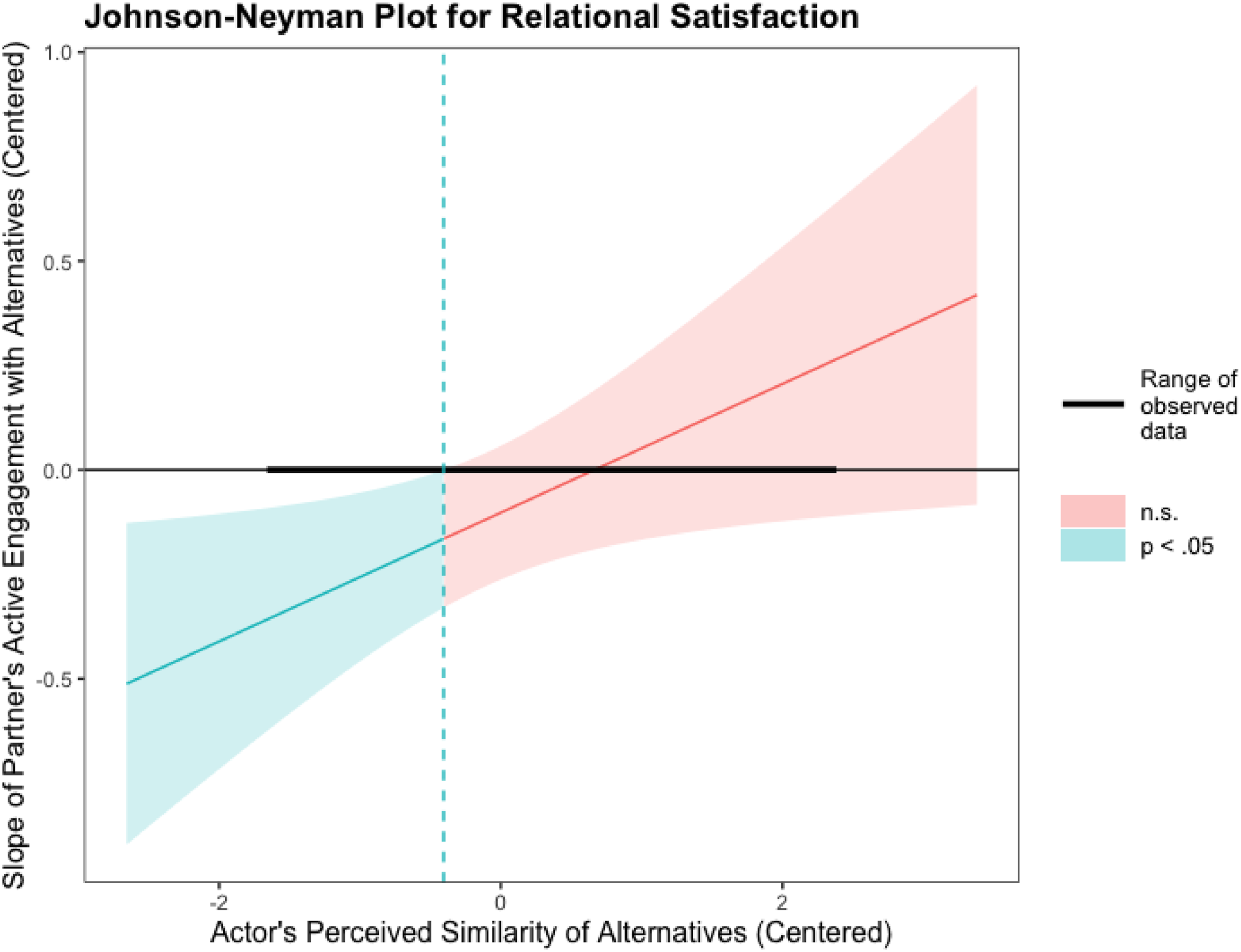
Passive engagement predicting relationship satisfaction
See Table 8 for a full report of the results. For the models with passive engagement as the predictor, actor’s perceived similarity with the partner’s TikTok alternatives significantly interacted with partner’s reported passive engagement with alternatives, B = 0.14, t(90.551) = 2.33, p = .022, 95% CI [0.02, 0.26], but not with actor’s perception of their partner’s passive engagement, p = .154. No other effects were significant, ps>.084. Simple slopes analyses revealed that for actors who perceived a relatively high degree of similarity with their partner’s TikTok alternatives (+1SD), partner’s reported passive engagement was not a significant predictor of satisfaction, B = 0.02, t(110.062) = 0.22, p = .827, 95% CI [−0.17, 0.22], whereas for actors who perceived a relatively low degree of similarity with their partner’s TikTok alternatives (−1SD), greater partner reported passive engagement significantly predicted lower levels of satisfaction, B = −0.27, t(99.729) = −2.76, p = .007, 95% CI [−0.46, −0.08]. In other words, if Jackson thought Rue’s alternatives did not look like him, Rue simply coming across videos that include those alternatives on their FYP was negatively associated with Jackson’s satisfaction. The Johnson-Neyman region of significance revealed that passive engagement was negatively associated with relationship satisfaction only at lower levels of perceived similarity to TikTok alternatives. See Figure 4. Partner’s reported passive engagement x actor’s perceived similarity on satisfaction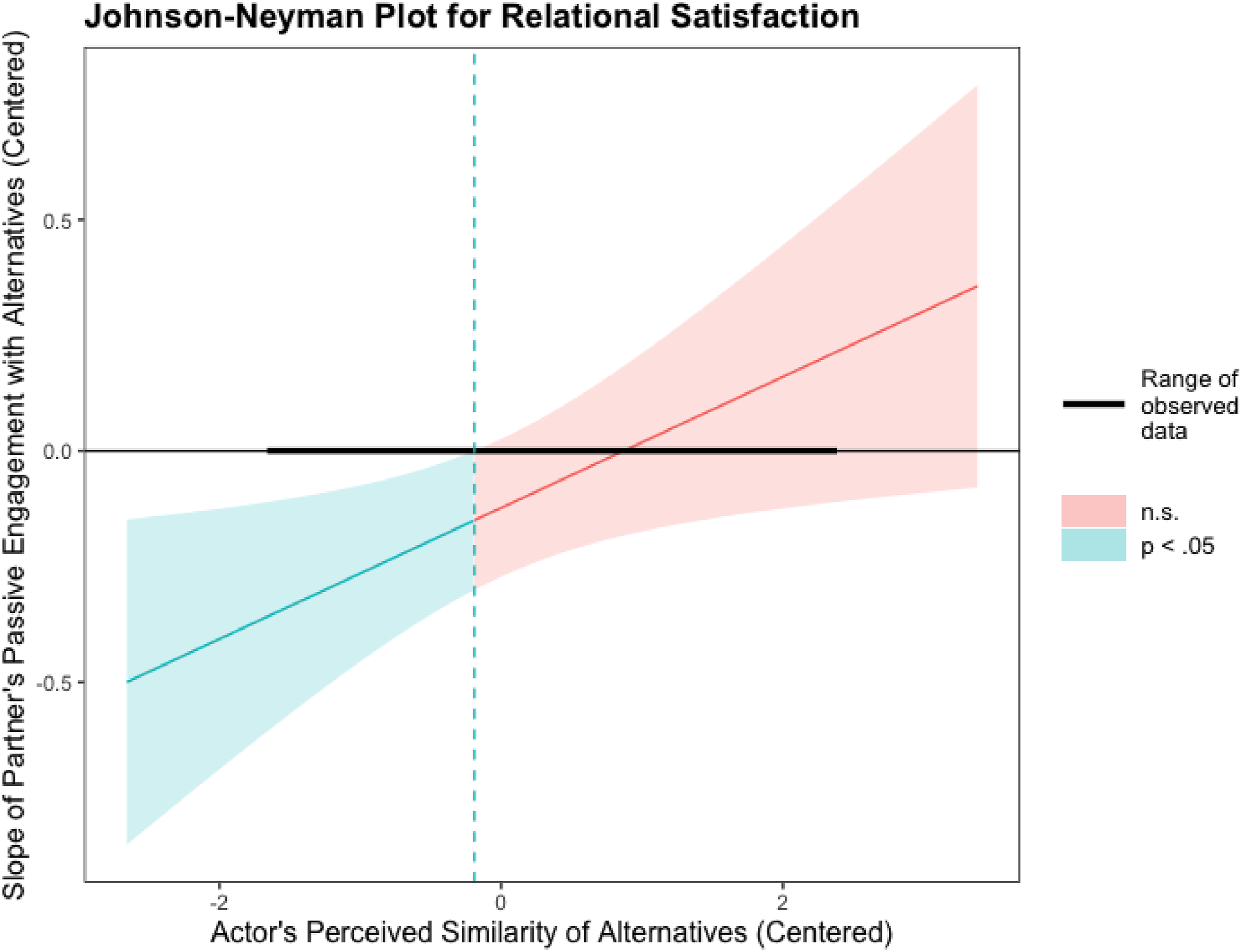
Discussion
Social media can introduce algorithmically-induced relationship threats by not only exposing committed people to attractive alternatives, but also by coloring how people perceive their partners interacting with online alternatives. We explored how perceptions of actors’ and partners’ interactions with alternatives on TikTok’s FYP affect the quality of their relationships using a maintenance theory perspective. Our results showed that when partners who were perceived as being low in commitment were high in their derogation of alternatives on TikTok, they inspired more actor trust. However, when partners actively engaged with these alternatives who were perceived as dissimilar from their chosen mate, they reported less trust and less satisfaction. We discuss the implications of these findings for maintenance theory and research on PPD.
Summary of results
In the first model examining the dyadic impact of own derogation, perceptions of the partner’s devaluation (PPD), and projection on relationship quality, we did not find evidence in support of H1. Surprisingly, the opposite seems to be true. Partner’s reported own derogation, but not the actor’s PPD, significantly and positively predicted relationship trust, but not relationship satisfaction. These results suggest that when it comes to responding to the partner’s TikTok alternatives, reality may be more important for relationship quality than perception. This association was significantly moderated by low levels of perceived partner commitment, in a direction contrary to what we predicted in H2. It could be that when people perceive their partner’s commitment as wavering, their partner actually engaging in trustworthy behavior (i.e., derogating alternatives) helps to promote greater feelings of trust.
We had consistent findings across the models examining perceived and partner reported active and passive engagement with TikTok alternatives predicting relationship quality. Partner’s reported active/passive engagement with TikTok alternatives significantly interacted with the actor’s perceived dissimilarity with those alternatives to predict decreased relationship trust and satisfaction. These findings provide some support for H3 (i.e., with active engagement having a stronger influence than passive engagement). We also found consistent support for H4 (i.e., perceived dissimilarity amplifying partner engagement’s negative association with relationship quality) across active and passive partner engagement; surprisingly, greater partner reported passive engagement significantly interacted with greater dissimilarity to predict lower relationship satisfaction. It is important to note that the actor’s perceptions of the partner’s engagement with alternatives did not significantly predict the outcomes. These unexpected results are consistent with the first set of models (i.e., examining PPD and derogation) and again suggest that the partner’s actual behavior involving TikTok alternatives influences relationship quality beyond the actors’ perceptions.
Theoretical implications
Maintaining commitment is an important process in relationships. According to the investment model (Rusbult, 1980, 1983), people maintain commitment by practicing pro-relationship cognitive strategies like derogation of alternatives (VanderDrift & Agnew, 2020). Prior work has considered the protective function of an individual’s own derogation of alternatives; only recently have scholars begun to examine how these signals of commitment are perceived by one’s partner and embedded within the relationship (Black & Reis, 2022). The current study advances maintenance theory by conceptualizing derogation as a dyadic phenomenon involving both actor and partner effects and does so in an understudied online context. Indeed, dyadic mitigation of alternative threat may be difficult when algorithms recommend attractive alternative partners. Partners with wavering commitment may be particularly susceptible to algorithmically-induced relationship threats and may even develop parasocial romantic relationships (PSRRs) with TikTok content creators. In one study, PSRRs threatened the current relationship’s existence which in turn was associated with greater feelings of jealousy (Frampton et al., 2025). Consistent with our findings, this effect was exacerbated when the PSRR involved a romantic rival perceived to have low levels of similarity with the current partner.
Past research has found that women report higher relationship satisfaction when they perceive themselves to fit their partner’s appearance-related preferences (Hockey et al., 2022). Additionally, studies on the Ideal Standards Model (ISM) have shown that individuals feel less satisfied within their relationships when they fail to meet perceptions of their partner’s ideal standards (e.g, attractiveness/vitality; Campbell et al., 2001; Simpson et al., 2001). In the context of the present study, our findings suggest that when committed people actively engage with TikTok alternatives that do not look like their current partners, it exacerbates the negative association between alternative threat and relationship quality. One potential explanation for the perceived discrepancy between actors and their partners’ TikTok alternatives could be that it challenges actors’ assumptions about their partners’ preferred physical “type” (i.e., ideal standards discrepancy) and as a result, may introduce further insecurity within the relationship surrounding alternatives.
Our study provides evidence of one specific way that committed relationships are maintained in algorithmically-driven social media environments. Algorithmic personalization means that “users do not necessarily need to have direct social interactions with others to form connections” (Lee et al., 2022, p. 3). TikTok’s FYP is a novel context for studying engagement with social media alternatives because its algorithm recommends content independently of follows (Taylor & Brisini, 2024), which makes it harder for people to manage impressions or disguise their interest in attractive alternatives. Relationship researchers can use this work as a starting point for examining how people make sense of their partner’s commitment level through their partner’s evaluations of alternatives via a widely-used social media platform. Similarly to the process of perceived devaluation, previous research has found that pro-relationship behaviors (e.g., sacrifice, accommodation) promote relationship satisfaction (e.g., Zoppolat et al., 2020) and trust (e.g., Wieselquist et al., 1999). Importantly, other forms of social media such as Instagram Reels and Snapchat Spotlight are similar to TikTok’s FYP and could also prove threatening for relationships. Further research is needed to better understand how algorithms provide recommendations involving alternatives across a variety of platforms beyond TikTok. For instance, warranting theory proposes that social media content is perceived as more credible when it is less prone to manipulation by the source (DeAndrea, 2014). Thus, when it comes to social media alternatives, people might consider algorithmic recommendations stronger signals of a partner’s trustworthiness than information about who that person does (or does not) follow.
Limitations
There are several limitations of the present study to note. Due to limited funding and the cost of recruiting couples, our sample was slightly underpowered. However, not reaching our intended sample size does not dismiss the significant findings in our models (see Lengersdorff & Lamm, 2025). This is because fewer dyads are needed when running indistinguishable APIMs in comparison to distinguishable APIMs, “For indistinguishable members, the number of dyads required are 45 (for actor effects) and 121 (for partner effects), with half the number dyads generally needed for running indistinguishable APIMs (Ledermann et al., 2022). Moreover, Kenny et al. (2006) estimated that the typical sample size for dyadic designs is 80 dyads and recommended, “Having a minimum of 25 dyads before testing for non-independence,” (p. 50). Collecting dyadic data is both expensive and time-consuming, and we believe that it is a strength of the current study.
Our sample was primarily composed of White and heterosexual individuals, limiting the generalizability of our findings to couples outside of this demographic. Although the average age of our sample was relatively young, this may actually be more representative of the average TikTok user based on recent estimates (Bestvater, 2024). It should also be noted that in general, couples in our sample reported high levels of relationship quality. Evidence suggests that research studies requiring dyadic data generally tend to result in samples that are more satisfied and committed than studies requiring only a single partner to participate (Barton et al., 2020; Starks et al., 2015). Therefore, the current sample does not capture how interacting with TikTok alternatives may impact relationship quality for couples who are at greater risk of infidelity, conflict, or dissolution.
Additionally, we only collected data about self-reported TikTok use and engagement with TikTok alternatives, which may not accurately capture individuals’ actual TikTok behavior, as previous research has found discrepancies between actual and self-reported social media use (Parry et al., 2021). Additionally, on average participants reported only being slightly above average in their awareness of the partners’ Tik Tok FYP content (1 = not at all aware to 5 = extremely aware; M = 3.49, SD = 1.24). Despite this, PPD reflects committed individuals’ motivated perceptions of their partners’ evaluation of alternatives and does not necessitate being tied to reality. Given the cross-sectional nature of this study, we also cannot make claims about the causal or long-term effects of TikTok use and perceived engagement with TikTok alternatives on relationship outcomes. We also used single-item measures for multiple outcome variables, although there may not be as large of a discrepancy between multiple- and single-item measures as once theorized (Song et al., 2023).
Future directions
Additional research is needed to better understand the influence of TikTok alternatives on relationship quality and could benefit from including more diverse samples (e.g., queer relationships and couples with diverse commitment structures). This will provide researchers with a more holistic understanding of how couples respond to alternative threat on TikTok and other social media platforms. The pervasiveness of algorithms and short form video content on other social media (e.g., Instagram, Snapchat) also renders our findings highly relevant. Therefore, future research can expand upon how the perception of alternatives affects the quality of romantic relationships in a similar way through different platforms (e.g., Instagram reels, YouTube shorts).
While accurate information about the partner’s FYP is not necessary to trigger the maintenance process of PPD, it would be interesting to examine if a positivity or negativity bias exists between perceived and reported content on the partner’s FYP based on current relationship dynamics and individual insecurities. For example, previous research has shown that anxiously attached people have greater difficulties with alternatives interacting with their partner because they represent a threat to the partner’s commitment level (Black, 2023; Black & Reis, 2022). Future studies on TikTok alternatives should therefore include attachment style as a possible moderator. Follow-up studies could also ask partners to report on actual time spent on TikTok (based on screen time estimates) or provide links to attractive alternatives they passively or actively engage with on TikTok and then have the partner evaluate them. Additionally, it would be interesting to examine how active/passive partner engagement and perceived similarity each interact with PPD to predict relationship quality, which were not tested in the present study. Studies that employ both qualitative and quantitative measures could provide a more comprehensive and contextual understanding of our findings, such as the specific types of content produced by TikTok alternatives that negatively impact relationship outcomes.
Conclusion
This study explored how perceptions of TikTok alternatives (e.g., a partner viewing a thirst trap) affect the quality of couples’ relationships. Our results showed that when partners who were perceived as being low in commitment were high in their derogation of alternatives on TikTok, they inspired more actor trust. However, when partners actively engaged with these alternatives who were perceived as dissimilar from their chosen mate, they reported less trust and less satisfaction. These results show how couples maintain relationships and manage threats introduced by social media algorithms, in this case via the TikTok FYP.
Supplemental material
Supplemental Material - Is my partner watching thirst traps? Associations between perceptions of a partner’s Tik Tok alternatives and relationship quality
Supplemental Material for Is my partner watching thirst traps? Associations between perceptions of a partner’s Tik Tok alternatives and relationship quality by Alexandra E. Black, Liesel L. Sharabi, Sara Cloonan, Karissa L. Beesley in Journal of Social and Personal Relationships
Footnotes
Acknowledgements
We would like to thank the RISE organizers of the 2023 IARR mini-conference in Tempe, Arizona for facilitating the lunch discussion groups where this collaboration and the current study’s idea began. We also would like to thank Dr. Daniel Hubler and Dr. Kelly Rossetto for being part of those discussions and Albina Letniku for her contributions to the study design.
Declaration of conflicting interests
The authors declared no potential conflicts of interest with respect to the research, authorship, and/or publication of this article.
Funding
The authors disclosed receipt of the following financial support for the research, authorship, and/or publication of this article: Funding for this study’s data collection was provided by the University of Pittsburgh’s Psychology Department to Dr. Alexandra E. Black (Faculty Research Grant).

Supplemental material
Supplemental material for this article is available online.
Note
Appendix
Descriptive Statistics for Main Study Variables (N = 65 dyads). Note. Actor PPD, partner own derogation, and actor projection are all reverse-coded items.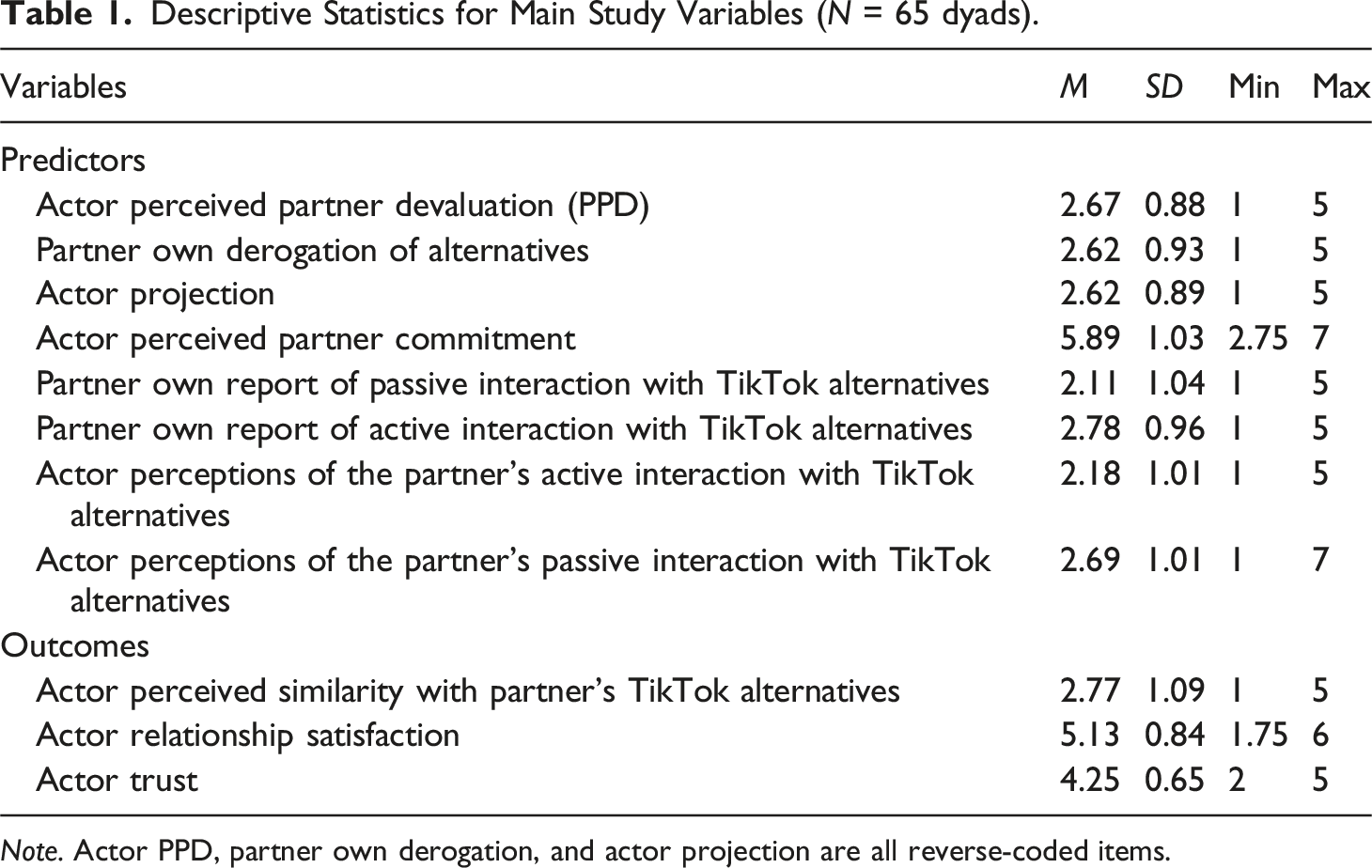
Variables
M
SD
Min
Max
Predictors
Actor perceived partner devaluation (PPD)
2.67
0.88
1
5
Partner own derogation of alternatives
2.62
0.93
1
5
Actor projection
2.62
0.89
1
5
Actor perceived partner commitment
5.89
1.03
2.75
7
Partner own report of passive interaction with TikTok alternatives
2.11
1.04
1
5
Partner own report of active interaction with TikTok alternatives
2.78
0.96
1
5
Actor perceptions of the partner’s active interaction with TikTok alternatives
2.18
1.01
1
5
Actor perceptions of the partner’s passive interaction with TikTok alternatives
2.69
1.01
1
7
Outcomes
Actor perceived similarity with partner’s TikTok alternatives
2.77
1.09
1
5
Actor relationship satisfaction
5.13
0.84
1.75
6
Actor trust
4.25
0.65
2
5
Bivariate correlations of main study variables (N = 130). Note. *p < .05 **p < .01 “Alts” refers to TikTok Alternatives.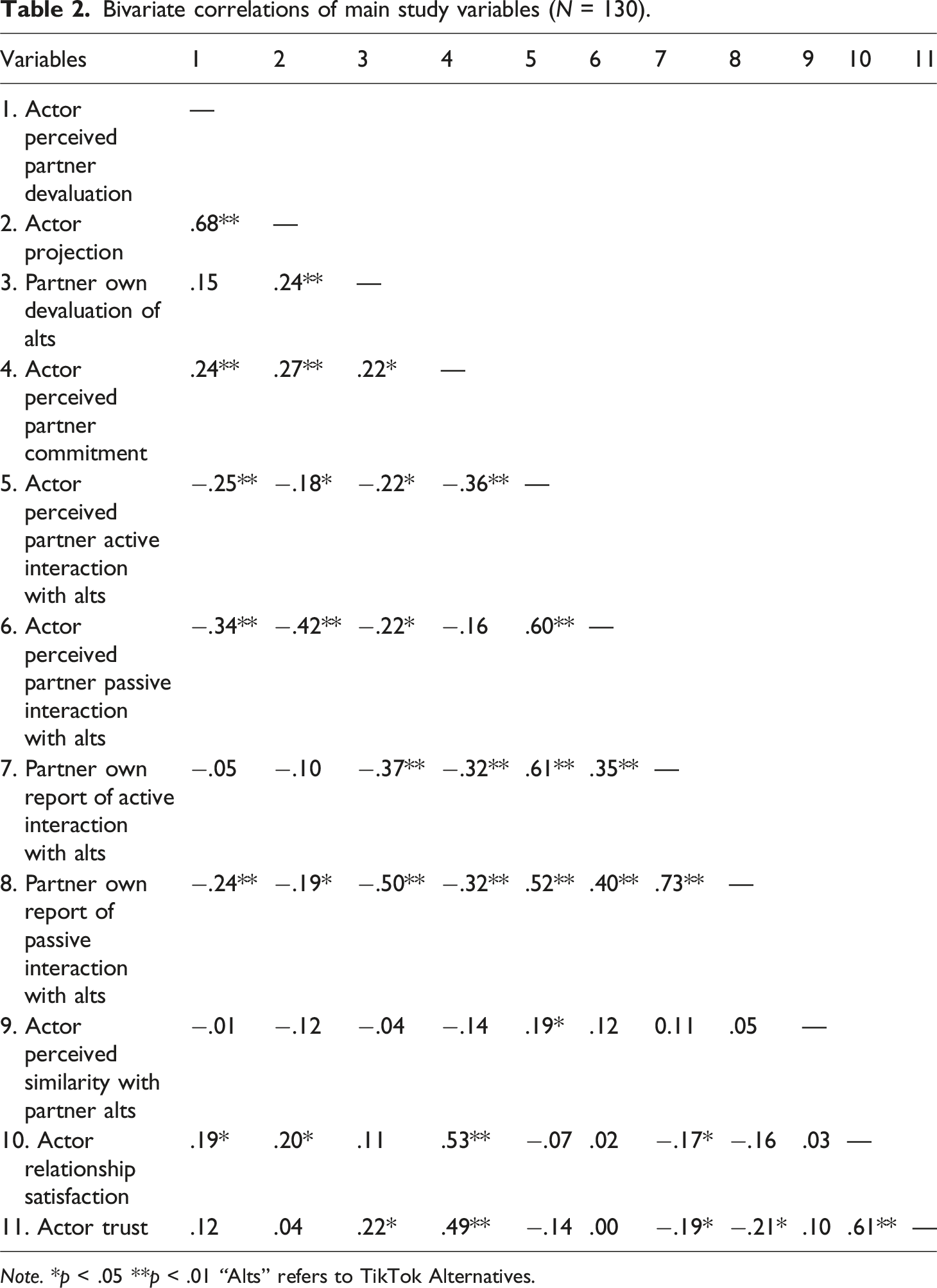
Variables
1
2
3
4
5
6
7
8
9
10
11
1. Actor perceived partner devaluation
—
2. Actor projection
.68**
—
3. Partner own devaluation of alts
.15
.24**
—
4. Actor perceived partner commitment
.24**
.27**
.22*
—
5. Actor perceived partner active interaction with alts
−.25**
−.18*
−.22*
−.36**
—
6. Actor perceived partner passive interaction with alts
−.34**
−.42**
−.22*
−.16
.60**
—
7. Partner own report of active interaction with alts
−.05
−.10
−.37**
−.32**
.61**
.35**
—
8. Partner own report of passive interaction with alts
−.24**
−.19*
−.50**
−.32**
.52**
.40**
.73**
—
9. Actor perceived similarity with partner alts
−.01
−.12
−.04
−.14
.19*
.12
0.11
.05
—
10. Actor relationship satisfaction
.19*
.20*
.11
.53**
−.07
.02
−.17*
−.16
.03
—
11. Actor trust
.12
.04
.22*
.49**
−.14
.00
−.19*
−.21*
.10
.61**
—
Perceived Partner Devaluation x Perceived Partner Commitment on Trust. Note. Trust refers to the actor’s outcome of relational trust. PPC refers to perceived partner commitment. Significant terms are bolded.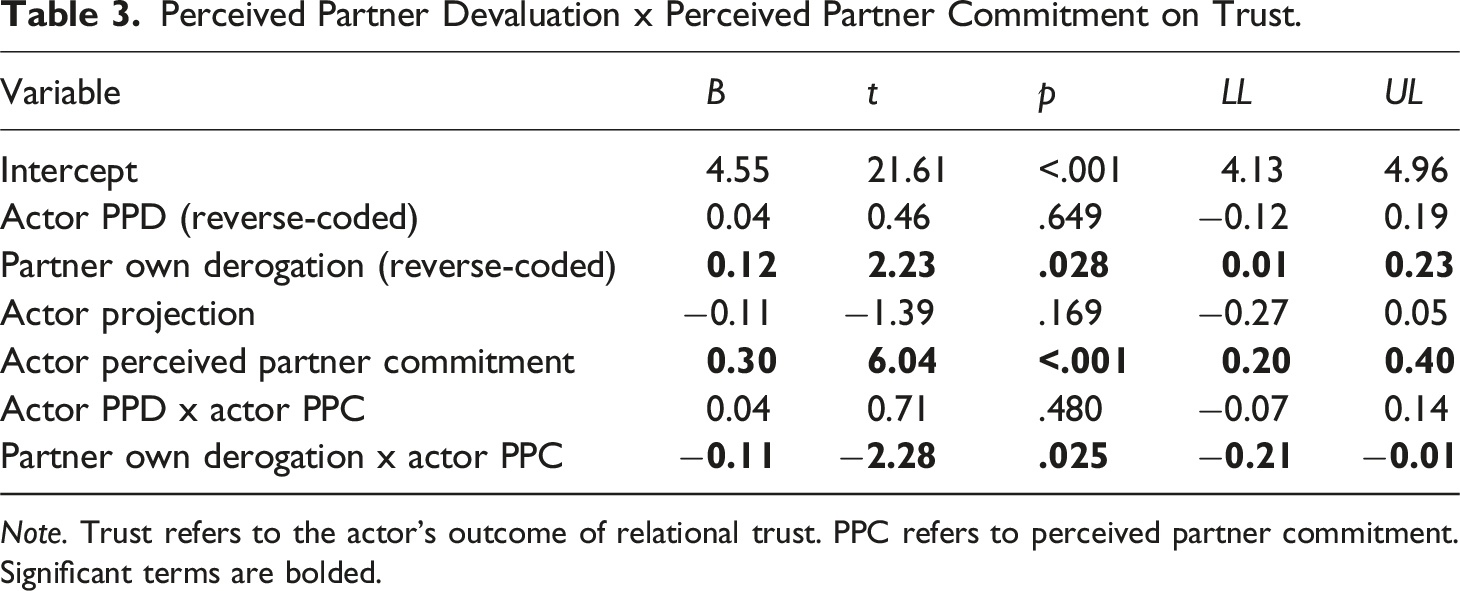
Variable
B
t
p
LL
UL
Intercept
4.55
21.61
<.001
4.13
4.96
Actor PPD (reverse-coded)
0.04
0.46
.649
−0.12
0.19
Partner own derogation (reverse-coded)
Actor projection
−0.11
−1.39
.169
−0.27
0.05
Actor perceived partner commitment
Actor PPD x actor PPC
0.04
0.71
.480
−0.07
0.14
Partner own derogation x actor PPC
Perceived Partner Devaluation x Perceived Partner Commitment on Satisfaction. Note. Satisfaction refers to the actor’s outcome of relationship satisfaction. PPC refers to perceived partner commitment. Significant terms are bolded.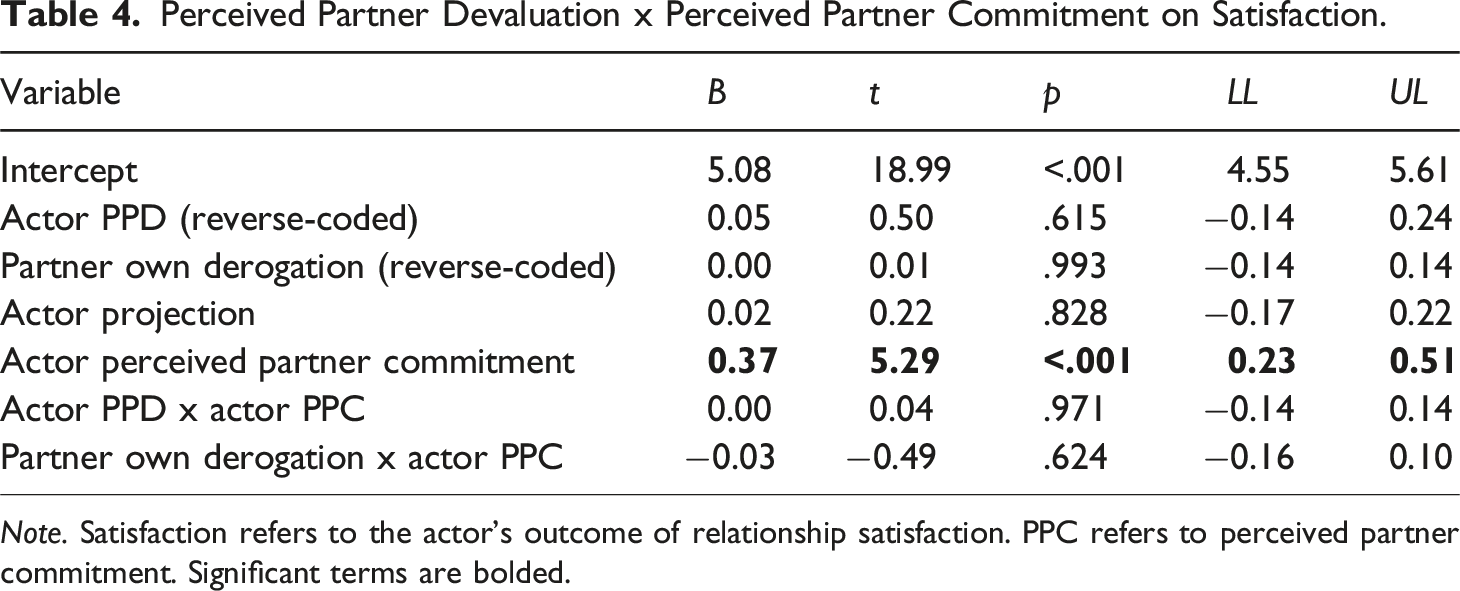
Variable
B
t
p
LL
UL
Intercept
5.08
18.99
<.001
4.55
5.61
Actor PPD (reverse-coded)
0.05
0.50
.615
−0.14
0.24
Partner own derogation (reverse-coded)
0.00
0.01
.993
−0.14
0.14
Actor projection
0.02
0.22
.828
−0.17
0.22
Actor perceived partner commitment
Actor PPD x actor PPC
0.00
0.04
.971
−0.14
0.14
Partner own derogation x actor PPC
−0.03
−0.49
.624
−0.16
0.10
Partner Active Engagement With Alternatives x Perceived Similarity on Trust. Note. Trust refers to the actor’s outcome of relational trust. Significant terms are bolded.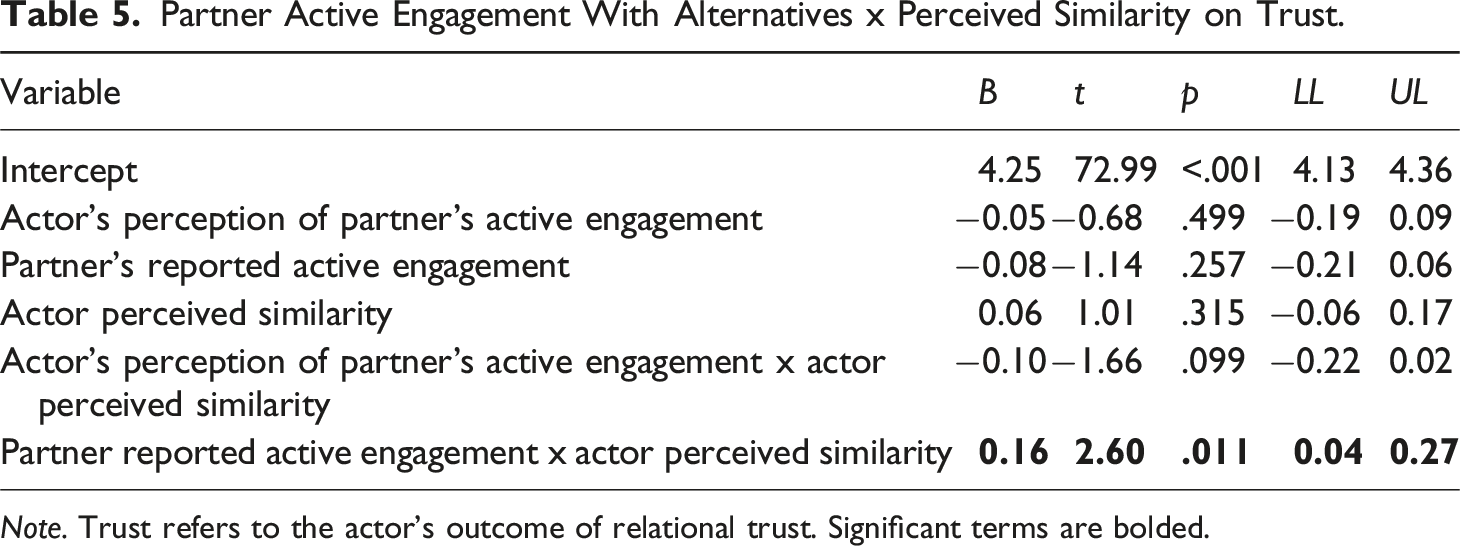
Variable
B
t
p
LL
UL
Intercept
4.25
72.99
<.001
4.13
4.36
Actor’s perception of partner’s active engagement
−0.05
−0.68
.499
−0.19
0.09
Partner’s reported active engagement
−0.08
−1.14
.257
−0.21
0.06
Actor perceived similarity
0.06
1.01
.315
−0.06
0.17
Actor’s perception of partner’s active engagement x actor perceived similarity
−0.10
−1.66
.099
−0.22
0.02
Partner reported active engagement x actor perceived similarity
Partner Passive Engagement With Alternatives x Perceived Similarity on Trust. Note. Trust refers to the actor’s outcome of relational trust. Significant terms are bolded.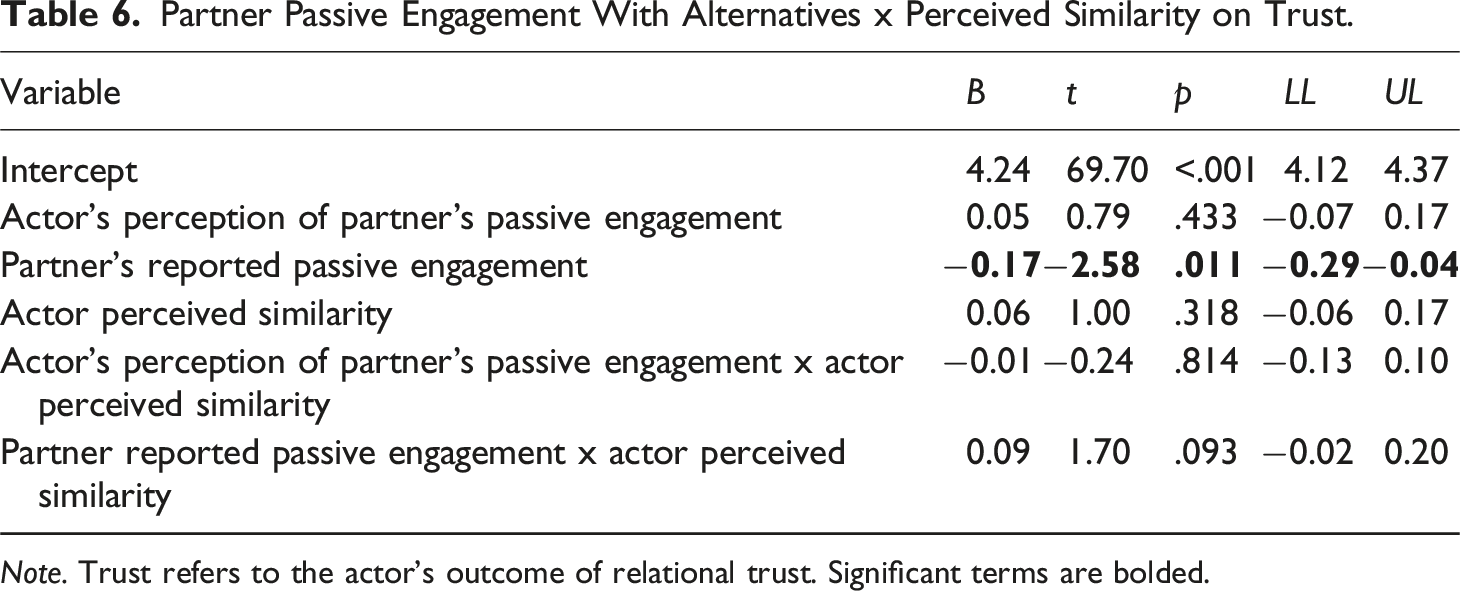
Variable
B
t
p
LL
UL
Intercept
4.24
69.70
<.001
4.12
4.37
Actor’s perception of partner’s passive engagement
0.05
0.79
.433
−0.07
0.17
Partner’s reported passive engagement
Actor perceived similarity
0.06
1.00
.318
−0.06
0.17
Actor’s perception of partner’s passive engagement x actor perceived similarity
−0.01
−0.24
.814
−0.13
0.10
Partner reported passive engagement x actor perceived similarity
0.09
1.70
.093
−0.02
0.20
Partner Active Engagement With Alternatives x Perceived Similarity on Satisfaction. Note. Satisfaction refers to the actor’s outcome of relationship satisfaction. Significant terms are bolded.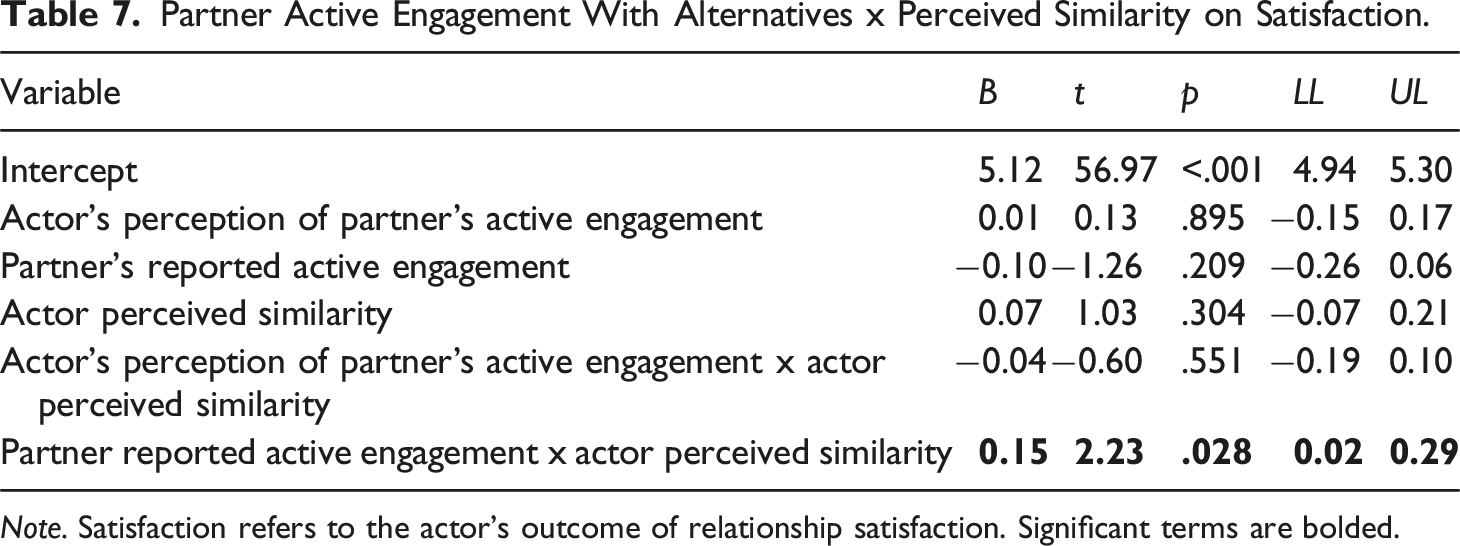
Variable
B
t
p
LL
UL
Intercept
5.12
56.97
<.001
4.94
5.30
Actor’s perception of partner’s active engagement
0.01
0.13
.895
−0.15
0.17
Partner’s reported active engagement
−0.10
−1.26
.209
−0.26
0.06
Actor perceived similarity
0.07
1.03
.304
−0.07
0.21
Actor’s perception of partner’s active engagement x actor perceived similarity
−0.04
−0.60
.551
−0.19
0.10
Partner reported active engagement x actor perceived similarity
Partner Passive Engagement With Alternatives x Perceived Similarity on Satisfaction. Note. Satisfaction refers to the actor’s outcome of relationship satisfaction. Significant terms are bolded.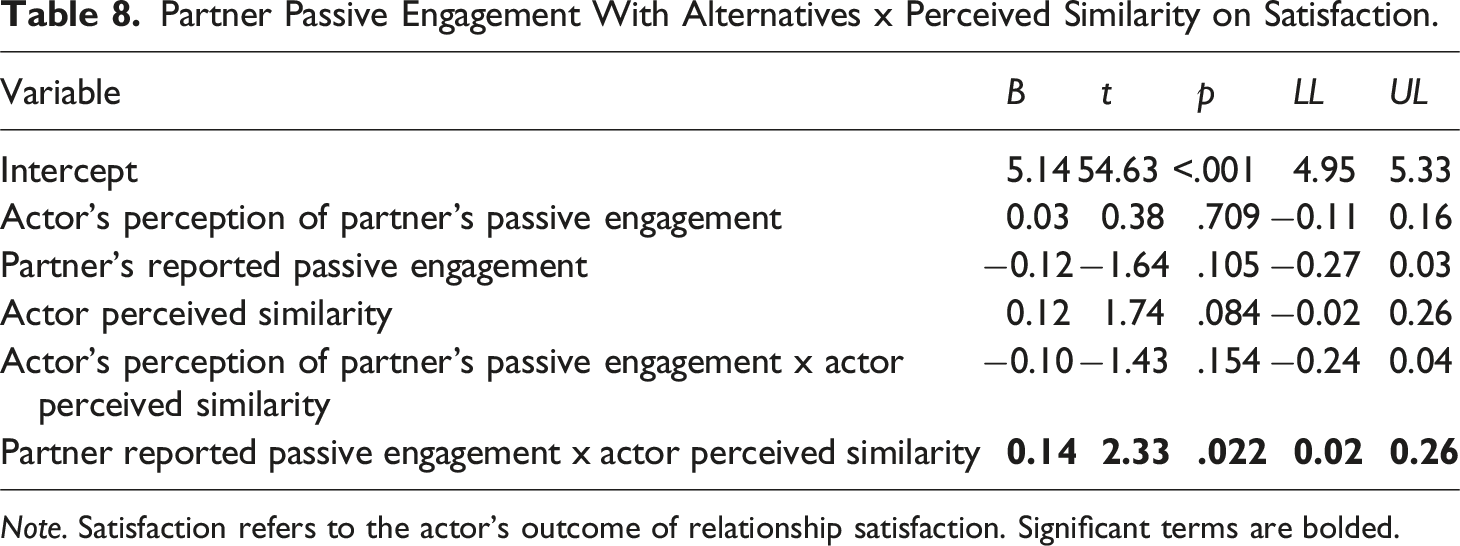
Variable
B
t
p
LL
UL
Intercept
5.14
54.63
<.001
4.95
5.33
Actor’s perception of partner’s passive engagement
0.03
0.38
.709
−0.11
0.16
Partner’s reported passive engagement
−0.12
−1.64
.105
−0.27
0.03
Actor perceived similarity
0.12
1.74
.084
−0.02
0.26
Actor’s perception of partner’s passive engagement x actor perceived similarity
−0.10
−1.43
.154
−0.24
0.04
Partner reported passive engagement x actor perceived similarity
References
Supplementary Material
Please find the following supplemental material available below.
For Open Access articles published under a Creative Commons License, all supplemental material carries the same license as the article it is associated with.
For non-Open Access articles published, all supplemental material carries a non-exclusive license, and permission requests for re-use of supplemental material or any part of supplemental material shall be sent directly to the copyright owner as specified in the copyright notice associated with the article.
