







Abstract
Desired friends represent aspirational relationships. But are they realistic? Two longitudinal studies were conducted, each with two waves of data within a single school year. Participants included 340 boys and 385 girls, ages 10–14, from Florida (U.S.) and Lithuania. Participants identified and rank-ordered classmates who were desired friends and existing friends. Peer nominations assessed status and attributes (i.e., academic achievement, attractiveness, athleticism, fun, popularity, unpopularity). Few (3.1–13.4%) desired friends became reciprocated friends. Desired friends had higher status and more favorable attributes than (a) those not nominated as desired friends and (b) those who desired them as friends. Youth had more in common with existing friends than desired friends. We conclude that desired friends represent unattainable ideals rather than realistic interpersonal goals.
Most youth report that friends are among their most important interpersonal relationships (Laursen & Williams, 1997). And for good reason: Friends proffer critical interpersonal resources and impact academic, social, and emotional well-being. Friends offer instrumental aid, emotional support, and protection against bullies (Kendrick et al., 2012; Vitaro et al., 2009). Friend loss is tied to a host of untoward consequences (Leclerc Bedard et al., 2025). Youth devote extraordinary amounts of time and energy to friendships, yet motives for friend selection are something of a mystery. Scholars know that similarity increases the likelihood of formation and decreases the likelihood of dissolution (Laursen, 2017). It is not clear, however, that youth reflect on this fact when identifying desired friends (i.e., those they want to become friends with). In romantic contexts, adults are more likely to opt for partners who represent unattainable ideals than for similar others (Eastwick & Finkel, 2008). We suspected that the same would be true of desired friends during childhood and adolescence. The present longitudinal study utilizes a representative sample of U.S. and Lithuanian 10–14-year-olds to ascertain whether those desired as friends early in the school year later become reciprocated friends. To determine the degree to which selections represented realistic choices or aspirational goals, we (a) examined whether participants nominated as desired friends possessed more favorable attributes than those not nominated as desired friends and those who desired them as friends and (b) contrasted desired friend-nominator similarity with existing friend-nominator similarity.
What Are Desired Friends?
Herein we define desired friends as classmates whom youth would like to become friends with, excluding those they already consider to be friends. We start from the premise that desired friends are best measured through a direct inquiry: A nominator identifies a target nominee as someone they would like to have as a friend. Desired friendships are, by definition, a subjective experience. To our knowledge, only one study has directly assessed desired friends, using a limited (3) nomination procedure with U.S. middle school students (Thomas & Bowker, 2013): “Someone you are not friends with but that you’d like to have as a friend.”
Desired relationships conceptually resemble ideal relationships. Initially focused on romantic relationships, the ideal standards model holds that individuals evaluate existing and prospective relationship partners against a set of relationship goals and expectations (Fletcher et al., 1999). Ideal partners are abstract or imagined peers who possess the qualities most desired in a partner. Thus, ideal partners differ from desired partners in that the latter involve specific individuals identified as potential partners whereas the former represent hypothetical constructs that are neither named nor framed as prospective partners. Adults evaluate adult romantic relationships according to expectations for warmth/intimacy, vitality/attractiveness and status/resources (Simpson et al., 2001). Standards for adult friends also include expectations of similarity, fun, and instrumental aid (Hall, 2012).
It is reasonable to assume that ideal friendship standards offer insight into the attributes, if not the identity, of desired friends. If so, they reveal a tension between aspirations and realism. Both are driven by the aim to optimize the benefits that flow from relationship participation. Standards reflecting a preference for partners with resources (e.g., vitality/attractiveness, status, fun, instrumental aid) reflect the goals of leveraging relationship exchanges into rewards. Partners with desirable attributes proffer opportunities for personal gain. In this vein, self-expansion theory holds that individuals are motivated to form relationships that broaden identities, increase resources, and enhance capabilities (Aron et al., 2013). Other models argue that humans are evolutionarily biased toward affiliation with high status individuals because status serves as a heuristic cue that signals competence and success (Henrich & Gil-White, 2001), providing the individual with opportunities for skill acquisition and rewards arising from basking in reflected glory (Dijkstra et al., 2010). Desired friends who align with these models are aspirational because they focus on higher status, out-of-reach others. Standards reflecting a preference for partners who offer the prospect of communality (e.g., similarity, warmth/intimacy) reflect the goal of leveraging relationship exchanges into interpersonal success. Matching or assortative pairing models hold that individuals seek partners of comparable social desirability because they know that upward affiliation efforts violate status equivalence norms and are unlikely to succeed (Berscheid et al., 1971). Similarity-attraction models hold that similar individuals share attitudes, interests and behaviors, which facilitates rewarding interactions and helps avoid aversive exchanges (Byrne, 1971). Relationship disruption is painful; a focus on compatibility is an acknowledgement that dissimilar relationships tend to be short-lived (Laursen, 2017). Desired friends who align with these models are realistic because they focus on compatible others with whom one might reasonably expect to form and maintain a friendship.
Who Are Desired Friends?
With age, views of friendship become increasingly sophisticated. Intimacy, loyalty, reciprocity, and trust are rated as more important than companionship, instrumental aid, and shared interests and beliefs (Furman & Bierman, 1983). Young adolescent depictions of ideal friends typically prioritize relationship support and trust over companionship and similarity (Kitts & Leal, 2021). Peer hierarchies come into focus at this age, accompanied by a growing recognition of the strategic value of affiliating with high-status peers (Laursen & Veenstra, 2023). Being liked and being popular are increasingly tied to aggression and prosocial behavior (Hartl et al., 2020), academic achievement (Brass & Ryan, 2021), attractiveness and physical abilities (Leggett-James et al., 2023), and being perceived as someone who is fun (Laursen et al., 2020). A fault line emerges: Closeness, reciprocity, and intimacy are not necessarily compatible with the company of high status, highly desirable agemates. As noted above, conceptual models of preferred affiliates reflect this tension. Some emphasize a desire to maximize personal benefits through affiliation with aspirational partners, whereas others emphasize a desire to maximize compatibility, with the goal of forming and maintaining a close relationship.
The extant literature does little to resolve this conundrum. In a groundbreaking study, middle school students reported that desired friends are popular, preferred (i.e., receive more liked-most nominations than liked-least nominations), and aggressive, but not prosocial (Thomas & Bowker, 2013). Similarity was not addressed in this study. These findings contrast with young adolescents’ reports of traits desirable in an ideal friend: Humor and common interests scored above status markers such as popularity, attractiveness, and sportiness (Wagner, 2019). More definitive conclusions can be drawn from research on romantic relationships. Young adults emphasize rewards and not similarity in their choice of desired partners. Kindness, followed by physical attractiveness, good financial prospects, and a good sense of humor are mate-preference priorities (e.g., Thomas et al., 2020). Ideal romantic partners are sometimes described in terms of similarity and shared interests, but these are typically of secondary importance (Regan et al., 2000). Romantic interest following speed dating is a function of attractiveness, earning potential, and personability; similarity is unrelated to partner preference (Eastwick & Finkel, 2008).
Some may object that our literature review omits unilateral friends. This is not an oversight. Although a few previous studies have operationalized desired friends in terms of unreciprocated friend nominations (e.g., Scholte et al., 2009), the practice is controversial and not widespread. The notion that unreciprocated friends are equivalent to desired friends rests on unverified assumptions about the motives of nominators (i.e., intentionally identifying desired relations in lieu of following instructions and identifying existing relations). Most scholars hold that unilateral friends represent a distinct type of peer relationship, one where participants hold differing perceptions of the strength of their affiliation (e.g., Almaatouq et al., 2016). Furthermore, unreciprocated friendships must necessarily encompass nominations that were not reciprocated because of error or oversight, implying that they include existing friendships. For these reasons, we hold that unreciprocated friend nominations ought not be considered evidence of a desired friendship and we refrain from summarizing them as such.
Who Are Future Friends?
Future friends describe forthcoming affiliations. In a longitudinal framework, two individuals who do not nominate one another at an initial time point may be described as future friends should they eventually nominate one another as friends at a later time point.
Empirical evidence overwhelmingly supports the view that future friends are established on the basis of compatibility rather than aspirational status. Adolescents are more likely to become and remain friends with peers who resemble them on both positive and negative attributes as well as on peer status (Hafen et al., 2011). Conversely, dissimilarity predicts dissolution (Hartl et al., 2015). There is little truth to the conventional view that relationships thrive on differences. Social network studies report that friend nominations directed toward higher-status peers are unlikely to be reciprocated when the nominator is a lower status classmate (Ball & Newman, 2012). A similar pattern emerges in the romantic domain. Individuals tend to pursue online dating partners who are, on average, 25% more desirable than themselves; their interest is rarely reciprocated (Bruch & Newman, 2018). Such findings have important implications for our understanding of desired friends, because they suggest that the pursuit of aspirational partners who possess highly valued attributes is unlikely to be successful.
Why Do Desired Friends Matter?
Desired friends offer a window onto friendship motives. First, like desired romantic partners, desired friends reflect interpersonal intent. Knowing who someone wants to become friends with can help us understand why. Dissimilar desired friends, particularly if the targets are influential and rewarding, suggest a focus on aspirations. Similar desired friends suggest a focus on compatibility. Second, some desired friends may be targeted as potential future friends. The success of these efforts could depend on the reasons for their selection. Desired friendships may fail to materialize because they reflect aspirational (unrealistic) social pursuits rather than compatible (realistic) prospects. Finally, as is the case for desired romantic partners, desired friends may serve as benchmarks against which existing friends are measured (Fletcher et al., 2000). Relationship contentment hinges on comparisons with ideals and alternatives. Ideal/existing relationship discrepancies diminish satisfaction (Hall et al., 2011), which is a harbinger of friendship instability (Faur et al., 2024).
The Present Study
We start from the premise that to understand the meaning and significance of desired friends we must ascertain the degree to which their characteristics map onto those of existing friends and future friends. The present longitudinal study encompassed three research aims. The first aim was to determine whether classmates identified as desired friends at the start of the school year subsequently became future friends (i.e., reciprocated friends later in the year). Do desired friends become new reciprocated friends? Given that desired romantic partners rarely become actual partners (Bruch & Newman, 2018), we hypothesized that most desired friends would not become reciprocated friends. The second aim was to describe the attributes of desired friends, on the assumption that targets would personify rewarding traits and social standing. Do classmates nominated as a desired friend have more favorable attributes than those who are not nominated as a desired friend? And, relatedly, do classmates nominated as desired friends have more favorable attributes than those who nominated them? Expanding on results from a previous study (Thomas & Bowker, 2013), we hypothesized that classmates nominated as desired friends would have higher status and have more favorable and fewer unfavorable attributes than (a) those not nominated as desired friends and (b) those who desired them as friends. The third aim was to determine whether desired friends resembled existing friends. Are youth more similar to their existing friends than to their desired friends? To this end, we compared the similarity of nominators with their existing friends to the similarity of nominators with those they desired as friends. Two alternative hypotheses were tested. Comparable levels of similarity in existing and desired friends support the proposition that nominators emphasize compatibility in the choice of desired friends. Greater dissimilarity in desired friends than in existing friends suggests that nominators emphasize aspirations over compatibility in the choice of desired friends. We predicted the latter, expecting nominators to be more focused on the potential rewards proffered by an attractive high-status affiliate than on the actual prospects that a desired relationship would be realized.
To address these hypotheses, we tracked adolescents from the United States and Lithuania across an academic year, using peer nominations to identify and describe desired friends, existing friends, and future friends. Replication is a strength of the study. We conducted two studies that differed in terms of the age and location of the participants and the size and focus of the nomination pool. Study 1 examined same-sex desired, existing, and future friends in a representative sample of Florida (USA) primary and middle school students. Study 2 examined same- and other-sex desired, existing, and future friends in a representative sample of Florida (USA) middle school students and in a community sample of Lithuania middle school students. Study 1 describes four characteristics of desired friends: Academic achievement, fun, popularity, and unpopularity. Study 2 replicates findings for these variables and expands the list to include athleticism and attractiveness, two attributes that are highly salient in the peer social world during adolescence (Leggett-James et al., 2023). Converging evidence with different samples from different locations using different methods and different outcome measures will enhance the generalizability of the findings and bolster confidence in the conclusions.
Study 1
Method
Participants
Participants (ages 10–13, M = 10.97 years, SD = 0.69, Mdn = 11) included 156 girls and 123 boys attending one public primary (5th grade, n = 146) and one public middle school (6th grade, n = 133) in South Florida. An enrollment lottery system ensured that the student population was representative of the school-age population of Florida in terms of ethnicity and family income. Primary school students kept the same classmates across the school day. Middle school students attended classes with a rotating subset of students from the same pod (i.e., two homeroom classes that met jointly once a day). The sample was 50.2% European American, 22.9% African American, 15.4% Hispanic American, and 11.5% had mixed/other backgrounds.
Procedure
Written parent consent and child assent were required for participation. The project was approved by school officials and the university IRB (#702335–1). In 12 of 13 classrooms/pods, participation rates averaged 76.4% (range = 60.9–97.5%); one class below 60% was excluded. Trained research assistants administered paper-pencil surveys during regular school hours. Of the 279 February 2014 (Winter/Time 1) participants, 97.4% (n = 272) completed surveys in May 2014 (Spring/Time 2).
Measures
Desired friend and existing friend nomination rosters included all same-sex classmates or podmates. Rosters were limited to same-sex participants to reduce questionnaire length and because reciprocated friendships are overwhelmingly same-sex at this age (Bukowski et al., 1999). Nonparticipant and out-of-class nominations were permitted (i.e., My friend is not listed).
Desired Friends
In Winter (Time 1), participants identified and rank-ordered up to ten same-sex classmates (5th grade) or podmates (6th grade) as desired friends (i.e., Who would you like to become friends with?). Consistent with Study 2, we focus here on the 5 top-ranked nominations. Rank describes the order of nominations, with lower values reflecting higher-ranked nominations. Thus, top-ranked desired friends represented a participant’s highest ranked nomination. Some participants nominated existing friends as desired friends; these were omitted. Lower-ranked desired friend nominations were moved up to replace nonparticipant and existing friend nominations. In the final dataset, participants nominated an average of 1.29 desired friends (SD = 1.48, range = 0–5). Participants with at least one desired friend (n = 164) nominated an average of 2.19 desired friends (SD = 1.31, range = 1–5). When lower-ranked desired friend nominations were not moved up to replace nonparticipant nominations, participants nominated an average of 1.24 desired friends (SD = 1.45, range = 0–5). Participants with at least one desired friend (n = 158) nominated an average of 2.18 desired friends (SD = 1.29, range = 1–5). When all 10 desired friend nominations were included (excluding existing friends), participants nominated an average of 1.51 desired friends (SD = 1.94, range = 0–10). In this case, participants with at least one desired friend (n = 156) nominated an average of 1.51 desired friends (SD = 1.89, range = 1–10).
Nominated as Desired Friends
Participants were categorized into two groups based on whether they received at least one desired friend nomination: (a) nominated as a desired friend (n = 168) or (b) not nominated as a desired friend (n = 111). When lower-ranked desired friend nominations were not moved up to replace nonparticipant nominations, 163 were nominated as a desired friend and 116 were not.
Desirability
The sum of desired friend nominations a participant received was converted to a proportion score to account for different class enrollments (M = 0.08, SD = 0.09, range = 0.00–0.50). When lower-ranked desired friend nominations were not moved up to replace nonparticipant nominations, the average proportion score was 0.08 (SD = .09, range = 0.00–0.50).
Existing Friends
In the Winter (Time 1) and Spring (Time 2), participants identified and rank-ordered up to ten same-sex classmates (5th grade) or podmates (6th grade) as friends (i.e., Who are your friends?). Consistent with Study 2, we focus here on the 5 top-ranked nominations. Lower-ranked friend nominations were moved up to replace nonparticipant nominations. In the final dataset, participants nominated an average of 4.57 friends (SD = 0.95, range = 0–5) in Winter (Time 1) and 4.38 friends (SD = 1.27, range = 0–5) in Spring (Time 2). Almost all (98.9%) participants nominated at least one friend. When lower-ranked friend nominations were not moved up to replace nonparticipant nominations, participants nominated an average of 4.37 friends (SD = 1.74, range = 0–5) in Winter (Time 1) and 4.29 friends (SD = 1.28, range = 0–5) in Spring (Time 2). When all 10 friend nominations were included, participants nominated an average of 6.86 friends (SD = 2.68, range = 0–10) and 6.58 friends (SD = 2.98, range = 0–5) in Spring (Time 2).
Reciprocated friends were dyads in which both partners concurrently nominated one another as an existing friend.
New reciprocated friends were dyads in which at least one partner did not nominate the other as an existing friend in Winter (Time 1), and both partners nominated each other as an existing friend in Spring (Time 2).
Nominated as desired friends→New reciprocated friends were dyads in which (a) one or both partners did not nominate the other as an existing friend in Winter (Time 1), and (b) one or both partners nominated the other as a desired friend in Winter (Time 1), and (c) both partners nominated each other as existing friends in Spring (Time 2).
Nominated as desired friends→Not new reciprocated friends were dyads in which (a) one or both partners did not nominate the other as an existing friend in Winter (Time 1), and (b) one or both partners nominated the other as a desired friend in Winter (Time 1), and (c) one or neither partner nominated the other as an existing friend in Spring (Time 2).
Not nominated as desired friends→New reciprocated friends were dyads in which (a) one or both partners did not nominate the other as an existing friend in Winter (Time 1), and (b) one or both partners did not nominate the other as a desired friend in Winter (Time 1), and (c) both partners nominated each other as existing friends in Spring (Time 2).
Peer Reputation
In Winter (Time 1), participants identified unlimited same-sex classmates (5th grade) or podmates (6th grade) who best fit each descriptor: academic achievement (i.e., Someone who does well in school), fun (i.e., Someone who is fun to be around), popularity (i.e., Someone who is popular), and unpopularity (i.e., Someone who is not popular). Parallel to friend nominations, rosters were limited to same-sex participants. Doing so limits gender stereotyping (Rubin et al., 2006) and (in the 6th grade) minimizes fatigue and error arising from lengthy class lists. For each variable, the sum of nominations a participant received was converted to a proportion score to account for different class enrollments (academic achievement: M = 0.45, SD = 0.24; fun: M = 0.43, SD = 0.21; popularity: M = 0.29, SD = 0.23; unpopularity: M = 0.25, SD = 0.20).
Plan of Analysis
The analyses described below correspond directly to the results that follow.
The first analyses determined whether desired friend nominations were aspirational or realistic. We expected the bulk would not become reciprocated friends, suggesting that these nominations were aspirational. To understand why, additional analyses examined the characteristics of desired friends. We expected that because desired friends were aspirational, they would describe ideal out-of-reach prospective partners, with more favorable characteristics than both those who were not nominated as desired friends and those who nominated them as desired friends. To underscore the unrealistic nature of these nominations, we examined the degree to which nominators were similar to their desired friends and to their existing friends. We anticipated considerably more similarity in the latter than the former.
First, a one-way chi-square (nominated as desired friends→new reciprocated friends) tested the hypothesis that desired friends tend not to become reciprocated friends. To this end, outgoing Winter (Time 1) desired friend nominations were categorized according to their Spring (Time 2) reciprocated friendship status: (a) became new reciprocated friends or (b) did not become new reciprocated friends. Participants made varying numbers of desired friend nominations. To minimize concerns about nonindependence and unequal contributions to the data, the chi-square was repeated with one randomly selected desired friend nomination from each participant. Both analyses were restricted to participants who made at least one desired friend nomination (n = 164). To ensure that the results were not biased by our decision to limit the dataset to the top 5 nominations, the analyses were repeated with all desired and existing friend nominations from each participant.
Second, a series of one-way ANOVAs tested the hypothesis that youth who were desired as friends have more positive and fewer negative attributes than youth who were not nominated as desired friends. Nominated as a desired friend (yes or no) at Winter (Time 1) was the between-subjects factor. Academic achievement, fun, popularity, and unpopularity at Winter (Time 1) were the dependent variables. All participants were included in these analyses (n = 279).
Third, repeated measures ANOVAs tested the hypothesis that top-ranked desired friends have more positive and fewer negative attributes than those who nominated them as a desired friend. Dyad member (nominator and nominator’s 1st-ranked desired friend) was the repeated measure. Academic achievement, fun, popularity, and unpopularity were the dependent variables. The analyses were restricted to participants who made at least one desired friend nomination (n = 164). In a few instances (n = 10), two participants reciprocally nominated one another as desired friends. The analyses were repeated with one randomly selected member of these dyads.
Finally, correlation contrasts tested the hypothesis that youth are more similar to existing friends than to desired friends. Two sets of intraclass correlations were calculated: (a) participants with their top-ranked existing friend nominee, and (b) participants with their top-ranked desired friend nominee. In these analyses, similarity was operationalized as a within-dyad intraclass correlation (Selover et al., 2026). Group differences in intraclass correlations were interpreted using confidence interval contrasts. Nonoverlapping intervals differed at p < .01 (Schenker & Gentleman, 2001); intervals that overlapped by less than half the average margin of error differed at p < .05 (Cumming & Finch, 2005). Duplicates were omitted [i.e., both members of a dyad nominated each other as top-ranked friends (n = 46) or as top-ranked desired friends (n = 10)]. Analyses were restricted to participants with both desired and existing friends (n = 161).
To ensure that the results were not a product of elevating participant nominations to replace nonparticipant desired and existing friend nominations, the analyses were repeated without altering ranks. The same pattern of statistically significant results emerged.
The first three sets of analyses were conducted in SPSS v25.0 (IBM Corp, 2019). The fourth were conducted in Mplus v8.6 (Muthén & Muthén, 1998–2017).
Missing Data
All participants had friend and desired friend nomination data in Winter (Time 1), and all participants had peer reputation data (i.e., were potential nomination targets) in Winter (Time 1) and in Spring (Time 2). Participants (n = 7) absent in Spring (Time 2) did not nominate existing friends, resulting in wave-level missing data for new reciprocated friends and desired friends→new reciprocated friends. Tests of missingness were not conducted because the amount of missing data (0.5%) was negligible (Schafer, 1999). Wave-level missing data were handled with multiple imputation using an EM algorithm with 25 iterations. The same pattern of statistically significant results emerged when cases with missing data were omitted from the analyses.
Power Analysis
Chi-square power estimates were calculated with G*Power 3.1.9.6 (Faul et al., 2007) to determine power (80%) to detect small (w = 0.10), medium (w = 0.30), and large (w = 0.50) effects. There was adequate power to detect large (Mpower>0.99, range>0.99–0.99) and medium (Mpower = 0.98, range = 0.97–0.99) effects, but less power to detect small (Mpower = 0.36, range = 0.25–0.47) effects.
ANOVA power estimates were calculated with G*Power 3.1.9.6 (Faul et al., 2007) to determine power (80%) to detect small (d = 0.20), medium (d = 0.50), and large (d = 0.80) effects. There was adequate power to detect large and medium (Mpower>0.99, range>0.99–0.99) differences, but less power to detect small (Mpower = 0.56, range = 0.39–0.72) effects.
To determine the power (80%) to detect small (ICC = .05), medium (ICC = .10), and large (ICC = .20) intraclass correlations, an F-distribution-based power analysis was conducted in RStudio (R Core Team, 2023). There was adequate power to detect large (Power>.99) and medium (Power = .95) intraclass correlations, but less power to detect small (Power = .28) intraclass correlations.
Results
Preliminary Analyses
Interclass correlations, conducted on Winter (Time 1) variables, revealed statistically significant positive correlations for desirability with academic achievement (r = .135, p = .024) and popularity (r = .202, p = .001). A negative correlation emerged for desirability with unpopularity (r = −.214, p < .001). Desirability was not significantly correlated with fun (r = −.016, p = .795).
Do Desired Friends Become New Reciprocated Friends?
New reciprocated friendships were rare. Only 2.9% of Winter (Time 1) dyads became reciprocated friends in the Spring (Time 2). One-way chi-square analyses [χ2 (1) = 34.000, p < .001] indicated that future reciprocated friends (N = 136) were more likely to be drawn from those who were not nominated as desired friends (n = 102; 75.0%) than from those nominated as desired friends (n = 34, 25.0%). Put differently, youth acquired an average of 0.49 new reciprocated friends in Spring (Time 2). Of this total, 0.12 were nominated as desired friends in Winter (Time 1) and 0.37 were not nominated as desired friends in Winter (Time 1). The same pattern of statistically significant results emerged when all 10 existing and desired friend nominations were included. In this case, 4.4% of Winter (Time 1) dyads became reciprocated friends in the Spring (Time 2). One-way chi-square analyses [χ2 (1) = 36.565, p < .001] indicated that future reciprocated friends (N = 207) were more likely to be drawn from those who were not nominated as desired friends (n = 147; 71.0 %) than from those nominated as desired friends (n = 60, 29.0%). When all friend and desired friend nominations were included in the analyses, youth acquired an average of 0.74 new reciprocated friends in Spring (Time 2). Of this total, 0.21 were nominated as desired friends in Winter (Time 1) and 0.53 were not nominated as desired friends in Winter (Time 1).
A one-way chi-square examined the distribution of nominated as desired friends→new reciprocated friends. Winter (Time 1) desired friend nominations did not forecast new reciprocated friendships in Spring (Time 2), χ2 (1) = 235.880, p < .001. Of the 359 desired friend nominations in Winter (Time 1), only 34 (9.5%) became reciprocated friends in Spring (Time 2). The same pattern of statistically significant results emerged when all existing and desired friend nominations were included in the analyses: Winter (Time 1) desired friend nominations did not forecast new reciprocated friendships in Spring (Time 2), χ2 (1) = 214.286, p < .001. Of the 420 desired friend nominations in Winter (Time 1), only 60 (14.3%) became reciprocated friends in Spring (Time 2).
The analyses were repeated with one randomly selected desired friend nomination per participant. Again, Winter (Time 1) did not forecast new reciprocated friendships in Spring (Time 2), χ2 (1) = 87.805, p < .001. Of the 164 randomly selected desired friend nominations in Winter (Time 1), only 22 (13.4%) became reciprocated friends in Spring (Time 2). The same pattern of statistically significant results emerged when all friend and desired friend nominations were included in the analyses: Winter (Time 1) desired friend nominations did not forecast new reciprocated friendships in Spring (Time 2), χ2 (1) = 94.696, p < .001. Of the 184 desired friend nominations in Winter (Time 1), only 26 (14.1%) became reciprocated friends in Spring (Time 2).
Do Classmates Nominated as a Desired Friend Have More Favorable Attributes Than Those Who Are Not Nominated as a Desired Friend?
Results from one-way between-subject ANOVAs revealed a statistically significant main effect for desired as friends. Compared to those who were not nominated as desired friends (n = 111), those who were nominated as desired friends (n = 168) at Fall (Time 1) were rated lower in unpopularity, F (1,277) = 6.517, p = .011 (d = 0.309). Desired friends scored higher on academic achievement than those who were not nominated as desired friends, a difference that failed to reach conventional levels of statistical significance, F (1,277) = 2.790, p = .096 (d = 0.204). There were no statistically significant differences on fun, F (1,277) = 0.339, p = .561 (d = 0.071), or popularity, F (1,277) = 0.910, p = .341 (d = 0.117).
Do Classmates Nominated as Desired Friends Have More Favorable Attributes Than Those Who Nominated Them?
Results from one-way repeated measures ANOVAs revealed statistically significant main effects for dyad member. Compared to nominators, those nominated as desired friends scored higher on academic achievement, F (1,162) = 4.633, p = .033 (d = 0.168), fun, F (1,162) = 4.473, p = .036 (d = 0.165), popularity F (1,162) = 7.348, p = .007 (d = 0.212), and unpopularity, F (1,162) = 8.044, p = .005 (d = 0.221).
The analyses were repeated omitting one randomly selected member from 10 dyads in which participants nominated one another as desired friends. The same pattern of statistically significant results emerged.
Are Youth More Similar to Their Existing Friends Than to Their Desired Friends?
Positive statistically significant correlations (p < .001) emerged between participants and their top-ranked existing friend: academic achievement (r = .473), fun (r = .518), popularity (r = .456), and unpopularity (r = .563). In contrast, no statistically significant correlations emerged between participants and their top-ranked desired friend: academic achievement (r = .113, p = .153), fun (r = .004, p = .959), popularity (r = −0.134, p = .090), and unpopularity (r = −0.110, p = .163). On each variable, correlation confidence interval contrasts indicated that participants were statistically significantly (p < .05) more similar to existing friends than to desired friends.
Study 2
Methods
Participants
U.S. participants (ages 10–14, M = 12.22 years, SD = 0.62, Mdn = 12) included 114 girls and 105 boys attending one public middle school (6th grade, n = 113 and 7th grade, n = 106) in South Florida. An enrollment lottery system ensured that the student population was representative of the school-age population of Florida in terms of ethnicity and family income. Students attended classes with a rotating subset of students from the same pod (i.e., four homeroom classes that met jointly once a day). Teachers rotated between classes. Of these, 40.2% were European-American, 19.2% were African American, 29.7% were Hispanic American, and 10.9% had mixed/other backgrounds.
Lithuanian participants (ages 11–14, M = 12.41 years, SD = 0.61, Mdn = 12) included 115 girls and 112 boys attending all three middle schools (6th grade, n = 85 and 7th grade, n = 142) in a mid-sized Eastern Lithuanian city. Students kept the same teachers and classmates across the school day. Nearly all students were ethnic Lithuanian.
Procedure
Written parent consent and child assent were required for participation. The study was approved by school officials and the university IRB (#135501-16) or ethics committee (Lithuania #6/-2020). Trained research assistants administered surveys on computer tablets during regular school hours. U.S. participation rates averaged 71.2% across pods (range = 64.6%–75.9%). In 13 of 23 classrooms, Lithuanian participation rates averaged 71.1% (range = 62.1%–92.0%); 10 classes with participation rates below 60% were excluded from the analyses. Two waves of data were collected: (1) October (Lithuania)/November (U.S.) 2021 and (2) May (Lithuania)/March (U.S.) 2022. Of those who participated in the first wave, 90.4% (U.S.) and 96.9% (Lithuania) completed surveys in the second wave. Measures were translated from English to Lithuanian by a bilingual team of research assistants and then back translated by a separate team. Differences were resolved through discussion.
Measures
Desired friend and existing friend nomination rosters included all same- and other-sex classmates (Lithuania) or podmates (United States). Nonparticipant and out-of-class nominations were permitted (i.e., My friend is not listed).
Desired Friends
In Fall (Time 1), participants identified and rank-ordered an unlimited number of podmates (United States) or classmates (Lithuania) as desired friends (i.e., Thinking of those who are not currently your friends, who would you like to become friends with?). To maintain consistency across locations and studies, and with nominations permitted for existing friends, analyses were restricted to the 5 top-ranked nominations. Some participants nominated existing friends as desired friends; these were omitted. Lower-ranked desired friend nominations were moved up to replace nonparticipant and existing friend nominations. In the final dataset, participants nominated an average of 0.94 desired friends (SD = 1.49; range = 0–5). Those with at least one desired friend (n = 173) nominated an average of 2.43 desired friends (SD = 1.46; range = 1–5). When lower-ranked desired friend nominations were not moved up to replace nonparticipant nominations, participants nominated an average of 0.85 desired friends (SD = 1.40, range = 0–5). Participants with at least one desired friend (n = 162) nominated an average of 2.33 desired friends (SD = 1.40, range = 1–5).
Nominated as Desired Friends
Participants were categorized into two groups based on whether they received at least one desired friend nomination: (a) nominated as a desired friend (n = 249) or (b) not nominated as a desired friend (n = 197). When lower-ranked desired friend nominations were not moved up to replace nonparticipant nominations, 229 were nominated as a desired friend and 217 were not.
Desirability
The sum of desired friend nominations a participant received was converted to a proportion score to account for different class enrollments (M = 0.06, SD = 0.08, range = 0.00–0.50). When lower-ranked desired friend nominations were not moved up to replace nonparticipant nominations, the average proportion score was 0.06 (SD = 0.08, range = 0.00–0.50).
Existing Friends
In Fall (Time 1) and Spring (Time 2), participants identified and rank-ordered up to seven podmates (United States) or five classmates (Lithuania) as friends (i.e., Who are your friends?). To maintain consistency across locations and studies, analyses were restricted to the 5 top-ranked nominations. Lower-ranked friend nominations were moved up to replace nonparticipant nominations. In the final dataset, participants averaged 3.30 friend nominations (SD = 1.52; range = 0-5) in Fall (Time 1) and 3.18 friend nominations (SD = 1.69; range = 0-5) in Spring (Time 2). When lower-ranked friend nominations were not moved up to replace nonparticipant nominations, participants nominated an average of 2.99 friends (SD = 1.66, range = 0-5) in Fall (Time 1) and 3.06 friends (SD = 1.68, range = 0-5) in Spring (Time 2).
See Study 1 for operational definitions of Reciprocated friends, New reciprocated friends, Nominated as desired friends→New reciprocated friends, and Not nominated as desired friends→New reciprocated friends.
Peer Reputation
In Fall (Time 1), participants identified unlimited podmates (United States) or classmates (Lithuania) who best fit each descriptor: academic achievement (i.e., Who does well in school?), athleticism (i.e., Who is good at sports?), attractiveness (i.e., Who is really good looking?), fun (i.e., Who is fun to be around?), popularity (i.e., Who is popular?), and unpopularity (i.e., Who is not popular?). For each variable, the sum of nominations a participant received was converted to a proportion score to account for different class enrollments.
Plan of Analysis
The same four sets of analyses were conducted as outlined in Study 1, and they correspond directly to the results that follow.
First, two one-way chi-squares (nominated as desired friends→new reciprocated friends) tested the hypothesis that desired friends tend not to become reciprocated friends. To this end, outgoing Fall (Time 1) desired friend nominations were categorized according to their Spring (Time 2) reciprocated friendship status: (a) became new reciprocated friends or (b) did not become new reciprocated friends. Separate analyses were conducted for the U.S. and Lithuania. Participants made varying numbers of desired friend nominations. To minimize concerns about nonindependence and unequal contributions to the data, the chi-squares were repeated with one randomly selected desired friend nomination from each participant. The analyses were also repeated with same-sex desired friend nominations, to replicate Study 1 methodology. Next, a 2 (U.S./Lithuania) x 2 (nominated as desired friends→new reciprocated friends) chi-square confirmed the replicability of the findings across locations. All analyses were restricted to participants who made at least one desired friend nomination (n = 173).
Second, one-way ANOVAs tested the hypothesis that youth who were nominated as desired friends have more positive and fewer negative attributes than those not nominated as desired friends. Nominated as desired friends (yes or no) and location (U.S. or Lithuania) were the between-subjects factors. Academic achievement, athleticism, attractiveness, fun, popularity, and unpopularity were the dependent variables. All participants were included in the analyses (n = 446).
Third, repeated measures ANOVAs tested the hypothesis that top-ranked desired friends have more positive and fewer negative attributes than those who nominated them as a desired friend. Dyad member (nominator and nominator’s 1st-ranked desired friend) was the repeated measure. Location (U.S. or Lithuania) was the between-subjects factor. Academic achievement, athleticism, attractiveness, fun, popularity, and unpopularity were the dependent variables. The analyses were restricted to participants who made at least one desired friend nomination (n = 173). In a few instances (n = 2), two participants reciprocally nominated one another as desired friends. The analyses were repeated with one randomly selected member from these dyads.
Finally, correlation contrasts tested the hypothesis that youth are more similar to existing friends than to desired friends. Two sets of intraclass correlations were calculated: (a) participants with their top-ranked existing friend nominee, and (b) participants with their top-ranked desired friend nominee. In these analyses, similarity was operationalized as a within-dyad intraclass correlation (Selover et al., 2026). Group differences in intraclass correlations were interpreted using confidence interval contrasts (see Study 1). Duplicates were omitted [i.e., both members of a dyad nominated each other as top-ranked friends (n = 26) or as top-ranked desired friends (n = 2)]. Finally, intraclass correlation contrasts compared results for U.S. and Lithuanian participants, to confirm the replicability of the findings. Analyses were restricted to participants with both desired and existing friends (n = 166).
To ensure that the results were not a product of elevating participant nominations to replace nonparticipant nominations, we repeated the analyses without adopting these changes in rank. The same pattern of statistically significant results emerged.
The first three sets of analyses were conducted in SPSS v25.0 (IBM Corp., 2019). The fourth were conducted in Mplus v8.6 (Muthén & Muthén, 1998–2017).
Missing Data
All participants had friend and desired friend nomination data in Fall (Time 1), and all participants had peer reputation data (i.e., were potential nomination targets) in Fall (Time 1) and in Spring (Time 2). Participants (n = 28) absent in Spring (Time 2) did not nominate existing friends, resulting in wave-level missing data for new reciprocated friends and desired friends→new reciprocated friends. Tests of missingness were not conducted because the amount of missing data (0.6%) was negligible (Schafer, 1999). Wave-level missing data were handled with multiple imputation using an EM algorithm with 25 iterations. The same pattern of statistically significant results emerged when cases with missing data were omitted from the analyses.
Power Analysis
Chi-square power estimates were calculated with G*Power 3.1.9.6 (Faul et al., 2007) to determine power (80%) to detect small (w = .10), medium (w = .30) and large (w = .50) effects. There was adequate power to detect large (Mpower>0.99, range>0.99–0.99) and medium (U.S. Mpower = .99, range = 0.98–0.99; Lithuania Mpower = .92, range = 0.86–0.97) effects, but less power to detect small (U.S. Mpower = 0.32, range = 0.27–0.37; Lithuania Mpower = .21, range = 0.18–0.24) effects. When analyses were restricted to one randomly selected nomination per participant, there was adequate power to detect large (Mpower>0.99, range>0.99–0.99) effects and medium effects (U.S. Power = 0.84; Lithuania Power = 0.74), but less power to detect small (U.S. Power = 0.14; Lithuania Power = 0.17) effects.
ANOVA power estimates were calculated with G*Power 3.1.9.6 (Faul et al., 2007) to determine power (80%) to detect small (d = .20), medium (d = .50) and large (d = .80) effects. There was adequate power to detect large and medium (Mpower>0.99, range>0.99–0.99) differences, but less power to detect small (Mpower = 0.65, range = 0.56–0.74) effects.
To determine the power (80%) to detect small (ICC = .05), medium (ICC = .10), and large (ICC = .20) intraclass correlations, an F-distribution-based power analysis was conducted in RStudio (R Core Team, 2023). There was adequate power to detect large (Power>.99) and medium (Power = .96) intraclass correlations, but less power to detect small (Power = .28) intraclass correlations.
Results
Preliminary Analyses
Interclass correlations, conducted on Fall (Time 1) variables, revealed statistically significant positive correlations for desirability with academic achievement (r = .181, p < .001), athleticism (r = .132, p = .005), attractiveness (r = .120, p = .011), fun (r = .264, p < .001), and popularity (r = .217, p < .001). Desirability was not significantly correlated with unpopularity (r = −.072, p = .129).
Do Desired Friends Become New Reciprocated Friends?
New reciprocated friendships were rare. Across locations, only 2.0% (U.S.: 0.9%; Lithuania: 3.0%) of Fall (Time 1) dyads became reciprocated friends in the Spring (Time 2). One-way chi-square analyses [U.S. χ2 (1) = 69.377, p < .001; Lithuania χ2 (1) = 85.723, p < .001] indicated that future reciprocated friends (U.S. N = 122; Lithuania N = 119) were more likely to be drawn from those who were not nominated as desired friends (U.S. n = 107; 88.7%; Lithuania n = 110; 92.4%) than from those nominated as desired friends (U.S. n = 15, 12.3%; Lithuania n = 9; 7.6%). Put differently, youth acquired an average of 0.54 (U.S. 0.56; Lithuania 0.52) new reciprocated friends in Spring (Time 2). Of this total, 0.05 (U.S. 0.07; Lithuania 0.04) were nominated as desired friends in Fall (Time 1) and 0.49 (U.S. 0.49; Lithuania 0.48) were not nominated as desired friends in Fall (Time 1).
One-way chi-squares examined the distribution of nominated as desired friends→new reciprocated friends, separately by location. Fall (Time 1) desired friend nominations did not forecast new reciprocated friendships in Spring (Time 2) [U.S. χ2 (1) = 205.435, p < .001; Lithuania χ2 (1) = 125.038, p < .001]. Of the 262 Fall (Time 1) desired friend nominations made by U.S. participants, only 15 (5.7%) became reciprocated in Spring (Time 2). Of the 159 Fall (Time 1) desired friend nominations made by Lithuanian participants, only 9 (5.7%) became reciprocated in Spring (Time 2). A 2 (U.S./Lithuania) x 2 (desired friends → new reciprocated friends) chi-square revealed no differences in the pattern of results across locations, χ2 (1) = 0.001, p = .978.
The analyses were repeated with one randomly selected desired friend nomination per participant. Again, Fall (Time 1) desired friend nominations did not forecast new reciprocated friendships in Spring (Time 2) [U.S. χ2 (1) = 86.367, p < .001; Lithuania χ2 (1) = 59.853, p < .001]. Of the 98 Fall (Time 1) desired friend nominations made by U.S. participants, only 3 (3.1%) became reciprocated in Spring (Time 2). Of the 75 Fall (Time 1) desired friend nominations made by Lithuanian participants, only 4 (5.3%) became reciprocated in Spring (Time 2).
The analyses were repeated with same-sex desired friend nominations. Fall (Time 1) desired friend nominations did not forecast new reciprocated friendships in Spring (Time 2) [U.S. χ2 (1) = 133.238, p < .001; Lithuania χ2 (1) = 74.462, p < .001]. Of the 185 Fall (Time 1) same-sex desired friend nominations made by U.S. participants, only 14 (7.6%) became reciprocated in Spring (Time 2). Of the 104 Fall (Time 1) same-sex desired friend nominations made by Lithuanian participants, only 8 (7.7%) became reciprocated in Spring (Time 2).
Do Classmates Nominated as a Desired Friend Have More Favorable Attributes Than Those Who Are Not Nominated as a Desired Friend?
Mean-Level Reputation Differences Between Students Who Received and Did Not Receive Desired Friend Nominations: Results From Study 2 Univariate ANOVAs
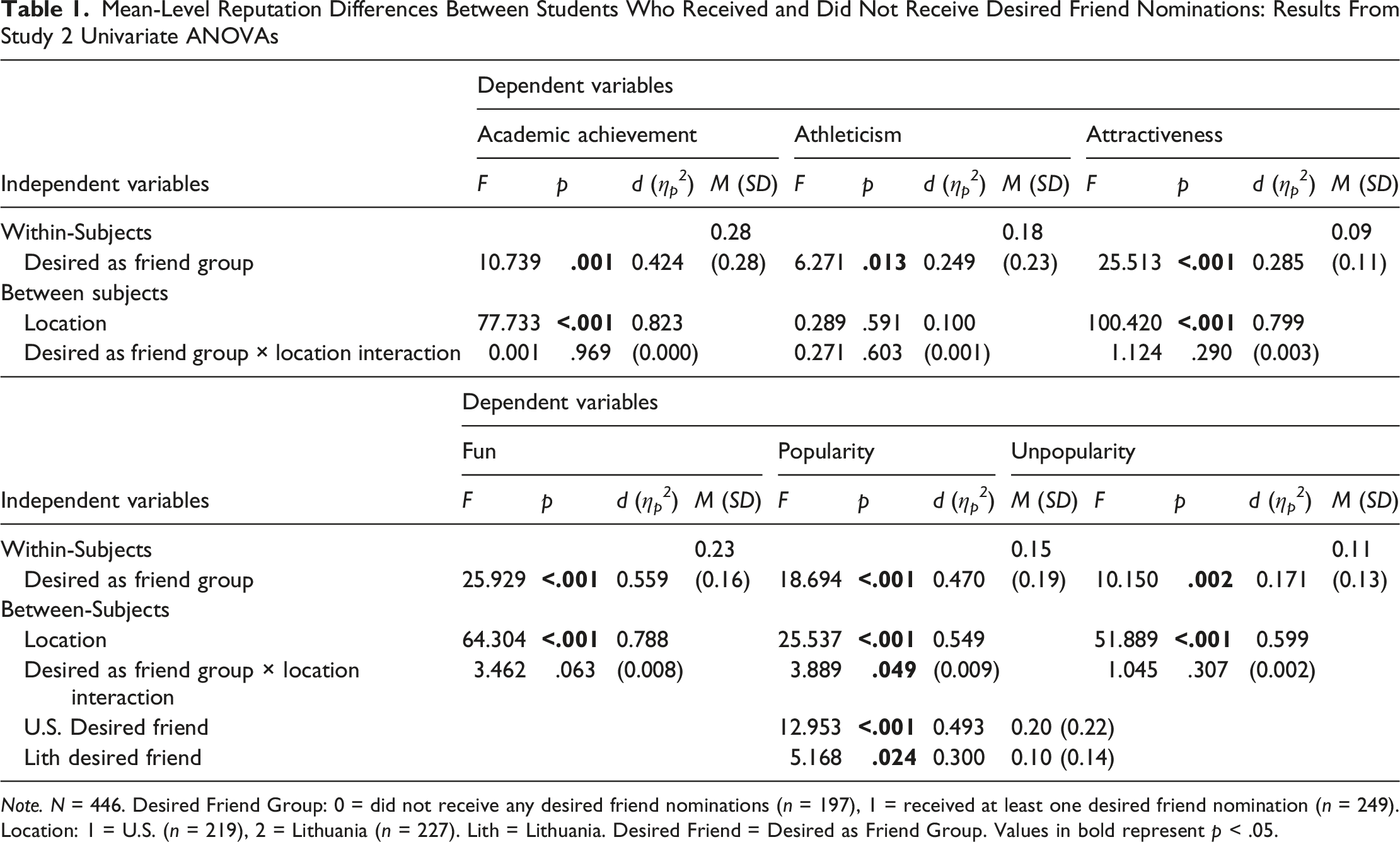
Note. N = 446. Desired Friend Group: 0 = did not receive any desired friend nominations (n = 197), 1 = received at least one desired friend nomination (n = 249). Location: 1 = U.S. (n = 219), 2 = Lithuania (n = 227). Lith = Lithuania. Desired Friend = Desired as Friend Group. Values in bold represent p < .05.
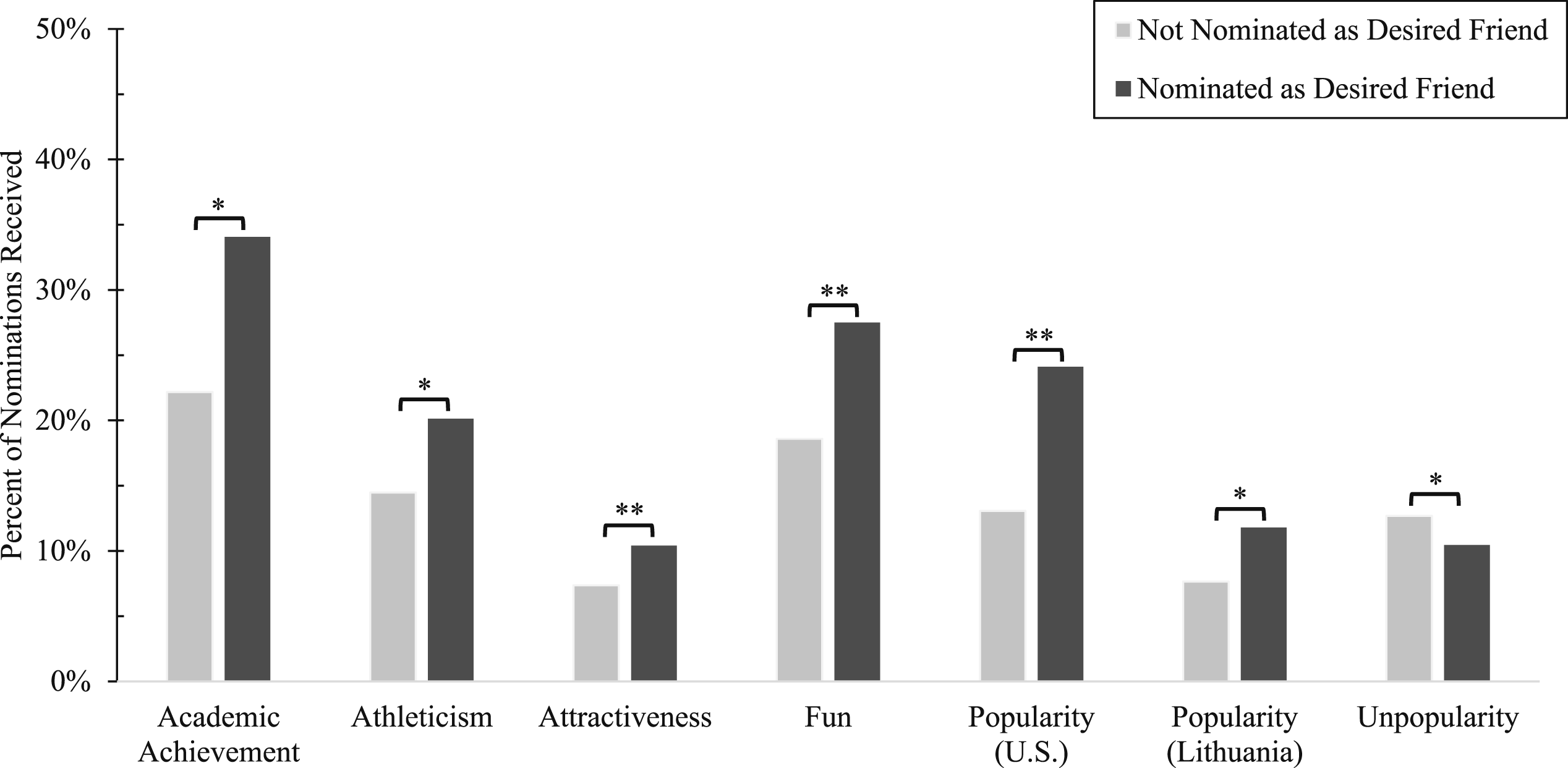
Comparing students nominated as desired friends with students who are not nominated as desired friends: Results from study 2 univariate ANOVAs
The analyses were repeated omitting one randomly selected member from 2 dyads in which participants nominated one another as desired friends. The same pattern of statistically significant results emerged.
Do Classmates Nominated as Desired Friends Have More Favorable Attributes Than Those Who Nominated Them?
Mean-Level Reputation Differences Between Participants and Their Top-Ranked Desired Friend: Results From Study 2 Repeated Measures ANOVAs
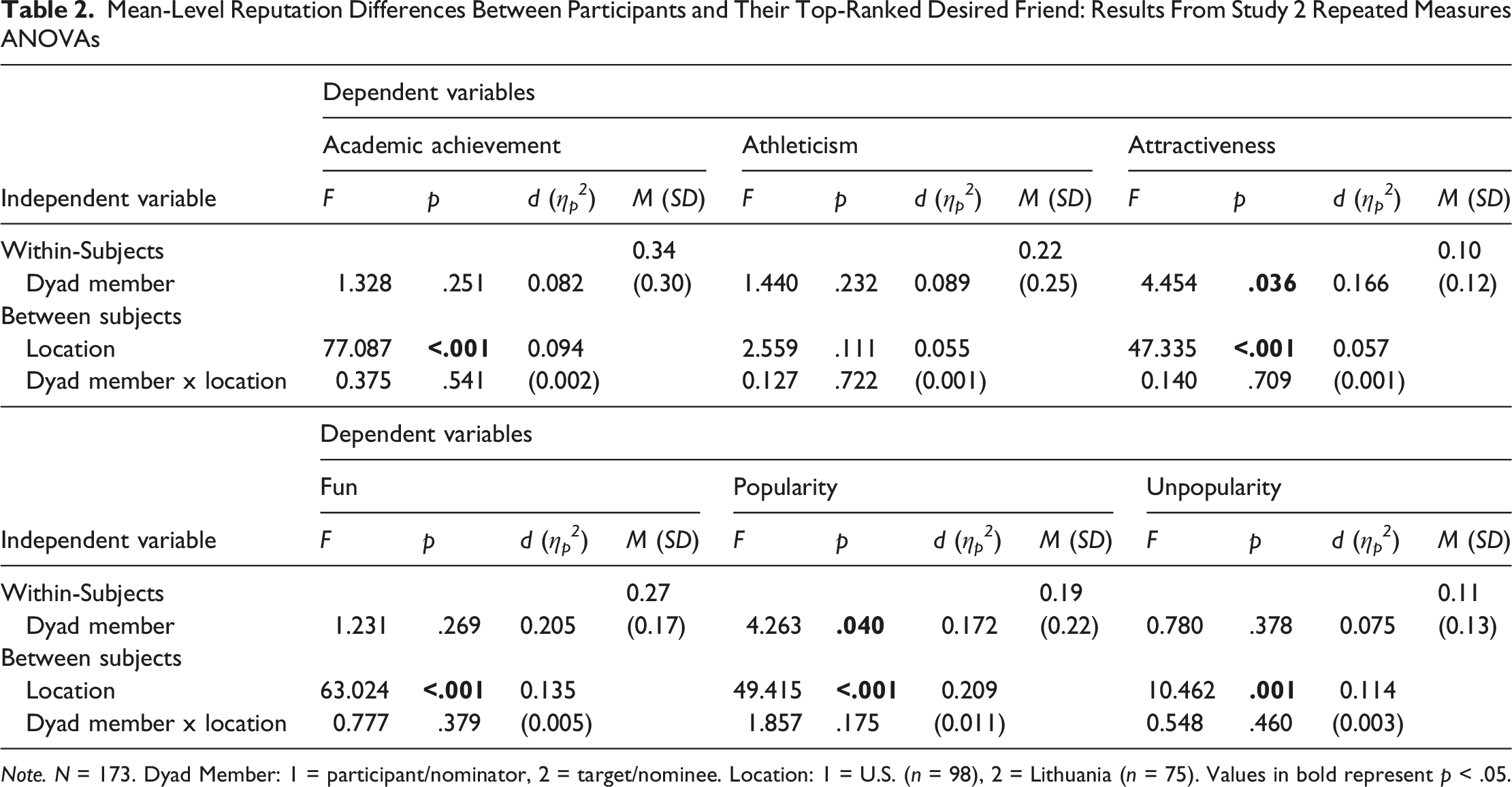
Note. N = 173. Dyad Member: 1 = participant/nominator, 2 = target/nominee. Location: 1 = U.S. (n = 98), 2 = Lithuania (n = 75). Values in bold represent p < .05.
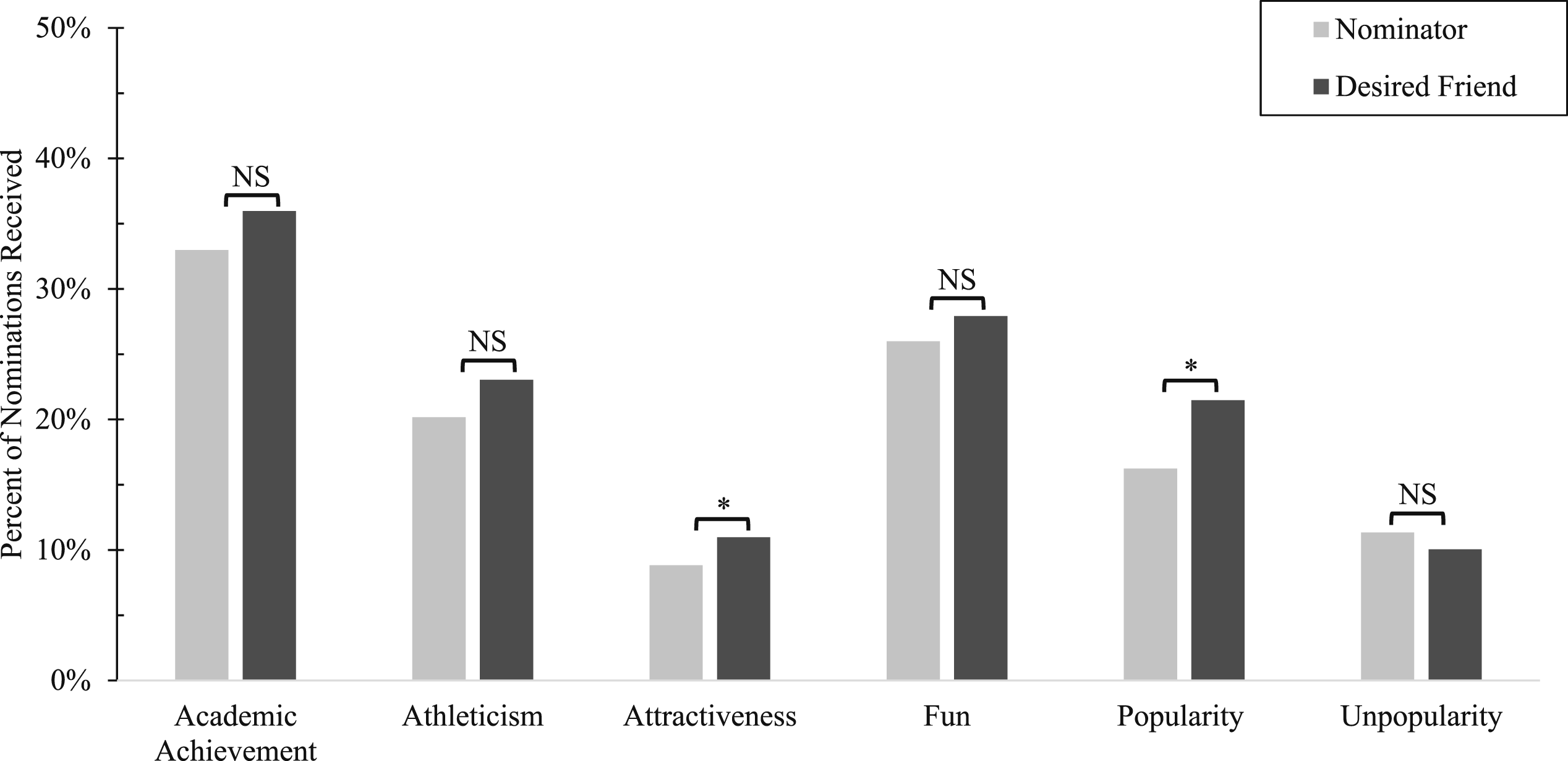
Comparing participants with their top-ranked desired friend: Results from study 2 repeated measures ANOVAs
Are Youth More Similar to Their Existing Friends Than to Their Desired Friends?
Positive statistically significant correlations (p < .001) emerged between participants and their top-ranked existing friends on academic achievement (r = .472), athleticism (r = .518), attractiveness (r = .665), fun (r = .554), popularity (r = .411), and unpopularity (r = .487). Positive statistically significant correlations (p < .001) emerged between participants and their top-ranked desired friends on academic achievement (r = .286), athleticism (r = .220), attractiveness (r = .380), and fun (r = .279), but not on popularity (r = .050) or unpopularity (r = .115). Correlation confidence interval contrasts revealed that participants were statistically significantly (p < .01) more similar to their existing friends than to their desired friends on athleticism, attractiveness, popularity, and unpopularity. Figure 3 illustrates the results. Reputation similarity for participants with (a) top-ranked existing friend and (b) top-ranked desired friend: Results from study 2 intraclass correlation Contrasts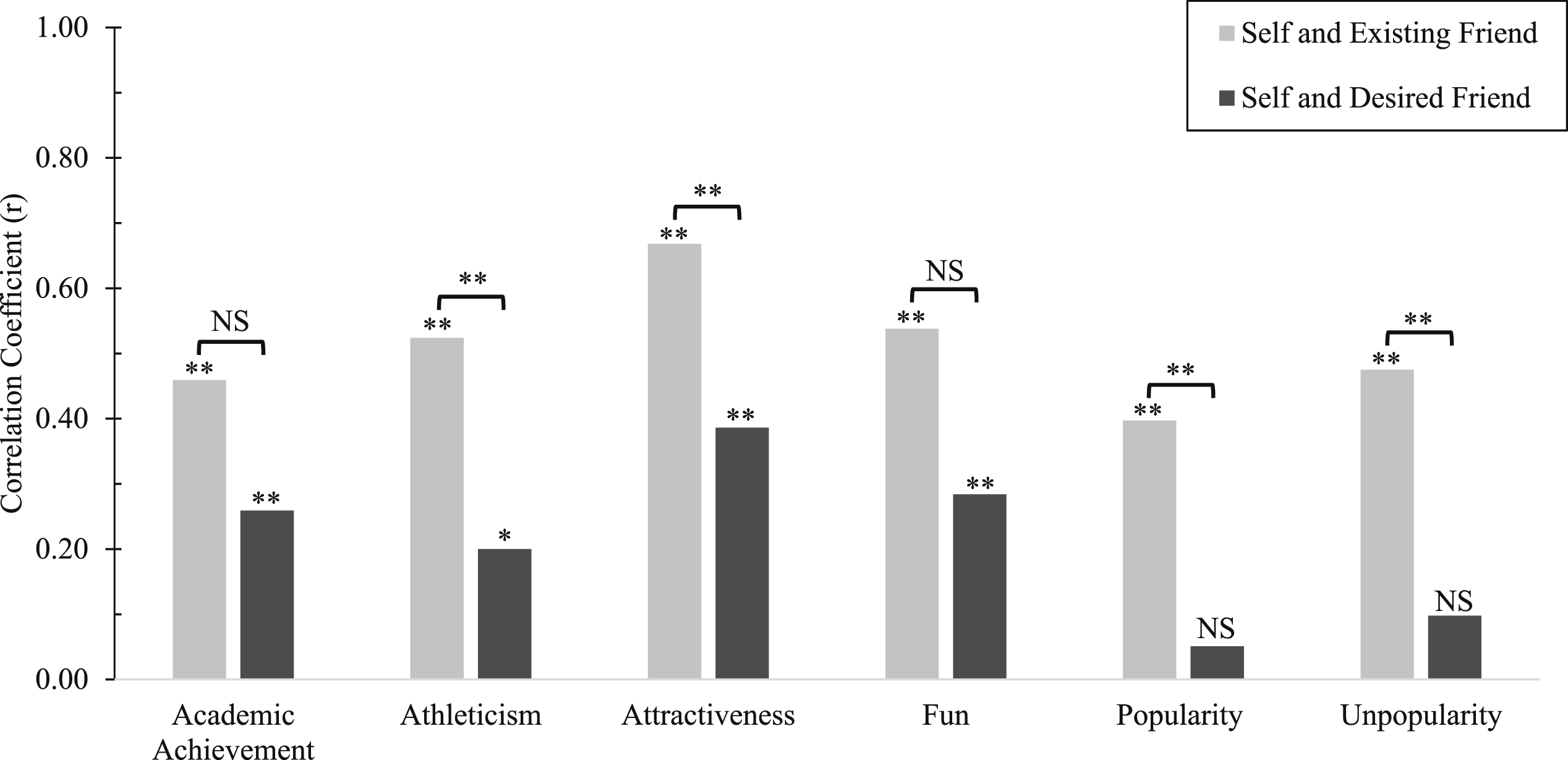
Additional correlation contrasts revealed no statistically significant (p < .05) differences between U.S. and Lithuania students on (a) similarity between participants and their 1st-ranked desired friends and (b) similarity between participants and their 1st-ranked existing friends.
Discussion
In a first-of-its-kind study, we sought to ascertain whether classmates desired as friends early in the school year later became reciprocated friends. In most cases, they did not. To understand why, we examined the characteristics of desired friends to ascertain whether nominators resembled their desired friends. For the most part, they did not. In both studies, fewer than one in ten desired friends eventually became reciprocated friends. The most likely explanation for the low hit rate was that desired friends represent aspirational targets with favorable attributes but few shared resemblances. In one or both studies, desired friends scored higher on academic achievement, athleticism, attractiveness, fun, and popularity and lower on unpopularity than those not nominated as desired friends. In one or both studies, desired friends also scored higher on every attribute (except athleticism) than those who nominated them. Finally, in most respects, nominators had more in common with existing friends than with desired friends. Replication across samples, grades, locations, and procedures inspires confidence in the results.
Our findings challenge the notion that desire precedes affiliation. Participants did not identify realistic targets for future relationships. Perhaps youth interpret the request to nominate desired friends as one to identify best-case, sky-is-the-limit partners. Perhaps the likelihood of success is not a factor in desired friend nominations. Or perhaps youth fundamentally misjudge the importance of similarity vis-à-vis favorability when identifying prospective friends. Whatever the reason, desired friend nominations should be understood as aspirational expressions rather than realistic interpersonal goals. The findings are consistent with the romantic relationship literature, where romantic attraction and affiliative efforts typically focus on dissimilar, socially desirable, out-of-reach targets (Asendorpf et al., 2011). Most come to naught (Bruch & Newman, 2018), highlighting a fundamental disconnect between (a) what individuals claim to value in relationships and the kinds of relationships they ultimately form and (b) the characteristics of archetypical partners and those they choose to pursue.
Why aspire to seemingly unattainable relationship partners? First, like the lottery, long-odds sometimes pay off. Self-expansion theory argues that individuals are motivated to seek relationships that broaden identities, resources, and social capital (Aron et al., 2013). High status peers fit the bill: They are fun to be around (Laursen et al., 2020) and they control and administer valuable assets (Hartl et al., 2020). Those in the orbit of high-status peers garner favorable treatment from others and benefit from social visibility and status transfer (Dijkstra et al., 2010). Admission to their exclusive company bolsters self-worth (Reitz et al., 2016). The conclusion that desired friend nominations reflect attempts at upward identity and resource expansion is also consistent with evolutionary-based views suggesting that humans are biased toward attending to and affiliating with prestigious others (Henrich & Gil-White, 2001). In this view, advantage is conferred upon those with the ability to evaluate potential models and mimic those held in high regard. Social skills and popularity are markers of success and prestige. To facilitate rank-based copying, individuals strive to affiliate with and mimic high-status models. Finally, affiliation befriending those with undesirable traits can be costly. “Status leakage” occurs: The affiliates of low status peers gradually lose favor among and standing with high status classmates (Milner, 2004). There are interpersonal consequences too. Youth with unfavorable attributes tend to have poor quality friendships (Rubin et al., 2006). Further, friendships characterized by an absence of positive features are apt to dissolve (Faur et al., 2024). It follows that youth may aspire to rewarding targets in a bid to improve the quality of their relationships and reduce friend turnover.
We assume that dissimilarity explains why desired friends rarely became real friends. Similarity-attraction models (e.g., Laursen, 2017) hold that dyadic similarity is a foundation for friendship formation. Shared interests provide opportunities for youth to establish common ground and identify mutually rewarding activities. Compatibility also minimizes sources of potential disagreement, increasing the chances that partners will hit it off (Gottman, 1983). It is not surprising, therefore, that future friends rarely involve dissimilar partners (e.g., Hafen et al., 2011). Social norms may also prevent dissimilar pairing because upward affiliation attempts violate expectations of status equivalence (Berscheid et al., 1971). Assortative pairing models also preclude dissimilar pairing on grounds that high-value individuals first select friends from among a pool of other high-value partners, foreclosing options for less desirable others, who settle on similar-value partners rather than choose downward (Ball & Newman, 2012).
Alternative explanations merit mention. Some may argue that similarity among future friends arises because socially skilled, high-status adolescents, embedded in dense clusters of similarly rewarding peers, have no need for new friends and little desire to expand their social circle (Dijkstra et al., 2013). Thus, status-based clustering could constrain access to admired peers, limiting opportunities for upward affiliation. Others may argue that desired friend nomination choices are simply a product of the availability heuristic (Tversky & Kahneman, 1973) and not a preference for attractive others. Popular youth are visible and socially central (Cillessen & Marks, 2011), their names are known to all and easy to retrieve. Modest correlations between popularity and desirability (the sum of desired friend nominations received), however, indicate that visibility and cognitive availability cannot account for the prevalence of aspirational nominations. Finally, structural opportunities may dictate the characteristics of those nominated as desired friends as well as those who are ultimately befriended. Small social networks constrain options to desire or befriend similar others (Selover et al., 2026).
The findings have important implications for parents, teachers, and practitioners. Prioritizing aspirational relationships with favored partners over realistic relationships with compatible partners may have unfortunate consequences, such as dissatisfaction with existing friends and diminished self-worth arising from rejected overtures. For friendless children and those who have difficulty making friends, the consequences may be more deleterious, potentially interfering with the formation of much needed close relationships. Interventions aimed at assisting friendless youth should focus on pursuing realistic aspirations and providing opportunities for joint activities with those who share similar interests. Even something as simple as realigning seating charts can promote friendship formation (Faur & Laursen, 2022). Finally, social and developmental scholars would do well to consider recalibrating models of friendship formation, to account for how relationship aspirations inform friendship selection and to identify potential individual differences in their interplay.
Our studies have limitations. First, desired friend nomination instructions were not consistent across studies. In one case, students nominated desired friends, whereas in the other, students nominated desired friends who were not currently friends. Many in the first study nominated existing friends, suggesting some may have misinterpreted the instructions (e.g., do you desire as friends those who are currently your friends?). After removing overlapping nominations, there was still considerable convergence across the results, which speaks to the strength of the findings. Second, the motives behind desired friend nominations can only be inferred. Absent a direct inquiry, we cannot know why certain groups of peers were more likely to be identified as desired friends or whether nominators thought them to be realistic prospects for future friendships. It is also possible that youth do not routinely reflect upon desired friends and that interpersonal behaviors are not guided by relationship aspirations. If so, it should not be surprising that the findings revealed a disconnect between the identity of future friends and responses to the nomination task. Third, because most analyses lacked power to detect small effects, null findings should be interpreted with caution. Differences that failed to reach statistical significance were always in the hypothesized direction, which suggests that the findings may have understated support for the hypotheses advanced. Our sample lacked power to test the hypothesis that desired friends who become reciprocated are more similar than desired friends who do not, and we call on future research to directly address this question. Fourth, we could not determine the role network size and composition played in the rate at which desired friends became reciprocated friends. In Study 1 (where the hit rate was higher), desired friend nominations were limited to same-sex peers, providing a smaller pool of potential nominees than in Study 2 (where the hit rate was lower), which included other-sex peers potential nominees. Finally, neither gender identity nor disability status was assessed. It is not clear whether or how either may play a role in desired friendships.
Desired friends have many favorable attributes– more than those who are not desired as friends and more than those who desire them as friends. Yet desired friends rarely become reciprocated friends, probably because, unlike existing friends, they have little in common with those who desire them as friends. The many parallels between desired friends and desired romantic partners imply that youth approach both relationships with similar goals: Maximizing the rewards that accrue from affiliation. Realistic assessments of prospective relationship partners do not appear to play a role in aspirational friendship pursuits. The consequences of this disconnect have yet to be articulated.
Footnotes
Acknowledgments
We are grateful for the assistance and cooperation of the students, faculty, and staff at Palm Point Educational Research School in U.S. and the Utena District Schools in Lithuania.
Ethical Considerations
This study was not preregistered. The project was approved by school officials and the university IRB (#702335–1; #135501-16) or ethics committee (Lithuania #6/-2020).
Consent to Participate
Informed consent was obtained from all parents, and child assent was required for participation.
Funding
The authors disclosed receipt of the following financial support for the research, authorship, and/or publication of this article: Support for the preparation of this manuscript was supported by a grant to Brett Laursen from the US National Institute of Child Health and Human Development (HD096457) and the European Social Fund (project No 09.3.3-LMT-K-712-17-0009) under grant agreement with the Research Council of Lithuania (LMTLT). The article was prepared as part of a project funded by the State Budget titled “Establishment of Centers of Excellence at Mykolas Romeris University,” which is implemented under the initiative “Centers of Excellence Initiative” initiated by the Ministry of Education, Science and Sports of the Republic of Lithuania.
Declaration of Conflicting Interests
The authors declared no potential conflicts of interest with respect to the research, authorship, and/or publication of this article.
Data Availability Statement
The datasets generated during and/or analyzed during the current study are not publicly available due to conditions established by the human subjects committee but are available from the corresponding author on reasonable request.
Open Research Statement
As part of IARR’s encouragement of open research practices, the authors have provided the following information: This research was not pre-registered. The data used in the research are not publicly available due to conditions established by the human subjects committee but are available from the corresponding author on reasonable request. The data can be obtained by emailing: laursen@fau.edu. The materials used in the research are not publicly available due to conditions established by the human subjects committee but are available from the corresponding author on reasonable request. The materials can be obtained by emailing:  .
.