






Abstract
In this study, we investigate deceptive/reluctant support (D/RS), which we define as verbal and nonverbal supportive communication that is communicated unwillingly (i.e., hesitantly or against their wishes), does not align with support providers’ true feelings or beliefs (i.e., disingenuous or inauthentic), or both. In addition, relational norms and patterns of behavior specific to providers' relationships with support recipients were central to their D/RS experiences. By analyzing 22 semi-structured, narrative-focused interviews, we offer novel conceptualizations for how D/RS manifests in relationships. Our analysis indicated three defining features of D/RS: unwillingness, dishonesty, and norms. Additionally, our results provided insight into complicating contextual factors that further nuance D/RS: fear of repercussions, justification, values, networks, and isolation. This research offers insight into how support providers engage in D/RS, which could be an intermediate step between offering positive support and choosing to disengage as a support provider. Moreover, understanding how providers navigate challenges when communicating support is key as scholars strive to understand what creates satisfying supportive relationships.
Introduction
Social support is essential to satisfying relationships, and research has documented its extensive positive effects. These outcomes are most pronounced for support recipients, whereas the experiences of support providers remain understudied by comparison (MacGeorge et al., 2011). Additionally, while much research into social support highlights its positive effects, a significant body of research underscores its complexity, noting that support is not inherently positive; instead, it can have complicated outcomes depending on its context and message features, among other things (Goldsmith, 2004; MacGeorge et al., 2011). Indeed, research into the complexities of supportive communication has highlighted instances where it fails (Wortman & Lehman, 1985), where it is helpful and hurtful (Faw et al., 2019), where people reduce or limit their support (Johnson, 2025), and where individuals decline to provide support at all (Ray et al., 2023). Given its central role in relationship communication, it is essential to understand the complexities inherent in communicating social support and, in particular, how support providers may experience interactions as challenging, disappointing, or even manipulative.
In this study, we provide findings from in-depth interviews exploring situations where support providers experienced challenges in their supportive communication. First, we outline literature regarding the complexities of social support, emphasizing support providers’ experiences. We then draw upon literature related to deception and deceptive affection to illuminate circumstances when people might communicate in ways contradictory to their feelings, highlighting the potential existence of deceptive/reluctant support (D/RS). It is possible that even as support providers are motivated to help, save face, and maintain relationships, they still engage in deception (the falsification or withholding of information with the intent to mislead; McCornack & Levine, 1990). Although dishonesty can produce deleterious outcomes (e.g., Cole, 2001; DePaulo & Kashy, 1998), D/RS can manifest for various reasons with implications for individuals and relational dynamics alike. Thus, our goal in this study is to better understand the complexities of D/RS processes.
Social Support and Complexity in Supportive Communication
Social support is defined as “verbal and nonverbal behavior produced with the intention of providing assistance to others perceived as needing that aid” (MacGeorge et al., 2011, p. 317). Much of social support research highlights its positive effects (MacGeorge et al., 2011). However, as with other forms of communication, social support is highly complex. Research into the positive aspects of supportive communication highlights its value for building satisfying relationships and facilitating enhanced coping, among others (MacGeorge et al., 2011). On the other hand, research also highlights instances where the communication of social support falls short or even causes relationship harm. For example, Wortman and Lehman’s (1985) work on support failures highlights the ways that support providers commonly react to individuals experiencing life crises, while well-intentioned, often result in recipients feeling hurt, misunderstood, and dismissed. Other research shows that experiencing low-quality support that does not acknowledge, validate, and legitimize support recipients is more likely to result in negative outcomes (High & Dillard, 2012). Still other research highlights that support is not perceived as helpful and, in some cases, is even perceived as hurtful when the type or amount of support offered is mismatched with support seekers’ desires (McLaren & High, 2019). Despite an abundance of research about the many positive aspects of supportive communication or, conversely, when it fails to bring about positive outcomes, there is room for exploration regarding the complexities of support, particularly from the perspective of support providers.
Support Provider Experiences
Supportive communication is a dyadic process, and interactants do not necessarily experience the supportive conversation in the same ways. For example, a provider might experience a conversation as negative and challenging whereas the recipient felt the interaction went well and was, overall, a positive one. When specifically considering support providers, research into what might make a supportive conversation a challenging or negative one is somewhat limited. Some evidence suggests that providing support is linked to feelings of frustration and burden, and this is especially true when people already feel unsatisfied in the relationship (Lu & Argyle, 1992). When providers feel obligated to offer support, they might experience negative affect and poorer relationship outcomes (Wortman & Lehman, 1985). Other evidence highlights that providers feel challenged when they feel they must balance their need to communicate honestly with the other’s desires to hear comforting, affirming support (Faw et al., 2019; Goldsmith & Fitch, 1997).
Another manifestation of supportive challenges occurs when providers engage in nonsupport. Currently, nonsupport is conceptualized as both support that is provided but ultimately unhelpful (Neufeld & Harrison, 2003) as well as a support provider’s conscious decision to not provide support (Ray et al., 2019; Ray & Veluscek, 2018). Investigations into nonsupport outline how and why people decline to provide support (Ray et al., 2019; Ray & Veluscek, 2018), and how individuals conceive of their identity and explanations for their nonsupport decisions (Ray et al., 2023). More recent scholarship unpacks the nuances of support boundary creation, or creating parameters around the amount and/or type of support one is willing to provide (Johnson, 2025). Support boundary creation offers insight for how providers navigate discrepancies in their supportive relationships likely before they reach the point of nonsupport (Johnson, 2025). When considering support providers, Inagaki and Orehek (2017) assert that two factors influence their outcomes: “(a) whether an individual freely chooses to give support and (b) whether [they think] the support is effective” (p. 110). This underscores that providers may experience fewer positive outcomes and increased negative ones if they feel obligated to offer support (Inagaki & Orehek, 2017).
A decision not to support someone in need potentially carries significant challenges and may be viewed negatively by others. Social support is often expected (Goldsmith, 2004) and considered the default in close relationships (Ray & Manusov, 2023), and failure to provide support might result in being labeled a bad relationship partner or incompetent communicator (Goldsmith, 1994; Parks & Floyd, 1996). For example, research suggests that unsupportiveness in romantic relationships is considered a destructive relationship behavior (Agnew & VanderDrift, 2015). As such, support providers experience both external and internal pressure to provide support in ways that would be perceived as effective by others (Goldsmith, 1994; Ray & Manusov, 2023). Additionally, support providers might find themselves in situations where they feel forced to communicate support when they would prefer not to and/or in non-preferred ways.
All this suggests that support providers may be placed in tricky situations where they feel obligated to support someone when they would rather not (Ray et al., 2023), where they feel incapable of offering meaningful support (Wortman & Lehman, 1985), or where their attempts at offering support are ineffective or even upsetting (High & Dillard, 2012; McLaren & High, 2019). These supportive pressures placed on relationship partners could create situations where providers feel forced into communicating support in ways that are deceptive. Indeed, research into deception and the related construct, deceptive affection, illustrate that even individuals in satisfying, healthy relationships may use deception as relationship maintenance tool (DePaulo et al., 2009; Pederson et al., 2020). In this way, supportive communication might share characteristics with various types of deception.
Deception, Reluctance, and Support Complexity
Deception & Prosocial Motivations
While openness and honesty are often valued in interpersonal interaction (Knapp, 2008), individuals report a range of acceptability for lying (Dunbar et al., 2016), which might be due in part to how people decide what “counts” as lying. Scholarly definitions often categorize deception by outcomes (benign or harmful), motivations (self-serving or other-oriented), and contextual acceptability (DePaulo et al., 1996). Rules and expectations for deception can vary in terms of how relational partners perceive them to be explicit/implicit and obligatory/discretionary (Roggensack & Sillars, 2014). As such, there are various ways that relational partners can respond to dishonesty depending on its motivations and contexts (Boon & McLeod, 2001). For instance, people withhold how they feel when interacting with a partner to avoid conflict, maintain positivity, or refrain from hurting their partner (DePaulo et al., 2009).
Despite reported prosocial intent, research demonstrates that deception can be disadvantageous for individuals and relationships, leading to decreased relationship satisfaction (Peterson, 1996), closeness (DePaulo & Kashy, 1998), and commitment and intimacy (Cole, 2001). Although our goal is not to find where to situate D/RS into a broader, often messy conceptual umbrella of deception, we recognize that some communicative practices of D/RS might resemble specific types of deception already established in the literature, such as within existing research about deceptive affection.
Deceptive Affection
Affection (i.e., feelings of warmth, fondness, and positive emotional regard for another person) and affectionate communication (i.e., outward expressions of affection to another person) appears in close relationships and enriches relational health (Floyd, 2006). Similarly, MacGeorge and colleagues (2011) assert that “supportive communication can signal care, commitment, interest, compassion, and even love” (p. 324), paralleling the functions of affectionate messages (Floyd, 2006). In recent years, more attention has been given to the nuances of deception in affectionate communication. In fact, research suggests that individuals can feel affection that they choose not to express or to minimize; similarly, they can express affection that they do not genuinely feel, pretending to care for someone when they really do not feel warmth and affection towards them (Horan & Booth-Butterfield, 2011). Given the overlap in affectionate and supportive communication, deceptive affection is a beneficial framework to consider while theorizing about the potential presence of deception in supportive contexts.
Deceptive affection occurs when individuals outwardly display affection that does not align with their internal feelings (Floyd, 2006; Horan & Booth-Butterfield, 2011, 2013). Deceptive affection is categorized in two main types: withheld affection and deceptive affectionate messages (DAMs; Horan & Booth-Butterfield, 2011). Withholding affection involves intentionally not communicating felt affection (Horan & Booth-Butterfield, 2011). DAMs occur when individuals communicate affection that does not reflect their genuine feelings (Floyd, 2006). Horan and Booth-Butterfield (2019) argue that “[…] deceptive affection is not significantly risky for sources. It may be a normal part of relational interactions” (p. 538). Indeed, individuals provide deceptive affection for various reasons, including masking their negative feelings (Horan & Booth-Butterfield, 2013), maintaining their relationship (Horan & Booth-Butterfield, 2011), and preventing conflict (Carton & Horan, 2014). As a result, deception and deceptive affection may be useful frameworks for understanding how individuals engage in support in deceptive ways.
Support and Reluctance
In addition to considering how deception might manifest in supportive communication, it is possible that individuals find themselves in encounters where their support provision is less characterized by deception than it is by a general unwillingness. In this case, support providers may occupy the position of a reluctant supporter. The notion of a reluctant supporter draws from research on reluctant confidants (Petronio, 2000; 2002), or individuals who receive another’s private disclosures against their will. Previous research noted that friends may experience challenges both from being an unwilling recipient of heavy information in addition to sometimes struggling to know how best to respond to that information (McBride & Bergen, 2008). Indeed, according to Petronio (2002), “…finding oneself in the role of reluctant confidant may mean that one is completely unprepared to handle the consequences of a disclosure and have difficulty coordinating rules with the discloser” (p. 112). This suggests that part of being a reluctant confidant can include challenges in knowing how to respond. Support-seeking, inherently, involves disclosure (MacGeorge et al., 2011), and evidence suggests that providers can struggle to know how to respond to support-seeking disclosures, at times even resenting the individual seeking support for their problems (Ray et al., 2023; Wortman & Lehman, 1985).
Deceptive/Reluctant Support
Just as individuals can communicate deceptive affection (Floyd, 2006; Horan & Booth-Butterfield, 2011, 2013), it is possible that individuals are not always honest in their supportive communication. The same motivations for engaging in deception and DAMs (e.g., to avoid conflict or protect the relationship; Carton & Horan, 2014; Horan & Booth-Butterfield, 2011, 2013) could be the same reasons that individuals engage in D/RS. Support providers also might feel the need to adhere to norms that privilege helping as opposed to not (Goldsmith, 2004; Ray & Manusov, 2023). Thus, support providers might feel obligated to communicate (in)authentic support, even if they are unwilling to do so. To our knowledge, research has not yet explored how deception manifests in supportive interactions despite work acknowledging tensions between honesty and supportiveness (Faw et al., 2019; Goldsmith & Fitch, 1997). With this in mind, we explore the following research question:
What are the defining features of D/RS?
Social support is a highly normative behavior, meaning that supportive communication is both enabled and constrained by factors that shape perceptions of its overall quality and value for interactants (Goldsmith, 2004; MacGeorge et al., 2011). For example, discussions of a support provider’s normative motivation emphasize their desire to behave appropriately, saying the “right things” according to their perception of the relationship, the situation, and broader expectations (Burleson et al., 2005). These can bump up against other motivations and goals, resulting in situations in which providers must adjust their behavior to, hopefully, accomplish as many desired goals as possible (Scott et al., 2011). Each of these goals is informed by a provider’s understanding of the context, including the specific relationship, the support seeker’s situation, etc. (MacGeorge et al., 2011). With this in mind, we pose a second research question to illuminate different contextual features that might influence a provider’s D/RS:
What contextual and/or relational features influence D/RS communication?
In addition to considering what characterizes and influences D/RS, it is important to explore how different aspects of D/RS might co-occur with contextual features. Social support is a dynamic process that evolves over time and across relationships, with different messages influencing people’s relationships and evaluations—and vice versa (Goldsmith, 2004; MacGeorge et al., 2011). Scholars in supportive communication have called for investigations into not just the features of support but also ways that interactants, the situation, the relationship, and other factors coalesce together (MacGeorge et al., 2011): “…Supportive interaction is a complex, highly contingent process involving (at a minimum) phases of support seeking, provision, reception, reaction, and response… further work is necessary to develop more accurate—and practical—theory about how and why supportive messages and interactions affect coping processes, relationships, and health” (p. 340). As such, by examining co-occurrences across D/RS defining features and influences, we can explore how these contribute to various provider D/RS experiences. Given this, we pose the following research question:
What, if any, co-occurrence relationships emerge between the defining features of D/RS and its contextual and/or relational influences?
Method
Participants
To participate, individuals self-identified at least one experience where they found supporting someone as difficult or challenging. Eligible participants had to be at least 18 years old and able to complete the study in English. The research team conducted 25 interviews in total; however, three interviews were excluded from analysis as these interviews discussed their supportive responsibilities aligning with an organizational role rather than experiences within a specific relationship.
Of the 22 participants, 82% (n = 18) identified as women, 14% (n = 3) identified as men, and 4% (n = 1) identified as nonbinary. Most participants identified as White (n = 19, 86.36%), with additional participants identifying as Black/African American (n = 1, 4.55%), Native American (n = 1, 4.55%), and Lebanese-American (n = 1, 4.55%). Participants ranged in age from 23 to 63 years old (M = 28.82, SD = 8.56). Additionally, 41% (n = 9) of participants self-identified as lesbian, gay, bisexual, transgender, queer, intersex, and/or asexual (LGBTQIA+). Participants shared their experiences from a variety of relationships, including with friends, (ex-)romantic partners, in-laws, siblings, coworkers, and workplace supervisors, and across diverse situations, including conflict, interpersonal violence, and physical/mental health crises, among others.
Procedures
All procedures were approved by an institutional review board. The research team used convenience and snowball sampling to recruit participants (Patton, 2001) via various social media sites (LinkedIn, Facebook, and Instagram) and across two large university campuses. Individuals interested in participating were encouraged to contact the research team to confirm eligibility and schedule an interview. Prior to the interview, participants completed a consent form and demographic survey. In-depth, semi-structured interviews were used for data collection (Lindlof & Taylor, 2017). The research team structured the interviews considering the nuances of inauthenticity (i.e., communicating support that did not align with participants’ feelings) and unwillingness (i.e., communicating support when participants did not want to) during interactions, resulting in three interview protocols for participant selection.
At the beginning of each interview, participants were encouraged to think of their challenging supportive relationship while listening to three scenario descriptions. The first scenario explained how people might offer support when they do not want to, but the support they offer aligns with their true feelings (i.e., unwilling). The second scenario described how people might provide support when they do want to help, but the support they offer does not align with their feelings (i.e., inauthentic). The third scenario explained how people might provide support when they do not want to help and the support they offer does not align with their true feelings (i.e., unwilling and inauthentic). After hearing these descriptions, participants selected the one that most closely matched their situation. Then, the researcher used the protocol that best fit the participant’s experience. Each protocol followed a similar format (e.g., asking participants to describe their supportive challenges, the nature of their relationship, their reasons for providing support, outcomes of their support, etc.). However, the language was tailored based on the scenario that aligned most with their experiences (i.e., unwilling, inauthentic, or unwilling and inauthentic). Throughout interviews, follow-up questions generally asked for more detail about various factors (e.g., motivations, emotions, etc.) impacting their D/RS. Interviews allowed participants to share entire stories so that the research team could gather insight about the nuances of their support rather than viewing deception as a singular event. All participants received a $15 e-gift card at the conclusion of their interview.
Analysis
All interviews were audio recorded and transcribed by the research team. Interviews ranged from 31 to 87 minutes long (M = 52.27 minutes). Approximately 1,000 double-spaced pages and 225,000 words of text were coded following Braun and Clarke’s (2019) thematic analysis steps, generating themes across the interviews while connecting emergent themes to existing theoretical frameworks. In our initial analysis, we identified three defining features and five complicating contextual factors of D/RS. All participants experienced at least two complicating contextual factors, with most experiencing three or four. To explore how defining features co-occurred with the complicating contextual factors, we completed a thematic co-occurrence analysis (TCA; Scharp, 2021). In keeping with TCA, we relied on Owen’s (1984) criteria (i.e., recurrence, repetition, and forcefulness) to ensure the trustworthiness of themes. Recurrence was present when specific meanings occurred numerous times (e.g., participants detailing their fear of repercussions), repetition occurred when meaning was repeated with the same words (e.g., participants labeling their support as “needed”), and forcefulness existed when participants used emphasis while speaking (e.g., higher volume or intense tone).
To examine potential co-occurrences across themes, we created a co-occurrence matrix and assessed patterns based on the following continua: (a) complementary-contradictory (do the themes reinforce or clash with each other?), (b) sporadic-pervasive (how recurrent and forceful are the co-occurrences?), (c) unilateral-bilateral (does one theme imply the presence of the other and vice versa?), and (d) balanced-unbalanced (are the themes comparable with regard to recurrence, repetition, and forcefulness?). We also focused on the possibilities of ubiquity (whether the theme appears for most participants) and independence (whether a theme does not co-occur with another theme) (Scharp, 2021; Scharp et al., 2024). In our co-occurrence coding process, the presence of a theme for any given participant was marked with an “X” in the matrix. We then marked instances where a theme was forceful with a “+” (Owen, 1984). We used “U” as a code to indicate instances where a theme was ubiquitous (Scharp et al., 2024). Finally, we used letters in alphabetical order (i.e., A, B, C, etc.) to indicate the presences of a co-occurrent relationship among themes and assigned each theme a number to reflect how many themes co-occur (Scharp, 2021; Wolfe et al., 2024). Superscripts reflect that two themes (e.g., A2/A3) may not co-occur with each other but co-occur with the anchor theme which is numbered “1” (e.g., A1). From this analysis, we identified patterns where co-occurrences had complementary relationships (i.e., parallel sentiment; Scharp, 2021) with the defining features, and we also identified instances of ubiquity and independence (Scharp et al., 2024). In these cases, the complicating contextual factors created an increasingly complex D/RS process.
Numerous steps were taken to ensure data credibility, including: reaching data saturation (i.e., additional interviews did not provide new themes or results; we reached saturation after interview 9), triangulation among the research team (i.e., independently coding and comparing findings for consistency), negative case analysis (i.e., searching for data that does not align with emerging themes), and peer debriefing (i.e., discussing findings with other colleagues) (Lincoln & Guba, 1985; Lindlof & Taylor, 2017). To ensure our understanding aligned with participants’ experiences, we conducted member checks with five participants (Lindlof & Taylor, 2017). During interviews, the first author rephrased their responses and asked clarifying questions. After themes were established, we provided the results from participants’ interviews (including theme names, definitions, and exemplars) and asked whether anything felt inaccurate. Individuals were selected for member checks based on (1) highly complex or unique features in their interview and (2) their willingness to be contacted. All five member checks confirmed the findings.
Researcher Positionality
Given a researcher’s engagement with data collection and analysis in qualitative research, it is vital to consider their positionality (Tracy, 2020). Throughout all phases of this project, we engaged in self-reflexivity to be aware and transparent about how our identities and scholarly commitments influenced this research (Tracy, 2010). Indeed, “failure to attend to reflexivity can negatively impact the knowledge built via qualitative research and those connected to it” (Olmos-Vega et al., 2023, p. 241). The first author has faced challenges as a support provider, including various moments of unwillingness and inauthenticity, which ultimately motivated this research. Her experiences allowed her to connect with participants and enhanced her ability to understand their experiences. However, the first author embodies a significant amount of privilege as a cisgender, White woman which possibly inhibited individuals with marginalized identities from participating. The second author identifies as a cisgender, White woman, and has studied social support in numerous contexts and relationships. The third author (identifying as a White, cisgender man) has studied support in various contexts that has shaped his views of support as being normatively positive. Neither the second nor the third author conducted participant interviews and thus only analyzed transcribed interview data. In short, various aspects of the research team’s identities and scholarly commitments could have influenced the research.
Results
RQ1: Defining Features of D/RS
We identified three defining features of D/RS: unwillingness, dishonesty, and norms.
Unwillingness
The first defining feature was unwillingness, which was characterized by a participant’s explicit desire to not provide support to their network member, even if they ultimately did. For some participants, unwillingness looked like wanting their network member to be supported but not wanting to provide that support. For example, one participant (Scarlett) shared an experience with an ex-boyfriend who relied on her during an ongoing mental health crisis. Scarlett recognized the situation’s seriousness even as she did not want to support him: I want him to be happy and be okay, of course. And I want him to have a support system […] But, you know, for my own well-being, I know that I can’t be that person for him, and I definitely have gotten to a point over and over where like it’s just—that’s not what’s best for me, and I don’t want to be that person […] So I wanted him to be supported, but I didn’t necessarily want to be the one to support him.
In Scarlett’s situation, she genuinely wanted her ex-boyfriend to receive support even as she stated her own unwillingness to be his support provider. For Scarlett, her unwillingness centered from a desire to safeguard her mental health and protect her own well-being, which she knew would deteriorate if she was asked to serve as a primary support person for her ex. This conflict represented how Scarlett came to understand her supportive relationship with her ex: She could either support him in the way he wanted and sacrifice her mental health, or she could choose to prioritize her well-being and not offer the support he wanted. For participants experiencing this bind, D/RS became characterized by difficult risks—either harm themselves in continuing to provide support or potentially harm others by altering or ceasing their support.
For other participants, unwillingness could be an outcome of supporting their network member over a significant period. For example, Lisa had a friend in an unhealthy romantic relationship. At first, Lisa provided genuine support; however, as time passed, she became more hesitant to provide support, resulting in her genuine support becoming deceptive: At first, I probably wanted to give her the support. But then, as time dragged on, it seemed like more a chore for the relationships […] I was like almost getting bored of having the same conversation over again, and being like, “I feel like there’s nothing I can give you. You need to find some other mechanism of support. It can’t be me, because, clearly, I’m not giving you what you need, or we wouldn’t still be in this cycle.”
The grind of supporting her friend left Lisa feeling like her supportive efforts were wasted. This left Lisa questioning her capability as a support provider, causing her to feel resistance towards continuing support. With regards to D/RS, several participants cited that prolonged supportive experiences combined with a lack of meaningful improvement resulted in significant shifts in their perceptions and their supportive behavior. In Lisa’s case, the combination of prolonged support and perceived ineffectiveness caused her genuine support to morph into unwilling, D/RS.
Marge echoed this experience, supporting a friend in the aftermath of their break-up. The near-constant supportive demands began to wear on Marge, and their support became deceptive: It was the same conversation over and over again, over and over again. It got the point where there was nothing new that I was going to add […] So I would just kinda be like, “Yeah, that really sucks. I’m really sorry.” […] Like, I didn’t want to be there. So, providing any validation in and of itself defies what I want to do […] can I tell him that I don’t want to support him without telling him that I don’t want to support him?
For these participants and others, an essential part of D/RS involved supporting others when they did not want to. This could happen as people struggle to prioritize their own goals (e.g., their personal well-being and happiness) and feel that their goals directly conflict with the needs of their network member. When supportive efforts drag on over time, the potential goal conflict could become stark, transforming individuals’ support from potentially genuine to D/RS. Ultimately, participants who experienced unwillingness in the D/RS wanted their network members to be supported; they just did not want to be the primary source of that support. This ultimately caused their desires to clash with the desires of their network member, and providers wanted to limit their support but felt obligated to keep providing it anyway in order to minimize (but not entirely eliminate) potential harms.
Dishonesty
Another defining feature of D/RS occurred when participants provided support that was dishonest. This dishonesty meant that participants, according to their own perception, chose to share support that did not reflect their actual feelings or perspectives even though they did want to offer support. For example, Rick had a friend in a romantic relationship that Rick believed to be unhealthy. Rick wanted to support his friend, but he also could not tell his friend what he truly thought about his romantic relationship: And at that point, I did still want to give him support because he’s still, you know, a really, really good friend of mine, right? But the support I was giving him at that point wasn’t aligned with my true feelings […] And so, yeah, I mean, I provided support despite that I don’t think they should [be together].
For Rick, his support became deceptive as he provided encouragement for his friend’s romantic relationship even though he disapproved of it. This deception was rooted in a desire to remain in good standing with his friend, with Rick knowing that honest support encouraging his friend to end his romantic relationship would, potentially, hurt their friendship. As such, Rick responded to the perceived bind in his relationship by choosing to move forward with offering support that was dishonest, supporting his friend in his romantic relationship even as he secretly thought the relationship should end. Another participant, Luna, supported her sister through a graduate program. Her sister would call feeling overwhelmed as she worked on an assignment last-minute, which Luna found frustrating. As a result, Luna communicated dishonest support to her sister: I was just kind of telling her what she wanted to hear at that point. It was just like, “It’s going to be okay.” Like, “You know, these things happen.” What I really wanted to do is just kind of shake her and be like, “You know, it’s frustrating when students do this. Why are you doing this?”
Later, when talking about supporting her sister in her dating life, Luna further described the challenges of providing dishonest support: So then, sometimes, I just kinda like will say what she wants to hear again […] And I think it’s really hard to be in that scenario, because it’s like I’ve tried to problem-solve with her before. And sometimes it works, and sometimes she’s not in a place to hear those things, right? […] You’re fighting with yourself at that point. I don’t agree with what I’m saying or what I should say, but I know it’s the right thing to say to this person, even though I don’t agree with it. And so, you have to grapple with it internally.
In Luna’s case, she had previously shared her honest evaluations with her sister and received significant blowback. These situations taught Luna that, to make her sister feel supported and to avoid alienating her, Luna had to communicate what she knew her sister wanted to hear. She experienced significant intrapersonal turmoil over this decision, as she communicated support that she did not actually believe, leaving her feeling at odds with her own conception of herself and her beliefs in order to satisfy her sister’s needs.
For these participants, their support was dishonest not because they did not want to provide support but because they felt forced to share support that did not reflect what they truly wanted to say to their network member. These participants sensed that sharing their true feelings might result in more harm than good; as such, they chose to prioritize the relationship, connection with their network member, and their network member’s sense of support over their desire to be 100% honest. These cases illustrate how some participants genuinely wanted to support their network member, and, at the same time, they felt cornered into providing support that was ultimately dishonest. For these participants, even as they felt that this dishonesty was the best option for different reasons, they often experience cognitive dissonance and negative feelings towards their own dishonesty.
Norms
Throughout interviews, participants explained how relational norms (or patterns of relationship behaviors specific to their unique relationship with the support recipient) were central to D/RS processes, and five subthemes emerged: boundary creep, lack of reciprocity, no questions asked, toxicity, and relational obligation.
Boundary Creep
For several participants, challenges around norms manifested as boundary creep. In these situations, participants detailed how they experienced a relational “slippery slope” where supportive expectations gradually shifted from acceptable to inappropriate. Sometimes, this boundary creep happened when participants had not clearly communicated their supportive limits. As Claire explained: […] I haven’t set hard boundaries because it’s just hard to. And I need to get better about not answering his calls when I’m off of work, but it’s really hard […] And so, say he is in the hospital or say something bad does happen… I don’t want to not answer that phone.
Claire’s experience illustrated her difficulty creating boundaries, leading to unreasonable expectations from her coworker. Claire detailed her indirect attempts at setting limits (e.g., taking longer to respond to texts) while also expressing challenges around setting “hard” boundaries. For Claire, allowing supportive requests and loose boundaries around her support made it difficult to establish a firm line when things became too much. Another participant, Lisa, expressed similar boundary creep: I wish I would have done more boundaries sooner so I wouldn’t have gotten to a point of feeling so exhausted that I don’t even want to hang out. I wish I would have implemented those straight off the bat […] I think if I would have done that earlier on, I think that would have been more the expectation rather than letting the expectation become, “Okay, yeah [I’m] going to listen to everything [you] say here.”
By not initially setting boundaries, Lisa’s relationship norms became exhausting and unsustainable, leading to D/RS. Other participants detailed how boundary creep resulted in unreasonably high supportive expectations, with Marge expressing, “So it was like you’d give him an inch, he takes a mile […]” For these participants, what often began as a reasonable, relatively healthy relationship with acceptable supportive expectations slowly, over time, became one with unreasonable, outsized supportive needs. This often happened gradually, with subtle shifts in boundaries resulting in a significant change over time that left support providers feeling concerned and unsure of how best to (re)establish better boundaries (if it was even possible). Participants recognized how boundary creep shifted their relational norms, creating relationship dynamics that they felt were hard to change or adjust that then prompted their D/RS. To try and reset the boundaries felt impossible, so, instead, they continued to offer support that became less and less genuine and more and more centered in D/RS. This reflects the tendency of D/RS to be something that evolves over time within a given relationship (rather than being the starting place of supportive conversations). In fact, no participants talked about instances of D/RS that originated from their earliest supportive conversations. Instead, the shift in boundaries and relationship norms made D/RS feel like the best option available to them in their relationship.
Lack of Reciprocity
The second subtheme related to norms revealed how a lack of reciprocity complicated D/RS. Participants described how the burden of support weighed heavily on them when their network member did not provide similar levels of support within their relationship. As one participant, Willow, shared, “I do feel I’m providing more support for him than he is for me. I feel like there’s always something going on with him. I don’t necessarily seek support from him.” Throughout her interview, Willow discussed frustration about the lack of mutual investment within her friendship, and this frustration cause her to move from genuinely wanting to support her friend to a place of D/RS. Similarly, another participant, Dani, shared, “But it seems as though that labor [of support] is not always reciprocated.” While navigating graduate school with a close friend, Dani provided substantial informational and tangible support. Although Dani felt there was a “shared sense of [wanting] to do [their] best to help each other”, Dani did not see the support as mutually beneficial. As such, the lack of reciprocity made communicating support a draining experience. For these participants, their relationships became characterized by a norm where they were expected to show up and support their network member, but their network member felt limited compulsion to do the same for them. This norm created a lopsided relationship that often left participants with questions about the quality of relationship and whether the norms around reciprocity functioned for them, and it caused participants to move towards D/RS. Additionally, this lack of reciprocity often became normalized over time. For participants, their relationships often featured acts of genuine support that slowly shifted to D/RS as providers realized that their supportive efforts would never be reciprocated appropriately.
No Questions Asked
Participants described how their relational partners often expected support from them, no questions asked, communicating a norm (implicitly or explicitly) that support (in a desired form) is always available without judgement or hesitation. For example, one participant, Luna, expressed, “Yeah, I think that we have the type of relationship where it’s just you do whatever you can to help the other person […] It’s unconditional in that, you know, we want the best for one another.” Although there were moments where Luna’s support was authentic, she cared enough about her sister to provide D/RS in service of the shared expectation of support, no questions asked. Lori expressed similar challenges with her sister-in-law: I would say her expectations of us are to do what she asks us to do and… I don’t know if this is fair to say… I would say that she expects us to not question it […] So, I think her expectations are to be there, be consistent, do what she asks us to do, and not question it.
Although Lori partially agreed with her sister-in-law’s expectations around support (especially because it involved a complicated medical condition), Lori also felt forced to provide support because of this no questions asked expectation even when she did not want to or she disagreed with what her sister-in-law demanded, resulting in D/RS. In these situations, the expectation of support no questions asked was often experienced as a norm or boundary for the support provider; however, no participants talked about this being a fully mutual norm. That is, providers often felt the pressure to provide support without questions or pushback, but they often did not receive similar support from their network members. This imbalance combined with the incredibly high expectations for support often transformed authentic support into D/RS.
Another participant, Justin, described how his family similarly expected unlimited support: “There are extremely high expectations. Extremely high since it’s family. So, there are extremely high expectations to help in the best way. In fact, it is expected that you sacrifice your own self.” For Justin, the expectations of support, no questions asked, extended into self-sacrifice in the service of family, mirroring other discussions of how norms could transform genuine support into D/RS through high demands that even called for the provider to potentially experience negative consequences for themselves. This notion of no questions asked left participants with limited room to consider their own agency and whether/how these supportive relationships were meeting their own needs. For these participants, the pressure around no questions asked meant that, to decline to provide support would result in them committing a relational transgression, potentially labeling them the “bad guy” or poor relationship partner—an outcome they were not willing to risk. As such, while they might have felt transgressed upon by their network member, to refuse to provide D/RS would be the bigger and more noticeable transgression. Therefore, an expectation of support, no questions asked, left them with little choice but to provide support or risk potential consequences and becoming the “bad guy” in the relationship, resulting in a norm that contributed to their communication of D/RS.
Toxicity
Many participants grappled with toxicity in their relationships. Toxicity occurred in various forms, with some participants going so far as to explicitly label their relationships as unhealthy or toxic. One participant, Iris, labeled her relationship with her sister as abusive, sharing: She goes through cycles of verbally abusive, angry aggression. And then she’ll change back to everything’s fine, we are best friends […] She thinks she can treat me like that. […] It’s kind of the cyclical abuse in some ways within the relationship. Or, at the very least, if not abusive, very toxic […]
For Iris, her relationship’s toxicity motivated her D/RS, as her relationship lacked the trust necessary for genuine support. Indeed, not providing support did not feel possible, but genuine support was also impossible because her relationship with her sister lacks genuine feelings of warmth and closeness. For Iris and other participants, D/RS became the escape hatch to manage potentially volatile and dangerous situations. They could play the part of loving sister or dutiful employee without truly engaging in the supportive process, protecting themselves from these harmful relationships. In these situations, there were often concerns about potential harm for innocent others, raising the stakes around choosing to violate a toxic expectation of support from the network member. Most often, descriptions of relationship toxicity occurred in what might be considered involuntary relationships (i.e., relationships with family members, co-workers, or workplace supervisors). For participants, manipulative and unhealthy norms permeated these relationships that they felt unable to cut-off or leave, and these norms left D/RS as one of the only self- or other-preservational strategies to manage toxic involuntary relationships in ways to ensure the greatest likelihood of safety.
Relational Obligation
Participants often cited a relational obligation to provide support as a reason for their D/RS. For participants, relational obligation went beyond the unique relationship with the specific support recipient to a stated moral stance that certain relationship types (i.e., friends, family) should be supported in specific ways regardless of a support provider’s personal objectives or hesitations. This obligation highlighted an overall norm regarding relationship types that transcended the specific, D/RS relationship. As one participant, Kirsten, shared, “Well, I mean, really, in a relationship… nothing is really off limits.” For Kirsten, a romantic partner merits support simply because they are a romantic partner. Thus, even when the partner's needs are in conflict with the provider, the provider is required to offer support—often leading to D/RS to appease the obligation. Another participant, Dani, revealed a personal belief that being a good friend included providing support unconditionally: “I felt like I was going to be a bad friend if I didn’t say yes, but, like on principle, and so at that point I did.” Another participant, Luna, echoed a similar value, “When you love somebody, you want to do what’s best for them, even if it’s not always what’s best for you and how you feel.” For these participants, their own beliefs about what people in relationships should do and their inherent obligations motivated their D/RS.
These values reflected larger discourses around what a good relationship partner should do, ultimately resulting in participants labeling their own behaviors and supportive actions almost in moral terms. As such, D/RS could become a moral act despite it representing some potentially immoral or unacceptable behavior (e.g., communicating dishonestly). Interestingly, participants made different judgement calls about which relationships carried obligations of support. For example, Lori described how they would have been more honest assessments if the support seeker had been a friend instead of their family: “I think that if this was just my friends... I think the hard conversation would have happened a long time ago.” In this case, Lori reflected a value of experiencing familial obligations differently than obligations with friends and, as a result, D/RS provision to family over friends. In these relationships, general feelings of obligation often combined with other norms and dynamics to create an accepted (if unwanted) requirement of offering support that left participants no choice but to engage in D/RS in order to meet accepted norms. Across all instances of relational norms, D/RS often reflected providers’ sense of being stuck or forced to provide D/RS in order to manage their own image and/or the relationship dynamics as well as to appease and appeal to broader discourses of appropriate behavior in interpersonal relationships.
RQ2: Complicating Contextual Factors
In addition to defining features, the results provide insight into complicating contextual factors, including fear of repercussions, justification, personal values, isolation, and networks. Although we list the complicating contextual factors second, these factors contributed to and sometimes drove support providers’ experiences of the aforementioned defining features. All participants experienced multiple complicating contextual factors, with most experiencing three to four.
Fear of Repercussions
Participants across the board cited a fear of repercussions should they refuse to provide support or to provide truly honest support that drove their D/RS. For some participants, their fears centered around experiencing conflict and harming their relationships. For example, Jennifer explained her fears about her friend’s reactions to her genuine support: “Yeah, I feel like I’m walking on eggshells. And I’m scared that I’m going to share too much. [That’s] what I would be afraid of. And pushing them away [as a result].” Another participant, Millie, shared her fear about how honesty would drive a wedge between her and her friend: I feel like no matter my feelings towards her situation, the friendship has always been bigger than that. Okay yeah, and not worth losing [the friendship] over […] I think [honest support] would drive a barrier between our friendship. And I think that once she didn’t feel comfortable talking to me about her relationship […] suddenly it’s “I don’t want to talk to you about work” or “I don’t feel comfortable talking about family stuff.”
In Millie’s relationship with her friend, she feared that being honest about her evaluations of her friend’s romantic partner would result in avoidance and decreased disclosure, harming their longstanding relationship. In cases like Millie's and others, participants’ conflicting needs to be honest and to be perceived as supportive ultimately favored doing what they believed would feel supportive for their network members. They feared harming or losing their relationship if they communicated honestly or declined to provide support, and they chose to prioritize their sense of connection over their own personal desires. They viewed being supportive and maintaining a good relationship as more valuable than providing genuine support. Each clearly expressed deeply valuing their relationships and saw D/RS as the price to keep those relationships intact.
For others, their fears centered on the potential consequences for their network member, for others, or for themselves. These fears were tied to very real concerns that the network member might physically or emotionally hurt themselves, others involved in the situation, or the support provider if they did not receive the support they wanted. For example, Kennedy experienced D/RS with her boss, who struggled with alcoholism, and she explained her fears: I was making a decent salary at the time. I was a single woman, and I needed the job […] I think I would have lost my job [if I didn’t provide D/RS]. I think my coworkers could have possibly lost their jobs. And we—none of us were in a position to be able to do that, you know.
In Kennedy’s case, the potential negative repercussion centered on losing her livelihood—an incredibly high cost that, ultimately, made it not worth it to choose her desires or honesty. Thus, D/RS became the escape valve for unreasonable pressures that minimized the chances of support recipients acting out against providers for being honest or declining to provider support. Other participants provided D/RS because they feared what their network member might do to themselves if the participants stopped. For example, Abigail feared that her friend might engage in self-harm: “I was afraid of them hurting themself, but I also was not really in the head space to be able to provide [the support they wanted] while also taking care of myself. But I felt their needs were more a threat to immediate safety.” Abigail’s feared repercussions centered on the support recipient and what they might do to themself if Abigail refused to offer D/RS. In the cases of Abigail or Scarlett (who supported her ex through a mental health crisis), participants found themselves caught in bind—fears around health and safety prompted them to keep supporting their network members to preserve their safety even as providers risked their own health and well-being through their D/RS efforts. This complexity meant that participants increasingly stretched their own well-being thin in order to preserve someone else’s safety. This created fears and a sense of guilt or shame around what it would mean to advocate for themselves and their own needs in the relationship, making D/RS feel like their only option and the moral option to prevent network members from harming themselves.
For others, they feared what their network member might do to someone else if their D/RS stopped. For example, Iris feared that declining to support their sibling might result in harm to their parents, “And so I think part of the reason why [my D/RS] continues is fear. Fear for the safety—for the health and safety of my parents.” Another participant, Lori, was afraid that, if they stopped supporting their sibling-in-law, it might hurt their nephews’ well-being: “Probably the top reason [I provide D/RS] is just, like, to keep my nephews safe and happy […] I think, it just always feels like such a risk.” A third participant, Carissa, reluctantly provided support to her estranged brother during a difficult situation involving her niece, stating, “[…] but most of what compels me to speak to [my brother] and to offer a listening ear to him is fear. I am so scared of him. He is thousands of miles away, and he still scares the hell out of me.” Carissa worried about her own safety and the safety of her niece, and this motivated her D/RS in order to placate her brother. For Iris, Lori, and Carissa, the stakes of their D/RS decisions centered other, innocent parties. To stop providing D/RS meant that others would suffer harm, and these others were usually perceived as being vulnerable (like Lori’s nephews or Carissa’s niece) or needing protection (like Iris’ parents). For these participants, D/RS became a sacrificial act of protection for others—not for themselves or the support recipient. As such, even though participants believed that the D/RS was well-received by their network members in these circumstances, the participants were truly communicating this support to benefit other, third-party individuals who might never know that they were being supported in this way. This supportive communication had nothing to do with the direct beneficiary, and much more to do indirect beneficiaries.
Justification
Justification depicts how participants rationalized why they continued to provide D/RS and maintain their relationships among challenging and even inappropriate experiences. Two subthemes emerged: it’s not all bad and it could be worse.
It’s Not All Bad
Even among frustration with their relationship and continued D/RS, many participants shared that it’s not all bad. In other words, participants emphasized the benefits of their relationship while wrestling with its challenges and their D/RS. For example, Rick discussed how he no longer wanted to provide support to his friend in an unhealthy romantic relationship. At the same time, Rick discussed how the friendship is an important one: “I’ve been friends with him since the seventh grade. And he’s one of the members of my wedding. When I was homeless, I lived on his couch at one point. And so, you know, it is as close to being a brother as you could have without sharing blood […]” Although Rick struggled with their supportive dynamics, he recalled the value of this friendship, ultimately rationalizing his D/RS and tolerating his friend’s romantic relationship because their friendship had many positive aspects.
Another participant, Luna, shared, “[My sister is], I would say, one of the most important people in my life. I’m really protective of her, and she’s a really good sister. She’s a good teacher. She’s a good person. She’s a great auntie.” Even though Luna struggled with D/RS, she acknowledged that the relationship was generally good. As such, providing D/RS felt important and worth the burden. For these participants, D/RS became one strategy for continued relational maintenance in a relationship context that, ultimately, felt worth the investment. Their justification for continued D/RS was an acceptance that all relationships have good things and challenging things, with D/RS being one of the sacrifices people make to sustain satisfying relationships. While not enjoyable, these participants accepted that D/RS was a natural part of relationship dynamics, indicating that D/RS can be an intentional and accepted relational maintenance strategy even as it feels unpleasant for the support provider. Thus, for some participants, despite the challenges surrounding their D/RS, the relationship was not all bad, making the D/RS worth it.
It Could Be Worse
At times, participants discussed how D/RS allowed their relationship to remain as positive as they believed it could be. For these participants, even though things in the relationship could be hard, it could be worse without their continued D/RS. For example, Ethan supported his romantic partner through her decision to sever contact with her family when he did not agree with her choice: […] I didn’t want to create even more conflict [in our relationship…] So, for me… I was like, if I’m also a source of conflict, like “Oh, you shouldn’t be doing this.” I think it would just really hurt. And so, I didn’t want [me not providing support] to be another source of conflict, I guess.
Though Ethan disagreed with his partner, he gave her D/RS because he believed that doing something different might create conflict and ultimately result in a worse situation for his partner and their relationship. In this case, participants believed that D/RS represented a pathway towards a realistic, possible best-case scenario in the supportive relationship.
Other participants cited gratitude for the ability to help at all, like Kennedy, who offered support to a supervisor struggling with substance use: “I felt somewhat happy to help him when I could, because, again, it was alcoholism. It wasn’t cancer. So, I still helped him when I could.” For Kennedy, she appreciated that she could provide D/RS, recognizing that it could be worse if she felt powerless to do anything. Viewing herself as helpful and capable resulted in positive feelings and personal evaluations for Kennedy even as she shared that she did find her D/RS challenging, unpleasant, and annoying at times. These participants saw their efforts as preventing increased negative outcomes instead of promoting something positive in the relationship. For them, D/RS became almost a dam to prevent negativity from flooding the relationship, causing harm to the relationship itself or to the participant and the network member. Ultimately, their decision to provide D/RS was a calculated one, and they anticipated that a decision to stop offering D/RS could make their relationship worse.
Personal Values
In the D/RS process, participants often cited their personal values as an influential factor. Personal values encompassed participants’ implicit and explicit personal and cultural principles regarding who, how, and when to provide support. As participants described their D/RS, they often invoked a moral stance about why they should go against their desires and provide support anyway. Some participants described being caring and empathetic as central to their D/RS. In their minds, if they did not support their network members, it would go against their understanding of their own identity. When describing herself, Iris encapsulated this value: “But I will help you, even though I don’t want to, because it is for me and this is about who I am in my identity, and how I like to help people in this circumstance. It really has nothing to do with you.” For Iris, D/RS is motivated by her sense of self and much less about the other person or the context, highlighting the role that an individual’s identity can play in the process. Another participant, Scarlett, had a similar view of herself that resulted in her continued support for her ex in a mental health crisis: “You know, I just need to show up when people are in [mental health crisis]. There’s no version of me that would have not called him back right away, you know, and I would do that again today.” Similarly, Carissa described their compassion for their niece, who was a bystander wrapped up in their network member’s troubles, motivating their continued D/RS: There’s this moral obligation to like, [this bystander is] a child, right? She’s 17 years old and a child. I feel some variation of moral compulsion to help the 17-year-old girl […] I do feel this internal, moral, empathetic, compassionate value for her, and I have a great deal of empathy for her situation, and that is part of what compels me to help […]
Though Carissa felt no love or desire to support her brother, her character and commitment to an innocent bystander in the situation compelled her to offer D/RS. To decline to do so might not only result in an innocent person experiencing unnecessary harm but also result in Carissa violating her own understanding of her morals and values. The potential cognitive dissonance of going against her moral character was unacceptable, even as she found her brother an abhorrent person engaged in unacceptable actions.
Another participant, Dorothy, shared about her general feelings regarding D/RS support in her relationships, “I feel like for me, especially if it is a relationship that I really value, I will give support. Because I really like… I want to give. I want to be a supportive person […].” In Dorothy’s case, she understood being a good friend as being a supportive friend—even when she did not want to provide that support or felt like she could not be honest. In this way, D/RS for Dorothy was an example of her strong commitments to her friendships, making D/RS a reflection of her values and moral commitments. For participants who discussed personal characteristics in their D/RS, this understanding of their identity underscored their behavior, and to cease providing support would violate their sense of self. However, these actions did not come without costs. As Lisa described: “I’m tired. It’s like you’re giving too much energy to something that you weren’t invested in, right? […] That’s like the guilt portion of me being like, ‘Oh, I need to be here for her. I need to support her, even though I’m tired.’ I don’t feel mentally capable of doing that right now.” As Lisa discussed, even as her D/RS aligned with her sense of self and her understanding of her character, she recognized that it caused feelings of physical and emotional exhaustion. For participants citing personal characteristics, D/RS became an expectation tied to their understanding of themselves as caring, supportive individuals. This sense of self then became implicated in their continued D/RS—to stop providing D/RS would be to go against their understandings of who they are and what it means to be a good or even ethical relationship partner, creating cognitive dissonance and sense of self-failure that would be intolerable even as their D/RS exacted a toll on their well-being.
Isolation
Another complicating contextual factor revolved around concerns about the recipient’s isolation while navigating their challenges. Participants described how it sometimes felt like they were the only one providing support to the other person. In her situation, Elaine found herself supporting her friend through a difficult time beyond what she wanted, and this happened, in part, because Elaine felt like her friend had no one else to turn to: “I was the only—I was her only friend in [city] left over. And so, I just think that it was like I was always there.” For Elaine, her role as the sole remaining supporter made disentangling herself from the situation feel almost impossible, and a decision to stop providing D/RS would mean that the other person would no longer have anyone supporting them. This raised the emotional stakes for Elaine, making her feel guilty for considering withdrawing herself from her relationship with her friend. In this way, D/RS became the only acceptable way to exist in the relationship with her network member. Additionally, even when other network members tried to support the recipient, their efforts could be viewed as unhelpful or ineffective, prompting participants to still feel alone in their efforts. As Iris explained about her D/RS with her sister: So, I hear these things through my family and networks. And they tried to, but they want out of dealing with her, or they just want to talk about how frustrated they are with her. So, I just sit there and fucking listen because they don’t. They don’t actually want to build a better relationship with her. They want her to correct herself.
In Iris’ situation, her belief that other people’s supportive efforts were ineffective led her to feel like she was the only person providing her network member with useful aid, necessitating her continued D/RS. Iris found this frustrating even as she failed to consider whether these other people were actually providing useful support. In this way, it was Iris’ perception and not necessarily reality that her network member had no support from others, raising questions about whether D/RS might be a self-inflicted wound when participants perceive network member isolation. For participants who discussed isolation, D/RS was partially necessary because there just was not another person who was available, willing, or (in the provider’s opinion) capable of offering sufficient support to the network member. In this way, participants conceptions of their role in the other person’s life as well as the failure of other people to live up to the provider’s understanding of the requisite standard of being a good relationship partner left participants feeling on the hook to continue their D/RS provision even when they would rather stop.
Network Dynamics
Much of what participants discussed around their D/RS provision centered on their perceptions and feelings within the dyadic relationship they had with the support recipient. However, one theme, network dynamics, demonstrated how participants wrestled with complexity in their D/RS provision beyond the immediate dyad. Indeed, while much of social support research focuses on support as a dyadic process, it often takes place among people embedded in larger, interdependent social networks (Parks & Floyd, 1996). For participants, part of what complicated their D/RS provision was the experiences they had with others about their D/RS and the relationship they had with the other person. They frequently shared how other network members were involved in promoting their D/RS or empowering them to stop their DR/S. These third-party conversations, then, influenced their own experiences and understandings of the D/RS support in ways beyond their own, immediate impressions of the relationship. As such, network dynamics prompted participants to mold their D/RS behaviors in ways that attended to relationships beyond the immediate dyad.
One example of network dynamics occurred when network members validated the participant’s feelings about their situation, which ultimately prompted participants to reflect on their D/RS. For example, Bella described checking in with her family and romantic partner regarding her D/RS of a friend going through a bad break-up: [My partner] just thinks that she’s not a good friend. He sees me constantly putting in effort and support towards her and then getting nothing in return. My sisters aren’t big fans of hers. Literally nobody in my life really likes her.
Bella’s network members openly acknowledge the challenges within her friendship, providing feedback that they felt her relationship was not a good one. This made Bella question whether she should continue providing D/RS. Their perception of the relationship validated some of Bella’s own negative feelings, opening space to consider whether the relationship would be one worth ending and if the potential social sanctions for terminating the relationship might be minimized given others’ perceptions of it. In this way, Bella felt as though her network members' assessment almost implicitly gave her permission to stop her D/RS without fear of major consequences, as losing the relationship might be a better outcome than continuing in unhealthy supportive patterns.
Participants also described the value of having others to provide guidance and encouragement related to their D/RS, as Iris (who supported her sister despite her abusiveness) described: “[…] That support system has helped me better manage how to provide support to these people that don’t support me, or I don’t feel connected with in the same way anymore.” In Iris’ cases, third-party network members helped her think through her own needs and goals related to D/RS. They helped giver her clarity around the extent of her obligations and allowed her to feel greater empowerment in these relationships. They also helped Iris feel supported even as the relationships experiencing D/RS felt draining and unsupported. For these participants, their networks were a valuable resource for understanding their own supportive efforts, shifting their D/RS communication, and recalibrating the supportive balance in their lives in order to continue in their D/RS or the unhealthy, unsupportive relationships.
In some cases, network members worked together to develop strategies for interacting with the support seeker. Kennedy, whose boss struggled with alcoholism, described how she and her coworkers coordinated together to manage their supervisor’s supportive needs so that no single person had to carry the supportive responsibilities: We would actually talk to each other to try to kind of figure out how to go about that, so that we don't get the [D/RS] work dumped on us at the last minute. You know, what's the best way to approach this, so that we can kind of shove it at him and get it done.
Similarly, Lori remarked on her family’s teamwork to provide support to her sister-in-law who dealt with a debilitating chronic illness: “Our family is really steady, like I feel good that I was like [part of] a wider web.” For both Kennedy and Lori, the broader network dynamics became sources of support for managing the needs present in the D/RS relationship. These network members collaborated to share the supportive load (rather than feeling isolated in these efforts, like other participants) and also served as a sounding board for their ongoing D/RS frustrations. As such, sharing the D/RS obligations became a way that network members provided genuine support to each other, creating unique bonds and camaraderie around their perceived supportive obligations.
An interesting case of network dynamics occurred when participants strategically limited their disclosures to third-party network members because they thought they would disapprove of their D/RS. For example, Scarlett limited her disclosure to her friends about her situation providing support to her ex-boyfriend: I’ve not told my friends everything that they should know in order to be like good friends to me […] But if they knew everything about him, they wouldn’t have wanted me to be in the relationship for all along, probably, you know.
In Scarlett’s case, she believed that her friends would disapprove of her D/RS, leading her to conceal the true extent of her continued support of her ex. It is interesting to note that Scarlett perceived that the network members would not provide D/RS in response to her D/RS of her ex and would, instead, encourage her to cease her relationship, and this resulted in her decision to circumscribe specific information from her friends. Cases like these illustrate how some participants knew that others would disapprove of their D/RS, and so they limited their disclosures, allowing them to continue providing D/RS without judgment from others. As such, D/RS could result in deception and concealment in other relationships, complicating participants’ sense of ethics and right-ness around their D/RS and creating additional complexity in otherwise positive, satisfying relationships. Overall, analysis revealed that network members could be involved in D/RS as co-conspirators, co-supporters, or agents to persuade against ongoing D/RS.
RQ3: Thematic Co-Occurrences
Through our thematic co-occurrence analysis (Scharp, 2021), we examined co-occurrent relationships between participants’ D/RS experiences (RQ1) and their complicating contextual factors (RQ2) (see Table 1). The defining feature, norms, was ubiquitous in nature, occurring for nearly all participants. Fear of repercussions, personal values, and networks were ubiquitous complicating contextual factors, occurring for most participants. Using the co-occurrence matrix, we found three additional patterns: (a) a complementary, unilateral, pervasive, and unbalanced relationship between the defining features (i.e., unwillingness/dishonesty) and justification (relationship A); (b) a complementary, unilateral, pervasive, and balanced relationship between any form of unwillingness (i.e., unwillingness only or unwillingness and dishonesty) and isolation (relationship B); and (c) an inverse relationship between justification and experiencing both unwillingness and dishonesty (relationship C1/C2).
Thematic Co-Occurrence Matrix
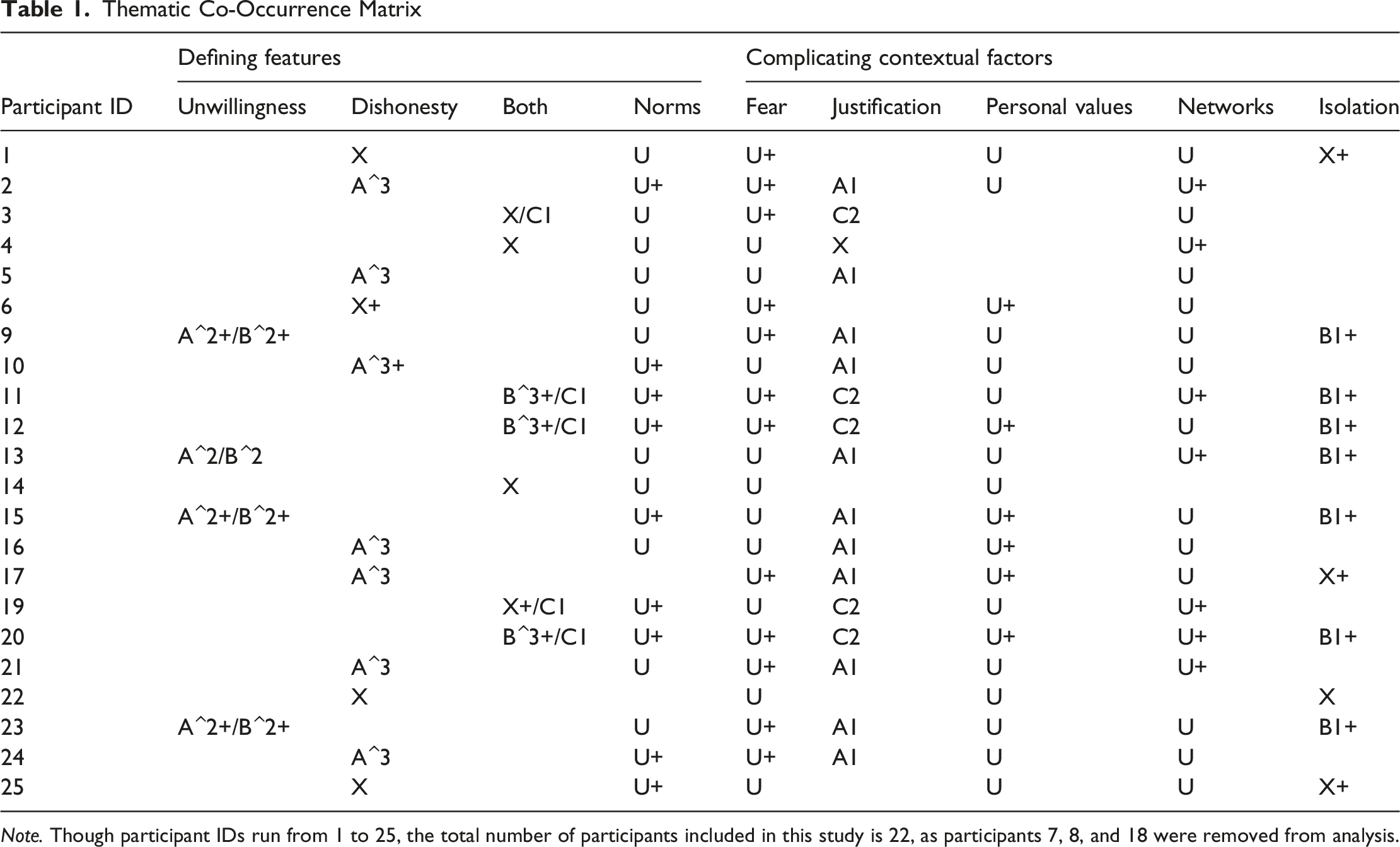
Note. Though participant IDs run from 1 to 25, the total number of participants included in this study is 22, as participants 7, 8, and 18 were removed from analysis.
Relationship B was unilateral, such that isolation (B1) was reported alongside participants who experienced any form of unwillingness, either exclusively (B2) or unwillingness in combination with dishonesty (B3). The relationship was also pervasive, such that the relationship was recurrent throughout the dataset, and balanced, such that the themes reflected similar recurrence, repetition, and forcefulness. Relationship B was complementary in that participants’ experiences of isolation reinforced their experiences of unwillingness. For instance, Abigail found herself providing D/RS to a friend struggling with depression. As this friend’s mental illness progressed, their behavior increasingly drove their other network members away, leaving Abigail as their only supporter. As a result, Abigail grappled with the challenge of being the last supporter standing, stating “It’s going to be detrimental to me, and so, I can’t be [their] only support network when [they] are struggling.” However, Abigail continued providing support—even though it left her drained—because she worried about her friend’s well-being. Reflecting on a conversation with her friend, Abigail shared, “‘I can’t be your only support network anymore. I can’t keep doing this to this degree and this severity… Reach out to a therapist or a psychiatrist or something’, then they never do. So, I guess, I have a fear of, if I don’t provide support, then something might happen…” For Abigail, being the only supporter (isolation) contributed to her unwillingness as well as her perceived inability to stop. As such, it is possible that participants experienced increased pressure to continue providing support beyond their willingness or capacity because they believed that they were the only source of support for the recipient. It is also possible that continued D/RS provision in combination with feelings of isolation may intensify a provider’s sense of unwillingness as the D/RS process drags on.
Relationship C was an inverse relationship, such that all participants, except for one, who experienced both unwillingness and dishonesty in their D/RS did not cite justification as part of their experience. Given the pervasive nature of relationship A, which depicts co-occurrences between justification and unwillingness as well as justification and dishonesty, it is surprising that justification was almost entirely absent from participants who cited experiencing both unwillingness and dishonesty. On the one hand, it is possible that participants do not feel a need to justify their unwilling and dishonest D/RS, in that they might perceive that the combination offsets one another. For example, a person might believe that the seeming contradiction of providing unwilling support is brought into balance by having the support they offer be dishonest. Conversely, it is possible that the combination of unwillingness and dishonesty feels unjustifiable and irrational to participants, but that they experience other factors and pressures that prompt continued D/RS in their relationships.
Discussion
Social support is essential to thriving relationships (MacGeorge et al., 2011), but not all social support is communicated willingly and genuinely. In this study, we identified the defining features of deceptive/reluctant support (D/RS), finding that it occurs when individuals communicate support unwillingly and/or in ways that are dishonest. Additionally, a central aspect of D/RS is people’s relational norms that create unique pressures that stimulate D/RS. We also identified several complicating contextual factors that participants shared as motivators, justifications, or values that influenced their engagement in D/RS. These included fear of repercussions, justifications about their behavior and the relationship, an overall sense of their personal values, and the complexity of experiencing D/RS within a larger social network or in isolation. Based on our analysis, we conceptualize D/RS as verbal and nonverbal support that is communicated unwillingly, is dishonest, or both. In addition, D/RS is characterized by an individual’s experience of relational norms that create pressure to provide D/RS.
Deceptive/Reluctant Support and Support Effectiveness
As defined by MacGeorge and colleagues (2011), social support encompasses “verbal and nonverbal behavior produced with the intention of providing assistance to others perceived as needing that aid” (p. 317). This definition does not explicitly address its authenticity or willingness—key considerations, especially for support providers. Some research suggests that individuals intentionally choose to offer dishonest support. For example, Goldsmith and Fitch (1997) found that advice givers deprioritized honesty, choosing supportiveness or meeting the emotional needs of the support seeker instead. Similar research found that parents struggle with the “correct” approach to providing support, whether to offer tough love (i.e., honest support) versus some other support that would alleviate stress and be preferred by the support seeker (Faw et al., 2019). In other research, Inagaki and Orehek (2017) note that support can be considered positive for providers only insomuch as it is offered willingly and deemed effective.
All these studies identify when and how providers choose to communicate support, highlighting a challenge extant in social support research: Who gets to decide when, how, and for whom social support is “effective”? D/RS provides a valuable framework for highlighting how traditional notions of effective support (i.e., providing support seekers with validating, acknowledging messages; High & Dillard, 2012) might not adequately capture what feels effective for support providers. Indeed, D/RS highlights a crucial challenge for support providers. In D/RS, providers choose to communicate in ways that they believe will satisfy the recipient even as that communication fails to meet their own needs or even subjects them to harm. The fact that some participants described their relationships as toxic while highlighting a lack of reciprocity and low respect for boundaries raises questions about for whom this type of support can be deemed effective (Inagaki & Orehek, 2017).
In this way, the experience of D/RS highlights inherent challenges in supportive communication, with providers experiencing their own D/RS efforts as creating and reinforcing problematic dynamics that damage their well-being. D/RS represents an interesting paradox, with providers simultaneously choosing D/RS to promote prosocial, positive outcomes for recipients while also recognizing that it can cause harm, internal conflict, and challenges for the providers themselves. As such, this research contributes to a growing literature that wrestles with a key question: How do support providers choose between honesty and supportiveness, between their own needs and the needs of others, and what are the consequences of those choices? Future research should continue to investigate these questions, exploring support providers’ experiences and outcomes of supportive interactions.
Deceptive/Reluctant Support in a Continuum of Supportive Communication
In addition to considering when, how, and for whom support might be considered effective, participants’ experiences of D/RS highlight that supportive communication is ongoing and dynamic, with providers’ motivations and efforts evolving as situations unfold. For many participants, their support started as genuine; however, as time progressed, they were no longer comfortable or capable of providing support in the same ways. In articulating their relationship norms (especially boundary creep and no questions asked), several participants noted that they only realized how much the norms in their relationship had shifted after it was too late, and an uncomfortable new norm was established. For other participants, the motivation to engage in D/RS sprang from having their genuine supportive efforts poorly received or from the belief they would be poorly received (seen in fear of negative repercussions and justification).
These findings suggest that supportive communication happens on a continuum. Between supportive communication that is authentic and genuine (what is usually discussed, simply, as social support), establishing parameters around the amount and/or type of support a provider is willing to offer (i.e., support boundary creation; Johnson, 2025), and the ultimate decision to cease offering support (i.e., nonsupport; Ray et al., 2023) is D/RS. Indeed, in work where individuals discussed their rationale for support boundary creation and engaging in nonsupport, many cited experiences that share significant similarities with participants’ discussions of D/RS (Johnson, 2025; Ray et al., 2023), including challenges of nonreciprocity, perceived ineffectiveness, and excessive demands for support. This suggests that when D/RS drags on or becomes intolerable, people might resort to minimizing, altering, or withdrawing their support (Johnson, 2025; Ray et al., 2023). Future research should examine the process of how individuals move through different types of support (genuine, within specific boundaries, deceptive/reluctant, and nonsupport) within a given relationship. Of particular value is increased insight into how individuals move from D/RS back to genuine support, something our participants struggled to do.
Complexity in Deceptive/Reluctant Support
The results of our thematic co-occurrence analysis (Scharp, 2021) indicate that D/RS is multifaceted and complex. In addition to the defining features, our participants detailed various complicating contextual factors that created complex D/RS experiences. The number of complicating contextual factors in combination with their nuances proved difficult to find clear-cut relationships between our themes. However, our analysis identified a few key patterns.
First, there were numerous themes that were ubiquitous, or present for almost all participants. Relational norms was a defining feature that was present for nearly all participants, making it ubiquitous in nature. Additionally, the complicating contextual factors of fear of repercussions, personal values, and networks were ubiquitous, occurring for most participants. It is important to note that, given the homogeneity of our participants, the norms and personal values highlighted in this research represent a highly White, female understanding of the D/RS experience. It is likely that individuals who experience different identities might experience different norms and values that influence their D/RS communication. Regardless, three of the five complicating contextual factors appearing to be ubiquitous among our participants illuminates the complexity of D/RS experiences.
Another pattern is reflected in relationship A, such that justification (A1) co-occurred with unwillingness (A2) and a dishonesty (A3). The relationship was unbalanced, as participants’ experiences of unwillingness were more forceful, and participants’ dishonesty was more recurrent. Regardless, this complimentary, pervasive relationship reflects how participants who provided support unwillingly and those who were dishonest both provided justifications of their deception. Surprisingly, the last pattern was an inverse relationship between justification and experiencing both unwillingness and dishonesty in their support. Almost entirely unrelated to one another, relationship C depicts how all participants (except for one) who experienced both unwillingness and inauthenticity in their D/RS provision did not offer justifications for their continued support. The lack of co-occurrence between these themes is surprising, given the pervasive nature of relationship A. However, it is possible that these individuals believed that their D/RS represents a more acceptable form of deception (DePaulo et al., 2009; Pederson et al., 2020), which might explain the lack of justification for their D/RS provision.
Additionally, relationship B depicts co-occurrences between isolation (B1) and any form of unwillingness (i.e., participants who were only unwilling (B2) or unwilling and inauthentic (B3)). This complementary, pervasive relationship reflects how feeling like the only one providing support might contribute to feelings of reluctance for continued support provision. It is possible that being isolated contributes to more continuous, excessive support, which may have accumulated over time and quickened their process of burnout. Other research suggests that the voluntary provisions of support is an important factor in creating positive interactions for support providers (Inagaki & Orehek, 2017); at the same time, pressure to provide support when a person does not want to can place providers in difficult positions, increasing the likelihood of D/RS and, perhaps eventually, supportive burnout (Goldsmith, 1994; Johnson, 2025; Ray & Manusov, 2023). As such, researchers should continue to investigate the complicated social dynamics—both within dyadic supportive relationships as well as broader social and cultural networks—to understand how providers can more effectively navigate these complex situations.
From these patterns, we also noted that all participants who cited being unwilling only experienced all five complicating contextual factors. These four participants cited fear of repercussions, personal values, and networks, which were labeled ubiquitous on our matrix as most participants experienced these themes. However, they also had co-occurrences with justification (detailed with relationship A) and isolation (detailed with relationship B). These findings highlight that there might be something unique about desiring not to provide support but being genuine in that support that is motivated by or creates high levels of complexity. Indeed, research illustrates how people use deceptive affectionate messages most while they have lower levels of commitment and relational satisfaction (Caton & Horan, 2021), and it is possible that our participants were navigating challenges that minimized their willingness to invest in their relationships. Future research should unpack how these contextual factors influence D/RS.
Deceptive/Reluctant Support, Deception, and Deceptive Affection
Our results align with similar research investigating affectionate communication and prosocial deception. Just as with social support, most discussions of affectionate communication assume that it is honest and willing; however, research on deceptive affectionate messages (e.g., Horan & Booth-Butterfield, 2019) illustrates how individuals may choose to deceive in their affection. Other forms of relational maintenance (e.g., surprises; Pederson et al., 2020) can be performed in deceptive ways with the intention to preserve or enhance the relationship. However, even prosocial deception is not universally positive. Pederson and colleagues (2020) noted that relational surprises can raise questions about how well a partner can deceive—if they are capable of prosocial deception, they might also be capable of deception for nefarious purposes, creating opportunities for doubt even in a prosocial deceptive situation.
Similar to deceptive affection, the notion of D/RS might conjure ideas of support that is malicious or coercive. However, it is important to recognize that D/RS is not inherently antisocial. Research into deception has identified numerous prosocial reasons why a person might lie (DePaulo et al., 2009). Aligning with past research on advice givers who perceive that recipients are not truly open to their insights (Goldsmith & Fitch, 1997), some participants engaged in D/RS because they felt other supportive efforts would be futile, or that creating boundaries or engaging in nonsupport would threaten their face or the relationship. In this way, participants brought careful thought and strategy to their D/RS, with many of them choosing D/RS because they believed it would result in the most positive outcomes possible. D/RS represents support providers’ efforts to address complex social challenges in ways to promote the most good for a specific relational and situational dynamic. Given other-oriented lies are more common in close relationships (DePaulo & Kashy, 1998), individuals might prioritize relational maintenance while engaging in D/RS. Future research should identify when and how D/RS becomes hurtful to promote communication that meets the needs of both interactants.
Limitations & Directions for Future Research
While this study’s findings generate novel insights about D/RS, it is not without limitations. Our participants were highly racially homogenous, with only three participants identifying as people of color. As such, our results should be considered carefully, as they reflect experiences of deceptive/reluctant support that are largely White and female. Given research demonstrating that supportive communication can be influenced by a person’s identity (Davis, 2021) and our own participants citing their personal and cultural values in their D/RS, it is essential that future research investigates how D/RS varies among different individuals and contexts. Additionally, we did not ask our participants to share information related to their experiences of disability or socioeconomic status, two other factors that might influence D/RS. Similarly, even though this study did not specify any constraints around the circumstances that prompted D/RS, our participants often shared more extreme incidents. While a few reflected D/RS in more mundane circumstances, it is possible that everyday experiences of D/RS might have additional complicating factors and serve varying purposes (Burleson, 1994). Future research could consider utilizing methods like daily diary studies to capture mundane D/RS.
Conclusion
This study represents an exploratory investigation into D/RS, or unwilling and/or inauthentic supportive communication. These findings contribute to research about the complexity of supportive communication, elevating the experiences of support providers who are often de-emphasized in conversations regarding the effectiveness of supportive communication. Our findings highlight the challenges that support providers navigate when they must make difficult choices about how to help a network member despite their desire to not provide support or inability to communicate honestly in the situation. Given that support providers often view their D/RS as the best possible course of action even as they cite its harms, D/RS represents an important paradox of supportive communication. With additional research and investigation, scholars can begin to unpack the complex and dynamic processes of D/RS communication as providers manage their experience of this highly challenging and important phenomenon.
Footnotes
Authors’ Note
Portions of this article were presented at the International Association for Relationship Research Dark Side of Relationships 2023 Mini-Conference and presented at the National Communication Association 2024 Annual Convention.
Acknowledgments
We would like to thank the Department of Communication Studies at Colorado State University for supporting this research. Additionally, our appreciation goes to the anonymous reviewers for their feedback.

Funding
The authors disclosed receipt of the following financial support for the research, authorship, and/or publication of this article: This research was funded by the Graduate Student Research Grant from the Communication Studies Department at Colorado State University.
Declaration of Conflicting Interests
The authors declared no potential conflicts of interest with respect to the research, authorship, and/or publication of this article.
Open Research Statement
As part of IARR’s encouragement of open research practices, the authors have provided the following information: This research was not pre-registered. The data used in the research cannot be publicly shared but are available upon request. The data can be obtained by contacting the lead author, Kylie J. Johnson (