






Abstract
Mate preferences are shaped by multiple social cues, including occupational information and perceived personality traits. However, little is known about how these signals interact, particularly when occupations carry strong artistic and cultural meanings. The present research examined how representations of ballet dancers interact with personality trait cues to influence romantic desirability. Across four within-subjects experiments, participants evaluated hypothetical profiles that varied by occupation (ballet dancer vs. accountant) and by one experimentally manipulated trait: intellectuality (Study 1), compatibility (Study 2), talent (Study 3), or sex-typed characteristics (masculinity/femininity; Study 4). Results generally showed that personality traits exert more influence on romantic evaluations than occupational labels. High intellectuality and compatibility substantially increased attractiveness, particularly in long-term contexts, regardless of occupation. Talent yielded modest increases in desirability across relationship contexts. Manipulations of masculinity and femininity produced mixed effects: high masculinity enhanced evaluations of accountants but did not offset perceptions of ballet dancers. Importantly, ballet dancers were not systematically devalued and were often rated as equally desirable to accountants when paired with favorable trait descriptions. Overall, the findings suggest that individual trait signals tend to override occupational stereotypes in mate preferences, although conflicts between sex norms and occupational cues may attenuate the positive effects of desirable traits.
The idea that artistic expression, especially dance and music, plays a role in mate preference has deep evolutionary roots. Darwin (1871/2019) famously proposed that such behaviors evolved, at least in part, to enhance sexual attractiveness, functioning as displays of genetic fitness. Building on this, Miller’s (2000, 2001) fitness indicator theory suggests that producing art requires costly traits such as creativity, and fine motor skills may honestly signal the underlying genetic and cognitive quality. A growing body of research has explored the evolutionary functions of dance, particularly its role in mate selection and social communication. According to Richter and Ostovar (2016), rhythm and dance likely co-evolved prior to melody and language, serving foundational roles in sexual attraction, social bonding, group coordination, and emotional expressions. Several studies have supported this idea by demonstrating that dance movements can function as honest signals of mate quality, conveying physical strength, fitness, and genetic viability in ways that are difficult to fake (Fink et al., 2021; Hugill et al., 2010).
The meanings attached to dance do not emerge in a social vacuum; rather, they are shaped by cultural expectations and sex norms that can amplify, distort, or even override biological signals. Dance is frequently entangled with these norms, as evidenced by Wade et al. (2015), who found that while women dancers are often seen as more sexually attractive than male dancers and associated with fertility and allure, male dancers are perceived as warmer but also more feminine than non-dancers. These sexed asymmetries are particularly evident in ballet. As Hanna (2010) noted, ballet carries rich sexual and emotional symbolism through heterosexual pairings and intimate gestures, yet it simultaneously idealizes restraint, delicacy, and bodily control. This ambiguity contributes to persistent stereotypes, especially regarding the sexuality of male dancers who are perceived as violating traditional masculine norms. To manage this ‘feminine’ stigma, male dancers often employ strategies such as emphasizing heterosexuality, likening ballet to sports, or framing it as an elite art form (Haltom & Worthen, 2014), strategies also observed among boys in other ‘feminine-coded’ domains like rhythmic gymnastics (Chimot & Louveau, 2010).
However, in societies with more traditional or conservative cultural fabrics, such as Türkiye, these perceptions often shift toward more rigid moral and gender-based judgements. According to Gedikli and Ulusoy (2024), who conducted a qualitative study with ballet dancers in Türkiye, societal perceptions of the profession are primarily structured around themes of sexuality and traditional masculinity/femininity roles. Their findings reveal a gender-specific dichotomy in negative social constructions: for male dancers, the stigma is predominantly built upon themes of ‘effeminacy’ and perceived same-sex orientation. In contrast, for female dancers, negative judgements are framed through the lens of honor and chastity, often associated with concerns regarding nudity, close physical contact with the opposite sex, and perceived ‘easy accessibility.’ Thus, while global stereotypes often focus on the dancer’s persona, the Turkish context introduces a distinct layer of scrutiny rooted in deeply embedded cultural definitions of morality.
Despite its rich cultural associations, research has primarily focused on ballet dancers’ internal experiences, leaving a critical gap in understanding how the external perception of the ballet occupation, with its unique gender stereotypes, shapes interpersonal evaluations and interacts with individual personality traits in mate preference contexts. Research has shown that artistic traits, such as creativity, can boost social and romantic desirability (Marin & Rathgeber, 2022; Tifferet et al., 2012; Wassiliwizky et al., 2023). These traits are often inferred directly from an individual’ s professional title, as occupational labels serve as primary social signals. However, recent studies suggest that this desirability may depend more on the traits associated with the artist (e.g., intellectuality and creativity) than on the occupational label alone (Şenyurt et al., 2026). Their findings suggest that the combination of creative and cognitive traits enhances attractiveness, especially for women, and that occupational identity can function as a shortcut to such inferences.
However, not all artistic occupations evoke the same romantic associations. Ballet, in particular, presents an interesting case because of its complex cultural positioning and divergence from more socially integrative forms of dance (Wainwright & Turner, 2004). Although ballet is technically classified as a form of dance, its broader cultural and social connotations complicate this categorization (Turner & Wainwright, 2003). Unlike many evolutionary dance forms that promote group cohesion, shared rhythm, and mutual engagement, ballet is a highly structured performative genre characterized by musical synchronization, individual mastery, and rigid aesthetic codes. It is primarily designed to be observed rather than collectively experienced, emphasizing performance over participation, and competition over cooperation (Twitchett et al., 2009).
In contrast, accounting is characterized as a highly conventional and analytically structured profession, typically associated with stability, conscientiousness, cognitive skills and financial reliability (Holland, 1997; Roberts et al., 2003). These attributes are theoretically pertinent to long-term partner preferences, as a social signal that extends beyond economic factors, and traits such as responsibility, predictability, and resource stability are consistently prioritized in assessments of committed relationship potential (Buss & Schmitt, 2019; Li et al., 2002). Furthermore, accounting is a globally prevalent and culturally recognized profession, rendering it an appropriate comparison category when evaluating the influence of occupational roles on partner desirability. In contrast to artistic professions such as ballet, which convey creativity, lifestyle openness, and an expressive orientation, conventional occupations are more likely to evoke perceptions of reliability and reduced lifestyle unpredictability (Gosling et al., 2002; Lievens & Sackett, 2012). Therefore, contrasting ballet dancers with accountants offers a theoretically significant framework for examining how socio-perceptual signals inherent in occupational categories affect mate preferences.
While specific vocational and cultural backgrounds (those associated with ballet dancers) can shape initial perceptions, the broader mate selection process is deeply intertwined with fundamental personality traits. Extensive research in evolutionary and social psychology underscores that the characteristics of potential partners critically inform both long-term and short-term mating preferences (Buss & Schmitt, 1993; Clarkson et al., 2020). Long-term mate selection is typically guided by preferences for traits that foster relational stability and compatibility, such as warmth, trustworthiness, conscientiousness, and agreeableness (Malouff et al., 2013; Regan et al., 2000; Valentine et al., 2020). In contrast, short-term mating contexts place greater emphasis on immediately observable cues, including physical attractiveness, bodily aesthetics, and confidence, which signal genetic quality and short-term desirability (Buss & Schmitt, 1993; Gangestad & Simpson, 2000; Li et al., 2002).
In addition to general personality characteristics, gender-role traits such as masculinity and femininity play a critical role in shaping romantic attraction, particularly in profile-based evaluation contexts. Prior research demonstrates that adherence to or deviation from traditional gender role expectations systematically influences perceived attractiveness in online dating scenarios. For example, Chappetta and Barth (2016) found that profiles signaling sex-role congruence were generally rated as more attractive, whereas violations of expected masculinity or femininity reduced desirability, especially for male targets. Similar findings suggest that masculinity is often associated with dominance, confidence, and status, which are valued differently across short- and long-term mating contexts, while femininity is linked to warmth, expressiveness, and nurturance (Buss & Schmitt, 1993; Regan et al., 2000).
Importantly, these sex-typed trait inferences frequently arise from minimal social cues, including occupational labels, and may interact with culturally loaded professions such as ballet, where traditional masculinity and femininity norms are often perceived as ambiguous or contested. Thus, examining masculinity and femininity alongside other personality traits provides a theoretically grounded framework for understanding how occupational identity and sex-role signals jointly shape mate preferences.
Although ballet is not equally embedded in all cultural contexts, it is a globally recognized artistic discipline with widely shared symbolic associations related to physical aesthetics, discipline, and elite cultural status. These shared representations, rather than direct familiarity, allow ballet dancers to function as a meaningful occupational category in experimental research on mate preferences. In this regard, personality profiles attributed to or inferred from ballet dancers may interact with their occupational identity to shape how they are appraised as prospective mates across varying temporal relationship horizons. Accordingly, examining the interplay between occupational cues and personality signals is essential for a nuanced understanding of mate preference formation.
Crucially, while artistic display is linked to mate choice, and occupational cues signal traits, there remains a significant gap in understanding how culturally rich and often sex-typed occupations, such as ballet, interact with specific personality traits to influence mate preferences. Specifically, few studies have examined external social perceptions of ballet dancers, and none have systematically investigated how the occupational label of ‘ballet dancer’ interacts with individual trait signals to shape romantic desirability. In this study, we isolated the occupational label of “ballet dancer” to explore how it influences perceived attractiveness in romantic contexts, particularly in interaction with individual trait signals.
Hypotheses and Overview of Studies
Conceptual Overview
The present research aimed to investigate how occupational information, specifically being identified as a ballet dancer versus an accountant, interacts with individual personality traits in shaping mate preferences across both short- and long-term relational contexts. Although artistic expression and personality traits have been widely examined in the mate preference literature, direct comparisons between ballet dancers and conventional professional roles such as accountants remain largely unexplored. Ballet represents a culturally distinctive subdomain characterized by strong aesthetic norms and sexed symbolic meanings, making it a theoretically informative case for examining how occupational cues shape romantic evaluations.
Hypotheses
Ballet dancers will be rated as more romantically desirable than accountants.
Higher levels of target personality traits (intellectuality, talent, masculinity/femininity, and agreeableness) will be associated with higher romantic desirability.
The interaction between personality traits and occupational cues will influence romantic desirability, depending on contextual and cultural expectations.
The relative influence of occupational cues and personality traits on romantic desirability will differ between short-term and long-term relationship contexts.
Overview of Studies
To test these hypotheses, we conducted a series of online experiments with male and female participants recruited through social media platforms. The study began with a preliminary phase in which participants answered questions about male and female ballet dancers. Subsequently, four experiments were conducted using a 2 (occupation: ballet dancer vs. accountant) × 2 (target personality trait level: high vs. low) within-subjects design. The number of participants were calculated through power analyses. Details of the a priori and post hoc power analyses are provided in Supplemental Material A. Participants evaluated four profiles presented in counterbalanced order and rated their short-term and long-term romantic interest in each profile. This within-subjects structure enabled direct comparisons of how occupational and personality cues shaped mate preferences within individuals, while the counterbalanced presentation of profiles mitigated potential order effects or demand characteristics. Ethical approval for all experimental procedures was obtained from the Social and Humanities Ethics Committee of the Balıkesir University, under the protocol number 2025/04-09. All participants provided informed consent prior to their participation in the study.
Preliminary Study
Method
Design and Sample
An online set of questions was created to understand the evaluations of ballet dancers by male and female participants. Another aim of this preliminary study was to select characteristics to be manipulated in subsequent studies. Sixty-four males (M age = 27.65, SD = 7.47) and 76 females (M age = 22.14, SD = 2.47) participated in preliminary study. Participants were not asked to report their race/ethnicity; however, all participants were residents of Türkiye. Given that, most of participants reported never having attended a ballet or opera (69.8% of males and 75% of females), they were considered naïve with respect to these art forms. They were presented with a series of questions, which included a rating scale, multiple-choice, and open-ended formats. The frequency of responses was subsequently analyzed.
Materials and Procedure
Participants were individuals who responded to a voluntary participation announcement distributed through social media platforms, including Instagram, X, and WhatsApp, utilizing convenience sampling. After initial informed consent form, sex information was collected to organize the presentation of sex-specific questions in the subsequent sections. In Turkish, there is no sex-neutral term for a ballet dancer; therefore, the term balet was employed for males and balerin for females. The remaining questions are structured accordingly.
Initially, participants were presented with a list of 21 adjectives that were previously used in studies conducted in Türkiye (e.g., Gündoğdu Aktürk, 2010; Şenyurt et al., 2026) and were instructed to select five adjectives in response to specific inquiries. The participants were posed with four questions: what attributes are characteristic of a ballet dancer, which of these attributes would lead you to choose a ballet dancer as a partner or spouse, what are the common traits you value in romantic partners and believe a ballet dancer possesses, and which traits would influence your preference for a ballet dancer in a long-term relationship or marriage. Furthermore, using the same set of adjectives, participants were required to make a singular selection and respond to two questions: I believe a ballet dancer would be a good partner or spouse (for second question: a bad partner or spouse) because a ballet dancer is … (e.g., talented).
The participants were presented with open-ended questions about ballet dancers. The inquiries addressed attributes that make a ballet dancer desirable as a romantic partner, the benefits and drawbacks of relationships with ballet dancers, and the typical personality traits of ballet dancers. Ultimately, participants were asked, ‘Would you consider having a ballet dancer as a romantic partner? Please provide the rationale for your response.'
Finally, the participants were asked to rate the sentences on a seven-point scale. These sentences present various social representations related to ballet dancers. The scale items included whether a ballet dancer was prone to infidelity, whether the tightness of the ballet outfit would bother someone as a romantic partner, whether the ballet was morally appropriate, and whether it was compatible with Turkish culture. At the end of the study, it was emphasized that the items were made only for research and did not reflect real life.
Results
While both female and male participants demonstrated numerous similarities in their evaluations of ballet dancers, notable distinctions were apparent in their assessments. However, it is not feasible to present all findings from a preliminary study within this text. Instead, a comprehensive examination of the data is available in the Supplemental Materials. Nonetheless, upon reviewing the data, several general results were noteworthy. First, participants exhibited a lack of enthusiasm for forming relationships with ballet dancers, particularly female participants. Second, both sexes attributed ballet dancers to being intellectual, talented, and compatible. Third, the female participants indicated that male ballet dancers lacked masculinity. This perception was frequently observed in both direct written statements in response to open-ended questions and in the attributes ascribed to male dancers (e.g., not being protective or being compliant). In contrast, the male participants regarded the femininity of female ballet dancers as a positive attribute. Based on the frequency and salience of mentions in open-ended questions and rating scales, intellectuality, talent, and compatibility emerged as key attributes. Similarly, the strong manifestation of masculinity and femininity in open-ended questions necessitated their detailed examination in subsequent studies.
Study 1
The first study centered on intellectuality, investigating whether variations in this trait, presented as high or low, differentially shaped romantic evaluations when paired with distinct occupational profiles. In subsequent studies, only features designated as either high or low were subject to modification. Consequently, the research methodology is comprehensively detailed solely for this experiment, whereas in the ensuing experiments, only the altered component is described.
Method
The present research employed a profile-based experimental design that shares important methodological features with vignette and factorial survey approaches. Similar to vignette methods, participants evaluated standardized, text-based descriptions of hypothetical individuals in which specific attributes (occupation and personality trait levels) were systematically manipulated while other profile information was held constant (Finch, 1987; Jasso, 2006; Ludwick & Zeller, 2001). Such designs allow researchers to isolate the effects of targeted social cues while maintaining a high level of experimental control (Wason et al., 2002).
At the same time, the present design differs from traditional vignette studies in several respects. Rather than relying on single or between-subjects scenarios, participants evaluated multiple profiles within a within-subjects framework, enabling direct comparisons across occupational and personality conditions and increasing statistical power (Ganong & Coleman, 2006). This approach has been widely used in research on mate preferences, where experimentally controlled profile evaluations allow for systematic examination of how specific cues shape romantic judgments. Nevertheless, as with all text-based and vignette-like methodologies, this approach cannot fully capture dynamic interpersonal processes or real-world interactional complexity, a limitation that has been noted in prior methodological discussions (Baumeister et al., 2007).
Design and Sample
Study 1 included 55 male (M age = 24.1, SD = 5.68) and 77 female (M age = 23.1, SD = 5.23) participants who lived in Türkiye. Participants were not asked to report their race/ethnicity. A 2 (Occupation: Ballet dancer, Accountant) × 2 (Intellectuality: High, Low) within-subject design was implemented.
Materials and Procedure
Participants were recruited using convenience sampling methods through various social media platforms, such as Instagram, X, and WhatsApp. Data were gathered using specialized online survey software called PsyToolkit (Stoet, 2010, 2017).
After obtaining informed consent on the first page, participants were given a direct task instruction stating that the study examined how individuals form impressions based on limited profile information. No additional cover story was introduced, and participants’ interpretations of the task were not formally assessed. Participants then provided demographic information, including age, sex, and sexual orientation (forced choice: more attracted to women or men). Based on the sex they reported, participants were directed to the corresponding set of sex-matched profiles and were then randomly assigned to one of the predefined profile order conditions within that set. Same-sex oriented participants assessed members of their own sex; however, they were excluded from the analyses due to the small number of participants in this category (n = 10), which was insufficient to support reliable statistical analyses.
The participants viewed the four profiles presented in random order. Two profiles were presented as ballet dancers, whereas the other two were accountants. The accountant profession served as a conventional comparison category rather than a strictly neutral control condition. This category provides a familiar occupational baseline for evaluating the effects of the target profession while acknowledging that all occupations inherently carry some social stereotypes. These two occupations represent distinct social representations within the framework of societal norms: The ballet dancer as an artistic figure and the accountant as a more traditional professional role as a control condition. Each profile page included the target’s name, occupation, educational background, health status, foreign language, hobbies, and personality test results. The name for each profile was randomly selected from a fixed pool of six female and six male names, which were determined based on the most common names in Türkiye as published by the Turkish Statistical Institute. Importantly, names were not consistently assigned to specific profiles; instead, they were randomly paired to prevent name-based biases. Similarly, the hobbies were randomly assigned from a pool containing three indoor and three outdoor activities. For all profiles, the educational background was university graduate, the foreign language was English, and health status was healthy. This experimental design aimed to isolate the influence of targeted personality traits on evaluations by minimizing the potential bias stemming from names or hobbies. Additionally, by randomly assigning names and hobbies from limited pools and ensuring that participants did not repeatedly encounter the same name and hobbies across profiles, the design controlled for habituation or carryover effects in this repeated-measures setup, thereby enhancing the internal validity.
Finally, participants were shown fictitious personality profiles scored on a 10-point scale. No additional information was provided regarding how these personality scores were generated; participants simply viewed the numerical ratings and star charts for each trait. The scores for five traits (intellectuality, patience, emotional balance, sociability, and fairness) were visually represented using star charts. In this chart, a standardized text-based description was developed to explain the profiles’ personality test results by the researchers. In the low intellectuality conditions, the intellectuality scores were presented as 5.1 or 5.2, whereas in the high intellectuality conditions, these scores were presented as 8.2 or 8.3. The latter traits were counterbalanced at an intermediate range of 6.5 and 7.4.
Participants were instructed to view each profile for a minimum of 10 seconds before proceeding with the evaluation items. Until this time, they were unable to access the profile evaluation scale. This procedure was programmed to ensure a careful and attentive examination of the profiles. After viewing each profile, participants completed the partner preference scale for the individual described. Upon completing the evaluation of one profile, the participants were automatically directed to the next profile. This process was repeated a total of four times.
The partner preference scale, which is the dependent variable of the study, is a self-report scale consisting of 10 items and using a seven-point rating system (1 = strongly disagree to 7 = strongly agree). After presenting each of the four profiles, participants completed the same set of items. The scale measures participants’ evaluations of partner preferences across dimensions such as desire for a long-term or short-term relationship, physical attractiveness, trust, ideal partner compatibility, and romantic compatibility. Factor analyses revealed that short-term and long-term preferences were two distinct factors on this scale.
Analysis
The data obtained in the study were analyzed using the Jamovi (Jamovi Project, 2024) software program (version 2.6.26) and SPSS (IBM Corp., 2021). The Modified Z-Score (Leys et al., 2018) method was applied to identify and remove outliers in the dependent variables. Observations with a modified Z-score greater than 3.0 were considered outliers and excluded from the dataset.
Exploratory factor analyses, conducted separately for male and female participants, revealed a consistent two-factor structure underlying the 10-item Partner Preference Scale. In both groups, the first factor represented short-term relationship preference (2 items), while the second factor captured long-term relationship preference (8 items). The first factor represents short-term relationship preference, exemplified by items such as “I would like to have a short-term relationship with this person”. The second factor represents long-term relationship preference, illustrated by items like “I would like to have a long-term relationship with this person”. Factor loadings were satisfactory, mostly above .65, with limited cross-loadings, thus supporting the internal consistency of the structure. Confirmatory factor analyses further validated this two-factor solution for both males and females, with fit indices indicating strong model fit (e.g., CFI = .96 for males and .97 for females). Reliability analyses demonstrated high internal consistency for both subscales across sex, with Cronbach’s alpha values exceeding .86 for the short-term preference factor and .94 for the long-term preference factor. These results confirm that the scale reliably and distinctly measures short- and long-term relationship preferences in both the male and female samples.
To examine the effects of sex, occupation, and target personality traits on mate preferences, a 2 (Sex: male vs. female; between-subjects) × 2 (Occupation: ballet dancer vs. accountant; within-subjects) × 2 (Intellectuality: high vs. low; within-subjects) Repeated Measures Mixed ANOVA (RM-MANOVA) was conducted. A Repeated Measures Mixed MANOVA framework was employed to simultaneously analyze short-term and long-term mate preferences, which are theoretically related constructs derived from the same preference scale. This approach reduces the risk of Type I error rates associated with multiple univariate tests and allows a more comprehensive evaluation of whether occupation, intellectuality, and their interaction exert differential effects across relationship contexts. Due to the unequal sample sizes between genders, Pillai’s Trace was reported for RM-MANOVA results as it is more robust to violations of assumptions in unbalanced designs.
Initially, the experimental design intended to categorize the experiments as a and b based on the sex of the participants. Following the recommendation of an anonymous reviewer, the data were integrated to treat participants’ sex as a predictor variable. Sex-based differences were formally analyzed, with the corresponding statistical findings reported in the Results section and their theoretical implications further examined in the Discussion. However, to maintain the ethical integrity of the original research design and the initial hypotheses remained unchanged, and these additional findings are treated as exploratory rather than confirmatory.
Results
Results indicated a significant main effect of sex, Pillai’s Trace V = .08, F (2, 131) = 5.72, p = .004, η2p = .08, such that male participants scored higher than female participants on both measures. Specifically, for short-term (ST) preferences, females scored lower (M = 3.22, SD = 1.01) than males (M = 3.84, SD = 1.23), Mean Difference (MD) = −0.62, SE = 0.19, p = .002. For long-term (LT) preferences, females also scored lower (M = 3.80, SD = 0.99) than males (M = 4.26, SD = 1.02), MD = −0.46, SE = 0.18, p = .009.
A significant main effect of Intellectuality was also observed, Pillai’s TraceV = .27, F (2, 131) = 23.77, p < .001, η2p = .27, with higher Intellectuality profiles being rated more favorably on LT. Specifically, participants in the lower intellectuality condition (M = 3.65, SD = 1.27) scored lower than those in the higher intellectuality condition (M = 4.41, SD = 1.16) on LT, MD = −0.76, SE = 0.11, p < .001. No significant difference was found for short-term mate preference, MD = −0.17, SE = 0.12, p = .17.
The Sex × intellectuality interaction was not significant, Pillai’s TraceV = .03, F (2, 131) = 1.96, p = .145, η2p = .03, indicating that the effect of intellectuality on relationship preference was similar for both sexes.
All effects involving occupation, including occupation × sex, occupation × intellectuality, and the three-way interaction, were not significant (all ps > .05), suggesting that occupational group did not influence participants’ ratings.
Discussion
The results from Study 1 indicate that intellectuality plays a key role in shaping romantic preferences, particularly in the context of long-term relationships. Participants favored high intellectual profiles, when evaluating potential long-term partners. This pattern was observed for both male and female participants, suggesting a shared valuation of intellectual traits across sexes.
These findings are consistent with prior research by Regan and Joshi (2003), who found the effects of physical appeal and sexual drive when considering short-term partners, but intelligence and mentally engaging traits (e.g., humor) were prioritized in long-term relationship contexts. Notably, Study 1 showed no sex differences in these patterns. Sex effects emerged with males providing higher overall ratings, yet the non-significant sex × intellectuality interaction indicates that the impact of intellectuality is similar across sexes. These results are consistent with prior research suggesting that individuals prioritize different traits depending on the duration and goals of the relationship.
Study 2
Method
Study 2 comprised 34 male (M age = 23.8, SD = 5.46) and 60 female participants (M age = 23.2, SD = 5.67) who lived in Türkiye. Two male participants were excluded following the outlier analysis, resulting in the continuation of the analysis with 32 male participants. The experimental procedure was identical to that of Study 1, except that the compatibility personality trait was utilized instead of the intellectuality trait. The manipulation of compatibility followed the same procedure as Study 1. The first trait was labeled as ‘Compatibility’ and presented as a global score on the star chart, representing an overall assessment of potential interpersonal fit.
Results
To examine the effects of sex, occupation, and target personality traits on mate preferences, a 2 (Sex: male vs. female; between-subjects) × 2 (Occupation: ballet dancer vs. accountant; within-subjects) × 2 (Compatibility: high vs. low; within-subjects) Repeated Measures Mixed ANOVA (RM-MANOVA) was conducted.
Multivariate tests indicated a significant main effect of sex, Pillai’s TraceV = .13, F (2, 90) = 6.63, p = .002, η2p = .128, and a significant main effect of compatibility, Pillai’s TraceV = .33, F (2, 90) = 21.73, p < .001, η2p = .33. Occupation and all interactions involving occupation were not significant (all p > .05).
Univariate analyses revealed that female participants scored significantly lower than male participants on both ST (M Female = 3.28, SE = 0.14; M Male = 4.18, SE = 0.20), F (1, 91) = 13.34, p < .001, η2p = .13 and LT (M Female = 3.58, SE = 0.13; M Male = 4.12, SE = 0.18), F (1, 91) = 6.67, p = .018, η2p = .07 partner preferences.
Participants showed a clear preference for high compatibility profiles than low compatibility profiles for both short-term preference (M High = 3.92 vs. M Low = 3.54), F (1, 91) = 6.35, p = .014, η2p = .07 and long-term preference (M High = 4.28 vs. M Low = 3.42), F (1, 91) = 43.52, p < .001, η2p = .32. This pattern indicates that profiles characterized by greater compatibility were consistently more desirable, highlighting compatibility as a particularly salient cue in mate selection across relationship contexts.
Discussion
Summary of Multivariate, Univariate, and Pairwise Comparison Results Across Four Studies for Short-Term and Long-Term Preference
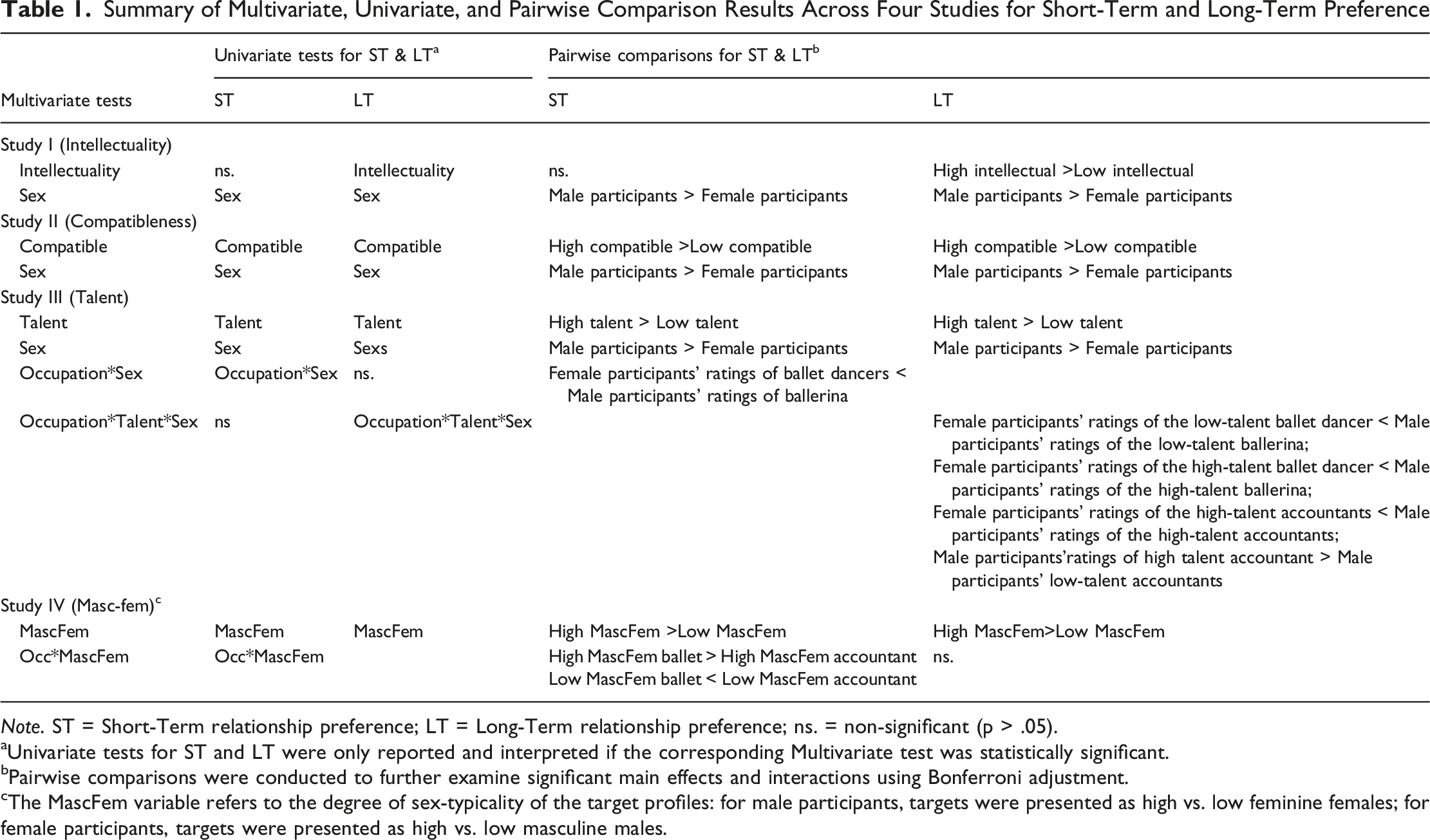
Note. ST = Short-Term relationship preference; LT = Long-Term relationship preference; ns. = non-significant (p > .05).
aUnivariate tests for ST and LT were only reported and interpreted if the corresponding Multivariate test was statistically significant.
bPairwise comparisons were conducted to further examine significant main effects and interactions using Bonferroni adjustment.
cThe MascFem variable refers to the degree of sex-typicality of the target profiles: for male participants, targets were presented as high vs. low feminine females; for female participants, targets were presented as high vs. low masculine males.
Study 3
Method
Study 3 included 59 male (M age = 25.2, SD = 7.67) and 70 female participants (M age = 23.6, SD = 6.48) who lived in Türkiye. Following the identification of outliers, six male participants were excluded from the study, resulting in the continuation of the analysis with a sample of 53 male participants. This study replicated the procedure used in the preceding two studies, with the exception that the manipulated personality trait (Talent) was introduced through conditions of high and low talent. The ‘Talent’ trait was manipulated using 10-point star charts; profiles in the high-talent condition were presented with scores of 8.2 or 8.3 (representing high-level aptitude), while profiles in the low-talent condition received scores of 5.1 or 5.2 (representing moderate-to-low aptitude).
Results
To examine the effects of sex, occupation, and target personality traits on mate preferences, a 2 (Sex: male vs. female; between-subjects) × 2 (Occupation: ballet dancer vs. accountant; within-subjects) × 2 (Talent: high vs. low; within-subjects) Repeated Measures Mixed ANOVA (RM-MANOVA) was conducted. Short-term and long-term mate preferences derived from the preference scale served as the two dependent variables (Figure 1). Interaction of occupation (ballet dancer vs. accountant), talent level, sex, and relationship context on romantic desirability ratings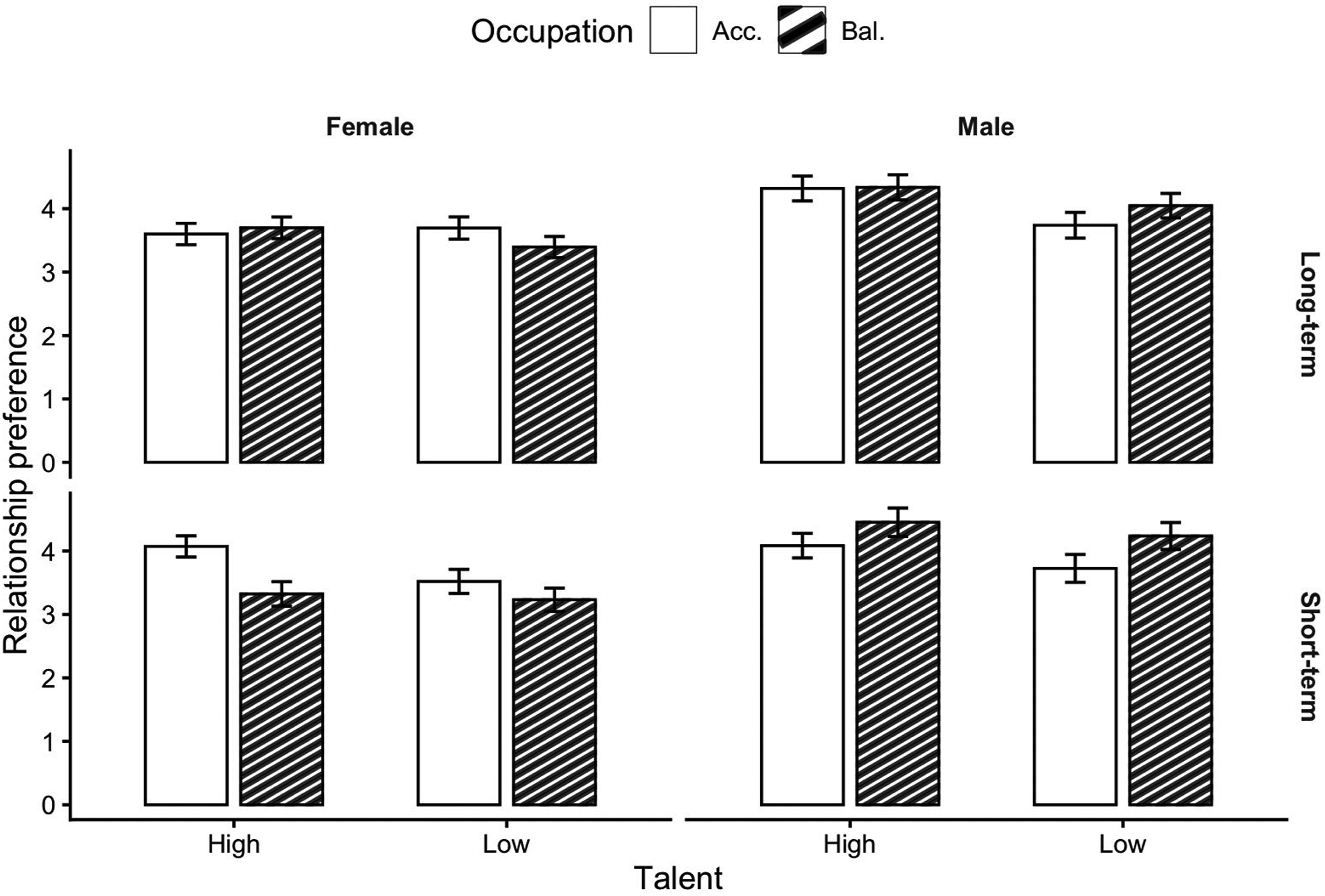
Multivariate tests revealed a significant main effect of sex, Pillai’s TraceV = .08, F (2, 121) = 5.24, p = .007, η2p = .08, and talent, Pillai’s TraceV = .07, F (2, 121) = 4.31, p = .016, η2p = .07, as well as a significant three-way occupation × talent × sex interaction, Pillai’s TraceV = .05, F (2, 121) = 3.37, p = .038, η2p = .05. On the other hand, occupation alone was not significant, Pillai’s TraceV = .003, F (2, 121) = 0.17, p = .84, η2p = .003.
Subsequently univariate analyses indicated that talent significantly influenced both ST, F (1, 122) = 7.16, p = .009, η2p = .06 and LT, F (1, 122) = 5.91, p = .017, η2p = .05 preferences, with high-talent profiles receiving higher ratings than low-talent profiles (MD ST = 0.31, 95% CI [0.079, 0.530]; MD LT = 0.27, 95% CI [0.050, 0.488]).
The occupation × sex interaction was significant for ST preferences, F (1, 122) = 13.06, p < .001, η2p = .10, such that male participants rated low-talent ballet dancers higher than female participants, whereas for high-talent ballet dancers and for accountants, sex differences were minimal or nonsignificant. In LT preferences, males rated low-talent ballet dancers (M = 4.19, SD = 1.89) higher than females (M = 3.55, SD = 1.67), while high-talent profiles showed no sex differences.
The three-way occupation × talent × sex interaction showed that females’ ST preferences favored accountants over ballet dancers regardless of talent, whereas males’ LT preferences favored high-talent accountants over ballet dancers.
Female participants rated low-talent accountants (M = 3.52, SD = 2.12) higher than low-talent ballet dancers (M = 3.23, SD = 2.00), for ST, MD = .29, p = .015, 95% CI [0.04, 0.54]. Also, in terms of high-talent profiles, females gave higher ratings to accountants (M = 4.07, SD = 1.89) compared to ballet dancers (M = 3.32, SD = 2.12), for ST preferences, MD = .75, p = .008, 95% CI [0.50, 1.01]. The ratings of male participants showed no significant differences in ST preferences between ballet dancer and accountant profiles (all ps > .10).
Male participants rated high-talent accountants (M = 4.32, SD = 2.23) significantly higher than high-talent ballet dancers (M = 3.74, SD = 2.23) for LT preferences, MD = .58, p = .014, 95% CI [0.12, 1.04]. Among female participants, there were no significant differences in LT preferences between those with high and low talent within the same occupations (all ps > .05).
Discussion
High-talent profiles received higher ratings for both short-term and long-term partner preferences in this study. These findings provide strong support for our primary hypotheses, suggesting that talent serves as a robust and prominent predictor of partner preference across different relationship durations. High levels of talent and competence likely signal resource acquisition potential and underlying genetic quality, which critically inform evolutionary mate selection processes (Buss & Schmitt, 1993). While occupation solely did not yield a significant main effect, the overriding influence of talent highlights that demonstrated competence remains a primary criteria in evaluation, independent of the specific vocational track.
Study 4
Method
Study 4 comprised 25 male participants (M age = 22.6, SD = 5.15) and 69 female participants (M age = 22.1, SD = 3.86). Participants who filled out the survey lived in Türkiye. Following the identification of outliers, three male participants were excluded from the study, resulting in the continuation of the analysis with a sample of 22 male participants.
In alignment with the procedures used in the preceding three studies, the experimental design was preserved without alteration. However, male profiles were presented as either high or low masculine to female participants, whereas female profiles were presented as either high or low feminine to male participants. Consequently, this variable is referred to as ‘Masc-fem’ throughout the results and discussion sections.
Results
To examine the effects of sex, occupation, and target trait on mate preferences, a 2 (Sex: male vs. female; between-subjects) × 2 (Occupation: ballet dancer vs. accountant; within-subjects) × 2 (Target trait: high vs. low femininity for male participants, high vs. low masculinity for female participants; within-subjects) Repeated Measures Mixed ANOVA (RM-MANOVA) was conducted (Figure 2). Interaction effects of occupation (ballet dancer vs. accountant), masculinity–femininity, sex, and relationship context on romantic desirability ratings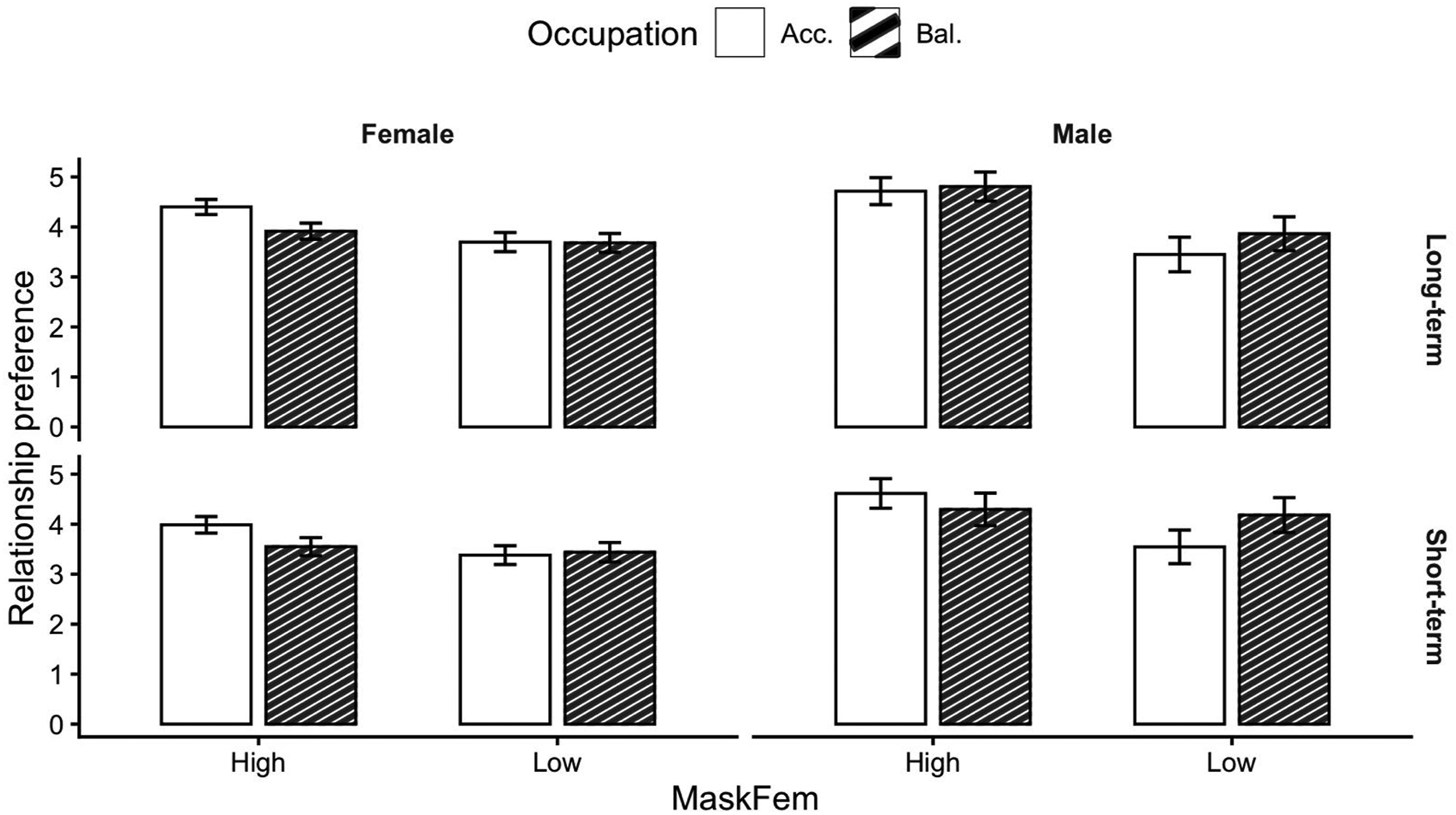
Results indicated a significant main effect of masc-fem, Pillai’s Trace V = .182, F (2, 90) = 10.04, p < .001, η2p = .18, showing that participants’ ratings differed across low and high masculinity or femininity conditions. The masc-fem × occupation interaction was also significant, Pillai’s Trace V = .098, F (2, 90) = 4.87, p = .010, η2p = .10. No other main effect or interaction effect was significant.
Follow-up analyses revealed that high masculinity male profiles (for female participants) and high femininity female profiles (for male participants) were rated significantly higher than their low counterparts across both ST and LT measures. Specifically, for ST ratings, high masc-fem profiles were rated higher than low masc-fem profiles (M High = 4.11, SD = 1.54) vs. M Low = 3.64 (SD = 1.74),MD = -.48, p = .013, 95% CI [0.103, 0.847]). For LT ratings, high masc-fem profiles (M High = 4.46, SD = 1.25) were rated higher than low masc-fem profiles (M Low = 3.67, SD = 1.74), MD = - .79, p < .001, 95% CI [0.438, 1.136].
Furthermore, the masc-fem × occupation interaction illustrated that participants favored high masc-fem accountants than low masc-fem accountants for ST (M High = 4.30 (SD = 1.64) vs. M Low = 3.46 (SD = 1.83), MD = .84, p < .001, 95% CI [0.404, 1.270]) and LT (M High = 4.56 (SD = 1.54) vs. M Low = 3.57 (SD = 1.93), p < .001, 95% CI [0.544, 1.425]). In contrast, high and low masc-fem ballet dancer profiles were not significantly different for ST (MD = −0.11, p = .611) but differed for LT (M High = 4.36 (SD = 1.64) vs. M Low = 3.77 (SD = 1.83), MD = .59, p = .005, 95% CI [0.182, 0.995]).
Discussion
The findings of Study 4 suggest that masculinity or femininity of target alters participants’ romantic evaluations. Profiles displaying high masculinity for male targets and high femininity for female targets were consistently preferred over profiles with lower counterparts, indicating a clear sensitivity to sex-typical characteristics in mate selection.
Beyond these primary main effects, the observed interaction between masculinity-femininity levels and occupational context suggests a potential role for social roles in moderating romantic preferences. While participants generally favored profiles with high levels of sex-typed traits, this preference was significantly more pronounced for accountants across both relationship contexts. Interestingly, the lack of significant impact of sex-typed traits on the short-term desirability of ballet dancers suggests a potential occupational overshadowing effect, where the role’s inherent stereotypes may supersede individual traits. This pattern can be fundamentally understood through the lens of Role Congruity Theory (Eagly & Karau, 2002), which posits that social categories are closely bound to their typical roles. Overall, these results indicate that both gender expression and occupational cues shape romantic evaluations, and that these effects are somewhat contingent on relationship contexts.
General Discussion
This study examined the interaction between occupational information and, specifically, the roles of ballet dancers and accountants and key personality traits (intellectuality, compatibility, talent, and sex-typed characteristics) in influencing mate preferences in both short- and long-term relational contexts. Drawing upon evolutionary and social psychological theories, we evaluated four hypotheses regarding the independent and interactive effects of occupation and traits as well as the moderating influence of the relationship timeframe.
A key contribution of this research is its direct challenge to the assumption that artistic skill universally enhances mate value (H1). Contrary to evolutionary theories emphasizing the signaling function of creative expression (Miller, 2000), our findings reveal that the occupational label alone, even for an artist, does not consistently enhance romantic desirability. Across most studies, occupation (ballet dancer vs. accountant) did not produce a significant main effect solely. This implies that the potential evolutionary appeal of dance-related attributes may be overshadowed by the cultural stereotypes associated with ballet, particularly concerning male dancers. This interpretation aligns with our preliminary study that indicated ambivalent or even negative perceptions of ballet dancers, especially among female participants who questioned the masculinity and relational suitability of male ballet dancers. These results highlight the socially constructed nature of occupational prestige and its impact on romantic perceptions. This outcome challenges the assumption that artistic skill universally enhances mate value, as suggested by evolutionary theories that emphasize the signaling function of creative expression (Miller, 2000). In align with this, occupations that are sex-atypical, such as male ballet dancers, can elicit backlash effects, whereby men are penalized to violate masculine norms (Bosson et al., 2005).
Across all four experimental studies, the findings consistently confirmed H2, which posited that higher levels of target personality traits would enhance romantic desirability irrespective of occupational label. Traits such as intellectuality, compatibility, and sex-congruent characteristics (femininity for women and masculinity for men) significantly augmented romantic preferences, particularly in the context of long-term relationships. These results are congruent with evolutionary theories that underscore the importance of personality characteristics such as warmth, emotional intelligence, and competence in promoting relational stability (Buss & Schmitt, 1993; Malouff et al., 2013). Notably, talent and compatibility yielded the most robust and consistent effects, with both male and female participants demonstrating a strong preference for profiles exhibiting high levels of these traits, particularly when assessing long-term partners. These findings align with prior research emphasizing the evolutionary and functional value of traits that facilitate social bonding, empathy, and mutual understanding in mate selection (Fletcher et al., 1999; Prokosch et al., 2009). Furthermore, the relative importance of personality traits over occupational labels might be understood through the lens of perceived malleability. While personality traits are typically perceived as stable, core psychological fixtures of an individual, occupational labels are often viewed as more malleable and transient. Consequently, individuals may rely more heavily on traits as reliable cues for long-term compatibility, whereas occupational cues might be discounted due to their perceived potential for change. Together, these results suggest that while culturally stereotyped attributes such as occupation may influence initial impressions, enduring romantic interest is more reliably shaped by stable personality dimensions and perceived interpersonal fit. The findings indicate that higher levels of certain personality traits are associated with enhanced romantic desirability.
Hypothesis 3, which proposed that negative occupational stereotypes could be mitigated by positive personality traits, was partially supported. In most studies, elevated trait levels increased desirability irrespective of occupation. However, in Study 3, an interaction was observed between of occupation, talent and sex for long term preference. Similarly in Study 4 the interaction effect of masc-fem and occupation was significant for short term preference. These results suggest that the desirability of occupation is contingent upon the level of perceived masculinity/femininity attributed to the target. Specifically, while the ballet dancer occupation may be undesirable across low masculinity/femininity conditions. This pattern indicates that high levels of sex-typed information may compensate for or even override stereotypical occupational expectations in short-term mating contexts. In line with mating strategy perspectives, individuals evaluating short-term partners may place greater emphasis on salient personality cues (Burley et al., 2018), allowing counter-stereotypical occupations to become attractive when paired with strong sex-congruent traits.
The observed interaction between masculinity-femininity levels and occupational context in Study 4 suggests a potential role for social roles in moderating romantic preferences, an avenue that warrants further systematic investigation. While participants generally favored profiles with high levels of sex-typed traits, this preference was significantly more pronounced for accountants across both relationship contexts. Interestingly, the lack of significant impact of sex-typed traits on the short-term desirability of ballet dancers suggests a potential occupational overshadowing effect, where the role’s inherent stereotypes may supersede individual traits. This pattern suggests that occupational stereotypes may either amplify or attenuate the perceived desirability of specific traits. That could be interpreted through the lens of Role Congruity Theory (Eagly & Karau, 2002).
According to this theory, social categories are persuasively matched to their typical roles. In the case of ballet, the cultural expectation for both sexes to embody “feminine” aesthetics (e.g., grace, elegance, and fluidity) is so deeply entrenched that it may obscure individual trait variations. Consequently, participants may exhibit a “skepticism effect”: they might find it difficult to perceive a male ballet dancer as truly masculine or a female ballet dancer as lacking femininity, regardless of the manipulated trait levels.
Occupational overshadowing aligns with the findings of Şenyurt et al. (2026), who observed that preconceived notions about certain professions can modify or even block the effects of personality variables. Just as participants in their study found it difficult to reconcile the image of a “painter” with low intelligence, the participants in the current study may have struggled to decouple the “ballet dancer” label from its inherent feminine-coded expectations. In contrast, the “accountant” role, which lacks such a singular, aesthetically rigid stereotype, allows for a clearer evaluation of masculine or feminine traits.
These patterns suggest a framework where highly stereotyped occupations might impose a ‘perceptual ceiling’ on trait evaluations. Within this context, the occupational label may function as a primary lens that shapes how individual characteristics are interpreted and valued. As Eagly and Karau (2002) suggest, when individuals enter roles requiring traits different from their social category’s typical expectations, the mismatch can lead to a devaluation of their individual characteristics in favor of the overarching occupational stereotype.
Overall, these results indicate that both the gender expression and occupational cues shape romantic evaluations, and that these effects are somewhat contingent on whether participants consider short-term or long-term relationship contexts. Such findings highlight the link between gender expectations, social roles, and mating strategies in understanding mate preferences.
Hypothesis 4 (H4) suggested that the relative weight of occupational cues and personality traits would vary depending on the relationship duration (short-term vs. long-term). Because short-term and long-term contexts were evaluated using separate statistical models rather than a single interactive model, direct statistical comparisons between these contexts cannot be made. However, a descriptive comparison of the results across the separate models provides a complex picture. While certain interaction effects emerged uniquely within specific relationship contexts, positive personality traits acted as a primary and stable driver of desirability across both conditions, leading to the conclusion that H4 was only partially supported.
The consistent dominance of personality traits across both relationship durations presents an intriguing contrast to established evolutionary frameworks. Specifically, based on Sexual Strategies Theory (Buss & Schmitt, 1993; Figueredo et al., 2006), one might have expected that traits such as intellectuality and compatibility would emerge as influential solely or predominantly within the long-term mate selection models, whereas short-term models would prioritize immediate, superficial cues or occupational status. Similarly, it was hypothesized that long-term decisions would be driven primarily by traits relevant to relationship stability, such as emotional alignment and value consistency (Valentine et al., 2020).
However, our findings diverged from these theoretical expectations of a clear shift in priorities between contexts. Instead, traits like compatibility, talent, and sex-typed characteristics remained robust predictors of desirability in both short-term and long-term evaluations, suggesting that for certain ‘necessity’ traits, the context-dependent shifts predicted by Sexual Strategies Theory may be less pronounced, or that their signaling value transcends duration. This lack of differentiation suggests that, within the current sample, these traits are viewed as “necessities” rather than “luxuries,” serving as foundational criteria regardless of the intended relationship duration.
The finding that personality traits consistently dominated partner preferences across both relationship contexts aligns with the “Necessities vs. luxuries” model of mate preference. As demonstrated by Li et al. (2002), certain characteristics are treated as fundamental requirements rather than situational bonuses. In the present study, the consistent main effect of personality characteristics suggests that participants treat these attributes as foundational fitness indicators. While Li et al. (2002) found that “special nonwork talents” were categorized as a luxury by men, our findings suggest that when talent is explicitly presented as a high-level trait, it may transition from a “luxury” to a “necessity” that outweighs secondary cues like occupational status. This may explain why the differentiation between short-term and long-term contexts predicted by Hypothesis 4 was limited. If a trait is perceived as a necessity, it must be present even in a short-term partner to meet the “minimum quality threshold.”
Discussion of Exploratory Findings
Three of the four studies showed a main effect of sex: Male participants rated romantic desirability higher than female participants in both short-term and long-term contexts. This pattern is consistent with the classical observation that women often exhibit more restrictive or conservative evaluation criteria for potential partners, a phenomenon potentially influenced by factors such as parental investment theory. First, this is consistent with parental investment theory, which posits that women, due to higher obligatory reproductive investment, tend to be more selective in mate choice and therefore impose higher thresholds for desirability (Buss, 1989). Consequently, female participants might more readily dismiss targets when personality or performance indicators, such as a lack of talent in ballet, do not meet the anticipated standards. Secondly, the lower romantic desirability of male ballet dancers among female participants can be attributed to the cultural “mismatch” between the ballet profession and traditional expectations of masculinity. In many societies, particularly those with rigid gender norms like in Turkish culture, ballet is often perceived as a feminine-coded pursuit (Gedikli & Ulusoy, 2024; Migdalek, 2013). This leads to horizontal gender segregation, where men entering these “atypical” fields face a social and romantic penalty. While a male accountant fits the “provider” and “stable” archetype, a male ballet dancer may be perceived through a lens of gender-role violation.
In line with previous research by Şenyurt et al. (2026), intellectuality played a nuanced role in partner evaluation. Its influence was limited in short-term contexts but became more salient in long-term preferences. Unlike talent (which represents a concrete, observable indicator of performance ability), intellectuality reflects a more abstract cognitive capacity. This distinction may explain why intellectual cues exert domain-specific effects. Creative professions such as painting (Painter was the focus in Şenyurt et al., 2026 study) may elicit stronger sensitivity to intellectual traits, whereas performance-based occupations like ballet rely more heavily on tangible demonstrations of skill. These findings suggest that the cognitive versus performance-based nature of a trait determines its relative importance across mating contexts.
Strengths and Limitations
Despite its significant contributions, this study entails some strengths and limitations that warrant discussion. The primary strength of this research lies in its robust experimental framework, utilizing a random within-subject design and a wide array of manipulated traits. This approach enhanced internal validity by controlling individual differences and ensuring that evaluations were driven by the experimental stimuli rather than participant-specific variance. Furthermore, the cultural specificity of the study serves as a distinct strength; by examining these dynamics within the Turkish context, the research provides rare empirical data on how traditional gender codes and occupational stereotypes interact in a non-Western setting, filling a notable gap in the global literature.
However, several limitations must be acknowledged. First, while occupation labels were consistently applied, the stimuli lacked dynamic components such as video footage. Given the inherently performative nature of ballet, participants’ evaluations might differ significantly when observing actual movement and artistry versus static descriptions. Second, although the Turkish context is a strength for localized insight, it simultaneously poses a challenge for cross-cultural generalizability. The rigid gender roles and specific sex codes prevalent in Turkish culture may have intensified occupational biases, meaning the results may not directly translate to cultures with more fluid perceptions of ballet.
Third, the scope of this study was restricted to heterosexual and binary sex roles, which does not capture the full spectrum of contemporary identity. Future research should adopt more inclusive models to account for diverse gender identities and orientations. In a related vein, demographic data collection was limited to binary sex categories and did not account for participants’ disability status. Incorporating more comprehensive demographic questions in future studies would allow for a more nuanced intersectional analysis. Fourth, the reliance on self-reported measures and hypothetical profiles may not fully encapsulate the complexities of real-life mate selection. Future investigations could benefit from more ecologically valid methods, such as virtual reality environments or speed-dating simulations, to offer richer insights into the interplay between occupation, personality, and romantic attraction.
Another limitation of the present research concerns differences in the base-rate prevalence of the occupational categories examined. Ballet dancing is a statistically rare and highly specialized occupation compared to accounting, which is widespread and socially familiar. While this asymmetry was intentional to contrast a culturally distinctive role with a normative profession, it could have influenced perceptions beyond simple familiarity, potentially intensifying the stereotype strength and salience for the rare occupation (ballet). This might have amplified the ‘occupational overshadowing’ effect observed for ballet dancers, suggesting that the impact of rare, highly stereotyped occupations on trait perception warrants further investigation. Importantly, the rarity and specialization of ballet may itself constitute a meaningful social signal, contributing to stronger or more polarized trait inferences rather than random noise. Furthermore, while the accountant category was used as a conventional comparison condition, it may carry its own set of professional stereotypes rather than representing a truly neutral baseline. A completely “no-occupation” control condition is challenging in profile-based designs, as participants inevitably form impressions based on other profile information (e.g., name, education, hobbies). Future research could explore alternative approaches to further isolate the effects of occupational labels. Nevertheless, future research would benefit from including multiple artistic and conventional occupations to disentangle the effects of occupational rarity, cultural symbolism, and lifestyle assumptions on mate preference judgments.
Lastly, while the within-subjects design was prioritized to maximize statistical power and control for individual variability in rating thresholds, we acknowledge that the contrast between occupations may have increased task transparency and allowed some participants to infer the study’s focus on occupational stereotypes. Although such awareness may influence responses, we did not directly assess participants’ perceptions of the study aims, which represents a limitation. However, given that the task did not involve highly sensitive or normatively constrained judgments, any potential bias due to demand characteristics may have been limited. Furthermore, the randomized presentation order of the profiles was employed to mitigate potential carry-over effects and systematic bias.
Conclusion
In conclusion, this study showed that trait signals consistently outweigh occupational cues in romantic preferences, particularly in the long term. Ballet does not enhance desirability when presented as an occupational label, likely because of sexed stereotypes. These findings underscore the need to integrate biological and cultural frameworks in studying mating preferences, as the social meanings of occupations can shape perceptions of attractiveness.
These findings have practical implications for understanding social evaluation based on limited identity cues, such as job titles or traits. In applied settings, such as online dating platforms, emphasizing traits associated with long-term compatibility may prove more effective than focusing on occupational status. These results are also relevant for reducing stigma and stereotypes in professions that diverge from traditional sex norms, such as male ballet dancers.
Future research should examine dynamic indicators, such as movement, speech, and interaction style, across diverse cultural and sexual orientation contexts. Exploring how individuals process trait information that conflicts with occupational stereotypes may reveal the cognitive mechanisms in impression formation. This study bridges evolutionary mate preference models with sociocultural theories of artistic representations and serves as a crucial step toward a holistic understanding of human attraction. Ultimately, the results of the studies suggest that underlying character traits, based on evolutionary perspective and remain the primary drivers of preference.
Supplemental Material
Supplemental Material - When Ballet Fails to Inspire Attraction: Trait Signals Override Occupational Cues in Mate Preferences
Supplemental Material for When Ballet Fails to Inspire Attraction: Trait Signals Override Occupational Cues in Mate Preferences by Bedirhan Gültepe, Ahmet Yasin Şenyurt, Elvan Kiremitçi Caniöz in Journal of Social and Personal Relationships
Footnotes

Ethical Considerations
Ethical approval for this research was obtained from the Social and Humanities Ethics Committee of Balıkesir University, under the protocol number 2025/04-09.
Consent to Participate
All participants provided informed consent prior to their participation in the study.
Funding
The authors received no financial support for the research, authorship, and/or publication of this article.
Declaration of Conflicting Interests
The authors declared no potential conflicts of interest with respect to the research, authorship, and/or publication of this article.
Data Availability Statement
The data supporting the findings of this study are available in the supplementary materials submitted with the manuscript.
Open Research Statement
As part of IARR’s encouragement of open research practices, the authors have provided the following information: This research was not pre-registered. The data used in the research are available. The data can be obtained by emailing:
Supplemental Material
Supplemental material for this article is available online.
References
Supplementary Material
Please find the following supplemental material available below.
For Open Access articles published under a Creative Commons License, all supplemental material carries the same license as the article it is associated with.
For non-Open Access articles published, all supplemental material carries a non-exclusive license, and permission requests for re-use of supplemental material or any part of supplemental material shall be sent directly to the copyright owner as specified in the copyright notice associated with the article.
