






Abstract
This study examines how surviving parents and emerging-adult children cope, both independently and communally, after the death of their partner/parent in a family unit. We collected data from 45 parent/emerging-adult child dyads who experienced partner/parental death within the previous three years to capture coping during bereavement. Dyads completed six weekly surveys, with short answer questions in weeks one, three, and five asking individuals to describe their coping behavior. We analyzed the responses using thematic co-occurrence analysis to identify themes and explore patterns within and between dyad members. Results revealed five theoretically aligned themes reflecting individual and communal coping behavior, as well as two identical patterns within themes for parents and children, and four patterns between parents and children. The results advance knowledge on communal coping and offer practical implications for bereaved parents and children.
Keywords
The death of a partner/parent is one of the most disruptive events a family can face (Porter & Claridge, 2021), forcing the surviving parent and child(ren) to rebuild their life amid grief, disrupted routines, and upended expectations (e.g., Cafferky et al., 2018). These challenges are particularly acute when the death occurs “off-time” such as when children are entering emerging adulthood. Emerging adulthood (roughly ages 15 to 25 for bereaved children) represents a period marked by struggles with identity, independence (Porter & Claridge, 2021), and instability (Arnett, 2007). Experiencing parental death during emerging adulthood can create a novel sense of vulnerability for children and parents that becomes exponentially more complicated due to the death. During bereavement, family members may cope individually or collectively to navigate grief, yet partner/parental death represents such an extreme stressor that coping may be especially challenging due to overwhelming grief (Porter & Claridge, 2021). Nonetheless, social coping, which refers broadly to coping efforts that involve others and can take many forms including communal coping (Afifi et al., 2020), creates opportunities for connection, mutual strength, and more effective grief management (Haine et al., 2008).
In particular, communal coping occurs when individuals share a common stressor and collectively work to address it (Afifi et al., 2006). The extended theoretical model of communal coping (Afifi et al., 2020) defines two dimensions of coping: shared appraisals and joint action. Following partner/parental death, surviving parents and children may fluctuate in appraisals and enactment of coping strategies for maintaining individual and relational well-being. Identifying the ways in which surviving parents and children appraise and enact coping behavior after partner/parental death is important for helping grieving families establish beneficial strategies for maintaining individual and relational well-being and can assist with short and long-term adjustment for children (Saldinger et al., 2004). Furthermore, the coordination of communicative coping behaviors after partner/parental death remains relatively underexamined, leaving a gap in our understanding of how shared appraisals and joint action are coordinated within surviving parent-emerging adult families.
Therefore, this study has two goals. First, we identify coping behaviors enacted by parents and emerging-adult children after partner/parental death. Second, this study explores how parents and children concurrently experience similar and different forms of coping within themselves and across the dyad. This study contributes to theoretical expansion by juxtaposing themes of coping that are relevant to parent/emerging-adult child dyads in bereavement with forms of individual and communal coping explicated in the extended theoretical model of communal coping (Afifi et al., 2020), and by demonstrating how different types of coping may co-occur within individuals and between bereaved parents and children. Practically, this study identifies different types of coping that surviving parents and children might find most beneficial for addressing grief. Thus, in the following sections, we present existing research on the extended theoretical model of communal coping and bereavement, pose research questions regarding coping with partner/parental death, and present the results of a qualitative study of parents and emerging-adult children following partner/parental death.
Communal Coping During Bereavement
Partner/parental death can be disruptive, traumatic, and sometimes tragic for surviving family members. In particular, the death of a partner/parent introduces and magnifies various stressors, including altered routines (Droser, 2020), shifts in roles and responsibilities (Cafferky et al., 2018), and increased demands on the surviving spouse (Holmgren, 2021). Furthermore, partner/parental death is associated with challenges to mental health, including reduced psychological well-being, heightened anxiety (Lundberg et al., 2018), and increased loneliness and identity confusion (Lowe & McClement, 2010). Efforts to cope with grief and related stressors can take many forms and vary depending on individual needs and preferences. Common coping methods include seeking social support, engaging in personal reflection or ritualistic behaviors, and using distraction to avoid emotional overwhelm (Haine et al., 2008; Shapiro et al., 2014). When surviving family members have an interdependent relationship, such as parents and emerging adult children, coping can involve individual and shared efforts to manage stressors. Further, how parents and children balance their personal and interpersonal coping behavior can have implications for grief management and emotional well-being (Droser, 2020). In particular, parents who involve children in the grieving process may help foster improved emotional outcomes for both parents and children (Haine et al., 2008), supporting the importance of understanding individual and communal coping strategies during bereavement.
In the extended theoretical model of communal coping (Afifi et al., 2020), communal coping occurs when individuals appraise a stressor as jointly owned, communicate about it, and act together to address it. Communal coping is characterized by two dimensions: shared appraisals and joint actions. Shared appraisal reflects a cognitive assessment that a stressor is co-owned by people in a relationship, which can motivate people to manage the stressor (Basinger, 2018). Joint action is a behavioral aspect of communal coping involving shared efforts to mitigate negative impacts of a stressor (Basinger, 2018). Together these dimensions distinguish communal coping from individual coping because they allow for alignment and collaboration between dyad members. These features also distinguish communal coping from other responses to hardship, such as “social support” or “relational coping,” that do not include the shared ownership and management of problems (Afifi et al., 2020). The intersection of these dimensions produces four coping types: individualism (referred to throughout the findings as individual coping; low shared appraisal and joint action), individual help and support provision (high share appraisal, low joint action), help and support seeking (low shared appraisal, high joint action), and communal coping (high shared appraisal and joint action; Afifi et al., 2020; Basinger, 2020). As appraisals and actions exist on continuous dimensions, they are inherently fluid and can fluctuate in response to changing needs and circumstances.
Given the fluid nature of coping dimensions and coping types (Afifi et al., 2020), it is theoretically useful to identify which coping types may operate in conjunction with one another during bereavement and to examine the ways in which coping types co-occur within individuals and between dyad members. In turn, research can be better positioned to understand how people layer, sequence, or trade off coping responses as they navigate bereavement. Examining the layering of coping strategies also captures the potential (mis)alignment across dyad members (e.g., a parent’s attempt at communal coping paired with a child’s individual coping), which can illustrate how communal coping is a dynamic process rather than a set of isolated behaviors.
Following partner/parental death, surviving parents and emerging-adult children may have opportunities to engage in communal coping because both family members are affected by the death and may need to navigate grief and related demands together. Shared appraisals may occur when parents and children view responsibilities that belonged to the deceased parent as something to address together rather than the responsibility of one person. For example, dyads may appraise changes in family finances as a shared problem that requires joint attention, which may ease burden felt by the surviving parent (Fadlon et al., 2019). Similarly, if dyads appraise grief as something to be shared, children may feel more involved and willing to disclose feelings (Shapiro et al., 2014). Regarding joint action, dyads may collectively act on these appraisals. Children may take a new job to contribute to family finances, and the dyad may also work to create an open line of communication, where both members feel comfortable discussing their feelings. In each case, shared appraisals and joint action guide efforts to cope after partner/parental death.
Enacting coping strategies may help bereaved families manage grief (Weber et al., 2019) and strengthen their relationship (Lundberg et al., 2018). Open communication about the bereavement process can also help children with long-term coping and better adjustment (e.g., Faro, 2018). Although research cited above has demonstrated benefits of coping after the death of a loved one, less is known about how coping is coordinated within surviving parent and emerging-adult child dyads after partner/parental death, particularly in ways that align with shared appraisals and joint action. In particular, because communal coping is defined by these relational dimensions, examining how surviving parents and emerging-adult children describe coping can clarify whether coping is enacted primarily as an individual process, a communal process, or something in between. Accordingly, we consider how the dimensions of shared appraisals and joint action that characterize communal coping are reflected (or not) in the types of coping behavior that surviving parents and emerging-adult children describe enacting after the death of a partner/parent. Therefore, we pose the following research question:
How do the types of coping behaviors described by surviving parents and emerging adult children after the death of a partner/parent correspond to the dimensions of shared appraisals and joint action in communal coping?
Importantly, focusing on the co-occurrence of coping behaviors (e.g., multiple types of coping happening at the same time or back-to-back) moves research beyond identifying coping themes in isolation to examining patterns of presence, which can reveal whether coping strategies function as complementary (e.g., individual coping alongside communal coping) or as substitutes or in opposition (e.g., engaging in support seeking when the other person is trying to communally cope with bereavement). Understanding co-occurrences can clarify how shared appraisals and joint action are enacted in practice within an individual and across a dyad during a high stress transition such as bereavement. As such, we pose the following research question:
How do themes of coping behaviors co-occur within individuals and between parent and child experiences after the death of the other partner/parent?
Method
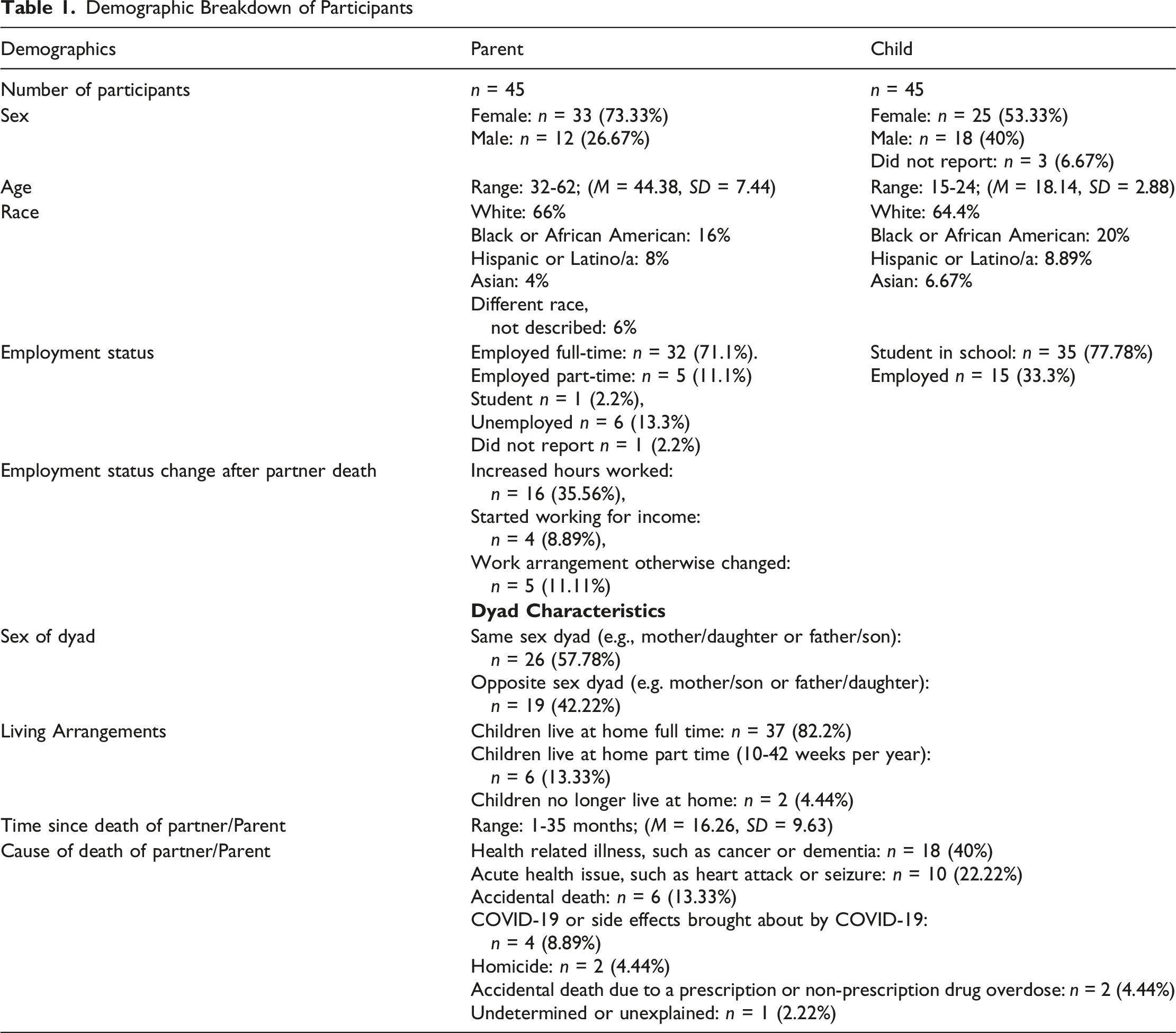
To assess the research questions, we recruited parent-emerging-adult child dyads who had experience partner/parental death within the last three years. This time frame was chosen to move beyond the immediate shock of the death and capture coping as families transitioned from acute grief to longer-term adjustment, including the formation of new routines and strategies for managing practical and emotional challenges. To participate, children had to be between the ages of 15 and 25, living at home or in regular contact (at least three conversations per week) with their surviving parent, and identify both the deceased and surviving parent as parents. Parents had to have been partnered with the deceased for at least eight years.
Demographic Breakdown of Participants
Analysis
Responses were analyzed using a thematic co-occurrence analysis (Scharp, 2021). Following Braun and Clarke’s (2019) reflexive thematic analysis, we began with open coding, where responses were read multiple times to identify patterns based on salience and intensity. We began with open coding to remain grounded in participants’ language and to avoid imposing existing coping types a priori, given that the model specifies coping orientations but not the full range of how these orientations may manifest in bereavement. The initial inductive process yielded 32 first-level codes for parents and 30 for children. Upon reviewing codes for content related to established coping behaviors, the researchers noted alignment with the coping types from the extended theoretical model of communal coping (Afifi et al., 2020). Almost all of the data mapped onto these four coping types with the exception of a fifth emergent theme reflecting a desire for communal coping and a small number of participants who reported not using any coping strategies in the previous week. The data were then recoded deductively based on the four coping types outlined by Afifi et al. (2020), with the fifth emergent theme reflecting a desire for communal coping.
Descriptors of Co-Occurrence Criteria for Themes
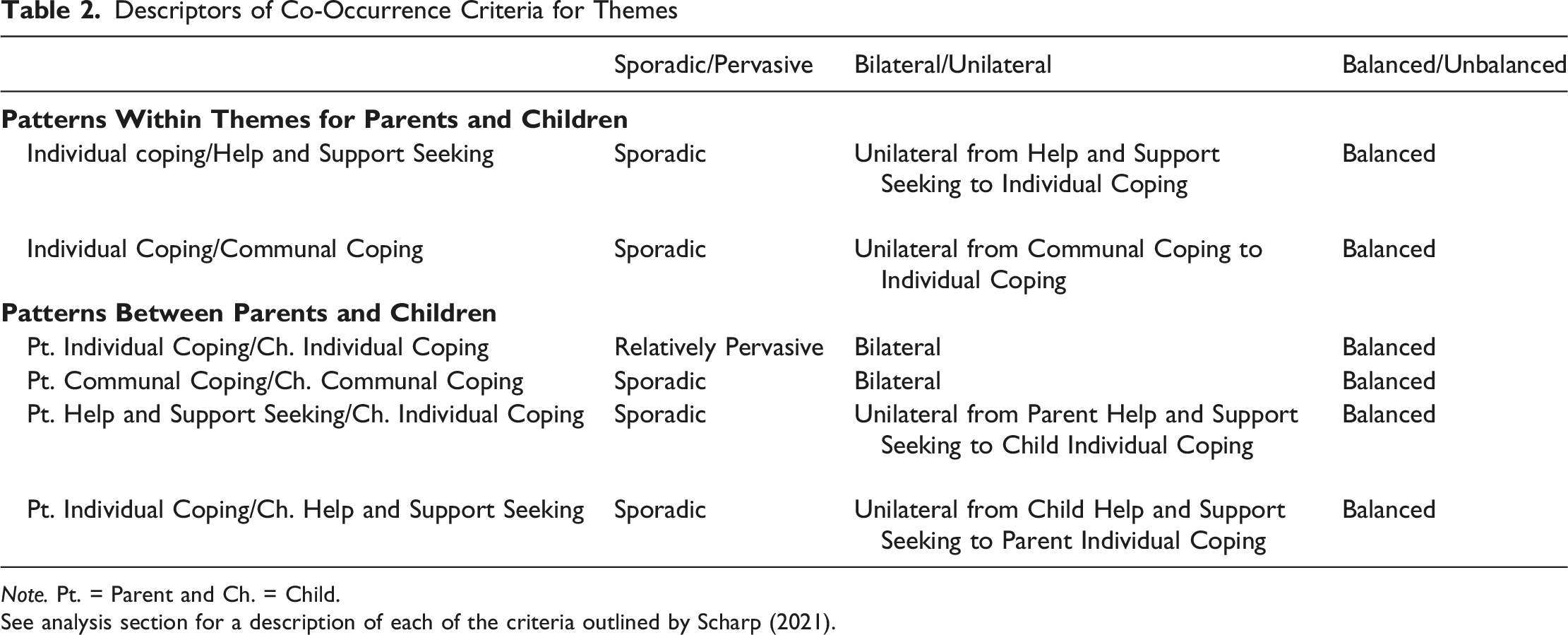
Note. Pt. = Parent and Ch. = Child.
See analysis section for a description of each of the criteria outlined by Scharp (2021).
Findings
Themes of Coping
RQ1 examined coping behavior surviving parents and emerging-adult children used after partner/parental death and how themes aligned with shared appraisal and joint action reflective of communal coping. We treated shared appraisal as the extent to which participants framed bereavement as ours (co-owned) rather than mine/yours. Joint action was coded when participants described coordinated coping behavior aimed at reducing the impact of the stressor. For dyad-focused interpretations, we distinguish between dyad-level joint action (between parent and child) and network-based joint action (with external others).
Emergent themes aligned with Afifi et al. (2020), including: (a) individual coping, (b) individual help and support provision, (c) help and support seeking, and (d) communal coping. A fifth theme also emerged focusing on (e) a desire to engage in communal coping. A small number of participants reported that they were not engaging in any coping or that they had no reason to engage in coping (e.g., “We never really took any actions to help us cope”). The following sections describe each theme for parents and children and with exemplar quotes. Additional quotes are provided in the supplemental file.
Individual Coping
The first type of coping outlined by Afifi et al. (2020) is individualism, or individual coping, which occurs when there are low levels of shared appraisals and joint action, which was the most common type of coping reported by parents and children, with parents reporting individual coping 58 times and children reporting it 64 times.
Parents
Parents typically described two actions reflecting individual coping: (a) maintaining a personal connection with their deceased partner, and (b) engaging in comforting activities. Strategies for maintaining connection involved talking out loud to the partner, journaling, doing activities that their partner enjoyed, or physically holding onto something that belonged to their partner. A father described how when he is alone at night he will “sit on my bed and hold on to some of my wife’s clothes. I just hug them and smell them. I don’t ever want to forget that smell” (parent #6, father, age 40, 13 months since partner death). For parents coping by trying to maintain a connection with their deceased partner, many emphasized that they were trying to not forget their partner, which helped them to at least manage the grieving process, even if they could not yet move forward in their life.
Parents also enacted individual coping by engaging in activities that brought them comfort or joy. For some, these activities included turning to religion or scheduling events that they could look forward to. One parent described: I’m very spiritual…I attend church every Sunday and Bible study on Wednesdays…This process is a roller coaster of emotions and feelings. I tend to breakdown when I’m alone. Being an only child leaves me very few shoulders to lean on. In search of support groups currently (parent #38, mother, age 34, 34 months since partner death).
By scheduling or incorporating enjoyable activities into their day, parents felt a sense of reprieve from their grief that allowed them to manage their feelings and grief.
Children
When the emerging-adult children enacted individual coping, they often described two behaviors: (a) maintaining a personal connection with their deceased parent, and (b) compartmentalizing or engaging in distractions. Similar to parents, a common coping behavior reported by children involved individually maintaining a connection with their deceased parent. Some children enacted individual coping because their surviving parent would not talk with them about the other parent’s death, such as one child who said: We didn't do anything together, or even talk about my mom to each other. But privately every night I look at my pictures of my mom, or of us together, and a couple nights a week I break down and cry alone in my room because I miss her so much, my dad doesn't know that (child #6, female, age 17, deceased mother, 13 months since parent death).
As reflected in this response, many children felt they had to maintain a connection individually because they were not able to talk about their deceased parent with the surviving parent.
A second individual coping strategy utilized by children was compartmentalizing or seeking distractions from their thoughts and emotions. One child expressed this when they said: “I just live life and try not to think about it. I go by my days on my own and just strive to be the best version of myself to try and make him proud” (child #9, male, age 18, deceased father, seven months since parent death). For many children, compartmentalizing helped them make it through life in the absence of their parent, even if they were not actively engaging in communication to cope with their feelings.
Individual Help and Support Provision
The second form of coping outlined by Afifi et al. (2020) is individual help and support provision, which occurs when shared appraisals are high, but joint action is low. In this study, we operationalized joint action as coordinated coping behavior specifically oriented toward jointly managing bereavement (e.g., shared processing, meaning-making, collaborative problem-solving around grief-related demands). Shared distraction and comfort activities were coded as support provision rather than high joint action when participants did not describe them as part of a coordinated approach to managing the death itself. Parents and children enact this type of coping when they believe the stressor affects them both, but they engage in few joint behaviors to address the stressor. In this way, parents and children might recognize that they are both affected by the death and may attempt to provide support and compassion, often prioritizing efforts to improve the other person’s well-being, but they do not enact behaviors that would allow them to collectively work toward navigating bereavement. Individual help and support provision was the least frequently reported established type of coping with parents reporting it 18 times and children reporting it nine times.
Parents
Parents enacted individual help and support provision in two ways: (a) having honest conversations with their children about the death without necessarily acting on them, and (b) engaging in activities to distract or comfort their child. Several parents described having open and honest conversation with children about the death of their parent (reflecting high shared appraisals), but not actively engaging in behaviors to address how the child(ren) were feeling (reflecting low joint action). A parent illustrates this concept in her response, describing how “to help us cope with stressful things, we talk about things and try to distract ourselves with a fun activity” (parent #37, mother, age 36, 20 months since partner death). This parent reports high shared appraisal of needing to manage “stressful things” with their child, but limited dyad-level joint action because the behavior described is shared distraction/mood repair and the response does not indicate coordinated coping efforts directed toward managing bereavement (e.g., joint processing, meaning-making, or problem-solving related to the death).
The second way parents enacted individual help and support provision was through engaging in fun or enjoyable activities with their child to distract from their sadness. Parents who enacted this strategy described how engaging in purposeful activities to help their children feel better also improved their own stress. For example, one parent said, “I just shop ALOT when I am not feeling well or I’m depressed and I like to spoil my daughter as well, like that will take the pain away or something” (parent #44, mother, age 40, ten months since partner death). Similar to the above response, this parent perceives a higher level of shared appraisal that she and her daughter are both in pain, but low levels of joint action because the coping response is primarily unilateral (shopping/spending as her strategy) and is described as relief-oriented rather than a coordinated dyadic effort to manage bereavement.
Children
Children similarly enacted individual help and support provision by engaging in activities with their parent to “take their mind off things” rather than taking direct action to address stressors tied to bereavement. One child reported that she and her father went: shopping at the mall which we almost never do. We also went rock climbing - honestly, I was really surprised and impressed that my dad could climb so many routes. We didn't talk much about my mom's death, but honestly I didn't want to bring anything up being it was the first time since the funeral that my dad seemed a little happy and not so depressed (child #27, female, age 16, deceased mother, one month since parent death).
By doing activities with their parent to help get their mind off the deceased parent, children are providing indirect support in light of shared grief, but avoiding conversations in which they could collectively work toward resolving the stressor.
Help and Support Seeking
The third type of coping is help and support seeking (Afifi et al., 2020), which occurs when shared appraisals are low, but joint action levels are high. Parents and children engage in this type of coping when they lack co-ownership of a stressor, but actively work together to address the tensions associated with it. In cases of help and support seeking, individuals were often seeking tangible support that their child (or others) could provide to make their grief more manageable, thereby engaging in collective action to navigate bereavement without acknowledging that both individuals might share in a common grief experience. Help and support seeking was the third most common type of coping reported, with parents reporting it 26 times and children reporting it 24 times.
Parents
Parents engaged in help and support seeking by (a) talking or spending time with their children, and (b) relying on external support networks. Talking and spending time together reflect joint action by enacting conversations that can support one another’s well-being and ability to cope, but there is little recognition that stressors associated with bereavement are shared by both parent and the child. For example, one parent noted, “He calls me on his walks; we discussed his mid-terms and how he is going to handle studying for them and getting stressed” (parent #7, mother, age 51, 18 months since partner death). In this response, the parent is not seeking explicit support from their child, but finds comfort in maintaining a routine connection. This maintenance helps the parent to manage her grief by staying engaged in her child’s life and maintaining a sense of normalcy amid profound change.
Parents also enacted help and support seeking by relying on external support networks, such as friends, family members, or support groups. We coded this as high joint action because the coping involved coordinated interaction with others (friends/family/support groups) aimed at reducing stress; however, this joint action occurred outside the parent–child dyad. One participant described scheduling events with her friends as a form of coping: “I do yoga with my friends two or three times a week to spend time with my friends and relax and have fun. This takes my mind off of the stress in my head and in my house” (parent #1, mother, age 47, 16 months since partner death). This example illustrates how parents often turned to external networks and group activities as a way of seeking connection and enjoyment with others to distract from the grief they felt.
Children
Children engaged in help and support seeking by (a) seeking support from their parent to feel better about the death of their other parent, and (b) relying on external support networks. Many children requested support from their parent to manage stressors associated with bereavement, but few children acknowledged that their parent shared in their grief. Thus, children sought joint action in the form of tangible support behaviors from their parent, but also demonstrated low shared appraisals by focusing only on their own needs in bereavement, which is a defining characteristic of help and support seeking as a coping behavior (Afifi et al., 2020). One child described how they garner support from their parent, stating “My mom gives me warm hugs whenever I need them and when I feel like being hugged, she’s always there to provide one and hot chocolate. Plus I like it when she sings to me” (child #33, male, age 21, deceased father, 31 months since parent death). As shown in this response, there is joint action in the tangible support behaviors provided by the parent, but the child is not perceiving his parent’s equal need for support to manage bereavement.
The second way children engaged in help and support seeking was by relying on external support networks. One child said they engaged in coping when they “spent time with friends and people I love this past week and having good quality time doing things I enjoy” (child #8, female, age 18, deceased father, four months since parent death). For children, relying on support from family and friends reflected network-based joint action (coping in interaction with friends/family) rather than dyad-level joint action with the surviving parent. Because the coping partner was external, these excerpts reflect low shared appraisal within the parent–child dyad.
Communal Coping
The fourth type of coping outlined by Afifi et al. (2020) is communal coping, which occurs when shared appraisals and joint action are high. Parents and children engage in this type of coping when they have high levels of co-ownership of the stressor and engage in shared action to help mitigate the stressor. Communal coping was the second most common type of coping, with parents reporting it 38 times and children reporting it 37 times.
Parents
Parents engaged in communal coping by: (a) prioritizing quality time with their child, and (b) maintaining a connection with their deceased partner or keeping their memory alive with the child. These two categories of behavior were seen as communal coping because they reflect shared appraisals, meaning parents recognized a need for their child and them to work through their grief together, and exhibit joint action, meaning parents were engaging in purposeful behaviors to address their grief with their child.
For prioritizing quality time, parents described scheduling time or events so they could spend meaningful time with their child to enhance their bond and adapt to living without a second parent. For example, one parent described how she and her child: go out together and watch a movie sometimes. We also go out and eat together a few times every week. They just want to make sure I am ok, and I feel the same about them. We both try and come up with different types of things to do that will make us feel better and lift our spirits up (parent #34, mother, age 53, 28 months since partner death).
As seen in this response, both dyad members want to confirm the other’s well-being (high shared appraisals because the participant explicitly framed grief as jointly owned) and enact purposeful behaviors to facilitate emotional improvement (high joint action). Thus, spending quality time together allowed for collective bereavement without burdening either party with the sole responsibility of resolving their own or the other’s grief.
Parents also communally coped by maintaining a connection with their deceased partner and working to keep their memory alive with their child. For example, one mother detailed how, during what would have been an important event in her relationship with her husband, she engaged in communal coping with her child to help navigate the emotions of that day: It would have been our 34th wedding anniversary this past week. One of my husband's favorite foods was Sicilian stuffed artichokes and he would make them several times a year. He was Sicilian and the artichokes were a labor of love. To honor him, I decided to make the attempt at making them myself. To my great surprise, they came out almost as good as his. Our son and daughter said that I did a really good job and they were really close to dad’s. That made me happy. I try to keep his memory alive as much as I can (parent #13, mother, age 57, 32 months since partner death).
Although the mother prepared the artichokes herself, joint action occurred in the shared commemorative episode around the wedding anniversary. Sharing the food, comparing it to their husband and father’s cooking, and using the meal as a collective way to honor him and keep his memory present reflected coordinated, complementary actions that the family used to cope together.
Maintaining a connection with the deceased partner was important for parents at both the individual and communal level. Given that parents had two relationships with their deceased partner, one as romantic partners and one as co-parents of their children, maintaining a connection with the deceased partner serves as an important form of individual and communal coping. Parents’ efforts to maintain a connection at the communal level punctuates the significance of learning how to sustain a connection as a family, rather than as an individual.
Children
Children engaged in communal coping by: (a) spending purposeful time with their parent to allow for coping to occur, and (b) maintaining a connection with their deceased parent with the surviving parent. These forms of communal coping mirror those described by parents, reflecting a shared sense of responsibility to maintain connections and enactment of collective behaviors to achieve that outcome.
Many children reported that they spent purposeful time with their parent as a form of coping, and to ensure that their parent could also cope without concern for their child’s emotional well-being. For example, one child whose mother died noted how she and her father: have been talking more here lately about it and I feel more at ease to know how my dad thinks and feels so I can help him, and he can help me. I usually try to start an activity or something with him if I think he is feeling down (child #28, female, age 16, deceased mother, 35 months since parent death).
As shown in this response, the child feels a shared concern for her own and her father’s grief, and they engage in joint action by encouraging open conversation about their feelings and participating in shared activities. Thus, children were intentional about spending time together with their parent (joint action), and they valued this time for allowing them to create shared memories and manage bereavement (shared appraisals).
Children also described maintaining a connection with their deceased parent along with the surviving parent as a form of communal coping. For example, one child noted, “In the past week the way my mom and I have coped with the loss of my dad has mostly been poking fun at him, or just talking about fond memories of him. It makes it easier to cope with” (child #13, female, age 21, deceased father, 32 months since parent death). For this child, there was not one event that served as communal coping, but rather incorporating their deceased parent’s memory into everyday interactions allowed them to experience communal coping. Children recognized that these mundane acts of remembrance promoted positive feelings and outcomes for themselves and their parent that made navigating grief a little less challenging.
Desire for Communal Coping
A final theme reflects a desire to enact communal coping behaviors among parents and children. Specifically, this desire manifested as participants explicitly expressing a wish to share appraisals and engage in joint action with their parent or child while simultaneously acknowledging that relational barriers, mismatched needs, or concerns about burdening the other person prevented them from doing so. Although Afifi et al. (2020) did not delineate a desire to enact communal coping in the extended theoretical model of communal coping, a small subset of participants heavily emphasized how they wished they could engage in communal coping with their parent/child to navigate the death of their partner/parent, but that they were unable to do so. Given how forceful participants were about this desire, this was categorized as its own theme, even though this only appeared sporadically throughout the data.
Across parents and children, participants in the sample wished that they could do more to cope with their parent/child or that their parent/child wanted to do more communal coping with them. This desire to engage in communal coping was exemplified by one parent who said: This past week I don't think we did anything to cope together. I sometimes get depressed by myself, and I'll have a drink of whiskey in my room behind closed doors. I try to keep communication open so that if my daughter wants to talk about her mom, I’m more than happy to. But I don't bring it up because she doesn't bring it up very often. But I think it would help her and be healthy to talk about her mother more (parent #6, father, age 40, 13 months since partner death).
Children echoed similar sentiments, with one child describing “I mostly cope by myself or my [romantic partner] is there for me. Me and my mom don’t do much together anymore and it does upset me at times because we used to be really close” (child #16, male, age 23, deceased father, 31 months since parent death). This son expressed disappointment that he and his mother lack connection, and he misses how close they used to be. Although it does not explicitly reflect communal coping, there is a desire for communal coping expressed with doing things together (joint action) and upset at a lack of closeness (shared appraisals).
Co-Occurrence Patterns Within and Between Coping Themes
RQ2 explored how coping behaviors co-occurred within and between parents’ and children’s experiences following partner/parental death. The same two co-occurrence patterns emerged between themes for both parents and children: (a) individual coping and help and support seeking (parents’ pattern A1/A2; children’s pattern C1/C2) and (b) individual coping and communal coping (parents’ pattern B1/B2; children’s pattern D1/D2). There were also four patterns between themes for parents and children: (a) parent individual coping and child individual coping (F1/F2), (b) parent communal coping and child communal coping (G1/G2), (c) parent help and support seeking and child individual coping (H1/H2), and (d) parent individual coping and child help and support seeking (J1/J2; see Figure 1). See Table 2 for description of the sporadic/pervasive, bilateral/unilateral, and balanced/unbalanced nature of each pattern. Wave 1 co-occurrence matrix for patterns within and between themes of coping for parents and children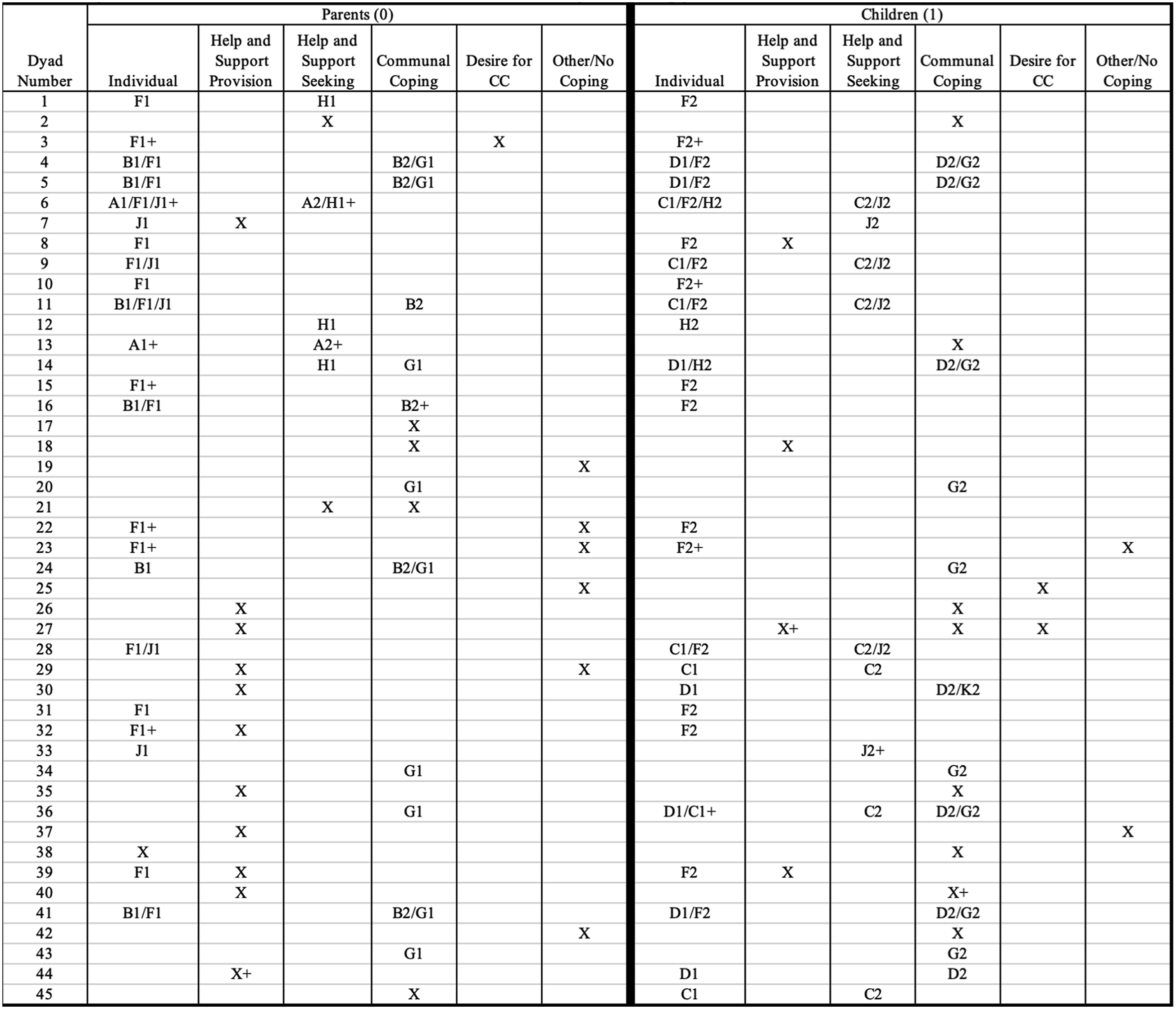
Relationships Within Themes for Each Dyad-Member
Individual Coping With Help and Support Seeking
The first co-occurrence observed for both parents and children was between the themes of individual coping and help and support seeking. One mother’s response reflects individual coping behaviors she engaged in independently and help and support seeking behaviors she enacted with others: I participated in therapy with a therapist. I exercise. I walk. I read and listen to audio books. I talk with my friends and my family, I go out with my friends for lunch or dinner. I try not to be alone too much. With my son, we talk on the phone and text. And we share funny reels through social media. We are very similar. He likes to go for walks too and he calls me during his walks and that is usually when we connect. He is never a bother to me (parent #7, mother, age 51, 18 months since partner death).
This example illustrates how individual coping is often complemented by external forms of social support. Individual coping allows parents to work through their grief, while help and support seeking allows them to rely on others for joint action to facilitate coping without having to navigate shared appraisals and co-management of grief and death-associated stressors.
Whereas this pattern for parents reflected help and support seeking complimenting individual coping, many children indicated they had to engage in individual coping because bids for help and support from their parents were not addressed. For example, one child described: “I watch movies with my mom, but we really never talk about the loss of my dad. How I deal with things is by just not thinking about them and going to the gym” (child #9, male, age 18, deceased father, seven months since parent death). For this child, watching movies together was a form of help and support seeking, as the child is attempting to spend quality time with the parent as a source of comfort (high joint action), but the parent and child do not talk about the death (low shared appraisals) in a way that the child would find helpful. Therefore, the child goes to the gym to avoid thinking about their father’s death (individual coping).
Individual Coping With Communal Coping
The second co-occurrence between themes for both parents and children reflected a relationship between individual coping and communal coping. One parent’s response reveals this pattern, describing how they enact communal coping with their child, but also how they have learned to cope by themselves. My son and I have learned that when waves of grief hit us, we talk about it. We have moments when something happens that we tear up because we wish his dad was here to see it. This week for instance, he started welding classes. His dad would have been very proud of him for that. Actions that I take individually to cope with my loss are, prayer and Bible studies. I try to stay active, by getting out of the house. I sleep in my recliner still, because it's too hard to sleep alone after 24 years. But I hope to overcome this (parent #16, mother, age 57, 31 months since partner death).
The pairing of individual coping and communal coping potentially occurred given that communal coping can be very difficult to enact and requires continuously purposeful communication (Afifi et al., 2020). During bereavement when emotions are heightened, communal coping may be beneficial, but parents may also want an escape from continually having to engage in purposeful behaviors with their children, so individual coping gives them a reprieve and a chance to process feelings and emotions on their own.
Similar to parents, this pattern illustrates that when children enacted communal coping, they also frequently enacted individual coping, but not necessarily vice versa. For many children, communal coping was described as something that was done in addition to individual coping, rather than something that was done to relieve the burden associated with individual coping. This pattern is reflected in the following response: I have taken an interest to baking and at times I stress bake when I feel overwhelmed. Together we engage in outdoor activities like hiking at least twice in a month sometimes even weekly because dad was pretty outdoorsy. It sort of helps us feel connected to him (child #4, female, age 17, deceased father, 14 months since parent death).
As demonstrated above, children identified activities that they like doing on their own that help them [individual coping], but also described actions taken with their parent to share in coping with stressors associated with bereavement [communal coping].
Relationships Between Themes of Parents and Children
Four co-occurrence patterns emerged between parents’ and children’s themes of coping after partner/parental death. These patterns occurred within individual dyads, representing patterns between dyad members. The first co-occurrence was between parent’s and children’s individual coping. Although parents and children can serve as important sources of support for the other during bereavement (e.g., Cafferky et al., 2018), individual coping may sometimes be preferable to avoid burdening one another and to prevent emotional fatigue. The co-occurrence of individual coping for parents and children demonstrates how coping can often be a very personal effort. For example, one parent noted: Individually I started to do yoga every week two times to have some time for myself to relax and try not to stress. I do the yoga with my friends so it makes me more happy. I also walk outside a lot with my dog to get fresh air and relax. (parent #1, mother, age 47, 16 months since partner death).
Their child also describes how they, have taken up long distance running every day that I can to clear my head and try to feel good about myself. Another thing I have taken up is digital art to try to relax. There is not anything I do with my parent, as I am away from home most of the week. (child #1, female, age 20, deceased father, 16 months since parent death).
As these responses illustrate, the parent and child place a focus on individual coping, not because they feel they cannot cope together, but because making time for themselves is a proactive way to navigate partner/parental death. This offers them an outlet to process grief on their own time without feeling beholden to anyone else, which reflects how family members may utilize individual coping to personalize bereavement to meet their needs.
The second co-occurrence pattern between experiences of coping was with parents’ and children’s experiences of communal coping. Communal coping involves the combined efforts of dyad members to engage in shared appraisals of a stressor and feel that it is up to all members to engage in joint action to address the stressor (Afifi et al., 2020). Therefore, although parents or children might each report they are engaging in communal coping, it is the co-occurrence of both dyad members that truly demonstrates the presence of communal coping. One parent-child dyad reflected communal coping in their responses, with the parent describing “We both do things that her mother really loved… like yoga and meditation and watching movies as a family” (parent #5, father, age 42, nine months since partner death). The child complemented this response, saying “As a family we go for yoga and meditation, [because] mom loved that. We also set aside one day mostly Saturdays to watch movies together, it keeps us close” (child #5, female, age 18, deceased mother, nine months since parent death). Both dyad members are describing similar events (yoga, meditation, and movies) to address stressors associated with parental death, which reflects high levels of joint action, and selecting activities that honor their deceased mother/partner, reflecting high shared appraisals.
The third co-occurrence pattern within dyads was with parents’ help and support seeking and children’s individual coping. One parent described that they “try to encourage my daughter to watch a movie with me each weekend” (parent #22, mother, age 37, 17 months since partner death), which reflects help and support seeking by trying to get the daughter to spend time with them. Yet, the daughter indicates that “Honestly sometimes I just try to stay busy and not think about it” (child 22, female, age 17, deceased father, 17 months since parent death), suggesting that the child may be deflecting help and support seeking bids from the parent and is focused on managing their own grief. This co-occurrence within dyads may reflect a breakdown of communication, where parents are attempting to engage in prosocial coping behaviors with their child, but the child prefers individual coping strategies to navigate grief.
The final co-occurrence pattern between experiences of coping was with parents’ individual coping and children’s help and support seeking. This pattern is the inverse of above, most often seen with children seeking help and support from their parent and parents eschewing their children in favor of engaging in individual coping acts. For example, one child said: Sometimes I will just break down and cry. This is something I don't want to do but it makes me feel better. My Mom and I try to go out and do something, like go to the mall or the movies. This helps keep my mind off things (child #39, female, age 15, deceased father, 14 months since parent death).
This response illustrates that the child is reaching out to the parent for help, and they report that the parent enacts joint action by going out to the mall or movies, but low shared appraisals because the child keeps their feelings private. In tandem, the parent responded by saying “My child and I have had a rough week… I slept a lot this week and watched a lot of TV. I don’t like when I do this, but it is sometimes necessary” (parent #39, mother, age 52, 14 months since partner death). This response reflects the notion that the parent is aware that the child is suffering, but that they are consumed with their own grief and individual coping, so they cannot provide the help and support their child needed.
Discussion
This study examined how parents and emerging-adult children cope after partner/parental death. Across responses, participants described coping that ranged from individual efforts to communal coping episodes, with patterns varying in how bereavement was framed as shared versus individual and the degree of coordinated action. Below, we discuss what these patterns theoretically suggest about our understanding of communal coping and how the findings can help families navigate grief.
Implications for Theory
Enacting communal coping can be challenging when individuals feel overwhelmed, as high stress can constrain coordinated joint action (Afifi et al., 2020; Maguire & Sahlstein Parcell, 2015). Furthermore, during bereavement, individuals may rely on internal or individual coping to navigate complex emotions and feelings that bereaved individuals may not feel able or ready to share with others (Porter & Claridge, 2021). Our findings support this logic in two ways. First, parents who reported overwhelm or a desire to avoid grief triggers tended to rely on individual coping, as the overwhelm of stressful circumstances impeded their ability to enact the more burdensome joint actions that facilitate communal coping. Instead, individual actions that required low joint action allowed parents to manage grief without also having to navigate bereavement with and for their child. Second, children who reported a need to compartmentalize or distract themselves from their grief also reported individual coping behaviors. For children, distractions from thinking about their parent’s death can help relieve the stress of bereavement (Brewer & Sparkes, 2011). Individual coping behaviors often served as distraction for children, where they were free from pressures associated with joint action or confronting feelings with their parent. Both patterns suggest that extreme stress limits the capacity for shared appraisals and joint action.
On the other end of the spectrum, our findings underscore the importance of communal coping after partner/parental death. Reflective of high shared appraisals and joint action, participants reported communal coping behaviors that prioritized quality time with the other and maintaining a connection with their deceased partner/parent with their surviving child/parent. Interestingly, Shapiro et al. (2014) illustrated that if a dyad appraises grief as a shared burden, bereft children may feel more involved in the grieving process and more willing to share their feelings. Our findings exemplify this notion, illustrating how dyads appraise grief as shared (e.g., involving the other in activities, conversations, and grief) and how they jointly act on appraisals (e.g., talking about the death and keeping the memory of the parent alive). Parents who include children in bereavement may help facilitate long-term adjustment and more effective coping into adulthood (Faro, 2018; Saldinger et al., 2004). Together, our findings illustrate how communal coping functions in bereavement through everyday actions that reflect shared appraisal and joint action in this context, forwarding our knowledge on theorizing about communal coping (Afifi et al., 2020).
Unlike individualism and communal coping, fewer parents described the two middle types of coping, individual help and support provision and help and support seeking. These two types of coping reflect more partial attempts at communal coping in that support is exchanged but appraisals or actions are not clearly shared. The ambiguity in responses relating to these types of coping raises some questions about their current articulation as forms of coping within the extended theoretical model of communal coping (Afifi et al., 2020). Specifically, it was often unclear whether these accounts reflected movement toward shared appraisals and joint action or simply episodic support exchanges that remained primarily individual in appraisal or actions. Thus, our findings suggest that these in-between orientations to coping potentially function differently in parent/emerging-adult child dyads than the current iteration of the theory captures. Perhaps, what distinguishes these orientations is not just the level of shared appraisals and joint action (Afifi et al., 2020), but also the interactional valence of the exchange, meaning support that facilitates coping versus support that is experienced as unhelpful, intrusive, or misaligned.
One way to integrate communicative valence into the extended theoretical model of communal coping is to treat valence as a relational qualifier (e.g., whether coping interactions feel supportive and facilitative versus strained or avoidant) that shapes movement between coping orientations, rather than as an additional coping type. To examine the fluidity of appraisals and action during coping interactions we call on Basinger et al.’s (2024) argument to account for the valence of the appraisal and action within coping conversations. Basinger et al. (2024) note that communal coping assumes co-ownership of a stressor is generally positive, yet when the valence of co-ownership feels negative (e.g., one father who reported drinking whiskey to cope and struggling to keep an open line of communication with his daughter), communal coping may be experienced as collapsing into more individual forms. In turn, collapsed communal coping due to the strained valence of the conversation may appear as one of the mid-level forms of coping, suggesting that these “in-between” orientations may sometimes be interpreted as disrupted or deteriorating coping rather than partial communal coping alone. Although some participants described positive mid-level experiences (e.g., a mother who reported she was happy she could help her son work through stress, even if she was not addressing emotions associated with bereavement), future work should explore how communication valence shapes the movement between coping types. In this way, valence helps specify when shared appraisals and joint action are likely to consolidate into communal coping versus stall or revert to more individual forms.
Another theoretical contribution was a fifth emergent theme: desire for communal coping. Although most themes aligned with the extended theoretical model (Afifi et al., 2020), a small subset of participants emphasized wanting to co-own the death and cope together but being unable to do so. In these accounts, desire often appeared as a stated preference for shared processing or coordinated coping paired with descriptions of relational barriers (e.g., avoidance, mismatched preferences, or concerns about burdening the other person) that limited coordination. We interpret this desire as signaling readiness for communal coping or, in some cases, a thwarted attempt when relational constraints, mismatched needs, or perceived costs block coordination. Because our qualitative analyses do not test temporal ordering, we treat desire as a conceptual extension that points to a potential antecedent state rather than a staged sequence. Building on the role of communicative valence (Basinger et al., 2024), desire may transition into enacted communal coping when attempts to coordinate coping (e.g., bids to talk, remember, or problem-solve together) are experienced as supportive and well-timed, but may remain unrealized when attempts are experienced as intrusive, poorly timed, or misaligned.
Finally, the co-occurrence patterns have implications for theorizing on communal coping. For both parents and children, individual coping co-occurred with communal coping, suggesting that people (a) can engage both ends of the coping continuum simultaneously, and (b) require multiple forms of coping when managing difficult transitions. Afifi et al. (2020) suggest that communal coping can be difficult to enact and requires continuous and purposeful communication. As described by participants, when emotions are heightened during bereavement, individuals may recognize the utility of communal coping but are too emotionally exhausted to continually enact communal coping strategies. Consequently, individual coping allows parents and children time to attend to their own grief and needs so they can go back to communally coping after having bolstered their energy. Importantly, the presence of the various co-occurrence patterns associated with coping supports the notion that communal coping is a dynamic and fluid process (Afifi et al., 2006), with parents and children vacillating between coping orientations as needs and capacity shift over time. In this way, co-occurrences are not merely methodological observations but a theoretical window into how communal coping unfolds in practice, capturing the layered and negotiated process through which bereaved family members move between individual and communal orientations as they navigate grief together.
Implications for Bereaved Families
Turning to practical implications, our findings extend work on the benefits of coping after partner/parental death (e.g., Faro, 2018; Lundberg et al., 2018; Weber et al., 2019) by positioning communal coping as a specific form of coping that can be beneficial during bereavement. Following parental death, surviving family members are often unsure of how to include children and desire to protect them from grief (Schonfeld et al., 2016). Our findings suggest that communal coping can serve two important functions in this regard. First, promoting communal coping offers parents a way to include children in the grieving process. Second, focusing on communal coping promotes a pro-social communication process that allows parents and children to work together. In this way, parents can feel that they are still “shielding” children, while doing so in a way that allows them to address issues rather than avoiding them, and incorporating children in the grief journey rather than isolating them.
Our findings also suggest that although family members may be good partners in the coping, they are not always the most preferred or most helpful. Both children and parents indicated the importance of outside sources for social support when dealing with grief which point to the benefits that peers can offer for long-term adjustment (Haine et al., 2008). Participants who enacted help and support seeking as coping reinforce the notion that outside networks not only serve as an essential form of social support, but they also allow individuals a space to grieve independently from their immediate family. Accordingly, in addition to fostering an emotionally supportive relationship between parents and children, bereaved families should be encouraged to turn to external support networks to enhance coping when needed.
Finally, many parents and children described using individual coping behaviors to manage the death of their partner/parent. Although enacted alone, these behaviors still serve relational functions. Some parents described needing private space or distraction to process their emotions before resuming parenting, while some children indicated that they used solitary activities to self-regulate before reconnecting. Such accounts from parents and children suggest that individual coping may therefore act as a preparatory step, helping family members manage emotions so they can more effectively re-engage in communal coping with their parent/child. In turn, parents and children can be allowed to grieve on their own timeline and in their own ways without expectations (Jones & Theiss, 2023). These findings suggest that individual and communal coping can coexist and that individual coping may sometimes enable, rather than inhibit, communal coping.
Limitations
This study has a few limitations. First, in additional quantitative data that was collected, parents and children reported relatively low struggles to their mental health, depression, and overall low levels of negative emotions. They also reported relatively high levels of adjustment after the death. The relatively small and homogenous sample of primarily white, biologically related, relatively well-adjusted parent-child dyads limits the generalizability to more diverse populations, family structures, and those having more severe struggles with partner/parental death. Future research should examine how demographic variables, such as disability status and sexual orientation, and non-normative death experiences (e.g., when one has a strained relationship with the deceased) are associated with bereavement and coping. Second, although qualitative responses during the first wave were quite detailed, about one-third of the final responses were much shorter, which may have influenced the identification of co-occurrence patterns. Future research should consider prioritizing dyadic qualitative interviews to allow for more depth in discussion and direct comparisons across coping with parents and children. Third, variation in emerging adults’ age and living situation likely shaped opportunities for shared appraisal and coordinated coping, particularly for dyads living together versus apart. Future research should test how proximity and family structure condition communal coping after loss.
Conclusion
The death of a parent or partner is one of the most challenging life events individuals experience (Porter & Claridge, 2021). Navigating this transition centers on creating a new norm with new routines, roles, and responsibilities (e.g., Cafferky et al., 2018; Droser, 2020). A key part of these new routines involves learning how to cope with the death and responding to stressors associated with it. As illustrated in this study, children and parents used coping strategies ranging from highly individualistic to highly communal, reflecting the nuanced and personal nature of bereavement. Our results show how parents and children used different and similar coping strategies to manage grief, revealing potential mismatches in communication and a desire for more coordination. Ultimately, these findings underscore the importance of promoting coping behaviors to help parents and children navigate bereavement. Although coping may not resolve all stressors, promoting coping efforts is a strong starting point coupled with the understanding that everyone grieves differently.
Supplemental Material
Supplemental Material - A Thematic Co-Occurrence Analysis of Communal Coping Within and Between Surviving Parents and Emerging-Adult Children After Partner/Parental Death
Supplemental Material for A Thematic Co-Occurrence Analysis of Communal Coping Within and Between Surviving Parents and Emerging-Adult Children After Partner/Parental Death by Hannah E. Jones, Jennifer A. Theiss in Journal of Social and Personal Relationships
Footnotes

Ethical Considerations
This study was approved by the Rutgers University IRB. All participants completed informed consent prior to completing the first survey and completed continuing consent prior to completing the surveys in waves two through six.
Consent to Participate
Participants also approved for their data to be published in research papers and presented at local, national, and international conferences. Participants were able to withdraw their consent at any time during the study.
Funding
The authors disclosed receipt of the following financial support for the research, authorship, and/or publication of this article: This research was funded through an internal grant from the School of Communication and Information at Rutgers University and from Dr. Jennifer A. Theiss’ faculty funds.
Declaration of Conflicting Interests
The authors declared no potential conflicts of interest with respect to the research, authorship, and/or publication of this article.
Data Availability Statement
Due to the sensitive nature of the study, the data is not publicly available.
Open Research Statement
As part of IARR’s encouragement of open research practices, the authors have provided the following information: This research was not pre-registered. The data used in the research cannot be publicly shared due to IRB requirements concerning the sensitive nature of the data and the use of minors in the sample. The materials used in the research cannot be publicly shared but are available upon request. The materials can be obtained emailing:
Supplemental Material
Supplemental material for this article is available online.
References
Supplementary Material
Please find the following supplemental material available below.
For Open Access articles published under a Creative Commons License, all supplemental material carries the same license as the article it is associated with.
For non-Open Access articles published, all supplemental material carries a non-exclusive license, and permission requests for re-use of supplemental material or any part of supplemental material shall be sent directly to the copyright owner as specified in the copyright notice associated with the article.
