






Abstract
As a nationally accredited test, the Test of Proficiency in Korean (TOPIK) assesses general Korean proficiency as a foreign language for various high-stakes purposes, such as university admissions, employment, and visa issuance. For this reason, the social impact of TOPIK on test takers is significant and cannot be underestimated. Despite the growing number of international test takers and stakeholders, there is limited validation research evaluating TOPIK’s various uses, as well as critical evaluation of the test itself. Thus, this test review provides an overview of the history, test purposes and use, design, and administration of TOPIK and offers an appraisal of its strengths and challenges. While the test scores are broadly utilized for their intended purposes and provide some evidence of language development across four skills in Korean, the lack of publicly available information on the test construct, psychometric properties, and standard-setting procedures makes it difficult to fully evaluate the validity and reliability of the scores. Furthermore, additional evidence and validation research are needed to examine the generalizability of TOPIK scores beyond academic domains, given the test’s diverse applications. Addressing these gaps is critical to meet the needs of various stakeholders and to strengthen the overall validity of the test.
Introduction
Global interest in learning Korean has surged in recent years, propelled by the rise of Korean popular culture and the growing educational and economic influence of Korea abroad. This phenomenon is commonly described as the Korean Wave or hallyu (Kr: 한류), referring to the global diffusion of South Korean cultural products such as K-pop, television dramas, film, and digital media, which the South Korean government has leveraged to enhance the attractiveness of the country and culture abroad (Samosir & Wee, 2023). Additionally, the Ministry of Education’s (MoE) “Study Korea 300 K Project” has been working to diversify and internationalize the workforce, making South Korea a top 10 destination for study abroad by 2027 (Ministry of Education, 2023). By 2024, the number of international students coming to South Korea to study abroad had already surpassed 200,000, with numbers expected to continue growing. Outside of higher education, the country recorded 698,000 incoming migrants in 2023, an increase of 92,000 from the previous year, alongside a 17.2% increase in immigrant marriages and a foreign workforce totaling over 470,000 (Korean Statistical Information Service, 2024). In short, hundreds of thousands of people are studying Korean as a second or foreign language, and these numbers are set to grow in the coming years.
This rapid increase in Korean language education and migration to South Korea has fueled a greater need to assess Korean language proficiency. Currently, the most popular and widely accepted Korean language proficiency test is the Test of Proficiency in Korean (TOPIK). In 2024, an all-time high of 492,498 (Paper-based test [PBT]: 481,505; Internet-based test [IBT]: 10,993) applicants registered for TOPIK (TOPIK, n.d.-c). TOPIK periodically appears in Korean and international media coverage, suggesting that the test has become socially visible. Recent news reports have highlighted its use in overseas university admissions systems in Hong Kong and Vietnam (Lee, 2026) and concerns about test security and fairness, including cheating scandals linked to time-zone differences across administrations (KBS World, 2026). Such coverage suggests that TOPIK functions not only as a language test but also as a high-stakes instrument connected to broader issues of internationalization of Korean and academic mobility. Given this growing prominence, there is a need to appraise the test for test takers, test users, and other stakeholders. This test review outlines the current PBT version of TOPIK, along with brief information about the recently introduced TOPIK Speaking and IBT versions. In addition, this review aims to examine how well research and investigation on TOPIK support the various uses of its scores and what interpretive cautions may be warranted.
Brief History of TOPIK
TOPIK is a policy-driven national language proficiency test currently administered by the National Institute for International Education (NIIED), a branch of the Ministry of Education (MoE). In the mid-1990s, as the number of Korean language learners and foreign migrants grew, the MoE proposed the development of a state-led Korean language proficiency test to establish a standardized and officially recognized assessment system (Im et al., 2022). The test was launched in 1997 and first administered by the Korea Research Foundation (1997–1998), followed by the Korea Institute of Curriculum and Education (1999–2010). It has since been administered by NIIED. Since its inception, TOPIK has retained a six-level classification scheme for language proficiency. However, the structure and content of the test have undergone several major revisions, reflecting evolving conceptions of Korean language ability.
In 2006, six separate tests that assessed each proficiency level were reduced to three, evaluating beginner, intermediate, and advanced levels. A second major restructuring of both format and content took place in 2014, resulting in the current two-test format: TOPIK I, for beginners (Levels 1 and 2), and TOPIK II, for intermediate and advanced learners (Levels 3 to 6). In terms of content, the target language skills and question types have undergone notable changes. Before 2014, reading, listening, writing, vocabulary, and grammar were evaluated as separate sections. After revision, vocabulary and grammar sections were integrated into reading, and writing remained only in TOPIK II. The writing section was modified from an indirect test with multiple-choice items to a direct test with constructed response essay tasks. These revisions suggest a gradual shift from a discrete point conception of language ability toward a more integrated and communicative construct of Korean proficiency, which has improved its authenticity and construct representation.
TOPIK has further expanded its construct representation in recent years. An optional TOPIK Speaking test was introduced in 2022, addressing longstanding criticism regarding the absence of speaking assessment (Kim et al., 2022). In addition, the computerized IBT format was introduced in 2023. For both the Speaking and IBT tests, remote proctoring is not provided yet and test takers must be physically present at designated test centers. Currently, TOPIK Speaking is only available in Korea, while the paper-based test and the IBT version are available globally.
Test Purpose and Use
According to the official TOPIK website, the test purpose is to “guide those learning Korean as a second language and promote more widespread use of the Korean language” and “assess individual proficiency in the Korean language and allow test takers to use their test results in filing college applications, job applications, etc” (TOPIK, n.d.-c). TOPIK targets heritage Korean learners and non-Korean L2 learners. TOPIK and NIIED official websites list five “potential/major uses” of the test scores as university admission and graduation, employment, visa obtainment for permanent residency, as a qualification for the Global Korean Scholarship (GKS), and as a substitute for academic credits or graduation requirements for Korean major programs at overseas universities. For university admission, generally Level 3 is required for 4-year universities and Level 2 for 2-year colleges. Level 4 is often set as the requirement for graduation. Level 1 is usually required for visa issuance under F-6 (a marriage migration visa) and D-4-6 (a general trainee visa) (Park & Shin, 2019).
Test Construct
There is little publicly available documentation that reports how the current TOPIK conceptualizes and operationalizes Korean language proficiency. Yang et al. (2012) noted that test items are developed primarily based on difficulty levels rather than on explicit constructs of Korean language proficiency, but this report was published before the 2014 revision. From what can be observed through available documentation, the construct is primarily oriented toward receptive skills and productive writing ability across a range of functional and formal registers.
Test Tasks and Administration
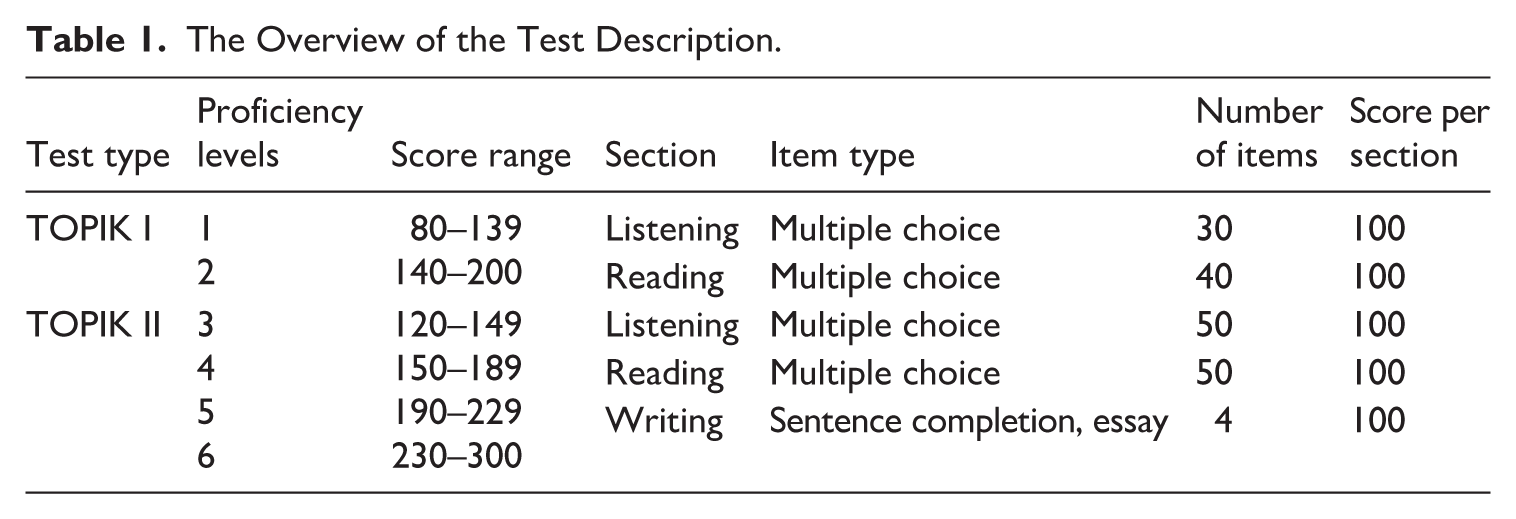
The test tasks and target language skills differ across the two test types (see Table 1). Both TOPIK I and II assess listening and reading in a multiple-choice format, and TOPIK II includes an additional writing section. TOPIK I targets local and global comprehension skills. The listening test includes inferring the setting of a dialogue, identifying specific details, matching a description with the corresponding picture, understanding the main idea, and identifying speakers’ intentions. The script covers short dialogues and one monologue approximately seven sentences long. In reading, items require identifying the main idea and specific details, understanding vocabulary in context, and inferring relationships between sentences. Given that text length ranges from two sentences to a short paragraph, the reading and listening tests focus primarily on lower-level receptive skills. The administration of TOPIK I takes 100 min.
The Overview of the Test Description.
As TOPIK II aims to assess language use in academic, social, and professional contexts, it requires test takers’ greater engagement with diverse discourse genres and higher-order thinking skills. In the listening section, test takers are asked to select the appropriate chart or graph, infer the next course of action, identify the speaker’s intention or purpose, and interpret the speaker’s attitude. The listening scripts include a wide range of genres, including news reports, announcements, interviews, debates, lectures, educational programs, panel discussions, and documentaries. The reading section includes a similar range of higher-order skills. TOPIK II writing is comprised of two sentence completion items and two essay questions. Sentence completion items are designed to assess discourse organization skills (TOPIK, 2024b). The essay questions include one explanatory and one argumentative essay. The first question requires a 200–300 Hangul character essay (approximately seven sentences), while the second requires 600–700 Hangul characters (approximately 15–18 sentences). In total, the administration of TOPIK II takes 180 min.
As a separate test, TOPIK Speaking is administered semi-directly and includes six questions lasting 30 min. The speaking tasks include six task types and topics from daily life to abstract social issues. The six items tap into interpersonal, interpretive, and presentational discourse. Task preparation time ranges from 20 to 70 s, and response time ranges from 30 to 80 s depending on the difficulty of tasks. Sample tasks and model answers are freely accessible online (TOPIK, n.d.-b).
The total number of TOPIK candidates has steadily increased from 218,869 in 2020 to 492,498 in 2024. Internationally, the scale of TOPIK administration has expanded significantly as well, with centers growing from 42 countries in 2020 to 89 countries in 2024. Countries such as Vietnam, Thailand, Japan, China, Uzbekistan, and Mongolia have consistently reported high numbers of applicants. New test centers in Southeast and Central Asian countries, including Myanmar, Kazakhstan, and Kyrgyzstan, suggest that there has been a rapid spread of Korean language learning across these regions (TOPIK, n.d.-c).
Scores
Test takers receive a test report approximately 6 weeks after administration, which is valid for 2 years. It includes a total score, section subscores, and the overall proficiency level (1–6). Score information for each section and corresponding proficiency level is presented in Table 1. Since TOPIK is a criterion-referenced test, the test report provides both can-do statements describing linguistic and functional abilities as well as individual subsection scores with group means. To infer what functions test takers at each ability level are able to accomplish, stakeholders can use the holistic rating descriptor. For example, TOPIK (2024a) states that test takers at Level 3 can communicate to maintain interpersonal relationships using personal and familiar social topics. They are able to understand and produce factual information from simple texts. By comparison, test takers at the highest level can perform effectively in professional contexts and communicate about abstract social topics. They can also understand and produce multi-paragraph texts containing a variety of complex sentence structures.
Developer and Publisher Contact Information
TOPIK Test Center
191 Jeongjail-ro, Bundang-gu, Seongnam-si,
Gyeonggi, 13557, Republic of Korea
Phone: +82-2-3668-1331
Email:
Website: www.topik.go.kr
National Institute for International Education (NIIED)
191 Jeongjail-ro, Bundang-gu, Seongnam-si,
Gyeonggi-do, 13557, Republic of Korea
Phone: +82-2-3668-1300
Fax: +82-2-742-1064
Website: www.niied.go.kr
Price
TOPIK registration fees vary depending on the test types and the country of administration. At the time of publishing in South Korea, the PBT format costs 40,000 KRW (US$27) for TOPIK I and 55,000 KRW (US$37) for TOPIK II. The IBT format costs 70,000 KRW (US$47) for TOPIK I and 95,000 KRW (US$64) for TOPIK II. TOPIK Speaking is 80,000 KRW (US$54). All examinees must complete their registration through the official TOPIK website or designated local institutions, and payment is required at the time of registration (TOPIK, n.d.-a).
Appraisal
Strengths
Korean Language Development
As TOPIK has been used to guide Korean language curricula and instructional programs, its score levels are often interpreted as indicators of learners’ stages of language development. The interpretability of such inferences can be strengthened when performance descriptors are linked to language proficiency frameworks such as the American Council on the Teaching of Foreign Languages (ACTFL) or the Common European Framework of Reference for Languages (CEFR; Chapelle, 2021). As an internally conducted project within TOPIK to internationalize the test, Kim et al. (2025) revised TOPIK performance descriptors and compared them with CEFR-level descriptors. The study showed a level correspondence between TOPIK and CEFR in terms of communicative functions and level-specific topics. The authors found that TOPIK I (Levels 1 and 2) corresponded to CEFR Levels A1 and A2 and that TOPIK II (Level 3) generally aligned with B1. Level 4 was calibrated slightly below B2. Levels 5 and 6 were comparable to C1 and C2 in terms of the topics, but some differences were observed in the range of functions, media, and rhetorical structures. However, this alignment study was conducted only on the basis of descriptor comparability rather than through empirical standard-setting practices (Council of Europe, 2009), and, as such, only represents one line of evidence of alignment. Thus, TOPIK’s descriptor-level alignment with CEFR should be interpreted with caution, as it does not guarantee psychometric comparability of scores or levels.
In addition to its alignment with CEFR, two studies have shown that linguistic complexity in the receptive sections of TOPIK I and II distinguishes beginner and intermediate/advanced levels. Jang and Jeon (2024a, 2024b) compared text difficulty in the reading and listening sections of TOPIK I and II. A Korean text analysis tool indicated that linguistic indices were generally set at a higher level of difficulty in TOPIK II than in TOPIK I, aligning with the intended design of the test. Similarly, DeVane et al. (2025) compared syntactic complexity and lexical diversity in the listening sections of Level 1 and 2. Level 2 generally used more complex sentence structures than Level 1, except in the use of coordinating conjunctions. However, lexical diversity was higher in Level 1, possibly due to the longer passages in Level 2. While these studies provide preliminary evidence of level differentiation, there remains room for more validation research to examine if there are differences across all six levels. Furthermore, cognitive and functional indices should also be examined to determine whether they differentiate between proficiency levels. Only then can it be argued that the six levels presented in TOPIK meaningfully represent a full continuum of language development.
Test Use
Investigating whether the test scores are used for their intended purposes is central to validation research (Chapelle, 2021). Given that TOPIK is a policy-driven language test, its score is formally embedded in governmental and administrative regulations related to higher education, employment, and immigration. Empirical studies on the actual use of TOPIK scores remain limited and have primarily been conducted by independent external researchers rather than by the testing organization itself (Choi, 2020; Park & Shin, 2019; Yan & Cheng, 2015). Nevertheless, the available findings generally suggest that TOPIK scores are used in ways consistent with the test’s intended purposes. In higher education contexts, Choi (2020) found that 13 of the top 20 colleges enrolling domestic international students in South Korea require a TOPIK score above Level 3 for admission as evidence of readiness for undergraduate academic study, in accordance with Ministry of Education regulations (Ministry of Education, 2025a). Some empirical support for this use of TOPIK comes from Yan and Cheng (2015), who found modest correlations between TOPIK scores and GPA (undergraduates r = .29; graduates r = .40), suggesting some degree of alignment with the academic target language use (TLU) domain.
In employment settings, required scores vary by profession, but test scores are used in hiring, promotion, and obtaining apprenticeship visas for training decisions (Park & Shin, 2019), which suggests that they may serve as an indicator of workplace communicative language ability for employers. In immigration contexts, TOPIK Level 1 (approximately A1 on the CEFR) serves as one requirement for F-6 (spouse) visas to demonstrate the ability to use communicative functions for everyday survival (Ministry of Foreign Affairs, 2025). However, little empirical research appears to have examined how TOPIK scores are interpreted or used in immigration-related decision-making practices. More broadly, to the best of our knowledge, we were unable to identify research conducted either by the test developer or through externally funded validation projects examining test score use.
Although there is evidence that the test is used for its intended purposes, limited research has examined whether test performance meaningfully transfers to language use across these heterogeneous TLU domains. A critical question remains whether a single general proficiency test can adequately support high-stakes decisions across academic, workplace, and everyday survival contexts, or whether domain-specific validation evidence is required to justify such diverse uses, as for high-stakes tests in other languages (e.g., IELTS; Read, 2022). We expand on these topics of test purpose and domain generalization below.
Accessibility
TOPIK has made efforts to strengthen the accessibility and fairness of the test. One way it has done so is by providing free test preparation materials. Annually, one set of past exam questions for both reading and listening sections of TOPIK I and II is released. Test takers can also experience TOPIK IBT and TOPIK Speaking through tutorials that replicate the test interface from the website. This supports test takers’ familiarity with new item types and operational procedures. Additionally, beginner-level lectures are freely accessible via the official TOPIK YouTube channel (The National Institute of International Education TOPIK, n.d.). These resources are offered in seven languages, Arabic, French, Khmer, Mongolian, Myanmar, Russian, and Spanish, to accommodate the diverse linguistic backgrounds of test takers.
Beyond access to preparation resources, TOPIK provides accommodations for test takers with disabilities upon their request. However, empirical evidence regarding whether such accommodations have been implemented equitably across regions and disability types is limited. Jung and Hwang (2014), in one of the limited discussions on this topic, raised concerns about the unavailability of a braille test to a visually impaired examinee. Therefore, continuing attention to the consistency of accommodations would strengthen the fairness of the TOPIK administration.
Challenges
Test Purpose and Construct
One of the most visible challenges for TOPIK is providing clarity on its stated purposes and how these purposes are represented by the test construct. The test provider’s statement about test purpose on the official website states that TOPIK primarily serves as a proficiency test, but it also mentions that scores may be used for monitoring achievement, assessing Korean for academic purposes, or assessing Korean for business purposes (TOPIK, n.d.-c). This ambiguity appears to stem from TOPIK’s policy-driven development, which has responded to the increasing demand for standardization of Korean language learning and assessment across a range of sectors in society. Likewise, there is limited explicit information available about the test construct, such as which aspects of communicative language ability are targeted and their rationale given the test’s intended purposes. Insufficient reporting complicates any claims linking the underlying construct with its intended purposes, which is a key aspect of test validation research. Clearer public information about the purposes of the test and its construct could help strengthen confidence in the meaningfulness of test scores. Even more pressing is the need for validation studies that provide evidence that the interpretations and application of assessment results support its stated purposes (Bachman & Palmer, 2010).
Psychometric Reporting
One of the most urgent needs for validation research on TOPIK is the public reporting of psychometric qualities of the test, such as reliability indices and standard errors of measurement. To our knowledge, Yang et al. (2012) is the only official document that has reported psychometric evidence based on the test data from three administrations before major test revisions in 2014. It showed medium to high correlations between test sections, but there was variance in the factor structure of the test across levels. Chang (2014) highlighted other issues in the consistency of item characteristics across administrations. Neither study reported reliability measures, and the demand for reliability reporting (including standard error of measurement) has often been raised in the literature (Choi, 2017; Kim et al., 2022). Making such data available would contribute meaningfully to TOPIK, as it plays a crucial role in establishing public trust in the validity of test scores.
Standard Setting
Establishing clear evidence of differences across proficiency levels and their relationship to criteria in the TLU domain is critical for test validation (American Educational Research Association [AERA] et al., 2014). Unfortunately, no publicly available documentation explains the rationale or methodology underlying the score thresholds used to classify test takers into different proficiency levels, which has been a consistent concern in the past literature (e.g., Choi, 2017; Nam et al., 2000; Yan & Cheng, 2015). This lack of transparency is particularly concerning given that the score intervals assigned to each proficiency level vary considerably, ranging from 30 to 70 points. Without transparent reports on how these proficiency-level thresholds were established, stakeholders may find it difficult to determine how accurate and precise these level distinctions are in high-stakes decision-making contexts.
In addition, because these descriptors provide the interpretive basis for distinguishing proficiency levels and supporting score meaning, the test developer should provide clear descriptors specifying the linguistic, cognitive, and functional skills associated with each level. TOPIK level descriptors were originally developed based on topics and content found in previously administered test items rather than on theoretical and empirical evidence of Korean language development (Kim et al., 2025). Although Yang et al. (2012) touched on these issues, their findings were based on test forms prior to the major restructuring of TOPIK in 2014. Thus, it remains unclear how or whether the current version of TOPIK’s level distinctions reflects its purported construct. Furthermore, any interpretation of their alignment with the CEFR (Kim et al., 2025) needs to be approached with caution, as standard setting was not used to determine these relationships. Future studies should follow best practices for alignment described in the Council of Europe (2009).
Domain Generalization
While TOPIK scores are used in various domains, such as education, employment, and visa issuance, language use in each of these domains varies substantially in terms of register, discourse, and communicative purpose. This raises questions about construct coverage and the degree to which the test adequately reflects the language abilities required in different TLU domains (Bachman & Palmer, 1996; Chapelle, 2021; Kane, 1992). Even in the general TLU domain, the shortage of productive assessment across all levels raises questions about the generalizability of scores to real-world communication. Writing in TOPIK II and the new optional speaking test certainly assist in providing additional evidence of communicative language ability, but more can be done to incorporate these productive skills across all ability levels. This is especially concerning given that TOPIK I is used for visa issuance to ensure the most basic communication skills, yet the test contains no speaking or writing components.
In terms of the specific domains the test is designed to be used for, academic language use has been studied the most, albeit with mixed findings. For example, the listening section was found to lack inferential and pragmatic items compared to TOEFL, and the speech rate reflected about 40% to 70% of that found in real-life discourse situations (Cho, 2022; Kim, 2016). Similarly, reading passages in TOPIK II are at most seven sentences long, raising concerns about whether TOPIK II sufficiently covers academic literacy to interpret information and draw inferences in extended texts. These findings suggest potential underrepresentation of key aspects of the academic language construct, which may weaken the alignment between test scores and academic TLU domains. This concern has also been raised in national reports proposing the development of an academic version of the test (A-TOPIK; Kim et al., 2011; Yang et al., 2012).
Research on non-academic domains (such as everyday communication or business) remains limited. Lim et al. (2018) questioned the authenticity of listening dialogues in TOPIK I and II, arguing that structural uniformity and limited attention to discourse and pragmatic features may reduce their resemblance to natural interaction. Similarly, Lee (2025) argued for a version of TOPIK for business purposes, noting the current test's limitations in assessing workplace performance skills, such as document drafting and oral reporting. Since available evidence suggests uneven construct coverage across TLU domains, it would be reasonable to interpret TOPIK scores as indicators of general proficiency, whereas their generalization to specific academic or professional domains requires further empirical support. To enhance TOPIK’s validity across contexts, more research needs to establish adequate alignment between the test and the TLU domains.
Conclusion
The evidence presented in this test review suggests that TOPIK scores do provide evidence of second language development in Korean, but much more research is necessary to support the use of its scores. Recent validation research from external sources suggests that the test is being used for its intended purposes, and internal research suggests that TOPIK proficiency descriptors broadly align with CEFR level descriptors. However, much more empirical evidence is needed to formulate a sound validity argument. The absence of recent technical and psychometric documentation, theoretical and empirical support for standard setting, and studies validating score uses highlights the need for broader and deeper inquiry. Although the authors contacted the TOPIK administration in April 2025 to request documentation related to test statistics and validation evidence, no additional information was made available. Based on our review, there are four key takeaways for stakeholders using TOPIK:
TOPIK is most appropriate as a broad, general indicator of Korean as a second language proficiency.
Supplementary assessment is advisable when high-stakes decisions require domain-specific abilities, such as advanced academic literacy, workplace and daily-life communication (e.g., Sejong Korean Language Assessment, Employment Permit System TOPIK, Korean Language Ability Test).
Score interpretation, especially regarding alignment with the CEFR, should be approached with caution given limited public documentation on the test construct and the psychometric properties of the test.
Global research on the uses and consequences of TOPIK scores across a wider range of TLU domains is needed, along with publicly available standard setting studies aligning TOPIK scores with the CEFR. Greater transparency in score interpretation and validation practices would align with recent calls for open science practices in language assessment (e.g., Göktürk & Alaca, 2026; Kremmel & Isbell, 2024).
Improving the transparency of psychometric data and incorporating diverse perspectives into validation research could greatly enhance validity argumentation for TOPIK. This is especially relevant given the growth of competing Korean language proficiency tests, such as the Korean Language Ability Test (KLAT) or the Sejong Korean Language Assessment (SKA). Such efforts would not only enhance the test’s fairness and usefulness but also foster greater confidence in its results. In addition, public access to policy research reports examining score equivalence and construct comparability between paper-based and computer-based tests (e.g., Lee, 2024; Ryu, 2022) may help stakeholders better interpret and use IBT scores. This is particularly pressing given that automated item generation and scoring of TOPIK have become a central policy initiative (Ministry of Education, 2025b). Test users would benefit from clearer evidence on the quality of items, the reliability and fairness of scoring, especially for productive skills. Ultimately, strengthening these areas would support TOPIK’s role in a globalized educational and professional landscape, especially as immigration to South Korea is set to greatly expand in the coming decade (Ministry of Data and Statistics, 2024).
Footnotes

Author Contributions
Funding
The authors received no financial support for the research, authorship, and/or publication of this article.
Declaration of conflicting interests
The authors declared no potential conflicts of interest with respect to the research, authorship, and/or publication of this article.