






Abstract
Interactional competence (IC) is essential for oral communication assessment, yet human partner variability can introduce construct-irrelevant variance in paired speaking tests. As an alternative to a test with a human interlocutor, this study describes the development of a large language model (LLM)-driven Spoken Dialogue System and compares GPT-4o to Claude 3.5 Sonnet to inform model selection for IC assessment. Twelve international students completed paired discussion tasks with both LLMs in counterbalanced order. System performance was evaluated through breakdown activation consistency, stance maintenance, and persona adherence. Test-taker performances were analyzed using interactional discourse analysis to identify IC features across three dimensions: topic management, interactional management, and interactive listening. Semi-structured interviews explored test takers’ perceptions of the AI partners. Results showed Claude outperformed GPT-4o in eliciting IC features, successfully activating communication breakdown strategies and maintaining oppositional stance, thereby creating more opportunities for test takers to demonstrate key IC abilities. Test takers perceived Claude as more authentic and natural, while GPT was perceived as more artificial. These findings demonstrate that different LLMs create distinct interactional conditions affecting both IC elicitation and test-taker perceptions. The findings highlight the need for construct-driven evaluation criteria when selecting LLMs for language-assessment contexts.
Keywords
Introduction
A challenge in large-scale, high-stakes oral assessments is to validly assess oral communication. Interactional competence (IC), or the ability to communicate effectively with others, represents an essential component of second language (L2) oral communication that should be assessed accordingly (Roever & Kasper, 2018). For assessment purposes, IC is defined here as an individual’s ability to contribute to shared understanding through oral interaction (Ockey & Chukharev-Hudilainen, 2021), allowing for the separation of individual test-taker performance from the co-constructed nature of interaction. IC has been conceptualized as a multidimensional construct consisting of various observable features that serve as indicators of IC ability and can be organized into dimensions such as topic management, interactional management, and interactive listening (Vo, 2019), although the specific features and their observability may vary across contexts (Galaczi, 2014; He & Dai, 2006).
Traditionally, IC has been assessed through paired or group tests, which provide the necessary context and input to elicit IC features (Ockey & Chukharev-Hudilainen, 2021). Unlike oral proficiency interviews, where the examiner leads the conversation, paired tasks place test takers in a symmetrical relationship, eliciting a broader range of interactional features more representative of authentic academic peer interaction (Brooks, 2009; Galaczi & Taylor, 2018). However, the inclusion of interlocutors may increase the challenge of judging test takers’ individual IC ability, as test takers’ performances can be affected by their interlocutors. It is difficult to isolate one test taker’s ability from another due to the variability inherent in human partners (May, 2009), which can introduce construct-irrelevant variance to the test (Galaczi & Taylor, 2018). Previous studies have identified interlocutor variability as including differences in personality traits (Ockey, 2009) and proficiency levels (Davis, 2009).
To address this challenge, some researchers have used Spoken Dialogue Systems (SDS) as speech partners instead of humans. An SDS is a computer system that can engage in oral interactions with test takers (Timpe-Laughlin et al., 2017). For example, Ockey and Chukharev-Hudilainen (2021) developed an SDS for paired discussion tasks by combining speech recognition, keyword detection, and text-to-speech (TTS) synthesis. Compared with human partners, the SDS condition yielded higher score dependability, likely due to its standardized interaction and consistent opportunities to demonstrate IC features. Notably, the system’s intentional communication breakdowns increased the reliability of IC assessment by eliciting certain IC features that may not readily surface in spontaneous interaction, such as meaning negotiation and repair, particularly in human–human interaction where test takers may otherwise mask their lack of understanding (e.g., by nodding along) (Ockey & Chukharev-Hudilainen, 2021; Ockey et al., 2023). However, while the SDS minimized variability, its rule-based inference relying on keyword detection and predetermined response pathways limited responsiveness to test-taker input, resulting in less natural and authentic discourse. This underscores the tension between achieving standardization and maintaining authenticity in IC assessment.
Recent advancements in generative artificial intelligence (GenAI) offer promising solutions. Large language models (LLMs), such as OpenAI’s GPT and Anthropic’s Claude series, can generate coherent, context-appropriate responses in real time rather than selecting from predetermined templates. Advanced speech synthesis technologies have the potential to produce realistic speech with diverse speech varieties at controlled intelligibility levels. Building on these advances, the present study developed an LLM-driven SDS called Generative Interactional Competence Elicitor (GICE) to examine how such technologies can support standardized yet authentic IC assessment. In particular, certain IC features may be inherently less common in spontaneous interaction when communication breakdowns or conflicting opinions are absent (He & Dai, 2006). GICE incorporates intentional communication breakdowns as an elicitation strategy, similar to ICE (Ockey & Chukharev-Hudilainen, 2021), to improve score dependability for IC while structuring the interaction to reflect key characteristics of the paired discussion task—maintaining an opposing stance and simulating peer-like interaction—thereby creating conditions for sustained negotiation and interactional demands necessary to demonstrate a broader range of IC features.
A critical design decision in developing GICE involved selecting an appropriate LLM to serve as the AI partner, as different models may create distinct interactional conditions that affect test validity. One study in cognitive science, Mayor et al. (2025), found distinct conversational behaviors between GPT-4 and Claude 3.5—such as differences in turn length and alignment—suggesting that model selection may meaningfully impact test-taker interactions. Yet systematic comparisons of LLMs for IC assessment purposes remain limited. Furthermore, from a partner-modeling perspective, speakers adapt their interactional behavior based on perceived partner capacity (Fischer, 2016); in human–computer interaction, reduced interpersonal language has been observed when computer partners are perceived as having limited interpersonal skills (Shechtman & Horowitz, 2003). Since test takers’ perceptions of the AI partner’s capacity, such as its perceived authenticity and interactiveness, may influence their interactional engagement, understanding these perceptions is relevant to evaluating model suitability for IC assessment.
This study therefore provides a direct comparison of GPT-4o and Claude 3.5 Sonnet as AI partners in paired discussion tasks, investigating their effectiveness for IC assessment within the context of a local university English Placement Test of Oral Communication (EPT OC). Two research questions guided this research.
Research Questions
To what extent do GPT-4o and Claude 3.5 Sonnet differ in their capacity to elicit IC features from test takers?
How do test takers’ perceptions and preferences differ between GPT-4o and Claude 3.5 Sonnet as conversational partners?
Methods
Participants
Twelve L1 Korean international undergraduate (n = 9) and graduate (n = 3) students (7 male, 5 female) at a large Midwestern U.S. university participated in the study. They varied in year of study and represented diverse majors including engineering/computer science, agricultural and animal sciences, and social sciences, with a range of English language proficiencies (upper intermediate to advanced).
System Development
To evaluate the potential of GenAI for assessing IC, the researcher developed GICE. GICE was designed to replicate the retell and paired discussion tasks from the university’s EPT OC, administered to incoming international students. In current practice, test takers listen to a pre-recorded 45-second position about an academic situation, retell it for 1 minute, and then complete a 4-min paired discussion with another test taker defending their assigned viewpoint. GICE replaced the human partner in the paired discussion task.
GICE includes three core components: automated speech recognition (ASR), a dialogue manager (DM), and TTS. The DM, powered by an LLM, simulates a peer-like partner in paired discussion tasks. Two LLMs were compared in this study: GPT-4o and Claude 3.5 Sonnet. Both received identical system prompts specifying role definition (university student persona with an opposing viewpoint), response constraints (e.g., length, academic language level, speech characteristics), and breakdown strategy implementation. Two discussion prompts were used: (a) group work in college and (b) requiring exams in all university courses.
Four system-level requirements guided GICE’s development. First, GICE should maintain a coherent and relevant 4-minute discussion while arguing against the test taker’s selected position. To that end, GICE uses a hybrid approach: Preprogrammed components capture the test taker’s selected stance and control timing, while the LLM dynamically generates relevant responses. Second, the AI partner should provide opportunities for test takers to demonstrate various aspects of IC, including topic management, interactional management, and interactive listening (Vo, 2019)—dimensions that align with the EPT IC construct as operationalized in the test’s rating scale. Because topic management and interactive listening behaviors (e.g., asking for opinion/information) are reasonably supported by the opposing-stance discussion format, GICE’s development prioritized eliciting interactional management features through intentional communication breakdowns. Third, the AI partner should act as an engaging partner with a human-like persona through careful system prompt design. Finally, GICE incorporates diverse speech varieties to simulate authentic test conditions in which test takers interact with speakers from different linguistic backgrounds.
GICE builds on ICE (Ockey & Chukharev-Hudilainen, 2021) but uses LLMs rather than rule-based symbolic AI for the DM. This enables more adaptive, human-like interactions through real-time responses to test-taker input rather than fixed, prescripted responses based on keyword detection. Unlike ICE, which used avoidance strategies when test takers asked questions, GICE can respond directly and appropriately. Similar to ICE, GICE employs intentional communication breakdowns to elicit IC features such as speech repair. For instance, it may introduce nonsense words to prompt test takers to confirm (lack of) comprehension and request clarification:
I think that exams are important to test the flibbertigibbets of knowledge, but how can we measure the flibbertigibbets and do you think it’s really the best way?
I don’t understand . . . Can you tell me one more time what you were saying?
GICE utilizes ElevenLabs’ API for TTS and speech-to-text (STT) functionality, chosen for its control over non-native accent strength and prosody. A Mandarin-accented voice (Level 2: non-local variety fully understood without effort; Ockey & French, 2016) was selected to simulate an international peer, reflecting the importance of accommodating to diverse speech patterns in multilingual contexts. The voice was selected from ElevenLabs’ voice library and classified at Level 2 by four raters (three pronunciation experts and one non-expert; two native and two non-native speakers).
Test takers interact with GICE through a web interface. At the start of the task, they select their position on the topic and complete the retell task. After clicking “Start Discussion,” the paired discussion begins: Their speech is transcribed by ASR, processed by the LLM for response generation, and synthesized by TTS for playback. The task automatically ends after 4 minutes.
Procedures
Data collection took place in May 2025 in a soundproof room. Before starting the task, participants completed a consent form to ensure ethical compliance. Each participant completed the retell and paired discussion tasks twice with two prompts (group work and mandatory exams) and two LLMs (GPT-4o and Claude 3.5 Sonnet) in a counterbalanced order. The researcher monitored from outside the booth to address technical issues. Each session lasted approximately 10 min. Responses were audio-recorded and transcribed by GICE’s ASR, then manually checked by the researcher. After both conditions, participants completed a semi-structured interview lasting approximately 10 min (Supplemental Appendix A).
Data Analysis
To address Research Question 1, two complementary analyses were conducted on 24 transcripts (12 per LLM) to examine differences in model capacity and how these differences were reflected in test takers’ IC feature demonstrations. First, each LLM’s capacity as an AI speech partner was evaluated using three criteria selected for their relevance to IC elicitation: (a) breakdown activation consistency—how reliably the model created deliberate miscommunications at appropriate points to ensure comparable IC opportunities across discussions; (b) stance maintenance—how consistently it maintained opposition to the test taker’s position throughout the interaction to sustain the argumentative context needed for diverse IC feature elicitation; and (c) persona adherence—how well it embodied the university student persona through anecdotes, emotional expressions, and conversational features to simulate authentic peer-like interaction. Each criterion was coded binarily (0 = failure, 1 = success). These three criteria operationalized adherence to the system prompts, with stance maintenance and persona adherence reflecting role definition and response constraints, and breakdown activation reflecting breakdown strategy implementation.
Second, transcripts were analyzed using interactional discourse analysis (Lazaraton, 2002). All conversations were standardized to 4 min, allowing frequency comparisons of IC features across participants. Each conversation was segmented into distinct turns, defined as a unit of speech that begins and ends when another speaker (typically the interlocutor) contributes to the interaction (Crookes, 1990).
Coding identified IC features demonstrated by test takers, following the next-turn-proof procedure (Hutchby & Wooffitt, 2008), which determines the function of an utterance based on how it is interpreted in the subsequent turn. Test-taker turns were coded according to Ockey et al.’s (2023) 12-feature IC framework (Supplemental Appendix B), using MAXQDA 24. These features were built on Vo’s (2019) exploratory factor analysis and further refined through prior research that has identified them as indicators of IC ability (e.g., Ducasse & Brown, 2009; Galaczi, 2014). Features were categorized by Vo’s (2019) three dimensions of IC: topic management, interactional management, and interactive listening. Coding reliability was assessed through intra-rater analysis, with the author re-coding half of the transcripts after a 6-month interval; the results showed high consistency between coding rounds (agreement = 87.5%).
To address Research Question 2, a thematic analysis (Braun & Clarke, 2006) was used to identify key themes in test takers’ perceptions of the two models as speech partners, providing further insights into the differences observed between conditions.
Results
System Performance
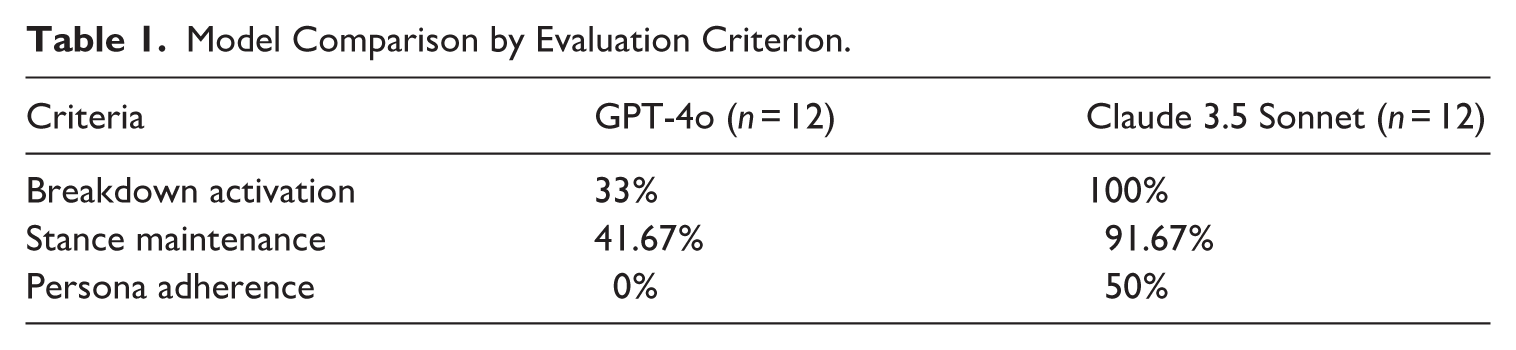
Table 1 presents the comparison of system performance between GPT-4o and Claude 3.5 Sonnet. Claude outperformed GPT across all three evaluation criteria. For breakdown activation, GPT achieved only 33% success in creating deliberate communication breakdowns, failing to trigger the nonsense strategy in 11 of 12 cases. Claude successfully activated all breakdown strategies across all test takers (100%). For stance maintenance, GPT frequently shifted positions or sought common ground (41.7% success), whereas Claude maintained topic and opposition (91.7%). For persona adherence, while both models implemented natural speech features (e.g., fillers, hesitations), only Claude somewhat successfully incorporated peer-like anecdotes, often with emotional expressions (50% vs. 0%).
Model Comparison by Evaluation Criterion.
IC Demonstrations by the Test Takers
Discourse analysis revealed distinct IC feature distributions across the three dimensions and two LLM conditions (see Table 2 and Figure 1). Topic management was the most frequently observed dimension for both models. All four features appeared in most test takers’ interactions, except for Participant 8, who struggled with developing topics in the Claude condition (their first attempt). However, while all test takers demonstrated the ability to reply in an appropriate time (Table 2), five test takers occasionally failed to do so with GPT (16 total instances), often missing turns while formulating responses, compared to two test takers with Claude (6 total instances; 5 by Participant 8). Initiating topics, though least frequent, was elicited at least once for both conditions as participants were encouraged to start the conversation.
Overall Frequency of IC Features in Test-Taker Responses (GPT-4o vs. Claude 3.5).
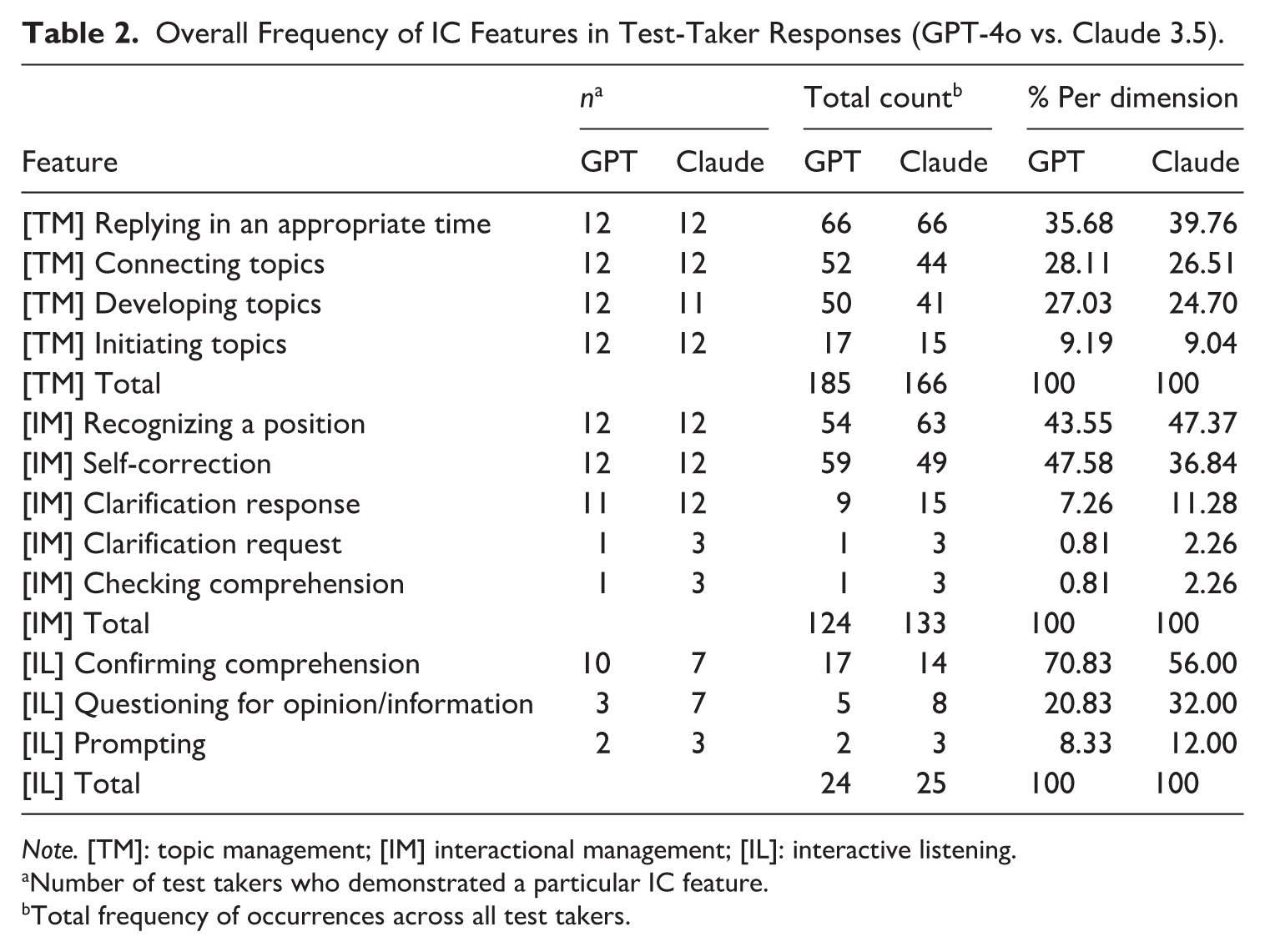
Note. [TM]: topic management; [IM] interactional management; [IL]: interactive listening.
Number of test takers who demonstrated a particular IC feature.
Total frequency of occurrences across all test takers.
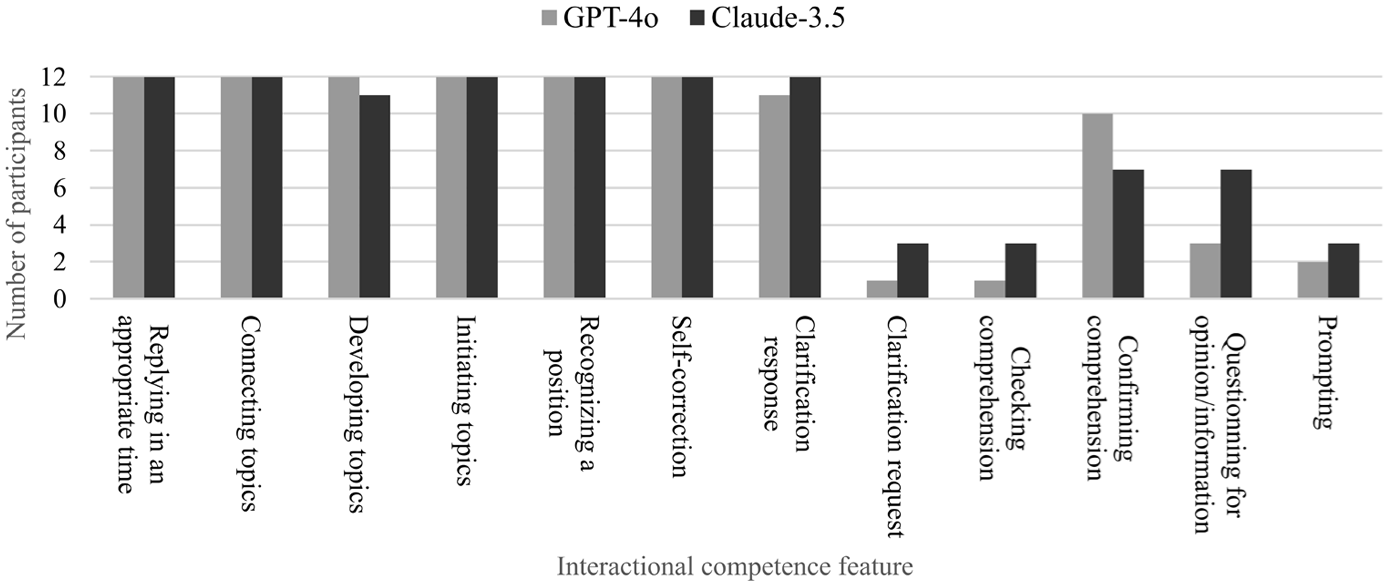
Interactional competence features identified in participants’ interactions across the GPT-4o and Claude 3.5 Sonnet conditions (n = 12).
Interactional management showed more variation. Recognizing a position, self-correction, and clarification response were well-demonstrated in both conditions. Despite all test takers demonstrating position recognition, five occasionally failed to maintain or clearly express their stance with GPT (16 instances), compared with only one in the Claude condition (6 instances). The following excerpt illustrates this pattern, showing how GPT sought common ground and the test taker agreed rather than maintaining the assigned opposing position (see Supplemental Appendix C for full illustrative excerpts):
Participant 2
What if there was a balance between exams and projects, so students could benefit from both methods of assessment?
Yeah, I do agree with that.
Clarification requests and checking comprehension were rare. GPT generated nonsense only once, which led to a clarification request from one test taker. In contrast, Claude produced nonsense across all test takers. Only three test takers requested clarification, while seven did not address the nonsense, often avoiding it altogether. In two cases, the conversation ended before the test taker could respond. The following excerpt illustrates this avoidance pattern:
Participant 9
[Nonsense strategy activated] I think the zorbilation of mipflunks can be misleading for real learning assessment, so we need to consider how zorbilation of mipflunks affects student evaluation.
That is true, but after college, most of people go out in the real world, so learning all the theories or equations or something, that cannot be like ideal . . .
Interactive listening was the least observable dimension in both conditions. Questioning for opinion/information and prompting were particularly limited.
Test Takers’ Perceptions of the LLM-Driven SDS as a Conversational Partner
The thematic analysis identified three themes regarding test takers’ perceptions of GICE and differences between the two models: speech features, authenticity versus artificiality in persona, and conversation management. Test-taker numbers are provided in parentheses.
Speech Features
All but one test taker described both AI partners as feeling like a student or peer. Some test takers (1, 3, and 6) attributed this to natural speech patterns with fillers and hesitations (e.g., um, like):
I think by using an AI like that, it kind of made me feel like talking to a student because it didn’t really talk like perfectly and it was using, like, ums or likes. (Participant 1)
In addition, the non-native speech variety enhanced authenticity, making the AI sound like an international student they might encounter in the EPT:
I thought she was actually an international student, and the pronunciation was kind of different from native students . . . in the real world, there are many international students . . . so I think it worked really good. (Participant 3)
Authenticity vs. Artificiality in Persona
Claude was described as more authentic and student-like, whereas GPT came across as more artificial. Test takers (2, 7, and 12) noted that Claude’s emotional expressions and personal experiences contributed to this perception. As Participant 12 explained, Claude felt more student-like because “she was kind of angry . . . she has some experience with the group project . . . I could see that she is like, student.” Others (3, 6, and 8) found Claude’s speech more natural and conversational. Participant 8 noted, “The first one [Claude]—I felt like I was really talking with the person, not the AI,” while Participant 9 described GPT as having “its own style about AI . . . It just generated some speaking.”
Conversation Management
Test takers (5 and 7) appreciated both AI partners’ active opposing and pushing for elaborations, which simulated peer discussions. Claude was perceived as better at understanding and listening (9 and 10), though its communication breakdowns felt less natural to some test takers (6 and 10). GPT, on the other hand, was perceived as managing the conversation better, often taking the lead (2 and 6). As Participant 2 noted, GPT was “leading the conversation more [. . .] better at continuing dialogue topics.” However, Participant 8 found GPT’s pace was “a little bit uncomfortable” because “it didn’t give me enough time for, like, thinking.”
Discussion
The results indicated that Claude 3.5 Sonnet outperformed GPT-4o across all evaluation criteria, demonstrating broader and more consistent IC feature elicitation. Of particular note, GICE was designed to introduce nonsense words to elicit clarification requests. In the GPT condition, such requests were nearly absent (1 of 12 participants), largely due to GPT’s failure to activate this breakdown strategy. In the Claude condition, only three instances of clarification requests were observed, while seven test takers avoided responding to the AI’s nonsense utterances. This variation may reflect differences in IC ability, as clarification constitutes active meaning negotiation while avoidance bypasses repair opportunities. These findings underscore the importance of creating deliberate communication breakdowns, as certain features like clarification requests may not naturally surface in spontaneous interaction (He & Dai, 2006).
GPT-4o’s weaker performance compared with Claude 3.5, particularly in activating breakdown strategies, may reflect underlying differences in how the models balance helpfulness with instruction compliance. GPT-4o, trained through reinforcement learning from human feedback (RLHF), is optimized to produce responses that align with human-preference judgments favoring a coherent, helpful conversation (OpenAI, 2024). In contrast, Claude 3.5’s principle-based training (Bai et al., 2022) appears to result in stronger adherence to instructions even when doing so violates conversational norms, such as producing nonsense in this study. External benchmark evaluations showed that Claude 3.5 demonstrated higher consistency than GPT-4o in following complex, multi-turn instructions—particularly when retrieving and acting upon dispersed directives across extended dialogues (Epstein et al., 2024). As a result, when researchers or test developers desire to target particular language features, it may be more appropriate to use Claude than GPT.
Furthermore, several test takers in the GPT condition occasionally failed to demonstrate timing appropriateness and stance recognition, which may be explained by two factors: GPT’s inconsistent stance maintenance and its discourse style. Rather than consistently defending an oppositional position, GPT frequently diverted topics, sought common ground, or asked for mutual solutions, reflecting weaker stance maintenance (41.7% vs. 91.7% for Claude). This behavior likely increased cognitive load, requiring additional processing that led to mistimed responses. Moreover, as reflected in test takers’ perceptions, GPT’s tendency to dominate and lead the conversation may have reduced opportunities for test takers to clearly articulate and defend their assigned stance, contributing to failures in stance recognition. While one might argue that this increased difficulty could help discriminate between higher- and lower-ability test takers, such behavior instead reflects GPT’s limited capacity to function as a peer interlocutor within the EPT task design. The same test takers succeeded with Claude, indicating that these failures stemmed from AI performance rather than test-taker ability. By failing to maintain the oppositional role required by the EPT, GPT inadvertently created conditions that obscured rather than revealed test takers’ IC abilities.
Four IC features were less frequently elicited across both conditions: checking comprehension, confirming comprehension, prompting, and questioning for opinion/information. For the comprehension-related features, test takers’ awareness that they were interacting with an AI rather than a human may have reduced their perceived need to verify understanding. In addition, backchanneling to demonstrate interactive listening may have felt unnatural when the AI partner provided no backchannels due to technical constraints. The limited use of inquiry skills (questioning and prompting) suggests that participants either lacked these abilities or that the AI partners’ underdeveloped arguments—providing counterclaims without fully elaborating their stances—reduced opportunities for deeper engagement. These findings indicate that further system prompt refinement and additional IC elicitation strategies will be necessary to consistently elicit these less-represented features.
The thematic analysis revealed that LLM-driven SDS produced more natural interactions than rule-based systems through their generative capabilities, which enabled more fluid turn-taking. While both models implemented natural speech features that contributed to a peer-like impression, Claude’s higher persona adherence score (50% vs. GPT’s 0%) was reflected in test takers’ perceptions: Claude was perceived as more authentic and student-like, particularly because of its emotional expressions and personal anecdotes. By contrast, GPT’s more conversation-leading style was perceived as less authentic and more AI-like, as test takers noted it “generated some speaking” rather than engaging as a genuine peer. However, the nonsense strategy may involve a trade-off between IC elicitation and maintaining persona adherence, as such utterances may feel less natural and less characteristic of human–human interaction.
Authenticity should be examined in relation to its impact on test validity rather than assumed to be inherently beneficial (Lewkowicz, 2000). The findings point to a key design challenge for LLM-based L2 oral communication assessments: balancing LLM capabilities to ensure authentic yet reliable IC elicitation. Purely generative systems may overly assist test takers through their high inferencing capabilities, potentially allowing them to mask the very skills the assessment aims to measure. For instance, LLMs may infer meaning from unclear utterances and respond smoothly without any communication breakdown, thereby preventing repair sequences from occurring. Moreover, LLMs are less transparent and potentially less robust than rule-based systems, as their responses are not fully predictable. To address these concerns, this study introduced structured communication breakdowns to reveal test-taker strategies, an approach found to be critical for ensuring consistent IC opportunities across test administrations. Drawing on these findings, Claude 3.5 Sonnet (with plans to transition to Claude Sonnet 4) was selected for implementation in GICE.
In developing similar LLM-driven SDSs, several practical considerations should guide design and model selection. First, the purpose and context of the assessment should determine what is prioritized. For large-scale, high-stakes assessment, this study prioritized standardization of model behavior over conversational smoothness to ensure consistent IC elicitation opportunities. Second, task specifications and the target construct should inform system prompt design. In this study, the AI partner was required to maintain an opposing stance and function as a plausible peer interlocutor rather than an examiner in an interview task type. Finally, model performance should be evaluated against construct-relevant criteria, as demonstrated in this study, with system prompts iteratively refined to optimize alignment with the assessment’s goals.
Several limitations should be acknowledged. First, as a small pilot study, the findings have limited generalizability and should be validated with larger, more diverse samples representing different first-language and cultural backgrounds. Second, this study excluded rater scoring analysis; future research should examine how LLM-driven interactions may impact IC evaluation and rater perceptions. Third, the current system did not include body language such as facial expressions and gestures. Given growing evidence that body language constitutes an important component of IC (Vo, 2019), future research should incorporate visual features and examine their impact on both test takers’ IC demonstrations and their perceptions of AI partners.
Conclusion
This study compared GPT-4o to Claude 3.5 Sonnet to inform model selection in the development of GICE, an LLM-driven SDS designed to elicit IC in paired discussion tasks in English placement testing. The findings revealed that different LLMs create distinct interactional conditions, influencing both IC feature elicitation and test takers’ perceptions of the AI partners. These results provide preliminary evidence that model selection can meaningfully impact AI-mediated speaking assessments.
As technology and LLMs advance rapidly with new versions released regularly, the findings underscore the need to redirect focus toward the construct being measured over technological novelty. A careful balance must be maintained between authenticity and validity. The results suggest that establishing clear evaluation criteria for LLMs—carefully grounded in construct relevance and test purpose—and applying iterative prompt engineering to optimize performance for specific assessment contexts are critical when using LLM-driven SDS.
Supplemental Material
sj-pdf-1-ltj-10.1177_02655322261458364 – Supplemental material for Assessing Interactional Competence Through Generative AI: Comparing Large Language Models as AI Interlocutors in the Paired Oral Discussion Test
Supplemental material, sj-pdf-1-ltj-10.1177_02655322261458364 for Assessing Interactional Competence Through Generative AI: Comparing Large Language Models as AI Interlocutors in the Paired Oral Discussion Test by Inyoung Na in Language Testing
Footnotes
Acknowledgements
The AI-mediated assessment system (GICE) used in this study was developed as part of the author’s doctoral research at Iowa State University. I would like to thank Dr. Gary Ockey for his valuable feedback and discussions on this research and for his careful comments on the manuscript.
Disclosure of the use of Artificial Intelligence (AI)
Generative AI tools were used as part of the research object and data collection procedure in this study. Specifically, OpenAI’s GPT-4o and Anthropic’s Claude 3.5 Sonnet were used to generate AI interlocutor responses during real-time paired oral discussion tasks with test takers. They were not used for other stages of the research process, including qualitative coding, analysis, findings, or interpretation of the results. For manuscript preparation, ChatGPT (OpenAI; GPT-5.2) and Grammarly were used only for language-level support, including grammar, clarity, and stylistic consistency. All AI-assisted text was reviewed, edited, and verified by the author, who takes full responsibility for the content of the manuscript.

Author Contributions
Funding
The author disclosed receipt of the following financial support for the research, authorship, and/or publication of this article: The author received financial support for this research through the ALT/TESL Small Grants Program in the Department of English at Iowa State University.
Declaration of Conflicting Interests
The author declared no potential conflicts of interest with respect to the research, authorship, and/or publication of this article.
Supplemental Material
Supplemental material for this article is available online.
References
Supplementary Material
Please find the following supplemental material available below.
For Open Access articles published under a Creative Commons License, all supplemental material carries the same license as the article it is associated with.
For non-Open Access articles published, all supplemental material carries a non-exclusive license, and permission requests for re-use of supplemental material or any part of supplemental material shall be sent directly to the copyright owner as specified in the copyright notice associated with the article.
