Abstract
Traditional approaches to standardized assessment are underpinned by the assumption that between-assessor variation in delivery can effectively be eliminated. However, fine-grained analyses of the administration of such assessments (e.g. Maynard and Marlaire, 1992) have established that significant subtle interactional variations occur even in procedures with regimented protocols, and that such variations can demonstrably affect examinee performance. In this article we draw upon the Vygotskian thinking that underpins dynamic assessment (DA) to posit that these spontaneous variations may provide clinically relevant information about an examinee’s learning potential. To illustrate this possibility, we apply the methodology of conversation analysis to examine a real-life picture-naming task involving a child with autism. Complex interactional processes above and beyond what might be assumed to occur during assessment are identified. In interpreting these as significant for a deeper understanding of the child’s profile of abilities, we argue that there is clinical value in empirically re-examining routine assessment from alternative methodological perspectives.
Keywords
I Introduction
Assessment is a fundamental component of practice in speech and language therapy (SLT). Depending upon the nature of an individual’s difficulties and the information required about them, there are various established ways in which assessment can be conducted with children with speech, language and communication disorders. In spite of the breadth of available approaches there is, however, a fundamental assumption that underpins traditional forms of assessment practice regardless of whether a child is observed, an informal assessment completed or a standardized test administered. This assumption is that assessment outputs can subsequently be reported as valid ‘snapshots’ of a child’s individual functioning and/or competence at that particular point in time.
On the one hand, this assumption may appear unremarkable given that a central component of SLT practice is the description of within-client variables and functioning (Hasson and Joffe, 2007). However, whilst assessment outputs are typically presented as being solely representative of examinee ability, the processes through which they are administered must almost always involve both a child and an examiner engaging in dyadic social interaction of some description (notable exceptions include computer-administered tasks and observation through one-way mirrors, although even these activities have to be introduced somehow and, moreover, occur within specific social contexts). There may therefore be dissonance between how the findings of many assessments are reported and the practices through which they are obtained (i.e. in interactive procedures inevitably involving individuals other than the examinees).
One assessment format that is particularly indebted to the above assumption is the formal, standardized test with a prescriptive administration protocol. Such procedures – which we will refer to as ‘static standardized assessments’ (SSAs) – are used by many speech and language therapists in everyday practice (Hasson and Botting, 2010), and are developed with explicit focus on designing protocols and materials to nullify the influence of factors other than a child’s individual functioning, including interactional biases, on assessment outcome. Indeed, in the professional and research literatures, SSAs are typically positioned as being ‘instruments’ or ‘tools’, with administration consistently presented as an interactionally ‘neutral’ endeavour that is impervious to examiner influence (or indeed examinee contribution, other than via responses to specific stimuli). Protocols are explicitly designed to mitigate interactional variation and thereby elicit the same response on stimulus items regardless of administrator, with students taught to aim for this ideal in their own practice. Additionally, it is considered legitimate to report SSA findings without reference to details of their administration. For instance, when publishing research there is no requirement to document the fidelity of adherence to SSA protocol as when, for example, reporting a controlled evaluation of an intervention approach.
These assumptions regarding SSA administration and the nature of the findings that they generate are reflected in recent discussions within SLT about dynamic assessment (DA). DA represents an alternative assessment paradigm, which aims to capture a child’s learning potential rather than their individual, static performance and/or competence. This is achieved in part by administrators embarking upon controlled and strategic modification of the testing interaction itself. Evidently, such an endeavour represents a different approach on philosophical, theoretical and practical levels from that advocated in SSA, where protocols are typically established in order to avoid interactional variation and administrator influence. We will return to DA subsequently, but relevant to the current discussion is that DA’s alternative orientation has highlighted the aforementioned assumptions about the lack of interactional variation during traditional forms of assessment. For example, Law and Camilleri (2007) describe a fundamental assumption in DA as being that ‘functioning needs to be evaluated in an interactive context’ (p. 271), thereby intimating that comparable evaluation in SSA does not involve such a context. This is articulated more strongly by Hasson and Joffe (2007), who suggest that ‘the interaction between tester and client is altered in DA so that the tester can act as a mediator to facilitate learning, rather than assess objectively without influencing the procedure’ (p. 14, our emphasis).
However, whilst SSAs can be – and usually are – presented as objective procedures in which administrators adopt a ‘neutral’ interactional role and thereby avoid influencing examinees, in reality it is unlikely that these assumptions are anything other than simplified and idealized. This is because they overlook the intrinsically and unavoidably social and interactive nature of all professional practices, including assessment administration. Instead, if it is accepted that assessment is as much a form of interaction as any other joint communication activity between two (or more) people, then it follows that the interactional processes involved in their administration should be neither overlooked nor understated. In support of this position are studies where the administration of clinical assessments across SLT, psychology and education contexts is the focus of enquiry, as opposed to assessment findings per se (e.g. Antaki et al., 2000; Antaki and Rapley, 1996; Beeke et al., 2008; Marlaire and Maynard, 1990; Maynard and Marlaire, 1992). Such research typically applies the approach of conversation analysis (CA) (see Hutchby and Wooffitt, 2008), a well-established qualitative methodology involving turn-by-turn micro-analysis of real-life social interaction, to examine video recordings of assessments administered across various settings. By producing detailed moment-by-moment transcriptions of the interactions through which assessments play out, every micro-contribution (verbal and often non-verbal) of the examiner and the examinee can be considered in terms of their consequences for the unfolding procedure.
These studies are important because they provide an alternative perspective on assessments that is at odds with some of the assumptions that are routinely made about their delivery. Indeed, their findings have established that SSAs cannot legitimately be conceptualized as interactionally neutral, and similarly raise questions about whether it could ever be possible for an examiner to avoid influencing an unfolding test interaction regardless of how carefully he or she adheres to protocol. For example, Maynard and Marlaire (1992) analysed video recordings of SSA administration in educational settings. Using CA, the authors demonstrated that SSAs unfold in a distinctive three-part sequence of turns where the examiner first initiates a response from the participant (sometimes verbally, but sometimes not: e.g. by turning a page of a stimulus manual), the examinee produces a response, and then the examiner provides some form of minimal acknowledgement before moving to the next item. Micro-analysis of these sequences demonstrated additional layers of interactional complexity, evident through two varying aspects of their organization. First, examinees did not always produce simple responses in the second position of the sequence; whilst they did in some cases, at other times they produced answer turns with varying prosody and pace, false starts and reformulations, or accompanied with gestures. The authors argued that these subtle differences enabled examinees to communicate additional information to the examiners about their responses, such as indicating them to be ‘tentative’ answers or even ‘best guesses’. Second, although the examiners broadly followed assessment protocol by providing only minimal acknowledgements (e.g. ‘ok’) following responses, these similarly varied in terms of timing, prosody, and accompanying micro-gestures such as nods. The authors demonstrated that examinees could be seen to monitor and then respond to these subtle differences by modifying or reformulating current and/or subsequent responses. In common with most SSAs, the protocols for the examined assessments specifically prohibited the provision of feedback to examinees during testing, yet based upon the presented analysis it was argued that in fact the examiners consistently, albeit inadvertently, did so through such variations. Hence, from a CA perspective examinee performance was in part collaboratively mediated, despite these being strictly administered SSAs that purport to profile individual functioning alone.
Within the CA and critical psychology literatures, these findings have sometimes been used to question the validity of SSAs and dyadic assessment more generally (see Rapley, 2004). Such arguments are well rehearsed and our aim is not to repeat them here. Instead, rather than focusing on whether interactional variation undermines the core principles of assessment, we posit that its presence (as identified using an approach such as CA) may represent a source of rich, potentially clinically relevant information that might otherwise be overlooked. To develop this argument further, let us return to the socio-interactionist thinking that underpins DA.
The DA paradigm builds upon the Vygotskian notion of a zone of proximal development (ZPD), defined as being the difference between a child’s performance as an individual and when supported by a more knowledgeable or experienced other (Vygotsky, 1978). In contrast to SSA where the target construct for measurement is the child’s individual performance alone, DA seeks to evaluate a child’s ZPD by focusing upon the processes they use to solve problems, the extent to which these can be scaffolded (see Bruner, 1986) by the examiner, and therefore the child’s learning potential and readiness to improve. Hasson and Joffe (2007) cite Campione (1989) to suggest that, in DA, this alternative focus is operationalized through modifying two aspects of the testing process: the nature of the assessment tasks and, crucially for our arguments, the nature of the interaction through which the tasks are delivered.
The conjecture that learning potential could in part be evaluated through strategically varying interaction during assessment has an intriguing implication given the established presence of naturally occurring variations during SSA. Admittedly, interactional variations during DA are likely – at least in some respects – to be qualitatively different from those occurring naturally in SSA given the former’s orientation towards ‘controlled’ variation; see, for instance, Glaspey and Stoel-Gammon’s (2007) application of a pre-defined hierarchy of examiner cues in a dynamic phonology assessment. However, as some level of spontaneous, dynamic variation appears to occur within even the most high-fidelity implementations of SSA, and this variation has been shown to scaffold examinee performance and thereby generate (at least partially) collaboratively mediated responses (Maynard and Marlaire, 1992), a clinically relevant possibility emerges: that scrutiny of the subtle interactional variations occurring during SSA administration, particularly in terms of their consequences for examinee performance, may provide information about examinees’ learning potential and readiness to change, as is argued in DA to be available through explicit modification of assessment interaction.
This possibility is explored in this article with reference to an illustrative SSA administered by the first author with a child diagnosed with autism. The specific aims of this article are:
to provide a detailed description of interaction during a relatively routine SSA procedure, in order to illustrate the dynamic variations that occur during assessment;
to analyse the consequences of notable interactional phenomena for the process of this assessment and the child’s actual responses; and
to examine the potential clinical applicability of these findings for deepening understanding of the child’s abilities and potential.
The first two aims will be directly addressed through the subsequent analysis, whilst the third will primarily be explored in the discussion.
II Participants, data collection and analysis method
The following data were collected within a project examining semantics and social interaction in children with autism. Four children, aged between 8 and 12 years and with an autism diagnosis verified using a teacher-completed childhood autism rating scale (CARS; Schopler et al., 1988), were recruited from a specialist school. Each child was video recorded twice-weekly for three weeks, in 40–45-minute sessions conducted with the first author in a quiet room at school. Sessions were divided into two: each child completed a battery of standardized and bespoke static assessments of vocabulary and semantic ability, before participating in free play with the first author for the remainder of the session. The project was approved prior to recruitment by a Departmental Research Ethics Review Panel. The children’s guardians provided informed consent prior to inclusion. Participating children were required to assent prior to each session.
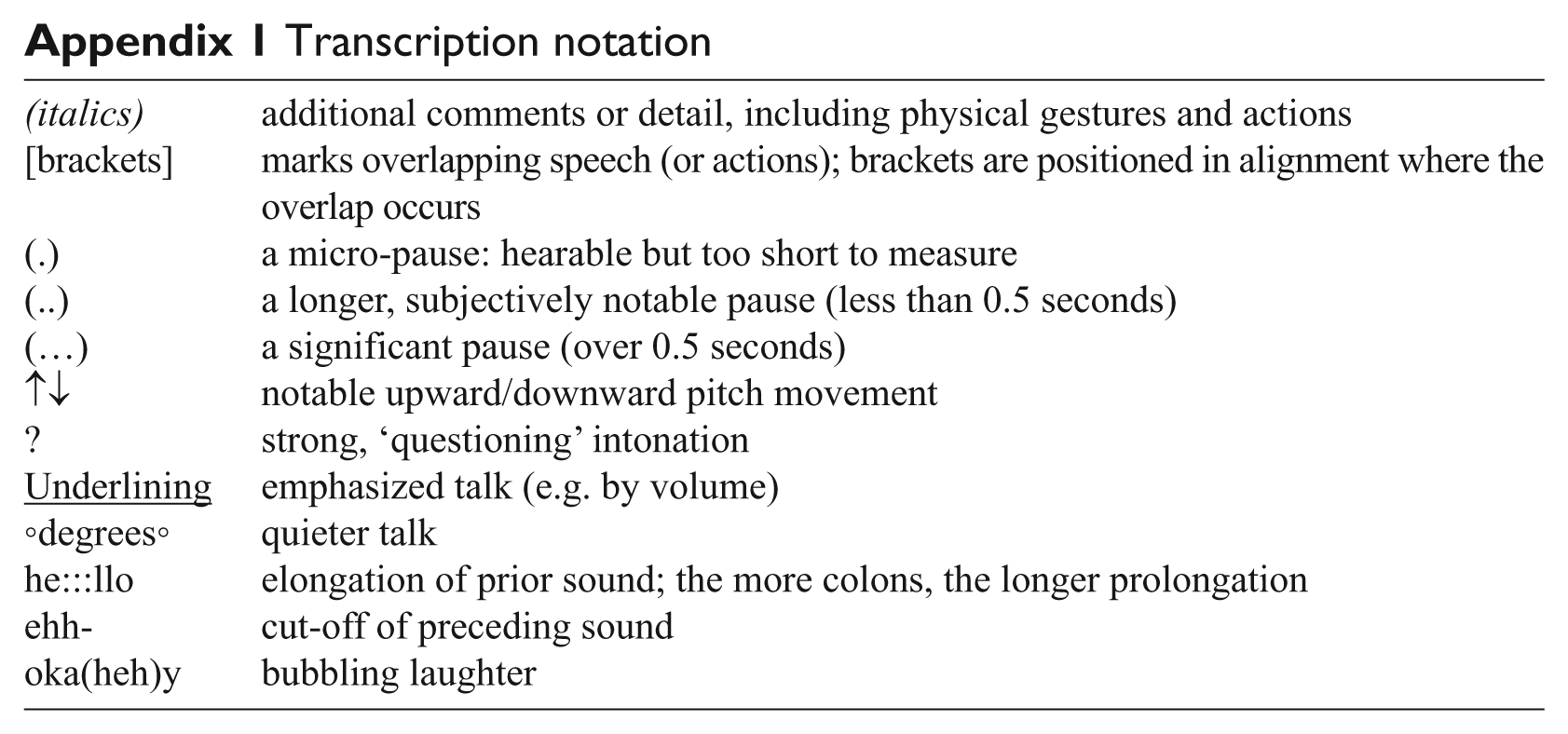
Following each session, recordings were transcribed using the Jefferson notation, simplified here for readability (see Appendix 1). In CA, through the process of detailed turn-by-turn transcription, the analyst is drawn to consider the sequential organization of the stretch of talk under examination. A key argument within the paradigm is that it is important to examine even short sequences of real interactions in such detail, because the actual mechanics of how the participants collaboratively organize these will otherwise be overlooked.
This article focuses on the administration of one SSA, the picture-naming subtest of the Assessment of Comprehension and Expression (ACE-N; Adams et al., 2001), with one child. The ACE-N involves the sequential presentation of 25 drawings, which the child is required to name. For newcomers to CA, the selection of such a limited dataset may raise concerns about the robustness of the arguments presented in this article. However, recall that our aim is to examine the contribution of CA to the formulation of a deeper understanding of a child’s profile of abilities. Therefore, examining a single dyad alone as an illustrative case example will provide a more complete elucidation of this aim than, for example, presenting incomplete fragments of assessments administered across several children or by several therapists.
The presented assessment episode was selected from the wider corpus because on analysis it was found to contain particularly clear examples of interactional variation, rendering it well suited for use in this article as an illustrative case example. However, such a rationale for sampling does raise the possibility that this particular assessment episode is not representative of ‘typical’ SSAs. Our contention would be that the variations identified in the subsequent analysis are likely to represent commonly occurring practices used by therapists to preserve client engagement and therapeutic alliance during routine work (including clinical assessment), and we invite readers to reflect upon their experiences of assessment administration in light of our data. We also maintain that the analytic approach demonstrated in this article would still generate comparably rich and clinically relevant findings when applied to SSAs in which the interactional variations are more subtle, such as those reported by Maynard and Marlaire (1992).
The participants in the assessment interaction are as follows. The first author, marked A in the transcript, is male, was aged 29;4 at time of data collection and is a qualified speech and language therapist with clinical experience of working with children with autism and delivering SSAs. William, marked W in the transcript, is male and was aged 11;1. His CARS score was 33, indicating mild-to-moderate autism. At 8;3 William was assessed as having a full scale IQ of 67, meaning that he also has a mild-to-moderate intellectual disability. This ACE-N was the first activity of William’s second session. According to responses recorded during the assessment, William’s performance was significantly poor for a child of his age. Of the 25 items, William was recorded as naming 14 correctly (standard score 6; 95% CI 3–9; percentile rank 9) and six inaccurately, with no response recorded for the remaining five.
III Results and analysis
The following section adopts the standard CA approach to the presentation of findings. Hence, we will proceed iteratively by providing a transcribed section of assessment interaction, describing it in fine-grained turn-by-turn detail in order to elucidate subtle but meaningful variations in the interactional contexts in which key responses were produced, and then interpreting these variations in terms of our stated aims.
We begin this process at the commencement of the ACE-N. The participants are seated at right angles, with W facing the camera and A sitting to his left hand side. Following discussion of a recent television programme, A presents the stimulus book to W by placing it on the table.
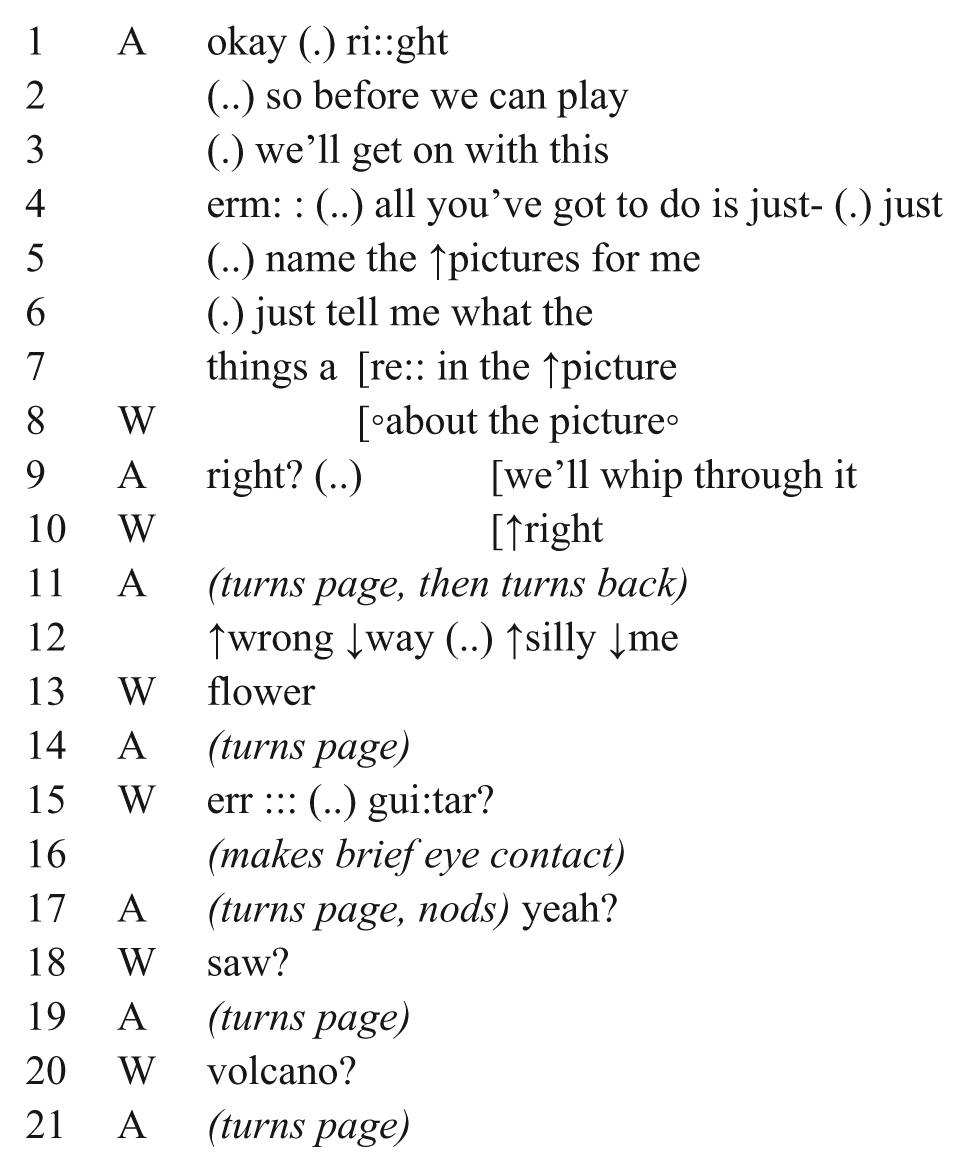
The assessment process begins with A explaining the test procedure to W. Following A’s turn in lines 1 to 7, W demonstrates understanding of the assessment process by completing A’s sentence in line 7, and then by producing “right” following A’s check of understanding in line 9. The participants then move into the assessment proper from line 11, when A turns the page of the stimulus book onto the practice item (albeit erroneously at first: see 11 and 12).
As stated above, the first aim of this article is to illustrate the dynamic, naturally occurring interactional variation that has been demonstrated to occur during SSAs. In these terms, analysis of the subsequent interaction indicates that there is such variation even within the first few stimulus items, where two distinct varieties of ‘correct answer’ interactional sequence are evident. The first can be seen around W’s productions of “flower” (lines 11 to 14), “saw” and “volcano” (18 to 20): here, W’s naming immediately follows presentation of the stimulus, and following W’s response A turns to the next item. A does not verbally evaluate or acknowledge W’s answers, with his page-turning instead performing the dual action of indicating receipt of a response whilst prompting the next. Accordingly, W aligns with these actions by naming on cue without indicating A’s lack of verbal acknowledgement to be problematic. Conversely, the second variety of correct answer sequence is evident between lines 14 and 17, where W names ‘guitar’. Here, W’s response (lines 15 and 16) is designed differently to those in 13, 18 and 20: his answer is not immediate and follows a hedging “err” and a pause, and he then makes a brief flash of eye contact with A. Subsequently, A does not merely page-turn to prompt W’s next response, but produces an additional explicit (albeit minimal) feedback turn (“yeah?”) in line 17.
The interactional differences between this sequence and the others are of interest for three reasons. First, by designing his turn in a subtly different way, W signals to A that his response is to be heard as different to the others. Second, W’s eye contact following his answer suggests that he is monitoring A’s subsequent receipt turn, as did Maynard and Marlaire’s (1992) examinees following similarly ‘tentative’ responses. As will be discussed further, the presence of such interactionally coordinated behaviour from W is notable both in terms of its implications for his approach to this specific task, but also his social abilities more broadly. Third, the inherently social and dyadic nature of assessment interaction is highlighted by the expanded evaluation from A (a nod and verbal acknowledgement), which follows W’s tentative answer but is not present after the other, more immediate responses.
The presence of two types of answering sequence indicates that this administration of the ACE-N is already more interactionally complex than typical descriptions of SSA would suggest. Indeed, these phenomena recurred throughout the assessment, with the level of variation in W’s answers and A’s responses becoming increasingly amplified. Extract 2 follows immediately from extract 1 with the presentation of the fourth item, ‘pineapple’.
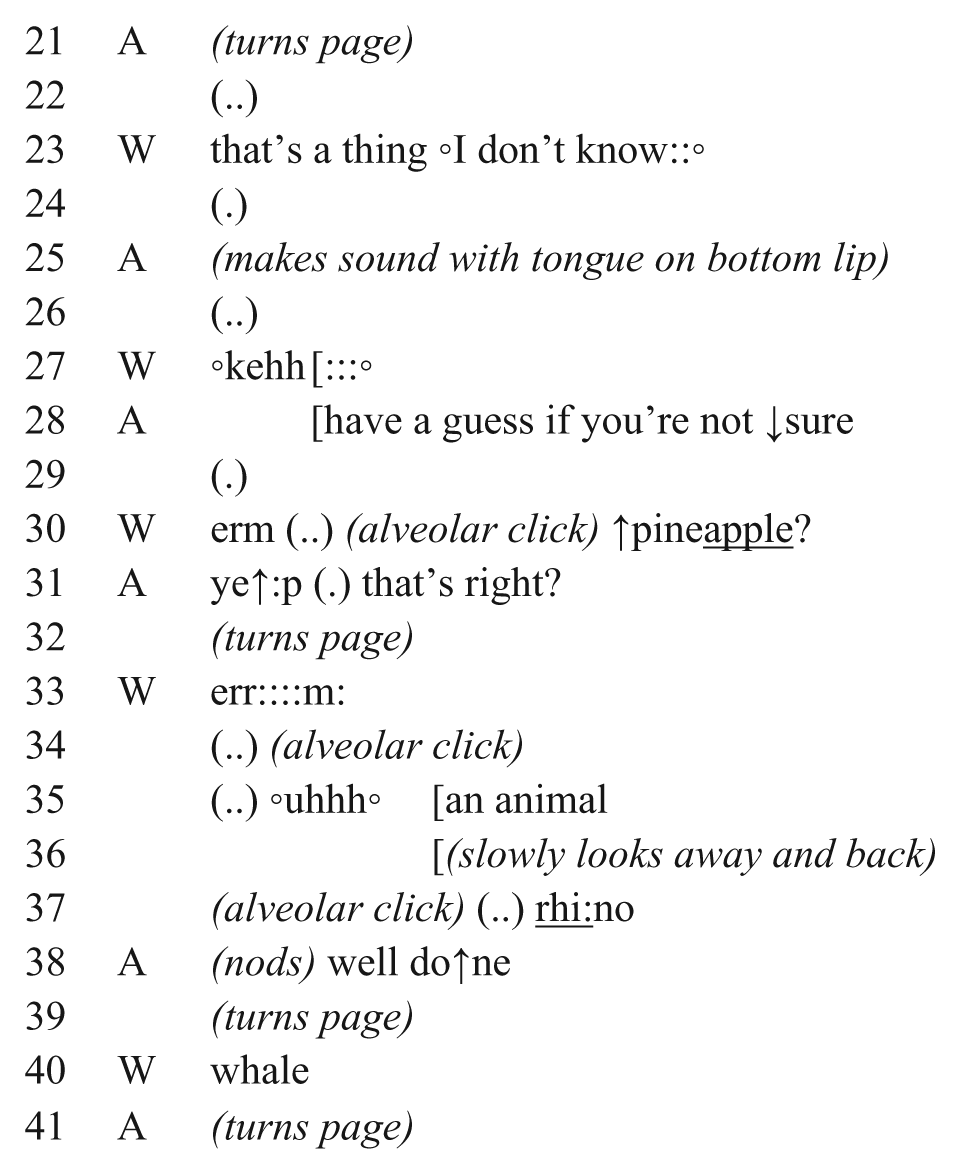
Following A’s page turn, W pauses before explicitly reporting difficulty in providing an answer (line 23), pausing again, and then producing a sigh (27). Accordingly, A’s understanding of W’s turn as indicating an incipient problem related to answering is reflected by the subsequent suggestion that W should “have a guess”. After another delay, hedge and click, W provides a correct response but with characteristically ‘guess’-sounding rapid upward intonation, termed ‘try-marking’ by Sacks and Schegloff (1979). A then spontaneously breaks from ACE-N protocol to provide an explicit evaluation (“that’s right”) in line 31.
Such explicit examiner feedback is notable, especially as it was not present in extract 1. There are two features of the preceding sequence that may account for why A provided such a turn in this position. First, W’s answer followed A establishing that a ‘guess’ would represent a sufficient response (line 28). In such a context, W’s subsequent correct naming may have been notable, as reflected by A’s provision of explicit evaluation. Second, W displayed considerable difficulty in providing an answer at all, which A’s “that’s right” may in part reflect.
During the subsequent item (‘rhino’) another complex sequence unfolds. W again marks his response as tentative by pausing (line 33), clicking (34), and then providing a super-ordinate response (“an animal”) whilst shifting eye gaze away from the test material (35). Although this could have been accepted as W’s answer, A does not provide a receipt or turn to the next stimulus, and therefore does not treat it as final. W’s shifting eye gaze may have influenced this, since A receives W’s second answer in line 36 (produced at a higher volume with no such shift) as definitive (see 38 and 39). From a clinical perspective, the presence of such sophisticated and coordinated micro-social behaviours again has intriguing implications for understanding W’s social and interactional abilities more broadly.
After a page turn, the participants move to the next test item, ‘whale’, in lines 39 to 41. In contrast to the extended sequences that characterized the previous items, here W responds without hesitation and A then provides no response or feedback. Such dynamic shifts in interaction between test items indicate that both participants are mutually treating some as different to others. The potential implications of these systematic and jointly mediated variations are even more striking when examined in the context of W’s responses that are produced with tentative design features but, unlike those above, are also incorrect. Consider extract 3, where ‘barrel’ is the target.
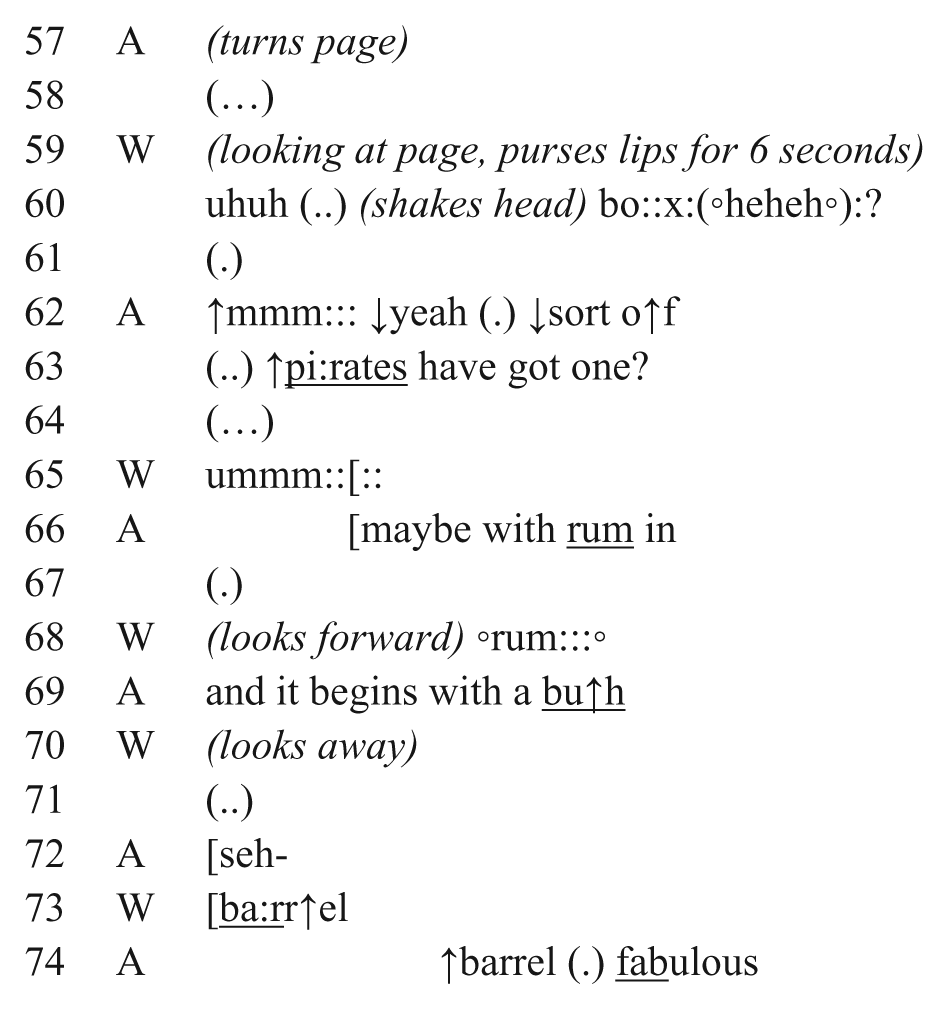
Following the page turn in line 57, W’s response is delayed and then marked as tentative via a pursed-lip facial expression in line 59. After another pause, W finally produces an incorrect response (“box”) with try-marked upward intonation. However, unlike his responses in extracts 1 and 2, W slowly shakes his head while doing so, with his production of “box” giving way to a bubble of laughter.
W’s head-shaking and laughter arguably mark the answer to A as more inadequate than those preceding, thereby indirectly demonstrating W’s own meta-awareness of its inaccuracy. Regardless, ‘box’ was recorded on the ACE-N score-sheet as W’s response to this item. However, as can be seen in the extract, this is not the whole story: A subsequently does not interactionally treat “box” as final, despite recording it as such. A’s feedback in line 62 is ambivalent: whilst prefaced with “mmm” and thereby signalling agreement that W’s response was inadequate, A’s evaluation of W’s answer as “sort of ” correct also avoids the delicate matter of explicitly describing it otherwise. A’s ambivalent feedback, produced with a slightly rising intonation, does not close this answering sequence and retains A’s position as speaker, as indicated by W not taking a turn during the subsequent pause. A then spontaneously produces a series of cues between lines 63 and 69, following which W produces the target response.
Clearly, such an extended sequence breaches ACE-N protocol, and more generally is incongruent with typical assumptions regarding SSA administration. At the same time however, drawing on the Vygotskian roots of DA this section of interaction could be interpreted as a naturally occurring cue hierarchy that successfully scaffolds W’s production of a target. Therefore, examining such a sequence could provide an opportunity to consider W’s learning potential with relation to this task, even though this is not the construct being measured by the SSA itself. We will discuss the clinical implications of this conjecture in the subsequent discussion but, returning to the analysis, the CA approach we adopt also enables useful consideration of why A might have cued in this way at this point in the assessment, given that such a sequence does not follow any other item. Evidence from elsewhere suggests that a critical factor might have been the strength of W’s marking of “box” as inadequate. Compare the above against extract 4 from later in the assessment: here, W also produces a tentative incorrect answer (“telescope” for ‘microscope’) but without additional features such as head-shaking and laughter. As with other tentative responses, A then produces a minimal acknowledgement. However, he also accepts the answer as final without initiating a cueing hierarchy:
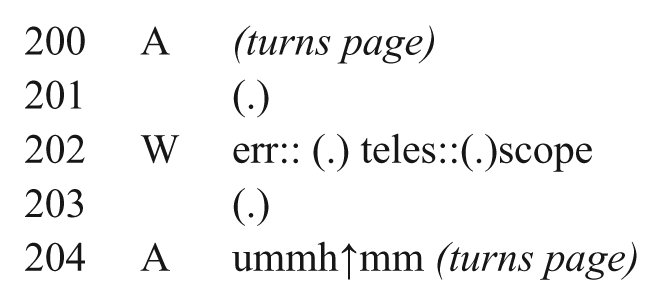
W’s design of certain responses to be heard as knowingly inadequate, rather than whether the responses are actually correct, therefore appears to primarily influence the subsequent interactional sequence. From a CA perspective, this is unsurprising. By marking responses as inadequate W makes relevant numerous socially delicate issues, including his adequacy as an answerer more generally. A’s downgraded evaluation in line 62, followed by his sustained attempts to cue an ‘adequate’ response, are elegantly designed to address these matters. Conversely, incorrect responses produced without any demonstration of inadequacy generate no such issues, allowing the assessment interaction to proceed.
Such nuanced management of interactional matters during a purportedly ‘neutral’ SSA further illustrates the complex variations that can occur during assessment administration above and beyond adhering to task protocol. However, in this article’s aims as stated above we also suggested that the direct influence of such variation on W’s performance would be examined. In these terms, extract 5 demonstrates an instance where such dynamic interactional variation apparently leads to A’s direct collaboration in W’s production of an incorrect answer (“coffee mug” for ‘flask’).
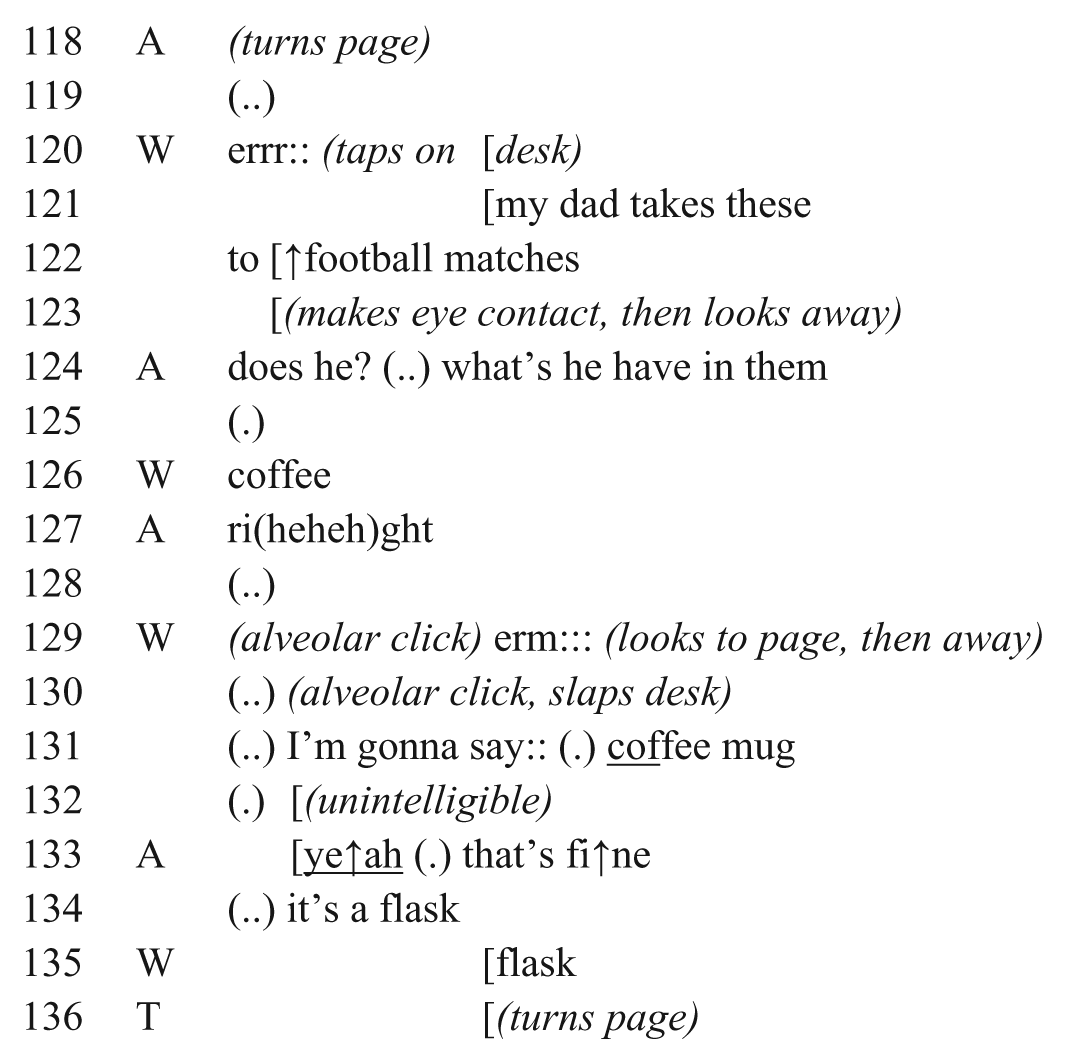
Following A’s page turn, W begins a tentative response turn by pausing, hedging and subsequently tapping on the desk. Then, in lines 120 to 122, W defers answering by revealing experiential knowledge about the stimulus item: that his father takes flasks to football matches. A accepts this as the live topic in 124, initiating an expansion sequence (see Schegloff, 2007) pertaining to what W’s father keeps therein. This sequence is closed by A in line 127 via minimal evaluation of W’s response of “coffee”, which effects a return back to the assessment.
On one level, A’s acceptance of a new topic for expansion is an unremarkable, everyday interactional occurrence. However, such an occurrence in more notable during an SSA, the protocol of which does not accommodate personal discussions about stimulus items. Moreover, this was not an isolated incident: during this assessment, W’s responses to three other test items contained such off-task talk, and in each of these instances T accepted, expanded and then closed W’s new topics in a manner comparable to the above. However, in extract 5 there is a unique consequence of W and T’s off-task sequence, which can be seen as the participants re-engage in assessment from line 128. Following more tentative gestures in 128 to 130, W finally produces a response to the stimulus item (“coffee mug”). A evaluates this as merely “fine” but also treats it as final, reflected by his subsequent provision of a model response and page turn.
There are two significant features of W’s response in line 131. First, unlike other answers it is prefaced with “I’m gonna say.” This arguably constructs it as a final ‘best guess’, a reading supported by A’s response in 133 and 134. Second, W’s best guess answer of “coffee mug” is subsequent to the coffee-related sequence in lines 121 to 127. It is striking that W should produce “coffee mug” following A’s inadvertent demonstration in 127 that “coffee” (line 126) is relevant to the current stimulus item. Hence, in this instance, “coffee mug” appears to represent the collaborative product of both participants’ engagement in an off-task sequence, rather than reflecting W’s individual ability to name a flask. This is significant given that the ACE-N, as with other SSAs, is solely concerned with the latter. But in addition, such a collaboratively mediated response provides direct evidence of W’s ability (albeit in a specific interactional context) to compensate for his possible lexical limitations by co-opting linguistic resources made interactionally available by interlocutors (see Perkins, 2007). Notably, the other three instances in which W initiated talk about test items differ from the above in that item-specific details (such as “coffee” in extract 5) did not feature in the subsequent off-task sequence. It is therefore unsurprising that for the three stimulus items in question, W ultimately did not produce a response (even an incorrect one) as he does here.
IV Discussion and conclusion
In the above analysis, a detailed moment-by-moment account of a routine SSA has been presented. Our findings demonstrate the presence of interactional complexity during this administration of the ACE-N above and beyond an examiner neutrally prompting an examinee to neutrally respond to stimulus items. Indeed, both participants can be seen to treat certain test items differently to others, as reflected by systematic variations in W’s responses and A’s receipt of these. Moreover, both participants at times broke from the assessment to engage in off-task interaction, which was not without consequence for W’s performance. We do not claim that either participant partook in these interactional sequences strategically, deliberately or consciously, but instead that such variation more broadly reflects the kind of rapid, collaborative and jointly-mediated activity that characterizes social interaction in any context.
However, whilst our findings are consistent with previous CA work regarding the interactional processes through which assessment is administered, the fundamental aim of this article was to consider whether such analysis can provide useful clinical information about individual examinees. As initially indicated in the analysis above, we would argue this to be the case. More specifically, whilst the ACE-N exists only to provide a static assessment of a child’s picture-naming ability, the above interactional examination of its administration provides additional rich findings about W’s language abilities, language learning skills and associated compensatory and problem-solving strategies, as well as his social interaction abilities more broadly. These domains will now be discussed in turn.
Regarding W’s language profile, the reported analysis provides particularly useful information at points where W makes errors. For example, consider his incorrect response of “coffee mug” for ‘flask’ in extract 5. From W’s response sheet alone, it might be tempting to suggest that this represents a form of semantic error. However, examining “coffee mug” in interactional context indicates that W reveals a level of meta-linguistic awareness about its incorrectness through the way in which he designs his answer turn. Indeed, W’s repeated design of responses to be heard as tentative and/or inadequate indicates frequent reflection on answer accuracy throughout the assessment, and only once (in extract 4) does W produce an ‘incorrect answer’ without such additional features. In itself, such meta-awareness represents a key finding to steer any potential intervention programme. Crucially though, W also appears to derive “coffee mug” from contexts established in previous turns. In doing so, he spontaneously, implicitly and actively deploys an interactional problem-solving strategy in order to generate a ‘missing’ target.
Drawing on the Vygotskian underpinnings of DA, we suggest that what occurs in extract 5 could therefore be described as a naturally occurring implicit form of scaffolding. Conversely, in extract 3, A spontaneously instigates an explicit form of scaffolding via a series of cues, to which W demonstrates responsiveness by accurately producing the target.
Hence, these sequences can be interpreted as providing initial indicators of W’s problem solving and readiness to change, therefore speaking of his lexical abilities and language learning style more broadly. To some extent, interactional analysis of any stretch of adult–child talk with a focus on the child’s language may reveal comparable practices that are interpretable as naturally occurring scaffolding, and therefore be applicable to assessment. However, we argue that the secondary analysis of SSAs in these terms has particular value because these require participants to jointly undertake relatively repetitive and restricted language-focused tasks (e.g. the sequential naming of 25 drawings), the spontaneous occurrence of which would be almost unthinkable during other interactions. Hence, in addition to producing their standard outputs SSAs provide an interactional context in which a child’s language and learning strategies are likely to be rendered transparent to some degree.
But in addition, the moment-by-moment examination of the organization of this assessment interaction invariably generates knowledge about more than a child’s language and language learning. Indeed, the above analyses also provide rich information about W’s profile of social abilities, a construct not targeted at all by the ACE-N. Up to now we have not focused on W’s autism diagnosis, and that therefore by definition he would be expected to present with deficits in social interaction. Indeed, W demonstrated considerable social difficulties at the time of data collection, including a strong tendency to dominate conversations around personal topics of pre-occupation (for instance, specific science fiction television programmes). Yet here it is evident that in some ways, W is socially nuanced: he designs his talk to perform complex and multifaceted actions, and likewise appropriately monitors and adapts to A’s responses. Moreover, by doing so he indicates an appreciation of the negative social connotations and practical consequences potentially associated with poor assessment performance (for more on this, see Antaki and Rapley, 1996). As we have argued elsewhere (Muskett et al., 2010), such a profile of micro-social competency in spite of broader social difficulties demonstrates the complexity of the problems associated with autism. From a clinical perspective, W’s interactional behaviours during this assessment provide clues about factors that may or may not contribute to his social presentation, thereby indicating areas where there could be potential for therapeutic change.
Of course though, the above findings are not just about W, but also A, the first author of this article, and the therapeutic relationship that developed between him and W during their six weeks together. Cross-professional applications of discursive methodologies such as CA (e.g. Taylor and White, 2000) have indicated that detailed examination of clinical interactions can provide valuable opportunities for clinicians to empirically, systematically and rigorously reflect upon their work with clients. Given the complex nature of social interaction, this does not necessarily mean that A should (or even could) use findings to ‘improve’ his administration of assessments. Instead, interactional analysis can illuminate complex features of professional practice, clinical interactions and therapeutic relationships, providing space to reflect upon their often challenging implications. Hence, the message to practitioners and researchers is that the re-examination of taken-for-granted elements of assessment practice can unlock rich and otherwise overlooked information about examinees’ abilities, therapeutic relationships and everyday clinical methods, thereby facilitating assessment procedures, clinician reflection, and the development of reflexive perspectives on taken-for-granted assumptions that underpin cornerstones of professional practice.
Footnotes
Appendix 1 Transcription notation
| (italics) | additional comments or detail, including physical gestures and actions |
| [brackets] | marks overlapping speech (or actions); brackets are positioned in alignment where the overlap occurs |
| (.) | a micro-pause: hearable but too short to measure |
| (..) | a longer, subjectively notable pause (less than 0.5 seconds) |
| (…) | a significant pause (over 0.5 seconds) |
| ↑↓ | notable upward/downward pitch movement |
| ? | strong, ‘questioning’ intonation |
|
|
emphasized talk (e.g. by volume) |
| °degrees° | quieter talk |
| he:::llo | elongation of prior sound; the more colons, the longer prolongation |
| ehh- | cut-off of preceding sound |
| oka(heh)y | bubbling laughter |