







Abstract
Pre-school education has been greatly expanded in the United Kingdom in the last two decades and further expansion is planned. Its provision allows parents to take up employment thus increasing family incomes and it is expected to narrow the gap between socially disadvantaged children and their peers. The latter is important as studies have shown that many children start school with poor language skills which threaten their attainment. Studies of the effects of pre-school education on the progress of disadvantaged children have shown inconsistent results and nurseries have been criticised by Ofsted for failing to prepare children for school entry. Nurseries and their staff have been found to vary in quality and in the level of qualifications they have. The provision of evidence based programmes which nursery staff may be trained to use may represent one means of improving their ability and improving the outcomes for pre-school children. We report an effectiveness study of Early Talk Boost a programme for use by nursery staff to improve language skills in three year olds. Nurseries were randomly assigned to use the programme or to act as waiting controls (who received the intervention in the following term). Children were assessed before and three months later after the completion of the programme. The progress of treated and control children differed significantly. Age equivalent scores showed treated children had gained 4.93 months, control children had gained only 2.33 months. We conclude that Early Talk Boost can be effective in advancing the language skills of socially disadvantaged children and improve their school readiness.
I Introduction
Children from poor families are more likely to meet adversity in life. They weigh less when born and are more vulnerable to infectious diseases and other health risks. Children who are eligible for free school meals perform more poorly than other children at school and their lack of skills affects their future employment and incomes (for a summary, see Bradshaw and Main, 2016). These disadvantages emerge early in life and are particularly evident in children’s language development. In their well-known study of US children, Hart and Risley (1995) found that the vocabularies of three year olds varied with social class. Children of professional parents had larger vocabularies than children with working class parents and knew more than twice as many words as children from families in receipt of welfare. Their parents talked to them more and in a more conversational style than working class parents whose style was more directive. These differences appear even earlier in life. Feinstein (2003) used data on children’s intellectual, emotional and personal development from the British cohort study to show a social gradient at 22 months of age which predicted educational achievement at 26 years of age. He argued that interventions after children enter school may be too late to reverse these differences.
Given these early differences it is not surprising that children who experience social deprivation have language delays when they start school. Blanden and Machin (2010) found that the vocabulary of five year old children from families in the top fifth of incomes were more than a year ahead of those in the bottom fifth. Locke et al. (2002) found that children in nurseries in a socially deprived area had language delays and Alsford et al. (2016) found that differences in the language development of children in school reception classes were closely related to the nature of the schools’ catchment area. These results suggest that many children from socially deprived homes have had insufficient exposure to language prior to starting school. Moreover attending school may not enable them to catch up. Law et al. (2011) found language delays in children throughout the primary school age range and Locke and Ginsborg (2003) who retested the children in Locke et al. (2002) and found that a majority fell further behind their expected level of development. Alsford et al. (2016) found that children with English as a first language and with English as an additional language (EAL) who had language delays at school entry made progress in their reception classes but failed to do so in year1 of school.
A variety of initiatives have been introduced in an effort to improve the chances of children with language delays. Nationally, the pupil premium, introduced in 2011 gives schools extra funding for each pupil who is eligible for free school meals. The aim is to reduce the attainment gap between advantaged and disadvantaged children. Alsford et al. (2016) found a close relationship between the levels of language ability in the children they tested and the extra funding their schools received from the pupil premium and suggested that it be used to improve the children’s communication skills.
Locally many speech and language therapy services conduct language groups in nurseries and in the early years of school. These target children identified as having delayed language due to social deprivation or children with EAL. Several studies have examined the effects of these groups. Lee and Pring (2016) evaluated Talk Boost an intervention designed for use by teachers and teaching assistants in schools. Groups of four children selected by their teachers are treated for half an hour three times a week for 10 weeks. Children in reception classes and in year 1 and 2 (ages 4–6) made significantly greater progress than controls. Dockrell et al. (2010) showed that a brief (7.5 hours) intervention (Talking Time) helped children between 3 to 5 years of age. The study included children with English as their first language and with EAL.
The most extensive research in this area has been of the Nuffield Early Language Intervention. The programme is longer than those above beginning with 10 weeks in nurseries and a further 20 weeks during the children’s reception year at school. Fricke et al. (2013) found that children described as having weak oral language skills who attended the programme had a significant advantage over controls and that this was maintained at an assessment six months after completing the programme. In a further study where teaching staff were less closely supported by researchers, Fricke et al. (2017) continued to find positive results though less strongly than in the initial investigation. Despite these positive results, the initial weeks of the intervention in nurseries alone was not effective, a result replicated by Haley et al. (2017). This may mean that the nursery stage is ineffective or that the overall effect is cumulative and requires the full 30 hour programme. Fricke et al. (2017) compared the full 30 week version with a 20 week version in reception classes only. Children receiving the longer version did better but not significantly so. The uncertainty about the benefits of language interventions in nursery classes requires further study and is the focus of the present investigation.
Similar uncertainty surrounds the benefits of pre-school education. This has been extensively researched in the United States with positive results (for summaries, see Barnett, 2011; Yoshikawa et al., 2013). Children who attend show a mean gain of about four months with substantially greater gains in some programmes. The advantage diminishes but remains in the early school years and gains are greater for disadvantaged children.
In the UK the Effectiveness of Pre-School Education Project (EPPE; for a summary, see Sylva et al., 2004) found positive effects on children’s academic outcomes where nurseries were of good quality. These were seen as the children started school and at the end of key stages 1 (age 7 years) and 2 (age 11 years). Benefits for children from disadvantaged homes were stronger when they attended nurseries with children with varied social backgrounds rather than those where the majority were disadvantaged.
Contrasting results were found in a retrospective study of children who took up free nursery places after these were introduced in 1998 (Blanden et al., 2016). The policy of offering 15 free hours of nursery attendance (to be extended to 30 hours in 2017) was intended to benefit disadvantaged children. The study found the majority of places were taken by families already paying for places. Disadvantaged children who took up places had a small but significant advantage when they started school but almost no advantage at age 7 years and none at 11 years.
Blanden et al. suggest that the differences in their findings and those of the EPPE may be due to the nurseries involved. Maintained nurseries (by local authorities) are free, normally attached to schools and must have qualified teachers and teaching assistants. The free places they studied were in private, voluntary and independent (PVI) nurseries who may have less qualified staff. The report on early years by Ofsted (2015, Office of Standards in Education which inspects educational provision in the UK) found that disadvantaged children made good progress when attending school nurseries. Mathers and Smees (2014) found that PVI nurseries in deprived areas were of poor quality and identified the quality of interactions and support for language and learning as key areas of weakness. They suggested that funding from the pupil premium, recently introduced in early years, be used to improve quality by recruiting staff with degree or equivalent qualifications. These findings support the plausible suggestion that staff qualifications influence children’s outcomes. However, a recent study by Blanden et al. (2017) found that neither staff qualifications nor Ofsted ratings of nurseries predicted children’s subsequent progress in school. The authors acknowledge the need to discover what does distinguish a good nursery and suggest the use of randomized control trials to do so.
The present article assesses the effects of Early Talk Boost (ETB), a language stimulation programme developed by I CAN (the Children’s Communication Charity) for use in nurseries. It does so by comparing the progress of children who attended nurseries where the programme was offered with control nurseries who offered their normal provision. ETB has been developed using similar principles to those in Talk Boost a language programme which has been shown to help children with delayed language in the early years of school (Lee and Pring, 2016). As described above, this evaluation takes place amid concerns that many children start school with language delays and uncertainty about the variable quality of nursery schools and their ability to help children improve their communication skills. It does so in a context of recent and future cuts in early years funding (Stewart and Obolenskaya, 2015, Action for Children, 2016) and extension of free provision from 15 to 30 hours which appears to favour quantity over improving quality. Our study follows the suggestion by Yoshikawa et al. (2013) that quality may be improved in nurseries by providing intensive programmes which staff are trained to use and the view of Blanden et al. (2017) that randomized control trials provide a means of identifying factors that distinguish quality pre-school education.
II Method
1 Design
Nurseries in socially deprived areas in the North and North East of England were contacted and asked to participate in the evaluation. A high proportion of children in these areas were expected to have delayed language development. A between nurseries pre-test, post-test design was used. Nurseries were randomly assigned to receive the intervention or to act as waiting controls. The latter carried out the programme when this evaluation was completed. The children were assessed before and after the intervention using the Pre-School Language Scale (PLS-4; Zimmerman et al., 2009). The PLS is a standardized assessment of language for pre-school children which gives separate scores for their auditory (receptive) and expressive abilities. The pre- and post-intervention assessments were carried out by speech and language therapists and speech and language therapy students under supervision who were blind to whether children had been in treated or control nurseries. Pre- and post-assessments for individual children were carried out by different assessors.
2 Participants
Early-years practitioners in each of the participating nurseries were asked to select up to eight children who they felt had delayed language development. This approach was used, rather than asking speech and language therapists to screen the children as it reflects the likely procedure in the future use of the intervention.
Initially 18 nurseries volunteered to participate. Difficulties in scheduling the programme led to three nurseries dropping out. The remainder were randomly assigned, eight to run the programme and seven to act as waiting controls. Eighty five children were included in the study; 45 in nurseries where the intervention was carried out and 40 in control nurseries. Four children had special educational needs, one in an intervention nursery and three in control nurseries. One child in an intervention nursery had English as an additional language; all the other children in both intervention and control nurseries had English as their first language.
3 Materials
ETB was designed by specialist speech and language therapists and an experienced nursery teacher. It combines methods known to support language development and experience of working with pre-school children. It is designed for groups of six to eight children. Each session is supported by a range of materials, a planning board, song cards, toys and a series of eight story books. A manual for practitioners is included and there are materials for a workshop to be held with parents. The underlying philosophy is that children learn language by being actively involved in activities that they enjoy and that they learn from responsive adults who can model language for them.
The intervention supports a range of basic skills. These are grouped under three headings which are addressed in sequence during the intervention: attention and listening, learning words and building sentences.
Attending and listening are central to early language development. Helping children to learn these skills gives a foundation for the rest of the intervention (Gilmore and Vance, 2007). Children with delayed language development are often identified by their poorly developed vocabularies. Unlike typically developing children, they may find it difficult to learn words by hearing them in context. Further definition and explanation of new words and opportunities to use them will help them and can be provided by adults (Justice et al., 2005). ETB emphasizes the learning of key words and uses a system of colour coding of parts of sentences to help children use them in longer sentences and to develop their awareness of word order. As children’s ability and confidence improve they are asked to share their experiences by telling stories about everyday familiar situations and to retell stories they have heard. The story books were created specifically for ETB. They tell a series of stories about the same characters so providing a familiar context for the children and reinforce the main objectives of ETB – ability to listen attentively, to learn key words and to use them in simple sentence structures leading on to the development of narrative skills. The books are then given to parents who are encouraged to use them at home. Songs and rhymes are also used to improve phonic skills. These abilities help children to meet the requirements of the English Early Years Foundation Stage curriculum in this area.
4 Training
Practitioners in the participating nurseries attended a training course given by the first author and members of the ETB development team (speech and language therapists and teacher). The training raises awareness of children’s language development and increase practitioners ability to identify children with delayed language. Once achieved it moves on to introduce ETB and its accompanying materials and to demonstrate the intervention sessions and the practitioner’s role in carrying them out. The training was delivered over the course of a day (4 hours) and all practitioners who delivered the intervention were required to attend. Practitioners in the waiting control settings received the training after the reassessment of children at T2. The parent training consists of a 1 hour workshop introducing key features of contingent behaviour when looking at books (Colmar, 2014).
5 Procedure
Local Authority Early Years teams who had previously worked with I CAN were contacted and asked to recruit early years settings in areas of social deprivation to participate. Participating nurseries were required to make time for staff to attend training (4 hours) and for the intervention to be conducted as required (3 times per week for 9 weeks). The speech and language therapists and students who assessed the children were recruited through the Royal College of Speech and Language Therapists (the professional body representing Speech and Language Therapists in the UK) and via universities. Assessors were blind to the assignment of the children.
Information about the project and the children to be targeted was given to settings. In agreeing to participate settings agreed that time would be made available to assess the children, train staff and deliver the intervention. Settings were randomly allocated to an intervention or a control group. Inclusion and exclusion criteria were given in written and verbal form to the settings to aid the selection of suitable children. Early Years practitioners identified appropriate children and consent was obtained from parents of the children selected. Children received the intervention in groups of 5–7. Sessions lasted 20 minutes.
III Results
Data was available from eight nurseries where children received Early Talk Boost and from seven nurseries which acted as waiting controls (these carried out the intervention in the following school term).
Eighty-five children were assessed and reassessed after completing the intervention. Forty-five children were in treated nurseries (19 girls, 26 boys; mean age 42.40 months, SD 4.15) and 40 in control nurseries (16 girls, 24 boys, mean age 41.75 months, SD 3.67).
The PLS measures a child’s expressive and auditory (receptive) language skills. The test is standardized and scores can be converted to standard and percentile scores and the child’s language age (age equivalent score) can also be obtained.
A three-factor mixed analysis of variance was used to analyse the raw scores on the test. Type of nursery (intervention, control) was a between participant factor and time (pre- and post-intervention) and subtest (expressive and auditory) were within participant factors.
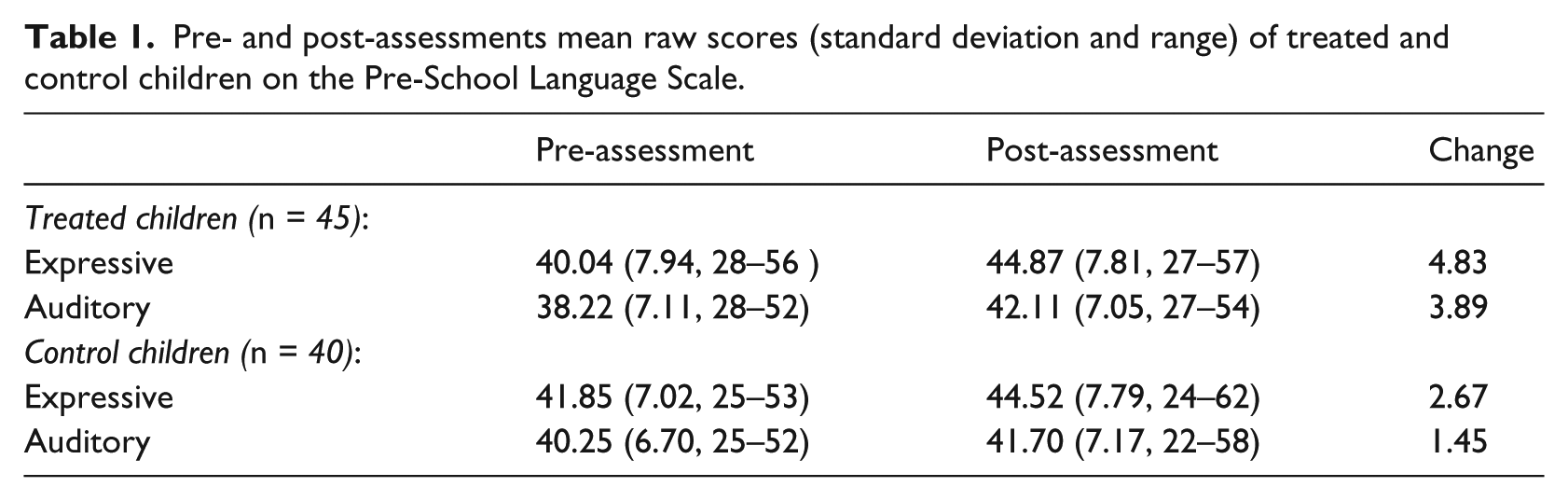
As expected the children improved over the 3 months of the experiment (F(1, 83) = 110.38, p < .001). This reflects the increasing age of the children and their general improvement while in nursery. The important result is the interaction between time and whether children were treated or not. This is significant (F(1, 83) = 14.09, p < .001, partial eta squared = 0.145). Table 1 shows that the treated children improved more on both the expressive and auditory scales. Although the changes and the advantage for treated children are numerically quite small they are highly significant and the effect size is large. Scores on the Expressive subtest were also found to be significantly higher than those on the Auditory subtest (F(1, 83) = 27.43, p < .001) and the interaction of subtest scores by time narrowly failed to reach significance (F(1, 83) = 3.63, p = .06).
Pre- and post-assessments mean raw scores (standard deviation and range) of treated and control children on the Pre-School Language Scale.
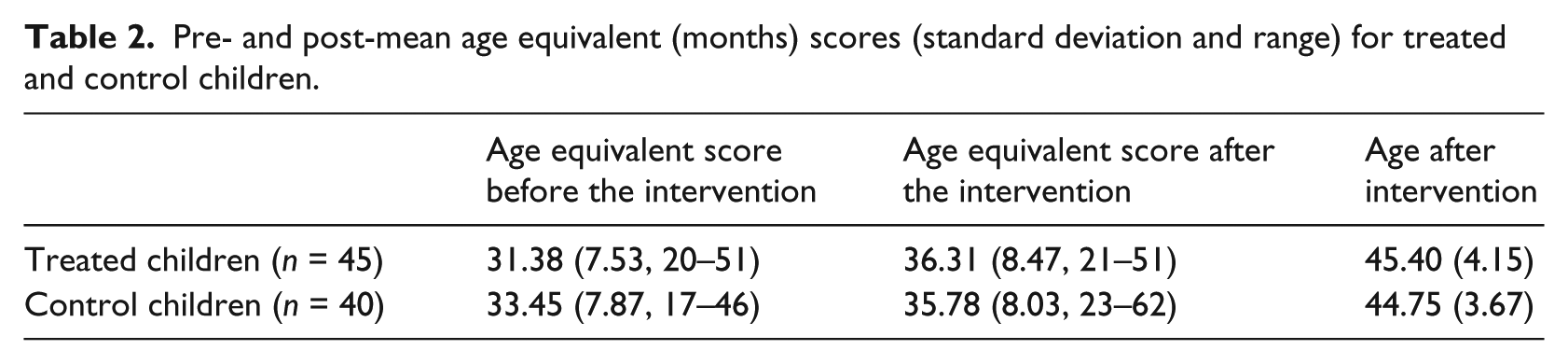
A clearer indication of the children’s progress is given by comparing age equivalent scores (see Table 2). A two-factor mixed analysis of variance with type of nursery (intervention, control) as a between participant factor and time (pre and post) as a within participant factor was used to analyse this data. Control children advanced by 2.33 months during the three month interval between assessments. The treated children advanced by 4.93 months. As with raw scores above the interaction between time and whether children were treated or not was significant (F(1, 83) = 7.46, p < .01, partial eta squared = 0.083). Again the result is highly significant with a medium effect size.
Pre- and post-mean age equivalent (months) scores (standard deviation and range) for treated and control children.
The children’s initial scores on the PLS varied. Forty nine children had scores that placed them in the bottom 10 percent of children for their age. The remaining children had higher scores and five had scores which placed them at or close to the expected mean score for their age. Since the primary purpose of the intervention is to help children with weak language skills, the presence of children with scores in the normal range may have influenced the outcome of the intervention. To examine this the analysis above was repeated on the two groups. The interaction between children’s assignment to intervention or to act as controls and time was significant for those in the bottom 10 percent (F(1, 47) = 5.61, p < .05; partial eta squared = 0.107) and for those with higher initial scores (F(1, 34) = 5.17, p < .05; partial eta squared = 0.132).
IV Discussion
These results show that Early Talk Boost had a beneficial effect on the children who received the intervention. Although the gains on the PLS raw scores are numerically quite small, the highly significant interaction and large effect size indicate a strong advantage for the treated children. This is more clearly shown by the analysis of the children’s age equivalent scores. Here the improvement by the control children was substantially less than the treated group of children and less also than the increase in their age during the course of the intervention. In contrast the treated children progressed by nearly five months, substantially more than the controls and more than the progress that might have been expected with their increasing age. These results are consistent with those for Talk Boost (Lee and Pring, 2016) a similar programme for children who are in the early school years. They also strengthen the evidence from other research (Dockrell et al., 2010; Fricke et al., 2013, 2017) that young children can benefit from attending groups which stimulate their language development and extends these results to younger children attending nurseries.
The procedure used here was similar to that which will be required in future use of the intervention. Early Years practitioners were trained to identify and select children with language delays and to carry out the intervention. This indirect approach to therapy in which speech and language therapists train other professionals to carry out an intervention is now quite common (Pring et al., 2012). Identifying language delays in such young children without a formal assessment is not straightforward particularly in nurseries in disadvantaged areas where a large proportion of the children may have delays. Although most of the children included here had substantially delayed language, some were less so and a few were close to the expected level for their age. The analysis indicated that both delayed and less delayed children improved after the intervention. This is consistent with the findings in studies in the United States which show that pre-school education can benefit children with different abilities (Yoshikawa et al., 2013). Future use of the programme will require nursery staff to select participating children without an assessment of their language ability and may result in similarly mixed groups. In view of the finding in Sylva et al. (2004) that disadvantaged children benefit from being in more socially diverse settings, this may not be a disadvantage.
It is likely that routine use of ETB in nurseries will include some variation in the procedures used in its administration and in the scheduling of sessions. In the present study we were unable to monitor whether the intervention was used consistently in different nurseries. Such measures of fidelity are desirable in intervention studies. That nurseries were impressed with the need to schedule the required number of sessions and that they undertook to do so as a condition of participation suggests that they would not readily depart from it. Equally the training given to participating staff and the prescriptive nature of ETB contribute to the consistency of its presentation. All told it is likely that any lack of fidelity in the present study is no greater and probably less than may occur in routine use of ETB and that our findings reflect the likely outcomes from that use.
The ETB programme is designed to include parental involvement. Parents of children who received ETB were given information about the programme and they took home the story books to read and discuss with their children. However, only 14 parents of children in the intervention groups were able to attend the training due to difficulties in finding convenient times for parents and members of the research team (with nurseries acting as intermediaries). This may mean that the present findings underestimate the full effect of the programme. It also suggests that nurseries using ETB be urged to ensure full parental training and engagement in the intervention. In an effort to address this an additional activity based workshop has been added to the final version of the intervention. An anecdotal finding from discussions with parents was that many of them were unaware that their children’s language was behind the expected levels for their ages.
Although these results are encouraging and suggest that the children are better placed to start school, we need to remain cautious in assessing their practical significance. First, as Table 2 shows the age equivalent scores for the children remain below their actual ages after the intervention. It is possible but unlikely that the level of their language is now commensurate with their other abilities. A non-verbal measure would give a clearer picture of the level of their language delay. A related problem is that we do not know whether the children will maintain their gains after the intervention. Of previous studies, only Fricke et al. (2013) carried out a maintenance assessment showing that treated children maintained their progress after six months. Their intervention was considerably longer than Early Talk Boost. Further information is required on the long term effects of brief interventions. For the above reasons it would be wise to assume that children who are as far behind in their language development as some of those reported here will need continuing help in order to catch up.
Ensuring that provision is effective in helping disadvantaged children is important given the intention to extend free provision to 30 hours per week in 2017. That entitlement to the extra hours requires that all parents should be in employment suggests that family income may be a higher priority for government than child disadvantage. A number of criticisms have been made of this expansion (see Johnes and Hutchison, 2016). Twin dangers are those found by Blanden et al. (2016) that places may be taken by parents who can afford to pay rather than parents of children with greater need and that expansion will occur primarily in nurseries of lower quality. More broadly there is concern that the funding which is frozen until 2020 will be inadequate to finance the intended number of places and will not allow the recruitment of more qualified staff or improve quality. Quantity appears to triumph over quality despite the fact that the EPPE project (Sylva et al., 2004) found that full time attendance gave no greater benefits than part time. The availability of programmes such as Early Talk Boost and the training of staff to use them offers one route to enhancing quality.
Footnotes
Declaration of conflicting interests
The author(s) declared the following potential conflicts of interest with respect to the research, authorship, and/or publication of this article: The first five authors are employed by I CAN (the Children’s Communication Charity) who designed and produce Early Talk Boost.
Funding
The author(s) disclosed receipt of the following financial support for the research, authorship, and/or publication of this article: We acknowledge and are grateful to UBS Optimus Foundation who provided funding for this research.