







Abstract
The power law is a fundamental scaling relationship in the dynamics of organisms and ecological systems. That cities exhibit this law with increasing returns to scale is an empirical finding reported by recent studies. I formulate a microeconomic model of urban systems that supports this evidence assuming a stochastic model, which is based on extreme value theory and random choice to describe all urban agents’ rational stochastic behavior and on Alonso’s urban economic principles. Thus, the observed superlinear increase in rents and wealth emerges, in addition to the classical scale economies, from individuals’ and firms’ behavior due to population diversity and size. A dynamic model of cities’ growth follows, allowing us to predict the expected evolution of urban organizations.
Introduction
A general law that governs the dynamics of all cities has existed in human geography since early evidence that cities comply with Zipf’s law was reported (see Gabaix, 1999). Recently another regularity has been postulated: the power law, whose consistence with Zipf’s law is open to debate.
In several papers West, Bettencourt, and colleagues (W-B papers; see Bettencourt et al., 2007, 2008) report studies of a number of cities across the developed world that support the argument that cities, similar to organisms in nature, consume and produce according to a power law with population N:
An interesting and relevant lesson from biology comes from the once enigmatic parameter δ in organisms (see West, 1999), empirically observed as a multiple of ¼ in almost all forms of life, defining metabolic rates (eg, rates of energy consumption), time scales (eg, lifespan and heart rate), and sizes (eg, aorta lengths and tree heights). A theoretical explanation emerged using fractal geometry and the fact that fractal structures at a microscale exhibit a common dimension determined by the size of the organism’s cells (West et al., 1999, 2001).
The evidence provided by W-B was obtained from the data of several urban indicators of American, European, and Chinese cities, revealing the statistically significant cross-sectional relationship between several indicators, denoted y, and population N over time t:
The evidence provided by the W-B studies directly motivates the question regarding whether the observed urban power law can be derived in a similar way to that for organisms from allometric—size and shape—relations. On this line of research, Bettencourt (2013) develops a first model using macroscale or aggregate relationships applied in physics to natural environments. Batty (2013) contributes to this model with an extension for a system of cities. The approach followed in this paper is different. I use microeconomic principles to formulate a theory of the microscopic social and economic behavior of all agents in a city, that is, at the individual level, including their interactions in all goods markets and their social life. By assuming that such microscale behavior is stochastic, a larger city offers better possibilities to match demand with supply, which leads to a higher average level of rents and welfare. This explains a factor for the emerging power law between both land prices and welfare, and population size. Then power laws combine two factors: economies of scale in the urban economy, which is the classical effect studied by economists; and the novel effect of the greater spectrum of opportunities offered for creativity and innovative production by larger and more diverse populations.
The theory of city dynamics proposed herein stands on one fundamental assumption: humans are rational beings facing stochastic information from the environment, which is modeled as if all agents in the city behave à la McFadden (Domencic and McFadden, 1975), maximizing a random utility or profit (see section 2), and all landowners maximize rents à la Alonso (1964), in a context where bids for land are also stochastic (Section 3). 1 Households’ maximization of utilities and firms’ maximization of profits are conditional on residence location, and the willingness to pay for locations is derived to represent the auction of urban land and properties that yield expected rents. It is precisely from the randomness of this optimizing behavior that the power law of rents and wealth with respect to population emerges, with an explanation for the scale parameter δ derived directly from the variance of the extreme value distribution (type II or Fréchet) that characterizes the stochastic distribution of bids in the auction of urban land. This model naturally yields a model of urban growth (see section 4) and therefore a model of relevant consequences for city dynamics. Additionally, under the weak assumption of nondecreasing scale economies in production and consumption, the scale parameter derived from agents’ heterogeneity supports—on its own —superlinear returns on the population scale, whereas scale economies—if any exist—are additional to the stochastic effect.
Agents’ stochastic behavior in urban systems
The complex behavior of agents in a city, including individuals’ socioeconomic activities and firms’ business activities, is the focus of this section, assuming that all agents have a known residence location or, more generally, that choices are conditional on the residence location. The fundamental assumption in this paper is that choices are made on the basis of the random utility model: that is, choices are stochastic. I support this assumption from the fact that individuals have a limited capacity to scan and analyze information, while the number of alternative options for each choice is large in a city. The literature on consumers’ psychology shows evidence that human capacity to process information in choice making is very limited, falling in the range of five to ten items of information, which motivated Miller’s (1956) ‘magical number seven +/− two’ (see also Malhotra, 1982). Empirical evidence supports that beyond this threshold consumers are overloaded with excessive information that deteriorates their best-choice process: failure to choose the best options increases with the overload. Thus, the set of options scanned and what information of each option is considered supports the assumption that the individual assessment of the options’ utilities is a random process. This random utility approach benefits from the significant literature on urban transport modeling, summarized, for example, by Ortúzar and Willumsen (2001) and Ben-Akiva and Lerman (1985).
In what follows human organization is described by the individual, the elemental agent who performa social and economic activities. Individuals are then grouped into households, defining the household agent who chooses a common location in the city. Firms can be modeled according to similar principles. In turn, households and firms define the set of social and economic activities available in the city. We assume that individuals maximize a random measure of satisfaction (utility or profit) under constrained resources. In this context we consider a large number of heterogeneous individuals who interact with activities, creating socioeconomic structures that emerge from their mutual social and economic interdependency and their satisfaction-maximizing behavior in a spatial context.
The Gumbel utility model of individuals’ behavior
The type-I Gumbel or double exponential df is
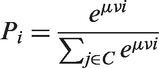
Another well-known Gumbel-based model is the nested logit model (with a similar closed-form probability function), which is of interest in this paper because of the hierarchical choice process considered next.
From individuals’ to households’ behavior
Each individual is assumed to choose, conditional on residential location, the optimal set of discrete activities and their locations, along with the required sets of consumption of goods and expenditure of time; to these choices, the individual allocates the limited income and time needed to maximize utility. This complex space of an individual’s options and the choice process is simplified as a hierarchical process of individuals’ choice making, which then aggregates up to the household aggregated utility as shown in figure 1.
Households individuals’ hierarchical choice process.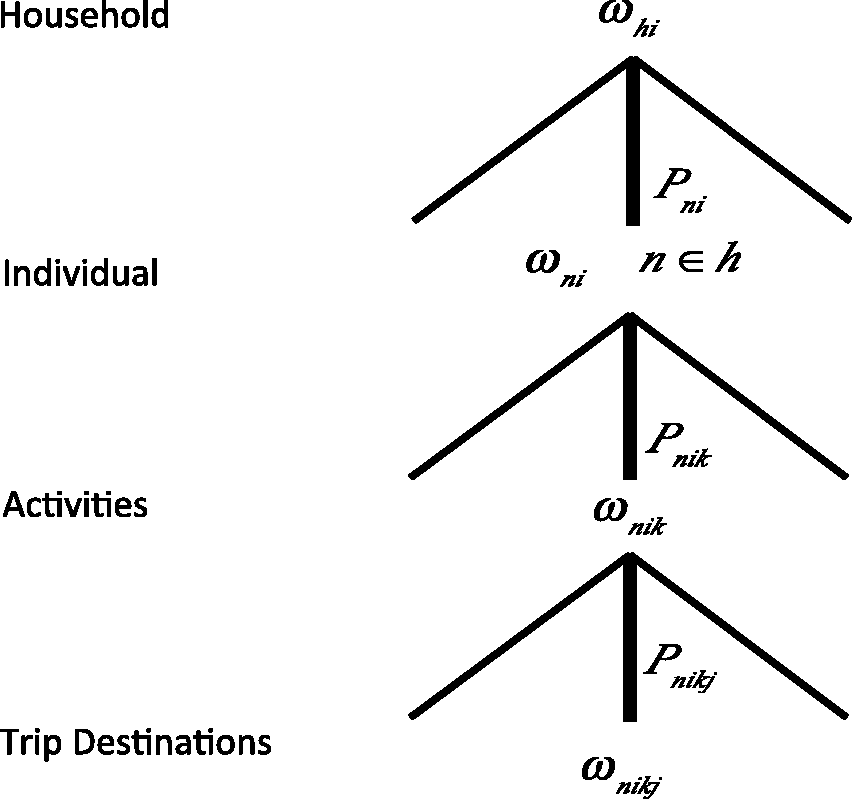
Consider an urban area partitioned into a set I of locations indexed by i, and consider one inhabitant indexed by
Under the assumption that rational agents choose among options that maximize their utility, we define
In this choice framework, a static equilibrium is attained in all markets in the urban system, yielding goods prices, labor wages, and transport times and costs that are inputs for the consumers’ estimation of utilities, which internalizes market signals to individuals’ utilities. Equilibrium prices are differentiated by spatial location according to transport costs that spatially differentiate otherwise nondifferentiated goods. Consumers’ utilities are also affected by travel times and costs, further differentiating consumption across the urban space. Additionally, leisure activities involve not only consumption but also social interactions. Therefore, the utility derived also depends on travel costs, which are conditional on the agent’s location. In sum, utilities considered in making optimal choices are evaluated at the urban market equilibrium, which yields optimal activities and expenditure—of time and income—conditional on the agent’s location.
Regarding the emergence of power laws, what is relevant about this choice process is that the df assumptions at the lowest level of utilities
Additionally, this distribution is preserved from individuals to household agents under the additional assumption that households distribute their common resources (eg, income) to maximize the global utility of the household unit, given the residential location and the maximum utility attainable by each member of the household from his or her optimal choice process: that is,
Firms’ behavior
Firms’ behavior in the urban system can be modeled analogously to that of individuals and households. In the same setting, consider firms as being indexed by
As previously discussed, what matters is that at the top level of the decision tree there is a random utility or profit for each firm,
In this hierarchical choice process, again, market prices of inputs and outputs, as well transport costs and freight times, feed profit levels. Industries may face economies of scale and scope and the market may be totally or partially competitive; these are all options that define optimal production and market equilibrium without affecting the conclusion of Gumbel profits conditional on firm location.
Section remarks
The decision-making model outlined above leads to the conclusion that households’ and firms’ choice making processes can be represented by a set of generic agents that make optimal choices regarding large sets of options of social and economic activities that are spatially distributed. It is worth noting that all these choices are interdependent through market interactions between consumers, between suppliers, and between consumers and suppliers. Out of these interactions, price signals emerge in the economy as the result of a complex nonlinear system equilibrium that is implicit in this approach. An example of a detailed model of these interactions in a similar random utility context is presented in Anas and Liu (2007), where consumers and firms are modeled by Cobb–Douglas random utilities and profit functions.
As a result of the choice process, agents’ utility conditional location choice can be arranged in one vector of households’ utilities

Studies of the expected utility of agents’ behavior assuming a Gumbel distribution are common in the transport literature following McFadden’s legacy, and models already applied in a large number of cities can provide estimates of the conditional utility vector. As we shall observe below, it is of special interest to study the existence of scale economies by testing, at the agent level, if benefits and profits scale with the population of a city N: that is, if
In this section I have sketched a model of agents’ activities in a social and economic system, with the aim of providing a complete behavioral model structure of social organizations. Although it is a simple construct, in the following section it will be explained how the power law emerges from individuals’ behavior through the specific role of utility variances (determined by μ) in this law; then, it is worth remarking that each
The location process
In this section Alonso’s urban economic principles are considered to allocate urban land to different household (residential) and firm (nonresidential) agents following the highest bidder rule. Hereafter we consider one set of agents, including households and firms, indexed by n. The behavior of each of these agents is represented by their bids for location options, derived directly from the indirect utility conditional on the choice of location
An illustrative example is given for the simple case of linear utilities, of how random bids are derived from random utilities. Consider Anas and Liu’s (2007) general equilibrium model, in which the Cobb–Douglas utility of residents yields the following logarithmic indirect utility function conditional on residential location:
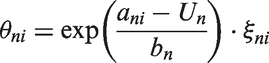
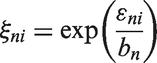
Given that in this example
The Fréchet model for land rents
Consider again the urban area partitioned into a set I of locations indexed i, with a population of Nh households and an economy with Nf firms, all agents indexed by n, where Na = Nh + Nf is the total number of agents in the set C.
Proof: The Fréchet distribution, also called the type-II extreme value distribution, is the domain of attraction or the limiting nondegenerative distribution of the maximum operator of a set of independent Fréchet variables, among other distributions: that is, this df is closed with respect to maximization. The Fréchet df is



To prove the proposition I first generalize Anas and Liu’s (2007) model, from their linear function to any utility function with logarithmic rents: that is,
It is worth remarking here that the ξ Fréchet variates of the location bids are functionally dependent on ɛ Gumbel variates of utilities, which implies that their variances are also dependent, such that
Following Von Thünen (1863), and particularly after Alonso’s (1964) seminal work, urban economists developed the fundamentals of urban economics from this assumption. The auction as a trade protocol in land markets is a direct consequence of differentiated goods (Rosen, 1974) because the specific location of land gives the owner the right to enjoy the neighboring amenities, which vary from one location to another. Land, however, is a special case of differentiated goods because every land lot has close substitutes as it shares attributes with nearby locations; hence, information about expected prices is considered to be commonly available to every agent. This situation, however, does not make land a homogeneous good but classifies urban land markets in the common value auction type (see McAfee and McMillan, 1987).
Ellickson (1981) uses the auction protocol to support the notion that land bids are extreme value variables because he asserts that only the maximum bid of a socioeconomic cluster is relevant for an auction. Hence, no matter the df of elementary bids within a cluster, the maximum bid relevant to an auction is an extreme variable. However, Ellickson ignored the positive domain of bids when assuming a Gumbel distribution, which was widely used thereafter, leading to the development of multinomial logit models. Nevertheless, it is worth recalling Ellickson’s argument in support of the Fréchet model used hereafter.
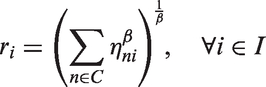
Proof. The expected rent yield by an auction (assumption 2), resulting from the expected maximum bid, is computed as
Defining
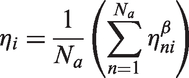
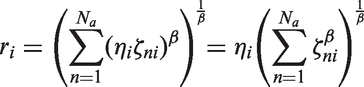
This relation motivates considering the following approximation:
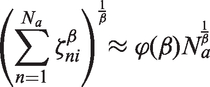
A test of the quality of this approximation is presented (in the appendix) by simulating random values for
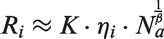
Using equation (2), replace the number of agents Na by total population N such that

Thus,

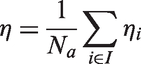
Because
Remark 1. Stochastic total rents. From propositions 1 and 2, the rent at any location is described by the stochastic variable
Remark 2. Super linearity emerges from microscopic diversity. The power law of equation (3) describes returns to scale produced by the variance of agents’ behavior across the population—represented by
Remark 3. Economies of scale. The stochastic superlinear effect of equation (3) is, in addition to other potential’ deterministic’ economies of scale, embedded in the expected average land value; that is, there may be an additional scale effect V = V(N). In the urban context, these economies combine consumers’ socioeconomic returns to scale (utilities) and business returns to scale in production (profit). Most studies in urban economics focus only on this relationship. If there is such relationship, these returns also emerge from individual agents’ (households and firms) benefits scaling bids with population; that is,
Therefore, assuming


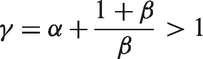
Note that even for an economy with diseconomies of scale up to grade
The Fréchet model of consumers’ surplus
Proof. For this proposition to hold, each agent has to adjust its bids, either upward, if there is no location where the agent is the highest bidder until he or she wins the auction in one location, thus reducing the utility level on which bids are conditional until the maximum attainable utility is reached; or downward, if there are several locations where the agent wins the auctions until there is only one, in this case increasing utility up to the attainable maximum.
From proposition 1 the adjustment of bids implies adjusting the reservation utility levels Un, a common value for bids on all locations. Given a location i offered in the market, an agent n has the following probability of being the highest bidder (Mattsson et al., 2014):




This equation defines a set of equilibrium
Additionally, replacing
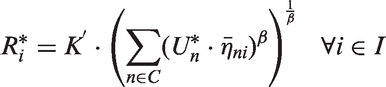
Proof. The ratio defining
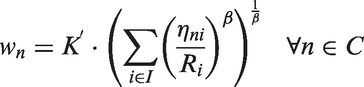
The conclusion that

Proof. Define the city’s total welfare as the sum of all agents’ and real-estate suppliers’ surplus, with the latter given by rents. Proposition 5 proves that if consumers’ surplus at equilibrium is nil then total welfare equals total suppliers benefits or rents. Proposition 3 proves that rents follow a superlinear power law with population size up to a degree of diseconomies of scale of
The theorem result is only valid in the static context where consumers do not have the alternative to spend income in the capital stock market. In a dynamic context, where consumers have the investment option in the stock market, the equilibrium condition includes the consumer trade-off between investment in residences and capital stock markets.
The base line
A final extension is necessary to complement the Fréchet model. Note that the rent equation (9) is homogeneous of degree one and the probability distribution of agents in space given by equation (5) is homogeneous of degree 0. Hence, the location model is invariant to a multiplicative factor on all bids (denoted by R0), but all rents are amplified by R0. Additionally, the general equilibrium framework used in this paper defines relative prices and rents scaled by an unknown numeraire price represented in equation (12) by R0. This numeraire factor scales all price-related values, including consumers’ surplus and rents R0, and also modifies the scale law as follows:
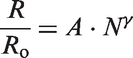
This apparently simple correction is important to compare dynamics among cities properly. The numeraire factor relates the prices in each urban system to the rest of the economy where it is embedded; the factor is common to all cities in the same economy, but it might differ across economies or countries. Therefore, this correction completes the power laws, making them finally consistent with W-B evidence, comparable across different economies, and consistent with microeconomic theory of equilibrium.
Urban growth
The power law of city socioeconomics derived above embeds the dynamic process of cities’ growth described by Bettencourt et al. (2007, 2008) with fundamental consequences for the evolution of urban systems. In this section, the model is applied using the theory developed above.
The power law associated with resources generation is applied to the following simple balance equation for resources:
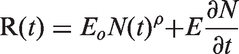
In what follows, I discuss the case in which available resources represent economic wealth given by equation (12), which combined with equation (13) yields

The solution to this equation varies depending on the parameters
The unique solution to equation (14) for the special case with

The solution to equation (15) for
If we consider

An important note made by W-B is that in equation (16) T decreases with the initial population (
For
Final comments
The theory outlined above emerges solely from two main microeconomic axioms. First, all microdecisions in the urban system are governed by agents’ rationality, which maximizes satisfaction from a large set of activities where each activity yields utility, activities interact in the market, and agents also interact socially. The second axiom is that agents perceive utility from activities with stochastic variability, which reflects a combination of their idiosyncratic variability—in their perceptions of goods, options, and environment—and the variability caused by imperfect information and external shocks in the environment where they make choices.
Following Page (2011), I interpret this result as follows: ceteris paribus, total welfare and rents of cities increase with population and with diversity. Diversity arises from Fréchet bids, which in turn emerge from Gumbel utilities (parameters β and μ, respectively), which yield a natural explanation for the increasing returns to scale, thus encapsulating a complex microlevel variability structure of the system that emerges in the land market. This stochastic optimization behavior is modeled using asymptotic results represented by extreme value distributions: type I (Gumbel) for utilities and profits and type II (Fréchet) for bids in land markets. Although the Gumbel model of microindividual choices is not essential for the main results to hold—it supports the notion that bids are distributed as independent Fréchet distributions—it has the merit of describing, however coarsely, a system-wide microeconomic consistency among all (households and firms) individuals’ choices and the diversity of the system from which the power law emerges.
Under plausible conditions of the economy, such as nonnegative economies of scale in production, the main result of the argument and discussion herein is the emergence of rent and welfare superlinear power laws with population from standard microeconomic assumptions. Compared with Bettencourt’s (2013) macroscale model, my approach allows simulation of the urban system’s microeconomic interactions to test the simultaneous emergence of all market prices and the scale law of the growth of cities.
This connection between bids and the scale parameter of the power law is significant because it allows the estimation of bids’ parameters from observed data of households’ and firms’ locations and the associated rents using standard maximum likelihood estimators. However, known estimates assume a Gumbel distribution of bids (eg, Lerman and Kern, 1983; Martínez and Donoso, 2010); it remains for further research to apply these estimation techniques to the Fréchet model, although the closed form of Fréchet probabilities make this estimation straightforward. Additionally, transport research may contribute with standard studies to test and estimate economies of scale in the productive and social activities of the Gumbel model.
The critical role of variability in this model implies that the higher the variance in the system’s aggregate choice process, the greater the expected total welfare and rents. This tells us that more diverse societies are more creative and produce more opportunities for interaction among agents and that the creation of welfare is more likely to occur for a given population. In other words, a society composed of cloned humans with predictable (deterministic) behavior is expected to provide the least welfare among societies of the same size, everything else (including culture and scale of economies) being equal.
This paper provides a very simple theoretical explanation for the empirical evidence that welfare and rent indicators scale superlinearly with size (population) in worldwide studies. Superlinear returns to scale have two sources: the classical economies of scale in economic theory (clearly not relevant according to the evidence) and the effect of diversity in creating better opportunities. From my model, even under nonnegative economies of scale, the sole stochastic effect supports the superlinear model.
The essential metaphoric connection between organisms’ and humans’ organization dynamics is direct: both share the assumption of optimization behavior; the former optimize energy production and its use, whereas humans optimize use of resources (material, economic, and time). Nevertheless, there is also an essential difference between them: human systems can grow faster, accelerated by scale economies and also by innovation and opportunities associated with population scale.
Footnotes
Acknowledgements
This research was supported by FONDECYT 1110124 and Instituto de Sistemas Complejos de Ingeniería (ICM: P-05- 004-F, CONICYT: FBO16). I also thank G. West, L Bettencourt, and LG Mattsson for their motivating and clarifying comments, Victor Rocco for his help, and unknown referees who contributed to enhance the paper.
Notes
 . Full applications in Santiago (Chile), Minneapolis-St. Paul (USA), Paris (France), Berlin (Germany, in progress). Project Partner of SinMobility project, Singapore MIT Alliance for Research and Technology (SMART) Future Urban Mobility (FM) Integrated Research Group.