







Abstract
Tactical urbanism initiatives have been interpreted as an alternative and a challenge to formal spatial planning tools to the need for a more responsive planning system. Short-term implementation, scarce resources and citizens’ involvement are said to be the key characteristics of this emerging movement in urbanism. In tactical urbanism, everything seems focussed on one thing: action. This paper analyses tactical urbanism initiatives in the United States considering three main aspects: the process, its interaction with planning institutions and the respective urban design outcomes. For this, the relation between tactical urbanism and complexity theory (in which self-organisation and evolution play an important role) is addressed. Findings suggest some contributions that tactical urbanism can make to urban design and spatial planning, in evolutionary terms and possible role for tactical urbanism in alternative to traditional division between plan making and plan implementation.
Introduction
Cities have been a familiar as well as intriguing issue for urban planners, despite of centuries of experience, ranging from the design of expansions to the redesign of pre-existing spaces. However, as part of planning institutions, planners seem to have difficulty in providing adequate solutions in terms of urban design. As such, the search for new planning paradigms is on the agenda of spatial planning and urban design.
Around five decades ago, urbanists started to question modern movement paradigms (Ellin, 1999). Christopher Alexander, with “A City is Not a Tree”, made room for the unplanned in planning, based on the principle that a city’s life and citizens’ behaviours are not organised in a rigid, hierarchical and mono-functional way. The search for alternatives to the hierarchical / functional / structured modernistic city’s approach, established new paradigms, in terms of planning theory and practice.
In this context – of the search for new planning answers –, complexity theory emerged as an interpretation and a tool to deal with contemporary urban territories in which a significant part of urban processes is not so much the result of planning implementation, but much more the result of unplanned and sometimes also self-organised initiatives (Batty, 2007). Self-organisations – leading to evolution – emerge as concepts to explain urbanisation processes, gaining space in planning research. This evolutionary side of cities has been explored in three main dimensions – space, time and civics (Marshall, 2009).
The choice of tactical urbanism occurred because this movement’s initiatives are a good example of bottom-up processes, not so commonly discussed within planning theory. They fit the concept of self-organisation in the sense that from different local initiatives emerged a movement, in an unpredicted way. Evolutionary and co-evolutionary processes need long sequences of continuous events in order to be perceived. Although the movement is officially recent, amongst the various tactical urbanism initiatives, some date back decades. The understanding of how tactical urbanism initiatives have evolved and co-evolved with planning institutions might shed light on the way bottom-up initiatives can be interpreted and integrated in planning processes.
Therefore, this paper will discuss the relation between bottom-up interventions – such as the movement of tactical urbanism – and planning institutions. A link will be forged with evolutionary and co-evolutionary processes, in order to understand the potential of tactical urbanism in relation to spatial planning.
This paper is divided into five parts. ‘Spatial planning and cities’ complexity’ section will establish the theoretical framework, based on the concept of cities, as evolutionary structures. ‘The possible meanings of tactical urbanism’ section will present the tactical urbanism movement and the tactical urbanism actions. ‘Tactical Urbanism actions and possible shifts in urban design’ section will discuss the contribution of this movement to spatial planning and urban design and, finally, ‘Final ideas on Tactical Urbanism actions and cities’ transformation’ section will conclude about the role of bottom-up movements in the evolution of spatial planning and urban design.
Spatial planning and cities’ complexity
Dealing with uncertainty is one of the most challenging tasks in spatial planning (Allmendinger and Tewrdwr-Jones, 2000; Faludi, 2000), particularly in urban design (Carmona et al., 2010). The agents of such processes do not interact in a predictable way (Batty and Marshall, 2012), due to the diversity of interactions, agendas, priorities and values (Heylighen, 2001). The result is a complex set of relations in which complexity has been underestimated, denied, ignored and even repressed by planning institutions.
Self-organisation initiatives can be an adaptive response to citizens’ aims and needs. In order to adapt, sets of elements, subsystems, self-organise and formulate new ways of interacting with other sets, on different scales (Allen, 2012; Innes and Rongerude, 2013). Following those sets of elements’ paths over time, evolutionary processes can be identified. They depend on three conditions (Winder et al., 2005): ontology – referring to a continuous existence; diversity – the variation in reaction to environmental conditions; and stress – as the result of external pressures. In order to understand them within the context of cities, counterpoint has been established between the “evolutionary paradigm” and two other “paradigms”: the creationist and the developmental (Marshall, 2009).
Considering these concepts – complexity, self-organisation, evolution – within the urban system, some additional considerations are required. The first is that self-organised processes can be somewhere between formal and informal spheres. In spatial planning this is particularly relevant, as planning institutions – considered as agencies and organisations, norms and rules (Ostrom, 2005) – are responsible for the sanction of private and public initiatives. The second, is that although sanction is associated with legal procedures, legitimacy also has to be considered mostly when it comes to citizens’ participation in urban transformations. Legitimacy corresponds to a recognised aim of an individual or a group, not necessarily sanctioned. The third is that in some cases, legitimate aspirations are even in a “legal Limbo”. Confrontation between legality and legitimacy might have two main kinds of consequences: legitimate actions are not continuous and relevant enough to lead to institutions adapting them; or they reach a point that forces planning institutions to adapt; Processes leading to evolution imply continuous and intense interaction between those who carry legitimate aspirations and those who are responsible for the sanction of public and private initiatives. In the case of cities’ evolution, three dimensions can be taken into consideration: space, time and civics. This will be addressed in the followings paragraphs in regard to three paradigms, the creationist, the developmental and the evolutionary (Marshall, 2009).
Cities as the result of evolutionary processes
Misconceptions of cities as objects or as the result of linear processes seem to be the main reasons for the contemporary modernistic believing in the creationist and in the developmental paradigms. In regard to the first paradigm, three conditions are suggested to have to be met when recognising an object: to know its purpose, how an existing model works and how it is to be constructed. However, when applying these conditions to an urban settlement, the time (for which it was designed), the space (in which it was developed) and the civics (corresponding to a specific social framework) are difficult, if not impossible, to predict. Therefore, this suggests not to be possible to anticipate the future of an urban settlement because it evolves in a complex way.
While the roles of designers and planners seem to be central to the creationist and the developmental paradigms, either because they are the creators or because they are responsible by the development process, taking evolution into consideration, the designer becomes a discreet part of the process. Cities play their role and tend to adapt to their limits (Weinstock, 2013), before they lose their meaning or despite of development gaps.
Nevertheless, the three paradigms seem to have a place in the city, with each one having an appropriate scale. As such, they seem to match three scales. The creationist paradigm seems better adapted to deal with very local contexts, where it is easier to discern functional needs, possible to know how to build it and how it will work. On an in-between level, it is possible to find interventions in large swathes of a city, where the creationist and the developmental paradigm might still be applicable. Despite being larger, complexity of uses can still be limited – for instance, a tourist resort, where many uses converge to a single function – and therefore the design of the space can still be phased, planned according to in-between steps. On the scale of the city as a whole or a significantly complex part of it, these kinds of paradigms are almost impossible to apply – “the larger the scale, the longer the term and the more people involved, the less likely this kind of design is to be appropriate”; instead, the “evolutionist paradigm allows that cities arise from purposive intervention, but the outcome is still somewhat organic in being complex and emergent.” (Marshall, 2009: 262). Urban design as an exercise to produce objects might fit some needs, depending of the scale, but might be significantly useless when referring to the city. Next section will address how tactical actions can transform the city.
Adapting: The unplanned in planning
As much as we want to see cities as the result of structured actions proposed by plans, the fact is that many cities are the result of unplanned changes. This happens not just due to the lack of means to introduce radical change in cities, but also because daily life is much more complex than a hierarchical and functional organisation of activities in cities (Alexander, 1965, Alexander et al., 1977). Therefore, adapting can mean a co-evolutionary process between plans and society.
Adapting appears as the possibility, up to a certain limit, to alter cities’ functions without changing the physical context. Small changes are possible in adaptation processes, being easy for instance to change some construction elements of buildings (Alfasi and Portugali, 2007). The limits for adaptation are usually characterised by a persistent abandonment of cities – or less drastically – of parts of cities. From the limits of adaptation we can easily reach the abandonment of cities.
Urban design initially corresponded to the assemblage of pieces produced to work (Adler, 1981), dealing with a trail or a cycle path in the same way as with a chair or a bath tub. The belief in the norm and standard was applied to the city and to urban spaces. The dominant idea was that of generalised solutions for different contexts.
Among the historicist approaches in reaction to this, emerged the study of typological evolution, in order to understand and to intervene in cities (Rossi, 1977). Typology and morphology became the core of research, particularly for Italian and French architects and urbanists. In the meantime the study of the evolution of building typologies became almost obsolete, because on a daily basis, cities were being transformed in a diversity of ways never known before, where patterns – which allowed typological differentiation – became apparently impossible to identify. From an old determinism where buildings, as a fundamental component of urban design, were a result of long-term sedimentation, urban territories switched to what can be called new typo morphological uncertainties.
As another reaction to prêt-a-porter solutions, bottom-up processes have been supported by planners and urban designers. But in less participatory contexts, citizens are invited, asked to participate, but they are not yet used to proposing. Directly interfering in a task that was considered that of the designer for decades has not been encouraged. Participation is still seen more like the inclusion of suggestions filtered by the designer instead of citizens’ participation being a key part of the proposal with spatial planners in a much more discrete place.
Increasingly surrounded by different forms of criticism, “form follows function” remained the base of urban design on a local scale. The belief in this theory led designers to solutions that did not follow the course of change and experienced difficulties in adapting. Zoning organised public spaces, which organised buildings, which, in turn, determined functions but not people’s ways of life. This determinism failed due, among other things, to the liberalisation of the land market. Each citizen became a potential transformer of urban territories with known outcomes: urban sprawl, peri-urbanisation and city centres’ decline. The convergence between emergent dynamics and a deterministic relation between form and function became occasional and unplanned; for instance, some city centres specialised in tertiary activities, not because of plans but because suburbia exploded with cheap housing, inviting people to abandon older parts of cities.
Uncertainty: Paralysing or moving on?
From a structured planning system perspective, nothing is more bewildering than having to deal with uncertainty. In many cases, spatial planning has pursued structured options, denying evidence that does not match those options. On the other hand, territories produced by these uncertainties can be fascinating and many authors have analysed and interpreted the effects of uncertainty. Despite the attraction caused by these phenomena, there is a risk of a certain paralysis regarding how to deal with future uncertainties and existing territories. Nevertheless, the question needs to be asked: how can we move on? One possibility is the use of tools that respond to new city challenges (Shane, 2011), which represents a change in the way typologies have been used and interpreted. This uncertainty, have made planners and planning systems to deal with a dilemma, the one of combining rigidity of norms and rules with flexibility, which recently started to be perceived as a quality in planning (Gielen and Tasan-Kok, 2010; Tasan-Kok, 2008). Unsatisfactory answers to this dilemma seem to be one of the reasons for a growing search of alternatives out of planning systems. In the meantime, other movements are looking at citizens’ experiences and learning from them. In the next section, tactical urbanism will be addressed as one of these experiences.
The possible meanings of tactical urbanism
Tactical urbanism is a broad expression used to describe many different kinds of interventions in cities. They seem to correspond to different qualities, for instance by occurring at different scales (Marshall et al., 2016), by including the creation of temporary use models for the reuse of cities’ vacant land, with benefits and down backs (Nemeth and Langhorst, 2014), by relating to informal actions taking place in legal limbos (Bermann and Marinaro, 2014), by being a lighter way to test solutions otherwise very costly to be implemented (Leonard, 2015), or by drawing attention and reclaim abandoned spaces (Campo, 2014); its use has also been extended to very specific fields of urbanism, such as the one of traffic engineering (Birdsall, 2015).
Apparently, they have a quality in common, the one of emerging from bottom-up processes and being part of a larger family of informality. However, the idea that tactical urbanism actions are typical bottom-up processes is becoming a topic for discussion. In some cases, they don’t seem to involve entire communities, but very specific groups (Wortham-Galvin, 2013) and the concept of tactical urbanism is itself evolving. The branding of tactical actions emerged from groups of citizens, but rapidly became politicised (Spataro, 2016) and were also adopted by some planning institutions in the context of 2008 financial crisis (Mould, 2014).
Despite a gradual proximity between tactical urbanism and planning institutions, tactical urbanism initiatives do not seem to meet planning strategies (Donovan, 2014); its relevance is questioned when confronted with traditional planning and building processes (Zimmerman, 2015) or when they interact with formal planning processes (Mitman and Rixey, 2015; Nielson et al., 2015).
Although the movement was officially created in 2010, in the northern American context they are considered not to be so novel, when considered as a do-it-yourself urbanism movement; on the contrary, tactical urbanism appears to have a long tradition in American urbanism (Talen, 2015), since tactical actions have been familiar in the United States since the beginning of the 20th century.
Tactical Urbanism involves a broader field of action of citizens in a context where public institutions are less responsive to people’s aims. This probably explains the fact that, of the four publications about tactical urbanism published so far, the first two focussed on the United States, the third on Latin America and the fourth and most recent on Australia and New Zealand.
Time, space and civics’ dimensions in New Urbanism and in Tactical Urbanism.
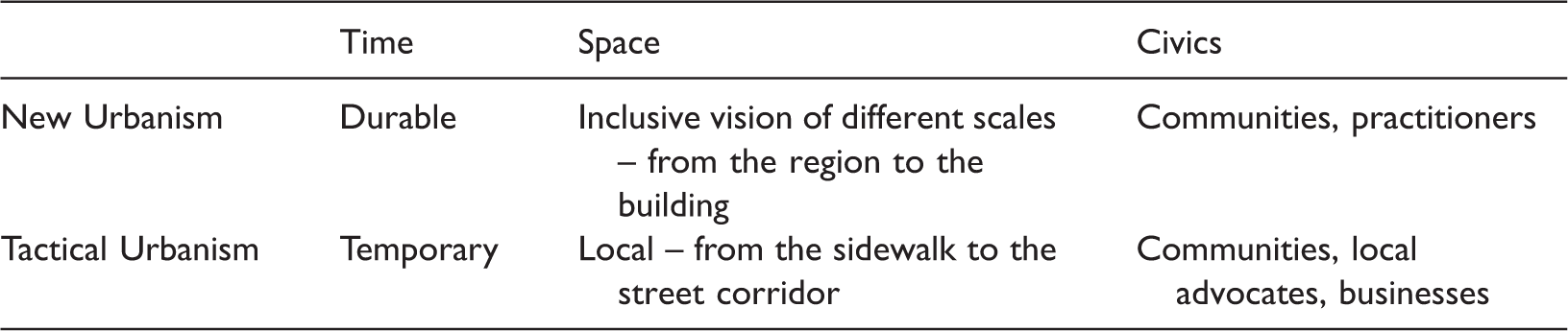
Most of tactical urbanism initiatives described in North American cities (Lydon et al., 2011, 2012) also have a very specific time frame. Often, they are not made to last, although, their temporary profile may have a number of aims. In some cases, temporary is a transition to permanent, like in “Site pre-vitalisation” or “Chair bombing”. In others, their temporary character is a way of allowing debate, like in “Pop-Up Town Hall”. In other contexts, they are temporary but cyclical, such as “Built Better Block”, “Park(ing) day”, “Pop-Up Retail” and “Open Streets”. The recurrent nature of these spaces allows people to get used to new ways of experiencing space, while allowing other activities to take place, but within different time frames.
While the New Urbanism movement focusses on how to design new urban expansions and provides an inclusive vision that ranges from regional to street level, Tactical Urbanism concentrates more on transforming existing spaces, expecting immediate results (not necessarily durable ones), as well as focussing at a very local level, such as streets and blocks. The space focus of tactical urbanism actions ranges from the block to the city, including the street, building, lot and district levels as well.
Tactical urbanism also refocuses urban design away from the object – a street, a public seat or bicycle parking – and more on change and process. The design qualities of the object are never a goal in itself. “Pop-Up Cafes” have designers as partners – and even then, only providing they are residents in the community. Quality resides in the fact that people build them without assistance and that seems to be a substantial part of their attachment to new urban spaces. The process seems to play an important role. This appears to occur because urban design becomes relevant due to people often get together and organise themselves using other structures that were created for different purposes, in order to achieve urban design solutions. In this context, civics plays a major part in tactical initiatives involving residents and local actors. In most actions, Tactical actions are often based on the re-use of pre-existing objects (like in “Chair Bombing”). Instead, design gets a stronger focus on the process and on the concept. The use of scarce resources is probably one of the key issues which allow tactical actions to remain independent and unsanctioned (Lydon et al., 2011, 2012).
Tactical Urbanism actions and possible shifts in urban design
Some of the motivations of tactical urbanism may be characterised as a reaction to current spatial planning and urban design practices, grounded on rigid rules and long bureaucratic procedures. These two main characteristics define the transformation of cities since planning systems were established in most of western countries. Tactical urbanism actions are characterised by other kind of properties, as referred at the beginning of ‘The possible meanings of tactical urbanism’ section. Their actions demonstrate what can be categorised as: specialising, following-up, adding, settling, claiming and merging. By presenting them, we intend to set a number of topics to address future challenges in urban design practice.
Specialising – Planning movements related to sustainability, despite set procedures being based on bottom-up participation and local action, they clearly define large objectives (see Millennium Goals) for initiatives like the “Depave” programme, as a way of achieving ecological goals; nevertheless, this happens without having a perception of what the final impact of the action actually is and what the relations with other actions are.
Following-up – Some of these groups learned from the extensive experience of others. “Open Streets” started in 1965 and, before, there was the “Play Street” movements in New York City (1914) and later in London. However, the “Play Streets” movements also had follow-ups, mainly in the city of New York. The follow-up of the original movement is characterised by more specific rules, in order for the initiatives to take place. It reveals a higher institutionalisation level than its predecessors.
Adding – Adding is another aspect of the tactical initiatives. The fact that a city starts a certain programme makes another city follow the same but with the addition of another task. One example of this is the “Pavement to Plaza” projects in New York City, which inspired a similar initiative in San Francisco, although this one was extended to include the “Pavement to Parks” project.
Settling – Tactical urbanism is characterised by short-term initiatives. Nevertheless, some of the initiatives are openly running-tests for further permanent initiatives and occupation, such as “Site pre-vitalisation”, where a plot that will be developed in a permanent way is temporarily occupied, thus warming the site up.
Claiming – Most tactical urbanism projects are the result of demands made by either individuals or citizens’ organisations. In some cases, they also express a need. The Informal “Bike Parking” initiative is the result of community activists, local businesses and property owners responding to the growing request for parking spaces for bicycles in cities in the United States. “Reclaiming Setback” is an initiative that claims the use of setbacks, the transition space between private houses and public streets and which landowners are forced to respect as a non-built space.
Monitoring – While some initiatives are completely autonomous from public authorities, sometimes their activities are monitored, due to their specific nature. In the case of “Intersection Repair” in Portland, the city’s Bureau of Transportation was the body that initially forbade the initiative to being the one that sanctions the work done by neighbours, activists, community organisations and home-owner associations.
Merging? – Some measures are quite specialised and simple, such as “Depave”. This is an initiative from neighbourhood activists and not-for-profit organisations. The main goal of this group is to remove asphalt to increase the permeability of urban soil. The way that soil is then used is a task for another group, perhaps a group made up of neighbourhood advocates engaged in “Guerrilla Gardening”. Will these merge one day?
Within these qualities time and space dimensions are present as well as civics. Tactical urbanism was inspired by inventive and peripheral experiences, such as initiatives in Latin American cities over recent decades, namely Bogotá in Colombia (where the “Ciclovía” movement started in 1974, inspiring “Open Streets” and “Atlanta Streets Alive”) and São Paulo and Curitiba in Brazil, suggesting that tactical actions can evolve by using and transforming the public space. The “Open Streets” projects originated in Seattle in 1965, but “Play Streets” has been in existence in New York City since 1914. In some cases, evolving means specialising in a certain kind of action, or more specific rules concerning a certain initiative through follow-ups of previous experiences, or adapting initiatives to new circumstances.
Tactical actions provide new insights into urban design and probably one of the most significant concerns with the shift of spatial concepts. Tactical actions help clarify spatial inputs, promoting the transformation of the space by using it. In most examples, citizens just start to adapt pre-existing spaces to enable new uses, showing there are other ways to design urban spaces, other than overdesigning an object that anticipates and establishes the way a space is to be used – following the creational paradigm – or being so open and flexible that it can allow any function, following the evolutionary paradigm. Designing a space can also offer people the opportunity to transform it, while using it at the same time. This is an additional quality of urban spaces, without seeing it as a degenerative process that needs to be repaired – in order to respect the creational paradigm or in order to eliminate abnormal elements and to get the developmental paradigm back on track.
The aesthetic values of design have been always present although the concept of beauty has undergone many different interpretations. Tactical urbanists’ motto seems to be that “local is beautiful”, due to the fact that initiatives are based on small interventions by different local organisations and individuals’ initiatives. When designers are present, they belong to the community. Some organisations are not just local but actively promote local values, as is the case with advocates. When some concepts are familiar from spatial planning for instance, they are coined in a “local” way. Here, mixed-use, which has being discussed for more than a decade and applied on different scales (Sieverts, 2003), is addressed as “Micro-Mixing”. Local becomes not only factual, but also boasts political content.
It seems clear that the urban designer is no longer the “creator” that matches the creationist paradigm. In tactical actions, they are almost absent and decision-making is based on the will of non-specialised organisations and people. In “Pop-Up Cafes”, it almost gives the idea that their role is to “beautify” the product of tactical action. In this context, urban designers tend to be one more actor involved with the design process.
Final ideas on Tactical Urbanism actions and cities’ transformation
Throughout this paper, the discussion focused on the role of tactical urbanism movement as a contribution to an evolutionary process that may eventually converge with spatial planning institutions. We started by defining the difference between objects and cities: objects are produced to be used and they last as long as their composite parts ensure functionality; cities adapt, in order to respond to society, to a certain extent.
The complexity of cities means they can exist for centuries without having to be completely renovated or innovated. Cities combine old elements (a monument for instance), modernised elements (a new street pavement) and new elements (an innovative transport system). Within this context, the research findings suggest that tactical urbanism actions play a role on city’s evolution and adaptation.
Tactical Urbanism, evolution and adaptive properties
The urban context discussed in this paper reflects the gap between what planning delivers and people’s needs. What we would like highlight is the way that people react to that gap. Tactical urbanism is the result of a new attitude of citizens towards the cities where they live, towards their planning and towards administration. People participate in adapting the urban fabric to their needs in a non-cooperative way.
We analysed the way tactical actions have evolved over time. Associated with the evolutionary process, there is an ability to adapt to local circumstances – aims, needs – in the actions discussed above, unlike traditional planning tools, which are designed by legal frameworks that are applicable during a certain timeframe and then replaced by a new one. Also, unlike traditional planning, they are not applicable to the territory in a homogeneous way. In this respect, legal frameworks are like objects, as presented in the early part of this paper. They are designed to fulfil certain needs and work in certain circumstances. When they become obsolete, they are replaced by new ones. As tactical urbanism occurs in a world ruled by laws, its actions somehow occur in an “air bubble” in which – apart from a few exceptions – there is no direct confrontation between legality and these actions. Nevertheless, the authors of Tactical Urbanism – Volume 2 (Lydon et al., 2012) refer in their preface to the fact that, in some cases, initiatives evolved from unsanctioned to sanctioned.
What can spatial planning benefit from tactical urbanism?
Tactical urbanism initiatives are opportunistic by nature. They spot each and every situation in which they can interfere and change the “normal” role of events, affecting linearity. The opportunity often resides in wasted space, which can mean underused public space or a vacant private lot. While tactical urbanism looks for waste to intervene, planning institutions look for malfunctions. They both use the same tools to invite citizens to intervene. Citizens’ ability to spot situations that need to be “fixed” or “repaired” is something that is still underused in information societies. A possible motto could be applied in both contexts – “you tell us, we fix it” – but while planning institutions do it autonomously, integrating information provided by citizens in their own modus operandi, in tactical urbanism, citizens become part of the process and of the solution, from the moment they report something. This particular characteristic of tactical urbanism transforms non-consolidated spaces into consolidated ones, in the sense that space starts to play a role in the city (Silva, 2010), with evident benefits to the urban form, interpreted as the result of how spaces are experienced (Secchi, 2003).
Tactical urbanism promotes temporary solutions which can constitute a running test to more perennial sets. As such, planning institutions have much to gain from tactical urbanism initiatives, using them as a laboratory. Public administration is more used to “implementing” rather than to “testing”. Tactical urbanism initiatives might gain space within the spatial planning context and solutions provided by small citizens groups may have an opportunity in the planning process. This will imply changes in planning methods, providing the opportunity to design and test solutions, while they are being formalised and discussed.
Plans are still designed to achieve targets, scenarios and goals. However, what would happen if we planned for undetermined goals and for the possibility of evolution? Certainly the whole structure of planning would change, regulation would play a much more important role and plans would have to achieve dynamic scenarios rather than fixed ones. If we think that evolution can occur from the interaction between actors and their system, and if one adds to that the fact that plans can be part of that system, then plans could address the evolution of local initiatives.
The fact that tactical urbanism initiatives evolve, adapting to new needs and new circumstances can be also an opportunity. Greater interaction between local actors and public authorities would allow co-evolution. Both are concerned about cities, from different perspectives, and about the fact they affect the way one another evolve. Most of the examples found are about tactical initiatives affecting the behaviour of planning institutions and their rigid structures. However, the opposite can also happen, allowing greater concern regarding issues affecting cities.
Constraints of tactical urbanism actions
Considering tactical urbanism initiatives as the result of self-organised structures, where each one does not play a role in a hierarchical organisation with pre-established goals, is certainly a challenge in terms of integration within spatial planning structures. On the other hand, it might be also difficult to maintain the spirit of tactical urbanism – something that is non-hierarchical, with very simple targets, sometimes leading to unexpected results – in a more integrated relation with spatial planning structures – a goal-oriented, hierarchical activity. The major challenge has to do with finding a role for tactical urbanism initiatives within planning processes and particularly with plan-making. Some attempts are already visible, such as “Site Pre-Vitalisation”, where a closer relationship is established between entrepreneurs and activists or in “Intersection Repair”, where the role of local authorities becomes more important. However, this is not important enough yet and may limit the impact of tactical urbanism.
Plans supposedly tend to allow flexibility, letting the process find its own path. However, actions like those of tactical urbanism demand another kind of flexibility – uncertainty in terms of results and the lack of programming. Tactical urbanism initiatives may be able to provide the energy necessary for an evolutionary way of planning. They do not wait for the urban object to be built, nor try to alter the organism in order to avoid malfunctions. They find solutions from the way systems evolve – including self-organised ones. Tactical urbanism provides urban design and planning with “laboratorial” outcomes for planning solutions, especially those initiatives with unexpected outcomes. For this reason, there should be room for tactical actions within planning process as a continuous activity.
In terms of major challenges, tactical urbanism initiatives demonstrate the importance of scale as a constraint. This far, they seem to have a scope in terms of scale – streets, blocks and buildings. When we talk about the evolution of cities and the evolutionary paradigm, the issue of scale is also a key. Small scale interventions (where tactical actions seem to have specialised) are the ones that, according to cities’ evolution, best cope with the concept of object – where it is possible to identify function, how it can be built and how it works. On the other hand, the more complex space, time and civics become, the more useful an evolutionary paradigm can be.
From here, the major question emerges: will it be possible to learn from tactical actions, in order to plan at city scale? In relation to certain tactical actions, the answer is yes. “Open Streets” initiatives have an impact at city and district level, while the impact of “Camps” is at city level (in the sense that they contribute to the emergence of cities). However, to improve the quality of contributions on a larger scale, tactical actions should be more than just a greater quantity of local events. If the scope remains focussed on local actions and at city level, another challenge emerges: how to integrate these local actions into a coherent urban fabric? In order to meet this challenge, some of the qualities identified in this paper may be helpful – the ability to evolve, to follow-up and to merge demonstrate potential that may help tactical actions to have a broader impact on urban design and spatial planning.
Footnotes
Declaration of conflicting interests
The author(s) declared no potential conflicts of interest with respect to the research, authorship, and/or publication of this article.
Funding
The author(s) received no financial support for the research, authorship, and/or publication of this article.