







Abstract
Education is argued to be an important driver of the decision to start a business. However, the measurement of its influence is difficult since it is considered to be an endogenous variable. This study accounts for this endogeneity by using an instrumental variables approach and a dataset of more than 10,000 individuals from 27 European countries and the USA. The effect of education on the decision to become self-employed is found to be strongly positive, much higher than the estimated effect in case no instrumental variables are used. That is, the higher the respondent’s level of education, the greater the likelihood that they will start a business. Implications for entrepreneurship research and practice are discussed.
Introduction
The determinants of entrepreneurial choice are widely researched (Evans and Jovanovic, 1989; Grilo and Thurik, 2008; Le, 1999; Lévesque et al., 2002; Parker, 2009; Roper and Scott, 2009; Sena et al., 2010; Wagner, 2007). Policymakers are particularly interested in the effect of education, since it can be influenced by policy measures (European Commission, 2003; Organisation for Economic Co-operation and Development (OECD), 2009). However, establishing its effect is difficult due to endogeneity (Van der Sluis et al., 2008). That is, education appears as a causal variable in an econometric model while it is in fact correlated with the errors in the model. In general, this correlation can be caused by measurement errors or omitted variables. 1 Other causes include reverse causality, autoregression with autocorrelated errors and non-random samples (Kennedy, 2008).
In these situations the use of instrumental variables regressions (IV regressions) is a solution to isolate the causality (Angrist and Krueger, 1991). 2 Using IV regressions, Parker and Van Praag (2006) find that education is indeed endogenous to entrepreneurial performance, and that it makes a difference whether or not IV methods are used. However, so far we do not know of any study using IV regressions to analyse the effect of education on entrepreneurial choice. This is surprising, since entrepreneurial choice is widely examined in the literature. It is even more surprising since correcting for endogeneity of education is known to make a difference in the related area of entrepreneurial performance (Van der Sluis et al., 2008) and in those of the returns to education in general (Ashenfelter et al., 1999; Blackburn and Neumark, 1993; Griliches and Mason, 1972) and occupational choice in general (Siow, 1984; Zarkin, 1985).
While human capital theory predicts positive returns to education for both wage earners and entrepreneurs, no such theory exists for the effect of education on entrepreneurial choice. In an ad hoc fashion, both Gimeno et al. (1997) and Le (1999) argue that education may lead to skills that are useful for both entrepreneurs and wage earners, and that no a priori effect of education on the choice between entrepreneurship and employment may be expected. Contrary to that, Davidsson and Honig (2003) argue that education provides individuals with increases in their cognitive abilities, and therefore, is positively associated with entrepreneurial discovery. Empirical exercises about the effect of education on entrepreneurial choice are not conclusive, as the surveys of Grilo and Thurik (2008) and Parker (2009) show. However, this may be due to the absence of a correction for endogeneity.
The present article has two aims. First, to analyse the effect of education on entrepreneurial choice using IV methods and a large international dataset and, second, to show to what degree not correcting for endogeneity leads to a bias. 3 Our dataset comprises more than 10,000 individuals from 27 European countries and the USA who are either self-employed or in a paid employment job. We obtain two main findings: first, that the effect of education on the decision to become self-employed is found to be strongly positive. The higher the respondent’s level of education, the greater the likelihood that they will start a business. Second, our results show that a standard Probit or Logit model strongly underestimates the effect of education on entrepreneurial choice and leads to biased results. We suggest that this is the reason why earlier studies have found weak or insignificant results (Parker, 2009; Van der Sluis et al., 2008).
Method
To analyse the effect of education on entrepreneurial choice, we use data from the 2007 Flash Eurobarometer Survey on Entrepreneurship. The dataset has been used in a number of published studies (Grilo and Irigoyen, 2006; Grilo and Thurik, 2008; Van der Zwan et al., 2010) and contains detailed information on the respondents’ employment status. We restricted the sample to those respondents who are either self-employed or in a paid employment job (10,962 observations (obs.)). We excluded respondents with solely domestic activities (1,678 obs.) or who were searching for a job (632 obs.), students (1,443 obs.), retirees (5,242 obs.), and respondents who refused to give an answer or did not fall into any of these categories (717 obs.). We discarded some further observations due to missing values. The final dataset contains 10,397 observations.
Our dependent variable is a dummy variable, which indicates whether the respondent is self-employed or not. Education is measured as the number of years that the respondent spent receiving education. We included a number of commonly used control variables in the regression model, such as gender or job experience (Grilo and Thurik, 2008). We also controlled for country effects. Table 1 describes the construction of the variables, and Table 2 shows correlations and descriptive statistics.
Description of Variables
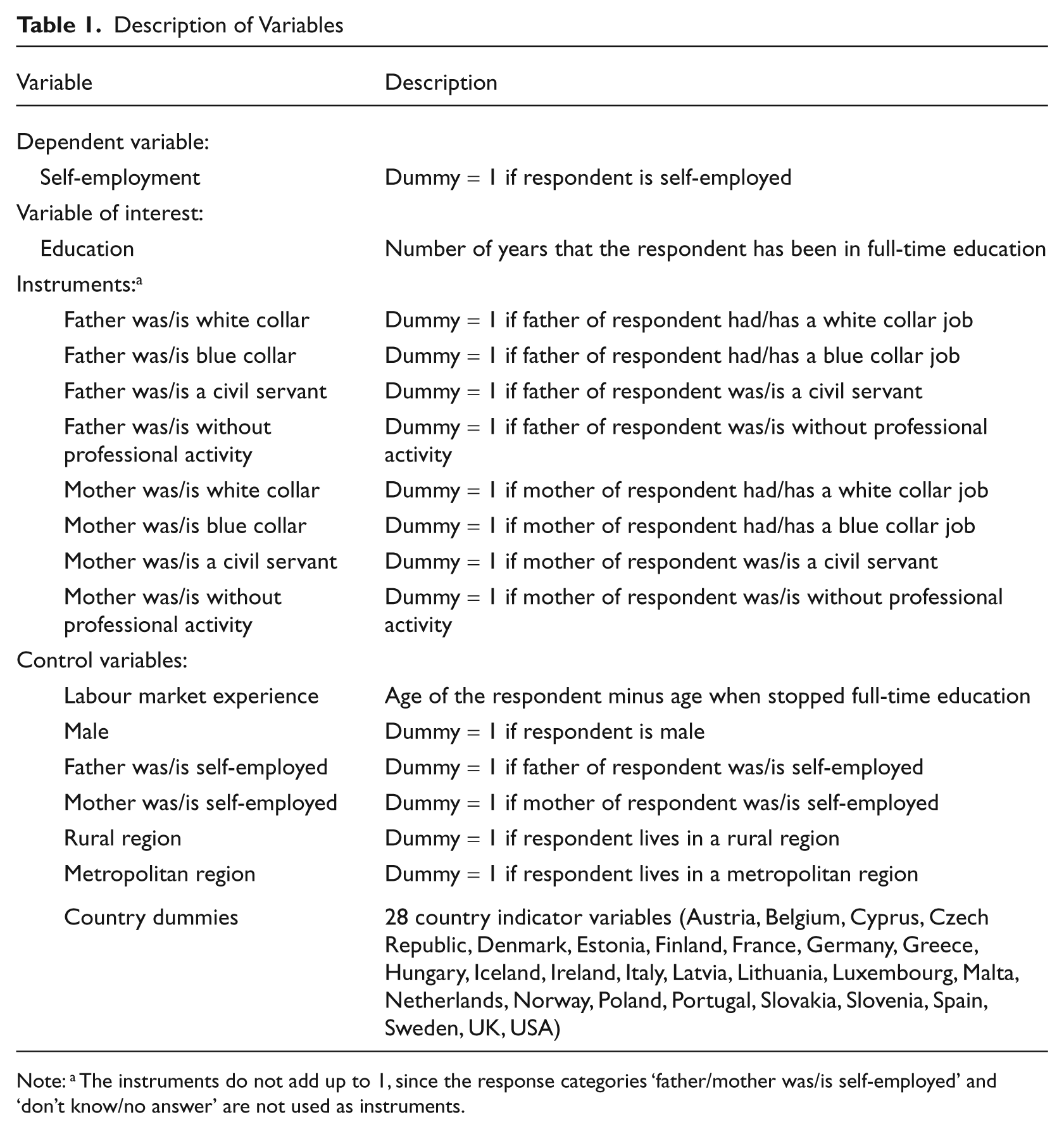
Note: a The instruments do not add up to 1, since the response categories ‘father/mother was/is self-employed’ and ‘don’t know/no answer’ are not used as instruments.
Descriptive Statistics and Correlations
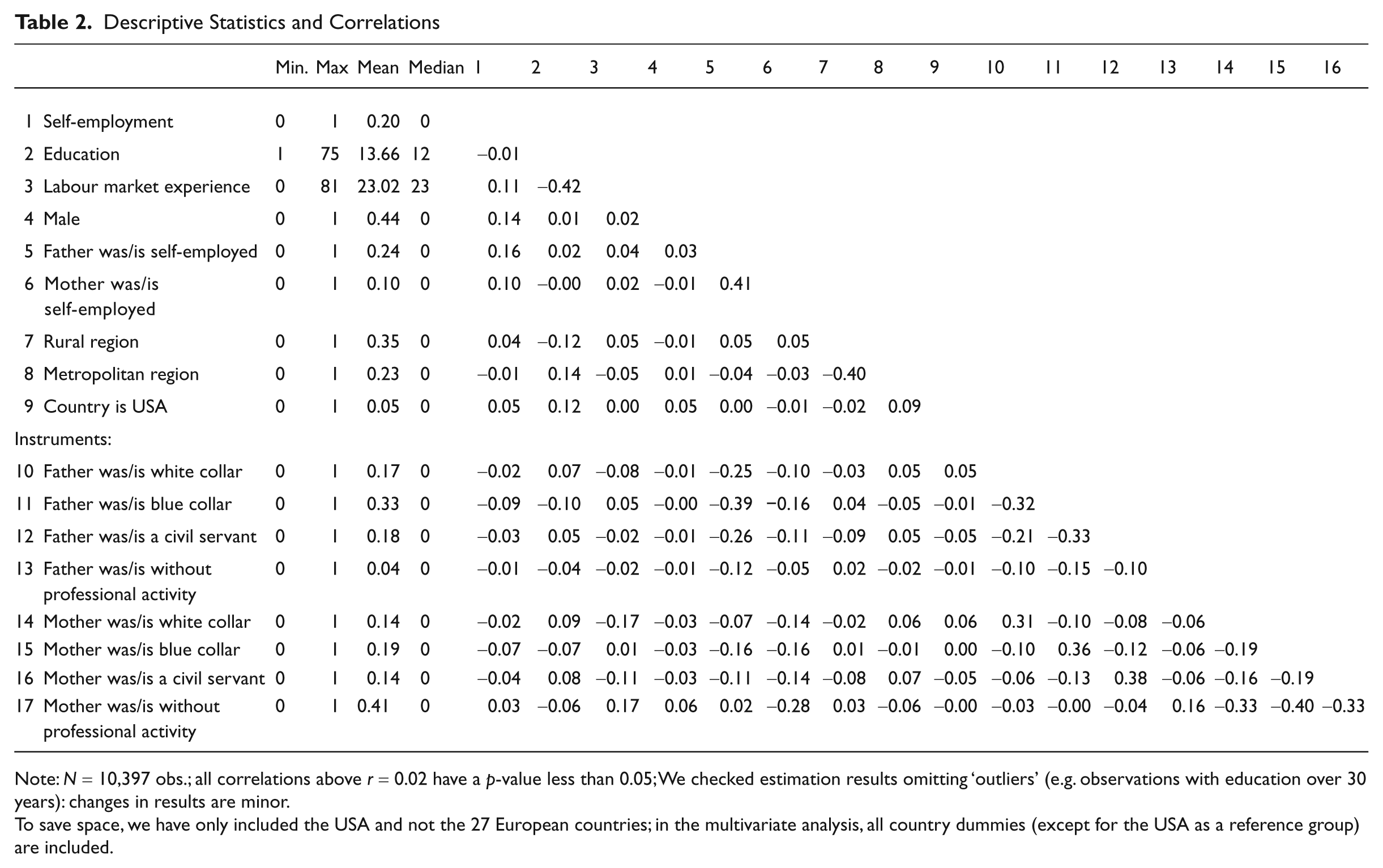
Note: N = 10,397 obs.; all correlations above r = 0.02 have a p-value less than 0.05; We checked estimation results omitting ‘outliers’ (e.g. observations with education over 30 years): changes in results are minor.
To save space, we have only included the USA and not the 27 European countries; in the multivariate analysis, all country dummies (except for the USA as a reference group) are included.
To analyse the effect of education on the decision to become self-employed, we estimated both a standard Probit model and an IV Probit model. The IV model is estimated to account for the above-discussed endogeneity issue associated with the education measure (Angrist and Krueger, 1991). There are two main groups of candidate instruments for education: family background variables and natural experiment variables such as changes or differences in compulsory schooling laws (Angrist and Krueger, 1991; Hoogerheide et al., 2007; Webbink, 2005). In general, family background variables are common, although not undisputed, instruments (Blackburn and Neumark, 1993; Parker and Van Praag, 2006). Other authors have used regional and legal variations in education as instruments, which also are not immune to criticism (Deaton, 2009; Heckman and Urzua, 2009; The Economist, 2009). Our dataset does not include the latter types of instruments. Hence, we relied on the first category and used the social class of the parents as instruments (e.g. blue collar vs. white collar).
First, we tested the validity of the instruments with the Amemiya-Lee-Newey minimum chi-square statistic (Amemiya, 1978; Lee, 1992; Newey, 1987). The null hypothesis of valid instruments was not rejected (p = 0.146): that is, the data did not provide evidence against the overidentification restriction that is incorporated in the IV Probit model with multiple instruments for one possibly endogenous regressor. Hence, the instruments seem not to have a direct effect on the dependent variable: their only effect on the dependent variable seems to go via its effect on the endogenous explanatory variable.
Second, the instruments should be statistically relevant in the sense that they are correlated with the endogenous explanatory variable. Preferably, the instruments will have a strong effect on the endogenous explanatory variable, otherwise one is faced with the case of weak instruments from which it may be difficult to draw meaningful conclusions (Bound et al., 1995). In the education–income literature, famous weak instruments are Angrist and Krueger’s (1991) quarter of birth dummies. 4 To test the strength of our instruments, we regressed the supposedly troublesome variable education on our social class instruments and the controls. The F statistic for the social class instruments is 17.76: this clearly exceeds 10.00, which is a widely used cut-off value to decide about the strength of an instrument (Kennedy, 2008). 5
A caveat applies to IV methods: even if one is able to find valid and statistically relevant instruments, one still should be careful with interpretation of the IV estimate. The IV estimate informs us only on the effect for those observations for which the instruments have power. This may be a small subgroup of the total population. For example, Hoogerheide et al. (2007) show that Angrist and Krueger’s (1991) estimate of return to education in the USA is determined by only a few southern states. Several alternative approaches to IV exist. For example, Card (1999) provides an overview of studies using sibling and twin data to estimate return to education and argues that omitted ability is eliminated when computing within family estimators. However, our dataset does not include the required observations on relatives. Alternatively, if one observes the same cross-sectional units over time and endogeneity arises from time-invariant sources, fixed effects estimation could eliminate endogeneity due to omitted variables. However, our data does not fit the required panel data framework.
Results
Table 3 shows the regression results.table3 The results regarding the effect of education on entrepreneurial choice are clear-cut: both in the standard Probit model and in the IV model, a positive effect of education regarding the decision to start a business is found. However, the IV model shows a much stronger effect (β = 0.014 in the standard Probit model; 6 β = 0.137 in the IV model).7,8, This strong difference in the size of the effects is explained by the fact that education is endogenous to entrepreneurial choice: estimating a standard Probit model underestimates the ‘true’ effect. The Wald-test of exogeneity is highly significant. The negative bias in the standard Probit model is also in line with underestimation of the OLS estimator for the effect of education on wage (Angrist and Krueger, 1991).
Results of Standard Probit Regression and Instrumental Variables Probit Regression
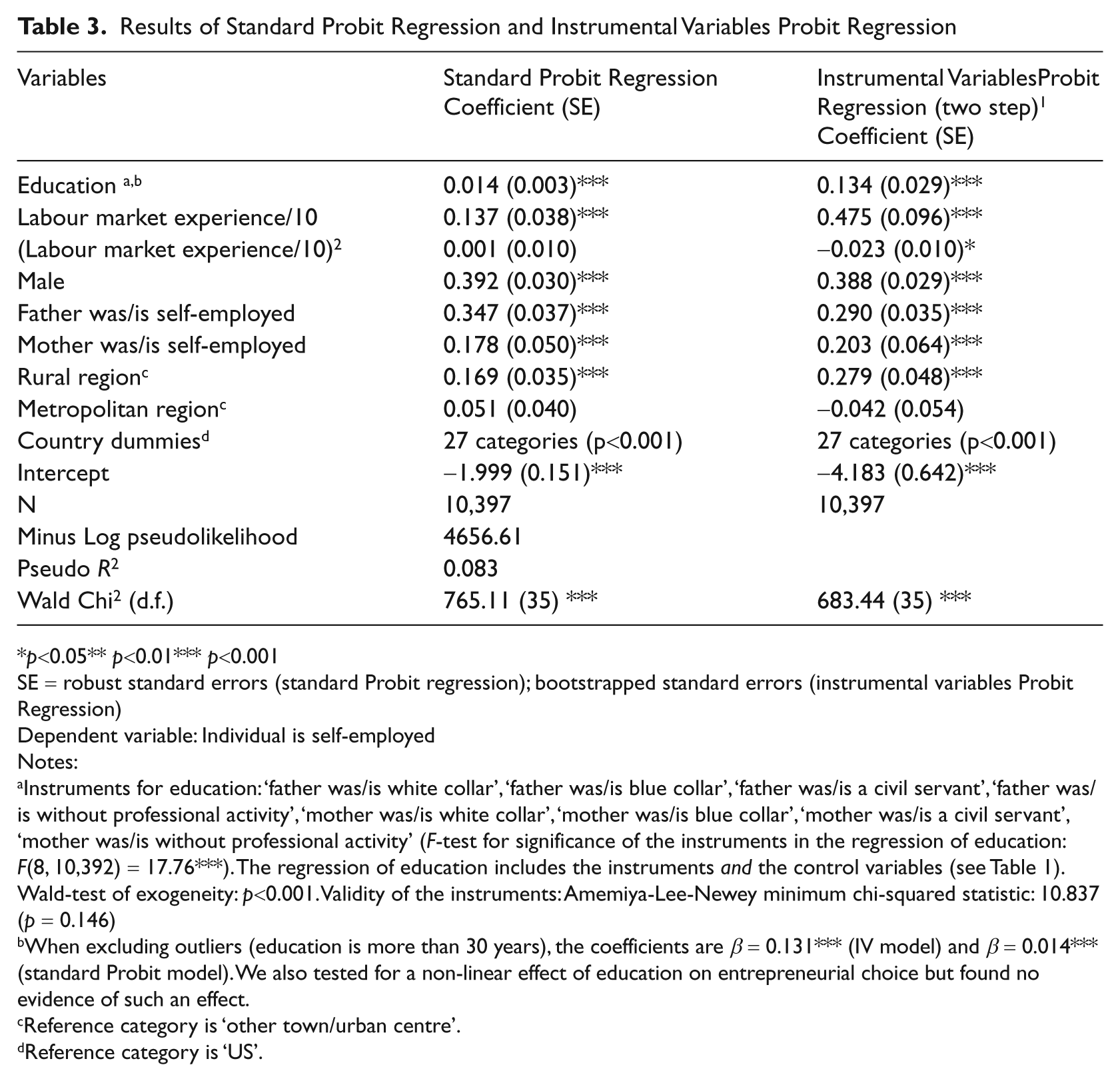
p<0.05** p<0.01*** p<0.001
SE = robust standard errors (standard Probit regression); bootstrapped standard errors (instrumental variables Probit Regression)
Dependent variable: Individual is self-employed
Notes:
Instruments for education: ‘father was/is white collar’, ‘father was/is blue collar’, ‘father was/is a civil servant’, ‘father was/is without professional activity’, ‘mother was/is white collar’, ‘mother was/is blue collar’, ‘mother was/is a civil servant’, ‘mother was/is without professional activity’ (F-test for significance of the instruments in the regression of education: F(8, 10,392) = 17.76***). The regression of education includes the instruments and the control variables (see Table 1). Wald-test of exogeneity: p<0.001. Validity of the instruments: Amemiya-Lee-Newey minimum chi-squared statistic: 10.837 (p = 0.146)
When excluding outliers (education is more than 30 years), the coefficients are β = 0.131*** (IV model) and β = 0.014*** (standard Probit model). We also tested for a non-linear effect of education on entrepreneurial choice but found no evidence of such an effect.
Reference category is ‘other town/urban centre’.
Reference category is ‘US’.
There are two possible reasons for the underestimation of the effect in the standard Probit model. First, there may be omitted variables that are associated positively with education level which have a negative effect on the decision to become self-employed (Blackburn and Neumark, 1993; Griliches and Mason, 1972). For example, a high education level may lead to attractive job opportunities in paid employment (e.g. an attractive position in a large corporation), which then increases the opportunity costs for starting a venture (Amit et al., 1995). In addition, it may be that higher education creates awareness of the risks associated with entrepreneurship (Oosterbeek et al., 2010; Von Graevenitz et al., 2010), which then has a negative influence on the decision to start a business. Another possibility would be that institutions of higher education create a negative image or status of entrepreneurs as a group of exploiters of other people’s work, which then has a negative effect on entrepreneurial choice (Begley and Tan, 2001). Finally, it may be that individuals with a strong preference for self-employment do not select university education but prefer to attend a trade school or professional schools, which requires fewer years than university education. Second, if years of education is a poor proxy for the level of education, 9 then measurement error drives the estimate for education in the standard Probit model towards zero or insignificance (similar to the linear model, for which the effect of measurement errors is discussed by Angrist and Krueger, 1991 and Griliches, 1977).
The almost zero correlation between education and entrepreneurship may seem surprising at first sight (Table 2), given our finding of a significant effect of education on entrepreneurship in the IV model (Table 3). However, the correlation merely tells the story of the data without use of IV: that is, if this correlation were to be interpreted and hence ‘trusted’ as a proper indicator for the causality between education and entrepreneurship, we would not need IV in the first place. The correlation suffers from all the problems that the standard Probit estimator suffers from in the case of an endogenous explanatory variable: the -0.01 incorporates the influence of measurement errors, omitted variables, etc.
The results regarding the control variables are as expected (Grilo and Thurik, 2008; Parker, 2009; Sena et al., 2010). For example, male respondents have a higher likelihood of falling into the self-employment category (IV model: β = 0.388, p<0.001). The effect of labour market experience is positive in its linear term and negative in its squared term. Country effects are important. For example, the probability of becoming self-employed is higher in the USA than in most European countries, but among European countries there is also wide disparity: the highest probability exists in Greece (β = 0.825, p<0.001), and the lowest probability exists in Denmark (β = −0.454, p<0.001). An F-test on joint significance of the country variables shows a significant result. The detailed discussion and interpretation of country differences is beyond the scope of the present article and has been discussed in prior research (Grilo and Thurik, 2005; Grilo and Irigoyen, 2006).
Discussion
The advent of the knowledge economy together with the recognition that such an economy requires a prominent entrepreneurial sector (Audretsch and Thurik, 2001) has produced many studies regarding the effect of education on entrepreneurial choice and performance (Van der Sluis et al., 2008). Moreover, of the many factors known to influence entrepreneurial choice and performance (Evans and Jovanovic, 1989; Le, 1999; Lévesque et al., 2002; Grilo and Thurik, 2008; Parker, 2009; Roper and Scott, 2009; Sena et al., 2010), education is popular among politicians, since it can be influenced. This article contributes to this literature by estimating an IV model to explain the causal effect of education on entrepreneurial choice. It shows that education appears to be an endogenous variable regarding the decision to become self-employed, which is why an IV model is needed to estimate its effect. Using such a model, it shows that a higher level of education increases the likelihood of becoming self-employed. Our dataset comprises more than 10,000 individuals from 27 European countries and the USA, who are either self-employed or in a paid employment job.
Conclusion
These two main results have a number of implications for both method and practice. First, the popularity among politicians to promote education as an important driver of economic growth is supported by the effect that education promotes entrepreneurship, which itself is a driver of economic growth (Thurik et al., 2008). Second, our results show that a standard Probit (or Logit) model should not be used to estimate the effect of education, since it tends to underestimate the effect of education. An IV approach might be a solution to find the ‘true’ effect. In this respect, entrepreneurial choice does not differ from other educational outcome variables such as wage (Angrist and Krueger, 1991; Van Praag and Van der Sluis, 2004; Webbink, 2005).
The results of this article offer several interesting avenues for further research. One particularly promising avenue concerns the discussion of necessity, opportunity and involuntary entrepreneurship (Block and Koellinger, 2009; Block and Wagner, 2010; Kautonen et al., 2010). Entrepreneurs who are ‘pushed’ into entrepreneurship might fall into a low education subgroup, in which case the effect of education on entrepreneurial choice would be negative. Another avenue of further research would be to analyse whether a higher level of education increases the preference for self-employment as a means to obtain non-monetary benefits (e.g. more flexibility or independence). A further avenue would be to use a more comprehensive dataset that includes more information about the individual’s labour market status. Such a dataset would allow for estimating the effect of education in a multinomial model, in which not only self-employment and employment exist as alternatives but also non-employment and unemployment (Grilo and Thurik, 2008). Lastly, it would be interesting to analyse whether the positive effect of education on entrepreneurial choice holds for all modes of entry into entrepreneurship (e.g. new venture start versus business takeover) and all countries alike (e.g. developing versus industrialized countries).
Footnotes
Funding
This research received no specific grant from any funding agency in the public, commercial or not-for-profit sectors.