







Abstract
Research beyond the field of entrepreneurship has long observed the involvement of super-wealthy entrepreneurs in large-scale philanthropic endeavours, while the world’s media has endowed them with celebrity-like status. However, entrepreneurial philanthropy is largely absent from the entrepreneurship research literature. This article addresses this gap both theoretically and empirically. It proposes capital theory as an appropriate theoretical lens through which to view contemporary entrepreneurial philanthropy, and to present fresh evidence relating to successful, wealthy entrepreneurs involved in significant philanthropic ventures. The findings highlight the active deployment of a distinctive blend of different forms of capital as a defining feature of entrepreneurial philanthropy, and contribute to emerging discourses regarding the nature of entrepreneurs, entrepreneurship as a socio-economic process and the sparse empirical analyses on entrepreneurial elites.
Introduction
Research beyond the field of entrepreneurship has long observed the involvement of super-wealthy entrepreneurs in large-scale philanthropic endeavours. Business historians in particular have documented the philanthropic activities of highly successful, wealthy entrepreneurs such as Andrew Carnegie (Harvey et al., 2011; Nasaw, 2006) and J.D. Rockefeller (Chernow, 1998). A small yet influential body of research also has drawn attention to the present-day involvement of wealthy entrepreneurs with powerful networks in significant acts of philanthropy intended to address persistent social and economic inequalities (Bishop and Green, 2008; Schervish, 2003, 2005, 2008). The world’s media has raised awareness of entrepreneurs’ involvement in philanthropy focusing attention on the philanthropic ventures of prominent entrepreneurs including Bill Gates, Warren Buffett, Paul Allen and Pierre Omidyar, endowing them with a celebrity-like status (BBC, 2011; Buffett, 2010). However, a review of the entrepreneurship literature reveals that beyond the work of a handful of researchers, including Acs and Phillips (2002) and Acs and Desai (2007), philanthropic activities undertaken by entrepreneurs are afforded little attention. Our intention in this article is to address this research gap, using capital theory to analyse and explore the current involvement of wealthy, successful entrepreneurs engaged in significant acts of philanthropy. Following Harvey et al. (2011), we refer to entrepreneurs who engage in significant philanthropy as entrepreneurial philanthropists, ‘distinguished both by a fierce drive to accumulate personal fortunes and by the desire to deploy a significant part of their wealth in pursuit of philanthropic ventures over which they can exercise control’ (Harvey et al., 2011: 425)
This article focuses on entrepreneurial philanthropy in Britain, which has a long history of entrepreneurial involvement in philanthropic projects, with the names of Rowntree (1904), Leverhulme (1925), Wellcome (1936), Nuffield (1943), Wolfson (1955) and Weston (1958) standing high in the league table of British charitable foundations. We ask why, given this rich history (Marinetto, 1999) and the current debate concerning entrepreneurship as a societal rather than an economic phenomenon (Steyaert and Katz, 2004), entrepreneurship scholars have largely overlooked this aspect of entrepreneurial behaviour. The celebrity status currently enjoyed by these philanthropic entrepreneurs emphasises the absence of critical analyses in the entrepreneurship literature. In particular, recognition of the UK’s rich philanthropic history questions whether we are witnessing an entirely new phenomenon, or the revitalization of an established practice (Anheier and Leat, 2002, 2006; Bishop and Green, 2008; Dees, 2008; Thomas, 2007). We argue that, while rooted within a solid historical context, contemporary entrepreneurial philanthropy differs from the past as the objectives and methods employed by philanthropists have become progressively informed more heavily by entrepreneurial values and practices.
Recognizing this, and cognisant that research on the philanthropic behaviours of high-net worth entrepreneurs is at an early stage, this topic presents opportunities for theoretical and empirical advances. This article seeks to contribute in both of these respects. It adds to the theoretical understanding of contemporary entrepreneurial philanthropy by considering the relevance of capital theory (Anheier et al., 1995; Bourdieu, 1986; Erikson, 2002; Firkin, 2003; Gorton, 2000; Harvey and Maclean, 2008) for the exploration of the involvement of super-wealthy entrepreneurs in philanthropy. Empirically, this article contributes both through an analysis of available secondary and recently collected primary data regarding the active involvement of wealthy entrepreneurs in acts of significant philanthropy. There is a further contribution to emerging discourses regarding the nature of entrepreneurs, entrepreneurship as a socio-economic process and the sparse empirical analyses on entrepreneurial elites. Our findings challenge the conventional view of entrepreneurs as working independently, isolated from others in their environment, and contribute to a more nuanced understanding of entrepreneurs as profit-maximizing individuals focused on generating and maintaining significant quantities of personal wealth.
Following this introduction, the historical context of contemporary entrepreneurial philanthropy is critically considered, including the socio-economic and political climate of the late 20th century which, it has been suggested, supported the accumulation of significant personal wealth by entrepreneurs and witnessed changes in the involvement; reach and impact of entrepreneurs philanthropic endeavours (Anheier and Leat, 2002, 2006; Bishop and Green, 2008; Dees, 2008; Thomas, 2007). We then outline the theoretical context of the study before describing our methodology. The research findings are then presented and discussed before the article is concluded, with implications and recommendations for future research.
Entrepreneurial philanthropy in historical perspective
Entrepreneurs’ involvement in philanthropy is not new. In the UK, the geographic context of this article, a succession of entrepreneurs involved in the redistribution of their wealth can be traced back to 1628, when the Henry Smith Charitable Foundation was established to help combat disadvantage and poverty (The Henry Smith Charity, 2008). This still-vital foundation continues to make available grants totalling £25m annually to up to 1000 charitable organizations combating social inequality and economic disadvantage. Business history reveals that since the establishment of Henry Smith’s foundation, wealthy entrepreneurs have demonstrated a keen interest in philanthropy, with both Andrew Carnegie (Harvey et al., 2011; Nasaw, 2006) and J.D. Rockefeller (Chernow, 1998) being identified as pioneering entrepreneurial philanthropists.
Against this background, political and media interest in the involvement of super-wealthy entrepreneurs in large-scale philanthropic ventures – such as those supported by the Bill and Melinda Gates Foundation, the Giving Pledge, the Clinton–Hunter Development Initiative and the Omidyar Network – has greatly increased. Much of this attention suggests that entrepreneurs possessing significant personal fortunes, and with powerful networks at their disposal, are becoming increasingly influential in global agendas for social and economic development (Bishop and Green, 2008; Schervish, 2003, 2005, 2008). This may well be the case, but there is evident need to consider more critically the motivations for entrepreneurs’ involvement in such ventures, and the consequences for themselves and their families, as well as the recipients of their philanthropic investments. A useful starting point in developing such a critical understanding is to reflect upon those factors that surround the accumulation of large fortunes, as well as entrepreneurs’ involvement in redistributing amounts of this wealth for social good.
First, alternative explanations for significant wealth creation can be identified. One viewpoint is that the global, socio-economic environment of the later 20th and early 21st centuries created unique opportunities for entrepreneurs to amass personal fortunes on a previously unseen scale and at younger ages than their historical peers (Giddens, 2001; Handy, 2006). This perspective suggests that buoyant economies, healthy stock markets, successful new product developments, technological advances and innovations, soaring property values, strong commodity prices and the emergence of a global marketplace combined to create an ideal environment for business growth and the accumulation of personal wealth. Alternative explanations are offered by academics and commentators who question the extent to which wealth accumulated by contemporary entrepreneurs is a consequence of genuine economic prosperity. For example, Harvey (2010) and Krugman (2009) suggest that neo-liberalist ideologies, which have dominated the socio-economic policies of most developed countries for the last 30 to 40 years, have contributed both to the rise of extremely rich individuals who have benefited from the shift in control of resources from public to private ownership, and to resulting income inequalities and a growing gap between the world’s richest and poorest. The problem with such neo-liberal policies, they argue, is that they go further than transferring risk from governments to the private sector: at their most extreme, they shift risk onto individuals, creating opportunities for economic winners and losers. Going further, Harvey’s (2010) Marxist critique leads him to suggest that wealth comes at a price; his view is that successful entrepreneurs’ ability to amass vast personal fortunes is a consequence of the ownership of economic resources and the economic rents that they are able to extract. In consequence, capitalism produces an unequal distribution of income and wealth – a perspective which has received empirical support from various studies analysing the means by which the rich acquire their wealth and the inequalities in income that result (Keister, 2005; Piketty and Saez, 2003).
This view is not new – it has long been part-and-parcel of the discourse of entrepreneurial philanthropy as first expressed by Andrew Carnegie in The Gospel of Wealth, initially published as a two-part essay in 1889 (Carnegie, 2006[1889]). Here, Carnegie argued that economic progress had led to ownership of the means of production becoming concentrated in the hands of a small number of entrepreneurs with a special aptitude for organizing production on a grand scale. Carnegie drew attention to the resultant dangers of excessive financial rewards, suggesting that they were ‘productive of envy, and threatening to the social compact between rich and poor, capital and labour’ (Harvey et al., 2011: 435). In order to alleviate such threats, Carnegie advised his fellow entrepreneurs that it was their responsibility to administer their wealth for public good (Carnegie, 2006[1889]).
Despite the shortcomings of statistics published in rich and giving lists, they do provide some indication of the scale of personal wealth currently possessed by a small group of individuals and, together with official statistics on income inequalities, offer evidence to support the analyses of Harvey (2010) and Krugman (2009), which point to increasing inequalities in the distribution of income and wealth. Forbes’ annual list of billionaires substantiates their assertion that recent socio-economic policies have encouraged the accumulation of vast personal wealth by a tiny minority of individuals. For example, the 2011 Billionaires List recorded 1210 billionaires spread globally, with an average net worth of US$4.5tn (Forbes, 2011), suggesting that despite the economic recession, this elite group continues to enjoy extraordinary levels of personal wealth; their situation stands in stark contrast to those at the bottom end of the global economic spectrum. The Multidimensional Poverty Index 2010 indicates that 1.7 billion people are multidimensionally poor; this means that almost 32 percent of the world’s population experience multiple deprivations with respect to education, health and living standards (Oxford Policy and Human Development Initiative, 2011).
It is against this background that we explore the phenomenon of contemporary entrepreneurial philanthropy. There is growing awareness of the expanding gap in fortunes between rich and poor resulting from advances in media technology, including 24/7 news coverage and instantaneous reporting via Twitter and YouTube. In consequence, the continuation of long-term social, health, environmental and related problems and the emergence of new and larger-scale problems have attracted global public attention. One such example is Africa which, as a result of the growing awareness of the severe, multiple and complex sociopolitical and economic problems that it faces, has become a focal point for international aid, including interventions by entrepreneurial philanthropists such as Sir Tom Hunter, whose foundation is collaborating with the Clinton Foundation to support sustainable economic development in Rwanda. However, awareness alone cannot explain why super-wealthy entrepreneurs turn to philanthropy as a vehicle for self-expression. Steyaert and Katz observe that ‘entrepreneurship in the last quarter of the twentieth century became a model for introducing innovative thinking, reorganizing the established and crafting the new across a broad range of settings and spaces’ (2004: 182). They suggest that philanthropy offers another space within which entrepreneurs can express their innovation and creativity, extending their entrepreneurial talents into the philanthropic domain to compensate for the same neo-liberal policies from which they have benefited. At present, there is little empirical evidence either to confirm or contradict this thesis, but it should be observed that only a small minority of entrepreneurs would seem to conform to the stereotype proposed by Steyaert and Katz.
Recent business history research offers a second and potentially more plausible explanation for entrepreneurs’ involvement in significant philanthropy. Harvey et al. suggest that Carnegie was ‘the progenitor of modern-day entrepreneurial philanthropy’ (2011: 426), and provide further insights into why currently super-wealthy entrepreneurs like Carnegie may become involved in significant philanthropy. Contrasting with the popular view of entrepreneurial philanthropists as altruistic individuals who, having amassed significant fortunes, desire to ‘give something back’ (Duncan, 2004), Harvey et al. (2011) propose that the benefits which can accrue to entrepreneurial philanthropists, including strengthening their reputation, legitimacy, power base and connections with influential politicians, celebrities and other prominent individuals and organizations, may provide more plausible explanation for their involvement in large-scale philanthropy. Related to this, a further factor impacting on wealthy entrepreneurs’ involvement in such philanthropy is likely to be their desire to be recognized as part of an elite group (Harvey and Maclean, 2008; Harvey et al., 2011; Maclean et al., 2006, 2010; Ostrower, 1995). In much the same way as Carnegie a century earlier, contemporary entrepreneurial philanthropists have been evangelistic in championing their approach to philanthropy within media and business circles (Bishop and Green, 2008; Fleishman, 2007). Well-known entrepreneurs such as Bill Gates, Sir Tom Hunter, Sir Richard Branson and the founder of eBay, Pierre Omidyar, have adopted prominent media profiles to communicate the scope and potential of their philanthropic ventures, urging their wealthy contemporaries to combat inequalities and engage in wealth redistribution. An example of the power of normative pressures within elite social groups is provided by Warren Buffett’s gift of US$31bn to the Bill and Melinda Gates Foundation in 2006. Rather than suggesting that all super-wealthy entrepreneurs share the same motivations for their engagement of philanthropy, we suggest that there is an essential ambivalence and plurality of motive regarding their wealth redistribution, and we have sought to outline a range of possible explanations for their involvement in contemporary philanthropy.
Defining entrepreneurial philanthropy
The literature reflects a growing interest in the relationships between wealth creation, income inequalities and philanthropy (Acs and Desai, 2007; Harvey, 2010; Krugman, 2009), but largely absent from this is serious consideration of the motives and modus operandi of the entrepreneurial philanthropist. We follow the definition of entrepreneurial philanthropists proposed by Harvey et al., who suggest that entrepreneurial philanthropy is defined by ‘the pursuit by entrepreneurs on a not-for-profit basis of big social objectives through active investment of their economic, cultural, social and symbolic resources’ (2011: 428), emphasizing the active involvement of entrepreneurs in the search for opportunities to address economic and social inequalities. Defined in this way, our conceptualization of entrepreneurial philanthropists resonates with Steyaert and Katz’s (2004) suggestion that entrepreneurship can be found across multiple sites and spaces. As such, we argue that situated within the philanthropic arena, entrepreneurs make use of their significant wealth (economic capital), entrepreneurial know-how (cultural capital), know-who (social capital) and reputations or brand (symbolic capital) to create innovative solutions to deep-seated social problems. However, distinct from Steyaert and Katz’s (2004) discussion is our interest in entrepreneurs who have amassed large personal fortunes within the setting of business or commerce before turning their entrepreneurial talents to philanthropy. We identify a history of entrepreneurial success – making significant money from enterprise – as a key feature of entrepreneurial philanthropy. We argue that when successful entrepreneurs engage in philanthropy they draw upon the totality of their resources – wealth, experience, connections and reputation – to effect economic and social change. This view accords with the various labels that abound in the literature to describe entrepreneurs who, when engaged in philanthropy, invest more than money and are prepared to take and manage risks: venture philanthropy (Letts et al., 1997), strategic philanthropy (Sandfort, 2008), creative philanthropy (Anheier and Leat, 2006), enterprising philanthropy (Dees, 2008) and philanthro-capitalism (Bishop and Green, 2008). However, we do not accept any of these representations uncritically, especially the emphasis given to the newness of the phenomenon, and adopt a more critical, tempered approach which, guided by business history research (Harvey et al., 2011), questions such novelty. We recognize a long history of entrepreneurs’ involvement in philanthropy and that, echoing their historical peers, contemporary entrepreneurs in possession of vast wealth, connections and an awareness of the socio-economic and health problems created by structural inequalities believe that multiple personal and social benefits can accrue from their active involvement in redistributing their wealth and alleviating social distress.
Theoretical perspectives
Business history and recent empirical research confirm that the participation of super-wealthy entrepreneurs in large-scale philanthropy involves more than the redistribution of their wealth (Bishop and Green, 2008; Harvey et al., 2011; Schervish, 2003, 2005, 2008). Instead, it has been argued that contemporary entrepreneurial philanthropy involves the application of multiple forms of capital in the pursuit of resolving pressing social and economic problems. Conceived of in this way, we identify capital theory (Bourdieu, 1977, 1986, 1998) as an appropriate conceptual lens through which to analyse the philanthropic activities of present-day entrepreneurs. While concepts of capital are not new to the social sciences (Giddens, 2001), their application to entrepreneurship is a recent development with significance for the research field (Erikson, 2002; Firkin, 2003; Gorton, 2000; De Clercq and Voronov, 2009; Haber and Reichel, 2007; Shaw et al., 2008). Most entrepreneurship researchers cite the origins of the forms of capital involved in the entrepreneurship process as a development of the resource-based view of the firm (Brush et al., 2001). However, Gorton (2000), Firkin (2003) and De Clercq and Voronov (2009) provide more critical and persuasive accounts of the value of Bourdieu’s (1986) perspective on capital for the study of entrepreneurship.
Bourdieu (1986) identifies individuals as possessing four types of capital: economic, cultural, social and symbolic. Economic capital includes all tangible and intangible forms of capital which can be immediately and directly converted into money. In addition to financial assets, economic capital includes tangible resources such as factories, plant and equipment, as well as intangible assets such as patents. Bourdieu (1986) conceives of three forms of cultural capital:
embodied – which refers to personal disposition;
objectified – which takes the form of cultural goods including books, pictures and instruments; and
institutionalized – which Bourdieu refers to as educational qualifications.
Social capital comprises social obligations, connections, relationships and networks and is critical in providing access to information and resources and to bridging structural holes (Burt, 1992). Symbolic capital includes those signifiers that generate trust in others; for example, business partners, customers, employees and investors. This final form of capital operates silently yet has powerful effects, including legitimizing entrepreneurs and engendering belief in their products and services within markets (Harvey and Maclean, 2008; Maclean et al., 2006). Significantly, Bourdieu argues that each form of capital is convertible from and into each other form of capital. For instance, if an individual possesses high levels of cultural capital in terms of their education and experience, it might be expected that this will convert into high levels of social capital in terms of networks and contacts. Of all these forms of capital, Bourdieu (1986) argues that economic capital is especially relevant, as its possession can facilitate and leverage access to all other forms of capital which, individually and collectively, can enhance the agentic power of individual wealth-holders (Maclean et al., 2006).
When applied to our study of entrepreneurial philanthropy, capital theory is relevant on a number of fronts. First, in the same way that Bourdieu highlights the particular relevance of economic capital for enhancing both access to other forms of capital and the power or agency of individual owners of capital, our definition of entrepreneurial philanthropy suggests that in order to become involved in large-scale philanthropy, entrepreneurs must have already acquired significant personal wealth over which they can exercise control, including its redistribution for social good. A current example of this is provided by Warren Buffett, who has pledged to redistribute 99 percent of his vast wealth (Buffett, 2010), and as mentioned previously, recently donated US$31bn to the Bill and Melinda Gates Foundation (BBC, 2011). Second is Bourdieu’s emphasis on the ability to convert each form of capital: we suggest that entrepreneurial philanthropists’ possession of vast personal wealth facilitates their access to significant amounts of all other forms of capital. As a consequence of this ‘virtuous circle’ of capital accumulation, Bourdieu argues that individuals can acquire abundant amounts of each form of capital such that they are elevated to a position within society from which they can command significant power and agency (Clegg et al., 2006; Maclean et al., 2010). Examples of contemporary entrepreneurial philanthropy illustrate both such possession of significant amounts of all forms of capital and their use of each of these when engaging in large-scale philanthropy. For example, Sir Tom Hunter has drawn upon a combination of significant personal wealth, social capital in the form of relationships with influential individuals including politicians, cultural capital signified by his success in establishing and growing successful entrepreneurial ventures, and his resulting reputation as an eminently credible, legitimate entrepreneur to leverage additional financial and non-financial resources, and to negotiate and implement philanthropic interventions, such as his involvement in the Clinton–Hunter Development Initiative. Third, as illustrated by this example, is the implication of capital theory that while highly significant for ‘entry’ into the philanthropic arena, economic capital alone is insufficient to accomplish large-scale philanthropy. Also necessary are the cultural capital acquired through education and (significantly, we argue) extensive experience of multiple instances of highly successful venture creation and growth; the social capital created by family, networks, memberships and relationships with influential groups and individuals who can provide access to further resources, emotional support and market information as well as bridge structural holes (Burt, 1992); and the symbolic capital endowed upon such individuals as a consequence of their reputation, credibility and legitimacy as successful entrepreneurs.
This discussion highlights the relevance of using capital theory to frame a theoretically informed analysis of contemporary entrepreneurial philanthropy. It also identifies a number of interesting, but as yet unexplored, avenues for research. Primarily, given the absence of critical theoretical or empirical analysis of entrepreneurial philanthropy within the entrepreneurship research literature, we know little about contemporary entrepreneurial philanthropy beyond what a handful of largely US-based studies have revealed (Handy, 2006; Schervish, 2003, 2005, 2008). Both this research and the business history literature (Harvey et al., 2011) indicate that when super-wealthy entrepreneurs engage in significant acts of philanthropy, they draw upon more than their vast personal wealth – they also make use of the cultural, social and symbolic capital at their disposal. There is also a scarcity of empirical research on entrepreneurs’ motivations for engaging in large-scale philanthropy, and while we have identified a number of possible explanations, without detailed empirical analysis, firm conclusions cannot be drawn. Cognisant of these gaps, we now turn to the methodology employed to collect and analyse data from a purposeful sample of super-wealthy UK entrepreneurs currently involved in significant acts of philanthropy, together with data collected from wealth advisers and those responsible for managing their foundations.
Method
Sample
This article draws upon the initial findings emerging from analyses of a complex set of data contained in a larger database developed by the research team as part of a wider, ongoing programme of research investigating contemporary individual and business giving. This database records information on UK philanthropists, drawn from seven different sources, after which a point of saturation is deemed to have been reached on each individual subject. It records data across numerous variables, including their demographics, class, religion, educational attainments, sources of wealth, known assets, core focus of philanthropy, key contacts, networks, distinctions and awards during the period 2007–2010. In addition, bibliographic files have been created for each individual listed on the database.
From this larger database, we have selected a purposeful sample (Easterby-Smith et al., 1991) of 100 wealthy entrepreneurs located within the UK and known to be engaged in philanthropy. Three criteria were used to identify the sample. First, individuals were identified as ‘entrepreneurs’: that is, they had to have made their fortune from business ownership and enterprise, or to have used inherited wealth to establish successful businesses. Second, borrowing from Bourdieu’s (1986) definition of economic capital, the next criterion specified that in the study’s census year of 2007, entrepreneurs had to possess a minimum personal wealth of £10m. Third, the final criterion stated that entrepreneurs must have redistributed, by 2007, a minimum of £1m. Having identified these individuals, a smaller, discrete database was created, using the theoretical framework to inform the selection of data which would allow consideration of the implications of their entrepreneurial capital for their involvement in philanthropy. To this end, details were gathered on the amounts that they had redistributed, the vehicles used to channel their wealth and the nature of the recipients of their philanthropy.
As mentioned previously, Bourdieu (1986) identifies an individual as possessing cultural capital by reference to a combination of qualifications, experience and cultural possessions (Maclean et al., 2006). Social capital has been variously defined, and entrepreneurship scholars tend to identify an individual’s possession of and access to social capital as being dependent upon the size, contents and relational dimensions of their networks (Davidsson and Honig, 2003; Firkin, 2003; Maclean, 2008; Shaw, 2006). More recently, there has been recognition within the entrepreneurship literature that social capital is essential if entrepreneurs are to become embedded within the field of business ownership and recognized as legitimate, credible players in their own right within the field (De Clercq and Voronov, 2009; Jack, 2010; Jack and Anderson, 2002; Shaw et al., 2008). Drawing on this, our database contains data on the entrepreneur’s key relationships gleaned from textual analysis of media publications. The final form of capital with which we are concerned, symbolic capital, speaks of reputation, credibility and legitimacy (De Clercq and Voronov, 2009). Conceptually powerful, symbolic capital can be difficult to operationalize, and to date there have been only limited discussions of this form of capital within the entrepreneurship literature (cf. Shaw et al., 2008). As the present research was restricted to analyses of publicly available data, Maclean et al.’s (2006) procedure was followed - that symbolic capital can be identified by titles, honours and awards. While our database contained many fields and a significant amount of information on each of these 100 entrepreneurs, it was limited in that it did not offer access to the total population of wealthy entrepreneurs located within the UK involved in philanthropy; accordingly, detailed statistical analysis was not possible. Instead, any numbers cited below are used to provide a quantitative description of the purposeful sample (Siggelkow, 2007).
Data collection and analysis
The quantitative focus of the dataset is complemented by evidence drawn from a series of 20 in-depth, qualitative life-history interviews with entrepreneurial philanthropists, their wealth advisers and those who manage their charitable foundations. The interviews were conducted by members of the research team, and averaged one-and-a-half to two hours in duration. Given the difficulties associated with accessing high net-worth individuals (Pettigrew, 1992), the interviews were conducted during the period 2007–2011 as the opportunity arose, across the UK. The interviews proved especially illuminating, particularly given the relatively high proportion of entrepreneurial philanthropists who are found to be self-made (see below), and whose forms of capital therefore, have been subject to greater transformation over time than is likely to be the case with those whose wealth has been largely inherited. Life-history interviews allow more complex social data to be captured and a more holistic picture to emerge with regard to individual subjects (Denzin, 2009). In particular, the interviews enabled the research team to capture some of the participants’ own reflections on the multiple personal and social benefits which can accrue from their active involvement in wealth redistribution. In the next section, the individual forms of capital exploited by entrepreneurial philanthropists in pursuit of social good are discussed in turn as these emerged from the interviews. All the participants are anonymized to preserve confidentiality.
Findings and discussion
Sample overview
Table 1 provides a summary of the demographics of the 100 entrepreneurs in the sample. As shown, most were aged between 46 and 65 (mean age = 60). This finding challenges recent research which has described contemporary philanthropists as young (Handy, 2006; Schervish, 2005), and might be explained in a number of ways. It may be that the criterion of possession of a minimum personal wealth of £10m in 2007 restricted the inclusion of younger entrepreneurs who, while wealthy, may not yet have accumulated this degree of personal wealth. Alternatively, it may be that younger entrepreneurs involved in philanthropy attract disproportionate media attention because of their relative youth and possibly the nature of their ventures. For example, it may be that younger dotcom entrepreneurs involved in high-profile philanthropy have aroused significant press attention despite possessing considerably less economic capital than their older counterparts. Table 1 also indicates that the majority were male (88). These figures reflect those of the wider entrepreneurial population, and are supported by research which has repeatedly found more business owners to be male than female, and for male business owners to be older than women business owners (Carter and Shaw, 2006; Labour Force Survey, 2009). In addition, in order to develop the demographic profile of the sample and provide greater insights into the motivations for giving and the chosen targets of their philanthropy, data on place of birth and religious affiliations (when known) were collected. Similarly, data on parental occupations were collected, which we discerned to be important for considering any impact that inherited versus self-made wealth might have on entrepreneur engagement in philanthropy. It was found that most of the sample was born within the UK, with a wide geographic spread across all regions. Data on religious affiliation were available for just 28 entrepreneurs, among whom Jewish (13) and Catholic (7) religions were more prevalent. Given this, interpretations of the implications of religious affiliation for entrepreneurial philanthropy were not possible.
Sample demographics.
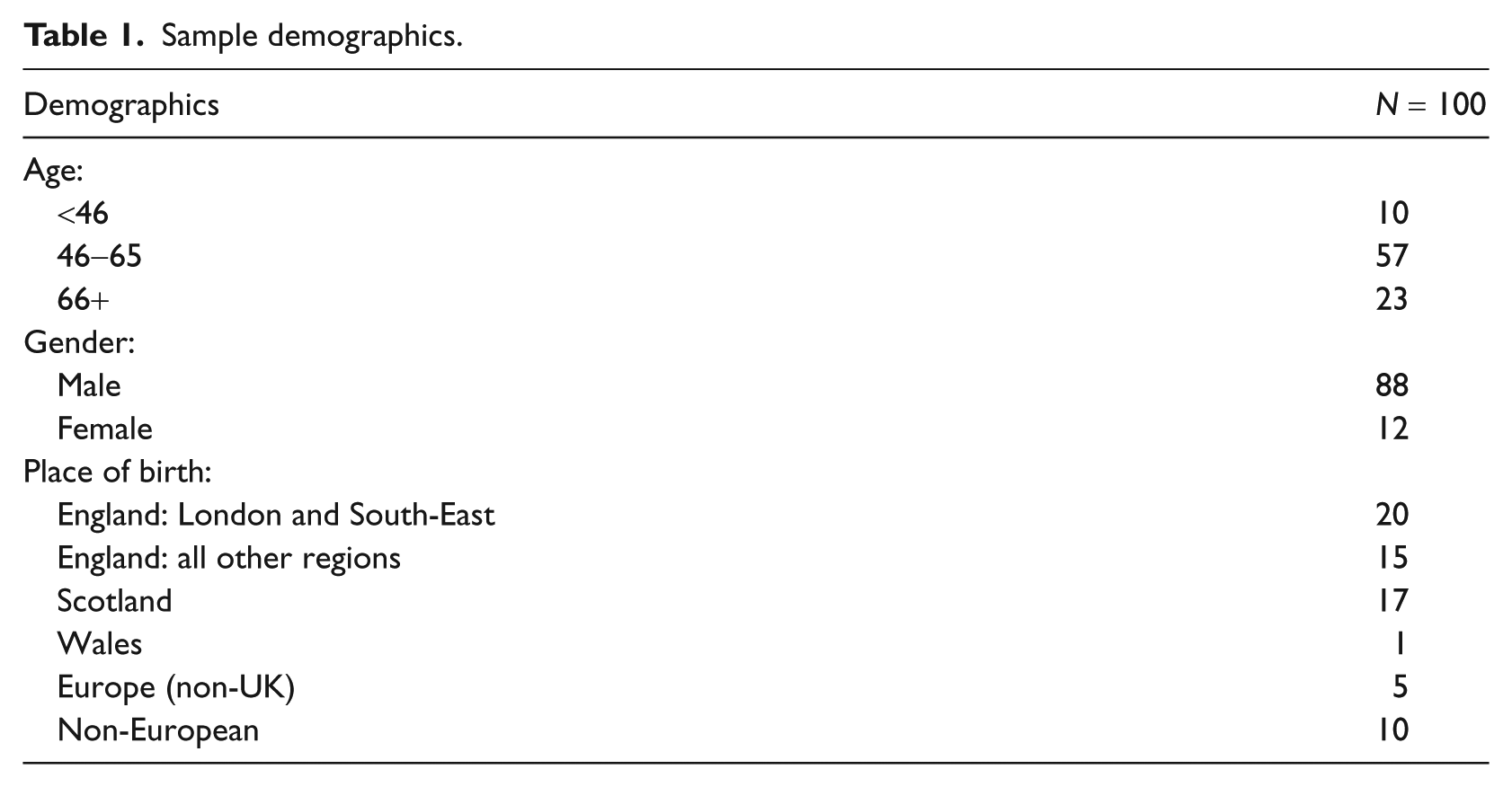
The data on parental occupation reveal that the majority of entrepreneurs in the sample are self-made, as only a small number (six) had inherited considerable wealth. This finding concurs with figures which highlight the disproportionate contribution that high-net worth individuals make to the £12.6bn of annual UK giving. Figures provided by the Sunday Times Rich and Giving Lists have repeatedly indicated that many of the UK’s wealthiest philanthropists are self-made millionaires, with lists 2006–2010 finding that on average, 75 percent of those included on these annual lists are self-made individuals (The Sunday Times, 2006, 2007, 2008, 2009, 2010). Similar analysis of Forbes lists of the wealthiest 400 Americans indicates that over various recent years, between 61 percent and 80 percent of those listed were business owners and, of those possessing inherited wealth, this was typically derived from businesses started by their parents or grandparents (Cagetti and De Nardi, 2006).
Requiring entrepreneurs to have donated at least £1m to qualify for inclusion in the present dataset ensured that committed philanthropists were being studied. Of these, it was found that more than half (59) possessed a formal vehicle for their philanthropy in the form of a foundation, of which 16 were established prior to 2000, with the longest-running established in 1972. Table 2 provides an indication of where entrepreneurs were found to direct their philanthropic investments. These figures reveal the concentration of philanthropic engagement directed towards education (targeted by 51 of the sample) and young people. Despite 28 of the sample having a publicly declared religious affiliation, only 10 entrepreneurs were found to have directed their philanthropy towards religious beneficiaries.
Philanthropy by field*.
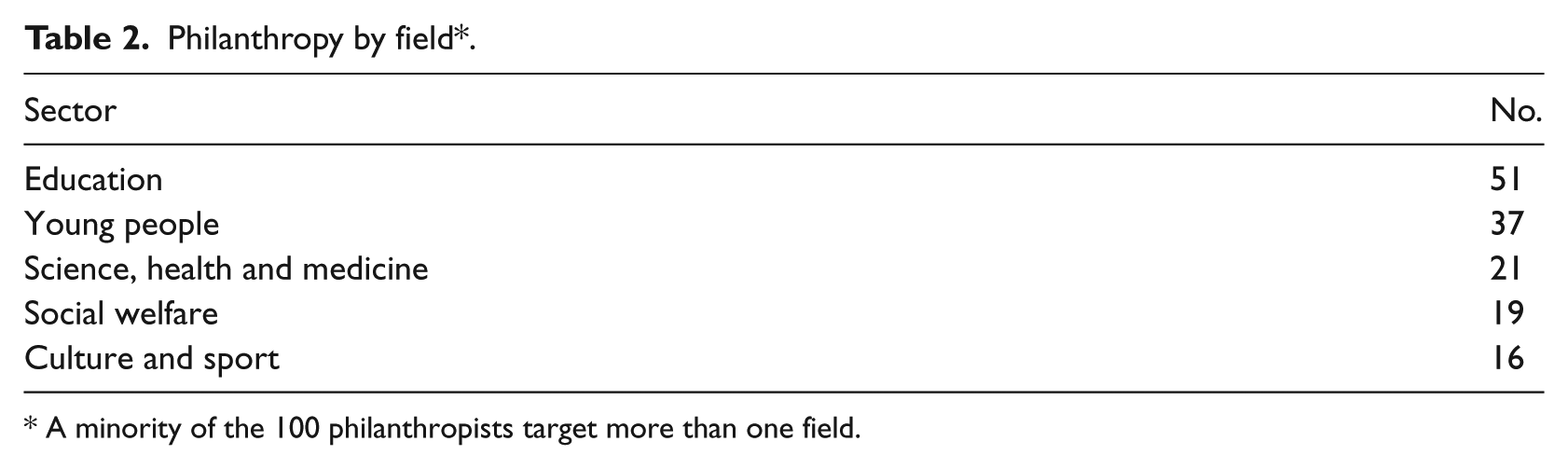
A minority of the 100 philanthropists target more than one field.
Economic capital
A key criterion for inclusion in the database was that entrepreneurs should possess a significant amount of personal wealth, and no less than a minimum net worth of £10m in 2007, as stated. Analysis of figures for personal wealth for 2008 established that all entrepreneurs included possessed significantly more than this amount, and that the mean net personal wealth stood at £268m. However, it is important to note that this figure is likely to have been inflated by the 10 percent of the sample found to be billionaires. Aside from this, these figures reflect the vast amounts of money that contemporary entrepreneurs have been able to amass, and supports Bourdieu’s (1986) position that economic wealth is the master form of capital. The power and agency conferred by economic capital, as the primary form of capital from which all others derive, is articulated in the following extract:
Being able to change things for the better is hugely fulfilling, and I suppose it has refocused our money-making, because I don’t make money now for the sake of having more money – that is, those material goals have all now been satisfied. I am making money now for the Foundation, which is a great motivator, and it has made us even more focused to make money. (Tyrone, entrepreneurial philanthropist)
Here, Tyrone expresses the view that making money for others has inspired him to go on making more money. This statement encapsulates the popular aphorism that ‘money makes the world go round’, and highlights the dominance and potency of economic capital and the circular nature of capital conversion and transformation. The sections which follow present and interpret findings relating to other types of capital, and consider their relevance for contemporary entrepreneurial philanthropy.
Cultural capital
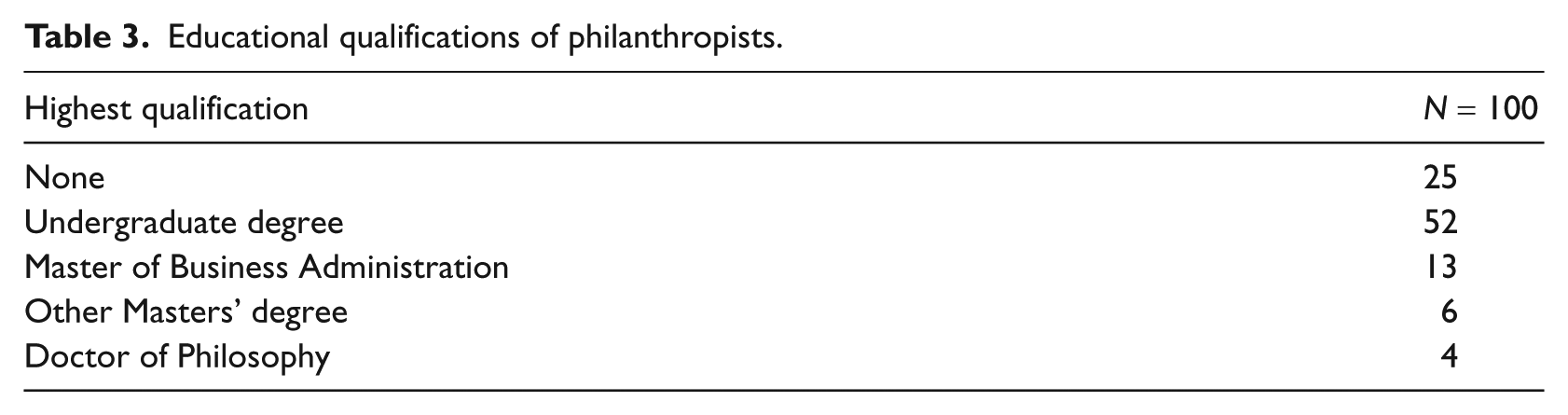
Education has been identified as a critical measure of an individual’s cultural capital, and has been conceived of as an objectified, institutionalized and embodied form of capital (Bourdieu, 1986). The present analysis concentrated on institutionalized cultural capital: the array of qualifications displayed in Table 3 suggests that accumulating cultural capital is important to the sample. De Clercq and Voronov argue that institutionalized cultural capital ‘refers to certifications and credentials that recognize and display certain kinds of knowledge and abilities deemed valuable within a particular field’ (2009: 400). Further analysis of qualifications by institution finds that a majority of undergraduate degrees (25) and all doctorates (4) were awarded by the Russell Group of research-intensive universities, and that eight MBAs were awarded by Ivy League universities, principally Harvard (7). Building on De Clercq and Voronov’s (2009) definition of institutionalized cultural capital, this might be interpreted as suggesting that entrepreneurs possess institutionalized cultural capital in the form of business qualifications which were initially relevant to the field of entrepreneurship, and subsequently to their involvement in entrepreneurial philanthropy. Perhaps most interesting are the implications of these findings regarding the quality of the awarding institution. Given the convertible nature of different forms of capital (Bourdieu, 1986; Firkin, 2003), it may be that a concentration of Russell Group and Ivy League awarding institutions contributes to the social (i.e. contacts made at university) and symbolic (i.e. reputations and credibility associated with attending a prestigious institution) capital possessed by entrepreneurs.
Educational qualifications of philanthropists.
Prior research has indicated that the possession of large amounts of cultural capital in the form of relevant experience and education can have a positive impact on the entrepreneurship process (Boden and Nucci, 2000; Davidsson and Honig, 2003). Contained within the database is information regarding entrepreneur career paths and involvement in business ownership. Analysis finds evidence of 39 entrepreneurs being involved in serial and/or portfolio entrepreneurship with many involved in both. Serial and portfolio entrepreneurship is indicative of entrepreneur enthusiasm for engaging in the entrepreneurship process, particularly new venture creation. High levels of experience of entrepreneurship are likely to have significant implications for the other forms of capital possessed by and available to entrepreneurs, and may have implications for their entry into the philanthropic field. One proposition is that successful serial and portfolio entrepreneurs may find that the transition into philanthropy is eased by their significant, relevant experience of the process of entrepreneurship, particularly the experience of identifying and implementing innovative and sustainable solutions to complex business scenarios. In this way, they bring their experience of entrepreneurship to bear on their philanthropic endeavours, as one entrepreneur explains:
Our funds are relatively modest, but we would like to try and use them in a sort of leverage type of basis … it is similar to the way we are running our businesses. (Kevin, entrepreneurial philanthropist)
Moreover, they expect to secure the same high level of return from such investments as they would for a business:
It is really being the engaged funder throughout the process, that it isn’t done once you have written the cheque. So that is a big piece of our thinking … We, in applying the business principles … we expect a return. We only want you to do the ones that have the highest value, and it is a real mindset change in the way that we work with organizations, and in how we think about what we are going to invest in. (Janice, co-founder and CEO, philanthropic foundation)
As an ‘engaged funder’, Janice emphasizes that she expects ‘a return’. Closely related to the expectation of a return is a concern for philanthropy to be impactful:
It is really about impact … it’s very much driven by a belief about marrying business principles with some very important understanding around development.
This is indicative of a move away from simply writing cheques in favour of measuring the actual success of philanthropic activities, towards greater performance and accountability in entrepreneurial philanthropy, in order to intensify its impact and so make it more ‘transformative’. All the interviewees, without exception, voiced their desire to ‘make a difference’ through their philanthropic engagement.
Social capital
Initial analysis of the entrepreneur’s key relationships found that all had one or more relationship with a person of influence, and an average of three important contacts. We define a person of influence as a person holding a position of power within their respective field, and analysis reveals that critical contacts are concentrated in the fields of politics (51 contacts across the sample) and philanthropy (27 contacts). Interestingly, the leaders of all three major UK political parties are identified 24 times, and several high-profile, globally powerful individuals, including Bill Clinton, Nelson Mandela, Kofi Annan, Tony Blair and Archbishop Desmond Tutu, also feature as key contacts. These figures provide some insight into the range of contacts nurtured by entrepreneurs. Network theory (Mitchell, 1969) identifies range as the heterogeneity of contacts within an individual’s network, while Granovetter’s (1985) perspective on embeddedness suggests that the ideal network position for an entrepreneur is to be embedded within a weakly connected, diverse range of networks. These contacts provide access to a wide range of resources. Initial analysis of key contacts by range reflected diversity, embracing figures from entertainment, business, finance, media, sport, education, environment and the arts, but also revealed a concentration within the fields of politics and philanthropy. Viewed through the lens of capital theory, the concentration of political and philanthropic contacts suggests that by developing social capital within the field of philanthropy, entrepreneurs purposefully seek to accumulate significant symbolic capital that enhances their agency and capacity to make a difference. This also recognizes the hierarchical relationship between different fields (Bourdieu, 1986; De Clercq and Voronov, 2009), suggesting that as entrepreneurs move through the philanthropic field, they seek to form relationships with agents holding powerful positions in higher order fields, principally politics. In addition, key contact data were analysed in order to identify the number of entrepreneurs mentioning others on the database among their key contacts. Initial analysis of this specified 19 entrepreneurs as sharing an important relationship with at least one other entrepreneur. This figure is interesting, as it conveys the density of the networks in which entrepreneurs included in the database are embedded. This suggests that UK entrepreneurial philanthropists may be well known to one another, reflecting perhaps an elite group of super-wealthy individuals with agency in the fields of entrepreneurship and philanthropy.
Analysis of primary contacts indicated that entrepreneurial philanthropists are aware of the value of ‘know-who’. The concentration of key contacts classified as influential within the fields of politics and philanthropy implies that entrepreneurs recognize that success in the field of philanthropy requires deployment of a combination of economic and social capital. As one interviewee expressed it:
It just seemed to me that this was a business head saying: right, by partnering with the best I am taking a shortcut, I am cutting down a whole load of learning as the learning is all there. I am partnering with one of the best people in the world. (Tyrone, entrepreneurial philanthropist)
Tyrone exhibits an acute awareness of the importance of ‘know-who’, seeking to embed himself within the field of philanthropy by strategically aligning himself with powerful political and philanthropic allies, which attracts further cultural and symbolic capital while simultaneously ‘standing out’ (De Clercq and Voronov, 2009) through a distinctive approach to sustainable socio-economic development. This challenges the suggestion that the legitimization of an individual in a field is not a result of deliberate planning, but rather a consequence of ‘the interplay of every day practices and the social context’ (De Clercq and Voronov, 2009: 401). On the contrary: the evidence gleaned from the interviews suggests that such strategic behaviour derives from, as the above extract mentions, ‘a business head’ – assuming a business-like approach. At the same time, exploiting social capital in the philanthropic field leads to further business opportunities which otherwise might not have arisen:
There are people that I meet through philanthropy who we’ve done business with that we would never have met if it was a purely business relationship, and there is a huge interest in philanthropy, and therefore it opens a lot of business doors for us as well. (Tyrone, entrepreneurial philanthropist)
Here, Tyrone points out that philanthropy serves to open ‘business doors’, underlining the transformative, circular nature of capital in generating further business opportunities to exploit. This generally remains couched and implicit; however, as the following observation from a wealth adviser suggests:
We hope that by building strong relationships they will do more business with us, but we don’t talk about any sort of specific business with them. (Marjorie, wealth adviser)
Symbolic capital
As indicated in Table 4, we found entrepreneurs possessed significant amounts of numerous types of symbolic capital; 40 had received various honours with 19 holding at least two such distinctions. In addition, a high number held honorary doctorates and fellowships. Education is a primary beneficiary of philanthropy. Recognizing that the symbolic value of distinctions, fellowships, honorary degrees and awards is likely to be specific to the value that they realize within particular fields, business awards (52) and specific awards for philanthropic activities, such as the Beacon Prize and the Andrew Carnegie Medal for Philanthropy, are likely to be of particular symbolic relevance. Considered collectively, the indicators of symbolic capital presented suggest that the entrepreneurs in the database are regarded as credible agents within the field of business ownership and recognized as significant players within this field.
Titles, honours and awards*.
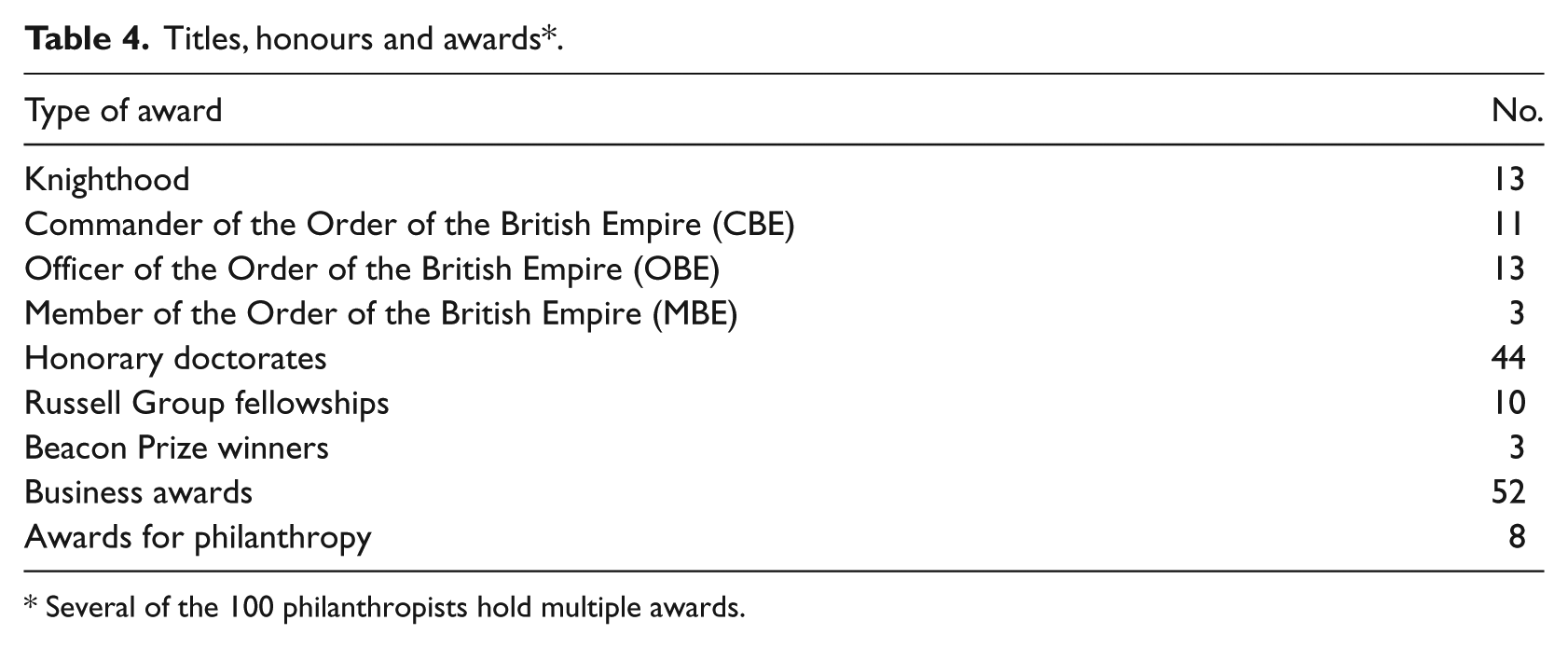
Several of the 100 philanthropists hold multiple awards.
The present research suggests that such legitimization matters to entrepreneurial philanthropists; they are self-conscious about wishing to be recognized as rounded individuals who share the fruits of their success with others, ‘giving back into the community from which we had profited’ (Tyrone, entrepreneurial philanthropist), as opposed to selfishly pursuing narrow business interests for material and financial gain (Maclean et al., forthcoming, 2012). Another interviewee spoke of the transition that he had undergone through his engagement in philanthropy to becoming ‘a more rounded person’:
It is something that I was very guilty of in my previous business, was living and breathing [the business], and everything revolved around it and, you know, it just doesn’t. So it probably comes from being a more rounded organization, a more rounded person – less selfish, perhaps. (Kevin, entrepreneurial philanthropist)
Similarly, another interviewee gives voice to the ethics of selflessness:
I think excessive consumption and excessive wealth are both pretty distasteful. If you have got excessive wealth and you are doing something with it, then it becomes excusable. (Arthur, entrepreneurial philanthropist)
Irrespective of the array of symbolic rewards displayed above, we argue that engagement in the philanthropic field generates significant symbolic capital sui generis, such that excessive wealth ‘becomes excusable’. As a prized form of the most sought-after capital which crowns the other three, such legitimization appears almost priceless. As one foundation CEO explained:
Subtly I am trying to figure out what recognition they are looking for … It is very difficult to ask that upfront. Some people are very clear about it, for example, [entrepreneurial philanthropist] and his programme, I am 99 percent certain that as much as he is proud of what he is doing, I don’t think he would say that he is in it for recognition. However, through this whole process he is being ‘OBE’d’, so there is a consequence. (George, CEO, philanthropic foundation)
Conclusion
This article has sought to contribute to a theoretical understanding of contemporary entrepreneurial philanthropy by considering the relevance of capital theory (Bourdieu, 1986; Erikson, 2002; Firkin, 2003; Gorton, 2000; Harvey and Maclean, 2008) allied to Bourdieu’s (1977, 1986, 1998) approach to practice. From this standpoint, the article also has sought to contribute to an emerging understanding of the present-day relationship between wealthy entrepreneurs and philanthropy by presenting a discussion of the various forms of capital possessed by 100 UK entrepreneurs known to be significantly involved in philanthropy, and considering the implications of the approach adopted by them. We suggest that capital theory is a valuable framework for analysing the economic, cultural, social and symbolic resources possessed by these entrepreneurs, helping to enhance our understanding of the means by which entrepreneurs deploy the capital acquired through their involvement in business in order to enter and become embedded within the field of philanthropy. While recognizing a long history of entrepreneur involvement in philanthropy, the present findings indicate that contemporary entrepreneurs are seeking to increase their impact through charitable giving and are more exacting about the measurement of its success, while simultaneously extending their reach further afield to target complex socio-economic development problems.
The present findings also imply that despite the considerable wealth possessed by the entrepreneurs in the sample, this alone is insufficient, and that their involvement in global social change is made possible by possession of other forms of capital. It may be that what distinguishes entrepreneurial philanthropists from other actors in the philanthropic field is their individual agentic power, as determined by their own capital wealth acquired through, and enriched by, their engagement in entrepreneurship. There is an evident interplay between different forms of capital. Having significant cultural capital appears to be particularly relevant to their entry into the field of philanthropy. The elite nature of the awarding institutions which many of them have attended has implications in turn for the degree of social and symbolic capital that they possess. In addition, recognizing that entrepreneurs must acquire legitimacy in order to be regarded by other key players as credible agents in the philanthropic field (Aldrich and Fiol, 1994; Zott and Huy, 2007), the present findings indicate that symbolic and social capital are heavily intertwined in the process of entrepreneurial philanthropy. The convertible, circular nature of capital (Firkin, 2003; Harvey and Maclean, 2008) suggests that by becoming involved in the philanthropic field, the capital possessed by entrepreneurs will be further enhanced, in conjunction with their agency and power within the overlapping fields of entrepreneurship and philanthropy in which they are embedded. As one interviewee confirmed, the networks acquired through his engagement in philanthropy had attained almost global dimensions, constituting a powerful repository of social capital at his disposal: ‘I guess we are networked almost globally now with our philanthropy, where we are not with our business, and therefore, that is a very powerful and valuable network’ (Tyrone, entrepreneurial philanthropist). Support for this conclusion is provided by the suggestion that one explanation for entrepreneur engagement in philanthropy are opportunities which this affords to become part of an elite, powerful global group (Harvey et al., 2011; Harvey and Maclean, 2008; Maclean et al., 2006, 2010; Ostrower, 1995).
This article contributes to the growing debate and discourse within the entrepreneurship literature concerning the nature of entrepreneurship, and to the sparse empirical analyses of entrepreneurial elites. It has shown that entrepreneurs who are deeply embedded within the field of business ownership acquire further social capital by strategically building alliances with individuals occupying positions of power when entering the field of philanthropy. As such, this discussion challenges the view that such entrepreneurs work independently, isolated from others within their environment. Moreover, the identification of 100 highly successful, super-wealthy entrepreneurs who have become actively engaged in philanthropy might challenge the view of entrepreneurs as profit-maximizing individuals focused on generating and maintaining significant quantities of personal wealth: as one interviewee observed, his engagement in philanthropy had given him ‘a fuller life, a more satisfying life and more interesting life’. Alternatively, it may be that while engagement in philanthropy provides super-wealthy entrepreneurs with broader and more interesting perspectives on life and the significant economic, social and health problems created by unequal wealth distribution, it is also possible that their engagement in philanthropy is equally driven by an awareness of personal and wider societal benefits which can accrue from attempts to distribute their wealth more fairly. This article queries the motivations of entrepreneurial philanthropists, while suggesting that the desire for legitimization remains a powerful underlying driver. Recognizing this, we recommend that detailed, qualitative primary research is required to shed further light on the complex and multiple reasons why wealthy entrepreneurs engage in philanthropy.
Limitations of the study and recommendations for future research
The limitations of the article include the fact that, as stated, detailed statistical analysis was not possible due to the purposeful nature of the sample. Moreover, only UK entrepreneurial philanthropists are included in the study; cross-national comparative studies might provide a valuable means of building upon the ideas presented here. To this end, we intend our future work to be oriented towards collecting internationally comparative data. In addition, it will be fruitful for further research to explore more fully the processes at work when entrepreneurs enter the field of philanthropy and seek to acquire positions of power, including those related to agency, field and habitus. Similarly, the motivations for involvement in highly engaged philanthropy require closer and more critical consideration. Our ultimate goal is to articulate clearly the two-way relationship that we believe to exist between entrepreneurship and philanthropy. Recognizing this, opportunities for empirical investigations of contemporary entrepreneurial philanthropy are presented.
Footnotes
Funding
The authors would like to acknowledge the support of their funders, the Economic and Social Research Council (Grant No. RES-593-25-0008).