







Abstract
This special edition editorial notes the complex and dynamic nature of the new venture creation process. Although the growing body of work which explores discrete elements of this process is acknowledged, in-depth analyses of the ‘black box’ of new venture creation remain scarce. Thus, this special edition features articles that recognize and explore how entrepreneurial actors and their ventures progress within and between the various phases necessary to establish viable new firms within differing and uncertain contexts. Three articles are featured offering a diverse range of perspectives upon the challenges encountered during new venture creation and the strategies adopted to address these issues. Drawing from these articles, a more nuanced processual view of entrepreneurial activity in the venture creation and development process is presented and in addition, pathways are suggested for future research to develop this debate.
Introduction
An important feature of economic change is the diffusion of entrepreneurship across cultures, economies and continents. The entrepreneurial process is essential to this diffusion: this includes the personal, sociological and organizational factors that influence the birth of enterprises and their ensuing development. It encompasses a number of key stages including pre-start, start up, reorientation, establishment of legitimacy, professionalization, growth, initial public offering, etc. Despite discrete elements of this process being subject to theoretical and empirical scrutiny (see for example, work by De Clercq and Voronov (2009) on entrepreneurial legitimacy), models of the entrepreneurial process remain fragmented (Moroz and Hindle, 2011) and often lack explicit theoretical and empirical underpinnings (Ucbasaran et al., 2001). While there may be calls to harmonize models of the entrepreneurial process rather than attempt a universalistic synthesis (Moroz and Hindle, 2011), there remains a need to develop coherent understanding of the heterogeneity of the entrepreneurial process and the context in which it occurs.
Entrepreneurial processes are likely to differ across the various phases of development, with major challenges to be addressed when moving across and between these phases (e.g. Vohora et al., 2004); failure to recognize and address this complex and dynamic process may frustrate and constrain subsequent development. In addition, it is becoming apparent that entrepreneurial ventures may grow in different ways. Some firms seek to build revenue, some may seek first to develop their technological capability before introducing products to the market which may only occur after initial public offering or strategic sale, and others may adopt hybrid strategies (Clarysse et al., 2011). Although there has been some attention focused on different measures of entrepreneurial firm growth and performance, and on the economic impact of different types of support programmes or initiatives (Davidsson et al., 2009; Delmar et al., 2003), theorizing and exploration of the processes behind these different growth paths is lacking. Entrepreneurial activities may take place in both new firms and established firms, such as those recently listed on a stock market, private equity-backed leveraged buy-outs, mature corporations and social enterprises. Finally, the contexts in which entrepreneurial activities take place are heterogeneous (Zahra and Wright, 2011), differing in the manner in which they facilitate or constrain entrepreneurship; for example, there are variations across both developed and emerging economies in the nature and extent of entrepreneurship. Entrepreneurs may need to adopt different processes to deal with these institutional contingencies which are, as yet, little understood.
This special issue centres on the entrepreneurial process with a particular focus upon contributing to the understanding of various dimensions of the heterogeneity of entrepreneurial activity in venture creation and development. We commence by providing an overview of the contribution of each article to the special issue, then outline suggestions for a future research agenda aimed at better understanding the role of entrepreneurial activity in the venture creation and development process.
Articles in this special issue
Following a general call, 22 submissions were received and seven authors were invited to revise and resubmit their work; from these, three papers were accepted for publication. Each submission was reviewed according to standard ISBJ procedures; Table 1 summarizes those which successfully negotiated this process.
Summary
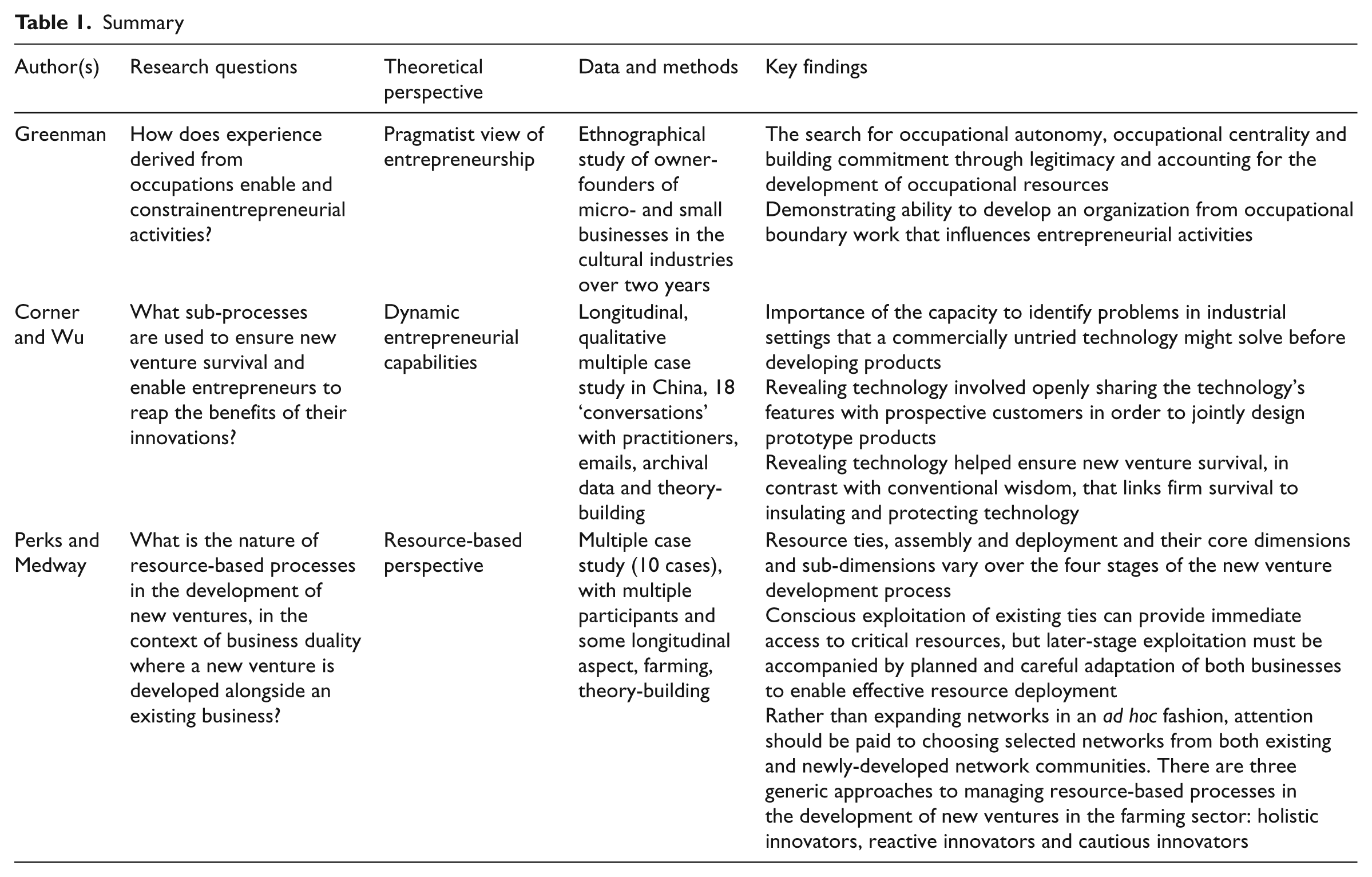
The articles each encompass a particular aspect of the role of entrepreneurs in the venture creation and development process, adopting a variety of theoretical perspectives. For example, Corner and Wu draw upon the notion of dynamic capabilities and Perks and Medway utilize a resource-based perspective. These approaches contribute to an emerging literature that considers the origins of resources and in addition, how they are assembled (Barney et al., 2011; Sirmon et al., 2011). In contrast, Greenman adopts a pragmatist perspective on entrepreneurial activity, exploring how founders use occupational resources to support their legitimacy.
In their recent review of the entrepreneurship field, Blackburn and Kovalainen (2009) note the need for greater methodological pluralism and longitudinal work to generate greater insight into how processes unfold over time and within specific contexts. These articles offer a valuable contribution to addressing this particular gap in the contemporary research agenda as they adopt a variety of methodological approaches to enhance our understanding of the venture creation and development process. Importantly for process research, there is a prevalence of longitudinal studies with multiple respondents in each case. Greenman presents rich insights using an ethnographical approach over a two-year period and Corner and Wu and Perks and Medway adopt a multiple case study design, with Corner and Wu employing a longitudinal perspective.
Themes for a future research agenda
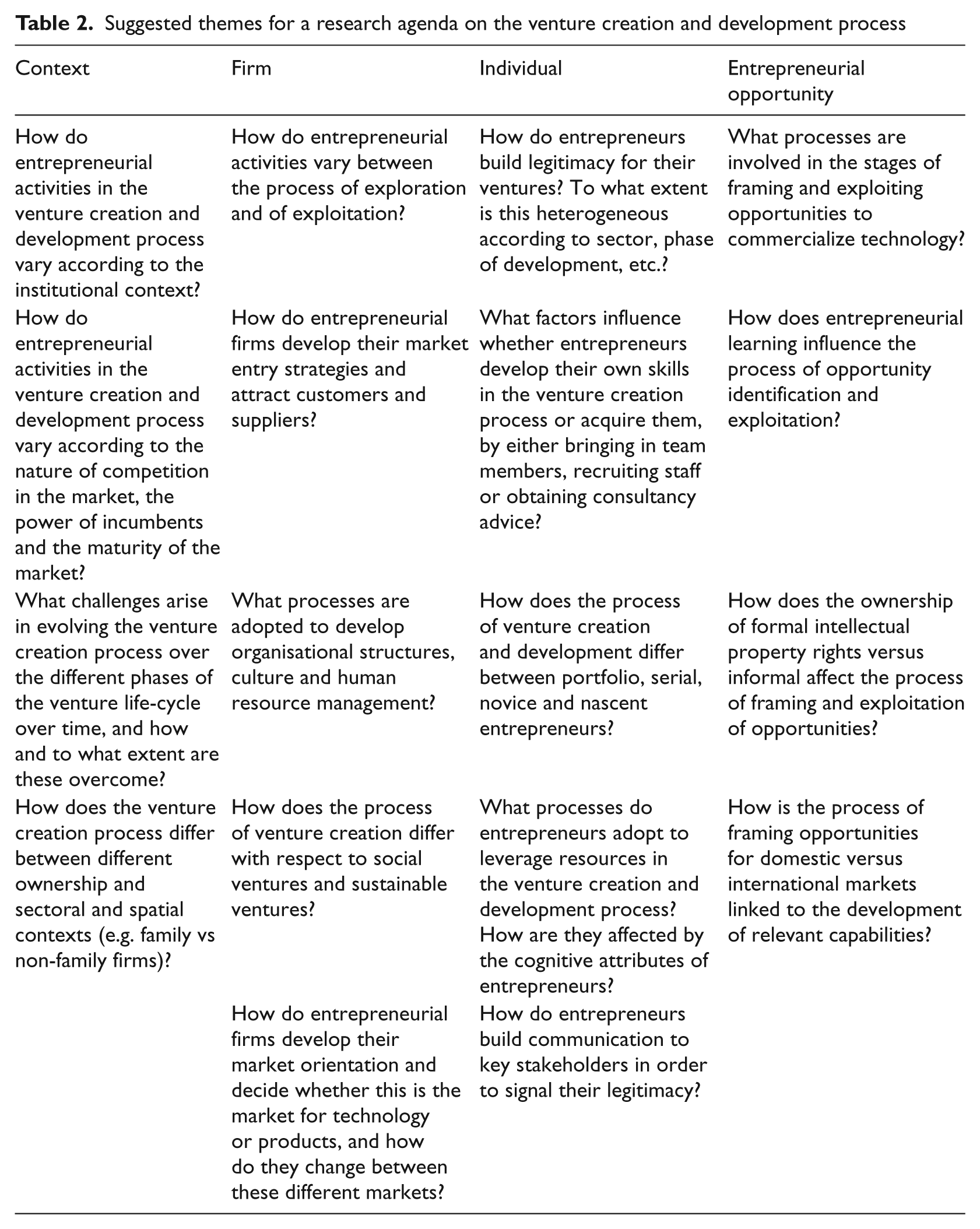
In Table 2, we offer an overview of potential themes for a future research agenda. In compiling these suggestions, we note how discrete thematic pathways might be articulated through specific approaches which acknowledge differing contexts and units of analyses (the firm, the entrepreneur). In addition, we outline particular issues underpinning entrepreneurial opportunities which might be pursued and developed through the exploration of these themes.
Suggested themes for a research agenda on the venture creation and development process
Contexts
The context in which entrepreneurial ideas, activities and ambitions are formulated is heterogeneous (Zahra and Wright, 2011), and is critical in shaping the venture and laying the foundations for future sustainability and growth. For example, as Welter (2011) argues, the institutional context that prevails in transitional economies is fundamental to shaping entrepreneurial orientation and new venture creation. Indeed, in order to illustrate this argument, Welter goes further in developing an intersectional analysis, drawing upon the influence of gender on women’s entrepreneurial activities within a context of relative subordination within Uzbekistan. Thus, context as a boundary made recognizable through institutional norms is vital in shaping the entrepreneurial process. There is much scope here for future research, particularly in developing work that challenges the US/Eurocentric assumptions which underpin much of mainstream theorizing. The growing influence of China and emerging Middle East economies offer new and challenging opportunities to evaluate dominant assumptions concerning the processes necessary to frame, exploit and commercialize entrepreneurial opportunities (Greene et al., 2011).
Related to institutional context, we have identified the influence of the market environment as crucial in shaping the entrepreneurial process. Clearly, the market reflects broader contextual influences; however, in the current volatile climate there are both many opportunities and serious challenges to positioning new ventures. In addition, perceptions of and propensity towards risk within such volatile markets are of considerable importance in critically analysing the future potential for, and opportunities available to, new ventures. This is of particular interest in an era when the prevailing neo-liberal perspective suggests that entrepreneurship holds many solutions to creating a more innovative and vibrant economy, but at the same time, market volatility represents an increasing threat to entrepreneurs engaged with new venture creation (Harvey, 2010). Thus, how opportunities are perceived, learning to exploit these opportunities and understanding the risks attached within diverse and dynamic market environments, offer much potential for future work.
Of perennial interest within the venture creation and growth process is the temporal context associated with the analysis of business life cycles (Phelps et al., 2007). Consequently, while highlighting this issue is not a new departure, we do suggest that clearer acknowledgement of the diversity of entrepreneurial activities must be recognized, in order to gain a more robust and informed picture of dynamic life cycles (Storey, 2011).
Firms
A number of important areas need to be developed in understanding the heterogeneity of the new venture creation process at the firm level. Increasing recognition is now given to the notion that market entry may relate not only to generating revenue in the product market, but also that firms may enter the market for technology (Clarysse et al., forthcoming, 2011). Similarly, firms may engage in exploration or exploitation activities. Over time, it is evident that firms may pursue one strategy initially, but then change to another – or indeed adopt a dual strategy approach. The process by which strategy choice is made, and how changes in such occur over time as the venture identifies and adopts a viable configuration, are little understood and so, are worthy of further analysis.
Growing debate is focusing upon the complementarities and contrasts between social and profit-focused enterprises. The former are attracting much greater attention, particularly in the light of political optimism that during times of economic recession, they will deliver many services previously provided by the public sector (Thompson, 2011). Yet, relatively little attention has been afforded to the processes underpinning the creation and growth of social enterprise and, indeed, to what extent they may or may not differ from their commercially focused counterparts (Westhead et al., 2011). Again, there is much scope here for future research to explore and critically evaluate any such differences.
Individuals
Further research that focuses on the role of individuals in the venture creation process has the potential for further development as the cognition and behaviour of individuals drives opportunity recognition, as well as the accumulation and configuration of resources to exploit such opportunities. These microfoundations of entrepreneurship are being recognized now (Abell et al., 2008), but there is considerable scope for further analysis. The processes adopted by entrepreneurs in the venture creation process to leverage their resources and skills and to build legitimacy are little understood. In addition, integrating the recognition of differing cognitive approaches adopted by diverse groups entrepreneurs may help to highlight variations in these processes.
When exploring the confidence levels of portfolio, serial and novice entrepreneurship, Ucbasaran et al. (2010) demonstrate how different ownership profiles critically influence entrepreneurial ambitions and activities. Consequently, future work needs to recognize how ownership structures profoundly affect the development of the venture. As noted by Westhead and Wright (2011), the majority of new firms are started by partners, families or teams, so much greater exploration of the dynamics and tensions that inform these relationships, and their impact on both venture creation and development, is required.
Opportunities
Opportunity recognition and framing is central to venture creation yet, the process through which this occurs in different contexts warrants further analysis. In addition, as we have noted already, entrepreneurs may have created previous ventures – an important consequence of this being that they may have learnt how to recognize and frame opportunities. Future studies could shed light on this process but also identify how biases in learning may affect whether and how subsequent efforts display adaptation in the process, in light of prior experience. Further sources of variety concern whether the opportunity is based upon formal or informal intellectual property, and whether the opportunity relates to a domestic or foreign venture. The extent to which these factors influence differences in the process of framing opportunities warrants additional research.
Data and method
Our suggestions here represent but a few pathways that will progress the diverse and encompassing field of new venture creation and development. In addition to such substantive issues, we would suggest that there is considerable scope to adopt a range of methodological approaches to illustrate and analyse the complexity and volatility of new venture creation and growth. Within this special edition, we have included articles using longitudinal work and ethnographic approaches; we would suggest that research drawing upon methodologies that facilitate a more detailed and nuanced exploration of the processual nature of creation and growth are essential to progress understanding. For example, Rasmussen et al. (2011) provide a longitudinal study of the venture emergence process in the context of academic spin-offs. Equally, comprehensive datasets that offer accurate and detailed accounts of creation and growth over time and within specific contexts are essential to inform future work. Of course, compiling such datasets is challenging but would enable the empirical testing of conceptual insights.
In conclusion, this special edition focuses on an issue of fundamental importance to the realization of entrepreneurial ambitions to create and develop new ventures. Axiomatically, this process is subject to considerable volatility and a myriad of uncertainties, but at the same time it is critical to future economic wealth creation, innovation and social development. Accordingly, developing robust evidence and generating sound theoretical insights to analyse this process is essential to inform future understanding of how entrepreneurial opportunities are translated into new ventures which, in turn, become sustainable enterprises.
Footnotes
This research received no specific grant from any funding agency in the public, commercial or not-for-profit sectors.