







Abstract
This article explores the political signification of the term entrepreneur in UK parliamentary debates over the past forty years. Following a review of the literature, a need is identified to understand the construction of the entrepreneur in political discourse. Concern here is not with the prosaic cataloguing of policies or definitions, but with exploring shifts in the discursive constructs of the entrepreneur that underlie political practice. To explore these constructions a large longitudinal dataset is systematically condensed, while maintaining sensitivity to the nuances of meaning. A corpus-based linguistics approach is undertaken. This combines the computational analysis of significant collocates, that is important words (concepts) that surround the term entrepreneur, with the richness of qualitative analysis. Patterns of reification, agency and structure are identified in the portrayed entrepreneurial constructs. The philosophical and practical implications of these patterns are discussed and proposals are made for using corpus techniques in international comparative analyses.
Introduction
This article explores the political signification of the term entrepreneur and its derivatives (e.g. entrepreneurship) in UK parliamentary debates over the past forty years. This allows changes in the discursive construction of representation to be traced during this period of political flux from the demise of the ‘welfare consensus’, through Thatcherite neo-liberalism to the Third Way of New Labour (Giddens, 1998; Meredith, 2003). Concern here is not with the prosaic cataloguing of policy and legislation, nor with the mechanistic generation of a definition, but with exploring shifts in the political discourse of entrepreneurs. The aim is to reveal the discursive constructions of the entrepreneur and how their portrayed actions underlie political intercourse and practice.
The contention is that such discursive constructions of the entrepreneur are part of a complex symbolic order of the political institutions that ‘permeate politics in a subtle and diffuse way, providing interpretive coherence to political life’ (March and Olsen, 1984). 1 The constructions of the entrepreneur become embedded in the political institution through a complex process of micro and macro interactions (Barley and Tolbert, 1997; Giddens, 1986; Jarzabkowsi et al., 2007; Jarzabkowski, 2008). Reified taken for granted knowledge is socially constructed through repeated personal interaction (Berger and Luckmann, 1967). These micro-processes occur within the everyday world of a political institution such as the Palace of Westminster, and in other policy-making, practice and academic domains too. Localized beliefs, built on shared constructs and symbolic representations of entrepreneurs, may develop within particular settings (Gergen, 1994). These beliefs are in turn reinforced through increased levels of interaction and sharing within particular institutions.
Actors and institutions may mimic constructs of the entrepreneur from other institutions, especially those perceived to be powerful, to maximize the spread of their legitimacy and enhance their survival (Meyer and Rowan, 1977). Such mimetic activity, between institutional settings, may over time result, to some extent, in a shared web of belief regarding the entrepreneur (DiMaggio and Powell, 1983). The political domain is likely to be perceived as relatively powerful and therefore, its construction of the entrepreneur may be mimicked by policy-making and academic domains (March and Olsen, 1984). Shared constructions of the entrepreneur are also likely to be reinforced by particular organizations working together towards common goals thus, forming structuration of an organizational field beyond organizational boundaries (DiMaggio and Powell, 1983). Such a field of constructions of the entrepreneur may exist, to some extent, between political, policy, academic and perhaps even practitioner domains.
Individual agents, whether they are politicians, academics, policy-makers or practitioners, are at the same time constrained by the prevailing constructs of the entrepreneur and also able to draw upon them in support of their communicative action (Giddens, 1986). Reflexive agents knowingly draw upon accepted meanings in legitimizing communicative action towards their personal aims. Here, adopting accepted constructions of the entrepreneur, potentially combined with other institutional structures, provides the agent with the potential to legitimate their actions and gain access to resources and authority (Giddens, 1986). In taking such actions, the agent draws upon the accepted constructs of the entrepreneur and thus, reinforces them within the institutional field. While drawing legitimacy from accepted constructs, they may also incrementally adapt them to match their own ends. Over time such incremental adaptations may result in new accepted constructs emerging. Identifying changes in the constructions of the entrepreneur in political discourse gives insight into the institutional structures, the interactions at play, and the implications for political, policy, practitioner and academic agents operating within interpretative schemes.
The next section provides the theoretical background, starting with a review of discursive constructions of the entrepreneur. Gaps and opportunities are identified in the literature and the research aims are established. The method section follows, providing a rationale for selecting corpus analysis to meet the research aims. Following this we explain how the dataset was established, how meaning through collocate words was analysed and how subsequent patterns were explored through qualitative analysis. The results are presented in two sections, each summarized with a diagram. The first of these shows the identification of the discursive meta-constructs of the entrepreneur (see Figure 3) and the second, the exploration of temporal patterns (see Figure 4). This leads to a concluding section that discusses the philosophical and practical implications of the constructions of the entrepreneur. Concerns are explored regarding the portrayed constructs of reification, agency and structure.
Theoretical background
Discursive constructions of the entrepreneur
The ‘linguistic turn’ is now becoming established in the study of entrepreneurship (Hjorth and Steyaert, 2004). Exploring how entrepreneurship and business development is enacted through discursive and social processes (Steyaert and Katz, 2004) has become a popular focus of study, which is often conducted from the practitioners’ perspective (e.g. Down, 2006; Selden and Fletcher, 2010). These are fascinating areas of study, but are less relevant to our concerns here than research that has focused on the discursive construction of the entrepreneur. Such research into the construction of the entrepreneur often explores the personal agency (see discussions in Campbell, 2009, and Emirbayer and Mische, 1998) of the entrepreneur, most often drawing upon metaphors or constructs that represent the entrepreneur as an active self-sufficient individual (e.g. Anderson et al., 2009; Dodd, 2002; Down and Warren, 2008; Hyrsky, 1999; Koiranen, 1995; Koiranen and Hyrsky, 1996; Nicholson and Anderson, 2005; Perren and Jennings, 2005; Radu and Redien-Collot, 2008). Allied to these representations of personal agency, some researchers also expressed concerns, to varying degrees, regarding the subjugating discourse of government, academia or the wider media (Dannreuther, 2006; Down, 2006; Iyer, 2009; Ljunggren and Alsos, 2001; Miazhevich, 2007; Nicholson and Anderson, 2005; Ogbor, 2000; Perren and Jennings, 2005; Radu and Redien-Collot, 2008).
In contrast to these positive representations a number of authors have also used negative imagery, such as ‘predator’, ‘evil wolf’, ‘warfare’, ‘exploit’, ‘disease’ and ‘egoistic’ (Anderson et al., 2009; Koiranen, 1995; Nicholson and Anderson, 2005). Nicholson and Anderson’s (2005) comparison of the discourse of entrepreneurship in newspaper articles from 1989 and 2000, suggests that these contradictions manifest from a mythological surge in the portrayed power and agency of the entrepreneur at the same time as a contradictory undercurrent of personal experience of more limited agency. They suggest this creates an increasing random backwash, as discourse swings between supernatural high agency to the contradictory discourse of low agency and failure. Perren and Jennings (2005) find a similar collocated contradiction in the portrayal of entrepreneurs on government websites: they are represented at the same time as powerful self-sufficient drivers of the economy and subjugated children who need help to survive.
Gaps, opportunities and research aims
The discussion above shows there is a growing vein of research on the discursive construction of the entrepreneur. Given the richness of this research, the surge in use of the entrepreneur in political discourse (see Figure 1), and the importance of political construction of the entrepreneur discussed in the introduction, it is surprising to find a dearth of empirical work that looks directly at political discourse. There have been a few notable exceptions that have touched upon the area. Miazhevich (2007) looked at representations in an official state-founded newspaper and compared them to entrepreneurial self-representation in interviews. Perren and Jennings (2005) looked at entrepreneurial portrayal on government websites. These papers provide interesting insights into the projection of entrepreneurship by government-related agencies, but neither looked directly at politicians’ discursive construction and their use in official interaction. Anderson et al. (2000) explore religious ideology in Margaret Thatcher’s entrepreneurial rhetoric. This provides fascinating insights, but it is essentially a thought piece, with a few examples of Thatcher’s discourse, rather than an empirically driven discourse analysis. The lack of empirical research on political discourse is especially surprising given the concerns, discussed above, regarding the discursive subjugation of entrepreneurial agency and the role of the state.
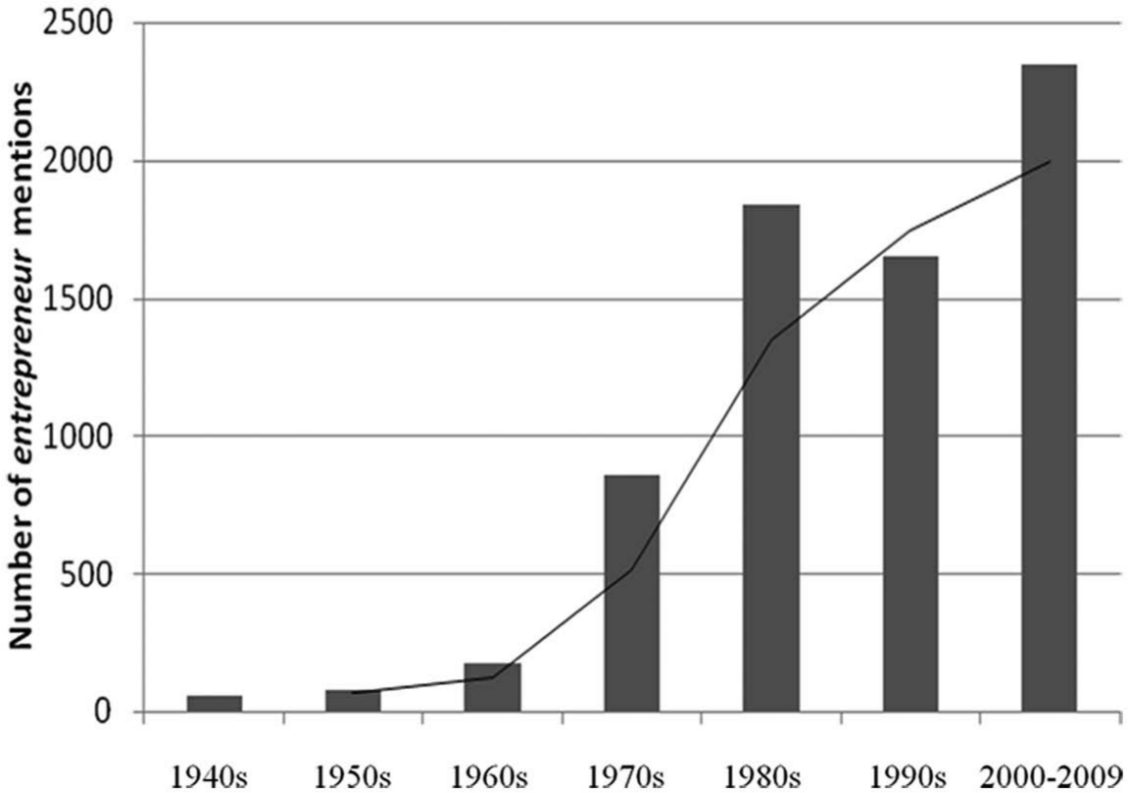
Number of times ‘entrepreneur’ mentioned in parliamentary debates (source: Hansard /Millbank Systems).
The diachronic construction of the term entrepreneur and its derivatives over time has also been under-analysed. Most research takes a synchronic snapshot or a case-based exploration of discursive entrepreneurial processes. Again, there are just a few notable exceptions. Achtenhagen and Welter (2003) explored changes in the portrayal of female entrepreneurs, and their level of ‘embeddedness’, in ‘left-’ and ‘right-’ wing national newspapers between 1995 and 2001. Achtenhagen and Welter (2004) also explored changes in entrepreneurship discourses and government policies and showed a gap between rhetoric and praxis. Baker et al. (1997) counted the frequency of coverage of female entrepreneurs in various publications over an extended period and reported under-representation. As discussed above, Nicholson and Anderson (2005) compared the construction of the term entrepreneur in newspapers in 1989 and 2000. Radu and Redien-Collot (2008) explored the social representation of entrepreneurs in the French press from 2001 to 2005. These studies provide interesting insights into how diachronic research of this type may be conducted and the sort of changes in discursive construction that may occur.
None of the above directly explores these themes in an explicitly political discourse. Other studies may initially appear to have a temporal element as the data under consideration extends over time and they are exploring construction of the term entrepreneur. However, closer examination shows the emphasis to be on aggregating the data and analysing it as a synchronic snapshot (e.g. Ahl, 2004; Bruni et al., 2004; Down and Warren, 2008). So, there is little empirical research on the political discursive construction of the entrepreneur or on how this construction changes over time. There also appears to be no research that combines both elements to look at the diachronic construction of the entrepreneur in political discourse. This is a crucial omission given that the construction of the entrepreneur is an increasingly important symbolic order within the political institution (see Figure 1), such that it ‘permeates politics in a subtle and diffuse way, providing interpretative coherence to political life’ (March and Olsen, 1984), and potentially influences the ‘structuration of an organizational field’ (DiMaggio and Powell, 1983).
The aim here is to draw upon the meta-constructs of the entrepreneur in political discourse and then to plot temporal changes in constructions. This should give insight into the institutional structures, the modalities and interactions at play, and the implication for political, policy-maker, practitioner and academic agents operating within the field. Analysing constructed meaning of the entrepreneur gives insight into the taken for granted norms operating within political institutions (Berger and Luckmann, 1967). In constructing the meaning of the entrepreneur, politicians call upon these norms to legitimize their aims, thereby giving them access to authority and resources (Giddens, 1986). Diachronically tracing these constructed meanings of the entrepreneur provides insight into the institutional norms operating at particular times. Comparing these constructed meanings from different times allows patterns and trends in the shift of meaning and norms to be surfaced. This allows consideration of potential explanations for how or why the patterns may have emerged. This in turn leads to considering the implications of the emerging patterns. Having mapped the existing studies and identified the gap to be filled by this research, the next section puts forward and justifies the notion of corpus-based analysis as an appropriate method to address the current deficit.
Method
Rationale for a corpus-based approach
Having established the importance of investigating the use of the term entrepreneur and its derivatives in political discourse, it is now timely to turn to the empirical part of the research, starting with the selection of a methodological approach. Language-based empirical research in the entrepreneurship area has drawn upon the popular gambits associated with the linguistic turn: metaphorical analysis (e.g. Anderson et al., 2009; de Koning and Drakopoulou Dodd, 2002; Dodd, 2002; Hyrsky, 1999; Koiranen, 1995; Nicholson and Anderson, 2005; Perren and Atkin, 1997; Pitt, 1998), various forms of manual content analysis (e.g. Achenhagen and Welter, 2003, 2004; Ahl, 2004; Baker et al., 1997; Carl, 2004; Foss, 2004; Gartner et al., 2003; Langowitz and Morgan, 2003, Ljunggren and Alsos, 2004; Miazhevic, 2007; Radu and Redien-Collot, 2008); narrative analysis (Ahl, 2007; Dodd, 2002; Down, 2006; Down and Warren, 2008; Fletcher, 2007; Hjorth, 2007; Martens et al., 2007; O’Connor, 2002, 2004, 2007; Steyaert, 2007a), and discourse analysis of various types (Berglund and Johnasson, 2007; Bruni et al., 2004; Iyer, 2009; Lawrence and Phillips, 2004; Ogbor, 2000; Perren and Jennings, 2005).
These approaches have their place, allowing the richness of qualitative enquiry, but they present difficulties when exploring floating signification over an extended period. The study of such diachronic phenomena requires a large longitudinal dataset and the techniques above tend to be labour-intensive and difficult to scale. If faced with extensive data they may even lead to an arbitrary approach to data-condensation, where evidence feels as though it has been ‘cherry-picked’ for inclusion. This is compounded by the difficulty of providing a transparent audit trail of the analysis within the space constraints of an article (Miles and Hubermann, 1994), which in turn makes the research hard to replicate for future comparative analysis.
The ideal empirical approach would do the ‘heavy-lifting’, by condensing a large dataset into a manageable scale in a systematic way, while maintaining the sensitivity required to do justice to the nuances of meaning construction that can only be achieved through qualitative analysis. Fortunately, developments in corpus-based linguistics provide such a hybrid approach (Baker, 2006 cites Biber et al., 1998). This technique combines the computational analysis of significant collocates, that is important words (concepts) that surround a particular term, with the richness of subsequent qualitative analysis (informed by Baker, 2006; Callon et al., 1983; Mason, 2000; Mitkov, 2004 and Stubbs, 1996). Distilling the constructed essence of the term entrepreneur and its derivatives through these collocations is in sympathy with the established view that meaning is constructed through context (Firth, 1957; Frege, 1952; – also see Joseph et al. 2001; Callon et al., 1983; Wittgenstein, 1958, P1, § 525, §527, §652; also see overview discussion in chapter 2 of Medina, 2005). Systematically identifying such habitual collocates in this way also has the advantage of uncovering discursive constructs that may be overlooked as they ‘seem merely natural’ (Stubbs, 1996: 194). Koiranen and Hyrsky (1996) undertook the only previous collocate-based study found in the entrepreneurship area. Their approach was also in sympathy with the legacy of Firth and colleagues in that they used a small survey-based sample of respondents to complete pairs of adjectives associated with the entrepreneurial term. Our research builds on this pioneering study, using a large sample of naturally occurring discourse that allows us to investigate the changing nuances of constructed meaning over an extended period. Having put forward a justification for adopting a hybrid computational collocate and qualitative analysis of a large temporal dataset, we now explain in detail how the method was undertaken.
Establishing a dataset for the analysis
Figure 2 provides an outline of the three main stages of the research: establishing the dataset for the analysis; analysing the constructed meaning of the term entrepreneur through collocated words; and exploring patterns through qualitative analysis. 2 The main framework for the analysis was based upon the techniques of computational corpus analysis and influenced by five core texts: Baker (2006), Mason (2000), McEnery (2003), Mitkov (2004) and Stubbs (1996). The bespoke Java modules, developed by one of the authors to undertake the computational aspect of the corpus analysis, drew inspiration from a number of technical sources: ‘scraping’ the web-pages was informed by Blum et al., (1998) and Trottier (2002, chapter eight); ‘stripping’ them of their superfluous html tags was guided by Friedl (2006) and the ‘stop-list’ was that available from the Glasgow University Information Retrieval Group.
The first step was to establish a dataset for the analysis. Ideally this would provide the authentic language of political debate, be available over an extended period and be in a consistent electronic form to allow temporal analysis. Fortunately, Millbank Systems have produced an electronic internet-based archive of Hansard that provides an edited transcript of proceedings of both Houses of Parliament between 1803 and 2005 (www.parliament.uk). The editing process removes hesitations and other verbal errors. In another form of research, such as conversational analysis, this form of editing might be a problem. However, the corpus approach taken here relies on the analysis of collocate words which are little affected by such editing. A search for pages containing the term entrepreneur and its derivatives was conducted and 4494 pages were downloaded and stored in a database using a bespoke program developed by one of the researchers.
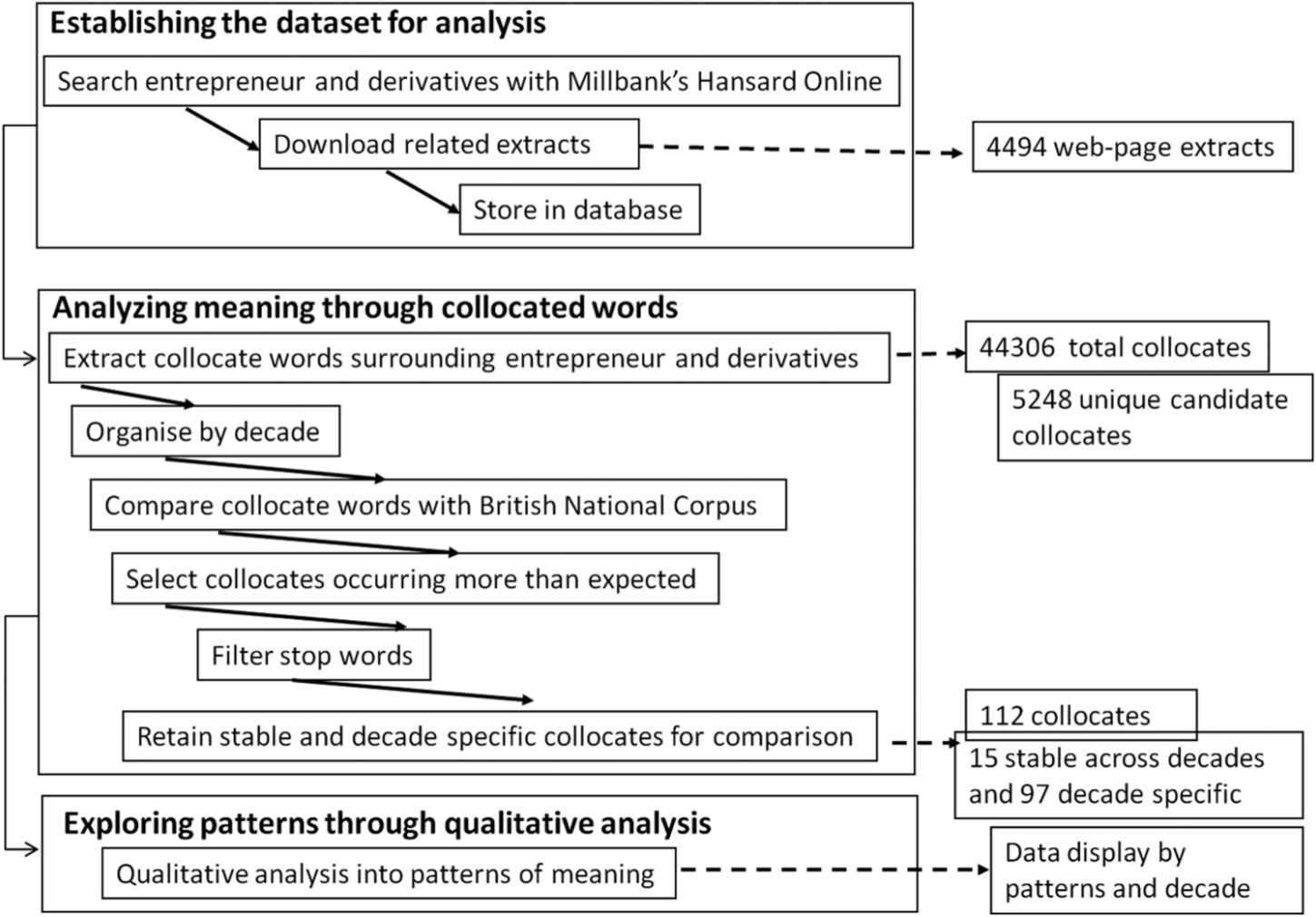
Overview of method: Mainly influenced by Stubbs (1996), Mason (2000), Phillips, (2003), Barnbrook (1996), Mitkov, 2004 and Baker, 2006).
Consideration was given as to whether to concentrate only on the stem-term entrepreneur or to also include its derivatives (-s, -ial, -ially, -ship, -ism). Allan (1986, see chapter on lexicon semantics) draws upon Marchand (1969) to explore word formation by adding the suffixes to stems. Some he observes, like legalize (to make something legal) from the stem legal, are transparent and occupy a similar semantic meaning space. Others, like computerize (as in ‘make suitable for feeding into a computer’ ) from stem computer, are less obvious (Allan, 1986: 223). Clearly if the derivatives of entrepreneur occupied a significantly different semantic space then it would be unhelpful to combine them for analysis. Fortunately this is not the case as derivatives generated by adding suffixes to the stem entrepreneur are transparent, closely domain-related constructs and regular. It therefore, makes sense to include the derivative terms within the analysis.
Analyzing meaning through collocated words
Having established the dataset for analysis the next step was to follow the proposal by Stubbs (1996) to systematically examine the words (concepts) that were collocated around the term and its derivatives. This was achieved by extracting a span of five words either side of the term entrepreneur and its derivatives (informed by Mason, 2000). Words outside this span have been found by other researchers rarely to be important (Phillips, 2003 cites Clear, 1993). For example: she will realize that the freedom means freedom for the on policies for employment, encouraging capitalist system, with the private the teaching and practice of
This produced 5248 unique candidate collocates that were tagged in the database to their decade of origin. This analysis looks at the data from 1970 onwards and then narrows further to the decades from the 1980s to 2000–2009 (hereafter, the noughties). The rationale for these periods is explained below. There were a number of reasons for selecting the initial forty-year period. The corpus method requires a large sample for the analysis to be valid and the period prior to the 1970s had insufficient frequency of usage of the term ‘entrepreneur’ and its derivatives (see Figure 1). Linked to this method-driven rationale is that the frequency of usage is a proxy for the importance of the term within political discourse. The low usage prior to the 1970s suggests that it was not central to political debate, whereas the increasing frequency of usage from the 1970s onwards suggests an increasingly important discursive role. Shifts in the discursive construction of the entrepreneur were also expected during this period. These changes were expected, not because of the increasing usage alone, but because of the combination of increasing usage and considerable political flux. This period saw the demise of the welfare consensus, through Thatcherite neo-liberalism to the Third Way of New Labour (Giddens, 1998; Meredith, 2003). Understanding the construction of the term entrepreneur and its derivatives during these changes can provide insights into the complex symbolic order of the political institutions (March and Olsen, 1984).
The narrowing of the temporal analysis to the decades from the 1980s to the noughties was pragmatically driven by the data. There was sufficient frequency of data in the 1970s to identify a few valid collocates, but this was not enough to be worthy of further discussion in the temporal aspect of the article. Therefore, the decision was taken to concentrate the diachronic analysis on the thirty-year period from the 1980s to the noughties inclusive.
A mechanism was needed to condense the data further to reveal those collocates that are particularly significant in providing the context of meaning for the term entrepreneur and its derivatives. An established way to achieve this in corpus linguistics is to compare the frequency of collocated words in the sample with the likelihood of them occurring by chance in another sample of general natural language (e.g. Barnbrook, 1996; Church and Hanks, 1991; Mason, 2000; Stubbs, 1996). In this case a bespoke application, developed by one of the authors, compared the collocated words in the sample with the probability of them occurring in the British National Corpus of 100 million words of natural language use (see www.natcorp.ox.ac.uk). The British National Corpus (BNC) is intentionally being used as a ‘disordered’ control corpus to compare against the potential ‘order’ of the corpus of words collocated around the entrepreneur term in the Hansard Corpus (e.g. Barnbrook, 1996; Church and Hanks, 1991; Mason, 2000; Stubbs, 1996). The frequency ratio of particular words in the BNC represents the ‘disordered’, ‘meaningless’ situation, where meaning is not being ordered by a person attempting to construct sense by bringing words together in an utterance. Comparison at the level of individual words is applied as this represents the maximum contrast of ‘disorder’ of the BNC words against the potential ‘order’ of words collocated around the entrepreneurship terms in Hansard. Comparison at levels above individual words, such as word bigrams, trigrams or phrases, would reduce the power of the contrast that is trying to be achieved. Comparing the words collocated around the term entrepreneur and its derivatives in Hansard with the words in the BNC, is in effect comparing with a control corpus of random words indeed, a control corpus approaching entropy (Shannon and Weaver, 1949 [1998]). In contrast, if the term entrepreneur and its derivatives are to have meaning, then the context of collocated words around the term should have a frequency make-up that is significantly different from the ‘disordered’ situation of the BNC. Metaphorically, the entrepreneurship term can be thought of as having a gravitational pull on certain words that make up its meaning (Steyaert, 2007b). The larger the ratio of frequency difference between the potential ‘order’ of a particular word collocated around the entrepreneurship term and the ‘disorder’ of the BNC, the more the word differentiates the two samples and the more meaning it can be considered to bring. Conversely, collocated words with ratios of frequency similar to the BNC will bring little additional meaning. Linguists have developed a number of ratios that compare the ‘disordered’ frequency of a word expected from a control corpus with the actual observed frequency of a word in the corpus of words collated around a particular term. The popular Mutual Information (MI), t-score and z-score tests of significance were used with established threshold values: the MI threshold was 1.58, the t-score threshold was 2 and the z-score 3 (Barnbrook, 1996). MI, z-score and t-scores were calculated by the program using the formula from Barnbrook (1996) and Mason (2000): Mutual Information (MI) = Log2 (Observed/Expected) (see Shannon and Weaver, 1949 [1998]); z-score = (Observed-Expected) / Standard Deviation of occurrence of word in corpus; t-score = (Observed-Expected)/Square Root of Observed.
As explained, the idea behind all these formulas are that these exceptionally used collocates provide the difference in meaning between the keyword (in this case entrepreneur and its derivatives) and any other randomly picked word. This approach is consistent with the conceptual discussion above of meaning being constructed through the context. Some may argue that this is just picking out the unusual words, but that is the point: it is the statistically unlikely words that are information rich and determine the difference in meaning from any other arbitrary word (there are some conceptual similarities to Derrida, 2001).
Exploring patterns through qualitative analysis
The remaining collocates, that met the threshold values, were analysed into the patterns of discursive constructs that they brought to the key-nodal term entrepreneur and its derivatives. This followed the coding techniques of Miles and Huberman (1994) and was summarized through a data-display that captured the main themes. Corpus-based approaches like this often draw upon quantitative and qualitative analysis techniques in this way (Baker, 2006 cites Biber et al., 1998). Indeed Baker et al. (2008) suggest the qualitative phase is essential to move beyond description to interpretation. Here the quantitative and qualitative paradigms complement each other to make an authentic contribution to the analysis (see discussion in Chapter 4 of Curran and Blackburn, 2001 and Blackburn and Kovalainen, 2009). This research is interested in the signification of the term entrepreneur and as such the emphasis in the analysis should be on the additional meaning that collocate-words bring to the construction of the entrepreneur, rather than on any other issues that might be surfaced. During some early false starts at coding the researchers forgot this focus on signification. Having wasted some time on coding that drifted from the purpose of the article, they realized that they needed a fine grain analysis that systematically coded portions of text related to the additional signification the collocate-word brought to the constructs of the entrepreneur within the Key Word in Context (KWIC) (Miles and Huberman, 1994). For example, the square brackets illustrate the text relevant to the analysis of these KWIC row extracts for the collocate-word attract: their anxiety [to an opportunity [to civil servant decides that an [entrepreneur can [to [to structure to encourage diversification and [entrepreneurial zeal to
Here attract brings two key constructed significations: Collocate (Keyword, Additional Signification)
So in this case the coding would be: attract (entrepreneur, them and their positive things [to society]) attract (entrepreneur, positive things to them and [their business])
The qualitative analysis program QSR NVivo lends itself to such fine grain analysis; so the researchers exported the 3615 Key-Words-In-Context lines from the database organized under the 112 significant collocates and coded in the way illustrated above. This first-level coding of these collocates was undertaken inductively in the spirit of a grounded approach (as epitomized by Glaser and Strauss, 1967) and using the free-node coding available in NVivo. Judgement was made at the time of coding to batch a number of KWICs to a free-node if the signification appeared clearly the same. The need to generate new codes diminished to a point of saturation towards the later stages of the analysis (see Bowen, 2008). The resulting first-order codes were then organized into inferential pattern codes that grouped the free codes into construct themes, organized them in tables and then captured them in a data-display (Miles and Huberman, 1994). A further stage of analysis revealed temporal patterns by comparing and displaying key construct themes for the three decades from 1980 to 2010 (Ragin, 1987). As explained above, the 1970s did not form part of this final stage as there were too few collocates to consider in that period. Having explained the methodological approach it now remains to present the results and discuss their implications.
Results
Surfacing the discursive meta-constructs of the ‘entrepreneur’
Figure 3 displays the patterns in the discursive constructs of the entrepreneur and its derivatives that emerged from the inductive analysis. It presents an aggregated summary of the signification drawing upon data from the past forty years. The results are intentionally shown in a straightforward and transparent way to empower the reader prior to exploration of implications in the discussion section. This maps the scope of the construct space that was discursively represented by politicians. Mapping the construct domain is a useful precursor to the temporal analysis that follows in the next section, as it provides an inclusive schematic against which changes in constructed signification can be plotted across the decades. Figure 3 has the entrepreneur at the centre stage surrounded by the discursive constructs that generate meaning through context. Reference to features on the figure will be provided in italics to aid explanation. There are four main domains in this mesh of construction: actions-effects
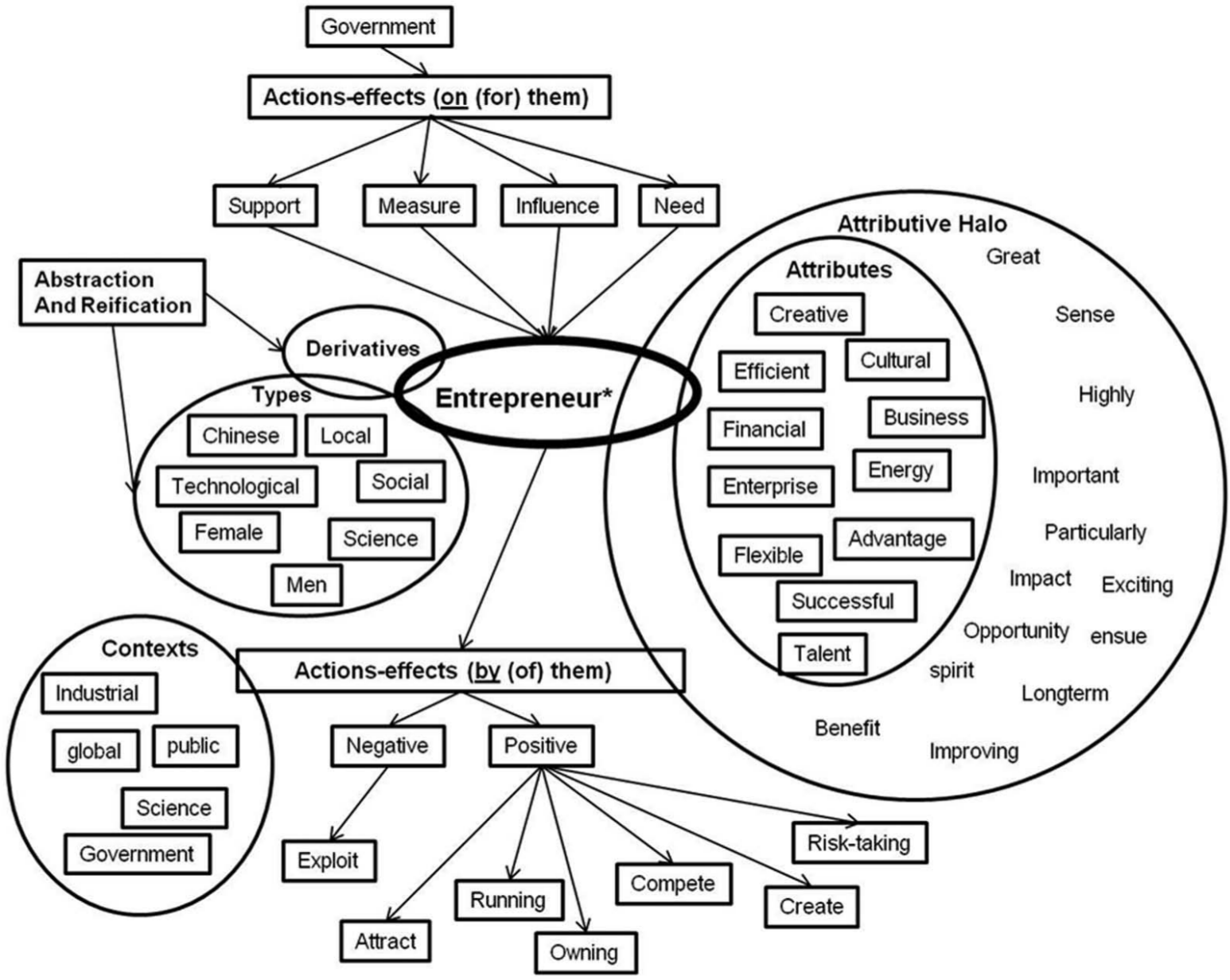
Patterns in the political constructs of the entrepreneur.
Actions-effects
Entrepreneurs are depicted as possessing inherent attributes that influence behaviour, including: being ‘creative’, ‘efficient’, ‘cultural’, ‘flexible’ and ‘successful’; having ‘enterprise’, ‘energy’, ‘advantage’, ‘talent’ and ‘idea creators’. These resonate with the depiction found by other authors (e.g. Anderson et al., 2009; Hyrsky, 1999; Koiranen and Hyrsky, 1996; Koiranen, 1995; and Nicholson and Anderson, 2005). Surrounding these inherent attributes is an attributive halo of associated collocates that bring a general positive aura to the construct of the entrepreneur without bringing specific signification (the term halo was influenced by Wittgenstein, 1958, §97). This halo is the atmosphere of the word (concept) brought by collocates that either do not have direct connection through syntax or do not bring much informational content. For example, the collocated words ‘great’, ‘highly’ and ‘important’ are often given in the vicinity of the term entrepreneur and they bring an atmosphere of positive signification, but not much further additional meaning. Similarly phrases like ‘long-term’ and ‘improving’ are rarely linked directly through syntax to the term entrepreneur, but still bring a positive aura as in ‘rewards [long-term] investment and entrepreneurship’ and ‘first, [improving] employability; second, developing entrepreneurship’.
Having explored the aggregated signification of the meta-constructs of the entrepreneur across all the decades it is now apt to turn to temporal diachronic analysis. This will use an abstracted form of the Figure 3 schematic to trace key changes in constructed signification across the decades.
Surfacing the temporal patterns in constructed signification
Figure 4 uses the schematic from the previous section to plot changes in signification across the decades. It maps changes in the discursively constructed space of the entrepreneur for the decades from the 1980s to the noughties inclusive. As previously explained, 1970 did not form part of this final stage of analysis as there were too few collocates to consider in that period. Figure 4 has a column for each of the decades that are based upon the Figure 3 schematic. Each decade has the entrepreneur at the centre of the column surrounded by the discursive constructs that generate meaning through context. Reference to features on the figure will again be provided in italics to aid explanation.
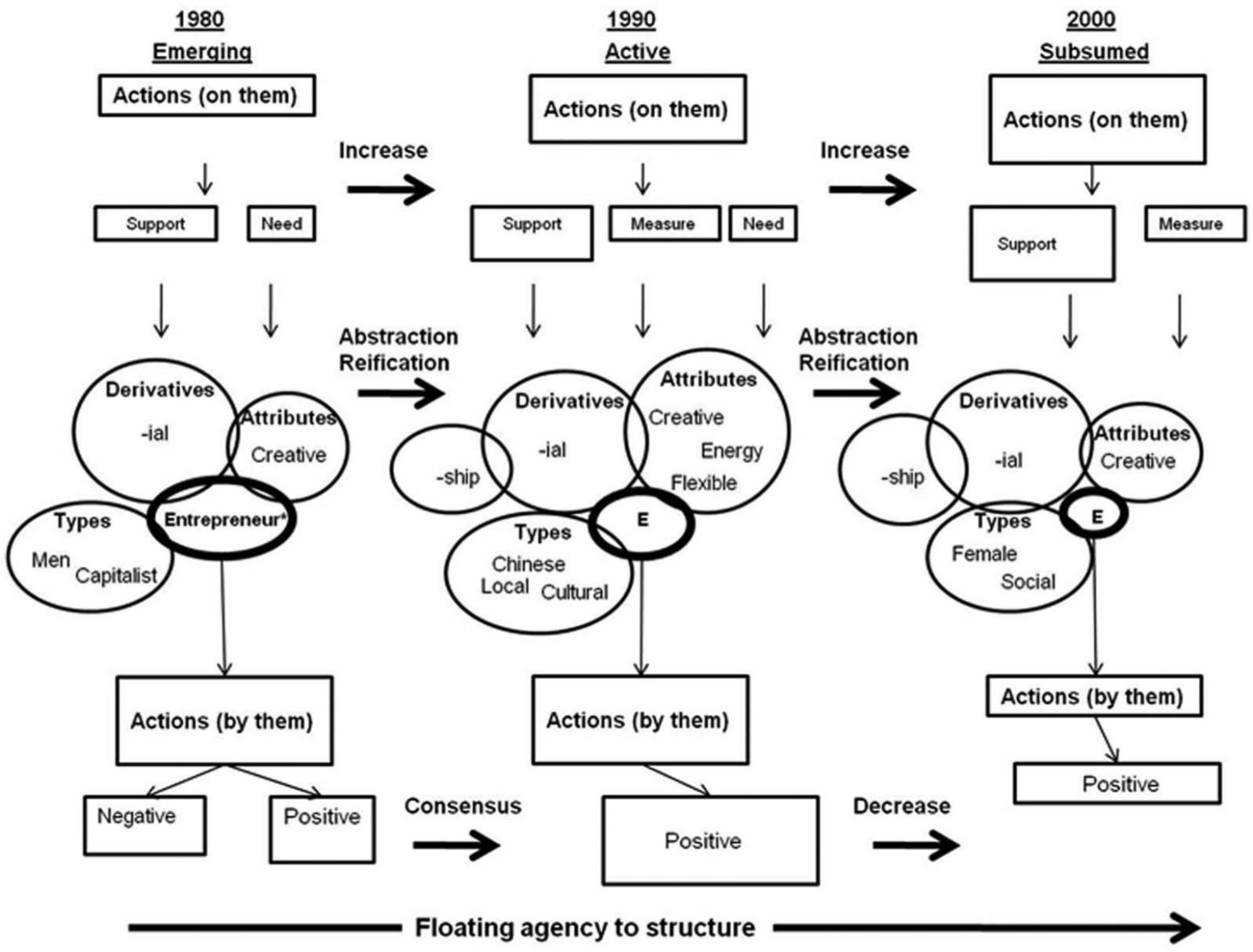
Changes in the political constructs of the entrepreneur across the decades.
There are four main domains in this mesh of construction for each decade column: actions-effects
As would be expected, the patterns of construction within each decade follow a similar outline structure to the schematic from the previous section. Here the concern is not with patterns within the decades, but the comparative shift in the patterns between the decades. The most striking feature is that there is a clear shift in the discursive construction of the entrepreneur within political discourse. Starting at the top of the decade columns, there is an increase in the discourse of actions on them by government. Support for entrepreneurs is a central constructed theme that expands through the period. During the 1980s and 1990s there is a persuasive discourse promoting the need for entrepreneurs and for them to be supported, by 2000 this discourse has dwindled. The 1990s and 2000s saw a rise in the measurement of entrepreneurs and their activities.
Moving to the bottom of the decade columns, actions by them move from a dialectical discourse of positive and negative in the 1980s, to a prevailing positive portrayal in the 1990s that persists into the 2000s. This shift towards positive construction of the entrepreneur may link to the dwindling of the persuasive discourse promoting the need for them. Perhaps the need for them was now just an accepted construct by the political class? While portrayal of actions by entrepreneurs became positive, the level of discourse of action by them diminished during the latter period.
The attributes conceptual node, in the central section of the decade columns, just shows the most prevalent themes from the discursive construction. The creative attribute of entrepreneurs is consistently portrayed across the decades and is a stalwart construction that many other researchers have found (e.g. Anderson et al., 2009; Hyrsky, 1999; Koiranen, 1995; Koiranen and Hyrsky 1996). The attributes of having energy and being flexible are prevalent in the 1990s and then dwindle. These have also been surfaced by previous language studies (e.g. Anderson et al., 2009; Hyrsky, 1999; Koiranen, 1995; Koiranen and Hyrsky, 1996). The general trend is for more discursive construction of entrepreneurial attributes in the 1990s than in the other two decades.
The derivative and entrepreneur nodes show a trend away from discursive construction of the entrepreneur as an individual, ontologically separate actor in society towards the derivative reified forms, particularly ‘entrepreneurial’ and from the 1990s ‘entrepreneurship’. The constructed portrayal of types of entrepreneur also varies in each decade. In the 1980s, men and capitalist entrepreneurs are prevalent, as in ‘men with strong entrepreneurial flair’ and ‘private capitalist entrepreneur’. In the 1990s it is Chinese, local and cultural entrepreneurs that are central as in ‘Chinese entrepreneurship’, ‘local entrepreneur’ and ‘cultural entrepreneurs’. In the 2000s, it is female and social that prevails as in ‘female entrepreneurship’ and ‘social entrepreneur’. Having presented and explained the results it is now timely to enfold previous literature and explore the implications.
Discussion and conclusion
Portrayal as reflexive agents
The patterns that emerge in Figure 3 relate to the reflexive agency of the entrepreneur; their portrayal reflects the sort of roles that living, aware, thoughtful beings can be depicted as possessing and taking in the world (Giddens, 1986). The constructs appear initially to be more of autonomous men (responsible for their actions) than plastic men (at the mercy of the functionalist structures they inhabit) (Hollis, 1977). The cluster of collocates around the entrepreneur resonate with the semantic construction of proto-typical agents that take action in the world and are acted upon by other actors (Dowty, 1991). Most of the action-effects
The action-effects
The sentient nature of entrepreneurial portrayal also leads to entrepreneurs being depicted as possessing inherent attributes that influence behaviour. It would be easy to conflate collocates that are providing additional meaning regarding the behavioural actions of entrepreneurs and those that are suggesting innate attributes. That is confusing the portrayed qualities of the dancer and that of the dance (Gartner, 1989; Yeats, 1928 [1956]). Such distinctions in signification resonate with the debates regarding trait and behavioural approaches within the literature (see seminal discussion in Gartner, 1989). A combination of syntax and semantics provided a reliable method of delineating attributes from behavioural actions.
Ontologically the aggregated meta-construct of the entrepreneur is grounded in what appears to be the commonsense realist notion of action, place and attribute. At the core of the portrayal is the entrepreneur as a reflexive sentient being that appears to ontologically anchor the construct (Moscovici, 1984) and semantically limit its extension to more abstract ethereal forms. Perhaps the risks of distortion and manipulation of language and terms by political rhetoric that resonate in the literature since Chase (1938 [1968]), Ogden and Richards (1923 [1989]) and Orwell (1946) are unfounded in the case of the entrepreneur (see further discussion in Joseph et al., 2001 and Norval, 2000). Stuart Hall (1996) may have found race to be a floating signifier open to political manipulation, but perhaps the construct of the entrepreneur is ontologically too well grounded for such ideological mischief. Indeed, the aggregate findings initially appear to contradict the concerns of Jones and Spicer (2005) that the entrepreneur is a sublime object, a phantom with an empty centre that can never be found but must always be pursued. Perhaps the ontological narrative of entrepreneurs is so pervasive that public narratives are grounded (discursively at least) in the portrayal of the sentient being. The entrepreneur remains centre stage, the construct ontologically fixed and political representation constrained to what appears to be a grounded portrayal (Steyaert’s, 2007a, draws upon Somers, 1994). This sentient portrayal may perpetuate the heroic individual entrepreneur and associated concepts as dysfunctional myths perpetuating societal ideological biases (Ogbor, 2000). But it nevertheless, appears to constructively limit political portrayal. It appears situated comfortably in the idealized Western fable of the bourgeois individual as ‘a bounded, unique, more or less integrated motivational and cognitive universe, a dynamic centre of awareness, emotion, judgement and action’ (Steyaert, 2007a, cites Geertz, 1979). The academic meta-narratives may have been influenced by Gartner (1989), Granovetter (1985) and others to move beyond the individual entrepreneur with special traits as the centre of investigation to explore approaches to social science without a subject (Hjorth and Steyaert, 2004; Steyaert, 2007b), but political public-narrative appears to keep the discursive construct of the ontologically grounded entrepreneur centre-stage. There may be cold comfort in this discursive constraint, but it is perhaps better than the political mischief that may result with free play. However, even this cold comfort is questionable, as things are rather more complex and concerning when the analysis is taken beyond the synchronic surface level analysis of portrayal of the entrepreneur as a sentient being to explore the effect of derivatives, temporal change and shifts in agency.
Derivatives and discursive reification
It has already been observed that derivatives of the stem-term ‘entrepreneur’ (-s, -ial, -ially, -ship, -ism) occupy a similar constructed semantic domain (Allan, 1986). Adding the suffix -ial as in entrepreneur[ial] creates the adjective to act like or have qualities of an entrepreneur; the suffix ship creates the abstract noun encompassing the qualities or practice of an entrepreneur, as in ‘ensure that entrepreneur[ship] is valued’ (this discussion drew upon Allan, 1986; prefixsuffix.com and thefreedictionary.com). These derivatives may share construct space with the stem entrepreneur, but their increasing use shown in Figure 4 is still noteworthy.
These derivatives may originate in the constructed portrayal of the stem term entrepreneur as an ontologically sentient concrete being, but they are nevertheless, somewhat separated from such concrete portrayal. They become reified versions of the constructed stem, that allow qualities or actions of the entrepreneur to be abstracted and flexibly transferred to differing contexts and groups; for example, ‘fostering entrepreneurial spirit’, ‘scope for imaginative entrepreneurship’ and ‘entrepreneurial ingenuity’. The discursive reification of derivatives associated with the entrepreneur makes them more malleable constructs in the lexicon of politicians. The rise in the use of the suffix ‘ship’ is particularly noteworthy as this creates the most abstracted and reified form of the noun, which detaches the construct of the entrepreneur from its ontologically grounded roots. The diminishing use of the stem entrepreneur and of their attributes is also symptomatic of the move away from the construct of the ontologically grounded entrepreneur towards the abstract reified portrayal of derived forms.
Similarly, entrepreneurial types are a reified form that is more plastic and open to political manipulation. These types follow the political concerns of the day: ‘capitalist’ in the 1980s, ‘Chinese’, ‘cultural’, ‘local’ in the 1990s and ‘female’, ‘social’ in the 2000s. The increasing trend towards abstraction and reification raises the increasing spectre of ‘floating signification’ and potential manipulation by political rhetoric (e.g. Hall, 1996; Jones and Spicer, 2005; Ogbor, 2000).
Agency and structure
Classically a key concept underlying the construction of the entrepreneur is their autonomous individual agency that is less constrained by structures than are other individuals within society. Weber (1978) places the entrepreneur as an autonomous individual operating largely outside the iron cage of the repressive bureaucratic machine. The entrepreneur is seen as providing a potential antidote to bureaucracy and its potentially detrimental effect on the profit-making capacity and efficiency of the economy. Goss’s (2005) and Swedberg’s (2000) excellent reviews of Schumpeter’s work informed the debate below. Schumpeter’s (1934) early work lines up with Weber, portraying entrepreneurs as ‘autonomous’ individuals who have a dream to be ‘superior’ and to ‘found a private kingdom’ (page xxi) by ‘conquering’ others and ‘exercising one’s energy and ingenuity’ (page 93). Both Weber and the early Schumpeter depict the entrepreneur as an autonomous agent who can act beyond the constraints of bureaucratic structures and economic equilibrium.
Conversely, other theorists see the entrepreneur as a plastic person (Hollis, 1977) largely at the mercy of the structure. Baumol (1968, 2004), Kirzner (1973), Mises (1998), and Shane and Venkataram (2000) portray the entrepreneur as a profit seeker who reacts to opportunities within the market. Hannan and Freeman (1993) portray the entrepreneur as needing to adapt to the ecology of the marketplace. The archetypal system theorist Parsons (1951) sees the entrepreneur as subsumed by the roles of professional executives and technologists that neatly slot into a functionalist systemic world driven by reified goals (also see discussion in Elam and Sardana, 2008). Similarly, Schumpeter’s (1943 [1976]) later work predicts the obsolescence of the entrepreneur, as their free agency and innovation is worth less in a society that has become accustomed to ‘an incessant stream of new consumers and producers’ and economic progress becomes depersonalized and automatic (p. 132). More recently theorists have made an explicit attempt at some form of rapprochement of the individual autonomous agent and the structural perspective on the entrepreneur (Burrows, 1991a, 1991b; De Clercq and Voronov, 2009; Gorton, 2000; Goss, 2005; Mole and Mole, 2010; Sarason et al., 2006, 2010). Most celebrated of these is probably Sarason et al. (2006, 2010) who draws upon Giddens’s (1986) structuration theory to attempt to bring together what is seen as the dualism between the different perspectives by viewing individual entrepreneurs as reflexive knowing agents who act within a context that has norms and rules. In acting they are not only enabled by these frames, but also take part in their reproduction and incremental adaptation.
There have previously been concerns regarding the discursive construction of the entrepreneur as subjugating the depiction of personal agency and subsuming the subject into the structure of the economic machine (Dannreuther 2006, 2007; Down, 2006; Goss, 2005; Miazhevich, 2007; Nicholson and Anderson, 2005; Ogbor, 2000; Perren and Jennings, 2005; Radu and Redien-Collot, 2008); entrepreneurial agency is portrayed as a dynamic struggle between self-sufficient action and government intervention (see Perren and Jennings, 2005). Worryingly Figure 4 supports such fears as the construct of the entrepreneur diminishes personal agency of action at the same time as the portrayal of governmental power through action increases.
During the 1980s the construct of the entrepreneur in political discourse is still emerging; the balance is towards their personal agency. The portrayal of their actions outweigh actions on them by the State and the grounded construct of the stem entrepreneur is prevalent denoting ontological connection to the construct of a reflexive sentient form, that is a commonsense realist portrayal of the entrepreneur. At this point their actions may be portrayed as negative as well as positive. The positive actions resonate with the active self-sufficient type metaphors and constructs that other researchers have found (Anderson et al., 2009; Dodd, 2002; Hyrsky, 1999; Koiranen, 1995; Koiranen and Hyrsky, 1996; Nicholson and Anderson, 2005; Perren and Jennings, 2005). Burrows (1991a, b) suggests the positive representation of entrepreneurs and enterprise was viewed by the political right as an ‘exhilarating ideological force “causing” the massive socio-economic changes’ of the time (p. 19). Similarly the exploitative actions surfaced here may reflect the concerns that the political left had regarding entrepreneur and enterprise discourse that is ‘designed to bamboozle the masses into a state of acquiescence’ (Burrows, 1991a,b). They also resonate with negative imagery others have found still permeating representation in other non-political contexts (Anderson et al., 2009; Koiranen, 1995; Nicholson and Anderson, 2005). The construct of the entrepreneur is at the same time ‘a celebrated’
During the 1990s the construct of the entrepreneur becomes active. The portrayal of actions by them has lost the dialectic of negative exploitation and is now solely positive. Actions on them by the State have grown and the portrayal of support and measurement of them has emerged as a central construct. During this period abstracted portrayal increases to bring the reified form entrepreneur-[ship] to prominence in political discourse. There is still, as in the 1980s, the depiction of entrepreneurial need that sits alongside support. Entrepreneurial attributes are amplified to link them to other political discourses of flexibility and innovation.
By the 2000s the construct of the entrepreneur has been subsumed into political discourse. Portrayal of action by them has diminished at the expense of their personal agency and actions on them by the State has grown still further and now focuses on support and measurement; the rhetorical battle to justify the need for them presumably having been won. Incrementally, depiction of agency has been subsumed into structure and the autonomous hero of Weber (1978) and the early Schumpeter (1934) moves towards the plastic structurally ensconced subject of Parsons (1951) and the later Schumpeter. By this time the construct of the entrepreneur has shifted from the ontologically grounded stem entrepreneur to the more plastic, malleable and reified derived forms of entrepreneur[ship] and entrepreneur[ial].
So, the trend in the construct of the entrepreneur is towards the notions of diminished personal agency, increased structural intervention and measurement, increased abstraction and reification, and reduced dialectic. These results stand in contrast to those found in the media by Nicholson and Anderson (2005) and Radu and Redien-Collot (2008). For example, during a similar period, Nicholson and Anderson (2005) found a surge in the mythical portrayal of the powerful entrepreneur, combined with a rational undercurrent of imagery portraying them as weak and fallible. Random oscillation between these discourses generated what they termed an entrepreneurial backwash of contradiction of myth and failure. These differences in findings probably reflect the different context of discourse. The media was still focusing, in part at least, on the sentient, ontologically grounded entrepreneur and their good or bad actions, whereas the political construct of the entrepreneur had moved towards abstract reified notions of entrepreneurship. The reified abstraction of the construct of the entrepreneur provides a malleable floating signifier to political discourse (Derrida, 2001; Jones and Spicer, 2005; Laclau, 1996; Levi Strauss, 1987; Norval, 2000) the consequences of which we now discuss below.
Political discourse and floating signification of the term entrepreneur
So the construct of the entrepreneur and its derivatives can be considered as a floating signifier in political discourse that does not point directly at a concrete signified, like a physical object or sentient being, but rather appears to be a slightly ethereal bag of constructs that are subject to a certain degree of free-play (Derrida, 2001; Jones and Spicer, 2005; Laclau, 1996; Levi-Strauss, 1987; Norval, 2000). As such its meaning has plasticity, being potentially subject to extension and contention (Derrida, 2001; Levi-Strauss, 1987; Nicholson and Anderson, 2005; Norval, 2000; Steyaert, 2007b; Radu and Redien-Collot, 2008).
Floating signification is not arguing for the extremes of postmodern relativism, with the construction of the entrepreneur totally free from constraint; it is not, as Jones and Spicer (2005) suggest, an empty signifier in a Lacanian sense. Nor is it arguing for the extremes of realism, with some objective true meaning of the archetypical entrepreneur waiting to be discovered in a Platonic sense. Rather, floating signification suggests a nuanced position between the two extremes, with the meaning of the entrepreneurial term being socially constructed from the semantic field of words collocated around it (Koiranen and Hyrsky, 1996; Nicholson and Anderson, 2005). Over time, representation of the entrepreneur becomes semantically anchored to particular repeated constructs (e.g. ‘actions on them’) (Moscovici, 1984). These repeated constructs form what appears to be an irreducible core of meaning, but would be more correctly viewed as taken for granted ontological assumptions (Berger and Luckmann, 1967; Hay, 2009). These have been shown to be shared in political discourse, although changing in emphasis over time. It remains to be seen from further research how far these ontological assumptions are shared in wider discourses. In political discourse, the meaning of the entrepreneurial term is not amorphous and free from constraint, but nor is it solid and real; rather it is plastic and socially constructed, calls upon the shared constructs of political discourse, but changes in emphasis as it flexes to context and purpose.
For some such plasticity may ignite long-standing concerns regarding the manipulation of language by political elites and the detrimental influence it might have on free society (Chase, 1938; Ogden and Richards, 1923 [1989]; Orwell, 1946; see also Joseph et al., 2001).The rise of the ‘spin doctor’ makes these concerns seem that much more germane (see for example discussion in Esser et al., 2000). This resonates with Richie’s (1991) early concerns that the discourse of entrepreneurs and the enterprise culture ‘appears as a free floating articulation of our times, when in reality it is being maneuvered by power interests pushing disparate claims over it’ (p. 17). For others the plasticity in the construction of the entrepreneur may be perceived like a magnet attracting collocated terms swaddled in the force of symbolic meaning of the times (see similar idea in Steyaert, 2007b and Callon et al., 1983). These explanations are far too simplistic as things are likely to be rather more complex; this plasticity is part of the complex symbolic order of the political institutions that ‘permeate politics in a subtle and diffuse way, providing interpretive coherence to political life’ (March and Olsen, 1984). As discussed earlier the construct of the entrepreneur becomes embedded in the political institution through a complex and ongoing constructionist process of structuration through micro and macro interaction (Giddens, 1986; Jarzabkowsi et al., 2007; Jarzabkowski, 2008). The subtle plasticity of the construct goes unnoticed as its discursive portrayal shifts imperceptibly from the controversial, ontologically grounded, autonomous entrepreneur, who takes action in the world of the eighties, to the consensual reified ‘plastic’ entrepreneurial construct acted on by the state in the noughties. Reflexive political agents draw upon the legitimization structures of the taken for granted (Berger and Luckman, 1967) construct of the entrepreneur (increasingly accepted as good, increasingly subsumed into the structures of society, increasingly reified into an ontologically detached abstract bag of constructs) to support their communicative action (Giddens, 1986). In doing so the agent reinforces the construct within the institutional field, but may also make subtle adaptations towards their own ends, perhaps increasing the shift still further towards the reified entrepreneurial construct. The construct of the entrepreneur is likely to be reinforced through the structuration of an organizational field (DiMaggio and Powell, 1983) that may to some extent exist between the political, policy and academic domains. It could be postulated that the political domain is likely to be perceived as relatively powerful (Dannreuther, 2007) and therefore, its construct of the entrepreneur mimicked by policy-making and academic domains to maximize the spread of their legitimacy, enhance their success (DiMaggio and Powell, 1983; Meyer and Rowan, 1977; March and Olsen, 1984) and gain access to allocative and/or authoritative resources (Giddens, 1986).
Extension of method for international and other comparative research
The corpus techniques used in this research are particularly appropriate to other comparative studies as they allow a consistent approach to the ‘heavy-lifting’ of condensing large disparate datasets into a manageable scale, while maintaining the sensitivity required to do justice to the nuances of meaning construction that can only be achieved through qualitative analysis (Baker, 2006; Callon et al., 1983; Mason, 2000; Mitkov, 2004 and Stubbs, 1996).
These techniques lend themselves to international comparative research. Other states have experienced a similar escalation in the discourse of entrepreneurship due to political, technological and social changes (Audretsch and Thurik, 2000; Piore and Sabel, 1984). Quasi and non-governmental organizations operating across the world also provide rich data sets over historical and geographical contexts. There is a wealth of international data from the press and other media. So a rich vein of international multi-level data is now available to compare the discursive representation of the entrepreneur in different contexts using the corpus analysis techniques presented in this article.
Constructions of the entrepreneur become embedded in the political institution through a complex process of micro and macro interactions (Barley and Tolbert, 1997; Giddens, 1986; Jarzabkowsi et al., 2007; Jarzabkowski, 2008). This research has started to explore the discursive construction of the entrepreneur, but it has also raised questions about the nature of the processes at work – for example, whether political discourse of the entrepreneur mirrors, develops in parallel with, lags, or leads discourse in the public domain. There has been some debate around this issue within the political sciences, but the exact dynamic has yet to be fully resolved (e.g. Baumgartner and Jones, 1993, 2002; Soroka, 2002). The corpus techniques explained here would allow comparative research that could throw light on these issues. Further research could repeat the analysis here on other domains and then conduct a systematic temporal comparison of the construction of the entrepreneur and its derivatives.
New forms of governance at EU, national and local levels place great store on the ability of entrepreneurial agencies to turn social uncertainties into manageable risks. Yet, the delegation of what were once state functions to the market has generated concerns around the political accountability of these new modes of governance (Weale, 2011). Just as new empirical techniques (such as cliometrics) rescued the role of the entrepreneur from economic history, so too the policies used to support entrepreneurship can better understood through corpus techniques. Corpus-based studies of entrepreneurship following the techniques presented in this article therefore, provide an opportunity for the greater understanding of not only the politics of enterprise, but also the enterprise of politics.
Footnotes
Acknowledgements
The title was inspired by  classic lecture ‘Race: A floating signifier’. Thanks for helpful feedback from colleagues at our presentations of early versions of this research to the Scottish Entrepreneurship Seminar and the Brighton Business School Seminar Series. Observations at these seminars highlighted the need for fine-grained analysis of signification. Thanks also to Professor Robert Blackburn, Professor Sara Carter, Professor Susan Marlow and the anonymous reviewers for their helpful feedback.
Funding
This research received no specific grant from any funding agency in the public, commercial, or not-for-profit sectors.
Notes
Author biographies
].