







Abstract
This study assesses the adoption of open innovation practices during different value chain activities and measures its effect on product and process innovation. Based on a quantitative survey of 293 US small and medium-sized manufacturing companies the empirical research results suggest a broad use of open innovation practices with customers and suppliers throughout the firm’s value chain. Strong interrelationships between open innovation practices along with the varied impact of open innovation practices on product and process innovation performance are presented and discussed. Overall, the study expands the understanding of open innovation beyond its traditional research and development focus, and highlights the importance of a stronger focus on selection of practices and partners for the effectiveness of open innovation.
Introduction
Technological innovations are essential for competing in high-technology industries, while organisational innovations are necessary for the successful exploitation of new technologies (Teece, 2007). Open innovation is an example of an organisational innovation that integrates external capabilities into the innovation processes of a firm rather than relying solely on its internal capabilities (Chesbrough, 2003). More precisely, it is referred to as ‘the use of purposive inflows and outflows of knowledge to accelerate internal innovation, and expand the markets for external use of innovation, respectively’ (Chesbrough et al., 2006: 2).
While research on the adoption of open innovation has been growing (Enkel et al., 2009; Van de Vrande et al., 2009), its scope has been limited. Most of the open innovation literature has concentrated on the open innovation practices of large firms (e.g. Appleyard and Chesbrough, 2007; Dodgson et al., 2006). Thus, the situation for small and medium-sized firms (SMEs), whose resources and capabilities might differ from the resources of large firms, is underrepresented (Huizingh, 2011). Subsequently, there is a scarcity of studies focusing on factors that stimulate innovation among small and medium-sized enterprises (Camelo-Ordaz et al., 2011). Prior research has also focused prion open innovation during technology and product development (e.g. Chesbrough and Schwartz, 2007; Huston and Sakkab, 2006). However, there are opportunities for open innovation to be used throughout a firm’s value chain. Furthermore, we lack understanding about the synergy effects from engagement in multiple open innovation practices. Therefore, the first aim of this study is to examine the prevalence and nature of openness outside of the traditional research and development (R&D) scope, as well as to test the interrelation between open innovation practices in the different value chain activities of small and medium-sized businesses.
Recent research assessing the role of different external partners in the practice of open innovation considers customers and suppliers to be the key contributors (Hienerth, 2006; Laursen and Salter, 2006; von Hippel, 1986). Often, customers – particularly lead users possessing high motivation and strong competencies – are engaged in the product development process (von Hippel, 2005). In addition, suppliers can help frame the possibilities for innovation based on the capacities of the materials, equipment and techniques that they provide (Kaufman et al., 2000). However, there is no clear consensus about the preference of firms for relations with either customers or suppliers during specific, or indeed general, open innovation practices. For example, Laursen and Salter (2006) find that firms choose suppliers as their most important external partners for open innovation, while on the other hand Enkel et al. (2009) state that customers are the more preferred choice. Therefore, the second aim of this study is to analyse partner choice between customers and suppliers for specific open innovation practices.
Understanding the adoption of open innovation needs to be combined with its effects on firm performance, namely, innovation performance. The relationship between open innovation practices and innovation performance has been explored, but with a focus on product innovation and larger organisations (e.g. Hagedoorn, 2002; Kang and Kang, 2009; Laursen and Salter, 2006). The few existing studies that offer a SME perspective lack analysis of the performance effects of open innovation (e.g. Van de Vrande et al., 2009). While it may seem self-evident that open innovation leads to improved innovation performance, prior research has been inconclusive about whether the benefits outweigh the costs (Christensen et al., 2005). Thus, the third aim of this study is to test the performance implications of open innovation practices on product as well as process innovation. Often, process innovation is recognised as a more sustainable type of innovation due to its less imitable nature (Barney, 1991; Damanpour and Gopalakrishnan, 2001). In line with this argument, in this study we examine the ability of open innovation practices to have a more sustainable impact on business performance, thereby reducing conceptual vagueness of this still-emerging research field (Laursen and Salter, 2006; Lichtenthaler, 2011; Van de Vrande et al., 2009).
Using the questionnaire responses of 293 manufacturing companies, this study assesses the extent, nature and performance implications of the adoption of open innovation practices with customers and suppliers throughout a broader spectrum of value chain activities. Three primary research questions are addressed: RQ1: How prevalent is open innovation throughout the value chain? RQ2: How interrelated is the adoption of open innovation between different value chain activities? RQ3: What are the effects of open innovation on innovation performance?
The article draws on the resource-based (Barney, 1991), dynamic capabilities (Teece et al., 1997) and value chain (Porter, 1985) perspectives to help with understanding how firms develop, manage and change their intra-organisational and inter-organisational capabilities for the purposes of innovation.
This study offers several interesting and novel insights by focusing on the investigation of particular collaborative open innovation practices; prior research has considered open innovation more generally, concentrating on the depth and breadth of sourcing channels (e.g. Kang and Kang, 2009; Laursen and Salter, 2006; Love et al., 2011). First, this research offers an understanding of open innovation outside of its traditional R&D scope, showing that open innovation is being used during manufacturing and commercialisation. Second, it reveals that firms are more likely to adopt joint manufacturing and commercialisation practices if they also engage in open innovation practices during technology and product development. Third, it examines the role of open innovation with regard to process and product innovation, while earlier work focuses mainly on product innovation. The findings reveal that only selected open innovation practices have a significant influence on both types of innovation; however, their effect may range from positive to negative. The success of open innovation is contingent upon the circumstances of its application, namely, the right practice and partner choice. In brief, this paper draws attention to the complexity of the open innovation construct, and reveals the importance of process characteristics.
This article begins by presenting a theoretical analysis of open innovation, its application to different value chain activities and the relationship to innovation performance measures. The hypotheses that drive the analysis are presented at the end of each subsection. Immediately after, the article describes the methods of the study, followed by the data analysis and discussion about the findings. The final sections of this study discuss the implications to theory and practice, address the limitations of this research, provide an agenda for future research and offer some conclusions.
Conceptual background and hypotheses
Open innovation
Central to the open innovation concept is the assumption that firms should use external knowledge, technologies and business models as complementary resources to internal capabilities and paths to market (Chesbrough et al., 2006). Recent literature exploring current understanding of the concept reviews the richness of the content, context and process of open innovation (Dahlander and Gann, 2010; Enkel et al., 2009; Huizingh, 2011; Lichtenthaler, 2011). In regards to content, openness of the innovation process rather than openness of the innovation outcome is emphasised as a distinct feature of open innovation relative to closed, public and open-source innovation approaches (Huizingh, 2011). Recent debate about relatedness between open innovation and traditional concepts such as supply chain management has raised, once more, the question about the newness and boundaries of open innovation. Some have pointed to the strong similarities of these two concepts in terms of reliance on external knowledge channels for the purpose of value creation (e.g. Groen and Linton, 2010). Others have identified considerable differences arguing that supply chain management concentrates on management methods and structures to achieve efficiency and cost-cutting within supply chains, whereas open innovation is a demand-induced phenomenon developed to improve the functionality and effectiveness of the innovation process (e.g. Badawy, 2011). The focus of the former is on ‘movement and storage of raw materials, work-process inventory, and finished goods from point of origin to point of consumption’, and the latter ‘on creativity, invention, innovativeness’ (Badawy, 2011: 66).
Context and process features are regarded as the main factors determining the effectiveness of open innovation practices (Huizingh, 2011; Lichtenthaler, 2011). Context factors include company demographics and strategies as well as industry characteristics, while process features contain decisions about how open innovation practices and partners are chosen (Huizingh, 2011). Nevertheless, certain aspects contributing to the effectiveness of open innovation remain under-researched. There is a shortage of quantitative studies identifying and measuring the important context and process characteristics relevant for open innovation success. In the next two sections, the boundaries of this concept are explored by examining the extent and nature of open innovation throughout the value chain, focusing upon the rarely explored context of small and medium-sized businesses. In addition, this study investigates the effect of multiple open innovation practices with customers and suppliers (process characteristics) on product and process innovation.
Extended use of open innovation
Open innovation has been heralded as critical for gaining competitive advantage for technology development (Chesbrough, 2003; Chesbrough and Crowther, 2006), and while research on the adoption of open innovation has been growing (Enkel et al., 2009; Van de Vrande et al., 2009), the academic literature has focused primarily on the inflow of external knowledge during product R&D in different industries (Chesbrough and Schwartz, 2007; Dittrich and Duysters, 2006; Ebner et al., 2009; Laursen and Salter, 2006). Only a few researchers analysed open innovation during the manufacturing and commercialisation phases (Chesbrough and Crowther, 2006; Dodgson et al., 2006; Lichtenthaler, 2009). Examining only one part of the value chain provides a limited picture of open innovation opportunities. Hence, the need to investigate open innovation opportunities throughout the firm’s value chain activities. Building on earlier discussion about the content boundaries of open innovation, this study applies open innovation to the value chain concept in order to better to understand the breadth and nature of this construct.
The value chain, as presented by Porter (1985), illustrates the activities in which a firm is engaged:, i.e. the activities that a firm needs to integrate in order to bring a product or service to market. It is a ‘linked set of value-creating activities all the way from basic raw material sources for component suppliers through the ultimate end-use product delivered into the final customers’ hands’ (Shank, 1989: 50). The value chain complements a supply chain view, which concentrates on the efficient and cost-effective transformation of raw materials into products (Balsmeier and Voisin, 1996). However, while the supply chain view focuses on the flow of products and services from the supplier’s perspective, the value chain focuses on the value offered by products and services from a demand perspective. Breaking down organisational practices into value chain activities enables a more focused analysis of each activity in regard to its value creation for customers (Sheehan and Gamble, 2010). From an industrial economics perspective, the capacity to add value to the supplied inputs before passing them to other actors determines a firm’s ability to position itself in the right place in the value chain (Normann and Ramírez, 1993).
Let us know discuss some examples which highlight how open innovation practices occur during the manufacturing and commercialisation phases of the value chain in order to illuminate opportunities for open innovation beyond R&D and product development. Firms may leverage external sources of knowledge and technology during the manufacturing of automobiles. A classic example is the way in which Volkswagen and Porsche co-developed and co-produce the Cayenne. In addition to the cooperative design of this vehicle, both companies are involved in joint manufacturing. Volkswagen is involved in the production of components, drawing on its experience with prior types of models, while Porsche assembles the final product, ensuring high standards of design, performance and safety (Fear and Knoop, 2006). This collaborative effort has not only facilitated the use of just-in-time delivery and lean production techniques, but also has improved the adaptation, flexibility and innovativeness of production processes for the Cayenne (Fear and Knoop, 2006).
Open innovation may also occur during technology commercialisation, including marketing, sales and distribution. For example, Procter & Gamble create new ideas for packaging by involving non-employees and external companies in ‘brainstorming’ sessions (Dodgson et al., 2006). In another setting, during the commercialisation of iPhone in the US market, Apple used an innovative co-entry approach with the telecommunication service provider AT&T. During this rather unusual relationship, each party – a phone maker and a wireless operator – brought expertise together, drawing from different backgrounds in order to offer a joint product to customers (Koblentz, 2008). Both partners engaged in innovating commercialisation. Apple designed its product to meet the conditions of AT&T’s network, and AT&T in turn changed its activation process from an in-store to a home-based process to satisfy the needs of Apple’s customers (Koblentz, 2008).
The occurrence of open innovation practices across various value chain activities as well as the likely differences in their adoption, calls for deeper analysis of these practices. The first step in this analysis is to understand the level of adoption of open innovation practices occurring throughout the value chain. The second step is to understand how interrelated the adoption is between different value chain activities. Scholars extolled the benefits of adopting open innovation (Chesbrough, 2003; Chesbrough and Crowther, 2006); however, prior research has not examined in-depth the pre-conditions for the adoption of open innovation. This study argues that open innovation is likely to be a product of specific organisational resources and capabilities that facilitate the development of a firm’s openness. Therefore, the nature and the development of open innovation can be better understood using insights from the resource and capability-based views, emphasising the relevance of resource heterogeneity for economic value (Barney, 1991; Teece et al., 1997). It is likely that the successful adoption of open innovation will require certain knowledge-based capacities. Cohen and Levinthal (1990) introduced the concept of ‘absorptive capacity’, or receptivity for external information facilitating identification and assimilation of external knowledge resources. In addition to absorptive capacity, Lichtenthaler and Lichtenthaler (2009) refer to two other knowledge capacities supporting the management and integration of external knowledge during open innovation practices. ‘Connective capacity’ is defined as ‘a firm’s ability to retain knowledge in inter-firm relationships’, and ‘desorptive capacity’ is defined as ‘a firm’s capability for external knowledge exploitation’ (Lichtenthaler and Lichtenthaler, 2009: 1321). Therefore, firms that have experience with joint technology and product development activities are likely to have developed these open innovation capacities, and may look for additional opportunities to leverage them for other value chain activities. This leads to the first hypothesis: H1: Firms that adopt open innovation for technology and product development are more likely to adopt open innovation for manufacturing and commercialisation.
Open innovation and innovation performance
Identifying the drivers of innovation remains a critical challenge for firms, as innovation can lead to and sustain a firm’s profitability (Teece, 2007). There is a broad literature on the role of management practices for enhancing innovation efforts (Bougrain and Haudeville, 2002; Laursen and Foss, 2003). However, this research aims to understand the specific influence of open innovation practices on product and process innovation performance.
As discussed previously, open innovation practices lead to improve product innovation performance. For example, Hagedoorn (2002) shows that suppliers’ engagement in R&D processes leads to improved product innovation performance in several industries. More recent research which explores the relationship between external sourcing channels and product innovation performance, finds that firms that exploit a variety of external search channels are generally more innovative (Kang and Kang, 2009; Laursen and Salter, 2006; Love et al., 2011)
Management researchers rarely focus their attention on process innovation, and the open innovation literature is no exception (Prajogo, 2006). Fichter’s (2009) study about the role of networks of promoters in open innovation is a rare example where three case studies addressing three different types of innovation are examined: organisational innovation, system innovation and product innovation. The lack of differentiation between product and process innovation may be due to their close interrelation, and the fuzzy dividing line between the two (Tidd et al., 2001). Yet it is important to distinguish product innovation from process innovation, as their relative effects on performance varies (Prajogo, 2006). Yamin et al. (1997) show that process innovation has stronger positive effects on business performance. An important difference is that process innovation is less susceptible to imitation than product innovation, offering firms a more sustainable strategic resource (Barney, 1991; Damanpour and Gopalakrishnan, 2001).
Open innovation constitutes a complex process involving critical capabilities and potentially high transaction costs (Christensen et al., 2005). Search capabilities are a pre-requisite in order to identify opportunities for open innovation, just as attraction, selection and management capabilities are a pre-requisite once an appropriate partner is found (Lichtenthaler, 2008). Firms may reach a ‘tipping point’ where openness – the usage of additional external sources after a certain amount – may become a burden rather than an advantage, resulting in negative returns (Laursen and Salter, 2006). There are also cultural and organisational barriers related to integrating external resources into the organisation (Van de Vrande et al., 2009). Moreover, the negotiation of intellectual property rights and contractual agreements with external partners may be a subject for disagreement and take extended time to resolve (West and Gallagher, 2006). Therefore, challenges related to the adoption of open innovation raise doubts about whether it results in innovation performance leadership, and these need to be considered when assessing whether or not to integrate external sources for innovation (Enkel et al., 2009). Firms need to assess the benefits and costs of open innovation, and it is far from self-evident that adopting open innovation leads to successful innovation. Hence we propose the following two hypotheses: H2a: Open innovation practices are positively related to product innovation performance. H2b: Open innovation practices are positively related to process innovation performance.
Method
This section describes the data and provides details on the items used in the questionnaire. In particular, the approach for measuring open innovation practices and the innovation performance of firms is explained, and the definitions of variables and steps to limit measurement error are presented.
Sample and data collection
The sample consists of 293 small and medium-sized manufacturing companies from seven industries (i.e. chemicals, rubber, fabricated metals, industrial equipment, electrical and electronic equipment, transportation equipment and instruments), located in five east coast states of the USA: Virginia, New Hampshire, Maryland, Maine and Vermont. The seven industries were chosen because they represent the majority of the industrial sectors in US manufacturing (Hoovers, 2011). A total of 550 target firms were selected randomly from the population of these firms by using a Dun & Bradstreet database. The sampling procedure ensured that every firm is a separate entity and that they are not affiliated with each other (e.g. by being plant subsidiaries). The size was limited to 500 or fewer employees in order to focus on small and medium-sized businesses. Furthermore, the five states were chosen since businesses in these locations are predominantly small to medium sized. (US Bureau of Census, 2008).
A telephone survey based on a questionnaire with primarily structured, closed-end questions and definitions of major terms was used to gather data for this research. The survey questions are based on case studies and the academic literature, and were pre-tested with manufacturers, consultants and academics. Development and pre-testing of the questionnaire entailed a literature review of case studies and questionnaires, a round-table discussion with several consultants and academics, and interviews with several manufacturers. The reasons for choosing a telephone survey were an expected high response rate, quick and flexible feedback and low cost. A professional marketing research firm conducted the survey, and the response rate was 53 percent (293 completed and usable interviews out of 550 firms contacted). The firms’ plant manager was contacted up to three times to maximise the response rate. The firms participated in the survey on a voluntary basis. Using chi-square tests, no evidence was found that the responding firms were different from the non-responders in terms of key variables, including firm location, sector or size, supporting the claim that there was no selection bias in the data.
Measures and data analysis
Evaluating and controlling for measurement error
Several approaches were taken to control for administrative and respondent errors: (a) a large sample, which reduces the possibility of sampling error, (b) the use of the widely recognised Dun & Bradstreet database, (c) the use of secondary data to verify available information about companies in the sample, and, (d) the absence of leading questions in the survey. In addition, administrative errors can result from interviewers’ mistakes during data gathering and entry. For this study, several professionally trained interviewers completed all interviews and entered the data to reduce any mistakes. Information about the firm’s performance was asked at the end of the questionnaire to reduce the potential for biased responses. The interviewers conducted the interviews according to the highest standards, having no interest in influencing the respondents’ answers. They were not aware of any company data other than firm names and contact details. The interviewers were compensated for the number of the completed interviews, having no incentive to research any information in advance about the surveyed firms.
Respondent errors can occur when respondents give inaccurate answers, are not familiar with the activities being asked about, or are tired or stressed (Zikmund, 2003). For this study, the respondents were surveyed at a time of their convenience, thus reducing their stress. The respondents possessed extensive experience in the operations of manufacturing facilities, allowing for well-informed and reliable answers. Being interested in the effectiveness of process design and workflow of their plants, they were responsible for product and process innovation across the entire value chain. While this may indicate possible bias in their answers, the variety of questions related and unrelated to collaborative efforts and innovation performance hampered the respondents’ ability to connect these two topics. In order to reduce errors during data entry and analysis, random checks were conducted when data were entered, and data analysis was performed several times independently.
Measuring innovation and open innovation practices
Two measures were used to reflect various types of innovation performance by firms. Product innovation was measured based on responses to the firms’ degree to which they ‘enhanced versions of existing products’ over the past three years. Process innovation was measured based on firms’ degree to which they ‘modified a production process for new or existing products’ over the past three years. These innovation perquestions were pre-tested prior to data collection in order to ensure that respondents would communicate longitudinal performance when responding to the phrase ‘over the past three years’. In addition, the assumptions were pre-tested and confirmed that the open innovation practices were done prior to the questionnaire being answered and during the three-year period. Nevertheless, we cannot rule out, entirely, the possibility that the open innovation practices under examination were adopted after the innovation occurred. This is critical to this study’s data analysis, since it tests the effects of the adoption of specific open innovation practices on innovation performance.
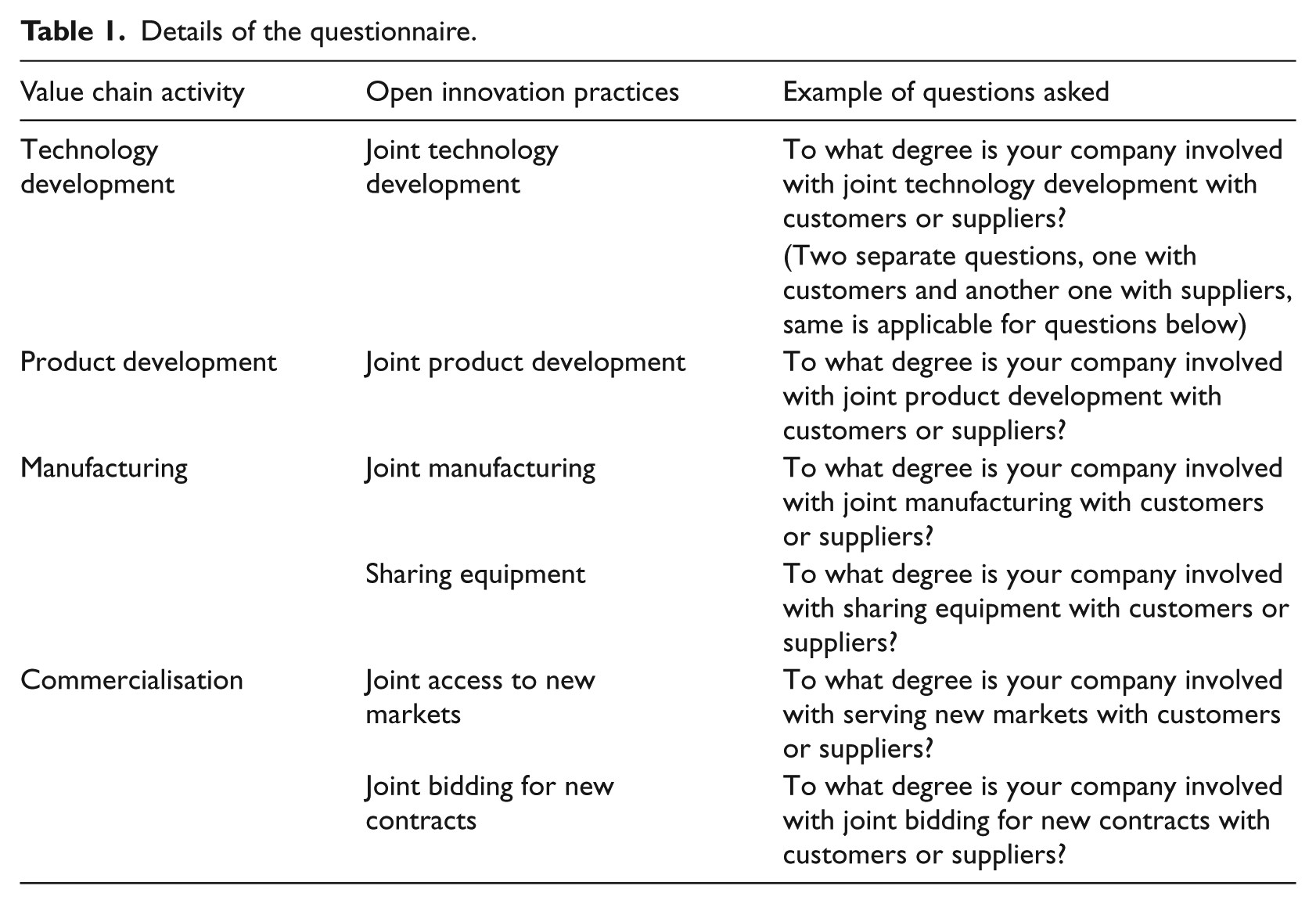
Open innovation practices along the value chain were grouped into four value chain activities:
technology development (joint technology development);
product development (joint product development);
manufacturing (joint manufacturing and sharing of equipment);
commercialisation (joint bidding for new contracts and joint servicing of new markets).
Interviewees were asked about their adoption of the open innovation practices with both their customers and suppliers (Table 1). A five-point ordinal scale (where 1 = ‘not at all’ to 5 = ‘to a great extent’) was used for the assessment of both the dependent and independent variables. The next section presents and discusses the results of the empirical research.
Details of the questionnaire.
Results and discussion
Use of open innovation throughout the value chain
The firms in this study show great variance in their adoption of open innovation along their value chains (see Table 2). The most common open innovation practice is serving new markets with customers, with 66 percent of the firms adopting this practice at least to a slight degree. The least commonly adopted practice is sharing equipment with suppliers, with 75 percent of the firms reporting no adoption of such a practice. Aggregating the data into the four value chain activities by averaging the measures reveals that open innovation practices are used by more than 50 percent of respondents during the technology and product development and commercialisation phases, and by only one-third of the firms during manufacturing. Firms using open innovation, due so primarily to a slight or a moderate degree. However, for each practice there is a small group of firms (fewer than 15 percent) that adopted the practices to a large or to a great degree; joint product development with customers and serving new markets with customers are the most common (adoption being approximately 12 and 14 percent respectively; see Table 2). The disparity between the large portion of minimal or non-adopters and the small, but distinguishable group of adopters raised curiosity, and motivated further assessment of the data in order to unveil specific groups of firms by their adoption behaviour.
Open innovation activities.
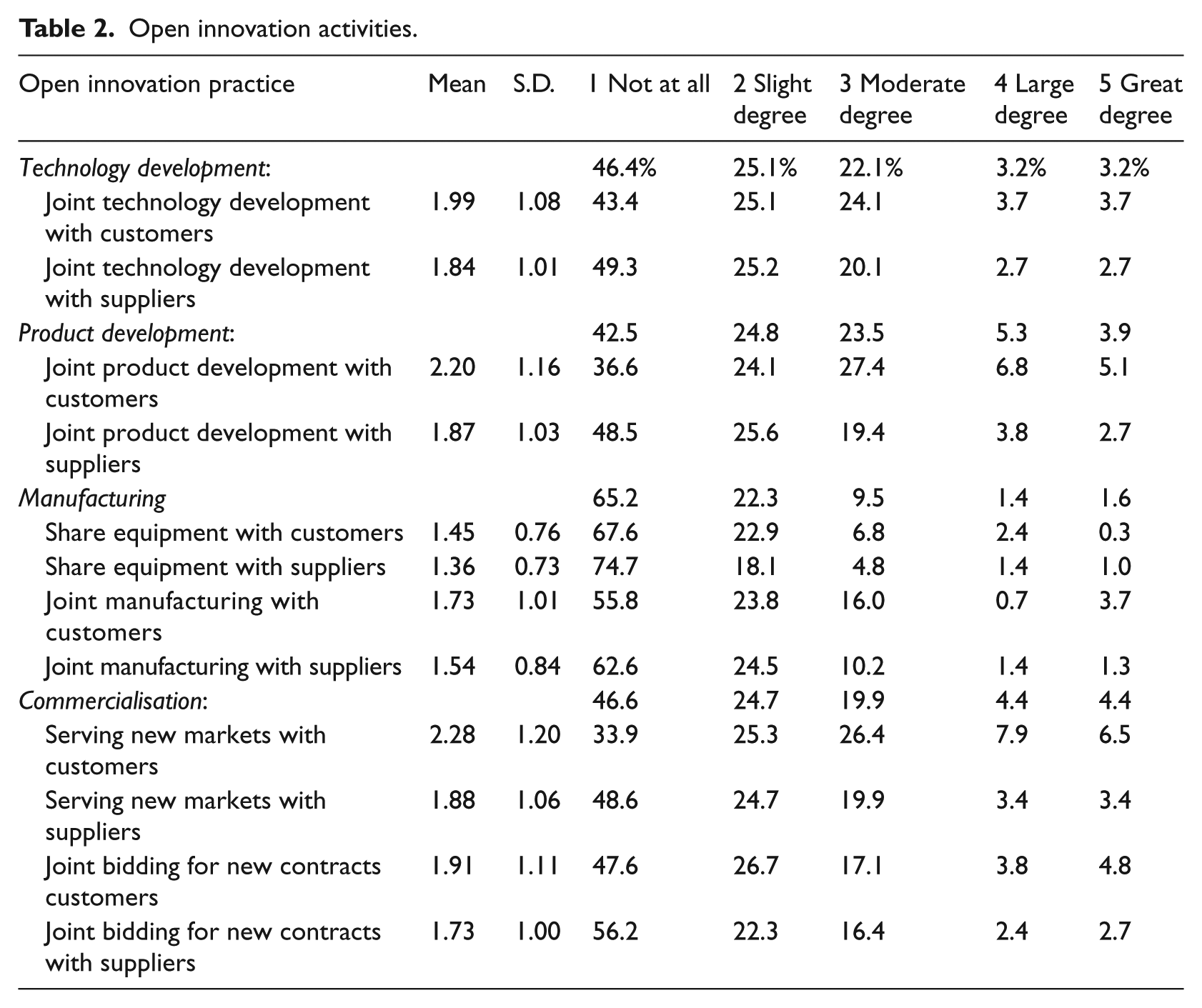
The technology development practices of the firms in this study involved open innovation in 54 percent of the firms, using joint technology development at least to a slight degree (see Table 2). More than 20 percent of the firms jointly developed technology with customers and suppliers to a moderate degree, although only about 5–7 percent of the firms used this approach to a large or great degree. Open innovation for technology development with customers is explained by their understanding of how the technology needs to support their use of the study firms’ output. Technology development with suppliers can be explained by the importance of their input on material opportunities and limitations. Firms might need to assess their technology development needs based on these parameters, and to involve customers and/or suppliers accordingly.
Joint product development with customers and suppliers is the most common open innovation practice, with 57 percent of the firms adopting this practice at least to a slight degree (see Table 2). Twelve percent of the firms use joint product development with their customers to a large or great degree. However, only about 6 percent of the firms use joint product development with their suppliers to a large or great degree. The 35 firms jointly developing products with their customers to a large or great degree are statistically larger in size and have been in business longer, but are not distinguished by state or industry. Working with customers on product development is understandable in light of many customers’ need for specialised products. Firms may seek to develop products jointly with their suppliers when they need close coordination of material and component inputs.
Open innovation for manufacturing (sharing equipment and joint manufacturing with customers and suppliers) is much less common than technology and product development among the firms in this study, with only 35 percent of the firms adopting open innovation for manufacturing to at least a slight degree. Fewer than 5 percent of the firms use these practices to a large or great degree, and 55 to 75 percent of the firms did not use these practices at all (see Table 2). Sharing equipment and joint manufacturing are inherently location-sensitive activities, so the study firms might best be located in proximity to their customers and suppliers. While distance does not preclude these types of open innovation practices, it is likely to limit the opportunities during this part of a firm’s value chain.
Serving new markets with customers (commercialisation) is the single most commonly used open innovation practice, with 14 percent of the firms using it to a large or great degree. The 42 firms using this commercialisation practice with their customers are statistically larger in size, have been in business longer and are more likely to be from the electrical and electronic and industrial equipment industries, but are not distinguished by state. The popularity of this practice is not surprising in light of the trend for co-branding and bundling products and services, such as AT&T, Apple and the iPhone. Serving new markets with suppliers and joint bidding with customers and suppliers are less common commercialisation practices (see Table 2), but taken together as commercialisation with customers and suppliers, 53 percent of the study firms adopted this form at least to a slight degree.
These findings offer a detailed profile of the extent of the adoption of open innovation practices. The firms in this study show that open innovation is being adopted in value chain areas including commercialisation and manufacturing, in addition to the common findings of other studies focused on technology and product development. The difference in degrees of adoption along the value chain may indicate that firms prefer the adoption of certain open innovation practices or certain customer types due to specific reasons, which could be a subject of a future research.
This assessment of the extent of adoption of open innovation sets the stage for understanding the relationships between the adoption of open innovation for technology and product development and the other open innovation practices in this study. Table 3 shows Spearman Rho correlations between the open innovation practices. Firms that adopt technology and product development practices are significantly more likely to adopt manufacturing and commercialisation open innovation practices. These results provide support for H1 and, as stated above, offer a likely explanation that firms may develop capabilities from adopting initial forms of open innovation (likely to be for technology and product development), which help them search for additional open innovation opportunities in other parts of their value chain, and help them succeed with these extended open innovation practices. Further experimental and longitudinal research is needed to address which capabilities and how could they help firms find and implement additional open innovation opportunities throughout their value chains.
Value chain activity correlation results (Spearman correlation).
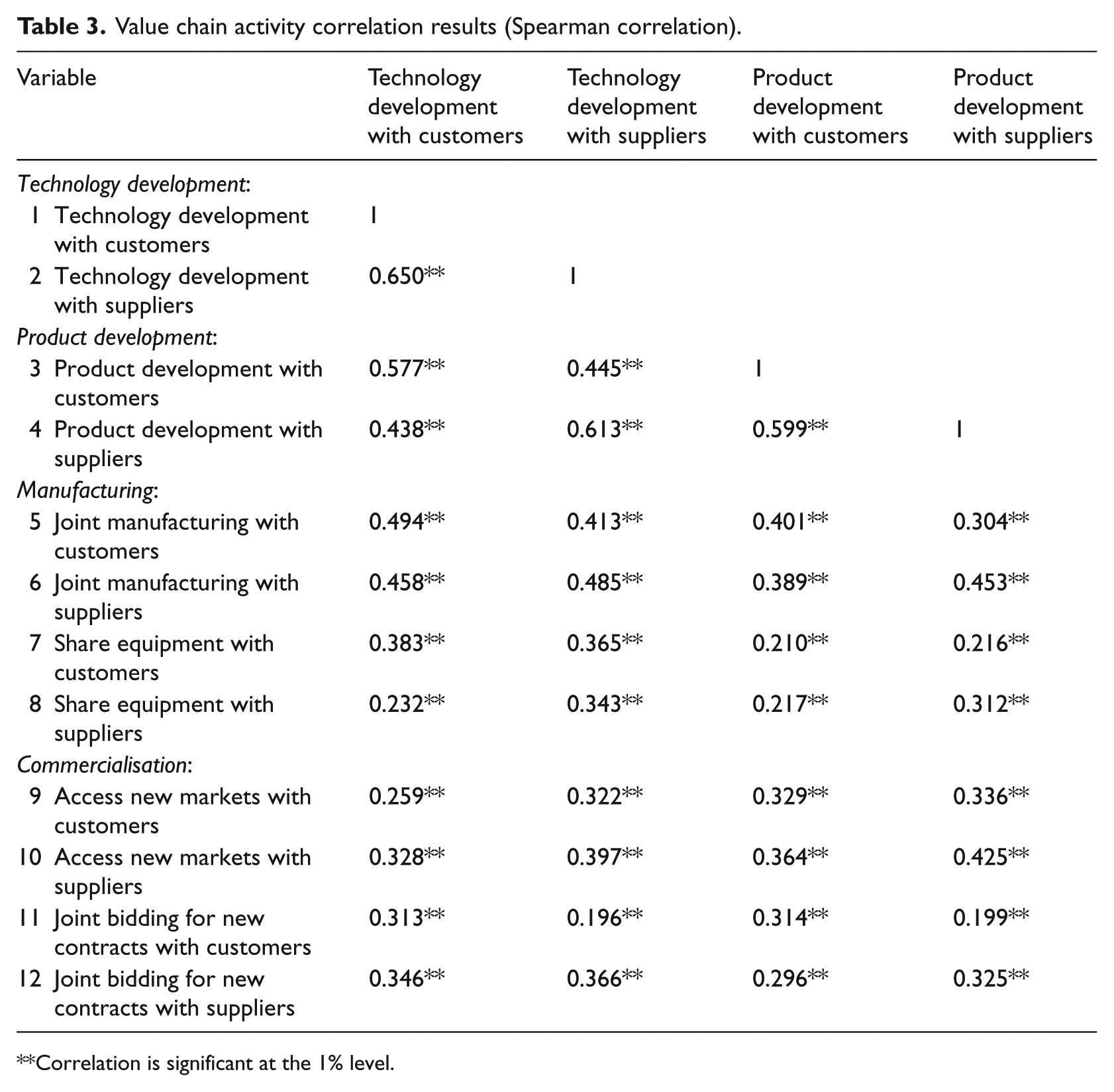
Correlation is significant at the 1% level.
Open innovation and product and process innovation
The descriptive findings above support the notion that firms are practising various forms of open innovation throughout the value chain with customers and suppliers. In order to test the relationship between open innovation and innovation performance, Spearman Rho correlations (see Table 4) and linear regressions with product and process innovation as dependent variables (see Table 5) are calculated. The levels of tolerance and variance inflation factor (VIF) are used to test for multicollinearity during the regression analysis. The level of tolerance for investigated independent variables are above 0.1, and VIF values are lower than 10, leading to the conclusion that the regression model does not suffer a multicollinearity problem (Marquardt, 1980). T-test analysis are used to analyse the difference between product and process innovation means of firms that adopt open innovation practices to at least a slight degree, and firms that do not.
Innovation performance correlation results.
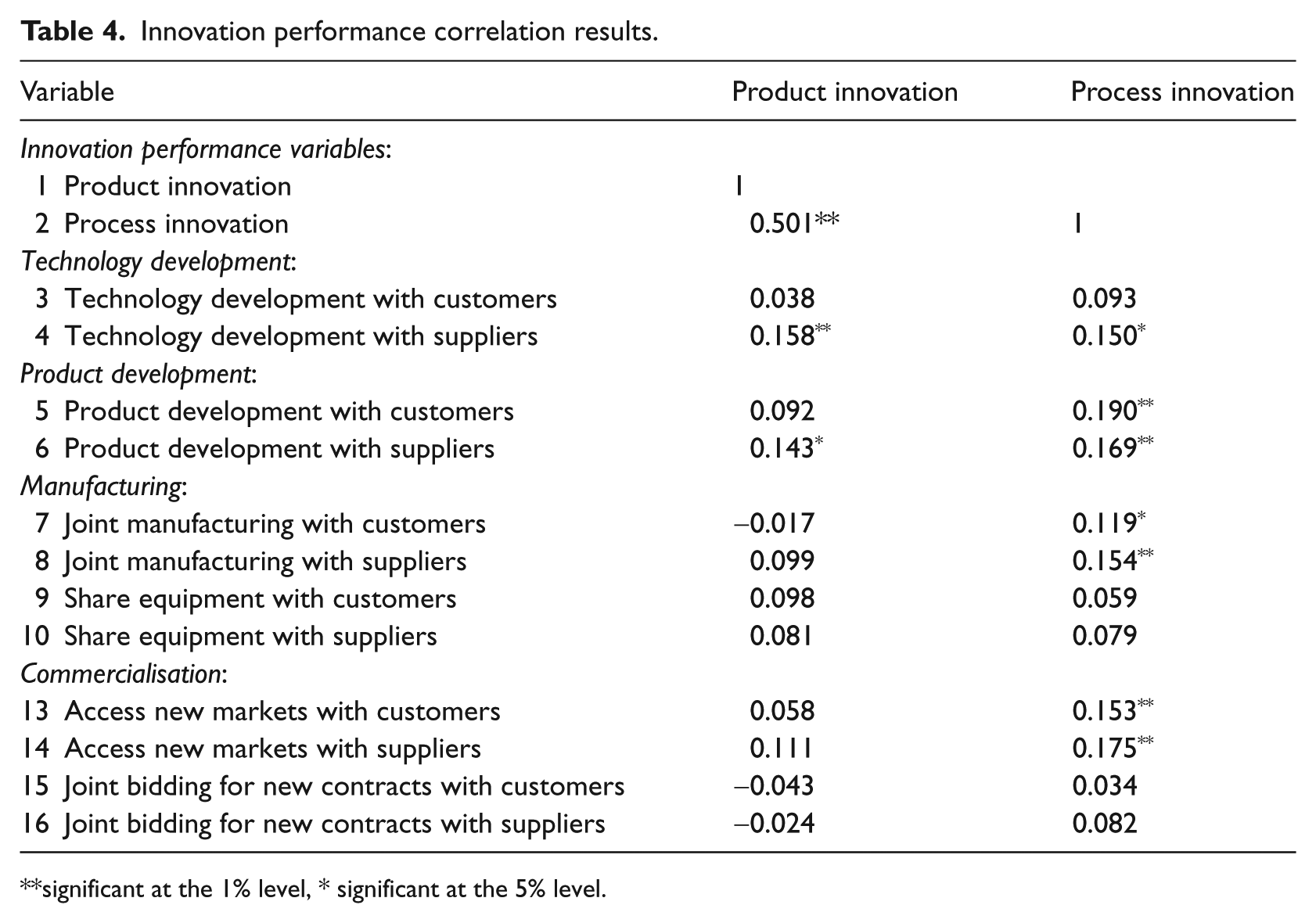
significant at the 1% level, * significant at the 5% level.
Regression results.
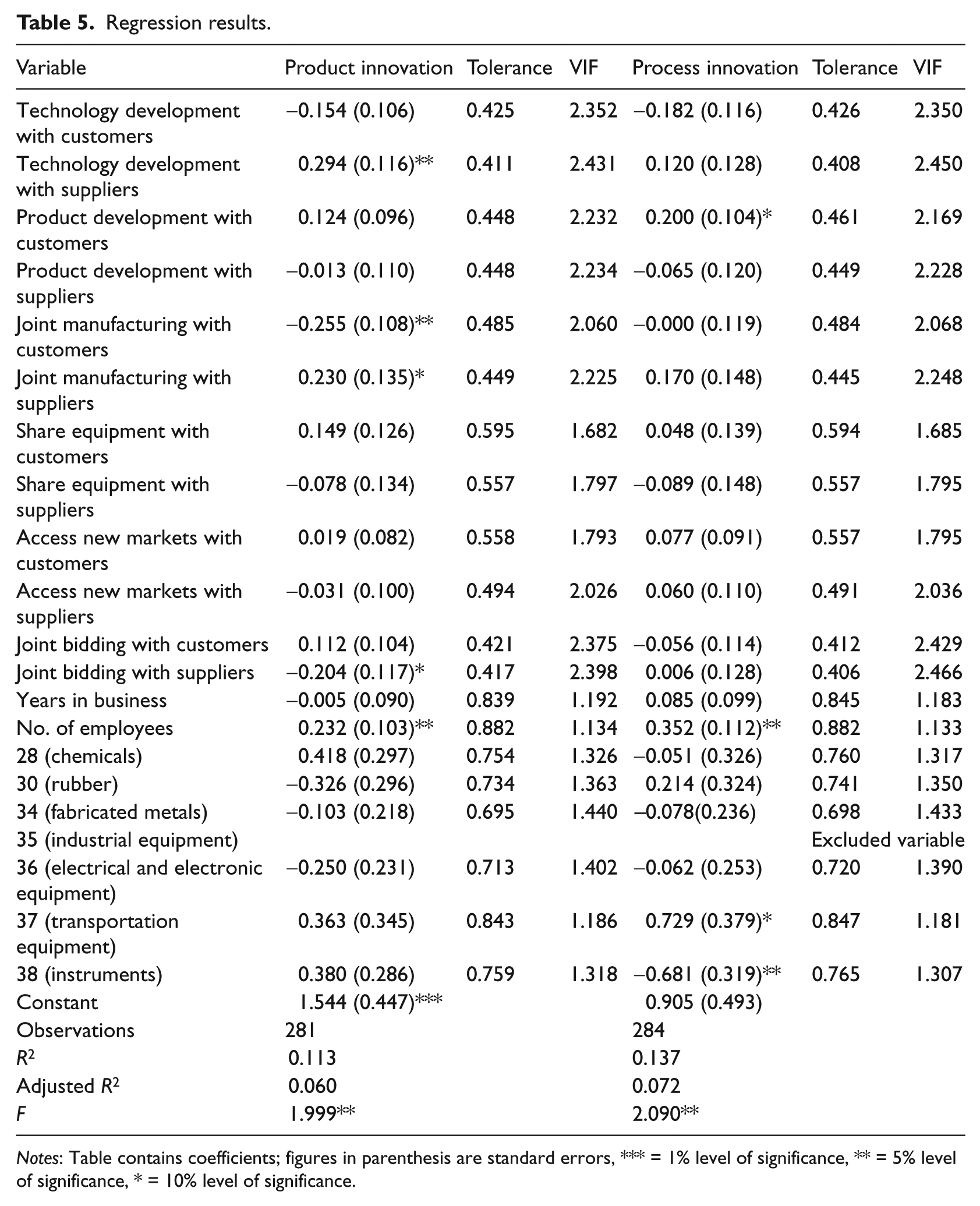
Notes: Table contains coefficients; figures in parenthesis are standard errors, *** = 1% level of significance, ** = 5% level of significance, * = 10% level of significance.
The analysis shows that technology development and product development with suppliers are correlated with both product and process innovation. However, joint product development with suppliers is more strongly correlated with product innovation than with process innovation, while a stronger association is found between joint product development and process innovation. A likely explanation for these occurrences entails an understanding of the firms’ under investigation second-tier position in their value chains. The firms under investigation purchase raw materials and equipment from their suppliers which they then use to develop components for their customers. Therefore, suppliers’ inputs are linked directly to initial product creation and improvements. Once the product is in the validation phase, process innovation may become more relevant for manufacturers eager to rely on suppliers’ knowledge. In addition, product development with customers was correlated with process innovation, supporting earlier findings about the common use of customers’ help during product design. For example, von Hippel (2005), argues that customers often participate in the development of a shared platform to enable easier and better interaction between firms and their customers during the testing and validation of product designs. Moreover, joint manufacturing with customers and suppliers is significantly correlated with process innovation. These findings support earlier research about the incorporation of external information during agile and lean processes to reduce inefficiencies and improve productivity during manufacturing processes (Naylor et al., 1999). Firms draw knowledge from the market and other firms to evaluate and react quickly to demand swings during agile operations, and to improve the production scheduling of stocked goods during lean manufacturing. Accessing new markets with customers and suppliers (open innovation for commercialisation) is significantly correlated with process innovation. Firms using these forms of open innovation are likely to be improving the coordination of their linkage from their suppliers on to their customers, leveraging synergies as they bring their products to new markets. This supports earlier findings, indicating that firms rely on external sources to obtain complementary assets such as access to distribution and acceleration of time-to-market (Chesbrough and Crowther, 2006; Mitchell and Singh, 1996).
The results of the linear regression analysis add more support for the value chain explanations above. First, open innovation with suppliers involving technology development and manufacturing results in firms improving their product innovation; and second, open innovation with customers involving product development results in firms improving their process innovation (see Table 5). Put concisely, firms are more innovative when they used technology development and manufacturing help from their suppliers to improve their products, and product design help from their customers to improve their processes. In order to provide further support for causal inferences between open innovation practices and innovation performance, t-tests are used for variables with statistically significant regression results, showing that there is a significant difference in product innovation between firms that practised joint technology development with suppliers, and firms that are not (t(286) = -2.143, p<0.05), as well as in process innovation between firms that practised joint product development with customers, and firms that are not (t(291) = -2.714, p<0.05). The firms involved in these types of open innovation practices show significantly better innovation performance than those that are not. However, the difference in product innovation between the firms with and without joint manufacturing practices with suppliers is not significant (t(286) = -1.884, p>0.05).
In contrast, open innovation practices for manufacturing and commercialisation do not increase firms’ innovation performance. In fact, firms engaging in joint manufacturing with customers and joint bidding with suppliers reveals even negative product innovation performance results. In addition, linear regression analysis reveals that: (a) the larger firms within the sample have better process and product innovation performance, (b) that firms from the transportation equipment sector are better at process innovation, and (c) firms manufacturing instruments are lagging behind. A possible explanation for the former is the resource and market power abundance of the larger firms, allowing them to have stronger innovation capabilities (Vossen, 1998). In regard to the transportation equipment companies, it is possible that because they have experience working with numerous suppliers, they have developed skills in communication and coordination which helps them use open innovation to improve process innovation. Companies making instruments may have less room for innovation and collaboration, so more interaction via open innovation with customers and suppliers actually may slow process improvement. The other five industries showed no relationships between open innovation and product and process innovation.
Collectively, these results reveal that only some open innovation practices, e.g. joint technology and product development, enhance a firm’s product and process innovation ability, only partially supporting H2a and H2b.
Conclusion
The present study contributes to the current literature and practice on open innovation by addressing unexplored aspects of open innovation activities. As such, this research extents the application of the open innovation concept in the academic literature, and furthers the discussion about its adoption beyond technology and product development and in particular during the manufacturing and commercialisation phases. The study suggests that more than 50 percent of firms engage in open innovation to at least a slight degree during technology and product development and commercialisation. In contrast, only one-third of the firms engage in joint manufacturing. Thus, the existence of a broader and varied adoption of open innovation practices is highlighted. Moreover, this study reveals the possibility of leveraging existing capabilities for the adoption of open innovation practices across different value chain activities. In support of the first hypothesis, firms that adopt open innovation for technology and product development are more likely to adopt open innovation for manufacturing and commercialisation. The findings also support prior research by Chesbrough and Crowther (2006) and Van de Vrande et al. (2009), in arguing that open innovation is used not only by large but also by small and medium-sized firms across a range of industries.
This study sheds some further light to the benefits and challenges of the adoption of open innovation practices, according the nature of firm’s product and process innovations. Prior research on open innovation has concentrated to the analysis of external knowledge channels (e.g. Kang and Kang, 2012; Laursen and Salter, 2006; Love et al., 2011), instead of researching specific practices. Examining multiple open innovation practices, this study reveals four practices which have significant effects on product innovation, in contrast to one practice which strongly influences process innovation. However, a strong correlation between product and process innovation indicates the limited impact on process innovation, which is often recognised as a more sustainable type of innovation due to its intangible nature – is likely to be a matter of time. Furthermore, this research shows that only some open innovation practices lead to better innovation performance, while others have no effect and can even deteriorate it. This results in partial rejection of the second hypotheses. It also contradicts prior research which argues arguing that use of external resources for innovation purposes leads to better innovation performance (e.g. Chesbrough, 2003; Hagedoorn, 2002; Huston and Sakkab, 2006; Kang and Kang, 2009). A possible explanation for these findings is that the upfront expenditures of many open innovation practices are bound to be equal or outweigh their benefits in the short run; thus, firms should be prepared to invest time and money in such open innovation practices. Yet, the broad adoption of open innovation despite variable outcomes indicates that open innovation practices may offer less straightforward and measurable benefits than what is currently suggested in the relevant literature. These benefits may include greater connectivity, reputation and awareness of innovation opportunities. These less tangible advantages of open innovation may begin to pay off only after an extended time period. Earlier studies support this argument, stating that the indirect effects of knowledge management practices on innovation performance are stronger than the direct effects among high-tech SMEs (e.g. Alegre et al., 2011).
Finally, this research adds to our understanding of the nature of the exogenous partnerships during open innovation, showing that small and medium-sized firms prefer relations with customers more than with suppliers. This is in line with Enkel et al.’s (2009) findings but comes in contrast with Laursen and Salter’s (2006) research, which suggest more involvement with suppliers. However, despite these overall preferences, relations exist and the level of involvement varies from one value chain activity to the next. Despite the relative choice of open innovation practices, partner selection matters equally for both types of innovation performance. The empirical research reveals that firms are more innovative when they use technology development collaboration with their suppliers to improve their products, and product development collaborations with their customers to improve their processes.
Implications of the study
This research has important implications for academics, and practitioners. For academic researchers, it presents evidence about the range and effects of open innovation practices and opportunities across different value chain activities and the association between them. This leads to the need for an academic contribution beyond the innovation and strategic management literatures, to incorporate disciplines such as operations, manufacturing and marketing. The collaborative effort of different research disciplines may lead to more insights about how open innovation can be organised for the different functional activities of the value chain, as well as how these different activities work together. The relevance of the nature of open innovation practices and partner choice for innovation performance indicates process characteristics, and therefore questions generalisation of the open innovation concept. In addition, it motivates more targeted research in regard to specific open innovation practices, their antecedents and effects on different types of innovation and business performance in the short and long term.
Practitioners can draw multiple lessons for their business strategies and organisational innovation processes in particular, A wide adoption of the open innovation practices along different value chain activities may encourage consideration of broader and more varied engagement with customers and suppliers along the value chain. This study highlights the close relation between different open innovation practices, indicating that companies who have incorporated external sources to their innovative activities might be able to share their expertise and capabilities with managers who are responsible for other value chain activities and work together towards improving the innovation processes throughout the value chain. The value of more effective open innovation practices for innovation performance becomes apparent, and should inspire firms to develop the appropriate culture, structure, skills and business models to account for such practices. On the other hand, this study raises the need for caution regarding the risks of adopting open innovation practices, revealing the limited or even negative effect that some open innovation practices might have to the innovation performance of the firm. Thus, innovation and business objectives should be taken under consideration when deciding to open up the innovation processes of the firm in Nevertheless, selecting appropriate open innovation practices and partners is possible, even for firms with limited resources and time constraints.
Limitations of the study and suggestions for future research
This study sets the board for further enquiries and research on open innovation practices across the full spectrum of value chain activities. First, this study covers only some value chain activities; a broader understanding of such activities and synergy effects between open innovation practices in these different value chains should further advance the current thinking and literature. Second, more understanding and subsequent research is needed around the resources and capabilities of firms as preconditions for finding open innovation opportunities and successfully implementing these practices. Why firms prefer to adopt some open innovation practices more frequently than others remains a question. Further longitudinal, quantitative and experimental large-scale research designs should shed more light to the causal factors affecting the adoption of open innovation practices along the value chain. Third, inclusion of more external partners in addition to customers and suppliers would be insightful. Fourth, more robust innovation performance measures and the observation of innovation and business performance and open innovation practices over a longer period of time could provide additional insights on the causal relationships between open innovation activities and innovation performance. Fifth, the focus on small and medium-sized US-based manufacturers offers a somewhat limited perspective of open innovation activities within US companies. Hence, there is a need for inclusion of more innovative industries as well as larger and, multinational companies with a broader scope of business activities. Finally, much deeper exploration is needed to understand the benefits, costs and potential risks of open innovation practices involving external partners in the less researched aspects of the value chain, such as for example manufacturing, commercialisation and after-sales service.
Footnotes
Acknowledgements
The author would like to thank Dr Andy Cosh, Professor Jaideep Prabhu and other anonymous reviewers of this article for their valuable comments and helpful advice.
Funding
This research received no specific grant from any funding agency in the public, commercial or not-for-profit sectors.