






Abstract
This article critically analyses how clients who have limited professional financial qualifications and experience evaluate the quality of highly customized, complex, intangible professional service such as financial audits. As the financial and business outcomes of an audit only become manifest over time, clients have difficulty in evaluating its technical worth. Consequently, it is critical to explore what motivates client likelihood of re-engaging an audit firm. This study of 519 small-firm clients of financial audit firms in Thailand demonstrats that, consistent with signaling theory, the quality of interpersonal communication, rather than technical quality, has the greatest impact on client perceptions of value-for-fee and, importantly, the likelihood of re-engaging the audit firm in the future.
Introduction
In the contemporary competitive business environment, professional service firms seek to provide small-medium size enterprise (SME) clients with value-for-fee as a means to establish long-term client relationships. The very nature of professional services (e.g. financial auditing, legal services, management consulting, civil engineering), which are considered ‘medium-high contact’ services and high in credence properties (Darby and Karni, 1973; Jarvis and Rigby, 2012), dictates that the client–service provider interactions (service encounters) constitute the heart of the client evaluation of the service experience. Yet scant information exists concerning the role that interpersonal communications plays in SME owner perceptions of value received, or intentions to continue their relationship with a particular professional service firm. Key personnel in SMEs typically lack the knowledge and skills to confidently evaluate the technical outcome of services prepared and delivered by highly skilled professionals (Patterson, 2000). So, for example, it is difficult for a business owner with no legal training to evaluate the advice of a strategic plan, developed by an experienced management consultant, or an owner without an accounting degree to assess the quality of a financial audit. When an SME client is unable to evaluate the technical outcome, research suggests they will seek surrogate information or cues to evaluate quality, value, and satisfaction. Based on signaling theory (Spence, 1973) and the elaboration likelihood model (ELM) of persuasion (Petty and Cacioppo, 1986), we argue that the effectiveness of audit firm communication with clients is interpreted as an important signal or quality cue. Thus, communication is inextricably linked to the client’s overall perceptions of the audit quality, value, and ultimately, repatronage intentions.
Background
The increasing emphasis on customer/client repeat patronage and even loyalty in all forms of business has spawned a variety of business development and marketing approaches – customer centric, customer engagement, market driven, relationship marketing, customer relationship management, integrated marketing communications, and so on (Baker and Sinkula, 2009). Each approach emphasizes the key role of two-way communication, but in particular the manner in which firms effectively communicate with their customers (clients) before, during, and even after a transaction which can enhance or destroy important brand relationships (Duncan and Moriarty, 1998). The highly technical nature and complexity of many services, coupled with client’s limited understanding of the problem has meant that professional business services (for example, health care, auditing, engineering, psychotherapy) have a history of communicating with clients in a dominating or controlling style, that includes behaviors that establish the communicators’ control and status (Webster and Sundaram, 2009). However, client expectations have grown over time: they now expect to be consulted by the service provider and are more assertive and empowered as a result of the availability of information through the Internet, even taking on the role of a co-producer of the service in many instances (McColl-Kennedy et al., 2012). Hence, the need for the professions to effectively communicate with clients to retain their business relationship is critical. Although there is research in health care dealing with the impact of doctors’ communication style on patient trust, feeling of confidence, satisfaction, and compliance with recommendations (Street and Weimann, 1987), such research is lacking in a business services context. Moreover, studying client perceptions of service providers’ interpersonal communications and the impact on evaluations of service quality and value is a topics of significant interest to practitioners.
Given the theoretical and managerial relevance of the topic, the primary objective of this study is to examine the impact of audit firms’ communication quality on SME client evaluations of technical and process quality, value-for-fee paid, and repatronage intentions in a rapidly developing Southeast Asian nation, Thailand.
More specifically, this study represents an attempt to resolve the following questions:
What is the relative impact of technical quality and process quality, in shaping SME client intention to continue engaging their current audit firm?
To what extent do SME client perceptions of communication quality impact their perceptions of technical and process quality, perceived value, and ultimately, repatronage intention with a financial audit firm?
Answers to these questions will not only add to our understanding of the factors underlying the foundation of long-term client–service provider relationships in a financial auditing context, but with professional services more generally. From a scholarly perspective, it demonstrates how signaling theory and the elaboration model can aid our understanding of how clients evaluate the quality and value received from professional service providers.
The SME context
SMEs make substantial contributions to the Thailand economy in terms of output, employment, and effective utilization of regional resources. In fact, SMEs are at the heart of the country’s strategy aimed at making it a competitive and dynamic knowledge-based economy. The Department of Industrial Promotion revealed that in 2010, there were 2.91 million SMEs in Thailand, comprising 99.6% of all enterprises (Office of Small and Medium Enterprises Promotion, 2012). SMEs are classified in terms of both number of employees and amount of fixed assets (Institute for Small and Medium Enterprises Development, 2012). The criteria currently employed in defining small and medium enterprises in Thailand are presented in Appendix 1.
To be useful for managerial decision-making, financial statements must be reliable (Knapp and Kemp, 2004; McMahon, 1999). In order to achieve this, it is required by law that the financial statements of SMEs that are operating as a limited company or limited partnership must have undertaken an annual financial audit. However, given that the majority of SME proprietors are unlikely to possess an accounting degree and the day-to-day pressures mean they have to wear ‘many hats’ (Morrissey and Pittaway, 2006), it is unlikely that they have the knowledge or time to objectively assess the technical quality of a financial audit. Moreover, many SME owners are unlikely to appreciate the benefits of audit report since it is a statutory requirement in Thailand and may be seen as an unnecessary bureaucratic exercise. Yet audit firms, like all professional service firms, want to retain existing clients by encouraging them to be ‘brand loyal’ to ensure a continuous revenue stream.
The nature of professional business services
Unlike consumer products and even non-professional, ‘experiential’ services targeted at consumers (hospitality, fitness training, theater, movies), which are relatively easy for customers to evaluate, professional services are highly customized, expensive, intangible, technically complex, and ‘manufactured’ and delivered by highly qualified personnel (Jarvis and Rigby, 2012). Such services are high in credence properties – that is, it is difficult for clients to confidently evaluate quality, value, and satisfaction even following purchase and consumption (Darby and Karni, 1973; Patterson, 2000; Sweeney et al., 2011). Hence, knowledge is typically asymmetric across the provider–client relationship (Bennett and Smith, 2004). That is, clients often lack the requisite professional skills, knowledge, and expertise to diagnose their own needs, discriminate between a range of possible options, or evaluate outcomes. For example, a client with no legal training is unlikely to be able to evaluate, with any confidence, whether they actually received the best possible legal advice. Likewise, a client of an investment bank is unlikely to know whether the advice they received resulted in maximum return on investment at an acceptable level of risk. In this study, we argue that an SME, in the absence of professional accounting education, is unable to confidently assess the technical quality of a financial audit. In these circumstances, signaling theory (Spence, 1973) indicates that clients rely on surrogates or other cues (e.g. how they are treated and communicated with during the service provision) to make reasonable assessments of technical quality (Duff, 2009; La et al., 2009). Furthermore, professional services are typically ‘medium-high contact’ – that is, a high degree of ongoing interaction and interpersonal communication between client and service professional provider is needed for the service to be rendered. The audit process is undertaken over a continuous stream of service encounters during which personnel have an opportunity to remix the service offering and add value in interactions with clients (Dyer and Ross, 2007). For example, by demonstrating that he or she has taken time to understand the client’s business, demonstrating (and communicating) a clear plan for the audit process, being punctual and reliable, displaying an understanding of the issues, and keeping the client informed, the professional can add value to the relationship (Patterson, 2000). Thus, both ‘what’ is delivered (the technical quality) and ‘how’ it is delivered (process quality) are both important in delivering overall service quality and value to clients.
Conceptual model
Service quality and perceived value
The service quality literature has consistently shown that customer-perceived service quality has two underlying dimensions – technical quality (the core service or ‘what’ is delivered) and process quality (‘how’ the service is delivered) (Gronroos, 1984; Parasuraman et al., 1985). Technical quality relates to actual outcomes or the core service as perceived by the customer. In the accounting literature, audit quality has been viewed (from the audit firm’s perspective) as comprising the auditor’s competence (which allows an auditor to find errors in the financial records) and independence (which allows them to report errors) (DeAngelo, 1981). This is a narrow view of audit quality since it assumes the audit is synonymous with the audit report, and so ignores the fact that an audit is a process as well as an outcome. Moreover, an audit report is likely to be of limited value for SME clients since it is typically prepared to satisfy statutory requirements. Furthermore, the real value in an audit only unfolds over time (months and even years) as the true financial situation of the client firm becomes manifest. Finally, it is worth noting that the core service – the audit report – has over time become a commodity. That is, many audit firms employ equally competent financial auditors and so it becomes difficult to differentiate the firm on the technical quality of their work. Consequently, audit firms may attempt to differentiate themselves via their levels of ‘client service’ – that is, process quality and the rapport and effective two-way communication they have with clients (and potential clients). Or as Leonard Berry so succinctly stated, ‘The five dollar bills the customer gets from the teller are the same; what is different is the tellers’.
As already noted, the audit process (process quality) involves numerous service encounters between the auditor and audit partner, and client (Duff, 2009). Because most SME clients are unlikely to be able to confidently evaluate the technical quality of the audit report, they rely on other cues – that is, the process that they observe and experience – to assess overall quality. Hence, process quality takes on added importance in clients’ assessments of value. Value is a very broad term and has been used in varying ways depending on the discipline. Conceptualizations of customer value include notions such as customer value being inherent in the use of a product, being perceived by customers alone, and involving a trade-off between what is received and what is sacrificed (Woodruff, 1997). Zeithaml (1988) describes value as the ‘customer’s overall assessment of the utility of a product based on perceptions of what is received and what is given’ – that is, a global assessment of value for money (p. 14). This latter conceptualization is adopted in the present study. Moreover, given that value is partly driven by ‘what is received’, it stands to reason that perceptions of technical and process quality (i.e. service performance) will be associated with client value perceptions (Cronin et al., 2000; Sweeney et al., 2001). Indeed, service quality has been shown to be a direct antecedent of perceived value (Bolton and Drew, 1991).
With this in mind, our first two hypotheses are as follows:
H1: Both (a) technical and (b) process quality will be positively associated with client-perceived value.
H2: Process quality will exert a stronger influence than technical quality on client-perceived value.
Signaling theory, interpersonal communications, and service quality
Signaling theory is essentially concerned with reducing information asymmetry between two parties (Spence, 2002); it is useful for describing behavior when two parties (individuals or organizations) have access to different information – that is, information asymmetry. Typically, one party, the sender (the auditor in the context of this study), chooses whether and how to communicate (i.e. signal) that information, and the receiver (i.e. SME client) must interpret the signal. Signals are qualitative in nature and require interpretation (Perkins and Hendry, 2005). Rao and Ruekert (1994) define signals as quality cues. Signals are a sign that cues influence some action or interpretation (e.g. of service quality) by consumers; they are a communication function (Duncan and Moriarty, 1998). Management and marketing scholars have applied signaling theory in a wide range of contexts. For example, a recent study of corporate governance illustrated how Chief Executive Officers (CEOs) signal the unobservable quality of their companies to potential investors through the observable quality of their financial statements (Connelly et al., 2011). Branding is another signaling concept. At an individual consumer level, signaling also aids consumer decision-making processes where information asymmetries exist. In a business-to-business context, signals also influence outside observer perceptions of firm quality (Riley, 2001). In fact, most signaling includes quality as a distinguishing characteristic – quality being the underlying, unobservable ability of the signaler to meet the needs of an outside observer of the signal. Here, we focus on a single dyad (signaler and receiver) communicating one signal, which is consistent with how signaling theory has developed as transaction-specific communication.
Professional services are inherently relational. Moreover, audit personnel operating at the ‘boundary’ between the firm and clients have an opportunity to add value to the relationship by the very manner in which they interact and communicate with clients. Thus, their technical (often unobservable by the client) as well as interpersonal (observable) skills become a source of competitive differentiation and a means of creating client value.
While communication has been linked to relationship commitment in channel relationships and industrial markets (Cambra-Fierro and Polo-Redondo, 2008; Mohr et al., 1996), little effort has been made to investigate its impact in professional business services. Communication is defined as ‘The human act of transferring a message to others and making it understood in a meaningful way’ Andersen (2001: 168). It is a way of signaling using observable (e.g. displaying enthusiasm, readily responding to clients request, exhibiting rapport) displays. Effective communication adds the ‘notions of balance, symmetry and reciprocity’ (Duncan and Moriarty, 1998) and manifests or signals itself in many ways, such as information, messages, signs, and other cues. In a professional services context, communication quality refers to the formal as well as informal sharing of meaningful and timely information between service provider and client in an empathetic, respectful manner. Its primary purpose is to reduce information asymmetry via educating, keeping clients informed in a language that they can understand, and in doing so sending a signal of overall professional quality. Benson (1994) notes that successful professional service firms possess a blend of technical knowledge and communicative abilities; strong communication skills are needed to ensure that clients understand and have confidence in the process and have a sense of (if not actual) control and appreciate the intrinsic value of the service to their firm (Kirchmajer and Patterson, 2004; Stewart, 1992). Based on the nature, frequency, and effectiveness of communication, clients then form perceptions of service quality.
For financial auditing services, the linkage between communication quality and client perceptions of value and repatronage is likely to be even stronger than in other contexts because of recurring interaction between client and auditor, the risks and uncertainties involved, as well as the technically complex nature of the service. Furthermore, due to the high involvement nature of the purchase (and continuance of the relationship) and credence properties of audit services, an auditor has to be effective in communicating (signaling) with clients to instill confidence, build rapport, and reduce risk perceptions. This is consistent with the recent importance placed on relationship management in the provision of financial services. In contrast to transaction lending, which is based on ‘hard’ objective financial data, relationship lending relies on evaluation of ‘soft’, qualitative information accumulated over numerous transactions between a loan officer and their client. As in the case of interpersonal communications, it is not observable to others (Berger and Udell, 2002).
Emotional factors are also influential (Bland, 1997). A good auditor is one with whom a client feels comfortable and who listens to and understands client needs. The affective component can be viewed as the degree of friendliness, courtesy, amount of time allocated to the interaction, level of interest shown in the customer, and an explicit expression of concern exhibited concerning a customer’s problem (Ben-Sira, 1976, 1980). As Benson (1994) notes, effective communication skills are a necessary (but not sufficient) requirement of successful professional services. We contend, therefore, that interpersonal communication acts as a powerful signal, or proxy, for technical quality (which as previously noted is inherently difficult for clients to evaluate) and also colors client’s perceptions of process quality.
Therefore,
H3(a), (b): Client perceptions of communication quality will be directly and positively associated with (a) technical quality and (b) process quality.
Next, we draw on the ELM of persuasion (Petty and Cacioppo, 1986), to derive our next hypothesis, that predicts communication quality will also have a direct impact on client-perceived value. The ELM predicts that communications operate in two ways, a central route and a peripheral route to persuasion. First, the direct route is relevant when a consumer’s motivation, knowledge, or ability to assess the attitude object is high. In this study, a client’s assessment of the audit value, based on the technical and process quality, represents the central route. However, as clients typically do not possess the knowledge to assess technical quality, and may also lack the motivation to do so because the audit is mandated by government regulation, we contend that a peripheral route to judging value may also operate. That is, judgment occurs via a peripheral route without the client focusing on information directly relevant to the attitude object (i.e. the audit outcome). Judgments are an outcome of secondary inducements or some form of communications (Petty and Cacioppo, 1986). Hence, given the low elaboration likelihood, client perceptions of the quality of the interpersonal communications between auditor and themselves may operate as a cue that triggers the use of heuristics (Chaiken and Maheswaran, 1994) or fosters simple positive (or negative) associations of value. In other words, when clients do not possess the knowledge or motivation to evaluate technical quality in particular, they may simply rely on their experience with the interpersonal communications with the auditor to assess the value-for-fee received. Thus,
H3(c): Client perceptions of communications quality will be directly and positively associated with client-perceived value.
Client value perceptions and repeat patronage intentions
Customer loyalty, relationship commitment, behavioral intentions, and repeat purchase behavior have been variously modeled over the past two decades by numerous scholars (for example, Bolton and Drew, 1991; Cronin et al., 2000; Dick and Basu, 1994; Morgan and Hunt, 1994; Palmatier et al., 2009). However, the purpose of this study is to examine the impact of communication quality on service quality and value, and then, as a secondary aim, to link value to repeat patronage intentions. It was not the purpose to comprehensively model repatronage intentions. Service quality has, in recent times, inextricably linked customer perceptions of value received to loyalty and repeat patronage intentions (Cronin et al., 2000; Lam et al., 2004; Sweeney et al., 2001). Our final prediction is therefore a replication hypothesis:
H4: Client perceptions of value will be positively associated with repeat patronage intentions.
The conceptual model is shown in Figure 1.
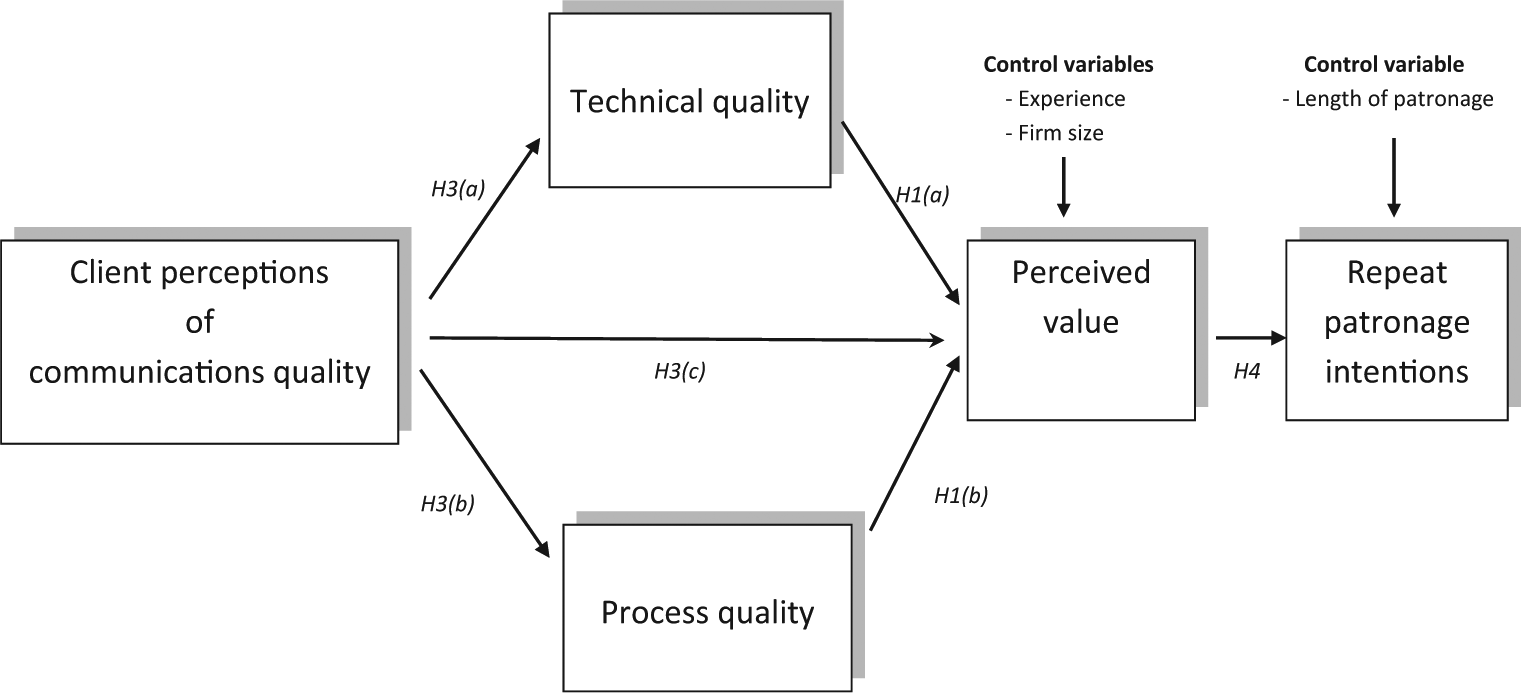
Conceptual model.
Research method
A multiphase approach was undertaken for this research. The first phase was exploratory and qualitative in nature and comprised 10 in-depth interviews with SMEs and auditors. The second phase comprised a cross-sectional survey. Details of both approaches follow.
Sample
Our cross-sectional survey yielded valid responses from 519 incorporated SMEs in five provinces having the largest concentration of SMEs in Thailand that are required, by regulation, to comply with an official financial audit. The data were collected using a structured questionnaire that was personally administered by trained interviewers so as to maximise the response rate. Therefore, the response rate was 98.9%. Convenience sampling was adopted to overcome time and resource limitations. The data obtained from Bangkok, Nontaburi, Chiang Mai, Chonburi, and Suratthani provinces were proportional to the number of SMEs in these provinces.
The key informant (respondent) in each case was the owner, a partner, or in some instances a manager who was intimately involved with the business and the audit process. To check for nonresponse bias, we compared the answers from late respondents (comprising approximately 18% of the final sample) to the balance of respondents on key constructs to detect any differences. Moreover, no differences were detected on key demographic measures at the p < 0.05 level. This, together with the very high overall response rate, indicates that the danger of non-response bias is low (Armstrong and Overton, 1977).
Instrument
A multi-stage method was employed for the development of the final questionnaire. Apart from a literature review, five in-depth qualitative interviews were conducted with SME owners and five interviews with auditors, in two provinces, prior to questionnaire development. The aim was to understand the importance and relevance of the communications construct, and how it influenced perceptions of service quality, and how clients evaluated technical and process quality and perceptions of value in an auditing context. This information was then used in conjunction with the literature to develop items for the constructs contained in the questionnaire.
Respondents’ profile
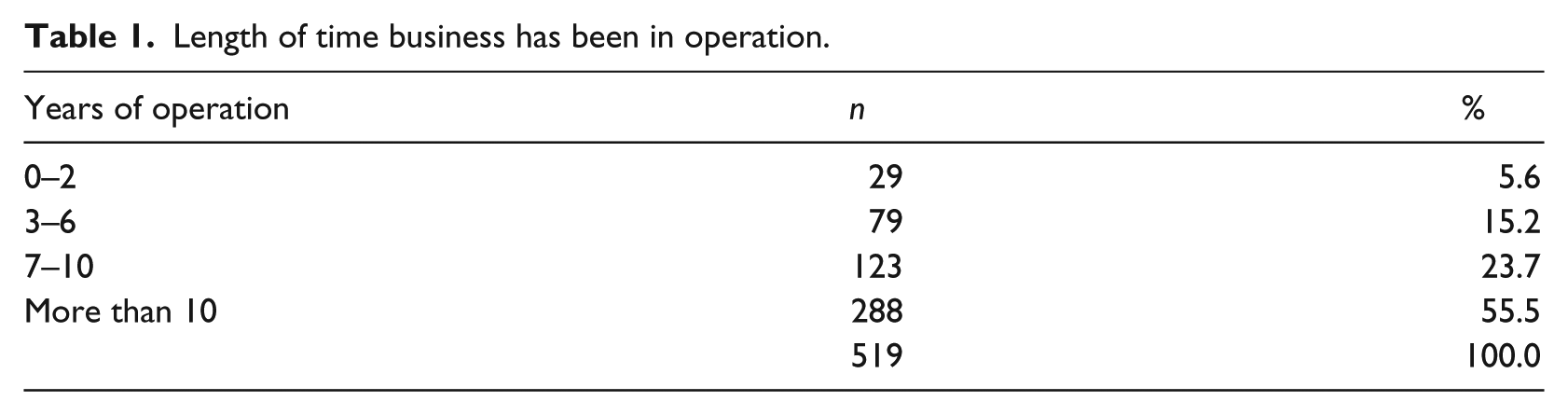
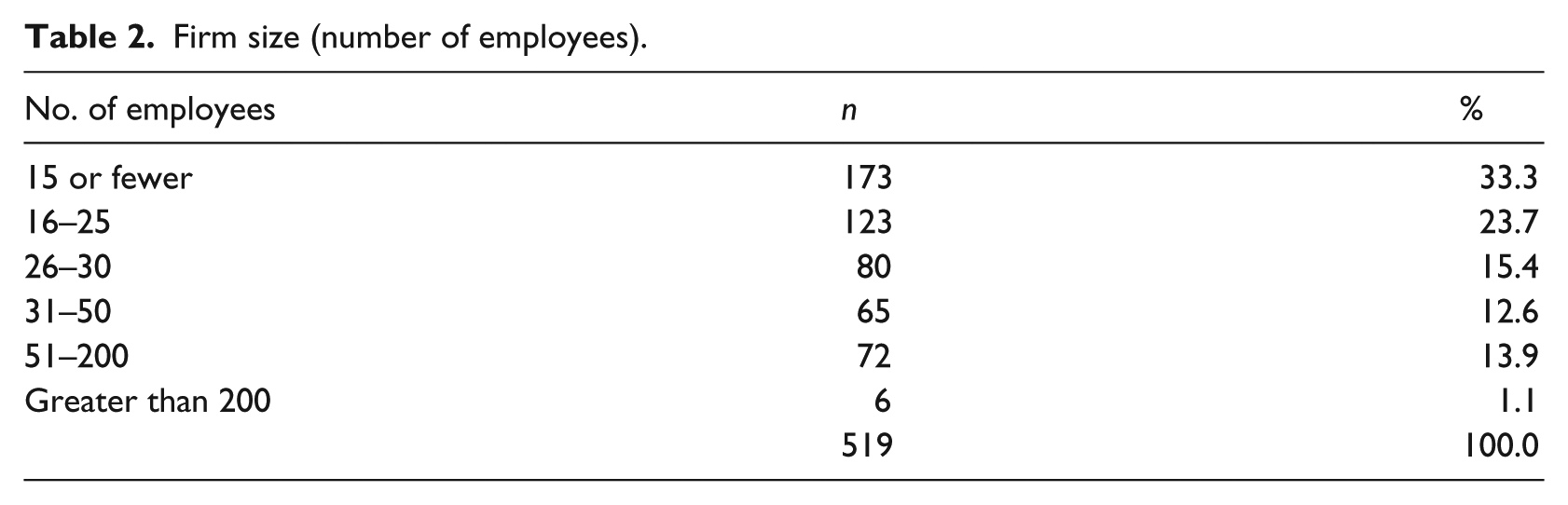
A profile of the final sample is shown in Tables 1 and 2. The profile reflects a skew toward small enterprises (57% had fewer than 26 employees and 33% with fewer than 16 employees) and a bias toward experienced enterprises with 55% operating for 10 years or more.
Length of time business has been in operation.
Firm size (number of employees).
Measures
The measures for perceived communication, technical, and process quality were adapted from Kirchmajer and Patterson (2004) and Ruekert and Walker (1987) plus our qualitative interviews. The measures for value and repeat patronage were single-item measures typically used in the literature. For value, the item was ‘For the audit we received, the fee for the audit was appropriate’, while for the dependent variable–repeat patronage, it was ‘I intend to continue with my current auditor in the future’. Both were captured on a 5-point Likert scale. Face validity was established by showing all scales to three marketing and management academics and five SME owners, who all agreed that the items captured the essence of the constructs. Moreover, these items have both face and content validity and are consistent with Rossiter’s (2002) call for more parsimonious measures.
Scale evaluations
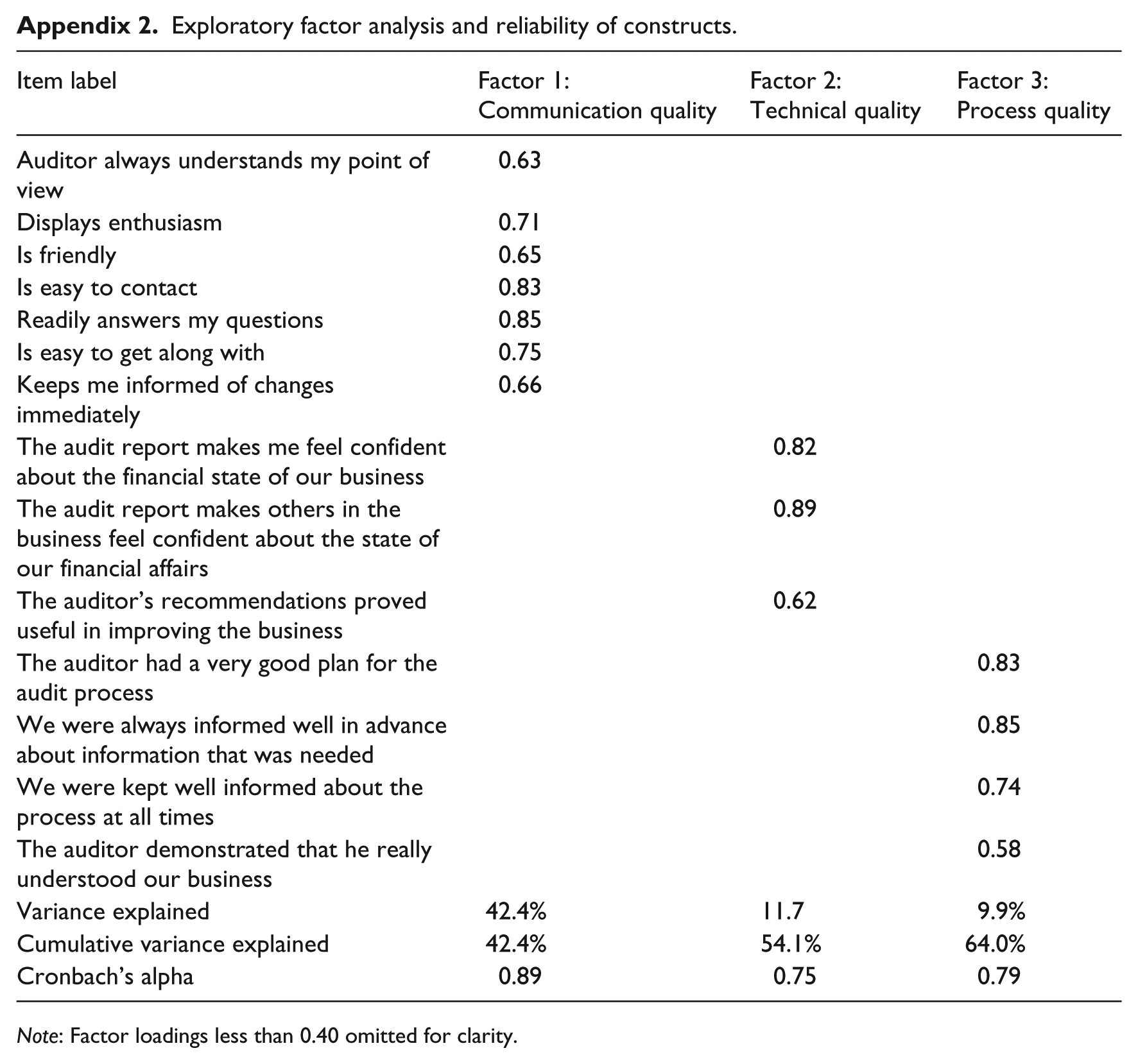
First, we conducted an exploratory factor analysis entering all items for communications quality as well as technical and process quality (refer to Appendix 2). The results confirmed a three-factor solution explaining 64% of the total variance, with the first factor (communication quality – seven items) explaining 42.4% of the cumulative variance; technical quality (three items) a further 11.7%; and process quality (three items) 9.9%. Cronbach’s alpha for the three constructs was a respectable 0.89, 0.75 and 0.79, respectively. Next, all multi-item constructs were subjected to scale purification using confirmatory factor analysis (CFA). First, the unidimensionality of the three quality constructs was established. This meant omitting one item from the technical quality scale. There were no standardized residual covariances greater than ±2.58. Next, an overall measurement model comprising the three quality constructs was assessed using CFA. Each scale was considered simultaneously in the model to provide for the test of convergent and discriminant validity. The hypothesized models were tested using AMOS software. The overall model fit statistics indicated a χ2/degree of freedom (df) = 3.62, p = 0.00 level, goodness-of-fit index (GFI) = 0.93, adjusted goodness-of-fit index (AGFI) = 0.90, comparative fit index (CFI) = 0.94, root mean squared residual (RMSR) = 0.04, root mean square error of approximation (RMSEA) = 0.07, and normed fit index (NFI) 0.92. All statistics provide sound support for the measurement model. Table 3 shows the completely standardized parameter estimates, average variance extracted (AVE) for each construct, and their reliabilities.
Composite reliability and AVE of latent variables.
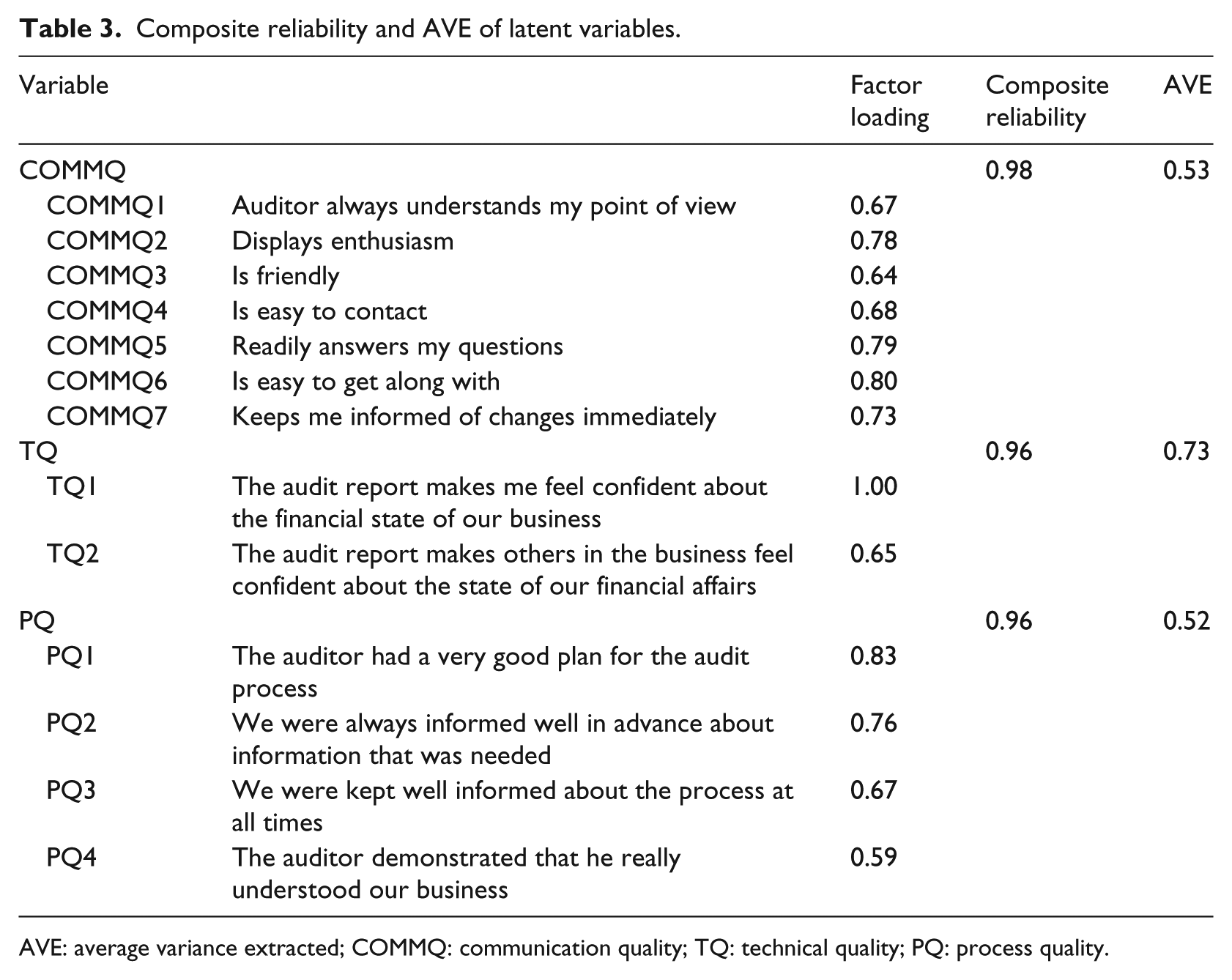
AVE: average variance extracted; COMMQ: communication quality; TQ: technical quality; PQ: process quality.
Validity and reliability
The composite reliabilities for all three measures of quality are greater than 0.9 (Table 3). Next, the AVE, which measures the amount of variance that a latent construct captures from its indicators, relative to measurement error, ranged from a modest but acceptable 0.52 (process quality) to 0.73 (technical quality). To further assess whether the quality constructs are distinct from each other, the procedure described by Fornell and Larcker (1981) was employed. As an indication of convergent and discriminant validity, the square root of the AVE for each construct should be higher than the correlation between that construct and any other construct. This proved to be the case. Thus, it may be concluded that the constructs are discriminant. A correlation matrix is shown in Table 4.
Correlation matrix.
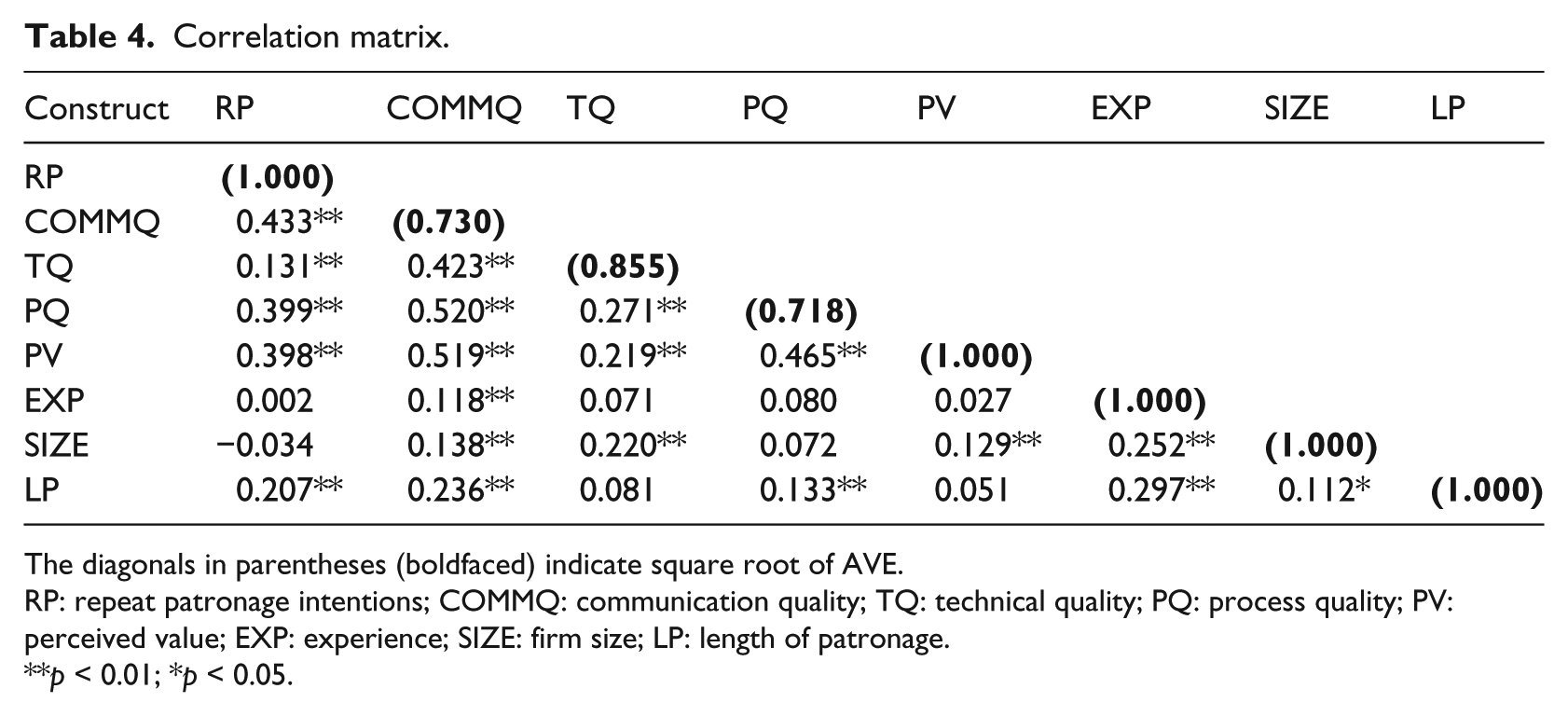
The diagonals in parentheses (boldfaced) indicate square root of AVE.
RP: repeat patronage intentions; COMMQ: communication quality; TQ: technical quality; PQ: process quality; PV: perceived value; EXP: experience; SIZE: firm size; LP: length of patronage.
p < 0.01; *p < 0.05.
Common method bias
The use of single data sources raises the possibility of common method bias. To test this, we first ran Harmon’s one-factor test (Podsakoff and Organ, 1986), which showed no single factor accounted for the majority of variance, with the first factor accounting for 40.8% of the 69.9% total variance explained. Next, we used the marker variable technique (Lindell and Whitney, 2001) in which a demographic variable was selected as the marker variable (having no theoretical relationship with the dependent variable) and which was nonsignificantly correlated (r = .13) with the dependent variable (repeat patronage intentions). After partialing out the effects of the marker variable, the mean change in the correlations of the independent and moderator variables was only 0.078, thus providing no evidence of common method bias. Next, following Podsakoff et al.’s (2003) suggestion, we separated measures of the independent variables from the dependent variables (value, repatronage intentions) by inserting them in separate sections of the instrument. And finally, we informed respondents that their anonymity would be assured, and so reducing any evaluation apprehension and demands for social desirability bias.
Control variables
To provide a more robust test of our hypotheses, we first included experience (number of years the firm had been in business) and firm size (number of employees) as control variables to perceived value. Years in business is a proxy for the number of previous audits (that is, experience), and larger firms are more likely to have qualified accountants and so would be in a better position to be able to objectively evaluate value. We then controlled for length of patronage with current auditor in modeling repeat patronage intentions.
Results
Structural model
To estimate the conceptual model, we employed structural equation modeling. The fit statistics indicated that the model represented the data well, with χ2 = 480, df = 125, CFI = 0.91, and RMSEA = 0.074. The explained variance for repeat patronage intentions was 18.7%. With one exception, all relationships were as predicted. The one exception being that H1a (the link between technical quality and perceived value) was, perhaps surprisingly, nonsignificant. Given technical quality (of the audit report and its findings and recommendations) is the core service, this indicates that clients are either not motivated, or are unable, to judge the worth of the audit based on their assessment of the audit’s technical quality. As predicted, the link between process quality and value was positive (0.16; p < 0.00) and is clearly stronger than technical quality in impacting client’s value perceptions. As predicted, due to the signaling effect, the direct communication quality–value link was also significant and positive (0.47; p < 0.00). This supports the view that clients are unwilling, or unable, to evaluate the value for money they have received based on their assessments of technical quality. Instead they rely heavily upon a peripheral route (Petty and Cacioppo, 1986) to assessing value; that is, how effectively the audit team communicates and how they are treated during the audit process.
Alternative model
Interpersonal communication is fundamental to building trust and a lasting relationship. This is especially so in higher-context cultures (e.g. Asian collectivist cultures such as Thailand) where words and gestures can communicate a complex message very effectively. Relationships have special salience in collectivist cultures, and efforts by an auditor to build rapport, for example, will help engender trust (Hall, 1976). Mohr and Nevin (1990) went so far as to claim that communication was ‘the glue’ that held relationships together, while Duncan and Moriarty (1998: 3) note that ‘communication is the human activity that links people and creates relationships’. Moreover, effective communication allows social bonds between client and service provider, to develop at an emotional level that makes a relationship more resilient and to nullify competitors’ inducements for clients to switch, thus presenting a psychological barrier to exiting the relationship (Patterson and Smith, 2003). Hence, a client will not dissolve a relationship unless there is a serious breakdown of service and communication.
Finally, as noted earlier, we contend that because SME clients typically have difficulty evaluating the technical worth of an audit, open, honest, and frequent communications over time from the audit team will take on added importance in a client’s likelihood of continuing to engage an audit firm in the future. Looking at this from the opposite side of the client–supplier dyad, it is consistent with the relationship management approach adopted in financial services where ‘soft’, qualitative information gleaned by a loan officer over multiple service encounters forms the basis of relationship lending (Berger and Udell, 2002; Udell, 2008). Hence, we tested an alternative model where communication quality has a direct impact on clients’ repeat patronage intentions, as well as an indirect one via perceived value (see H3c). The result shows a significant, direct path (0.47; p < 0.00), an increase in the R2 from 18.7% to 24.1%, and a statistically significantly (p < 0.00) improved model fit: χ2 = 444, df = 124, CFI = 0.92, and RMSEA = 0.071. Moreover, all parameter estimates remained stable except the value–repeat patronage intentions link which reduced from 0.388 to 0.212, reflecting its role as a partial mediator, rather than providing complete mediation. The results are shown in Table 5 and also depicted in Figure 2.
Parameter estimates: Alternative model.
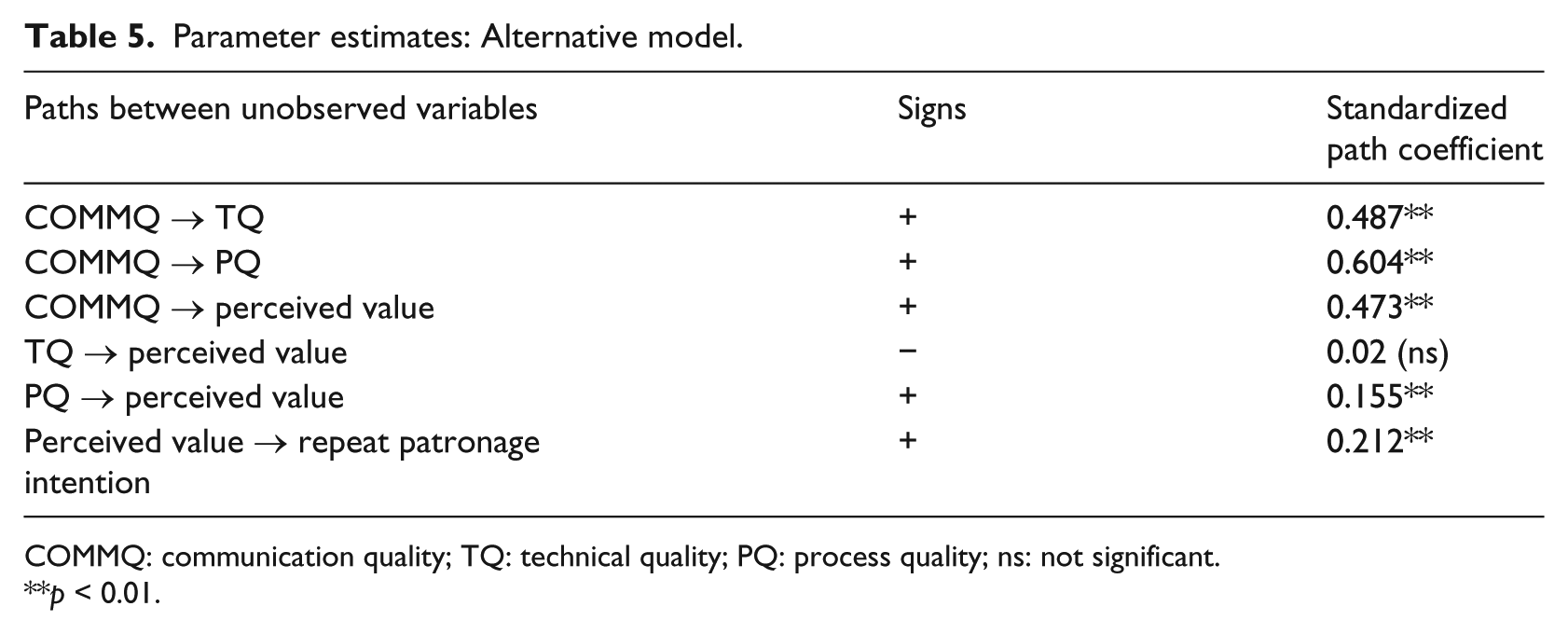
COMMQ: communication quality; TQ: technical quality; PQ: process quality; ns: not significant.
p < 0.01.
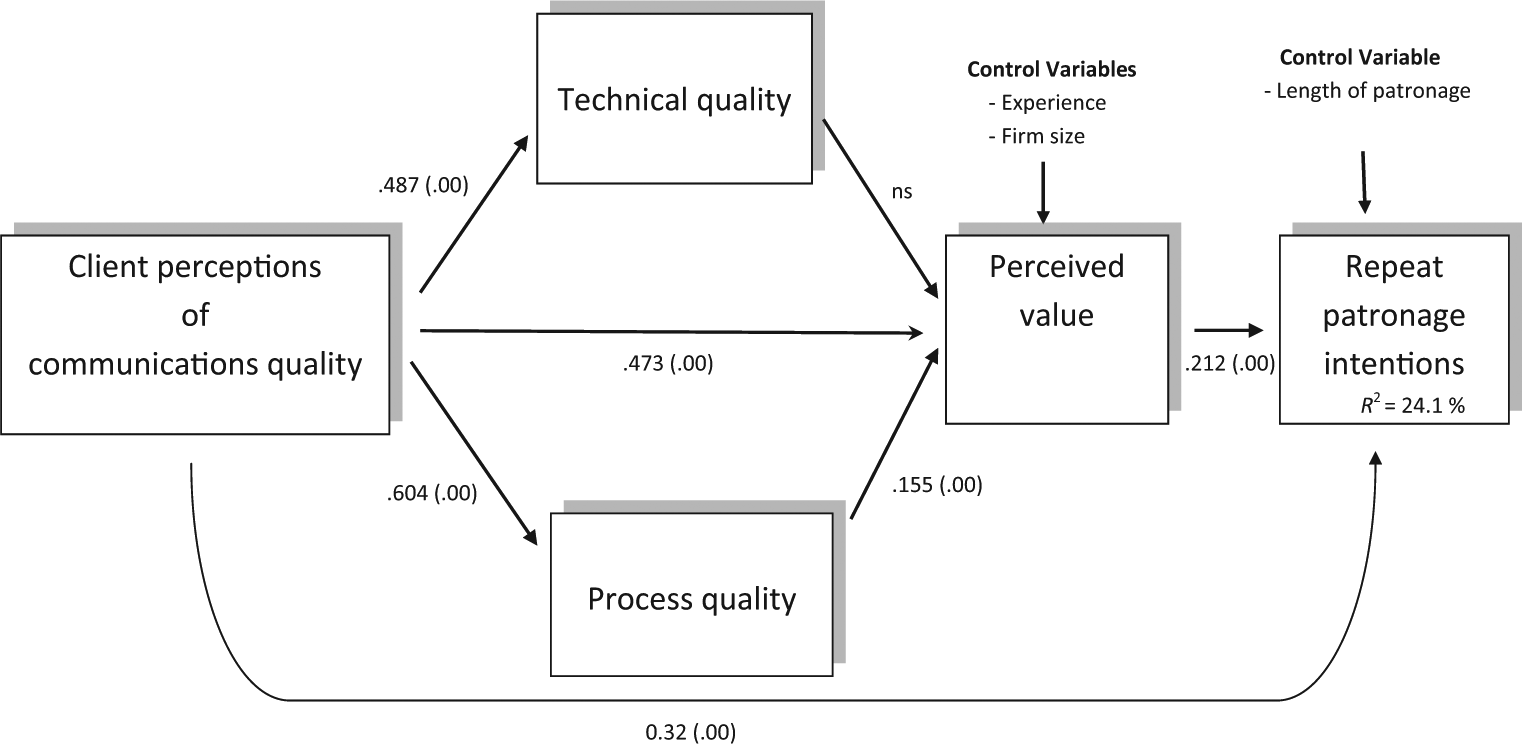
Alternative model.
For the three control variables, business size (number of employees) was small but significant (0.08; p < 0.05) in influencing perceived value, while business experience (number of years in business) was not significant. The impact of length-of-patronage on repeat patronage intentions was significant (0.19; p < 0.00). The size of this coefficient rivals that of perceived value (0.212), suggesting that with length-of-patronage comes trust, familiarity, and even inertia such that the incumbent audit firm has the inside running when it comes to reengaging a client.
Discussion
The results highlight the critical role that effective interpersonal communication plays in influencing perceptions of not only technical and process quality, but value and even client repeat patronage intentions. In both base and alternative models, the path from technical quality to perceived value was non-significant. In other words, as expected, SME client perceptions of the value (for fee paid) of the audit are not influenced by their view of the technical quality of the audit report or outcome (Figure 2). In fact, the strongest driver of value (and indeed client repeat patronage intentions), and consistent with signaling theory, is interpersonal communication quality. This was supported by qualitative interviews, where clients emphasized the importance of various aspects of communications. For example, ‘I have limited knowledge about the audit process so what I am looking for is an auditor who understands my point of view’ (female, 42 years, owner, 20 years in furniture business); ‘As my background is not accounting, I base the quality of the audit on how the auditor informs me about the law and accounting regulations needed to run my business especially when there are changes in those regulations’ (female, 39 years, owner, 16 years in transportation business); and ‘I simply value audit quality from auditor’s willingness and enthusiasm in responding to my questions’ (male, 35 years, manager, 12 years in trading business).
These examples serve to illustrate the point that the business and financial implications of an audit only unfold over time and most SMEs typically do not have the accounting skills to assess and appreciate the technical quality of an audit. Moreover, it is likely that some clients do not place a high value on the benefits of an audit report because every audit involves sampling since the auditor cannot examine 100% of the business transactions during a period. Yet scrutinizing a larger sample of transactions over a longer period of time means a higher fee and therefore, arguably a higher quality technical report. This, of course, leads to the greater likelihood of the auditor finding some anomalies in financial statements. The larger percentage of transactions scrutinized, the higher the probability that this may lead to a ‘non-clean’ or ‘qualified’ audit report which is not what SME owners want. Therefore, SMEs may not value a thorough, high-quality audit report (technical quality) since it may draw negative attention to firms’ financial results. However, because the audit report is a statutory requirement, if given an ‘unqualified’ or ‘clean’ opinion of their financial statements by the auditor, they are satisfied. Upon reflection then, it is perhaps not surprising that clients use perceptions of interpersonal communication with an auditor as a tangible cue or proxy to make assessments of the technical quality of an audit (and so value and repeat patronage intentions).
Concerning the limited amount of variance explained (24.1%) (alternative model) around the dependent variable (repeat patronage intentions), while it was not the purpose of this study to maximize the explained variance, it might be speculated that the inclusion of switching barriers or even inertia would significantly increase this. Switching barriers would include the fact that the incumbent audit firm is knowledgeable about the client’s business, is privy to the workings of the firm, and may be trusted to maintain confidentiality. Moreover, the interpersonal relationships developed between client and auditor may prove to be a psychological barrier to exiting the relationship (Patterson and Smith, 2003).
Managerial implications
Effective communication in a business context means sharing timely information in an empathetic, respectful, friendly, and enthusiastic way with some social orientation (Webster and Sundaram, 2009). It is a way of signaling the unobservable. In a business context, most signals include quality as a distinguishing feature, with quality being the unobservable. Furthermore, effective communication also reduces information asymmetry between sender (firm) and client, and so serves to educate the client and reduce uncertainty (especially in a services context where the core deliverable is intangible). Successful professional service firms possess a blend of technical knowledge and communicative ability. Strong communication skills are needed to ensure that clients understand and have confidence in the process, have a sense of (if not actual) control, and appreciate the intrinsic value of the service to their firm. Based then on the nature, frequency, and effectiveness of communication, clients then form overall perceptions of service quality and, importantly, value. To illustrate, as noted earlier, the emergence of relationship lending in financial services is based on a loan officer’s assessment of the ‘soft’, unobservable information acquired over many service encounters with an SME client (Berger and Udell, 2002; Udell, 2008).
Hence, in order to re-engage an SME client in the future, an audit firm needs to focus on the quality of their ‘soft’ skills – that is, interpersonal communication – because most SME owners are not motivated and do not have the accounting skills to either recognize the value or confidently assess the technical quality, of an audit. With this in mind, the empirical results indicate that clients typically take a peripheral route (Petty and Cacioppo, 1986) to assessing an audit’s value. That is, rather than exert time and cognitive effort in assessing technical quality of the audit, they rely heavily on the communication signals received to assess value; or, put another way, clients pay more attention to ‘style over substance’ (Sparks and Areni, 2002). So, the audit firm should place interpersonal communication skills as one of the main criteria when recruiting new employees. Once recruited, training programs for auditors should include interpersonal communication skills apart from the focus on professional technical knowledge. Well-designed and effective delivery of communication programs is needed to improve auditor communication ability, and in doing so, enhancing client perception of audit quality and value is key to retaining clients. Finally, the firm should encourage individual auditors to be proactive and keep clients informed about regulations related to their business, provide suggestions to improve their business, and present those suggestions with enthusiasm and in an empathetic manner during the audit process.
Enhanced communication skills might be employed by the auditor to manage client expectations. As a result, the auditor should have a plan for the audit process and always inform the client well in advance about information that is needed for this. Clients should be well informed about the progress on a regular basis. For example, if financial anomalies are detected, the auditor might progressively inform the client rather than ‘drop a bombshell’ of bad news upon audit completion.
To improve client’s understanding of the workings of a financial audit, governments and policy makers can support SMEs by providing assistance programs to enhance their understanding of the audit process focusing on technical quality of an audit report. For such programs to be effective, it is important that the concept of a financial audit is itself clearly defined and understood. Developing an effective integrated program to support SMEs, to realize the benefits of the audit process and report, will require more than just a simple package. Governments could learn from existing programs, in designing and running such programs, in developed countries and adapt them to Thailand and other developing economies. Such programs may take the form of a series of seminars, workshops, and one-to-one consultancy sessions.
Limitations and future research
This study is not without limitations. First, for those associated with all cross-sectional surveys, employing a longitudinal method and tracking communication effectiveness at different stages of an audit might prove insightful. Second, interpersonal communication in this study was operationalized as a unidimensional construct. However, future work might examine how different styles of communication – such as a controlling versus an affiliative style – influence client evaluations. Next, the key role of communications should be examined across a range of professional, consumer services (rather than business-to-business) such as financial planning or health care (where there is prolonged, intimate contact and the outcome is uncertain) to test whether communication has the same critical impact on value perceptions and repatronage intentions. Other antecedent variables might be examined, including likeability of the individual professional service provider, loyalty to the individual or the firm, risk perceptions, and importance of the technical outcome to the client. Finally, communication is to some extent culture bound. Different communication styles and the receiver’s interpretation and reaction to different styles reflect cultural norms and values. This study was undertaken in a Southeast Asian, collectivist society (Thailand) where the culture and many of the social norms, especially interpersonal communication, are at variance with western cultures. Future research should therefore examine the extent to which the results might be generalized to highly individualistic cultures (such as the United Kingdom, United States, or Australia) by replicating (and extending) the study in a western culture.
In conclusion, despite limitations, this study of 519 SME clients of financial audit firms demonstrated the important role that interpersonal communications between the service professional and client play in evaluating an audit outcome. Consistent with signaling theory, it is client perceptions of interpersonal communication, rather than technical quality, that have the largest impact on client perception of value-for-fee and, importantly, the likelihood of reengaging the audit firm.
Footnotes
Appendix
Exploratory factor analysis and reliability of constructs.
| Item label | Factor 1: Communication quality | Factor 2: Technical quality | Factor 3: Process quality |
|---|---|---|---|
| Auditor always understands my point of view | 0.63 | ||
| Displays enthusiasm | 0.71 | ||
| Is friendly | 0.65 | ||
| Is easy to contact | 0.83 | ||
| Readily answers my questions | 0.85 | ||
| Is easy to get along with | 0.75 | ||
| Keeps me informed of changes immediately | 0.66 | ||
| The audit report makes me feel confident about the financial state of our business | 0.82 | ||
| The audit report makes others in the business feel confident about the state of our financial affairs | 0.89 | ||
| The auditor’s recommendations proved useful in improving the business | 0.62 | ||
| The auditor had a very good plan for the audit process | 0.83 | ||
| We were always informed well in advance about information that was needed | 0.85 | ||
| We were kept well informed about the process at all times | 0.74 | ||
| The auditor demonstrated that he really understood our business | 0.58 | ||
| Variance explained | 42.4% | 11.7 | 9.9% |
| Cumulative variance explained | 42.4% | 54.1% | 64.0% |
| Cronbach’s alpha | 0.89 | 0.75 | 0.79 |
Note: Factor loadings less than 0.40 omitted for clarity.
Funding
The author(s) received no financial support for the research, authorship, and/or publication of this article.