







Abstract
This article examines the moderating role of regional social capital in the intention–behaviour link in entrepreneurship. We investigate to what extent the regional social capital context in which aspiring entrepreneurs are embedded strengthens or weakens the translation of individual entrepreneurial intentions into new venture creation activities. Our results suggest that the intention–behaviour link is weakened by cognitive regional social capital in the form of regional hierarchy values and strengthened by structural regional capital in the form of regional cultural diversity and regional breadth of associational activity, as well as by relational regional social capital in the form of high levels of regional generalised trust. Our findings suggest that to support new venture creation activity, there is a need to grow regional social capital via the enhancement of social trust, associational activities and regional cultural diversity – and at the same time decrease hierarchical social structures within regions.
Keywords
Introduction
Starting a new business venture is challenging due to multiple internal and external limiting factors (Autio and Acs, 2010). Decision of aspiring entrepreneurs not to act on their potentially successful entrepreneurial intentions is a case in point (Van Gelderen et al., 2015). What explains the intention–behaviour gap in entrepreneurship? Prior studies have focused mainly on the role of individual-level characteristics such as self-efficacy (Boyd and Vozikis, 1994), demographics (Shirokova et al., 2016), self-identity (Obschonka et al., 2015a) or emotions (Van Gelderen et al., 2015) in explaining the translation of entrepreneurial intention into start-up behaviour. The contingent effect of contextual factors has remained relatively underexplored (see Bogatyreva et al., 2019; Kibler et al., 2014, for two notable exceptions in that context).
In entrepreneurship research, context has been long recognised as a crucial factor in explaining entrepreneurial activity (Welter, 2011; Zahra, 2007). According to this view, entrepreneurs and their firms are embedded in particular places, communities and networks that socially frame resources and opportunities (McKeever et al., 2015). The concept of social embeddedness can explain how context and community affect the ability of entrepreneurs to draw on social and economic resources (Dahl and Sorenson, 2009; McKeever et al., 2014).
The fact that new venture creation activities tend to be more highly concentrated in certain geographical areas than in others constitutes a relevant empirical pattern in that context. Regional scientists argue that this may be due to regional variations in ideas, knowledge, agglomeration effects and entrepreneurship-related values (Audretsch and Fritsch, 1994; Klepper, 2010; Stuetzer et al., 2016, 2014). Another possible explanation for this clustering, widely overlooked in the literature, could be regional variations in social embeddedness, that is, variations in the regional social capital context in which aspiring entrepreneurs are embedded. We conjecture that this context might be particularly important for the intention–behaviour link in entrepreneurship. On that basis, we argue that certain regional social capital environments may induce a higher individual propensity to turn entrepreneurial intentions into actions than others. Thus, we seek to answer the following research question: What is the role of the regional social capital in the translation of entrepreneurial intentions into start-up behaviour?
We anchor our theoretical argument in concept of social embeddedness (McKeever et al., 2014), complemented with the social capital (Burt, 1997; Granovetter, 1973; Putnam, 1993) and regional science literatures (D’Ambrosio et al., 2019; Florida et al., 2002; Marshall, 1920; Mickiewicz et al., 2019; Parrilli, 2009; Porter, 1990) as well as models of entrepreneurial intentions (Ajzen, 1991; Kautonen et al., 2015). Our main premise is that, ceteris paribus, strong entrepreneurial intentions epitomise valuable capabilities on the part of aspiring entrepreneurs that allow them to more successfully leverage resources from social relationships and networks at the region-level than their weak-intention counterparts, which, in turn, will boost their propensity to engage in new venture creation activities. We test our ideas using a longitudinal sample of 663 students participating in the 2013/2014 and 2016 Global University Entrepreneurial Spirit Students’ Survey (GUESSS). 1
Our study makes several contributions to the entrepreneurship literature. First, we contribute to the entrepreneurial intention–behaviour link through an in-depth examination of social capital factors at the region-level that enhance or impede the translation of entrepreneurial intention into start-up activity. Compared to prior studies, which focused mainly on the moderating effect of individual-level characteristics (see, for example, Kautonen et al., 2013; Van Gelderen et al., 2015) or country-level features (Bogatyreva et al., 2019), the incorporation of contextual factors in the form of regional social capital offers a novel perspective to examine the interplay between macro- and micro-level influences in determining new venture creation. Second, we contribute to the entrepreneurship literature investigating the role of social and placial embeddedness in new venture creation (Korsgaard et al., 2015a; McKeever et al., 2014, 2015). Third, by documenting the link between entrepreneurial intentions and actions of university students, we empirically contribute to the literature on the entrepreneurial intentions and start-up activity of university students (Edelman et al., 2016; Giacomin et al., 2016), thus adding to the increasing research field of youth entrepreneurship. Finally, we make a methodological contribution to the social capital literature in an entrepreneurship context (Liao and Welsch, 2005), by comprehensively operationalising the social capital construct based on its previously conceptualised structural, relational and cognitive dimensions (Nahapiet and Ghoshal, 1998).
The article proceeds as follows. We start by presenting our theoretical framework and hypotheses. We then move to a description of our sample and methodology, and present our empirical insights. Next, we discuss our findings and then conclude with the implications and limitations of our research.
Theoretical framework
Entrepreneurial intentions, social embeddedness and new venture creation
What drives the start-up of new businesses? Some argue that new businesses are started because of favourable psychological and behavioural traits and human capital of the business founder (Backes-Gellner and Moog, 2013; Davidsson and Honig, 2003). Another stream of research explains new venture creation through intentionality, which can be conceptualised using Ajzen’s (1991) Theory of Planned Behavior (TPB). TPB posits that intention, that is, a person’s propensity to engage in a certain behaviour, is the direct determinant of that behaviour; it has been increasingly utilised in entrepreneurship literature to explain entrepreneurial intentions (Lortie and Castogiovanni, 2015; Schlaegel and Koenig, 2014), but there is a lack of studies testing TPB’s postulated association between intentions and behaviour (Kautonen et al., 2015). The third stream of literature views new venture creation as the result of the actions of individuals embedded in social networks and personal relationships, such that starting a business is determined by the network of relationships of entrepreneurs – or in other words, their social capital (Aldrich, 1999; Aldrich and Zimmer, 1986; Greve and Salaff, 2003; Liao and Welsch, 2005).
Embeddedness is described as ‘the social, structural, cultural, political, and cognitive structuration of decision situations in economic contexts’ (Beckert, 1999: 3). In the entrepreneurship literature, the concept of social embeddedness has been explored through different perspectives, including ‘ethnical embeddedness’ (Ram et al., 2002), ‘family embeddedness’ (Aldrich and Cliff, 2003; Edelman et al., 2016), ‘social class embeddedness’ (Anderson and Miller, 2003), ‘university embeddedness’ (Shirokova et al., 2018) and ‘placial embeddedness’ (Korsgaard et al., 2015a; McKeever et al., 2015). The social embeddedness concept emphasises the importance of context in shaping entrepreneurial behaviour (McKeever et al., 2015), given entrepreneurship spans contextual boundaries. Portes and Sensenbrenner (1993) explain that embeddedness is an important mechanism for identifying opportunities and understanding the ways through which resources are distributed.
In this study, we adopt the lens of ‘placial embeddedness’ from the social embeddedness perspective to examine the role of regional social capital in the translation of entrepreneurial intention into start-up activity. Placial embeddedness refers to the ‘entrepreneur’s knowledge and use of the physical, cultural, and historical landscapes on their respective islands, as well as the entrepreneur’s strong concern for the wellbeing of the local island communities’ (Korsgaard et al., 2015a: 575). Place may be considered as a construct of relations of social life (Johnstone and Lionais, 2004) and, therefore, represents the location where entrepreneurs can leverage their social capital (McKeever et al., 2015). Social capital is a multidimensional concept, occurring at both individual and cohort levels. Putnam (1993, 2000), for example, aggregate social capital pertains to individuals and smaller communities to a collective trait of larger population aggregates that become comparable across cities, regions and countries.
In the context of our study, we are interested to what extent new venture creation is affected by regional social capital. We define regional social capital, in line with Nahapiet and Ghoshal (1998), as actual and potential resources that are part of and accessible through the network of relationships possessed by an individual in a geographically delimited area below the nation-level.
Three major reasons warrant this empirical focus. First, new venture creation activities tend to be more highly concentrated in certain geographical areas due to regional differences, for instance, in ideas and knowledge (Audretsch and Fritsch, 1994; Klepper, 2010; Stuetzer et al., 2016, 2014). More precisely, the urban economics and economic geography literature views economic growth as driven by knowledge spillovers which, in turn, are facilitated by geographical proximity (Acs and Sanders, 2014; Jacobs, 1969; Marshall, 1920; Porter, 1990) and social proximity (Agarwal et al., 2006; Saxenian, 1994). Maskell (2001), for example, finds that geographical proximity may be conducive to the establishment of trust-based relationships, which in turn boosts knowledge flows between agents at the local-regional level. On that basis, it can be argued (a) that social capital acts as a precursor to knowledge creation (Nahapiet and Ghoshal, 1998), which in turn can manifest itself in new venture creation activities, and (b) that regional social capital appears to be particularly powerful in stimulating this process.
Second, and related to the first argument, there is agreement in the entrepreneurship literature that the formation and implementation of entrepreneurial intentions occurs not only in a social but also a spatial setting (Korsgaard et al., 2015a; McKeever et al., 2015). For example, it has been shown that aspiring entrepreneurs tap into their local and regional networks in the process of starting a business, they often receive support from local and regional organisations (e.g. business incubators) and they tend to operate in regional markets (Feldman, 2001; Sternberg, 2009). In several studies of social embeddedness of entrepreneurs in a rural context, it was shown how local social ties become a source of competitive advantage for rural entrepreneurs by providing an access to resources otherwise not available (Jack and Anderson, 2002; Korsgaard et al., 2015a, 2015b; McKeever et al., 2015).
Third, with regard to the notion that an entrepreneurial culture is a legitimate element of the cognitive dimension of social capital, recent evidence suggests that entrepreneurial cultures may differ not only between but also within countries, emphasising the need to consider the concept of a regional entrepreneurial culture when analysing the culture–entrepreneurship link (Fritsch and Wyrwich, 2017; Kibler et al., 2014; Obschonka et al., 2015b; Stuetzer et al., 2016).
Regional social capital contingency effects on entrepreneurial intention–behaviour translation
The above discussion outlines conceptual arguments explaining why entrepreneurial intention and regional social capital can be expected to stimulate entrepreneurship and in particular, nascent entrepreneurship. The intention–behaviour link in entrepreneurship moreover has some, albeit thin, empirical support due to the lack of studies using longitudinal data to test this relationship (Kautonen et al., 2015). By contrast, as noted by Backes-Gellner and Moog (2013), there is a scarcity of empirical studies linking the concept of social capital to the decision to become an entrepreneur (for notable exceptions, see Davidsson and Honig, 2003; Kwon and Arenius, 2010; Liao and Welsch, 2005) – and apart from Nieto and González-Álvarez (2016), there is no such study examining the effect of regional social capital on new venture creation.
Building on this, to the best of the knowledge of authors, no empirical study has so far tested to what extent individual entrepreneurial intention affects individual nascent entrepreneurial behaviour in interaction with regional social capital. A similar study in terms of conceptual reasoning is Parrilli (2009) who, based on case study insights, argues that social cohesion (i.e. social capital) and individual self-realisation (which arguably is strong if an individual has strong entrepreneurial intentions) must go hand-in-hand to foster entrepreneurship and improve the economic performance of regional business systems such as clusters and industrial districts.
We conjecture that there are individual-level capabilities that may allow individuals with stronger intentions to more successfully access resources from social relationships and networks at the region-level than individuals with weaker intentions, which, in turn, will boost their propensity to engage in new venture creation activities. Our thesis is that strong entrepreneurial intention on the part of the aspiring entrepreneur constitutes such a capability because it embodies two idiosyncratic capabilities – entrepreneurial intensity and social competence – which have been argued to effectively leverage social capital during the venture creation process (Kreiser et al., 2013).
The latter constitutes commitment-related and focus-related attitudes and behaviours (Liao and Welsch, 2004), which can be summarised as an individual’s entrepreneurial motivations, willingness of entrepreneur to make sacrifices to start the venture by giving up on other activities and goals and the explicit formulation of an entrepreneurial intention (Kreiser et al., 2013). In short, individuals with high entrepreneurial intensity can be expected to be more committed to, and focused on, searching, identifying, acquiring and absorbing region-level resources useful for new venture creation (Gundry et al., 2003). This, at the same time, might enhance the willingness of other individuals or social units within the regional social network to share resources because of the high entrepreneurial intensity signalled by the aspiring entrepreneur. A bank, for instance, would be more convinced of the viability of a business idea if the founder exhibits commitment and focus (Kreiser et al., 2013).
Social competence refers to the effectiveness with which individuals utilise their social skills (Baron and Markman, 2003), with the literature agreeing that enterprising individuals possess a high level of such competence (Beugelsdijk, 2010; Kreiser et al., 2013). We argue that individuals with strong entrepreneurial intentions clearly belong to this category. High social competence helps aspiring entrepreneurs because it is said to lead to a more effective interaction and communication with other network members, facilitating the acquisition of vital network resources particularly from extensive network relationships (Gartner et al., 1992; Hisrich and Jankowicz, 1990; Baron and Markman, 2003; Wei et al., 2010). As noted by Baron and Markman (2000), a key effect of social competence of new venture creation activities is the founder’s ability to effectively interact with diverse and previously unconnected network members within their relationship networks. Similarly, Kreiser et al. (2013) argue that a socially competent entrepreneur will be more successful in building ties with non-similar individuals potentially able to provide rare resources. In sum, our postulation is that individuals with strong entrepreneurial intentions have a larger absorptive capacity (Cohen and Levinthal, 1990) or combination capability (Nahapiet and Ghoshal, 1998) than their low-intention counterparts in terms of leveraging their regional social capital for the purpose of new venture creation. Reflecting Cohen and Levinthal’s (1990) arguments, we equate strong intentions to start a business with the individual’s ability not only to recognise the value of resources embedded at the region-level but also to assimilate and use it in the context of new venture creation.
Strong entrepreneurial intentions encompass entrepreneurial intensity and social competence but are not limited to these concepts. For example, we opine that the seven attributes that Cromie (2000) outlined to distinguish entrepreneurs – including aspiring entrepreneurs with strong intentions – from non-entrepreneurs all contribute to mobilising critical resources from the regional environment to stimulate the venture creation process. These attributes include the enterprising individual’s strong need for achievement, a strong locus of control, a risk-taking attitude, creativity, a strong need for autonomy, an ability to effectively handle situations or information that are vague, uncertain or unclear and self-confidence or self-efficacy (Beugelsdijk, 2010).
Hypotheses
Based on the above discussion, we formulate testable hypotheses regarding the moderating influence of regional social capital on the propensity of individuals to turn their entrepreneurial intentions into actual entrepreneurial behaviour. In that context, and in line with Nahapiet and Ghosal (1998), we subdivide social capital into a structural and relational (see also Granovetter, 1992) and a cognitive dimension.
Structural regional social capital as moderator in the intention–action link
Structural social capital describes the pattern of linkages between individuals or social units, measured, for example, through network density (Bourdieu, 1986; Burt, 1992; Nahapiet and Ghoshal, 1998). It is also measurable through network diversity because more differentiation within a network may allow network members to exploit specific resources which might not be available in a more homogeneous network (Erickson, 1996; Lin, 2001). Both attributes are in line with Granovetter’s (1973) and Burt’s (1992, 1997) bridging view of social capital, which implies the notion that social relations characterised by ‘weak ties’ of network members facilitate exchange of non-redundant resources. This contrasts with the term ‘bonding social capital’, which refers to network cohesion, that is, the close relationships between individuals who already have relevant sociocultural similarities such as ethnicity (Putnam and Goss, 2002). Florida et al. (2002) argue that that strong regional bonding social capital will ultimately lead to relationships characterised by complacency, isolation from outside information and conformity – all are detrimental to innovation. By contrast, Florida et al. (2002) view weak regional ties as conducive to a basic level of information exchange and collaboration while allowing for the inclusion of outsiders with different resources into the social network – which encourages innovative thinking. Innovation is in turn, relatable to opportunity-based entrepreneurship (Acs et al., 2009; Schumpeter, 1934 [1911]; Shane and Venkataraman, 2000). In terms of nascent entrepreneurship, structural social capital can be assumed to yield possibilities for nascent entrepreneurs to access resources that are conducive to venture creation (Liao and Welsch, 2005).
Regarding the structural dimension of regional social capital, we are interested in examining the moderating effect, on the one hand, of regional network diversity and, on the other, of regional network density on the intention–behaviour link. We conceptualise the former through a region’s cultural diversity and the latter through its associational membership breadth. As to cultural diversity, in an age of migration, with ever more people structurally ‘on the move’ (Baycan and Nijkamp, 2011), migrants import customs and traditions of their sending regions. This affects the cultural diversity of the receiving regions which, in turn, could affect the economic performance of receiving regions (Dohse and Gold, 2014). In relation to entrepreneurship and innovation, Mickiewicz et al. (2019), for example, highlight the importance of regional social diversity – including cultural diversity – as a driver of regional entrepreneurship through a change in values towards entrepreneurship-conducive values (e.g. openness to new ideas and non-standard behaviour). The author’s argument is in line with similar literature emphasising the important role of social diversity in enhancing regional innovation (Schneider et al., 2019) and local entrepreneurship (Efendic et al., 2015). Still more nuanced insights in that context are provided by D’Ambrosio et al. (2019) who argue that the social capital of the destination community of the regional emigrants together with their own social capital as community on the move drive innovation processes in recipient regions. The result is a form of bridging social capital that reduces the barriers to localised knowledge transfers, ensuring that new knowledge of migrants complements the existing knowledge base (D’Ambrosio et al., 2019).
Synthesising these above studies, our main conceptual arguments as to why regional cultural diversity will enhance the translation of individual entrepreneurial intentions into start-up activities are as follows: For one, reflecting Florida et al. (2002) and Mickiewicz et al. (2019), we expect regional cultural diversity to embody relevant bridging social capital that has the potential of boosting regional entrepreneurial activity. Moreover, drawing on D’Ambrosio et al. (2019), we argue that the quality of such regional bridging capital will be further enhanced by the interaction of a region’s cultural diversity with the strong social capital of aspiring entrepreneurs residing in that region, which we assume to be epitomised by strong entrepreneurial intentions. We conjecture that such strong entrepreneurial intentions will allow aspiring entrepreneurs to more successfully access relevant resources from social relationships and networks at the region-level – the quality of which will increase in line with a region’s cultural diversity – than individuals with weaker intentions. This, in turn, will boost propensity of aspiring entrepreneurs to engage in new venture creation activities. Knowledge diversity created by cultural diversity is an example of such a regional resource; it is regionally ‘sticky’, fostering regional innovation and growth via the generation of regional knowledge spillovers (Jacobs, 1969; Marshall, 1920; Saxenian, 1994). These spillovers are absorbed by individuals able to perceive, assess and commercially exploit that knowledge (Audretsch et al., 2010). Both factors, then, will jointly determine individual entrepreneurial behaviour. Hence, in line with the TPB, we formulate the following hypothesis:
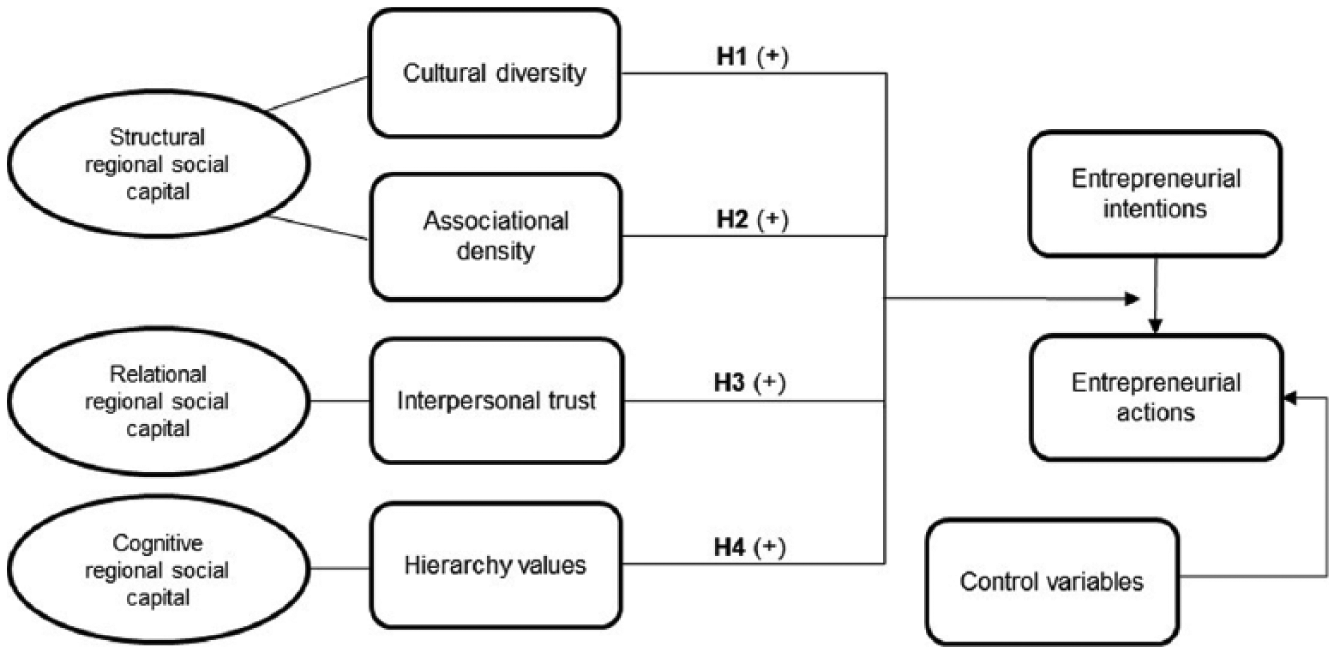
H1. The link between entrepreneurial intentions and subsequent entrepreneurial behaviour is moderated by regional cultural diversity, such that the relationship is stronger for higher levels of a regional cultural diversity.
We conceptualise regional network density through the average breadth of formal associational memberships at the region-level. Putnam (1993, 1995, 2000) argued that joining formal associations helps individuals socialise outside their close family and kin circles, providing them access to diverse and non-redundant resources (Burt, 1997). This may allow aspiring entrepreneurs to discover and exploit information and knowledge relevant for the venture creation process (Davidsson and Honig, 2003; Shane, 2000). On that basis, we argue that regions with larger average breadth of individual formal associational memberships imply regions with larger regional structural (‘bridging’) social capital. We consider this, however, not sufficient for new venture creation because of our previously outlined argument that regional structural capital will need to interact with an individual’s entrepreneurial intention to yield entrepreneurial behaviour in the form of new venture creation activities. Formally,
H2. The link between entrepreneurial intentions and subsequent entrepreneurial behaviour is moderated by the average breadth of individual regional associational memberships, such that the relationship is stronger for higher levels of such memberships.
Relational regional social capital as moderator in the intention–action link
Relational social capital refers to personal relationships between actors of a network such as friendships and acquaintanceships, and the assets created and leveraged through them (Nahapiet et al., 1998). Key attributes related to this dimension are trust between and trustworthiness of network members, and, related to that, strong bonding ties (Putnam, 2000). This has been argued to allow for an effective and efficient transfer and exchange particularly of tacit resources (Adler and Kwon, 2002; Coleman, 1988; Fukuyama, 1995; Putnam, 1993). The relational view of social capital is in many ways connected to Putnam’s (2000) notion of social capital as a universal lubricant of social relations – which not only increases network cohesion (i.e. bonding social capital) but also helps expand networks (i.e. bridging social capital). For nascent entrepreneurs, relational social capital embodies the degree of accessibility to network resources, that is, the extent to which the enterprising individual will be able to tap into these resources in the new venture creation process (Liao and Welsch, 2005).
Our conceptualisation of relational regional social capital involves the notion of interpersonal (i.e. social) trust and its prevalence at the region-level. Interpersonal trust is an individual’s conviction that most people with whom they could potentially deal with will act in a trustworthy way (Coleman, 1990; Hardin, 2002; Uslaner, 2002). It is distinguishable from particularised trust which implies that a person puts faith in particular people, rather than in a generalised anonymous other (Hardin, 2002). On that basis, one could argue that high levels of interpersonal trust epitomise the existence of bridging regional social capital. Research suggests that people with high interpersonal trust also signal individual trustworthiness, and not just the conviction that others are trustworthy (Glaeser et al., 2000). Sociologists view interpersonal trust as a critical resource for modern societies (Parsons and Shils, 1951; Sønderskov and Dinesen, 2014), and economists have linked it to a country’s economic success (Fukuyama, 1995; Knack and Keefer, 1997). Interpersonal trust has been shown to influence entrepreneurial activity as well (Guiso et al., 2006; Kwon and Arenius, 2010). This could be explained by the fact that interpersonal trust can improve the flow of information and knowledge across socially disparate individuals and groups through the establishment of Granovetter’s (1973) ‘weak ties’ (bridging social capital), and spur an enterprising individual’s identification of business opportunities (Hills et al., 1997).
Embedding is a mechanism whereby the entrepreneur becomes a part of the social context through systems of social relationships, local ties and networks (Jack and Anderson, 2002), and through this mechanism, the entrepreneur creates and extracts value from the environment (McKeever et al., 2015). Embeddedness also provides within-group trust, shared values and bounded solidarity (Aldrich and Waldinger, 1990), thus offering more opportunities for the expanding entrepreneur’s capabilities through accessing ‘socialized reservoirs’ of knowledge, experience and other localised resources (Jack and Anderson, 2002). Thus, we posit that a region’s relational social capital in the form of the average interpersonal trust of that region’s citizens will be positively associated with new venture creation activities of individuals residing in that region. As outlined above, we deem that this link will hold only when relational regional social capital is combined with strong individual entrepreneurial intentions. Formally,
H3. The link between entrepreneurial intentions and subsequent entrepreneurial behaviour is moderated by the density of regional interpersonal trust, such that the relationship is stronger for higher levels of regional interpersonal trust.
Cognitive regional capital and the intention–action link
The cognitive dimension, less discussed in the social capital literature, describes social capital as those resources ‘providing shared representations, interpretations, and systems of meaning’ among network actors (Nahapiet and Ghoshal, 1998). This is closely related to the concept of culture discussed in the psychology and sociology literature, which typically refers to a society’s system of shared beliefs, norms, values, customs and codes of conduct (Hofstede, 2001; Hofstede and McCrae, 2008; North, 1990, 1994; Schwartz, 1994). An entrepreneurial culture (Hoselitz, 1957; McClelland, 1961; Weber, 1930) – interpretable as a high social legitimacy or moral approval of entrepreneurial activity (Kibler et al., 2014; Suchmann, 1995) – can be considered a subset of a society’s culture. Against that backdrop, it could be argued that the social norms existing in the network environment of nascent entrepreneurs will influence their nascent entrepreneurial activities (Liao and Welsch, 2005).
Our conceptualisation of cognitive regional social capital is based on the extent to which hierarchy values are present at the region-level. This regional cultural feature belongs to Schwartz’ (1994, 1999) ‘hierarchy/egalitarianism’ category, a so-called cultural value dimension. A cultural value dimension is referred to as a bipolar set of cultural orientations on a basic issue to describe the cultures of different societies and hence create profiles of their most basic (informal) institutions (Licht et al., 2007; North, 1990). Licht et al. (2007: 662) define hierarchy as ‘a cultural emphasis on obeying role obligations within a legitimately unequal distribution of power, roles, and resources’, and egalitarianism as the ‘transcendence of selfish interests in favor of voluntary commitment to promoting the welfare of others whom one sees as moral equals’.
Drawing on Licht et al. (2007), we argue that the extent to which hierarchy values are present within a region captures whether intra-regional resources can be distributed easily across a wide set of regional actors. Hierarchical cultural values could influence how resource flows might be stifled by expectations or role obligations imposed by others (Schwartz, 1994, 1999). In societies with more hierarchical values, the access to and sharing of resources tends to be limited, including those that could matter for the discovery of business ideas and the creation of a new venture, because it might prevent the creation of extensive weak ties (De Clercq et al., 2013). A recent study on intention–action translation showed that the country-level power distance weakens the intention–action relationship, suggesting that aspiring entrepreneurs are less likely to engage in start-up actions due to societal inequality and localisation of resources in the hands of a small group of people (Bogatyreva et al., 2019).
We expect this not only to directly affect new venture creation in a negative way. More importantly, we posit that it will prevent aspiring entrepreneurs from translating their entrepreneurial intentions into actions because in a society with hierarchical values – where incumbents are more likely to protect the status quo and their preferential positions (Bourdieu and Wacquant, 1992) – their absorptive capacity may be reduced – which, in turn, should decrease their propensity of starting a business (Cohen et al., 1996; De Clercq et al., 2013; Scholtens and Dam, 2007; Takyi-Asiedu, 1993). Correspondingly, in regions with a more egalitarian value base, the absorptive capacity of aspiring entrepreneurs may be favoured because of greater possibilities to leverage the resource base inherent in their entrepreneurial intentions with external resources accessible through the region-level social capital. Formally,
H4. The link between entrepreneurial intentions and subsequent entrepreneurial behaviour is moderated by the relative abundance of regional hierarchy values, such that the relationship is weaker for higher levels of regional hierarchy values.
Figure 1 illustrates our theoretical framework.
Theoretical framework.
Data and methodology
Data
Our sample originates from the 2013/2014 and 2016 GUESSS waves. The GUESSS project was initiated by the Swiss Research Institute of Small Business and Entrepreneurship at the University of St. Gallen in 2003, and in 2016 included more than 50 countries. The data are collected biannually using an online survey. Every participating country is represented by one coordinator who is responsible for data collection. The coordinator contacts different universities in the respective country with an invitation to take part in the survey. If the universities agree, they complete a registration form which indicates how many students will get the link to the survey.
We select only those respondents who participated in both the 2013/2014 and 2016 waves of data collection with final sample of 663 students. Each of these students studied full-time at a European university, each of which was nested in one out of a total of 40 European NUTS-2 regions spread over seven European countries (Austria, Germany, Estonia, Spain, Hungary, Italy and Poland). 2 Our regional social capital variables are all measured at the NUTS-2 level, which is a moderately disaggregated (i.e. small in size) regional level. In our final sample, we moreover only keep those students who in 2013/2014 neither were self-employed nor involved in start-up activities in order to reduce a random sampling error (Malhotra et al., 2017).
The data allow us to analyse to what extent the social capital in NUTS-2 regions in which our students are embedded in 2013/2014 affect the translation of their entrepreneurial intentions – formulated in 2013/2014 – into nascent entrepreneurial behaviour by 2016. We consider this longitudinal research design adequate for our purposes for the following reason: while the TPB postulates a direct relationship between intentions and behaviour, entrepreneurial intentions require time to yield actual entrepreneurial behaviour (Kautonen et al., 2015). From an empirical point of view, this time lag should, however, not be too long to maintain the predictive power of intentions. Our longitudinal sample implies a time lag of approximately three years, which corresponds with previous research (Kibler et al., 2014; Van Gelderen et al., 2015). Using GUESSS data also implies a theoretical focus on the growing student entrepreneurship literature. Student entrepreneurship matters because start-ups by students and recent university graduates have been found to be more frequent than spin-offs by their faculty, and not of low quality (Åstebro et al., 2012). In addition, using a student sample to analyse the intention–action link implies methodological benefits such as reduced endogeneity problems (Bönte et al., 2016).
Variables
Scope of start-up activities
Our dependent variable measures the number of activities students in the sample have carried out by 2016 to start their business. The activities respondents could check include the following: discussed product or business idea with potential customers; collected information about markets or competitors; written a business plan; started product/service development; started marketing or promotion efforts; purchased material, equipment or machinery for the business; attempted to obtain external funding; applied for a patent, copyright or trademark; registered the business, sold product or service and so on. The scope of possible nascent entrepreneurial action ranges between 1 and 10. The count variable takes on zero if the student did not conduct any nascent entrepreneurial activity at all. We measure this dependent variable in 2016.
Entrepreneurial intention
We employed Liñán and Chen’s (2009) multi-item measure of entrepreneurial intention. The items are as follows: ‘I am ready to do anything to be an entrepreneur’; ‘My professional goal is to become an entrepreneur’; ‘I will make every effort to start and run my own firm’; ‘I am determined to create a firm in the future’; ‘I have very seriously thought of starting a firm’ and ‘I have the strong intention to start a firm someday’ (1 = strongly disagree; 7 = strongly agree; α = 0.92). We computed the total entrepreneurial intention score by calculating the average of the six items. The Cronbach’s alpha reliability scores (Cronbach, 1951) reported for each multi-item construct in our study (see also below) all exceeded the acceptable level of 0.7 (Nunually, 1978). The data source is the GUESSS 2013/2014 survey.
Regional cultural diversity
We measure regional cultural diversity by the 2011 percentage share of foreign-born persons in the total population of each NUTS-2 region in the sample. The variable is based on own calculations which, in turn, made use of regional demographic data from Eurostat. Building on Dohse and Gold (2013, 2014), we interpret the share of foreigners living in a NUTS-2 region as approximation of that region’s structural regional capital in the form of regional network diversity.
Regional breadth of associational membership
This is another variable proxying structural regional social capital in the form of regional network density. We compute the variable by taking the average percentage share of NUTS-2 regional population that formed part of a voluntary organisation in 2008. Using individual-level data from the European Values Study (EVS) 2008 and aggregating the data to the NUTS-2 region-level, our final variable involved two calculation steps. We first computed the percentage share of regional population that indicated whether or not they belonged to one out of 14 selectable organisations or activities (social welfare services for elderly, handicapped or deprived people; religious or church organisations; education, arts, music or cultural activities; trade unions; political parties or groups; local community action on issues like poverty, employment, housing and racial equality; third world development or human rights; conservation, the environment, ecology and animal rights; professional associations; youth work; sports or recreation; women’s groups; peace movement and voluntary organisations concerned with health). The second step consisted in computing an average regional percentage share regarding density of associational membership based on the 14 regional percentage shares calculated in Step 1. While this variable does not capture the intensity of group engagement, it can nevertheless be viewed as approximation of Putnam’s (1993) concept of dense horizontal networks in a society under the assumption that group membership is correlated with group engagement intensity.
Regional interpersonal trust
This variable is based on the following survey question in the EVS 2008: ‘Generally speaking, would you say that most people can be trusted or that you can’t be too careful in dealing with people?’ The level of interpersonal trust in each NUTS-2 region is measured by the percentage share of survey respondents who indicate that ‘Most people can be trusted’. This variable, which has been used, for example, by Tabellini (2010), is meant to proxy relational regional social capital.
Regional hierarchy values
We proxy the extent of regional hierarchy values by the percentage share of NUTS-2 region residents who in 2008 considered obedience a very important quality that children should be encouraged to learn at home. The data source is the EVS 2008. For other studies using this variable, see, for instance, Tabellini (2010).
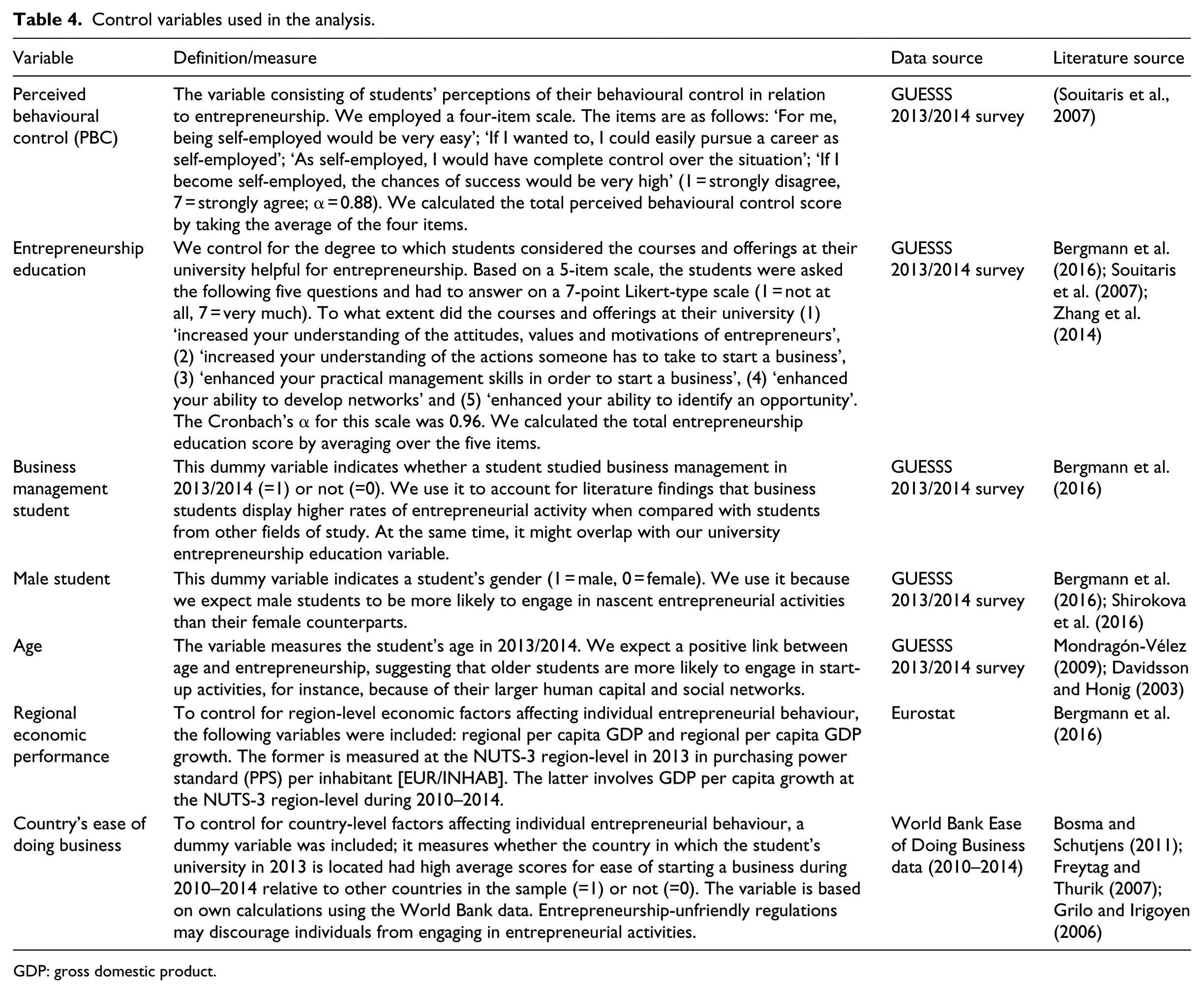
Besides our key variables, we include controls at the individual-level as well as region-level and nation-level (see Table 4 in the Appendix for more details).
Empirical strategy
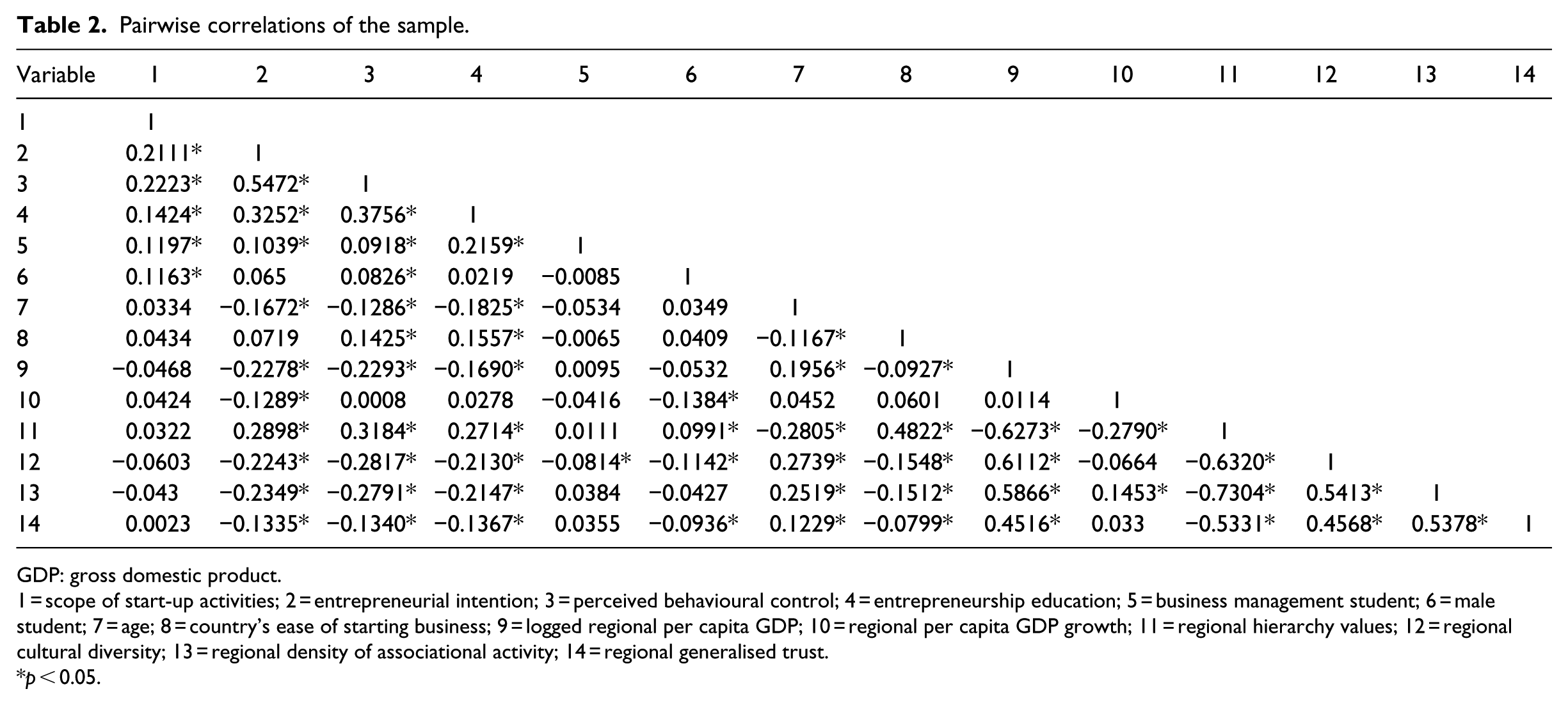
Our hypotheses are tested using multilevel mixed-effects Poisson regression analysis as pertinent empirical method to examine our research hypotheses (Autio and Acs, 2010; Hofmann, 1997). Multicollinearity issues can be ruled out because the variance inflation factors in our models are well below the cut-off value of 10 (Neter et al., 1996). Moreover, our analysis accounts for endogeneity problems potentially present in social capital research (Gedajlovic et al., 2013). For one, in line with Putnam (1993) and Uslaner (2002, 2008), we consider social capital including associational membership breadth, and the particular and generalised trust embedded in it, more of a long-lasting exogenous cultural trait at the region-level. Also, our moderating variables are measured prior to the GUESSS 2013/2014 and 2016 surveys, which reduce endogeneity concerns further. As argued by Fritsch and Wyrwich (2017), cultural variables are usually deeply rooted in a region’s economic history. Therefore, measuring such a culture would ideally require the use of regional past or historical values because today’s regional cultural differences might be the result of economic development and migration. While we do not have access to historical data, using the EVS data from 2008 and Eurostat data from 2011 implies at least some degree of regional past values. Table 1 presents the descriptive statistics of the sample, and Table 2 its pairwise correlations.
Descriptive statistics of the sample (N = 671).
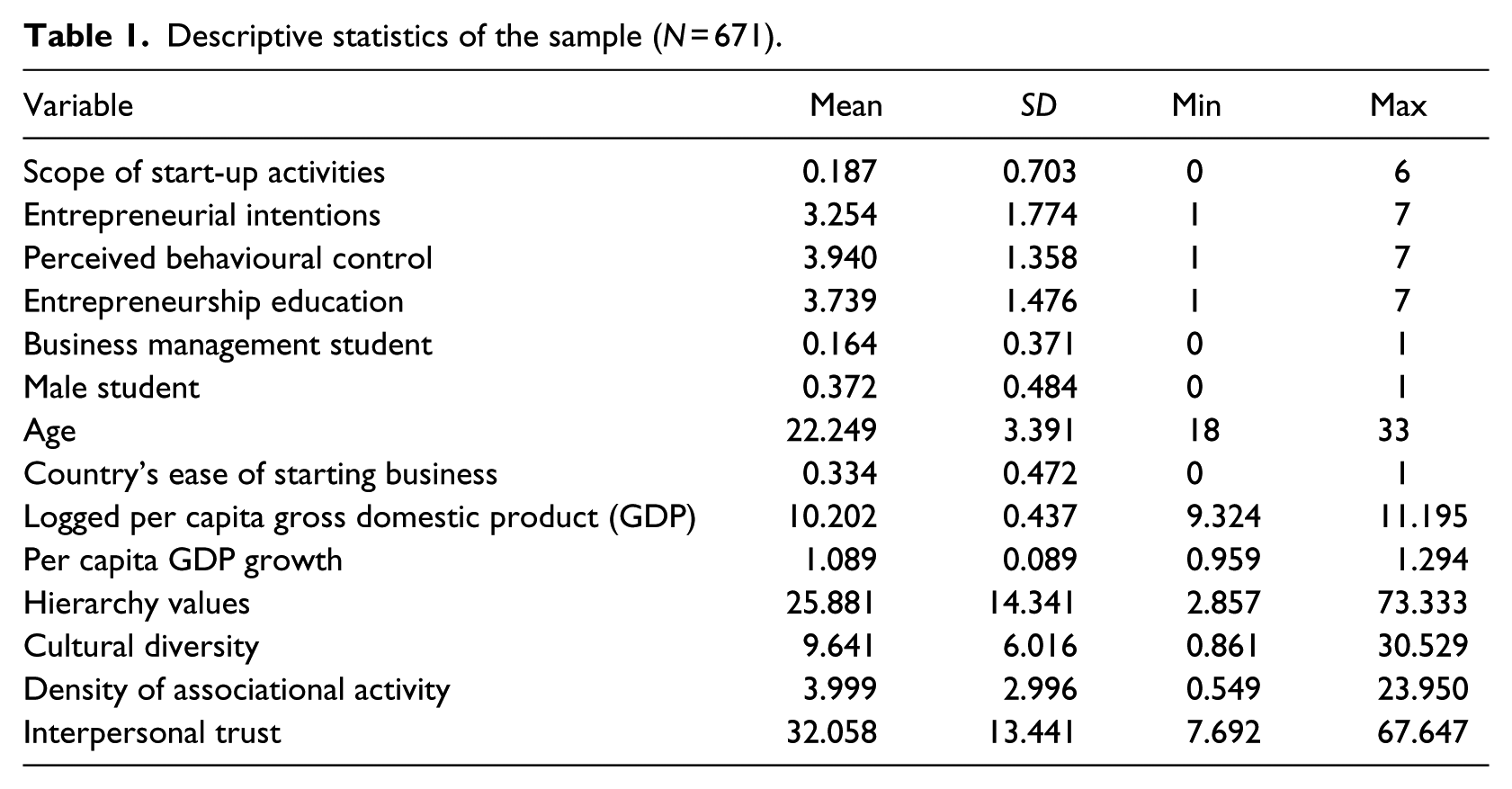
Pairwise correlations of the sample.
GDP: gross domestic product.
1 = scope of start-up activities; 2 = entrepreneurial intention; 3 = perceived behavioural control; 4 = entrepreneurship education; 5 = business management student; 6 = male student; 7 = age; 8 = country’s ease of starting business; 9 = logged regional per capita GDP; 10 = regional per capita GDP growth; 11 = regional hierarchy values; 12 = regional cultural diversity; 13 = regional density of associational activity; 14 = regional generalised trust.
p < 0.05.
Results and discussion
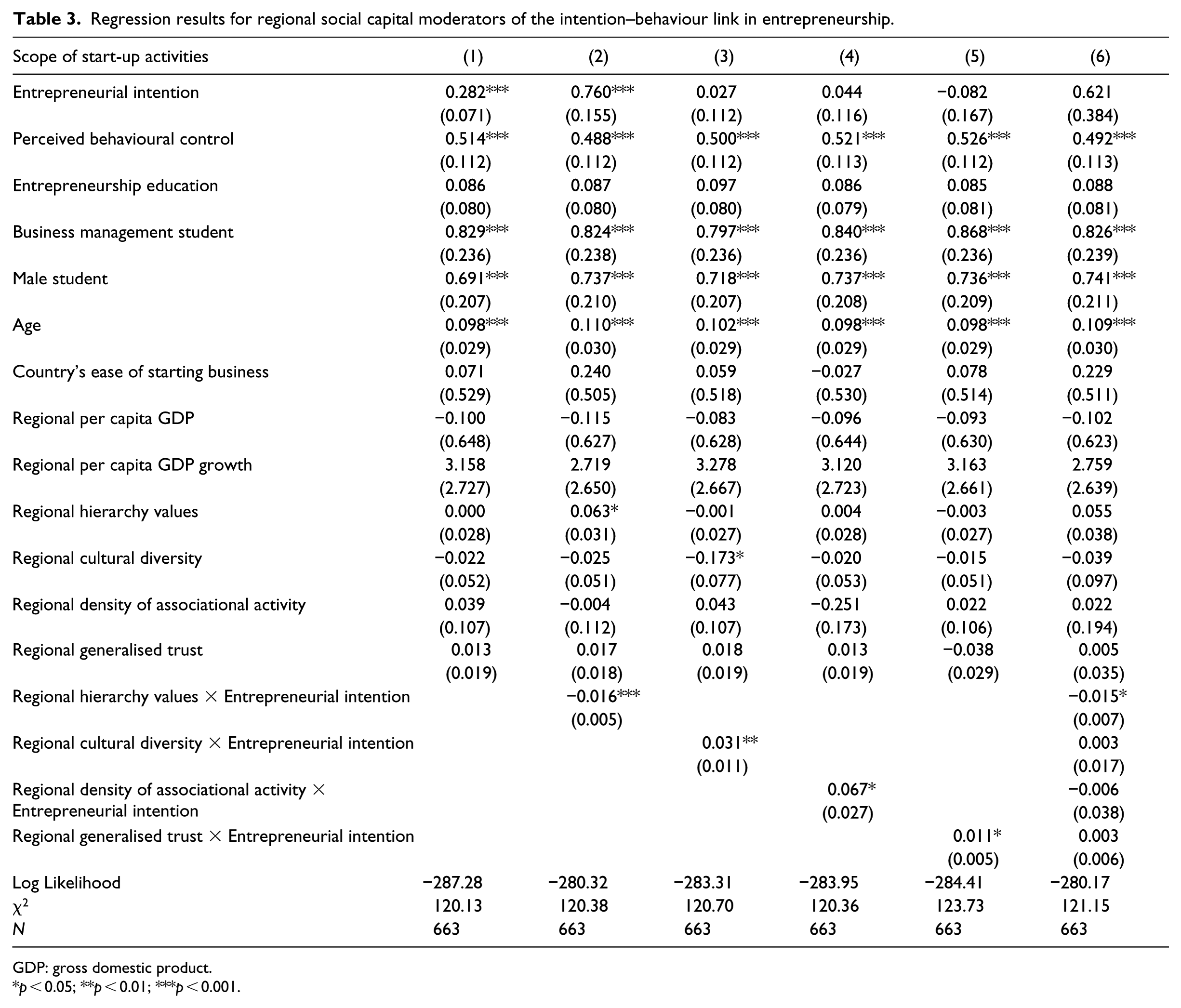
Our estimation results are reported in Table 3. Model 1 displays direct effects of our regional social capital proxies and control variables on nascent entrepreneurial behaviour, measured by the scope of individual start-up activities. The regression coefficients for the regional social capital variables are all statistically insignificant, which suggest that they are not directly associated with nascent entrepreneurial activity. Regional economic performance and national formal institutions potentially conducive to entrepreneurship do not appear to matter for nascent entrepreneurship, as evidenced by the statistically insignificant coefficients for regional per capita gross domestic product (GDP), regional per capita GDP growth and our country ease of doing business variable. By contrast, the individual-level variables, except for entrepreneurial education, are all highly statistically significant, which confirms two schools of thought regarding the explanation of new venture creation. For one, our results confirm the stream of literature arguing that new business formation occurs due to favourable traits and human capital of the business founder (Backes-Gellner and Moog, 2013; Bergmann et al., 2016; Davidsson and Honig, 2003; Liao and Welsch, 2005; Mondragón-Vélez, 2009; Shirokova et al., 2016) – which is mirrored in positive and significant associations between our covariates perceived behavioural control, business management student, male student and age, and our outcome variable scope of start-up activities. In addition, our findings are supportive of the intentionality view of entrepreneurship based on the TPB (Ajzen, 1991), and here, in particular, the literature testing the intention–behaviour link in entrepreneurship using longitudinal data (Kautonen et al., 2013, 2015; Van Gelderen et al., 2015) – as evidenced by a positive and significant link between our covariate entrepreneurial intention and scope of start-up activities.
Regression results for regional social capital moderators of the intention–behaviour link in entrepreneurship.
GDP: gross domestic product.
p < 0.05; **p < 0.01; ***p < 0.001.
Models 2–6 help test our hypotheses regarding the moderating effect of the regional social capital context, by first testing each of the four interactions embodied in our four hypotheses separately (Models 2–5), and by then including them simultaneously (Model 6). Regarding the first analytical step, the positive moderating role of regional cultural diversity, as manifestation of a region’s structural social capital (Hypothesis 1), is supported in Model 3 due to a positive and highly statistically significant interaction between our entrepreneurial intention and regional cultural diversity variables (coef. = 0.031, p < 0.01). In Hypothesis 2, we posited that the positive intention–behaviour link is further strengthened by the regional density, or breadth, of associational membership as a further manifestation of a region’s structural social capital. Our findings lend strong support to this conjecture given a positive and highly statistically significant interaction between our entrepreneurial intention and regional density of associational activity variables in Model 4 (coef. = 0.067, p < 0.05). Next, we postulated a positive moderating effect of regional generalised trust levels, as expression of a region’s relational social capital, on the intention–behaviour link (see Hypothesis 3 above). This reasoning is supported by Model 5 because of a positive and highly statistically significant interaction between our entrepreneurial intention and regional generalised trust variables (coef. = 0.011, p < 0.05). Our last hypothesis involved testing the claim that the intention–behaviour link is weakened by a regional abundance of hierarchy values, which we claimed to be associated with a lack of bridging social capital, or weak ties, important for entrepreneurship to unfold (see Hypothesis 4). Interestingly, our theoretical predictions are supported by the data; the association between entrepreneurial intentions and actions becomes indeed stronger as the regional presence of hierarchy values decreases (coef. = –0.016, p < 0.001). For a better interpretation of our moderation effects, we plotted the four interaction terms forming part of our hypotheses and Models 2–5, respectively, using Stata’s margins procedure. Figure 2 plots these interactions.
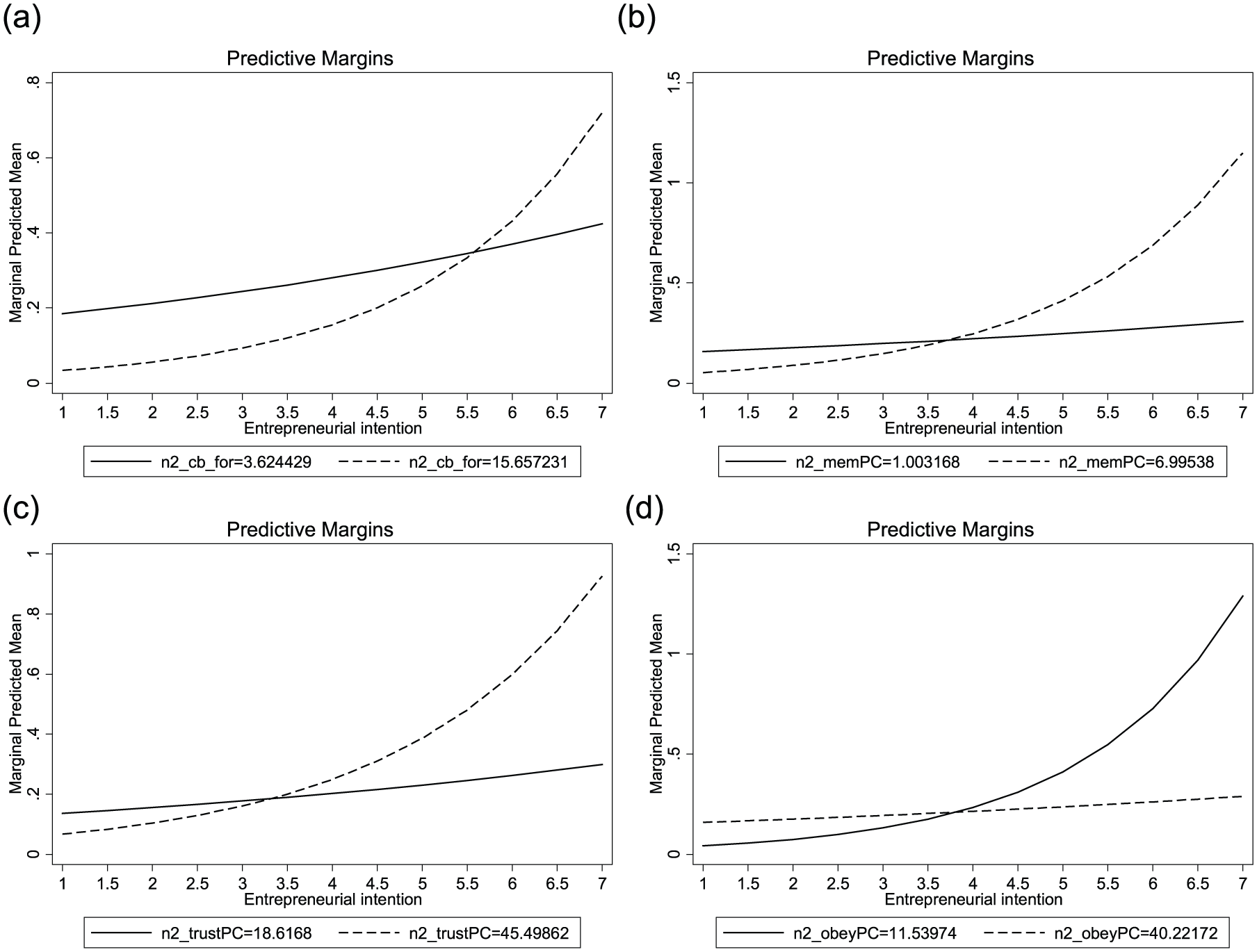
Illustration of the moderating effects of regional social capital on the intention–behaviour link in entrepreneurship: (a) entrepreneurial intention × regional cultural diversity, (b) entrepreneurial intention × regional associational density, (c) entrepreneurial intention × regional generalised trust and (d) entrepreneurial intention × regional hierarchy values. The graphs plot the interaction effects between each regional social capital moderator and entrepreneurial intention at two different levels of entrepreneurial intention: –1SD and +1SD.
Robustness checks
To investigate the robustness of our results, we conducted several robustness checks. First, we included a second analytical step in our main analysis by considering all interactions simultaneously in Model 6. The results reveal that only the interaction between entrepreneurial intention and regional hierarchy values remains a robust predictor of entrepreneurial action (coef. = 0.015, p < 0.05), whereas the other interaction terms turn insignificant. Hence, while we find evidence of the moderating role of structural, relational and cognitive social capital in the intention–behaviour link, the evidence is particularly strong regarding the negative moderating effect of regional hierarchy values as a legitimate type of cognitive regional social capital.
A second robustness check involves examining the construct validity of two of our measures to increase confidence that the operational definition of the variables in question really captures what they are supposed to measure based on our theoretical framework. First, we re-ran our models using an alternative variable for regional cultural diversity. The variable, based on own calculations using Eurostat data, measures the 2011 percentage share of highly educated foreign-born persons in the highly educated population of each NUTS-2 region in the sample. Individuals are considered highly educated if they either had completed their first stage (Level 5) or second stage (Level 6) of tertiary education (see ISCED 1997 (the International Standard Classification of Education from 1997)). 3
We use this variable because one could argue that the regional density of highly educated foreign-born persons constitutes a more effective lever than the regional density of foreign-born persons per se when aspiring entrepreneurs with strong entrepreneurial intentions exploit the diversity of their region’s structural social capital, conceptualised by regional cultural diversity, in the context of planning to start a new business. For one, one could expect that the larger the regional presence of highly educated foreign-born individuals, the stronger the bridging social capital in that region which, as argued in more detail below, should be associated with an increase in innovation and entrepreneurial activity (see, for example, D’Ambrosio et al., 2019; Florida et al., 2002; Mickiewicz et al., 2019). Second, and related to that, a larger share of highly educated foreigners in a region should reduce the risk of ethnic polarisation because these individuals can be expected to be more integrated in their host communities – which should favour the regional bridging social capital. Building on Efendic et al. (2015), this in turn means that regional variable start-up activity will not be hampered but favoured. The empirical results are robust to our main specifications and are available from the authors upon request.
In addition, we examined the robustness of our regional density of associational activity variable by replacing it with an alternative variable of regional associational membership, also based on the EVS 2008. The variable involves the regional density of non-associational activity, which is measured as the percentage share of the NUTS-2 population that, in 2008, was not member in any association. The results, which are available upon request, are robust to our main specifications in a sense that regional non-membership in associations negatively moderates the intention–behaviour link.
Limitations and suggestions for future research
There are several limitations in our study that may trigger future research. First, when considering all regional social capital dimensions simultaneously as moderators of the entrepreneurial intention–behaviour link, only regional hierarchy values remain a robust moderator. The reason for this could be that there is a certain overlap – that is, interdependence – between the structural, relational and cognitive social capital dimensions established by Nahapiet and Ghosal (1998); in fact, the authors themselves acknowledge the possibility of such an overlap. This, in turn, calls for future research to investigate whether and to what extent this is the case; it is beyond the scope of this study to tackle this empirical issue. One avenue of future research could be the investigation of moderated mediated effects (Preacher et al., 2007) of different regional social capital characteristics in the intention–behaviour link in entrepreneurship. For example, in our study, and in line with Putnam (1993) and Uslaner (2002, 2008), we consider interpersonal trust more of a long-lasting exogenous cultural trait at the region-level. If this assumption – in line with a diverging literature stream (see Sønderskov and Dinesen, 2014, for details) – is relaxed, interpersonal trust becomes endogenous, that is, it will itself be determined by other factors. In that context, one could for instance assume that regions with large cultural diversity affect regional interpersonal trust positively because of larger levels of bridging social capital (see, for example, D’Ambrosio et al., 2019; Florida et al., 2002). Equally, it could be argued that regions with strong hierarchy values have a negative effect on regional interpersonal trust because of lower levels of bridging social capital. On that basis, one could conjecture that some of our regional social capital moderators, including interpersonal trust and regional cultural diversity, lose their significance when including all regional social capital moderators simultaneously in a full model because of more complex underlying moderated mediation relationships. In line with the above notion, one such relationship could be that regional interpersonal trust mediates the moderating effect of regional cultural diversity on the entrepreneurial intention–action link, and it may also mediate the moderating effect of regional hierarchy values on this link. In that context, we also encourage future studies to use still more refined measures of regional cultural diversity. Limitations in terms of data prevented us, for instance, of measuring regional cultural diversity by means of a Herfindahl–Hirschman index (see Dohse and Gold, 2013, 2014).
Second, embeddedness now is a well-established concept in the field of entrepreneurship; however, there are still areas where future research might further illuminate our understanding of the role of context in the entrepreneurship (Welter, 2011). For instance, we believe that there is a need for entrepreneurship research to focus more on the relationship between entrepreneurs and the communities in which they live and do business. Communities can be described as a places – ‘geographically, collective, self-defining and organizing contexts’ (McKeever et al., 2015: 52) – a rich context for examining embeddedness in entrepreneurial practices (Lyons et al., 2012). Such communities can be found in different cultural settings, including emerging market countries, where community and political structures provide interesting contexts for explaining different manifestation of entrepreneurship (McKeever et al., 2015).
The findings from such studies could complement those from our analysis and provide relevant policy implications. For instance, they could assist regional policymakers in improving the region-level social capital to increase the propensity of aspiring entrepreneurs to turn their intentions into entrepreneurial action – by trying to start, starting or growing a business. Also, in line with Lortie and Castogiovanni (2015), we encourage researchers to build their analyses on longitudinal research designs to better disentangle the complex and dynamic associations between individual entrepreneurial intentions, new venture creation and the regional social capital context, combined with adequate methodological approaches, to tackle potential issues inherent in social capital research such as endogeneity and sample selection bias (Gedajlovic et al., 2013).
Finally, we recommend future studies to continue unravelling the concepts of strong and weak ties in their empirical analyses, for example, by simultaneously including several hierarchical social capital levels in the modelling process, such as the local/community level, the region-level and the nation-level.
Implications
Our study provides valuable theoretical implications for regional and institutional entrepreneurship literatures as well as practical implications for policymakers and aspiring entrepreneurs. In terms of theory, our study makes a substantial contribution to the intention–behaviour link in entrepreneurship (Kautonen et al., 2013; Van Gelderen et al., 2015), by providing evidence of the importance of regional social capital for the propensity of individuals to turn entrepreneurial intentions into actions. Studies that omit such a higher level context may provide an incomplete assessment of the new venture creation process. We demonstrated that a low presence of regional hierarchy values, high regional cultural diversity, regional associational density and high levels of interpersonal trust at the region-level represent important regional social capital contingencies for individuals aiming to turn their strong entrepreneurial intentions into actions. As argued above, these strong intentions epitomise a large individual absorptive capacity in terms of a strong ability on the part of the aspiring entrepreneurs to leverage the regional social capital in which they are embedded.
Based on the theory of social embeddedness and drawing on more general work on the role of social capital in venture creation (Aldrich and Zimmer, 1986; Chang et al., 2009; Davidsson and Honig, 2003; Zellweger et al., 2011), we find that regional social capital has a great importance in the translation of entrepreneurial intention to the subsequent start-up behaviour of young student entrepreneurs. Our finding extends prior research on the role of social capital in entrepreneurial activity by demonstrating that social networks acquired by students at the regional level are instrumental in the process of venture creation of nascent entrepreneurs. Currently, there is call for greater consideration of context in entrepreneurship studies (Welter, 2011) and there is an increasing number of appeals for higher scrutiny of context in theory development (e.g. Bamberger, 2008; Meyer, 2014; Michailova, 2011). Indeed, as indicated by Whetten (1989), all management scholars aiming for a theoretical contribution should be sensitive to context and to all possible boundary constraints. Building on the development and use of the context perspective, entrepreneurship scholars are able to better understand how entrepreneurship occurs within a particular context (Zahra, 2007).
Our study also has important policy implications. First, the intention–behaviour gap in entrepreneurship may incur a substantial opportunity cost to the aspiring entrepreneur because not acting on intentions might cause entrepreneurial individuals to miss out on a business opportunity. This could be disadvantageous to society at large, as new firms create employment and constitute economic agents of change, launching new products and services and more efficient modes of working (Organisation for Economic Co-operation and Development (OECD), 2010). Our findings could assist aspiring entrepreneurs by encouraging them to relocate to regions with a strong social capital because it is in such an environment that their propensity to act on their intentions may increase significantly. Moreover, we stress the need for regional policymakers to build regional social capital to enable more individuals exposed to their respective regional social capital contexts to turn their entrepreneurial intentions into actual entrepreneurial behaviour, for example, by promoting regional associational membership and egalitarian values and by enhancing regional cultural diversity. This includes nurturing both bonding and bridging social capital, which should be balanced to achieve favourable economic outcomes including new venture creation activities (Adler and Kwon, 2002).
Footnotes
Appendix 1
Control variables used in the analysis.
| Variable | Definition/measure | Data source | Literature source |
|---|---|---|---|
| Perceived behavioural control (PBC) | The variable consisting of students’ perceptions of their behavioural control in relation to entrepreneurship. We employed a four-item scale. The items are as follows: ‘For me, being self-employed would be very easy’; ‘If I wanted to, I could easily pursue a career as self-employed’; ‘As self-employed, I would have complete control over the situation’; ‘If I become self-employed, the chances of success would be very high’ (1 = strongly disagree, 7 = strongly agree; α = 0.88). We calculated the total perceived behavioural control score by taking the average of the four items. | GUESSS 2013/2014 survey | (Souitaris et al., 2007) |
| Entrepreneurship education | We control for the degree to which students considered the courses and offerings at their university helpful for entrepreneurship. Based on a 5-item scale, the students were asked the following five questions and had to answer on a 7-point Likert-type scale (1 = not at all, 7 = very much). To what extent did the courses and offerings at their university (1) ‘increased your understanding of the attitudes, values and motivations of entrepreneurs’, (2) ‘increased your understanding of the actions someone has to take to start a business’, (3) ‘enhanced your practical management skills in order to start a business’, (4) ‘enhanced your ability to develop networks’ and (5) ‘enhanced your ability to identify an opportunity’. The Cronbach’s α for this scale was 0.96. We calculated the total entrepreneurship education score by averaging over the five items. | GUESSS 2013/2014 survey | Bergmann et al. (2016); Souitaris et al. (2007); Zhang et al. (2014) |
| Business management student | This dummy variable indicates whether a student studied business management in 2013/2014 (=1) or not (=0). We use it to account for literature findings that business students display higher rates of entrepreneurial activity when compared with students from other fields of study. At the same time, it might overlap with our university entrepreneurship education variable. | GUESSS 2013/2014 survey | Bergmann et al. (2016) |
| Male student | This dummy variable indicates a student’s gender (1 = male, 0 = female). We use it because we expect male students to be more likely to engage in nascent entrepreneurial activities than their female counterparts. | GUESSS 2013/2014 survey | Bergmann et al. (2016); Shirokova et al. (2016) |
| Age | The variable measures the student’s age in 2013/2014. We expect a positive link between age and entrepreneurship, suggesting that older students are more likely to engage in start-up activities, for instance, because of their larger human capital and social networks. | GUESSS 2013/2014 survey | Mondragón-Vélez (2009); Davidsson and Honig (2003) |
| Regional economic performance | To control for region-level economic factors affecting individual entrepreneurial behaviour, the following variables were included: regional per capita GDP and regional per capita GDP growth. The former is measured at the NUTS-3 region-level in 2013 in purchasing power standard (PPS) per inhabitant [EUR/INHAB]. The latter involves GDP per capita growth at the NUTS-3 region-level during 2010–2014. | Eurostat | Bergmann et al. (2016) |
| Country’s ease of doing business | To control for country-level factors affecting individual entrepreneurial behaviour, a dummy variable was included; it measures whether the country in which the student’s university in 2013 is located had high average scores for ease of starting a business during 2010–2014 relative to other countries in the sample (=1) or not (=0). The variable is based on own calculations using the World Bank data. Entrepreneurship-unfriendly regulations may discourage individuals from engaging in entrepreneurial activities. | World Bank Ease of Doing Business data (2010–2014) | Bosma and Schutjens (2011); Freytag and Thurik (2007); Grilo and Irigoyen (2006) |
GDP: gross domestic product.
Acknowledgements
The lead author gratefully acknowledges support from the Centre for Young and Family Enterprises (CYFE) at the University of Bergamo, Italy, in the process of writing this manuscript.
Funding
The author(s) received no financial support for the research, authorship, and/or publication of this article.