







Abstract
In the last decade, new design-driven approaches, such as Design Thinking, Customer Discovery, and Lean Start-up, have gained popularity in entrepreneurship education (EE). However, their adoption has been characterised by confusion in understanding their theoretical underpinnings and the challenge of introducing these new methods into a pedagogic culture emphasising ideation over experience, emotional intelligence, and making. This article argues that the implementation of these new pedagogic approaches can be improved by better translating the principles of design-driven and artifact-centered entrepreneurship into pedagogical practices. To achieve this goal, a model for a pedagogy of making in EE is proposed along with theoretical and economic arguments based on recent advances in the debate on entrepreneurship as a design science, the growing importance of intangibles in the economy, and the challenges of artificial intelligence (AI) to the job market and student employability. The critical elements for successfully adopting such pedagogy and common misconceptions that can hinder its full deployment are outlined.
Introduction
In the last decade, the growing popularity of approaches such as the Lean Start-up (Reis, 2011), Customer Discovery (Dorf and Blank, 2012), Business Model Generation (Osterwalder and Pigneur, 2010) and Design Thinking (Brown, 2008) signalled an element of marked novelty in pedagogic practice in entrepreneurship education (EE). The emergence of such approaches, which in the next section are connected to the larger category of design-driven entrepreneurship education (DDEE), follows the evolution of entrepreneurial pedagogy from positivist and teaching-centred approaches to more constructivist and action-based perspectives (Hägg and Gabrielsson, 2019; Nabi et al., 2017). DDEE draws from action-based pedagogic approaches by emphasising the primacy of action, situated knowledge, effectuation and experiential learning (Higgins and Elliott, 2011; Macpherson et al., 2022; Pittaway and Cope, 2007; Sarasvathy, 2009). However, it also introduces several elements of novelty. A combination of theoretical, pedagogical and technological advancements contributes to defining such novelty.
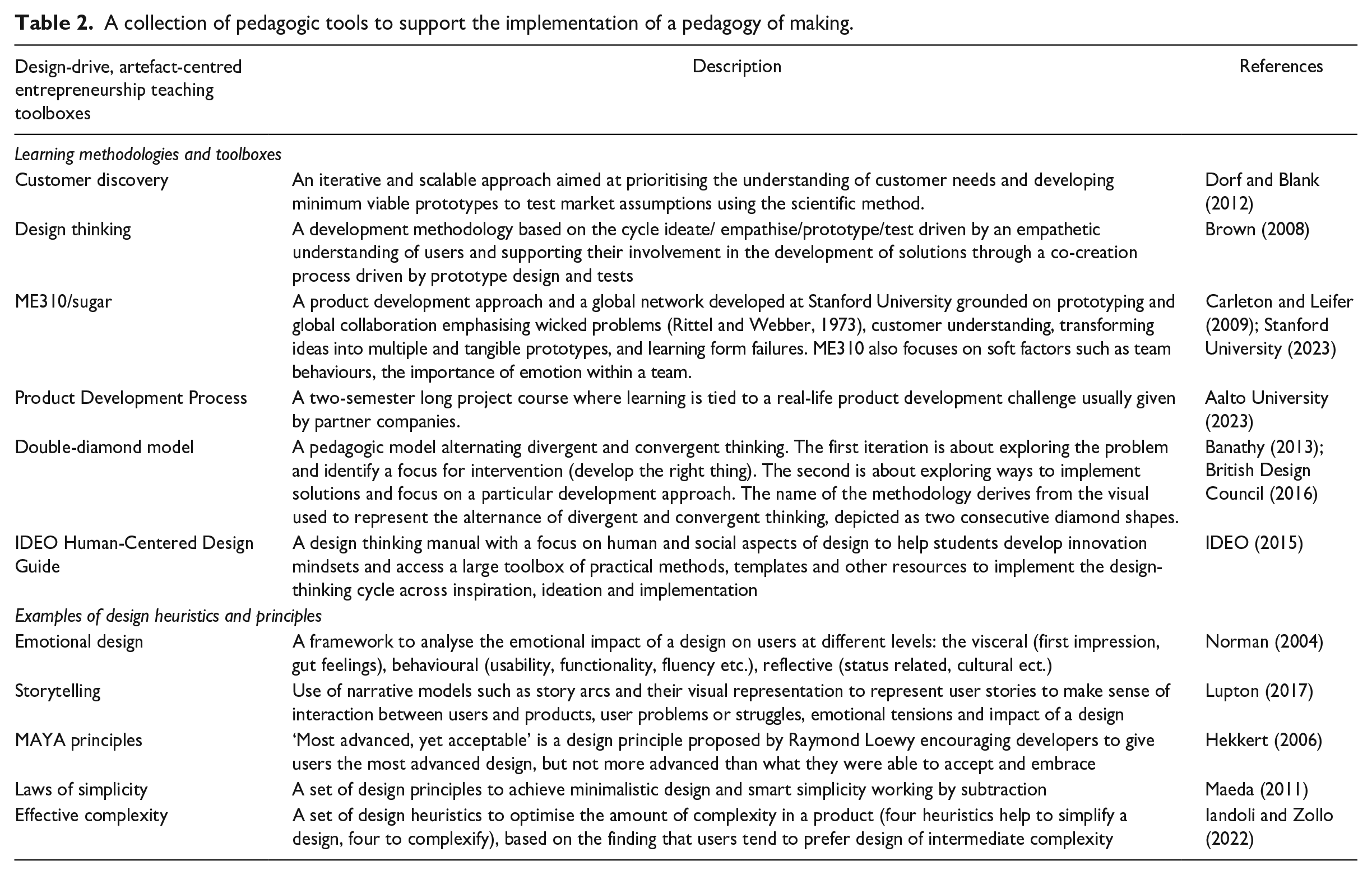
In terms of advancing debate, DDEE helps overcome the dualism between positivist and constructivist approaches in EE (Berglund et al., 2020) and emphasises the centrality of artefacts in entrepreneurial learning and action (Berglund and Glaser, 2022). Regarding pedagogical innovations, DDEE relies on a family of tools, including learning frameworks such as Design Thinking, Customer Discovery and user-centred product development methodologies and toolboxes (see Table 2 for a non-exhaustive list and definitions). Regarding the contingent element, one can report: first, the increasing demand for actionable knowledge guiding entrepreneurs towards more effective professional practices and the building of entrepreneurial expertise (Dew et al., 2018; Sarasvathy, 2009). Second, the search for an alternative EE pedagogy for non-business students (Lamine et al., 2021). Third, the growth of the digital and immaterial economy (Haskel and Westlake, 2017); and fourth, the democratisation of digital technologies for makers, such as 3D-printing or open source software and hardware that lowers the barriers between invention and innovation (Browder et al., 2019).
In this review article, I will discuss DDEE from the point of view of a different pedagogic approach grounded on the experience of building things (making). Such a ‘pedagogy of making’ (Ingold, 2013) prioritises first, learning through things over learning from things; second, the active transformation of materials and artefacts over their description and documentation; third, sensorial and emotional experience over information processing; fourth, immersion and flow over abstraction; and finally, participation over observation. Making is central in DDEE and typically occurs through iterative and scalable prototyping. However, DDEE adopters often fail to recognise such centrality and implement design-driven educational practices inconsistently or ineffectively. For instance, based on a survey related to the adoption of Design Thinking in Entrepreneurship courses, Sarooghi et al. (2019) lament a widespread limited understanding of the conceptual foundations of these new practices. The authors report that the inclusion of Design Thinking in entrepreneurship syllabi is often biased towards ideation instead of prioritising building solutions for prospective customers. Other areas for improvement are the lack or underuse of Makerspaces due to costly investments to build this infrastructure and insufficient entrepreneurship instructors with skills in design and prototyping. This paper discusses these difficulties and obstacles and proposes a pedagogical model for implementing a DDEE pedagogy centered on artifacts as learning media and generators of entrepreneurial opportunities and entrepreneurial skills.
To explore these issues, the article is structured as follows: In section ‘Background: A design perspective on EE’, I present DDEE by reviewing the debate on entrepreneurship as a design science (Berglund et al., 2018; Dimov, 2016; Sarasvathy, 2003; Seckler et al., 2021; Selden and Fletcher, 2019). The article commences by demonstrating how DDEE resolves the tension between positivist and constructivist EE pedagogical approaches (section ‘Entrepreneurship as a design science’) arguing that a distinctive aspect of DDEE pedagogy is its reliance on making as the primary learning mechanism and the role of artefacts and prototypes as scaffolding structures for creativity and interaction (section ‘The centrality of making in DDEE’). I will then identify a set of desirable design-driven entrepreneurial skills that a pedagogy of making informs (section ‘Design-driven entrepreneurial intent and skills’). Finally, this section is then concluded with a summary of the novel elements of DDEE compared with EE approaches based on action learning (section ‘What is novel about DDEE? From learning by doing to learning by making’). Section ‘A model for a pedagogy of making in EE’ proposes a model of a pedagogy of making in EE to clarify the dual epistemological foundations of DDEE across objectivist and constructivist perspectives and identify critical components that can inform the development of new, design-driven pedagogic practices and tools. Finally, in sections ‘Requirements to effectively adopt a pedagogy of making’ and ‘Conclusions and future research: A pedagogy of making to innovate teaching and learning and support employability in the digital age’, I outline the critical issues for the successful adoption of DDEE centred on making and suggest questions and avenues for future research.
Background: A design perspective on EE
Entrepreneurship as a design science
Several scholars have recently advanced theoretical arguments to shift entrepreneurship research from a natural science paradigm to one based on the sciences of artificial (Berglund et al., 2018, 2020; Dimov, 2016; Romme and Reymen, 2018; Sarasvathy, 2003; Seckler et al., 2021; Selden and Fletcher, 2019). This distinction is based on Herbert Simon’s demarcation between natural sciences, aimed at explaining reality through the discovery of general laws, and sciences of the artificial, whose objective is to design working solutions addressing specific problems. Physics, Chemistry and Economics belong to the first category, while Engineering and Architecture are in the second. Entrepreneurship research has been predominantly undertaken under a natural science paradigm in which the entrepreneurial phenomenon is described and explained retrospectively (Dimov, 2016). However, in practical applications, such as consultancy, training, or the launch of a new venture, entrepreneurship can be conceived as a design science to help entrepreneurs master crucial skills leading to the creation of successful ventures. Dimov (2016) provides business planning as an example: in the natural science approach, research answers theoretical questions, such as whether planning reduces the risk of failures; in the design science paradigm, the issue becomes how to create a good business plan in a specific context and case.
In EE, historically the natural science perspective formed the origins of behaviourist approaches in which entrepreneurial success was considered the result of applying codified knowledge and instructional methods following a positivist paradigm (Nabi et al., 2017). For instance, if research shows that planning reduces the risk of failure, business planning should be codified into standard models, rules, and templates to be taught to entrepreneurs. This positivist perspective has been criticised for failing to recognise the complex and situated nature of entrepreneurial action, and alternative pedagogic frameworks have been proposed grounded on constructivism and action learning (Higgins et al., 2013; Macpherson et al., 2022; Pittaway and Cope, 2007; Sarasvathy, 2009).
Current pedagogic approaches based on DDEE overcome this juxtaposition and embrace entrepreneurship’s ambivalent character as a natural and design science. Berglund et al. (2020) provide precious help in clarifying this aspect. They do so by transforming this juxtaposition into a duality in which the two approaches can complement each other and empower entrepreneurial training for different skills and situations. The two pillars of this duality are the complementary ways to conceptualise and resolve uncertainty and, the role of artefacts as generators of entrepreneurial opportunities. Regarding the first aspect, when entrepreneurial action is considered from the point of view of natural sciences, reality is a given that can be discovered using the mindset and the tools of the scientific method (formulating and falsifying hypotheses via empirical experimentation). Uncertainty, in this case, is epistemic. The ‘customer discovery approach’ largely resorts to this positivist view to help entrepreneurs formulate their assumptions as testable hypotheses via the design of rigorous experiments (Dorf and Blank, 2012). When entrepreneurial action is analysed from a design perspective, reality is transformed through available means and constraints to focus on controllable aspects of an unpredictable future, as described by effectuation theory (Sarasvathy, 2001). Uncertainty is ontological in this alternative perspective. The second pillar regards leveraging artefacts to generate entrepreneurial opportunities. Using Simon’s terminology (2019), entrepreneurial artefacts, such as a new product or technology, function as the interface between an external system (e.g., the market) and the subjectivity of the artefact users or creators. Artefacts, too, benefit from the duality between discovery and transformation. As the object of transformative activities, artefacts help entrepreneurs to capture opportunities concealed in possible inter-subjective worlds, such as those emerging from making sense of a user’s tacit knowledge and needs. However, artefacts support the discovery process by functioning as experimental prompts to design user experiments and test hypotheses. Seckler et al. (2021) echo this dual perspective by stating that design science in entrepreneurship is a ‘specific scientific approach that shares the values of practice (i.e., usefulness) and uses the methods of science (i.e., scientific method plus more specific, scrutable methods)’ and conceptualise design knowledge as ‘a body of scientific knowledge that comprises both design object knowledge (e.g., situated artefact, and design principles), and design evaluation knowledge (e.g., usefulness, and social worth)’ (p. 1).
As will be illustrated in section ‘A model for a pedagogy of making in EE’, this duality is a useful intellectual instrument to support a better understanding of DDEE’s conceptual foundations and guide the creation of teaching approaches and tools to grow discovery and transformational skills. However, while there is no shortage of methodologies and tools in the academic tradition to help students think and act as scientists, much less room is dedicated to training entrepreneurs to develop transformational skills. The experience of designing and building artefacts (making) is a critical tool to this end.
The centrality of making in DDEE
Think of a workshop with your students consisting of the following three steps (Helsinki Museum of Design, 2022):
Do: Students are given a collection of random objects and materials and asked to combine items they like without overthinking.
Observe: Students are asked to take time to look at their creation and reflect on the thoughts their composition evokes.
Interpret and Ideate: Participants are asked to create meaning around the assembly, thinking about possible uses, functions, or contexts in which the object could exist.
This exercise is a simple but effective example of a pedagogy of making in action; it reverts the academic tradition in which thinking and planning precede acting. In his book Making, Tim Ingold provides solid criticism of this widely accepted assumption (Ingold, 2013). Using a metaphor proposed by Kwon, Ingold argues that we should help our students to become good hunters (Ingold, 2013: 31). Hunting is an excellent example of a human activity in which tools and knowledge are accumulated and transferred socially and must be combined to adapt to situations shaped by contingent constraints (e.g. prey biology and behaviour, geography, weather conditions etc.). Hunters must do their best and improvise with the resources they have at their disposal; they must look for emerging opportunities by sensing and scanning the environment to predict where their prey will fall or to transform a random encounter into a successful capture. Devising and executing a plan does not apply to hunting and many other realistic situations. However, the belief that ideation precedes and informs action (ilomorphism) is deeply rooted in the western intellectual tradition. According to Ingold (2013), it is wrong to think of learning as transferring a pre-packaged corpus of information that precedes its application to specific practical contexts. On the contrary, humans learn by making. In this perspective, the teacher’s role should not consist in passing knowledge onto students in the form of a pre-constituted system of concepts and categories but rather, in creating the conditions in which learners can discover autonomously or aided by adequate apprenticeship.
In contrast with the ilomorphic approach, the creation of something novel is not the result of a ‘production’ based on abstract blueprints but of a process of organic growth taking place through the transformation of materials to determine a correspondence between cognitive and environmental constraints. Creativity has little to do with ideation; it is instead a process of individuation and fabrication of new forms (morphogenesis). Ingold (2013) does not question the ability of individuals to produce abstract ideas; he only remarks that an artefact is never determined by this abstraction but by the experience of manipulating materials and constraints at the interface between the subjective consciousness and the external reality. In a telling example of the production of clay bricks, an artefact that may seem like an immediate translation of an abstract idea into an object, Simondon (2005) shows that the idea that a brick is just clay in a cubic shape is an oversimplification. First, the mould is made of other materials, for example, wood. Second, clay is never pure but must be processed to become the raw material needed to make bricks. Third, there is the expert act of injecting the clay into the mould that the brickmaker has developed after a long apprenticeship process. Finally, some of the above practices may have been uniquely shaped by specific geographic and cultural circumstances (the type of raw clay available in a site, the socially situated practices that regulate training and the context of the workplace etc.).
The role of experience as the primary structuring element of our cognition is also confirmed by theories of embodied cognition (Damasio, 1999; Lakoff, 2012). Increasing evidence from cognitive science shows that we need a body to think (McKerney, 2011), that feeling and knowing cannot be separated (Damasio, 2021), and that even higher-level human abilities, such as language skills or the understanding of mathematics, are grounded in our physical experience of the world (Lakoff, 2012; Lakoff and Núñez, 2000). Despite this intellectual progress, many EE pedagogy proposals do not recognise the centrality of ‘making’ and keep intellectual development disjointed from bodily experience. A learning-by-making perspective is instead, highly consistent with DDEE. Creating artefacts through manipulating and modifying available materials and technologies is a formidable way to help entrepreneurs acquire transformational skills and design artefacts.
Prototyping can help in this direction; prototypes help designers to support transformational activities thanks to their ability to embody ideas into cognitive, collaborative and affective representations (Passera, 2017). Cognitive visualisations help identify, analyse and organise patterns. Collaborative visualisations increase mutual understanding and improve coordination among members of development teams by talking through an artefact instead of talking about an artefact. Affective visualisations support aesthetic and emotional assessment of a design and empathic understanding of users (Norman, 2004). Prototypes include simple and low-fidelity renditions, for example, mock-ups, storyboard, cardboard and tape renderings, as well as more advanced high-fidelity concoctions obtained through specific prototyping technologies and methods (e.g. 3-D printing, suites for apps and website designs, open hardware and software, CAD tools etc.). Mock-ups, storyboards, simulations and digital renderings can also be used to prototype services. Prototype categories will also be included that capture other types of knowledge visualisations, such as business canvas and cognitive maps, if they are used to mediate discussions with partners and stakeholders aimed at soliciting feedback and engagement to improve solution design.
Using simple materials to build low-fidelity prototypes is typical of the very early stages of development (Figure 1). This helps contain the development costs and favours the realisation of fuzzy, underspecified renderings characterised by high interpretative flexibility. Learning by making and the early user feedback obtained by testing the low-fidelity prototypes open the way to design improvements or identify different and more promising variations. Through quick prototyping and early testing, entrepreneurs are more likely to stumble into ‘good problems’ while hedging the risks of committing too much time and resources to the design of refined but off-target versions of a prototype.
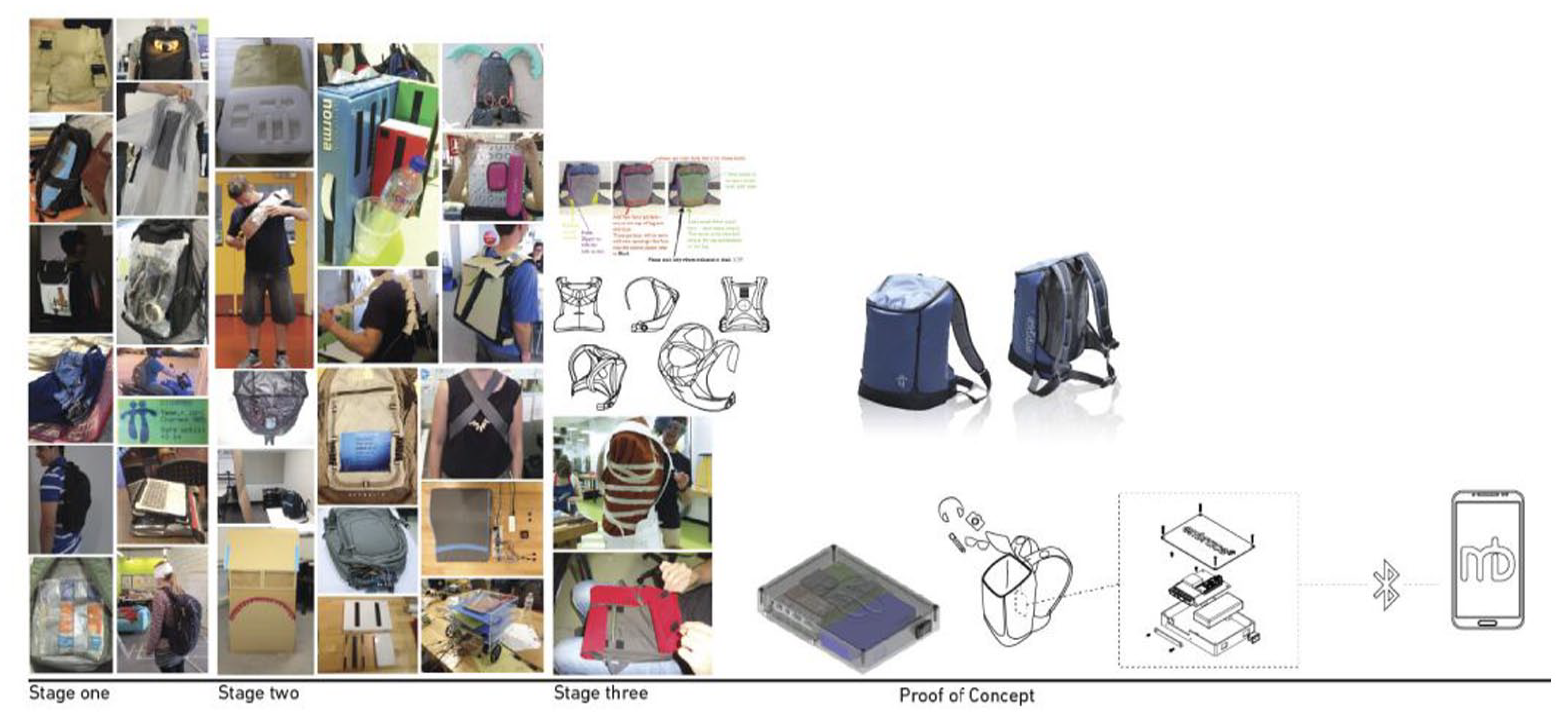
Types of prototypes and their scalability from low to high fidelity and from early stage to proof of concept.
Design-driven entrepreneurial intent and skills
Prototyping activities are increasingly facilitated by the widespread diffusion of user-friendly and low-cost digital open-source tools and the emergence of physical and virtual communities of makers (Anderson, 2012). These tools include open-source software and hardware for various applications, 3D printing and digital imaging suites. Makers can access these technologies online or in physical locations known as Makerspaces or Fab Labs, which function as workshops, co-working, and social spaces. While not all makers want to become entrepreneurs, there is increasing evidence that access to digital maker tools and communities positively affects entrepreneurial intent (Lamine et al., 2021). Kennedy et al. (2021) provide empirical evidence that ‘a lack of student technical skill and an unwillingness or inability to physically manifest ideas [are an] impediment to establishing entrepreneurial competencies’ (p. 550). Rayna and Striukova (2021) show that Fab Labs and Makerspaces foster entrepreneurial skills when proactively combined with entrepreneurship and education programmes. The experimentation-transformation duality explains why this combination works. Makerspaces function as aggregators of two types of resources: technological tools and a social space where knowledge is created and shared among inventors and users (Browder et al., 2019). These resources are leveraged in project-based challenges that may lead to entrepreneurial exploitation by enabling, at the same time, the transformation of ideas into prototypes and their experimentation in captive networks of co-developers and early adopters. These networks also provide opportunities for co-creation, crowdfunding and the construction of an initial customer base.
The increasing digitalisation and dematerialisation of the economy are providing additional opportunities and needs to augment the entrepreneurial skills portfolio with the ability to design artefacts and products. In their book, Capitalism without Capital, Haskel and Westlake (2017) identify four characteristics of intangible assets in a digitalised economy:
Scalability: Intangible digital assets can be used multiple times regardless of geographic constraints and can be produced at almost zero marginal cost (Rifkin, 2014).
Sunkness: The formation of intangible assets typically requires high up-front investments that translate into large, highly specific, and irrecoverable fixed costs
Spillovers: It is relatively easy for other businesses to take advantage of intangible assets they did not own or contribute to developing.
Synergies: Intangible assets are more likely to generate other ideas and are easier to combine with other intangible assets to create value.
Intangible assets based on various types of intellectual property (IP) are intrinsically scalable via licensing. However, one of the most valuable forms of IP, patents, requires entrepreneurs to embody their innovative idea into a physical artefact, usually a functioning and high-fidelity prototype. Prototyping is thus, a crucial prerequisite for acquiring a fundamental asset. The same applies to copyrights in creative industries such as entertainment (e.g. movies, video gaming, e-sports etc.). In these applications, a plethora of relatively affordable devices and software make the creation of professionally formatted content accessible to a vast audience of makers. Social media then provide an affordable and highly scalable platform for distributing such content bypassing the traditional publishing industry’s closed and elite distribution channels.
To hedge the risk associated with high sunk costs, entrepreneurs need to learn agile project management techniques based on rapid prototyping, customer discovery and hypothesis testing. Also crucial is the ability to pivot, that is, steer an initial idea towards new applications or target users as new insights are acquired throughout discovery and transformation. Mastering these skills can reduce the probability of costly failures by favouring a ‘fail often, fail cheap’ method to minimise affordable losses and maximise learning outcomes (Sarasvathy, 2001). This challenge is typical in emergent markets characterised by rapid technological development, such as artificial intelligence (AI)-driven human speech recognition (Iandoli, 2023). Traditional issues, such as customer segmentation or positioning, cannot be answered in such fluid contexts. Critical challenges include understanding which user problems a novel technology can effectively serve and engaging early adopters to experiment with minimally viable prototypes. This is precisely the case with voice-based services enabled by AI: for what types of digital applications do customers want to interact discursively with a computer? Who are the potential early adopters, and how to partner with them to transform and experiment with the new technology? How to become members of an ecosystem of developers and users where knowledge and ideas about these new technologies are exchanged? Start-ups can manage both ontological and epistemic uncertainty in fluid emerging markets by developing a strategy based on minimum viable growth and user-centred design in which the priority is not to position an offering in the market but to learn as much, and as efficiently as possible, while undertaking a discovery path that minimises risks and investments.
Value creation through spillovers is more likely to occur if entrepreneurs can secure active membership in relevant communities of practices (Wenger, 1998); these are now empowered and made global by the Internet (Benkler, 2006) and by the democratisation of technologies for makers (Anderson, 2012). For instance, communities of makers and micro-investors can be valuable sources of new ideas and support technical problem-solving. Studies on crowdfunding sites (Feola et al., 2021) show that entrepreneurs achieve many advantages from their participation beyond the capital they collect through the platform, including early customer feedback, online visibility and evidence of early sales. Airbnb is a straightforward example of how digital entrepreneurs can appropriate assets they do not own or develop. One of the founders, Joe Gebbia, an industrial designer by training, reports in a popular TED Talk titled ‘How Airbnb designs for trust’ (Gebbia, 2016) that critical insight to successfully connect excess lodging capacity owned by potential hosts with the growing demand in tourist accommodation was to understand the importance of the stranger-danger factor and introduce design tweaks to the platform to address that crucial concern.
The mastery of exploring a problem space through search approaches based on serendipitous customer discovery and creativity increases the likelihood of identifying synergies between different ideas, products or services. The development of open artefacts, such as sharing platforms facilitating the connection between stakeholders that offer complementary assets, such as in influencer marketing, is a case in point. The ability of social media influencers to monetise content creation is a typical example in which entrepreneurially minded social media users leverage content creation and digital distribution channels to increase and monetise their followers. In the same ecosystems, other digital entrepreneurs build digital platforms to help sponsors and advertisers find influencers that fit their brands by leveraging the power of data mining and AI technologies (Elia et al., 2023).
The IDEO guide to human-centred design provides a compelling summary of a design-driven skillset that can be valuable for entrepreneurs (IDEO, 2015). Some of these skills, such as Empathy, Agility, Creativity and Making, clearly resonate with the literature cited above and complement existing entrepreneurial skill-sets by focusing on the ability to engage with the transformation and experimentation of materials and technologies through a co-creation process with users. The acquisition of prototyping skills and the ability to tinker with technology are significant learning outcomes of a pedagogy of making. Technology is a means (method, process or device) to fulfil a human purpose (Arthur, 2007). It consists of a main assembly and subassemblies that execute a base principle that the technology can exploit to achieve the goal. These parts are arranged into a design architecture and can be modified to generate variants.
This definition helps to identify possible avenues to identify opportunities for innovation. For instance, a new invention can be generated by changing the purpose of existing technology (re-purposing), as in the case of microwave ovens, which repurposed radar technology for food cooking. A second option is re-founding, that is, resorting to a different base principle to achieve the same purpose, as in the case of the replacement of propeller technology in flight with jet engines. A third option is re-combination by creating a novel combination of assemblies from different technological domains. This is the case with digital cameras, which combine existing optical technologies with digital image processing hardware and software. Finally, an invention can be determined by re-architecting, that is, by altering the formal model that defines the behaviour of a system. This is a common way to innovate the making of personal computers, for example, via the addition and coordination of specialised processors instead of a single centralised unit.
If technological innovation is crucial for new ventures, not only must entrepreneurs possess adequate knowledge of the technology underlying their products, but they must be able, directly or through someone in their team, to tinker with technology to explore new ways of translating a base principle into a novel invention or to re-invent their products by repurposing, re-founding, recombining and rearchitecting. This ability to generate and experiment with new versions or variants of technology is more likely to be acquired if entrepreneurs are trained to be tinkerers and engage in the iterative exploration of ways to address someone’s purpose. Such a process can be conducted by implementing and refining prototypes to test assumptions or to explore how users react to and process a novel device or method.
What is novel about DDEE? From learning by doing to learning by making
DDEE can be seen as an attempt to combine action-based and constructivist pedagogical approaches with the positivist mindset and toolbox typical of engineering design. If seen through the lenses of the sciences of the artificial, the coexistence of objective and subjective stances in the unfolding of entrepreneurial action is not contradictory. The recognition of an artefact’s ability to function as a boundary object between an external physical/economic reality and the individual consciousness of developers and users (Simon, 2019) is a significant intellectual acquisition of design-driven entrepreneurship theories. On the practical side, DDEE can help instructors to resort to more specific and actionable teaching practices driven by the concrete process of designing and testing prototypes. In this sense, DDEE answers a criticism of the learning-by-doing approach that it is sometimes ‘uncritically adopted in entrepreneurship education as a panacea to make entrepreneurship teachable (Fayolle, 2013) and only surfac[ing] the articulated task of training for/about entrepreneurship (Morris & Liguori, 2016)’ (Loi et al., 2019: 124). Pragmatic approaches helped to shift the pedagogical focus in EE towards the importance of situated knowledge, sensemaking, experience, the socially embedded nature of entrepreneurial action and other contextual factors such as culture (Macpherson et al., 2022). However, action-driven approaches are not product-centred, even though one of the most evident outputs of entrepreneurial action is the creation of a new product/service and its adoption by the targeted users.
Most entrepreneurship courses take for granted that a product is a given and that entrepreneur’s job is about ‘injecting’ a product into a market to fill a gap. Even when students take a more action-oriented entrepreneurship class, most of their time will be devoted to developing skills to facilitate such an ‘injection’: pitching an idea, persuading investors and customers, performing market research, benchmarking business models, learning from case studies and simulations and so on. While pragmatic approaches to EE advocate a different way to train these skills via experiential learning and other action-oriented methods, they do not provide much guidance about designing a good product. By not paying attention to the centrality of artefacts in EE, instructors incur a misconception and miss an opportunity. The misconception is the illusion that a product results from an ideation process that culminates with a launch. In contrast, a product is an output of iterative and situated practices that involve getting our hands dirty with materials and technologies and co-creating with internal and external stakeholders. The missed opportunity is that while experiential learning and other action-based methods have a positive impact on raising awareness and entrepreneurial intention (Frese and Gielnik, 2014; Mukesh et al., 2020), these approaches are not geared to help students acquire skills for transforming ideas into artefacts, empathetically understanding user problems and creatively designing products that respond to these needs.
In EE pedagogy, whether traditional/positivist or experiential/constructivist, the assumption is that entrepreneurial success is the outcome of, respectively, well-structured and codified training or the honing of effective mindsets behaviours through action and sense-making. In an artefact-centred EE pedagogy, the growth of effective attitudes, knowledge, and behaviours co-occurs with the ability to make things and learn with them thanks to the power of artefacts to function as learning and interaction media (Ingold, 2013; Orlikowski, 1992). A further element of novelty of artefact-centred entrepreneurship is shifting the measure of EE success to performance metrics related to the quality of the artefact’s design and the user/product fit.
In a systematic review of EE, Nabi et al. (2017) show that metrics of EE success include either short-term subject-level measurements such as intention and self-efficacy (Bae et al., 2014) or more long-term metrics applied at the societal and economic level, such as start-ups created, firm survival and growth, job creation and contribution to economic development. Measures of the impact of the entrepreneurial outcomes at the meso-level of products and user satisfaction are largely absent in the context of EE. This is surprising if one considers that the ability to design a functional prototype is a critical step in the new venture creation process, a means to acquire valuable IP assets and a precondition to early-stage technology and large-scale development and commercialisation (Auerswald and Brascomb, 2003).
A model for a pedagogy of making in EE
To illustrate how a perspective of entrepreneurship as a Design Science can be translated into pedagogical practices, I will refer to the model in Figure 2, in which, following Berglund et al. (2020), entrepreneurial action is represented as a duality between experimentation and transformation occurring across the interface between an external system (reality) and individual consciousness. According to Simon (2019), this interface is given by a design artefact through which we can engage with both systems. Typical entrepreneurial artefacts include product prototypes, business model visualisations, marketing campaign materials, the design of suitable workspaces and so on. In their distinct form, artefacts can be used in the experimentation step (see Figure 2, left side) to test the validity of market assumptions (Dorf and Blank, 2012), for example, to ascertain whether a novel solution can effectively address an identified market imperfection. Specific hypotheses associated with the prototype’s features and functions can be formulated and subject to testing following the rules and the approach of the scientific method. The results of such experiments can suggest whether a particular feature or function should be removed or redesigned. While not impossible, identifying illuminating insights and ‘a-ha moments’ is unlikely in the experimentation phase. First, experiments tend to be quite structured, and little space is left for unconstrained user exploration or engagement; second, the need to test an artefact against measurable properties biases the test towards the assessment of aspects that are easier to measure, such as functionality, performance and usability.
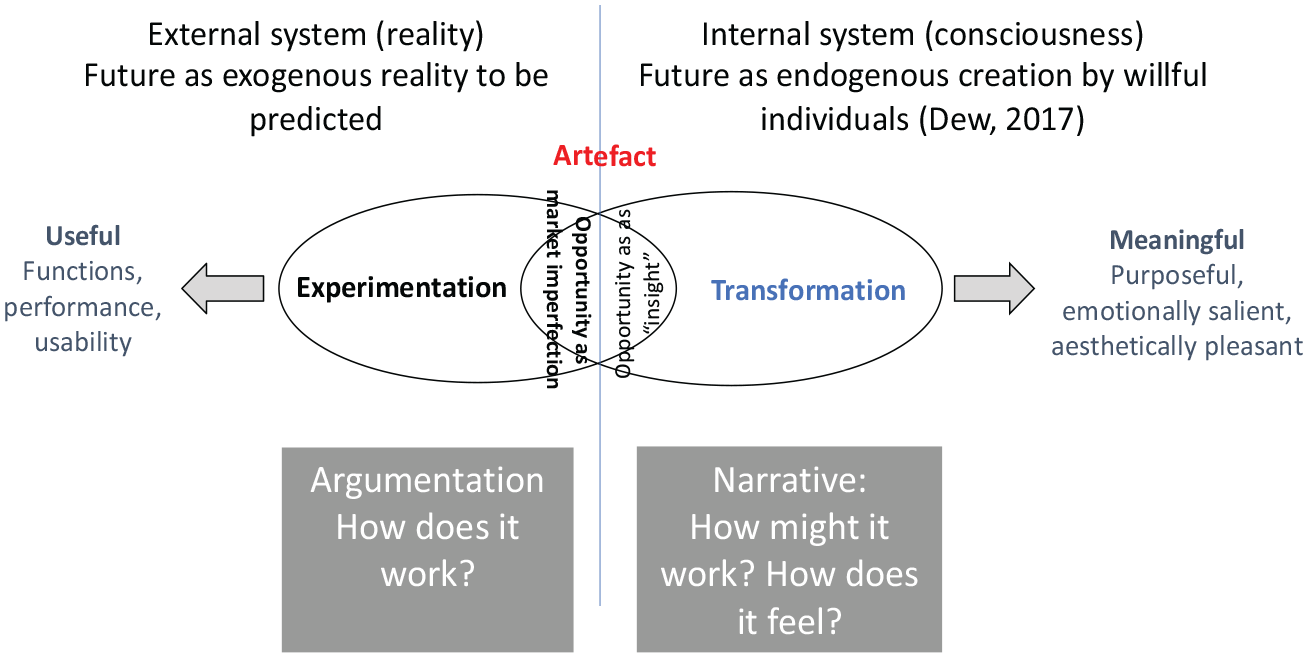
Entrepreneurial action as a duality between transformation and experimentation.
On the transformation side of the model (Figure 2, right side), artefacts tend to be underspecified and mutable objects that fulfil the function of cognitive, collaborative and affective scaffolding of an idea and its growth through manipulating material, environmental and cognitive constraints. In the transformation phase, instead of helping us reduce environmental uncertainty and ‘discover’ reality through empirical testing, artefacts allow us to think about possibilities and conceive the future as an endogenous creation by wilful individuals (Dew et al., 2018).
The learning-by-making approach produces the most creative results in this phase. Using underdeveloped and mutable artefacts to support the transformative process creates room for interpretative flexibility and less constrained user interaction and co-creation than in the experimentation phase. It favours creativity as an endogenous, morphogenetic process in which students are continuously asked to question the take-for-granted and explore across boundaries by altering and manipulating forms. It finally helps them to hone their aesthetic and emotional intelligence to empathise with customers and anticipate possible hostile or welcoming emotional responses that will play a crucial role in adoption or purchasing decisions. While the scientist mindset supports rigorous validation of market and product assumptions in the experimentation phase, the dominant thinking mode on the transformation side is narrative. Bruner (1985) posits that human thinking is the product of a duality between two modes of thought. Argumentation is typical of scientific reasoning and aims to verify if a conclusion is true or false. In contrast, narrative thinking is more frequently applied in artistic endeavours. The objective of a storyteller is to convince the readers that a particular chain of events sounds plausible, emotionally salient and aesthetically pleasing.
Research on storytelling in entrepreneurship has focused on the role of narratives to help form entrepreneurial intention (Gartner, 2010), to support venture legitimacy (Becker-Blease et al., 2015; Fisher et al., 2017), to emphasise stories of success versus failure (Steyaert, 2007) or as a tool to increase the effectiveness of marketing messages and branding. Limited attention however, has been dedicated to building stories as a mechanism to devise entrepreneurial opportunities through creating and modifying artefacts. A simple analogy is the case of children building imaginary scenarios using and repurposing daily tools, for example, a broom can be a horse or a stick a magic wand. In the transformation phase, hypotheses and cause-effect relationships can be constructed as sequences of desirable events leading to a happy ending, perhaps through some trouble and conflict resolution. For example, Lupton (2017) uses narrative arcs to represent and visualise stories of users struggling with a problem and then succeeding when equipped with the right tool to address the issue. Lupton’s work is an example of how a pedagogy of making in EE could expand its teaching techniques portfolio by exploiting design heuristics and principles to support the transformative side of entrepreneurial action. Design heuristics, such as Maeda’s laws of simplicity, Gestalt laws, emotional design (Norman, 2004) and effective complexity (Iandoli and Zollo, 2022), could help entrepreneurs to recombine and reorganise their designs to increase interpretative flexibility, question the obvious and generate new insights. Narrative thinking helps entrepreneurs to create plausible and desirable scenarios without worrying about their veracity, at least in this phase. Consequently, the evaluation of artefacts on the transformation side is based on something other than functional or feasibility criteria, as in the experimentation phase. Instead, good stories are meaningful: they have purpose and internal consistency, elicit emotional responses and must be aesthetically pleasing.
In the proposed model, opportunity recognition occurs through design and test iterations across subsequent rounds of transformation and experimentation via the development of scalable prototypes characterised by higher levels of fidelity (Figure 3). In theory, the iteration can start on either side of the model: through distinct, high-fidelity prototypes tested to address a supposed market imperfection or by employing mutable, low-fidelity prototypes as performative discourse objects for generating opportunities via co-creation with users and stakeholders. The more typical trajectory, advocated by design thinking and customer discovery (Dorf and Blank, 2012), is to start with a low-fidelity prototype and escalate it to a minimum viable product as developers engage with and learn from co-creation and testing through successive iterations.
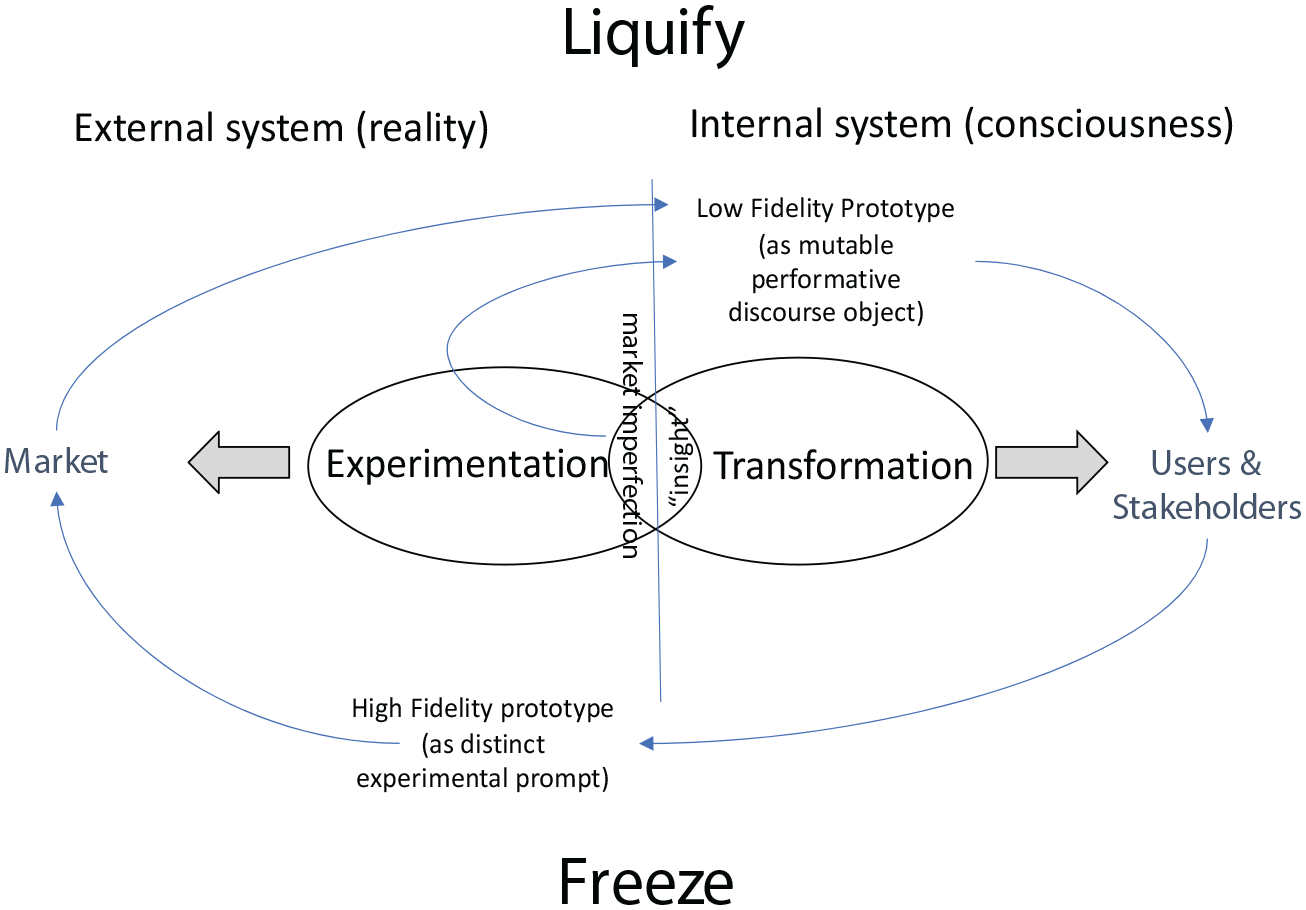
Opportunity generation as an iterative design process across experimentation and transformation.
The convergence towards prototypes characterised by higher fidelity will result either from a reduction of epistemic uncertainty through user tests or when creative insights ontologically eliminate uncertainty through transformation. Since transformation requires mutable and weakly-specified prototypes to favour interpretative flexibility, it involves questioning assumptions and existing design conventions and constraints, which equates to ‘liquifying’ existing knowledge. The opposite happens when the prototype needs to move to the experimentation phase: the design must be temporarily frozen into a distinct and relatively higher-fidelity prototype to support objective and measurable testing.
It is interesting to note that a pedagogy of making based on the proposed model is highly compatible with well-known theories of entrepreneurial action, namely Sarasvathy’s ideas of effectuation. Effectuation seems mostly at work in the transformation phase, while causation appears to be the underlying logic of experimentation (Table 1). Again, the duality reconciles different theoretical descriptions of entrepreneurial action. At the same time, an approach based on making facilitates the translation of effectuation theory into actionable teaching strategies.
A comparison of experimentation and transformation based on effectuation theory.
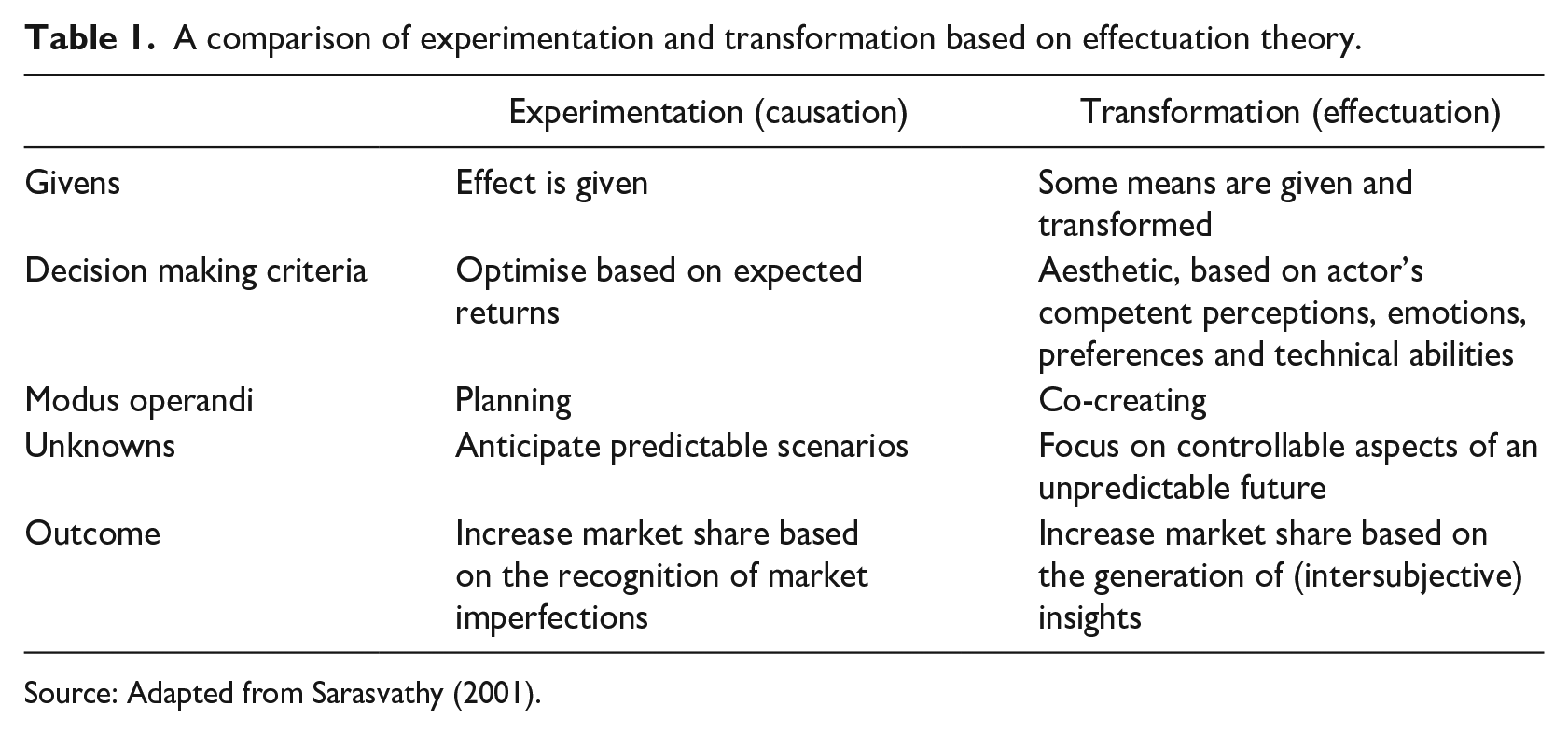
Source: Adapted from Sarasvathy (2001).
Requirements to effectively adopt a pedagogy of making
In this section, I list specifications to implement a pedagogy of making in EE classes and programmes derived from the proposed framework. This list can be the base for building a roadmap for adopting this approach by introducing pedagogic, infrastructural and organisational innovations required for its successful implementation. The model I propose assumes the campus as the unit of intervention and is established by creating a pervasive and robust innovation culture across different organisational units in the academic system following an entrepreneurial ecosystem approach (Hayter et al., 2018; Miller and Zoltan, 2017; Rice at al., 2014). I adopt Schein’s definition of organisational culture as the set of shared values and basic assumptions invented, discovered or developed by a group to resolve the twofold problem of external adaptation and internal integration (Schein, 2010). There are three crucial constituents of organisational culture: the social aggregate upon which the culture insists, the learning mechanisms through which culture is shared and apprehended and the material infrastructure and artefacts that embody cultural beliefs and can be felt or used by individuals to communicate and interact with others. In the context of academic entrepreneurship, these three dimensions will be respectively referred to as: community, pedagogic platform and material infrastructure for making and creativity, as described below:
Community includes the social ecosystems in which innovation is shared, co-created and supported. A community should be nurtured to offer a mix of networking opportunities and forms of active support and subsidisation. The community should hinge around a hub connecting various existing networks such as student clubs and associations, business angels, mentors and alums and other communities of practice in specific domains. These various groups, especially the student groups, should actively engage the community with grass-roots events and initiatives. In some best practices cases, such as Aalto Design Factory (Björklund et al., 2017), students have a vibrant and central role in the governance and management of the community and innovation infrastructure, with the university limiting itself to providing resources and policies for their proper use. Active support includes the more traditional availability of applicable Intellectual Property Policies and support in IP development and acquisition, tech transfer offices, business development and seed funding. Increasingly important is the membership to communities of entrepreneurs and innovators to support their abilities to access international networks and work in distributed teams. These opportunities can be international innovation boot camps, accelerators or hackathons. Similarly, the campus community would benefit from linking and collaborating with non-academic entities operating in the same area or region, such as companies, not-for-profit organisations, associations, local government, other schools, universities and so on.
Pedagogic platform: This includes teaching and learning initiatives such as courses and curricula empowered by a pedagogy of making aimed at training students to develop an entrepreneurial mindset and skills grounded on Bruner’s two modes of thoughts (narrative and argumentative) and the duality between transformation and experimentation, that is, iterating prototype building and testing. Different teaching tools can be combined and experimented with, ranging from the already popular customer discovery and design thinking toolboxes to more innovative frameworks based on gamification (Sidhu et al., 2015), engineering and architectural design such as Stanford’s ME310 (Carleton and Leifer, 2009), the double-diamond model (Banathy, 2013; British Design Council, 2016), human-centred design (IDEO, 2015), design heuristics (Hekkert, 2006; Iandoli and Zollo, 2022; Lupton, 2017; Maeda, 2006) and digital platforms for app and website design, easy CAD tools and 3D printing suites. A brief description of some of these tools is provided in Table 2. Prototyping can broadly be interpreted as creating testable artefacts to solve a user problem. With this broad interpretation, a pedagogy of making can be adopted across disciplines or by designing interdisciplinary classes.
The material infrastructure for creativity and making includes a variety of spaces, ranging from social places inspiring creativity and collaboration to ‘making’ spaces or Fab Labs covering the whole prototype fidelity spectrum. These include general-purpose facilities supporting ideation and low-fidelity prototyping, such as maker’s labs and 3D printing centres, and more specialised and advanced tech labs. The primary function of these spaces is to provide access to prototyping technologies and tools and support knowledge socialisation and aggregation of diverse skills and ideas (Browder et al., 2019). Unlike traditional research labs, Makerspaces should be open to all students, multifunctional and multidisciplinary, scalable to accommodate the needs of small teams and larger gatherings and connected to a network of resources that students can easily navigate as they scale up their projects. The addition of features such as rooms for team working, soundproof booths to support virtual meetings, spaces where students can consume food and drinks socially, and the presence of resources to stimulate the right brain, such as games, foosball/ping pong tables, informal and inviting furniture such as sofas and bean bag couches, have the purpose of favouring social connection and stimulate informal circulation and remix of ideas (Kirjavainen, 2017).
A collection of pedagogic tools to support the implementation of a pedagogy of making.
There could be different ways through which these three components can be implemented and combined to create a functioning ecosystem and support the new venture life cycle in each phase. A possible model is provided in Figure 4. The model can be used to map and connect existing initiatives, identify gaps in the ecosystems, introduce novel initiatives and find ways to integrate the various parts into a connected and coherent system that academic inventors and entrepreneurs can navigate with ease and relative autonomy. While an increasing number of campuses are trying to implement ecosystems such as that in Figure 4, the three components must be well-connected and balanced. Makerspaces and Fab Labs must connect to entrepreneurship programmes and other forms of support. This connection helps makers become aware of the prototype’s entrepreneurial potential and have access to skills and assets to shift their focus from product design to new venture creation (Rayna and Striukova, 2021). The maker infrastructure and activities should have a prominent role and generate a critical mass of ideas and artefacts that the rest of the ecosystems can exploit for entrepreneurial endeavours.
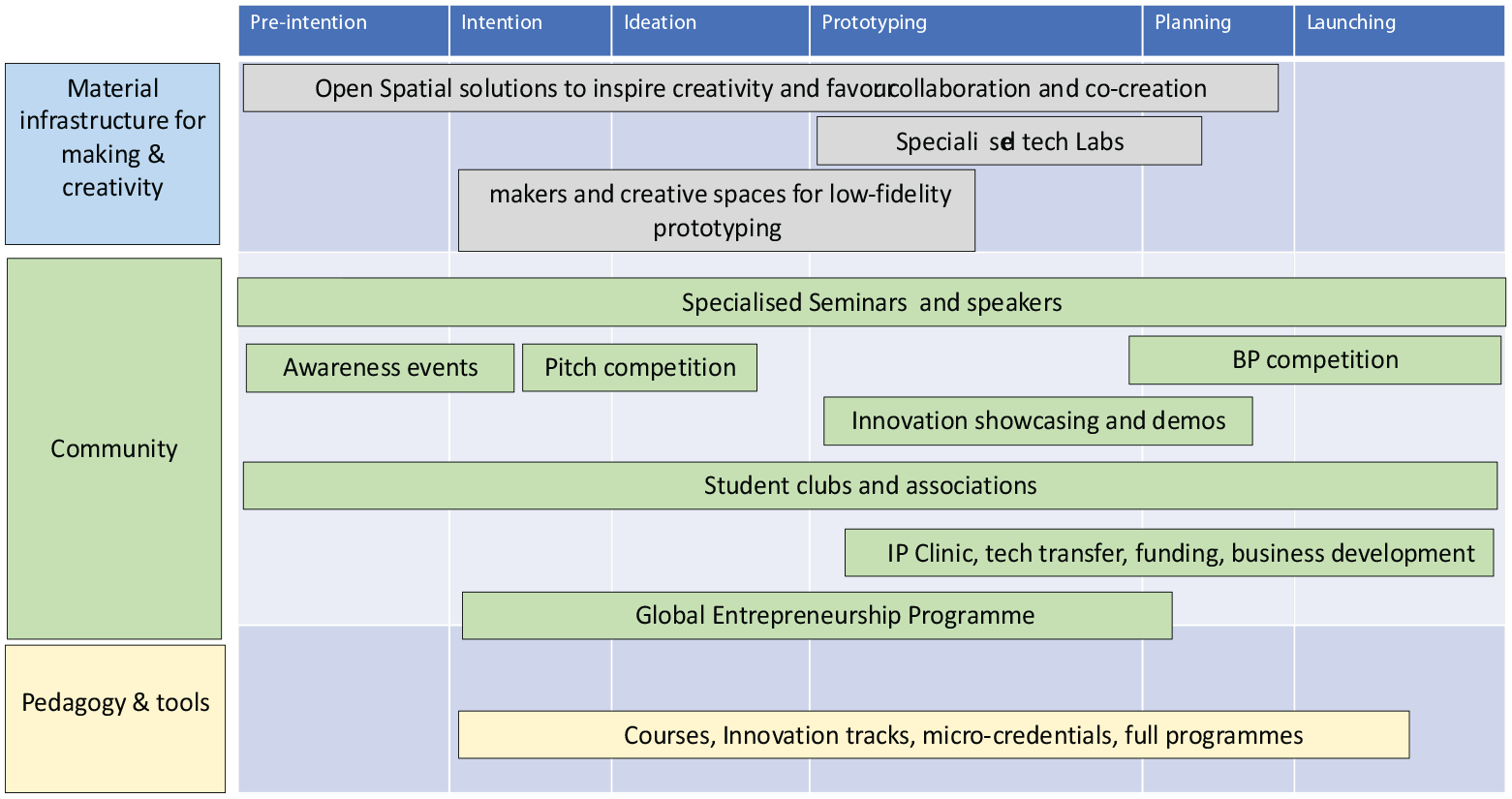
Mapping the campus innovation ecosystem to support the creation of entrepreneurial culture and the formation of entrepreneurial skills.
Optimising the structure and functioning of academic entrepreneurship ecosystems is a key and relatively neglected research area (Hayter et al., 2018), and it lies beyond the scope of this paper. As far as this review is concerned, however, it is important to stress that the successful implementation of a pedagogy of making cannot be solely based on injecting novel teaching techniques into existing courses or by opening a brand-new maker’s lab but requires the design of a maker-centric supportive academic entrepreneurship ecosystem accompanied by the necessary investment for the creation of the material, cultural and pedagogic infrastructure (Saaroghi et al., 2019). The ecosystem perspective can help instructors and university administrators identify the critical elements that must be implemented and anticipate potential hiccups and causes of failure. Here are four crucial warnings to consider:
(a) The persistence of the ilomorphic view: A symptom of this problem is the implementation of teaching approaches in which making is still subservient to ideation, and creativity is mainly a mental activity that is disjointed from practice and experimentation.
(b) The lack of adequate infrastructure: Putting up the infrastructure to support making in its progression from transformation to experimentation through the design of prototypes characterised by increasing fidelity is expensive, especially for schools that do not have a making tradition that can be imported or adapted from programmes in technology, engineering, architecture and so on.
(c) Siloed culture and ideological resistance to entrepreneurial exploitation of science: Technological and science schools and programmes may suffer from the opposite problem: while some infrastructure is available, they struggle to connect labs and centres into a makers’ ecosystem and with a teaching platform that promotes the entrepreneurial valorisation of design and technology. This resistance is not so much due to political ideology as to the alleged inferiority of entrepreneurship as a non-rigorous academic discipline and a distraction from technology development. It is reasonable to argue that teaching entrepreneurship through making as opposed to business-based approaches for which technical students lack the necessary background and mindset can help to overcome such resistance (Lamine et al., 2021; Loi et al., 2022).
(d) Critical mass and lack of integration: While ecosystems in nature exist because they find ways to survive and grow sustainably in a specific environmental niche, an academic entrepreneurship ecosystem is artificial. Like a greenhouse or an aquarium, it is developed in a relatively closed and protected context, such as an academic campus, and it struggles to reach a desirable level of self-sufficiency and self-organisation. Substantial efforts and organisational gardening are needed, especially at the beginning, to generate the critical mass and the necessary integration between the various components required to jumpstart the system and put it in motion. The creation of an Innovation Hub charged with this mission can help. The introduction of Makerspaces designed as places to access technology and socialise ideas can act as an attractor and a catalyst. However, universities will have to deal with a chicken and egg problem: without the conditions for such an ecosystem to thrive naturally, a significant investment may be required to create a hub and the needed infrastructure to generate the level of participation and energy required to sustain the ecosystem with less effort. This is a risky strategy, especially for universities with little tradition, infrastructure, funding or experience with academic entrepreneurship.
Conclusions and future research: A pedagogy of making to innovate teaching and learning and support employability in the digital age
In his definition, Schein (2010) mentions external adaptation as one of the drivers leading to the emergence and consolidation of organisational culture. Whether universities should develop and nurture a culture of innovation by creating an artefact-centred entrepreneurship ecosystem is then a question of what kind of external adaptation the adoption of such a culture would help to achieve.
In this review, I wish to focus academician attention on student employability as a key benefit. Section ‘Design-driven entrepreneurial intent and skills’ illustrates how DDEE and a pedagogy of making can help form crucial skills in an economy where immaterial investments and digitalisation of business and life are becoming dominant. Here I briefly touch upon two other forces shaping employability opportunities for students: first, the fast development and mass adoption of AI technologies; and second, the increasing demand for skills to understand, adopt, tweak and deploy digital technology. Brynjolfsson and McAfee (2014) provide a rich analysis of how AI and other automation technologies can destroy more jobs than they help to create. By analysing thousands of job descriptions, Frey and Osborne (2017) developed a model to calculate the probability of a position being taken over by machines soon. An analysis of their ranking based on such chance shows that the jobs with the highest probability of staying with humans (p > 0.995) are mainly in human services, such as health and education, or domains in which creativity and craftsmanship are crucial. The skills for such jobs include empathy, creativity, sophisticated communication skills (based on persuasion and storytelling), fine manual dexterity, skills to manipulate and build unique crafts and the ability to make ethical decisions.
While technological developments in AI seem faster than anticipated, it is reasonable to assume that jobs characterized by high levels of empathy, fine crafts, emotional intelligence, and creativity will be safe for a while. The question is not whether computers can think, but whether they can think like humans. If the theory of embodied cognition is correct, the current computational paradigm driving AI development does not pursue the type of embodied intelligence that makes us humans. More empirical research and evidence are needed to show that these expectations are correct. First, rigorous studies should be conducted to prove that DDEE is effective at training such skills. Second, and more importantly, we need empirical research to support the notion that such skills are conducive to better employment opportunities and careers. AI is disrupting teaching as well. The diffusion of AI tools that simulate human creativity in content production, such as Chat GPT or Dall-e, democratises producing ‘creative’ content. While a long debate would be necessary to discuss whether algorithmically generated content is creative, delegating content production to machines changes the nature of creativity and makes it editorial in nature. The task for humans is to navigate, vet and manipulate these new materials to generate solutions that serve users in meaningful and genuinely novel ways. The proposed pedagogic model displayed in Figures 2 and 3 helps to nurture these editorial and transformative human skills in an actionable and empathetic way and apply them to various professional situations and challenges beyond starting a new venture.
Regarding theoretical advancements in EE, the diffusion and growing adoption of pedagogic approaches based on DDEE open exciting research avenues. The diffusion of DDEE is a typical example in which practice is walking faster than theory, so we must play ‘catch up’. First, we need more hard evidence about the pedagogic effectiveness of such approaches. To answer this question, it is crucial to develop theoretical models that adequately capture DDEE’s foundations and epistemological stances and define competency models that are consistent with them. Without this consistency, we might fail to measure what should be measured and make wrong conclusions regarding whether DDEE improves general-purpose, problem-solving skills, positively impacts specific entrepreneurial skills and mindset, or both. Possible examples include assessing if DDEE teaching approaches influence entrepreneurial orientation (Daniel, 2016) or whether the ability to build and test prototypes significantly affects the acquisition and improvement of critical entrepreneurial skills such as recognising opportunities, building effective social networks, acquiring essential resources, making effective decisions, metacognition and self-regulation (Baron and Henry, 2010). A possible sub-question under research on DDEE effectiveness is whether DDEE makes a difference for certain groups of learners. For instance, is a pedagogy of making a better approach to teaching entrepreneurship to non-business students? Are more student-centred, experiential, practical and engaging pedagogic practices more likely to work to close the diversity gap in EE and education in general? (Eddington et al., 2019; Smith, 2011). It is reasonable to hypothesise that more developmental and performative pedagogy could help to improve diversity and inclusion compared to pedagogic approaches driven by a deficit-based mindset (Basu, 2022). Another area in which more research is needed is the possibility to import to entrepreneurship teaching design principles and heuristics created and used in other fields such as engineering, architecture and industrial design. Finally, more research is also needed beyond the pedagogical challenges of adopting and implementing a pedagogy of making, such as studies on the design and effectiveness of campus-based entrepreneurial ecosystems consistent with DDEE, including the possibility of creating hybrid ecosystems that can branch out via the adoption of specialised digital platforms.
Footnotes
Funding
The author(s) received no financial support for the research, authorship, and/or publication of this article.
