







Abstract
This article uses a global multilevel sample to advance our understanding of the gender gap in youth entrepreneurship by investigating the joint moderating influence of in-group support and national embeddedness values on young women’s entrepreneurial activity relative to that of young men. Based on a mixed embeddedness theoretical lens, our moderation analysis demonstrates the importance of in-group support in narrowing the gender gap in youth entrepreneurship. Moreover, in-group support enhances young women’s entrepreneurship vis-à-vis that of young men primarily in countries with strong embeddedness values. Our findings contribute to the entrepreneurial gender gap literature as well as to the comparative entrepreneurship literature, by providing evidence of the joint role of micro-level and macro-level cultural layers in reducing the entrepreneurial gender gap. Implications for theory, practice and policy are provided.
Keywords
Introduction
On a global basis, evidence indicates an increasing number of young people are engaging with entrepreneurship (Kew et al., 2013; Schøtt et al., 2015; Sieger et al., 2021). This may reflect their entrepreneurial ambitions as well as education and technological shrewdness that equips them to create growth-oriented new ventures (Lüthje and Franke, 2003; Mowery and Shane, 2002). As for the enabling role of technology, growing social media-based entrepreneurship among young people is a case in point (Guanah and Okowa-Nwaebi, 2022; Simanjorang and Nawawi, 2022). Since an increasing number of young people now have a university education, the entrepreneurial activity of university students reflects the entrepreneurial engagement of the youth population in general (Gimenez-Jimenez et al., 2022). Student entrepreneurship has a significant share of university entrepreneurship (Bergmann et al., 2016), benefiting from university entrepreneurship ecosystems (Morris et al., 2017) and making significant social and economic contributions to the innovative activities in proximity to universities (Dodgson and Gann, 2020).
Gender has been a core topic in entrepreneurship research, including student entrepreneurship, for many years (Edelman et al., 2020; Gimenez-Jimenez et al., 2022; Sieger et al., 2019, 2021). Accordingly, the literature on the impact of gender on entrepreneurial activity has been expanding steadily, often with women as the gendered subject, particularly in terms of the gap in self-employment rates (Marlow, 2020; Marlow and Martinez Dy, 2018; Minniti and Naudé, 2010). In terms of the role of gender in student entrepreneurship, the Global University Entrepreneurial Spirit Student Survey (GUESSS), which records the entrepreneurial intentions and activities of university students worldwide on a biannual basis, has provided valuable insights since its inception in 2003 (GUESSS, 2022). In its global reports, GUESSS has consistently observed an entrepreneurial gender gap, in the sense that young women have been found to be less likely to engage in entrepreneurship than young men (Sieger et al., 2021). For instance, 2018 GUESSS data show that the proportion of active, nascent and intentional student entrepreneurs – both directly and five years after studies – is relatively smaller among women than among men (Sieger et al., 2019).
This trend is mirrored in a burgeoning stream of literature on the entrepreneurial gender gap and its determinants (Abbasianchavari and Block, 2022; Cuberes et al., 2019; Hechavarría et al., 2018). Why do women show a lower propensity to engage in entrepreneurial activities than men (Piva and Rovelli, 2022; Wheadon and Duval-Couetil, 2019)? Many studies explain this finding with individual-level factors, including women’s differing psychological and socio-economic characteristics (e.g. weaker risk-taking attitudes) (Caliendo et al., 2015; Dheer et al., 2019). Extant research also stresses the role of gender stereotypical beliefs: women have been found to abstain from entrepreneurship due to ‘self-stereotyping’. This implies that women believe they must transform themselves to become successful entrepreneurs (Ahl, 2006; Ahl and Marlow, 2021). It also suggests that entrepreneurship is still more likely to be seen as a man’s domain and less congruent with women’s social roles (Eagly et al., 2000; Edelman et al., 2020). While these individual-level factors have their merits in understanding the entrepreneurial gender gap, they overlook the critical role of the context in which entrepreneurs, including women entrepreneurs, operate (Welter, 2011, 2020; Welter et al., 2019). This has sparked research into contextual determinants of the entrepreneurial gender gap (Dheer et al., 2019). A major focus in this regard has been on the role of bias against (aspiring) women entrepreneurs from their social environment, including resource providers (Guzman and Kacperczyk, 2019; Van Ewijk and Belghiti-Mahut, 2019).
Our study adds to this emerging ‘context’ literature on the entrepreneurial gender gap. Based on a mixed embeddedness perspective (Brieger and Glienik, 2021; Kloosterman, 2003; Kloosterman et al., 1999) and quantitative research methods, it proposes a complex multi-level cultural approach to understanding the gender gap in youth entrepreneurship. Part of the complexity is that we, as opposed to most of the extant research (see Feldmann et al., 2022, for an exception), model culture – the ‘collective programming of the mind’ (Hofstede, 2001: 1) – as a multi-layered construct including macro and micro layers (Leung et al., 2005; Steel and Taras, 2010) to explain gendered entrepreneurial engagement at the individual level. We deem our focus on young women entrepreneurs justified because cultural factors have been found to be particularly relevant for this group in their early career stages (Markussen and Røed, 2017; Van Ewijk and Belghiti-Mahut, 2019). In so doing, we respond to literature calls that advocate (1) modelling the cultural complexities influencing women in the context of new venture creation (Gimenez and Calabrò, 2018; Gimenez-Jimenez et al., 2022) and (2) recognising the national context as a major factor in future entrepreneurship studies, including women’s entrepreneurship (Bullough et al., 2022; Davidsson, 2017; Gimenez and Calabrò, 2018).
Our cultural approach involves investigating the joint role of in-group support and national embeddedness values in nascent entrepreneurial engagement of women and men university students. We consider nascent entrepreneurship a suitable concept for our study population defining them as individuals acting to create an independent business (Delmar and Davidsson, 2000). Drawing on Liñán and Chen (2009: 596), we refer to in-group support as the perception that ‘reference people’ (e.g. parents or friends) would approve of the decision to become an entrepreneur and actively support that decision (e.g. financially, emotionally or morally). As such, we suggest that women and men might differ in the extent to which they make use of in-group support for their entrepreneurial purposes (Edelman et al., 2016; Markussen and Røed, 2017; Van Ewijk and Belghiti-Mahut, 2019).
Young women’s entrepreneurial activity is moreover, embedded in a broader national context that might influence whether and how in-group support affects their entrepreneurial engagement. We argue that young women, when compared with young men, will benefit from in-group support for entrepreneurial engagement especially when being part of societies with strong embeddedness values, that is, countries, where conservative values such as group solidarity, obedience and the traditional social order dominate (Schwartz, 1994, 1999). Previous research has found that embeddedness cultures suffer from general resource allocation distortions (De Clercq et al., 2013, 2014), with unequal access to entrepreneurial opportunities and resources between men and women being a case in point (Fischer et al., 1993; Van der Zwan et al., 2013). The underlying reason for this inequity appears to be widespread gender bias (Gupta et al., 2009; Webb et al., 2015), especially in embeddedness cultures where traditional gender role models prevail (Baughn et al., 2006; Van der Zwan et al., 2012; Xiong et al., 2020). Considering this, we conjecture that in embeddedness societies in-group support may be particularly important for young women as a replacement mechanism for the resource disadvantage encountered at the national level (De Clercq et al., 2014; Van der Zwan et al., 2013). On that basis, we raise two research questions: (1) How does in-group support moderate the gender gap in young entrepreneurship? and (2) How do national embeddedness values shape the moderating effect of in-group support on the gender gap in young entrepreneurship? We test our theoretical model on a rich sample with multilevel data on almost 125,000 students from 33 countries. The individual-level data were collected in 2018 by the GUESSS project. The country-level data stem, among others from the Schwartz Value Survey (Schwartz, 2006, 2008).
Our research seeks to make several theoretical contributions. First, we contribute to a growing body of literature focusing on ‘contextualising gender and gendering contexts’ (Welter, 2020: 27) in an entrepreneurship setting as well as investigating the structural barriers hampering young women entrepreneurs (Kuschel et al., 2020). Analysing the entrepreneurial gender gap based on such an aggregate perspective is meaningful because the magnitude of this gap has been shown to differ substantially across countries (Cuberes et al., 2019; GEM, 2022; Sieger et al., 2021). Such variance suggests that conditions in some nations are more encouraging for women to pursue entrepreneurship than they are in others (Dheer et al., 2019). Our article adds to this stream of research by arguing that the entrepreneurial gender gap can be explained by a complex interaction of gender and culture. In so doing, we contribute to the women’s entrepreneurship literature (Henry et al., 2021) and the embeddedness literature in entrepreneurship.
Second, we contribute to the literature on comparative international entrepreneurship by explaining gender differences in entrepreneurial activity among young people on a global basis given their exposure to multi-layered cultural values. Our theoretical and empirical analysis explains how such values influence engagement of young women in entrepreneurship relative to that of men. Hence, the study contributes to a theoretical understanding of the cultural constraints faced by young women entrepreneurs in some national settings – and addresses calls for identifying contextual conditions that can overcome these constraints (Batjargal et al., 2019; Clough et al., 2019). Finally, we contribute to the emerging literature on university student entrepreneurship. Prior studies in this field have mostly focused on the entrepreneurial intentions of university students (Autio et al., 2001; Krueger et al., 2000; Lu et al., 2021), whereas investigations of actual entrepreneurial engagement, which is our focus, have been neglected, particularly those examining the role of context in this regard (see Edelman et al., 2016, Gimenez-Jimenez et al., 2022, and Weiss et al., 2019, for notable exceptions).
Theory and hypotheses
Mixed embeddedness and entrepreneurial activity
This study adopts mixed embeddedness as a theoretical lens focussing particularly on cultural and social embeddedness dimensions to analyse engagement in entrepreneurial activity of young women across different countries. Embeddedness can be defined as ‘the nature, depth and extent of an individual’s ties into the environment’ (McKeever et al. 2015: 52). A recent review of embeddedness in entrepreneurship research shows that prior studies largely consider embeddedness in one single context (Wigren-Kristoferson et al., 2022). It has been noted however, from Granovetter (2017) that the concept of embeddedness should be considered much more broadly now and include not only social networks and their repercussions, but also political, cultural and institutional influence.
We adopt the ‘mixed embeddedness’ perspective (Brieger and Gielnik, 2021; Kloosterman, 2003; Kloosterman et al., 1999) to theorise how important differences between individual-level and country-level contexts affect young women’s engagement in entrepreneurship. The concept of mixed embeddedness includes multiple levels of context plus its resources and values, as well as the entrepreneur’s personality and life history (Wigren-Kristoferson et al., 2022). Mixed embeddedness is an especially relevant conceptual framework for analysing the antecedents and consequences of entrepreneurial activities of entrepreneurs who lack accessibility to entrepreneurial resources (Zhu et al., 2019). For instance, this concept has been used in research on immigrant entrepreneurship (Jones et al., 2014; Kloosterman et al., 1999), ethnic minority entrepreneurs (Barrett et al., 2001), new graduate entrepreneurs (Mwasalwiba et al., 2012), rural entrepreneurship (Korsgaard et al., 2015a, 2015b; Zhu et al., 2019) and women’s entrepreneurship in developing countries (Langevang et al., 2015).
We consider two theoretical mechanisms for explaining moderating effects of in-group support and national embeddedness values on the gender gap in young entrepreneurship. The first mechanism involves in-group instrumental, moral and emotional support via relationships based on frequent contacts, such as those existing among family members or close friends (Coleman, 1988; Liñán and Chen, 2009). While emotional support goes beyond the behavioural encouragement of moral support, involving listening and empathy (Adams et al., 1996; Liñán and Chen, 2009), instrumental support describes tangible assistance aimed at solving a problem (Beehr and McGrath, 1992; McIntosh, 1991). Prior studies show the importance of both types of support in early-stage entrepreneurial activity (Edelman et al., 2016; Sørensen, 2007), particularly for women entrepreneurs. For instance, research on the gendered differences in entrepreneurship suggests that women entrepreneurs are more likely to obtain money from their personal network including family and friends to finance their businesses (Carter et al., 2003).
The second mechanism includes national cultural values that provide templates for interpretation and actions of people embedded in the specific cultural context (Greenman, 2013). The starting point here is that entrepreneurial action occurs at the interface between individual action and collective cultural values (Hardy and Maguire, 2008). On that basis, we argue that these values will affect the willingness of in-groups to support young women’s entrepreneurship, while at the same time affecting the extent to which they make use of the support offered and translate it into entrepreneurial action. Put differently, we claim that cultural values may enhance or restrict in-group support of women entrepreneurship through people’s perception and interpretation of the cultural norms in a given society.
The entrepreneurial gender gap
One of the key challenges encountered when starting new ventures is accessing resources (Aldrich 1999; Reynolds 2011). Prior research has suggested that women entrepreneurs face constraints with respect to resource access; for instance, evidence suggests that women have fewer social and business networks and so tend to lack ‘weak ties’, also referred to as access to more diverse resources outside the in-group (Brieger and Gielnik, 2021; Edelman et al., 2016; Greve and Salaff, 2003; Renzulli, et al., 2000). This positions women at a disadvantage vis-à-vis men, as a relative absence of weak ties, that is, a restricted access to more diverse resources, is detrimental for business activity (Mickiewicz et al., 2017). Furthermore, prior studies identify that one of the main reasons for the gender gap in entrepreneurship is women’s restricted access to financial resources (Heilbrunn, 2004; Muravyev et al., 2009). In addition to contextual factors, the gender gap in entrepreneurship might be explained from socio-demographic characteristics, such as a lower level of entrepreneurial self-efficacy among women (Allen et al., 2007; Van der Zwan et al., 2013; Wilson et al., 2007), and stronger fear of failure (Wagner, 2007). Such factors are particularly pronounced for young women (Edelman et al., 2020) but vary substantially across countries (Van der Zwan et al., 2012). Nevertheless, research shows that the gender gap in entrepreneurship is a global phenomenon, as women, in general, are less likely to be engaged in entrepreneurial activity (GEM, 2022). Hence, our baseline hypothesis is as follows:
In-group support and the entrepreneurial gender gap
In-group support in relation to entrepreneurship constitutes the micro-level of our multi-layered socio-cultural approach to the gender gap in youth entrepreneurship. It encapsulates the transfer of important emotional and instrumental resources to the potential entrepreneur through the strong ties of personal relationships (e.g. within the family or between friends, peers and colleagues) among members of social networks (Coleman, 1988; Granovetter, 1973). As opposed to looser ‘weak tie’ relationships, such strong ties usually involve a significant emotional engagement (Granovetter, 1973; Mickiewicz et al., 2017). The concept of in-group support overlaps with the notion of culture (Hofstede, 1980). In defining culture, we refer to Inglehart (1997), Hofstede (2001) and Schwartz (2004), who describe culture as basic norms and values, as well as ways of feeling, thinking and acting, shared and learned by people belonging to the same social environment, including the country-level but also more proximate and personal levels (e.g. family members, peers and role models). In our case, in-group support in relation to entrepreneurship may be interpretable as a micro-level entrepreneurial culture (Thurik and Dejardin, 2012) that spurs entrepreneurial activity by enhancing the social legitimacy of women’s entrepreneurship via moral approval, as well as by offering instrumental support. Such a culture can operate at various levels of aggregation, including the in-group (Liao and Welsch, 2005; Liñán and Fernandez-Serrano, 2014) and the broader societal level (Davidsson, 1995; Etzioni, 1987; Fritsch and Wyrwich, 2017; Kibler et al., 2014). Drawing on previous research (Kaasa and Minkov, 2020; Schwartz, 2011), we expect cultural values to be relatively stable over time, that is, they ‘change slowly, sometimes over centuries’ (Schwartz, 2011: 315).
We argue that women’s entrepreneurial activities will benefit more than those of men when in-group support is present. Hence, we expect in-group support to positively moderate the entrepreneurial gender gap, such that strong in-group support will decrease this gap. We base our rationale on two aspects: first, previous research has shown that women benefit strongly from instrumental and emotional resources from the in-group in the entrepreneurial process (Edelman et al., 2016; Powell and Eddleston, 2013). For instance, these studies found that families are a key (and often the sole) source of women’s start-up capital and that the family reputation, connections and emotional support are important. In sum, family’s instrumental and emotional support can help women to engage in entrepreneurial activity by providing necessary resources, including quality and timely information, by buffering adversity and by facilitating transactions (Edelman et al., 2016). Indeed, prior research argues that women have more difficulty in accomplishing their entrepreneurial potential without encouragement and active support (Marlow and McAdam, 2013; Roos, 2019). More recently, Edelman et al. (2020) showed that young women make better use of family support during venture creation. Similarly, it has been argued that women are able to leverage larger social networks to support venture growth (Batjargal et al., 2019; Liou and Aldrich, 1995). Second, it has been argued that personal social networks related to the family, friends, peers or colleagues can transmit entrepreneurial norms and values as well as moral support, from which young adults – and particularly women – benefit (Feldmann et al., 2022; Liñán and Chen, 2009; Markussen and Røed, 2017; Rocha and van Praag, 2020). On that basis, we postulate our second hypothesis:
National embeddedness values, in-group support and the entrepreneurial gender gap
National embeddedness values are a construct developed by Schwartz (2006) and form part of an embeddedness/autonomy value dimension where embeddedness values and autonomy values serve as antipodes. The dimension describes the connection between the individual and the group: autonomy cultures view individuals as autonomous in the sense that they should independently formulate and act upon their personal feelings, intellectual ideas and preferences. By contrast, in embeddedness cultures, individuals are considered as belonging to the collective group. This includes values such as group solidarity, obedience, security and respect for the traditional social order (Schwartz, 1994, 1999).
We argue that the positive moderating influence of in-group support on the entrepreneurial gender gap should be stronger in countries with strong embeddedness values and weaker in countries with weak embeddedness values. This would be equivalent to claiming that the above moderating influence will be stronger in countries with weak autonomy values and weaker in countries with strong autonomy values. Hence, we deem that women’s engagement in entrepreneurial activity will be enhanced through strong in-group support in strong embeddedness cultures (i.e. weak autonomy cultures). By contrast, women entrepreneurs will not benefit to the same extent as their male peers from strong in-group support in weak embeddedness cultures (i.e. strong autonomy cultures).
We explain our rationale through the lenses of two underlying theoretical mechanisms that arguably operate in embeddedness societies: (1) women’s necessity to access in-group resources and (2) women in-group conformism. As for the first mechanism, within a particular country, entrepreneurs are linked to customers and organisations through communications and business relationships (Bergmann et al., 2016; Trettin and Welter, 2011). This influences access to resources and may enable or constrain entrepreneurial activity (Batjargal et al., 2019; Korsgaard et al., 2015a. 2015b). There exists an unequal access to entrepreneurial opportunities and resources between men and women at the wider country level in embeddedness cultures (Fischer et al., 1993; Van der Zwan et al., 2013), over and beyond more general resource allocation distortions in such value systems (De Clercq et al., 2013, 2014; Matsumoto et al., 2008). We hypothesise that gender bias is a major reason for this gender-distorted opportunity and resource provision (Eagly, 1987; Gupta et al., 2009; Webb et al., 2015), especially in embedded cultures, where traditional role models, such as the notion of women as caretaker in the household, still prevail (Baughn et al., 2006; Van der Zwan et al., 2012; Xiong et al., 2020). It is not surprising then that recent research found gender bias to be a distinct feature particularly of embeddedness cultures (Lomazzi and Seddig, 2020).
In relation to entrepreneurship, such instances of gender bias are most likely to hinder aspiring women entrepreneurs from building and accessing weak ties in the entrepreneurial process; these are deemed important for new business activity (Mickiewicz et al., 2017). For example, Guzman and Kacperczyk (2019) used population data on California and Massachusetts-based business between 1995 and 2011 to break down the entrepreneurial gender gap. A key finding was that the likelihood of women-led ventures to obtain venture capital was 63% lower than that of men-led ventures. While 65% of this disparity was due to women being less successful in signalling start-up growth potential to investors, there was a residual gap of 35% that, it was posited, stems from investor gender bias against women.
We argue that resource access inequalities from the perspective of women can be alleviated through in-group support – particularly in embedded national value systems; a factor that we expect to boost women’s entrepreneurial engagement relative to that of men (Bullough et al., 2017). Women might realise that in-group support from the family and other peers is a necessity to advance in the entrepreneurial process because of reduced resource access possibilities at the wider societal level. Evidence in this regard is provided by Kalafatoglu and Mendoza (2017) who demonstrated that in embedded societies, women entrepreneurs face culturally rooted barriers concerning access to entrepreneurial opportunities and resources. Some of these barriers, such as access to capital, training and management advice, or new business opportunities in male-dominated industries seem to be resolved through networking, that is, through strong ties provided by the in-group.
As for the second mechanism, we argue that women in embedded cultures might have stronger in-group conformism than men due to a sense of belonging to the in-group and due to perceiving ‘strong tie’ relationships as helpful in reducing risk and uncertainty in decision-making situations – with the entrepreneurial process being a case in point (Batjargal et al., 2019; Markus and Kitayama, 1991). Related to that, women in embeddedness cultures have been found to exhibit higher in-group obligations (Bond and Smith, 1996; Kim and Markus, 1999; Schwartz 1994, 2006; Smith et al., 2002) than men who do not feel the same degree of long-term obligations to their close peers and instead, display more task-oriented and instrumental networking practices of the ‘weak tie’ type (Anderson and Blanchard, 1982; Batjargal et al., 2019). Therefore, we formulate the following hypothesis:
Figure 1 illustrates the conceptual framework of this study.
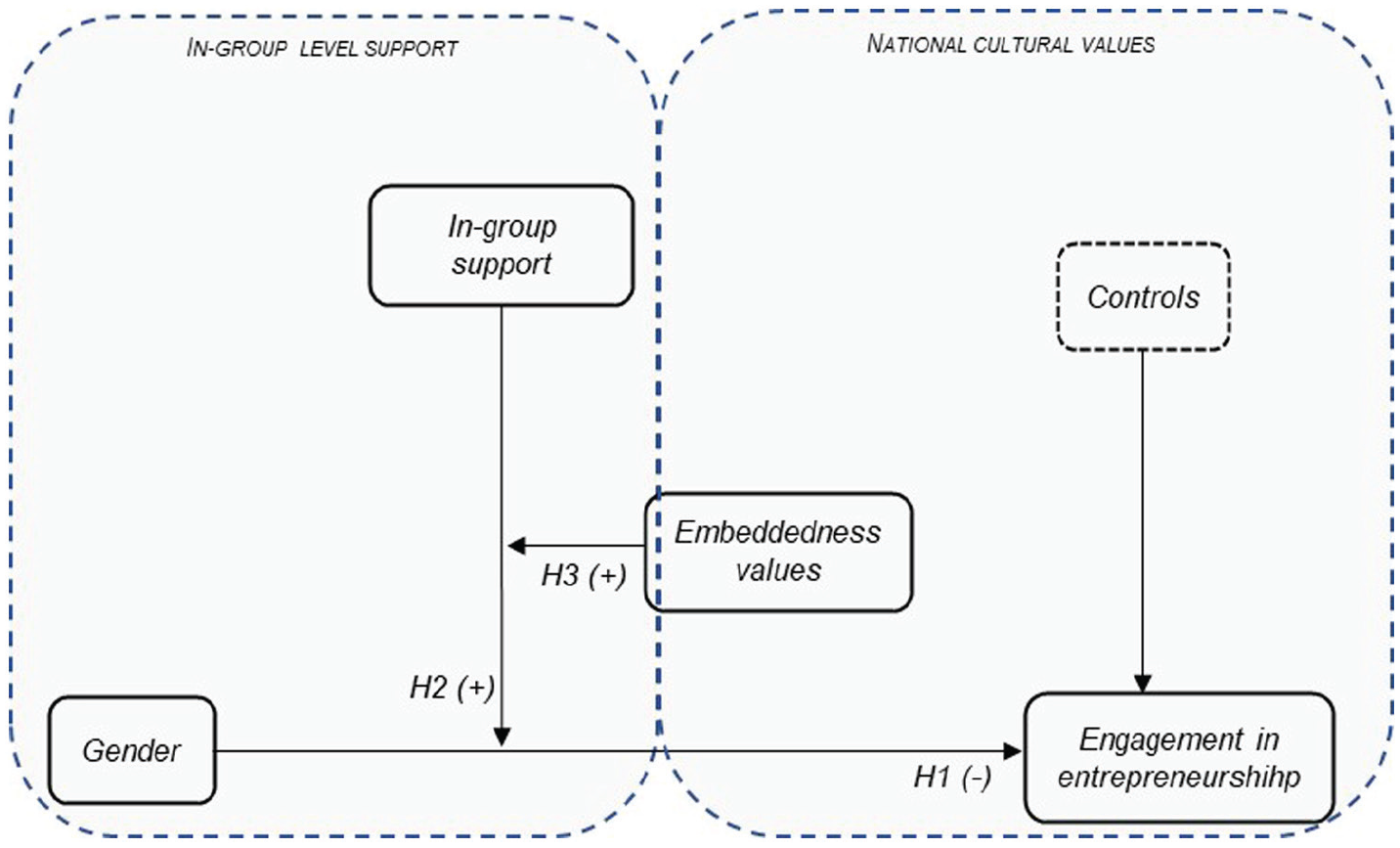
Conceptual framework.
Research method
Data and sample
We tested our research hypotheses on a comprehensive multilevel sample featuring individual-level and country-level data. The individual-level data stem from the 2018 wave of the GUESSS and consists of students engaging in entrepreneurial activity and students who do not (Sieger et al., 2019). The GUESSS project was established by the Swiss Research Institute of Small Business and Entrepreneurship at the University of St Gallen in 2003. It investigates entrepreneurial intentions and behaviours from students on a global basis. The data were collected by means of an online survey. The 2018 GUESSS survey was undertaken between September and November 2018 and included 208,636 students from 54 countries (see Gillanders et al., 2020; Sieger et al., 2019).
Our country-level data collection involved cultural data to model cross-country variation in embeddedness values and also, economic data to control for other relevant country-level effects on individual entrepreneurial engagement. Through Schwartz (2008), we obtained country-level data on embeddedness and autonomy value scores as part of Schwartz’ cultural value orientation framework. Autonomy value scores were used in robustness checks. The country-level controls (cf. next section) were obtained from the World Bank (World Bank, 2020a, 2020b) and from Rougier and Combarnous (2017). As for the merging procedure involving GUESSS and country-level data, in the GUESSS database, we have information allowing us to identify the countries in which the universities hosting the surveyed students were located. Accordingly, we created a country identifier variable with unique numerical values for each country in the sample. We then created identical country identifier variables for our country-level data to merge each respective database with our country-level variables of interest, with the GUESSS dataset.
Given our focus on youth nascent entrepreneurship, we removed 9393 active entrepreneurs as well as 7728 students older than 34 years from the sample. Further, we only included non-exchange students and students who had citizenship of the country in which they studied. We argue that this restriction is essential to be able to generate valid results as to the effect of national culture on individual entrepreneurial engagement. Doing so involved removing 19,196 non-citizens and 8543 exchange students. The inclusion of national embeddedness and egalitarian values in the regressions implied a further reduction in sample size so that our final sample size was 124,545 young students (age group 16–34) residing in 33 countries. Table 1 reports the sample countries and student shares per country.
Countries in the sample and student distribution across countries.
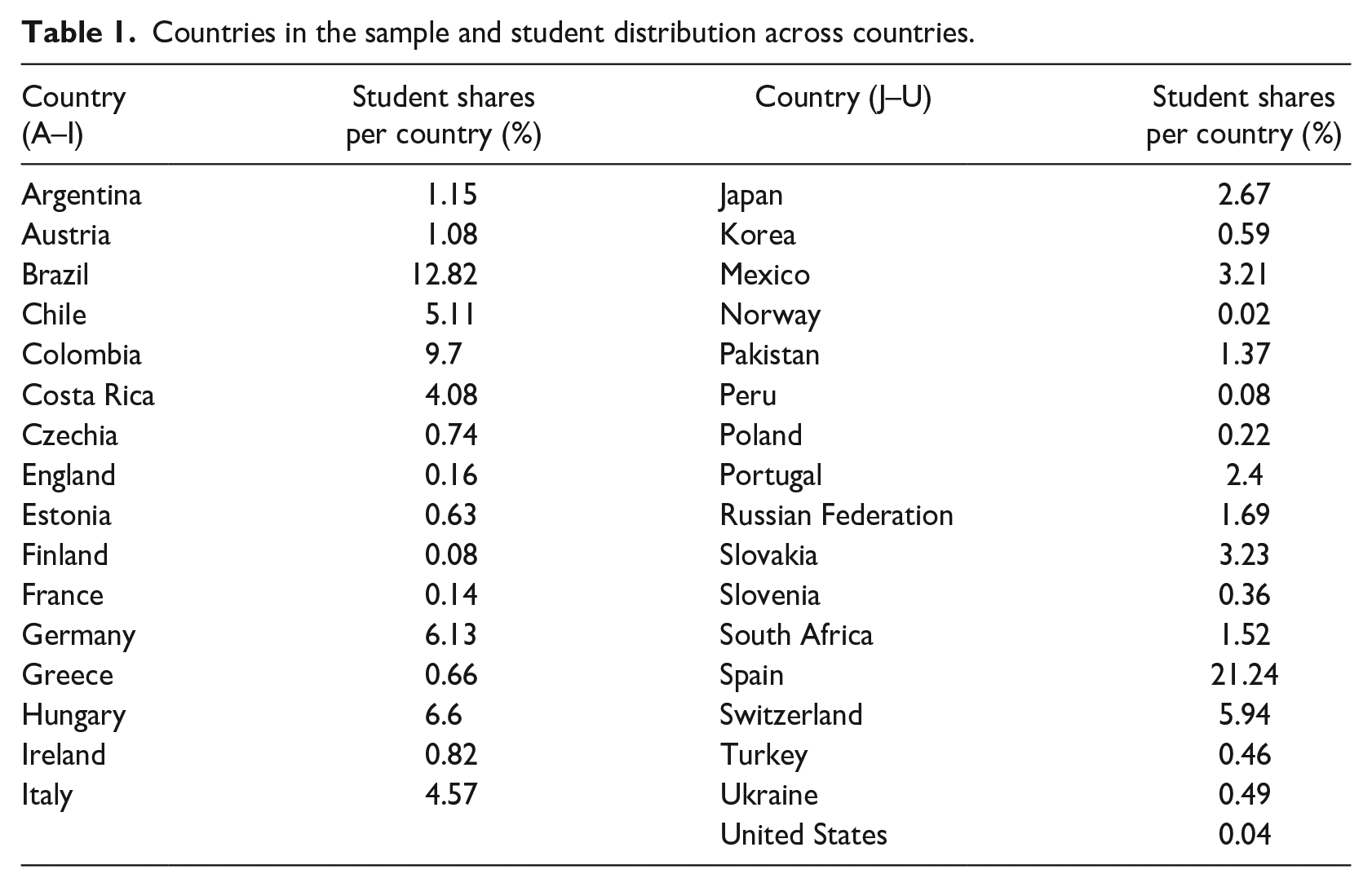
Average student age in our sample is 22.3 years. 82% of our sample students were undergraduate students, 23% studied Business Administration, and the large majority (76%) studied full-time. Moreover, 58% of the sample were women. 20% of the sample students are classifiable as nascent entrepreneurs; they were trying to start a business in 2018. 10% of them can be described as nascent entrepreneurs with at least one start-up activity performed by 2018. Most sample students (80%) were not entrepreneurially active in 2018. There are indications that new venture creation activities of university students are representative of those performed by other demographic cohorts (Gimenez-Jimenez et al., 2022; Moog and Backes-Gellner, 2013).
Measures
Dependent variable
Our dependent variable (DV), Try, measures whether the student in 2018 was trying to start her own business/to become self-employed (=1) or not (=0). The variable is supposed to capture a student’s nascent entrepreneurial status.
Independent variable
Our key independent variable, Woman, is a dummy indicating whether the student is woman (=1) or man (=0). It is part of our baseline hypothesis (H1) and our moderation hypotheses (H2 and H3).
Moderators
To operationalise culture as a multi-layered concept, we include In-group support at the micro level and Embeddedness at the macro level. The former is a multi-item construct based on the following validated scale (Liñán and Chen, 2009): If you would pursue a career as an entrepreneur, how would people in your environment react (1 = very negatively, 7 = very positively, seven-point Likert-type scale)? The construct consists of three items (α = 0.8): (1) Your close family; (2) Your friends; (3) Your fellow students. Liñán and Chen (2009) used the term ‘subjective norms’, that is, ‘the perceived social pressure to carry out – or not to carry out – entrepreneurial behaviours’, or rather ‘the perception that “reference people” would approve of the decision to become an entrepreneur, or not’ (Liñán and Chen, 2009: 596). We created an average variable score by calculating average scores over the three items for each student. The construct is used as a moderator to test H2 and H3; it aims to measure resource and normative support from ‘strong tie’ relationships in relation to entrepreneurship. Our main argument for why we see causality between the in-group support construct and our DV is our interpretation of in-group support as (entrepreneurial) culture (Inglehart, 1997; Hofstede, 2001; Schwartz, 2004). A key feature of culture, according to previous research, is that it persists over time, changing only slowly (Kaasa and Minkov, 2020; Schwartz, 2011). Therefore, our assumption is that a culture of in-group support will have existed already before the sample student tried starting a business, which would justify the causal link we claim between in-group support and nascent entrepreneur status.
The Embeddedness variable was taken from Schwartz (2008), who computed embeddedness value scores for 80 countries based on individual-level data. Higher (lower) scores imply stronger (weaker) national embeddedness values, and respectively weaker (stronger) national autonomy values. This is because embeddedness and autonomy are antipodes of the same cultural value dimension (Schwartz, 2006). Schwartz (2008) provides country scores on the strength of autonomy values as well, which we use in one of our robustness checks. The items used by Schwartz for measuring embeddedness are social order, respect for tradition, family security, national security, politeness, self-discipline, forgiving, obedience, honouring parents and elders, devout, wisdom, moderate, clean, protecting my public image, reciprocation of favours. The score for embeddedness values in a country is the mean importance rating of the value items above (Schwartz, 2006); it is used as a moderator to test H3.
Control variables
We include individual-level and country-level controls. Through our individual-level controls, we control for individual-level resources and human capital in relation to entrepreneurship (Liao and Welsch, 2005). Undergraduate student is a dummy indicating whether the student was an undergraduate student (=1) or not (=0) in 2018. It reflects lack of study/professional experience which we expect to reduce the probability of being a nascent entrepreneur. Business student is a dummy indicating whether the student studied Business Administration (=1) or not in 2018. We expect higher entrepreneurial propensity among business students. Full-time student is a dummy indicating whether the student studied full time (=1) or had a regular job parallel to her studies (=0) in 2018. We expect a lower probability of nascent entrepreneur status among full-time students due to a lack of professional experience. Age measures the student’s age in 2018. We expect older students to be more experienced and knowledgeable professionally and academically, which should enhance the probability of being a nascent entrepreneur. These individual-level variables have been used in previous research (see Bergmann et al., 2016).
Through our country-level controls, we control for country-level-induced entrepreneurial opportunities, entrepreneurial transaction costs and necessity entrepreneurship, which are conceivable explanatory factors of an individual’s nascent entrepreneur status. Egalitarianism measures the strength of egalitarian values in a society. Lower (higher) value scores imply more hierarchical (egalitarian) values. In line with De Clercq et al. (2013), we expect entrepreneurial engagement to be higher in egalitarian societies due to an overall better individual access to entrepreneurial resources and opportunities. The data source is Schwartz (2008). GDP per capita measures the average GDP per capita during 2014–2018 in the country in which the student studied in 2018 (PPP constant 2017 international $). It aims to capture economic factors that either pull individuals into (‘prosperity pull’) or push them out (‘recession push’) of entrepreneurship (see also Acs et al., 2008; Konon et al., 2018). Unemployment measures the average unemployment rate during 2014–2018, among people with tertiary education in the country in which the student studied in 2018. This variable could be both positively and negatively related to entrepreneurial entry: if positively related, we expect it to reflect ‘necessity push’ factors; if negatively related, it would indicate ‘opportunity pull’ factors (Konon et al., 2018). Both variables were constructed using data from the World Bank’s World Development Indicators (cf. ‘Data and sample’ section). Ease starting business measures the ease of starting a business in the country during 2014–2018. The indicator includes scores for procedures, time and cost for an entrepreneur to start and formally operate a business, as well as paid-in minimum capital requirement, with higher scores indicating more ease of starting a business. We computed an average score for each country in our sample. The variable aims to capture national deregulation of entrepreneurial entry and should hence increase the probability of nascent entrepreneur status. The data is from the World Bank’s Ease of Doing Business Project (cf. ‘Data and sample’ section).
Finally, we control for unobserved heterogeneity at the country-level by including country-group fixed effects (i.e. country group dummies) measuring different types of capitalist economies across the world (Rougier and Combarnous, 2017) that might influence entrepreneurial entry rates. The choice of these dummy variables is inspired by the Varieties-of-Capitalism literature, that is, research into the varieties of entrepreneurship that are facilitated by distinct national institutional group features (Dilli et al., 2018; Herrmann, 2019). We opt for country-group, rather than country dummies to keep our model parsimonious and reduce potential multicollinearity issues. Coordinated indicates whether the sample country belongs to a coordinated market economy cluster (=1) or not (=0). Globalisation-friendly indicates whether the sample country belongs to a globalisation-friendly economy cluster (=1) or not (=0). Resource-dependent indicates whether the sample country belongs to a resource-dependent economy cluster (=1) or not (=0). Hybrid indicates whether the sample country belongs to a hybrid-idiosyncratic economy cluster (=1) or not (=0). The country-group dummies are compared with a reference country-group category, namely a liberal market economy cluster.
Empirical strategy
Our empirical strategy is to estimate the probability that a student has a nascent entrepreneur status – which we also refer to as nascent entrepreneurial propensity – as a function of several individual and group-level characteristics and interactions thereof. This involves estimating different multilevel (hierarchical) Probit regressions of the following basic functional form:

where
To estimate our baseline hypothesis (H1), we opt for a stepwise regression approach to demonstrate the robustness of our estimations concerning the entrepreneurial gender gap. To estimate the simple moderating influence of in-group support on the relationship between gender and nascent entrepreneurial propensity (H2), our multilevel Probit regression estimation included a two-way interaction term between Woman and In-group support. For the joint moderating influence of In-group support and Embeddedness on the relationship between gender and nascent entrepreneurial propensity (H3), we included a three-way interaction term between Woman, In-group support and Embeddedness in our estimations. Regarding the tests of H2 and H3, the multilevel Probit regression was followed by computing and interpreting each interaction term’s marginal effect using Stata’s margins and marginsplot commands (StataCorp, 2017). This procedure accounts for the complexity in interpreting interaction effects in limited DV models and their inherent non-linearity (Ai and Norton, 2003; Bowen, 2012; Wiersema and Bowen, 2009), given that the marginal effect of an interaction term in such models is not equal to its estimated coefficient (Hoetker, 2007; Norton et al., 2004). It also includes an important graphical analysis of the influence of our moderating variables on the relationship between gender and nascent entrepreneurial propensity (Bowen, 2012; Norton et al., 2004). In sum, for such models, reporting interaction plots alongside interaction coefficient estimates avoids overstating or understating empirical results (Kingsley et al., 2017).
Results
Main analysis
Summary statistics and pairwise correlations of the sample are reported in Table 2.
Descriptive statistics and pairwise correlations.
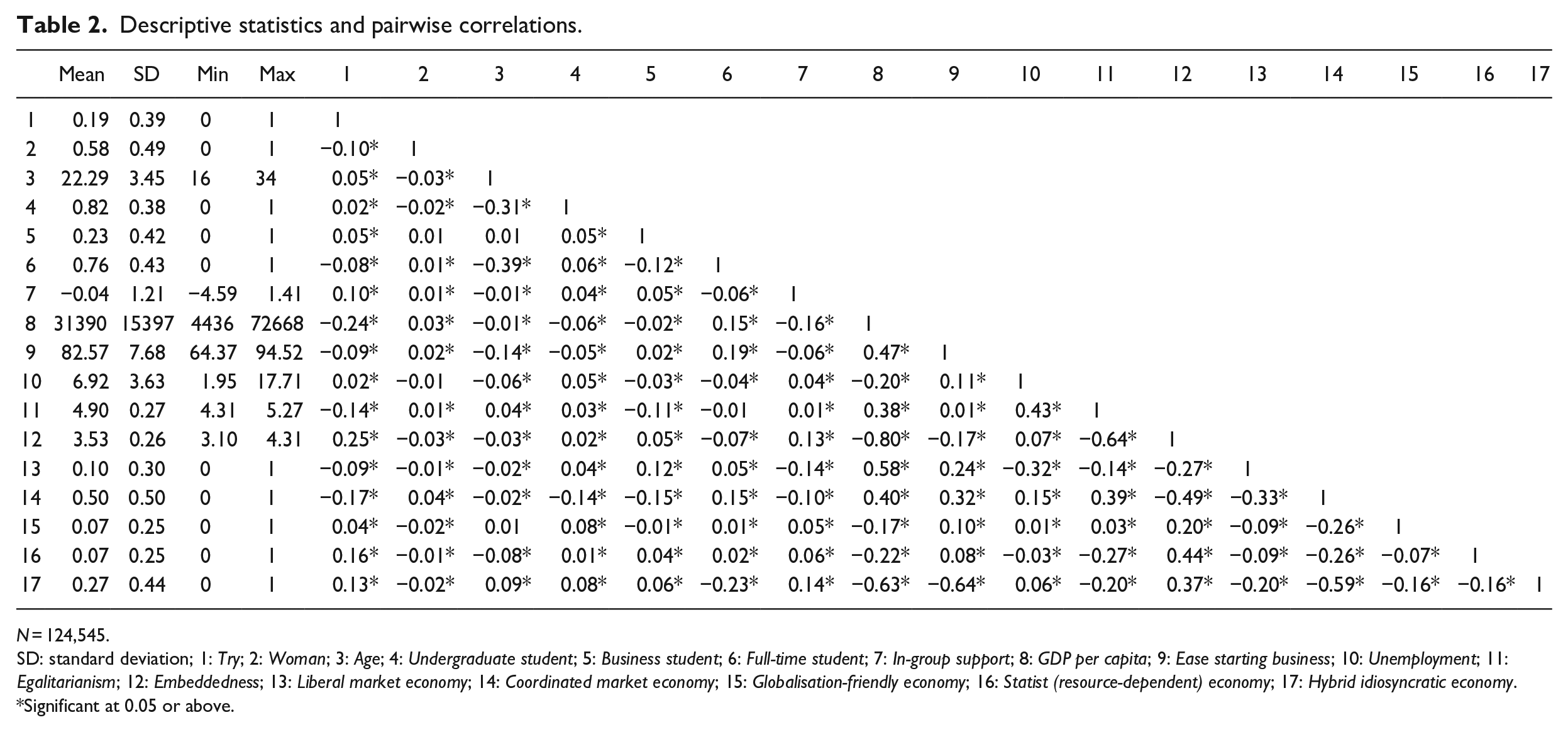
N = 124,545.
SD: standard deviation; 1: Try; 2: Woman; 3: Age; 4: Undergraduate student; 5: Business student; 6: Full-time student; 7: In-group support; 8: GDP per capita; 9: Ease starting business; 10: Unemployment; 11: Egalitarianism; 12: Embeddedness; 13: Liberal market economy; 14: Coordinated market economy; 15: Globalisation-friendly economy; 16: Statist (resource-dependent) economy; 17: Hybrid idiosyncratic economy.
Significant at 0.05 or above.
Further statistics on the sample are presented in the Supplemental Appendix Table A-1 reports, based on the GUESSS 2018 survey, the percentage share of nascent entrepreneurs in each country sample, as well as the percentage shares of nascent women and men entrepreneurs in each country sample’s total number of nascent entrepreneurs. Supplemental Appendix Tables A-2 and A-3 provide statistical test results showing to what extent in-group support and the other variables in our sample are significantly different between nascent men and women entrepreneurs and between men and women, respectively. Supplemental Appendix Table A-4 reports country scores on national embeddedness values as well as national autonomy values; their antipode in Schwartz’ (2006, 2008) cultural value framework.
In terms of average variance inflation factors (VIFs), collinearity issues appear not to be present, given values below the conservative cut-off value of 5 in all collinearity checks (Studenmund, 1992; De Clercq et al., 2014). We, however, discovered elevated VIFs for some of our continuous independent variables, namely GDP per capita and Embeddedness, with the latter variable also being rather highly correlated with Egalitarianism. To further ensure that our results were not affected by multicollinearity, we re-tested H2 and H3 through various robustness checks, which involved dropping GDP per capita and/or Egalitarianism. The results are virtually identical with our main findings regarding H2 and H3, which boosts confidence in our original research model and rules out potential collinearity issues. A subset of the results is presented in the Supplemental Appendix and also referred to in the robustness checks
The main results of our empirical tests of H1 to H3 are reported in Table 3.
Multilevel probit regression results for moderating influence of in-group support and national embeddedness values on gendered number of start-up activities.
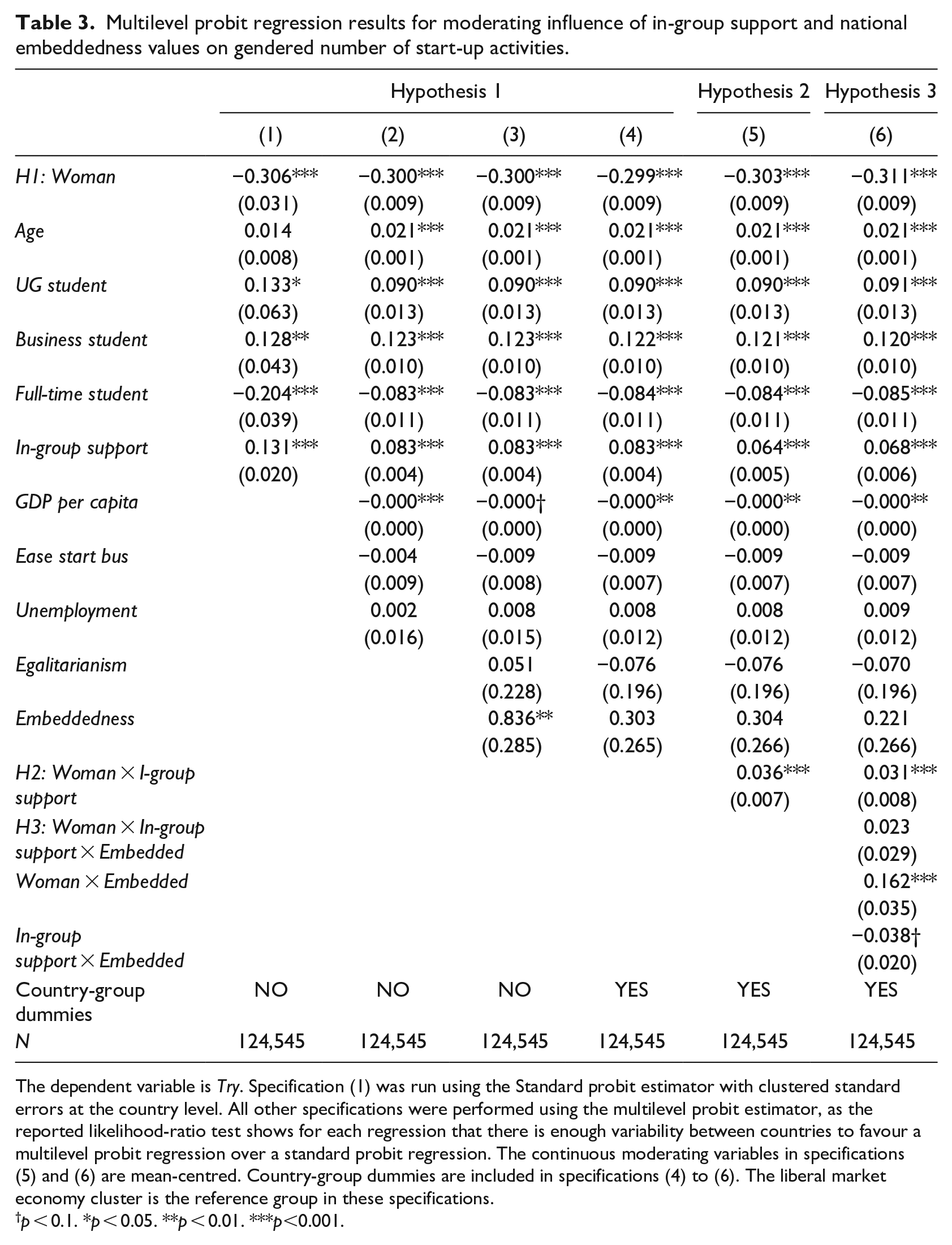
The dependent variable is Try. Specification (1) was run using the Standard probit estimator with clustered standard errors at the country level. All other specifications were performed using the multilevel probit estimator, as the reported likelihood-ratio test shows for each regression that there is enough variability between countries to favour a multilevel probit regression over a standard probit regression. The continuous moderating variables in specifications (5) and (6) are mean-centred. Country-group dummies are included in specifications (4) to (6). The liberal market economy cluster is the reference group in these specifications.
p < 0.1. *p < 0.05. **p < 0.01. ***p<0.001.
Specifications (1) to (4) test H1 in a stepwise regression process. Specification (1) includes individual-predictors only; (2) adds the economic controls at the country level; and (3) as well as (4) also include the national cultural value measures, both excluding and including country-group dummies. The estimation results support our baseline hypothesis (H1) of an entrepreneurial gender gap: in the first four specifications shown in Table 3, the Woman dummy coefficient is negative and statistically highly significant, including after controlling for country-level effects in Model 4 (β = −0.299, p < 0.001). Next, through model 5, we find strong evidence in support of H2, owing to a positive and statistically highly significant interaction term between Woman and In-group support (β = 0.036, p < 0.001). Finally, our empirical tests do not provide immediate support of H3, given a statistically insignificant three-way interaction term between Woman, In-group support and Embeddedness in model 6 (β = 0.031). Interpreting interaction effects in non-linear models, however, is more complex, as their signs, magnitude and significance can differ between observations; therefore, we provide an important graphical analysis of the moderation effect related to H3, as well as that related to H2 (Bowen, 2012; Hoetker, 2007, Norton et al., 2004). As for H2, Figure 2a plots gendered predicted probabilities of nascent entrepreneur status at weak and strong levels of in-group support.
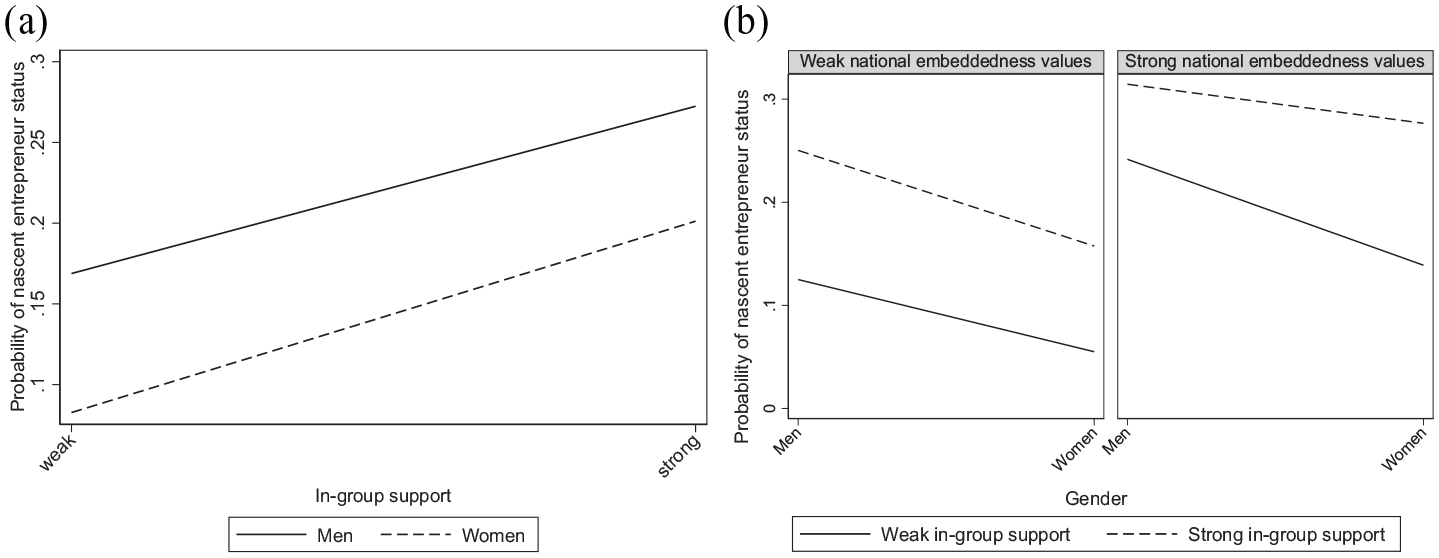
Interaction plots of moderating influence of in-group support and national embeddedness values on gendered probability of nascent entrepreneur status. (a) H2: Moderating influence of in-group support on the entrepreneurial gender gap. (b) H3: Moderating influence of in-group support on the entrepreneurial gender gap in weak and strong national embeddedness value contexts.
As can be observed, the entrepreneurial gender gap decreases at high levels of in-group support, boosting women’s probability of having a nascent entrepreneur status relative to that of men. The effect sizes corresponding to Figure 2a, all highly statistically significant, are reported and discussed in the Supplemental Appendix (Table A-5).
The interaction plot for H3 is displayed in Figure 2b. The right-hand panel shows the moderating influence of in-group support on the probability of nascent entrepreneur status of women and men in countries with strong embeddedness values. As can be discerned, in such value contexts, women benefit disproportionally from strong in-group support in terms of nascent entrepreneurial propensity, when compared with men. By contrast, in countries with weak embeddedness values, the impact of strong in-group support on women’s nascent entrepreneurial propensity is weaker when compared (1) with men in such value contexts and (2) with women in countries with embeddedness values. The effect sizes corresponding to Figure 2b, all highly statistically significant, are reported and discussed in the Supplemental Appendix (Table A-6). This graphical and effect size analysis provides support of H3, as it demonstrates that for strong in-group support and strong national embeddedness values, the gender gap in terms of nascent entrepreneurial propensity is substantially reduced, which is not the case in countries with weak national embeddedness values.
Robustness checks
We conducted additional sensitivity analyses to investigate the robustness of our results for H2 and H3. Details of these analyses can be found in the Supplemental Appendix. A given robustness check concerned both H2 and H3 or one of the hypotheses exclusively.
Our first robustness check for H2 and H3 was to replicate our main analysis by replacing each respective moderator of concern with an alternative measure. Regarding H2, we replicated our main analysis by replacing In-group support with a three-item construct from the GUESSS 2018 survey labelled University environment. The construct measures the extent to which the university environment is supportive of entrepreneurship (cf. also Bergmann et al., 2016; Franke and Lüthje, 2004). The empirical results, which are presented in specification (1) in Supplemental Appendix Table A-7, as well as in Figure A-1a, provide additional evidence in support of H2. As for H3, we replicated our main analysis by replacing Embeddedness with a variable labelled Autonomy. The variable measures the strength of national autonomy value; it is the antipode to Embeddedness in Schwartz’ cultural value framework (Schwartz, 1994, 2006). We expect similar joint moderation results as in our test of H3 based on Embeddedness for students located in countries with weak national autonomy values, because the latter should be roughly equivalent to strong national embeddedness values. Results involving the Autonomy variable are presented in Supplemental Appendix Table A-10’s specification (1) and in Figure A-2a. They provide strong support of H3, suggesting that, in countries with weak autonomy values, strong in-group support leads to a reversal of the gender gap in nascent entrepreneurship, which is not the case in countries with strong autonomy values.
Second, we replicated our empirical tests of H2 and H3 by constructing an alternative DV based on the GUESSS 2018 survey. The variable, which we labelled Start, measures an advanced stage of nascent entrepreneurial activity; it is a dummy taking the value 1 if the nascent entrepreneur in the sample either already registered her business or sold products/services. The value 0 is assigned (1) to nascent entrepreneurs who did not perform any of these two advanced gestation activities yet or (2) to non-entrepreneurs. We constructed this variable to investigate whether our main results for H2 and H3 hold in situations where a student’s nascent entrepreneurial progress is significant and even overlaps with active entrepreneurship. Our robustness findings for H2 are reported in Supplemental Appendix Table A-7’s specification (2) and in Figure A-1b. While the interaction term between Woman and In-group support is statistically insignificant, though positive, the interaction plot demonstrates a substantial decrease in the entrepreneurial gender gap as advanced nascent entrepreneurship by women benefits disproportionately from in-group support. The robustness results for H3 are reported in Supplemental Appendix Table A-10’s specification (2) and in Figure A-2b. While the three-way interaction term between Woman, In-group support and Embeddedness is statistically insignificant, though positive, the interaction plot demonstrates a reversal of the gender gap in nascent entrepreneurship as a result of in-group support substantially encouraging women’s entrepreneurship in countries with strong embeddedness values when compared with men as well as with women in countries with weak embeddedness.
Third, we re-tested H2 and H3 by including a dummy variable, labelled Self-employed mother, which measures whether the sample student’s mother was self-employed in 2018 (=1) or not (=0). A self-employed mother is meant to control for family entrepreneurship/business effects; it was used in a recent similar study (Feldmann et al., 2022). The results for H2 are reported in Supplemental Appendix Table A-7’s specification (3) and in Figure A-1c. Our robustness findings for H3 are reported in Supplemental Appendix Table A-10’s specification (3) and in Figure A-2c. It can be observed that including this control variable does not affect our main results for H2 and H3.
Fourth, we performed several diagnostic tests to ensure our main analysis did not suffer from multicollinearity issues, given moderate-to-high correlations between Embeddedness, Egalitarianism and GDP per capita. While in terms of average VIFs, collinearity issues appeared not to be present (see above), and we discovered elevated VIFs of individual IVs in our collinearity checks of the original set of IVs, particularly for GDP per capita and Hybrid but also for Embeddedness and Coordinated. To ensure that our results were not affected by multicollinearity, we re-tested H2 and H3 through various robustness checks in which we dropped Egalitarianism, GDP per capita or both. In the Supplemental Appendix, we report results for a restrictive collinearity check involving dropping both Egalitarianism and GDP per capita. The findings for H2 are presented in Supplemental Appendix Table A-7’s specification (4) and Figure A-1d; those for H3 are presented in Supplemental Appendix Table A-10’s specification (4) and Figure A-2d. As can be verified, both the regression results and interaction plots are virtually identical with our original results for H2 and H3, which rules out multicollinearity issues.
Finally, we re-tested H2 and H3 using sample splits. As for H2, we split the sample by gender. The split analysis results can be found in specifications (5) and (6) of Supplemental Appendix Table A-7. What can be observed regarding In-group support is that its coefficient is highly statistically significant for both sub-samples. We also computed effect sizes, which turned out to be virtually equal between men and women. Hence, our supportive findings of H2 in the main analysis were not backed up by the gender-based split sample analysis. Regarding the H3 sample split, we essentially re-ran our empirical test of H2, the only difference being that it was run not for the whole sample but separately for countries with weak and strong embeddedness values. This helped us to better understand how the gender gap in nascent entrepreneurship is influenced by in-group support in each respective national value context. The results are reported in Supplemental Appendix Table A-10’s specifications (5) and (6) and Figure A-2e and f. They provide additional support of H3. Regarding our findings from the sample split analyses, it must, however, be noted that these findings should be interpreted with care, as a split sample analysis is not equivalent to formulating interaction terms in our regression models. We discuss this in more detail in the Supplemental Appendix.
Discussion and implications
The findings from our global sample support the notion of an entrepreneurial gender gap; a young woman’s probability of having nascent entrepreneur status is lower than that of her male counterpart. Our results reflect previous literature (Guzman and Kacperczyk, 2019; Van der Zwan et al., 2012, 2013). As such, the evidence related to H2, namely that in-group support is an important positive moderator of the gender gap in entrepreneurship – by enhancing women’s propensity to be a nascent entrepreneur, when compared with that of men – reflects that of Arshad et al. (2016), Bullough et al. (2017) and Díaz García and Jiménez Moreno (2010). This provides empirical support for our theoretical argument regarding the key role of instrumental and emotional resources, as well as entrepreneurial norms provided by the strong ties within in-groups, for young women’s entrepreneurial engagement (Edelman et al., 2016; Liñán and Chen, 2009). This evidence is moreover, relatable to Rocha and van Praag (2020), who stress the importance of entrepreneurial role models for women’s entrepreneurial activity. Our robustness checks involving an alternative DV measuring nascent entrepreneurship also support the notion that in-group support is an important catalyst particularly of advanced nascent or the early-stage entrepreneurship of young women. This finding complements previous research (Davidsson and Honig, 2003; Mickiewicz et al., 2017; Van der Zwan et al., 2013) arguing that such cultural factors have a substantial influence – mostly at earlier stages of the entrepreneurial process.
In terms of H3, it is important to note that the empirical support indicated by our analysis is not based on the three-way interaction coefficients, which were statistically insignificant, but on a graphical moderation analysis, including effect sizes. Such an analysis is crucial for interpreting interaction effects in non-linear models (Ai and Norton, 2003; Hoetker, 2007; Wiersema and Bowen, 2009). Our findings regarding H3 suggest that in-group support matters mostly for women’s entrepreneurship in embeddedness cultures. Our theoretical interpretation of this finding is that entrepreneurial women in national embeddedness value contexts exhibit a strong necessity to turn to the in-group to achieve their entrepreneurial entry objectives due to unequal access to entrepreneurial opportunities and resources in such societies. Our results place previous findings into a more nuanced perspective; as such, the disadvantage faced by women in such gender biased societies, in terms of access to entrepreneurial resources (Gupta et al., 2009; Webb et al., 2015), can be alleviated through strong in-group support (Batjargal et al., 2019). Moreover, previous studies found that women, including those with less experience, are more likely to be engaged in entrepreneurial activity in countries lacking supportive work-family policies – of which embeddedness cultures arguably form a part – due to being pushed into self-employment as fallback employment strategy (Thébaud, 2015). Our findings, including robustness checks, in principle support this notion, given that a woman’s probability of having a nascent entrepreneur status tends to be higher in embeddedness value contexts than in autonomy value contexts, even for low levels of in-group support. Equally, our findings demonstrate that in-group support significantly increases women’s nascent entrepreneurial propensity relative to that of men in embeddedness contexts – which suggests that women in such contexts do benefit from a supportive environment – from their in-groups. Our findings are furthermore, reflective of past research stressing the importance of in-group collectivism, a salient feature in embeddedness cultures, for women’s business ownership (Bullough et al., 2017). The evidence in this study also supports findings by Kalafatoglu and Mendoza’s (2017) that networking can lever women’s entrepreneurial activity in embedded societies; in addition, our results demonstrate the negative consequences for women’s entrepreneurship in embeddedness cultures when in-group support is lacking. Finally, our evidence enriches previous research in the field of social psychology (Bond and Smith, 1996; Kim and Markus, 1999) and entrepreneurship (Bullough et al., 2017) that found social conformity to be particularly strong in embeddedness cultures. We also confirm that societal cultural dimensions and an entrepreneurial micro-environment both matter for women’s entrepreneurship (Bullough et al., 2022; Feldmann et al., 2022).
Theoretical implications
We contribute to research on the gender gap in entrepreneurship in several ways. First, by contributing to the body of literature devoted to understanding the role of enabling or constraining contextual conditions in women’s entrepreneurial engagement, including national context (Dheer et al., 2019; Welter, 2020). Our findings imply that accounting for context and boundary constraints is important for a better understanding and explanation of the entrepreneurial gender gap. Hence, considering such contextual constraints strengthens the theoretical contribution of this article (Shirokova et al., 2022; Welter et al., 2019).
Second, we theorise and empirically validate how a supportive environment at the individual level (in-group support) enhances entrepreneurial activity among young women relative to that of young men. In so doing, we contribute to the embeddedness literature as well as the broader women’s entrepreneurship literature (Henry et al., 2021). More specifically, drawing on Mickiewicz et al. (2017), we enrich these literatures by theorising about the differing importance of strong ties for the entrepreneurial endeavours of women and men entrepreneurs.
Third, our study contributes to international, comparative entrepreneurship research by integrating individual-level entrepreneurship research with national contextual contingencies – and by using a multilevel research design appropriate for this purpose (Autio et al., 2013; Baker et al., 2005; De Clercq et al., 2013; Mickiewicz et al., 2017). In comparison with prior studies, that mostly investigated the direct effect of country-level institutions (Bogatyreva et al., 2019; Hechavarría, 2015; Stephan and Uhlaner, 2010; Van der Zwan et al., 2013), we confirm the relevance of studying multiple contextual and cultural layers and their simultaneous and gendered influence on individual entrepreneurial activity (Bullough et al., 2022; Feldmann et al., 2022; Gimenez and Calabrò, 2018). More precisely, our study improves understanding of the varying importance of in-group support for the entrepreneurial engagement of women and men across national cultures. Our findings suggest that in-group support may not be a universally effective remedy to boost young women’s entrepreneurial engagement but appears to be particularly relevant for young women entrepreneurs in embeddedness cultures. We view women’s restricted access to entrepreneurial opportunities and resources as a key underlying mechanism behind the effectiveness of in-group support in leveraging their entrepreneurial engagement in these societies. Such access restrictions seem to be part of more general resource allocation problems in embeddedness economies (De Clercq et al., 2013, 2014) – and they are closely intertwined with more prevalent gender bias in such societies (Baughn et al., 2006; Van der Zwan et al., 2012). As such, we establish and expand the explanatory power of embeddedness theory.
Fourth and finally, through robustness checks involving a DV that captures advanced nascent entrepreneurial activity and actual business ownership (see Supplemental Appendix Table A-8), we contribute to the literature on the entrepreneurial process by offering a combined and gender-based analysis on the role of individual resources (in-group support) and national cultural contingencies in such more advanced entrepreneurial activity (Bergmann and Stephan, 2013; Mickiewicz et al., 2017; Van der Zwan et al., 2010, 2012, 2013). Our findings suggest a particularly important role of in-group support for young business ownership of young women in countries with strong embeddedness values.
Practical and policy implications
Policy-wise, our findings signal a vital role for policymakers in creating and strengthening local entrepreneurial ecosystems. We argue that such ecosystems should be able to deliver strong in-group support to young aspiring women entrepreneurs. This applies particularly to embeddedness cultures, where in-group support appears to be an important enabler for nascent entrepreneurial propensity of young women. Drawing upon the notion of in-group support, policy measures, especially in such embeddedness cultures, should be geared towards the micro level and aim at strengthening entrepreneurship-related in-group support. We would like to highlight two dimensions of such an ecosystem relevant to our study: a women-inclusive entrepreneurial culture and entrepreneurship education within universities for women.
Concerning the former, an essential starting point for policy makers would be to help develop a local social legitimacy of women’s entrepreneurship (Bullough et al., 2022; Kibler et al., 2014; Thurik and Dejardin, 2012), with social and cultural norms encouraging such entrepreneurship being a key entrepreneurial framework condition (GEM, 2022). Supporting the evolution of a women-inclusive micro-level entrepreneurial culture could eventually contribute to creating positive feedback effects over time between in-group support in relation to women’s entrepreneurship and women’s propensity to engage in nascent, and eventually active entrepreneurship. This is because an improved social legitimacy of women’s entrepreneurship may lead to more effective emotional and instrumental support in this regard. Social legitimacy stemming from in-groups may be most effective, as people have been found to be more prone to imitate the entrepreneurial attitudes and behaviours they observe in close proximity (Lortie et al., 2019).
We would like to outline two important steps towards building a women-inclusive entrepreneurial culture. First, that policymakers should stress and communicate that entrepreneurship as a profession is broad, including both more commercially and more socially fulfilling ventures (Hechavarria and Ingram, 2016), and that it is not a masculine activity but open to women and gendered entrepreneurship practices (Díaz García and Welter, 2011). Indeed, given that entrepreneurship is often considered a masculine domain (Marlow and McAdam, 2013), women have been found to engage in ‘self-stereotyping’ and perceive a lack of alignment between masculine entrepreneurial behaviour and their ingrained feminine behavioural or psychological characteristics. This would then discourage them from entrepreneurial engagement (Gupta et al., 2009; Thébaud, 2010).
Second, the need to address the role of bias against (aspiring) women entrepreneurs from their social environment, including resource providers (Van Ewijk and Belghiti-Mahut, 2019). Such discrimination can manifest itself both in the form of sex-based bias – that is, related to physical features – (Jennings and Brush, 2013) and bias due to gender stereotypes (Balachandra et al., 2019; Guzman and Kacperczyk, 2019; Kanze et al., 2018). Assuming that such bias is also found in women’s in-groups, tackling, and reducing it would be equivalent to improved in-group support from which, as we found, women’s entrepreneurship in embeddedness societies could benefit, given difficulties to acquire entrepreneurial resources at the broader societal level as well as due to stronger conformity of women in such countries (Kim and Markus, 1999; Smith et al., 2002).
Entrepreneurship education matters within higher education as universities also constitute important centres of in-group support in relation to entrepreneurship – from friends, fellow students, teachers, guest-lecturing entrepreneurs, incubators etc. Our findings suggest that the social legitimacy of entrepreneurship built – and the emotional and instrumental support delivered – in these entrepreneurial university environments may be particularly beneficial for women entrepreneurs in embeddedness societies, by assisting them in mobilising important entrepreneurship-related resources. Examples of resources that the university environment could enable include not only entrepreneurial knowledge and skills through core educational activities, but also access to practitioners (e.g. entrepreneurs) and their entrepreneurial enthusiasm, knowledge and networks (Markussen and Røed, 2017). Even financial resources might be delivered in such an environment, either directly through university-based funding or indirectly through investors with whom the university may collaborate, including entrepreneurs themselves. Hence, such societies would benefit from continued and expanded investments in entrepreneurship education within universities (Acs, 2008; Colombo and Piva, 2021; Fayolle, 2013; O’Connor, 2013) and efforts to continuously improve their activities to support especially women students in relation to entrepreneurship as alternative career option (do Paço et al., 2015).
To conclude, our research findings have valuable implications for the 2030 Agenda for Sustainable Development in terms of gender equality (UN, 2015) regarding a reduced entrepreneurial gender gap through enhancing women’s entrepreneurship, and facilitating strong in-group support, could boost women’s freedom, empowerment and emancipation especially in embeddedness cultures (Alkhaled and Berglund, 2018). That said, we do not suggest that closing the entrepreneurial gender gap is desirable for a society, essentially because some (young) women might have intrinsic non-entrepreneurial preferences or would potentially be needed as valuable employment-based human resource in the economy (see also Ahl and Marlow, 2021). Our findings imply, however, that in group-support could help young women, particularly from embedded societies, and with affinity for entrepreneurship to overcome the entrepreneurial resource mobilisation problem caused by gender bias – and thereby, enhance their propensity to become business owners.
Limitations and future research
This study is, to our knowledge, one of the few studies to suggest a stronger and multi-layered focus on cultural moderation of the gender gap in youth entrepreneurship. As such, it is not without limitations. First, we opt for a cross-sectional research design to test our hypotheses. Such a study design, however, is not ideal for making causality claims between macro-level cultural factors and individual entrepreneurial behaviour, which is why in particular policy implications need to be derived with care from empirical results. A longitudinal research design would be preferable but is more costly and challenging to implement (Bergmann and Stephan, 2013). We compensate for this methodological weakness by combining multilevel modelling techniques suitable for our research problem (Autio et al., 2013) with thorough robustness checks to validate our main findings. Second, our joint moderation analysis is restricted to investigating how the moderating influence of in-group support on the entrepreneurial gender gap varies across countries with different magnitudes of embeddedness values, although we provide a theoretical justification for why we opted for this particular cultural dimension in Schwartz’ national cultural value framework. This may imply a study limitation for two reasons. For one, national embeddedness values could have changed after being measured (see McGrath et al., 1992). Since the data on embeddedness values was generated between 1988 and 2007, this could theoretically be the case, although, according to Schwartz (2011), change in his cultural value orientations is very slow. Moreover, national cultural values can be measured in other ways than embeddedness. Therefore, we encourage future studies to theorise about and empirically test the influence of such other national cultural dimensions on the entrepreneurial gender gap. Future research could also analyse to what extent cultural factors beyond the in-group but below the country-level could narrow the entrepreneurial gender gap, for example, entrepreneurial norms at the region-level (see Liñán et al., 2020). This could provide valuable insights for gendered regional entrepreneurship policy. Third, entrepreneurship is often measured through binary choice models; a path that we, too, opt for in our main analysis, in spite of being conceptually limited. This is because new venture creation usually implies a sequential process rather than a sudden binary outcome (Mickiewicz et al., 2017). Future studies could address this shortcoming. Finally, the individual-level data used in this study consists of university students, who are usually less experienced regarding entrepreneurial activity. Consequently, their intentions and decisions could follow other motives than those found among more experienced individuals. Future studies in this field could address this by focusing on other study cohorts such as the working population.
Conclusions
Using a global multilevel sample, we examined the single and joint moderating roles of in-group support and national embeddedness values in the gender gap in youth entrepreneurship. Our moderation analysis demonstrates the importance of in-group support in narrowing the gender gap in youth entrepreneurship. The positive moderating influence of in-group support is further moderated by national embeddedness values, that is, we demonstrated that the positive moderating influence of in-group support on the entrepreneurial gender gap is particularly strong in countries with strong embeddedness values.
Supplemental Material
sj-docx-1-isb-10.1177_02662426231168556 – Supplemental material for The entrepreneurial gender gap: The role of in-group support and national embeddedness values in young women’s entrepreneurship
Supplemental material, sj-docx-1-isb-10.1177_02662426231168556 for The entrepreneurial gender gap: The role of in-group support and national embeddedness values in young women’s entrepreneurship by Jan Weiss, Tatiana Anisimova, Galina Shirokova and Susanne Durst in International Small Business Journal: Researching Entrepreneurship
Footnotes
Acknowledgements
We are very grateful to two anonymous reviewers and the editor, whose valuable comments helped us substantially improve our manuscript.
Authors’ note
Susanne Durst is now affiliated to Professor, Reykjavik University, Iceland.
Declaration of conflicting interests
The author(s) declared no potential conflicts of interest with respect to the research, authorship, and/or publication of this article.
Funding
The author(s) disclosed receipt of the following financial support for the research, authorship, and/or publication of this article: Galina Shirokova gratefully acknowledges support from the Basic Research Program of the National Research University Higher School of Economics in 2023. Jan Weiss is member of LabEx Entrepreneurship, funded by the French government (LabEx Entreprendre, ANR-10-Labex-11-01).

Supplemental material
Supplemental material for this article is available online.
Author biographies
References
Supplementary Material
Please find the following supplemental material available below.
For Open Access articles published under a Creative Commons License, all supplemental material carries the same license as the article it is associated with.
For non-Open Access articles published, all supplemental material carries a non-exclusive license, and permission requests for re-use of supplemental material or any part of supplemental material shall be sent directly to the copyright owner as specified in the copyright notice associated with the article.
