







Abstract
An entrepreneur’s motivation to set and strive towards their business goals is an integral part of the venturing process. Research has indicated that positive affect enhances motivation, specifically in terms of the level of effort devoted to achieving a goal. However, motivation is also reflected in the strategy or tactics used to attain goals. Interestingly, scholars know substantially less about this aspect of motivation, even though it may be equally important. In this article, we examine how affect shapes an entrepreneur’s propensity to change their strategy when encountering a challenge in the venturing process. Our longitudinal study of 166 tech entrepreneurs reveals that both positive and negative affect have a significant role to play in motivational processes, particularly during challenging times. The study has practical implications for how entrepreneurs manage their feelings when facing challenges and theoretical implications for how scholars apply affective theories in entrepreneurship.
Introduction
Motivation, which is the drive to do or accomplish something (Baumeister and Vohs, 2007), is directed towards setting and achieving goals (Mitchell, 1997; Seo et al., 2004) and is channelled into behaviours aimed at reaching that end (Renko et al., 2012). Entrepreneurs are exemplars of this process in that they are motivated to set and achieve goals related to the progress and outcomes of the businesses they envision and operate (Baron et al., 2016; Laguna et al., 2016). The overarching goal of an entrepreneur could be as broad as successfully establishing a new venture (Cardon and Kirk, 2015). This principal goal, however, will include any number of sub-goals and related activities such as securing financing, recruiting employees, promoting the new firm and making sales to new customers (Baron et al., 2016; Cardon and Kirk, 2015; Carter et al., 1996; Laguna et al., 2016). Yet, in the venturing process, entrepreneurs inevitably encounter challenges that slow or prevent their progress towards achieving their goals (Frese, 2009) and thereby, induce negative affect (Shepherd et al., 2014). It is at these points that sustaining motivation becomes particularly important.
Scholars have recognised the importance of affect to an entrepreneur’s motivations and goal-directed actions, focusing on the impact of affect on the level of effort entrepreneurs exert. For example, research has demonstrated that negative affect motivates effort on venture-related tasks that are immediately necessary, while positive affect motivates effort on tasks that go beyond what is immediately required (Foo et al., 2009). Additionally, studies of entrepreneurial passion, which is characterised by positive emotion, have linked passion with a tendency to persist in venturing efforts (Cardon and Kirk, 2015; Cardon et al., 2013). Yet, motivation is reflected not only in the intensity and persistence of effort but also in the direction of effort (Kanfer, 1990; Seo et al., 2004). An individual’s ‘direction of effort’ in goal pursuit represents their chosen course of action (Kanfer, 1990), which may also be understood as the strategy they employ to pursue the goal. In other words, motivation, though not directly observable, is reflected in how much effort is expended and in the specific actions into which the effort is channelled. For example, an entrepreneur who has a goal of raising $1 million in equity investment may be refused funding by a group of angel investors. In this case, the entrepreneur might change direction and adapt their strategy by pursuing crowdfunding instead.
This highlights the first of two important areas lacking in the study of affect and motivation in the field of entrepreneurship. First, although research has shown that affect influences the level of motivated effort towards a goal (Foo et al., 2009), akin to the intensity and persistence of effort, the literature is relatively silent on how affect influences an entrepreneur’s direction of effort, which is the strategy for goal achievement and the propensity to adapt that strategy in the face of challenges. In this context, and consistent with the psychological perspective on strategy, we refer to strategy as the types of actions, behaviours and tactics that an entrepreneur uses to pursue their goals (American Psychological Association, n.d.b). Arguably, the strategy that an entrepreneur adopts in goal pursuit is as important as the level of effort invested (Katerberg and Blau, 1983). If maximum effort is invested into achieving a goal for the venture, but the entrepreneur utilises ineffective strategies, they will still be unlikely to achieve the goal despite such effort. The strategy becomes especially important when entrepreneurs encounter challenges that block goal achievement and potentially negate the effectiveness of past strategies. Second, research has offered competing theoretical indications on the role of affect in motivational processes. The broaden-and-build theory, in particular, has been used to explain the benefits of positive emotions in motivation. In this view, positive emotions expand thinking and creativity, while negative emotions constrict cognitive focus (Fredrickson, 1998, 2001). Conversely, another theory applied in the study of motivation in entrepreneurship, the affect-as-information perspective, suggests that positive affect indicates all is well and thus, induces coasting, while negative affect focuses attention on the problem (Carver, 2003; Foo et al., 2009). However, theory-building from qualitative research has recently demonstrated the possibility for positive and negative affect to work in tandem to facilitate adaptive responses to negative events (Byrne and Shepherd, 2015). Given the lack of understanding of the direction, or strategy, component of motivation and the unclear indications as to the impact of affect on motivation, we ask, how does affect influence an entrepreneur’s propensity to adapt their strategy for goal achievement in the face of challenges?
In this article, we test and build the idea that both positive and negative affect have utility when adapting to challenges encountered as entrepreneurs pursue their venturing goals. To do so, we draw on a sample of 166 tech entrepreneurs, measuring their cognitive and behavioural reactions to a salient venture challenge over the course of ten working days. This daily diary study allows us to examine the impact of both average and daily levels of affect on the entrepreneur’s thoughts about the challenges they face as well as their propensity to adapt their strategies in pursuing their goals. In so doing, we make several contributions to the literature on entrepreneurial motivation, cognition and affect. First, we extend the understanding of a relatively ignored yet, essential outcome of entrepreneurial motivation: the direction of effort (i.e. strategy). Many studies have analysed the level of effort put forward in terms of either the intensity of effort or persistence (Cardon and Kirk, 2015; DeTienne et al., 2008; Foo et al., 2009; Gimeno et al., 1997; Holland and Garrett, 2015; Holland and Shepherd, 2013; Klyver et al., 2018; Renko et al., 2012). For example, researchers have found that value, expectancy (Holland and Garrett, 2015), environmental munificence, personal investment, previous success, collective efficacy (DeTienne et al., 2008), and instrumental support (Klyver et al., 2018) all foster persistence with venturing efforts. The expectancy that one can achieve their goals also increases the intended amount of effort, as well as the actual amount of time spent on venturing tasks (Renko et al., 2012). Conversely, the perception of adversity (Holland and Shepherd, 2013), the presence of other personal options (DeTienne et al., 2008) and venture performance below the entrepreneur’s required threshold (Gimeno et al., 1997) may decrease the amount of effort they are willing to exert.
Comparatively, little attention has been paid to the other component of motivation that concerns the strategy and tactics used to reach the goal. Despite the lack of attention to the strategy component of motivation in entrepreneurship, scholars have long recognised that the direction of effort is essential to understanding the level of effort put forward (Seo et al., 2004). In scenarios where individuals have a great deal of latitude to determine their own actions, overall performance is more likely to be driven by the strategy rather than the magnitude of effort (Katerberg and Blau, 1983). If research focuses only on discovering ways to push entrepreneurs to devote more effort without regard to the direction, scholars may inadvertently be encouraging entrepreneurs to put more effort into doing the ‘wrong thing’. In this article, we explore what drives entrepreneurs to change their strategy. This is particularly important for entrepreneurs facing a new challenge that has rendered their current choice of actions or strategy less effective. Since a significant challenge often connotes a non-routine situation, new tactics are needed because the previous way of approaching the goal simply does not work (Cope, 2003; Marsick and Watkins, 1990). In these cases, entrepreneurs may be better served by working ‘smarter’ to adapt their tactics rather than working ‘harder’ using ineffective strategies.
We also expand understanding of the role of affect in entrepreneurial cognition and behaviour by finding evidence for the utility of negative affect in motivation. From past evidence, it is clear that positive affect and other constructs that connote positive affect, such as entrepreneurial passion (Cardon and Kirk, 2015), entrepreneurial self-efficacy (Hechavarria et al., 2012), and resilience (Hayward et al., 2010), foster motivation. However, few have acknowledged the importance of studying positive and negative affect in tandem when seeking to understand entrepreneurial behaviour (Patzelt and Shepherd, 2011), and researchers have called for an examination of the impact of negative affect on progress when entrepreneurs encounter a challenging task (Shepherd, 2015). Indeed, some research has indicated that negative affect has an important role in triggering certain thoughts and actions in entrepreneurs, such as making sense of a business failure (Byrne and Shepherd, 2015). By ignoring the role of negative affect in motivation, scholars may be overemphasising the importance of positive affect. Although conventional wisdom holds that one should always ‘look on the bright side’, our study shows that negative affect is valuable to certain motivational processes in times of challenge.
Finally, we contribute to the affective perspective of motivation by reconciling the seemingly conflicting predictions of the broaden-and-build theory and the affect-as-information perspective. Traditionally, the broaden-and-build theory has highlighted the usefulness of positive emotions in goal pursuit, while the affect-as-information perspective has identified negative affect as key to motivation in times of challenge. Yet, research in psychology has shown that both positive and negative affect can be functional, depending on the context in which it is experienced (Coifman et al., 2016; Goldsmith and Davidson, 2004). Similarly, our research demonstrates that these theories are complementary in explaining the utility of both positive and negative affect, particularly when an entrepreneur encounters challenges in pursuit of venture goals. Our work suggests that both theories, although seemingly contradictory, may be simultaneously valid once one considers the self-regulatory processes at work in this context.
Theoretical development
Research on motivation in entrepreneurship is extensive; it encompasses the motivation to start, grow, and exit the venture (Murnieks et al., 2020). Our focus is on the motivation of entrepreneurs to pursue a specific, venture-related goal – this may also be termed task-specific motivation (Kanfer, 1987). We ground our theorising in a self-regulatory perspective of goal striving and motivation (Bandura, 1977; Carver and Scheier, 1981; Kanfer, 1977, 1987; Seo et al., 2004), which includes the idea that individuals choose behaviours, including strategic actions or tactics, that help them achieve their goals (Carver, 2003). Goals are mental representations of targets or standards that individuals wish to attain in the future (Seo et al., 2004). Goals may be concrete or abstract but are typically organised in some form of hierarchy (Carver and Scheier, 1998; Seo et al., 2004). Individuals compare their current state with the desired state or objective and modify their behaviour in order to move closer to that objective (Bandura, 1991; Seo et al., 2004). Furthermore, we draw on self-regulatory models of motivation, which suggest that affect, self-regulation and motivation are closely linked. In this perspective, affect influences motivation to achieve a goal both directly and indirectly through cognitive mechanisms (Seo et al., 2004, 2010). In particular, research employing this model has found that affect influences the behavioural orientation that an individual adopts when working towards a familiar goal, which is another perspective on the direction of effort in motivation (Seo et al., 2004, 2010). Our reasoning herein, draws on these theoretical building blocks from the domains of psychology and organisational behaviour and considers their implications for affect and motivation in the uncertain environment of entrepreneurial venturing.
Affect includes subjective feelings of pleasantness or unpleasantness, which vary in their level of intensity (Baron, 2008; Barsade, 2002; Cardon et al., 2012; Feldman-Barrett and Russell, 1998; Feldman-Barrett et al., 2007; Foo et al., 2009). Although the terms affect and emotion are often used interchangeably, we follow Baron (2008) and use affect as the overarching term which encompasses emotions and covers both relatively stable trait affect and situation-specific state affect. 1 Affect, both positive and negative, prompts cognitive and behavioural responses and primes humans to take particular actions (Frijda, 1987; Roseman, 2011). Moreover, it is important to acknowledge trait affect, in addition to state affect, when studying how entrepreneurs make decisions and act when they are pursuing a goal. This is because affect influences thoughts and behaviours even when it is not elicited by or even specifically related to the situation at hand (Baron, 2008; Forgas, 2000). Both trait and state affect are believed to have a simultaneous and similar influence on cognition and behaviour (Baron, 2008; Lyubomirsky et al., 2005).
Two key theories that have traditionally been used to explain the impact of affect on motivation in entrepreneurship include the broaden-and-build theory and the affect-as-information perspective. These theories have been utilised as both indicate that affect evokes cognitive and behavioural tendencies. We consider the motivational implications of these theories as they have a precedent in the literature and because, consistent with self-regulatory models of affect in work motivation (Seo et al., 2004, 2010), they link affect with both cognition and behaviour in motivation.
Broaden-and-build theory of positive emotions
The broaden-and-build theory of positive emotions maintains that positive emotions expand the array of potential actions or behaviours that come to mind and encourage individuals to approach or engage in a given situation (Fredrickson, 2001). Over time, the exploration and learning that result from the cognitive and behavioural tendencies associated with positive emotions are purported to build the social and cognitive resources available to an individual (Fredrickson, 1998, 2004). Positive emotions are motivating in that they encourage an individual to continue with a course of action (Fredrickson, 2004; Izard, 1977). Furthermore, positive emotions are said to facilitate learning (Fredrickson, 1998), to allow individuals to see broader connections between ideas, and to aid in understanding complex situations (Isen, 1987). Subsequently, researchers have applied this theory in the study of motivation in entrepreneurship largely to explain the level of effort put forth by entrepreneurs. Hayward and Colleagues (2010) theorised that, consistent with the broaden-and-build theory, positive emotions enhance resilience and, subsequently, the ability and likelihood of founding a venture after a previous failed attempt. Similarly, Chadwick and Raver (2018) theorised that because positive emotionality underlies resilience, resilient entrepreneurs are more likely to appraise obstacles as challenges that can be overcome, which in turn fosters proactivity and venture survival. Although they did not measure affect in the study, their results did provide indirect empirical support for their theorising. While the broaden-and-build theory highlights the beneficial effect of positive emotions on motivation, it also briefly touches on the role of negative emotions. This theory holds that negative emotions have a constraining effect on cognitions and restrict the ability to think in an integrative fashion. Negative emotions constrict the array of behaviours that one considers, preparing an individual to either ‘fight or flee’ (Fredrickson, 1998, 2001; Tugade and Fredrickson, 2007). Furthermore, negative emotions are thought to push people to withdraw from a situation (Roseman, 2011), which can be detrimental to goal pursuit. In sum, the broaden-and-build theory of positive emotions highlights the beneficial impact of positive emotions on motivation and cognition, while suggesting potential detriments of negative emotions on motivation (Fredrickson, 1998, 2001).
Affect-as-information perspective
The affect-as-information perspective highlights the importance of negative affect in motivation. It holds that positive and negative affect convey information (Schwarz and Clore, 1983), including information about goal progress (Carver, 2003; Carver and Scheier, 1990). Positive affect signals that sufficient progress is being made and hence, the individual can maintain course or direct their attention to other, more pressing tasks. Conversely, negative affect indicates an issue or that insufficient progress is being made towards the goal. Therefore, negative affect signals to an individual that they need to devote their attention to the issue to get ‘back on track’ (Carver, 2003). Again, entrepreneurship researchers have used this perspective to examine motivation as reflected in the amount of effort made by entrepreneurs. Foo et al. (2009) found that negative affect had a positive effect on the amount of effort an entrepreneur devoted to venture tasks that were immediately required. Following the affect-as-information perspective, they hypothesised that negative affect signalled to participants that insufficient progress was evident. This, in turn, encouraged them to devote more effort to those tasks that required immediate attention. Additionally, the study found that positive affect directed attention away from tasks immediately required and led entrepreneurs to spend more time on other tasks that were not immediately pressing. Consistent with predictions of the affect-as-information perspective, positive affect provides a signal that progress towards the goal is sufficient and, thus, can be directed towards less urgent tasks. This effect may be useful in some situations but could be detrimental if there are immediate, pressing challenges that truly require attention.
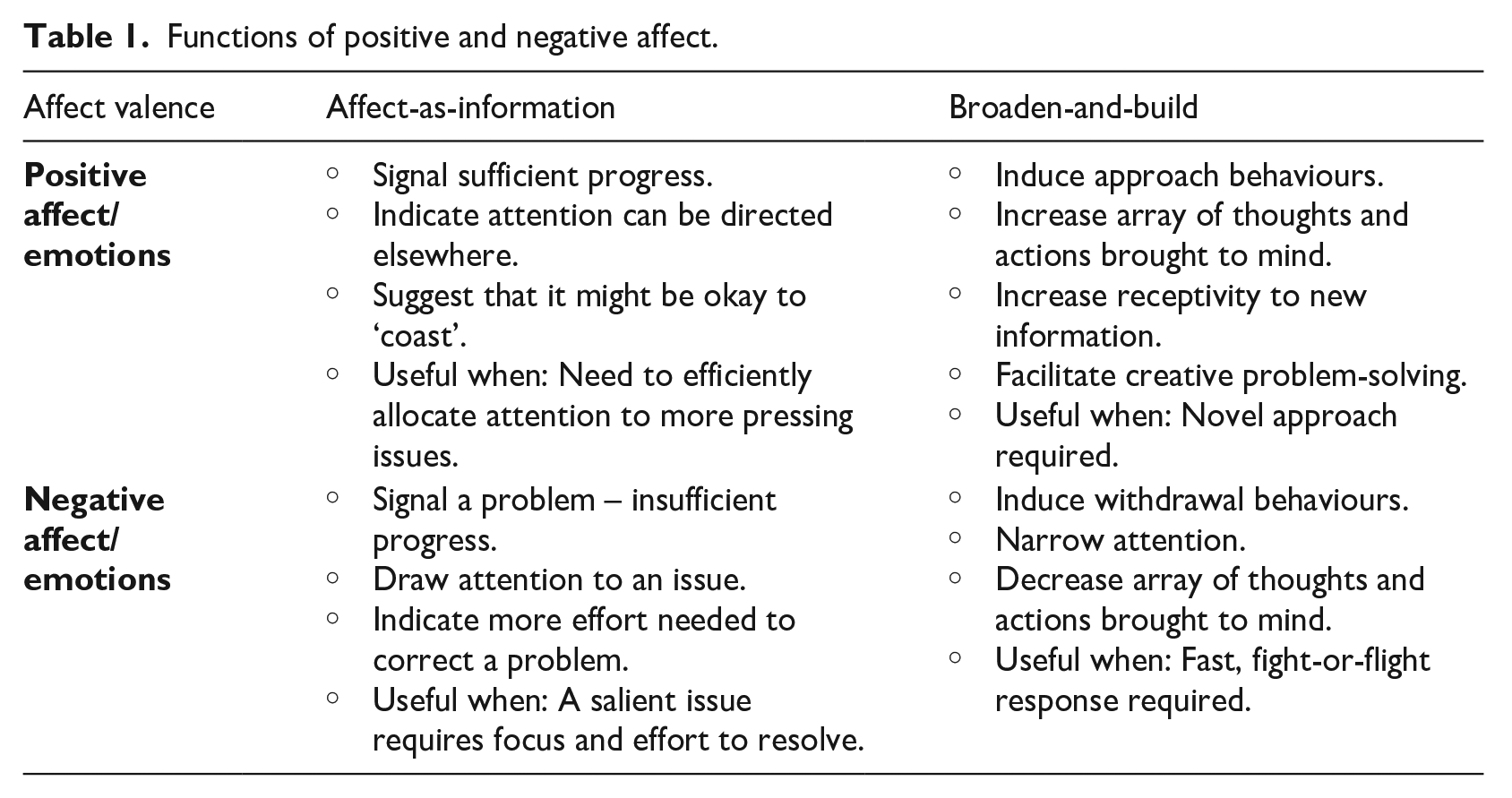
As shown in Table 1 below, the broaden-and-build theory of positive emotions and the affect-as-information perspective appear to be contradictory in some respects (Carver, 2003). The broaden-and-build theory has been used to highlight the benefits of positive emotions to motivation, while painting negative emotions in a less favourable light. Conversely, the affect-as-information perspective has been used to emphasise the benefits of negative affect on motivation and the potentially detrimental effects of positive affect on the same construct.
Functions of positive and negative affect.
The role of self-regulatory processes
The key to reconciling these implications lies in understanding what might cause one possible effect of positive or negative affect, depicted in Table 1, to dominate over the other possible effects. Byrne and Shepherd (2015) demonstrated that positive and negative emotions can play complementary, beneficial roles in cognition and that the order in which the emotions are experienced could provide an explanation for these effects. Through interviewing entrepreneurs who were dealing with the failure of their business, Byrne and Shepherd (2015) observed that those who were best able to make sense of their venture’s failure experienced both positive and negative feelings in the wake of the challenge. The authors proposed that it was negative feelings that initially triggered sensemaking efforts, while positive emotions then informed or enabled these efforts. In other words, negative feelings first provided the impetus to do something about the issue, while positive feelings subsequently provided the fuel to make sense of the situation first and then move forward. However, those in the study who experienced other combinations of positive and negative emotions did not show optimal sensemaking.
While Byrne and Shepherd’s (2015) study revealed the possibility for the effects of positive and negative affect to work in concert, the context of that study differs significantly from that undertaken here. In that study, entrepreneurs were reflecting on a terminal event that was likely to be associated with a strong sense of loss (Shepherd, 2003, 2009). Our study is situated in a context in which an entrepreneur is striving to achieve a goal for the venture but has encountered a challenge that inhibits the attainment of that goal. We propose that, in this context, self-regulatory processes may help to explain the impact of affect on motivation, particularly the propensity to adapt the strategy. Self-regulation is the capacity to modify one’s responses and has been linked to motivation in several ways (Baumeister and Vohs, 2007). We began this work by noting that motivation is directed towards a goal. Goals induce self-regulation by defining a desired state that has not yet been achieved; that is, a discrepancy between a current state and a desired future state that must be overcome (Latham and Locke, 1991). In essence, goals and the motivation to achieve them are situated in the context of self-regulation (Seo et al., 2004). Theoretical perspectives on self-regulation propose that individuals who are pursuing a goal manage their thoughts, behaviours and feelings in a way that will help them achieve their goals (Baumeister, 1998; Fitzsimons and Bargh, 2004). Given this, it is possible that individuals could also manage the effects of affective states such that any affective state experienced is channelled into cognitions and actions that are most adaptive and helpful for achieving their goal.
Consider that, when a challenge arises, an entrepreneur may feel inclined to withdraw from the situation or ignore the issue and attend to more pleasant tasks. Here, self-regulation can make the difference (Baumeister and Vohs, 2007). If self-regulatory processes function optimally, the entrepreneur will suppress those competing inclinations, and self-regulate thoughts and actions in a way to best achieve their goal. One of the most substantial determinants of successful self-regulation is the strength of competing urges (Baumeister and Vohs, 2007). Given the potential resources, including time and money (Hyytinen et al., 2013; Reynolds, 2017), invested into the venture, it is reasonable to suggest that the success of the venture, and goals supporting that success, will often be of greater importance than that of competing inclinations, such as those to ignore a challenge. Furthermore, to overcome a challenge and achieve those venture goals, an entrepreneur should, optimally, direct their attention and efforts to overcoming the challenge by setting aside less-pressing issues. At the same time, they should remain open and flexible to cognitively process the situation and implement an appropriate solution. If self-regulation is successful, then an entrepreneur would use negative affect to focus their attention and effort on the problem and allow positive affect to fuel cognitive processing and adaptive behaviours. These self-regulatory processes may be deliberate but could also function automatically to some extent (Fitzsimons and Bargh, 2004).
In summary, taken together, the broaden-and-build and affect-as-information perspectives suggest that positive and negative affect could have beneficial or harmful effects on motivational processes. We theorise that, in the context of pursuing a goal, self-regulatory processes help to determine which effect each type of affect has upon the entrepreneur. Given that entrepreneurs in this situation are organising their thoughts, behaviours and feelings to achieve a goal, each type of affect should be regulated to influence cognition and behaviour in a way that best serves the achievement of that goal. In other words, self-regulation helps to ensure that negative feelings are used as a signal to focus effort, as noted in the lower left-hand quadrant of Table 1, and that positive feelings are used to fuel approach and flexibility, as noted in the upper right-hand quadrant of Table 1. We emphasise that while individuals can attempt to regulate their propensity to experience affect of a given valence, our theorising here is focused on how affect is allowed to influence thoughts and behaviours once it has already been experienced. That is, our focus is on the entrepreneur’s ability to regulate or modify their response to affective states both behaviourally and experientially. Indeed, psychologists have noted that, in regulating affect, individuals can regulate where they focus their attention as well as how they respond to affective experiences (Gross, 1998). We now build on this possibility to offer predictions as to the effect of affect on an entrepreneur’s strategic adaptation in times of challenge.
Development of hypotheses
When an entrepreneur encounters a challenge that prevents them from achieving the goals they have set for the venture, negative affect is likely to arise (Seo et al., 2004, 2010). Moreover, novel challenges tend to render past tactics less effective (Cope, 2003; Marsick and Watkins, 1990), which often necessitates adapting the strategy used to pursue the goal. According to the affect-as-information perspective, negative affect is essential in times of challenge in that it focuses attention on the issue by signalling that there has been insufficient progress made towards the goal (Foo et al., 2009). Negative affect prompts an entrepreneur to devote more effort to finding a way around the issue while setting aside other less-pressing demands on their attention (Carver, 2003; Clore and Huntsinger, 2009). We expect that negative affect motivates an entrepreneur to do whatever is necessary to achieve their goal and to fix the problem or ‘right the ship’. Therefore, negative affect is essential in prompting adaptation to challenges (Byrne and Shepherd, 2015). Furthermore, and as detailed above, we expect that negative affect has this particular effect because: first, an entrepreneur must focus on the challenge in order to overcome the obstacle and second, in this context, self-regulatory processes are at work, which help entrepreneurs to direct the effects of their feelings into behaviours that will support goal achievement, rather than allow negative affect to inhibit them (Brown et al., 2005). Additionally, an entrepreneur’s cognitions and behaviours can be influenced not just by affect elicited by a particular situation, that is, state affect, but also by affect that is consistently experienced across situations, known as trait affect. In many situations, both types of affect exert an effect (Baron, 2008). For example, a person who generally experiences positive affect could also experience heightened levels of negative affect in a stressful situation. While it is important to consider that both types of affect exert an influence, past theorising suggests that their impact should be similar; that is, trait positive and state positive affect have similar effects, while trait negative and state negative affect have similar effects (Baron, 2008). Therefore, we hypothesise:
Positive affect, in turn, is expected to have a complementary effect on strategic adaptation in the pursuit of venture goals. The broaden-and-build theory suggests that positive emotions facilitate creativity and encourage continued engagement with an issue or subject (Fredrickson, 1998, 2004). These emotions open an individual’s thinking patterns to include a wider array of potential actions going forward (Fredrickson, 2004). For an entrepreneur who has encountered an obstacle that could inhibit their goal progress, positive affect encourages them to approach or continue working towards their goal (Cacioppo et al., 1993; Carver and Scheier, 1990; Clore, 1994; Davidson, 1993; Frijda, 1994) and increases their willingness to try a new strategy. Positive emotions create behavioural flexibility by pushing an entrepreneur to consider different actions that might allow them to circumvent the challenge to achieve their goal (Fredrickson, 1998, 2004; Fredrickson et al., 2000). Again, we expect that positive affect will have this effect at least in part because self-regulatory processes direct responses to feelings into actions that support the achievement of goals and simultaneously suppress competing behavioural inclinations which would hinder goal achievement. Therefore:
Thus far, we have considered the direct effects of affect on an entrepreneur’s behaviour as they pursue their venture goals. Negative affect indicates that a problem must be corrected, while positive affect encourages continued action and flexible engagement as an entrepreneur works towards their goal. However, affect can influence behaviours related to motivation through intervening cognitive mechanisms (Seo et al., 2004, 2010). Therefore, we also propose that cognitive processes mediate the relationship between affect and strategic adaptation, that is, change in behaviour. Indeed, psychologists have long realised that affect influences how individuals think about and solve problems (Isen et al., 1987, 1991).
Cognitive processing includes acquiring, interpreting, and applying knowledge (American Psychological Association, n.d.a). Negative affect moves an individual to focus on an issue and set aside concerns and thoughts about other matters. Therefore, for an entrepreneur facing a challenge in their venture, negative affect directs their attention and cognition to the challenge. Negative affect triggers an entrepreneur to ignore other concerns and possibilities to devote more mental resources to thinking about and processing the immediate challenge and means for overcoming it (Byrne and Shepherd, 2015; Foo et al., 2009). Similar to the effect of negative affect on sensemaking found by Byrne and Shepherd (2015), we expect that negative affect serves to trigger cognitive processing of the challenge an entrepreneur is facing and their strategy for achieving their goal. We expect this effect because self-regulatory processes direct the effects of negative affect to focus on the challenge when seeking to achieve the goal. Hence:
Positive affect facilitates receptivity to information (Estrada et al., 1997). Positive emotions make it easier for an entrepreneur to make mental connections between concepts and, therefore, to better understand complicated situations (Fredrickson, 1998; Isen, 1987). This implies that when an entrepreneur is dealing with a challenge, positive affect allows them to think more holistically about the challenge and their goal, making mental connections between past challenges and the challenge at hand. In other words, although negative affect triggers attention to and, therefore, thinking about the problem, positive affect serves the function of making more cognitive resources available, thereby facilitating creative, flexible thinking about the challenge. Following Byrne and Shepherd (2015), who noted that positive emotions informed sensemaking efforts after a business failure, we propose that positive affect also informs an entrepreneur’s cognitive processing of the challenge and how they might overcome it to achieve their venture goals. Again, we expect that this occurs because self-regulatory processes direct the effects of positive affect to the cognitions that will best serve achievement of the entrepreneur’s goal. Hence:
As noted, cognitive processing includes acquiring, interpreting, and applying knowledge. As an entrepreneur reflects on, interprets, and transforms the information taken in about the challenge and the goal, he or she is able to learn from the challenge and develop a new strategy for achieving the goal (Cope, 2005). Acquiring and interpreting the information about their challenge and how it is preventing them from achieving their venture goals allows an entrepreneur to understand that their current strategy is not functioning optimally and, therefore, encourage them to change the way they approach the challenge and goal (Kim, 1993; Minniti and Bygrave, 2001). Furthermore, the creative, flexible cognitive processing of the goal and challenge should yield the discovery of a greater number and variety of strategies moving forward. The entrepreneur might make connections between their available resources, the challenge and their goal that they had not considered previously (Isen et al., 1985, 1987). This enables an entrepreneur to apply the knowledge gained from the information that they have acquired and interpreted in order to alter the way they approach their goal, with the hope of achieving greater success in the future. Therefore:
Following hypotheses one through five, we propose that both positive and negative affect work through cognitive processing as a mechanism to influence an entrepreneur’s strategic adaptation when facing a challenge. Therefore, connecting the proposed relationships between affect, cognitive processing and the strategic adaptation, we hypothesise:
Method
Study design and procedure
Previously, research has focused on the impact of affect on motivation at the within-person level (Foo et al., 2009). In such cases, researchers study affect that arises in response to a particular event as state affect. However, as noted by Baron (2008), individuals are simultaneously influenced by both state-like affect arising from an event, as well as trait-like affect that is more stable over time (Baron, 2008; Clore and Huntsinger, 2007). To explore the impact of affect holistically, we implemented a daily diary study design that allowed us to parcel out both the between-person (trait) effects and within-person (state) effects. The data collection process involved an initial survey followed by daily, interval-contingent prompts for responses to brief surveys.
We asked participants to complete an introductory, web-based survey that collected baseline measures of several control variables. Key to this initial survey were two questions asking participants to describe the primary challenge they were currently facing in their business and how this challenge impacted a goal they had set for the venture. In other words, they were asked to reflect on a specific challenge that was hindering their goal progress. Participants were instructed to consider a challenge that was of high magnitude or importance to them and to achieving their goal. The two most common types of issues reported were related to identifying and making sales to customers and securing funding. Respondents also noted challenges with the start-up team or employees, scaling the venture and product development. The challenge and goal identified served as the focus for reflection throughout the study. After completing the initial survey, participants were sent an orientation document that outlined the schedule for the remainder of the study and provided a reminder of the goal and challenge they had identified.
Participants were then asked to download an experience sampling mobile application onto their personal phones. The app was programmed to send prompts to complete a brief survey once per day, between Monday and Friday, and over the course of two weeks. This resulted in 10 total days of data collection. The daily surveys took approximately five minutes to complete, were available starting at 4 p.m. and had to be completed by midnight each day. The ability to capture respondent experiences closer to the time they occur (i.e. at the end of each working day) is one of the primary benefits of this methodology, as it reduces recall bias (Fisher and To, 2012). Over the course of the 10 days of surveys, we collected data daily on the independent (positive affect, negative affect), mediating (cognitive processing), and dependent (strategic adaptation) variables.
Sample
Participants were identified using the Crunchbase database of start-ups. Recently, research on entrepreneurship and start-up financing has relied on data obtained from this database (Bernstein et al., 2017; Cumming et al., 2016; Haddad and Hornuf, 2019). For this study, the database was used to identify a relatively homogeneous sample of venture founders and to obtain contact information for potential participants. The frame of eligible participants was narrowed to include those whose ventures were founded between January 2015 and January 2020 and had 50 or fewer employees in order to ensure that those included in the study were truly in the early stages of business venturing. To enhance the homogeneity of the sample (cf., Davidsson, 2016: 97), the list of eligible participants was further narrowed to include only those whose ventures were privately held, for-profit, headquartered in the United States, and based in a technology-focused industry such as software, analytics, or apps. The founder or co-founder of those ventures that fit the eligibility criteria was then contacted via email or LinkedIn mail and asked to participate in the study. As Fisher and To (2012) note, it can be challenging to find participants who are willing to engage in a longitudinal study that requires repeated responses over time. Therefore, to incentivise participation, participants were entered into a drawing for one $100 and one $500 prepaid Visa card and were also offered a report of their responses at the conclusion of the study.
Participants were recruited, and the study was administered in 14 rounds from August 2020 to July 2021. 2 Of the 9400 founders contacted, 353 agreed to participate and completed the initial web-based survey. Of those who completed the survey, 234 completed at least one of the daily surveys. However, following the guidelines set by previous studies using a similar methodology (Uy et al., 2015), we retained only those participants who responded to at least two of the daily surveys each week (four surveys total). This left a final sample of 166 venture founders. 3 The final group of 166 respondents provided 1361 daily observations. Given that 1660 prompts were sent (166 participants × 10 days), and 1361 valid responses were received, the response rate to the daily surveys was 82%, which is consistent with past studies utilising a similar methodology (cf., Foo et al., 2009; Schwartz et al., 2020). The average age of participants was 44.23 years; the majority held either a bachelor’s or master’s degree. In this sample, 79.5% were male and 20.5% were female.
Daily diary measures
Positive and negative affect
During the daily survey prompts, respondents completed an abbreviated form of the Scale of Positive and Negative Experience developed by Diener and Colleagues (2010). This questionnaire asks respondents to rate how often they generally experience 12 positive and negative feelings on a scale of 1 to 5, where 1 indicates ‘very rarely or never’, and 5 indicates ‘very often or always’. This scale was selected because it captures a range of emotions varying in affective valence and activation and has been advocated in previous entrepreneurship research (Foo et al., 2015). To mitigate participant fatigue, we utilised four items for positive affect (good, joy, happy, contented) and four items for negative affect (bad, sad, angry and afraid). The use of shortened scales is common in daily diary and experience sampling method (ESM) studies (Foo et al., 2009). Specifically, we asked how often that day the participant had experienced each of these feelings. Following Diener et al. (2010), we added the four items of positive affect each day to create a daily positive affect score, and we added the four items of negative affect each day to create a daily negative affect score. Across the 10 days of data collection, the measures of positive affect (Cronbach’s alpha = 0.946) and negative affect (Cronbach’s alpha = 0.910) showed excellent reliability.
Cognitive processing
In each daily survey, respondents were asked if they had any new thoughts about their challenge or their goal over the last 24 hours. This question was used to ensure the challenge and goal identified in the baseline survey were top-of-mind for participants and the point of their reflection in the daily surveys. Using the mobile app, participants were able to take an audio recording of their reflections, which was then transcribed using the NVivo (Burlington, MA) transcription platform and manually checked for accuracy. The transcribed text was analysed using the Linguistic Inquiry and Word Count (LIWC) dictionary for ‘CogProc’. This dictionary comprises 797 words indicative of cognitive processes, including words such as ‘think’, ‘know’, ‘because’ and ‘effect’ (Pennebaker et al., 2015). LIWC generated a score for each daily recording, indicating the prevalence of these terms in each recording. We opted to use textual analysis of the recordings because language is thought to hold rich information on an individual’s thoughts (Fisch and Block, 2021). Furthermore, LIWC has been frequently used as a textual analysis tool in entrepreneurship research (Fisch and Block, 2021; Parhankangas and Renko, 2017; Wolfe and Shepherd, 2015), and the ‘CogProc’ variable has been previously used as an indicator of cognitive processes in entrepreneurship research (Fisch and Block, 2021).
Strategic adaptation
We asked two questions in the daily surveys to measure the degree to which respondents adapted their strategic approach to their goal each day. Respondents were instructed to consider these questions as they related to the initial goal and challenge identified in the baseline survey. 4 Each day, respondents were asked, ‘To what extent did you change the strategy that you used to pursue your goal today?’ and ‘To what extent did you try a new approach to achieving your goal today?’. Responses were given on a scale of 1 to 5, with 1 being ‘not at all’ and 5 being ‘a great deal’. Responses to these two questions were averaged to obtain a daily score. The alpha reliability coefficient for this measure was 0.92.
With this variable, we capture the magnitude of the strategic adaptation. We acknowledge, however, that the substance of the strategic change is also important and may differ depending on which entrepreneurial methodology an entrepreneur is following. For example, the lean methodology prescribes tactics like targeted experiments, while effectuation prescribes taking a means inventory (Mansoori and Lackeus, 2020). Our measure of strategic adaptation does not capture this level of detail in terms of tactical substance. Still, while the daily recordings were used to measure indications of cognitive processing of the goal and challenge, several founders revealed the types of strategic adaptation they implemented or considered that day in the recordings. For example, some founders who were having trouble securing investment noted that they changed the way they communicated with investors by continuing conversations with investors even after they gave a ‘no’ or increasing the amount of information shared regarding the firm’s risk. Other founders noted that they worked to drive sales by making changes to the product based on customer feedback or that they made a new plan based on failed experiments. Further, some founders indicated that they did not change their strategic approach but rather became more confident in their current strategy.
Baseline (time 0) measures
Control measures were captured in the initial web-based survey and included age, gender, years of education and years of experience starting and running a business. Due to its potential to affect an entrepreneur’s confidence in their chosen strategy, we also included a measure of baseline entrepreneurial self-efficacy (Zhao et al., 2005). As the measures of the key constructs of interest were self-reported, we included a control for the propensity to answer questions in a socially desirable manner. Therefore, in the initial survey, respondents completed Crowne and Marlowe’s (1960) Social Desirability Scale, which was subsequently included as a control variable in the analysis. A control was also included for the number of hours per week the individual reported working on their venture, as well as the extent to which the performance of their venture was meeting their expectations. The possible responses for this variable ranged from 1 to 5, with 1 indicating that the venture was performing much worse than expected and 5 indicating that the venture was performing much better than expected. We included this variable, reasoning that if the entrepreneur perceived the venture as performing very poorly in the face of the challenge, they were likely to feel a greater need to implement strategic change. Conversely, if the venture was performing quite well in the face of the challenge, they would feel less compelled to implement strategic change.
Results
We first examined the intraclass correlation coefficient (ICC) of the daily diary variables. The ICC for strategic adaptation was 0.332, and for cognitive processing, the ICC was 0.208. This indicated that there was substantial non-independence in the data, which necessitates the use of a mixed regression model (also called a multilevel random coefficient or hierarchical linear model). The mixed model accounts for the fact that each participant provided multiple responses for the independent (affect), mediating (cognitive processing) and dependent (strategic adaptation) variables and, therefore, that the data were correlated. Furthermore, we separated the independent and mediating variables (negative affect, positive affect, and cognitive processing) into person-mean (providing between-person effects) and person-mean-centred (providing within-person effects) components. For the affect variables in particular, the person-mean-centred variable indicated daily measures of state-induced affect, while the person-mean-component represented more stable levels of trait-like affect. The means, standard deviations, and correlations among the variables are reported in Table 2 below.
Correlations and descriptive statistics.
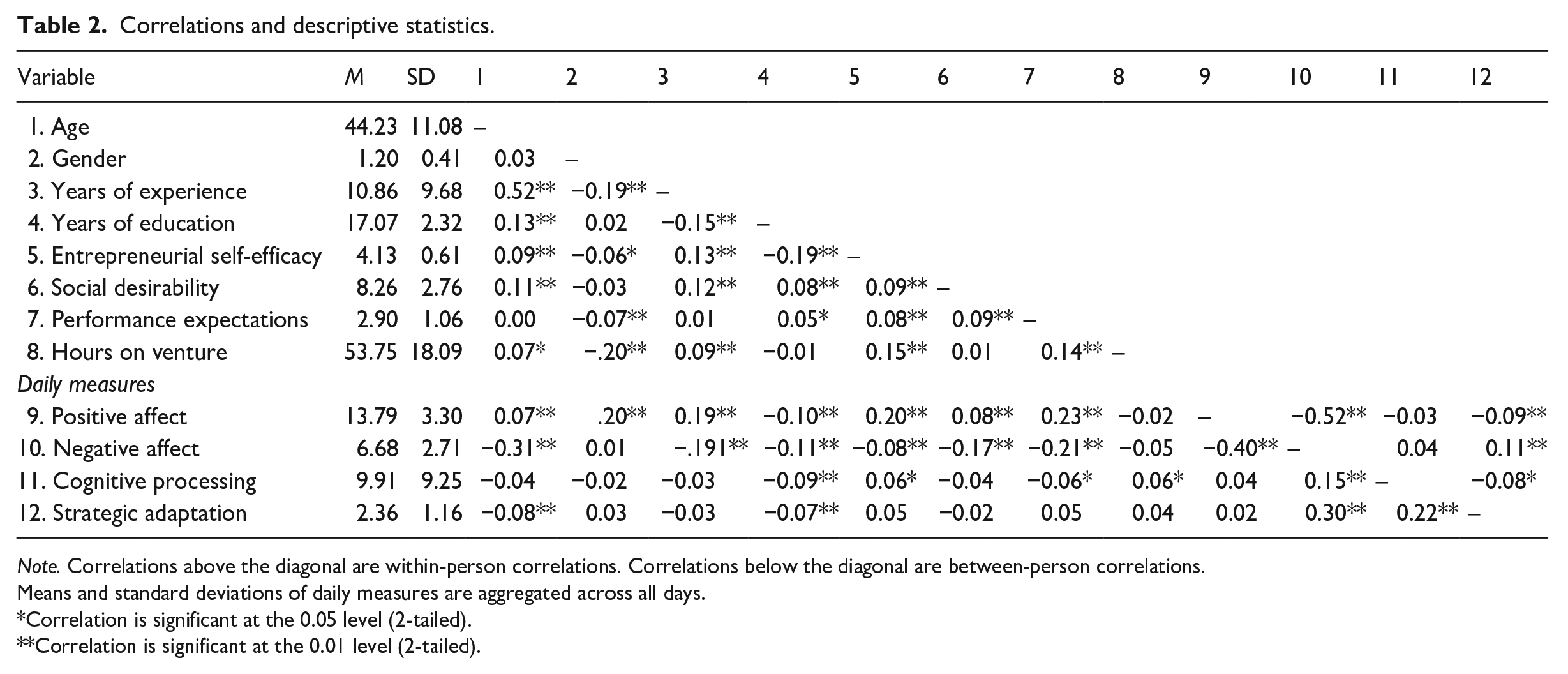
Note. Correlations above the diagonal are within-person correlations. Correlations below the diagonal are between-person correlations.
Means and standard deviations of daily measures are aggregated across all days.
Correlation is significant at the 0.05 level (2-tailed).
Correlation is significant at the 0.01 level (2-tailed).
For the analyses, we paired the independent and mediating variables collected at the end of each day (day x) with the measure of the dependent variable on the following day (day x + 1). This resulted in a possible 9-day-pairs of data for each respondent, with positive affect, negative affect, and cognitive processing captured at the end of day x and strategic adaptation captured at the end of day x + 1. Using this order of data allowed us to pair respondent’s affect during a given day with their cognitions at the end of that day and with their strategic adaptation the following day. In other words, affect was modelled to influence cognitions on the same day, while these variables were modelled to manifest an effect on strategic adaptation the following day. The temporal order of data collection is pictured in Figure 1 below. In each model, we controlled for the between-person effects of age, gender, years of experience, years of education, performance expectations, entrepreneurial self-efficacy, social desirability, and hours spent on the venture. For the analyses, we utilised the mixed linear regression function in SPSS 28 (IBM Corp., Armonk, NY) with maximum likelihood estimation.
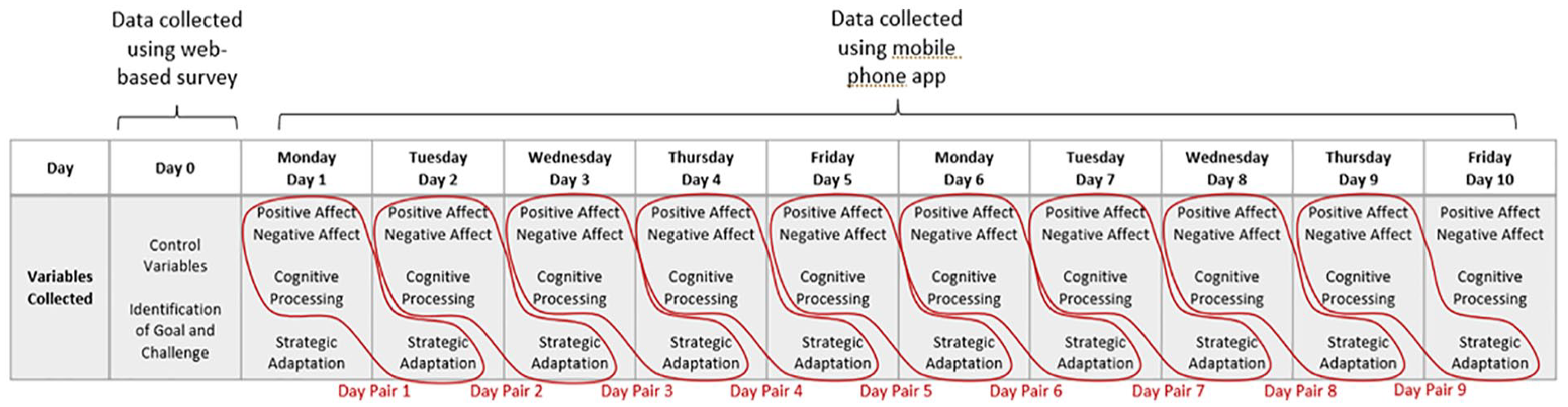
Data collection schedule and analysis strategy.
In the first model shown in Table 3, we tested hypotheses 1 and 2 which predicted that negative and positive affect would have a positive relationship with strategic adaptation. We began by running a mixed regression model including the control variables and the person-mean (between-person or trait measure) and person-mean-centred (within-person or state measure) variables for positive and negative affect. We found that negative affect had a positive effect on strategic adaptation both between and within individuals, thus providing support for hypotheses 1a and 1b. At the between-person level, the impact of positive affect on strategic adaptation was statistically significant and positive, indicating support for hypothesis 2a. However, the within-person impact of positive affect on strategic adaptation was not statistically significant, and therefore, hypothesis 2b was not supported.
Mixed model regression results.
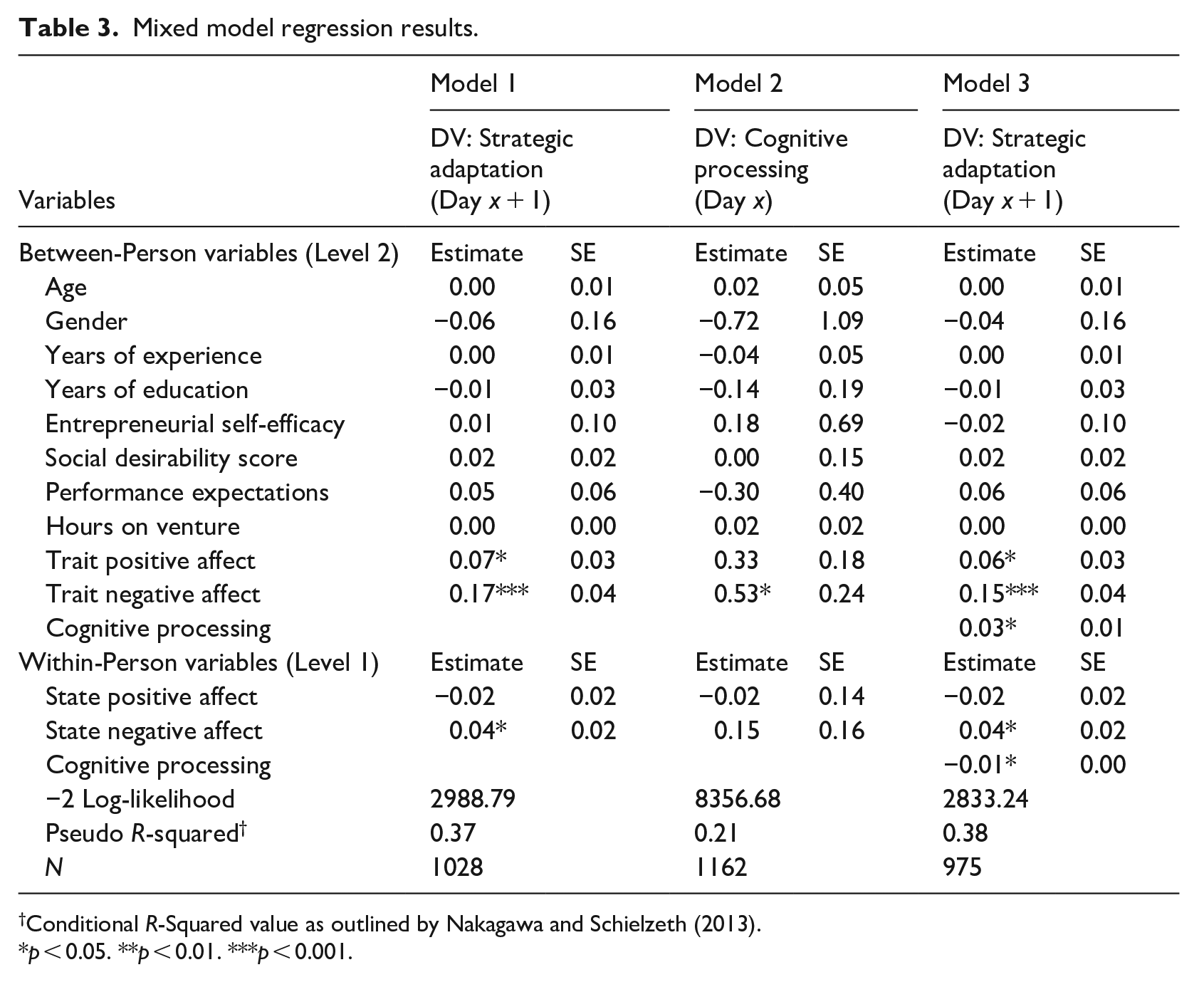
Conditional R-Squared value as outlined by Nakagawa and Schielzeth (2013).
p < 0.05. **p < 0.01. ***p < 0.001.
Next, in Model 2, we tested hypotheses 3 and 4, predicting that positive and negative affect would have a positive effect on cognitive processing. Only negative affect at the between-person level had a statistically significant, positive relationship with the level of cognitive processing. Therefore, hypothesis 2a was supported while hypotheses 2b, 3a, and 3b were not. Subsequently, in Model 3, we tested the relationship between cognitive processing and strategic adaptation. At the between-person level, this relationship was positive and statistically significant, as predicted in hypothesis 3a. However, at the within-person level, cognitive processing had a statistically significant negative impact on strategic adaptation, which is contrary to hypothesis 3b.
We moved on to test the mediated relationship between affect and strategic adaptation through cognitive processing. From the previous analyses, we noted that only trait negative affect had a statistically significant relationship with the dependent variable and the mediator, and thus, was the only relationship that could potentially support mediation. As shown in Model 3 of Table 3, when we added cognitive processing as a mediator in the mixed regression model predicting strategic adaptation, the strength of the direct relationship between trait negative affect and strategic adaptation was not substantially reduced, as would be expected for mediation. To further test for a potential mediation effect, we utilised the macro in SPSS developed by Hayes and Rockwood to test for mediation and indirect effects in multilevel mediation models (Hayes and Rockwood, 2020). This macro relies on the methodology recommended by Bauer et al. (2006) to disaggregate the indirect effects that occur within and between levels and uses a Monte Carlo bootstrap procedure with 10,000 resamples to establish confidence intervals. This test revealed a positive, indirect relationship between trait negative affect and strategic adaptation through cognitive processing but fell short of statistical significance (indirect effect = 0.015, 95% Monte Carlo CI [0.001, 0.037], p = 0.104). Although the confidence interval did not contain zero, the fact that it was very close to zero and that the p-value was far from statistical significance let us to conclude that there was insufficient evidence to conclude that the indirect effect was significantly different from zero. Thus, the mediation hypotheses were not supported. Figure 2 below provides an illustration of the hypothesis testing results for both between- and within-person effects, where solid lines indicate statistically significant direct effects, and dashed lines represent non-significant relationships.
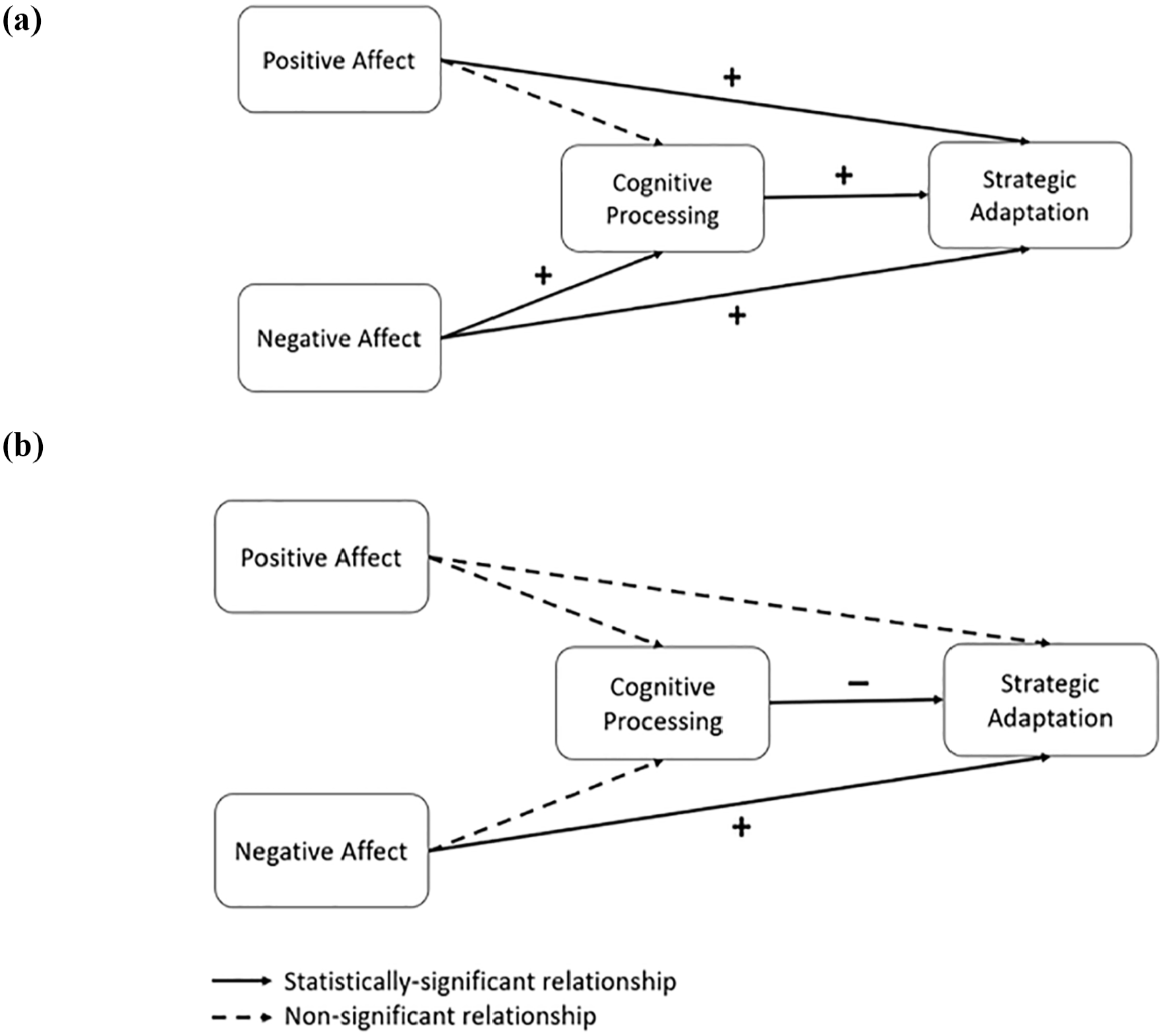
Summary of findings. (a) Trait (between-Person) effects. (b) State (Within-Person) effects.
We considered that it was theoretically possible that after an entrepreneur changes their strategy, they may be more inclined to think about and analyse that strategy (i.e. engage in cognitive processing of the strategy) and that change may also have an impact upon their affective state the following day. Therefore, we also ran a model using strategic adaptation at day x as a predictor of positive affect, negative affect, and cognitive processing on day x + 1. None of these relationships were statistically significant, supporting the direction of the initial models.
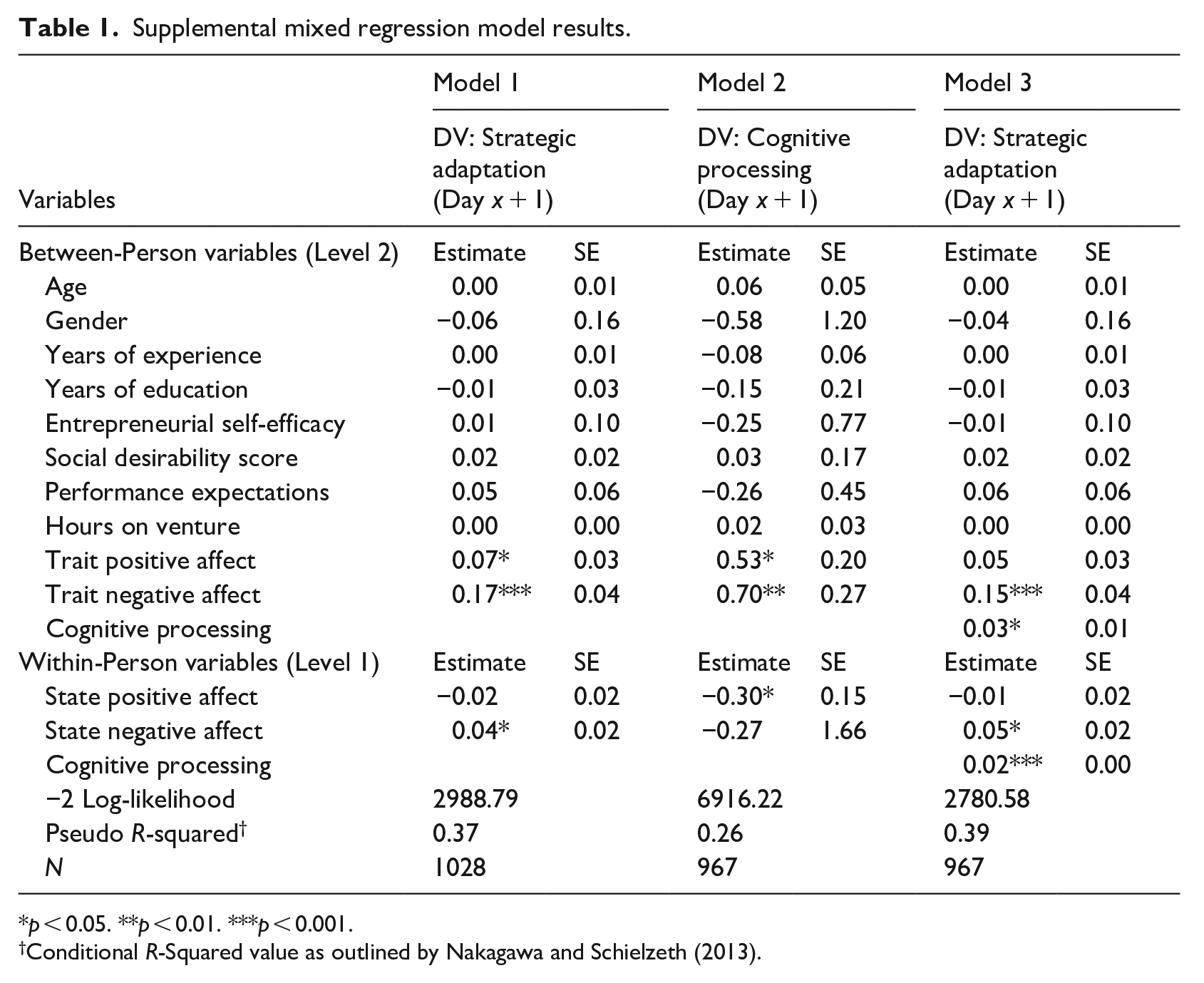
Finally, we also considered that, through the reflections required in the end-of-day surveys, individuals might become more aware of their affective state at the end of the day. Therefore, it is possible that affect could influence both cognitive processing and the strategy the following day rather than influencing cognitive processing on the same day. We constructed an additional set of models that used affect on day x to predict cognitive processing and strategic adaptation on day x + 1. The results were largely the same as those for the initial model. The exception is that the positive relationship between trait positive affect and cognitive processing and the negative relationship between state positive affect and cognitive processing, which were marginally non-significant in the initial model, became statistically significant in these models. Also, within-person cognitive processing became statistically significant and positively related to strategic adaptation on the same day. Hence, cognitions and adaptation may be correlated within a given day. The indirect effects predicted in the mediating hypotheses remained statistically non-significant. The results of these additional tests are reported in Table 1 in the Appendix. Our primary insight from these additional models is that there is more evidence to suggest that affect influences cognitive processing the following day, rather than on the same day.
Discussion
This article has yielded several insights on the role of affect in motivation. Although motivation is reflected in both the level and direction of goal-related efforts (Kanfer, 1990), most research to date has focused on the impact of affect on the intensity and persistence of effort (Foo et al., 2009; Gimeno et al., 1997; Holland and Garrett, 2015; Holland and Shepherd, 2013; Klyver et al., 2018; Renko et al., 2012). Yet, the tactics or strategy (i.e. direction of effort) used to attain a goal are perhaps more important (Katerberg and Blau, 1983), as maintaining an ineffective strategy is likely to result in failure to reach a goal. Furthermore, many entrepreneurs have significant latitude to determine their actions or strategy in goal pursuit. Instead of undertaking the directions of a manager or supervisor, an entrepreneur has the opportunity and, indeed, burden to determine what actions will consume their time. For example, those in this study reported they made such strategic adaptations as completely rewriting their pitch deck, modifying their go-to-market strategy, shifting responsibilities to employees and applying to different accelerator opportunities throughout the course of the study. Therefore, in this context, the strategy used to pursue a venture goal is not only important but also controllable to some extent.
We offer a number of contributions. First, this study is, to our knowledge, one of the few to demonstrate that affect is a determinant of an entrepreneur’s propensity to adapt their strategy for achieving a goal in the face of a challenge. Specifically, the frequency of both state- and trait-like negative affect, as well as trait-like positive affect, were all shown to have a direct positive impact on strategic adaptation in challenging circumstances. This indicates that entrepreneurs who generally experience positive and negative affect more frequently are more likely to adapt when encountering a challenge; furthermore, as an individual experiences negative affect more frequently than they typically do, they too will be more likely to change their course of action. Conversely, those entrepreneurs who generally experience positive and negative affect less frequently are more likely to continue with their current course of action. In essence, affect influences not only how hard an entrepreneur works but also how they work. These results offer a more complete understanding of the role of affect in entrepreneurial motivation.
Second, our results highlight the function that negative affect plays in an entrepreneur’s motivation and adaptation to challenges. Although calls have been made for an examination of the function of negative emotions when entrepreneurs face challenges (Shepherd, 2015), positive affect has traditionally been connected with motivation because of its propensity to broaden thought and action and to encourage approach behaviours (Fredrickson, 1998, 2001). However, in this study, experiences of both trait- and state-like negative affect spurred entrepreneurs to adapt their behaviours. Negative affect contains crucial information signals that call attention to a problem that needs to be addressed (Carver, 2003). Following the qualitative observations of Byrne and Shepherd (2015), and consistent with the affect-as-information perspective, we believe that negative affect serves as a trigger to draw attention to an issue and instigate action to adapt to that issue. This is contradictory to conventional wisdom that might encourage an entrepreneur to ‘move on’ or let go of negative feelings arising from a challenge. Rather, if negative affect is absent, an entrepreneur might overlook a problem that requires attention and action.
Third, our results offer interesting implications for existing theories of affect and how scholars apply these theories when studying individual responses to challenges. Traditionally, the broaden-and-build theory has been used to emphasise the cognitive and behavioural benefits of positive emotions, noting that they encourage individuals to keep moving forward (Fredrickson, 2004; Izard, 1977) and aid creative problem-solving (Isen et al., 1987). At the same time, this perspective acknowledges that negative affect should have a constraining effect on cognition and behaviour (Fredrickson, 2001). Conversely, the affect-as-information perspective implies that negative affect is helpful in challenging times because it serves to focus attention on a challenge that must be addressed (Carver, 2003). Simultaneously, this perspective holds that positive feelings could be harmful in challenging circumstances, as they may provide a false signal that ‘all is well’, and attention can be directed elsewhere. Yet, our results showed that both positive and negative affect can have a positive impact on strategic adaptation when an entrepreneur faces a challenge.
In other words, our evidence illustrates that, in some circumstances, both theories offer predictions that are at least partially correct. While any combination of the effects of positive and negative affect noted above could be realised, context may be key to understanding which effects are more likely to occur. In a context in which individuals are striving towards a goal, we argued that self-regulatory processes are likely to direct the effects of feelings into cognitions and actions that will aid the achievement of the goal and simultaneously quash inclinations that hinder goal achievement. If our theorising is correct, then in this context, entrepreneurs use negative affect to direct their attention to the issue and they use positive affect to fuel continued engagement with the challenge, as well as cognitive and behavioural flexibility. At the same time, this implies that, in contexts where self-regulatory processes and goal striving are not at the forefront, other factors would determine which effects of affect are realised. For instance, the affect-as-information perspective’s predicted functions of affect may be most relevant in contexts characterised by threat. In such cases, negative affect is required to focus attention and prepare one for quick, decisive action. Conversely, the broaden-and-build theory’s perspective on emotions may be most likely to offer predictive power in scenarios characterised by opportunity, such as contexts that demand holistic, creative thinking and action that is facilitated by positive emotions (Fredrickson, 2001). In sum, this emphasises that researchers must be alert to the context in which a theory is applied when explaining the impact of affect on cognition and behaviour.
Fourth, and on a practical level, entrepreneurs who are aware of the possibility of negative affect to draw attention to problems and for positive affect to fuel adaptation are better positioned to self-regulate their affect and its impact on their thoughts and actions. Indeed, several entrepreneurs in the study specifically noted the highs and lows of entrepreneurial venturing and the need to manage these experiences. The evidence indicates that the experience of affect influences cognitive and behavioural processes (i.e. strategic adaptation) and, therefore, is substantive. In other words, affect is not just an isolated ‘feeling’ but can also influence how entrepreneurs process information and act. If entrepreneurial venturing is characterised by highs and lows which have a real impact on functioning, it is important that entrepreneurs are aware of their affective experiences if they are to manage them. Anecdotally, several respondents noted that taking the time to reflect each day helped them to focus more on their goals. We suggest that, similarly, taking time to reflect on affective experience regularly could help entrepreneurs understand their feelings and how those feelings influenced their behaviour and thoughts that day. This is a prerequisite to managing the highs and lows that respondents reported – it is difficult to manage something that one is unaware of. If an entrepreneur recognises, for example, that they have not been feeling affect of either valence over the past few days (perhaps a feeling of apathy), the evidence indicates they may also have been less likely to make any strategic adaptations. The entrepreneur is then able to assess that connection metacognitively and consider more thoroughly whether any adaptations are currently needed. Beyond this, we have theorised that self-regulation can at least partially determine the type of effect that each affective state has on cognition and behaviour. If this is correct, this also implies that entrepreneurs must be mindful of how they allow their affective states to influence them when they encounter venturing challenges. Ideally, an entrepreneur would use any negative affect to direct their attention to the challenge at hand and also use any positive affect to fuel cognitive processing and behavioural adaptation. Conversely, an entrepreneur should be on their guard to ensure that negative affect does not induce withdrawal from the task and that positive affect is not taken as a signal that no problem exists.
We also noted the divergent effect of cognitive processing on strategic adaptation the following day within and between participants. The results indicate that entrepreneurs with higher average levels of cognitive processing were more likely to adapt their strategy. However, higher daily levels of cognitive processing had the opposite effect, implying that, as an entrepreneur moves above their average level of cognitive processing in a day, this inhibits adaptation the following day. Entrepreneurs may find themselves stuck in ‘analysis paralysis’; thus, they must be prepared to reflect meta-cognitively about how their thoughts influence their actions. Furthermore, the within-person relationship between cognitive processing and strategic adaptation became positive when the two constructs were measured on the same day. This may imply that as entrepreneurs engage in more cognitive processing beyond their average level, they are more likely to adapt their strategy that day. In other words, entrepreneurs in this study were more likely to enact change immediately, as opposed to waiting to enact change the day after they spent more time thinking on their goals and challenges. Scholars have suggested that entrepreneurs need to act quickly to seize opportunities in uncertain, highly dynamic environments (Baum and Bird, 2010). However, it would be useful for researchers to further examine this relationship to see if it holds in larger samples, and what the outcomes, both positive and negative, of taking swift action might be. These results also highlight the importance of separating the between- and within-person effects when studying entrepreneurial affect, cognition, and motivation. An effect that holds at one level may not hold at another level.
Limitations and future research
This study has several limitations, which present opportunities for future research. First, we have presented arguments that imply that modifying one’s strategy when a challenge is encountered is the best course of action. However, we acknowledge that, in some cases, it may be most prudent to maintain the same strategy and simply wait for the challenge to pass. Future research may be able to identify the challenge as either transient or permanent, which, in turn, has implications as to whether strategic adaptation is called for or not. Additionally, we recognise that entrepreneurs may modify their strategy for reasons unrelated to a challenge. For example, realising a new opportunity to achieve a goal in an entirely different way may prompt an entrepreneur to change their strategy and still result in the achievement of the goal. Future research can explore what other types of events might prompt entrepreneurs to adapt their strategy in goal pursuit and what role affect plays in such processes.
Second, although we theorised that self-regulatory processes were responsible for the effects we observed in this research, our results do not prove that is the case. Therefore, future research can work to better understand what exactly is driving these results. Relatedly, our theorising relies on the assumption that self-regulatory processes are functioning optimally and that individuals have sufficient self-regulatory resources and strength. In some ways, the context of the study supported optimal self-regulation as the goals identified were likely set by the entrepreneurs themselves, which is connected with enhanced self-regulatory effort (Schunk, 1995), and were intentionally brought top-of-mind each day. However, self-regulatory failure can and does occur (Muraven et al., 1998). The fact that our results suggest a pattern of self-regulatory success does not indicate that this happens in all cases. In essence, a boundary condition of our theorising is that it applies when self-regulation towards a goal is functioning sufficiently well, if not optimally. Future research may also try to better understand how and when the effects of affect are not optimally managed, that is, when self-regulation fails.
Third, the results of this study lead us to call for future exploration of the mechanisms of affect in motivation. We did not find statistically significant results to suggest that affect has an indirect effect on motivation through the level of cognitive processing. Although this could be an artefact of this dataset, it is also likely that there are other mechanisms that account for the relationship between affect and motivational constructs, such as strategic adaptation. For instance, affect could induce specific coping tactics or processes, such as planning, distracting oneself, or seeking support (Skinner and Zimmer-Gembeck, 2007). These coping strategies, in turn, have implications for the behaviour of entrepreneurs as they push through a challenge towards their goal.
Additionally, there is the limitation of common method variance and, relatedly, social desirability, as the variables are self-reported by participants. Respondents may be inclined to show they are flexible and adapting to the challenge. To mitigate such concerns, we lagged the dependent variable, strategic adaptation. Also, the short form of the Marlowe-Crowne social desirability scale (Crowne and Marlowe, 1960) was administered at the outset of the study and used as a control measure in each model. Still, future studies may be able to overcome the issues inherent in self-reported data by collecting more objective measures of affect and motivation. This could involve enlisting the help of an entrepreneur’s partners or employees to report on the actual motivated behaviours of the individual.
Finally, another limitation of our study is that the sample was not strictly randomly selected from the population, as participants were invited to participate and then chose to engage in the study. Therefore, the final sample may not be representative of the population of tech entrepreneurs, nor entrepreneurs in general. Hence, these results might not be generalised to other samples or the larger population of entrepreneurs. In fact, it is possible that only highly motivated individuals opted into the study, thus creating range restrictions on the dependent variable. This, however, would make it more difficult to find statistically significant results. Therefore, future research using more representative samples may be able to identify significant results of a larger magnitude. Additionally, we did note statistically significant, though small, differences between those who dropped out of the study and those who completed the study. Those who completed the study had a 4.3% lower frequency of baseline negative affect than those who started but then dropped out of the study (mean difference of 1.29 points on a scale of 30). It is possible that if those with higher baseline negative affect had been included in our study, the results may have differed slightly. In fact, we suspect that, similar to positive affect (Baron et al., 2012), very frequent experiences of negative affect should interfere with cognition and behavioural responses to challenges. As with all findings, our results likely hold to a point, and certainly not across all individuals and situations.
Conclusion
In this article, we have contributed to the understanding of affect in entrepreneurial goal pursuit, particularly in the face of challenges. We have shown that, in addition to influencing the level of effort devoted to a goal, affect can also influence an entrepreneur’s propensity to adapt their strategy to achieve a goal when challenges arise. Additionally, we have presented evidence to suggest that the broaden-and-build theory and affect-as-information perspectives can be reconciled when one considers self-regulatory processes in the context of motivation and goal pursuit. Instead of looking at the utility of affect as ‘either/or’, positive and negative affect have utility in situations that require focused problem-solving and thus, a ‘both/and’ approach is likely to be more appropriate – depending on the context. Our hope is that this research inspires scholars to continue to explore the relationships between affect, cognition and behaviour in entrepreneurship (Shepherd, 2015) in order to help entrepreneurs understand and manage their thoughts, feelings and behaviour in the venturing process.
Footnotes
Appendix
Supplemental mixed regression model results.
| Model 1 | Model 2 | Model 3 | ||||
|---|---|---|---|---|---|---|
| Variables | DV: Strategic adaptation (Day x + 1) | DV: Cognitive processing (Day x + 1) | DV: Strategic adaptation (Day x + 1) | |||
| Between-Person variables (Level 2) | Estimate | SE | Estimate | SE | Estimate | SE |
| Age | 0.00 | 0.01 | 0.06 | 0.05 | 0.00 | 0.01 |
| Gender | −0.06 | 0.16 | −0.58 | 1.20 | −0.04 | 0.16 |
| Years of experience | 0.00 | 0.01 | −0.08 | 0.06 | 0.00 | 0.01 |
| Years of education | −0.01 | 0.03 | −0.15 | 0.21 | −0.01 | 0.03 |
| Entrepreneurial self-efficacy | 0.01 | 0.10 | −0.25 | 0.77 | −0.01 | 0.10 |
| Social desirability score | 0.02 | 0.02 | 0.03 | 0.17 | 0.02 | 0.02 |
| Performance expectations | 0.05 | 0.06 | −0.26 | 0.45 | 0.06 | 0.06 |
| Hours on venture | 0.00 | 0.00 | 0.02 | 0.03 | 0.00 | 0.00 |
| Trait positive affect | 0.07* | 0.03 | 0.53* | 0.20 | 0.05 | 0.03 |
| Trait negative affect | 0.17*** | 0.04 | 0.70** | 0.27 | 0.15*** | 0.04 |
| Cognitive processing | 0.03* | 0.01 | ||||
| Within-Person variables (Level 1) | Estimate | SE | Estimate | SE | Estimate | SE |
| State positive affect | −0.02 | 0.02 | −0.30* | 0.15 | −0.01 | 0.02 |
| State negative affect | 0.04* | 0.02 | −0.27 | 1.66 | 0.05* | 0.02 |
| Cognitive processing | 0.02*** | 0.00 | ||||
| −2 Log-likelihood | 2988.79 | 6916.22 | 2780.58 | |||
| Pseudo R-squared † | 0.37 | 0.26 | 0.39 | |||
| N | 1028 | 967 | 967 | |||
p < 0.05. **p < 0.01. ***p < 0.001.
Conditional R-Squared value as outlined by Nakagawa and Schielzeth (2013).
Funding
The author(s) received no financial support for the research, authorship and/or publication of this article.
