







Abstract
Resource allocation decisions are pivotal in shaping the strategic direction of organisations, particularly in micro-firms that operate with limited resources and dispersed information. This research delves into the intricate interplay between managerial and organisational factors related to information collection, processing and resource allocation in the context of high-performing micro-firms. By advancing our understanding of how the internal coordination of information needed in decision-making and resource allocation evolves within micro-firms, we reveal the mechanisms that stabilise the relationship between participants and problems. Additionally, we explore how the capabilities of managers and owners, who often centralise final decisions in micro-firms, can catalyse the emergence of such coordination. This holistic view of strategic resource allocation in micro-firm settings addresses the fundamental question of how micro-enterprises overcome structural limitations to achieve high levels of performance. Our findings provide valuable insights for scholars, managers and policymakers, contributing to the broader discourse on resource management in micro-firms.
Introduction
In the strategic management of a firm, resource allocation choices stand as key pillars. Chandler defines business strategy not only as the determination of a firm’s goals and objectives but also as the ‘allocation of resources necessary for carrying out these goals’ (1962: 13). Hofer and Schendel (1978) suggest that firms formulate strategies primarily to aid in allocating strategic discretionary resources. This perspective highlights the critical nature of resource allocation decisions made by top managers (Carpenter, 2002; Gupta et al., 2018). In micro-firms, that is, firms with fewer than 10 employees and €2M in turnover 1 , the breadth and scope of resources are extremely limited compared to large firms (Brouthers et al., 1998; Villanueva et al., 2012), a formal workflow system is lacking, and information is dispersed (Kelliher and Reinl, 2009). Consequently, in this context, resource allocation decisions can become even more important (Dunkelberg et al., 2013; Nason et al., 2019; Symeonidou et al., 2022). Given their limited resources, most micro-firms can only access and process a minimal amount of information and resources to, respectively, inform and execute strategic decisions (Simon and Houghton, 2002). Therefore, they might use different sources of information, both internal or external or derived from formal or informal relationships, and resources (Daft and Weick, 1984; Simon and Houghton, 2002), prioritise a few specific strategic issues (Jaouen and Lasch, 2015) and rely strongly on the cognitive characteristics of the individuals responsible for interpreting information and seizing opportunities (Daft and Weick, 1984; Simon and Houghton, 2002). The alignment between strategy and resources, whether it pertains to individual owners/managers or, more broadly, a firm’s organisational structure as in the case of large firms, remains unclear (Levinthal, 2017; Maritan and Lee, 2017). This ambiguity becomes more pronounced in situations where activities outsourced to external actors are not under the firm’s control, as is the case for micro-firms.
As such, a critical gap persists in our understanding of how the internal coordination of information important for making decisions and allocating resources within and outside a firm’s control naturally occurs within micro-firms, effectively stabilising the relationship between internal and external actors and the firm’s strategic problems. The description of strategic decision-making concerning resource allocation for problem-solving in micro-enterprises, as an intuitive and unstructured amalgamation of the involvement of internal and external actors, heavily contingent on owner–manager perception and interpretation of information, as well as their connections with the environment, fails to account for high-performing micro-firms (Liberman-Yaconi et al., 2010). Conversely, high-level performance presumes the identification of processes that ensure attention is focused on problems with a degree of power delegation to actors depending on the issues to be adresssed (Joseph, 2001). Past studies (Verreynne et al., 2016) neglect to describe how information is gathered, perceived, processed and transformed into business knowledge to inform and nurture resource allocation choices, and how this knowledge is used effectively through a combination of internal and external actors addressing challenging issues. Verreynne et al., (2016) find that the conjoint application of the participation of external and internal actors, under various contextual conditions, may provide small firms with a wider range of strategic possibilities and critical information. Strategies of resource allocation tend to treat ‘participants’ as carriers of organisational solutions and problems (Carley, 1991), rather than emphasising the emergence of processes focusing a firm’s attention on problems, through the identification of actors and their respective levels of authority, delegated to address particular strategic issues. Additionally, for a comprehensive grasp of strategic resource allocation choices in these settings, it is essential to explore how the capabilities of managers/owners centralising the final decision, particularly in the micro-firm context, can catalyse the emergence of such coordination. However, while the importance of managerial cognitive frames for resource allocation in large firms has been addressed (Gilbert, 2006), the current literature has neglected to identify significant managerial cognitive factors for resource allocation in micro-firms (Foss et al., 2023; Matsuoka and Kaplan, 2008; Walsh, 1995).
This oversight hampers a deeper understanding of the drivers behind resource allocation strategies employed by micro-firm owner–managers (Busenbark et al., 2017). Given that micro-firms constitute the majority of small- and medium-sized enterprises, accounting for over 90% of organisations globally (Coke-Hamilton, 2023; Kelly et al., 2020; Mellett et al., 2018), and act as drivers of wealth and growth on a global scale (Duarte Alonso and Bressan, 2016; Maiti et al., 2020; Pinelli et al., 2022; Rodrigues et al., 2022), it is important to study their resource allocation strategies. This is particularly crucial as only a minority, estimated at around 30% of micro-firms, survive beyond two years (Wong et al., 2020). Therefore, the research questions we address in this study are the following: how do the managerial and organisational factors responsible for information collection and processing affect resource allocation choices in high-performing micro-firms, and how are internal and external actors involved?
We examined competitive differences among micro-firms in dairy farm production, focusing on how high-performing micro-firms addressed resource constraints and information dispersal issues through strategic resource allocation. This allocation connected actors to emerging problems, facilitated by managerial cognition and organisational embeddedness. Specifically, we studied how new resource allocation practices distributed and linked actors to the firm’s issues, highlighting the role of managerial and organisational factors. Our study connects resource allocation decisions with managerial and organisational factors, as well as the intermediate coordination mechanisms that naturally arise when addressing the relationship between actors and strategic problems (Liberman-Yaconi et al., 2010). This research responds to the need for a deeper exploration of processes coordinating interactions among participants and problems in high-performing firms. It challenges the assumption that decision-making in contexts with dispersed information, such as micro-firms, and the allocation of resources is inherently unsystematic and disorganised (Liberman-Yaconi et al., 2010). Furthermore, our study explains how micro-firms manage resource constraints and dispersed information through strategic allocation decisions that align resources with environmental demands, thereby influencing their performance. Beyond contributing to the scientific understanding of resource allocation in micro-firms, our findings offer practical insights for managers and policymakers seeking to optimise resource allocation for enhanced performance.
Theoretical background
Resource allocation
The competitive advantage of firms relies on unique sets of resources and strategies (Barney, 1991; Wernerfelt, 1984). Resources comprise all the assets, capabilities, processes and knowledge controlled by the firm (Edelman et al., 2005). The significant constitutive elements of managerial decisions and actions affecting a firm’s survival and performance enable the formulation and implementation of strategies, as well as its resource allocation choices. Moreover, Hofer and Schendel (1978) emphasise that, at the basis of strategy formulation, there is a need to allocate discretionary strategic resources for a firm to achieve its goals (Chandler, 1962). In the case of large firms, the resource allocation process has been described by Bower (1970) as a multistage process in which managers positioned at different organisational levels, with different types of information at hand, cover different roles. Subsequent research has corroborated Bower’s findings across diverse contexts (Ackerman, 1970; Bower and Doz, 1979). Burgelman (1983) expanded Bower’s model to acknowledge the fact that senior managers play a crucial role in establishing a strategic context for resource allocation noting that the outcomes of resource allocation can subsequently alter the initially intended strategy, thus influencing the strategic context of future allocation decisions.
Subsequent studies have adapted and refined the Bower–Burgelman model to explore other dimensions, such as examining the impact customers have on resource allocation (Christensen and Bower, 1996), investigating iterations of resource allocation as part of the strategy-making process (Noda and Bower, 1996) and studying how managerial cognitive frames influence the resource allocation process in large firms (Gilbert, 2006). More recent studies on resource allocation in organisations tend to underplay the role of individuals and instead, emphasise the role of the structure of the firm in mediating the distribution of resources. In this vein, Levinthal (2017) emphasises this role by recognising that organisations possess unique access to various investment opportunities and contend with diverse opportunity costs, leading to distinct choices. Furthermore, different organisational structures highlight a diversity in beliefs and perspectives (Lau and Murnighan, 1998), contributing to heterogeneous choices in resource allocation processes within an organisation. The organisational structure sets the stage within which different perspectives compete for influence over decisions (Moch, 1976). Additionally, the size and degree of decision-making centralisation has an impact on strategic decisions. Accordingly, Vieregger et al. (2017) and Sengul and Obloj (2017) have focused on the role played by the structural context that governs the allocation of decision rights and the provision of incentives, thereby exerting influence on the resource allocation behaviours of business unit managers.
Grasping the essence of these mediation processes has posed a fundamental challenge for scholars in the field of management (Levinthal, 2017), along with the challenge of determining the activities that firms undertake when they determine resource allocations and the hierarchical level in the organisation where these activities occur. Building upon this rationale, Helfat and Maritan (2023) have introduced a comprehensive array of resource allocation routines across various levels of the management hierarchy, forming the resource allocation capability of a multi-business firm. In their examination of a firm’s mediation in the resource allocation process, Helfat and Maritan (2023) emphasise that the selection of specific resource allocation routines is contingent on the overall organisational structure and the firm’s scope. The heterogeneity of how firms navigate trade-offs related to the choice of routines may lead to variations in their resource allocation capabilities. Consequently, the diverse approaches employed by firms in addressing these trade-offs can result in differences in the routines they choose, which consequently influence their overall resource allocation capabilities. As a result, elucidating the mediating role of organisations becomes imperative to understand how firms differently manage resource allocation processes relative to an arms-length market process (Levinthal, 2017).
Resource allocation in micro-firms
Previous studies focused on the central role of organisational structure and hierarchy, concepts that often overlap in the literature (Bradach and Eccles, 1989; Williamson, 1991) and failed to explain how resource allocation choices are made in cases of little, or no hierarchical control, over resources or in the case of a lack of systematic workflow (Lee and Edmondson, 2017; Puranam et al., 2014), as in the case of micro-firms. Indeed small- and micro-firm decision-making studies describe strategic decision-making as iterative, chaotic and unsystematic (Gibb and Scott, 1985; Greenbank, 1999; Harfield et al., 2001; Jocumsen, 2004). More recently, Tonellato et al. (2023) identified microstructural coordination mechanisms allowing organisational participants, in conditions of decentralised information, looseness, or even the absence of authority, to self-organise to provide mutual information regarding how to address problems. Therefore, we argue that resource allocation choices, in the same conditions, may emerge as the result of spontaneous, evolving and interdependent interactions between participants and problems. In addition, the resource allocation process can be conceptualised as an emerging phenomenon embedded in a relational structure involving two classes of interdependent entities, that is, ‘participants’ – the carriers of organisational solutions – and ‘problems’ (Carley, 1991), linked by process bundling and leveraging internal and/or external resources/actors to implement strategy and ultimately affect performance. For micro-firms, characterised by the constant change in their profiles, problems and allocation decision opportunities, the involvement of actors in strategic decisions and allocation of tasks cannot be reduced to a stable set of categories, such as internal or external actors, as proposed by Verreynne et al.,(2016). The specificity of emerging problems and learning and cognitive costs lead to strategic decision-making by those who are familiar with the problems and so, better placed to address them. For this reason, a novel view of the processes accompanying the resource allocation choices of micro-firms is required. We seek to identify the processes associated with the allocation of strategic resources to address the specific problems micro-firms might have, and for which they rely on the mutual interdependence of participants to whom they can delegate different degrees of power.
Previous research on resource allocation has mainly focused on large firms, overlooking micro-firms characterised by resource scarcity, low barriers to entry, lack of isolating mechanisms and dispersed information (Kevill et al., 2021). Indeed, appropriate resource allocation choices and swiftness in decision-making are more important in micro-firms due to their constant need to innovate and linked to the shorter lifespan of their goods compared to those of larger enterprises (Faherty and Stephens, 2016; Raghuvanshi et al., 2019; Räisänen and Tuovinen, 2020). Unfortunately, the results of resource allocation research conducted on large enterprises are difficult to apply to the managerial conformation of these enterprises. Apart from resource endowment, and the need to innovate, many other characteristics differentiate them from larger enterprises significantly affecting strategic decision-making (Liberman-Yaconi et al., 2010), especially if there is a high level of centralisation in the hands of the owner–manager (Brockman et al., 2012; Foss et al., 2023).
Resource allocation in micro-firms: Managerial and organisational factors relevant to information collection and processing
The role of owner/managers, who strategically, operationally and culturally dominate micro-enterprises (Jaouen and Lasch, 2015; Kearney et al., 2019), has been noted as crucial in strategic decision-making (Greenbank, 2000; Phillipson et al., 2004). As such, strategic decisions largely depend upon the owner’s discretion rather than on formal decision models (Kelliher and Reinl, 2009). Therefore, strategic decision-making has been linked to the owner’s disposition and mental faculties (Duarte Alonso and Bressan, 2016; Hermel and Khayat, 2011), indicated by managerial cognition and broadly defined as the manner in which managers perceive and process information (Apfelthaler et al., 2011). Owner/managers of micro-firms are portrayed as utility maximisers rather than profit maximisers (Revell and Blackburn, 2007), with utility functions incorporating both accounting profits and variables that indicate sources of non-market costs and benefits associated with firm ownership and control. However, although the relevance of managerial cognitive frames for resource allocation in large firms has been discussed (Gilbert, 2006), the identification of significant managerial cognitive factors for resource allocation in micro-firms has been overlooked in contemporary literature, thus inhibiting a better understanding of what drives micro-firm owner–manager resource allocation strategies (Busenbark et al., 2017).
It is assumed that a firm’s ability to integrate new information is an antecedent to resource allocation decisions (Leiblein et al., 2017). Accordingly, differences in the ability to integrate new information and therefore, in the ability to learn, lead to different resource allocation choices and competitive advantage. Classic organisational theories emphasise the notion that bounded, rational participants often make decisions amidst a high degree of ambiguity (March and Olsen, 1976). From this viewpoint, the entire organisational process – encompassing the division of work, allocation of tasks and integration of efforts – is interpreted as a continuous process in which information becomes less ambiguous through the coordinated actions of individual organisational participants (Puranam et al., 2012). Consistent with this view, a firm’s formal or emergent organisational structure might have a set of prescribed arrangements that shape the information processing activities enabling the accumulation of predictive knowledge about the results of certain resource allocation choices (Puranam et al., 2012).
Accordingly, past literature (Beaver, 2002; Verreynne and Meyer, 2010) has analysed how firms process information through a strategy-making process to gain advantages focusing on the three informal strategy-making approaches observed in small firms: namely, internal participation, external participation and centralised strategy-making. Centralised approaches, such as simplistic strategy-making (Lumpkin and Dess, 2006), are top-down with decision-making in the hands of the owner–manager. In participative approaches, decisions are collaborative, so they include owner–managers and employees at different organisational levels (internal participation) and/or external stakeholders (external participation or adaptive strategy-making). In keeping with this reasoning, Verreynne et al.(2016) show that the participation of internal and external stakeholders can play different strategy-making roles depending on levels of external dynamism. Micro-firms are characterised by the constant change in their participants (i.e. their absence of permanent staff, limited capital assets, simple technologies and procedures and absence of bureaucracy), as well as problems and allocation decision opportunities. Hence, the involvement of actors in strategic decisions cannot be reduced to a stable set of categories such as internal or external stakeholders. Moreover, given the specificity of the problems they encounter, their lack of resources plus learning and cognitive costs, strategic decisions tend to involve only those with a high level of familiarity with the problems at hand. For this reason, a novel view is required of the information process accompanying the resource allocation choices of micro-firms.
Methods
Given the limited theory on how resource allocation choices may promote higher performance in micro-firms, we have adopted an explorative research framework based on multiple interpretive case studies aiming to build grounded theory (Gehman et al., 2018; Glaser and Strauss, 1967). The nature of the topics investigated, including managerial cognition, organisational embeddedness and motivations and goals in the resource allocation process, is inherently connected to a subjective ontological position based on an informant’s interpretation of reality (Gioia and Thomas, 1996). Multiple cases allowed us to collect detailed and rich data enabling the study of complex phenomena embedded in their context. The use of multiple cases yields more robust and generalisable theories than single case studies (Tsang, 2014; Yin, 2009). Moreover, this method is especially suited to addressing ‘why’ and ‘how’ research questions (Eisenhardt, 1989), and it is appropriate when clarifying whether an emergent finding from a single case can be validated through cross-case comparison (Eisenhardt and Graebner, 2007). Coherently, to maximise the validity of our study, we applied theoretical sampling to select cases that were homogeneous but that represented polar types in terms of performance (Eisenhardt, 1989). Using this approach, constructs and relationships that are not yet well defined in the literature can be specified and elaborated upon (Glaser and Strauss, 1967), and theories of success and failure can be developed. Each case was thoroughly analysed as a stand-alone entity and then cross-case analysis was performed to identify recurrent patterns. From the within-case analysis and cross-case comparison, an initial, tentative framework emerged, with themes, concepts and relationships between variables. The framework has been repeatedly refined and modified to make it fit the data more and more closely, through a highly iterative process of continuous comparison among the researchers. Further analysis of the qualitative data then helped us understand the theoretical reasons why each relationship held, allowing us to confirm the internal validity of the results. Finally, the last step of the analysis was to compare the concepts that emerged with the theories and assumptions within the existing literature, to pinpoint similarities, contradictions and novelties. In the following section, we summarise the main steps in our model development, giving further details of the study.
Case selection
To build a model applicable across organisation types regarding the impact of managerial and organisational factors upon strategic resource allocation choices in micro-firms operating in traditional sectors and their influence on firm performance, we followed a deliberate theoretical sampling plan. Indeed, the majority of micro-firms in the USA and OECD countries operate in traditional sectors, and they therefore deserve particular attention (Edelman et al., 2005). The dairy sector presents peculiar challenges for micro-enterprises, which made it an interesting setting to study the determinants of resource allocation choices to achieve innovation and performance.
Farm dairy production requires a combination of physical resources (cows, barns, equipment), human resources (artisanal skills) and financial resources (capital for purchasing raw materials and equipment). This range of elements allows us to study how businesses balance and allocate different types of resources to optimise production. Additionally, farm dairy production lends itself well to business expansion. Micro-enterprises can grow gradually by increasing production or introducing new products. This growth process requires strategic decisions regarding resource allocation, offering a unique opportunity to study how businesses make plans and implement expansion. Moreover, farm dairy production involves various complementary stages (milk collection, coagulation, ageing) that need to be efficiently coordinated. This allows us to explore how businesses manage the complementarities between internal and external resources, better illustrating the complexities of resource allocation both within and outside the firm. Many micro-enterprises in the farm dairy sector operate in local and traditional contexts, where product quality is closely linked to the origins of raw materials and artisanal techniques. This provides a unique opportunity to study how local resources influence allocation strategies and how businesses navigate the constraints and opportunities offered by the local context.
Market conditions characterised by increasing milk price volatility, the scarcity of agricultural land coupled with a new manure policy that seriously limits expansion possibilities, and the increasing number of rules that farmers have to comply with since the introduction of the new Common Agricultural Policy (CAP) in the EU are all factors that make innovativeness and focus on performance crucial, especially for micro-enterprises (Samson et al., 2016). In addition, the limited power of farmers to negotiate, the increasing pressure they feel to accept lower prices from buyers, and their great dependence on commercial actors (usually suppliers and other value chain parties) for knowledge acquisition and exchange seriously limit their ability to innovate and be profitable (Vermunt et al., 2022). Moreover, the Netherlands is the EU’s fourth-largest milk producer by volume and has more than four times the average European livestock density, and therefore is a relevant context for studying the dairy sector. For all these reasons, micro-firms in the Dutch dairy sector may constitute the ideal setting in which to analyse resource allocation strategies to overcome the problem of resource constraints.
We considered a population of 80 homogeneous micro-firms that operate in the same sector (i.e. farm dairy production), are located in the same geographical area (i.e. the Netherlands) and belong to the same producer consortium that certifies their farm cheese brand using very strict rules. As a consequence, they are subject to the same institutional pressures. We initially contacted the list of 80 firms registered with the producer consortium via e-mail. Only 17 companies agreed to be interviewed. We thus conducted an initial round of interviews collecting data on the age of the enterprise, the current generation in the case of family enterprises, the presence of any external employees, the current workforce employed in the enterprise as measured by full-time equivalent (FTE) and financial data relating to the sale of milk and cheese. Since all the farms in the sample belong to a producer consortium and must, by statute, own cows and produce cheese from their milk, we decided to measure their financial performance by relating total turnover (from milk and cheese sales) to the number of cows owned. In this way, we obtained a measure of the profitability of the dairy business. It is worth noting that any additional profit from other forms of dairy production (yoghurt, buttermilk, butter, etc.) still constituted a minority share of the business and was considered negligible. We then identified three performance ranges: low (below 25th percentile), mid (between 25th and 75th percentile) and high (above 75th percentile). Criteria based on percentiles are commonly used in exploratory business studies, where it is necessary to set a relative scale of performance in a sample (Conyon and He, 2017; Linton and Kask, 2017). Table 1 summarises the main characteristics of the farms. The identities of the companies and individuals are disguised to ensure confidentiality.
Summary of the major characteristics of the farms examined.
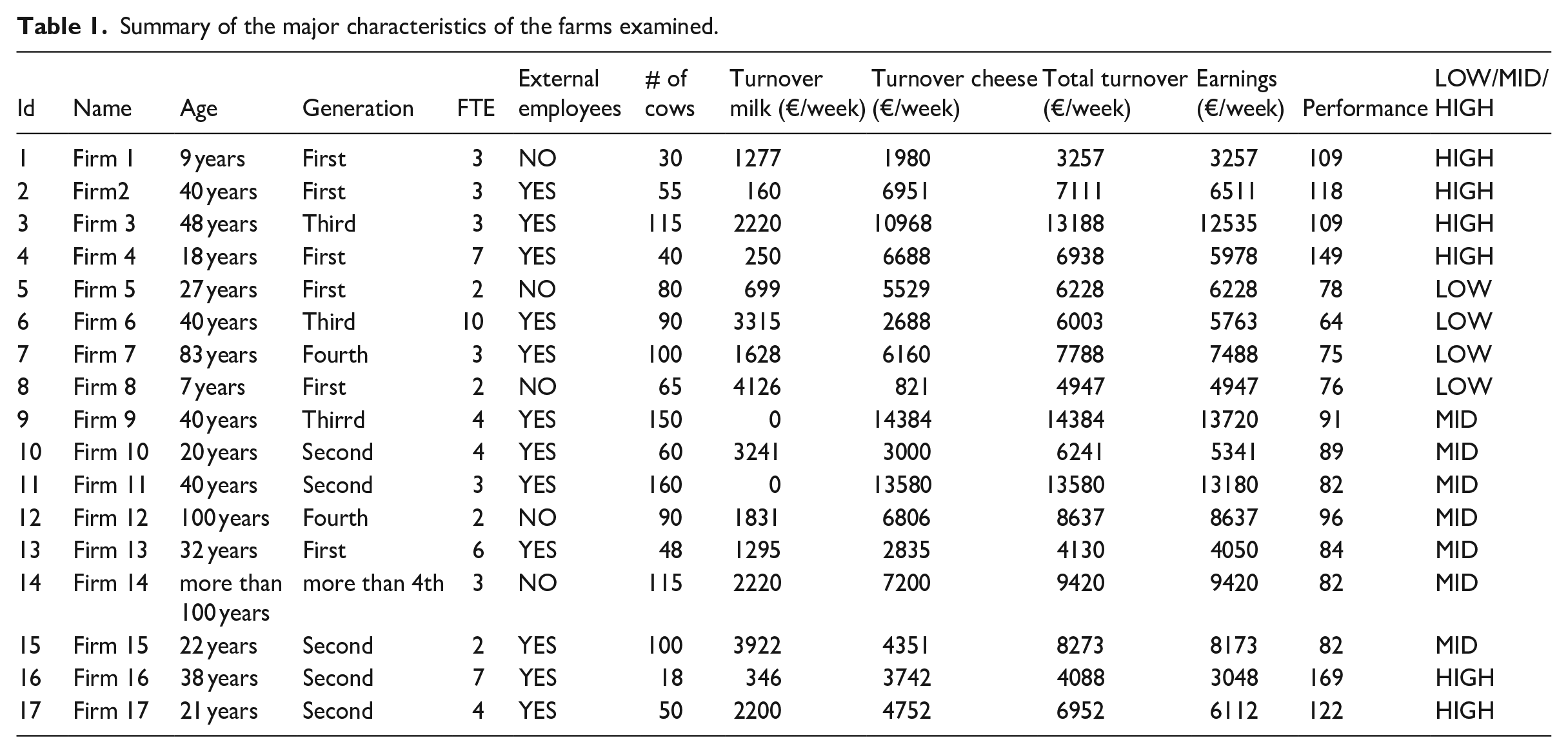
The first round of interviews helped us become familiar with the industry and understand the context. Then, to focus on the phenomenon of interest, which is the relationship between resource allocation choices and performance, we purposely selected a sample of seven enterprises out of the initial 17 to have a polar sample including four high-performers and three low-performers. Sampling extreme or ‘polar’ cases, in this case along the performance dimension, is a very powerful type of theoretical sampling that allows: ‘very clear pattern recognition of the central constructs, relationships, and logic of the focal phenomenon’ (Eisenhardt and Graebner, 2007). Among the high and low performers, we selected those available for further study to have a balanced sample.
Data collection
We collected data for this study from interviews and secondary data. The first round of in-depth, semi-structured interviews involved, as mentioned above, 17 enterprises, from which the seven cases under consideration were then extracted (named Firm 1, Firm 2, etc.) through purposeful sampling (Shepherd, 2019). All these interviews were conducted face-to-face with the owners of the farms, lasted for about an hour and a half and were held between November 2018 and February 2019. Since each respondent was the owner of the firm and also, the manager and decision-maker (in cases where the owners were more than one, a couple, or more than one sibling, we considered them all to be owners and managers/decision-makers), we will refer to them as the owner in the following sections. The interviewees were asked about the firm income, products, production processes, relationships, organisational structure, as well as the personal characteristics of the owner/manager. The interviews were all recorded and transcribed with the permission of the respondents. After this step, the final sample of seven farms was extracted. To broaden our understanding of the context, two interviews were also conducted with the main milk cooperatives operating in the area.
The interviews with the cooperatives, lasting approximately 1 hour each, sought to understand the overall operation, the advantages/disadvantages for farmer members, the level of flexibility provided to farmers, and, in general, the distribution of power within their relationships. In addition, in the first round, two interviews, lasting about 45 minutes each, were conducted with a supplier common to all the farmers to understand the characteristics of the relationships they established with farmers, their flexibility and their level of dependence. Subsequently, the farm websites were examined to collect further information, their connections and collateral activities. In addition, we searched the web for news and information on events in which the farmers participated or promoted, interviews with local media during various events such as village festivals, land enhancement initiatives, and, when possible, their Facebook and Instagram pages.
This enabled a more complete picture of the connections between the enterprises and their social fabric; it also prompted new questions regarding the activities set up by the farmers, their resource allocation decisions, and most importantly, the motivations for these decisions. Consequently, about 12 months after the first round of interviews, a second was undertaken lasting for approximately the same time (60 minutes). These interviews have a stronger focus on resource allocation decisions and motivations. Finally, the second round of interviews concluded with questions regarding their vision for the future, their finances and specific questions to clarify inconsistencies in the previous interviews and their websites. In addition, due to some ambiguities in the transcripts, we decided to contact the interviewee of each farm a third time using telephone interviews to clarify any inconclusive data and to confirm that the details regarding each farm were correct. This round of interviews lasted around 10–15 minutes. Table 2 shows the list of interviewees, the number of interviews in the three rounds and the interview mode (in person, online, phone call).
Interview data.
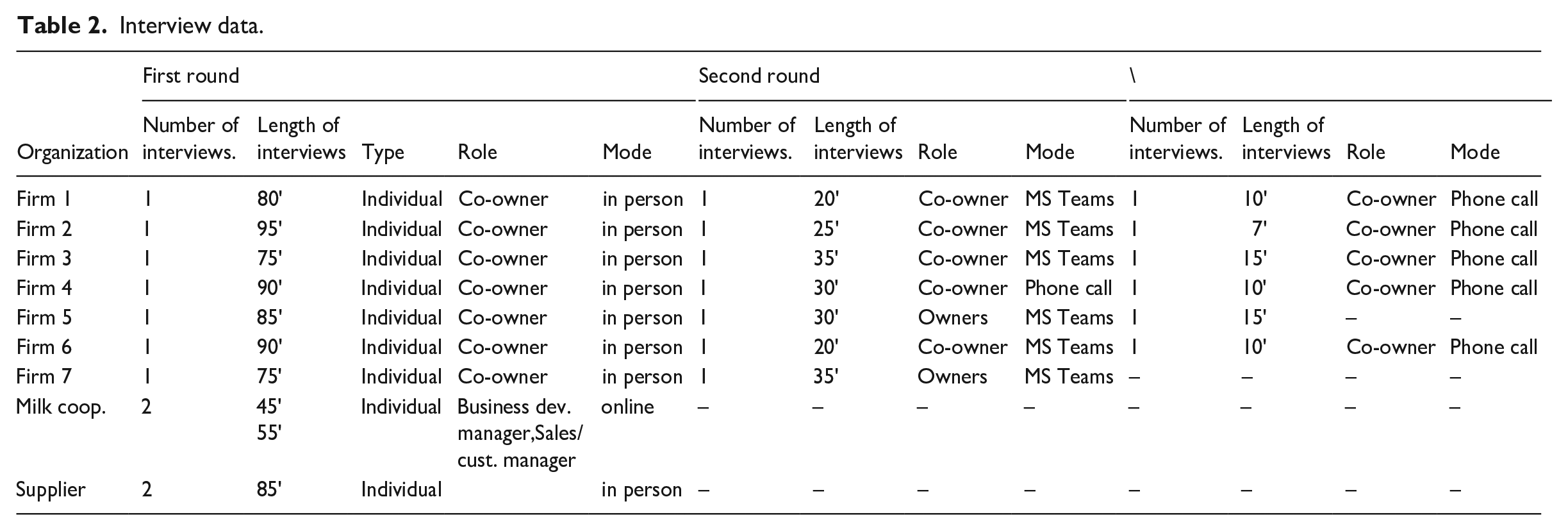
Case analysis
Data from the transcripts of the interviews and secondary data were coded using typical content analysis procedures (Lincoln and Guba, 1967; Strauss, 1987). We progressively open-coded the interview and secondary data, searching for relevant text segments (phrases and passages) referring to the manner in which resource allocation decisions were made and implemented. Using within-case analysis, the authors initially labelled these segments with the in vivo terms and phrases used by the informants (Locke, 2012), coding one case each and then swapping the material. Following multiple re-readings, the data was clustered into first-order categories by gathering the in vivo codes into emergent themes that were similar, albeit varying in specifics (Locke, 2012). Therefore, to ensure consistency between their emerging accounts and the informant’s interpretation, most first-order codes were labelled to keep them as close as possible to the terminology and expressions the informants used. In examining how these firms make resource allocation decisions and, especially, the rationale given for these decisions, our analysis revealed the managerial and organisational underpinning of them. In the following stage, we collectively undertook a cross-case analysis that compared the separate coding structures for each, identifying discrepancies through discussion and, occasionally, re-coding the data. This coding scheme was submitted for a friendly review by two qualitative scholars and experts in the field who provided a fresh and less embedded perspective that helped identify similarities and discrepancies.
During this cross-case analysis, we sifted cases into various categories including firms led by the first generation or later, high versus low performance, entrepreneurs with higher education or not and the presence or absence of non-family employees. Among the categories we considered, only performance led to important patterns of within-group similarity and across-group differences, related to resource allocation decisions and antecedent factors. Specifically, in this coding round, we tentatively combined the first-order categories into fewer, broader and theoretically relevant second-order categories associated with aggregate nodes and referring to aggregated themes. The resulting data structure is shown in Table 3.
Data structure.
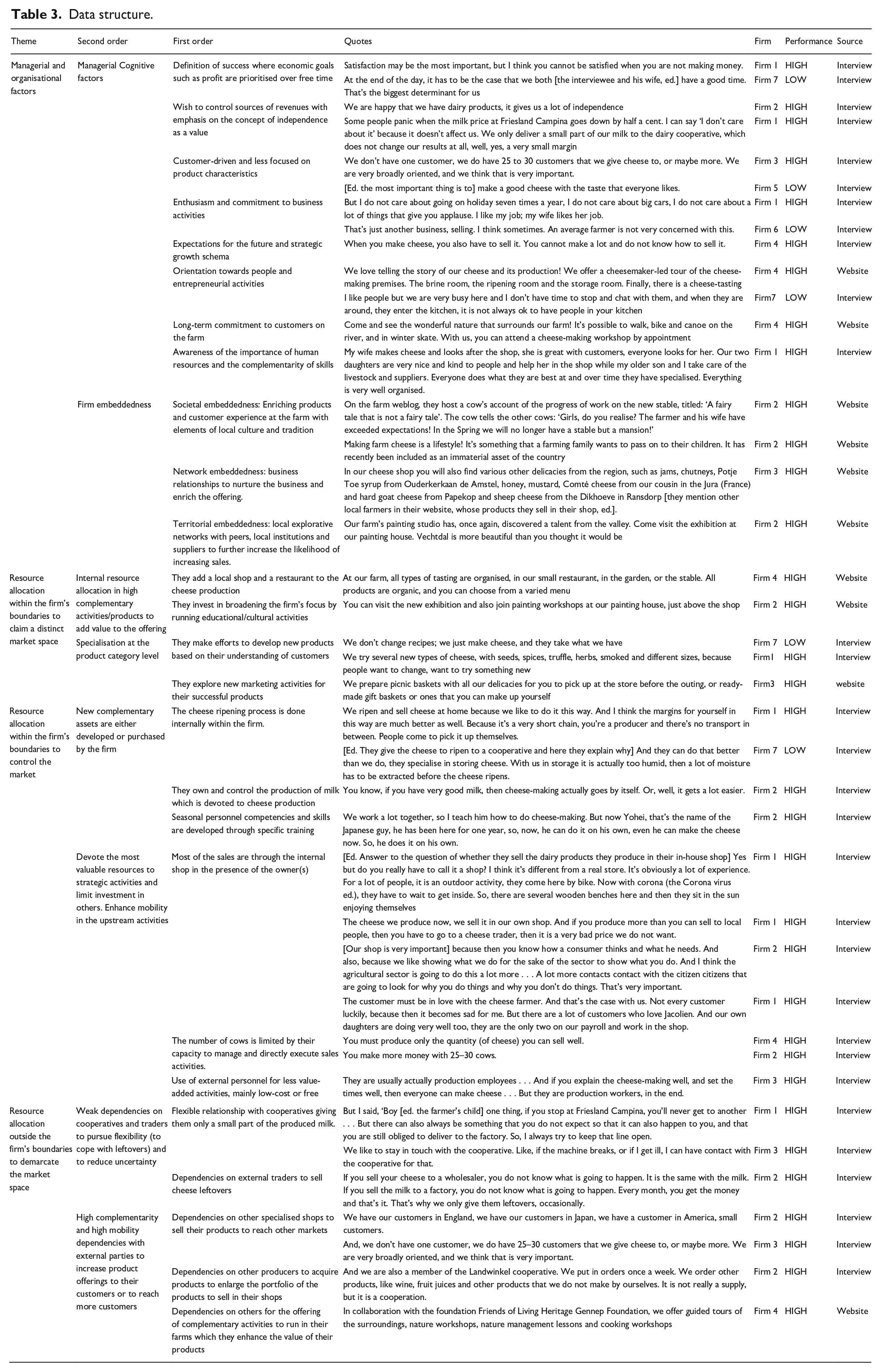
We then built on our data and current understanding of the phenomenon to identify how the aggregated themes were interrelated, and we developed a model of resource allocation decisions, their antecedents as managerial and organisational factors, and financial performance as the output construct. Following Locke (2012), we tested alternative conceptual frameworks until we assembled our categories into an overarching model that reflected the evidence. To increase the reliability of our overall interpretation, at various stages of the analysis, we routinely submitted provisional interpretations to several informants for feedback (De Massis and Rondi, 2020). In the following sections, we present our evidence and the interpretative framework that emerged from our analysis (Van Burg et al., 2022).
Findings
A comparative analysis allowed us to detect the main differences that led firms 1, 2, 3 and 4 to achieve higher performance levels than firms 5, 6 and 7. The iterative content analysis we engaged in, which involved first within-case and then cross-case analysis, resulted in the development of a grounded model of resource allocation choices by high-performing micro-firms, including three major components: managerial and organisational factors, including managerial cognition and firm embeddedness, firm performance and resource allocation choices. High performance is obtained by (i) maintaining a close link with customers through the formation of a learning network that includes their involvement, which gives the companies visibility on the market, in addition to (ii) designing and testing many new products and (iii) having high turnover and reinvesting it in innovation. A combination of resource allocation choices, expressed in terms of investment in a firm’s internal resources and external dependencies, distinguished firms that achieved high-performance levels from those that did not. Managerial and organisational factors justified the combination of successful resource allocation choices that we identified. Dynamically, the grounded model shows that high-level firm performance generates a virtuous cycle further reinforcing the selection of successful resource allocation choices, thus enabling firms with limited resources to construct and control a distinct market space and achieve higher performance levels.
In this section, we briefly describe the three key components – managerial cognitive factors and firm embeddedness, resource allocation choices and intermediate company outcomes – of our grounded model (see Figure 1) and the relationships identified between them.
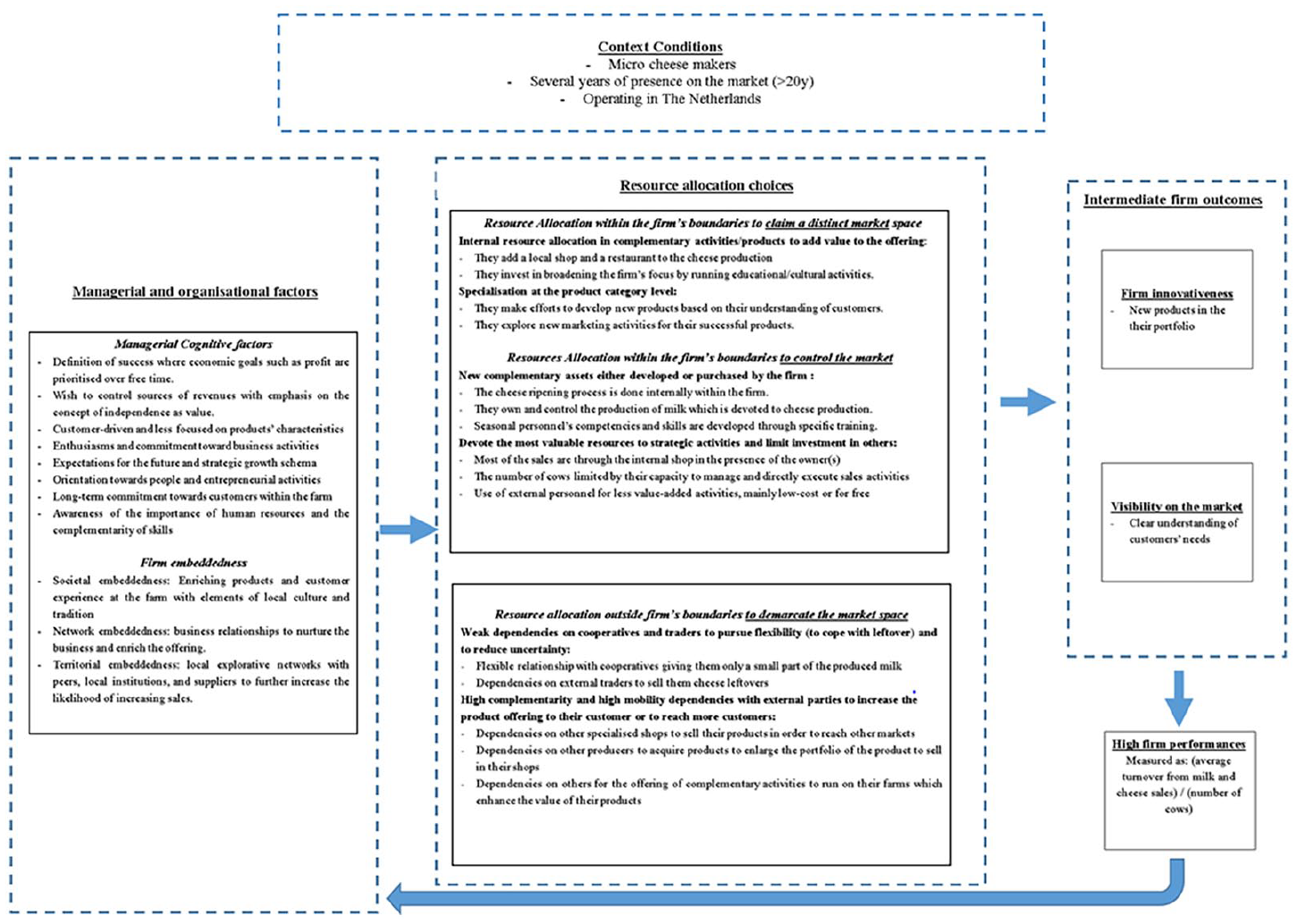
Theoretical model developed in this research.
Managerial cognitive factors
The connection between managerial cognition, broadly defined as the way managers perceive and process information, and strategic decision-making is widely recognised in the literature (Apfelthaler et al., 2011). Every manager develops different pictures of reality based on differing interpretation mechanisms (Hodgkinson and Sparrow, 2002), and develops and employs cognitive structures, schemes, models and/or knowledge structures to interpret a variety of complex and ambiguous streams of information and carry out effective strategic decision-making. The coding we conducted on the interviews revealed several factors attributable to managerial cognition which are profoundly different between high performers and low performers, and these could explain some differences in strategic decision-making.
Defining success, where economic goals such as profit are prioritised over free time
This refers to the commitment that the owners of the firms have towards economic returns as the main driver of their actions. In the group of high-performing firms, each owner–manager considered economic returns to be a significant aspect of their decisions on how to allocate future organisational resources. The owner–manager of Firm 4 (a high-performing firm) reported:
Yes, so if we want to grow financially, we have to add a property. And then hospitality is the most obvious.
In the low-performing firms, the owners also attempted to organise their work based on the time they intended to allocate to their business. Therefore, the availability of free time and being able to benefit from high-quality standards regarding a good work–life balance can limit and condition the investment of resources in the firm. For instance, the owner–manager of Firm 7 (a low-performing firm) said:
We need to have holidays. So, it is nice to be able to have that. On Saturdays and Sundays, the milk goes to the factory, so we do not have to produce cheese then . . . If in July, we produce less because we go on holiday with our family, that also needs to be possible, otherwise we do not want to do this. It has to be fun . . . Last year, we tried whether we wanted to package it ourselves, but it is a lot of work and a lot of regulations. So, it’s easy for us just to be able to sell all the cheese to traders. We are looking for a reduction in working hours because that’s a lot now.
The wish to control sources of revenue with more emphasis on the concept of independence as a value
This regards the establishment of a decision-making framework for pricing and the products to be sold, with a clear intent to maintain a particular responsibility for the long-term value creation of the firm. For example, in high-performing firms, the owners were willing to keep key decisions and activities as their sole responsibility when they related to the strategic planning of the sale of their products and maintenance of all marketing operations. They collected significant information from their customers and decided the price of their products based on their understanding of the contingencies of the market. For example, the owner–manager of Firm 2 (a high-performing firm), claimed:
We can make our price and it is nice to know where the food goes. If you sell your cheese to a wholesaler, you do not [know] what is going to happen. It is the same with the milk. If you sell the milk to a factory, you do not know what is going to happen. Every month, you get the money and that’s it. And now you are responsible for your product, you have customers, and you like that your customers are happy.
In the low-performing firms, managers did not feel capable of attracting customers with their products, as they had a lower level of understanding of the market dynamics, which inhibited them from the very start from taking sole responsibility for the long-term creation of value for their products. To reduce the risk of failing in the market, they preferred to engage with external parties both for their cheese and for their milk. For instance, the owner–manager of Firm 5 (a low-performing firm) said:
We also have purchasing certainty. That cheese is always taken away, they pay on the quotation, so the price never has to be negotiated, there are already agreements about that. And then you know where you stand . . . We never have to peddle that cheese either. You know, every week we bring cheese away all at once. Nowadays it works a bit to order, but little stuff. Actually, we have regular customers to whom we sell the cheese.
Customer-driven and less focused on product characteristics
In the high-performing firms, all the owners captured value through direct interactions with customers. Every owner liked spending time chatting and getting to know their customers. As the owner–manager of Firm 1 (a high-performing firm) said:
When the store is open, I do know a lot of customers well. And then I have a chat with everyone or a little chat with some of them.
These interactions were mostly aimed at serving their shared interest in improving their products and services by understanding the customer better:
We think it’s important to know why customers come to us and why they do not come. We also find it interesting how that works, how that marketing works. If you’ve tried something like: does it work or doesn’t it work? Or what works well and what doesn’t work well. And why does it work or why not? And I find that very interesting to figure out and to see that. By trying what works.
In the low-performing firms, owners were primarily driven by their product, focusing their attention on the selection of ingredients and ignoring market dynamics. For instance, the owner–manager of Firm 7 (a low-performing firm) said:
We have been extensifying over the last few years. More emphasis on cycle, and nature, which keeps us busy a lot. You are also being steered a little bit and I think you should just go along with that and maybe be ahead of it, on the developments.
Enthusiasm and commitment to business activities
This refers to the commitment that different managers show regarding the creation of value in their firms. In high-performing firms, owners were very engaged with the business and felt satisfied with their performance. Indeed, they felt their interventions in operations were important to design and lead the way for much-needed improvements, as the manager of Firm 2 (a high-performing firm) stated:
At the moment we are satisfied. Things can always go better but at the moment, we are satisfied. We still would like to improve the number of customers, improve the quality of the cheese, and improve many things.
In the low performers, the interviewees were mostly driven by their specific personal interests, such as just enjoying their work or by the need to support their family. They did not manifest high-level economic interests or focus on making their businesses successful. For instance, the owner/manager of Firm 7 (a low-performing firm) stated:
You do feel a little responsible for maintaining the family business. Although I have to say, the motivation, we do ask ourselves more and more often. We wonder what our motivation is to continue.
Expectations for the future and strategic growth schema
The key element in the operational planning of the high-performing firms was a schema of business growth that includes a comprehensive plan for future expansion, as highlighted by the owner of Firm 4 (a high-performing firm):
It can be nicer if we sell it 100% here [ed. in the internal shop], then we earn more money. We are building a stable for the heifer. The heifers are now in another village and when that’s ready we only have one farm building, in the middle of the farm, we want to build a stable restaurant where people can buy and drink coffee, homemade cake, and eat homemade soup.
Conversely, owners/managers of low-performing firms were more preoccupied with their financial situation and risk avoidance behaviour. They adopted a mental schema more oriented towards achieving efficiency in the use of their internal resources, as the manager of Firm 7 (a low-performing firm) stated:
Increase milk production without increasing the number of cows; build a cement silo to ripen grass and increase milk production. That is our plan is to build some concrete things. And also maintain quality, which is the main. Cheese quality has to be good, and everything will be good.
Orientation towards people and entrepreneurial activities
More generally, the owners of high-performing firms reported that they made explicit attempts to engage with customers. Both low- and high-performing firms value interactions with customers. However, the high-performing firm owners saw interaction with customers as mandatory whereas, many of the low-performing firm owners claimed not to have time to do so. Again, the owner/manager of Firm 5(a low-performing firm), told us:
I think the contact with the people, and telling your story should be good. I often don’t have time for that now. But the first few years you were in the store, so many people came in ‘Ooh let’s take a look’ and ‘Nice, do you make cheese here and how do you do all that?’ And if you had time, you’d tell them. Nowadays I don’t have time for that at all, especially on Saturdays.
In contrast, the owner of Firm 1 (a high-performing firm), as an entrepreneur, worked in the background and spoke to customers in the shop. As the owner–manager of Firm 1 (a high-performing firm), told us:
When the shop is open, I always take the opportunity to drop by and chat with customers. Above all, I tried to find out if they liked the new cheese flavours, and what they liked best and least. It's important to understand how to move forward.
Additionally, he looked after what he considered the most important element of his businesses – keeping track of finance:
That’s important to keep a close eye on accounting and finance.
Along similar lines, the owner/manager of Firm 7 (a low-performing firm) mentioned these as his strengths and weaknesses:
My strengths: I think the whole treatment with the animals, keeping animals healthy. So, the whole management around the cows. I think my weakness is the organisational part.
Long-term commitment towards customers within the farm
The main focus of the farmers in the group of high performers related to customer care aiming to keep them on the farm longer, creating means to attract and retain customers. Thus, on the one hand, we found that, from the very beginning of their activity, high performers were deeply involved and liked having interactions with the customers on the farm. For example, the owner of Firm 4 (a high-performing firm) said:
It is already busy here, so we are not necessarily talking about attracting more customers, but financially it is more interesting to keep the customers with you a little longer. Then, in addition to the groceries, we can keep them a little longer and buy some goodies; they are already buying coffee to go and ice creams.
On the other hand, low performers did not appreciate the presence of customers around their farms. As the owner of Firm 7 (a low-performing firm) told us:
From the municipality, we have also been approached to give tourists a tour here, but we didn’t like that . . . You work to run that whole business and then of course they want to come exactly during your harvest work or something like that and we didn’t really like that.
Awareness of the importance of human resources and the complementarity of skills
Our analysis reveals that having different partners or employees who possess diverse and distinctive competencies, such as an inclination to interact with customers, is not evident in all micro-firms. Our comparison of the two sets of firms, that is, the high and low performers, revealed why this is not always the case and how it influences the choice of whether to invest in external parties to deal with customers. For instance, the lower performers did not have complementarity or knowledge integration between different employees. In general, they tended to take care of livestock management and cheese production personally and mostly employed seasonal workers, or college students, who did not bring specific skills but performed various simple tasks as needed. Lacking higher level skills among employees, and being overwhelmed by farm work themselves, the low performers employed intermediaries to reach the market and limited farm shop opening times leading to very low volume turnover. By prioritising backstage work, they also forewent the only opportunity they had for direct customer contact in the shop, where they generally employed poorly trained young people. In the words of the owner of Firm 5 (a low-performing firm):
They say you have to use your best staff on the busiest days. And if you have a 16-year-old girl all day who does not really know what to say, some people drop out. People like themlove chatting, and if you remember half of what they say, then that is fine, you have to see it as your work.
Instead, high performers fully exploit and implement their internal skills to improve their business and the quality of their services. For example, the owner of Firm 1 (a high-performing firm) reported about the organisation of the work on the farm:
We started a very small company with 16 cows, more or less, and then by chance one or two years later a cheese factory came our way. We seised on that, especially my wife Jacolien. She makes the cheese and also has the shop under her care, and together we do it this way. And we’re both directors, shareholders, just how you want to name it, it’s a small company. Since August, our eldest son has also joined our company, so we now have a general partnership (VOF) with the three of us. Is that enough?
Moreover, regarding relationships with the customers on the farm, he said:
Jacolien is very good with people. I had once read a piece in a magazine, and it said: ‘The customer must be in love with the cheese farmer’. And that’s the case with us. Not every customer luckily, because then it becomes sad for me. But there are a lot of customers who love Jacolien.
Firm embeddedness
Embeddedness, identified as the nature, depth and extent of an individual/organisation’s ties to the environment (Jack and Anderson, 2002; Wilson et al., 2022), has been conceptualised as consisting of three interdependent dimensions: societal, network, and territorial embeddedness (Hess, 2004; Wood et al., 2019). Societal embeddedness is the local/regional/national culture of the organisation and depends on its history; network embeddedness refers to the connections the organisation has with heterogeneous actors and is described by its spatial dimension, which derives from the physical location of the actors; territorial embeddedness is seen in the localised manifestations of networks, i.e. the extent to which the organisation is anchored in local consumer markets and cultures, local labour markets, local business networks, connections with area associations, local institutions and logistics and supply networks (Wood et al., 2019).
Societal embeddedness: Enriching products and customer experience at the farm with elements of local culture and tradition
High-performing firms are deeply rooted in the culture, traditions and customs of their home region and enrich their offerings through this connection to the land. This wealth of content, values and traditions translate into storytelling narratives about their farms and products, as well as contingent action plans to attract customers and have them spend a pleasant time on the farm. In some cases, they can formulate a competitive strategy that goes beyond selling cheese and aims to anchor the firm’s scope to a broadly acknowledged set of societal values or cultural interests. For instance, the owner of Farm 3 (a high-performing firm) revealed the presence of a coordination plan linking cheese-making to the arrival of tourists on the farm.
Making cheese depends on the date of production and the time the guests come, of course, but we always demonstrate clog-making. And the guests who can, will then taste all our cheeses and hopefully buy them, which is the intention of the whole story of course.
In general, high performers were able to leverage characteristic elements of Dutch culture to enhance the tourist experience on their farm, beyond the purchase of good products. Again, in the words of the owner of Firm 3:
At the end of the day, it’s a tourist business. I mean we are just in front of Volendam so normally there is no shortage of tourists. And well, we are also really typical Dutch, we also normally wear the Volendammer costume when we are working. In most places where we are working. And it’s all quintessentially Dutch, so the cheese and the clogs and nice souvenirs. And also, in the workshops we all have that typical Dutch touch.
Network embeddedness: The presence of business relationships to nurture the business and enrich offerings
Personal and institutional relationships are important assets in shaping the business choices of the group of high-performing firms. These networks offer important, distinctive support that increases the probability of selling their products and extracting additional earnings to cover cost overruns. Indeed, this is something that the owner of Firm 3 (a high-performing firm) indicated:
We have contracts with tour operators that come by with the groups they bring to the Netherlands. But in general, we have just verbal agreements. In that respect, which is still quite normal, that it is not all on paper, that they have to pass through here and stop, I mean. Because generally having to intervene and be allowed to intervene is a bit of freedom that the driver and the guide, who is with the group, would like to keep, let me put it that way . . . We also visit fairs for the tourist part, mainly business-to-business. So just tour operators to buyer-supplier fairs.
Through these networks, high-performing firms can also collect ideas to enrich their businesses further with value-added and complementary activities, as the owner–manager from Firm 4 (a high-performing firm) reported to us:
Complementary activities came from being enthusiastic, and the demand for tastings and tours came [to]us. However, it has to be fun, if we could not or did not want to, then we would not have done it.
Networking is also relevant for low-performing firms, but their system of relationships is mainly political, aimed at improving their relationships with their local area, as the owner of Firm 7 (a low-performing firm) states:
We are alsomembers of the promotional association, which is from the municipality. That is what we do. I started an initiative with a bike ride-along, there are 20 cheese farmers nearby. So, we took a bike ride and started a kind of collective. I’m always looking for a connection to the environment.
When a certain need for personnel emerged in high-performing firms, it was addressed by using their network to hire and even expand their market. For instance, the owner of Firm 2 (a high-performing firm) says:
For many years we have been working with foreign students, maybe 30 years. And that’s from everywhere. That could be someone from Germany, from Russia, from Mongolia. Really from anywhere, all over the world. Africa, too. And sometimes you have contacts for that. And because you’re interested in it, sometimes it goes by itself.
Territorial embeddedness
This is the goodwill produced by the local relationships, both formal and informal, that managers can use to obtain resources and information (Adler and Kwon, 2002). Indeed, both formal and informal local business relationships provide managers with channels to convey information that may help detect new opportunities (Adner and Helfat, 2003). In the group of high-performing firms, relationships with other people in their community seem to be not only informal but also strong, as they are characterised by frequent interactions that are motivated by the pleasure the owner/managers experience when interacting with others. These local interactions are crucial to ensure a significant flow of information regarding the community. Accordingly, the owner/manager of Firm 1(a high-performing firm) reports:
Well, we have not lived here very long, but we basically know all the neighbours. Because many neighbours also come here to buy our products, and they also meet here tosocialise, this is also a meeting point. I like that, too. I have a famous Dutchman nearby and he also visits every week with his wife and children. For him, too, because he integrates like that.
This is not the case with low-performing firms, whose connections with others are driven more by their explicit interest in collecting useful information for their business. Thus, the purposeful relationships they start are more formal and with entities strictly related to their activities, as stated by the owner of Firm 5 (a low-performing firm):
It’s not like we’re just on the farm. Harry (ed. the son) is indeed on the board of De Producent (ed. a local cheese cooperative). That’s fun, but also to keep up. You (ed. the husband) are also on the board of the Buurthuis, the neighbourhood association.
This has an impact on the firm’s understanding of the market dynamics developing at the local level. Indeed, the owner/manager of Firm 5 (a low-performing firm) seemed unaware of the local competition:
Nowadays, of course, you have a lot of farmers who also make fresh cream cheese, or with red crust or I don’t know what. But nothing to do with what we do. Coincidentally, I talked to someone this week who said, ‘There are a few around here who make Gouda cheese, but I’m not going there anymore because everything tastes like that cheese’. I won’t respond to that, but of course, there is such a risk.
Resource allocation choices
Allocating scarce resources is a critical task for managers; such allocation choices can help explain the heterogeneity of firm performance. It appears that successful owners of micro-firms adopt a uniform approach to allocate their resources across organisational boundaries. Our findings indicate that resource allocation choices have three different aims: (1) claiming a new and distinct market space by developing new, complementary activities that leverage the firm’s internal resources (see second-order code: use of resources in high complementary activities/products to add value to their offering), and by experimenting with new products (see second-order code: specialisation at the product category level); (2) demarcating this new market space by allocating resources outside firm boundaries and establishing alliances with surrounding organisations to create an architectural advantage, that is, barriers to imitation. Moreover, these relationships help the firm reduce uncertainty, handle variations in demand and achieve economies of scale (see second-order codes: weak dependencies on cooperatives and traders to pursue flexibility and reduce uncertainty; high complementarity and high mobility dependencies with external parties increase product offerings to customers or reach more customers); (3) controlling the market by allocating resources within the firm boundaries, focusing on upstream activities, and developing internal resources to use as slack for downstream activities (see second-order codes: enhancing mobility in upstream activities; complementary assets are either developed or purchased by the firm).
Claiming a new and distinct market space
The high-performing firms operated with more complex business models that enlarged the original concept of the firm. Most of them added a local shop or restaurant to keep customers at the farm longer and to control sources of revenue. They invested time in customers, telling them the story of their farms and their products. In some cases, the owners tried to give their activities a social meaning by providing social services, such as employing people with specific health needs or who benefitted from proximity to nature. For instance, Firm 4 (a high-performing firm) enriched their business by organising activities around tourists visiting the farm offering souvenirs for purchase and the opportunity to undertake specific tasks on the farm. They invested time in creating a special Dutch atmosphere for tourists and thereby enhanced the value of their products. As the owner of Firm 3 (a high-performing firm) told us:
We are a cheese farm, a clog factory, and a tourist company. So normally we receive busloads full of tourists from all over the world . . . And well, we are also really typical Dutch, we also normally wear the Volendammer costume when we are working. In most places where we work. And it is all quintessentially Dutch, so the cheese and the clogs and nice souvenirs. And also, the workshops we do all have that typical Dutch touch. So, for a real Holland experience, you can get your money’s worth at . . . yes. Look, producing cheese is part of that. But at the end of the day, everything around it is much more comprehensive.
Nonetheless, this initial cost also produced additional benefits, such as helping farmers better understand their customers and design new products. Indeed, most of the high-performing farms regularly tried new products and had a broad portfolio of products. For instance, the owner/manager of Firm 2 (a high-performing firm) reported:
Well, we develop new products, yes variations. We make cheese with grape must. We have cheese that ripens in a bunker. Down the road, we have a bunker from the Second World War and there we bring cheese, and it is smeared with a bacterium. And that’s how we do different things every time.
In the group of low-performing firms, the owners/managers were more focused on upstream activities and cultivated their passion for working with animals and for producing cheese. As such, they had little time to interact with customers or consider ways to find new markets or create distinct ones in which they could become a point of reference. Their products were also quite traditional, with almost no variation, as the owner/manager of Firm 7(a low-performing firm) stated:
We just make cheese, and they take whatever we have . . . I don’t have any arrangement, or we don’t have any obligations to deliver a certain amount of kg. They just take what we have to offer. That’s very nice, that’s very flexible.
Demarcating new market space
The owners/managers of micro-firms were surrounded by powerful milk cooperatives and traders who threatened to influence their market, or act as competitors. Our data suggest that the owners/managers of high-performing firms attempted to avoid competition within their market by involving these firms through the following specific alliance mechanisms. (1) Revenue-sharing agreements with other craft enterprises in the area. These agreements involved the purchase of others’ products to enrich the product offerings in their shops and never risk running out of cheese to sell. In the same way, they introduced their products to other local shops. (2) Limited investment agreements allowed traders or cooperatives to buy their leftovers, enabling these firms to benefit from selling their products without crossing the boundary of the enterprise’s market space. In this way, at the expense of giving up total ownership of their product, since the firm is no longer the sole distributor, owner–managers can reduce uncertainty (e.g., missed sales due to illness, vacation, etc.), and limit any incentives for these traders to become their competitors. (3) Positioning agreements were boosted, especially in situations where the firm perceived the opportunity to dominate adjacent markets thanks to their specific assets, such as geographic location, facilities, and competencies. In this case, owners/managers tried to get others to join them and undertake joint activities on the farm. Firm 4 is a notable example, in this regard. They have a special contract with the municipality and healthcare institutions to which they offer educational farm experiences for schools and the opportunity for psychiatric patients to do simple work on the farm, in contact with nature and animals, under the guidance of their educator–nurses and the supervision of farm staff. The extract that follows partly describes their relationships with external parties that contribute to doing their business:
We are small on the one hand, but very wide on the other. Because: we have care, nature management, horticulture, dairy cattle, processing, the shop, education in the sense that we are a city farm and are accessible to visitors all day 7 days a week . . . We started that with a healthcare institution, they do the care content guidance and the whole financial part with PCBs (public funds, ed.), or what kind of money they have. So that we do not have to do that piece, but that we can offer the work with some of the guidance. But not everything behind the scenes that comes with that.
Controlling the market
Given the possible competitive threat from rival firms, our data show that owners attempt to control their markets by filling all the spaces in their target market through specific resource allocation choices within firm boundaries to create a structural advantage. This is achieved through three main mechanisms: (1) allocation of owner resources (time and commitment) to value-added activities, such as direct customer relationship management, to monitor their latent needs and evolving tastes; (2) acquisition (and development) of human resources to allocate to upstream, low value-added activities, to be able to focus precious managerial resources mainly on downstream activities; and (3) blocking the entry of other firms by undertaking the whole cheese production process in-house, including cheese ripening and selling. Indeed, the risk that traders could easily enter the market and claim high-profit margins is clear in the words of the owner of Firm 1, who reported that ‘The margins by doing it themselves are better’. To retain the total ownership of the product, they prefer to internalise the cheese ripening process and increase cheese production by buying milk (although they are farm cheese producers, they are allowed to buy a limited quantity of milk from other farmers) instead of investing in more cows, which would absorb additional resources in low value-added activities. Another example, in this regard, is Firm 2. They use external, part-time employees to look after the cows and cheese production:
They will have a look at cheese or cows, but mostly he [ed. the husband-owner] milks the cows in the evening, and during the daytime, he works on cheese.
Instead, considerable work downstream was shared between the two owners, that is, a husband and wife:
I do office work, take phone calls, wash cows, and do work on the farm. Sometimes, I chat a little with customers in the store or talk to students like you. My wife does shop work, but she also does marketing work. My wife makes leaflets or websites or paintings.
His wife was an artist, and this talent was also emphasised in the farm’s branding and mission statement, as presented on their website:
Cows, Cheese, and Art are the 3 pillars of our farm. (Firm 2 website)
In this manner, this owner’s artistic inclinations also became a side business on the farm. The owners even renovated the room above the store, which became a painting studio where temporary exhibitions were hosted, and children’s painting classes were organised. The farm’s Facebook and Instagram pages contain, in addition to many photos of cows and newborn calves, images of the tables where customers taste cheese, and several photos of paintings with nature subjects.
Intermediate firm outcomes: Visibility on the market and firm innovativeness
The main challenge high-performing firms faced was the design and production of new products deriving from a clearer understanding of customer tastes and needs. In particular, we found that, in such firms, the owners considered their interaction with customers an important source of information, providing considerable insight regarding novel products.For example, the owner of Firm 1(a high-performing firm) said:
Feedback of course is very important . . . The small sizes, people want them for presents. People want small baskets with a lot of stuff. They give it as a present.
In the same vein, the owner of Firm 2 (a high-performing firm) said:
You have to try to get a little better in your product and the service to your customers. And come up with new things regularly . . . New cheese flavours. Each village almost has a local brewery, which brews beer locally, everywhere you will find them in the Netherlands and also in this region. And we sometimes make beer cheese. . .. Some time ago we had a Japanese guy on the farm. At that time, we made seaweed cheese and soy cheese. . . . People liked it. Or, at least, they liked telling the rest an exciting story at a drink in the evening, that he had spoken to such a Japanese and tasted a new fantastic cheese.
On the other hand, low-performing firms, as they had limited interactions with their final customers and focused on B2B business, with limited demand, had a poor understanding of the market and how to evolve their product portfolio accordingly. A notable example is Firm 5 (a low-performing firm), which had interactions with just one trader and limited their product variation to different product sizes:
We all make sixteen kilos, but there is one customer, De Producer, who wants to have bigger ones, so we make them 18 kilos. Also, on request. We also make kilos; we don’t go smaller than a kilo. And that’s all for the store. Kilos, two kilos, three kilos, four kilos. And we often make those four kilos with herbs. Twelve kilos we never actually make.
The relationship between high firm financial performance and resource allocation choices
The grounded model in Figure 1 illustrates a positive relationship between firm financial performance and the effect it produces in resource allocation choices. This is confirmed by both cohorts of firms. Our evidence, for instance, shows that when facing limited financial performance, firms attempt to optimise the use of their internal resources, as explained by the owner of Firm 7 (a low-performing firm):
Always optimising. We do not want to expand our business to more cows or more milk. More milk may be from the same number of cows.
More elevated business goals and the prospect of bigger investments within the firm are contemplated by firms with high financial performance. In this case, for instance, the owner of Firm 4 (a high-performing firm) reported:
Our mission is to produce good biodynamic healthy products in harmony with the earth, and the soil. So, we do not only produce good products, but we also take care of the soil.
Moreover, speaking of investments, the owners of Firm 4 said:
We are working with the municipality and architect to initiate a permit application for a small building where we can start simple catering. Look: you can buy cheese from us in the store, you can buy bread which has been ground by the watermill next to us and baked by the organic bakery in the city. But a cheese sandwich just can't. We noticed our customers miss it.
Discussion
Our theoretical model, reported in Figure 1, outlines a holistic view of how micro-firms achieve high performance through processes of resource allocation. It explains how high-performing micro-firms, relying on specific managerial cognitive factors and a high degree of firm embeddedness in their social context, collect information. Using this information, they identified specific strategic problems to which they allocated internal and external resources. We found that high-performing micro-firms adopted specific resource allocation processes to address the following strategic problems: (1) claiming a market, (2) controlling the market and (3) demarcating the market. To claim a distinct market space, resources were distributed through novel organisational arrangements enhancing the value of their focal products (e.g. a new shop, new products to enrich their portfolio and new marketing activities to penetrate the market). Indeed high-performing micro-firms allocated resources to structural assets and to the direct management of sales; this allowed them to appropriate most of the value generated and fuelled their entrepreneurial action with first-hand data from customers. To control the market, they optimised and exploited the value of their internal resources (e.g. caring about personnel competence acquisition, controlling the production of milk to use for cheese production, doing the ripening process internally to control the entire production process, and engaging personally in customer-facing activities to increase their customer knowledge).
To demarcate the market, they invested resources in developing alliances with external parties, such as cooperatives, to reduce uncertainty and deepen engagement with customers by, for example, distributing products at other points of sales, selling others’ products in their shop and so, offering new experiences to customers. Specifically, high performers, well aware of the scarcity of internal resources that characterise them as micro-enterprises, developed relationships with other local entities characterised by high complementarity, that is, high value obtained from the combination of assets, but equally high mobility, that is, high substitutability of assets. This was possible given a high degree of territorial embeddedness facilitating relationships with other local organisations, for which they had a plurality of available options. Allocating resources to business relationships with other local outlets in addition to increasing the value of the offering, served to demarcate their market space by curbing possible imitation attempts and achieving a distinct advantage. Moreover, the value afforded to firm independence and autonomy enabled them to avoid ‘lock-in’ situations, favouring relationships characterised by little, or no specific investment, geared towards increasing reach without compromising flexibility and end-market visibility. This is evident, for example, in the reciprocal agreements established with local cooperatives and businesses to sell the products of others in their stores (enriching supply and reducing stock-out risk) and to sell their products in other local stores (expanding their market and awareness).
Similar considerations can be made for the relationships established with milk cooperatives and cheese merchants, geared towards increasing flexibility without compromising relationships with end customers. Indeed, our evidence reveals that low performers are bound by exclusive contracts with cooperatives and traders who, in cases of early product deterioration, return them – obliging micro-firms to absorb all the risks from transactions with final customers but without the benefits, in terms of market visibility, that direct sales deliver. Generally, high performers can reap the benefits of embeddedness by establishing virtuous external relationships enabling them to appropriate the value generated. In contrast, low performers are victims of the ‘dark side of embeddedness’ (Carsrud and Johnson, 1989) locking them into exclusive relationships that blind them to the end market. Thus, they are unaware of the true value of their products for end customers, making them insecure and unable to produce innovations.
By illustrating the multiple resource allocation decisions across different strategic problems the model also illustrates the pattern of ties allowing firms to survive and perform well. Our model shows that high-performing firms draw on free resources in the environment, accessible through their rootedness in the local community, traditions, and culture, to enrich their products and extend the meaning of their presence in the area. Our model also highlights the cognitive managerial factors, such as customer orientation and openness to personal relationships. This illustrates a tension between customer satisfaction, that justifies managerial entrepreneurial action, and the constant inflow of information feeding it. Indeed, managers filter and process such information to generate the business knowledge that guides strategic resource allocation choices towards the creation and control of a distinct market space. High performers are fully aware of the particular value of their products and what stages of the production and sales cycle need to be overseen to control value generation and the distribution process.
Theoretical contributions
In summary, our research shows consistency in the resource allocation choices of high-performing micro-enterprises, which, influenced by the cognitive characteristics of their managers and firm embeddedness, are nonetheless oriented towards defining, protecting, and controlling a precise market space. While the importance of clear strategic positioning in a competitive market is widely known in the literature (Porter, 1980), it is worth emphasising this further in the case of micro-enterprises, to which the literature often affords an intuitive, unstructured, chaotic, and unsystematic strategic decision-making process (Gibb and Scott, 1985; Jocumsen, 2004; Liberman-Yaconi et al., 2010). Indeed, studies on this specific category of firms attribute their difficulties in making informed strategic decisions, and the consequent need to rely on leader intuition, to the scarcity of resources and dispersion of information (Kelliher and Reinl, 2009; Liberman-Yaconi et al., 2010). Despite our findings highlighting the pivotal role of owner–managers and their cognitive characteristics in decision-making processes, we highlight how high-performing micro-firms engage in strategic processes that not only involve these actors, but also focus on the systematic collection of information. This information-gathering is crucial for informing resource allocation decisions that align with precise strategic positioning. The cognitive characteristics of the owner–manager play an important role in interpreting the context; however, we observed that these same characteristics lead them to continuously gather information and increase their embeddedness in the local environment and social context. Therefore, it seems that in high-performing micro-enterprises, rather than a manager’s intuition guiding strategic decisions, it would be more correct to speak of informed intuition (Akinci and Sadler-Smith, 2019). Hence, there is a non-rational but reasoned decision-making process which, according to Simon (1986: 107), has the potential to be ‘frequently correct’ or, at least, as effective as analysis under certain sets of circumstances (Hough and Ogilvie, 2005; Khatri and Ng, 2000).
The majority of the literature analysing the importance of resources available to organisations seeking to achieve competitive advantage has focused on large, medium, and small firms (Kelliher and Reinl, 2009). Our research contributes to this body of knowledge by focusing on the role played by resources in micro-firms, which deserve special attention due to their distinctive traits, that is, scarcity of resources, flat organisations, dispersed information, and owner/manager-centred decision-making (Edelman et al., 2005; Kelliher and Reinl, 2009; Kevill et al., 2021). A more detailed understanding of the role of resources in this context is especially pressing considering the significance of micro-firms in the overall wealth and development of countries and given their total number (Kelliher and Reinl, 2009). Verreynne et al. (2016) highlighted strategies of resource allocation treating ‘participants’ as carriers of organisational solutions and problems (Carley, 1991), rather than emphasising the emergence of processes focusing attention on problems, through the identification of actors and their respective levels of authority, delegated to address particular strategic issues. Despite the fact resource allocation has been recognised as central for sustained competitive advantage and performance, it has thus far been overlooked in the literature, as recently highlighted by Maritan and Lee (2017). Previous studies have analysed types of resource allocation and contextual drivers (Ahuja and Novelli, 2017; Danneels, 2007; Souder and Shaver, 2010), but a deeper understanding of how resource allocation occurs, and how actors are connected and drive strategic problems, has been somewhat overlooked. Using an inductive approach, we focused on managerial and organisational factors, highlighting the finding that both are crucial in understanding how resource allocation occurs to support high performance in micro-firms.Our model led to identify strategic issues, and processes regarding involvement, crucial in the absence of a formal workflow characteristic of micro firms (Lee and Edmondson, 2017). Moreover, we have recognised the significance of both internal and external resources for micro-firm resource allocation.
A further contribution of this study is to highlight the recursiveness of the model, whereby financial performance resulting from resource allocation choices in successful microenterprises helps finance new investments and strategic choices. These in turn led to new performance gains. In contrast, poorly performing micro-enterprises are inclined to make optimisation choices designed to reduce costs and minimise efforts regarding stakeholder engagement activities and product enhancement initiatives. Models of resource allocation in small firms to address performance implications (Brockman et al., 2019; Khan et al., 2021; Verreynne et al., 2016) typically fail to consider the role financial performance plays in fuelling information gathering, stakeholder engagement activities and the development of tactics and narratives with which to enrich their offerings. This leads to resource allocation choices geared towards further increasing the innovativeness of the enterprise and therefore, towards performance. Our contribution responds to the call for studies that explore the possible role firm performance plays as a feedback mechanism in resource allocation strategy, which encourages continued investment in this strategy (Symeonidou et al., 2022). However, our results also indicate that poor performance does not lead to a change in the resource allocation strategy. Low performers appear to repeat the behaviours that damaged their position in the market and forced them into conditions of dependence on cooperatives and distributors for financial security. In addition, most work to date has utilised quantitative methodologies (Dunkelberg et al., 2013; Khan et al., 2021; Symeonidou et al., 2022); thus, we have responded to calls for more case studies to provide a clearer understanding of strategic management choices in microfirms (Verreynne et al., 2016) by adopting a qualitative approach enabling us to shed light on the antecedents and mechanisms of resource allocation.
Practical contributions
Engaging in resource allocation choices means managing resources across firm boundaries to varying degrees. There are many practical implications in a more in-depth understanding of the nature of these demands for micro-firms, of the strategic issues attracting their efforts in allocating resources and of their approaches for collecting and processing relevant information. First, we argue that the approaches presented in our findings are important for owner–managers of micro-firms in many contexts. Similar implementations can be attempted in situations that share the difficulty of resource scarcity and a lack of formal and stable allocation of the human workforce. Second, our findings indicate that the boundary work practices and coordination structures at the basis of resource allocation choices in high-performing micro-firms constitute actionable knowledge that can be transferred into practical strategies and applications within various contexts. By leveraging this knowledge, individuals and organisations can make informed decisions, enhance their performance, and achieve their goals more effectively. Additionally, we have disclosed a set of tactics that owner–managers can adopt to facilitate the collection and renewal of important information to spread within their firms; these rely on the concept of social embeddedness. Although it might be tempting to consider the strategy-making process of micro-firms chaotic and unstructured, our work documented the importance of certain managerial cognitive factors in facilitating information processing and the benefit derived from the centrality of firms in their network of external ties. Therefore, our study also provides insights into how managerial cognitive characteristics are important to prevent negative outcomes from a lack of internal resources.
Limitations and further developments
Notwithstanding the above-mentioned contributions of this research, some limitations need to be acknowledged, though these pave the way for future developments. First, data collection was limited to cheese farms in the Netherlands, a choice that supported the consistency and comparability of data, but there is room to explore other sectors and countries to further generalise our results. Second, future studies might also consider the effect of firm age as another significant factor that can affect resource allocation. In addition, we have focused on financial performance to assess micro-firm high performance, but future studies may use other proxies of financial performance as well as other measures of performance. Moreover, a longitudinal case study, which would make it possible to analyse the phenomenon over time, might provide additional contributions to our research. Furthermore, we adopted an inductive approach that highlights how managerial and organisational factors related to the collection and processing of information can affect resource allocation choices in high-performing firms. Future studies could analyse this phenomenon further using a quantitative approach to measure the quantifiable effects of resource allocation.
Conclusions
The strategic orientation of organisations is significantly shaped by their resource allocation decisions, a factor that is particularly critical for micro-firms operating with limited resources and dispersed information. Our study of high-performing micro-firms uncovers the intricate interplay between management practices and organisational processes involved in information collection and processing. These processes underpin the structural mechanisms that support the boundary-work activities that are essential for effective resource allocation. By focusing on specific strategic issues, crucial for micro-firm survival and success in competitive markets, we provide fresh insights into the resource allocation choices of micro-firms. This article offers valuable contributions to scholars, managers and policymakers by enhancing understanding of the resource allocation dynamics in micro-firms and highlighting their implications for strategic management.
Footnotes
Authors’ note
Francesco Cappa is also affiliated to Roma Tre University, Rome, Italy.
Authors contributions
Maria Carmela Annosi: Conceptualization, Data curation, Formal analysis, Methodology, Visualization, Writing – original draft, Writing – review & editing.
Francesco Cappa: Conceptualization, Formal analysis, Methodology, Visualization, Writing – original draft, Writing – review & editing.
Silvia Massa: Conceptualization, Data curation, Formal analysis, Methodology, Writing – original draft, Writing – review & editing.
Antonio Messeni Petruzzelli: Conceptualization, Writing – review & editing.
Enzo Peruffo: Conceptualization, Writing – review & editing.
Funding
The author(s) received no financial support for the research, authorship, and/or publication of this article.
