







Abstract
Entrepreneurs who operate in contexts of poverty and informality are, in many ways, archetypal ‘outsiders’. By virtue of the resource deficits they experience, their acute lack of political power, and the overall precarity of their economic lives, they are profoundly marginalised. And yet, entrepreneurship in contexts such as this is frequently characterised by high levels of social embeddedness, suggesting that – rather than being fixed or mutually exclusive conditions – ‘outsidership’ and ‘insidership’ interact and intersect across different levels of analysis. Drawing on ethnographic data collected during fieldwork in an informal settlement in Nairobi, Kenya, this study explores how entrepreneurs navigate this duality.
Introduction
High rates of entrepreneurial activity are often observed in countries with low levels of industrial development (Naudé, 2010). This apparent paradox is now relatively well understood, insofar as it is driven in large part by inequality of economic opportunity: in wealthier countries, the availability and quality of wage employment are generally higher than in poorer countries, where the industrial base tends to be narrower and labour market institutions weaker (Acs et al., 2008). This inaccessibility of decent work pushes a large number of people into entrepreneurship (Dencker et al., 2021; O’Donnell et al., 2024), much of which is undertaken in the informal economy. It is a phenomenon that can manifest even more strikingly within developing countries, where the poorest and most marginalised districts – particularly in urban areas – become visible hotbeds of informal entrepreneurship (de Soto, 2000). But this explanation yields its own paradox. It is in essence a narrative of economic outsidership, whereby those who find their options circumscribed by inequalities in our global economic system turn to entrepreneurship as a means of income generation. However, structural inequalities of this kind do not make outsiders of individuals, rather they make outsiders of the communities and other social collectives to which those individuals belong, and herein lies the paradox. Social collectives that are acutely and chronically marginalised can play an important enabling role for the entrepreneurs that belong to them. So, whilst entrepreneurs that operate in so-called ‘base of the pyramid’ (BoP) settings are among the archetypal outsiders of the modern economy, research into their practices, and into the broader institutional architecture of BoP markets, shows that they are also embedded in rich sociocultural systems that enable and regulate their work (Slade Shantz et al., 2018; Sydow et al., 2022; Weiss et al., 2024).
BoP contexts, therefore, have the potential to reveal particular insights into the phenomenon of outsider entrepreneurship – not only because they constitute an ‘extreme case’ (Alvi et al., 2019) of entrepreneurial outsidership but also because they provide a rich illustration of the multi-dimensionality of outsidership. The macroeconomic inequalities that produce outsider entrepreneurs tend to do so by creating dense clusters of outsidership – in the form of deprived communities – which means that we must consider outsidership and insidership as two sides of the same coin if we are to understand the micro-level implications of those inequalities. In other words, we are forced to consider outsidership not only as a question of ‘I’ but also as a question of ‘we’. Similarly, the lens of outsider entrepreneurship is one that can yield new and important insights for research on entrepreneurship in contexts of severe poverty. Although much attention has been paid to the various ways in which communities enable and constrain entrepreneurial action in BoP contexts (Peredo and Chrisman, 2006; Viswanathan et al., 2010), much less attention has been paid to the fact that these communities play host to insider/outsider dynamics which are deeply complex (Bähre, 2007), and which are likely to have a profound impact on entrepreneurial practices and outcomes.
In this respect, our study seeks to move beyond an analysis of how entrepreneurial practices are influenced by the contexts in which they are enacted; taking the premise that ‘context matters’ as a point of departure (Welter, 2011; Zahra, 2007), we instead attempt to drill deeper into the question of why different entrepreneurs relate to the same context in different ways. To provide a theoretical grounding for the intertwinement of insidership and outsidership, we draw from Giddens’s (1986) seminal distinction between a duality and a dualism. The paired elements within a duality – in the case of Giddens’s structuration theory, these paired elements were structure and agency; in our case they are insidership and outsidership – are assumed to be structurally inseparable, such that the interaction between those elements may make them mutually generative or mutually reinforcing. By contrast, a dualism tends to treat those paired elements as essentially separate and therefore, amenable to categorisation by dichotomy (Jackson, 1999). This point of view yields what we believe to be a novel and theoretically important starting assumption: rather than assuming that entrepreneurs will look to shed the status of outsider with a view to obtaining the status of insider (or even postulating that they might attempt to preserve their outsider status for whatever benefits it might bestow), we instead assume that entrepreneurs – particularly those operating in disadvantaged contexts – are both outsiders and insiders at the same time. Accordingly, our research question can be stated as follows: how do entrepreneurs operating in BoP contexts navigate the insidership–outsidership duality that stems from being embedded in a community that is itself acutely marginalised?
Data for the study were collected during two phases of ethnographic fieldwork – spaced one year apart and totalling four-and-a-half months – conducted by the first author in an informal (or ‘slum’) settlement called Mukuru, in Nairobi, Kenya. Beyond the fact that a slum represents a stark embodiment of poverty and marginalisation, there are several reasons why the community of Mukuru provided an appropriate empirical context for the research question at hand. First, Mukuru plays host to an extraordinary concentration of entrepreneurship, a large majority of which is undertaken on a purely informal basis. Second, the territorial boundaries of Mukuru are quite clear, as is the glaring disparity in the quality of physical infrastructure, services, economic opportunities and so on, between the slum and its hinterland. This socio-spatial boundedness supports at least a rudimentary delineation between ‘insiders’ and ‘outsiders’, which is important to our theoretical aims. Third, because Mukuru is a community that exists in an ongoing, decades-long state of rapid expansion, a large proportion of its entrepreneurs have experienced – or are somewhere in the midst of – ‘crossing the threshold’ between outsidership and insidership, which is something that may be less commonplace in more stable communities, particularly those in rural areas. Finally, entrepreneurship in Mukuru is sufficiently homogenous to reveal the kind of patterns and themes that underlie qualitative theorising (Chalmers and Shaw, 2017; Miller, 2011; Wiklund and Shepherd, 2011); yet, it is sufficiently heterogenous to enable a systematic analysis of variance. This, too, is core to the basic aims of our study.
The contributions of our study are threefold. First, we contribute to the emerging literature on entrepreneurial outsidership by re-imagining the insider–outsider dichotomy as a duality. More specifically, we examine how entrepreneurs cultivate and capitalise upon the solidarity that derives from collective outsidership, where entire social groups believe themselves to be marginalised. To-date, research has generally treated entrepreneurial outsidership as a function of individual difference, where specific individuals (e.g. migrants, people with disabilities, people from deprived backgrounds) are deprived of certain opportunities or privileges because they do not conform to a given social or cultural ‘standard’ (Miller and Le Breton-Miller, 2017; Neville et al., 2018; Santos et al., 2022). Surprisingly little attention has been paid to the fact that outsiders – peripheral as they may be within society at large – are often bound by geography, ethnicity or lived experience to each other. That is to say, outsidership creates in-groups, as the attributes, circumstances, interests or worldviews that constitute the social markers of outsidership come to double as the basic symbolic ingredients of collective identity (Haslam et al., 2005; Snow and McAdam, 2000). Whilst other literatures, such as those on the emergence of social and political movements (Polletta and Jaspar, 2001; Snow, 2001), have long seen outsidership as a cornerstone of collective struggle, the still-nascent literature on entrepreneurial outsidership has tended instead to frame the process of ‘breaking in’ as a relatively solitary one. Our central contribution of, therefore, is to bridge the literatures on entrepreneurial outsidership and entrepreneurial embeddedness (Jack and Anderson, 2002), and to illustrate that – far from being conceptual opposites – outsidership and embeddedness are deeply intertwined.
Linking this premise to the context of poverty and informality yields our second and third contributions, both of which pertain to the literature on entrepreneurship in developing world or BoP settings. Our second contribution is to provide much-needed insight into the heterogeneity of entrepreneurship in such contexts. Subsistence markets are often said to be characterised by the proliferation of informal micro-businesses which are virtually identical in their commercial offering, but there remains a broad consensus that underlying entrepreneurial processes are much more heterogeneous than extant research suggests (Dencker et al., 2021; Weber et al., 2022). In this article, we examine not only the ways in which entrepreneurship is embedded in our study community but also the ways in which it is embedded within various fragments of that community’s internal structure. In so doing, we explore different conceptualisations of community (Bacq et al., 2022) and consider how different notions of community emerge and interact. Our third and final contribution is to draw attention to the acute vulnerability of those for whom collective outsidership is compounded by individual outsidership, that is, those that do not perceive themselves to be embedded in any kind of relational network that might afford them some measure of economic security. Prior research in poor and informal contexts has emphasised how interpersonal networks and an overarching spirit of collectivism play an important part in attenuating the immense precarity that pervades people’s economic lives (Shepherd et al., 2021). Although our data lent some support to this view, it also suggested a need for researchers to theorise solidarity in a more nuanced way, and in a way that more effectively captures the often partial and contingent nature of solidarity amongst entrepreneurs (and between entrepreneurs and their wider community) (Bähre, 2007; Molyneux, 2002). Solidarity, mutuality and goodwill are rarely distributed evenly across societies or other social collectives (Fafchamps and Lund, 2003; Foster and Rosenzweig, 2001), and it is important that researchers and developmental practitioners avoid the simplistic (if morally appealing) assumption that generalised norms or proclamations of togetherness translate into an economic safety net upon which all members of a community can rely to a more or less equal extent. Within poor and marginalised communities, as within communities of other socioeconomic status, cliques, rivalries and patterns of interpersonal exchange serve to make insiders of some and outsiders of others. Understanding how entrepreneurs navigate outsidership within social contexts that are themselves socioeconomically peripheral is vital in our wider efforts to unpackage the role that entrepreneurship plays in alleviating poverty and vulnerability.
Theoretical background
The uneven distribution of economic development in the past 30 years or so has brought improved living standards to more than one billion people in Asia, Latin America and Eastern Europe, whilst causing another billion plus people, most of whom live in Sub-Saharan Africa, to become increasingly disadvantaged (Collier, 2007). Within 10 years, 9 out of 10 people in extreme poverty will live in Sub-Saharan Africa (World Bank, 2019), with ‘the urbanization of poverty’ (Ravallion, 2002) continuing to spawn pockets of acute economic disadvantage in larger cities. More than three-quarters of adults living in Africa’s urban centres earn a living from the informal economy 1 ; of that number, more than half are self-employed (ILO, 2018). In general, informal entrepreneurs operating in developing world cities live deeply precarious economic lives. The overwhelming majority of informal enterprises are small in size, with many operating in ultra-congested markets characterised by low levels of differentiation, strong reliance on local knowledge and resources and exposure to a wide array of environmental shocks (Alvarez and Barney, 2014; Morris et al., 2022). At the same time, informality allows for the circumvention of typical barriers to market entry such as the costs and bureaucracy that accompany new-business registration, meaning that it provides a critical ‘in’ for those living in subsistence contexts (Danquah et al., 2021; Khavul et al., 2009). Indeed, informal businesses can achieve varying grades of economic success (de Mel et al., 2008; Kodithuwakku and Rosa, 2002), with some providing levels of security and prosperity that may be modest in absolute terms, but which compare favourably to typical returns to wage employment (Gindling and Newhouse, 2014; Sarkar et al., 2018; Weber et al., 2022).
Contexts in which economic informality is prevalent are often understood through the prism of ‘institutional voids’ (Mair and Marti, 2009; Webb et al., 2020), owing on the one hand to the absence or ineffectiveness of formal institutions within those settings, and on the other, to the elevated role played by informal institutions – like norms, values and customs – in regulating economic and social exchange (Acquaah, 2007; Mair et al., 2012; Puffer et al., 2010; Williams and Vorley, 2014). For this reason, high levels of social embeddedness are usually seen as characteristic of informal entrepreneurship (Khavul et al., 2009; Kodithuwakku and Rosa, 2002; Viswanathan et al., 2010); informal entrepreneurs depend to an even greater extent than their formal counterparts on personal contacts for resources since they often cannot obtain resources through official channels like banks and state bodies (Barrios and Blocker, 2015; Honig, 1998; Imas et al., 2012; Valliere and Peterson, 2009). Driven by internal patterns of repeated reciprocal exchange and by the participant’s marginal status in the wider economy, informality can inculcate collectivistic, ‘us-and-them’ values that promote strong internal solidarity (Lee and Hung, 2014; Peredo and Chrisman, 2006; Portes and Sensenbrenner, 1993; Webb et al., 2009).
Shepherd et al.’s (2021: 365) account of how entrepreneurs in the slums of Mumbai and Delhi relate to their community provides a vivid illustration of how this looks, and what it means, for entrepreneurs in operating in acutely marginalised contexts. They highlight that ‘a common theme for enabling slum entrepreneurship was the strength of the community [. . . which] appeared to be developed, fostered, and maintained by the nature of the slum’s harsh living conditions’, most notably the poor-quality and high-density housing that characterises slum settlements. For entrepreneurs in the slums, this strong community ethos found expression in co-operation and in the sharing of information and resources; although this ‘caring orientation’ did not fully offset the wide-ranging difficulties that entrepreneurs faced, it was nevertheless essential for the viability and longevity of micro-enterprises. Similarly, Weiss et al. (2024) highlight the centrality of entrepreneurial solidarity to the practice of ‘survivalist organising’, while across the wider literature on entrepreneurship in BoP settings, we see reference to an array of indigenous concepts that encapsulate the selflessness, social belonging and collective agency that serve as the sociocultural framework for this kind of solidarity; faena (referring to the communal unsalaried work in which residents of Andean villages have habitually engaged for generations), harambee (the grassroots rallying cry of ‘lets pull together’ that was popularised in post-independence Kenya) and ubuntu (an idea of South African origin that denotes a feeling of absolute one-ness with a social group) are some examples (Peredo, 2003; Vershinina et al., 2018; Zoogah et al., 2015).
Taken together, this body of work provides a strong affirmation of the importance of solidarity in enabling entrepreneurial activity in subsistence contexts. However, solidarity is underpinned by complex relational and institutional dynamics which remain poorly understood. Whilst much is made of the potential for outsidership to engender solidarity – where those on the socioeconomic periphery come to identify as a collective that is bound by a shared struggle – far less attention has been paid to the potential for solidarity to engender outsidership. This is a deeply problematic oversight, since social boundaries are an inherent property of solidarity, and outsidership is an inherent property of social boundaries. If solidarity is to be taken as a key facet of entrepreneurial practice in developing contexts, it is important that we take seriously the notion that solidarity can be both a consequence and a cause of economic outsidership. Limited attention has been paid, for example, to the fact that informal institutions can perpetuate hierarchies of status and power which result in the (often unseen) exclusion of particular individuals and groups (Webb et al., 2020). For example, in strongly patriarchal societies, women may not enjoy the same range of economic freedoms as men, meaning their efforts at entrepreneurial venturing often do not garner the support of friends and family members or of society at large (Essers and Benschop, 2009; Haugh and Talwar, 2016). This does not dispel the notion that solidarity is important – indeed, research on women’s entrepreneurship in patriarchal societies illustrates the potential for solidarity networks to form at the margins of what are themselves marginalised communities (Datta and Gailey, 2012; Schindler, 2010) – but it forces us to consider where the boundaries of that solidarity might lie, and what it may mean to be an ‘outsider’.
It also forces us to consider the manner in which solidarity might be – or could be – expressed. Whilst members of a chronically deprived community may feel a strong sense of affinity towards one another, material assistance (in the form of loans or gifts, e.g.) tends to flow more freely within tight-knit network clusters such as close friends or extended families than within communities at large (Fafchamps and Lund, 2003; Khavul et al., 2009). This is, first and foremost, a question of material constraints: severe poverty places relatively firm limits on how, and with whom, people express solidarity (Park, 2006). It is also a reflection of the extent to which people feel bound by social expectations, which is in turn contingent on the range and efficacy of the sanctions through which such expectations are enforced. In small, stable communities with firmly established patterns of reciprocity, the potential consequences for defaulting on one’s economic or social obligations may be far more severe than in a larger or more transitory setting with lower levels of interdependence. Studies on the so-called ‘paradox of embeddedness’ (Uzzi, 1997), which call attention to the suffocative effects that social expectations can have on small businesses in poor settings – as prosperous business become ‘welfare hotels’ (Portes and Sensenbrenner, 1993: 1339) for those struggling financially – suggest that outsidership might, in fact, enable business growth by mitigating overembeddedness, and therefore, diminishing the salience and potency of solidarity norms.
Overall, prevailing notions of solidarity, at least within the entrepreneurship literature, conceive of it as a public good, that is, as a property of a social group which is accessible in more-or-less equal measure to all members of that group. Even within the small body of research that has considered the possibility that overembeddedness might yield a dark side to solidarity (Slade Shantz et al., 2018; Wincent et al., 2016), it is generally assumed that solidarity norms are clear, consistent and ingrained in the everyday social intercourse of community life, including the practice of entrepreneurship. In reality, solidarity is fluid, patchy and deeply situational. Bähre (2007: 52) writes that solidarity ‘is the conflict about the parameters of inclusion’ and thus, is predicated on negotiation, rivalry and ambivalence as much as it is on collectivism and mutuality. Accordingly, the lens of outsidership has the potential to enrich our theoretical understanding of the role that solidarity plays in enabling (and constraining) entrepreneurship, particularly in poor and marginalised contexts.
Methodology
Research setting
Data for this study were collected by ethnography, which involved two phases of immersive, full-time fieldwork – spaced 1 year apart and totalling 4.5 months – in an informal settlement in Nairobi, Kenya, called Mukuru. Nairobi is the largest city in East Africa, and with 60% of its population housed within slums that cover only 1.62% of its residential land area (Wouters et al., 2015) it epitomises well the Developing World trends of accelerating urbanisation and inequality (UN-Habitat, 2015). Mukuru has a population of around 500,000 contained within a land area of <0.7 square miles (Wouters et al., 2015), making it one of the largest – by population – informal settlements in East Africa. It conforms to the popular definition of a slum by combining, to various extents, the following characteristics: (i) inadequate access to safe water; (ii) inadequate access to sanitation and other infrastructure; (iii) poor structural quality of housing; (iv) overcrowding; and (v) insecure residential status (UN-Habitat, 2003). Although almost all of the slum’s residents were Kenyan, ethnicity was an important marker of social differentiation. Like many other African countries, Kenya’s ethnic make-up is extremely diverse: there are over 40 native ethnic groups, or ‘tribes’, in Kenya, most or all of which were represented in the study community (although a small handful of ethnic groups, namely Kamba, Luo, Luhya, Kisii and Kikuyu together accounted for a sizable majority of its population).
Mukuru, like many other urban slum settlements in Africa and elsewhere (Davis, 2007), experienced a population explosion in the 1990s which continued through the following decades, abating only when all usable ground space had been intensively developed. Because of this, the slum, until recently, did not have a large ‘native’ population – most had instead come as adults from rural areas or regional towns or cities, drawn by the possibility of securing employment in one of the light industry firms that are clustered on the fringes of the Mukuru settlement (Blanco et al., 2012). As the slum’s demographics have evolved, increasingly large waves of ‘urban natives’ have begun to reach adulthood and become economically active. As such, the so-called ‘youth bulge’ that is a characteristic feature of the age profile of many developing countries, particularly those in Sub-Saharan Africa, is especially pronounced in Mukuru, as it is in other urban settlements (Corburn, 2017). Meanwhile, the number of elderly people in Mukuru remains extremely low, with some reports estimating that working age people outnumber those over 65 by a factor of almost 50 (Ruben Centre, n.d.).
Most economic activity in Mukuru occurs outside the formal sector (Blanco et al., 2012), meaning that it is not housed within legally registered firms and is not formally taxed (Barrios and Blocker, 2015; Williams and Shahid, 2016). The intrinsically opaque nature of the informal sector means that it is almost impossible to quantify the number of informal enterprises operating in a given society or their aggregated economic output; as such, aggregate-level economic statistics for Mukuru are severely lacking. However, it is reported that two-thirds of Nairobi’s adult population is active in the informal economy, and that this figure is likely to be significantly higher in the city’s slums (UN-Habitat, 2006). Moreover, the proportion of people who are self-employed (as opposed to being employed on an informal or casual basis), is much higher in slum districts (ILO, 2012), making them a uniquely abundant context for entrepreneurial activity and, therefore, an attractive setting for an ethnographic study on entrepreneurship. Mukuru, like other slum communities, supports a vibrant entrepreneurial ecosystem (Blanco et al., 2012) and micro-enterprises – almost all of which are housed in open-fronted stalls constructed from corrugated metal or tarpaulin-covered wood frames – line both sides of almost every thoroughfare. Sellers of clothes, food, charcoal, household items, small electronics, and handcrafts, added to barbers, medical practitioners, ‘mobile money’ kiosks, movie parlours and computer-service business account for a large proportion of the vast number of street-side enterprises in the slum (Blanco et al., 2012).
Data collection
During two separate rounds of dedicated fieldwork – the first lasting three months and the second lasting six weeks – the first author made daily visits to the slum, spending over 530 hours collecting primary data through a diverse set of ethnographic techniques, including unstructured and semi-structured interviews, focus groups, and nonparticipant observation (Hammersley and Atkinson, 1995). As Altheide and Johnson (2011: 591) write, ‘[a] key part of the ethnographic ethic is how we account for ourselves’. In ethnography, positionality – ‘who we are’ whilst in the field, and the relationships that we have with research participants – impacts on how we are perceived, the participants we have access to, and ultimately, the data we gather and the knowledge we claim (Heyl, 2001). In Table 1, we draw from Brewer (2000: 132) to provide a critical and reflexive account of how this research, both in its formulation and execution, was influenced by the fieldworker’s positionality. Since this research will largely be consumed within a cultural context that differs markedly from that in which it was created, this section also serves as an opportunity to identify and scrutinise particular cultural ideologies that were challenged in the course of this research.
An overview of key positionality considerations as they pertain to the present study.
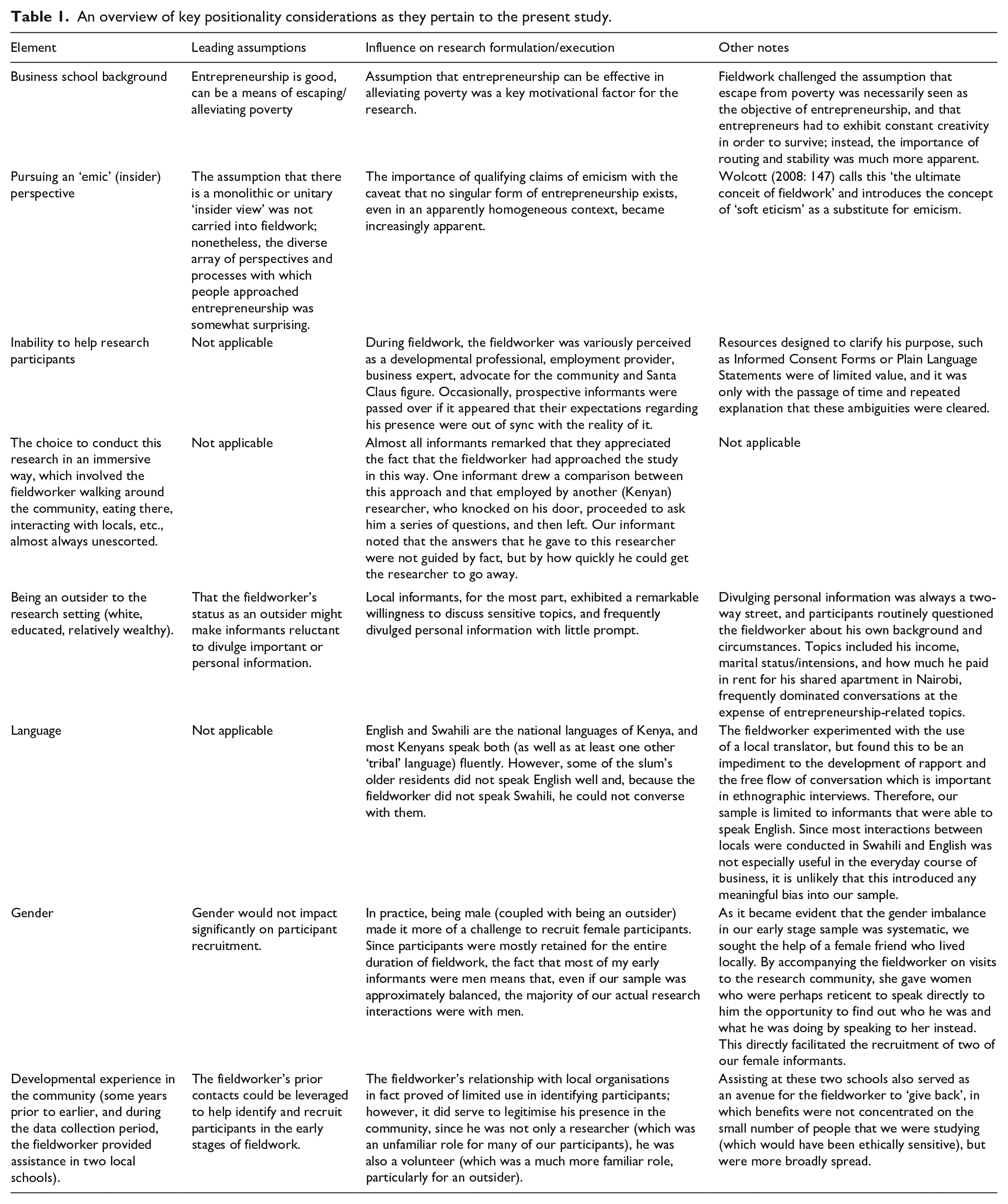
Having identified Mukuru as an appropriate study setting, partly on the grounds that prior research has neglected contexts characterised by such entrenched poverty and marginalisation, it made greater logical sense to sample primarily for ‘similarity’ than for ‘difference’ (Gobo, 2004: 445). Along these lines, the empirical sample was not purposefully composed of cases which exhibited marked difference from what might be considered ‘the norm’ for communities of this kind, meaning, for example, that we did not focus exclusively on high-performing entrepreneurs or entrepreneurs that in some way sought to leverage new technological possibilities. Although such ‘extreme’ or ‘deviant’ cases (Flyvbjerg, 2011) were included as a means to explore what entrepreneurship can do in such settings, they were viewed as being peripheral to the majority of cases which illustrated what entrepreneurship actually does. Thus, sampling procedures pursued the ‘emblematic case’ (Gobo, 2004: 449), which is concerned with the typical case rather than the deviant case. This represented a critical design choice which enabled the study to address mounting calls for entrepreneurship research, in both established and non-traditional contexts, to focus less on the ‘gazelles and unicorns’ of the discipline, and more on the ‘cows and horses’ that in fact make up its vast majority (Welter et al., 2017: 313; see also Hjorth and Steyaert, 2004; Imas et al., 2012; Watson, 2013). The process of recruitment itself was often opportunistic, with snowball techniques – where interviewees are identified and recruited with the assistance of other interviewees (Noy, 2008) – used occasionally but sparingly. For the most part, initial contact with interviewees was organic or serendipitous; in some cases (e.g. Francis, Simon), entrepreneurs would beckon the fieldworker as he walked past their businesses, and inquire about his background and the reason for his sudden appearance in their community; in others, like that of Peter, a barber, the fieldworker began as a customer; a small number of entrepreneurs were known to the entrepreneur through his work as a volunteer at a local school some years prior.
Defining a clearly bounded ‘sample’ is often difficult in ethnography: in the course of the four and a half months that he spent in Mukuru, for example, the fieldworker met with countless micro-entrepreneurs, and it would be impractical – indeed, impossible – to list each one. Instead, we provide summary information only for the entrepreneurs that we cite directly in our analysis, all of whom engaged in multiple, recorded interviews and became relatively well known to the fieldworker (see Table 2).
Study participants.
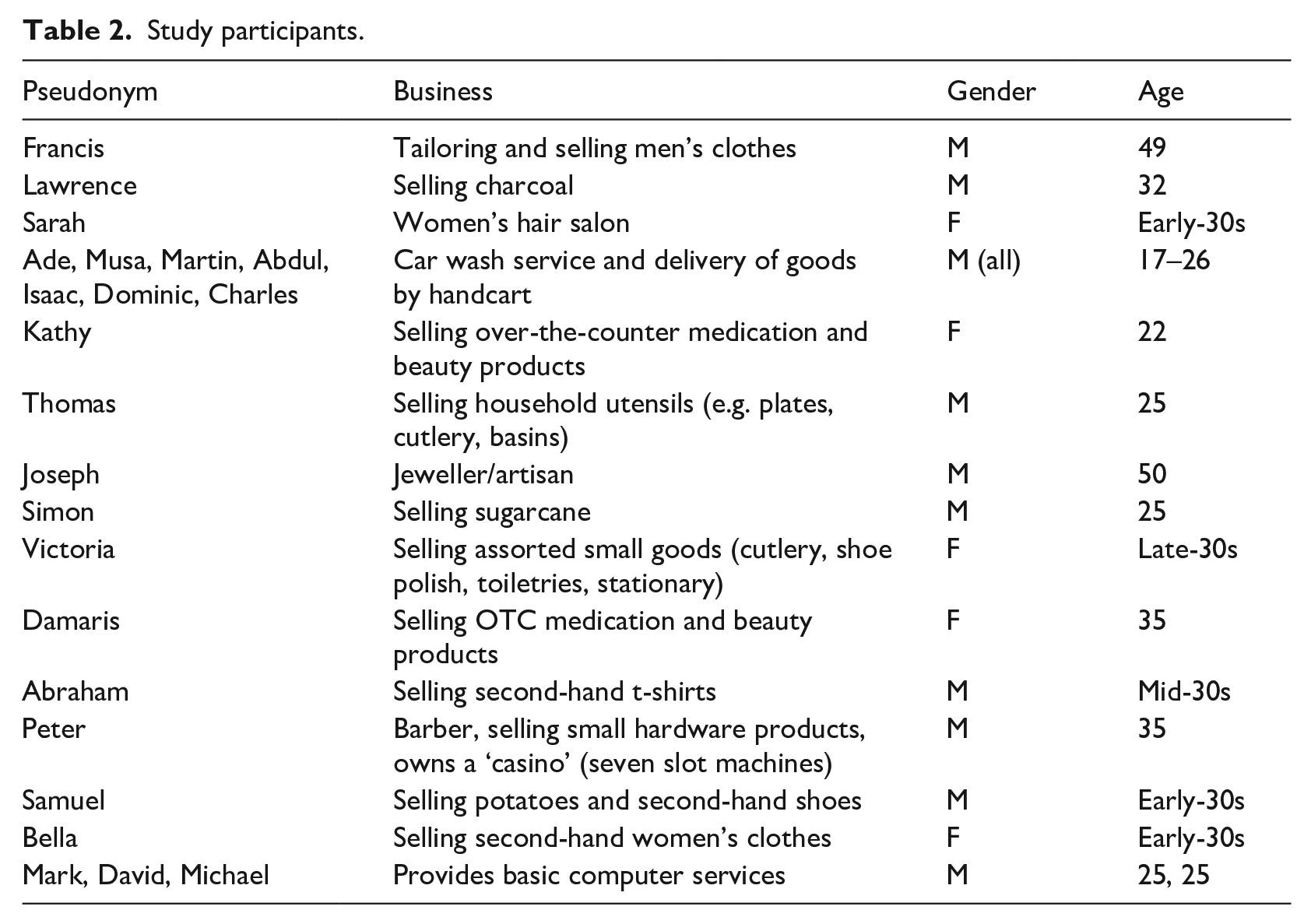
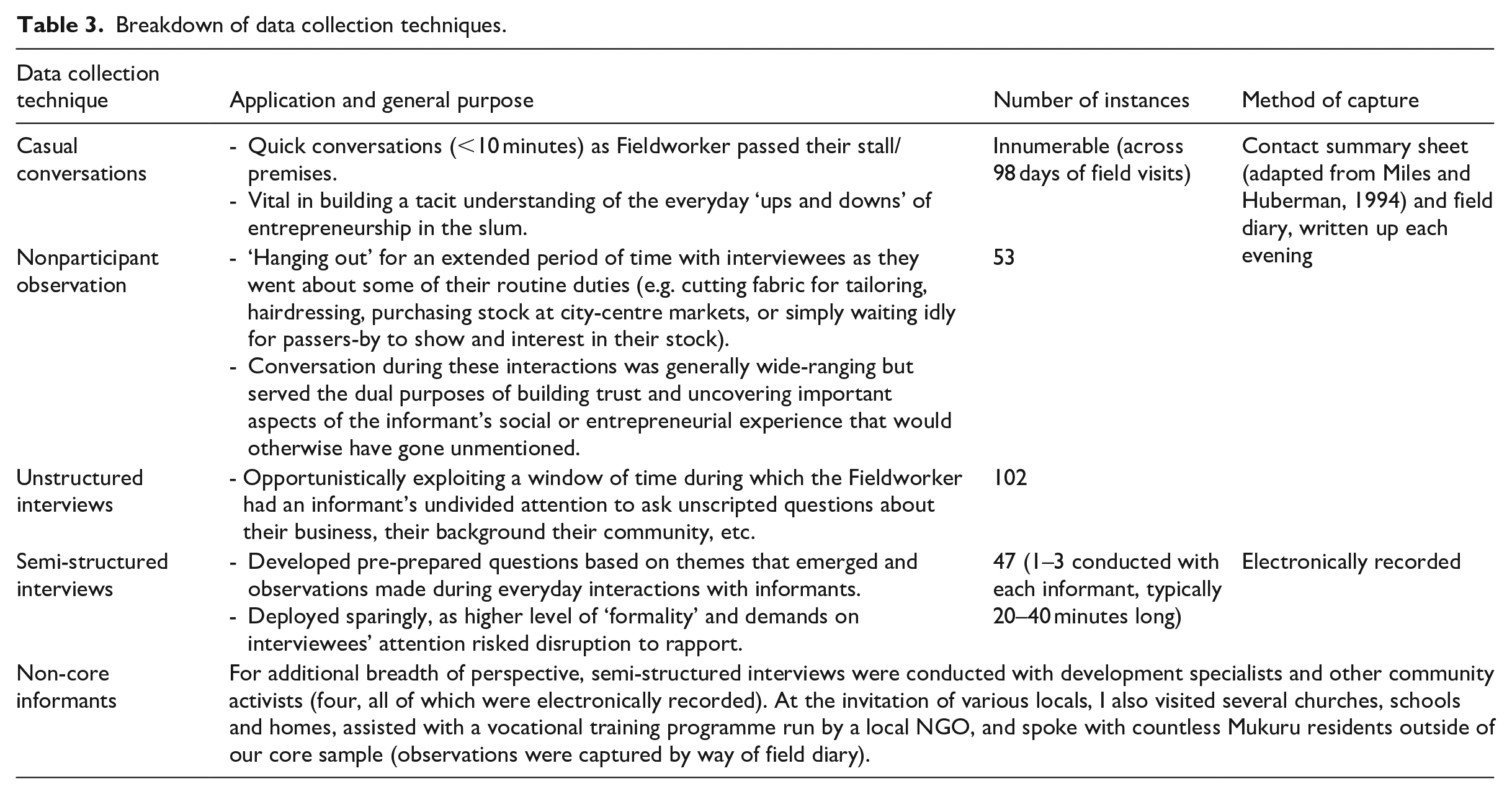
Individual research interactions ranged in duration from a couple of minutes (an informal chat in passing) to a full working day. Interviews and conversations with a broad array of local actors, including NGO representatives, community leaders, and countless other Mukuru residents, lent added richness as well as an important breadth of perspective to our core data (see Table 3). The final corpus of primary data consisted of 264 pages of single-spaced, typed interview transcripts and 150 pages of typed fieldnotes.
Breakdown of data collection techniques.
Data analysis
This study followed an abductive research process. A foundational principle of abductive theorising is that ‘[t]he route to good theory leads not through gaps in the literature but through an engagement with problems in the world . . . [I]t is best to start with real-life experience, develop your preliminary ideas, and then turn to the relevant literature to see what has been said and done’ (Kilduff, 2006: 252). Aligned to our abductive approach, the exploratory nature of data collection, particularly in the early stages, was driven also by the unfamiliarity of the research context and by the opportunities afforded by our methodology; very little work has so far been done on entrepreneurship in informal or slum communities, and only a small fraction of that research has employed immersive, longitudinal methods – like ethnography – which attend to the rich complexity of people’s economic and social lives (Branzei and Abdelnour, 2010; Martí et al., 2013). During the first few weeks of data collection, fieldwork was guided therefore guided by broad, open-ended questions, like, ‘How is entrepreneurship initiated and sustained when (conventional or material) resources are so scarce?’, ‘How do entrepreneurs relate – economically, psychologically, emotionally – to their wider community and specific members of it?’ and ‘What meanings are associated with entrepreneurship in this community?’ In other words, ‘What is it like to be an entrepreneur in this community?’
Over time, insights from these broad lines of inquiry converged on themes of identity, belonging and solidarity, and – crucially – the variance that we observed across all of these themes. Intrigued by this variance, we narrowed our focus to the sense of ‘we-ness’ or ‘oneness’ that derived from the community’s marginal status, and the potential relevance of this sense of collectivism to entrepreneurial practices and outcomes. Put differently, we were interested in the extent to which the community’s socioeconomic status engendered a sense of togetherness, belonging and solidarity, and the potential for this to enable or constrain entrepreneurship. Provisional analysis suggested the need for a theoretical lens that could accommodate and make sense of the contrasts that were coming to the fore in our data. For example, we noted at this point the co-existence of ‘narratives of sameness’ (the contention that everyone in the community is ‘in the same boat’, and the sense of unity to which this gave rise) and ‘narratives of difference’ (the contention that ‘my’ experience of life in this community – as a youth, a woman, a member of a particular ethnic group, etc. – differs sharply from that of other members). Similarly, we also observed cases of extreme entrepreneurial interdependence in close proximity to cases of absolute self-reliance.
The need to theorise the contradictory and oftentimes messy nature of our interim findings led us to interrogate the many contrasts within our data. We reasoned that the idea of an ‘insidership–outsidership duality’ could help us to reconcile many of the empirical contrasts that we had observed but also that it might capture in an intuitive way the overarching tension that is inherent in the basic condition of belonging to a community that is itself profoundly marginalised. From this point, we returned to our original dataset and to the codes that we had developed at earlier stages of our analysis with a view to understanding whether evidence of such a duality exists within our data, and how entrepreneurs might navigate it. Our main findings are discussed in the next section.
Findings
How do entrepreneurs operating in BoP contexts navigate the insidership–outsidership duality that stems from being embedded in a community that is itself acutely marginalised? We begin our analysis with a brief illustration of what we mean by an insidership–outsidership duality, and how this was manifest in the study community.
Mukuru’s marginal economic status meant that living conditions for its residents were characterised by a set of shared hardships that were remarkable in both their intensity and their range. The community was poorly served by infrastructure and state services and was characterised by social problems such as widespread unemployment, deficient housing and sanitation facilities, highly variable standards of education provision, single parentage and increased mortality. Unsurprisingly, this fostered a sense of economic and political outsidership.
Mukuru itself, it is a void. And it is a void because [. . .] Kibera is the biggest, the largest and the most wonderful, [it] wants to be the most wonderful slum in the world [laughs] . . . but Mukuru is this place where everybody thinks there should be work, everybody thinks there shouldn’t be a slum because it’s in the middle of an industrial area. [. . .] But it doesn’t happen. And for whatever reason, I dont know, but it doesn’t happen. But we are just ignored because the voice here is the industry. – Non-core interviewee (development worker) When I was small I was thinking, ‘Ah, Nairobi is a very good place to stay.’ When I came here I was asking, ‘Is this place [really] Nairobi?’ Because you look [at] this [neighbourhood], even our [rural] homes are not like this. No toilets, you rent a house without toilet, without a bathroom . . . The people who stay in estates, those are the ones that can say ‘I stay in Nairobi’, but in this [community] you can’t talk. – Bella
You know, one day, in 2007, [when] our president was Mr Mwai Kibaki, there was a fire down here in Sinai [a neighbouring slum]. But . . . the president said: ‘Sinai? What is Sinai?’ Like they don’t care about [us]. That’s how Mukuru is, like they don’t care about it.
That fire even made international news, a lot of people were killed.
But the president doesn’t even know the place. ‘Oh, that place?’ [laughs]
The idea of an insidership–outsidership duality is predicated on the idea of collective outsidership, which is one that came to the fore in our analysis. We use the term collective outsidership to highlight that the perception of being economically and politically excluded was – somewhat paradoxically – a deeply unifying sentiment. Markers of the community’s disadvantage were so ubiquitous and salient that outsidership was accepted as a defining feature of the community’s shared conception of ‘who we are’. In this respect, outsidership went hand-in-hand with a sense of belonging to a readily delineable social collective.
You do not need to believe [everything you hear about Mukuru]. Come by yourself and see. Experience is the best teacher. Don’t judge a book by its cover, you just come and see for yourself. – Musa People of Mukuru are not like people of other places. When it comes to things like elections, I haven’t seen Mukuru people fighting, but [in] other places you can hear that boys have been shot, that people are fighting. But in Mukuru I have never seen anything like that. – Dominic You know, police they are there, tomorrow they will not be there. But Chief, we determine the Chief because he is a long-lasting person in the community. [. . .] Chief is trusted more than the police. Chief is someone who will determine if you will stay here or you will move. When chief says, ‘This guy, I don’t want him in my area, he’s not a good guy’, you have no alternative. Leaving. Because Chief, the government understands Chief most than other people. Chief talks the truth. But the police will just chase you today, chase you tomorrow. But they will not be there [for long]. – Simon
As these comments illustrate, the territorial boundaries of the slum enclosed a social world which – in the mind of community members – looked, sounded, and worked very differently to what existed on the outside. The implications for entrepreneurship are clear in the extent to which the institutions – the ‘rules of the game’ (North, 1990) – that set the parameters for ‘normal’ or ‘acceptable’ entrepreneurial practice differed from those of the wider environment. This institutional incongruity was most visible in the prevalence of informal entrepreneurship.
If you open a business in Kibera [another slum in Nairobi], even if it is small . . . you must pay 50 shillings per day. And here, they don’t pay. You don’t pay anything, just open business and continue. . . . Here if you open a business, even if you want to [sell] sweets outside there, they don’t care. Nobody will ask you. – Sarah Do you know if you come here, like you, you want to put a business here, nobody comes [to see your registration]. – Francis This is a slum. A slum cannot be, the government cannot be so strict. – Peter
Whereas paid employment was generally accessible only if one had the right contacts or upon payment of a bribe, informal entrepreneurship was virtually barrier-free. As such, it was widely relied upon to provide for basic household needs, and as a backstop against destitution. At an individual level, informal entrepreneurship was routinely framed as an economic imperative. More importantly, at an institutional level, the ‘right’ to engage in informal entrepreneurship was framed as a moral imperative, insofar as it constituted a ‘levelling of the playing field’ – a way for those at the very margins of society to claim the baseline measure of economic security that was not afforded them by the State.
If they [the authorities] were competent, we would pay tax. – Francis How can you come and tax someone that is selling sukuma wikki [cabbage], Unga [corn flour], these small small things. You want 50 bob [50c] and maybe he earns like 150 [$1.50] a day. So if you take 50 bob it’s like you’re killing him. – Michael
While the de facto right to operate informally may have been grounded in outsidership, it was the specific conditions of collective outsidership that enabled and empowered people to assert that right whenever it came under serious challenge. This is illustrated powerfully by the contrast in the way that entrepreneurs operating within and outside the slum interacted with local officials and other agents of the State. The extract below, taken from the first author’s fieldnotes, documents his experience of eating lunch at one of the slum’s hotelis (small, outdoor eateries) when word circulated that a city council official was in the area to check the trading permits of local businesses.
Word of their presence spread in a chain from hoteli to hoteli all the way down to us. [The proprietor] started packing things away hurriedly, and soon she picked up my half-finished plate and told me to move along. Once she hid the food she hid herself, leaving the pots with beans and rice and ugali steaming at the side of the road. Walking past all of the other hotelis between there and Kobil, every single one had been deserted. – Extract from fieldnotes
In the interior of the slum – on what community members saw as ‘our turf’ – evasion tactics such as these gave way to much more confrontational and forceful forms of resistance.
There was a time when the Kanjo people came here to register all the businesses and people started to throw stones that them. So they said, ‘Hey, we cannot go there’. – Ade Kanjo are so afraid of this place! They don’t come, they don’t come. – Samuel
Outsidership – and specifically the collective outsidership that was the basis for the insider–outsidership duality at the heart of our research question – therefore helped to legitimise a set of institutional arrangements that were particular to the local setting of the slum. Although the context was inhospitable to entrepreneurship in many important ways (e.g. the acute shortage of financial and material resources, infrastructural deficits, etc.), the predominance of informality served a clear enabling purpose; namely, it allowed ‘insider’ entrepreneurs – those belonging to and operating within the community in question – to circumvent the costs and bureaucracy associated with formalisation and to start trading with very limited stocks of financial capital.
Substructures of community
Clearly, the durability of the slum’s institutional status quo owed much to the solidarity that was felt by its residents. However, it was equally clear from our field observations that the kind of solidarity upon which entrepreneurs relied to sustain their ventures over time relied on different conceptions of insidership. Belonging to this community ‘entitled’ entrepreneurs to an opportunity – specifically, the opportunity to engage in the kind of informal trading activity that was carried on freely within the slum but tended to draw much greater levels of interference elsewhere – but it did not entitle them to the kind of ongoing, material support that such ventures typically need to grow or even survive over the longer term.
As we have observed, the diverging norms around economic informality were rooted in a vision of the community as a singular, integrative whole. However, while there was a tendency to frame it as such when external referents were invoked (e.g. local government officials, nearby middle-class districts, political elites), informants’ everyday discourse illuminated an intricate web of identity ‘faultlines’ within the community’s internal structure. These faultlines typically corresponded in the first instance to higher order identity categories, like ethnicity, gender and age, but they were also fluid, emergent and malleable, and given meaning by the distinctive social experience of life in the slum. Our data suggest that it was from within these bounded substructures or fragments of community, rather than from the community in general, that entrepreneurs cultivated the kind of social safety nets that went some way to mitigating the immense precarity of their operating context.
These fragments of community were most clearly delineated along ethnic lines, with the slum’s ethnic make-up reflecting, to a large degree, the ethnic diversity of the nation at large (Kenya has over 40 different ethnolinguistic groups, each of which hail from a different geographical region). In Kenya, as in much of Africa, ethnicity has historically been regarded as a more central facet of a person’s social identity than their nationality (Wrong, 2009), and ethnic loyalties engender both solidarity (within ethnic groups) and rivalry (across ethnic groups) in everyday social conduct. A small-scale trader explained how these ethnic dynamics helped to give form to his market:
You can’t buy here when a Ja’luo is there, when a Luhya is there, you know we have so many tribes here.
Okay, so if a Luhya comes they will buy here [at a Luhya-owned shop], if a Kikuyu comes they will buy from you? A Luo won’t come and buy from you?
Yeah, a Luhya won’t come, a Ja’luo won’t come here. A Kikuyu will.
Entrepreneurs generally felt that the norms of solidarity and reciprocity that originated in the sense of belonging that they felt towards their ethnic community were more substantive than those associated with their membership of the slum community. As such, ethnic relationships were a more prominent feature of resourcing practices: entrepreneurs were generally more inclined to borrow from, lend to or co-operate with another entrepreneur because of an ethnic affinity than because of an affinity arising from proximity. Similar to the role of ethnic enclaves in international migration, those who had succeeded in establishing themselves economically in the city were often relied upon to provide support to others following behind.
Relationships grounded in age and gender exhibited similar conventions. Some of our women interviewees, for example, developed networks of mutual support within which workload, know-how and materials were pooled and shared quite freely. Often, these networks transcended ethnicity, and were rooted instead in the shared imperatives (and hardships) of womanhood in the slum.
I remember once, when I was starting my business, some guys they were engaging me saying that . . . I’m wasting my money [and that I should] just go and be married . . . How can you be married to a man that doesn’t have anything? He just wants the money so that he may quit [his job]. It’s very difficult to start a business with a guy, so it’s better you be personal. . . . I asked them [other female entrepreneurs], ‘How can I start? How can I have these things, or where can I get them?’ . . . That is how I make it now. But now, I can engage others. – Kathy It is not good to wait every day in the house, you [should] go and look for [money] yourself. That’s why they [men] usually slap you. You are just sitting there waiting for him to bring to you. – Sarah
The tendency for social and economic relationships to coalesce into one was especially prominent among young people in the slum. For the large portion of slum youth whose parents were either dead, living in distant rural homes, or too poor to provide any meaningful degree of economic support, friendship networks played an explicitly surrogative role, helping not only to remediate resource deficits, but also to provide a sense of social belonging where families did not.
What I can tell you is we’ve grown together like brothers. So the group is good, we love each other like brothers. If you don’t have your brother can help you. – Abdul
As with the case of ethnicity, being associated with these alliances connoted not only belonging but also difference. Entrepreneurial co-operation among the youths of the slum was rarely just that; it usually went hand-in-hand with other modes of cultural expression, and it was often this, rather than considerations centring on economic value, that gave entrepreneurs an ‘in’ with these groups. Mark, who operated a cyber café and provided freelance digital services to corporate clients, described how early partnerships took shape as follows: So we started as a team of three, and our aim to start that business was to get that petty cash to cater for our transport when we go to events, because we sing, we are a music group, a gospel music group. . . . Our aim was not to do business, it was to do something that may give us some transportation fees to go somewhere. – Mark
This collective outlook on entrepreneurship, which was widely observable within younger cohorts, often involved the routine pooling of resources within bounded peer groups.
The good news from Charles was that the car wash was back up and running. They paid an official Sh2k (around $20) to install a direct, illegal connection to the car wash. Then the other car wash across the road threatened to call the police, as they were afraid of losing customers. So Charles was patrolling the area throughout the afternoon, ensuring that the peace was kept and that if any police or officials came he could reason with them. Eventually one did come (another official) and he was paid another Sh1k ($10) to reinstall the wires, as the previous ones were poorly wired and were a major fire risk. Charles was pleased with this outcome. I asked him whether everyone had paid an equal share of this fee and he said no, some paid 200/= ($2), some paid only 50/= (50c). ‘People bring whatever they have’. – Extract from fieldnotes
The boundaries of those peer groups, which served to delineate between those that could readily leverage the financial, physical, human and social capital of the group and those that had no reasonable claim to such benefits, were grounded primarily in a person’s capacity to demonstrate likeness with other members of the group. ‘Hustling’ was regarded as both a livelihood and a lifestyle, and synchronicity in the latter – encompassing things like recreational interests and personal aspirations – was often pivotal for the formation of business partnerships.
It would be hard just to hustle, to find money, but since we are together like this I can do work easily because I know I have some friends who I live with like brothers. – Abdul. We are together, we don’t take other people like, because he comes from another area [he can’t be with us], it is not like that. We live like brothers. – Martin
As such, spatial proximity was a necessary but insufficient condition for everyday resource-sharing of this kind. Legitimising one’s claim to the status of insidership vis-à-vis such networks meant gaining acceptance as ‘one of us’, which revolved around identity and cultural symbolism, rather than around proximity or even economic value. This was evident, for example, in the role of language: young people in the slum typically conversed with one another in Sheng, a localised and ever-evolving composite of English, Swahili and a handful of the languages spoken by the different ethnic groups of Kenya, shot through with slang borrowed from the lyrics of popular U.S. and African hip-hop (Mazrui, 1995). Because of the fluid and improvisational nature of Sheng, patterns of usage differed noticeably not just between regions/, or even between neighbourhoods, but between peer groups within the same locality, essentially giving rise to a patchwork of ultra-localised micro-dialects that signified tight-knit bonds of social affiliation and belonging.
Outsiders among outsiders
The importance of solidarity structures such as these brought to light a different kind of insidership–outsidership duality, one which was grounded in an inversion of our initial reasoning. Whereas our primary interest was in the idea that hardship and marginalisation can instil within a social group a sense of oneness or ‘we-ness’ (Portes and Sensenbrenner, 1993; Snow and McAdam, 2000), the plurality of ways in which insidership was conceived and affirmed forced us to move beyond binary notions of ‘insider’ and ‘outsider’ and instead to look more holistically at how insidership–outsidership dynamics might be playing out across multiple planes of a community simultaneously. From this vantage point, we take an interest not only in how outsidership might give rise to insidership, but also how insidership might give rise to outsidership.
As we have seen, entrepreneurs in Mukuru relied extensively on ethnic networks to access resources and opportunities. However, whilst every entrepreneur in Mukuru belonged to one ethnic group or another, some – particularly those that were part of minority ethnic groups within the community – felt that ethnicity served as an ‘othering’ force to an extent that far outweighed any social capital that could be derived from it. Others expressed a sense of distrust towards members of their own ethnic group which effectively rendered ethnic identity obsolete as a potential basis for interpersonal solidarity.
Kikuyus are left alone. Kikuyus and Kalenjins. So you can find if another person from another tribe comes and finds that I’m a Kikuyu they go and find the same good I’m selling [somewhere else]. It’s very hard to find another tribe coming to [buy stock from me]. Very few are coming. That is why I’m telling you nowadays business is very hard. – Samuel [Maasai] are very honest people, the most honest. Not like our tribe. If you keep our tribe here, you can find that nothing [will be left in the] morning. – Francis
Other bases of solidarity that we have discussed, such as gender and age, tended to give rise to cliques which were characterised by very high levels of economic collectivism, but which were inherently bounded. These were, first and foremost, social collectives, and outsiders did not immediately or inevitably become enmeshed in these kinds of network structures. Those that were not tended to emphasise the imperatives of absolute self-reliance that accompanied entrepreneurship in the slum. Reflecting on the aftermath of a robbery in which her business was all but wiped out, Damaris, a chemist, said: Here, we don’t have support. They [neighbours] will come and say, ‘Oh, I’m so sorry’, but they don’t give anything, so you have to look [for] your own means. – Damaris
When Bella, who sold second-hand clothes at a roadside stall, ran into the common problem of being unable to sell her current stock, depriving her of the cash flow that she needed to replenish that stock with better quality goods, her business entered a downward spiral which culminated some time later in its closure. When Bella was asked, in the midst of her business’s decline, whether she felt hopeful that support might be forthcoming, she responded: Who would assist me? Nobody. Nobody. It’s just me. – Bella
Other entrepreneurs made similar observations.
If [my business] goes down? Nobody can help, nobody . . . [I am] all alone . . . Everybody struggles for him[self] because he has [his own] problems, he has his children to feed. – Francis In our country, Kenya, we are not crying for each other, you are crying for your own interest. . . . It’s so difficult, you just sleep here, this is your neighbour, but your neighbour wakes up [and] he just goes. That’s the Kenya culture. They don’t have the solidarities. – Simon
Despite sharing in the circumstantial hardships of slum life – living at extraordinarily close quarters with one’s neighbours, sharing communal amenities like toilets, washing facilities and passageways, and co-existing in a territorial space that was subject to chronic economic and political neglect – some of the entrepreneurs in our sample expressed a pervasive sense of economic isolation, characterised by a feeling that their troubles were not the concern of others, that mutual assistance or interpersonal support were not a feature of their social relations, and of generally being ‘alone in the crowd’.
Generally speaking, economic performance among those whose entrepreneurial practice was oriented towards individualism or self-reliance was not noticeably worse than it was among those who took a more collectivistic approach to entrepreneurship. However, when these entrepreneurs encountered periods of crisis, which tended to arise episodically for almost all entrepreneurs in Mukuru, their options tended to be comparatively more limited. Feelings of economic isolation married with entrepreneurial struggles were seen to have significant impacts on emotional and physical well-being.
When I get money, I will go to the market, things will be very good.
But now, little money.
Very, very, very, very little.
When was the last time you went to the market?
I have stayed too many days [without going] . . . Even now eating is too [expensive for me]. I’m just not giving up, so not eating is just . . .
You just eat a little.
Because your child is very, you can’t afford to [let him] be hungry. But when I have money I will eat.
In principle, entrepreneurs operating in informal markets can move quite easily from one business type to another, because sunk costs tend to be low and business competencies quite generic (Kodithuwakku and Rosa, 2002). It is clear from our data, however, that such flexibility is not distributed equally across the informal economy. Transitions towards better quality or higher value opportunities were typically underpinned by capital investments of one kind or another; for those with neither financial nor social capital at their disposal, options were profoundly limited. Broadly speaking, those options were threefold, and – although we did not observe it directly – we believe that, for many entrepreneurs, these options will play out sequentially. The first option, as exemplified by Abraham above, was to persevere in what they were doing and to bear the personal hardships – like eating fewer meals, withdrawing children from school, foregoing medical expenditures – that ensue from a progressive decline in revenues in the hope of an eventual turnaround in fortunes. The second option was to embark on a new venture in which the working capital requirements were even lower than their previous venture, which generally yielded greater competition, lower margins, and little prospect of a ‘bounceback’. The third option – as we saw earlier with Bella – was to leave Mukuru altogether, either to start afresh in another slum or to return to what many view as a prospectless life ‘upcountry’.
Discussion
Outsidership is typically framed within the entrepreneurship literature as a liability to be overcome, or as an asset to be leveraged (Baron et al., 2018; Li and Fleury, 2020; Pidduck and Clark, 2021; Schweizer, 2013; Stoyanov et al., 2018). Implicit in this view is a conceptualisation of outsider entrepreneurs as atomistic, aberrant outliers and of markets as enclosed places of opportunity which are characterised by rigid institutions and by consistent patterns of internal exchange. This paper is guided by the idea that outsidership can be a collective as well as an individual state, and by the corollary that if outsidership is a collective state, outsidership and insidership ought to be treated as a duality rather than a dichotomy. Under this view, the question shifts from ‘how do entrepreneurs overcome/leverage their status as outsiders?’ to ‘how do entrepreneurs navigate the insidership/outsidership duality?’ We present this not as an abstract or purely theoretical idea, but as one which we believe could serve as an illuminating lens through which to study entrepreneurship in contexts that are chronically and systematically marginalised. In their seminal work on social identity theory and intergroup behaviour, Tajfel and Turner (1986) posit that individuals who belong to low status groups – that is, outsiders – can improve their circumstances in one of two ways. The first is through social mobility, where the goal is to move from the lower status group to a higher status group. Drawing on the writing of Hirschman (1970), they relate the idea of social mobility to that of the American dream: ‘The successful individual who starts out at a low rung of the social ladder, necessarily leaves his own group as he rises; he “passes” into, or is “accepted” by, the next higher group. He takes his immediate family along, but hardly anyone else (pp. 108–109)’. The second is through social change: here, the intention is not to move from a low status group to a higher status group, but rather to bring about a narrowing or an inversion of the status differential between the groups, typically through some form of collective action (Haslam and Ellemers, 2005; Rao et al., 2003).
We see the premise of an insidership/outsidership duality as a means to more effectively sensitise future work on entrepreneurial outsidership to two foundational ideas of social identity theory. The first of those ideas is that the state or condition of outsidership is not one that is necessarily characterised by lower levels of embeddedness or social belonging; rather, the outsider entrepreneur is generally an outsider only to the extent that the social group to which s/he belongs lack status and power. Second, in their efforts to improve their economic circumstances or achieve some measure of personal fulfilment, it is likely that outsider entrepreneurs will choose to (or perhaps need to) marry aspects of social mobility and social change strategies (DeClercq and Voronov, 2009; Mair et al., 2016). This may be particularly true in the context of ‘institutional voids’ (Mair and Marti 2009; Webb et al., 2020), where extreme persistent poverty might incentivise social mobility, but where the norms, values and networks that are relied upon to regulate social and economic exchange may make the notion of individual mobility problematic. We observed how shared or collectivistic notions of outsidership accreted into a set of institutional arrangements that deviated fundamentally from the mainstream, and that were valued for their role in enabling the kind of informal micro-entrepreneurship that provided an economic lifeline to a large portion of the community’s residents. In this way, outsidership was used as a way to justify or legitimise informality (Webb et al., 2009), and the sense of solidarity to which collective outsidership gave rise found expression in a desire to preserve this institutional status quo. However, enabling institutions such as these tend to be accompanied by ‘levelling pressures’ (Portes and Sensenbrenner, 1993: 1342), where, ‘as long as everyone is relatively equal, entrepreneurs can “afford” to be a-competitive. However, as soon as someone appears to become significantly more successful, jealousy and competitiveness ensue’ (Slade Shantz et al., 2018: 430).
Our observations also made clear that the insidership–outsidership duality was a multi-dimensional one. Insidership ‘entitled’ community members to engage in entrepreneurship on a purely informal basis, but it did not entitle an entrepreneur to any kind of material assistance from their peers or wider community, even if their venture was drifting towards collapse. Material assistance of this kind tended to be accessed within pockets or fragments of community, where the parameters of insidership were entirely different. These parameters, and the interpersonal obligations that were predicated on them, can be understood as an approximation of the sociological dichotomy between universalism and particularism (Parsons, 1951/1991). Universalism reflects the view that rules, standards and norms are (or should be) applied in a way that is impartial and indiscriminate, such that one person’s moral obligations to another are not contingent on whether they are known to one another, or whether they have an affinity of one kind or another. Particularism, on the other hand, stresses the role of social affinity in guiding social action, positing that people are likely to treat one another more favourably if they share some kind of positive affinity. Although prior work has tended to treat the two as mutually exclusive (Leavitt et al., 2012), universalism and particularism were both discernible in our findings – universalism in the propensity of community members to respond violently to efforts by the City Council to tax local enterprises (irrespective of the specific entrepreneur being targeted), and particularism in the clear reliance on relational and identity-based networks (ethnicity, age, gender, etc.) for material support. The co-presence of these contrasting social orientations, and the distinct role that each one plays in enabling entrepreneurship, illustrates that insidership and outsidership can interact and intersect across different levels of analysis.
Our findings also highlight how an overemphasis on the inclusivity (or universality) of solidarity norms may lead to the acute vulnerability of some entrepreneurs being overlooked. An analogy might be made here to Penrose’s (1959) ‘interstices’, a term that she famously used to describe the market gaps that exist as a residual by-product of large firms not having the capacity or the inclination to pursue all available avenues for growth, and into these gaps step small (new) firms. Such interstitial spaces, as they might relate to our findings, are not so much spaces of opportunity as they are the ‘cracks’ that become visible when we recognise that communities are a confluence of disparate identity groups as well as distinct social collectives in their own right. Our findings highlighted not only that entrepreneurs, in their resourcing practices, tended to see the community as a relatively fluid aggregation of identity groups – ethnicity, gender, shared interests and so on – and that it was within these groups that solidarity networks tended to emerge, but also that some entrepreneurs felt that any solidarity norms that might exist within these structures were closed to them. Despite being community insiders, these entrepreneurs found themselves in the interstices – that is to say, they fell through the cracks – of the solidarity structures that are often considered to be characteristic of contexts of deep informality.
For the field of development studies, our findings suggest that efforts to reach the so-called ‘poorest of the poor’ should be informed by a more nuanced understanding of the role that social capital plays – or sometimes doesn’t play – in enabling entrepreneurship in BoP contexts. It has been noted that – although much has been written about the solidarity and collectivistic ethos that often prevails in poor and marginalised settings – far less has been written about ambivalence, rivalry and exclusion, all of which are inevitably manifest in and around the boundaries of that solidarity, and all of which could play just as significant a part in the social and economic lives of the poor (Bähre, 2007). For example, the proliferation of microfinance – designed to promote small-scale enterprise as a vehicle for poverty alleviation in the developing world, and among the most heralded social innovations of the last quarter-century (Roodman, 2012) – has been predicated heavily on the existence and cohesiveness of such solidarity networks. This can be seen from the centrality of borrower groups and joint liability to its classic operating model (Banerjee and Jackson, 2017; Rankin, 2002). In pointing out that ‘comparatively little attention has been paid to situations where social solidarity is weak’, Molyneux (2002: 178) observes that, by failing to properly grasp the nuances of solidarity, developmental interventions such as microfinance have sometimes forced people to co-operate and support one another even when there has been no meaningful history of – nor, indeed, appetite for – collective action or reciprocity between them.
Conclusion, limitations and future research
This study proceeded from the idea that our understanding of entrepreneurial outsidership could be meaningfully advanced if we were to re-imagine the insider–outsider dichotomy as a duality. We examined how entrepreneurs operating in a socioeconomic context that was profoundly marginalised cultivated and capitalised upon the solidarity that derived from collective outsidership. From an empirical perspective, we sought to provide much-needed insight into the heterogeneity of entrepreneurship in such contexts. Subsistence markets are often said to be characterised by the proliferation of informal micro-businesses which are virtually identical in their commercial offering, but there remains a broad consensus that underlying entrepreneurial processes are much more heterogeneous than current research suggests. In this article, we examined not only the ways in which entrepreneurship was embedded in our study community, but also the ways in which it was embedded within various fragments of that community’s internal structure. In so doing, we also drew attention to the acute vulnerability of those for whom collective outsidership is compounded by individual outsidership, that is, those that did not perceive themselves to be embedded in any kind of relational network that might help to mitigate the immense precarity of their economic lives.
This study has touched upon the temporal changes that communities, particularly those at the vanguard of macro demographic shifts like urbanisation, are subject to, and the bearing that this can have on entrepreneurs and entrepreneurship within them. Such tumultuous social conditions are fertile ground for the emergence of new organisational forms (Hsu and Hannan, 2005), and it is almost certainly the case that these divergent organisational forms bear the imprint of several aspects of the reality of disenfranchised urban populations. A deep dive into this topic was beyond the scope of the present study, but our data and field observations hinted at a considerable depth of insight that has yet to be tapped. The structure and composition of these alliances served to highlight the social upheaval that urbanisation can engender. Young people, often with little or no familial guidance, begin to encounter the harsh economic imperatives of slum life from a young age, and are forced to develop coping strategies with the limited set of tools (human, financial, social capital) at their disposal. It is vital, however, that scholars contextualise these economic imperatives within the broader set of needs – the need for self-esteem and self-expression, the need to feel a sense of belonging, the need to feel physically safe – that all humans are inherently subject to. This would suggest a pressing need to depart from the widespread fixation with bottom-line profits, and a more general embracing of the possibility that, even where poverty is rampant, the goal of profit maximisation vies for supremacy with other, more social, objectives that do not sit within the economic sphere.
Footnotes
Funding
The author(s) received no financial support for the research, authorship and/or publication of this article.
