






Abstract
How and when do entrepreneurial stressors shape strategic action? Integrating Dual Information Processing Theory with the entrepreneurial Job Demands-Resources model, we advance a “stressor-as-information” perspective to develop an integrated moderated mediation framework in which entrepreneurial stressors indirectly influence strategic entrepreneurial behaviors via strategic decision comprehensiveness, with work engagement and firm performance serving as key boundary conditions. Using multi-informant, multi-wave survey data from 283 entrepreneurs and their co-founders, we find support for the proposed model. While acknowledging that cognitive processes are inferred through behavioral manifestations, our findings suggest that moving beyond purely motivational accounts of entrepreneurial stress can enrich understanding of how and when the pressures inherent to entrepreneurship translate into strategic processes and offer new insights into the micro-foundations of strategic entrepreneurship.
Keywords
Introduction
Entrepreneurship is inseparable from stress. Founders routinely face cash flow crises, investor demands, team conflicts, and relentless uncertainty, while bearing ultimate responsibility for their venture’s survival. A substantial body of research has examined how these stressors shape outcomes, yet the findings present a striking paradox: some studies portray stressors as uniformly detrimental, eroding well-being and impairing performance, while others reveal their potential to sharpen focus, mobilize effort, and even enhance venture outcomes (see Lerman et al., 2021; Rauch et al., 2018; Stephan, 2018, for reviews). How can the same stressors produce such divergent consequences? More puzzling still, if stress impairs cognition, as decades of psychological research suggest, how do some entrepreneurs manage to make their most critical strategic action precisely when stress is highest? Existing research has approached this puzzle primarily through a motivational lens, examining how stressors affect entrepreneur energy, commitment, and self-regulatory resources (Dijkhuizen et al., 2016; Kollmann et al., 2019; Obschonka et al., 2023; Xu et al., 2020). This work has been invaluable; yet, it sidesteps a related question: how do entrepreneur interpretations of stressors, rather than merely their motivational responses, shape their subsequent strategic decisions and behaviors? Stressors do not act on outcomes directly; they are filtered through how entrepreneurs interpret cues, process information, and construct meaning from challenging situations. This interpretive “black box” has remained surprisingly understudied, a gap that matters precisely because the same motivational state, for example high commitment, can lead to radically different strategic decisions or behaviors depending on whether the entrepreneur is thinking deliberatively versus reacting impulsively.
This study opens that black box. Integrating Dual Information Processing Theory (DIPT; Chen and Chaiken, 1999; Evans and Stanovich, 2013) with the entrepreneurship-tailored Job Demands-Resources model (JD-R; Obschonka et al., 2023), we advance a “stressor-as-information” perspective. Rather than viewing stressors merely as threats to be managed, we conceptualize them as informational cues that can trigger distinct cognitive responses. Our central argument is that under certain conditions, stressors activate deliberate thinking, a mode of information processing characterised by heightened awareness, conscious control, and effortful analysis. This cognitive shift, in turn, manifests in how entrepreneurs make strategic decisions. Specifically, it prompts strategic decision comprehensiveness: the extent to which leaders engage in exhaustive information-seeking, consider multiple alternatives, and apply diverse decision criteria when charting their venture’s course (Atuahene-Gima and Li, 2004; Miller, 2008; Talaulicar et al., 2005). Through this pathway, we argue, stressors can ultimately fuel the strategic actions that drive innovation and competitive advantage, which are captured in our study through the construct of strategic entrepreneurial behaviors (SEBs; the integration of opportunity-seeking and advantage-seeking actions; Anderson et al., 2019; Ireland et al., 2023).
Of course, not all entrepreneurs respond to stress in the same way. Whether stressors activate deliberate thinking (and whether such thinking translates into comprehensive decision-making) depends on key boundary conditions. Drawing on the entrepreneurial JD-R framework, we identify two moderators rooted in the entrepreneur’s personal and job resources: work engagement, the venture-centric dedication, vigor, and absorption that distinguishes how entrepreneurs experience their work (Obschonka et al., 2023), and perceived firm performance, which provides critical feedback about the venture’s competitive standing relative to peers (De Cock et al., 2020; Wiklund and Shepherd, 2003). These resources, we propose, shape whether stressors serve as catalysts for deliberate strategic processing or merely add to the cognitive load. The theoretical model is illustrated in Figure 1.
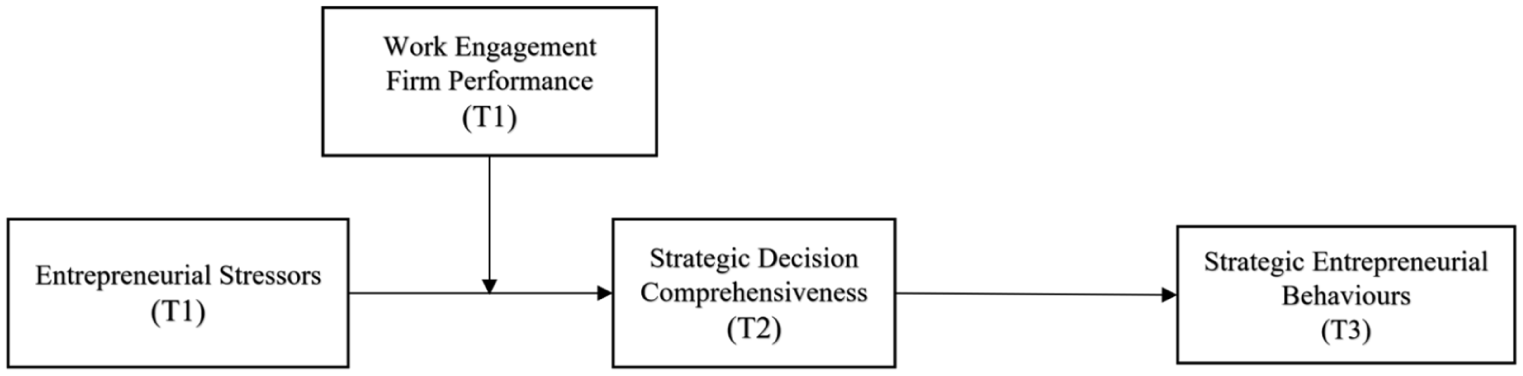
The theoretical framework.
Our study makes three contributions. First, we challenge the prevailing assumption in entrepreneurial stress research that stressors operate primarily through motivational mechanisms in form of depleting or enhancing efforts. Prior work has explored the extent to which stressors are positive or negative without specifying how they produce effects. By integrating DIPT, we show that stressors also function as informational cues that activate deliberate thinking, a cognitive pathway previously overlooked. This shifts the question to “when and how do stressors trigger systematic processing?” thereby explaining why the same stressor can impair one entrepreneur’s decision-making while sharpening another’s.
Second, we reframe strategic entrepreneurship from a dispositional to a process-oriented phenomenon. Existing research has relied on static constructs like entrepreneurial orientation, which conflates attitudes with behaviors, or strategic ambidexterity (structural arrangements). We position stressors as a critical antecedent of actual SEBs that innovation-driven actions ventures undertake. Our findings show that stressor-induced cognitive processing shapes whether entrepreneurs engage in opportunity and advantage-seeking actions, not just whether they intend to. This moves the field beyond “what entrepreneurs are disposed to do” toward “how they translate pressure into action.”
Third, we extend the entrepreneurial JD-R model beyond its motivational focus by incorporating cognitive mechanisms. The positive JD-R model emphasizes psychological resources as buffers against stress but does not explain how resources translate into strategic outcomes. We show that resources such as work engagement also enable deliberate thinking, a cognitive mode that transforms stressors into strategic action. This broadens the model’s scope to explain the process linking resources to strategic behaviors, not merely why they reduce burnout. In so doing, we offer a specific answer to the puzzle posed in our introduction: stressors become catalysts for strategic advantage when entrepreneurs possess both motivational (engagement) and cognitive (deliberate processing) resources to treat stressors as information rather than threats.
Theory
SEBs: The behavior-centric perspective
Strategic entrepreneurship emerged in the early 2000s as an integrative framework bridging the strategy and entrepreneurship fields. At its core, SE captures the simultaneous pursuit of advantage-seeking behaviors, activities directed at enhancing and sustaining current competitive advantages, and opportunity-seeking behaviors, activities aimed at discovering or creating new market opportunities (Ireland et al., 2003; Mazzei, 2018). This dual pursuit reflects the recognition that in dynamic and uncertain environments, firms cannot rely solely on exploiting existing advantages; they must also explore new opportunities to remain competitive. Over the past two decades, it has evolved into a rich research domain encompassing construct development, theoretical model refinement, and investigations of various organizational phenomena (Costa et al., 2023; Ireland et al., 2023, for a comprehensive review). Our study focuses specifically on SEB, a construct developed by Anderson et al. (2019) to capture the behavioral dimension of strategic entrepreneurship. Defined as “the firm’s exploitation of new product-market opportunities through the intended commercialization of its product innovations” (Anderson et al., 2019: 200), SEB reflects what firms do to pursue innovative entrepreneurship, rather than how they orient themselves toward it or how they structurally balance exploration and exploitation. Unlike entrepreneurial orientation, which conflates behaviors with attitudes, or strategic ambidexterity, which focuses on structural arrangements, SEB is unidimensional and behaviorally focused, capturing specific, observable actions that firms take to commercialize innovations (Covin and Wales, 2019; Wales et al., 2021; Wenke et al., 2021). This behavioral specificity aligns closely with the logic of our theoretical model, as we seek to trace how the cognitive responses enacted by entrepreneurs to stressors translate into observable strategic actions.
The relevance of SEB to our theoretical model rests on two observations. First, entrepreneurs and their ventures constantly navigate stressors and uncertainty while pursuing both personal and organisational goals (McMullen and Shepherd, 2006; Rauch et al., 2018). Understanding how these stressors ultimately affect whether ventures engage in SEBs requires tracing the intermediate cognitive and decision-making processes, precisely what our model does through strategic decision comprehensiveness. Second, prior research has established that the entrepreneur’s personal characteristics, such as overconfidence (Engelen et al., 2015), regulatory focus (Kammerlander et al., 2015), values (Tang et al., 2017), and behavioral tendencies (Zimmermann et al., 2019), significantly influence SEBs. This suggests that individual-level factors, including cognitive responses to stressors, are critical antecedents of entrepreneurial behaviors. Our study extends this line of inquiry by examining how job demands shape SEBs through cognitive and decision-making pathways.
Entrepreneurial stressors: The job demands perspective
Entrepreneurial stressors, also referred to as an entrepreneur’s job demands, capture the unexpected challenges and undesirable obstacles that entrepreneurs encounter when establishing and scaling their ventures, including resource shortages, financial constraints, workload pressures, and interpersonal conflicts (Dijkhuizen et al., 2016; Kollmann et al., 2019; Xu et al., 2020, 2022). Researchers have identified diverse types of these stressors, which can be categorised into three primary classes: economic stressors such as cash flow challenges (Pollack et al., 2012), social stressors such as interpersonal conflict (Collewaert and Fassin, 2013), and psychological stressors, such as excessive workload (Xu et al., 2020). Drawing on prominent job stress theories, such as the JD-R theory and Conservation of Resources theory, recent studies have documented the consequences of these stressors, including impacts on entrepreneur well-being and health (Cardon and Patel, 2015; Kollmann et al., 2019) as well as entrepreneurial performance outcomes (opportunity exploration; Schmitt et al., 2018).
Despite the growing body of work, the literature remains characterised by equivocal findings regarding the nature of stressor influence, namely, whether their effects are positive or negative. This inconsistency has prompted researchers to seek explanatory mechanisms that move beyond simple main effects. One prominent line of explanation draws on the challenge-hindrance stressor framework (LePine et al., 2005), which classifies stressors based on their motivational properties. Challenge stressors, such as workload, time pressure etc., are theorised to promote growth and performance by activating positive motivational states, while hindrance stressors, such as role ambiguity, interpersonal conflict, etc., are expected to impede them by depleting motivational resources. Applying this framework to entrepreneurship, a meta-analytical study categorised entrepreneurial stressors into challenge and hindrance types and examined how they shape entrepreneurial outcomes (Lerman et al., 2021). However, the findings revealed an incomplete picture: both challenge and hindrance stressors impaired entrepreneur well-being; although challenge stressors positively predicted performance, hindrance stressors did not exhibit the expected negative effects. These patterns echo broader organisational behavior research, which has similarly documented anomalies in the challenge-hindrance framework when applied to employees (for an updated review, see Podsakoff et al., 2023). Taken together, these findings suggest that within entrepreneurial contexts, the motivational classification of stressors offers limited predictive power: challenge stressors may sometimes function as hindrances, while hindrance stressors do not consistently exert adverse impacts.
An alternative perspective has shifted focus toward the entrepreneur’s personal agency and the distinctive nature of entrepreneurial work. Rather than classifying stressors by type, this line of inquiry emphasises how an entrepreneur’s psychological capacities enable them to navigate demands in ways that differ fundamentally from traditional employees. Notably, Obschonka et al. (2023) proposed an integrated theoretical framework, the “positive” JD-R model, that explicitly compares entrepreneurial work with traditional employed work across dimensions such as stressor effects and recovery processes. The model posits that entrepreneurs proactively leverage their psychological resources, such as stronger intrinsic motivation and deeper psychological attachment to their ventures, to adapt to stressors, thereby shielding themselves from being overwhelmed by stressful experiences. Moreover, personal and job resources can further amplify this buffered stress response process. This perspective helps synthesize conflicting findings: while stressors may impose costs on entrepreneurs (reduced recovery levels), they can also motivate them to remain committed to and engaged in their work, driven by their internal motivational resources. What both perspectives share, however, is an anchoring in motivational mechanisms. The challenge-hindrance framework explains stressor effects through motivational activation versus depletion; the positive JD-R model explains them through motivational resources that sustain engagement. Yet, this motivational focus leaves a critical dimension underexplored: the cognitive processes through which entrepreneurs interpret and respond to stressors. To delve into this issue, we turn to DIPT, which provides the conceptual tools to theorise about an entrepreneur’s apparent reliance on different information-processing modes, specifically, the shift from heuristic to deliberate processing, as an interpretive lens for understanding the link between stressors and strategic outcomes.
An integrated cognitive framework of entrepreneurial stressors and behaviors
What does it change to treat stressors as information? Traditional stress research, whether through the challenge-hindrance framework or the JD-R model, conceptualises stressors primarily as demands that consume resources, trigger strain, or require coping. In this view, stressors are liabilities to be managed or buffered. By contrast, the “stressor-as-information” perspective we advance threat stressors as signals that carry actionable intelligence about the venture’s environment and goal attainment. This shift has three theoretical implications. First, it reframes the question from “how much stress can entrepreneurs endure?” to “what information do stressors convey, and how should entrepreneurs process it?” Second, it predicts that the same stressor can produce opposite effects depending on whether it is interpreted heuristically (as a threat) or deliberately (as a problem to be solved). This explains the equivocal findings in prior literature. Third, it makes cognitive resources, not just motivational ones, central to the stress-to-strategy linkage, as deliberate processing requires both the capacity and the willingness to engage in effortful analysis. Thus, treating stressors as information does not deny their potential costs but highlights conditions under which they become catalysts rather than impediments to strategic action.
To theorise how entrepreneurial stressors shape SEB, we integrate the entrepreneurship-tailored JD-R model with DIPT. Central to DIPT is the distinction between heuristic thinking (low-effort, automatic, experience-based) and deliberate thinking (high-effort, conscious, analytical; Chen and Chaiken, 1999; Evans and Stanovich, 2013; Kickul et al., 2009). Routine stressors that align with expected work demands tend to trigger heuristic responses, conserving cognitive resources. In contrast, stressors perceived as critical to venture survival or growth, such as financial constraints or multi-stressor accumulation, demand deliberate thinking, which involves logical reasoning, exhaustive information scrutiny, and active cognitive regulation. Entrepreneurs mobilise these capabilities through self-regulatory resources and psychological attachment to their ventures (Nikolaev et al., 2023; Obschonka et al., 2023). Crucially, deliberate thinking does not remain purely internal; it manifests in observable decision-making behaviors. A well-established manifestation is strategic decision comprehensiveness, the extent to which decision-makers engage in exhaustive information-seeking, consider multiple alternatives, and apply diverse decision criteria (Atuahene-Gima and Li, 2004; Miller, 2008; Talaulicar et al., 2005). When entrepreneurs engage in deliberate thinking, they systematically gather and evaluate information, weigh alternatives, and scrutinise assumptions before committing to a course of action. In this sense, strategic decision comprehensiveness serves as the behavioral signature of deliberate thinking in strategic contexts. However, this cognitive-behavioral pathway is not automatic. Drawing on the JD-R model, we propose that an entrepreneur’s personal and job resources shape whether stressors trigger deliberate thinking and, subsequently, comprehensive decision-making. Personal resources, such as work engagement, enhance cognitive capacity and persistence under stress, enabling entrepreneurs to sustain deliberate thinking in demanding situations (Obschonka et al., 2023). Job resources, such as performance feedback, provide critical information that signals whether comprehensive analysis is warranted or whether alternative cognitive strategies may be more appropriate (De Cock et al., 2020). In essence, these resources moderate the translation of stressors into deliberate thinking.
Hypotheses
Entrepreneurial stressors and strategic decision comprehensiveness
We propose a positive relationship between entrepreneurial stressors and strategic decision comprehensiveness. Our argument builds on two premises about how entrepreneurs experience and respond to stressors. First, entrepreneurial stressors, such as financial constraints, resource shortages, and workload pressures, are inherently tied to venture survival and growth (Dijkhuizen et al., 2016; Kollmann et al., 2019). Unlike generic workplace demands, these stressors directly implicate the entrepreneur’s core goals and aspirations. This connection matters because entrepreneurs exhibit a distinctive psychological attachment to their ventures: they view their ventures as extensions of themselves, and thus, stressors are perceived not as personal threats to be avoided, but as challenges to venture goals that demand resolution (Nikolaev et al., 2023; Obschonka et al., 2023). Consequently, entrepreneurs are motivated to actively engage with stressors rather than disengage from them. Second, entrepreneurs possess self-regulatory resources that enable them to maintain cognitive clarity under pressure (Obschonka et al., 2023; Xu et al., 2020). These resources allow entrepreneurs to resist the pull toward impulsive, heuristic responses that stress might otherwise induce. Instead, they can adopt a deliberate approach to processing stressor-related information, one characterised by conscious analysis, logical reasoning, and careful evaluation of options (Evans and Stanovich, 2013; Kickul et al., 2009).
When these two conditions hold, namely, stressors tied to venture goals and entrepreneurs equipped with the capacity for deliberate processing, stressors are likely to trigger a more comprehensive approach to strategic decision-making. Specifically, facing a stressor such as a funding gap, an entrepreneur engaged in deliberate processing will not simply react. Instead, they will reframe the problem from “we lack funds” to “what are our options to close this gap?” This cognitive shift prompts active environmental scanning, monitoring competitor funding strategies, consulting industry mentors, to gather multi-source information. Moreover, deliberate processing encourages the generation of multiple alternatives (equity financing, cost optimisation, and bridge loans) and rigorous evaluation of their long-term consequences (how equity dilution might affect future control). These behaviors, extensive information search, alternative generation, and multi-criteria evaluation, constitute the core of strategic decision comprehensiveness.
The counterfactual scenario further clarifies the logic. If entrepreneurs lacked psychological attachment to their ventures or if stressors were unrelated to venture goals, disengagement or avoidance would be more likely. Similarly, without adequate self-regulatory resources, stress might impair cognitive processing and lead to narrower, more heuristic decision-making. But given that entrepreneurs in our context do possess these attributes (attachment and self-regulatory capacity), we expect that encountering stressors will, on average, prompt more comprehensive strategic decisions. We predict that:
Strategic decision comprehensiveness and entrepreneurial behaviors
A range of studies have provided evidence on the influences of strategic decision comprehensiveness on entrepreneurial outcomes, such as new product performance (Atuahene-Gima and Li, 2004), and organisational adaptability (Friedman et al., 2016). Based on the literature, we propose that practicing it can not only help entrepreneurs adapt to dynamic and uncertain environments but also update their information and knowledge, thereby driving SEB.
First, engaging in SEB requires entrepreneurs to act in response to dynamic uncertainties (customer needs, competitive tactics, and technological changes) while avoiding misalignment with external environments or internal resources. Practicing strategic decision comprehensiveness, which can facilitate this alignment judgment, mandates comprehensive analysis of multi-dimensional information (environmental trends, stakeholder demands; Atuahene-Gima and Li, 2004; Talaulicar et al., 2005). This helps entrepreneurs capture “hidden opportunities” or “potential risks” that would be overlooked in superficial decision-making. Entrepreneurs considered comprehensive decision makers should not only be more alert to acquiring key but novel information but also be more flexible in taking advantage of diverse sources of information from those aspects. Furthermore, this can help them avoid problematic or biased choices and identify appropriate decision factors and trends, thereby effectively addressing the inherent complexity of strategic decisions under uncertainty (Amato et al., 2017; Cabantous and Gond, 2011; Miller, 2008; Shepherd and Rudd, 2014).
Second, engaging in SEB requires entrepreneurs to integrate existing knowledge to generate innovative solutions, and to have sufficient motivation to translate these solutions into actionable behaviors. Practicing decision comprehensiveness fuels this knowledge–motivation–behavior chain in two important ways. On the knowledge side, the process of decision comprehensiveness, such as deliberating on diverse business development alternatives and cross-verifying information from multiple sources, expands entrepreneurs’ knowledge of venture management, for example learning new methods of cost control, and updates their understanding of market-demand logic such as realising the need for personalised products. This expanded knowledge reserve directly provides the “cognitive raw material” for SEB. On the motivation side, the thoroughness of decision comprehensiveness enhances an entrepreneur’s perceived control and autonomy: by fully grasping decision-related information and verifying the feasibility of alternatives, entrepreneurs gain greater confidence in their ability to predict and manage the outcomes of entrepreneurial behaviors. This sense of control strengthens their commitment to daily operations and activates proactive motivation to initiate behaviors, such as investing in R&D for the technology upgrade. In this way, decision comprehensiveness not only equips entrepreneurs with the “ability” (knowledge) but also ignites their “willingness” (motivation), thereby, directly driving the occurrence of entrepreneurial behaviors.
Mediating effect of strategic decision comprehensiveness
The logic linking entrepreneurial stressors to SEB via strategic decision comprehensiveness follows from integrating the arguments developed for H1 and H2. To recap: entrepreneurial stressors, particularly those tied to venture goals, trigger deliberate processing among entrepreneurs, who possess the psychological attachment and self-regulatory resources to maintain cognitive clarity under pressure. This deliberate processing, in turn, manifests as strategic decision comprehensiveness: exhaustive information search, generation of multiple alternatives, and multi-criteria evaluation. Comprehensiveness then enables SEBs by providing entrepreneurs with the knowledge and confidence to pursue opportunity-seeking and advantage-seeking actions. Put differently, why would stressors not directly translate into SEB without this intervening decision process? The answer lies in the nature of entrepreneurial stressors themselves. Stressors, by definition, present novel, complex, and often ambiguous challenges. Without a comprehensive decision-making process that systematically gathers information and evaluates alternatives, entrepreneurs risk responding to these stressors in ways that are reactive, narrowly focused, or misaligned with venture goals. In the absence of comprehensiveness, stressors might trigger heuristic responses in form of quick fixes that address immediate symptoms but fail to generate the sustained innovation and market-oriented actions that define SEBs. For example, facing a cash flow shortage, an entrepreneur who bypasses comprehensive analysis might simply cut costs indiscriminately, a reactive move that does not constitute SEB. By contrast, an entrepreneur who engages in comprehensive analysis might identify not only cost-saving measures but also new revenue opportunities, strategic partnerships, or product pivots, actions that embody the opportunity-seeking and advantage-seeking logic of strategic entrepreneurship.
This logic suggests that comprehensiveness serves as a critical filter: it transforms the raw pressure of stressors into actionable, strategically coherent behaviors. Without it, stressors risk becoming merely sources of distraction or reactive firefighting, rather than catalysts for entrepreneurial action. Thus, the indirect effect of stressors on SEBs operates through strategic decision comprehensiveness. We predict that:
Moderating effect of work engagement and firm performance
We predict that the proposed mediated indirect effects are contingent on the baseline levels of the entrepreneur’s work engagement and firm performance. As entrepreneurs can still work and strive for their goals under stress, entrepreneur trait-level work engagement should be a valuable personal resource for directing their cognition for stressor-related information processing. Work engagement, characterised by vigor, dedication, and absorption, represents a critical personal resource that shapes how entrepreneurs process stressor-related information (Bakker et al., 2014; Obschonka et al., 2023; Schaufeli et al., 2006). When work engagement is high, entrepreneurs possess greater physical and emotional resources to sustain cognitive clarity under stress. They can maintain vigor to persist through demanding tasks, draw on emotional resources to regulate negative reactions to stressors, and sustain absorption in complex problem solving. These resource endowments enable them to engage in deliberate thinking when facing stressors by systematically gathering information, evaluating alternatives, and making comprehensive strategic decisions. As a result, the positive indirect effect of stressors on SEB via decision comprehensiveness is amplified when work engagement is high. By contrast, when work engagement is low, entrepreneurs lack these resource buffers. They are more likely to experience cognitive depletion under stress, leading to reliance on heuristic shortcuts rather than deliberate analysis. Stressors become sources of distraction or avoidance rather than catalysts for comprehensive decision-making. Under such conditions, the indirect pathway from stressors to SEB via comprehensiveness weakens or disappears.
We predict that:
Perceived firm performance, an evaluation of current performance relative to competitors, provides critical feedback that shapes the entrepreneur’s cognitive strategies (Breugst et al., 2020; De Cock et al., 2020; Obschonka et al., 2023). When entrepreneurs perceive superior firm performance, they may become overconfident in their ability to navigate stressors (Zhang and Cueto, 2017). While overconfidence can boost confidence, recent evidence suggests that it disrupts controlled information processing and reduces systematic thinking and increasing reliance on mental shortcuts (Kraft et al., 2022). Under such conditions, entrepreneurs facing stressors are more likely to make abrupt, probabilistic decisions rather than engage in the deliberate, comprehensive analysis required for strategic decision-making. Consequently, the indirect pathway from stressors to SEB via decision comprehensiveness weakens when perceived firm performance is high. By contrast, when entrepreneurs perceive lower firm performance, such as performance below industry averages, this signals that venture goals remain unfulfilled. This realisation compels them to invest greater cognitive effort to foster growth or ensure survival. However, underperforming ventures often face resource constraints: external resource providers tend to evaluate them negatively, limiting access to new support. Thus, entrepreneurs must maximise their information processing capacity and engage in systematic thinking to navigate these constraints. For instance, De Cock et al. (2020) demonstrated that when entrepreneurs believe firm performance is sub-optimal, leveraging their cognitive resources significantly enhances the likelihood of venture survival. Rather than driving them toward probabilistic decisions, reduced performance expands their decision-making scope through comparative and analogical reasoning, fine-tuning coping resources, reorienting toward potential markets, or reconnecting with existing customers. This adaptive cognitive adjustment strengthens the translation of stressors into comprehensive decision-making and, ultimately, into SEB. We predict that:
Method
Participant and procedure
We sampled entrepreneurs and their co-founders from new ventures in China. Entrepreneurship involves creating, developing, and managing a new business venture for profit, with entrepreneurs acting as founder-CEOs or business owners who discover, evaluate, and exploit opportunities while bearing personal risk (McMullen and Shepherd, 2006; Ratten, 2023). Our focus is on everyday commercial entrepreneurs, individuals actively engaged in the day-to-day management and strategic direction of their ventures, whose experiences and decision-making reflect the realities of entrepreneurial practice in context (Welter et al., 2017). Following prior research (Xu et al., 2021), we recruited active Chinese entrepreneurs who identified as founders or CEOs overseeing new ventures. The research team generated a list of entrepreneurs through governmental institutions managing entrepreneurial clusters and start-up hubs in major cities across Northern and Southern China (Beijing, Guangzhou). Ventures were limited to those within 10 years of founding. This age cutoff is not only consistent with research defining new ventures as firms in their early developmental stages (Ratten, 2023) but also aligns with the definition commonly adopted in entrepreneurship surveys and official classifications within the Chinese context (Liu et al., 2026). Of the 620 entrepreneurs initially contacted, 414 expressed interests, and 351 agreed to participate after receiving invitation letters (response rate: 57%). Consistent with prior studies examining executive decision-making (Ling et al., 2008; Reina et al., 2017), we then asked each participating entrepreneur to identify a co-founder to serve as an additional informant.
Data were collected across three time points over one year (2020–2021) to capture time-lagged effects, a design well-suited for examining how personal attributes influence strategic outcomes over time (Flammer and Bansal, 2017; Lévesque and Stephan, 2019). Surveys were administered through Wenjuanxin (www.wjx.cn; similar to Prolific), a widely used professional online survey platform in China that provides features such as IP restriction, duration tracking, and response validation to ensure data quality. Survey links were distributed via WeChat, a common communication tool in China, which served solely as a notification channel; all responses were directly captured and recorded through this platform. At each time point, participants received a survey link and were given one hour to complete the questionnaire.
At Time 1, entrepreneurs reported on their demographics, stressors, work engagement, perceived firm performance, and individual- and firm-level control variables. Six months later (Time 2), the identified co-founders rated the founding entrepreneur’s strategic decision comprehensiveness. Founding entrepreneurs and co-founders always work in concert to make strategic decisions and practice managerial tasks (Jin et al., 2017). Therefore, co-founders should gain an important insight into the daily operation and strategic decision-making process of the ventures. Using co-founders as informants for this construct provides an external perspective on the founder’s decision-making process, reducing concerns about common method bias and self-report inflation (Ling et al., 2008; Reina et al., 2017). Another six months later (Time 3), entrepreneurs reported on their firm’s SEB. This multi-informant, time-lagged design establishes temporal separation between independent variables (stressors, measured at T1), mediator (decision comprehensiveness, rated by co-founders at T2), and dependent variable (SEB, reported by entrepreneurs at T3), thereby addressing endogeneity concerns and strengthening causal inference (Hill et al., 2021).
Of the 351 entrepreneurs who completed Time 1, 300 co-founders responded at Time 2 (86%), and 283 entrepreneurs responded at Time 3 (81%). No missing data occurred, as the WJX platform required participants to complete all items on each page before proceeding. The average entrepreneur age was 34.76 (Standard deviation (SD) = 7.95); 78% were male, and 51% held a bachelor’s degree. Ventures averaged 4 years in age (SD = 3.17) and 26 full-time employees (SD = 56.14). Entrepreneurs worked an average of 11 hours per day (SD = 8.48). Industries represented included high-tech/IT (27%), wholesale/retail (15%), education/training (15%), manufacturing (13%), financial services (10%), and others (20%). Co-founders averaged 37.87 years of age (SD = 5.65), with 45% female.
Measures
Full items of the utilized scales can be viewed in Supplemental Appendix A.
Entrepreneurial stressors
Participants reported distinct entrepreneurial stressors with a five-item scale, which was especially developed to fit the entrepreneurial process (Kollmann et al., 2019). It captures how often entrepreneurs can find it difficult or impossible to perform their job tasks in terms of five different stressors, including “inadequate or lack of equipment, tools, or supplies,” “inadequate of lack of help from others (i.e. stakeholders),” “inadequate or lack of job-related information,” “inadequate or lack of financial resources,” and “lack of time.” Participants responded via seven-point Likert-type scales (1 = never to 7 = always). The Cronbach alpha was 0.82.
Strategic decision comprehensiveness
We asked co-founders to report founding entrepreneur’s strategic decision comprehensiveness using the five-item scale. Sample items are “When faced with an immediate, important, non-routine threat or opportunity, our Founder/CEO usually develops many alternative responses” and “Our Founder/CEO considers many different criteria and issues when deciding the course of action to take.” Participants responded via five-point Likert-type scales (1 = strongly disagree to 5 = strongly agree). The Cronbach alpha was 0.90.
Strategic entrepreneurial behaviors
The entrepreneurial orientation scale contains multiple and lower-order dimensions involving both attitudinal (i.e. risk-taking) and behavioral (i.e. innovativeness and proactiveness) components (Anderson et al., 2015). Further, strategic ambidexterity is the higher-order construct with formative subdimensions involving both the exploratory and exploitative scales. This can suffer from statistical problems related to multicollinearity, thereby resulting in publication bias (MacKenzie et al., 2011; Wenke et al., 2021). We utilise the four-item validated scale of SEBs (Anderson et al., 2019). This unidimensional scale creates advantages for reducing measurement error and lowering the probability of interpretational confounding. Sample items are “In general, the top managers of my firm prefer to lead our industry in new product/service introductions” and “In general, the top managers of my firm prefer to be ahead of the competition when introducing new products/services.” Entrepreneurs responded via five-point Likert-type scales (1 = strongly disagree to 5 = strongly agree). The Cronbach alpha was 0.89.
Work engagement
Entrepreneurs reported work engagement with a nine-item Utrecht Work Engagement Scale (Schaufeli et al., 2006). This scale covers three dimensions that correspond to the theoretical construct in our study, namely, vigor, absorption, and dedication. Sample items are “At my job, I feel strong and vigorous,” “My job inspires me,” and “I am immersed in my work.” Participants responded via five-point Likert-type scales (1 = strongly disagree to 5 = strongly agree). The Cronbach alpha was 0.97.
Firm performance
Entrepreneurs reported subjective firm performance with a six-item measure of current performance compared to competitors in the same industry. We asked participants to rate their firm’s current performance by comparing their competitors’ performance on a seven-point scale (1 = much worse than competitors, 4 = about the same as competitors, 7 = much better than competitors) on six key indicators: growth in sales, growth in profitability, growth in employment, return on equity, return on assets, and profit margin on sales. These six items were averaged to yield a firm performance score, with higher values denoting perceived superior performance. This method has been frequently utilized in entrepreneurship research and demonstrates a sound measurement effect (Breugst et al., 2020; De Cock et al., 2020; Wiklund and Shepherd, 2003). The Cronbach alpha was 0.94.
Control variables
We controlled for individual demographics, such as gender (0 = female) and age. Having created a prior venture can exert a significant influence upon how an entrepreneur navigates stressful circumstances (Kollmann et al., 2019). We controlled for it using a dummy variable that took a value of 1 if an entrepreneur had previously started a venture and 0 otherwise. As strategic decision-making processes are seriously affected by environmental dynamism (Samba et al., 2021), we therefore, controlled for this important construct assessed by the four-item scale (α = 0.60; Jansen et al., 2009). We also controlled for firm-level characteristics. That is, firm size (the number of employees) and age (the year when entrepreneurs founded ventures) would impact their stressful experiences and strategic decision-making processes (Reina et al., 2017). We also controlled for the industry effects by creating four dummy coded variables (the first four industries).
Results
Preliminary analysis
Convergent and discriminant validity
First, convergent validity was assessed by examining the average variance extracted (AVE) and composite reliability (CR) for each construct. As shown in Table 1, all constructs demonstrated adequate convergent validity, with AVE values ranging from 0.51 to 0.75 (exceeding the 0.5 threshold) and CR values between 0.83 and 0.96 (surpassing the 0.7 benchmark). Second, discriminant validity was evaluated using three complementary methods. First, the Fornell–Larcker criterion was satisfied, as the square root of the AVE for each construct (ranging from 0.72 to 0.87) was consistently larger than its correlation coefficients with all other constructs (off-diagonal values in Table 1). Second, the Heterotrait-Monotrait ratio (HTMT) was employed, with all HTMT values (ranging from 0.73 to 0.86; see Table 1) falling below the conservative threshold of 0.90. Third, we conducted the confirmatory factor analysis (CFA). The seven-factor (work engagement has three second-order factors) model fit was acceptable (comparative fit index (CFI) = 0.91, root-mean-square error of approximation (RMSEA) = 0.08, and standardized root-mean-square residual (SRMR) = 0.06). Together, these results confirmed sufficient validity among the constructs.
Convergent and discriminant validity.
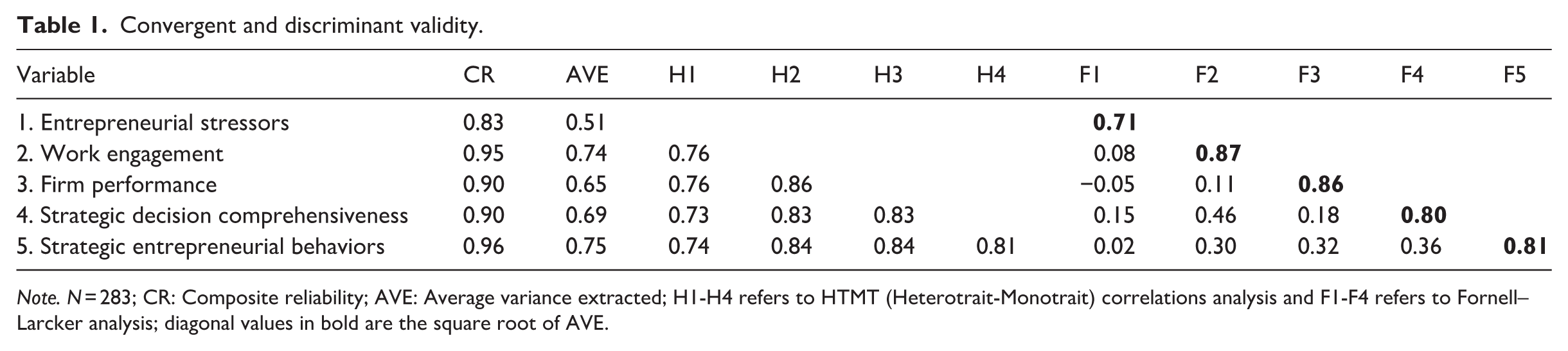
Note. N = 283; CR: Composite reliability; AVE: Average variance extracted; H1-H4 refers to HTMT (Heterotrait-Monotrait) correlations analysis and F1-F4 refers to Fornell–Larcker analysis; diagonal values in bold are the square root of AVE.
Common method variance
The study relied on entrepreneur and co-founder reports of core variables as well as the time-interval design, which can reduce the common method variance to some extent. We further conducted statistical analyses. First, Harman’s single-factor test was conducted using exploratory factor analysis. All observed items of the core latent variables were included, and the model was restricted to extract only one factor without rotation. The results showed that the single factor explained 28.16% of the total variance (far below the 40% threshold). Second, we used the common method factor. We added a common method factor (i.e. marital status that is theoretically unrelated to these variables but assessed in the same way) into the CFA allowing all items for core variables to load onto their respective factors as well as a common method factor. We then compared these results with the theoretical model. The loadings of this factor on the variables in our model were relatively low (between −0.01 and 0.18), and the model did not represent an improvement of fit over our hypothesized model but worse (CFI = 0.89, RMSEA = 0.09, SRMR = 0.06). In all, these potential sources of error are unlikely to have had a significant impact on our results.
Hypothesis test
To test our hypotheses, we estimated a series of hierarchical regression models using ordinary least squares. For models involving interaction terms, all continuous variables were mean-centered prior to constructing product terms to facilitate interpretation of lower-order coefficients. Direct and moderation effects were estimated using hierarchical regression (Table 3). To test the indirect (H3) and moderated indirect effects (H4-H5), we employed Monte Carlo bootstrap simulation with 10,000 resamples to generate bias-corrected 95% confidence intervals around the indirect effects (Hayes et al., 2011; Preacher and Selig, 2012). This approach is appropriate for complex mediation models estimated with maximum likelihood, as it does not assume normality of the sampling distribution of the indirect effect.
Table 2 presents descriptive statistics and correlations. Hypothesis 1 predicted a positive association between entrepreneurial stressors and strategic decision comprehensiveness. As shown in Model 1 of Table 3, the statistical evidence supports this hypothesis: stressors were positively associated with decision comprehensiveness (b = 0.14, p < 0.001). To interpret the magnitude of this effect, a one-unit increase in entrepreneurial stressors corresponds to a 0.14-unit increase in strategic decision comprehensiveness, holding other variables constant. In practical terms, a one-standard-deviation increase in stressors (SD = 1.06) raises decision comprehensiveness by approximately 0.15 points, moving a typical entrepreneur from the mean of 3.72–3.87 on the five-point scale, a modest but non-trivial shift in how comprehensively they gather information and evaluate alternatives.
Means, standard deviations, and correlations.
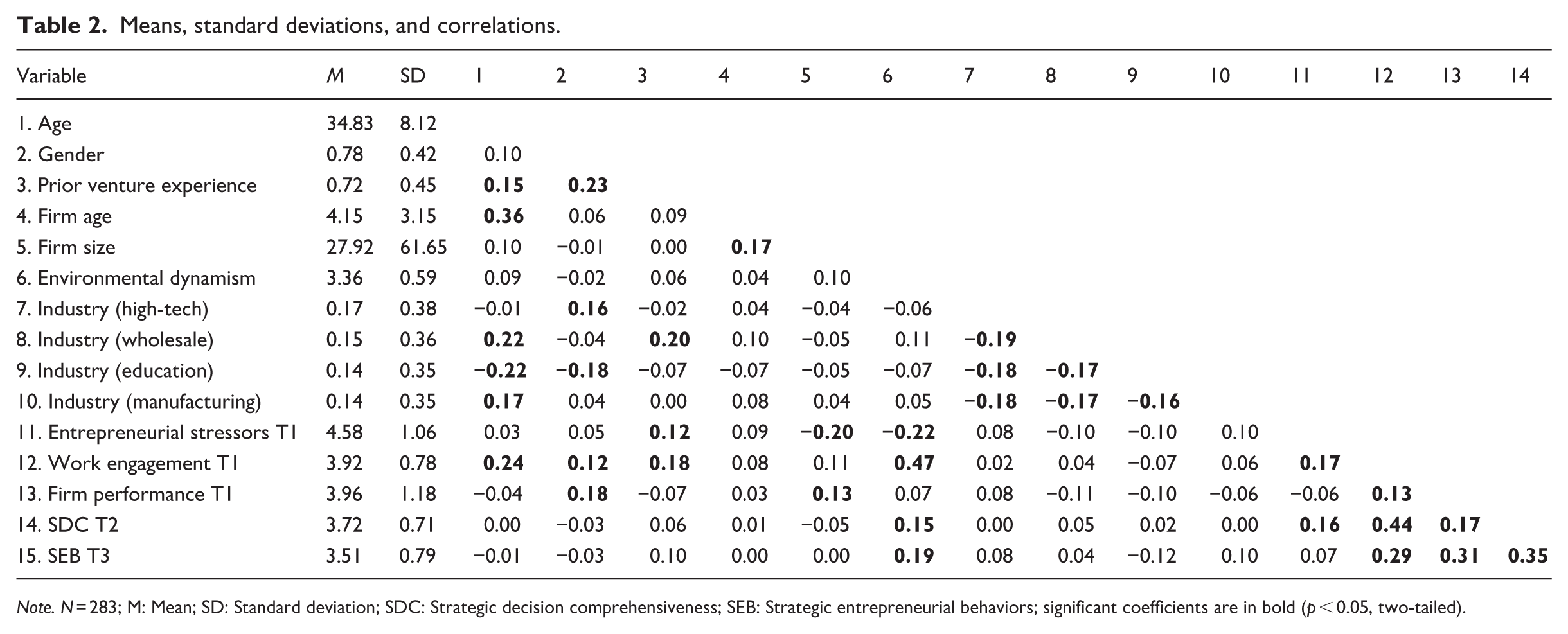
Note. N = 283; M: Mean; SD: Standard deviation; SDC: Strategic decision comprehensiveness; SEB: Strategic entrepreneurial behaviors; significant coefficients are in bold (p < 0.05, two-tailed).
Hierarchical regression results.
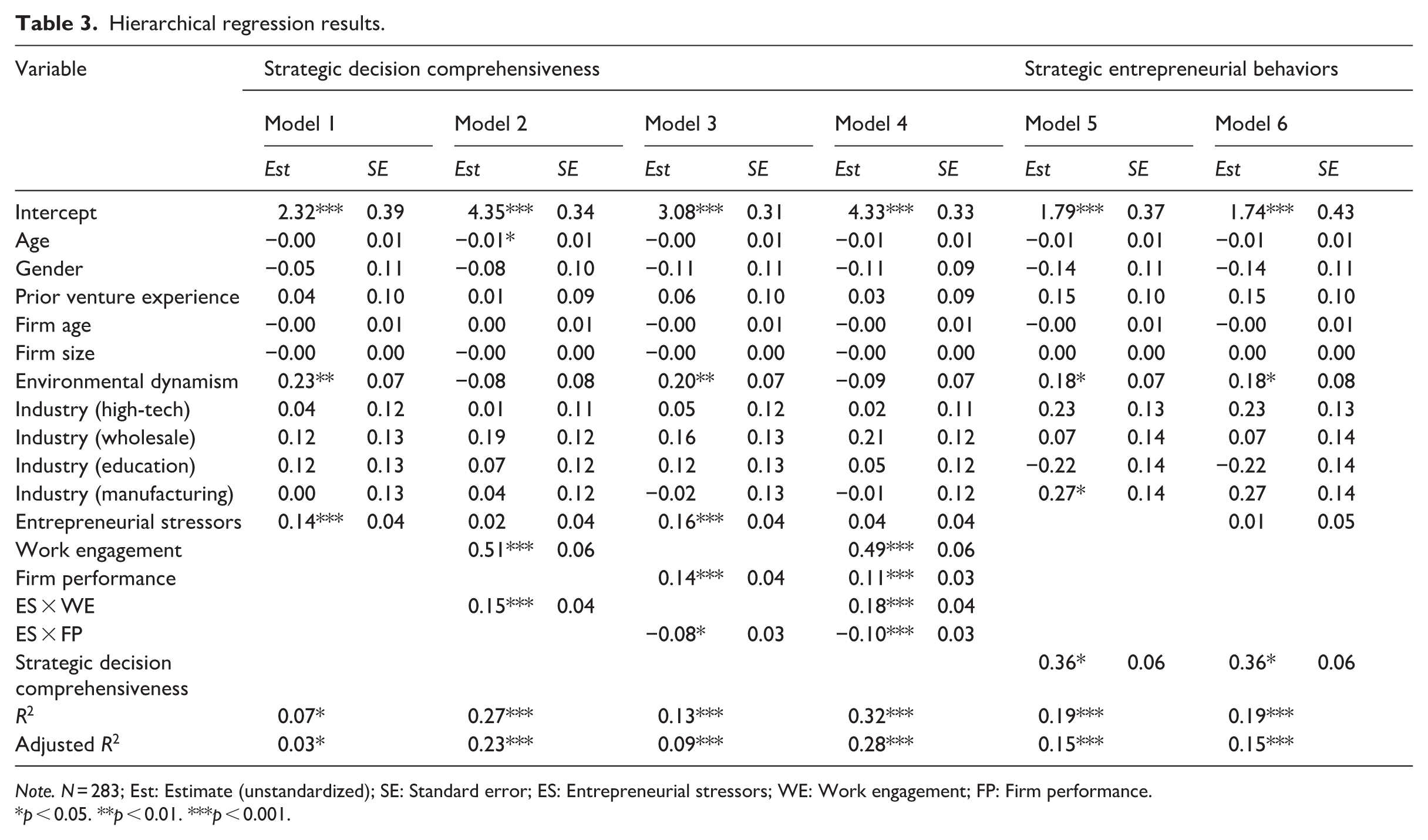
Note. N = 283; Est: Estimate (unstandardized); SE: Standard error; ES: Entrepreneurial stressors; WE: Work engagement; FP: Firm performance.
p < 0.05. **p < 0.01. ***p < 0.001.
Hypothesis 2 predicted a positive association between strategic decision comprehensiveness and SEB. Models 5 and 6 in Table 3 provide supporting evidence: decision comprehensiveness was positively associated with entrepreneurial behaviors (b = 0.36, p < 0.05). In practical terms, a one-unit increase in decision comprehensiveness corresponds to a 0.36-unit increase in SEB. Relative to the mean SEB score of 3.51, a one-standard-deviation increase in decision comprehensiveness (SD = 0.71) would boost SEB by about 0.26 points, moving it from 3.51 to 3.77, a meaningful improvement in the extent to which a firm engages in opportunity-seeking and advantage-seeking actions.
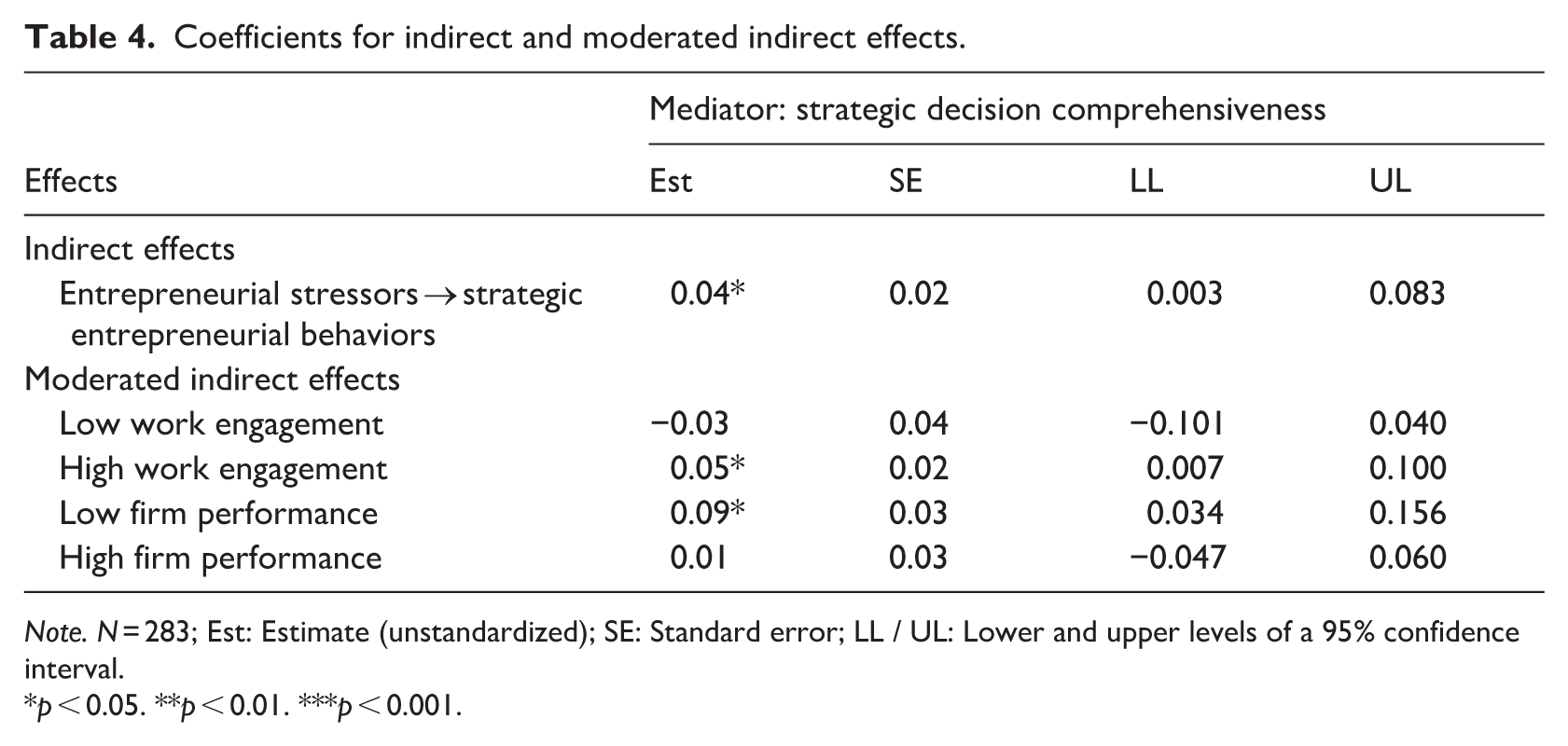
Hypothesis 3 predicted that strategic decision comprehensiveness mediates the positive relationship between entrepreneurial stressors and SEB. Using Monte Carlo bootstrap simulation, we found support for this indirect effect (b = 0.04, p < 0.05; 95% CI [0.003, 0.083]), as reported in Table 4. This indicates that the effect of stressors on strategic behaviours operates through the pathway of decision comprehensiveness. The magnitude of this indirect effect means that for every one-unit rise in stressors, SEB increases by 0.04 points via improved decision comprehensiveness, representing about 1.1% of the total SEB scale range and illustrating a small but statistically detectable transmission mechanism.
Coefficients for indirect and moderated indirect effects.
Note. N = 283; Est: Estimate (unstandardized); SE: Standard error; LL / UL: Lower and upper levels of a 95% confidence interval.
p < 0.05. **p < 0.01. ***p < 0.001.
Hypothesis 4 predicted that work engagement moderates the indirect effect, such that the indirect effect is stronger when work engagement is higher. First, we examined the first-stage interaction between stressors and work engagement on decision comprehensiveness. As shown in Model 4 of Table 3 and Figure 2, the interaction term was significant (b = 0.18, p < 0.001). Simple slope analysis revealed that the association between stressors and decision comprehensiveness was not significant at low levels of work engagement (b = −0.09, t = −1.64, p = 0.10) but was significant at high levels (b = 0.13, t = 3.01, p < 0.01). Conditional indirect effects (Table 4) were positive and significant for highly engaged entrepreneurs (b = 0.05, p < 0.05; 95% CI [0.007, 0.100]), but not for less engaged entrepreneurs (b = −0.03; p = 0.35, 95% CI [−0.101, 0.040]). These results support Hypothesis 4.
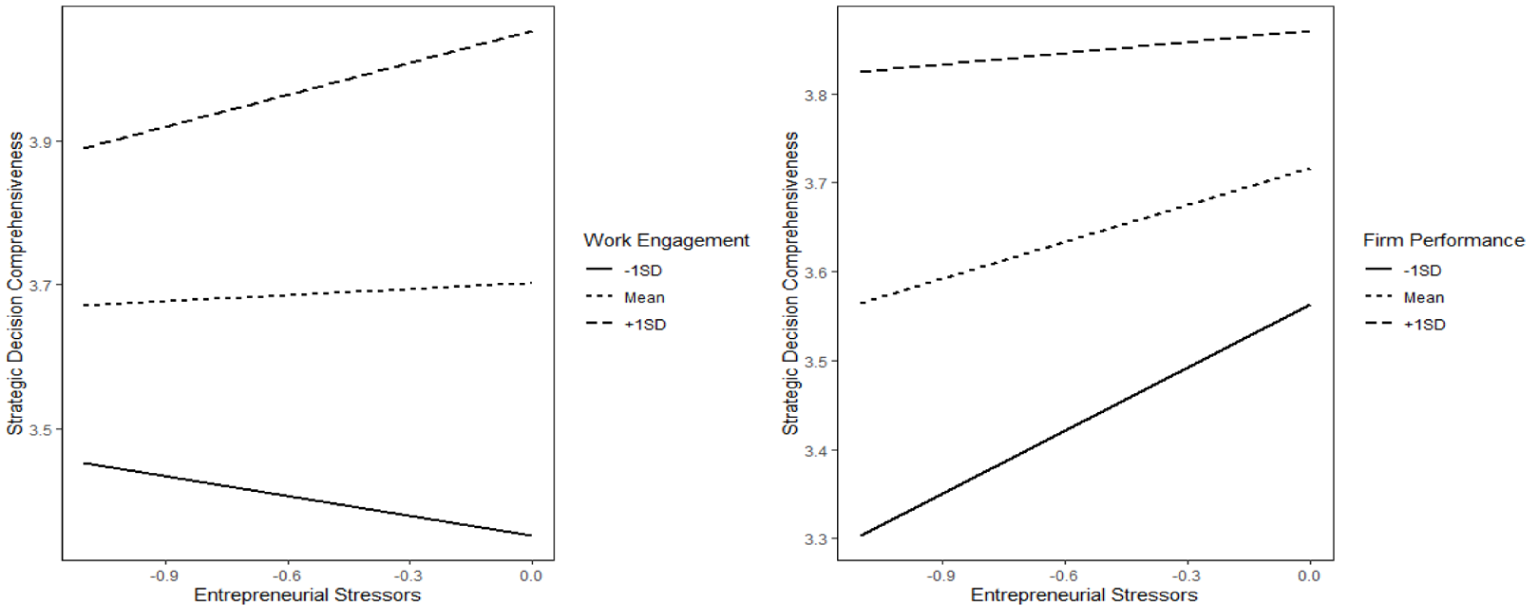
Moderating effects of work engagement and firm performance.
Hypothesis 5 predicted that perceived firm performance moderates the indirect effect, such that the indirect effect is stronger when perceived firm performance is lower. The interaction between stressors and firm performance on decision comprehensiveness was significant (b = −0.10, p < 0.001; Model 4, Table 3; Figure 2). Simple slope analysis indicated that the association was not significant at high levels of firm performance (b = 0.03, t = 0.60, p = 0.54) but was significant at low levels (b = 0.23, t = 3.87, p < 0.001). Conditional indirect effects (Table 4) were positive and significant for entrepreneurs who perceived lower firm performance (b = 0.09, p < 0.05; 95% CI [0.034, 0.156]), but not for those with higher perceived performance (b = 0.01, p = 0.40; 95% CI [−0.047, 0.060]). Hypothesis 5 is supported.
Supplementary analyses
We conducted several additional analyses to consolidate the empirical results.
Robustness check
First, as prior review studies show that an inverted-U shaped relationship between job stressors and performance may occur in entrepreneurial contexts (Rauch et al., 2018), we included the squared term of job stressors in the model but found no support for this nonlinear specification. Thus, our assumption about the linear relationship is justified. Second, there is a possibility that under stressful contexts and dynamic environments, entrepreneurs should make strategic decisions rapidly and timely (Forbes, 2007). That is, as strategic decision speed is also important for facilitating strategic behaviours by new firms (Talaulicar et al., 2005), we tested whether job stressors can affect it (assessed with the five-item scale, α = 0.82; Talaulicar et al. 2005) in the model. We found no support for this relationship (b = −0.04, p = 0.28). This reveals that entrepreneurs may not prefer to make strategic decisions in a rapid way but in a deliberate way, even if exposed to stressors.
Third, despite its conceptual limitation, the construct of strategic ambidexterity can indicate exploitative and exploratory innovation (Simsek et al., 2017). We used it as an alternative outcome for further analyses. It is the multiplication of exploitation and exploration (measured at Time 3 with a 12-item 5-point Likert scale of Lubatkin et al., 2006; α = 0.91). We first found support for the main effect concerning the linkage between strategic decision comprehensiveness and strategic ambidexterity (b = 0.60, p < 0.001). Then, we continued to test the indirect and conditional indirect effects. Mediation analysis shows that stressors positively, indirectly affect strategic ambidexterity via strategic decision comprehensiveness (b = 0.06, p < 0.05; 95% CI [0.003, 0.123]). Moderated mediation analyses show that the conditional indirect effects were positive and significant for highly engaged entrepreneurs (b = 0.08, p < 0.05; 95% CI [0.009, 0.154]), but not for less engaged entrepreneurs (b = −0.05; p = 0.32, 95% CI [−0.145, 0.065]); the conditional indirect effects were positive and significant for entrepreneurs who perceived lower firm performance (b = 0.14, p < 0.001; 95% CI [0.057, 0.225]), but not for well-performing firms (b = 0.02, p = 0.67; 95% CI [−0.074, 0.095]).
Heterogeneity check
To examine whether the observed relationships vary across key individual and firm characteristics, we conducted heterogeneity checks testing whether firm size, firm age, entrepreneur gender, and prior venture experience moderate the indirect effects proposed in our model. Using the same first-stage moderated mediation approach with Monte Carlo bootstrap simulation, we found no significant moderating effects for any of these variables: firm size (b = −0.01, p = 0.78), firm age (b = −0.02, p = 0.65), gender (b = 0.05, p = 0.32), nor prior venture experience (b = −0.03, p = 0.58). Conditional indirect effects did not differ significantly across levels of these moderators. These findings suggest that the cognitive pathway we theorize operates consistently across these dimensions, further underscoring the specific moderating roles of work engagement and perceived firm performance in shaping the stress-to-strategy pathway.
Endogeneity check
To address potential issue of endogeneity, we employed the widely accepted approaches of testing the impact threshold for a confounding variable, and identifying instrumental variables (Hill et al., 2021). The results supported the notion that endogeneity is not a concern for the current study (see Supplemental Appendix B).
Statistical check
We conducted additional statistical analyses to consolidate the results. We repeated all the models using Bayesian modeling as it appropriately estimates complex models with limited sample sizes and generates credibility intervals to assess the non-normally distributed effects. The Bayesian modeling approach generated consistent results, further supporting the regression results (see Supplemental Appendix C).
Discussion
Theoretical implications
Our study contributes to the entrepreneurial stress literature by extending the dominant motivational focus to consider cognitive pathways. Rather than framing stressors solely through motivational mechanisms, we integrate DIPT with the entrepreneurial JD-R model to develop a “stressor-as-information” perspective. In this view, stressors function as informational cues that, under certain conditions, trigger deliberate thinking, a cognitive mode that manifests in more comprehensive strategic decision-making. Empirically, our findings support the proposed direct and indirect effects of stressors on strategic decision comprehensiveness and SEB. These results suggest that context-specific stressors can serve as catalysts for systematic processing when entrepreneurs possess the capacity to engage in such thinking. Our findings are consistent with DIPT’s prediction that deliberate, effortful processing drives contextually appropriate action in high-stakes settings (Evans and Stanovich, 2013). Furthermore, we extend theory via uncovering ‘resource-driven boundary conditions’ for processing mode switching. That said, we add a critical layer: personal and job resources (work engagement, firm performance) act as ‘accelerators’ that enable systematic processing, even under stress. This theorisation and empirical testing also provide a nuanced understanding of how stressor-related factors shape information processing systems, an aspect that remains underdeveloped in the existing literature. Our findings reveal that stressors can function as ‘adaptive cues’ prompting systematic processing when paired with the right resources. In sum, the study extends the theory’s applicability to contexts where stressors are inherent and highlights the theory’s utility in explaining how individuals turn contextual challenges into opportunities for deliberate decision-making with their information processing capabilities.
Our study also contributes to strategic entrepreneurship research by identifying entrepreneur-specific determinants of SEB. Unlike prior studies that have relied on constructs such as entrepreneurial orientation (which conflates behavioral and attitudinal dimensions; Covin and Wales, 2019) or strategic ambidexterity (which captures structural arrangements between exploration and exploitation; Wenke et al., 2021), we focus on the behavioral component of strategic activities (Anderson et al., 2019). Our findings suggest that stressors, filtered through cognitive and decision-making processes, shape whether firms engage in opportunity-seeking and advantage-seeking actions. This behaviour-centric perspective offers a more parsimonious approach to studying strategic entrepreneurship (Ireland et al., 2023), and points to future research opportunities examining how cognitive attributes and motivational states jointly influence the emergence of SEB and related strategic processes. The evidence presented also extends the positive JD-R model (Obschonka et al., 2023) by integrating insights from cognitive psychology. While the original model emphasises an entrepreneur’s motivational resources as buffers against stress, our findings suggest that cognitive strategies, particularly the shift toward deliberate thinking, play an important role in how they navigate stressors. Moreover, personal and job resources (work engagement, firm performance) appear to strengthen this cognitive pathway. These results illustrate the value of examining how the individual’s cognitive strategies interact with their motivational states to shape stress coping and strategic outcomes (Allen et al., 2021; Kuratko et al., 2021). By linking stressors to strategic processes and outcomes, our study offers one initial step toward unpacking the cognitive mechanisms that may underlie JD-R processes in entrepreneurship. Of note, this research speaks to general job demands theory by examining how demands function in non-traditional work roles. Traditional applications of JD-R theory emphasise negative outcomes such as burnout in formal employment settings (Bakker et al., 2014). Our findings suggest that in entrepreneurial contexts, where work is oriented toward opportunity creation rather than routine task completion, stressors can sometimes function as informational cues that motivate proactive information processing and strategic action. This suggests that the impact of job demands may depend not only on their nature but also on the contextual goals of the work role, offering one possible explanation for why not all job demands lead to negative outcomes in dynamic, opportunity-focused contexts.
Finally, the empirical context of our study deserves explicit consideration when interpreting the generalisability of our findings. This period was characterised by significant economic and social uncertainty, which is likely to have amplified the salience of entrepreneurial stressors and may have heightened entrepreneur sensitivity to the cognitive pathways we theorise. On the one hand, this context provides a meaningful test of our theoretical framework, as the mechanisms we propose were examined under conditions where stressors were particularly pronounced. On the other, our findings may generalise most directly to contexts characterised by similar levels of environmental dynamism and institutional complexity. In more stable economic conditions, or in cultural contexts where stress is interpreted differently, such as Western economies with different entrepreneurial support structures, the strength of the cognitive pathway we identify might differ. Similarly, our sample consisted of everyday entrepreneurs actively managing established ventures (Welter et al., 2017). Whether similar patterns hold for nascent entrepreneurs still in the venture creation phase, or for serial entrepreneurs whose prior experience may shape stress responses differently, remains an open question for future research.
Practical implications
Our findings offer several implications for entrepreneurs navigating stressors. Thus, recognising stressors as informational cues rather than merely threats can shift an entrepreneur’s cognitive orientation from reactive coping to deliberate strategy. By understanding that stressors tied to venture goals can trigger systematic thinking, entrepreneurs may consciously engage in comprehensive information gathering, alternative generation, and multi-criteria evaluation, behaviours linked to enhanced SEBs. Moreover, the moderating role of work engagement suggests that maintaining high levels of engagement (vigour, dedication, and absorption) sustains the cognitive capacity needed to process stressors systematically. Entrepreneurs may benefit from preserving psychological resources through boundary management and recovery routines. Finally, the contrasting role of perceived firm performance offers nuanced insight. For those in well-performing ventures, high performance may breed overconfidence that undermines systematic processing; adopting a ‘challenger’ mindset (actively questioning assumptions) could help. For those in lower-performing ventures, stressors appear to galvanise systematic processing; yet, resource constraints make such processing challenging. External support providing structured decision-making frameworks could help capitalise on this motivational impetus. For policymakers, training programmes focused on deliberate information processing, such as decision comprehensiveness workshops or structured opportunity evaluation, may be more effective than generic stress management interventions. For investors, observing how entrepreneurs make decisions under pressure, and not just what they decide, may signal important cognitive capabilities relevant to venture potential.
Limitations and future research
This study is not without limitations which offer avenues for future inquiry. As such, we theorised cognitive mechanisms but did not directly measure intuitive and systematic processing. Moreover, our key constructs, entrepreneurial stressors, strategic decision comprehensiveness, work engagement, firm performance, and SEBs,were measured using self-reported responses to Likert-type agree-disagree questions. While we took steps to mitigate common method bias (multi-informant design for decision comprehensiveness, time-lagged data collection), such self-reports remain a proxy for the actual decision processes and behavioural investments we theorise. What an entrepreneur reports as ‘comprehensive’ may not fully capture the extent to which they systematically gathered information or evaluated alternatives in real time. Future research could complement survey measures with more direct assessments (behavioral trace data, archival records of strategic initiatives, or observational coding of decision-making processes) to strengthen the behavioral grounding of our findings. Additionally, reciprocal relationships may exist between stressors and entrepreneurial outcomes (Bakker et al., 2014; Rauch et al., 2018). Future studies could integrate cognitive and motivational pathways via repeated measures designs to explore such dynamics.
Our focus on SEBs (Anderson et al., 2019; Ireland et al., 2023) offers preliminary evidence; however, additional mediators and moderators warrant investigation. Future research might incorporate strategy theory insights or examine entrepreneurial characteristics such as self-efficacy or passion as boundary conditions, bridging strategic entrepreneurship with behavioral strategy research. While our moderators were grounded in the entrepreneurship literature, other factors, such as personality traits or organisational slack, may shape the entrepreneur’s cognitive responses to stressors. Future studies could integrate these variables into the proposed framework. Although co-founders rated strategic decision comprehensiveness, a common approach, social desirability bias remains a concern. Future research could explore the CEO/TMT interface, examining decision-making across multiple TMT members or investigating TMT behavioral integration as an alternative coping mechanism (Simsek et al., 2017). Finally, despite multi-source, time-lagged data collection, our design remains cross-sectional. Future research could adopt repeated-measures or panel designs to strengthen causal inference. Additionally, generalisability is limited by our sample; cross-country investigations incorporating social, cultural, and economic variables would help establish boundary conditions.
Conclusion
This article presents a cognitively grounded framework for understanding how entrepreneurial stressors shape strategic action. Integrating the positive JD-R model with DIPT, we propose a ‘stressor-as-information’ perspective in which stressors, rather than merely depleting resources, can activate deliberate thinking and, through strategic decision comprehensiveness, fuel SEBs. By identifying work engagement and perceived firm performance as boundary conditions, we show when this cognitive pathway is most likely to operate. In so doing, we bridge the gap between stress research and strategic entrepreneurship, offering a nuanced view of how the pressures inherent to entrepreneurship can, under the right conditions, become catalysts for strategic success.
Supplemental Material
sj-docx-1-isb-10.1177_02662426261457919 – Supplemental material for Entrepreneurial stressors as information: An integrated cognitive framework of strategic action
Supplemental material, sj-docx-1-isb-10.1177_02662426261457919 for Entrepreneurial stressors as information: An integrated cognitive framework of strategic action by Feng Xu and Linlin Jin in International Small Business Journal
Footnotes

Funding
The authors disclosed receipt of the following financial support for the research, authorship, and/or publication of this article: This work was supported by the National Natural Science Foundation of China (grant numbers: 72072043 and 72572046) and Guangzhou Philosophy and Social Sciences Planning Project (2025GZYB26).
Declaration of conflicting interests
The authors declared no potential conflicts of interest with respect to the research, authorship, and/or publication of this article.
Supplemental material
Supplemental material for this article is available online.
Acknowledge of AI
The authors, as non-native speakers, acknowledge the use of Doubao 2.0 for British English language editing and proofreading of this manuscript. All core academic content and intellectual contributions are original to the authors, who retain full responsibility for the final work.
Author biographies
References
Supplementary Material
Please find the following supplemental material available below.
For Open Access articles published under a Creative Commons License, all supplemental material carries the same license as the article it is associated with.
For non-Open Access articles published, all supplemental material carries a non-exclusive license, and permission requests for re-use of supplemental material or any part of supplemental material shall be sent directly to the copyright owner as specified in the copyright notice associated with the article.
